Mother Earth, Greenpeace & Agrofuels – 2009

Mother Earth, Greenpeace & Agrofuels: On Monday 12th October 2009 I came to London for a protest over the threat of agrofuels both to the native Latin American people and to the planet. Later there was a protest against the UK subsidising power stations that use agrofuels and research into agrofuels for aviation which would enable that industry to continue to hugely pollute. Going home from Westminster I photographed protesters who were still on the roofs of the Houses of Parliament protesting against the failure to act on climate change.


London Mobilisation for Mother Earth

Embassies of Colombia, Peru & Spain
Mother Earth, Greenpeace & Agrofuels - 2009
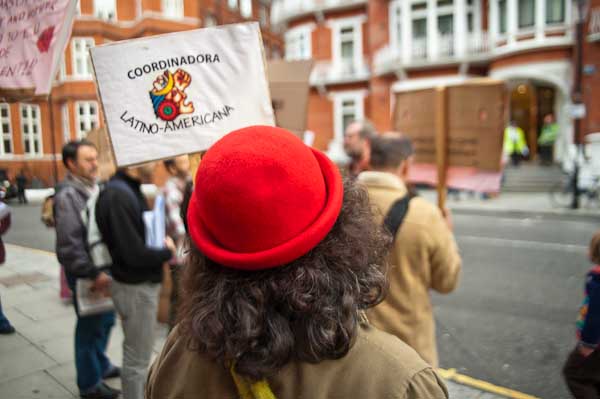
At the start of the protest opposite the Colombian embassy in Kensington

The Global Mobilisation for Mother Earth, an international day in support of the struggles of Latin American native people and to protest against the increasing threat of agrofuels, was called by the Coordinadora Andina de Organizaciones Indigenas on the day celebrated as a public holiday in the USA as Columbus Day, though it has other names in some South American Countries. It marks the day Columbus landed on Abya Yala (the Americas) in 1492.
Mother Earth, Greenpeace & Agrofuels - 2009

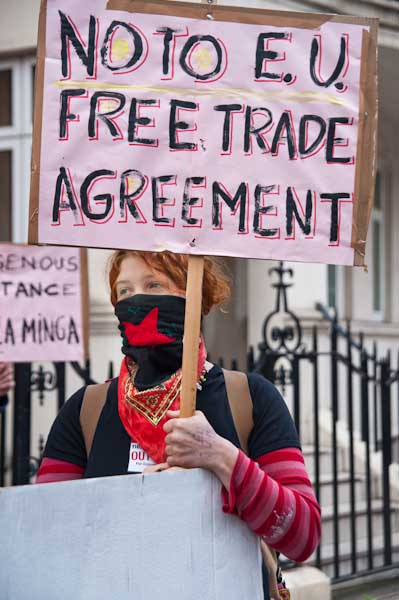
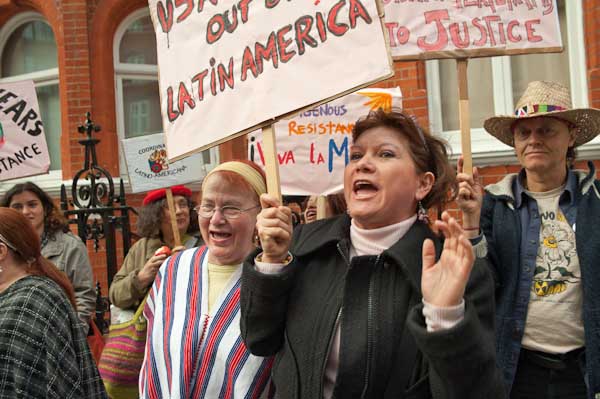
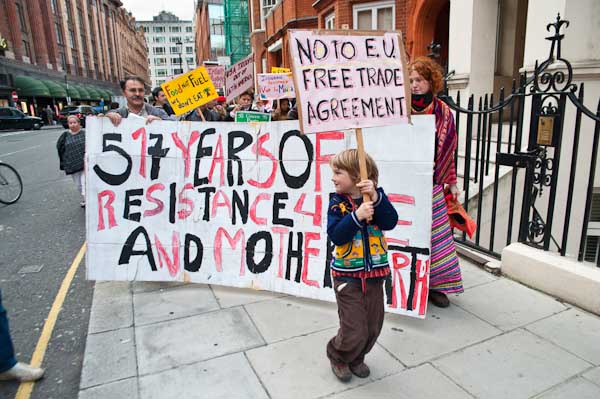
The London protest was organised by the Coordinadora Latino-Americana which unites a number of Latin American solidarity groups in support of peoples along the Andes in Colombia, Ecuador, Bolivia, and Peru who were marching against the European Union’s Free Trade agreements with Latin American countries. These will allow multinational companies to exploit resources on favourable terms, with deals by Colombia and Peru that will destroy the ancestral territorial rights of indigenous peoples. Former EU Trade Commissioner Peter Mandelson and his replacement Cathy Ashton, had played a leading role in these agreements.
Mother Earth, Greenpeace & Agrofuels - 2009
On the way to the Peruvian embassy

The UK government was diverting large amounts of funding meant for renewable energy projects to the use of agrofuels which worsen global warming and threaten food security around the world.
Mother Earth, Greenpeace & Agrofuels - 2009
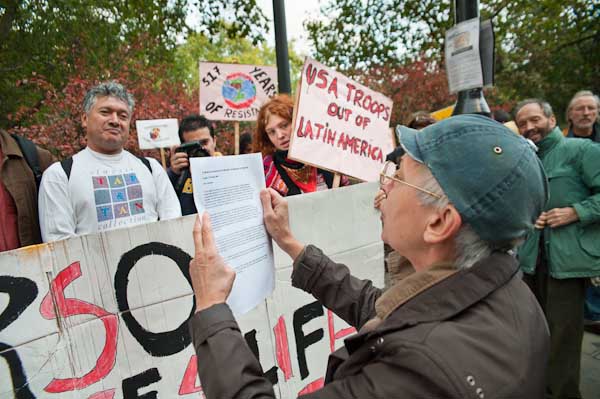
Reading the letter to Peru outside the embassy

Large areas of land in Latin America and elsewhere in the global South is being taken over by multinationals for agrofuel production, displacing the inhabitants, and introducing monoculture that destroys biodiversity and rapidly exhausts the soil. Large areas of irreplaceable ancient forests are also being felled mainly to grow these crops, but also as timber and to burn in power stations.
Mother Earth, Greenpeace & Agrofuels - 2009

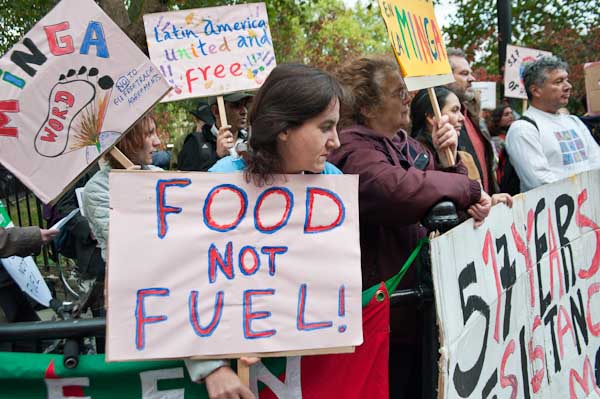
After a protest with speeches relevant to Colombia outside their embassy and the delivery of a letter there, the protesters walked on the the Peruvian Embassy, where we listened to a clear exposition of the link between opposition to agro-fuels and the indigenous struggles in Peru by eco-socialist Derek Wall of Green Left. Another letter was handed on and we moved on to the Spanish Embassy for a further protest. I left them there to go to the protest at the Department for Energy and Climate Change.

More pictures


Agrofuels Don’t ROC(K)

Whitehall

Mother Earth, Greenpeace & Agrofuels - 2009
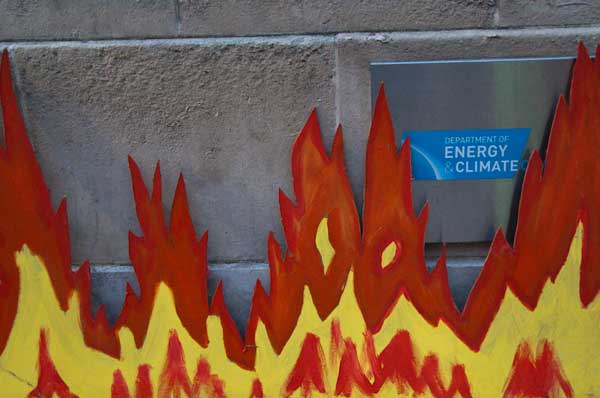
The Department of Energy & Climate Change was briefly surrounded by flames – but police said remove them

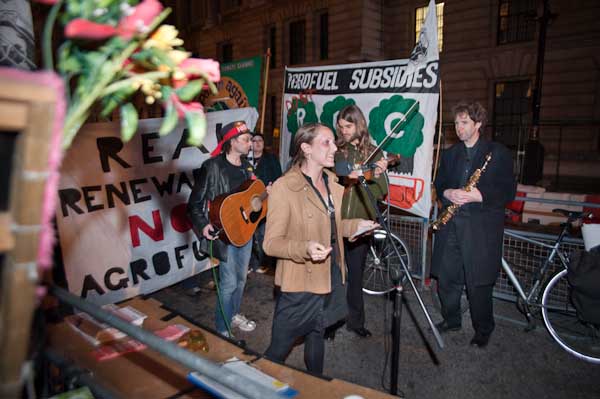
Around a hundred protesters turned up for a demonstration at the DECC in London calling for an end to government subsidies for agrofuels because of their serious harm to communities and ecosystems and contribution to climate change.

The UK Government is diverting renewable energy subsidies (Renewable Obligations Certificates – ROCs) to subsidise power stations that use ‘agrofuels’. Fuel produced from palm oil was getting twice the subsidy that wind power would get to produce the same amount of energy. The hugely polluting wood-burning power station at Drax in Yorkshire was getting huge subsidies for its climate-wrecking activities.
Agrofuels were once seen as part of the solution to our environmental crisis, but we now know that they cause serious harm to the climate, wreck communities whose land is taken for their growth, destroy biodiversity, replace complex natural ecosystems by agrochemical based monoculture, and by replacing food crops, cause starvation.

Agrofuels allow industrial companies to continue ‘business as usual‘ and export their environmental problems to the non-industrial south, buying up land and creating ‘biofuel refugees‘ of indigenous peoples. A UN source has described this as a ‘crime against humanity.’
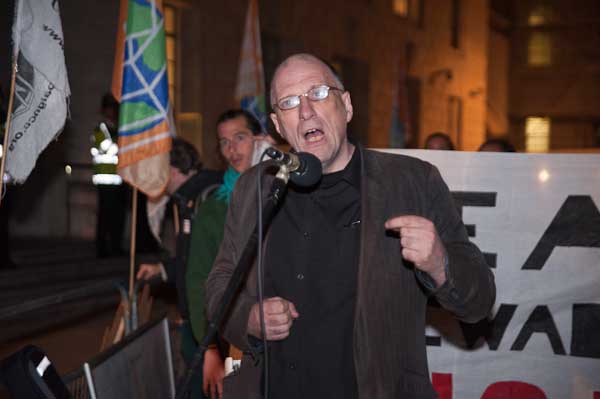
John Stewart

One of the speakers was John Stewart, who warned that the air transport industry sees agrofuels as their salvation, allowing them to continue offering cheap flights and increasing air traffic, while pretending to be green.
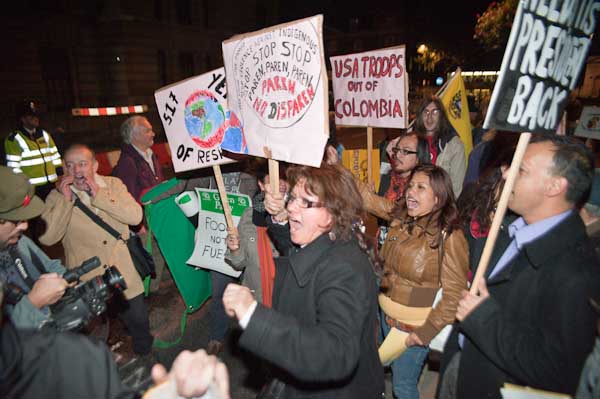
The Latin American ‘Mobilisation for Mother Earth’ arrives to join the protest

The protesters here were later joined by those who had been on the Mobilisation for Mother Earth protest against the the destructive alliance between multinational corporations and local elites in South America, particularly in mining and agrofuel production, and a speaker talked of their struggle for a dignified future for their children and their communities.

More pictures


Greenpeace Parliament Roof Protest Ends

Houses of Parliament

I stopped on my way home as I walked past the Houses of Parliament amd took a couple of pictures. Around 20 Greenpeace protesters who had been on the roof since the previous evening were still there, although they came down shortly afterwards and were arrested.

They held bright yellow banners with the message ‘CHANGE THE POLITICS SAVE THE CLIMATE’ and called on the UK Government to take effective measures to combat climate change, including stopping airport expansion, a refocus of taxes on pollution, fair financing to help pay for low carbon.

Greenpeace say we have to change to green policies rather than simply mouth green rhetoric and listed 12 policies to save the climate and our planet and end the locking of the UK into high carbon lifestyles. They said “The International Energy Agency and leading economists agree that failure to act now will lead to economic as well as environmental disaster” and this is now increasingly becoming obvious.

Although the protest gained considerable media attention, almost all of this in the major news media was about the breach in security on the Parliamentary Estate and not about the much more vital issues raised by the protesters.


Flickr – Facebook – My London Diary – Hull Photos – Lea Valley – Paris
London’s Industrial Heritage – London Photos

All photographs on this page are copyright © Peter Marshall.
Contact me to buy prints or licence to reproduce.

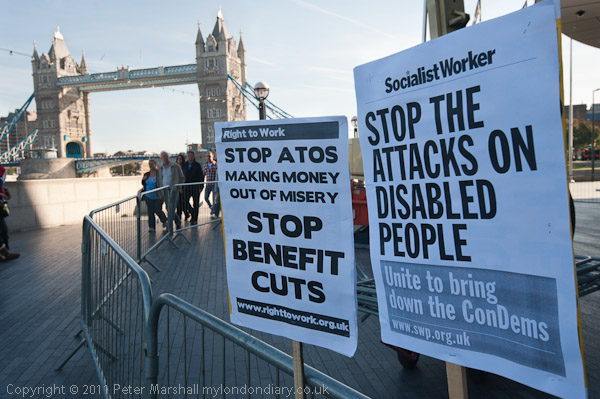
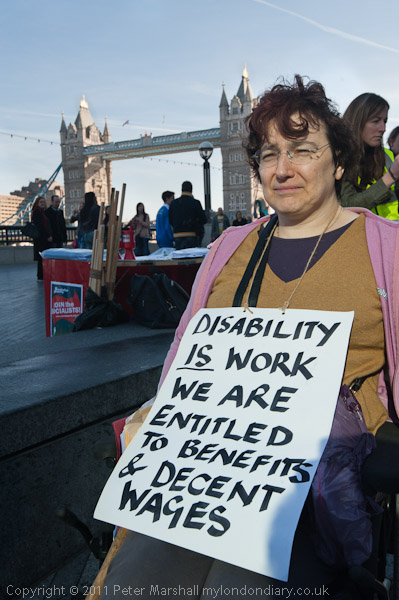
Hardest Hit, Biofuels, Tibet and OccupyLSX – 2011

Hardest Hit, Biofuels, Tibet and OccupyLSX: Saturday 22 October 2011 began for me with a protest at City Hall (still then in Southwark close to Tower Bridge) Next in Whitehall I photographed a protest against the pollution, environmental damage and human rights abuses of burning forests produce energy. Also on Whitehall I met Tibetans and supporters marching from the Chines Embassy to Downing Street demanding an end to China’s increasing repression in Tibet. Finally I went to St Paul’s Churchyard for a brief visit to Occupy London a week after their camp there had begun.

Hardest Hit Protest At City Hall

City Hall, More London

Hardest Hit, Biofuels, Tibet and OccupyLSX

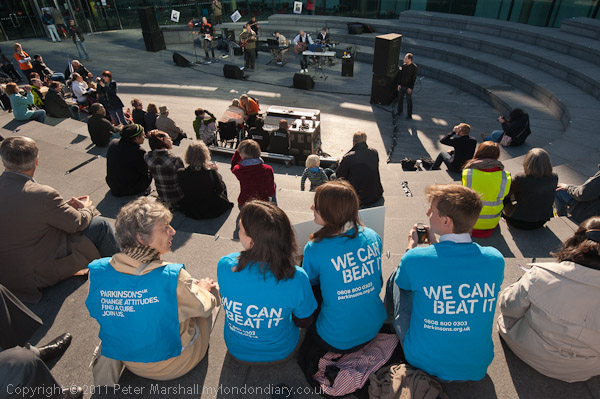
The Hardest Hit campaign, organised jointly by the Disability Benefits Consortium and the UK Disabled People’s Council were holding a rally outside City Hall as a part of protests in cities and towns across the country calling on the government to stop the cuts in benefits and services and changes in the assessment of disabilities which have hugely affected their lives.

Hardest Hit, Biofuels, Tibet and OccupyLSX

Of course the Mayor of London was not responsible for the cuts, and I assume this was just a convenient location he had made available for the protest. Of course many services provided by local government had been cut as a result of the government funding cuts. And as usual the government claimed to be concerned with the plight of the disabled and to be trying to help them while at the same time making cuts that really hurt them.

Hardest Hit, Biofuels, Tibet and OccupyLSX

The protest took place in the Scoop, an outdoor sunken amphitheatre next to City Hall, part of the More London development, an events space which can seat around a thousand and it looked a little empty though there were many disabled protesters, some with carers and supporters.

Hardest Hit, Biofuels, Tibet and OccupyLSX

More at Hardest Hit Protest At City Hall.


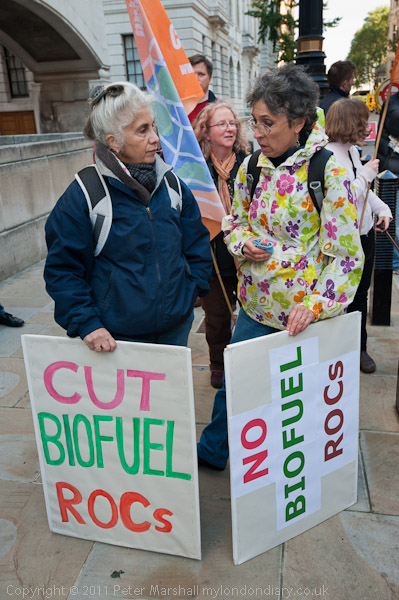
Environmentalists Protest Against Biofuels

DECC, Whitehall Place

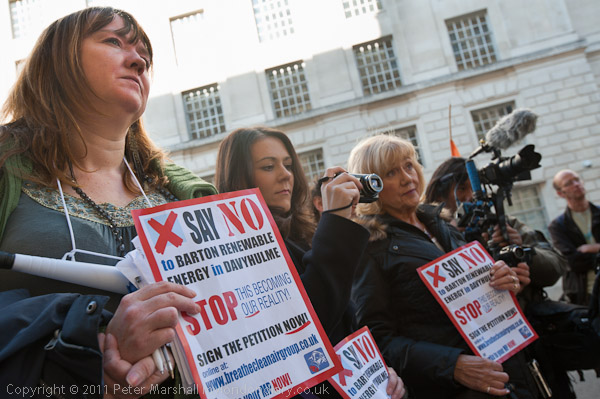
Protesters against Barton Renewable Energy in Davyhulme, Manchester

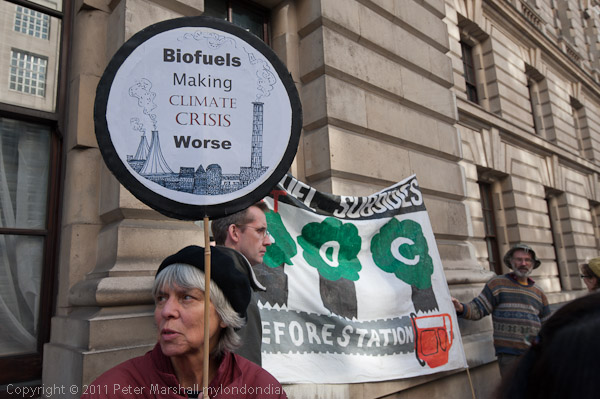
People had come from across the country to protest at continued government support for biofuel energy production despite it now being clear that this is contibuting to climate change, causes deforestation and the loss of valuable forest land, results in a loss of food production and threatens human rights in many areas.

Biofuels were once seen as a green alternative which would help us reduce global warming, but it is now clear that are worse polluters than coal or oil. Despite this, they still receive huge payouts from funding meant to encourage renewable energy sources. The huge wood-burning plant at Drax in Yorkshire in 2024 received £869 million in public subsidies – over £2 million a day for polluting the planet.

At last in February 2025 the UK government has announced a cut in the subsidies for Drax, and the winding down of using imported wood pellets for energy generation. But even when this comes into force in 2027 Drax will still be getting £1.2 million a day. Drax will cut its power production to around half its current level and further reductions are expected from then.

More at Environmentalists Protest Against Biofuels.


Tibetans March Against Chinese Repression

Whitehall

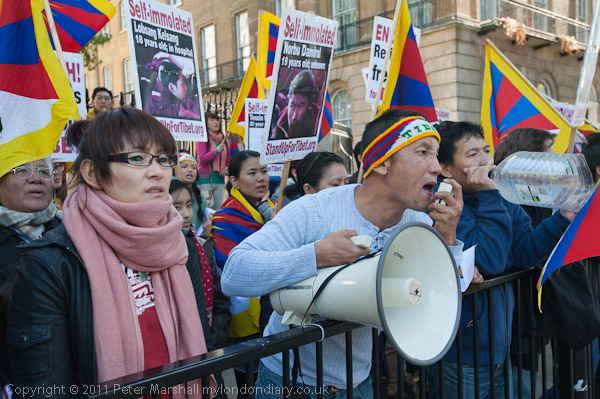
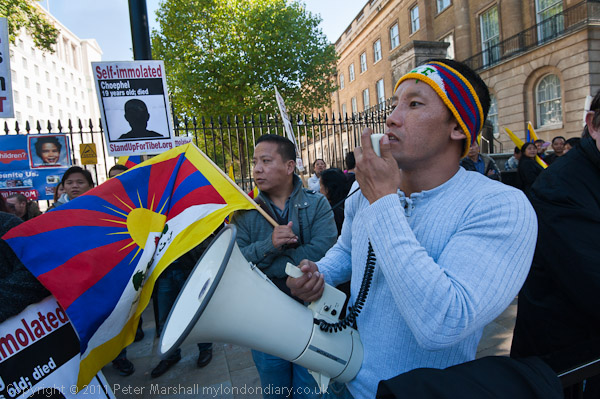
Tibetans shout their message to Downing St, across Whitehall

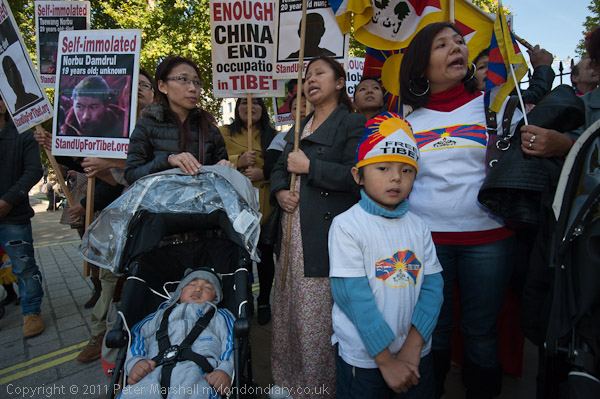
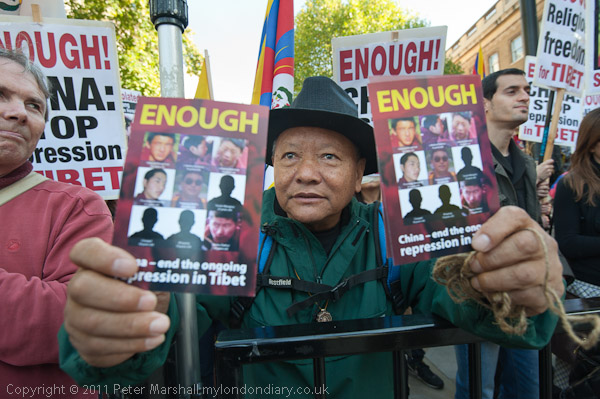
Several hundred Tibetans and supporters marched from the Chinese Embassy to Downing Street in a protest over China’s increasing repression in Tibet, where in March 2011 eight young monks and a nun had set themselves on fire in desperate protests. Five had died.

Protests around the world like this one aimed to get the international community to end their silence over the Chinese abuses of human and civil rights in Tibet. It was supported by the Tibet Society, Free Tibet, Students for a Free Tibet, Tibetan Youth UK and the Tibetan Community in Britain.

The held a rally opposite Downing Street and delivered a letter to the Prime Minister calling for the UK Government to take action.

There was to be a world-wide day of action on Wednesday 2 Novemeber, the to call for action from international governments the day before world leaders meet in Nice, France for the G20 Summit.

More pictures Tibetans March Against Chinese Repression.


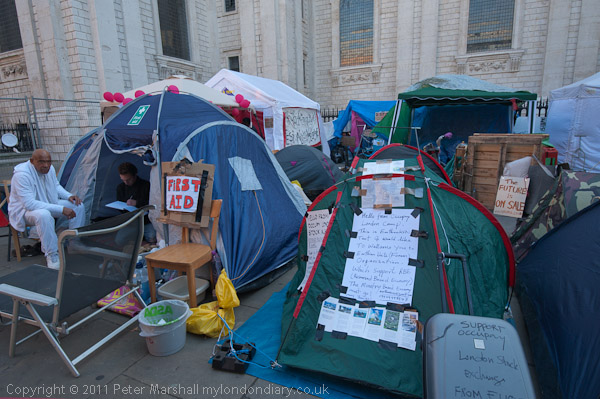
OccupyLSX Continues At St Paul’s

St Paul’s Cathedral

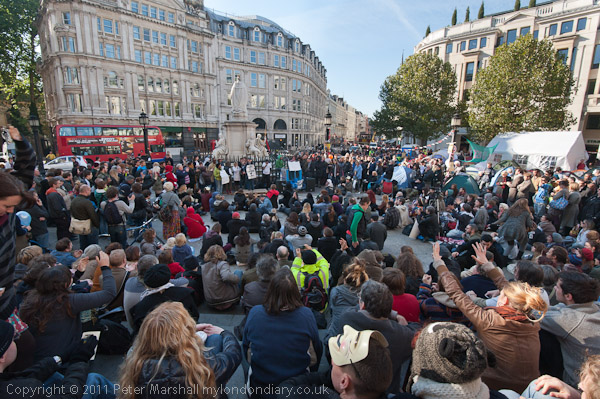
A week earlier on 15th October 2011 I had been at the protest when around 2000 Occupy protesters had tried to protest outside the Stock Exchange but were prevented by police. They had returned to the steps of St Paul’s and held a general meeting. Police kettled the protesters (and me) there, but I left when a group of them forced their way through the police line. Those that were still kettled decided to stay and occupy the area after police told them they should leave. A week later they were still there and I went back to see what was happening.

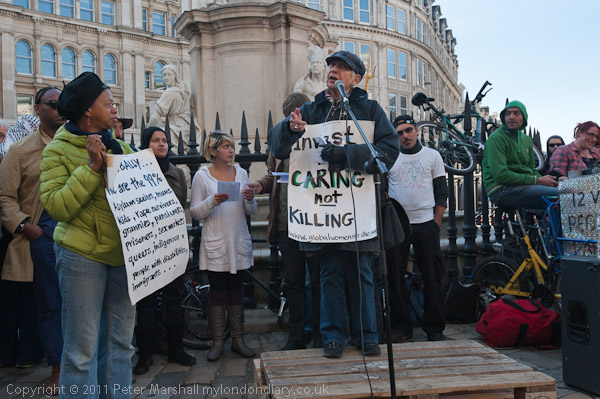
There was a full program of events for the day, and a general meeting was taking place with Selma James speaking.

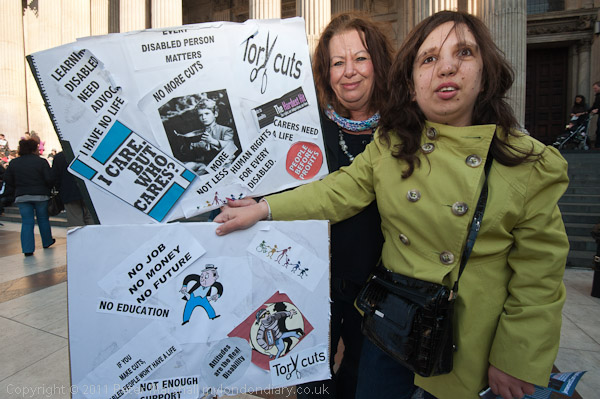
A mother and daughter concerned about privatisation of the NHS at OccupyLSX

As I said “the organisation of the camp is impressive, although clearly there are some people around who don’t respect the camp’s ‘no alcohol’ rule. But like the previous camps in central London, the camp attracts a number of the rough sleepers and odd characters who normally wander the streets of our city. It’s a useful service for people who are normally neglected, but does bring some problems.”

More at OccupyLSX Continues At St Paul’s.


Flickr – Facebook – My London Diary – Hull Photos – Lea Valley – Paris
London’s Industrial Heritage – London Photos

All photographs on this page are copyright © Peter Marshall.
Contact me to buy prints or licence to reproduce.