Stowage, Deptford

Stowage, Deptford – Stowage is the place were things were stored and Stowage was from 1600 until 1782 a storage area for the East India Company who also built ships here. The name was not just for the street but for a wider area including the site of Deptford Power Station, the world’s first commercial-scale high voltage power station by Sebastian Ziani de Ferranti in 1889.

The Hoy, Deptford Power Station, Stowage, Deptford, Greenwich, 1988 88-10e-34-Edit_2400
The Hoy, Deptford Power Station, Stowage, Deptford, Greenwich, 1988 88-10e-34

The Hoy pub was open on the corner of Stowage at 193 Creek Road at least by 1840 but closed in 2008, becoming a café. Some reports say it lost its licence because of a large number of reports of drug use. It looked closed and unoccupied when I walked past a few months ago. Until the 1920s there were two pubs actually in Stowage, the Old George and the Fishing Smack, both open in the 1820s.

Stowage, Deptford, Greenwich, 1988 88-10e-35-Edit_2400
Stowage, Deptford, Greenwich, 1988 88-10e-36

The General Steam navigation Co Ltd established its shipyard on Stowage at the mouth of Deptford Creek in 1825, using it to build and maintain its paddle steamers. The site became part of Deptford Power Station for the Deptford East HP station which opened in 1953.

Stowage, Deptford, Greenwich, 1988 88-10e-26-Edit_2400
Stowage, Deptford, Greenwich, 1988 88-10e-26

The area has a long and interesting history. Stowage was the first base of Trinity House, who were close to St Nicholas’s Church at the west end of Stowage from 1511-1660 before moving to the City of London, and this was the location of the first Trinity House Almshouses. According to the entry in Pepys Diary for Friday 8 April 1664 he went with Sir William Batten, then the Master of Trinity House to see the new almshouses which were being built at Deptford. They were demolished around 1877.

Stowage, Deptford, Greenwich, 1988 88-10e-11-Edit_2400
Stowage, Deptford, Greenwich, 1988 88-10e-11

The walk District 45 created by the Royal Geographical Society is a fine introduction to the area and one I recently followed (with a few of my own additions) with a couple of friends. It is based on Charles Booth’s walk around the area with the local police in 1899 and you can read Booth’s notebooks on the LSE’s Charles Booth’s London web site (his handwriting is occasionally a little difficult) which provide some further notes to those in the RGS walk.

Stowage, Deptford, Greenwich, 1988 88-10e-13-Edit_2400
Stowage, Deptford, Greenwich, 1988 88-10e-13

In his notes, Booth described Stowage as “A stinking unpaved lane with wharves on north side until the bend is passed … occupied by a low rough waterside population. ” He went on to say “Most people living here work at one of the factories along the Creek. Besides the chemical works there are numerous business places employing a large number of ‘hands’. The Steam Navigation Company has a large yard in the Stowage.

All these works are busy and work is plentiful so that no man need be unemployed. Women work
in woodyard and laundry, girls in the tin factory or as ‘gut girls’ in the meat market cleaning the entrails of the slaughtered beasts
. “

Stowage, Deptford, Greenwich, 1988 88-10e-12-Edit_2400
Stowage, Deptford, Greenwich, 1988 88-10e-12

I walked along the short street on various occasions in the 1980s and 90s, and it seems to me that relatively little had changed, except there were rather fewer houses and people living on the streets. It was a street were there were often small groups of men who looked shifty and where I didn’t always feel able to stop and take photographs and where much that went on was perhaps on the edge of the law. Often there were fires burning and foul smoke, perhaps getting rid of rubber and plastic from various scrap metal objects.

Stowage, Deptford, Greenwich, 1988 88-10f-64-Edit_2400
Stowage, Deptford, Greenwich, 1988 88-10f-64

I wrote “It was also an area where anyone with a camera aroused suspicion, if not outright hostility. If you were lucky people just asked accusingly “You from the council?”, but there were others who made rather more direct threats. it was an area where there were dodgy deals, stolen cars and other things going on that it wasn’t healthy to poke your nose into. Most of the time I kept my Olympus OM1 under my jacket as I walked along.”

Stowage, Deptford, Greenwich, 1988 88-10f-65-Edit_2400
Stowage, Deptford, Greenwich, 1988 88-10f-65

Other photographers were less timid than me – and had rather different interests in the area. One I knew slightly was Jim Rice, and for his Deptford Creek project he got to know many of those in the area and made some striking portraits.

Stowage, Deptford, Greenwich, 1988 88-10f-51-Edit_2400
Stowage, Deptford, Greenwich, 1988 88-10f-51

Nakba, NHS, Gitmo etc & Tamils

NakNakba, NHS, Gitmo etc & Tamils – Saturday 18th May 2013 was another busy day for protests in London and I covered a number of demonstrations.


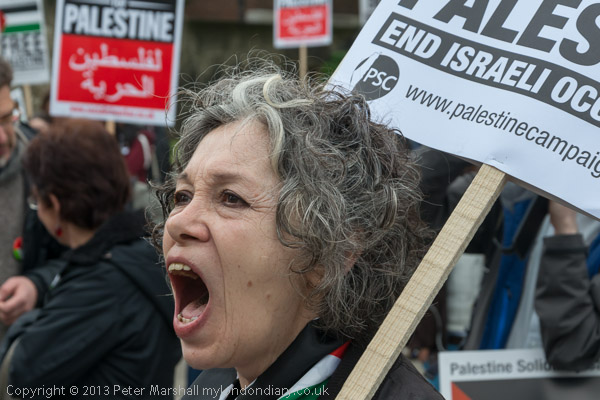
End Israeli Ethnic Cleansing – Old Palace Yard, Westminster

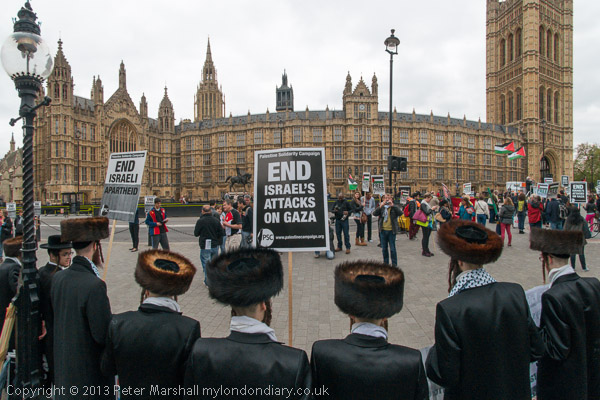
65 years after 700,000 Palestinians were driven out of their homes as refugees in the ‘Nakba’ (catastrophe) when the state of Israel was created, Palestinians and their supporters protested outside parliament calling for an end to the continuing ethnic cleansing and a boycott and sanctions until Israel complies with international law.

There had been protests in Jerusalem earlier in the week on Nabka Day against the continuing sanctions against Palestinians that have crowded them into an ever-decreasing area of land, diminishing almost daily as new Israeli settlements are created and new restrictions placed on the movement of Palestinians. Many of those protesting in London from Jewish or Palestinian backgrounds and as usual these included a group of extreme orthodox Neturei Karta Jews who had walked down from North London; they see themselves as guardians of the true Jewish faith, and reject Zionism.

The speeches were continuing when I left to cover another event. More at End Israeli Ethnic Cleansing


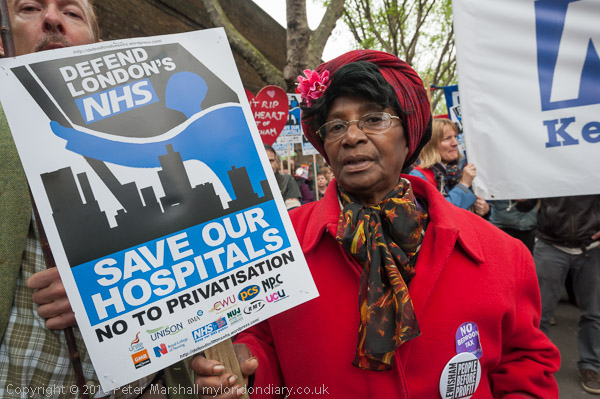
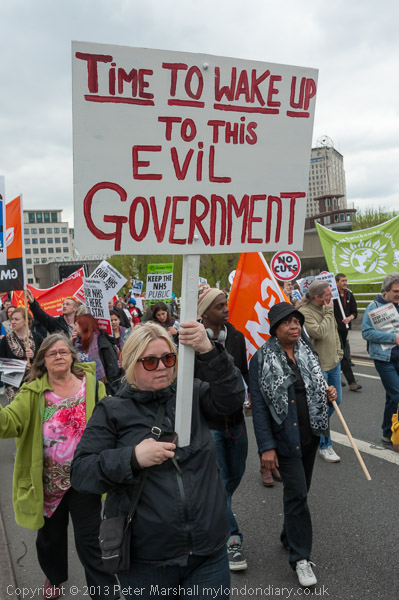
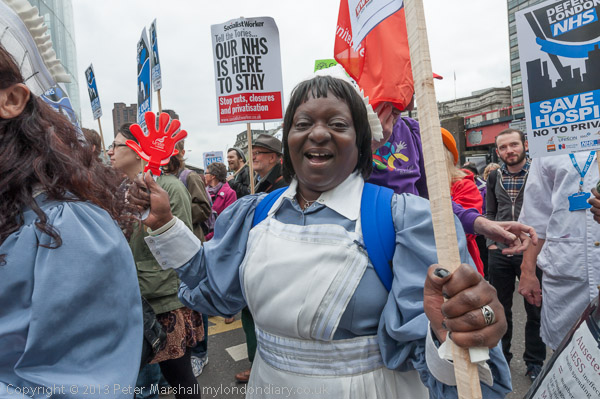
London Marches to Defend NHS – South Bank to Whitehall

On the opposite side of the River Thames thousands were gathering by the Royal Festival Hall to march against cuts, closures and privatisation of the NHS, alarmed at the attack by the government on the principles that underlie our National Health Service and the threats of closure of Accident and Emergency facilities, maternity units and hospital wards which seem certain to lead to our health system being unable to cope with demand – and many lives put at risk.

Nine years later we are seeing the effect of these policies with ambulance services unable to cope with demand, lengthy delays in treating people in A&E, delays in diagnosing cancers leading to increased deaths and more. And although it was only a matter of time before we had a pandemic like Covid, and exercises had shown what needed to be done to prepare for this, the NHS had not been given the resources to prepare for this, leading to much higher death rates than some comparable countries.

Part of the problems of the NHS come from disastrous PFI agreements pushed through under the Labour government, landing NHS trusts with huge debts that will continue for many years. This forced NHS trusts into disastrous hospital closure plans, some of which were defeated by huge public campaigns. Many of those marching were those involved in these campaigns at Lewisham, Ealing, Charing Cross, Hammersmith, Central Middlesex, Whittington and other hospitals around London.

I left the march as it entered Whitehall for a rally there. More at London Marches to Defend NHS.


Guantánamo Murder Scene – US Embassy, Grosvenor Square

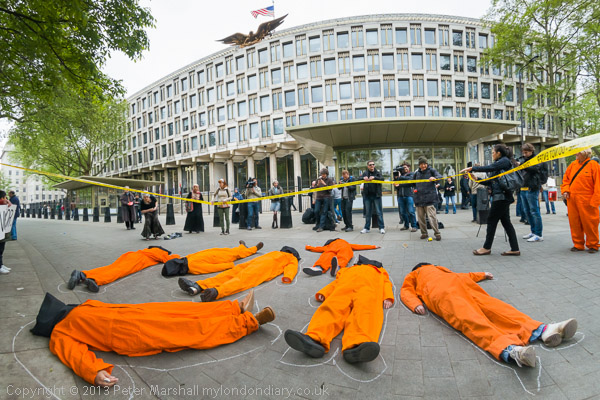
London Guantánamo Campaign staged a ‘murder scene’ at the US Embassy on the 101st day of the Guantánamo Hunger Strike in which over 100 of the 166 still held there are taking part, with many including Shaker Aamer now being forcibly fed.

More at Guantánamo Murder Scene.


More US Embassy Protests – US Embassy, Grosvenor Square

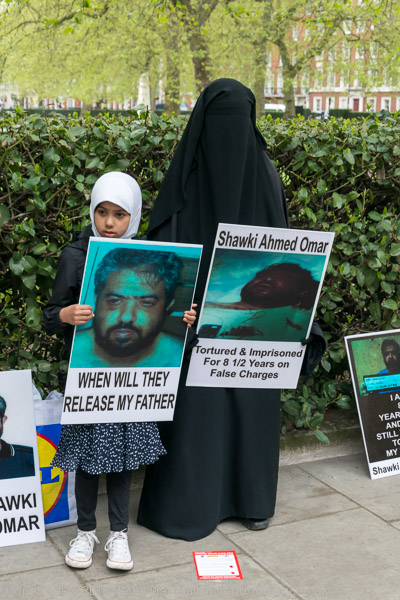
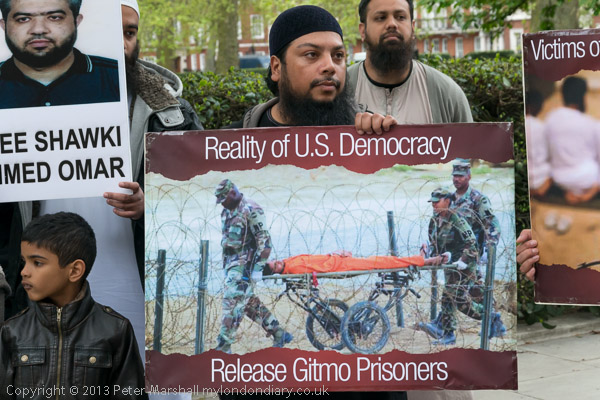
Other protesters outside the US Embassy included Narmeen Saleh Al Rubaye, born in the US and currently living in Birmingham, whose husband Shawki Ahmed Omar, an American citizen, was arrested in Iraq by American forces in 2004 and turned over to Iraqi custody in 2011. He was tortured by the Americans when they held him and was now being tortured by the Iraqis and also was on hunger strike. She has protested with her daughter Zeinab outside the US Embassy for a number of weekends and on this occasion was joined by a small group of Muslims who had come to protest against Guantanamo, appalled by the actions of the US waging a war against Islam and Muslims.

Shawki Ahmed Omar is still held in Iraq; before he died in 2021 former US Attorney General Ramsey Clark recorded a video calling for his release which was posted to YouTube in with the comment by another US lawyer “This case is one of the greatest miscarriages of justice in recent United States history. It is a case where the US government essentially lied to the US Supreme Court to cover up torture and to be able to turn an American citizen over to people who they knew would torture him.”

A few yards away, kept separate by police, a group of supporters of the Syrian regime, including some from the minor Communist Party of Great Britain (Marxist-Leninist) was also holding a protest in favour of the Assad regime and against western intervention in Syria.

More at More US Embassy Protests.


Tamils protest Sri Lankan Genocide – Hyde Park to Waterloo Place

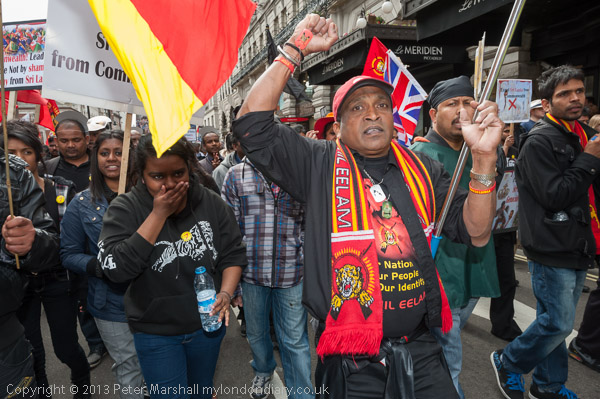
I met thousands of British Tamils and dignitaries and politicians from India, Sri Lanka and the UK as they marched through London on the 4th anniversary of the Mullivaikkal Massacre, many dressed in black in memory of the continuing genocide in Sri Lanka. Many wore the tiger emblem and called for a Tamil homeland – Tamil Eelam.

Although it was a large protest, with perhaps around 5,000 marchers I think it received absolutely no coverage in UK media, and I seemed to be the only non-Tamil photographer present. Tamils were rightly disgusted at the lack of response by the UK, the Commonwealth and the world to the organised genocide that took place in Sri Lanka, of which the massacre at Mullivaikkal four years ago was a climax.

The march had started from Hyde Park, and I caught up with it on Piccadilly and went with it taking photographs to Waterloo Place where there was to be a rally. But it had been a long day for me and I left just before this started.

More at Tamils protest Sri Lankan Genocide.


The Wall Must Fall & Kyoto March

Back in 2004 I was still working with the Nikon D100, one of the first really affordable DSLR cameras which I bought when it came out in 2002. It used a 6Mp Sony sensor in what Nikon called DX format – though it could have been called half-frame. For years Nikon insisted we didn’t need larger sensors, and though they were correct, marketing pressure eventually forced them to move to “full-frame” and us zombies followed them.

The D100 was a decent camera, but let down by a rather small and dim viewfinder, and to some extent by the processing software available at the time for its RAW images. If I had the time to go back to the RAW files these images would look sharper and brighter. Here are a few of those I posted on My London Diary from the two events I photographed on 16th May 2004 along with the two sections of text (with some minor corrections.)


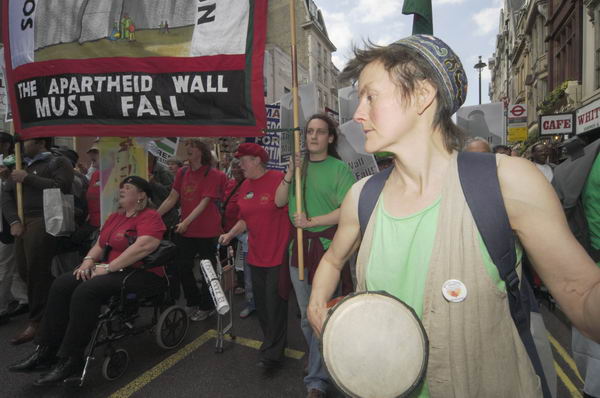
The wall must fall. Free Palestine rally, Trafalgar Square

Israel has a right to exist and defend itself, but not to put itself outside international law. We all need peace in the Middle East. Support for Palestine is also support for an Israel that can coexist with the rest of the world, and for the rest of the world.

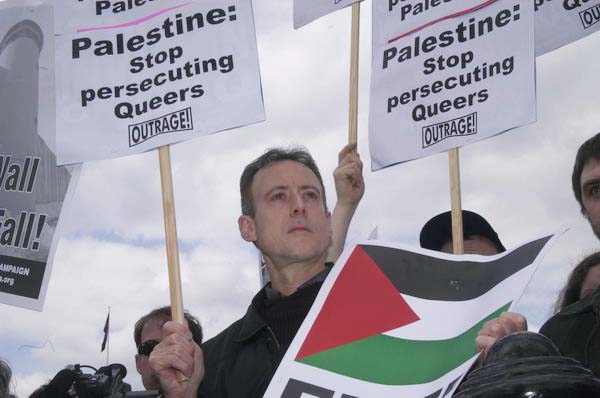
Peter Tatchell protests the persecution of Queers in Palestine

The wall must fall rally in Trafalgar square on 16 May 2006 started with an an ugly scene, when stewards stopped Peter Tatchell and a group from Outrage from being photographed in front of the banners around Nelson’s column.

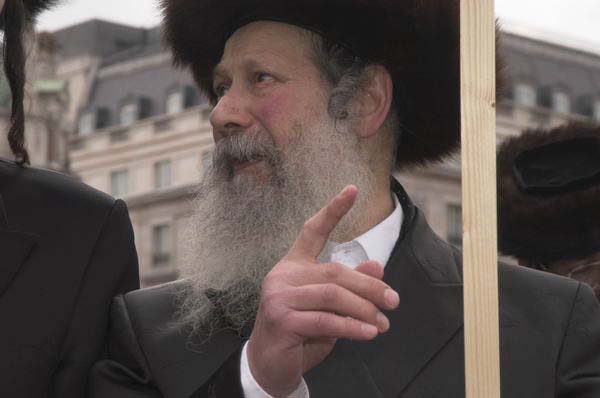
Neturei Karta orthodox Jews had walked down from Stamford Hill on the Sabbath to oppose Zionism

The rally organisers argued that raising the question of the persecution of gays in Palestine distracted attention from the Palestinian cause. Their childish attempts to distract the attention of photographers by jumping in front of the outrage protesters, holding placards in front of theirs and shouting over them simply increased the force of Tatchell’s arguments.

Fortunately the rally soon got under way, the main speaker was Jamal Jumaa – director of the Stop The Wall campaign in Palestine, although there were many other speakers, including Sophie Hurndall, the brother of Tom the murdered peace activist, Green MEP Caroline Lucas, Afif Safieh, Palestinian general delegate to the UK, George Galloway and more. Too many more for most of us.

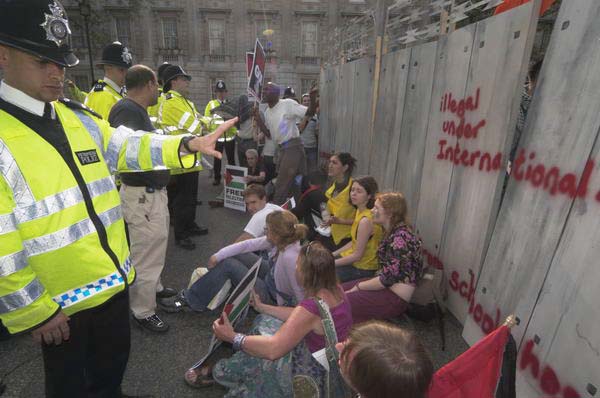
War On Want activists came with a wall to dramatize the effect of the wall in Palestine. When the march moved off down Whitehall, the wall walked with them, and it was erected opposite Downing Street. There was a short sit-down on the road before the event dissolved.


Campaign against Climate Change Kyoto March, London

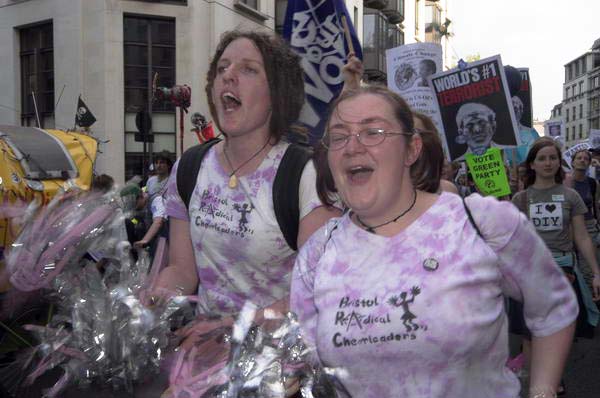
Bristol Radical Cheerleaders in the Kyoto march to the US embassy

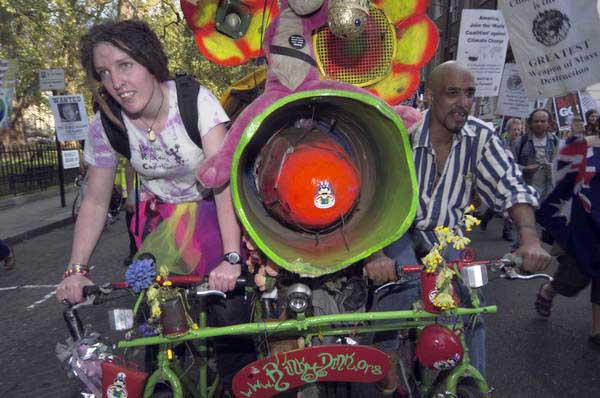
I caught up with the Kyoto march, organised by the campaign for climate change, as it reached Berkeley Square on the last quarter-mile of its long trek from the Esso British HQ in Leatherhead. Esso are seen as being one of the main influences behind the refusal by George Bush and the US administration to ratify the Kyoto accord. The campaign has organised a number of marches in London, and this is an annual event.

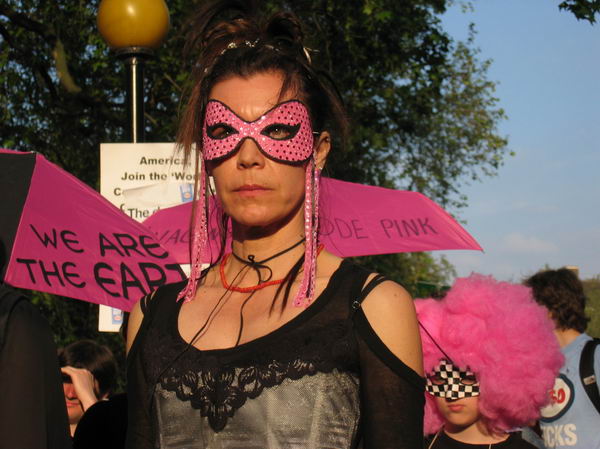
Among the marchers it was good to find a number dressed ready for the promised ‘dinosaur party’ at the US embassy, as well as the fantastic Rinky Dink cycle-powered sound system. It was also good to meet a couple of the Bristol Radical cheerleaders again, bouncing with energy as ever. A little colour was also added by a small group of of Codepink activists forming a funeral cortege, carrying the globe on their coffin.

The police in Grosvenor square were not helpful, but eventually the speeches got under way in the corner of the square.


You can find more pictures on My London Diary starting from the May 2004 page or from the pages for the two events, The Wall Must Fall and Campaign against Climate Change.


Bank, London Bridge, Fish Island, Hackney Wick

Bank, Victoria Park, Fish Island, Hackney Wick: In 1988 I was still teaching a full timetable at the sixth-form and community college where I worked, but because I took an evening class on Tuesdays I was able to finish the week’s teaching at noon on Friday. As a union rep I had persuaded my members against national union advice to some deviations from the national conditions that suited the peculiar circumstances of the college and made such arrangements possible.

Most of the pictures I made back in 1988 were either taken during the college holidays – we kept more or less normal school terms – or at weekends, but at noon on some Fridays I would rush down to the caretakers stores where I kept my bike, pedal home furiously, dump the bike, pick up my camera bag and rush to the station for a train to London. Until the clocks went back at the end of October there was then time for a few hours walking and taking pictures – in late October sunset is around 5.45pm. I think the pictures in this post were probably taken on the last occasion that year that my journey was worthwhile.

Doorway, Bank Station, Bank, City, 1988 88-10d-25-Edit_2400
Doorway, Bank Station, Bank, City, 1988 88-10d-25

I didn’t make many pictures on this Friday afternoon – around 16 black and white frames and perhaps two or three in colour, perhaps partly because I broke my journey to make this picture. Rather than taking the train from Richmond to Homerton or Hackney Wick, I went up to Waterloo and took the Waterloo & City line to Bank. I’d some time earlier photographed this doorway at Bank station and had for reasons now unknown to me decided I needed another and different image. Possibly I’d been reminded of it when the earlier picture, a closeup of the three heads, was used on a bookjacket.

It perhaps took me a few minutes at Bank to find the doorway still there on King William Street on the side of the splendid Hawksmoor church of St Mary Woolnuth. Having make the single exposure shown here, I made my way to a bus stop for a No 8 bus to Bethnal Green and then walked up Grove Road to Victoria Park.

Old London Bridge, stone alcove, Victoria Park, Tower Hamlets, 1988 88-10d-26-Edit_2400
Old London Bridge, stone alcove, Victoria Park, Tower Hamlets, 1988 88-10d-26

I’d realised when I got home from my previous walk that I had not photographed the shelters which were stone alcoves from the Old London Bridge. That bridge, built in 1176-1209 had until 1760 been cluttered with houses and shops, leaving only a narrow path across the river. These were cleared in 1760-63, more than doubling the width of the bridge, and seven stone alcoves were installed along each side.

The bridge was demolished in 1831, but these alcoves were sold and two found there way to Victoria Park when it was opened in 1845. Another is in a courtyard at Guy’s Hospital and two ended up on an estate in East Sheen along with some of the balustrade, though only one now remains in the grounds of some 1930s flats at Courtlands, close to the 1st Richmond Scouts HQ.

Percy Dalton, Dace Rd, Hackney Wick, Tower Hamlets, 1990, 90-9h-46

From Victoria Park I walked across the footbridge over the East Cross Route to Hackney Wick, then turning south and making my way down Wansbeck Road to the Northern Outfall Sewer on Wick Lane. Steps there took me down to Dace Road and along to Old Ford Locks. Unfortunately although I took a few picture on the walk, none are among those I’ve digitised. So here’s one I took in 1990 on Dace Road of Percy Dalton’s peanut factory.

Loading Bay, Lock, Old Ford, Lea navigation, Tower Hamlets, 1988 88-10e-61-Edit_2400
Loading Bay, Lock, Old Ford, Lea navigation, Tower Hamlets, 1988 88-10e-61

I walked across the gates at Old Ford Lock and took a few pictures there, including this one of the loading bay at Swan Wharf.

Bridge, White Post Lane, Lea Navigation, Hackney Wick, Tower Hamlets, 1988 88-10e-62-Edit_2400
Bridge, White Post Lane, Lea Navigation, Hackney Wick, Tower Hamlets, 1988 88-10e-62

The I walked north on the towpath. Now there are two new bridges on this stretch, from Stour Road and Monier Road, but in 1988 the next crossing was at White Post Lane.

Bridge, White Post Lane, Lea Navigation, Hackney Wick, Tower Hamlets, 1988 88-10e-65-Edit_2400
Bridge, White Post Lane, Lea Navigation, Hackney Wick, Tower Hamlets, 1988 88-10e-65

At left is the splendid 1913-14 Queen’s Yard works, part of the Clarke, Nickolls & Coombs Ltd “Clarnico” sweet and chocolate factory, formerly the largest employer in the area. Much of their five works were damaged or destroyed by wartime bombing and this building needed some restoration. The company was bought by Trebor in 1969 and the works closed. The white building fronting the canal beyond the bridge was the cocoa bean roasting factory built around 1900.

I walked over the bridge and along to Hackney Wick station for a train to Richmond on my way home.


Holloway, Nakba, Refugees & Topshop

Holloway, Nakba, Refugees & Topshop – Six years ago, the 14th May 2016 was also a Saturday, and like today there was a protests for Nakba Day, the ‘day of the catastrophe’, remembering the 80% of Palestinians forced to leave their homes between December 1947 and January 1949, but also several others on the streets of London which I covered.


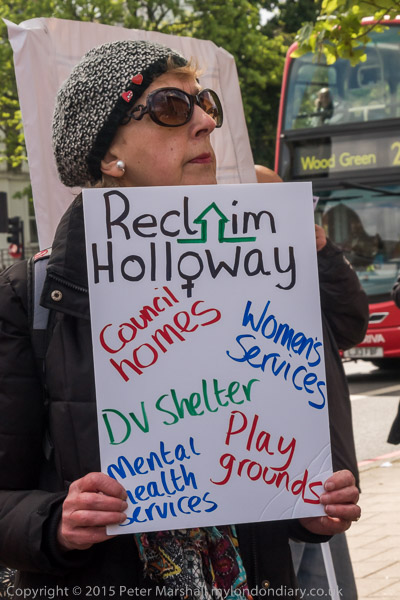
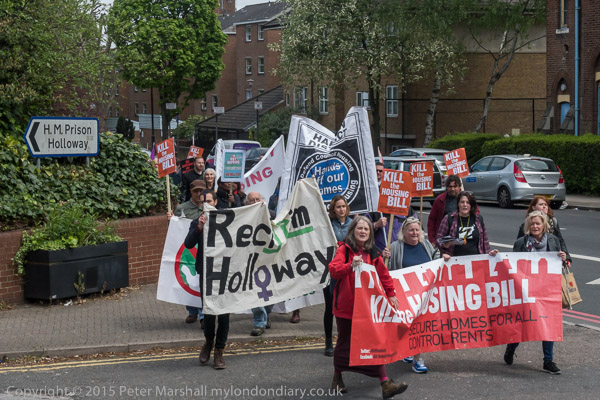
Reclaim Holloway – Holloway Road

Holloway, Nakba, Refugees & Topshop

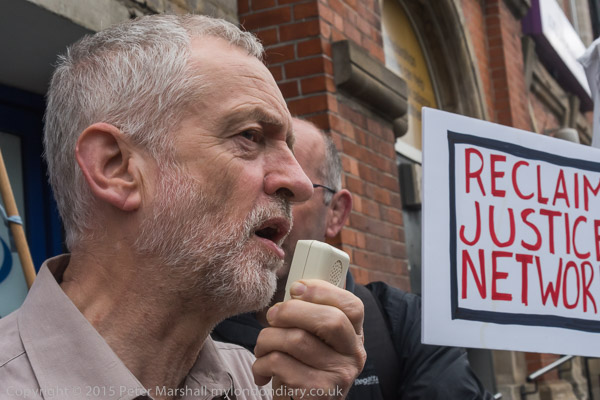
Local MP and Labour Party leader Jeremy Corbyn spoke outside London Met on Holloway Rd at the start of the march by Islington Hands Off Our Public Services, Islington Kill the Housing Bill and the Reclaim Justice Network to HMP Holloway demanding that when the prison is closed the site remains in public hands, and that the government replace the prison with council housing and the vital community services needed to prevent people being caught up in a damaging criminal justice system.

Holloway, Nakba, Refugees & Topshop

A group of around a hundred then marched from there to Holloway Prison, apparently already largely emptied of prisoners, and held a long rally there with speeches by local councillors, trade unionists and campaigning groups. Islington Council would like to see the prison site and adjoining housing estate then owned by HM Prisons used for social housing rather than publicly owned land being sold for private development.

Holloway, Nakba, Refugees & Topshop

The Ministry of Justice sold the site to housing association Peabody for £81.5m in 2019 and their plans include 985 homes and offices, with 60% of so-called affordable housing as well as a women’s building with rehabilitation facilities reflecting the site’s history. The development stalled in February 2022 with Peabody saying they were unable to afford the money needed to fit out the women’s centre.

Reclaim Holloway


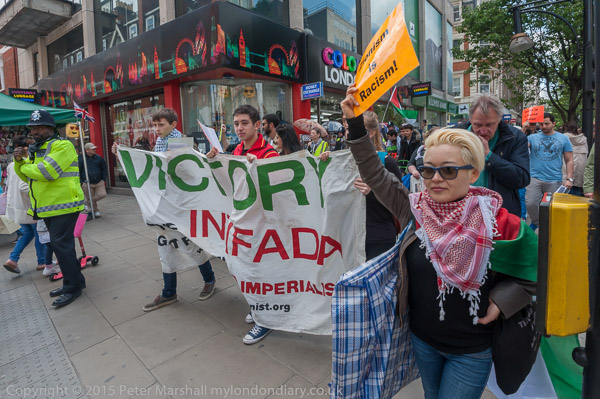
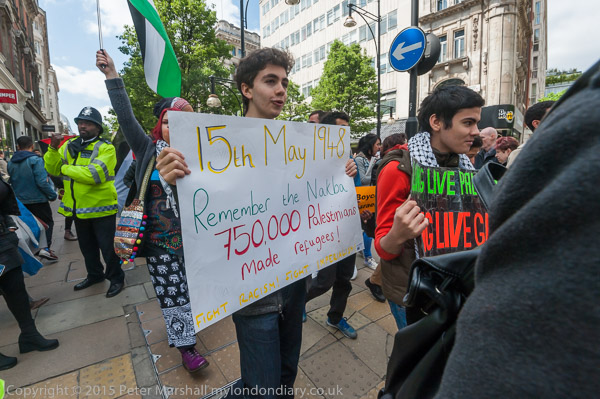
68th Anniversary Nabka Day – Oxford Street

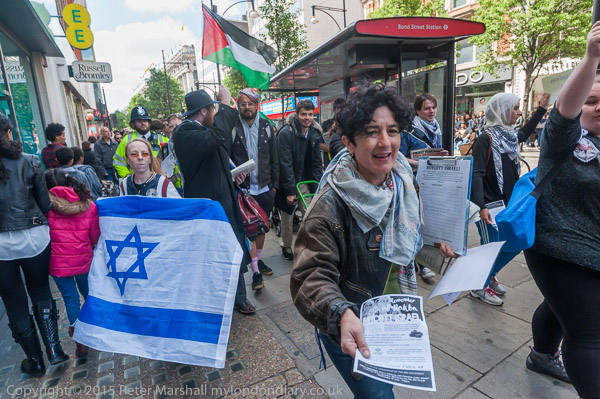
Protesters made their way along Oxford St from their regular Saturday picket outside Marks & Spencers, handing out leaflets and stopping outside various shops supporting the Israeli state for speeches against the continuing oppression of the Palestinian people and attempts to criminalise and censor the anti-Zionist boycott, divestment and sanctions (BDS) movement.

Nabka Day, the ‘day of the catastrophe’ remembering the 80% of Palestinians forced out of their homes between December 1947 and January 1949 is commemorated annually on May 15th, but the protest was a day earlier when Oxford Street would be busier. The Palestinians were later prevented by Israeli law from returning to their homes or reclaiming their properties, with many still living in refugee camps.

The protesters included a number of Jews who are opposed to the continuing oppression of the Palestinians by the Israeli government. A small group of counter protesters shouted insults and displayed Israeli flags, accusing the protesters of anti-Semitism but the protest was clearly directed against unfair and illegal policies pursued by the Israeli government rather than being anti-Semitic. The counter-protesters tried unsuccessfully to provoke confrontation, standing in front of the marchers and police had at times to move them away.

68th Anniversary Nabka Day


Vegan Earthlings masked video protest – Trafalgar Square

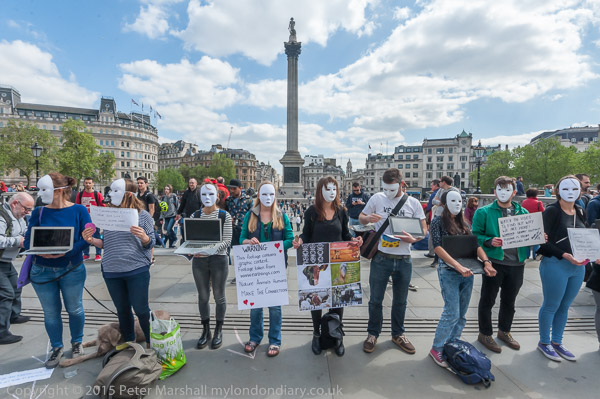
Vegans wearing white masks stood in a large circle in Trafalgar Square holding laptops and tablets showing a film about the mistreatment of animals in food production, bullfighting, etc. The protest was organised by London Vegan Actions and posters urged people to stop eating meat to save the environment and end animal cruelty.

Vegan Earthlings masked video protest


Refugees Welcome say protesters – Trafalgar Square

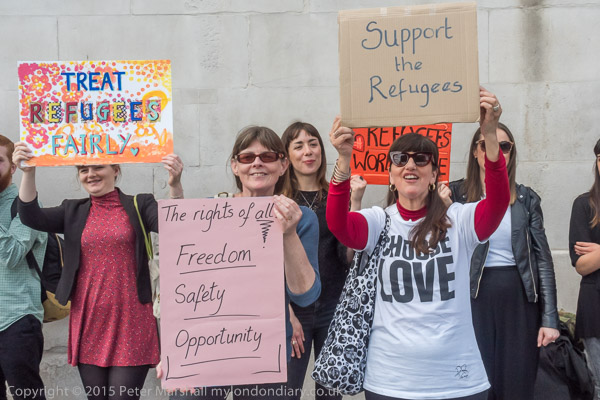
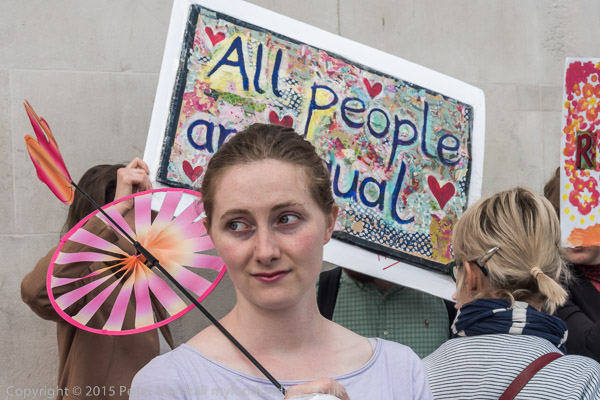
Another small group of protesters stood in front of the National Gallery held posters calling for human rights, fair treatment and support for refugees. Some held a banner with the message ‘free movement for People Not Weapons’.

Refugees Welcome say protesters


Topshop protest after cleaners sacked – Oxford St

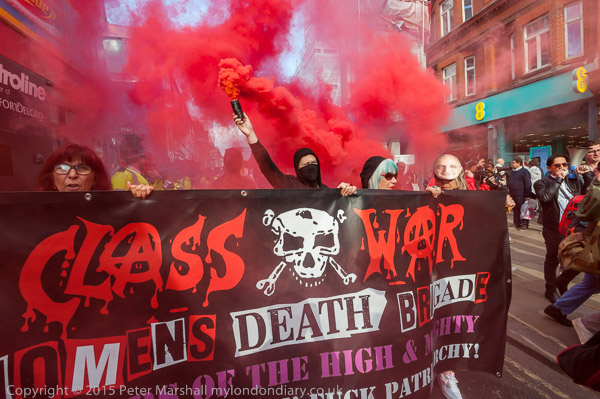
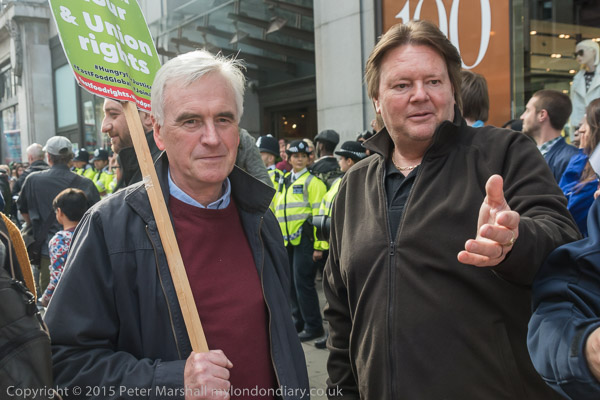
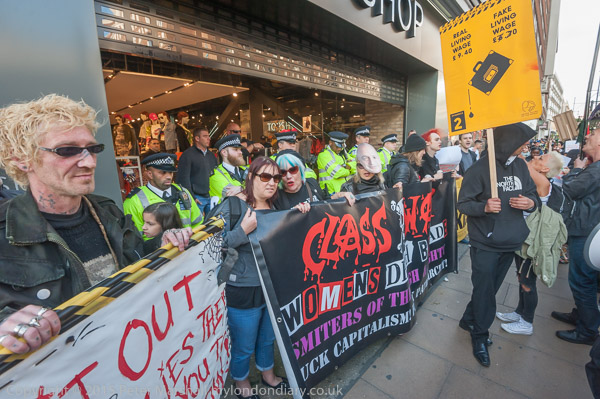
Finally I was back on Oxford St where cleaners union United Voices of the World (UVW) was holding one of protests outside Topshop stores around the country following the suspension of two cleaners who protested for a living wage; one has now been sacked. Joining them in the protest were other groups including Class War, cleaners from CAIWU and other trade unionists including Ian Hodson, General Secretary of the BWAFU and Shadow Chancellor John McDonnell.

Shadow Chancellor John McDonnell, MP and Ian Hodson, Baker’s Unions General Secretary outside Topshop

The Oxford Street Topshop was heavily defended by police, as well as by illegal extra security guards wearing no ID. Several hundred protesters held up banners and placards and with the help of the police blocked the entrance to the shop, though the protesters made no serious attempt to enter the building.

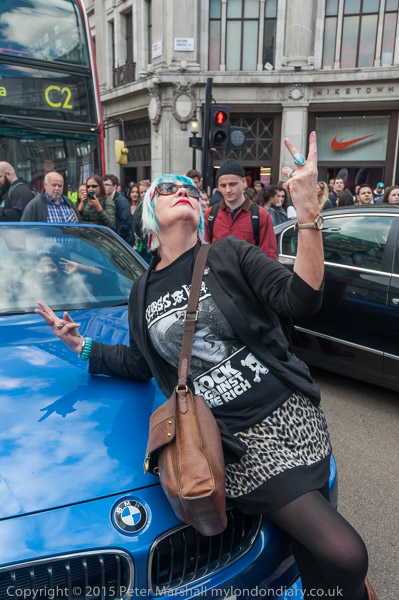
Jane Nicholl of Class War poses on a BMW as they block Oxford Circus

After a while some of the protesters, led by the Class War Womens Death Brigade, moved onto the road, blocking it for some minutes as police tried to get them to move. The whole group of protesters then moved to block the Oxford Circus junction for some minutes until a large group of police arrived and fairly gently persuaded them to move.

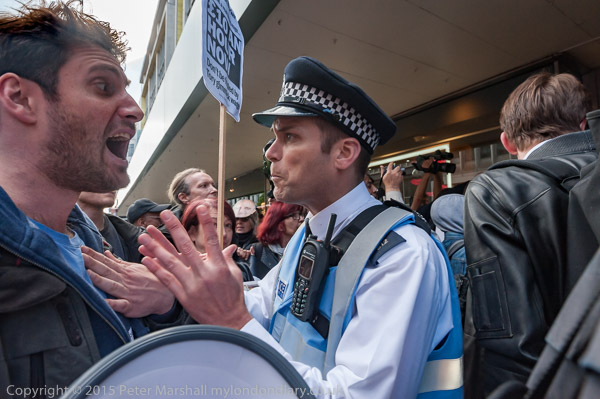
UVW’s Petros Elia argues with a police officer outside John Lewis

They moved off, but rather than going in the direction the police had urged them, marched west along Oxford St to John Lewis, where they protested outside the entrance, where cleaners have a longstanding dispute. The cleaners who work there are outsourced to a cleaning contractor who John Lewis allow to pay low wages, with poor conditions of service and poor management, disclaiming any responsibility for these workers who keep its stores running.

There were some heated exchanges between protesters and police but I saw no arrests and soon the protesters marched away to the Marble Arch Topshop branch to continue their protest.

Topshop protest after cleaners sacked


Whistleblowers, Ticks, FGM & Barnet

Whistleblowers, Ticks, FGM & Barnet – four very different events in London on Wednesday 13th May 2015


End Child Abuse, support Whistleblowers – Parliament Square, London

Whistleblowers, Ticks, FGM & Barnet

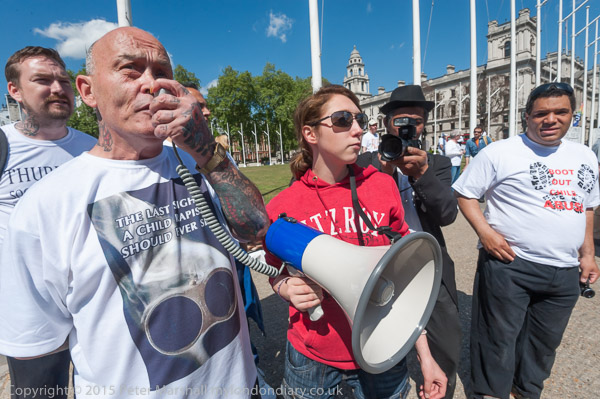
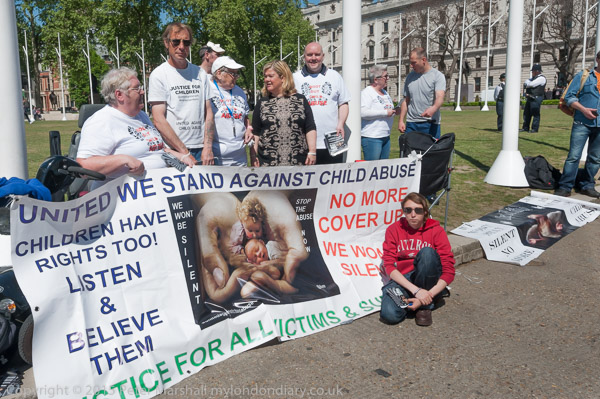
Adult survivors of child abuse and Whistleblowers United called on parliament to end abuse in the care system, to believe and act upon children’s reports of being abused and to end the covering up of abuse by social services and police.

Many of those at the protest had personal stories of the failure of police to take action, and some who had complained about abuse of their children had found themselves under investigation and their complaints had led to their children being taken away or access to them being refused. But though I am sure many of their personal complaints were justified, they were also promoting some of the widespread conspiracy theories and draconian punishments for child abuse which made me uneasy.

End Child Abuse, support Whistleblowers


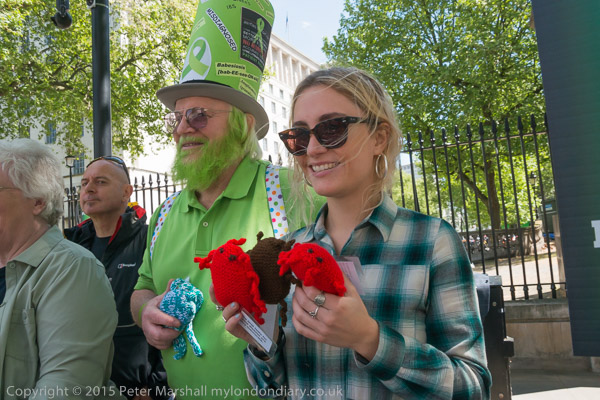
Lyme Disease – Urgent action needed -Downing St

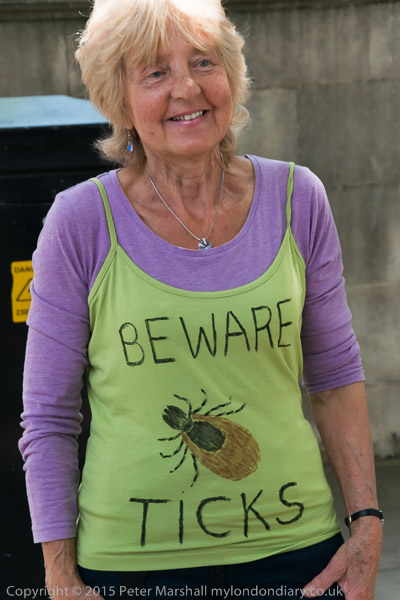
Campaigners at Downing St highlight the serious dangers of Lyme Disease from tick bites, calling for public education and for the NHS to abandon useless tests and tackle this killing disease seriously with effective tests and treatments.

Lyme disease, or borreliosis, is becomiing increasingly more common and all who walk or work in woods, parks and even gardens are at risk. Spread by bites from infected ticks, it is hard to diagnose and often goes untreated, with few doctors being aware how serious and widespread it is, often leading to partial or complete disablement.

Prompt proper removal greatly reduces the risk of infection, and is best performed with the aid of a small cheap plastic tool (such as the O’Tom Tick Twister) which could be made very readily available for a few pence – although currently they cost from around £2.60 up. It would be useful for these to be included in commercial First Aid kits. If tick removal is carried out improperly, the risk of infection is high.
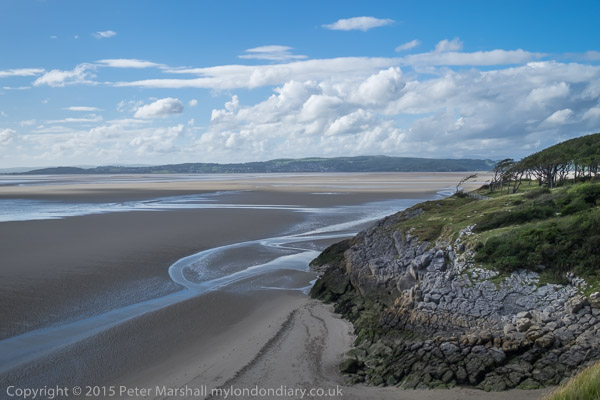
In August that year I was on holiday with friends in Silverdale, a truly beautiful area of the country but with woods full of ticks. The tick remover was an essential part of our holiday equipment, removing many of them from various parts of our bodies. It was fortunate that I had met the Lyme Disease campaigners earlier in the year.
Lyme Disease – Urgent action needed


Grant FGM campaigner Maimuna Jawo asylum – Home Office

Maimuna Jawo fled The Gambia in her fight against FGM (Female Genital Mutilation), refusing to take over her family’s duty as her village’s ‘cutter’ when her mother died. In the UK she was held in Yarls Wood, and now her asylum claim has been rejected.

Grant FGM campaigner Maimuna Jawo asylum


Sweets Way & West Hendon at Barnet Council – Barnet Town Hall

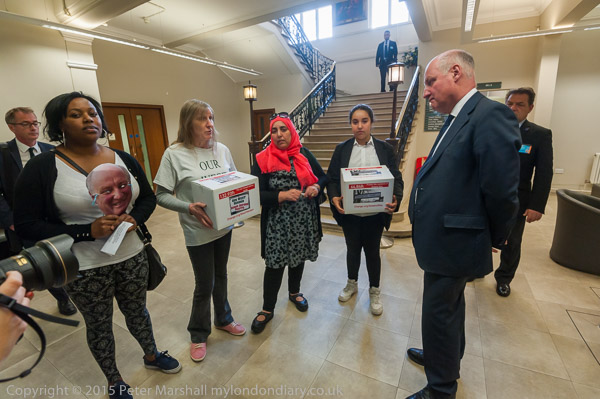
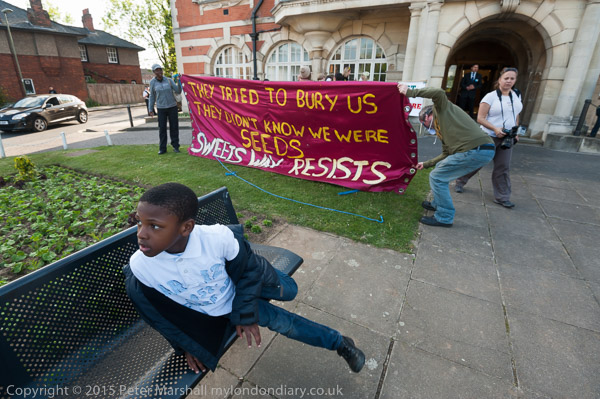
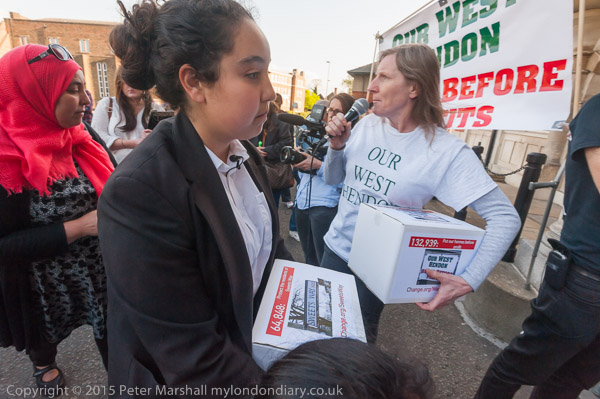
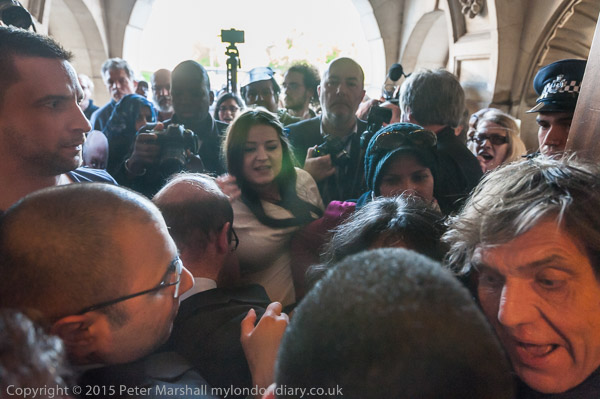
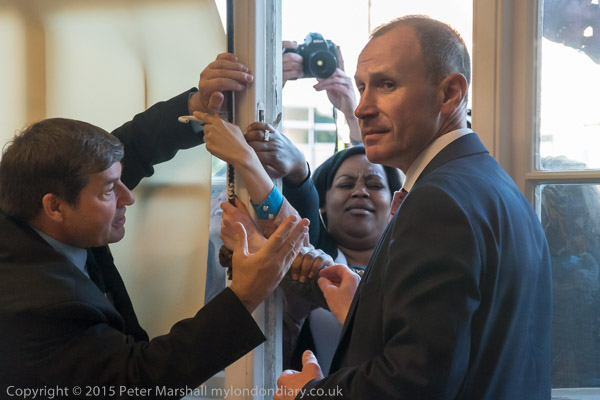
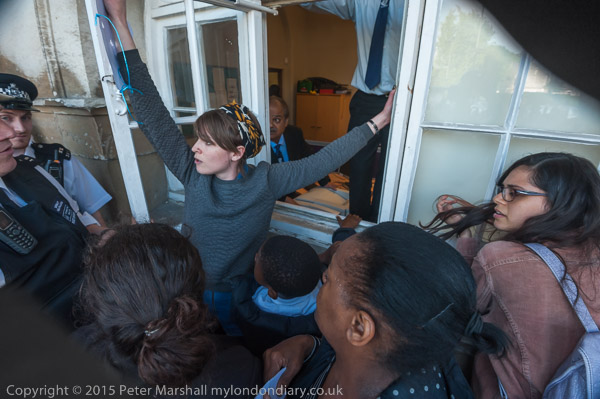
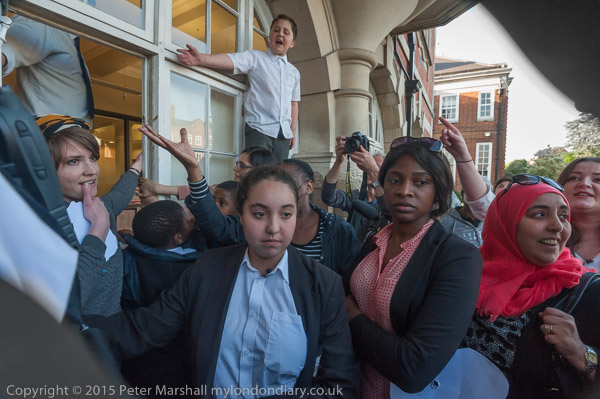
People facing eviction as Barnet Council hands their estates to property developers brought petitions with over 200,000 signatures to council leader Richard Cornelius (above). There were angry scenes as security restricted access to the town hall meeting which the protesters wanted to attend.

I showed my UK Press Card and security admitted me with the group carrying the petition into the town hall. But when I started to photograph the handover, a council press officer intervened, looked at my press card and told me I could not take any pictures of the handover. Fortunately by the time he told me I had already taken several. He instructed security to take me out of the building.

That proved to be impossible as a large crowd of protesters was attempting to push its way inside. Another photographer who had been allowed to take photographs of the handover stood in the lobby with me, and we both took pictures, despite the security men telling me I was not allowed to do so. A council officer attempted to block my view of what was going on as they stopped people trying to climb through a window, but there seemed to me to be clearly an attempt to block press freedom in recording events in which there was a clear public interest and I continued to work as best I could.

Eventually the security officers were able to help me out through the crush, which had subsided a little. They had behaved reasonably and I think were not happy at having to carry out the orders they had been given by the council officer. Our disagrements were relatively polite, but they made it clear that I would not be allowed back into the town hall as I had taken photographs when instructed not to do so. By the time they could evict me I wanted to be outside to photograph the protest continuing there.

Protesters are stopped from entering by a window

Barnet had been a leader in the destruction of themselves as local authorities in the application of austerity and outsourcing of services under their ‘Easy Council’ policy, begun in 2008 but reaching its peak in 2013 with huge contracts to Capita – and on which they ended up spending £217million more than orginally agreed . As Aditya Chakrabortty wrote in The Guardian about Northamptonshire and Barnet “Both true blue Tory; both preaching the need for sound finances while raiding their contingency funds and refusing to raise council taxes; both happy to chuck millions at consultants and build themselves swanky headquarters. And, crucially, both adamant that their council’s future lies in smashing itself up and handing out the shards to big companies to provide the bulk of public services… It was cartoonish, it was reckless, it was grotesque.”

Finally I am escorted out and can photograph the protesters outside

And it failed, with the Tories having to admit huge losses and announce that the major contracts would not be renewed when they expired in 2023. And though I was pleased to hear that the recent local elections had resulted in Labour gaining control with 41 seats to the Conservative’s 22, it will give them the problem of picking up the pieces. And London Labour Councils have a notoriously bad record over the demolition of council estates and the treatment of residents and leaseholders.

Sweets Way & West Hendon at Barnet Council


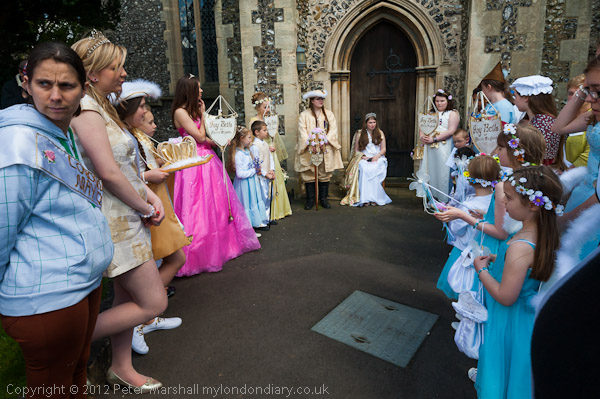
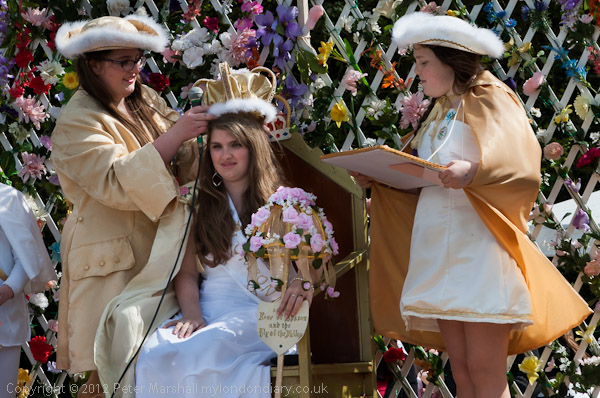
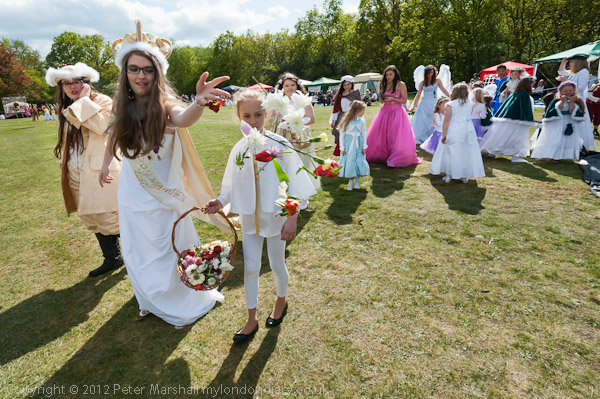
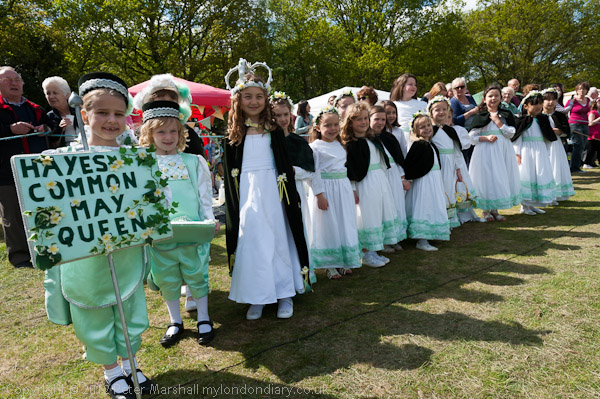
London Crowns 100th May Queen

London Crowns 100th May Queen – Hayes, Kent.

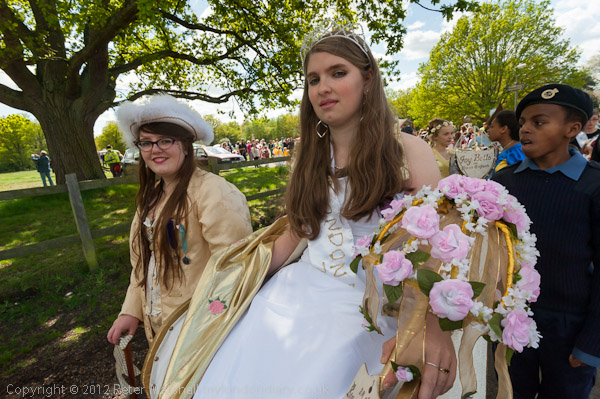
On Saturday 12 May 2012 I went by invitation from the family of the 100th May Queen to photograph her crowning on Hayes Common. Earlier I had photographed and written about the festival and other May Queen Festivals. Below is the text from my report on the event in My London Diary, with just a few minor corrections along with a few of the pictures. You can find more pictures on the web site.

London Crowns 100th May Queen

The Merrie England and London May Queen Festival was started by Joseph Deedy, usually described as a ‘Dulwich schoolmaster’ in 1913, and moved to its current location on Hayes Common soon after. Surprisingly it continued throughout both world wars, although in a somewhat truncated version, with no procession around the village. It was also felt that holding the ceremony in the open air would present too tempting a target for the enemy, and so it was moved from the common to the parish church. But continue it did, and every year since 1913, one girl has been crowned as the London May Queen, making this year’s Festival and Queen the 100th.

London Crowns 100th May Queen

Whitelands College in London started its May Queen festival rather earlier in 1881 at the prompting of John Ruskin, and this still continues at the college (now part of the University of Roehampton) although since the college now admits men, some years they have a May King in place of a queen. Talking to one of the organisers of the event yesterday I learnt that Deedy had worked at Whitelands – contrary to the published information on him, including that I retold in my own book and PDF on the festival. [You can read a little more about this book on >Re:PHOTO which also has has an e-pub link.) Copies of this and my other Blurb books are usually available to UK addresses more cheaply direct from me.

The London May Queen sits in her carriage

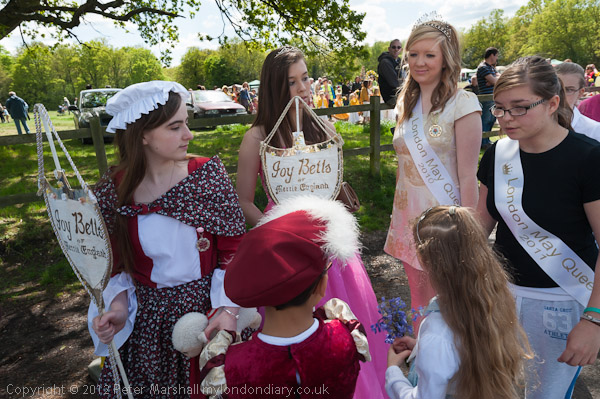
The ceremonies take place in a large roped off arena on Hayes Common, with the May Queens and their groups from various places on the fringes of south east London taking their places around it in alphabetical order. Each group has its own colour for the dresses and its own flower, and girls who may join as young as three make their way up through the various roles in the group until, if they remain long enough, they become the May Queen of their local realm. After this they can move on to join the London May Queen group, and again take the various roles by seniority until finally – usually when they are around 16 – they become London May Queen. As well as taking part in May Queen activities, May Queens and their groups also appear at various charity events in their local areas.

London Crowns 100th May Queen
Beckenham May Queen and retinue

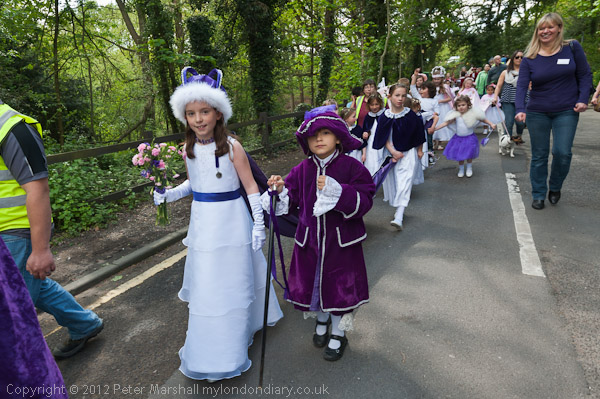
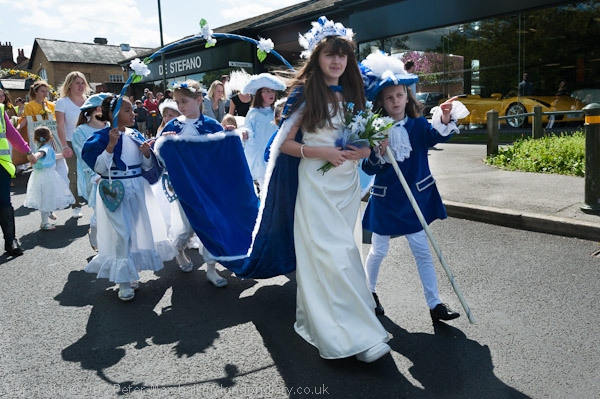
I arrived just as the procession around Hayes was starting, with the uncrowned queen in a lightweight carriage pulled by Sea Cadets with the Prince of Merrie England walking beside her and preceded by a bagpiper. Behind her were the members of London May Queen, including the Joy Bells celebrating Music, Company, Life, Beauty, Flowers as well as the Fairy Queen, Bo-Peep, Robin Hood and several others.

London Crowns 100th May Queen
Bromley Common Queen and retinue

Behind them came the May Queen realms in alphabetical order – Beckenham, Beddington, Bletchingly, Bromley Common, Caterham, Chislehurst, Coney Hall, Downe, Eden Park, Elmers End, Green St Green, Hayes, Hayes Common, Hayes Village, Orpington, Petts Wood, Shortlands, Wallington, Warlingham and West Wickham. In the heyday of the event in the 1920s and 30s there were as many as 100 groups, and the event made the national newspapers and the cinema newsreels.

Little Sanctum - London Crowns 100th May Queen
At Hayes Parish Church for Little Sanctum

At the parish church, the London May Queen group made their way into the churchyard for a short service written by Deedy which he called ‘Little Sanctum’, before joining back on the end of the procession around the village and back to the common.

London Crowns 100th May Queen

There the 100th May Queen was crowned and the further pageant witten by Deedy performed, ending with the May Queen being led around the arena by BoPeep and scattering flowers towards the seated May Queen realms.

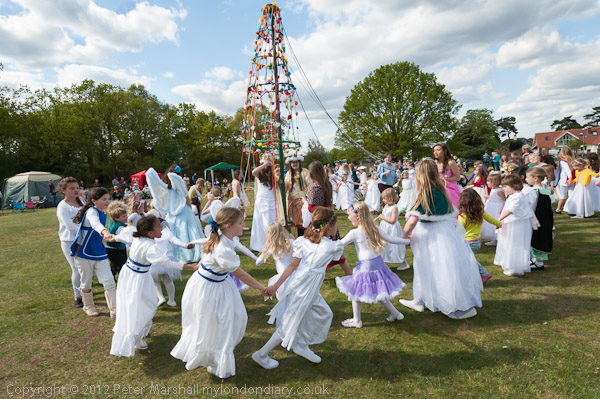
Many of the younger girls were quite tired by the walk around the village and were busy eating ice cream and sandwiches, which revived them considerably, and after the Chislehurst May Queen group had given a demonstration of ribbon dancing, all of the Merrie England children – including a few young boys who mainly take part as pages – came and took part in a lively circle dance around the large maypole.

All that was left was for the May Queen to draw the tickets for the raffle which helps to cover the expenses.

London Crowns 100th May Queen


You can read more about this and other May Queen ceremonies in London both in reports of the various events on My London Diary and from my book mentioned above. I had hoped that this would be followed by a major exhibition and a more scholarly work illustrated by my pictures but as yet this has not been possible.


Car Spares And Fly Tipping In Hackney Wick

The final few hundred yards of my walk in Hackney on a Sunday in October 1988 took me to Hackney Wick station and I made a few views using the height of the footbridge across the East Cross Route and also from Hackney Wick station where the railway line runs on a viaduct. The previous section of this walk is Homerton to Hackney Wick.

Footbridge, Hackney Wick, Hackney, Tower Hamlets, 1988 88-10d-56-Edit_2400
Footbridge, Hackney Wick, Hackney, Tower Hamlets, 1988 88-10d-56

Looking roughly north you can see the tower blocks of the Trowbridge Estate. Some had already been demolished by 1988 – the programme had been started in 1985 and was completed by 1996.

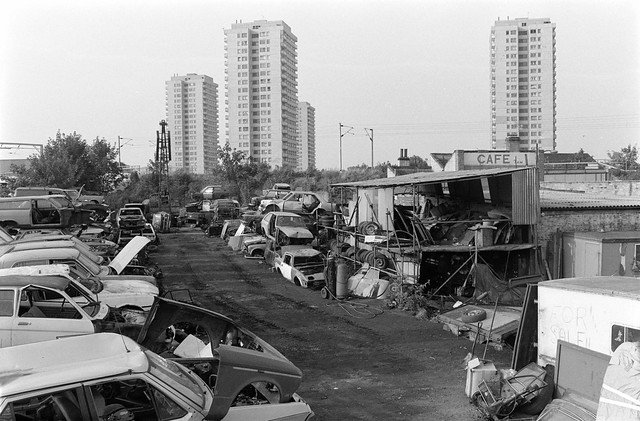
Car Spares, Hackney Wick, Hackney, 1988 88-10d-42-Edit_2400
Car Spares, Hackney Wick, Hackney, 1988 88-10d-42

Coming down the footbridge I got a better view of the large car spares yard on Rothbury Road, past which you can see the embankment carrying the North London Line. At right is the top of a cafe and towering above the railway the remaining towers of Hackney Wick’s Trowbridge Estate. Perhaps given its history my my confusion with Trowbridge and the accident-prone frigate HMS Troutbridge in BBC radio’s long running series with Lesley Phillips, Jon Pertwee, Ronny Barker and others, The Navy Lark was understandable.

Car Spares, Rothbury Rd, Hackney Wick, Tower Hamlets, 1992, 92-8d-41

I didn’t photograph the front of the car spares site on Rothbury Road on this occasion – it had been a long walk and I was tired and just wanted to get to the station in time for a train towards home. So here are a couple of pictures from around four years later, when little had changed.

Fence, Car spares, Rothbury Rd, Hackney Wick, Tower Hamlets, 1992 TQ3684-009

And one in colour.

Fly tipping, Rothbury Rd, Hackney Wick, Hackney, 1988 88-10d-31-Edit_2400
Fly tipping, Rothbury Rd, Hackney Wick, Hackney, 1988 88-10d-31

The area at the Hackney Wick end of the footbridge was a favourite with fly-tippers, sometimes making it hard to use the bridge.

Wallis Rd, White Posts Lane, Hackney Wick, Tower Hamlets, 1988 88-10d-34-Edit_2400
Wallis Rd, White Posts Lane, Hackney Wick, Tower Hamlets, 1988 88-10d-34

The whole right hand side of White Posts Lane at the right of this picture was redeveloped in 2018-9, but the low section of wall from earlier demolition in my picture was still there after that though now – like much of Hackney Wick, highly decorated with graffiti. A considerable amount of graffiti in the Wick was removed in tidying up the area for the 2012 Olympics but was soon re-stablished. Wallis Road at left led me to the station.

Hackney Wick, Hackney Wick Station, Tower Hamlets, 1988 88-10d-36-Edit_2400
Hackney Wick, Hackney Wick Station, Tower Hamlets, 1988 88-10d-36

From the footbridge at Hackney Wick station there were views over the surrounding area. The station has been rebuilt since I made this picture, and now has an entrance on the south side of the line.

This was the end of my rather long walk in the London Borough of Hackney in October 1988 which had begun at the southern end of Stoke Newington in the post South Stokey & Hornsey Detached.


Police & Public Sector March, 4,000 Days

PPolice & Public Sector March, 4,000 Days of the Parliament Square Peace Campaign approaches – some of my pictures from Thursday 10th May 2012.


Police March Against Cuts and Winsor – Westminster

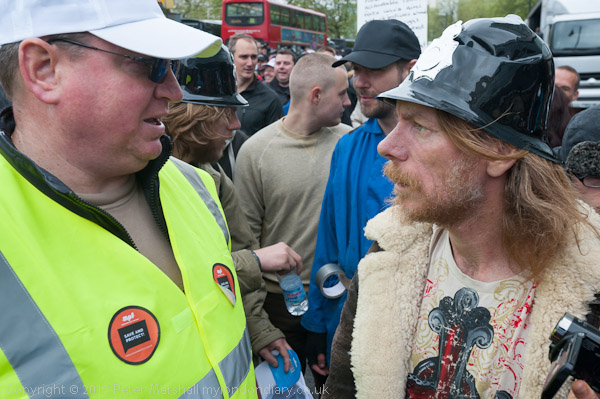
Occupy supporters in plastic helmets joined the police march

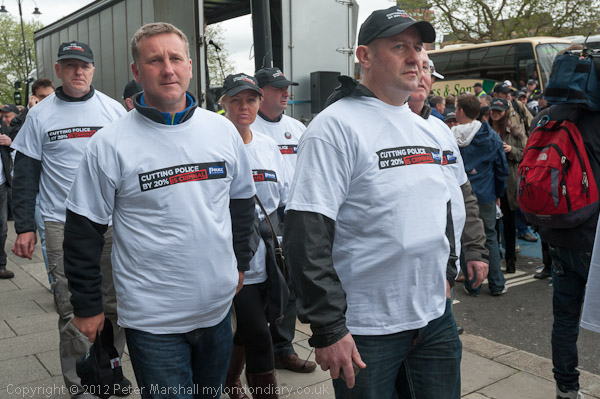
An estimated 20,000 police from all 43 forces in England & Wales marched through central London in protest at 20% cuts in police budget and proposed restructuring following the Winsor review. Occupy, Right To Protest and others joined in to protest for justice in policing.

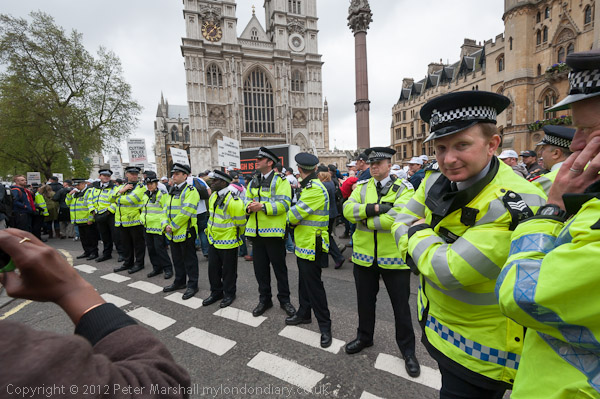
Police are not allowed to strike or belong to a proper trade union, but the Police Federation can organise demonstrations like this when thousands of off-duty police, some with family members made a impressively large if rather dull protest past the Home Office, the Houses of Parliament and Downing St. Most wore one of the 16,000 black caps produced for the protest, the number of officers expected to be lost over the next four years as the police budget is cut by 20-30%.

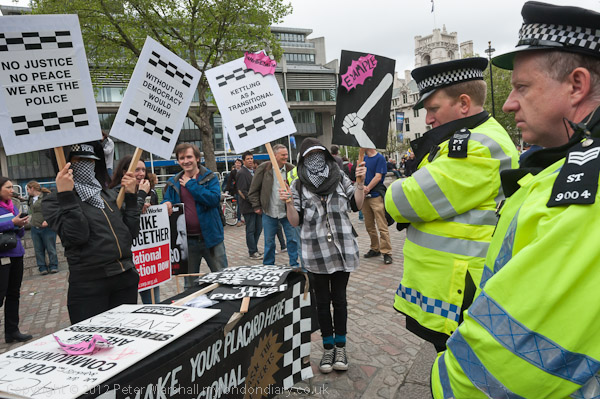
Police officers attempt to intimidate the Space Hijackers

Like other public sector workers, police had suffered a two year wage freeze, as well as increases in pension contributions and many have also had large cuts in overtime. As well as those protesting, police were also on duty controlling the protest, though it was unlikely to get out of hand. But there were others as well as police, including the Space Hijackers who had a stall giving advice on how to protest, and also Occupy protesters who were calling for “a fully, Publicly funded, democratically accountable Police force who’s aims and objectives enshrine the right to peaceful Protest in some sort of People’s Charter!

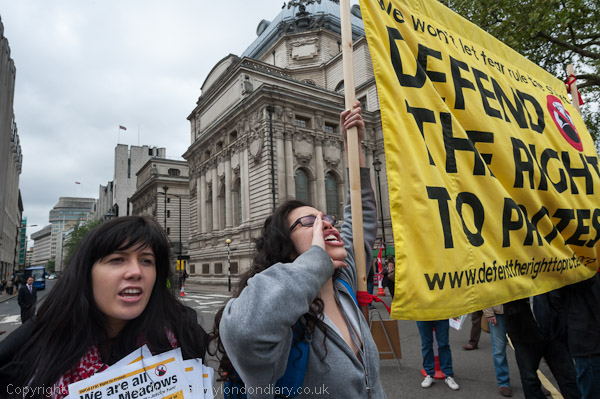
Others were there to protest against various aspects of police corruption and faced some aggravation from the officers on duty as well as some protesters. The Defend The Right To Protest group reminded police marchers of Alfie Meadows, Sean Rigg, Ian Tomlinson, Jean Charles de Menezes and many others killed or seriously injured by police officers. Officers on duty made some attempts to intimidate some of the non-police protesters – and also photographers covering the event.

More at Police March Against Cuts and Winsor


Public Sector Pensions Strike and March – St Thomas’ Hospital to Westminster

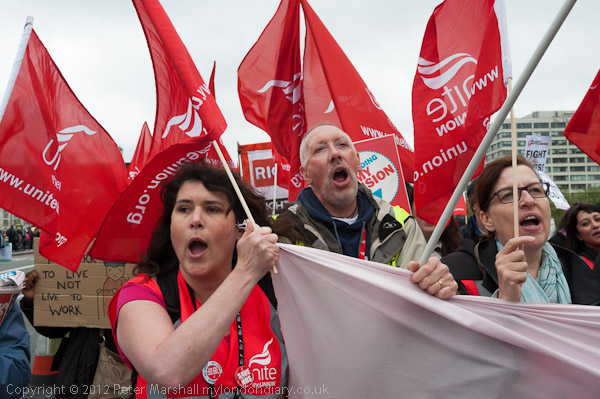
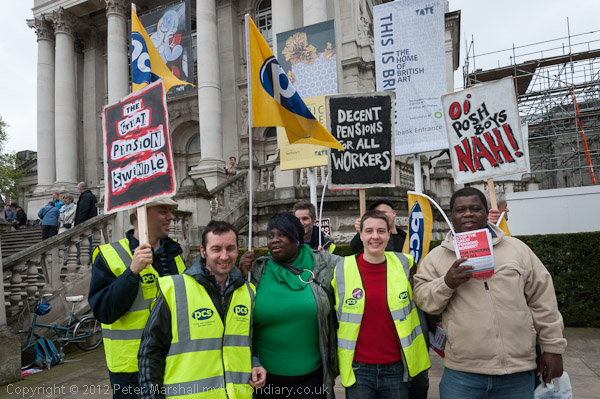
Public sector workers in Unite, PCS and UCU were on a one-day strike against cuts in pensions, jobs and services, and picketed workplaces and marched from a rally at St Thomas’ Hospital across Westminster Bridge to Methodist Central Hall for a further rally.

PCS picket at Tate Britain

Some of the pickets had begun at 5am, and a few were still in place as I walked past workplaces in Westminster – including the Houses of Parliament to meet the marchers coming over Westminster Bridge.

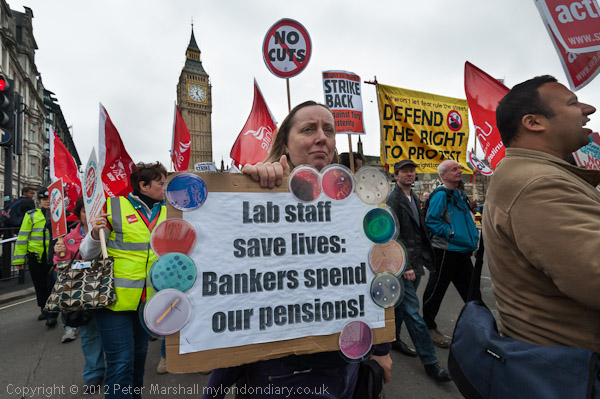
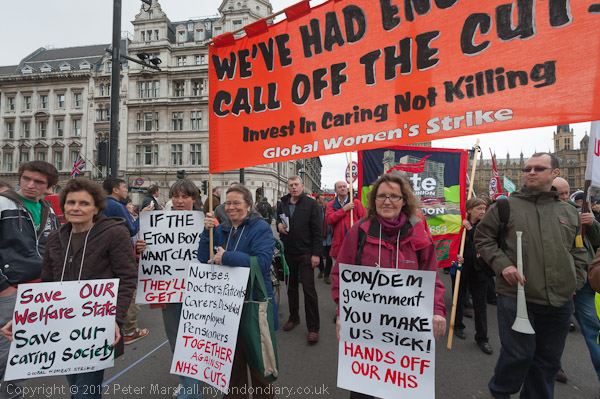
As they marched, many chanted “Sixty-eight – is TOO Late”, as retirement age is set to increase to 68 and beyond, while retirement contributions are increasing. They are also losing out because the government has decided to index pensions to the lower CPI inflation figures which mans they get around 15-20% less. Over 94% of Unite’s NHS members voted to reject the government’s proposals and take strike action today along with members from the Ministry of Defence and government departments as well as others from the PCS and UCU.

More on My London Diary at Public Sector Pensions Strike and March.


4000 Days in Parliament Square – Parliament Square Peace Campaign

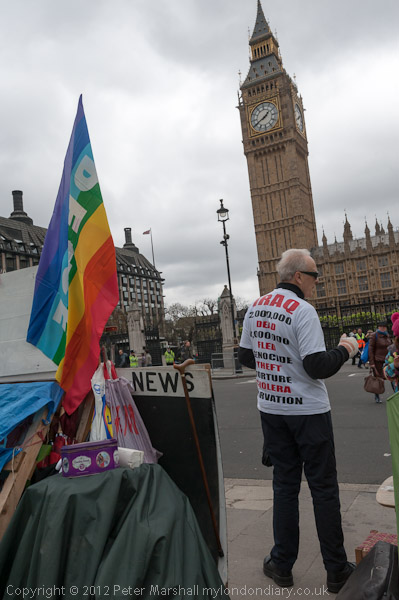
Brian Haw came to Parliament Square to begin his protest there on the 2nd June 2001, and the Parliament Square Peace Campaign he started had been there for almost 4,000 days, with a presence night and day, 24 hours a day since then.

Barbara Tucker

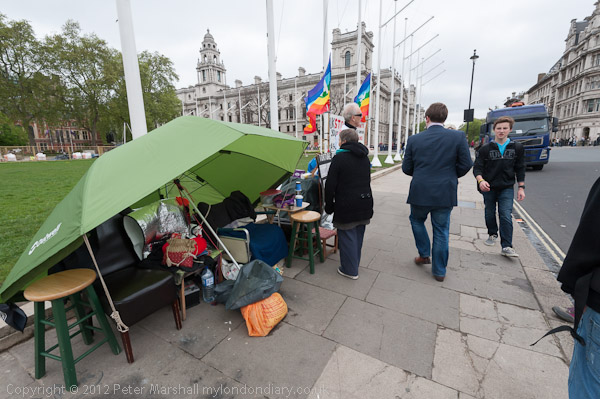
After Brian’s death from cancer the protest was continued by Barbara Tucker and other supporters who have maintained the protest on those various occasions when Brian or Barbara was arrested and held overnight. Over the years the campaign has been subjected to frequent illegal harassment by police officers, Westminster Council officials and thinly disguised members of the security service, and laws have been enacted intended to bring the protest to an end.

A few hours before I arrived, police had come and spent 90 minutes “searching” the few square meters of their display in the early morning, and three days later, at 2.30am on Sunday 13 May, police and Westminster Council came and took away the two blankets that Barbara Tucker, no longer allowed to have any “structure designed solely or mainly to sleep in” by law was using to survive in the open. Clearly a blanket is not a structure, and police and council have also removed other items of property. Later her umbrella was also taken away. Barbara’s health deteriorated and she eventually had to leave the square, and the protest finally ended early in May 2013.

4000 Days in Parliament Square


Homerton to Hackney Wick

Homerton to Hackney Wick – This walk I made in October 1988 continues from where my previous post Morning Lane, Paint, Handbags and Printers ended.

Homerton High St, Homerton, Hackney, 1988 88-10d-01-Edit_2400
Homerton High St, Homerton, Hackney, 1988 88-10d-01

Immediately east of Mackintosh Lane on the south side of Homerton High St at No 178-84 was an unusual arched brick wall, which attracted my attention. Thistle House at 178-82 was a hostel with 33 rooms in multiple occupation. Part of the wall shown in this picture has now been demolished to allow storage of large rubbish bins. The wall goes in front of two distinct houses, both of which have one circular window – but in the joined house it is above the second floor window.

Barnabas Rd, Homerton, Hackney, 1988 88-10d-63-Edit_2400
Barnabas Rd, Homerton, Hackney, 1988 88-10d-63


Barnabas Rd runs south from Homerton High Street past Homerton Station. In 1988 the premises of printers Alan Moor & Co at No 24 was up for auction. It is still there and remains a handsome villa – my photograph doesn’t really do it justice. I suspect it dates from around 1860 when Barnabas Road was called Church Road, (it was renamed in 1936) but can find no details. The rather ugly porch has I think been extended since 1988.

The Immaculate Heart of Mary & St Dominic, RC, Church, Kenworthy Rd, Homerton, Hackney, 1988 88-10d-64-Edit_2400
The Immaculate Heart of Mary & St Dominic, RC, Church, Kenworthy Rd, Homerton, Hackney, 1988 88-10d-64

Originally called the The Church of the Immaculate Heart and St. Dominic it was designed by C A Buckler and built on what was until 1939 Sidney Rd two years after a mission was founded here in 1873. The church, completed in 1883, was badly damaged by bombing and fire in 1941 and was rebuilt in 1955-57. My picture shows it with shops on the corner of Wick Rd, where there is still an Indian takeaway.

Hackney Hospital, Homerton High St, Kenworthy Rd, Homerton, Hackney, 1988 88-10d-65-Edit_2400
Hackney Hospital, Homerton High St, Kenworthy Rd, Homerton, Hackney, 1988 88-10d-65

I went up Kenworthy Road back to Homerton High St, stopping on the corner of Ward Lane to make this picture of the East Wing of Hackney hospital, which I think is Pavilion B, built in 1880-82, designed by William Finch, a typical design for the time with long airy ‘Nightingale Wards’ and towers at the corner containing sanitary facilities. (I stayed on a similar ward in a south London hospital in 2003 just before it was demolished – and collapsed in the disconnected sanitary area after an operation, fortunately in reach of the red emergency cord which I came around sufficiently to pull and bring medical staff running to my aid.) Although Hackney Hospital closed in 1995, parts are still in use for mental health services and a notice calls this the John Howard Centre, which provides low and medium secure mental health services for North East London.

Shops, Homerton High St, Homerton, Hackney, 1988 88-10d-66-Edit_2400
Shops, Homerton High St, Homerton, Hackney, 1988 88-10d-66

These buildings are still there at 201-205 Homerton High Street, though in different hands. Back in 1988 a Bookmakers next to a Turf Accountant (a rather upmarket term for the same thing) seemed excessive, while F A MURRELLS business was completely hidden by shutters. It seemed to be some kind of miniature business, the whold width of the property perhaps around 7 ft with a tiny door only suitable for a slim child in the shutters. Whatever was going on inside – or rather had once gone on inside – obviously involved something of some value, worth protecting with an AFA Burglar Alarm, perhaps a jewellers or pawnbrokers? But this tiny shop had obviously been fairly recently sold – and now appears to be a residential property.

The Adam & Eve, pub, Homerton High St, Homerton, Hackney, 1988 88-10d-51-Edit_2400
The Adam & Eve, pub, Homerton High St, Homerton, Hackney, 1988 88-10d-51

There has been an Adam & Eve tavern in Homerton High Street since at least 1735, but its fine frontage is dated from 1915 and was recently restored. Its cream terracotta front includes a large relief showing very chastely the couple before the fall but underneath an apple tree. In 1988 it was a Taylor Walker pub (though Taylor Walker had been taken over and closed in 1960), now it is described as a gastro-pub, with fresh food from the farm daily and offering “CURING – MICROBREWERY – ALLOTMENT”. The Taylor Walker pub sign was rather better and had above the field gun that came from the Clerkenwell Cannon brewery they took over in 1929.

East Cross Route, Hackney Wick, Hackney, Tower Hamlets, 1988 88-10d-55-Edit_2400
East Cross Route, Hackney Wick, Hackney, Tower Hamlets, 1988 88-10d-55

The East Cross Route was a part of the disastrous Ringways plan for concentric motorway rings around London. This was one of two major parts of the of the innermost Ringway 1 which actually got built between 1967 and 1973. The cost and environmental devastation caused by the building of the Westway in North Kensington led to a huge backlash which led to the cancellation of the remaining parts of the scheme.

The East Cross Route was less controversial, partly because it was in East London and most politicians and others didn’t much care about what happened there, but also because it largely replaced an existing rail line which had long separated the communities on each side. For much of its length there was in any case little between the road and the natural boundary of the River Lea and the Lea Navigation.

There were relatively few roads which ran across the area, and the links across the new road were maintained with both Wick Lane and Wick Road still leading to Hackney Wick. Olf Ford Road no longer led to Old Ford, except by a footbridge, but for vehicles the detour was relatively short. The bridge I was on when I made this picture carries a footpath across Victoria Park from Cadogan Terrace to Rothbury Road in Hackney Wick. The Trowbridge Estate built in 1965-9 had 7 rather striking 21-storey tower blocks. Demolition of these had begun with Northaird Poiont in 1985 and all had gone by 1996.

The final post in this series, appearing shortly, will include my pictures from Hackney Wick where my walk ended.