Police Protest & Lay Wreaths – 2008

Police Protest & Lay Wreaths: On Wednesday January 23rd 2008 around 20,000 police marched through London to demand more pay. As ‘crown servants’ rather than employees they are not allowed to take strike action or work to rule or any other collective action, but apparently organising a demonstration like this doesn’t count. As a part of their protest police officers and families of officers laid wreaths in a dignified ceremony at the National Police Memorial. I photographed the events and wrote about them in some length on My London Diary back in 2008, and here I’ll post that again – with some minor corrections, mainly of typos.


Police March for More Pay

Westminster
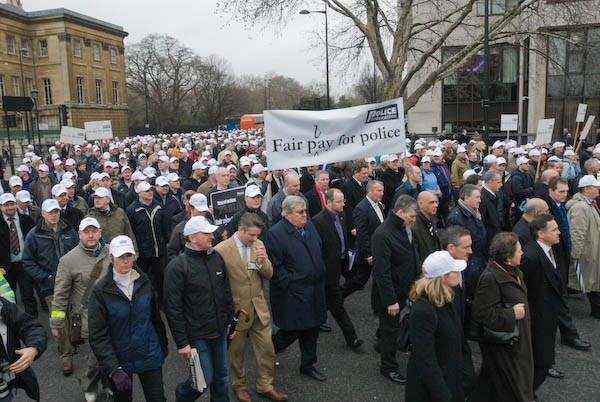
Police on the march – along with BNP and Liberal Democrat candidates for London Mayor

more pictures

Along with what seemed like a thousand other photographers, I had decided that the police demonstration against their recent pay award was one that I had to cover. (We did wonder idly whether it was also being a good day out for burglars and other crimes across the country – though of course all those attending the demo were off-duty.) But although it showed the ability of the Police Federation to motivate officers on the issue of pay, bringing coachloads from over the country, it was a drab event on a drab day.
For perhaps the one and only time, I’ve absolutely no reason to think that the figure given by police of around 20,000 attending was seriously in error. It was a significant size, although rather smaller than many other demonstrations I’ve photographed in current years. I think a more normal police estimate would probably have put it at 10,000! [Or rather less.]

Of course it’s axiomatic that the public services get screwed by governments, although, along with the armed forces the police have over the years got a relatively easy ride compared to teachers and others, and I’m pleased to see a current trend to reverse that.
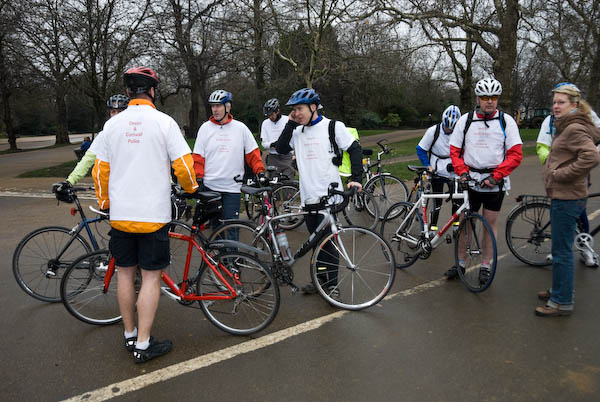
Most of the police came in coaches, but this group cycled from Exeter to London

The ride by some Devon and Cornwall police from Exeter to be with the demonstration was one of the few point of interest – just a pity the demo wasn’t a couple of days later so they could have joined up with Critical Mass.
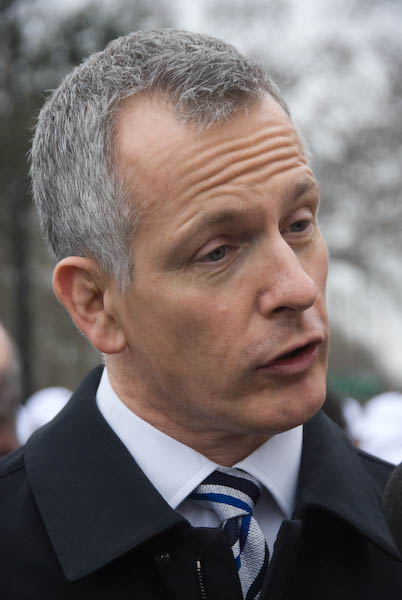
Liberal Democrat Mayoral candidate Brian Paddick retired from the Met in May 2007

The Evening Standard gave the event the headline ‘BNP Chief On Police March‘, and yes, the the Barking & Dagenham councillor and BNP Mayoral candidate Richard Barnbrook was there – as too was the Liberal Democrat Mayoral candidate Brian Paddick. Unlike Barnbrook, Paddick came to see the press at the beginning of the march for interviews and photographs, although it seemed to me that none of the police wanted to talk to him, though many had been his former colleagues. It may be OK now to be gay and out in the police, but if you have liberal views best hide them under your helmet.
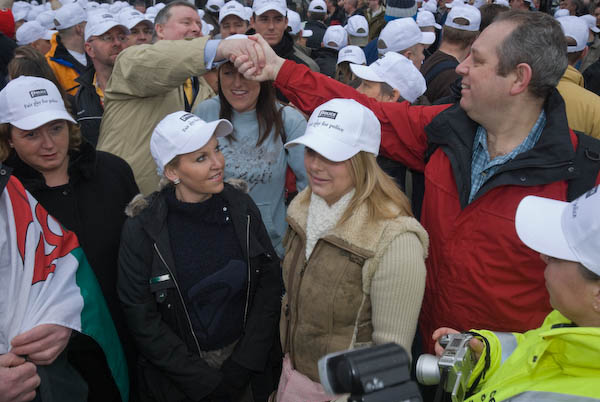
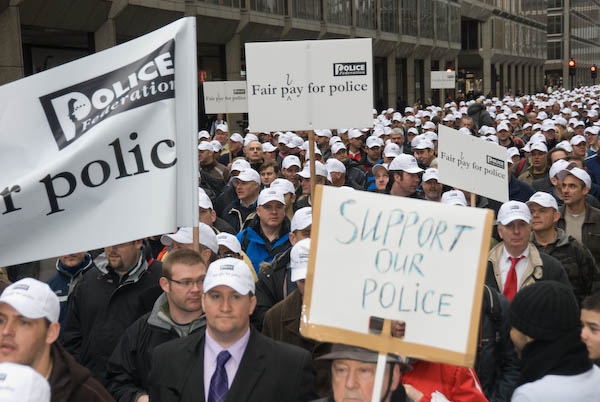
The press and photographers aren’t too popular with the police either, and at one point when I walked along with the demonstration I was jostled and sworn at, told to get out. But 99% of the demonstration was well-behaved and just rather dull. How many pictures can you take of a crowd in white baseball caps?
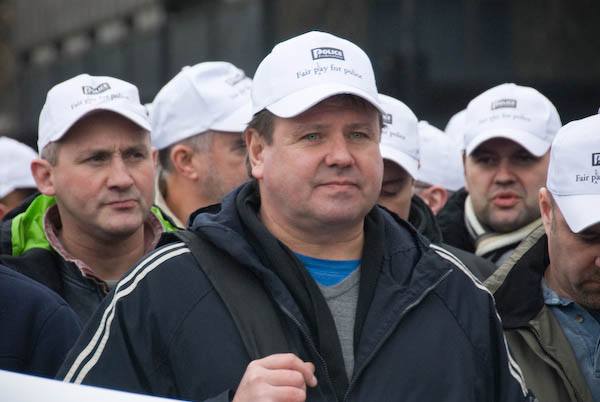
As a crowd it really stood out in London for the very few black faces it contained – certainly very few compared even to the proportion among those policing the event, let alone those watching as it went through the streets around Victoria station.
more pictures

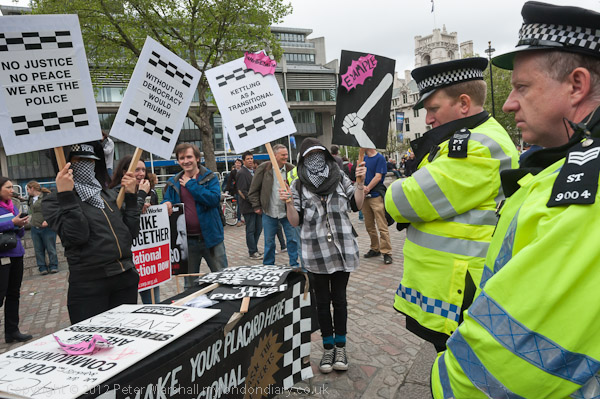
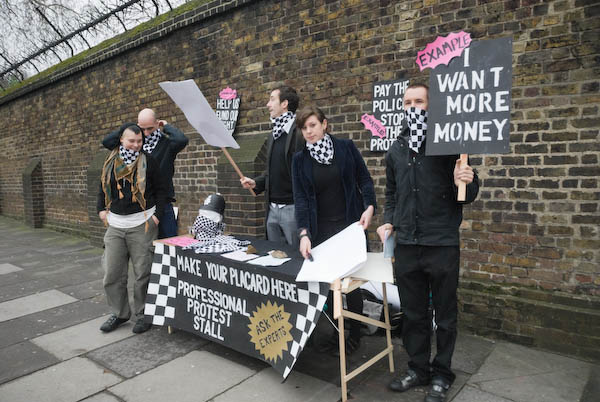
The professional protest stall offers advice to the police on making placards and more

Fortunately a few left-wing groups turned up to give the police some advice and examples on demonstrating. The Space Hijackers had a Professional Protesters Stall at Hyde Park Corner, offering advice on making placards (and materials – although I don’t think anyone took up their offer), handing out leaflets on ‘Your Rights as a Protester’ as well as some suitable chants.
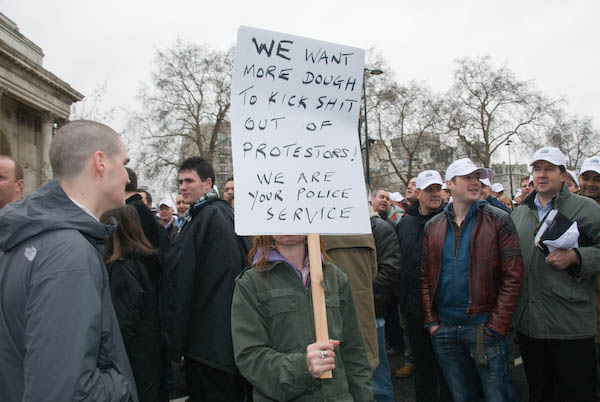
Their
What do we want?
More Money!
When do we want it?
Backdated from Spetember 2007!

did draw a few smiles and even the occasional cheer from those walking past, but most officers showed a total lack of humour, and there was quite a lot of abuse and offensive language directed at them.
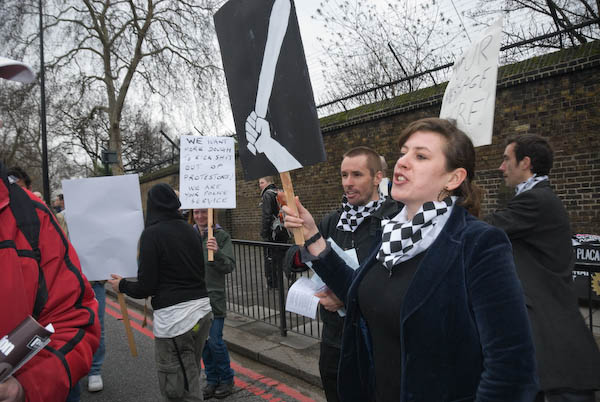
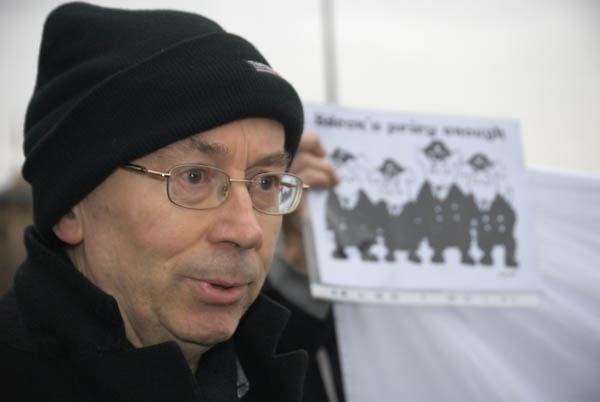
Some officers allowed themselves to smile, but others were abusive, some using language that could have got them arrested if there were any police around

more pictures

Ian Bone of Class War

Earlier, a group of around twenty from ‘Class War’ had made their opposition clear at the start of the march; the slogan on one cartoon showing four pigs in police uniform reading ‘Bacon’s pricy enough’ [sic]. Another showed a member of the riot police being hit on the back of the head by a brick.
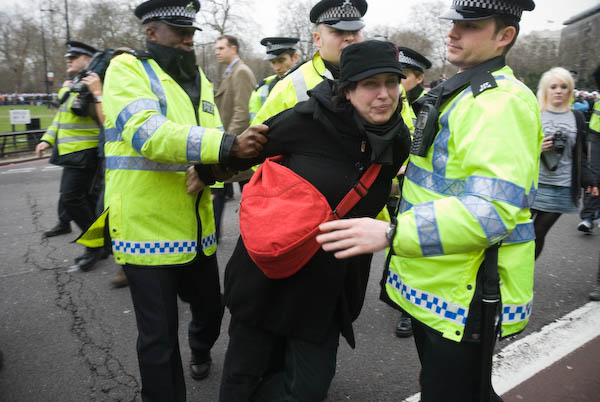
A ‘FITwatch’ demonstrator is arrested when she refused to move out of the road

Some FITwatch protesters gave out leaflets and then attempted to block the march by standing on the roadway. Their protest held up the start of the march for almost half an hour until the police on duty for the day made a couple of arrests.

Surrounded by a media scrum, police tried hard to keep things relatively calm and made repeated attempts to the two to go back onto the pavement before making the arrest.

more pictures


Police Honour Colleagues Killed on Duty

Police Memorial, The Mall
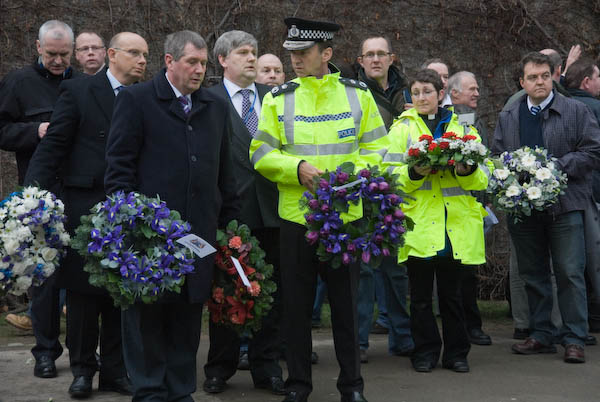
Preparing to lay wreaths at the National Police Memorial

I think there are many, many problems with the police, some of which arise from our problems with governments, but in some respects ours are still some of the better police forces around the world. Despite often having minor issues with them while working – and having once been threatened with a conspiracy to fit me up that was serious enough for me to make a complaint (and receive some kind of apology) there are still times I’m pretty glad they are there. Particularly when they drove up and rescued me from a vigilante attack.

Police – like firemen – frequently put themselves at risk through their work, at times requiring considerable bravery; and several thousands have lost their lives serving us over the years. Although this is something that deserves public recognition, I was not sure it was entirely appropriate to make use of the National Police Memorial as a part of the demonstration over pay. But the ceremony that took place was certainly solemn and dignified and expressed deep feelings among those taking part.
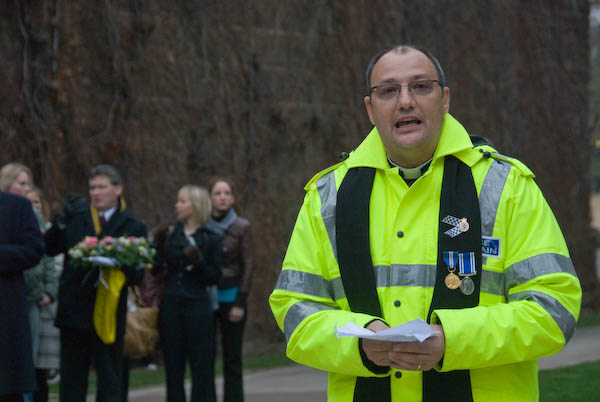
The service was led by a police chaplain

Officers and families from around the country made their way to the Police Memorial at the top of the Mall. There was a short service, including the laying of wreaths and a two minute silence, followed by the playing by two pipers.

more pictures.


FlickrFacebookMy London DiaryHull PhotosLea ValleyParis
London’s Industrial HeritageLondon Photos

All photographs on this page are copyright © Peter Marshall.
Contact me to buy prints or licence to reproduce.
Police, Public Sector & Peace Campaign – 2012

Police, Public Sector & Peace Campaign – Thursday 10th May 2012 saw two rather different marches by workers taking place in London, with a large protest by police and a day of public sector strikes with trade unionists marching to a rally. I also visited the Parliament Square Peace Campaign.


Police March Against Cuts and Winsor

Police, Public Sector & Peace Campaign

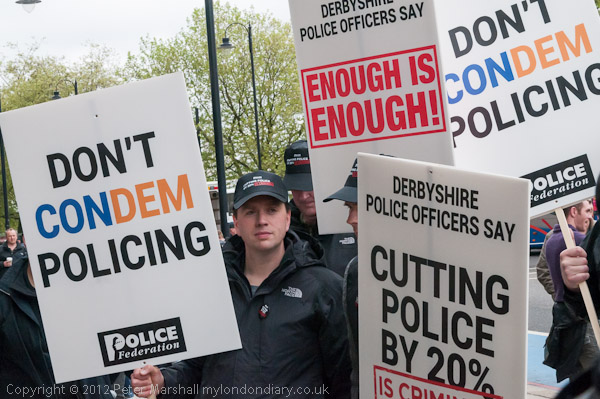
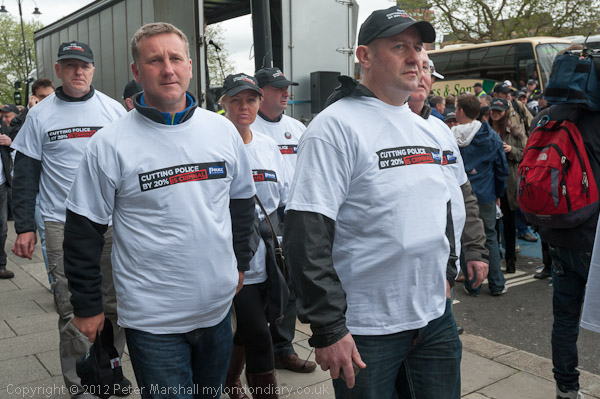
An estimated 20,000 police from all 43 forces in England & Wales marched through central London in protest at 20% cuts in police budget and proposed restructuring following the Winsor review. Other groups including Occupy and Right To Protest and others joined in call for justice in the policing of protest.

Police, Public Sector & Peace Campaign

Police are not allowed to strike or belong to a proper trade union but can join the Police Federation, a staff association that can represent and support their interests. Although it cannot call for strike action it can organise demonstrations such as this one, attended by off-duty police and some family members.

Police, Public Sector & Peace Campaign

It was an impressively large march, but rather dull as it marched past the Home Office, the Houses of Parliament and Downing St, most wearing black caps. The Police Federation had provided 16,000 black caps to represent the number of warranted officers expected to be lost over the next four years due to the cut in the police budget of 20-30%.

Police, Public Sector & Peace Campaign

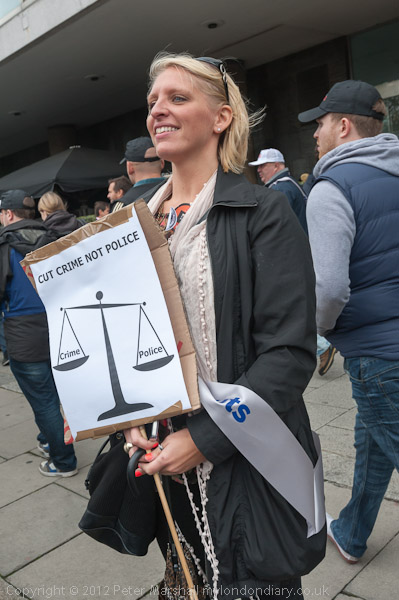
My pictures concentrate too much on the relatively few officers from some areas who had come with placards. Most simply marched and mainly in silence. A few carried carried small posters with the names of officers who had been unable to attend due to being at work – and there were some police who were policing the police protest, on rather better behaviour than at some other protests.

Some people also came to protest against the police, with the Space Hijackers setting up a ‘professional protest stall‘ at the side of the march offering advice on making placards and chanting. Most of the police marchers were amused by their chants such as ‘One Solution – Institution’ and some of the mock placards, although there were a few jeers.

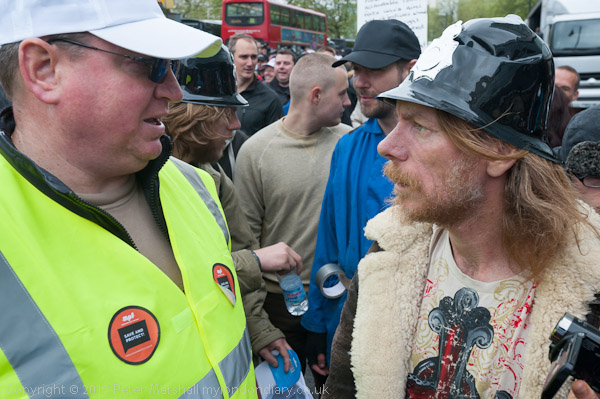
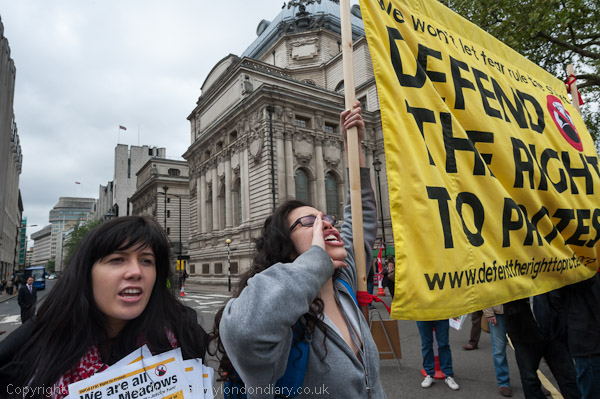
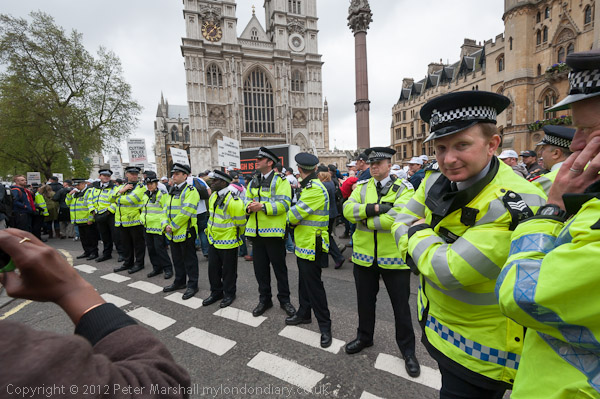
Those Police policing the protest were less amused, and threatened the Space Hijackers with arrest unless they removed one of their placards with the well-known acronym ACAB. They also stood in front to try and hide them and other protesters including those with a ‘Defend the Right to Protest’ who were shouting slogans against police violence and over deaths in custody for which there is seldom if any justice.

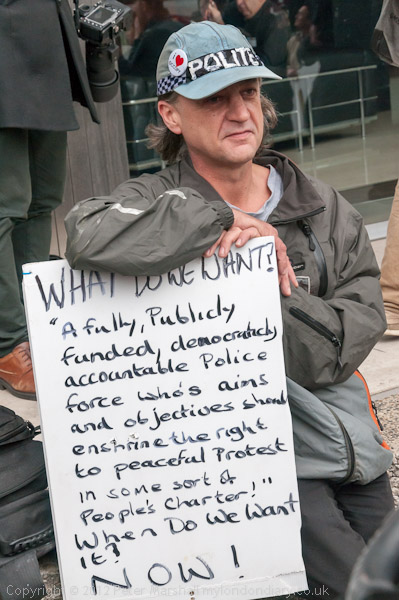
Some from Occupy London had come with plastic police helmets to join in the march, saying they were not against the police but called for a force that worked for the 99% rather than the 1%, or as one long-winded placard put it, “A fully, Publicly funded, democratically accountable Police force who’s aims and objectives enshrine the right to peaceful Protest in some sort of People’s Charter!”

Others taking part on the march included Ian Puddick who got intimidated, attacked and prosecuted by City of London Terrorism Police and Counter Terrorism Directorate in an operation costing millions carried out on behalf of a giant US security corporation after he discovered his wife had been having an affair with one of her bosses. He marched with a sign ‘Police Corruption‘ and unfortunately there is still a great deal of that as well as racism in forces around the country.

More on My London Diary at Police March Against Cuts and Winsor.


Public Sector Pensions Strike and March

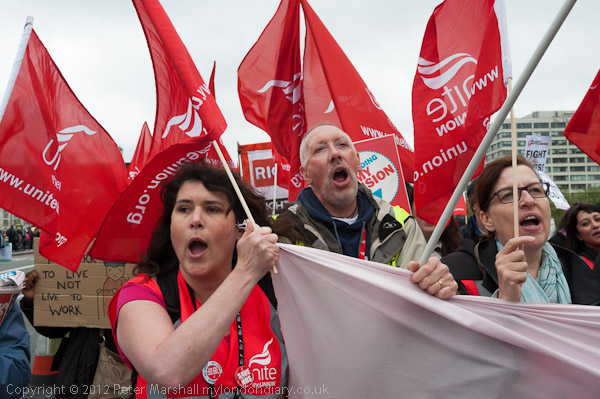
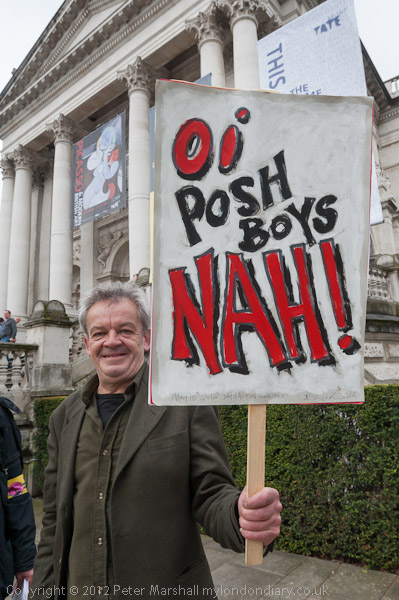
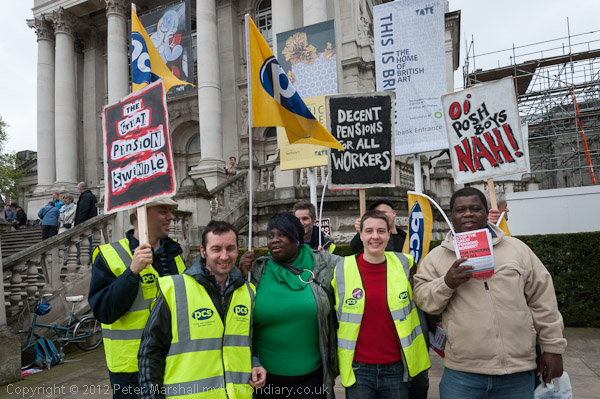
Unite, PCS and UCU were holding a one day strike against public sector cuts in pensions, jobs and services. Many had been up in the early hours picketing at their workplaces long before I arrived in London, but there were still pickets in place when I visited Tate Britain and walked past the House of Commons on my way to a rally outside St Thomas’ Hospital on the opposite bank of the Thames.

I arrived late for the rally there and people were just getting ready to march to a larger rally at Methodist Central Hall.

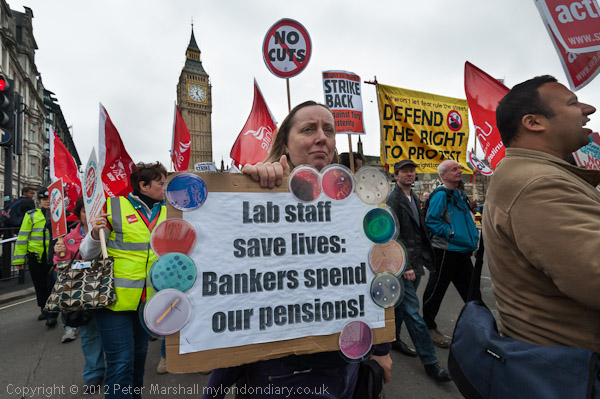
Workers are incensed by increases in their pension contributions and plans to increase them further. They are also worried by the increasing state retirement age which also applies to their pensions. Now in 2024 it is 66 and will increase to 67 between 2026 and 2028. A further rise to 68 is planned and the date for that is likely to be brought forward – as the rise to 67 was.

As they marched, people were chanting “Sixty-eight – is TOO Late“. Pensioners also feel they are being cheated by the government’s decision to index them to the CPI inflation rather than the higher RPI inflation figures, which will mean them receiving some 15-20% less. Over 94% of Unite’s NHS members voted to reject the government’s proposals and take strike action today along with members from the Ministry of Defence and government departments as well as others from the PCS and UCU.

I left the marchers as they went into the rally at Central Hall and returned to photograph the police march and visit the peace camp in Parliament Square.

More pictures at Public Sector Pensions Strike and March.


4000 Days in Parliament Square

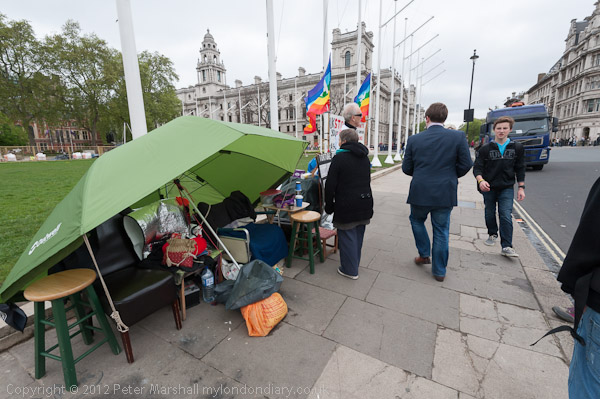
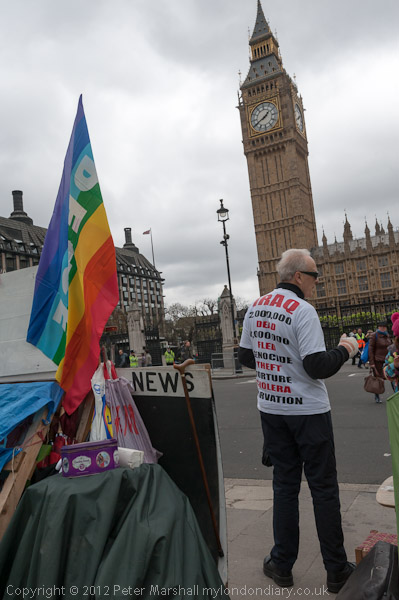
I went to talk with Barbara Tucker who was continuing the Parliament Square Peace Campaign begun by Brian Haw on the 2nd June 2001. The protest, continued by her and other supporters was about to reach a total of 4000 days of 24 hour protest in the square, with others in the group maintaining the presence on those various occasions when Brian or Barbara was arrested and held overnight.

They had then continued for almost 11 years despite constant harassment years by police, who have been pressured by politicians – as well as passing two Acts of Parliament intended to end the protest.

As I wrote in 2012:

A few hours before I arrived, police had come and spent 90 minutes “searching” the few square meters of their display in the early morning, and three days later, at 2.30am on Sunday 13 May, police and Westminster Council came and took away the two blankets that Barbara Tucker, no longer allowed to have any “structure designed solely or mainly to sleep in” by law was using to survive in the open. This was apparently one of two visits over the weekend by police and council in which they illegally removed property from the site.

4000 Days in Parliament Square.

Despite an increase in harassment as a great attempt was made to clean up the capital for the Olympics, the peace protest continued in the square for another year, with Barbara Tucker starting a hunger strike in January 2013. Eventually she became too ill to continue and the protest came to an end in May 2013.


FlickrFacebookMy London DiaryHull PhotosLea ValleyParis
London’s Industrial HeritageLondon Photos

All photographs on this page are copyright © Peter Marshall.
Contact me to buy prints or licence to reproduce.

Police & Public Sector March, 4,000 Days

PPolice & Public Sector March, 4,000 Days of the Parliament Square Peace Campaign approaches – some of my pictures from Thursday 10th May 2012.


Police March Against Cuts and Winsor – Westminster

Occupy supporters in plastic helmets joined the police march

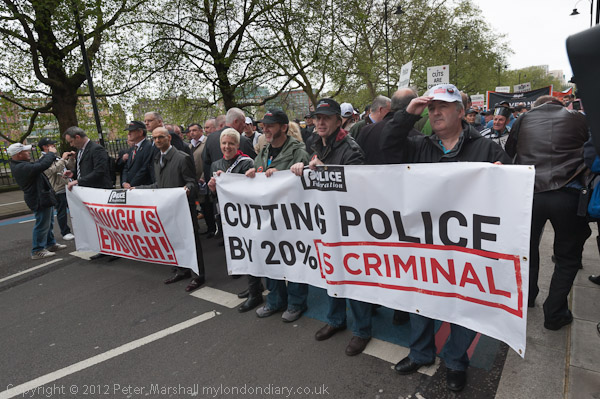
An estimated 20,000 police from all 43 forces in England & Wales marched through central London in protest at 20% cuts in police budget and proposed restructuring following the Winsor review. Occupy, Right To Protest and others joined in to protest for justice in policing.

Police are not allowed to strike or belong to a proper trade union, but the Police Federation can organise demonstrations like this when thousands of off-duty police, some with family members made a impressively large if rather dull protest past the Home Office, the Houses of Parliament and Downing St. Most wore one of the 16,000 black caps produced for the protest, the number of officers expected to be lost over the next four years as the police budget is cut by 20-30%.

Police officers attempt to intimidate the Space Hijackers

Like other public sector workers, police had suffered a two year wage freeze, as well as increases in pension contributions and many have also had large cuts in overtime. As well as those protesting, police were also on duty controlling the protest, though it was unlikely to get out of hand. But there were others as well as police, including the Space Hijackers who had a stall giving advice on how to protest, and also Occupy protesters who were calling for “a fully, Publicly funded, democratically accountable Police force who’s aims and objectives enshrine the right to peaceful Protest in some sort of People’s Charter!

Others were there to protest against various aspects of police corruption and faced some aggravation from the officers on duty as well as some protesters. The Defend The Right To Protest group reminded police marchers of Alfie Meadows, Sean Rigg, Ian Tomlinson, Jean Charles de Menezes and many others killed or seriously injured by police officers. Officers on duty made some attempts to intimidate some of the non-police protesters – and also photographers covering the event.

More at Police March Against Cuts and Winsor


Public Sector Pensions Strike and March – St Thomas’ Hospital to Westminster

Public sector workers in Unite, PCS and UCU were on a one-day strike against cuts in pensions, jobs and services, and picketed workplaces and marched from a rally at St Thomas’ Hospital across Westminster Bridge to Methodist Central Hall for a further rally.

PCS picket at Tate Britain

Some of the pickets had begun at 5am, and a few were still in place as I walked past workplaces in Westminster – including the Houses of Parliament to meet the marchers coming over Westminster Bridge.

As they marched, many chanted “Sixty-eight – is TOO Late”, as retirement age is set to increase to 68 and beyond, while retirement contributions are increasing. They are also losing out because the government has decided to index pensions to the lower CPI inflation figures which mans they get around 15-20% less. Over 94% of Unite’s NHS members voted to reject the government’s proposals and take strike action today along with members from the Ministry of Defence and government departments as well as others from the PCS and UCU.

More on My London Diary at Public Sector Pensions Strike and March.


4000 Days in Parliament Square – Parliament Square Peace Campaign

Brian Haw came to Parliament Square to begin his protest there on the 2nd June 2001, and the Parliament Square Peace Campaign he started had been there for almost 4,000 days, with a presence night and day, 24 hours a day since then.

Barbara Tucker

After Brian’s death from cancer the protest was continued by Barbara Tucker and other supporters who have maintained the protest on those various occasions when Brian or Barbara was arrested and held overnight. Over the years the campaign has been subjected to frequent illegal harassment by police officers, Westminster Council officials and thinly disguised members of the security service, and laws have been enacted intended to bring the protest to an end.

A few hours before I arrived, police had come and spent 90 minutes “searching” the few square meters of their display in the early morning, and three days later, at 2.30am on Sunday 13 May, police and Westminster Council came and took away the two blankets that Barbara Tucker, no longer allowed to have any “structure designed solely or mainly to sleep in” by law was using to survive in the open. Clearly a blanket is not a structure, and police and council have also removed other items of property. Later her umbrella was also taken away. Barbara’s health deteriorated and she eventually had to leave the square, and the protest finally ended early in May 2013.

4000 Days in Parliament Square