Along the Cally & York Way

My walk around King’s Cross on Saturday 8th April 1989 continues. The previous post was King’s Cross Road – 1989

Alley, 7 Caledonian Rd, Pentonville, Islington, 1989 89-4d-13

Although I had begun this walk on my own, at some point I had joined up with others for a walk around the area organised by GLIAS, the Greater London Industrial Archaeology Society, of which I had long been a member, and some of the others taking part in the walk can be seen in this and some later pictures.

This alley is now an entrance to the Regent Quarter, an estate which “is currently arranged in two blocks and comprises approximately 260,730 sq ft of mixed-use real estate, across 12 office buildings and 20 retail and leisure units” which was purchased by Hong Kong based Endurance Land in 2018 who aim to revitalise the 3.5 acre site.

The name Regent Quarter applies to a larger area, mainly within Islington but also including the ‘Lighthouse’ block in Camden which largely grew up around the railway. Back in 1989 around a third of the buildings in the area were vacant, some derelict and the rest largely in poor condition, partly because of the blighting effect of uncertainly over future major developments in the area, much of which was then expected to be demolished for the Channel Tunnel Rail Link and in which I became interested through the Kings Cross Railway Lands Group in the late 1980s.

Old Forge, Business Centre, Caledonian Rd, Pentonville, Islington, 1989 89-4d-15

This is now a part of the Regent Quarter and I think these particular buildings in the block west of the Caledonian Road reached from the alley above through the opening at the centre of this picture are still present around this internal courtyard. But I can find no mention now of the Old Forge Business Centre name still in the area.

Old Forge, Business Centre, Caledonian Rd, Pentonville, Islington, 1989 89-4e-61

Another picture of the internal courtyard of what was the the Old Forge Business Centre.

Caledonian Rd, Keystone Crescent, Pentonville, Islington, 1989 89-4e-65

We returned to the Caledonian Road and I took this photograph across the road of one end of Keystone Crescent, but our walk conitnued north up the Caledonian Road, though I did photograph Keystone Crescent on other walks in the area.

Lanitis Fabrics, Caledonia St, Pentonville, Islington, 1989 89-4e-66

The group turned west down Caledonia Street stopping to admire the 1906 built frontage of the former Kings Cross Laundry, with the large intertwined KCL insignia. More recent signs included those for Lanitis Fabrics Ltd, and Stella Models, with signs calling for Machinists, Overlockers, Pressers, Finishers and Cutters, though I think the business had closed and the building was vacant. The building is still there, much cleaned up.

York Way, Pentonville, Islington, 1989 89-4e-51

Caledonia Street took us to York Way. I’m not sure but I think this may be one of the few listed buildings in the area at 34B, where the Grade II listing text mentions “The highly unusual roof structure is a notable survival.”

If so, the frontage on York Way is rather more impressive than this side of the building, with a nicely symmetrical frontage around an arched carriage entrance, a warehouse for the adjoining black lead works designed by Thomas Marsh Nelson and William Harvey in 1873.

I think this building was where I showed work and gave a presentation as a part of the The London International Documentary Festival in 2010, I think the first time the festival had included still photography.

Taxi depot, York Way, Pentonville, Islington, 1989 89-4e-53

I think the sign at the upper centre of the image once read COACHWORK DEPT with the later addition of MOTOCOL LTD. The sloping ramp to these first floor works was built for horses and this could possibly have been a converted stables.

Now it was a busy depot for London ‘black cab’ taxis, with the driver of one at right using an air line on a tyre and small group talking by a diesel pump.

Grange Motors, York Way, Pentonville, Islington, 1989 89-4e-55

A second picture shows others on the walk going to look more closely at Crash Repair Specialists Grange Motors, while more taxi drivers are now by the pumps. The alley along the side of Grange Motors led to an enclosed yard surrounded by derelict buildings, but I’ve not digitised the couple of pictures I made there. It was a dead end and we had to come back out onto York Way.

To be continued…

The first post on this walk was Kings Cross, St George’s Gardens & More


King’s Cross Road – 1989

My walk around King’s Cross on Saturday 8th April 1989 continues in this post. The previous part was Winged Lions, A School, Thameslink, Wine, Buses

Kings Cross Road, Lorenzo St, King's Cross, Camden, 1989 89-4d-32
Kings Cross Road, Lorenzo St, King’s Cross, Islington, 1989 89-4d-32

140-142 King’s Cross Road on the corner with Lorenzo Street had a distinct style to it, with the two oval windows and some interesting brickwork. British History Online states “This five-storey office block is largely of 1991 but incorporates the front and side elevations of a tenement building of 1888” and the view from where I made this picture is still much as it was before the rebuilding.

The two terracotta panels facing Lorenze Street are still there and together give the date of AD 1888. The BHO article suggests the architect was probably W. Youlle who was the architect for a similar building on Pentonville Road. The ground floor was occupied by shops – bricked up and fly-posted in my picture – with rooms and a toilet on each of the upper floors.

Almost legible in my picture is a line of text above what had been a shopfront on Lorenzo Street which appears to read ‘B R E E D O M E T E R S’ though some letters are unclear and part obscured by the no-entry sign. Perhaps someone will be able to clear up this mystery.

Leeke St, King's Cross, Camden, 1989 89-4d-33
Leeke St, King’s Cross, Camden, 1989 89-4d-33

The buildings at 5-11 Leeke St have become the offices for the Paul Hamlyn Foundation, established by Paul Hamlyn in 1987; after his death in 2001 this became one of the largest independent grant-making foundations in the UK. At left is a doorway with the date 1890 and an arm in armour holding the butt of a broken spear, the Irish Foster family crest for the Foster Parcel Express Co. The conservation area document describes it as “a microscope emblem”.

Kings Cross Road, King's Cross, Camden, 1989 89-4d-35
Kings Cross Road, King’s Cross, Camden, 1989 89-4d-35

These buildings are still there but their uses have changed and the café is now a property management company. The fine block at 150-158 was being refurbished in 1989 and is now home to an advertising agency.

Again British History Online is informative and suggests it was a speculative development. Built in 1902–3 with what it describes as a ” mildly ambitious” facade, it says that 154 and 156 had goods hoists and winches, though there is no sign of them in my picture.

Kings Cross Road, King's Cross, Camden, 1989 89-4d-36
Kings Cross Road, King’s Cross, Camden, 1989 89-4d-36

Again the BHO article linked above tells us that this was built as an office, workshops and stabling in 1899–1900 and was from many years occupied by J J Connelly who probably built it. The wide doorway at left was for horses with a ramp leading up to stables on the upper floor. It was apparently still being refurbished when I made this picture as offices for Community Service Volunteers. The structure is still there but looks rather different as the striped window shades have been removed and the frontage painted a uniform white.

The taller building at right was the Mary Curzon Hostel for Women, built in memory of his wife for Lord Curzon in 1912-3 to provide inexpensive hostel accomodation for working women. Again there is a fuller description in the BHO article. When it was taken over by the LCC in 1955 it was renamed the Susan Lawrence Hostel.

Dodds the Printers, Kings Cross Road, King's Cross, Camden, 1989 89-4d-24
Dodds the Printers, King’s Cross Road, King’s Cross, Camden, 1989 89-4d-24

Dodds the Printers had these shopfronts at 193-5 on King’s Cross Road for many years and their signage shown looked like something from a different age in 1989. From around 2013 the shopfronts have been put to other uses but the printers still appear to be in business at the rear of the premises down St Chad’s Place, the alley through the doorway in this picture. I’d taken a few photographs in this alley in 1986, which show the signs for Dodds on the back of their property.

Kings X Radio Cars, Kings Cross Road, Kin Pentonville Rd, King's Cross, Islington, Camden, 1989 89-4d-11
Kings X Radio Cars, Pentonville Rd, King’s Cross, Islington, 1989 89-4d-11

I turned left onto Pentonville Road, and took a picture of these shops on the north side of the road, all of which are now a Pizza Restaurant, though not the same Italian snack bar as in my picture.

There is still a clock high more or less in the same position though that blank wall has now got four windows. The rectangular clock permanently at three minutes past four which had I think once advertised a businness here has been replaced by a slightly bulky circular one which appears to change with the hours.

I walked a few yards west and tuned right up Caledonian Rd where the next post on this walk will begin. The first post on this walk was Kings Cross, St George’s Gardens & More.


Kings Cross, St George’s Gardens & More

The day after my short trip to Canning Town the weather was again looking good and so on Saturday 8th April 1989 I was out again walking and taking pictures. This time my starting point was King’s Cross St Pancras Underground Station (not then International.)

Kings Cross, Lighthouse, Pentonville Rd, Gray's Inn Rd, Islington, Camden, 1989 89-4c-41
Kings Cross, Lighthouse, Pentonville Rd, Gray’s Inn Rd, Islington, Camden, 1989 89-4c-41

Immediately on coming out of the station I crossed the Euston Road and took a photograph looking across the busy junction between Pentonville Road and Grays Inn Road. Later this was to be transformed into the death trap for cyclists it now is, after the road engineers were told to ignore cyclists in planning the junction, and I’ve photographed a number of protests there. In the past ten years at least three cyclists have been killed and 15 seriously injured here.

Back in 1989 before the redesign it was almost certainly safer, as traffic here was usually moving rather more slowly – and in my picture I think is at a complete standstill.

The building at the centre of the image is the famous “lighthouse” whose presence has invited a litany of stories, almost all empty fabrication and speculation. But it seems that it was built between 1875 and 1885 to promote Netten’s Oyster Bar then doing a roaring fast food service at street level. Later the block became home to one of London’s best known jazz record stores, Mole Jazz, which opened at 374 Gray’s Inn Road in July 1978 – and I became one of its early customers, though I had given up buying records long before it closed in 2004.

The lighthouse seems in decent condition in my picture, but more recently deteriorated and became covered in graffiti. The building has recently been refurbished as the Lighthouse King’s Cross office space, with a top floor bar and roof terrace around the lighthouse itself.

Kings Cross Station, Euston Ed, Camden, 1989 89-4c-42

I turned around and took another picture, looking back at Kings Cross Station across Euston Road. The view here remained much the same until around 2021 when the more recent buildings in front of the 1851-2 station building, designed by Lewis Cubitt, the younger brother of both Thomas Cubitt responsible for much of London’s nineteenth century housing and William Cubitt, another important developer, who gave his name to Cubitt Town on the Isle of Dogs and later served two consecutive terms as Lord Mayor of London.

The station building is Grade I listed, and the recent changes have I think greatly improved it.

St George's Gardens, Sidmouth St, Camden, 1989 89-4c-32
St George’s Gardens, Sidmouth St, Camden, 1989 89-4c-32

There are many parts of London which it is hard to assign a name to, and the one I was walking around on this Saturday was one of them. My street atlas calls it ‘St Pancras’, I think it is part of Camden’s King’s Cross Ward, and when I’ve often walked across it from Tavistock Square I’ve always thought of it as Bloomsbury. Wikipedia has a rather lengthy discussion which says in part “Bloomsbury no longer has official boundaries and is subject to varying informal definitions, based for convenience“.

St George’s Gardens began in 1713-4 as a joint burial ground for St George-the-Martyr, Holborn (in Queen’s Square, now known as St George’s Holborn) and St George’s Bloomsbury and still has a line of stones marking the division of the area between the two churches, both of which had run out of space for burial in their churchyards. It was one of the earliest London burial sites situated away from the churches it served.

St George's Gardens, Sidmouth St, Camden, 1989 89-4c-34
St George’s Gardens, Sidmouth St, Camden, 1989 89-4c-34

But people kept on dying, and where buried here, mainly in unmarked graves. By 1885 there was no more room, and it was closed for burials. As a consecrated burial ground it could not be built on and burial grounds such as this were fast becoming the only open spaces in central London. “Campaigners including Miranda Hill and the Kyrle Society and Octavia Hill fought to create ‘outdoor sitting rooms’ to ‘bring beauty home to the poor’. St George’s Gardens were opened in 1884.”

St George's Gardens, Sidmouth St, Camden, 1989 89-4c-33
St George’s Gardens, Sidmouth St, Camden, 1989 89-4c-33

I made ten pictures here, of which three are online. The Friends of St George’s Gardens say that by 1997 the gardens were very run down, though I don’t think this is apparent in my pictures which show neatly cut grass and generally well-tended areas. The Friends were formed in 1994 when they say there had been a “prolonged period of neglect” and the gardens have been restored since then, with a lottery grant in 2001 and other and continuing work by the Friends.

Houses, Frederick St, Camden, 1989 89-4c-12

Frederick Street was one of those developed by Thomas Cubitt and Numbers 48-52 date from 1815-1821, a few years earlier than some of the other Grade II listed houses on the street. Before making this picture I’d also photographed (not online) on of his terraces in Ampton Street, parallel and a few yards to the south. Both run east from Greys Inn Road, where in later years I often visited the NUJ offices on the corner with Acton Street.

Royal National Throat, Nose and Ear Hospital Swinton St, Camden, 1989 89-4c-16
Royal National Throat, Nose and Ear Hospital Swinton St, Camden, 1989

Walking north up Greys Inn Road past the NUJ offices (now at ground floor Bread&Roses @ The Chapel Bar) the next corner a few yards on is Swinton Street, and a few yards down there is this five floor frontage of the Royal National Throat, Nose and Ear Hospital towering above the fairly narrow street.

This hospital remained in use until March 2020, when it was closed a few months earlier than planned due to Covid-19. Until then it was still offering inpatients ear, nose and throat (ENT) and oral surgery, sleep diagnostics and allergy day case services.

The hospital had been set up in 1874 as the Central London Throat and Ear Hospital by two doctors who had previously worked at the first specialist throat hospital in the country, the Hospital for Diseases of the Throat in Golden Square.

The hospital’s original building was begun on the Grays Inn Road in 1875, and various other buildings and wards were later added, with the hospital eventually covering a large site between here and Wicklow St. This rather odd building on Swinton Street was the Nurses’ Home, built in the 1930s.

More about my walk in later posts.

Murdoch, Tower Bridge and Poor Doors

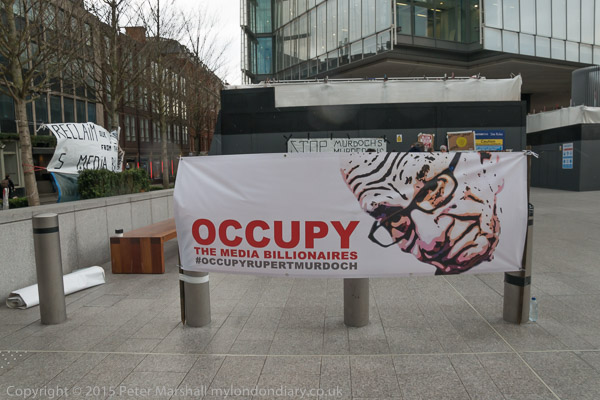
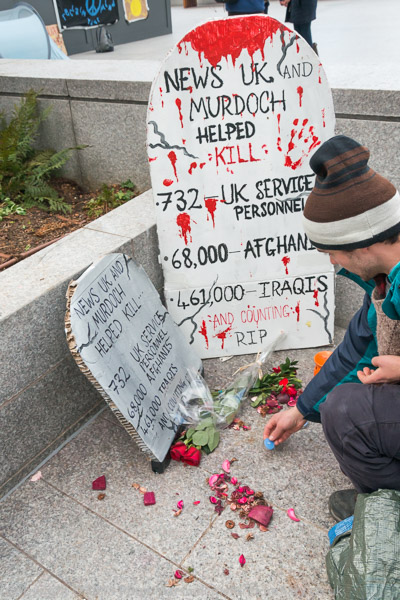
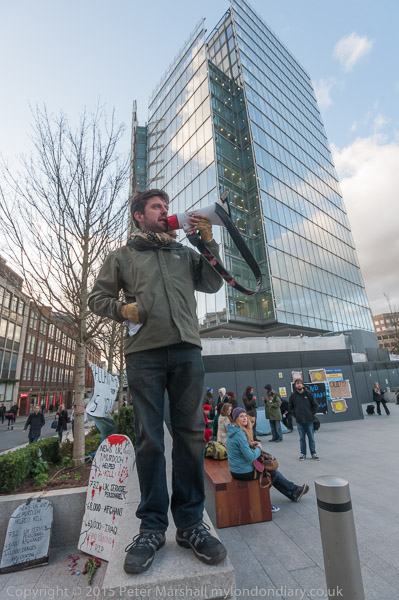
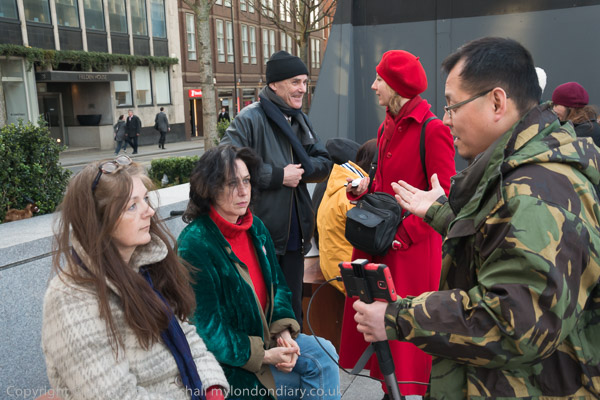
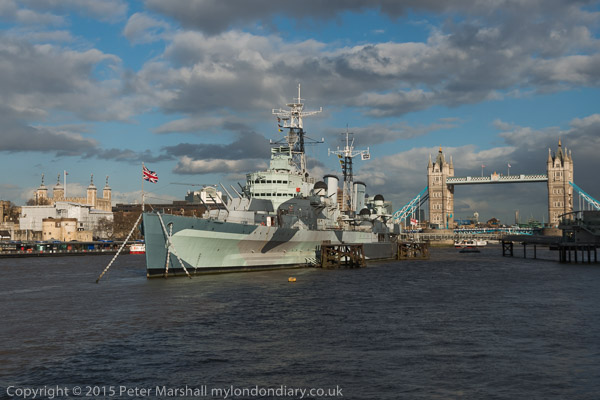
I came up to London on the afternoon of Thursday 26th March 2015 and began my work by going to News International opposite the main entrance to London Bridge Station where te week of Occupy Rupert Murdoch was on its fourth day. Not much was happening there, so after taking a few pictures I went for a short walk to Tower Bridge and back. Things were only just beginning to start for an evening of events there when I needed to leave and cross the river for another weekly protest by Class War at One Commercial Street.


Occupy Rupert Murdoch – News International, London Bridge

Thursday 26th March 2015

I’d been at News International three days earlier on Monday 23 March 2015 when campaigners against the scandal of the UK’s media monopoly, with 5 billionaires owning 80% of the media, had marched there the short distance from London Bridge to present an arrest warrant for Rupert Murdoch, charging him with for war crimes, phone hacking, political blackmail, tax avoidance and environmental destruction.

Thursday 26th March 2015

Someone from News International had come and taken the warrant, and the campaigners had then set up camp on the pavement outside for a week of activities, Occupy Rupert Murdoch Week. I’d been busy for a few days and this was my first opportunity to return and see what was happening.

Thursday 26th March 2015

The answer when I arrived late on Thursday afternoon was not very much, though the camp and some of its supporters were still there, and still putting up posters and telling people going into London Bridge Station opposite the camp why they were protesting.

Thursday 26th March 2015

I went for a short walk along the riverside to Tower Bridge and came back later when more people were beginning to arrive for the evening session. But unfortunately I needed to leave to walk across the river and join Class War in Aldgate before things really got going.

Occupy Rupert Murdoch


Around Tower Bridge

I’d thought that Tower Bridge was probably the most photographed building in London but a survey of Instagram tags in 2022 showed that Big Ben had inched ahead with 3.2 million posts to Tower Bridge’s 2.6 million.

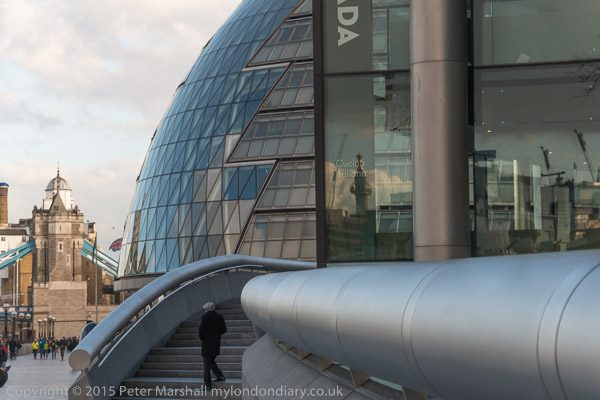
I don’t often feel a great need to add to the number of pictures of London’s most famous bridge, which I think I first photographed 50 years ago, though I’d gone under it on a school trip almost 20 years earlier, back before primary children had cameras. Most of the pictures which I’ve taken including it in the last 25 or so years have a group of protesters outside nearby City Hall in the foreground.

London’s City Hall is now no longer within sight of Tower Bridge, hidden out beside the ROyal Victoria Dock in Canning Town, though it was still in its rented home, bought back by the Kuwaiti state a couple of years earlier. Tower Bridge is still owned by Bridge House Estates, a charity set up in 1282, its only trustee THE MAYOR AND COMMONALTY AND CITIZENS OF THE CITY OF LONDON.

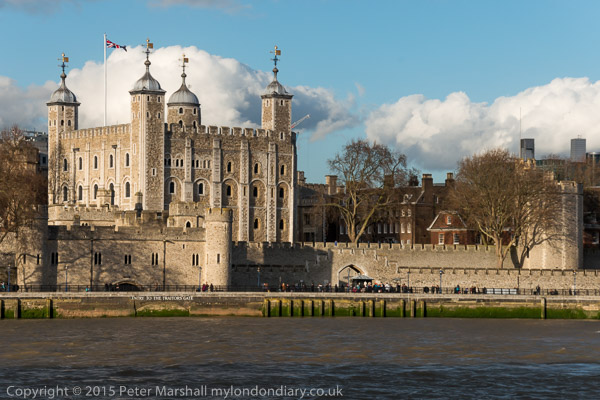
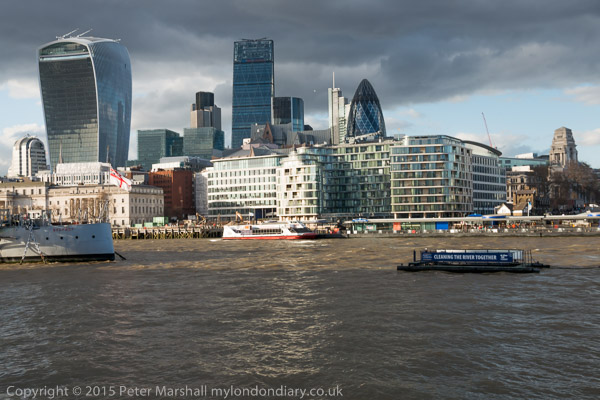
But mostly my attention was on the north bank of the river now rather dominated by a cluster of ugly and idiosyncratic towers in the centre of the City of London, until close to Tower Bridge where the Tower of London, actually outside the City in Tower Hamlets, still stands out despite its relatively low height.

Around Tower Bridge


A Quiet Night at Poor Doors – One Commercial St, Aldgate.

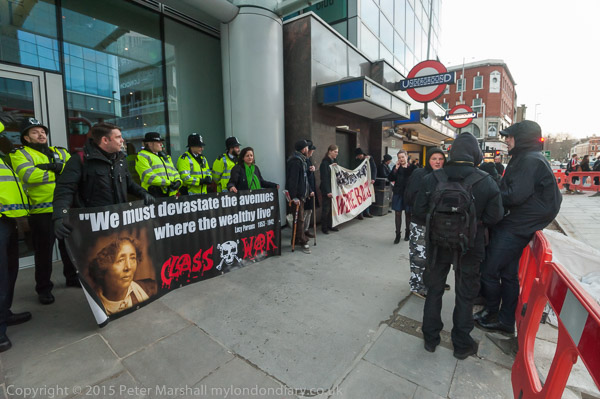
Eight months earlier in July 2014 Class War had started a series of weekly protest outside the massive largely residential block of One Commercial Street on the corner of that street and Whitechapel High St. The block includes flats for both private owners and a smaller number of socially rented flats, with the two groups having separate entrances.

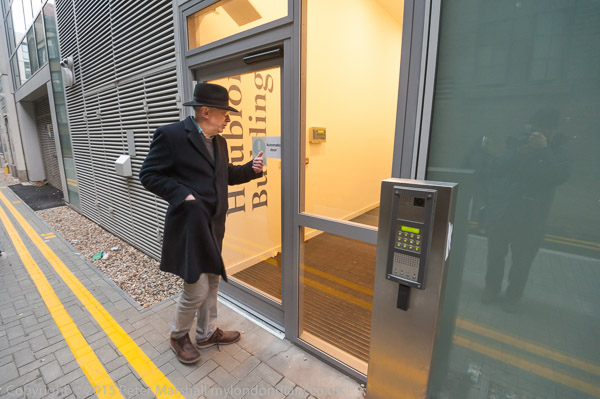
The ‘rich door’ is on the main road, next to the Underground station entrance, while the ‘poor door’ is down a side alley. When the protests began the alley was dark, with dumped rubbish and a strong and persistent smell of urine, but one positive result of the protests has been that the alley has been cleaned up and new lighting installed.

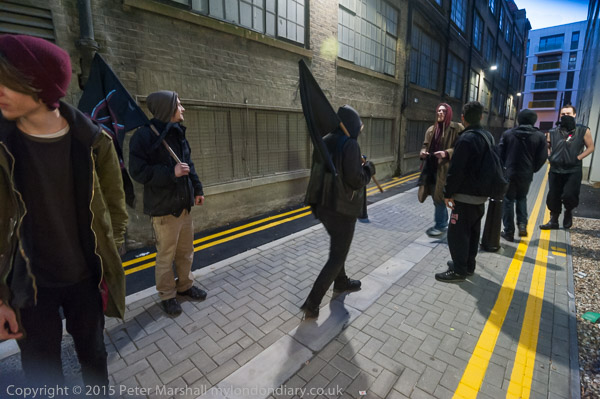
As the protesters were getting ready at the rich door, I went after Ian Bone of Class down the alley to look at the poor door. We returned to the front of the building and the rich door, followed by two police officers who had come to watch us.

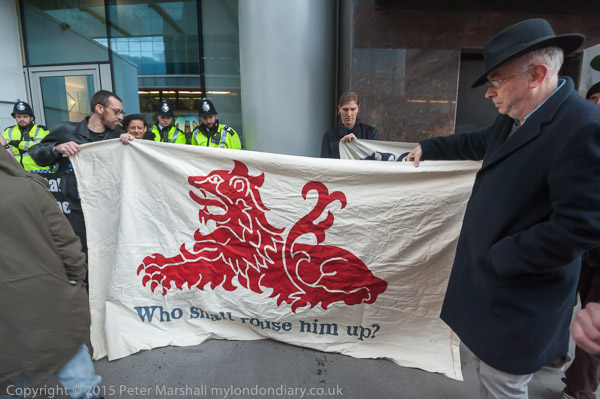
It was good to see again among the banners the ‘Epiphany’ banner based on the Fifth Monarchists who led a short-lived rebellion in London which began on 6th January 1660. Class War had taken part in the filming of a re-enactment of this event in 2013.

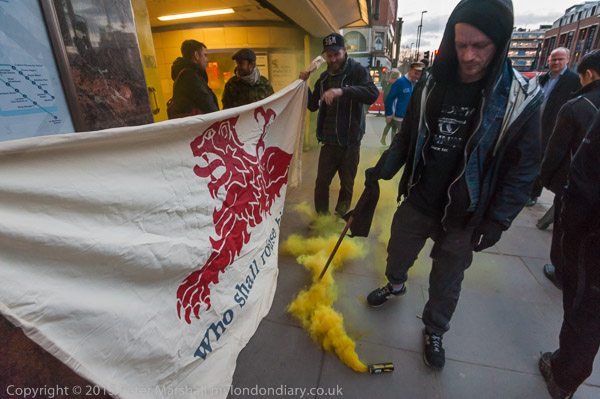
It began as a fairly quiet protest with speeches and some chanting, and at some point a yellow smoke flare rolled across the pavement.

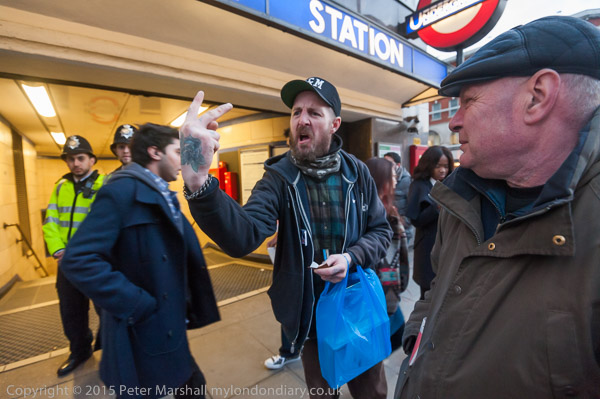
There was a small confrontation when one resident entering the rich door pushed rather roughly past the protesters, but very few came in or out of the rich door. The ground floor also includes shops and a hotel, and I think residents could probably use the hotel entrance. We had also found that they were able to exit via the ‘poor door’.

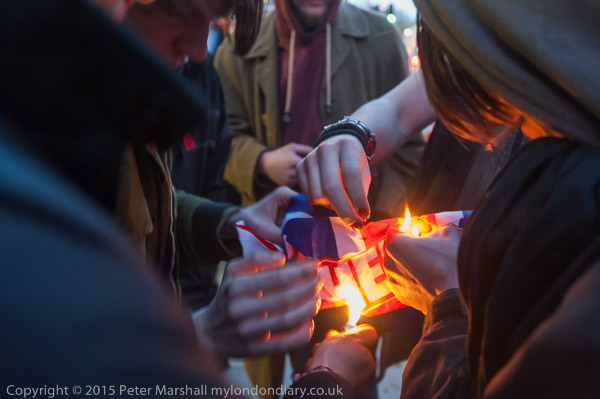
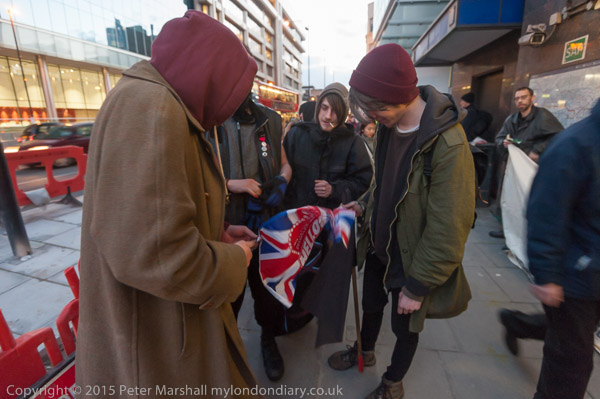
At the end of the protest some of the protesters who had brought a Hello! magazine Queen’s Diamond Jubilee flag attempted to burn it. But this turned out to be difficult and it melted a bit but didn’t catch fire. Some then when down the alley to look at the poor door before everyone left.

More pictures on My London Diary at Quiet Night at Poor Doors.

Canada Water, Southwark Homes & Cody Dock

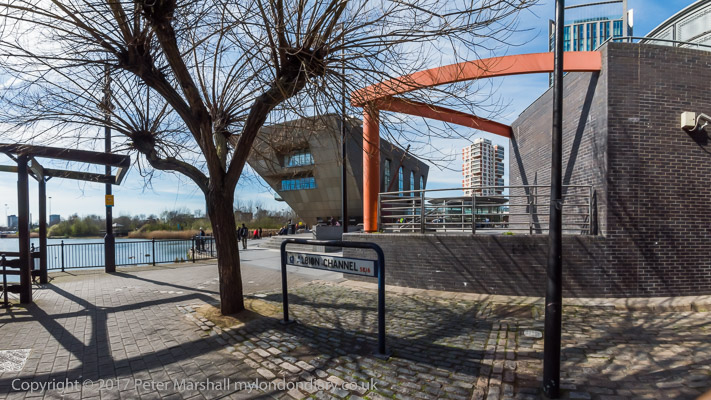
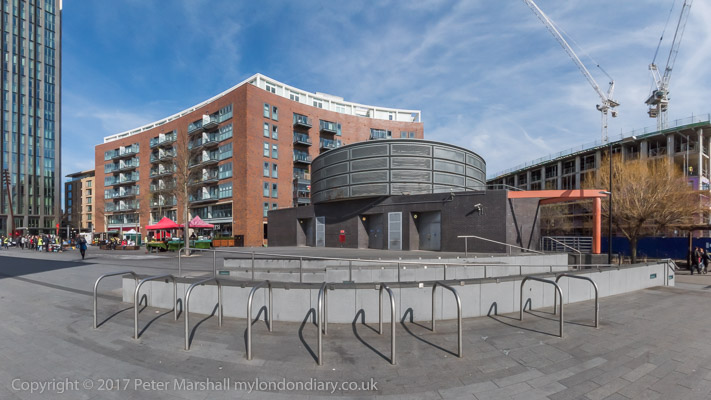
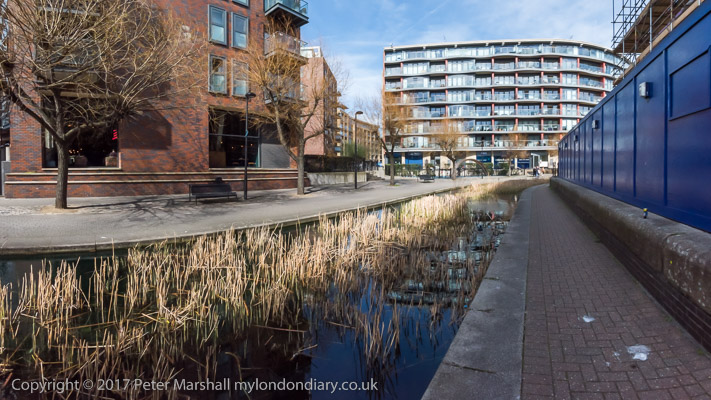
Canada Water, Southwark Homes & Cody Dock: Events and pictures from Saturday 25th March 2017


Canada Water, Southwark.

Canada Water, Southwark Homes & Cody Dock

The Surrey Commercial Docks were the largest area of London’s Docklands and the only large docks on the south bank of the River Thames, built on a large marshy area at Rotherhithe, a little closer to London than the Royal Navy dockyard at Deptford.

Canada Water, Southwark Homes & Cody Dock

The first dock here was dug out in 1696 and was the largest dock of that age, and could take 120 sailing ships. Later the dock became Greenland Dock, a base for the Arctic whaling trade, but in the 19th century there was a huge increase in trade with Scandanavia and the Baltic, and other docks were dug, as well as huge timber ponds which soon became its major trade.

Canada Water, Southwark Homes & Cody Dock
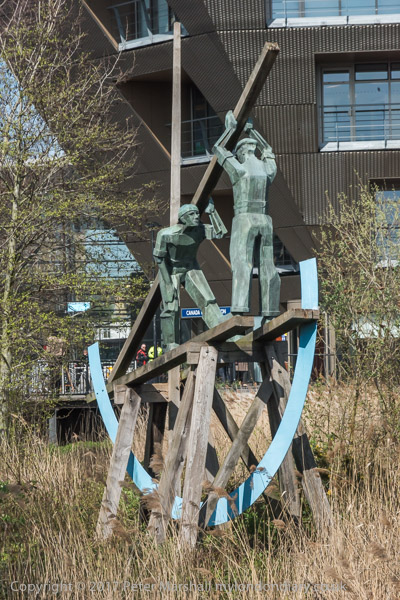
Deal Porters sculpture by Philip Bews

Surrey Docks was in full swing the in the Victorian age, with nine docks, six timber ponds and the Grand Surrey Canal. Badly damaged by bombing in the Second World War, the docks never fully recovered and were then hit by containerisation. The docks were too small to handle container ships and closed in 1970. Most of the docks were filled in and the whole area was redeveloped.

Canada Water, Southwark Homes & Cody Dock

By the time the London Docklands Development Corporation was set up by the Tories in 1980 the redevelopment initially led by Southwark Council was well under way and the area was set to have a rather different character from the redevelopments on the north bank.

But the LDDC appeared as the principal objector, to the council’s statutory development plan and was backed by the Department of the Environment. Southwarks plan for the whole of the south riverside from London Bridge to Deptford was rejected for showing ‘unrealistic commitment to public housing‘ and for its ‘opposition to office and other private development’. The LDDC went ahead with selling land and buildings for speculative development.

The LDDC rubbed its hands in glee at the thought of selling riverside sites which Southwark had planned for low cost rented housing to developers of large blocks of luxury flats, and rushed to clear aging council estates and replace them with privately owned properties, policies which were strongly opposed by Southwark Council.

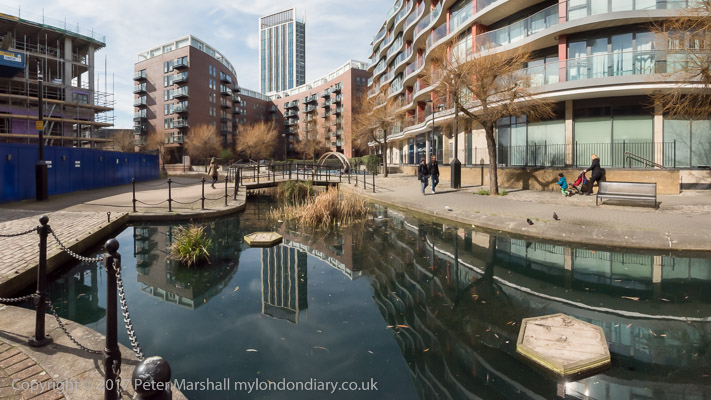
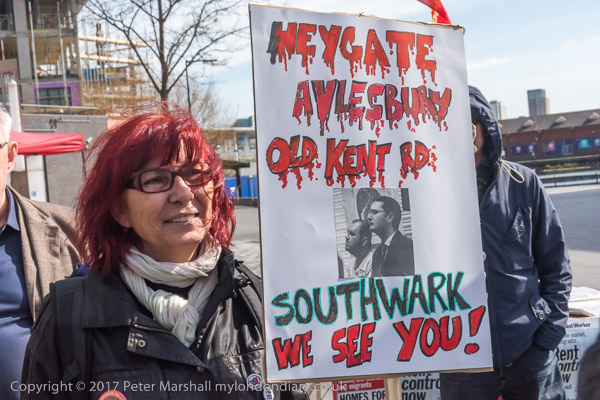
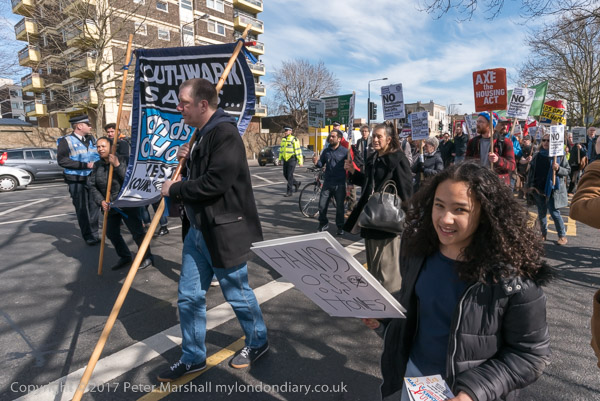
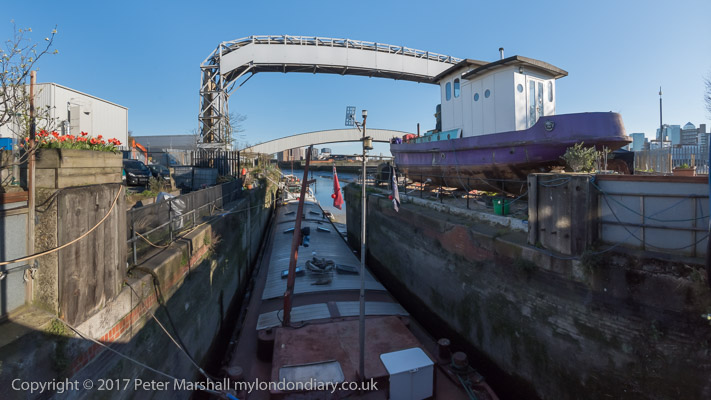
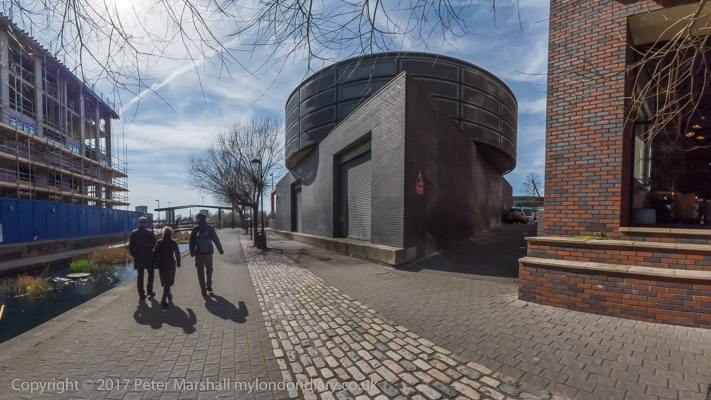
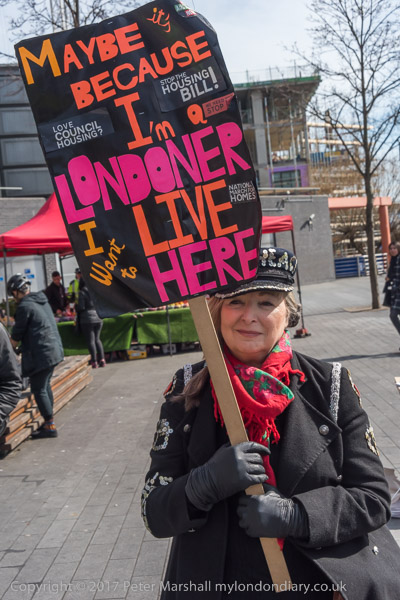
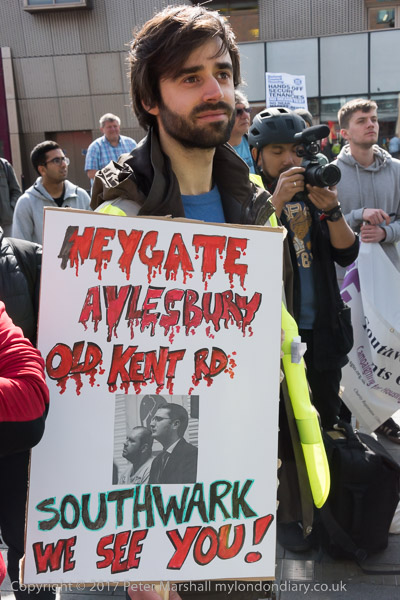
But times have changed, and I had come to Canada Water for a march where local people had come to protest against very similar policies by Southwark’s Labour council, working for and with developers to demolish estates such as the Heygate and Aylesbury, with the replacements including only a very small percentage of social housing. I’d arrived early on purpose to give me time for a short walk around before the protest began.
More at Canada Water.

Southwark march for homes & businesses

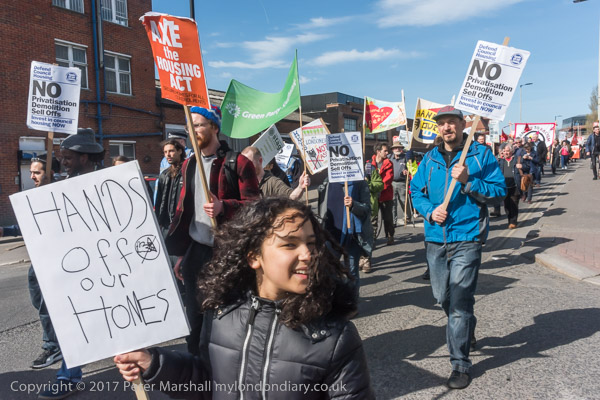
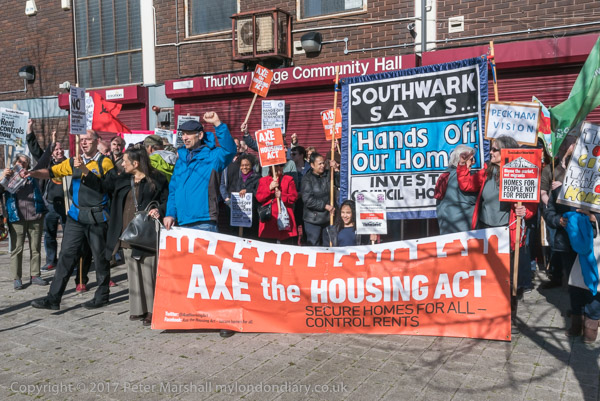
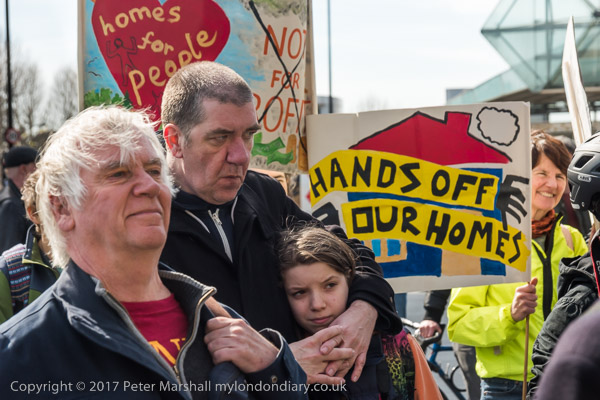
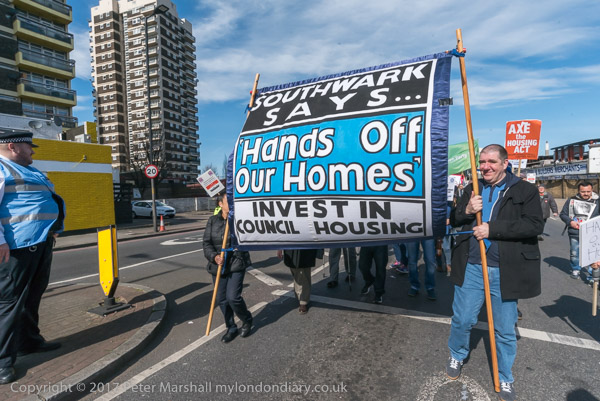
Southwark campaigners marched from Canada Water to protest at Thurlow Lodge Community Hall on the Aylesbury Estate, calling on Labour-run Southwark Council to save homes and jobs in the borough.
Marchers and speakers at the rally before the march included those from tenants and residents organisations, local business networks and others. They had come to oppose Southwark Council demolishing council estates for luxury home building, selling off public land to private developers and profit-oriented housing associations and forcing out small businesses through policies they say are solely concerned with realising asset values and trample on the rights and needs of local residents.

On My London Diary there is a long list of some of the groups involved, but there were others too.

One of the bigger battles, still continuing, is over the future of the Aylesbury Estate in Walworth, just south of the Heygate Estate at the Elephant and Castle, where the council lost a great deal of public money in providing a huge site with great transport links to allow a private developer to make huge profits, losing around 2000 social rent homes. Many of the new flats are empty boxes, investments for wealthy foreigner profiting from rapid increases in London property prices.

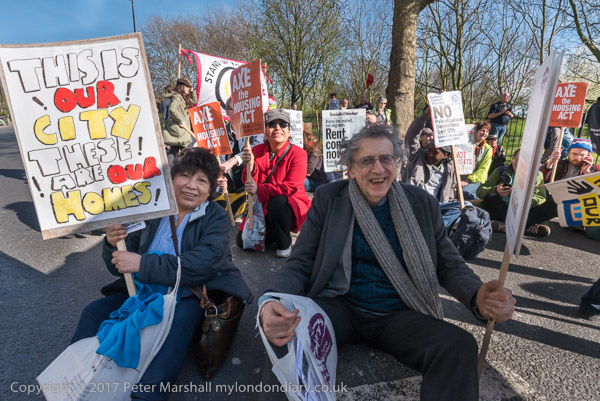
Piers Corbyn with others sitting down on Albany Road at the end of the march

Much of the Aylesbury estate has now been emptied, and some demolished. The council was found to have acted acting unfairly towards leaseholders who were being offered derisory compensation – usually less than half the market value of comparable properties in the area. Those who took the court case got improved offers, but there is little evidence of it changing its ways and trying to cheat others. Among those involved in fighting to save the Aylesbury on this march was Piers Corbyn, Jeremy’s older brother, in the news more recently over arguably less worthwhile causes, particularly in opposition to Covid restrictions.

The Aylesbury Estate had been at the centre of the Labour Party’s plans for the regeneration of council estates, the site of Tony Blair’s first big press event. But Labour’s policy was more about grabbing headlines than providing the good low-cost housing that a proper social housing policy requires. Councils such as Southwark have used it to demonise and run-down their large estates, spending large sums with PR companies to do so and working with major developers, rather than properly consulting with residents and putting the necessary cash into estate maintenance, running them down on purpose.

It was a long march to the Aylesbury Estate, detouring to pass several housing estates and business areas threatened by the council, and a tiring one on a warm and sunny March Day, and we were all tired by the time it ended outside Thurlow Lodge Community Hall. This had been saved earlier this year by a community occupation after Southwark Council had wanted to evict the occupants, Divine Rescue, a body with a soup kitchen offering support, training and meals to around a hundred homeless people, and runs a a food bank. Southwark wanted to sell or let the community hall to make more money.

The march organisers had planned to end the march here with Divine Rescue providing hot drinks and toilet facilities after the long walk, but Southwark Council had warned Divined Rescue that there lease would again be threatened if they had anything to do with the protest, forcing them to withdraw their offer. The hall was locked and shuttered, guarded by Southwark Council security when we arrived. It seemed a very petty piece of bullying by the council.

The protesters sat down on Albany Road blocking traffic for around 10 minutes in protest at this, then moved to the area in front of the community hall for a final rally.

Many more pictures from the march and the rallies before and afterwards on My London Diary at Southwark march for homes & businesses.


More From Cody Dock

From the Aylesbury Estate I made my way to Cody Dock for the opening of my show there, ‘All Along the Lea‘, black and white photographs from the 1980s and 90s, arriving an hour or two early.

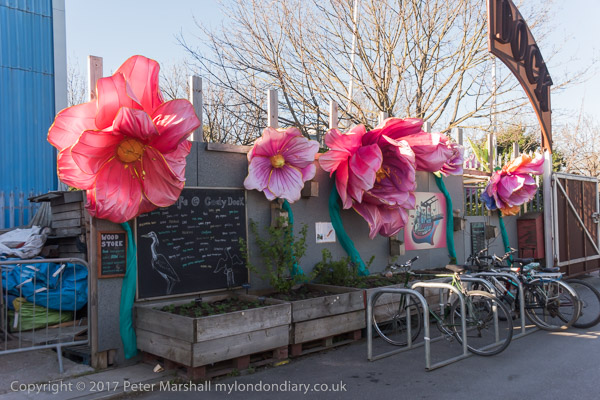
This gave me time to take a few more pictures, but also to have some food and a beer and listen to some live music and just to enjoy being there.

It was a pleasant opening with a decent crowd, with plenty of people coming to look at the pictures and talk, including the local MP. As I said and wrote, “When I took these pictures many people wondered why I was wasting time and film on such scenes, so I’m really pleased to have them appreciated now. “

I hadn’t chosen the title for the show, and it wasn’t accurate fro the pictures that were on the wall, almost all from Bow Creek. But I had photographed ‘All Along the Lea’ and my web site and the book ‘Before the Olympics‘ have pictures from the source at Leagrave to the outlets into the Thames both at Bow Creek, and, via the Limehouse Cut, at Limehouse Dock.


Wandsworth Panoramas – March 2014

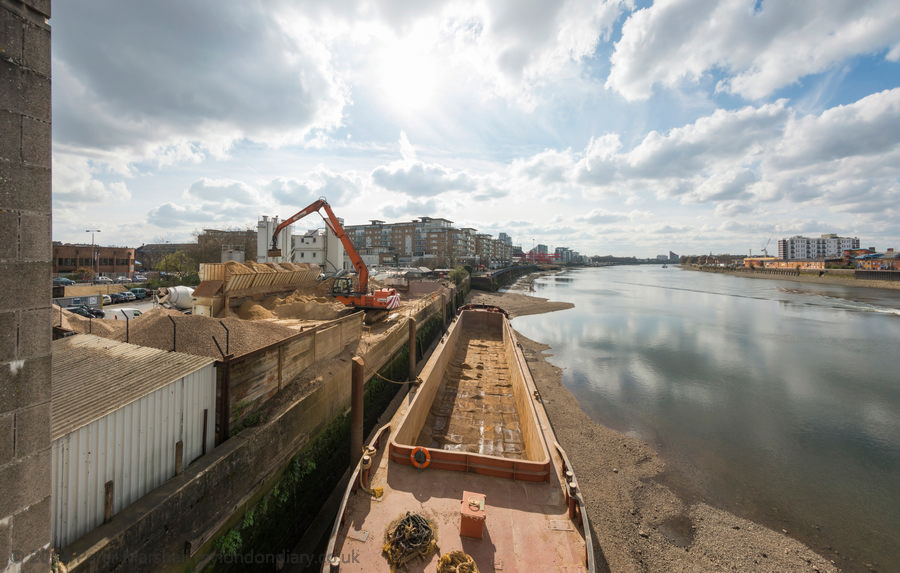
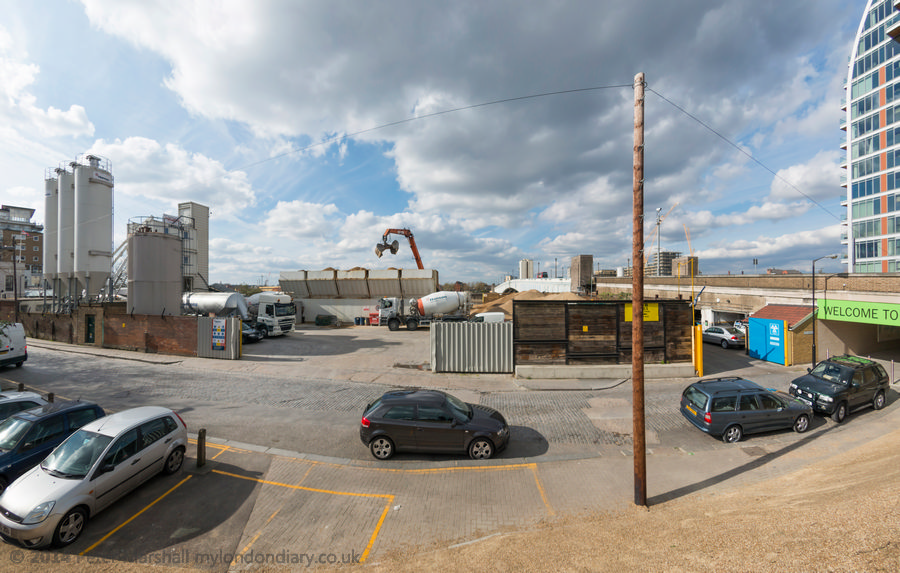
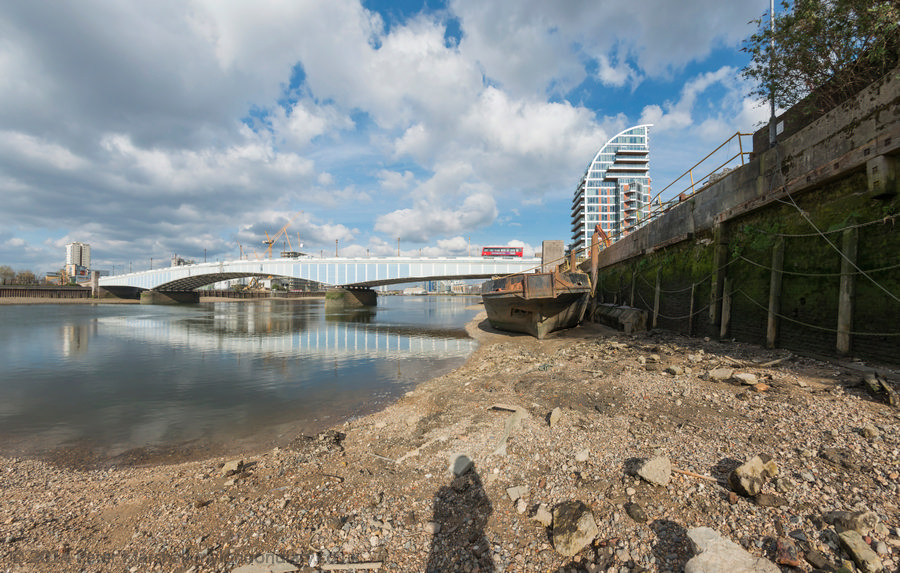
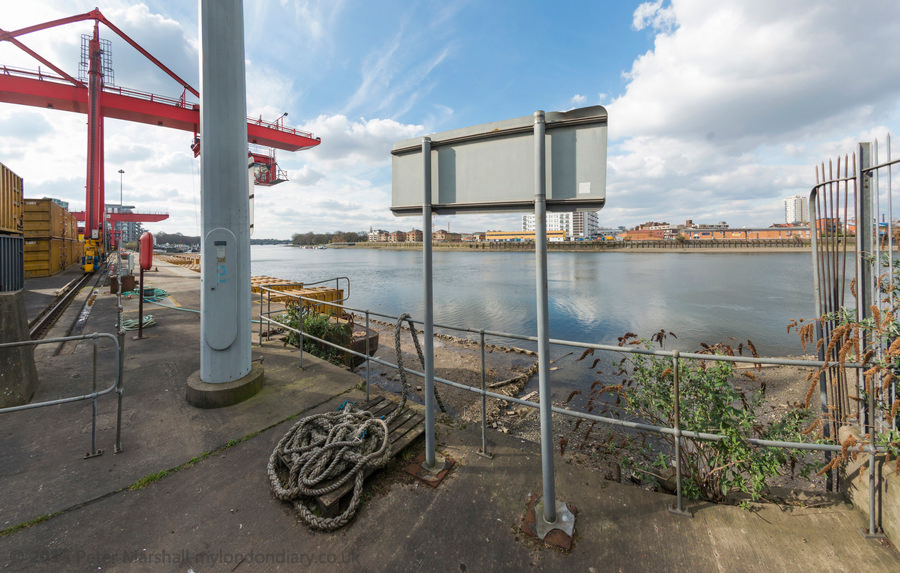
As a photographer I’ve long been interested in the difference between how we experience the world around us and how the camera records it. Some of those differences are obvious but others less so, and some we are seldom aware of.

Wandsworth Panoramas - March 2014

The camera records an image produced by its lens which follows strict optical rules which I learnt about long ago in my physics lessons, though real lenses deviate slightly from those ideal and perfect specimens in those science texts.

Wandsworth Panoramas - March 2014

The camera holds a film or sensor to record that image – and again does so following strict physical (and chemical for film) processes which may fail to record significant features and distort others to produce an essentially flat two-dimensional image. It may not even record colours but if it does they always to some extent arbitrary, as too are the tones.

Wandsworth Panoramas - March 2014

Those of us who grew up on film are perhaps more aware of this than the digital generations. We had to be aware of the differences in recording of, for example Ilford’s Pan F and Kodak’s Tri-X, and how these were affected by processing and printing, and of the rather unreal but different colour renditions of Kodachrome, Kodacolor, Ektachrome, Agfa, Ferraniacolor and the other colour film films, each with its own qualities. Though perhaps if we ever used Orwo film quality was not the right word for its purplish nature.

Wandsworth Panoramas - March 2014

Of course there are differences in the way digital cameras record colour, but these are rather smaller, and we can make use of software to make them match more closely or exaggerate the difference. Lightroom and Photoshop can make my Fuji files look very similar in terms of colour rendition to those from Nikon.

But our experience of a scene is very different, combining inputs from all of our senses, and it would be impossible to over-emphasise the subjective aspects. But even just visually it is still very different. While the lens cuts out all but a small rectangle in front of us, our eyes send information to the brain from a much wider field, much of it except from a small central section lacking in sharpness. Most of us have binocular vision, gathering this data from two eyes a short but significant distance apart, enabling us to see in depth. And our view is always dynamic, our eyes moving around, and as we swing our head around or up and down we have the sensation of moving through a static universe. Doing the same with a camera has a very different effect.

A standard lens – around 40 to 50mm on a full frame digital or 35mm film camera gives a similar idea of depth in its flat images to that we normally experience. With longer lens the effect of depth is reduced and by the time we get to really long lenses the images become flat patterns rather than appearing to represent a three dimensional scene. But what interested me more was what happened when the camera tried to represent a much wider angle of view than the standard, when the rectilinear rendering of normal lenses becomes impossible.

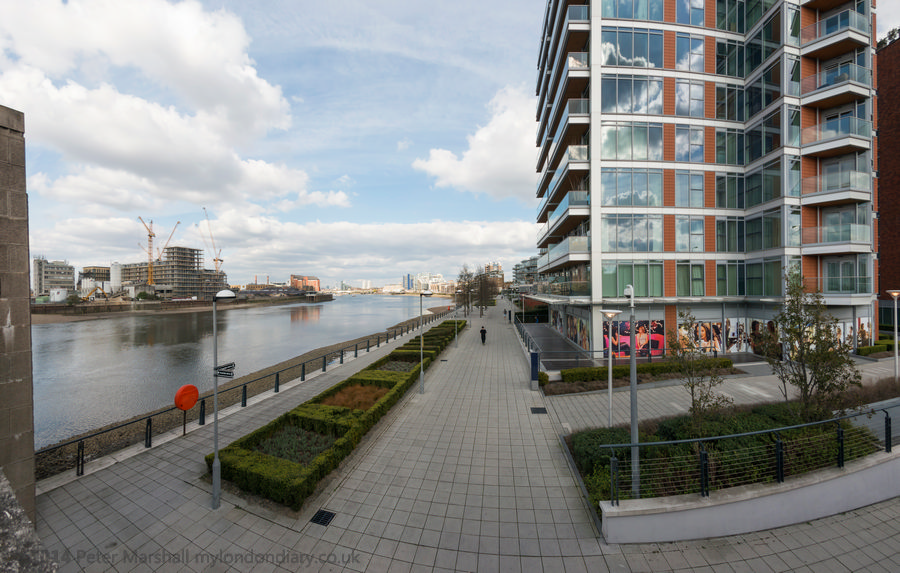
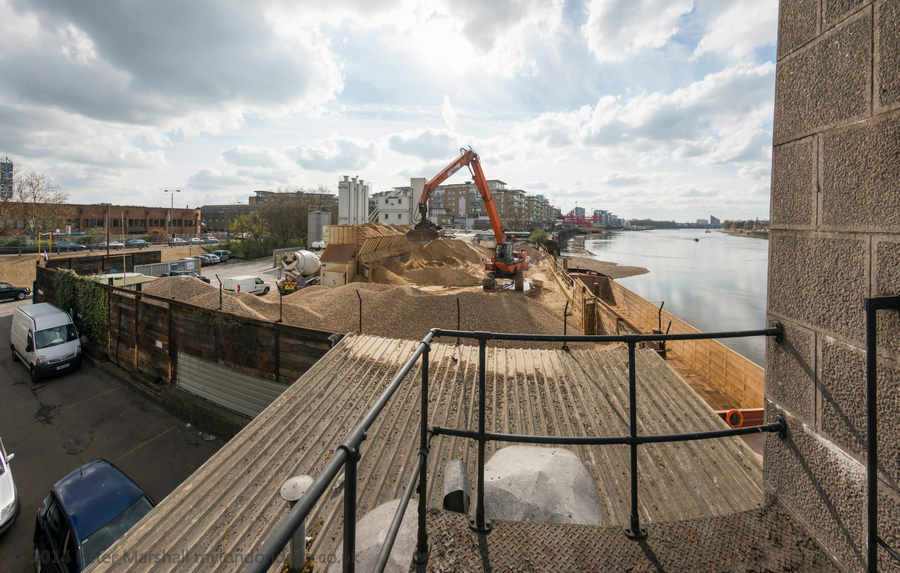
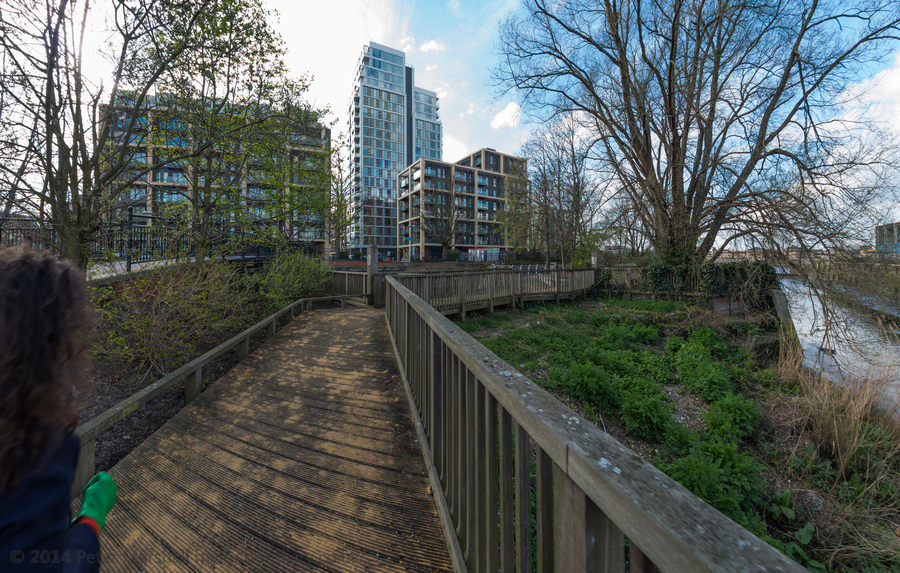
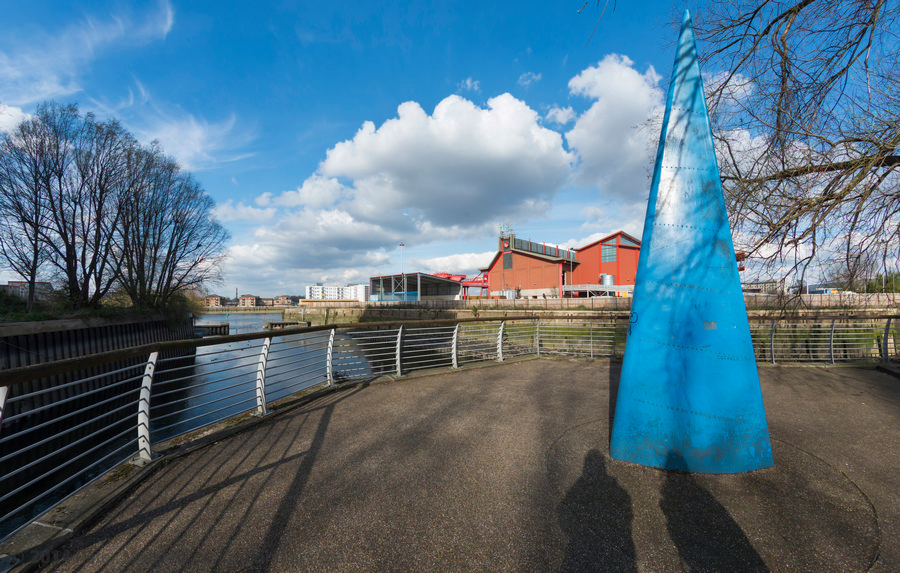
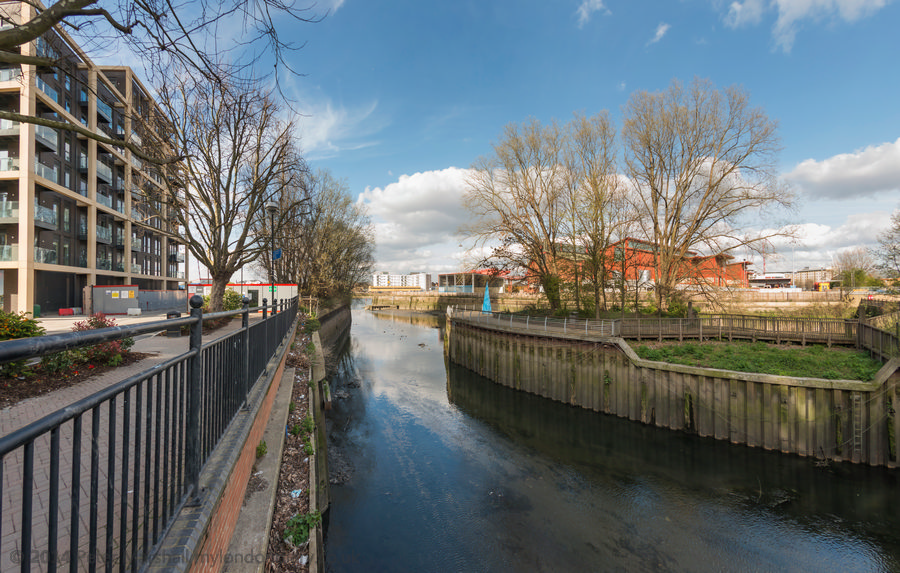
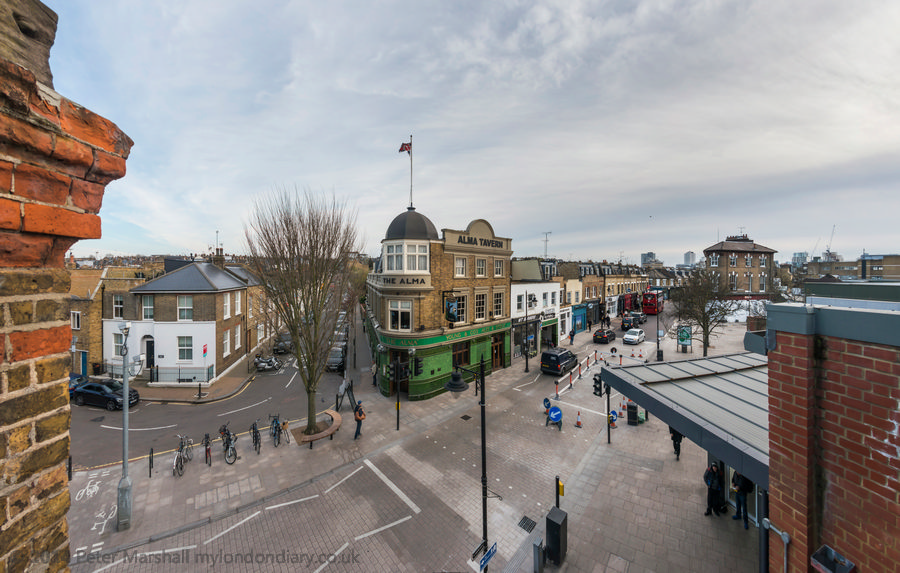
On Monday 14th of March I went for a walk with a painter friend who had brought her sketch book to introduce her to an area I thought she might find interesting. And I wanted to further explore some of the different ways of rendering very wide angles of view with digital cameras. I’d brought two Nikons with me, one fitted with a conventional wide-angle zoom which I used mainly at 16mm, close to the limit for such lenses (and I do have a wider lens which demonstrates this) and the other with a 16mm full-frame fisheye which fills the frame with an image which is 180 degrees across the diagonal.

While my friend stopped to make sketches I had time to make a series of images from similar locations. I kept warmer as I was moving around, but she fairly soon got cold, which was a good excuse to visit the pub which appears in some of these pictures, after which I took her back to the station where we had met and went back to take some more pictures on my own.

Back home I uploaded the images. Those from the conventional wide-angle zoom I’ve use as they were taken, with just the normal adjustments in Lightroom. But the fish-eye images I worked on with my panorama stitching software, PtGui, not to join images but to take the raw image data and process it it various different ways to produce cylindrical projections. If the camera was upright when the picture was taken, this will produce straight vertical lines for all upright elements. There are many different approaches to this which produce visually different results, some of which are common in mapping, such as Mercator.

Those I’ve found most useful are the equirectangular, Vedutismo and Transverse Vedutismo projections used in these examples.

More panoramic images from my walk on My London Diary at Wandsworth Panoramas.


More From Bow Creek, April 1989

The second part of a short walk by Bow Creek on Friday 7th April 1989. The first part is at Bow Creek, East India Dock Way, April 1989.

London Sawmills, Bow Creek, East India Dock Rd, Canning Town, Newham, 1989 89-4b-15

I walked back a few yards to the west along the East India Dock Road and made this picture looking south down Bow Creek, again showing the stacked timber on the wharf. The closer of the two bridges visible was I think just a pipe bridge, probably to carry gas from the nearby gasworks from Poplar to Canning Town, and has since been removed.

The second bridge is a Dock Road Foot Bridge, more commonly called the Blue Bridge (a name it shares with several others in London), though it also carries pipes and is still in place. I think it was intended to provide a route for people living in South Bromley to Canning Town station, and it leads to a bridge taking the footpath over the DLR, but unfortunately this has been almost permanently locked. It has been at least partly rebuilt since I made this picture

Hidden by this bridge a few yards further downstream and fenced off is another bridge, Canning Town Old Railway Bridge, long disused which was built to carry a single rail track over the river.

Pipe Bridge, Bow Creek, Tower Hamlets, Newham, 1989 89-4c-61

I walked on across Bow Creek and took this picture of the pipe bridge. As you can see it was well fenced off and although there were steps up and a footway across I could not access this.

All this brickwork on the Middlesex side of the river has gone, I think when the road bridge here was widened and a link road provided to the Limehouse Link tunnel but the brick abutment remains on the Essex side. The bridge was built to give sufficient clearance for navigation.

Pipe Bridge, Bow Creek, Tower Hamlets, Newham, 1989  89-4c-63
Pipe Bridge, Bow Creek, Tower Hamlets, Newham, 1989 89-4c-63

At the centre of the river I had crossed from Newham into Tower Hamlets. My street atlas names this area as South Bromley, but I don’t think anyone now knows where that is, as there is no station of that name, the DLR having decided on East India instead.

A few yards on along waste ground I made another picture showing the pipe bridge and the river, before turning back to the East India Dock Road. I made two exposures and I wonder if I may have chosen the wrong one to digitise as it is just slightly unsharp.

London Sawmills, Bow Creek, East India Dock Rd, Canning Town, Newham, 1989 89-4c-65
London Sawmills, Bow Creek, East India Dock Rd, Canning Town, Tower Hamlets, 1989 89-4c-65

Across the water you can see much of the planks produced by the sawmill on the wharf, as well as stacks on a further wharf downriver between the building around 50 yards away on land but half a mile downstream round what is now the Bow Creek Ecology Park. Behind the cut timber you can see part of the Pura Foods edible oils factory on the opposite bank of the invisible river, and above that the top of the flood barrier across the river on the other side of the factory.

Timber was for many years a major industry on Bow Creek and along the Lea Navigation, as the Surrey Docks just across the Thames was mainly a timber dock, with large timber ponds. Boats and barges would have brought huge trunks to sawmills such as this, and the cut timber was also mainly transported further on by barge.

Pura Foods, Bow Creek, Tower Hamlets, 1989  89-4c-52
Pura Foods, Bow Creek, Tower Hamlets, 1989 89-4c-52

I walked further east and used a short telephoto lens to make this image of Pura Foods. Their factory processing vegetable oils here at Orchard Place had grown considerably over the years, as had the smells from it, and many locals were pleased when the factory moved out in 2006.

Almost all of my pictures at this time were taken with a 35mm lens, giving a moderate wide angle view. The Olympus Zuiko lens I used was unusual in being a shift lens, allow me to move the optical elements relative to the film to give additional control over the perspective. It made it possible for example to photograph taller buildings without tilting the camera which would have resulted in verticals that converged.

Lens design has improved considerably since, and so have our expectations of lenses. Many of my pictures made then have a lack of critical sharpness at the corners which we would now find unacceptable. Digital imaging in particular means we now routinely look at images on a much larger scale on screen than the prints we used to make.

West Ham Power Station, Bow Creek, East India Dock Rd, Newham, 1989 89-4c-55

I crossed to the other side of the busy East India Dock Road, going along Wharfside Road under it, and made this view looking north up Bow Creek. As you can see the West Ham Power Station was then being demolished. This was the last in a number of power stations on the site since 1904, when West Ham Council built one here to power its trams. This was West Ham B, built in 1951 and it used coal brought up Bow Creek as well as coke from the neighbouring Bromley Gas Works.

Power production at the station dropped off from the late 1960s and it closed in 1983. By 1989 its two 300ft cooling towers had already been demolished and the rest of the station was following.

West Ham Power Station, Bow Creek, East India Dock Rd, Newham, 1989 89-4c-56

A second view shows more of the Newham (or Essex) bank south of the main power station building and the closer parts are again full of stacked timber.

Newham Council together with Tower Hamlets has plans for a number of new bridges in the area providing links across Bow Creek, at Lochnagar St, Poplar Reach near to Cody Dock and Mayer Parry connecting the Leven Road former gasworks site to roughly where the old power station was, now the SEGRO industrial park.

It had been a short and interesting walk and I made my way to Canning Town station for the slow journey home. Canning Town is much easier to get to since the Jubilee Line opened at the end of 1999.


Bow Creek, East India Dock Way, April 1989

I only had time for a short walk on Friday 7th April 1989, cycling home furiously from the college where I was teaching at noon as I had no afternoon classes, picking up my camera bag and rushing to catch a train into London.

Essex Wharf, Bow Creek, Pura Foods, Wharfside Rd, Canning Town, Newham, 1989 89-4b-31

Canning Town, where I was heading, was on the other side of London and not then the easiest of places to get to before the DLR and Jubilee lines were completed. My journey involved a slow transit around North London on the line from Richmond on the North London Line to the old Canning Town station immediately north of the A13 East India Dock Road, next to Stephenson Street.

Bow Creek, East India Dock Way

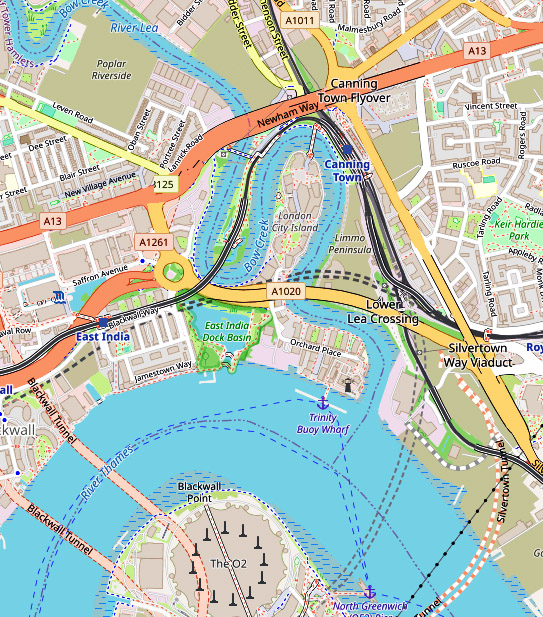
If you are not familiar with the geography of this area, a small clip from OpenStreetMap, slightly enhanced, will help. The East India Dock Road on this map is labelled Newham Way, which is here a flyover above the road itself. The former station I used was just to the north of this. Pura Foods was inside the loop which is now London City Island and there was no bridge across the river at the top of the bend.

Essex Wharf, Bow Creek, Pura Foods, Wharfside Rd, Canning Town, Newham, 1989 89-4b-34
Essex Wharf, Bow Creek, Flood Barrier, Pura Foods, Wharfside Rd, Canning Town, Newham, 1989 89-4b-34

A subway close to the station entrance took me to the other side of this busy road, where I had a view of Bow Creek, northern end of its loop dominated by Pura Foods, looking across waste ground where the DLR would shortly run. The flood barrier on Bow Creek became redundant when the Thames Barrier was built.

Essex Wharf, Bow Creek, Pura Foods, Wharfside Rd, Canning Town, Newham, 1989 89-4b-35

I moved slowly west along the East India Dock Road, stopping to take occasional images. There was a considerable amount of waste including old tires dumped here, but it was also a working industrial area, with workers cars parked alongside the river.

Essex Wharf, Bow Creek, Pura Foods, Wharfside Rd, Canning Town, Newham, 1989 89-4b-26
Essex Wharf, Bow Creek, Pura Foods, East India Dock Rd, Canning Town, Newham, 1989 89-4b-26

The main business on this side of the river appeared now to be the sawmill, though I also photographed the sign board for Haughton Engineering, but I’m unsure whether they were still in business.

Bow Creek, Pura Foods, Wharfside Rd, Canning Town, Newham, 1989  89-4b-11
Bow Creek, Pura Foods, Wharfside Rd, Canning Town, Newham, 1989 89-4b-11

It seemed to me an area which cried out for some panoramic images, and I took a set of three overlapping handheld pictures – the left of the set above – intending to combine them – which back then would have involved cutting and pasting the three together, but later I found I couldn’t quite get them to match up. Even when it became possible to do this digitally I found I hadn’t quite made these precisely enough.

Bow Creek, Pura Foods, Wharfside Rd, Canning Town, Newham, 1989 89-4b-12

It was experiences like this that led me a couple of years later to save up and buy a proper panoramic camera – I think the first one cost me around a month’s wages.

London Sawmills, Bow Creek, Wharfside Rd, Canning Town, Newham, 1989 89-4b-13

I continued walking west, the road on a low viaduct giving me a good view of the area to the south, coming to a timber yard where Bow Creek flowed into the area, going down south towards Orchard Place before turning north to go back towards the East India Dock Road where I had taken the earlier images.

London Sawmills, Bow Creek, East India Dock Rd, Canning Town, Newham, 1989 89-4b-15

I’ll post about the second and final part of this short walk later.


Druid Order – Spring Equinox at Tower Hill

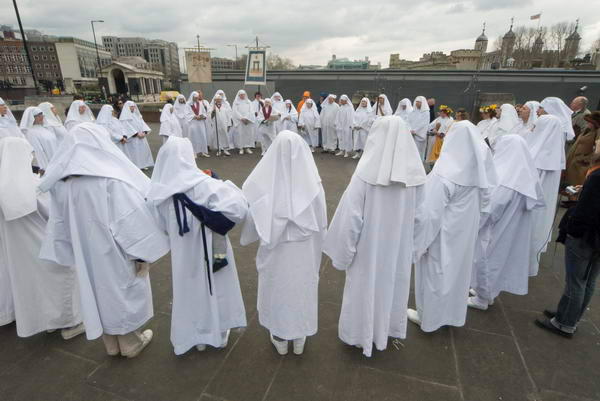
Spring begins today, Monday, 20 March 2023, officially at 21:24 UTC, though our weather may not reflect this. Thanks to global warming the weather here is increasingly unpredictable and while most of us are protected from its extremes, plants and wild life seem to be getting more and more confused.

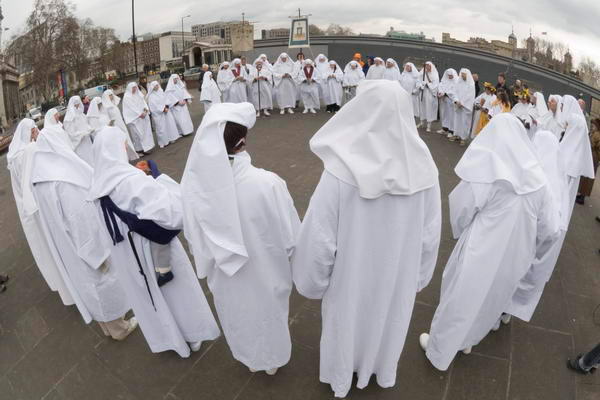
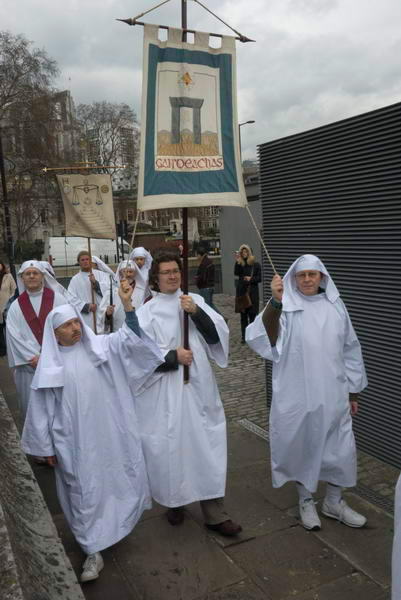
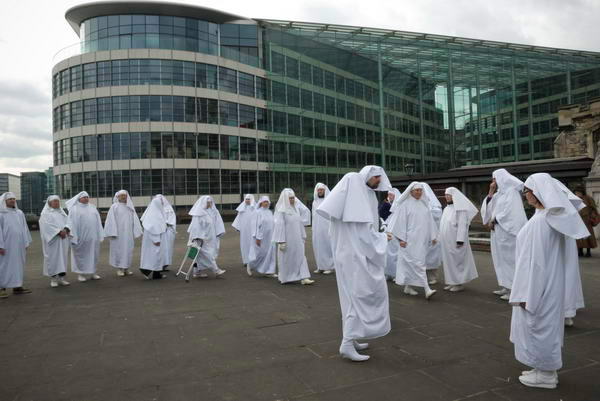
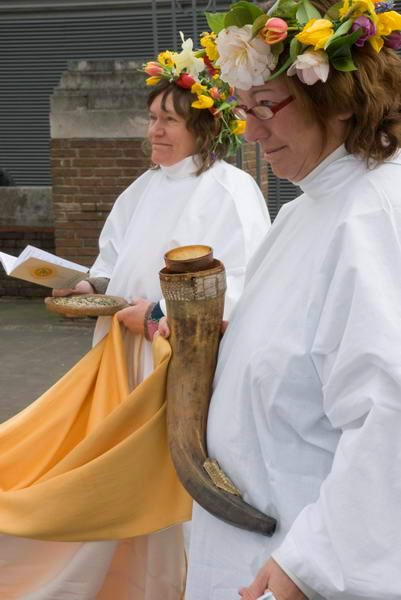
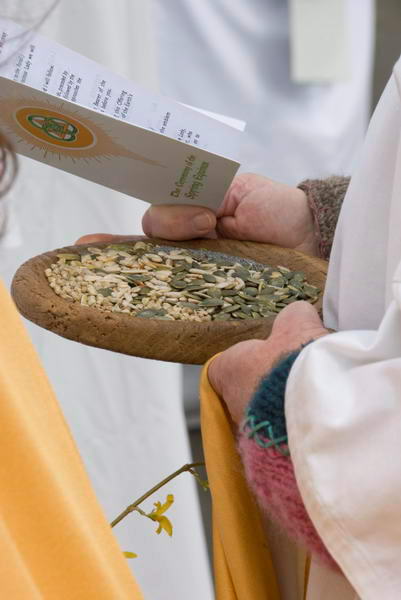
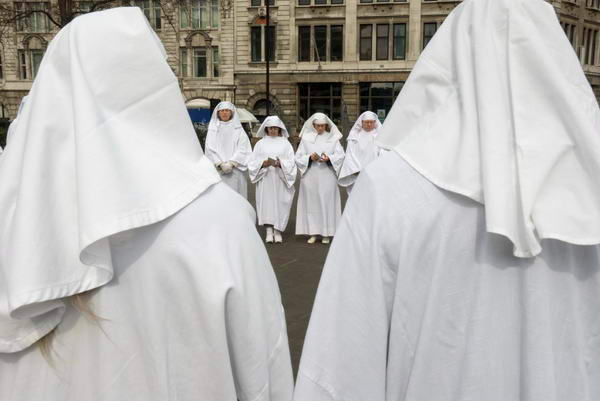
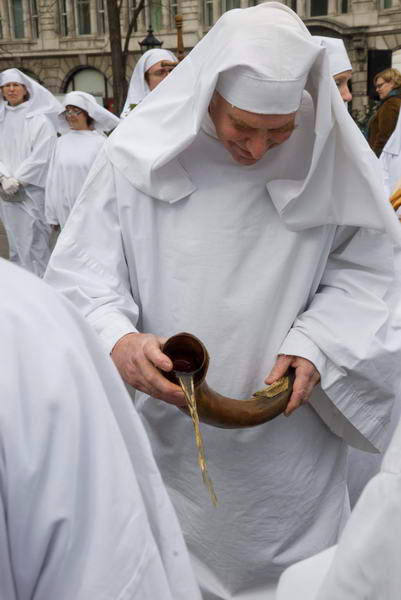
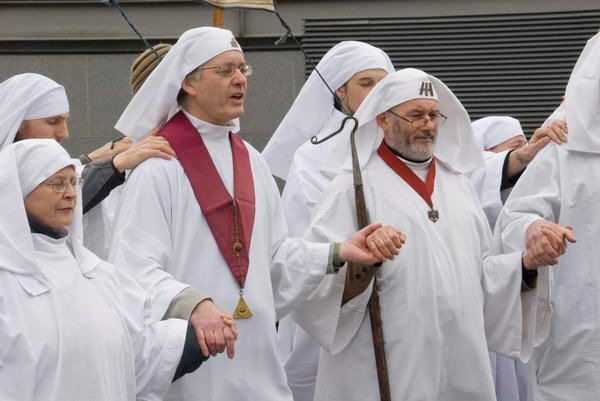
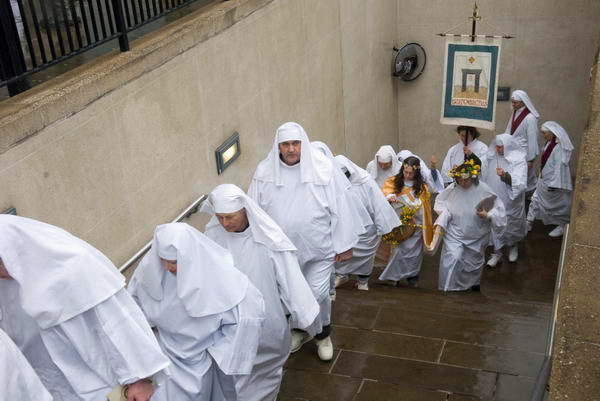
Druids celebrate the occasion at noon, with The Druid Order doing so on Tower Hill, processing there this year from The Ship in Hart Street in white robes with their banners and performing a ritual celebration.

Druid Order - Spring Equinox

The Ancient Druids were a Celtic upper class we know relatively about as they kept no written records of their religious activities but there are some descriptions by Caesar and other Roman and Greek authors of their importance and their pagan practices, although some aspects of these may have been based on hearsay and propaganda.

Druid Order - Spring Equinox

Druidry was apparently an entirely oral tradition, with druids spending years of study and learning texts and rituals by heart; some of these may have been passed down through the years in folklore, particularly in Ireland, but much or all of this may well be later romantic invention.

Druid Order - Spring Equinox

According to Wikipedia Caesar “wrote that they were one of the two most important social groups in the region (alongside the equites, or nobles) and were responsible for organizing worship and sacrifices, divination, and judicial procedure in Gallic, British, and Irish societies.”

Most of the ancient sources state that one aspect of their religious practices was human sacrifice, possibly of criminals “but when criminals were in short supply, innocents would be acceptable.”

One form that is said to have been used for this sacrifice was the “wicker man” where the victim was encased in a large wooden human effigy and was then burnt alive. But they are also said to have practised divination by stabbing a victim in the chest and observing the flow of blood and the convulsive movement of the limbs as the victim died.

Modern-day druid ceremonies are considerably tamer, with druids appearing as peaceful lovers of nature, which of course had much more obvious importance in ancient times – though we are now realising fairly desperately that our modern neglect or indifference to it is having disastrous consequences on biodiversity and future food supplies.

Some trees, in particular oak and hawthorn seem to have played a large role in the worship of ancient druids, and there are many groves of trees around the country believed by some to (sorry) have druidic roots. Certainly some of these ancient groves, whatever their origins seem to have a spiritual nature.

The Romans also wrote about the druids as philosophers, and Wikipedia has an quote from Caesar on this where he writes that they believed the human soul was indestructible, passing at death from one body to another. He also commented on their interest in astronomical matters – perhaps most obviously expressed at Stonehenge and other ancient monuments, as well as “on the extent and geographical distribution of the earth, on the different branches of natural philosophy, and on many problems connected with religion.

I’ve photographed the Druid Order ceremonies in several years on both the Spring Equinox at Tower Hill and the Autumn Equinox on Primrose Hill, a more dramatic setting. The pictures here come from 2008, but I’ve taken very similar ones in other years. Although inspired by earlier activities and mentioning some of those involved during their rituals, the actual form of their celebration is not ancient, but a little over a hundred years old.

More pictures from 2008: Druid Order – Spring Equinox.


Highgate, Swains Lane And Dartmouth Park, April 1989

This is the second and final part of my walk on Friday 7th April 1989 which had started at Gospel Oak station and I had walked up to Highgate. You can read the first part at Highgate April 1989.

Highgate Literary, Scientific Institution, South Grove, Highgate, Camden, 1989 89-4a-11

I took another picture of the Highgate Literary & Scientific Institution, but didn’t explore much more at the top of the hill.

Pond Square, Highgate, Camden, 1989 89-4a-22

Though I did take a few more pictures, but have only digitised this one. I was eager to go down the hill again, this time taking Swain’s Lane, by the side of the Literary & Scientific Institution.

Swain’s Lane is rather steeper than West Hill and apparently had got its name from being used by pig herders and was first recorded in writing as Swayneslane in 1492. It provided access to farms on either side and only the top few yards were developed for housing before 1887. Fortunately I was walking down hill and hadn’t brought my bike as riding up this lane would have been something of a challenge.

House, Swains Lane, Highgate, Camden, 1989 89-4b-63
Lodge, Swain’s Lane, Highgate, Camden, 1989 89-4b-63

Even now much of Swain’s Lane is undeveloped as it runs between one of London’s great cemeteries, Highgate Cemetery and one of its fine parks, Waterlow Park, both behind brick walls with just a narrow pavement. Below Waterlow Park on the east side is the newer part of Highgate Cemetery, which includes Karl Marx’s Tomb.

The Grade II listed building is the picture is the Lodge at the Swain’s Lane entrance to Waterlow Park, built in the mid-19th century in a fine example of Victorian Gothic, though the chimneys are more Tudor. The post at right is for the park gate and I took just a brief stroll inside before continuing my walk. On warmer days I’ve explored the park rather more and sometimes found a bench to eat my sandwiches as well as taking a few pictures.

In 1992 I visited and took some pictures in both the West and East parts of Highgate cemetery, some of which are on-line in Flickr, but on this walk I didn’t have time to stop and just went on down the hill.

House, Swains Lane, Oakeshot Ave,  Highgate, Camden, 1989 89-4b-52
Mansion, Swains Lane, Oakeshot Ave, Highgate, Camden, 1989 89-4b-52

Immediately south of the West cemetery is the Holly Lodge Estate, with mansion blocks on Makepeace Avenue and Oakeshott Avenue. The website tells that in 1809 Harriot Mellon, a young actress acquired a large villa later known as The Holly Lodge here, and after she married banker Thomas Coutts in 1815 both house and grounds were enlarged and landscaped. She died in 1837, leaving the property and her fortune to one of the most remarkable women of the Victorian age, her husband’s ganddaughter, Angela Burdett-Coutts.

When she died in 1906 her husband tried to sell the entire property with no success, but then managed to sell off some of the outlying parts – including Holly Terrace on West Hill and South Grove House, both mentioned in the previous post on this walk but it was not until 1923 that the main part was sold off and development of the Holly Lodge Estate began.

This area was acquired by the “Lady Workers’ Homes Limited to build blocks of rooms and flats for single women moving to London in order to work as secretaries and clerks in the city on the Eastern side of the estate.

These blocks built in the 1920s had fallen into a poor state of repair by the 1960s and were acquired on a 150-year lease in 1964 by the Metropolitan Borough of St Pancras – and so are now owned by the London Borough of Camden. The council for some years continued with the policy of only housing women on the estate but this has now lapsed.

The flats were designed without separate kitchens and with shared bathrooms and toilets as bed-sits for single women – and the estate was built with a long-demolished community block with restaurant, reading and meeting rooms and a small theatre, and behind it three tennis courts. Some of the bed-sits have been converted into self-contained flats but others still share facilities.

Raydon St, Dartmouth Park Hill, Highgate, Camden, 1989 89-4b-42

I returned to Waterlow Park, making my way through it to Dartmouth Park Hill and on to take thsi picture of some very different housing on the Camden’s Whittington Estate. But by now I was in a hurry and the light was fading a little and I took very few photographs (none online) as I made my way through the streets of Dartmouth Park to Highgate Road and Grove Terrace and on to Gospel Oak station for my journey home.