End Indefinite Detention, Don’t Sack Cleaners

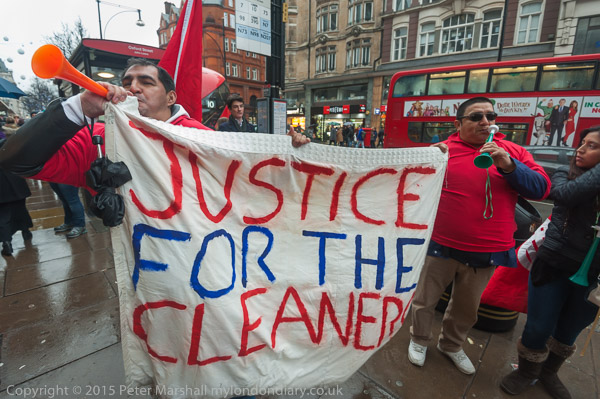
End Indefinite Detention, Don’t Sack Cleaners – two protests I photographed on Saturday 7th May 2016, one on the edge of London and the other in the centre.


Detention Centres Shut Them Down – Harmondsworth, Saturday 7th May 2016
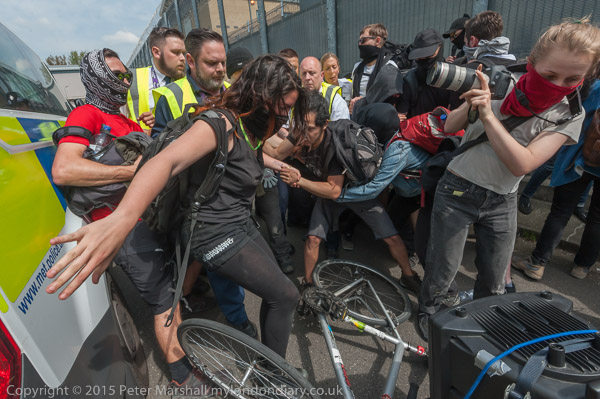
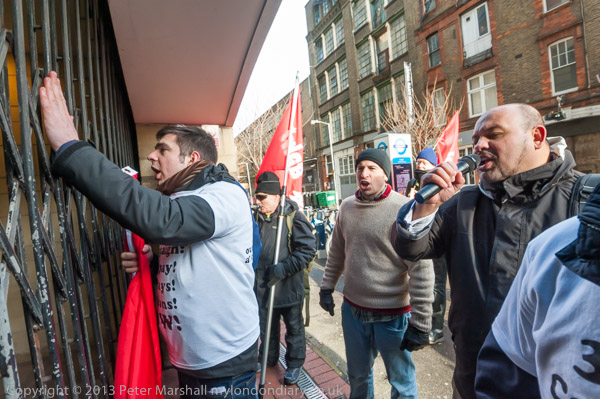
Mostly protests begin later than expected and I was surprised when I arrived at Europe’s largest detention centre complex at Heathrow, two Category B prisons, Colnbrook & Harmondsworth, managed by private security company MITIE to find that the action organised by the Anti Raids Network as a part of a day of action at all UK detention centres had already begun.
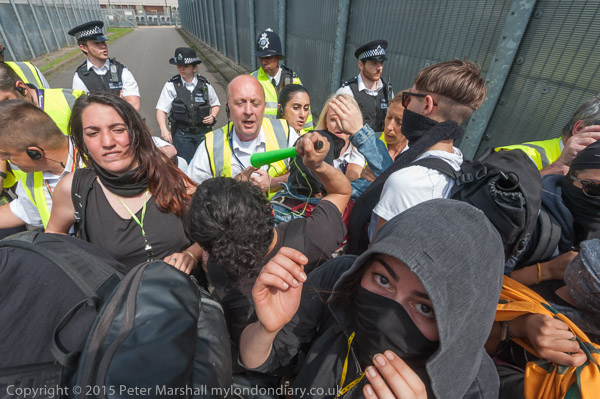
Most of the protesters had come out to the protest on the west edge of Greater London from the centre and had apparently got there earlier than they expected and had immediately rushed past the few security guards onto the private roadway between the two prisons to communicate with the detainees who had gathered around the windows of the two blocks behind their 20 ft high fences. I’d photographed earlier protests here where the protesters had walked noisily around the Harmondsworth block (strangely on the Colnbrook side of the complex) on the rough track around the fence, but the centre was now under new management and MITIE were determined to keep them further away.
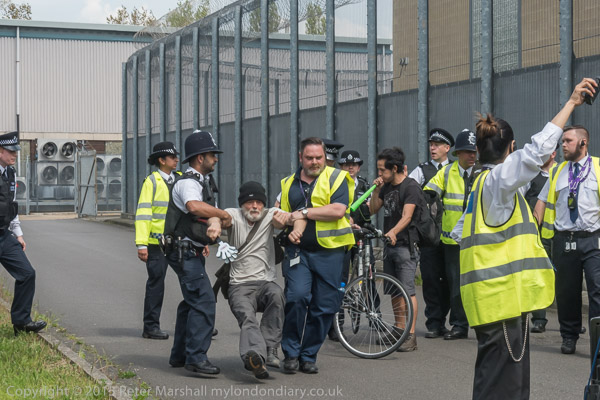
As I arrived and talked with the small group who had remained at the entrance those inside appeared at the far end of the road, being slowly moved out by the police reinforcements who had arrived shortly before me, and I followed protesters down the road to join them.
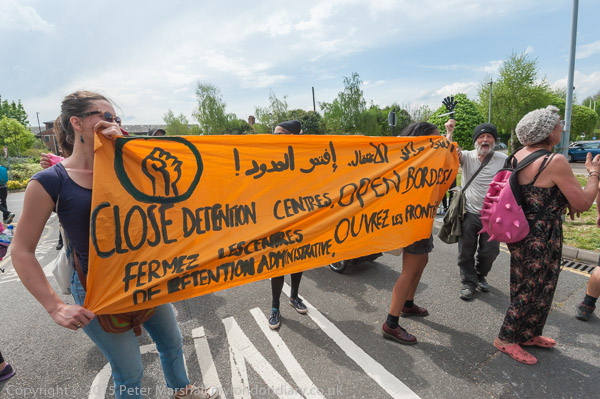
As well as making a lot of noise with pots and pans, megaphones and kicking the solid metal bottom of the fence, the protesters also held up a large banner with a phone number so that the detainees could contact them and tell them what was happening inside. At first the police made slow progress in moving them along, but soon another police van arrived with more officers and they were able to move them quickly to the front of the complex.
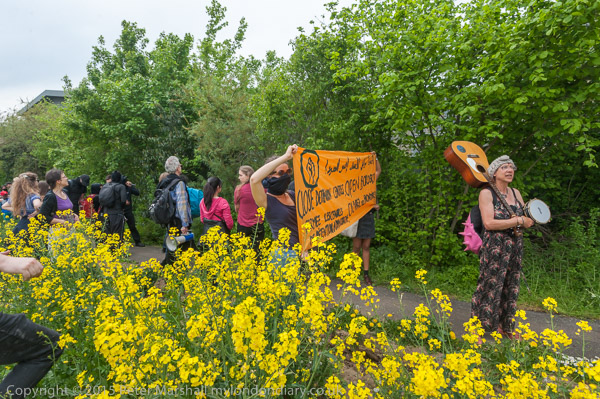
After regrouping there, most decided to walk along to the public footpath that runs along the east edge of the centre. Although bushes and small trees in front of the fence made the centre almost invisible, it was easy to hear the detainees shouting from inside and for them to hear the protest. Soon phone contact was made with some of them and they were able to speak over a megaphone. As I wrote back in 2016:
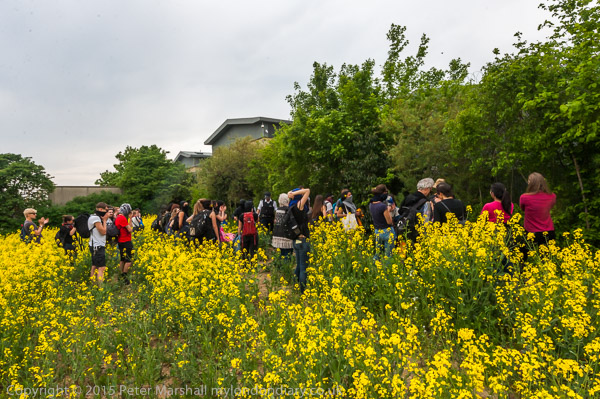
“Bashir from Lebanon told us he had been held in detention for 18 months and that his wife and children need his help, but he is stuck inside, unable to see them or do anything. Indefinite detention such as this seems a clear breach of so many of the human rights that everyone in the UK should be entitled to under our Human Rights Act 1998. Treating people like our system does is simply shameful.”

Detention Centres Shut Them Down – where there is more about the protest.

Cleaners invade Barbican Centre – Barbican, London, Saturday 7th May 2016
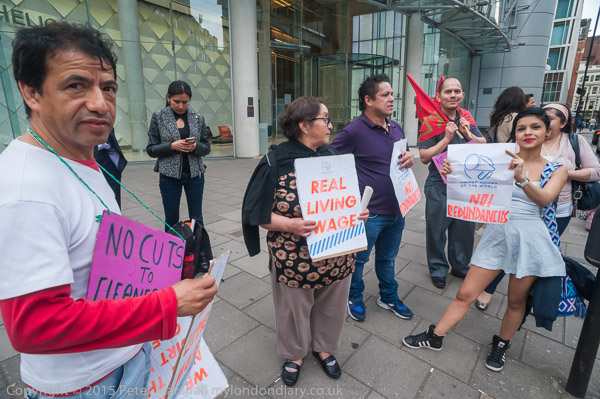
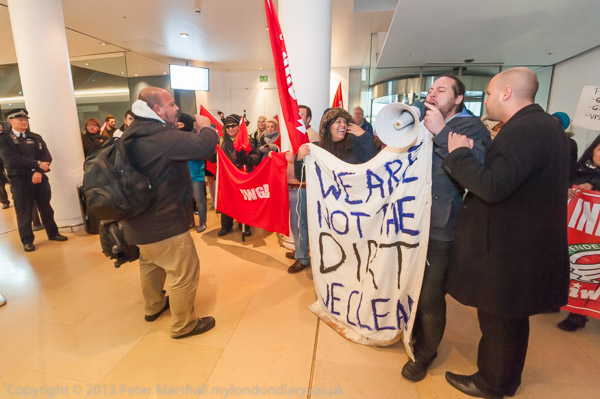
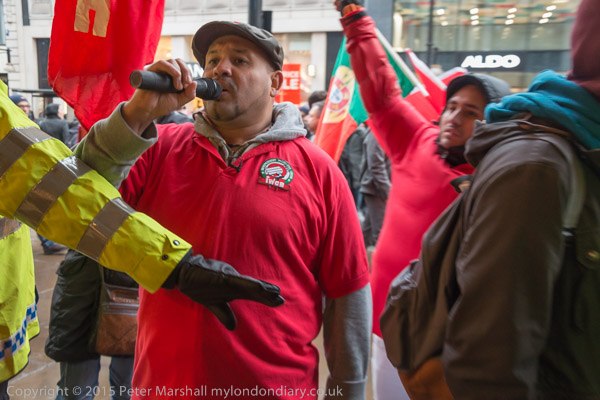
I left to make my way to central London where Cleaners union United Voices of the World were holding a flashmob at the Barbican Centre after cleaning contractor Servest proposed making many of the cleaners redundant or severely cutting their hours and pay. As well as the UVW, the action was supported by activists from the Bakers Union, Class War, SOAS Unison, Unite Hotel workers branch and IWGB Couriers branch.
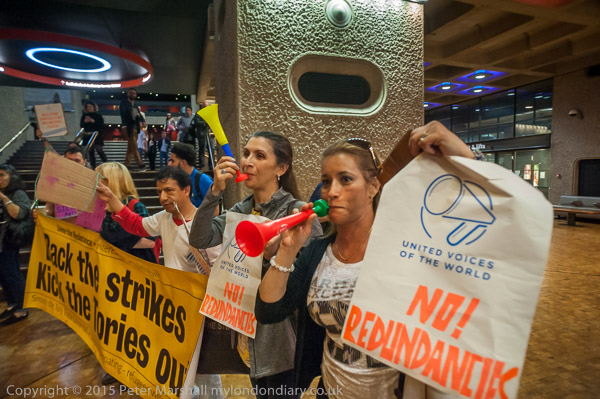
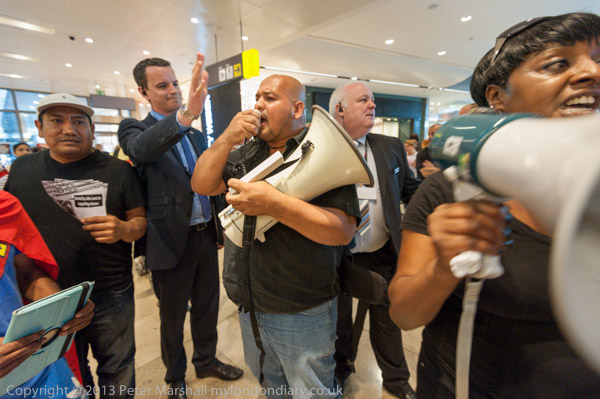
I met the cleaners close to Moorgate Station and walked with them towards the Barbican, where they burst into a run as they turned a corner and rushed into the main entrance, past a couple of security guards who had no chance of stopping the unexpected arrival. They made there way to the middle of the arts centre, to protest noisily outside the hall where customers were entering a sold-out concert of music by Yann Tiersen.
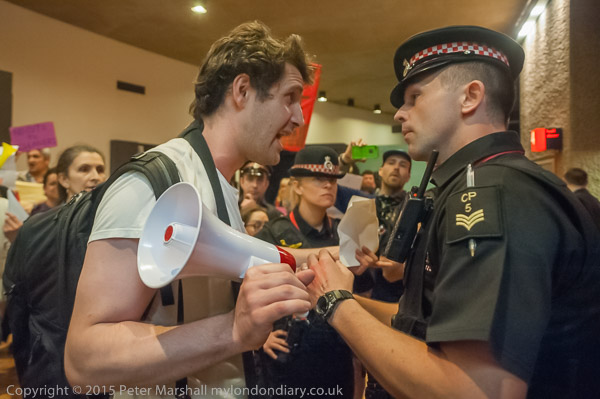
After a few minutes police arrived and told the protesters they must leave or be arrested, and after some argument they slowly and noisily made their way back towards the main entrance, with police continuing to harass them.
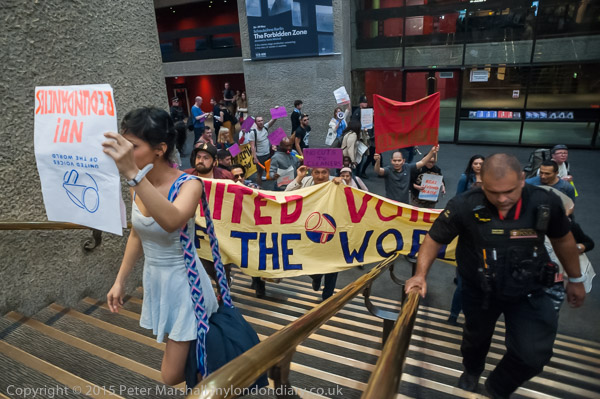
They continued to protest on the street outside the main entrance, and the protest was still continuing there when I left for home.
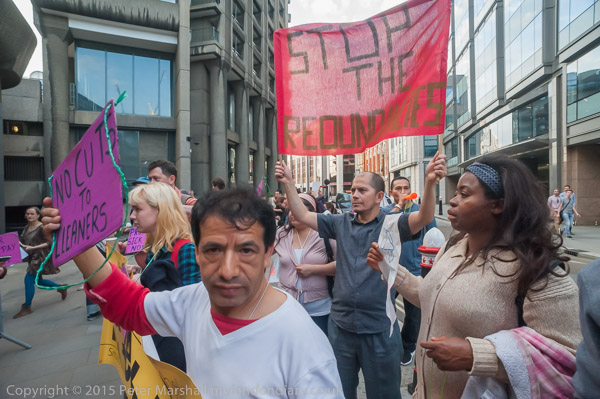
More on My London Diary at Cleaners invade Barbican Centre.

Tax Robbery, Racism & John Lewis

Tax Robbery, Racism & John Lewis. Saturday 21st March 2015 was another busy day for me in London, covering protests against the criminal activities of UK banks, a large march and rally against racism in the UK (and a few racists opposing this) and customers of John Lewis calling on the company to treat its cleaners fairly.


Great British Tax Robbery – HSBC, Regent St.

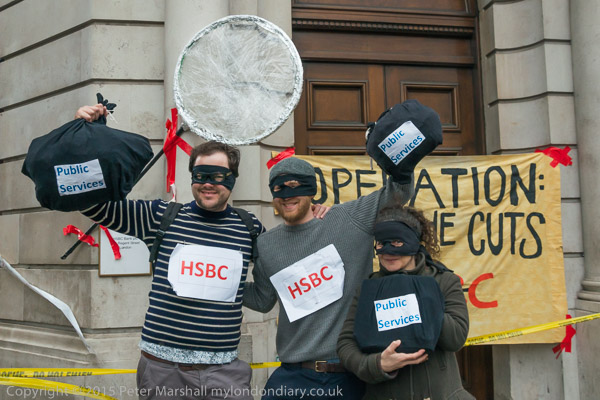
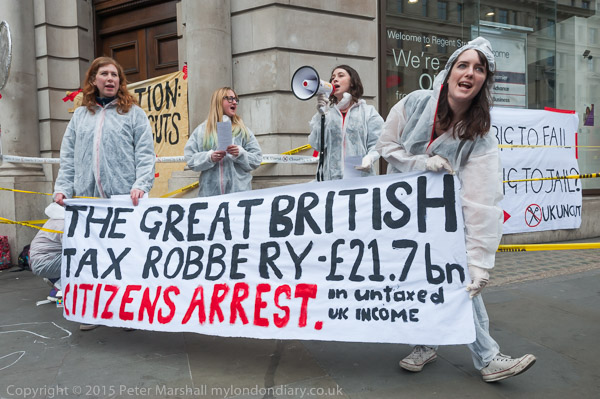
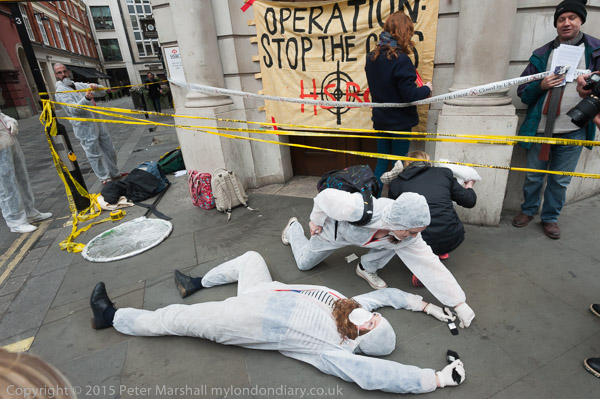
UK Uncut campaigners arrived at the HSBC Regent St branch dressed as detectives and robbers to highlight the bank’s crimes in causing the financial crash and tax dodging, which have led to drastic cuts in vital public services and welfare and attempt a ‘Citizen’s Arrest’.

UK Uncut had a clear message for both HSBC and the government, accusing them of being criminals:

The government told us they’d “protect the poorest and most vulnerable”. They said “those with the broadest shoulders will bear the brunt of the cuts”. And what have we seen? Dismantling the NHS and wrecking the welfare state. Cutting schools, youth clubs, sure start centres, domestic violence refuges and libraries. Slashing local council budgets. Attacking disabled people with inhumane ‘work capability assessments’ and cuts to vital benefits. Removing access to justice through legal aid cuts. Allowing the big six energy companies to push people into fuel poverty. Cutting jobs, wages and pensions. Selling off social housing and moving people away from their communities. Driving hundreds of thousands into food banks and making families choose between heating or eating

My London Diary, March 2015

The bank closed a few minutes before the protesters arrived and kept its doors shut as the protesters’ ‘forensic team’ chalked around ‘crime victims’ on the ground and put crime scene tape around the area, sealing off the door with a banner. There was a speech from a NHS campaigner from East London about the effects of the cuts on the NHS and ‘criminals’ with HSBC on their chests posed for pictures. After a few minutes the protest was ended as many of those taking part were, like me, joining the Anti-Racism protest.

Great British Tax Robbery


Stand Up to Racism March – BBC to Trafalgar Square

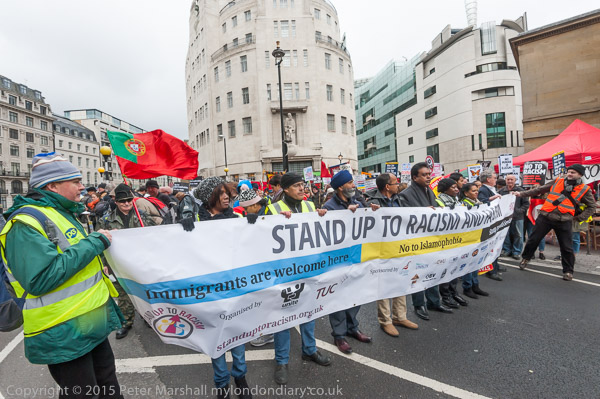
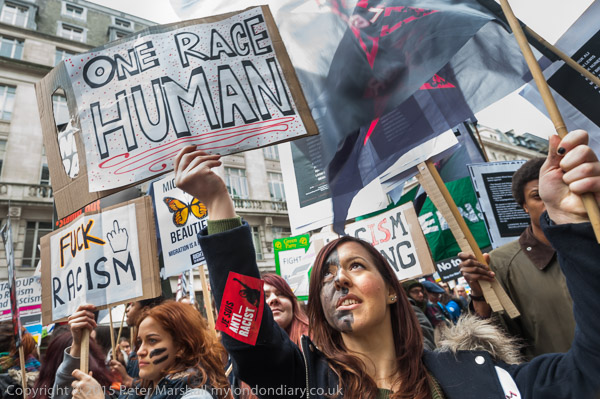
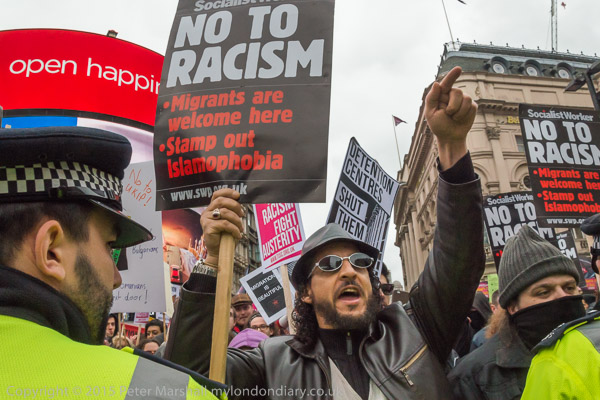
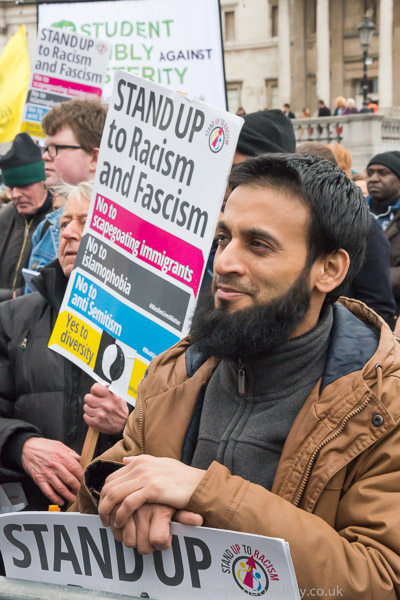
Thousands came to the Stand Up to Racism march from the BBC to Trafalgar Square to reject the scapegoating of immigrants, Islamophobia and anti-Semitism and to celebrate the diversity of Britain, with the message ‘Migrants are Welcome Here!

The march began at the BBC, who campaigners accuse of having a policy of ignoring protests in the UK, especially those against government policies – such as the racist hounding of immigrants under their ‘hostile environment’.

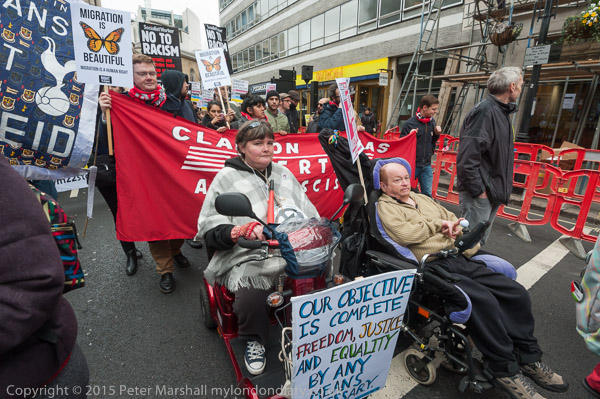
Among those marching were DPAC, Disabled People Against Cuts. Government policies have also targeted disabled people, cutting benefits and subjecting them to unfair ‘fitness to work’ tests which largely ignore medical evidence.

Stand Up to Racism March


Britain First Protests anti-Racist March – Piccadilly Circus

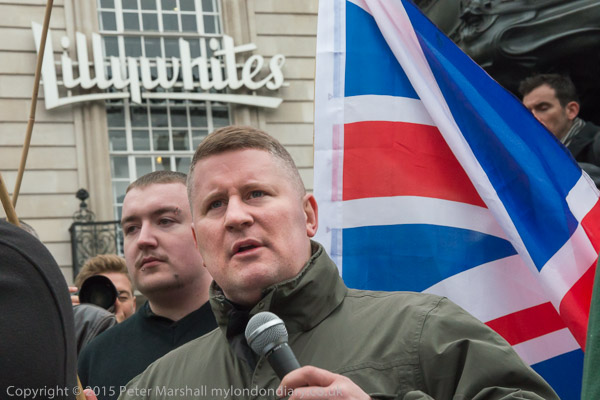
A small and rather sad extreme right-wing group stood on the steps around Eros waving flags and shouting insults at the anti-racist marchers as the thousands marched past. It was a reminder of the kind of bigotry the great majority were marching against.

Some of the marchers paused to shout back at them, while others followed the advice of the march stewards and ignored the small group. There were a few scuffles but generally police kept the two groups apart, though later I learnt that after I had gone past a group of anti-fascists had seized the Britain First banner.

Britain First Protests anti-Racist March


Stand Up to Racism Rally – Trafalgar Square

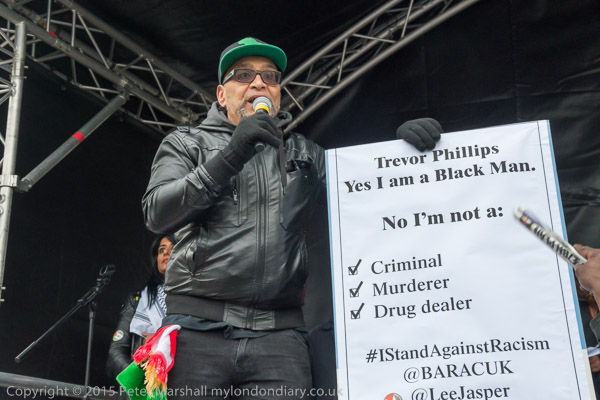
Lee Jasper holds up a large poster responding to Trevor Phillips saying he is not a criminal, murderer or thief

Several thousand who had marched to ‘Stand up to Racism’ through London stayed on to listen to speeches at a rally in Trafalgar Square.
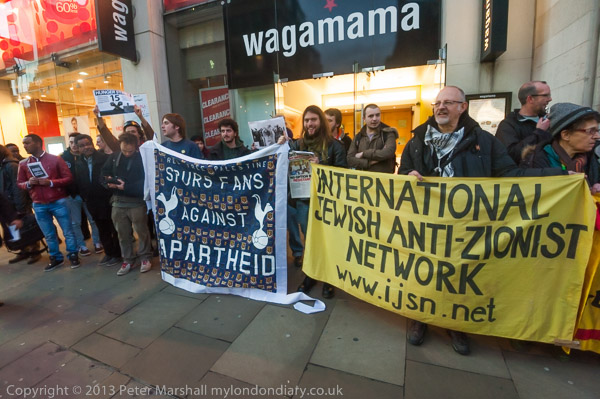
Speakers included Owen Jones, Jeremy Corbyn, Zita Holbourne, Omer El Hamdoon, Lee Jasper and many others, whose photographs you can see on My London Diary.

Stand Up to Racism Rally


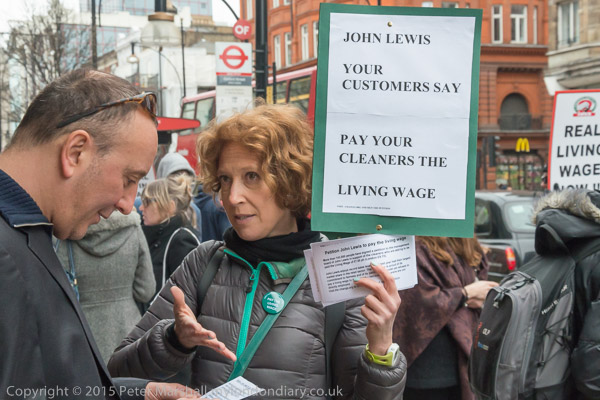
John Lewis customers support Living Wage – Oxford St

John Lewis is a company proud of its history and its reputation as a company based on its constitution as the UK’s largest employee owned business with both John Lewis and Waitrose owned in Trust by its 80,000 ‘partners’. They say everyone who works in its stores are not just employees, but a partners in the company, and in almost every year they enjoy a share in its profits.

Everyone who works there, except the cleaners who play a vital role in the proper running of the stores. John Lewis gets out of making them partners by using other companies to employ them and provide the cleaning as a service, choosing its cleaning company through competitive tendering. Cleaning companies cut wages and conditions of service such as sick pay, maternity pay, pensions, holiday pay to the bone – usually the absolute legal minimum – so they can put in low tenders and still make good profits. They exploit the workers – a largely migrant workforce with limited job opportunities – while John Lewis can claim it isn’t them who are doing so and try to maintain their reputation as a good employer.

For some years the cleaners have been protesting to get a living wage and also for John Lewis to recognise their responsibility as the actual company the cleaners are providing a service to. They want to be treated equally with the others who work in the stores, rather than the second-class employees they are now. The least John Lewis could do would be to insist on contractors paying the living wage and giving employees decent conditions of service as a condition of tender, but they had refused to take any responsibility.

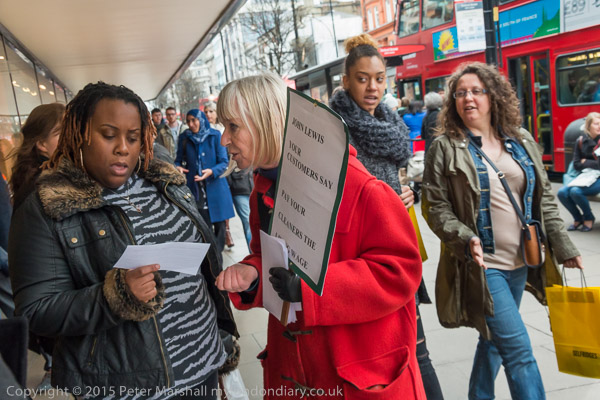
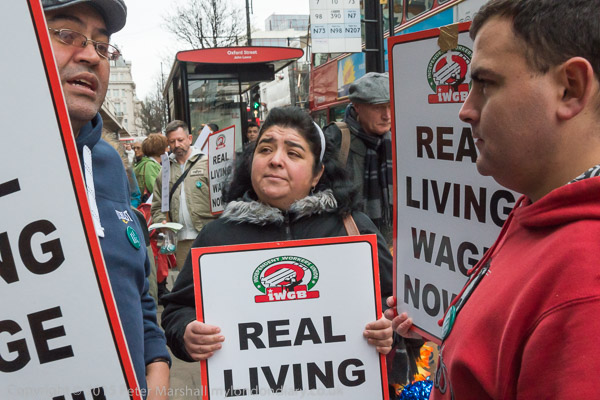
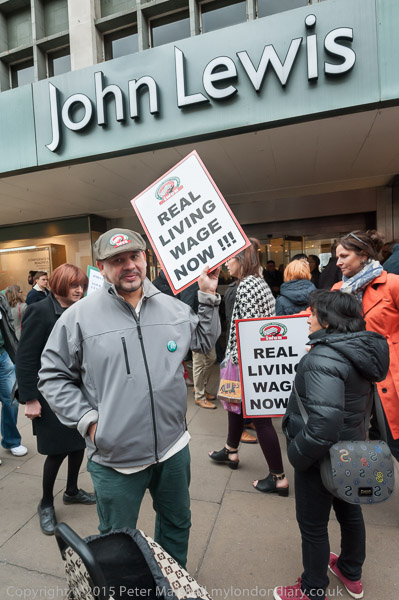
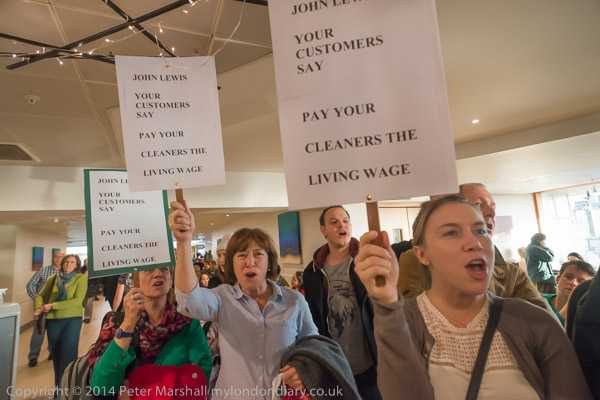
Many customers of John Lewis – a very middle-class group – back the cleaners’ case for fair and equal treatment, and a few had come to hand out flyers and talk to shoppers to back their case in a very restrained protest. One of them told me it was the first time she had ever taken part in any protest. They were supported by a few members of the cleaners union, the IWGB, who had brought some of their posters.

John Lewis customers support Living Wage


University of London 3 Cosas Strike

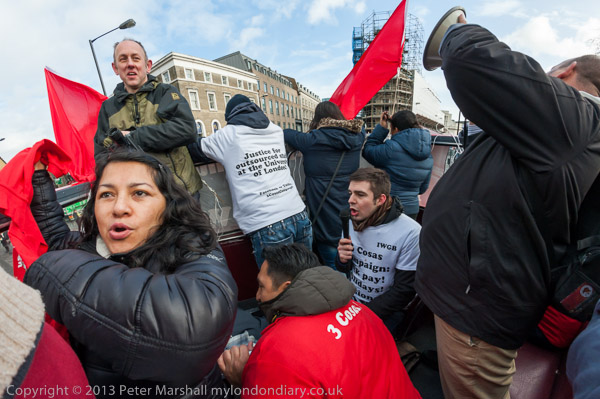
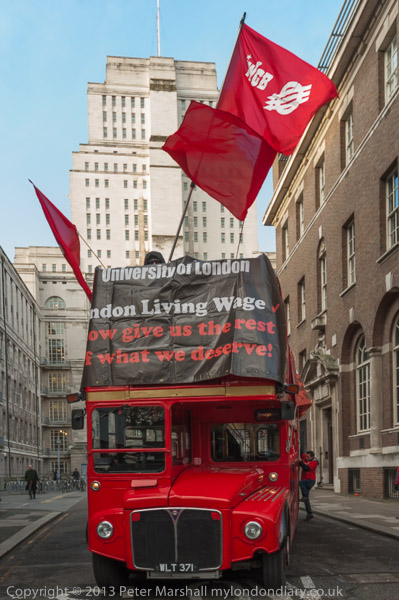
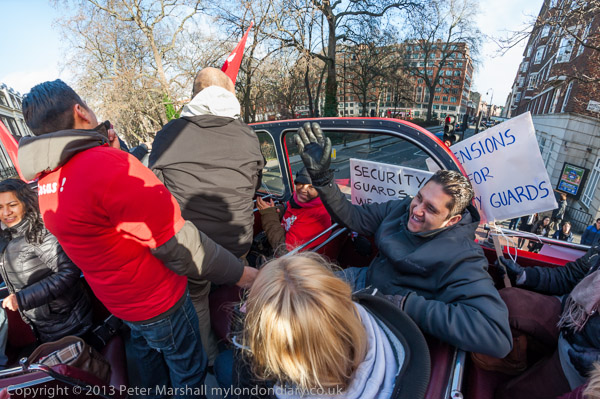
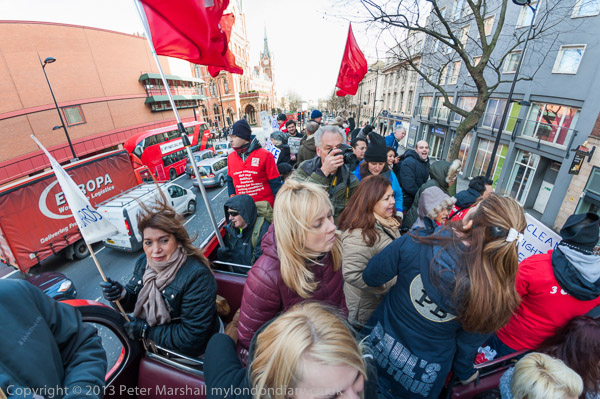
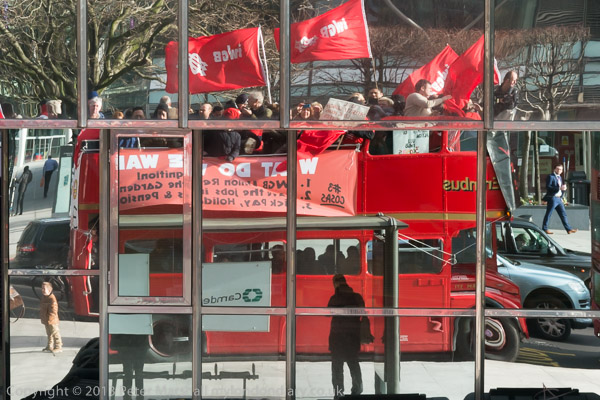
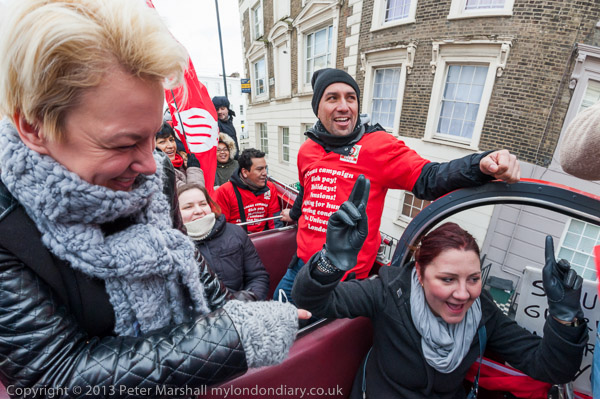
On the IWGB battlebus

Eight years ago on Tuesday 28th January 2014 low paid workers at the University of London were on the second day of their 3 day strike. Their union had organised a day of action around London and I had been invited to come and photograph it, having photographed a number of their previous protests.
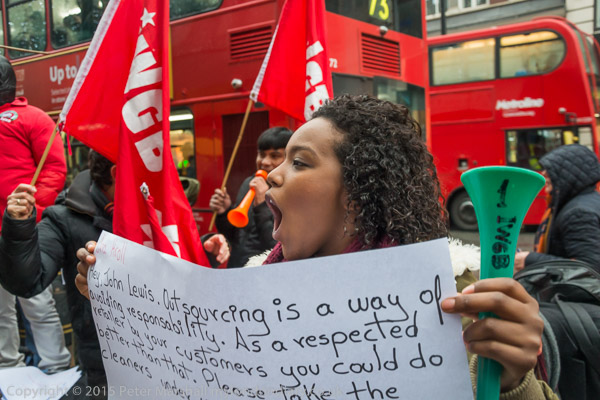
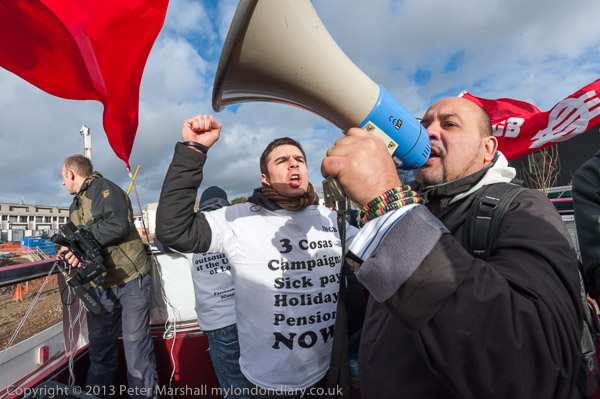
University cleaners, maintenance and security staff were demanding that the University recognise their trade union, the IWGB (Independent Workers’ Union of Great Britain) and give them better pay and conditions, comparable with other university staff they work alongside. The ‘3 Cosas’ were sick pay, paid holidays and pensions – all areas where these staff were only being given the legal minimum (and sometime not even that.)

As I wrote in 2014:

“although these workers work at the university and carry out work essential for the running of the university, the university does not employ them. Most low paid workers – cleaners, maintenance and security staff, catering works and others – at the University of London are no longer directly employed by the University, but work in the University on contracts from contractors Cofely GDF-Suez (who took over the former contractor Balfour Beatty Workplace at the end of last year.) The policy of outsourcing these workers seems largely intended to evade the responsibilities of London University towards an essential part of their workforce.”

3 Cosas’ Strike Picket and Battle Bus

It meant an early start for me, although the pickets had been outside Senate House for four hours when I arrived at 9am. Living outside London though on its edge I seldom arrive before 10am as it doubles my travel costs and I’ve never been a happy early riser. Fortunately the weather was good, a bright winter day and I’d dressed for the weather with thermal underwear, thick socks and a woolly hat, though it was still pretty chilly on top of the open-top bus.

The bus turned out to be a 1960 Routemaster which was sold by London Transport in 1986 but only converted to open-top in 2001. (I’d long thought that there was a plentiful supply of such vehicles after drivers attempted routes under low bridges, but apparently not, although a couple of bridges near where I live have had quite a few victims over the years.) Compared to modern buses, Routemasters offered a very bumpy ride with considerable vibration, and taking pictures on the upper deck required some faster than normal shutter speeds and most of the time working one-handed while clinging on with the other.

Space on bus tops is also quite small and moving around impeded both by the seats and the other riders (I think it’s a more appropriate term than passengers) and though they were very cooperative the top of the bus was pretty full. Most of the pictures I made were taken when the bus was stopped either at junctions or for short protests and my fisheye lens proved really useful.

The bus trip began at Senate House, and then began an extensive tour around central London, making a tour of various university sites where IWGB members were striking. There was a great deal of booing as we passed the Unison headquarters on Euston Road, as many of the workers had left Unison in disgust as they felt the were not supporting the demands of low-paid workers. The IWGB had intended to stop outside the offices of The Guardian newspaper, but had been held up too much by London’s traffic and drove past and on to Parliament Square.
Here we jumped off the bus and marched to Parliament where the IWGB had arranged to meet Labour MPs John McDonnell and Jeremy Corbyn for a short rally (and Andy Burnham sent a short message of support.)

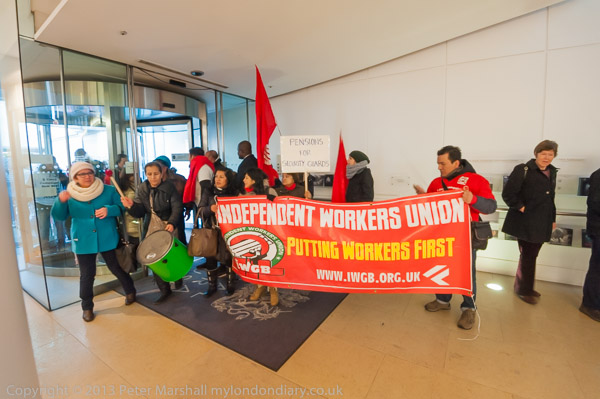
There was a short shower before the bus came to pick us up on the Embankment, taking us to a side street near the Royal Opera House. Everyone kept quiet as we got off, then rushed around the corner and into the foyer. IWGB members there had voted for a strike the following month for union recognition and the London Living Wage.
In the foyer we were met by a man who introduced himself as the Unison Health & Safety rep and told the IWGB President and the other protesters that the ROH had already agreed that the cleaners will get the Living Wage, but had not yet told them. The Opera House recognises Unison, despite the workers almost entirely being IWGB members. It’s a ridiculous situation but one which is allowed under our poor trade union laws, though not one that makes sense for either workers or employers.

After making their views clear the IWGB members left quietly and got back onto the bus for the final visit of the day, to the Angel Islington, where Cofely GDF-Suez (who took over employing the workers at the University of London from the former contractor Balfour Beatty Workplace in December) has its offices. As at the Royal Opera House, there were plenty of police present and waiting for the protesters, but here they managed to lock the metal gates on the two entrances to Angel Square as the bus arrived, leaving the protest to take place in front of one of them in Torrens Place.

From here the bus was going on to the union offices at the Elephant and Castle and I was invited to join them for a very late mid-afternoon lunch but unfortunately I had work to do on the many pictures I had taken and had to leave them and make my way home.

IWGB at Cofely GDF-Suez
IWGB in Royal Opera House
IWGB at Parliament
‘3 Cosas’ Strike Picket and Battle Bus


Margareta D’Arcy, Education and Africans in Israel

Margareta D’Arcy, Education and Africans in Israel
Three protests on Wednesday 22nd January 2014

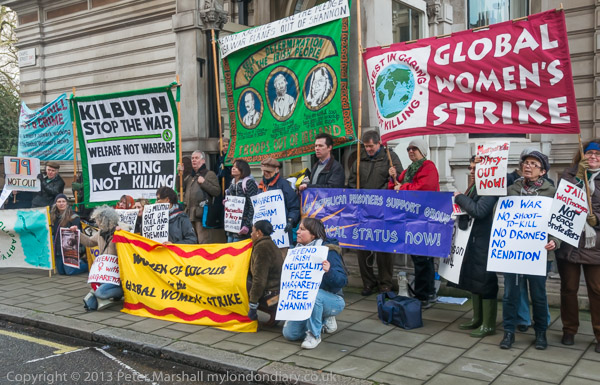
Release Margaretta D’Arcy Now! Irish Embassy

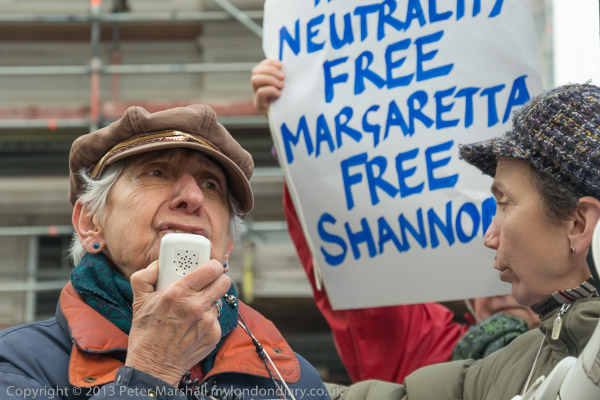
Selma James calls for the release of Margaretta D’Arcy

I don’t think my path has ever crossed, at least not knowingly, with that of ‘Guantanamo Granny’ Margaretta D’Arcy, though Facebook tells me we have 163 mutual friends. My eldest brother, around her age but long since dead, may well have sat down with her on Whitehall with Bertrand Russell’s Committee of 100 back in 1961. Her life has been “decades of playwriting, acting, pageantry, pirate radio, books, peace activism, protest and imprisonment whilst bringing up her family of boys. She addresses Irish nationalism, civil liberties and women’s rights.”

Her political activities led to imprisonment in Northern India, in Armagh, in Holloway (for protests at Greenham Common against Cruise missiles.) This protest came after she was due in court after being jailed for lying down on the runway at Shannon in a peaceful direct action by members of Galway Alliance Against War against the use since 2001 of Shannon by US war planes in violation of Irish neutrality – and she served three months for refusing to sign a bond against further trespass on the airport.

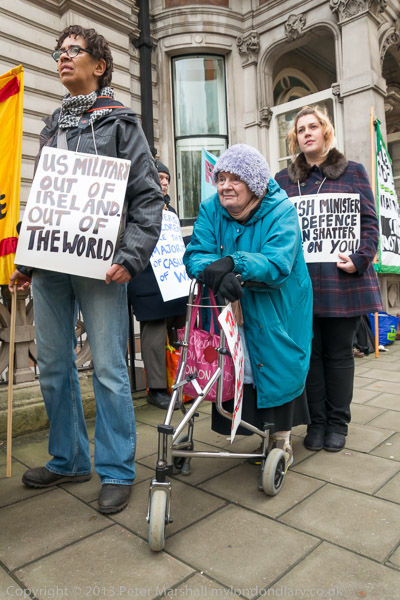
The protest at the Irish Embassy called for her immediate release and was supported by organisations including the Global Women’s Strike, Troops out of Ireland, Winvisible, Women of Colour, Kilburn Stop the War, Labour Caribbean Solidarity, Payday Men’s Network, Irish Republican Prisoners Support Group.

Students march to protect Education

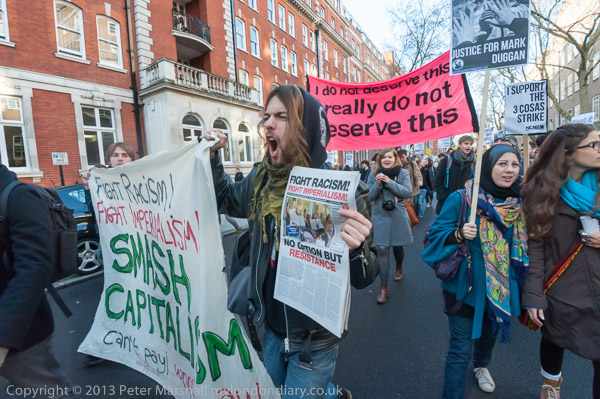
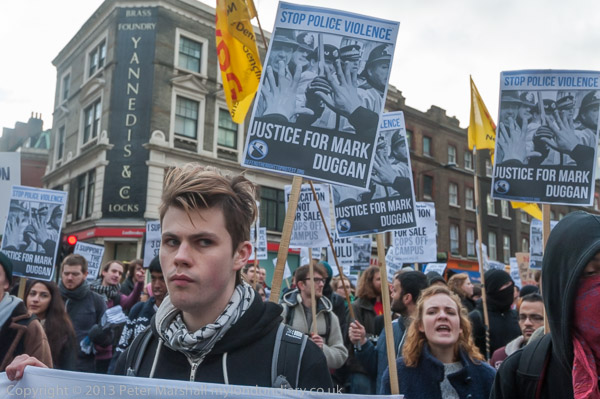
London University Students held a peaceful protest to show they intend to keep up their protests for democratic, public education free from exploitation and police violence and to support university cleaners on a 3-day strike for ‘3 Cosas’ – sick pay, holidays and pensions – and for recognition of their trade union, the IWGB.

After a rally outside the University of London Union in Malet St they marched on a tour of key sites including Senate House, the University & Colleges Employers Association in Woburn House in Tavistock Square, Holborn Police station, where they protested loudly against police violence and in particular at the execution by police of Mark Duggan and ending with another short rally outside the Royal Courts of Justice.

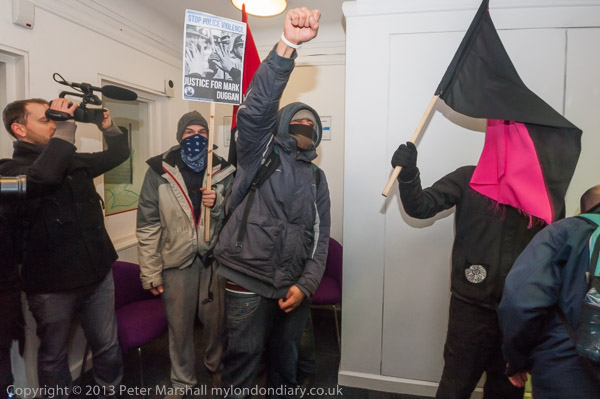
At the Tavistock Square offices, a few of those in a black block at the front of the march made a brief token entry into the lobby, accompanied by rather more photographers and videographers, and some paint was thrown at the outside of the building, hitting several protesters and photographers.

Solidarity with African Refugees in Israel

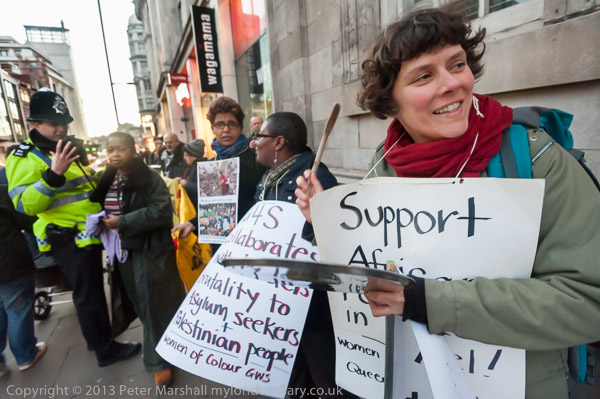
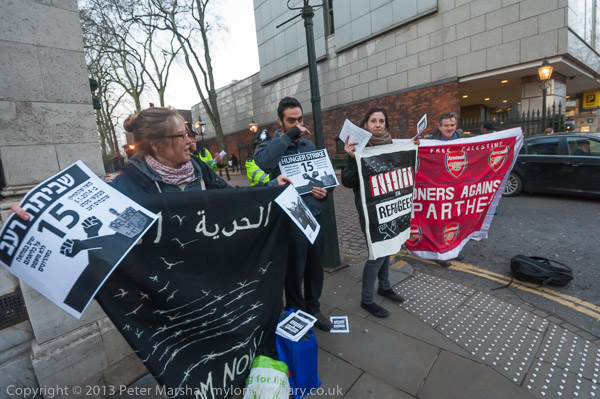
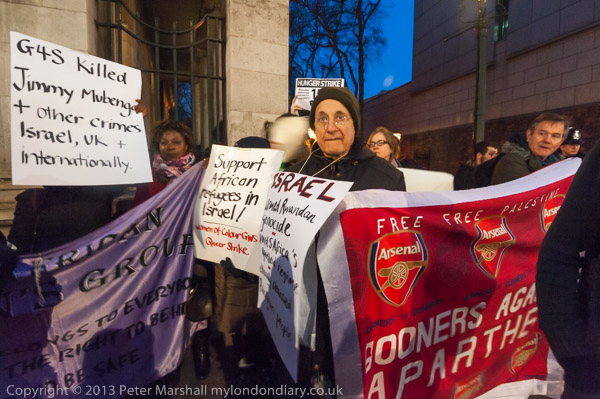
People protested close to the Israeli Embassy in response to a call by African asylum seekers for international action to support their protests against the arbitrary arrests, imprisonment and inhumane treatment of refugees inside Israel.

Tens of thousands of African asylum seekers have been protesting on the streets of Israel since the beginning of the month, holding mass rallies against their treatment by the Israeli authorities. New laws mean anyone entering the country without proper papers to be held for up to a year without trial, and for those who are already in the country to be held in infinite detention, at a detention facility in the Negev desert which like many other Israeli prisons is run by the private security company G4S.

Although there are around 50,000 African refugees in Israel, only a few hundred have had their applications processed. Most live illegally on the streets, taking whatever work is available in the ‘black economy’, with constant exploitation and threat of arrest. A recent strike by those working as cleaners, cooks, dishwashers and other low paid workers had brought many restaurants, hotels and businesses to a standstill.

Police tried to move the protesters to the opposite side of the busy main road, still further from the embassy which is in a private street, but they refused to move. Eventually police gave up and brought some cones from across the road to allow others to pass the growing protest in safety.

More on all these on My London Diary:

Solidarity with African Refugees in Israel
Students march to protect Education
Release Margaretta D’Arcy Now!


John Lewis Cleaners Protest

A protester holds a message from John Lewis customer Una Kroll: ‘Outsourcing is a way of avoiding responsibility’

John Lewis Cleaners Protest
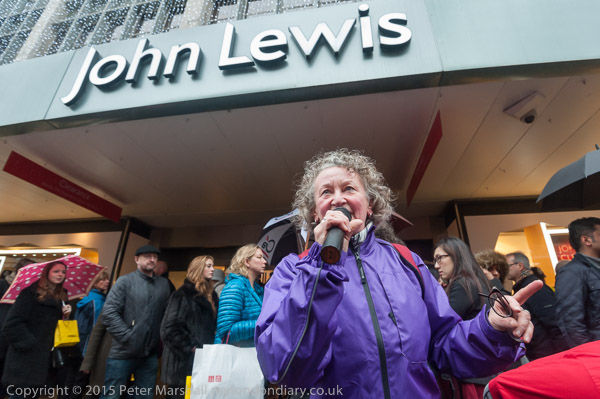
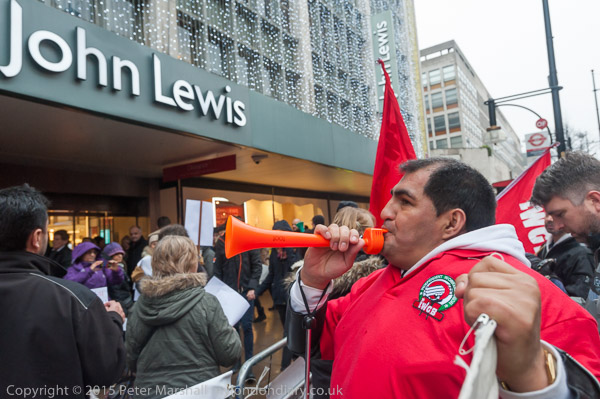
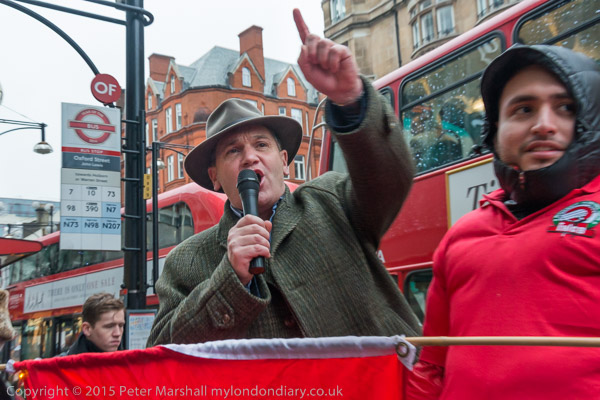
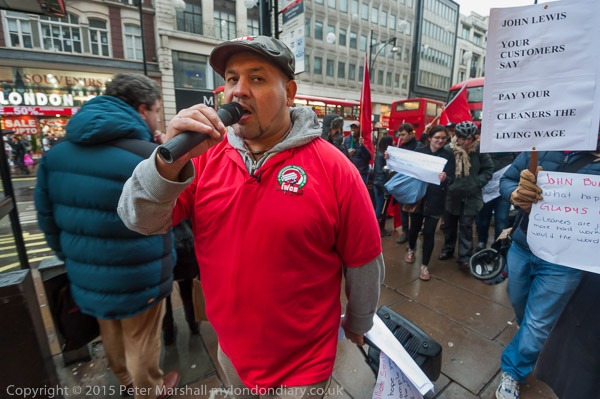
On Saturday 3rd January 2015 I met cleaners from the Cleaners And Facilities Branch of the IWGB (Independent Workers Union of Great Britain) outside John Lewis’s flagship Oxford Street store. They were there to hold a protest rally demanding the company lived up to its ethical reputation and paid the workers who keep the shop clean a living wage.

When John Spedan Lewis set up his small drapers shop on Oxford Street in 1864 he had the revolutionary idea of involving those who worked for him in the running and progress of the business, setting up a constitution that made all of them partners.

The ultimate purpose was expressed in Principle 1 of this consitution:

The happiness of all its members, through their worthwhile and satisfying employment in a successful business.
Because the Partnership is owned in trust for its members, they share the responsibilities of ownership as well as its rewards – profit, knowledge and power.

John Lewis Partnership

Green Party London Assembly member Jenny Jones, Baroness Jones of Moulsecoomb, speaking at the protest

But although staff on the counters and running other aspects of the business remain partners – and almost every year get an extra bonus payment as a share of the profits, the cleaners who work in the store who are not included in the scheme and say that in this and other respects they are being treated as second-class citizens.

Although the cleaners work in the store next to the John Lewis partners they are not employed by John Lewis. John Lewis pays a cleaning contractor to employ its cleaners, who get lower rates of pay and far inferior conditions of service than staff who are directly employed.

This lets John Lewis maintain the pretence of being an ethical employer while these people who work there get bullied, work under poor and often unsafe conditions, are paid less than a living wage and get only statutory minimum holidays and sick pay.

Mick Dooley of London TUSC

Neither John Lewis nor the cleaning contractor recognise the IWGB although a large majority of the cleaners belong to it, and neither had been willing to engage in talks about the dispute. John Lewis attempts to disclaim any responsibility for the cleaners, but the trade unionists and others who came to speak dismissed this as a a shallow attempt at deception. The work done by the cleaners takes place in the store and is essential to its running and should be properly recognised and paid.

In a protest before Christmas I had met with members of the IWGB in the restuarant at the top of the store and photographed an unannounced protest by them inside the store. This time was very different, with the protest being held on the wide pavement outside and given as much advance publicity as possible.

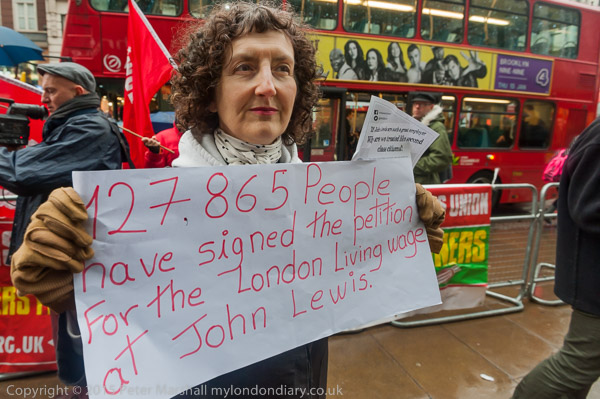
The union had received considerable support from John Lewis customers, with over 125,00 signing a petition calling on the company to live up to its ethical reputation and ensure that the cleaners are paid a living wage. Some of them came to protest with the union.

After speeches in front of the store on Oxford St, the protesters marched around the block containing the store which has entrances for shoppers on three sides. Although they arrived at some of these before the police and security they made no attempt to go inside, determined to avoid any trespass, though there were some arguments with police over a thin metal line in the pavement which marked the edge of the property.

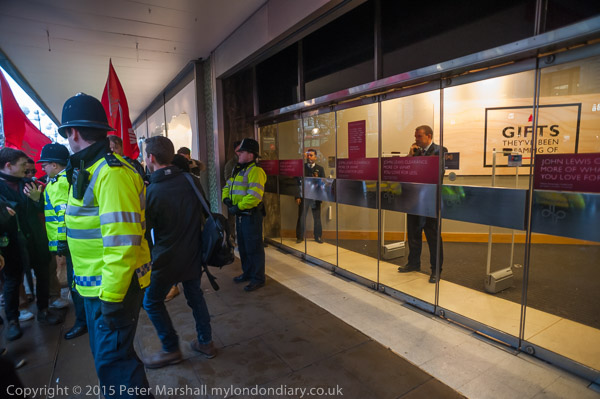
Many shoppers on the street stopped briefly to find what the protest was about and most expressed support for the workers. The main doors to the store were closed by John Lewis security staff for much of the roughly an hour and a half protest.

Xmas Protests – Low Wages, Evictions, John Lewis – 2014

Three Xmas Protests – Low wages, Evictions, John Lewis – in Brixton, Mayfair and Oxford St on December 14th 2014.

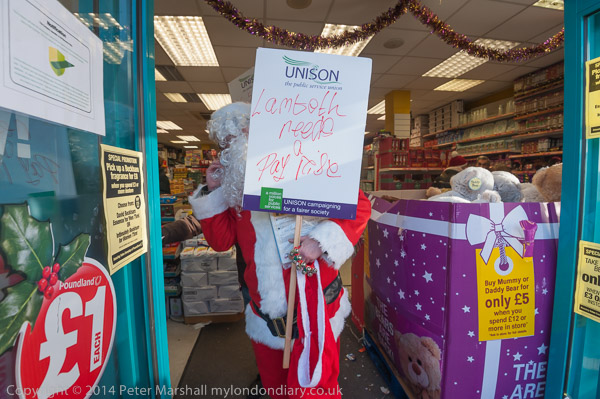
‘Santa’s Naughty List’ Living Wage

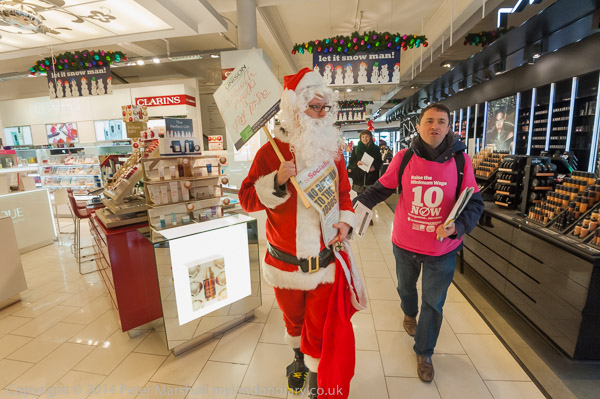
Lambeth Living Wage campaigners, led by an impressive Santa, protested in and outside shops in the centre of Brixton, handing out flyers calling for all workers to be paid a living wage. They urged shop workers to join a union and gave out forms.

While I was with them they visited department store Morleys, Subway and Poundland and they were going on to other stores in Brixton paying poverty wages. The protest was supported by Unite the Resistance, the Socialist Party, Unison (who provided the Santa costume), the Fast Food Rights Hungry for Justice campaign supported by the Bakers, Food & Allied Workers Union, BFWAWU, the National Shop Stewards Network and other groups.

‘Santa’s Naughty List’ Living Wage


Class War: ‘Evict Westbrook, Not New Era’

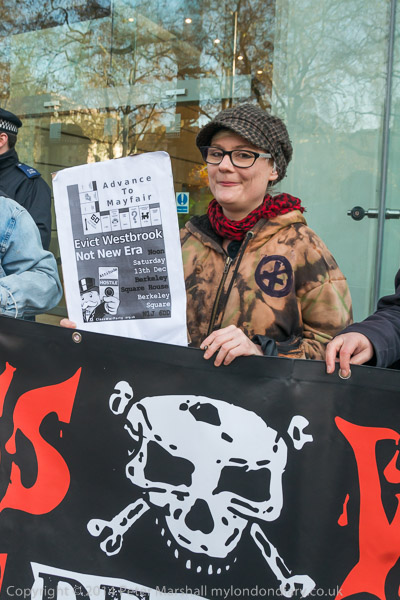
Scrooge at Christmas 2014 was US property developers Westbrook Partners who were intending to evict the tenants of the Hackney New Era Estate by Christmas so they can refurbish these low rent social properties and re-let them at market rents at roughly four times the current rents. Class War and friends protested at their Mayfair offices of in solidarity with the tenants.

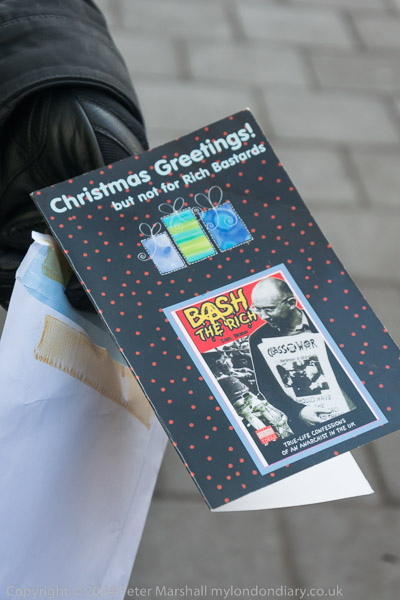
Class War came with banners and posters and a Christmas Card which they presented to Westbrook with the message ‘Christmas Greetings! – but not for Rich Bastards’ and a pictures of wrapped gifts and the cover image from Ian Bone’s autobiography ‘BASH THE RICH’. It’s an interesting read and might make a friend a good Christmas Present, available from Freedom Press at a special discount.

This was one of a number of protests by the residents, Class War and other housing activists, with a video by Russell Brand going viral and a petition with 350,000 signatures that led to Hackney Council entering into talks with Westbrook and resulted in the estate being sold to the affordable housing group Dolphin Living.

Class War: ‘Evict Westbrook, Not New Era’


Cleaners Xmas Protest in John Lewis

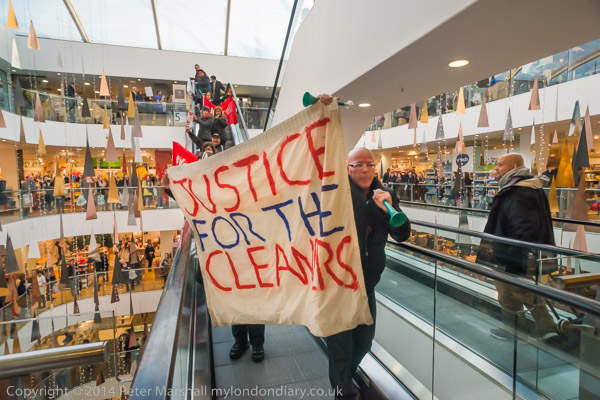
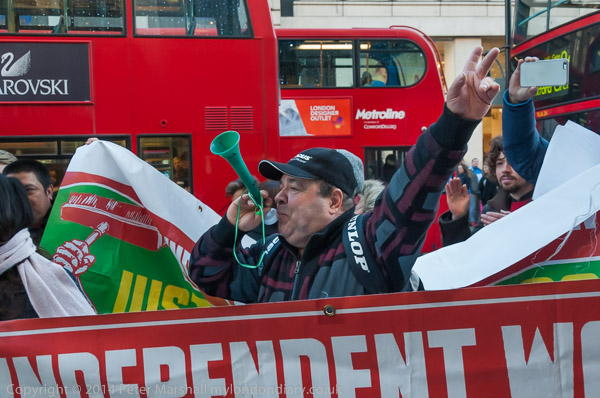
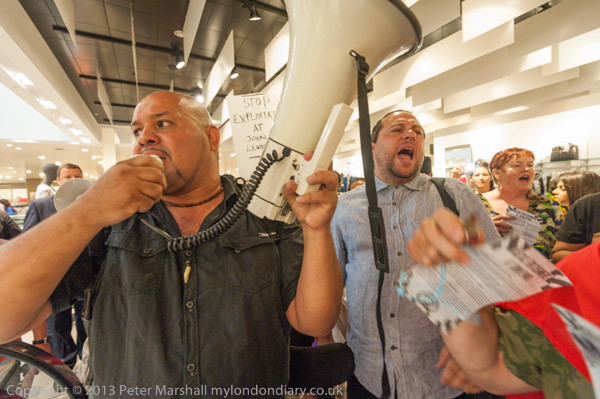
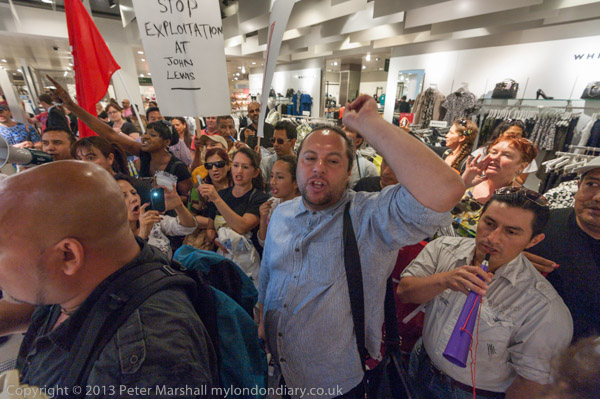
Many shoppers who can afford it go to John Lewis to buy Christmas presents, but members of te IWGB trade union and supporters including some John Lewis customers were there not to buy gifts but calling for the London Living Wage for cleaners there and an end to their treatment as second-class citizens. Many of the Christmas shoppers applauded their noisy protest.

I met the cleaners on the top floor of the store where they had gathered in the restaurant before getting out banners and flags and a megaphone, with IWGB organiser Alberto Durango used to inform customers why they were holding the protest.

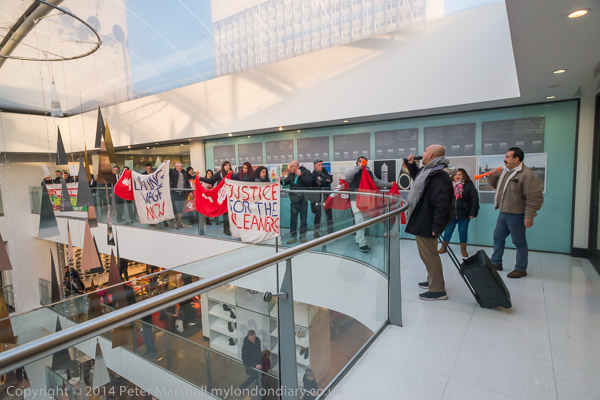
The together with a group of John Lewis customers they slowly and loudly made their way around the top floor to the escalator, moving carefully through the gangways to avoid any damage.

They made their way down floor by floor, pausing on the balconies to display their banners.

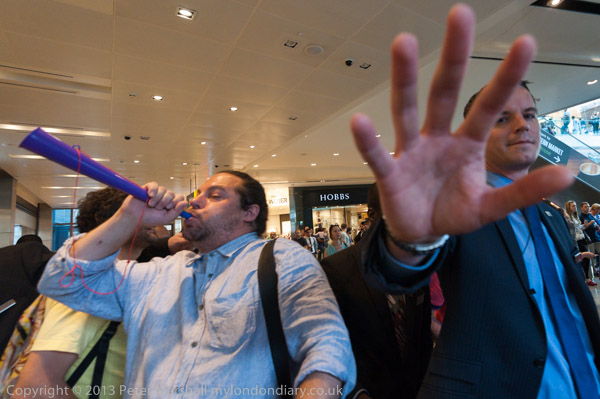
John Lewis security staff and managers met the protesters and asked them to stop protesting and leave the store. They continued their way protesting until they reached the ground floor, where police stopped them from leaving. Here the situation became confused, with a great deal of unnecessary pushing by the police which blurred many of the pictures I made. The protesters were trying to get out, store security was pushing them out and the police were pushing them back. Eventually most of the protesters managed to get past the police and the protest continued on the pavement outside. The protest inside the store had been totally non-violent for a little over a quarter of an hour and had the police not decided to push the protesters back they would simply have walked out.

A police officer made an attempt to seize the amplifier the protesters were using, but they held onto it and eventually he gave up. At least one person was arrested and carried out of the store by police, though I think charges were later dropped.

Cleaners Xmas Protest in John Lewis


SOAS Shut Down 2015

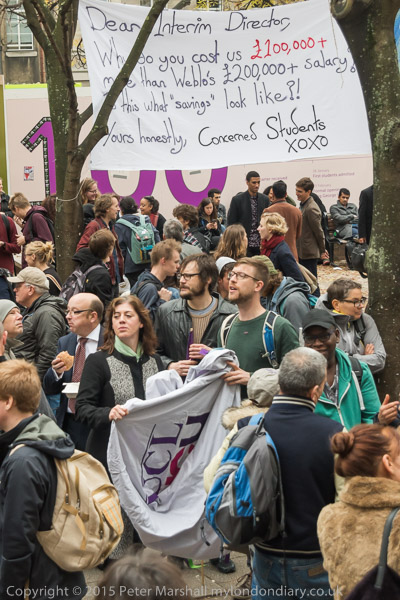
Students at SOAS, University of London, occupied the Brunei Suite on the Bloomsbury campus on October 6th 2015, after a leaked management document detailed £6.5m of cuts including the loss of 186 courses, roughly a third of the curriculum.

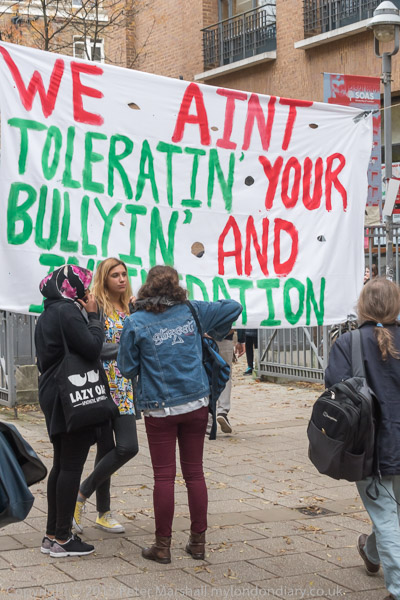
This leak came as the latest in a whole series of decisions by management which dismissed or ignored the views of both students and staff, and led to a unanimous vote of no confidence in the management two days later by the General Assembly of the SOAS Student Union.

As well as the course cuts and problems with switching courses and choosing tutorials, they complained that management had ignored an overwhelming vote in support of the Boycott, Divestments and Sanctions (BDS) Campaign, ignored the opposition to the outsourcing of cleaners, security staff and other workers and failed to respond to the strike by Fractional workers (who are responsible for much of the teaching) for fair pay. The students said that management were failing to deal with the gender pay gap and that institutional racism is thriving in SOAS.

They called for a restructuring of the Executive Board and Board of Trustees to give students, academic staff and support staff authority over the running of our university, and suggested that a large proportion of the savings needed could be made by the Executive Board cutting their own inflated salaries rather than making staff redundant.

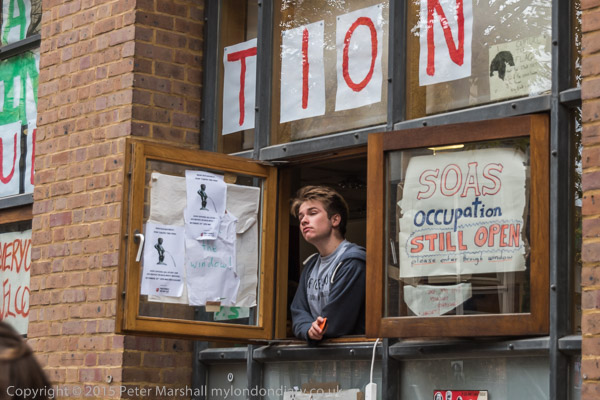
The entrance to the occupation after management locked the doors

The management responded with lies and by harassing the students, including by cutting off the power on 23rd October, and when many teaching and administrative staff refused to cross a picket line they locked the doors of the university. The entrance to the occupation became through the high ground floor windows.

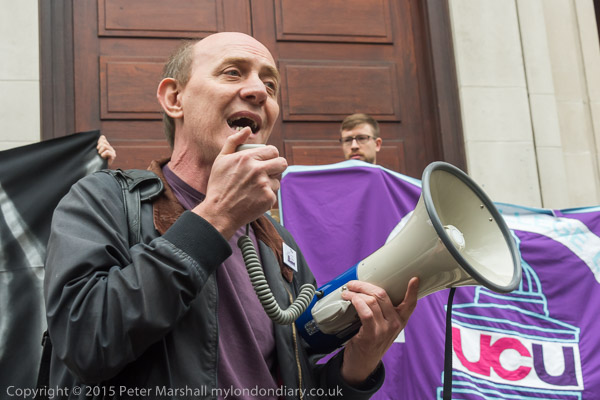
Sandy Nicoll, Unison Branch Secretary

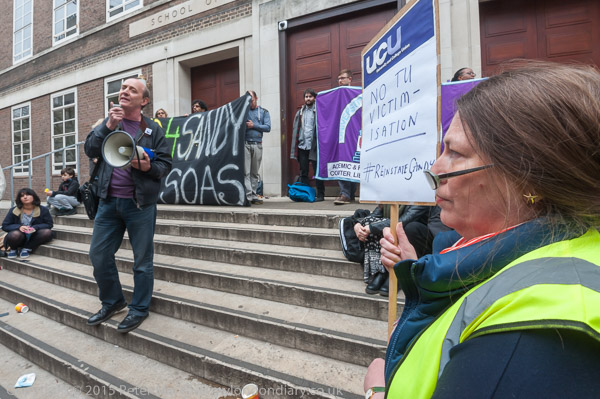
After a rally held on 27th October which I had missed they tried to intimidate the trade unions by suspending Unison Branch Secretary Sandy Nicoll, falsely claiming he had let students into the main building to protest outside the offices of recently appointed SOAS Director Baroness Amos.

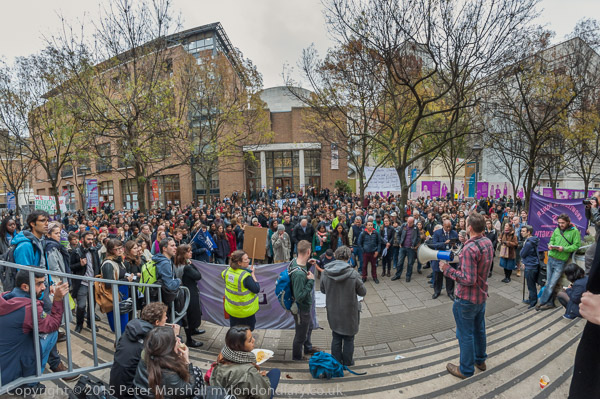
The protest on Thursday 29th was held to call for the reinstatement of Nicoll, and there were messages of support for Sandy from colleges and trade unions around the country as well as a long series of speakers who came to give their support in person.

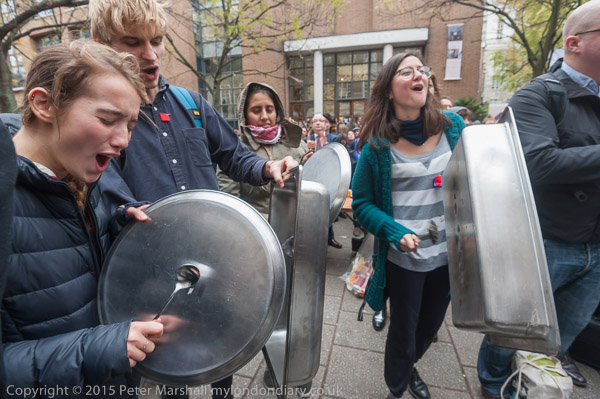
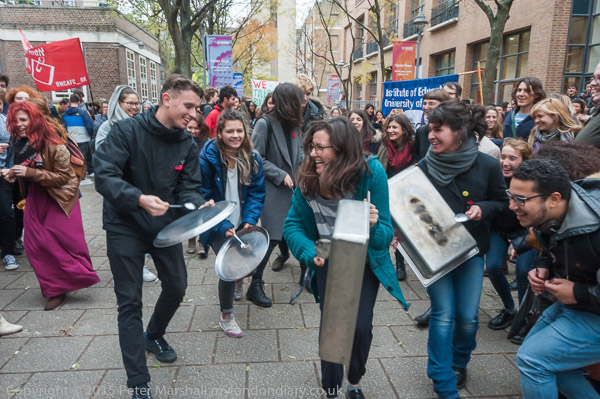
It was a well-attended and noisy protest with much banging on catering pots and pans with Nicoll getting a lengthy welcome before he could speak.

At the end of the rally there was music and dancing, with people taking part in the 'Strikey-Strikey', an adaption of the Hokey-Cokey:
You put your left arm in
Your left arm out
In, out, in, out
You shake it all about
You do the strikey-strikey
And you turn around
That's what it's all about
Woah, the strikey-strikey
Knees bent
Arms stretched
Ra-ra-ra...

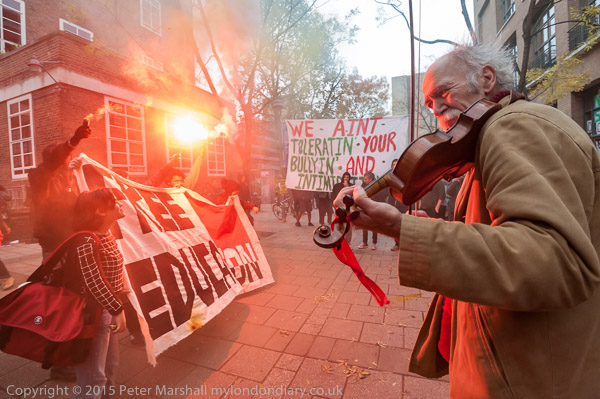
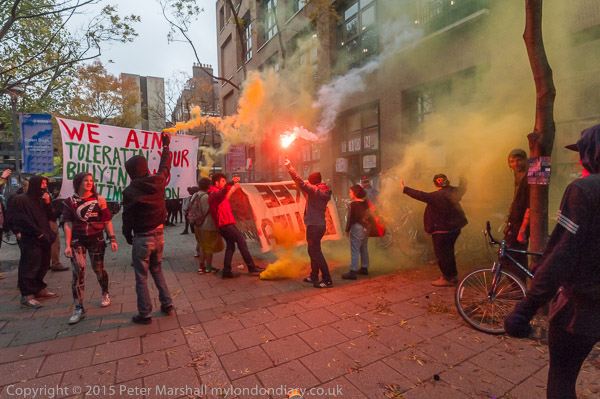
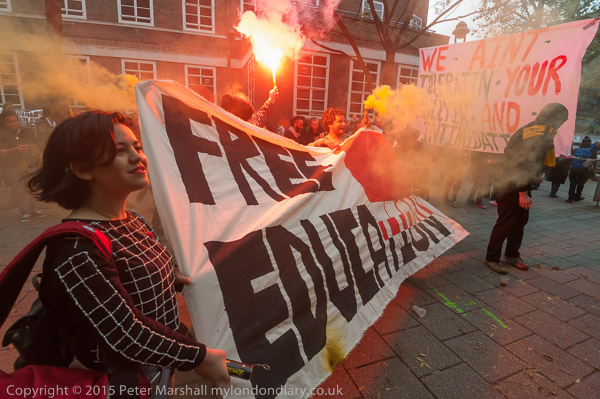
Things appeared to be drawing to a conclusion and I got ready to leave when things livened up a little with people setting off smoke flares as they paraded with banners in front of the occupied building to the music of a violin and drums.

The management finally backed down and reinstated Sandy Nicoll and eventually the occupation came to an end too, with management changing some of its plans but not meeting the main student demands. Dissent continued on campus and there was a further occupation in 2017. There have been some victories, and after a 12 year fight the cleaners became directly employed by SOAS at the end of August 2018.

More at SOAS Shut Down after Sandy suspended.


At the LSE – Sept 29, 2016

I’d gone to the LSE to attend a session in the LSE’s 3-day ‘Resist’ festival organised by Lisa McKenzie, then a research fellow in the Department of Sociology there, though I imagine that this was one of several reasons her contract was not renewed. It’s OK if your work is purely academic, or if it supports the kind of people and companies that fund universities, but anything practical which supports the working classes is definitely infra-dig.

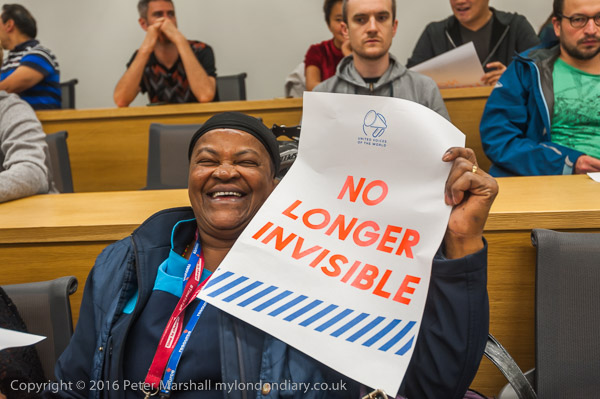
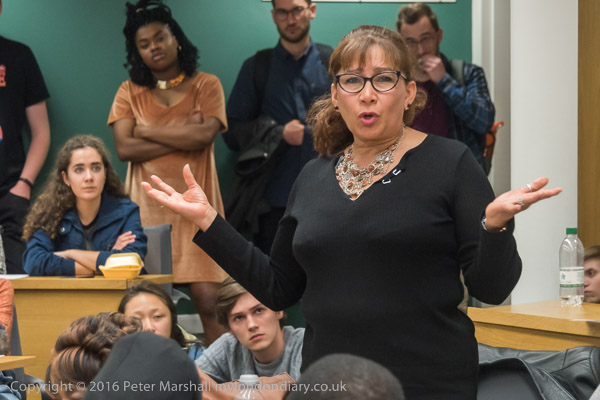
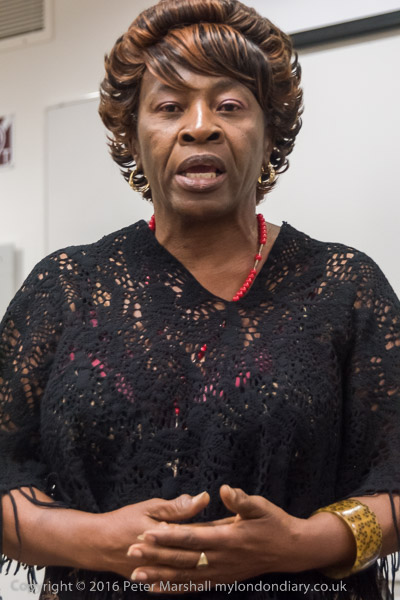
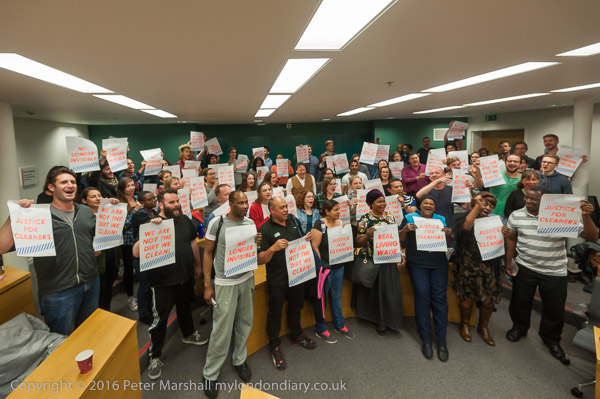
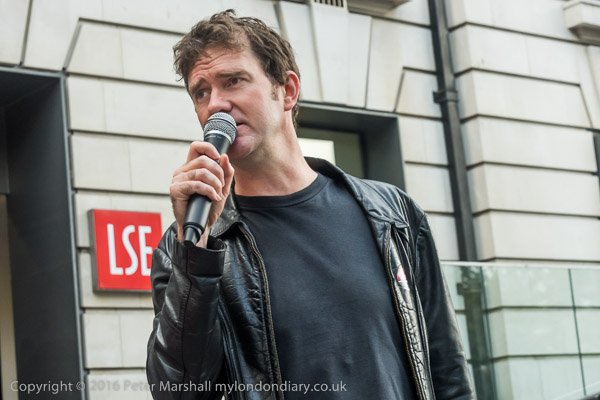
At the end of the session (more about it below) McKenzie called upon Petros Elia, General Secretary of the United Voices of the World trade union to which many of the LSE cleaners now belong. He accused the management of the LSE of failing to protect the interests of cleaners working there who they have outsourced to a cleaning contractor in a cost-cutting exercise without insisting on decent working conditions and conditions of service. He invited all present to a meeting to discuss action by the cleaners which was to be held as a part of the Resist festival later that day. I hadn’t intended to stay for that, but decided to do so.

Covid has made many re-evaluate the contributions of many low-paid workers, and to realise how essential their services are to the running of society. Cleaners are one such group and the meeting organised by the UVW made clear how terribly they were being treated by their employers, Noonan, while the LSE was happy to pocket the few pennies they were saving by outsourcing and look the other way to the injustices taking place under their own roof – while claiming the moral high ground and uncovering and moralising on those in societies around the world.

It was also a meeting which would have shattered any prejudices about low-paid workers being less intelligent, less aware or less articulate than those in higher positions. Many of them were migrant workers and speaking in their second (or third) language, though some through interpreters, but made themselves heard more clearly than the average cabinet minister in a radio or TV interview.

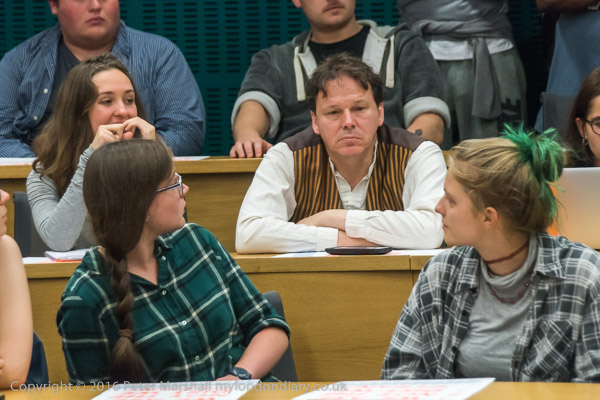
The cleaners’ campaign for parity of treatment with other workers employed directly was supported by students – including those on a new graduate course in Equality – and the students union General Secretary, several post-graduate students and staff. One of those present was LSE Professor of Anthropology David Graeber who so sadly died aged 59 just over a year ago and is much missed.

Students and staff continued to support the cleaners in various actions and the campaign was partly successful. The cleaners were brought in house in June 2017, but are still remained “frustrated and grieved by their continuing treatment as “second-class” workers.” A petition was launched in April 2021 making 14 demands. A major continuing problem is that the LSE does still not recognise or talk with the cleaners’ trade union, the UVW, but talks with Unison which never consults the cleaners and fails to represent many of their needs.

The earlier session of ‘Resist’ was a lengthy and detailed indictment by Simon Elmer of Architects for Social Housing of a report by a group of LSE academics on Kidbrooke Village, a development by Berkeley Homes and Southern Housing. This replaced the LCC-built Ferrier Estate in SE London, which was deliberately run-down, demonised and emptied by Greenwich Council from 1999 onwards.

Elmer accused the report of lies about the estate regeneration, of basing their report on that of the property developer and passing it off as their own, of placing the cultural legitimacy of an LSE report in the service of Government policy and the profits of Berkeley Homes and of accepting financial backing to validate the desired conclusions of their backers.

Elmer made a convincing case, but none of those responsible came to make any defence of the report, and it was hard to know whether there could have been any – though I suspect it might well have been only a matter of picking a few holes and making minor corrections to his analysis. Clearly universities should not be places where property developers or even governments call the tunes and the LSE would appear to have been caught out kowtowing to capital.

More at:
LSE Cleaners campaign launch
Simon Elmer of ASH indicts LSE


All photographs on this and my other sites, unless otherwise stated, are taken by and copyright of Peter Marshall, and are available for reproduction or can be bought as prints.


Low Pay, Lousy Conditions. 3rd Aug 2013

IWGB are harassed by Westfield security after their protest in John Lewis

The two events I covered on Saturday 3rd August 2013 both concerned the fight to get decent wages and conditions for low paid workers in London, something which has largely been left to the left wing and grass roots unions to fight for rather than the big trade unions or the Labour Party.

Outside Sports Direct in Oxford St

The two major ways that low paid workers are cruelly exploited in modern Britain are through zero-hours contracts and outsourcing, and these were at the heart of the two protests.

Security stop protesters from going down the escalator in Sports Direct

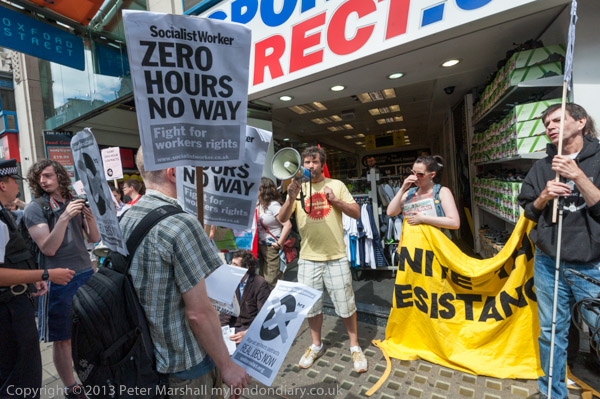
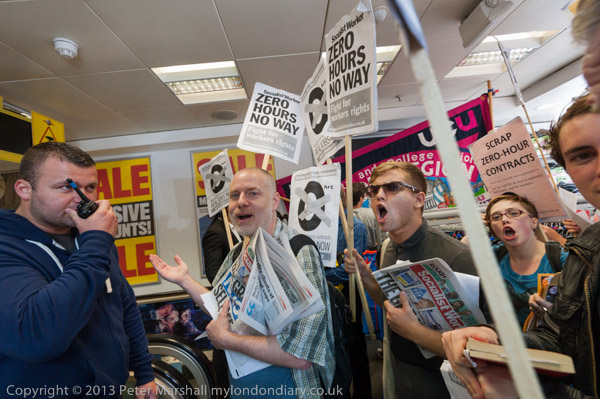
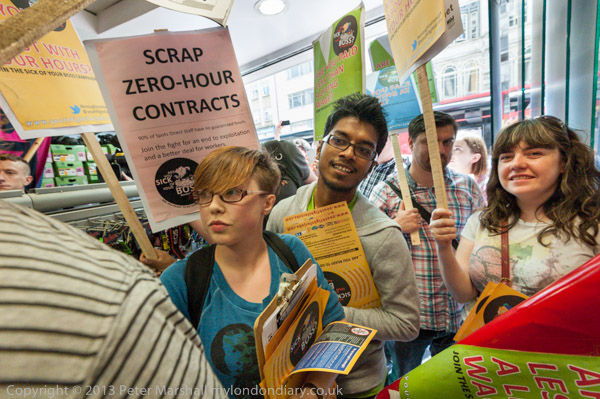
The first, at Sports Direct in Oxford St called on the company to abandon the use of zero-hour contracts which deprive all their 20,000 part-time workforce (over 85% of staff) sick pay, holiday pay and other employment rights.

The protest continues inside Sports Direct

Zero hours contracts, as I explained on My London Diary “are a peculiar legal casuistry that in essence denies the whole concept of a contract as normally understood, agreements without substance which gravely disadvantage workers … Although they give no guarantee of any income, they oblige the workers to be available for work at the employer’s whim, making it impossible for them to take on other work.”

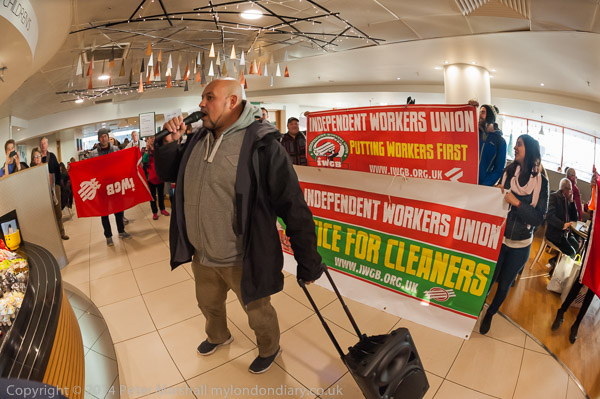
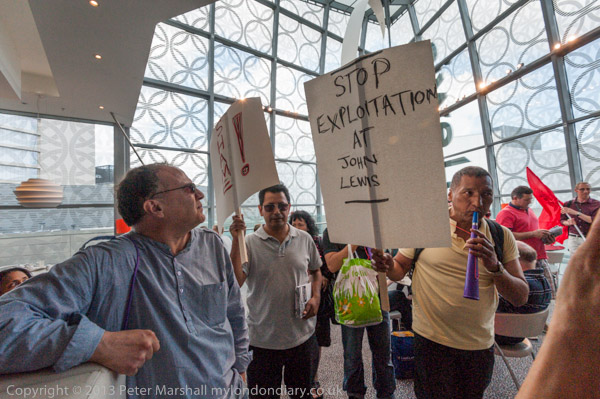
IWGB get out flags, placards and banners on the top floor of John Lewis

All the advantages are for the employer who has a contract which imposes great constraints on workers while denying them the employment rights which are a part of normal employment and leaving them open to the whims of managers as to whether they work or not. A limited reform in 2015 prohibited terms in them which prevented people working for other employers, but if that leads to them being unable to work when the employer demands them to, they may still find their hours very much reduced in future or their contracts terminated.

And begin their protest in John Lewis in Stratford Westfield

The protest was a noisy one and after around 50 minutes handing out leaflets and speaking to shoppers on the street outside, they surged into the small street level area of the shop, where they made no attempt to push post security men who stopped them at the entry to the escalator leading down to the main store. They continued the protest inside the store being careful not to cause any damage. After around five minutes one of the police officers who were watching came to talk to one of the leading protesters and was told they would leave shortly, and after a few more minutes they did, ending the protest on the pavement a few minutes later.

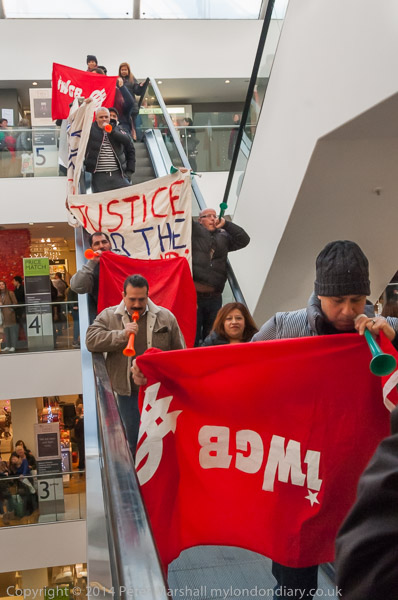
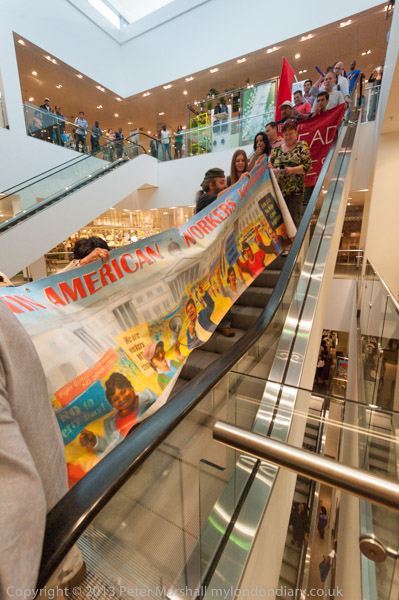
They take the escalator to continue the protest on the floor below

I made my way to Stratford to join the IWGB union who were making a surprise visit to protest inside the John Lewis store in Stratford Westfield. The cleaners there are outsourced to sub-contractor ICM of the Compass Group, who had recently announced pre-tax profits for the year of £575 million. They pay the cleaners £6.72 per hour, considerably less than the London Living Wage of £8.55 an hour set by the GLA and backed by the London Mayor.

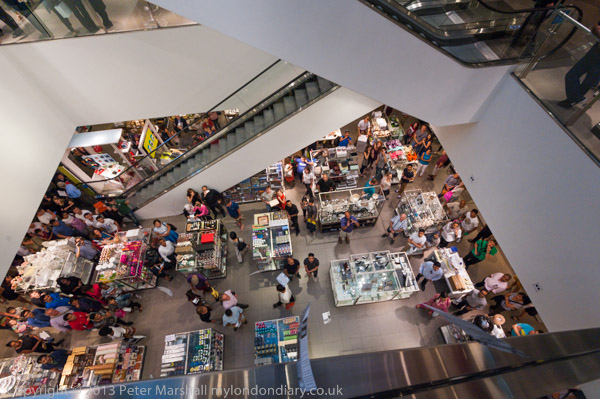
Everyone in John Lewis could hear the protest and stopped to look and listen

Outsourcing enables John Lewis to distance itself from the low pay and poor conditions of service of these workers who share the workplace with the much-lauded John Lewis ‘partners’, who as well as higher pay and better benefits, also get a share in the company’s profits, enabling John Lewis to claim it is a ‘different sort of company’ with a strong ethical basis, but still leave its cleaners – a vital part of its workforce – on poverty wages.

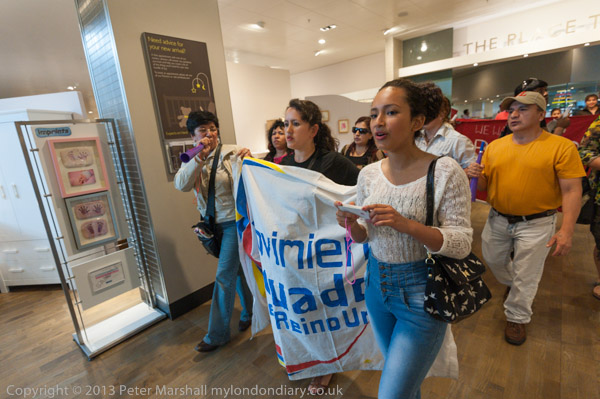
I met the cleaners outside Westfield and walked with them through the shopping centre to John Lewis at its far end, trying with them to look inconspicuous. In the store we went up to the cafe area on the top floor where they got out banners, placards and a large megaphone from their bags and then proceeded to walk around in a noisy protest.

They then took the escalator to the floor below and walked around that making the case for a fair deal for the cleaners to management and customers. Among those protesting (centre, above) was a man who had been a ‘partner’ in the Westfield store and was dismissed after he gave an interview to The Guardian supporting the cleaners’ case for equal treatment, and he was greeted by many of his former colleagues on the shop floor.

I get told I can’t take photographs

After protesting on each floor of the store, there were a numbber of final speeches, including one by the dismissed ‘partner’, on the ground floor before the group left, going out into the Westfield Centre in front of John Lewis. Here they were met by the centre manager and security staff who tried to stop the protest, with some pushing them (and me) around. Here I was told I was not allowed to take pictures, but took little notice. Very slowly we all made our way out of the centre by the nearest exit, still followed by Westfield security, and were met by two police officers who were told the protest was finishing.

Many more pictures at:

Cleaners in John Lewis Westfield
End Zero Hours Contracts – Sports Direct


All photographs on this and my other sites, unless otherwise stated, are taken by and copyright of Peter Marshall, and are available for reproduction or can be bought as prints.


Five Years Ago – 13th July 2016

Wednesday was a busy day for me on 13th July 2016, photographing five events in London.

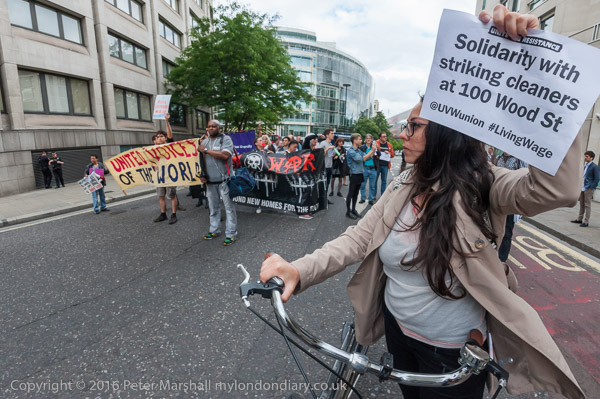
Cleaners at the 100 Wood St offices were still on strike against the anti-union cleaning contractor Thames Cleaning, by then the longest running industrial dispute in the history of the City of London and supporters including Unite the Resistance, the Haldane Society of Socialist Lawyers, Class War and others held a rally in support of the action by the United Voices of the World trade union, beginning on Wood St and then moving on to the street outside CBRE who manage the offices.

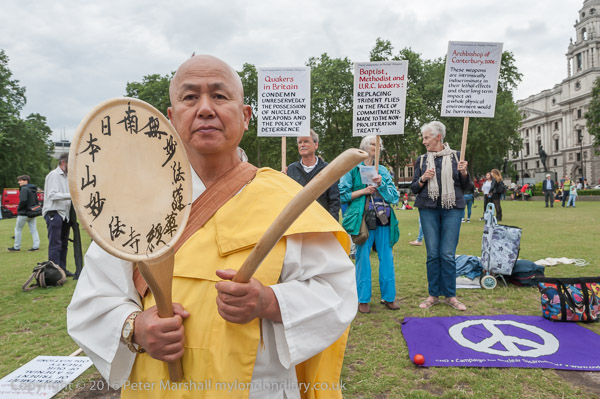
CND members and supporters had come to Parliament to lobby MPs against the plans to replace Trident at a cost of at least £205 billion, and held a ‘Mad Hatters Tea Party’ in Parliament Square where members of Faith groups including both Christians and Buddhists held placards. Church leaders had written to The Times stating ‘The Government must take a lead – cancelling Trident would be a momentous step – Britain can lead the way!’ The government was instead led in its decisions by the lobbyists from those arms companies that profit greatly from these totally redundant weapons.

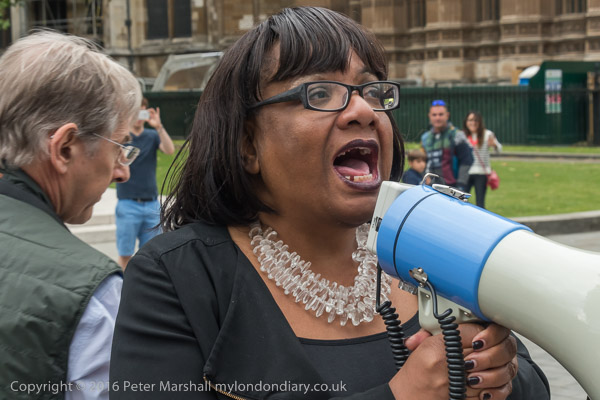
Also on Parliament Square was a protest supporting Labour MP for Wirral West Margaret Greenwood’s ‘Ten Minute Rule Bill’ with cross-party support to stop the privatisation of the NHS and return it to its founding principles. Among those who spoke was Shadow Health Minister Diane Abbot.

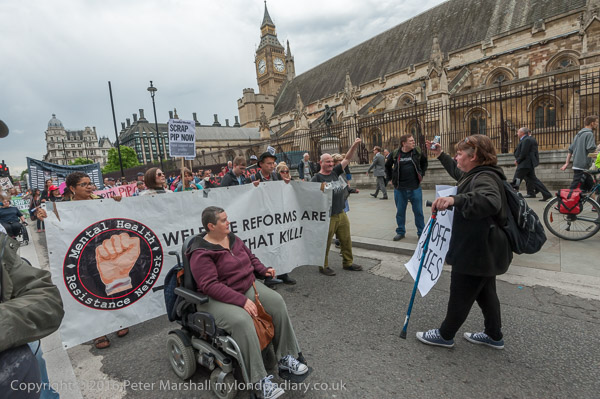
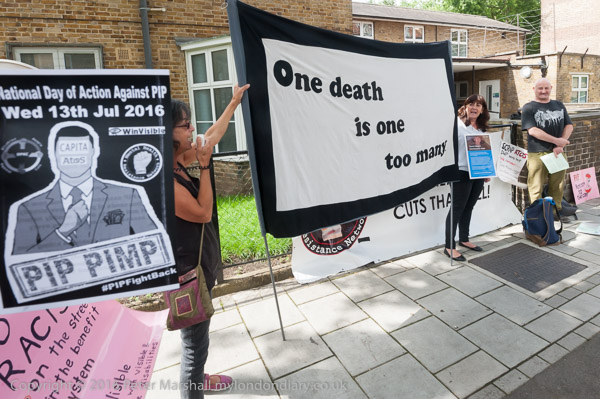
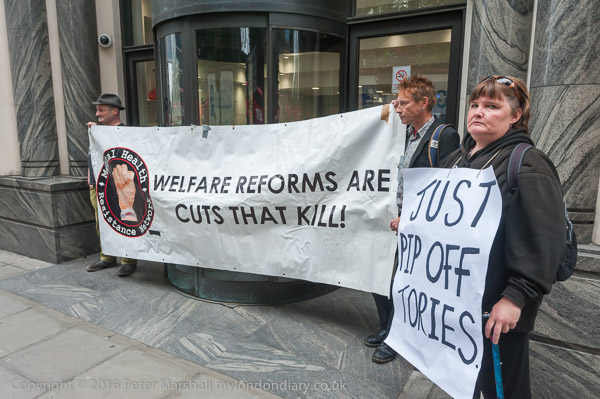
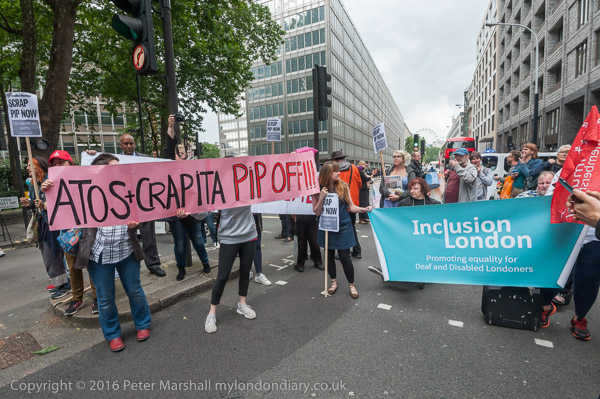
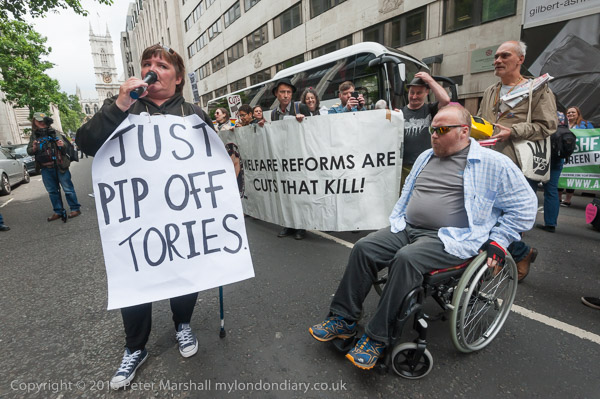
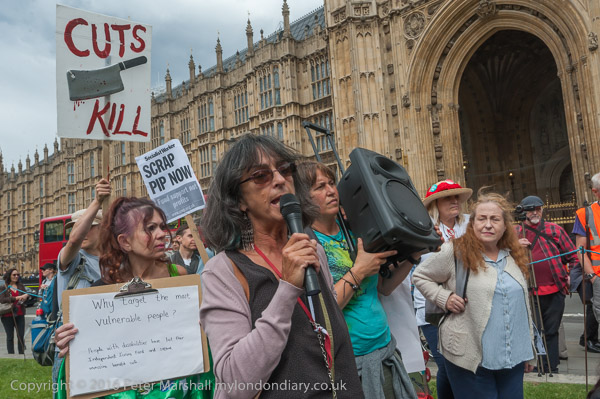
The day was also a ‘#PIPFightback’ National Day of Action against the Personal Independence Payments which disabled people say are a totally inadequate replacement for the Disabled Living Allowance. These rely on systematically flawed assessments carried out by private firms Capita and Atos which make no allowances for many variable conditions and ignore medical evidence. Administered by poorly qualified staff, many are overturned at tribunals after disabled people have suffered for months, sometimes leading to hospitalisation or suicide.

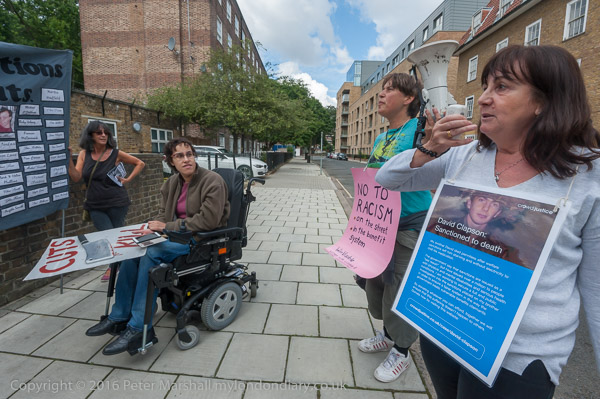
I’d started the day outside the Vauxhall PIP Consultation Centre run by ATOS in a back street with a small group of protesters including Gill Thompson, whose brother David Clapson, a diabetic ex-soldier died in July 2013 after his benefits were ‘sanctioned’. He was left starving without money for food or electricity to keep the fridge containing his insulin running. Like many his benefits had been stopped for trivial reasons and she was calling for a full and public inquiry into cases like those of her brother and to ensure a fairer system for vulnerable claimants.

Later people from the Mental Health Resistance Network (MHRN), Disabled People Against Cuts (DPAC) and Winvisible (Women with Invisible and Visible Disabilities) and other supporters met outside the Victoria St offices of Capita PLC, one of the companies responsible for PIP assessments and held a rally on the busy pavement there.

After some speeches they moved from the narrow pavement to the busy road to continue their protest, holding up traffic for a few minutes, though they quickly moved to one side to allow an ambulance to drive through.

From there the moved to hold a short protest outside the Department of Work & Pensions offices at Caxton House, and then on to Parliament Square for another short rally.

Finally they decided to go to College Green where a media village was present with politicians being interviewed on TV over the appointment of Theresa May as Prime Minister. Police tried to stop them going into the area, but after some moved in eventually allowed them to stand on a path in the middle of the area a few yards away from the TV crews, who almost all totally ignored the protesters. Disabled people suffering and even dying apparently isn’t news.

Solidarity for Wood St cleaners
Trident Mad Hatters Tea Party
Disabled PIP Fightback blocks Westminster
NHS Bill protest at Parliament
PIP Fightback at Vauxhall


All photographs on this and my other sites, unless otherwise stated, are taken by and copyright of Peter Marshall, and are available for reproduction or can be bought as prints.