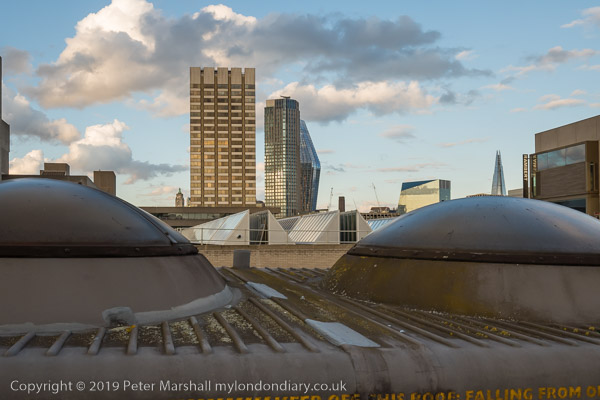
Gun & Knife Crime, Equiano & St John’s – 2007

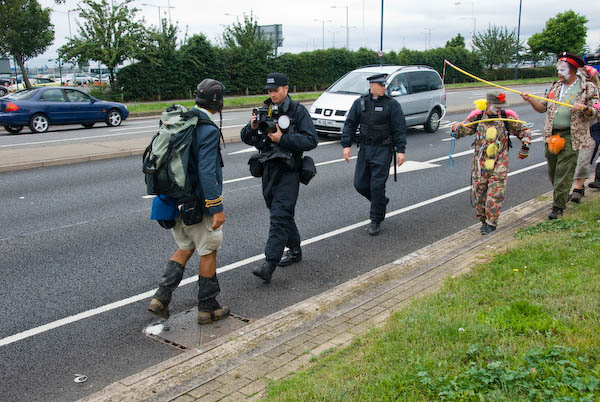
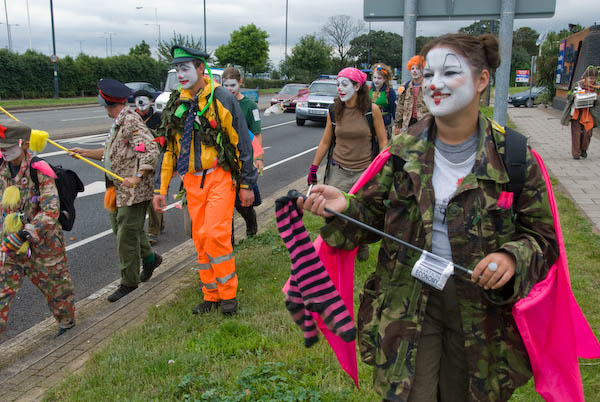
Gun & Knife Crime, Equiano & St John’s: I went to two events in North London on Sunday 14th October 2007, a local march against gun and knife crime and then a Black History Month event in Abney Park Cemetery. And on my way home I stopped to take a few pictures of the church opposite Waterloo Station.


Communities Against Gun and Knife Crime, Hackney

In the 2000’s a stretch of road between Upper Clapton and Lower Clapton attracted the title ‘Murder Mile’ in the press after eight people were shot dead on the street or in the streets just off the main road over a period of two years. Of course there are some other cities around the world – including in the USA – where that number of deaths in a week or even a day would not be unusual. But London is generally a very safe city and Clapton is one of a number of areas which has more than its share of gun and knife crime.

Gun & Knife Crime, Equiano & St John's:

This is an area with a number of night clubs and where drug dealing is common and a large proportion of the shootings and deaths are related to these, often involving people from outside the area.

Gun & Knife Crime, Equiano & St John's:

But young people who live in and around the area are also caught up in gun and knife crime and one death is one too many, particularly when it involves your friends or family. Like many areas of London it houses a wide social mix, and these crimes particularly involve the poorer members of the community, many of whom are black.

Gun & Knife Crime, Equiano & St John's:

The march organised by Communities Against Gun And Knife Crime appeared to have no support from either of the two London Boroughs concerned – Hackney and Haringey – or from the Met police, who did escort it. The only other organisation which I could see was supporting it was Hackney Respect, a local group of the left-wing Respect party.

Gun & Knife Crime, Equiano & St John's:

The march began at Clapton Pond with a prayer by a Black Church Sister, and then moved slowly north up the Lower Clapton Road and across the Lea Bridge Roundabout and up the Upper Clapton Road. I had to leave before the end for my second event.

The march was smaller than I had expected with fewer than a hundred people taking part, and although it atrracted waves and shouts of support from people as it passed, few if any of them came to join it. As I commented, “marches like this are surely useful in raising community awareness, and it is hard to see why there was so little support from either the public, local authorities or other local groups – including the other political parties, churches and other community groups.” Apart from myself there was a photographer from a local paper reporting on the event, but no other media interest. I don’t think any of the pictures or my report which I filed to an agency were ever used.

Here is my final comment from my 2007 article:

The real challenge in cutting youth crime – and gun and knife crime is mainly youth crime – is getting people, and especially young people – real jobs that offer training and possibilities for advancement. At the moment there are too few jobs for young people, and many pay below a living wage, especially a living wage for London. While crime offers the only way to money, prestige and apparent success, many will take that route.

Communities Against Gun and Knife Crime

Equiano Society – His Daughter’s Grave – Abney Park Cemetery, Stoke Newington

I joined a Black History Month walk led by Arthur Torrington OBE, the secretary of the Equiano Society which ended around the grave of Joanna Vassa, the daughter of Olaudah Equiano.

As the web site Olaudah Equiano, or, Gustavus Vassa, the African shows he was a truly remarkable man. Probably born around 1745 in what is now Nigeria he was kidnapped and sold into slavery as a child and taken to Barbados. In 1745 he became slave to a captain in the Royal Navy who renamed him Gustavus Vassa, and taught him to be a seaman and also sent him to school in London to learn to read and write. Later was bought by a Quaker merchant in Philadelphia who set him to work on one of his trading ships. Equiano was also able to engage in some trading for himself, and in four years made the £40 that his master had paid for him and was able to buy his freedom.

After various adventures in 1743 he came to London and became involved in the fight against slavery, although at first he was engaged in projects to set up black colonies in Central America and Sierra Leone, becoming for the latter the first black civil servant – but after he pointed out corruption among some officials he was quickly sacked.

He then wrote the book which made him famous, ‘The Interesting Narrative of the Life of Olaudah Equiano, or, Gustavus Vassa, the African‘ which was an autobiography, a description of the horrors of slavery and a polemic calling for its abolition. It was a success when published in 1789 and he earned a considerable income from it. In 1792 he married an English woman, Susanna Cullen, at Soham in Cambridgeshire and they had two daughters, one of whom after his death in 1797 inherited his estate of £950 (equivalent to around £100,000 now.)

Joanna Vassa later married the Congregational minister, Henry Bromley, and in 2005 their joint grave (also of Henry’s second wife) was discovered in Abney Park Cemetery, fallen down and covered by moss and undergrowth. Much of the inscription was worn away, but the names remained and the stone was restored and re-erected.

Equiano’s daughter


St John’s, Waterloo – A Waterloo Church

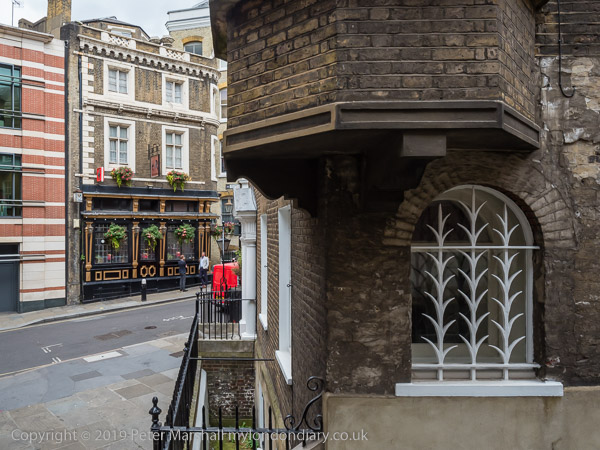
St John’s Church, now opposite Waterloo Station was one of a number of churches built in the years of national triumph following the defeat of Napoleon in 1815 with money granted by acts of Parliament to the Church Building Commission in 1818 and 1824 totalling £1.5 million. A total of 612 new churches were built by the Church Commissioners, mainly in the new and expanding industrial towns and cities, but initially “particularly in the Metropolis and its Vicinity“.

London south of the river was expanding rapidly, with new industries and a great deal of housing. The church was designed by Francis Octavius Bedford and built in 1822-1824 in a Greek Revival style – as were his other churches for the commissioners in Camberwell, West Norwood and Trinity Church Square, Southwark.

The site chosen, close to the foot of Waterloo Bridge was a difficult one, being a pond and a swamp, and John Rennie the Younger was consulted for advice about the foundations. This has proved sound as the building, despite being badly bombed in 1940 and standing in ruins until 1950 and the construction of the Jubilee Line underneath is still sound. It was restored and rededicated in 1951 as a part of the Festival of Britain, and again controversially in recent years which removed some of the later features.

I think I probably had just missed a train home from Waterloo Station opposite, a later development which opened as Waterloo Bridge Station in 1848, and had some time to wait for the next. Soon I was on a train home.

St John’s Waterloo


Cable Street – Labour Lost

Cable Street – Labour Lost: Over recent days I’ve seen a number of posts and articles celebrating the ‘Battle of Cable Street’, when people from the East End of London prevented a march through their streets by Oswald Mosley and the British Union of Fascists on October 4th 1936.


Battle of Cable Street 80 March – Altab Ali Park & Cable St

Cable Street - Labour Lost

Back on Sunday 9th October 2016 along with many others I went to Cable Street to celebrate the 80th anniversary of that event, and here are a few of the pictures that I made.

Cable Street - Labour Lost

I also wrote a little about what actually happened back in 1936, though of course I wasn’t around then, so what I know about it relies on what others have written and said, including the testimonies I’ve heard over the years from some of those who were there and have spoken at this and various earlier celebrations.

Cable Street - Labour Lost

Cable Street has acquired a mythical status that it doesn’t entirely deserve, or at least one which distorts the actual nature of the event. It certainly was not a great victory for the organised left – with the Labour Party actively urging people to stay away. They urged people instead to attend a rally in Hyde Park, miles away in West London. If anything it was a victory for the ordinary common decency and solidarity of the working class population of the area who came out and fought the police (and generally not the fascists) who were trying to clear the streets to allow Mosley and his blackshirts to march. A victory for the kind of community self-organisation which is at the centre of anarchism.

Cable Street - Labour Lost

So in 2016 for me the anarchist groups taking part were the real centre of attention rather than the more official aspects of the celebration – this was really their day, though none were invited to speak at the official rallies at the start or finish of the event. And here I’ll repeat a little of what I wrote about the event 4 years ago.

“Probably many of those present already knew that the battle wasn’t fought by the political parties – Labour told people to stay away and urged them to protest in Hyde Park, while the official communist party opposed any opposition on the streets until almost the last minute, when it was pretty clear it was going to happen anyway.

“It was the community that came out onto the streets. People from the mainly Jewish areas of the East End, trade unionists, communist rank and file and Irish dock workers. Men and women in a grass roots movement opposed to Mosley, people who knew that they would be the victims if he came to power. And of course the battle was not against Mosley, but against the police.

“Of course there were communists and socialists among those who came out on the streets, and some who played a leading role. But it was essentially a victory for the working class left, for the anarchists and for many without political affiliations who came together spontaneously to defend their place and their people.

“It wasn’t a great defeat for Mosley and his National Socialists; they actually became more active in the East End after it, and areas such as Bethnal Green remained strongly supporting the Nazis. There was an even larger ‘battle’ the following year in Bermondsey. But Cable Street was undoubtedly an important event for the left, and one that has come to be associated with a much greater battle of the era, the Spanish Civil War. Cable Street radicialised many on the left.”

Many more pictures and more comments on My London Diary:
Black bloc rally at the Cable St Mural
Battle of Cable Street 80 March
Battle of Cable Street 80 Rally


Squat, Circus, Garage & Church

Squat, Circus, Garage & Church continues my walk on Wednesday 19th July 1989 in Stockwell and South Lambeth which began with the previous post, Stockwell Park, Bus Garage, Tower and Mason.

House, 38, Guildford Rd, Stockwell, Lambeth, 1989  89-7g-33
House, 38, Guildford Rd, Stockwell, Lambeth, 1989 89-7g-32

I took a couple more pictures of the previously squatted Grade II listed house at 38 Guildford Road, which ended the previous post on this walk. It now seemed firmly bricked up against further occupation.

The garden gate was only tied closed with rope, but I didn’t trespass and photographed from the pavement. At the side of the house the gate was open, announcing thyat this was 38 and The House, with the message to ‘POSTMAN DELIVER LETTERS INSIDE GARDEN PLEASE’ and some drawings, with a leaping figure and the sun for the Solstice Festival as well as smiley faces.

House, 38, Guildford Rd, Stockwell, Lambeth, 1989  89-7g-33
House, 38, Guildford Rd, Stockwell, Lambeth, 1989 89-7g-33

As the smiley faces and the LSD on the wall show, the Solstice Festival in Stockwell was an acid culture event, celebrating peace and love – part of the ‘Second Summer of Love’ in 1989 which also saw raves and parties in deserted warehouses across the UK, largely propelled by Ecstasy. But I can find no details of this Stockwell event online.

Lansdowne Circus, Lansdowne Gardens, Stockwell, Lambeth, 1989 89-7g-35

Landsdowne Circus is the central element of the area laid out in 1843 with houses built shortly afterwards by John Snell; the land was owned by architect James Humphreys who probably designed the houses in the then popular neo-Classical style. These houses are at 35-41 on the south-east of the circus, which I think is all Grade II listed.

The area had deteriorated considerably by the middle of the twentieth century but fortunately escaped much wartime damage. After Lambeth Council failed to find a responsible legal owner they used compulsory purchase to take control of the area in 1951. It became a conservation area in 1968.

Mondragon House, 49, Guildford Rd, Stockwell, Lambeth, 1989 89-7g-22

Grade II listed neo-Jacobean style former vicarage for St Barnabas Church immediately to the south, in a neo-Jacobean style. It is listed as Mandragon House and was built between 1843 and 1850 by John Snell as the vicarage to adjoining St Barnabas Chapel.

The church was deconsecrated in 1978 and converted into flats as Ekarro House by a housing cooperative, Ekarro Housing Co-operative Limited, set up by local residents which leased the church and vicarage, and now also manages some other properties in the area still as a cooperative.

Kelvedon House, a 22 storey tower block built nearby for Lambeth council in 1966 towers 64 metres in the background.

Stockwell Bus Garage, Lansdowne Way, Stockwell, Lambeth, 1989 89-7g-23

I walked back down to Landsowne Way and could not resist another photograph of the Grade II listed concrete bus garage, one of London’s finest postwar buildings completed in 1952. I hope its concrete is still safe.

Stockwell Baptist Church, 276, South Lambeth Rd, Stockwell, Lambeth, 1989 89-7g-25

I turned east down Lansdowne Way to South Lambeth Road where around a hundred yards to the north I came to this fine classical church, Stockwell Baptist Church at No. 276. Again Kelvedon House towers in the background.

Stockwell Baptist Church, 276, South Lambeth Rd, Stockwell, Lambeth, 1989 89-7g-12

The church web site has this short history:

https://www.stockwellbaptistchurch.co.uk/about-us/our-history/

And as it also says, it “has been part of the rich and ever-changing history of this part of London for a long while.

Charles Spurgeon (1834-92) who preached the first sermon in the chapel was a remarkable man and one of the leading non-conformist preachers of the 19th century. For 38 years he was pastor at the Metropolitan Tabernacle at the Elephant & Castle. He founded an almshouse and an orphanage in Stockwell, as well as a college named after him following his death, and set up various institutions to aid the poor, following the Bible example of Jesus and exhorting his congregations to do so too. He had great influence both nationally and internationally and campaigned for free hospitals for the poor, and against slavery which antagonised Southern Baptists in the USA. He wrote many books, some of which are still now re-published and is still held in high esteem by many, particularly evangelical Christians.

My walk continued – more shortly.


Houses, Almshouses, A Pub and Cold Store

Houses, Almshouses, A Pub and Cold Store: The end of my walk on 17th July 1989 which began with Back in Stockwell. The previous post was Stockwell Housing and Adventure.

Terrace, 195-203, Brixton Rd, Angell Town, Lambeth, 1989 89-7e-64

This terrace is on the east side of Brixton Road, with 195 on the corner with Normandy Road. They were built on a part of the large Lambeth Wick estate which was owned by the Church of England but was developed by Henry Richard Vassall, the third Baron Holland, who had adopted his wife’s maiden name of Vassall in 1800. The manor was leased to him in 1820 with a building lease that specified he had to built “houses of at least the third rate” and keep them in good repair, painting outside wood and ironwork every 4 years “and offensive trades were prohibited.”

Vassall’s lease was for 99 years and he let out small plots such as this one to builders and speculators on 80 year leases. The lease for the plot for these three-storey terraces was granted to James Crundall in 1824, but the actual date of completion of Alfred Place as they were known may have been a little later. The Grade II listing simply states early-mid C19.

The end wall facing Normandy Road has no windows – its interior layout is presumably similar to those houses in the middle of the terrace, but what would have been a massive slab of brickwork is relieved by a central pilaster and blind windows.

House, 104, Fentiman Rd, South Lambeth, Lambeth, 1989 89-7g-62

I was now on my way home and walked quickly north up Brixton Road before cutting through Crewdson Road to Clapham Rd and then turning down Fentiman Road, heading for Vauxhall Station.

It wasn’t until I stopped opposite No 124 that I made my next picture. This was built on part of the large Caron House estate which stretched north from South Lambeth Road. Fentiman Road was laid out just to the south of the large house after it and its extensive grounds were sold to Henry Beaufoy in 1838 and this unlisted mid-19th century building probably dates from shortly after this.

There are a number of other interesting buildings on this section of the road, some listed I did not stop to photograph, and I think the reflection in the car and the shadow of the tree which occupy much of the lower part of the picture may have made me stop here.

Caron's Almshouses,  Fentiman Rd, South Lambeth, Lambeth, 1989 89-7g-63
Caron’s Almshouses, 121, Fentiman Rd, South Lambeth, Lambeth, 1989 89-7g-63

Sir Philip Noel Caron, Dutch Ambassador to King James I founded his almshouses in 1621 on what is now Wandsworth Road to house seven woman aged over 60, but by the 1850s these were, according to the Survey of London ‘“uncomfortable and unsuitable” for aged persons‘ and the site was sold to Price’s Patent Candle Company for their factory. They sold the site in 1865 to the Phoenix Gas Light and Coke Company, which later became part of the South-Eastern Gas Board.

The £1500 from the sale in 1853 was used to erect these new almshouses in a Tudor style in 1854 and they are now Grade II listed. Various charity amalgamations took place over the years and in the 1990s the Trustees granted a 50-year lease on the almshouses to the Family Housing Association. Modernised and repaired they were officially reopened by the Dutch Ambassador in 1997 and are still housing local women in need.

Builders Arms, pub, Wyvil Rd, Vauxhall, Lambeth 1989 89-7g-52

The pub was built in 1870 and an application for a licence refused in 1871 but it did open shortly afterwards, and remains open now, though under a different name. At some time in became Wyvils, then the Vauxhall Griffin, but after it was bought in around 2018 by Belle Pubs & Restaurants they renamed it the Griffin Belle. According to Camra, “Refurbished in contemporary style in 2017, with a further make-over in 2018, the interior now features varied seating, plastic foliage and an array of TV screens showing sport (can be noisy at times). Upper floor has been converted to hotel rooms.”

Still overshadowed by tall buildings (although those in my picture have been replaced by more recent versions) and on the edge of what has for some years been the largest building site in the country if not in Europe, stretching all the way to Battersea, its earlier name might have been more appropriate.

Nine Elms Cold Store, Brunswick House, Wandsworth Rd, Nine Elms, Lambeth, 1989 89-7g-53

Brunswick House is still there on one of the busiest traffic schemes in the country, at the junction of Wandsworth Road and Nine Elms Lane close to Vauxhall Cross, but the Nine Elms Cold Store is long gone, replaced by St George Wharf, which isn’t a wharf but a “landmark riverside development spanning across 7 acres of London’s newest area of regeneration” with the 48 storey Tower which is the tallest solely residential building in the UK.

Some describe it as ‘magnificent’ but others think it hideous and I’m more inclined to the latter view. The Guardian in 2016 called it “a stark symbol of the housing crisis“, with two-thirds of the apartments in the Tower “in foreign ownership, with a quarter held through secretive offshore companies based in tax havens.” At its peak is a £51 million five-storey penthouse “ultimately owned by the family of former Russian senator Andrei Guriev“.

Brunswick House has a long article on Wikipedia. It dates back to the mid seventeenth century but was extended in 1758. In 1860 it was bought by the London and South West Railway Company who used it as offices and a Scientific and Literary Institute. In 1994 it was sold to the railway staff association who again sold it in 2002. It is now a restaurant and the yard around it is used by an architectural salvage and supply company.

The Nine Elms Cold Store was built in 1964, a huge windowless monolith erected on the site of the South Metropolitan Gas Works, ideally placed to take barge loads of frozen meat and other goods from London’s docks and store them in its 150,000,000 cubic feet of cold dark space for onward distribution from the adjacent railway yard or by lorry. But when the docks ran down it was redundant, only 15 years after its construction.

According to Kennington Runoff after it closed it became “used illicitly as a cruising ground, a recording studio, a performance space and even a convenient spot for devil worshiping.” It remained in place derelict until 1999 as it was extremely difficult to demolish and it provided a popular location for filming when desolate urban industrial landscapes were required.

Vauxhall Station was a short walk down the road and I was soon sitting on a train on my way home.


Stockwell Housing and Adventure

Stockwell Housing and Adventure: Continuing my walk on 17th July 1989 which began with Back in Stockwell.

Flats, Aytoun Place, Stockwell, Lambeth, 1989  89-7d-35
Flats, Aytoun Place, Stockwell, Lambeth, 1989 89-7d-35

In 1994, five years after I made this picture the Stockwell Park Community Trust was created in response to the high crime rate and poor housing services on the Stockwell Park Estate and surrounding areas. The estate was then ranked by the UK government in the worst ten estates in the country. Tenants on the estate got together and formed a Tenant Management Organisation to get funding to refurbish the estate which had been built around 1970 for Lambeth Council.

The Community Trust held a ballot and gained a 97% vote for them to manage the £220 million investment and managed not only to retain all the social housing but to create another five units as well as building some new private housing to help with the finances.

Working with others in the community they also tackled crime and drug dealing on the estate, reducing these massively. The estate was transferred from Lambeth to Network Housing Group in 2007 and is now managed by SW9 Community Housing.

The graffiti here refers to the well-known case of George Davis, sentenced in 1975 to 20 years for an armed robbery which for once he had no part in. Though there were probably many other Georges who were also fitted up by police.

Houses, 37-39, Lorn Rd, Stockwell, Lambeth, 1989 89-7d-21

A block of 23 acres ofland of the west side of Brixton Road was leased in 1804 by Randle Jackson, barrister-at-law and an expert on Indian affairs and Robert Slade. In 1804 they split the estate, Jackson taking the northern part. In 1832 Jackson also acquired a stretch of Stockwell Park Road.

Only a few houses along Brixton Road were built before Jackson’s death in 1837, and it was only after this around 1840 that the two streets Lorn Road and Groveway (then Grove Road) were laid out on what had been gardens and outhouses. Lorn Road forms the approach from Brixton Road to St Michael’s Church on Stockton Park Road.

These Grade II listed houses date from the 1840s and are described as cottages ornés and are very much in a Gothic style. Perhaps rather over-exuberantly Gothick.

Houses, 37-39, Lorn Rd, Stockwell, Lambeth, 1989 89-7d-25

A wider view of the two houses. There are quite a few other listed houses and others of interest from the mid and later 19th century in Lorn Road, Groveway and Stockwell Park Road which were build on the Jackson estate, but I took few pictures.

Adventure Playground, Slade Gardens, Stockwell, Lambeth, 1989 89-7d-12

Slade Gardens gets its name from Robert Slade, proctor-at-law, who took the southern part of the estate he had leased with Randle Jackson and was suceeded by his two sons. Slade’s younger son Felix is rather better-known than his father for the art school which he enable by a bequest to University College London in 1871. The Slade School of Art was one of the earliest schools to admit women on the same basis as men.

The site was acquired by the London County Council after the Second World War when many of the houses on the site had been badly damaged by a flying bomb which killed 11 people. The LCC bought up the remaining houses and demolished them. It was opened to the public as a park in 1958 and the adventure playground is on part of the site.

Adventure Playground, Slade Gardens, Stockwell, Lambeth, 1989  89-7d-13
Adventure Playground, Slade Gardens, Stockwell, Lambeth, 1989 89-7d-13

Much of the ideas behind adventure playgrounds came from the ‘Junk Playground’ estatblished by Carl Sorenson in 1943 near Copenhagen, based on his observations of how children actually played on waste ground, building sites and bomb sites etc. The movement spread to this country and a number of such playgrounds were set up in urban areas in the decades after the war. Play leaders encouraged imaginative play and tried to prevent serious accidents as well as discouraging drug use.

I think this adventure playground was set up around 1970. In 1999 it became independently managed by local residents and a voluntary committee was formed and the playground was set up as a new charity.

House, 55, Stockwell Park Rd, Lorn Rd, Stockwell, Lambeth, 1989  89-7d-15
House, 55, Stockwell Park Rd, Lorn Rd, Stockwell, Lambeth, 1989 89-7d-15

This house has its main frontage on the Stockwell Park Road with this fairly recent extension at the side along Lorn Road.

The other half of this semi-detached house, probably dating from the late 1840s is grade II listed, but this half is not, probably because of this extension as the two halves look almost identical from the frontage on Stockwell Park Road. But although very different in character this seems to me an interesting addition.

House, 41, Stockwell Park Rd, Stockwell, Lambeth, 1989 89-7e-62

Another house in the area with considerable individuality, 41 Stockwell Park Road described as an ‘Irregular stuccoed early C19 house’ is Grade II listed. The house is on the corner of Groveway and I think was probably one of the first built on the road, probably in the 1840s.

It has a much less sympathetic building attached, a plain four storey modern block you can just see at the right of the picture but this has not prevented its listing – and no reason why it should. But sometimes there seems to be a large element of architectural snobbery in listing decisions.

More from Stockwell in a later post.


Martydom of Ali & Cut the Carbon

Martydom of Ali & Cut the Carbon: Two unconnected events in London on Sunday 30th September 2007. I photographed a Muslim festival in Park Lane before making my way to Battersea where a long march organised by Christian Aid around Britain was resting before its final push to the City of London calling for urgent action to cut our carbon emissions. Sixteen years ago it was already clear we needed to do this to avoid climate catastrophe – but our government has clearly not yet got the message with its recent decisions, including giving the go ahead to exploit the Rosebank field.


Mourning the Martrydom of Ali – Marble Arch

Martydom of Ali & Cut the Carbon

Ali Ibn Abi Talib grew up in the household of the prophet Muhammad and was the first male to profess his belief in his guardian’s divine revelation.

Martydom of Ali & Cut the Carbon

Later he married Muhammad’s daughter Fatimah and became a great warrior and leader and also one of the foremost Islamic scholars. He was made Caliph after the previous Calip was assassinated, and was then himself assassinated while praying in the mosque at Kufa, Iraq dying a few days later on the 21st of Ramadan in 661CE.

Martydom of Ali & Cut the Carbon

Revered by all Muslims, he is particularly celebrated by Shia, who regard him as second only in importance to Muhammad, and celebrate his martydom annually, including in a colourful march on the streets of London.

Martydom of Ali & Cut the Carbon

They gathered in front of Marble Arch for a lengthy period of mourning before a ceremonial coffin was carried out and men and women rushed to touch it. People began to beat their breasts, the men with extreme force and the women very much more decorously.

Eventually they formed into a procession and moved off down Park Lane, with much continued mourning and beating of breasts, led by a tall banner about Ali, then the men, followed by the ceremonial bier and finally the by the women with more banners.

Although the men were happy to be photographed, some were concerned that I also photographed the women taking part in this and other similar events. But after putting the photographs from events like this on-line I received e-mails from some of the women in them thanking me for having recorded their participation.

I left the marchers as they moved down Park Lane. The procession continues for some hours, moving slowly and then returning to Marble Arch but I had to go to Battersea.

Many more pictures beginning at on My London Diary.


Cut The Carbon March: Christian Aid – St Mary’s Battersea

The ‘Cut The Carbon March’ organised by Christian Aid called for the UK and the world to take urgent action to reduce the carbon emissions which are leading to a catastrophic global warming which was already threatening the lives and livelihoods of many around the world, particularly in the Global South.

Clearly all countries needed to take urgent action to avoid the growing catastrophe, and countries such as the UK with higher per capita carbon footprints need to take a lead in this as well as helping other less industrialised countries to do so. We have benefited from a couple of hundred years of carbon-dirty industrial growth which has brought to world to the brink.

The marchers, including a number of international participants, had begun in Northern Ireland in July, moving on to Scotland, England and Wales on a thousand mile route through major cities which were listed on the back of the t-shirts worn by the marchers. The march was intended to convince people of the necessity to cut carbon emissions from the UK and globally. As well as marching there were events at their stops on the route, including a visit to the Labour Party conference in Bournemouth where they had met with then Prime Minister Gordon Brown.

Many others had joined the core marchers, walking with them for short sections of the route and providing hospitality at churches along the way. They were stopping in Battersea and taking part in an evening service in St Mary’s there before the final day of the march which was to end at St Paul’s Cathedral on October 1st.

I was late and the marchers had arrived at St Mary’s just I few minutes before me and were enjoying a rest in its riverside churchyard. Later some talked about the march and why they had given up their summer to take part in it as it was so vital that the UK and the world take serious action.

We were reminded that some of the world’s lower-lying countries were being threatened by the sea level rise from global warming, with ice-caps melting as a high Spring tide began to flood parts of the churchyard, but fortunately stopped with only a few large puddles at one side. But the sea-level will continue to rise and make some whole island countries uninhabitable as well as large areas of others already subject to flooding.

More recently we are also now seeing the effects of global heating and climate instability clearly in the UK, Europe and North America with record high temperatures, huge forest wild fires and odd weather patterns affecting crop yields. But the fossil fuel companies are still huge lobbyists and contributors to party funds and still our UK government, while paying lip-service to zero carbon in the rather distant future of 2050, continues to pump up the carbon with new coal, gas and oil exploitation. Total madness.

But this was a fine September evening and St Mary’s is a fine listed building and I was pleased yet again to take a tour inside and admire its architecture, fine monuments and modern stained glass windows for both William Blake and Joseph Mallord Turner who knew it well, as well as the riverside views.

More pictures on My London Diary


As well as the pictures you can see what I wrote about these events at the time near the bottom of the September 2007 page of My London Diary.


Whitechapel & Illegal Dates

Whitechapel & Illegal Dates; On Saturday 27th September 2014 I went to Whitechapel early to photograph campaigners who were to protest against Sainsbury’s who were selling dates and other goods from illegal Israeli settlements, in defiance of international law. Around two years earlier I had made a panoramic image of part of the new Royal London Hospital which interested me but I felt was not quite what I wanted.

Whitechapel & Illegal Dates

Going back to re-take photographs is often disappointing, with key features having changed, but I think this time I did at least come up with an improvement. This was a more complex panorama than most of those I now make, and needed me to stitch together three separate exposures. It would perhaps be a little better with some slight cropping on the botton edge.

Whitechapel & Illegal Dates

The Royal London Hospital has much great problems, all arising from the poor PFI deal that was used to finance its construction. All PFI schemes have turned out to be a mistake, but this was worse than most and I think has left the hospital group in financial trouble while providing excessive profits to the investors, with payments continuing for many, many years. The contract means they can charge silly prices for necessary services,

Whitechapel & Illegal Dates

After several attempts at producing the picture I wanted I went for a short stroll around the area making a few more panoramic images before it was time to join th protest.

More pictures at By the Royal London.


Sainsbury’s told Stop Selling Illegal Goods – Whitechapel High St

Whitechapel & Illegal Dates

Campaigners from the Tower Hamlets & Jenin Friendship Association held a protest on the high Street close to Sainsbury’s, calling on the store to end selling dates and other goods from illegal Israeli settlements, in defiance of international law.

The protes was part of the international BDS campaign calling for a Boycott of Israeli goods, divestment from Israeli firms and sanctions against Israel until it ends the persecution of Palestinians and comes into line with international law and UN resolutions.

Similar protests earlier outside Co-op stores had led to the company in 2013 stating they would ‘no longer engage with any supplier of produce known to be sourcing from the Israeli settlements’.

The BDS campaign was given added impetus early in 2014 by the disproportionate use of force against the people of Gaza. During the recent Israeli attacks on Gaza over 2,100 Palestinians were killed, roughly 1500 of them civilians, among them over 500 children. 66 Israeli soldiers died, along with 5 Israeli civilians (including one child.) Over 500,000 people – roughly 30% of the population of the Gaza strip were displaced from their homes, and over 17,000 homes made uninhabitable, with over twice that number suffering less severe damage.

The raids also destoryed much of Gaza’s industry, including factories making biscuits, ice cream factory, plastics, sponges, cardboard boxes and plastic bags as well as the main electricity plant. Two sewage pumping stations were damaged, as were the main offices of the largest diary product importer and distributor.

The protesters had several tables on the pavement outside the library on Whitechapel High St ,one selling Palestinian olive oil, almonds and a range of decorated purses etc. Some handed out leaflets and a postcard ‘Sainsbury’s: Taste the Indifference’, while others held banners or collecting signatures for petitions. At intervals people made short speeches about the Palestinian situation and the campaign to get Sainsbury’s to stop selling illegal Israeli goods.

After an hour or so on the busy street, some of the protesters decided it was time to visit Sainsbury’s, just a couple of hundred yards away down a side-street. They folded up their banners and walked down to the store, where Sainsbury’s were ready and waiting for them with extra security on duty, and they were stopped in the very spacious lobby area in front to the store.

Here they opened up their banners and protested for a little over 10 minutes. There were a few moments of some tension, when store employees or security tried to grab one of the banners, but the whole protest and Sainsbury’s response was pretty civilised.

After 12 minutes, a man in casual dress arrived, and after asking the store manager to request the protesters to leave came across and talked with the the protesters, showing them his poolice warrant card and apologising that the police station didn’t have anyone in uniform available to send at the moment.

Having made their point by their protest, they decided to go quietly and a little exultantly back to the High Street, where others had been continuing the protest. Shortly after I decided it was time for me to leave.

Sainsbury’s appears still to refuse to follow its own ethical guidelines and still apparently sells some products from the occupied West Bank and to deal with suppliers who source goods from there, although probably rather less than in 2014. They have claimed not to source goods from the occupied territories but do still deal with wholesalers who deliberately mislable such produce.
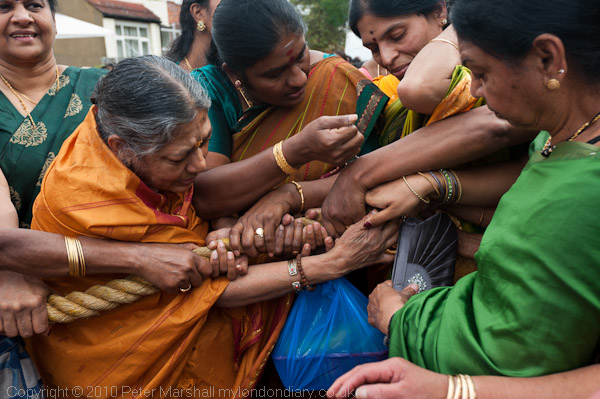
Sainsbury’s told Stop Selling Illegal Goods

Access to Work & Harvest Festival – 2015

Access to Work & Harvest Festival: On Saturday 26th September 2015 I was pulled in two directions, wanting to attend both a protest for disabled people in Westminster and the harvest festival at Grow Heathrow in Sipson on the western edge of London. In the end I managed to get to both, leaving the first early and arriving a little late at the second, going more or less to the end of the Piccadilly line at Heathrow Central and then catching a bus.


Deaf & Disabled Access to Work protest – Westminster

Access to Work & Harvest Festival

The Access to Work scheme was set up in 1994 to provide disabled people with funding to pay for extra disability-related expenses which enable them to work, including travel, support workers and specialised equipment. It was a significant milestone in equality for the deaf and disabled in the UK, and at the end of the Labour government in 2010 was supporting almost 28,000 people. Under Tory cuts this number had been reduced by 15% to around 22,000 with many applications being refused by the DWP.

Access to Work & Harvest Festival

In 2015 the government put a cap on the amount which could be claimed annually by those on the scheme of around £42,000, applying immediately to new claimants and in a couple of years to those already part of the scheme.

Access to Work & Harvest Festival

According to the protesters the cuts would not only prevent many currently supported by the AtW scheme to be able to continue their jobs but would also would lose the government revenue as the current scheme brings in £1.48 for every pound invested.

Access to Work & Harvest Festival

Many of those taking part in the protest were disabled people on the AtW scheme who fear they will be unable to continue in their careers if the cuts are implemented, including many deaf people. Many signed with their hands as I photographed them, and the hand, a symbol for British Sign Language was prominent on some of the banners and on at least one face.

The campaigners met in Old Palace Yard and then assembled to march through Parliament Square and a short distance up Victoria Street and then past the Department of Work and Pensions in Caxton House and on to a rally opposite Downing Street.

I left as the rally there was about to start to take the District line and then the Piccadilly to Heathrow Central from where I could catch a 111 bus to Sipson.

More at Deaf & Disabled Access to Work protest.


Grow Heathrow celebrates Harvest Festival – Sipson

Grow Heathrow which had occupied an abandoned and overgrown nursery in Sipson in 2010 were holding a harvest festival to celebrate another year’s harvest there with ‘music, pumpkins and pizza’ as well as holding an open ‘No Third Runway!’ discussion. which I was keen to attend and take part in.

The discussion was already underway when I arrived a little out of breath after running the short distance from the bus stop, but I was able to ask several questions and make some comments as well as taking pictures. With John Stewart and other campaigners including Christine Taylor of Stop Heathrow Expansion and Sheila Menon of Plane Stupid taking part it was an interesting discussion, and if fairly small the group taking part was certainly a select one.

As I commented then, “Whatever decision the current government take over the curiously defective considerations of the Davies committee (and I think we may well see some very long grass coming into play) it seems to me unlikely that Heathrow expansion will be deliverable.”

The commision had been set up in order to approve Heathrow expansion and it became official government policy in October 2016. It was supported by a parliamentary vote in 2018, but an application for judicial review by environmental groups, the Mayor of London and local councils ruled the decision unlawful as it had failed to to the government’s commitments to combat climate change into account. The government accepted the court’s decision, but Heathrow appealed to the Supreme Court who overruled this decision.

Although this theoretically allowed the expansion to go ahead, it currently seems unlikely to do so, with increasing environmental concerns, changes in forecasts of future air traffic, increasing costs and also increasing capacity at other UK airports almost certainly make it no longer viable.

After the discussion I took the opportunity to walk around the site to see what had changed since my last visit, and take more pictures. The case for eviction of Grow Heathrow had been recently adjourned until Summer 2016. Half the site was lost by an eviction in early 2019 but the site was only finally evicted in March 2021.

More at Grow Heathrow celebrates Harvest Festival.


Back in Stockwell

Back in Stockwell: It was the 17th July 1989 before I was able to return to Stockwell and take up my wanderings around south London where I had left off on 4th June.

Stockwell War Memorial, South Lambeth Rd, Stockwell, Lambeth, 1989 89-7c-26

Coming out from Stockwell Underground I turned left and came to the war memorial, then on a rather scruffy triangle of grass and litter between the South Lambeth Road and the A3 Clapham Road. This has since been tidied up as Stockwell Memorial Gardens with a mural celebrating others who died in WW2 including war hero Violette Szabó, GC and a the Bronze Woman statue by Aleix Barbat, a tribute to all black Caribbean women.

The Stockwell War Memorial was erected in 1922 to the design of Frank Twydals Dear which attracted praise at the time for its excellent proportion, refined detail and simple lines.

The figure of Remembrance is by sculptor Benjamin Clemens and the clock with a face on all four sides of the tower was donated by the father of one of the 574 men named on the memorial who died on the Somme on 9th August 1916, aged 19, Frederick H S Caiger. He was the only son of Dr Caiger, superintendent of South Western Fever Hospital.

The mural is on the Security Archives in my picture, one of eight deep level shelters built for WW2. Stockwell was used to house US troops. The bunkers were 100ft underground and had 8000 bunks, canteen and hospital facilities.

Scallywag, Clapham Rd, Stockwell, Lambeth, 1989 89-7c-15

Scallywag was a pine furniture showroom which had started in an old church in Camberwell in 1970 and moved here in 1985 becoming the largest pine showroom in Europe. It is now based in a rural location in East Sussex as well as in the USA.

TDA House, Mecca Bookmakers, 211-213, Clapham Rd, Stockwell, Lambeth, 1989 89-7d-66

Opposite the war memorial on Clapham Road were these two architecturally very different buildings, TDA House and Mecca Bookmakers.

TDA House at 211 was built as the Stockwell Palladium cinema which opened in 1915 but was rebuilt as the Ritz Cinema in 1937. In 1954 it became Classic Cinema and in 1969 the Tatler Film Club showing uncensored blue movies, reverting to the Classic for a couple of years before closing in 1981. A snooker club for some years it then became TDA House for the Tigray Development Association supporting Ethiopian refugees and in 2017 became an Ethiopian restaurant.

Next door at 213 Mecca is now Ladbrokes.

Stockwell Lane, Stockwell, Lambeth, 1989 89-7d-53

I didn’t go up Clapham Road but turned into Stockwell Road, walking along her and making this picture just after I had turned into the narrow Stockwell Lane. It shows quite a mixture of buildings, with a recent house close to where I was standing, the back of a row of shops on Stockwell Road and a white building on the opposite side of the road which then had shops on its ground floor, but which is where Stockwell Green United Reform Church moved to after selling its premises on Stockwell Green.

The tower beyond is Birrell House, with an address on Stockwell Road but set well back from it, now managed by Hyde Housing, who took it over from Lambeth council after a vote by residents in 1999. The block, approved by the London County Council in 1964 was an addition to the Stockwell Gardens estate with 68 flats on 18 floors was named after Miss Elsie Birrell, London Undergroud’s first female porter who worked at Stockwell Station during the Second World War.

Garden, Stockwell, Lambeth, 1989  89-7d-56
Garden, Stockwell, Lambeth, 1989 89-7d-56

Stockwell in the past was noted for its gardens, particularly the botanical gardens of the Tradescant family and I could resist these fine specimens (certainly not Tradescantia) filling a fairly small front garden near Stockwell Park Crescent.

Houses, 2-4, Stockwell Park Crescent, Stockwell, Lambeth, 1989 89-7d-46
Villas, 2-4, Stockwell Park Crescent, Stockwell, Lambeth, 1989 89-7d-46

Stockwell Park Crescent was laid out in the late 1830s and many of the houses in it date from the 1840s. These were large houses for the middle classes many of whose heads will have worked in the city but wanted to live in the ‘country’ in places such as Stockwell. The small attic rooms will have been for the servants. These were villas rather than the terraces common in urban London and on a crescent which aimed for a more informal and romantic landscape.

Although basically plain, there are classical details on the frontage rather than actual columns, extending to the eaves which give a classical facade. The pair is Grade II listed.

More on my walk in a later post.


Autumn Equinox & Druids

Autumn Equinox & Druids: In 2023 the Autumn Equinox is at 6.50am Greenwich Mean Time on 23rd September (7.50am British Summer Time.) The exact timing timing is when the sun’s path crosses the Equator and it happens at slightly different time each year between the 21st and 24th of September, though mainly on the 22nd or 23rd.

Autumn Equinox & Druids

In 2009 the Equinox was at 10.19pm BST on September 22nd, and nine hours earlier I was photographing the Druid Order celebrating the event with their annual ceremony at Primrose Hill in London.

Autumn Equinox & Druids

I’ve photographed the Druid Order on a number of occasions both at Primrose Hill and also for the Spring Solstice at Tower Hill in March. I think 2009 was my first visit to the autumn ceremony and probably my best attempt to cover it as a whole, though I did take one or two striking images in a later year.

Autumn Equinox & Druids

The ceremony follows closely the pattern laid out possibly a hundred years ago. The Druid Order dates from around 1909 or 1912, though it claims to be a continuation of much older druidry. You can read more about its founder in a lecture by Dr Adam Stout.

Autumn Equinox & Druids

All we know about the ancient druids who worshipped in these islands for thousands of years before the Romans came is from their monumental structures such as Stonehenge and the brief and probably rather biased comments of Roman historians which described them as wise but bloodthirsty and given to human sacrifice, staining the altars of Angelsey with blood.

As I commented on My London Diary, “Fortunately today the members of The Druid Order are peace loving. free-thinking and rather photogenic in their white robes, and their main aim is to develop themselves through being rather than through intellectual learning.”

My post on My London Diary describes the Alban Elued (Autumn Equinox) ceremony in some detail both through the text and my photographs, and I won’t repeat myself here. You can read various versions of the ceremony on-line (also called Alban Elfed) and also watch a 49 minute video on the Druid Order website which also has a reflection on the Autumn Equinox.

Before the ceremony I also photographed a memorial plaque to Iolo Morganwg (1747-1826) unveiled in June 2009 at the top of the hill which had been unveiled earlier in the year, marking the site of the first meeting of the Gorsedd of the Bards of the Isle of Britain on Midsummer’s day 1792.

The start of the 18th century saw a revival of interest in druidry by people including Irish freethinker and philosopher John Toland (1670-1722). Iolo Morganwg (1747-1826) invented descriptions of Druid ceremonies and added these, together with some of his poems, into the translations he made of medieval Welsh manuscripts. He also introduced the ‘Awen’ symbol with its three ‘rays’ still used by the Druid Order.

The Druid Order are not the only druids who celebrate the Autumn Equinox on Primrose Hill. A little further west down the hill in a small hawthorn grove you may see the celebration of a smaller group of the Loose Association of Druids of Primrose Hill.

More at Autumn Equinox: Druids at Primrose Hill.