TUC ‘March For The Alternative – 2011

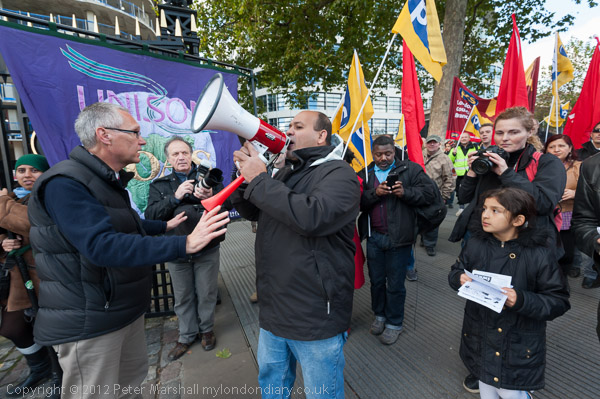
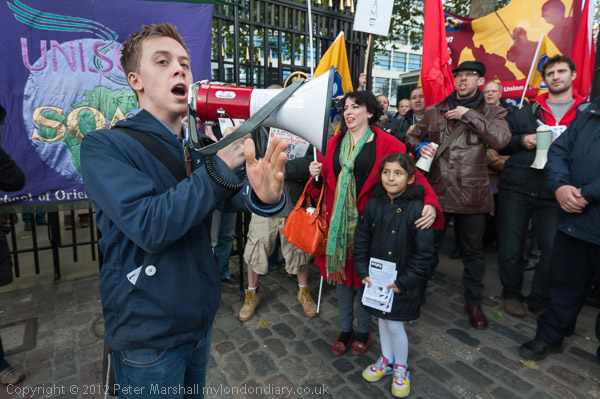
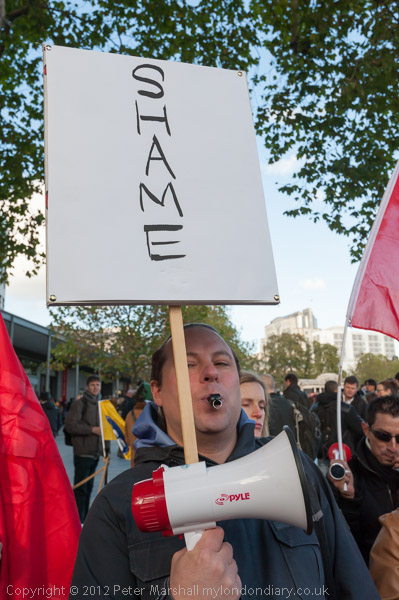
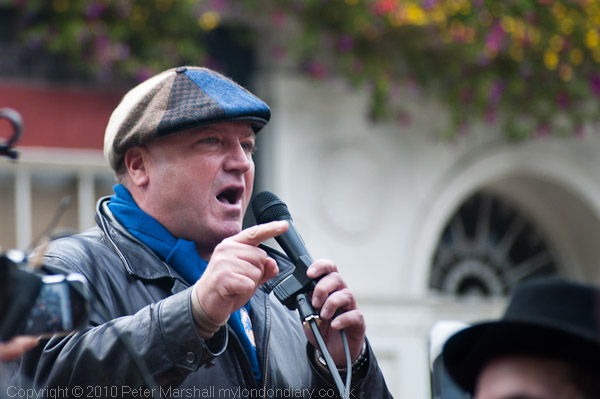
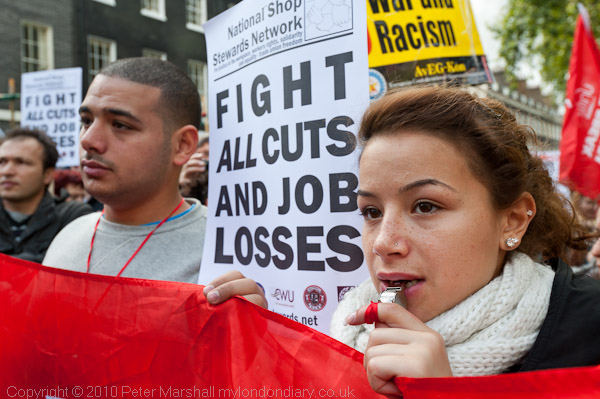
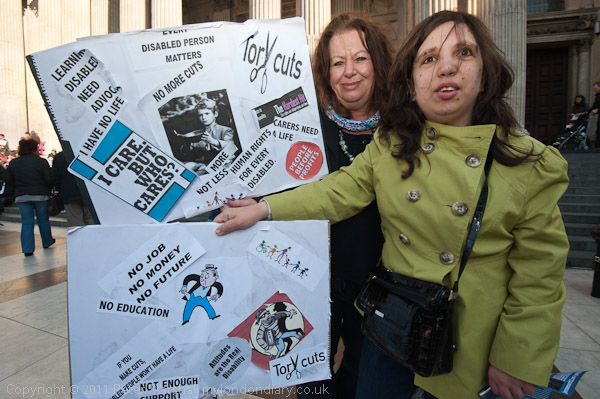
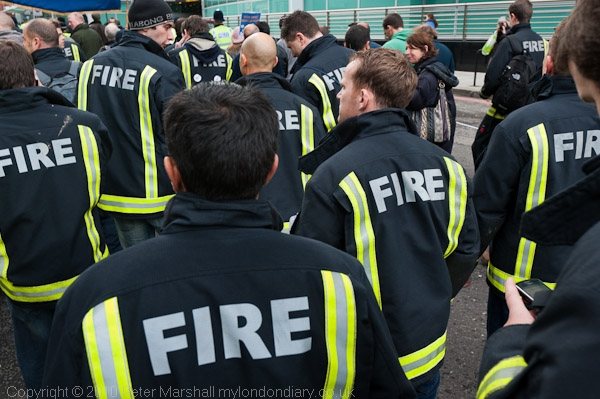
TUC ‘March For The Alternative – On 26th March 2011 between a quarter and half a million people marched through London against planned public spending cuts by the Conservative-Liberal Democrat coalition government in the largest demonstration since the 2003 protest against the plan to invade Iraq.

TUC 'March For The Alternative - 2011

The TUC argued that what the country needed was not austerity but policies that would grow the economy, and that we should raise income from those more able to pay rather than by measures that had the greatest impact on the poorest in society.

TUC 'March For The Alternative - 2011

It was the largest march and rally organised by the trade union movement since the Second World War, and like other major trade union marches was perhaps largely worthy but not exciting – and like others it achieved nothing. The cuts went ahead and we all suffered – except of course the wealthy – who continued to grow richer and richer, helped by government bail-outs and the deliberate failures to tackle tax evasion, stop tax avoidance loopholes and raise taxes on those with excessive wealth.

TUC 'March For The Alternative - 2011

The cuts particularly hit the public services, including teachers, nurses and other medical professionals – and eventually helped drive these areas into the critical conditions that they are now in. They resulted in financial problems and excessive workloads and also meant that those of us who rely on public provision for health and education often failing to get proper treatment. The gap between those who could afford private services and those who relied on the state provision increased.

TUC 'March For The Alternative - 2011

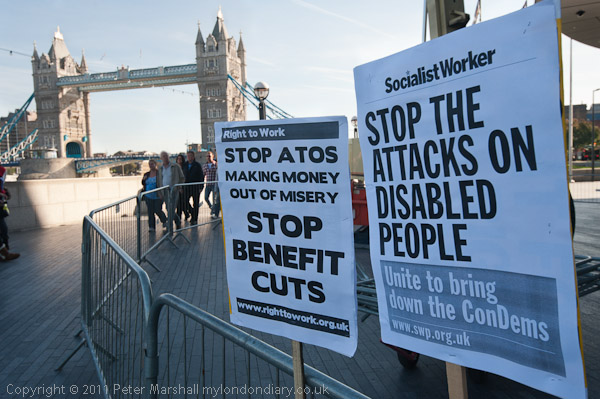
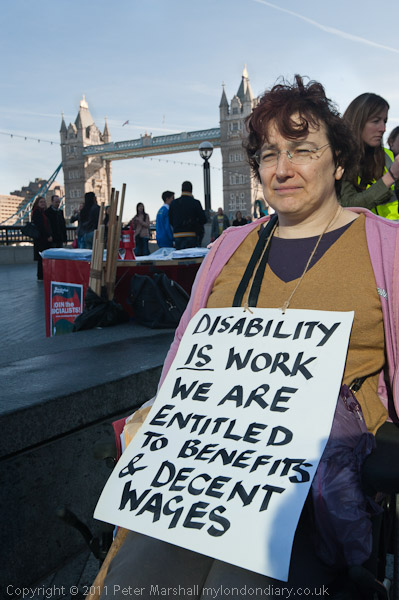
Particularly hard hit by the cuts were the disabled and for them the situation continues to worsen with our now Labour government announcing huge cuts which will leave many considerably worse off – and greatly reduce their ability to lead normal lives and contribute to society.

As well as the TUC, other groups contributed to the march, announcing various feeder marches and other activities, many of which added a little life and colour to the day’s events. They also resulted in over 200 arrests and a number of injuries.

Too much was happening on the day for me to rehash it all here, but you can read my seven posts on my London Diary for my account of events. I started with the feeder marches from South London, disowned by the TUC. The ‘Armed Wing of the TUC’ brought its street theatre Trojan Horse, Spitfire, Tank and armed Lollipop Ladies produced by Camberwell art students to Camberwell Green where they marched to Kennington where the South London Feeeder March was gathering for a rally before the march in Kennington Park – the site of the final “monster meeting” of the Chartists on 10th April 1848 from where they marched to Parliament to deliver their final petition.

I left there to take the tube to Trafalgar Square where I found that the main march had started early and was well on its way to Hyde Park and I stayed around there for over an hour as marchers filed past, including photographing the Morris Liberation Front, an idea of Henry Flitton specially for the TUC demonstration, with music, provided by a couple of mandolins playing the Clash’s ‘I fought the Law’ and the Smith’s ‘Panic.

Later in the day Trafalgar Square was the site of bitter fighting as police made a largely unprovoked attack on a partying crowd, but when I was there things were peaceful.

I left the square to follow several hundred anarchists, dressed in black and mainly wearing face masks making their way up past the National Portrait Gallery, many waving red and black flags. I went with them through the back streets to Piccadilly Circus and then up Regent Street where they turned off into Mayfair and were held off by police when they attacked a RBS branch – one of the main banks to receive a huge government handout.

At Oxford Circus they attacked Topshop, then owned by the prominent tax avoider Sir Philip Green. As I went to take photographs of police arresting one of the protesters and holding him on the ground I was “hit full on the chest by a paint-bomb possibly aimed at the police, although many of the protesters also have an irrational fear of photographers. My cameras were still working and I continued to photograph, but I had also become a subject for the other photographers.”

It wasn’t painful, but it was very messy and bright yellow. I scraped and washed the worst off in a nearby public toilet for around 20 minutes, then went out to take more photographs, joining UK Uncut supporters who had come to hold peaceful protests at tax dodging shops and banks around Oxford St and to party at Oxford Circus.

Eventually I followed them down to Piccadilly Circus where 4 hours after the start of the official march people were still filing past. I stopped there and photographed until the end of the march passed, rather than going with UK Uncut into Fortnum and Mason. Inside the story they sat down and occupied the store peacefully. if noisily calling on them to pay their taxes. After an hour or more a senior police officer told them they were free to leave, promising they could make their way home “without obstruction”. 138 were arrested as they left the store, charged with ‘aggravated trespass’. Most of the cases were latter dropped but at least 10 were found guilty, given a six-month conditional discharge and a £1,000 fine.

Even after the official end of the march there were various other groups following the march route – including a group of Libyans with green flags, marching in support of Colonel Gaddaffi. I walked back to Trafalgar Square where there were still plenty of people around but everything was pretty quiet, so I got on the tube to come home and try to wash more of the paint off.

I think it was later when police made a charge to try and clear Trafalgar Square than almost all the arrests on the actual march took place – according to GoogleFurther clashes were reported later in Trafalgar Square. 201 people were arrested, and 66 were injured, including 31 police officers.” Had the police simply gone away people would have eventually dispersed and there would have been no trouble.

Others also got hit by paintballs

Back home I spent hours trying to scrub out yellow paint, but the rather expensive jacket I was wearing was only ever really fit to wear for gardening. The also expensive jumper underneath still has some small traces of yellow 14 years and many washes later, though I do sometimes still wear it around the house. Until my Nikon D700 came to the end of its life, beyond economic repair, a few years later I would still come across the occasional speck of yellow paint.

Much more about the day and many more pictures in the following posts on My London Diary

26March: Armed Wing of the TUC
26March: South London Feeder March
26March: TUC March – Midday
26March: Dancing in Trafalgar Square
26March: Black Bloc Goes To Oxford St
26March: UK Uncut Party & Protest
26March: The End of the TUC March


FlickrFacebookMy London DiaryHull PhotosLea ValleyParis
London’s Industrial HeritageLondon Photos

All photographs on this page are copyright © Peter Marshall.
Contact me to buy prints or licence to reproduce.
Aldermaston 2008

Aldermaston 2008: Searching for what to write today I came to my post about my journey to Aldermaston, where the huge 750 acre Atomic Weapons Establishment is the UK’s main site for nuclear weapons research, design and manufacture. It was to here that people marched from London over 4 days at Easter1958 in a pivotal event in the anti-nuclear movement organized by the Direct Action Committee Against Nuclear War (DAC) and supported by the newly formed Campaign for Nuclear Disarmament (CND) – which took over the organisation of further marches. 

Aldermaston 2008

The CND leaflet in 1958 gave the reason for marching:

“MARCH TO ALDERMASTON
WHY?
BECAUSE we must show our opposition to the Testing, Storing and Manufacture of the H-Bomb in Britain.
If we make no protest now we have given our consent to its use.
“All who are opposed on any ground to Nuclear Weapons, whether possessed by the British, American or Russian Governments, are welcome.”

I didn’t go on that march as my parents thought I was too young, but both my older brothers marched. 50 years later at Easter 2008 I decided to take part in CND’s 50th anniversary event.

Aldermaston 2008
The cyclists arrive at the main gate at Aldermaston

I had decided not to march but to cycle at least part of the way from London to Aldermaston with Bikes Not Bombs, but for various reasons (sloth, other events, lousy weather and a dislike of early rising) it didn’t happen, although I did manage to photograph the riders on Oxford Street, where they were going in exactly the wrong direction.

Aldermaston 2008
WMD were not in Iraq – but here at Aldermaston

In the end I did ride from Reading to Aldermaston (and back) on Monday, but started an hour or two later than the organised ride, taking a more direct route at a faster pace and arriving before them. Here I’ll copy what I wrote on My London Diary in 2008 with a couple of minor corrections and post a few of the pictures with a link to many more on My London Diary.


Aldermaston – 50 years

Monday 24 March, 2008

Aldermaston 2008
Holding hands around the base

Monday I got up too late to join the Bikes Not Bombs cyclists on their way from Reading, where I arrived by train. The train that goes from Staines to Reading is so so slow I’m convinced there is still a man with a red flag walking in front of it much of the way, and the 20 or so miles took almost an hour.

I took exactly the same route from Reading that I’d walked with Pat Arrowsmith and the other Aldermaston marchers in the 2004 march. Although a cool day, it was a pleasant morning for riding and I was quite enjoying it until a stretch of road called ‘Hermit’s Hill’ reminded me how out of practice I was at cycling. I can’t remember when I last had to push my bike up a hill, although in 2002 when my arteries were almost fully clogged with cholesterol I did once have to stop and rest in Normandy. Fortunately it turned out to be the only significant hill on the route.

I went first to the main gate and joined the other photographers who were there, and took a few pictures of people arriving, including the 30 or so cyclists who I had beaten there. I walked down with some of the other photographers to the Falcon gate, but not a lot was happening there.

Falcon Gate

Later I took a ride around perimeter, or at least the part of it which is on roads – the northern side is simply a footpath, and it was rather muddy and full of demonstrators, so I didn’t try to ride along it. I caught up with the cyclists again at the Boiler House gate where I stopped to take some pictures, as quite a lot seemed to be happening there.

They left before I had taken all the pictures that I wanted, and got a few minutes start on me, before I pedalled off in pursuit. The road leads down and through the actual village of Aldermaston (rich home counties, rather too tidy), but what goes down has to come up, and I found myself struggling uphill again through the queue of traffic held up by the ‘bikes not bombs’ group and their police escort of two cars and several motorbikes.

Welsh choir at the Construction gate

The Construction gate at the top of the hill had a Welsh socialist choir, and I took a few pictures before I saw the cyclists coming up again – they had stopped to regroup a little down the road. Further along the fence, near the Home Office Gate was another largish group of people and a veteran from 1958 was talking.

Veterans of 1954 who spoke

The incredible Rinky-Dink mobile cycle-powered sound system was also there – another reminder of 2004 when it accompanied us as we marched down the lanes to the base.

People were now beginning to link hands around the base, although the organisers had talked about one person every 5 metres. Most of it seemed to be surrounded considerably more densely than this, although there were some gaps.

Back at the main gate there was an opportunity to photograph some of the speakers who were touring the event, although I didn’t actually hear them speak. They included two labour MPs, Jeremy Corbyn and John McDonnell, Green MEP Caroline Lucas, veteran Labour Party member Walter Wolfgang and several guests from Japan, one of whom was a survivor from Hiroshima.

Jeremy Corbyn, Caroline Lucas, Walter Wolfgang, John McDonnell and others

After that people started to go home, and after a short but rather heavy shower I decided it was time to get on my bike too.


Many more pictures from the event at Aldermaston – 50 years, and I also took a few on my ride back to Reading Station.


FlickrFacebookMy London DiaryHull PhotosLea ValleyParis
London’s Industrial HeritageLondon Photos

All photographs on this page are copyright © Peter Marshall.
Contact me to buy prints or licence to reproduce.

Stand Up to Racism & Kites Not Drones – 2014

Stand Up to Racism & Kites Not Drones: On Saturday 22 March 2014, the day following UN Anti-Racism Day (chosen to remember the 69 people killed by police in the Sharpeville massacre in South Africa on 21 March 1960), the TUC and Unite Against Fascism organised a march and rally as a part of a European day of action against racism.

Stand Up to Racism & Kites Not Drones - 2014

Thousands – perhaps as many as 20,000 – turned up to march the short distance from Old Palace Yard opposite parliament to a long rally in Trafalgar Square – on My London Diary I list 19 speakers, though I think there were a few more on the day, but I didn’t stop to listen to all of them, going instead to Hyde Park where a smaller protest by peace activists tried without much success to fly kites in in solidarity with the people of Afghanistan.


Stand Up to Racism – Westminster

Stand Up to Racism & Kites Not Drones - 2014
No Human is Illegal’ – protesters from the National Coalition of Anti-Deportation Campaigns

This protest stood out for the wide range of people and organisations who had come to join it, “many of whom are sickened by the anti-immigrant policies of successive governments and opposition parties who have long been engaged in trying to outdo each other in the ‘toughness’ of their immigration policies, and have recently moved even further to the right in an effort to neutralise the political threat of UKIP and Nigel Farage.”

Stand Up to Racism & Kites Not Drones - 2014

And since 2014 the main parties have kept moving to the right. We continue to see this scapegoating of immigrants in the policies both of the current government and its recent Tory predecessors, particularly in the campaigns and legislation against those who cross the channel in small boats, but also in restrictions on those who claim asylum here and the harassment being suffered by many who have made their lives here and contributed to our society but are now threatened by deportation, dragging them away from families and friends. Still we have not set up safe routes for asylum seekers to come to Britain, still we have not offered amnesties to those who have worked here and made useful and essential contribution here for years.

Stand Up to Racism & Kites Not Drones - 2014

I photographed many of the marchers in Parliament Square, where the march had been planned to start close to the statue of Nelson Mandela who had celebrated “the ideal of a democratic and free society in which all persons live together in harmony and equal opportunities” as the aim of the fight for freedom and equality in South Africa.

A man taking part in unusual dress for a protest

Some posed in front on the grass with ‘Big Ben’ in the background, a name I like to use as it annoys pedants, but is what everyone except them still calls the clock tower which Wikipedia describes as “one of the most prominent symbols of the United Kingdom and parliamentary democracy.”

Among those taking part were people from our Roma and Muslim communities who bear no responsibilities for our country’s current problems and suffer more than most from them while at the same time being blamed by the racist right for them.

“In particular we have seen many promoting fear and hate of Muslims associating the whole community with the acts of a tiny few. Islamophobia is rife and has led to more attacks on the Muslim population, including murder and violent attacks on mosques. “

More from 2014 on My London Diary at Stand Up to Racism.


Kites Not Drones Solidarity with Afghanistan – Hyde Park

This protest by peace activists was part of a weekend of solidarity with the Afghan people who traditionally celebrate their New Year (Now Ruz) on the Spring Equinox by flying kites. (Until 1752 the New Year began at around the same time in Britain and its colonies on Lady Day March 25th.)

Peace activist Maya Evans ties up the Drones on Trial banner ‘EVERY AFGHAN HAS A NAME, WAR IS NOT A VIDEO GAME’

In 2014 I quoted the organisers statement:

‘Kite flying has become synonymous with Afghanistan as a well loved pursuit which was banned under the Taliban, now Afghans are more used to the presence of UK armed and surveillance drones flying overhead.’

‘We are encouraging peace groups, Afghans in the UK and the Muslim community to fly kites in solidarity with Afghans who now have to live under the mental pressure and physical destruction which British drones (currently operated from RAF Waddington, Lincoln) now reap upon Afghanistan.’

None of those taking part appeared to have had any previous experience in actually flying kites, and although the photographers present helped, the gusty conditions only allowed some short and erratic flights, with one kite getting stuck up a tree. For once a police officer was sympathetic, and having come across to tell the protesters that flying kites was not allowed in this or the other Royal Parks told them that so long as they stayed in this empty area of the park and were not a nuisance to others he would not stop them.

More at Kites Not Drones Solidarity with Afghanistan.


FlickrFacebookMy London DiaryHull PhotosLea ValleyParis
London’s Industrial HeritageLondon Photos

All photographs on this page are copyright © Peter Marshall.
Contact me to buy prints or licence to reproduce.

Cabin Crew, Education, Living Wage & Light Up the Night – 2010

Cabin Crew, Education, Living Wage & Light Up the Night: Saturday 20th March 2010 was an unusual day for me, including protests in two parts of London I seldom visit, Hatton and Hampstead. It was also the start of a campaign on Oxford Street to get the London Living Wage for shop workers and there was a march to Downing Street against education cuts.


BA Cabin Crew at Heathrow – Hatton

Cabin Crew, Education, Living Wage & Light Up the Night - 2010

BA cabin crew on the first day of their 2-day strike at Heathrow held a rally outside Bedfont Football Club a short distance from Hatton Cross, where several hundred strikers came to listen to speakers, including Len McCluskey, Unite assistant general secretary, and show their determination to fight management plans to downgrade their conditions and make BA into a cut-price airline. Others kept up their pickets at gates around the airport.

Cabin Crew, Education, Living Wage & Light Up the Night - 2010

BA management under CEO Willie Walsh had refused to come to an agreement with the union, BASSA, and had threatened any workers who spoke at the meeting or appeared in media interviews with dismissal. So none of the strikers spoke at the meeting, but there was thunderous applause when speakers including local MP John McDonnell criticised BA management.

Cabin Crew, Education, Living Wage & Light Up the Night - 2010
Len McCluskey – We Offered Pay Cuts to keep BA Premium

I photographed the picket at Hatton Cross on my way to catch the Piccadilly line into central London.

More at BA Cabin Crew at Heathrow.


March Against Education Cuts

Cabin Crew, Education, Living Wage & Light Up the Night - 2010
Sitting down in Whitehall outside Downing Street

A couple of thousand teachers and students met outside Kings College in Strand to call for the reversal of planned education cuts which they say abandon a generation of students and will damage our economic recovery.

Cabin Crew, Education, Living Wage & Light Up the Night - 2010

Police had insisted that they march on the pavement, but the numbers and the banners made this impossible and after a hundred yards or so they moved onto the street. At Downing Street they filled both carriageways for several minutes with a short token sit-down before police and stewards persuaded everyone to move to one side of the road, but the crowd was still a little large for the space available and there seemed to be a few dangerous incidents – including a rather uncontrolled police horse – but fortunately no injuries as police appeared keen to get a lane of traffic moving past without due regard for public safety.

As speakers at the rally said, Labour had come into power on the mantra ‘Education, Education, Education‘ but 12 years later were proposing the largest cuts in education funding for a generation or more, estimated to lead to the loss of more than 20,000 jobs in Further Education, Higher Education and Adult Education. They will disproportionately affect the poorer and more disadvantaged in our society, in particular immigrants and young people who are unemployed or lacking in qualifications.

As Jenny Sutton, branch secretary of the UCU at the College of North East London pointed out the proposed cuts of £1.1 billion on education contrasted with the £21 billion spent on wars in Iraq and Afghanistan and the £500 billion given to the banks, one of which, the 84% publicly owned RBS is now paying out £1.3 billion in bonuses.

In protest Sutton was standing against the then Education Minister David Lammy in the May 2010 election. Lammy kept his seat and she lost her deposit, but the election put a Tory-led coalition into power. Education suffered even worse in the following years.

March Against Education Cuts


London Living Wage Launch in Oxford St

The London Living Wage campaign began in 2001 and has had the support of all London mayors since. Calculated annually by the Greater London Authority it takes into account the higher living costs in London, and Living Wage employers also have to provide fair employment conditions including holiday and sick pay and allowing employees to belong to a trade union.

Although some of London’s larger employers have adopted the London Living Wage, the retail sector, one of the most profitable areas of business in London, still had many of many of its workers struggling on wages below this level.

London Citizens, a grassroots charity working for social, economic and environmental justice , has led the campaign for a London Living Wage, and held a training session for its members before coming to Oxford Circus. Here they took advantage of the recently introduced diagonal crossing system to cross and recross several times with their banners before going off in smaller groups to continue the campaign inside the larger stores on Oxford Street.

They intended to give letters to all the general managers of shops on the street inviting them to meet with London Citizens to discuss the Living Wage.

London Living Wage – Oxford St


Light Up the Night in Hampstead

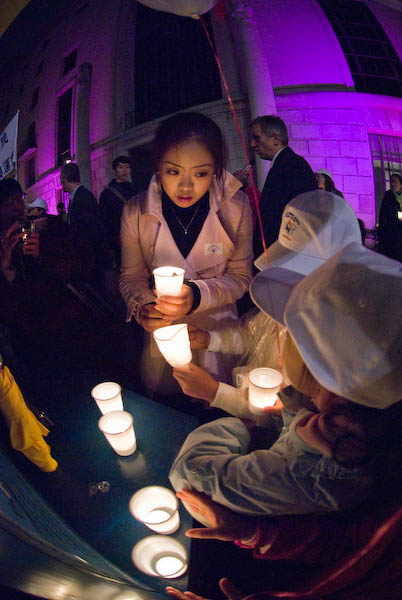
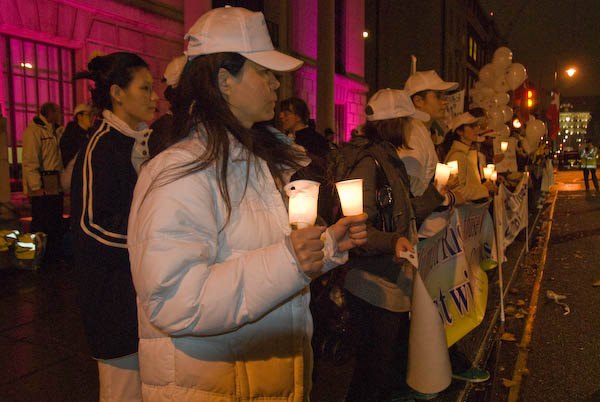
The Commons‘ candidate for the Hampstead and Kilburn constituency Tamsin Omond had organised a ‘Light Up The Night‘ candlelit march to show community solidarity against violent crime and make the streets safe for women at night.

Around 30 people, mainly women, turned up outside the Hollybush pub in Hampstead for the march, where there was a short speech by Sam Roddick, noted for her campaigning on issues related to human rights, feminism, pornography and for taking Fair Trade into hitherto unexplored areas through Coco De Mer, her Covent Garden ‘erotic emporium.

Tamsin Omond

It was a wet and windy night and it was hard to to keep the candles alight as the marchers made their way down the hill from Hampstead and the streets were emptier than usual.

‘The Commons’ campaign hoped to reach people who are fed up with politicians and appeal to ordinary people, many of whom, like Roddick have never bothered with voting because they felt it made no difference. But it made little progress. The election was closely fought with Labour’s Glenda Jackson gaining a narrow victory by 42 votes over the Tory candidate, but Omond was over 17,000 votes behind both of them with only 123 votes and the turnout was low.

More at Light Up the Night in Hampstead.


FlickrFacebookMy London DiaryHull PhotosLea ValleyParis
London’s Industrial HeritageLondon Photos

All photographs on this page are copyright © Peter Marshall.
Contact me to buy prints or licence to reproduce.

Bring the Troops Home – 2005

Bring the Troops Home: On Saturday 19th March 2005 I photographed the Stop the War march on the second anniversary of the invasion of Iraq. From Hyde Park it went past the US Embassy in Grosvenor Square on to a rally in Trafalgar Square. I published text and pictures on My London Diary.

Bring the Troops Home - 2005
Don’t unleash your missiles on Iran – No more Bush wars.

This is another slightly hard to find post from the early years of My London Diary before I redesigned the site with links to every post on top of each monthly page and discovered the Shift key. Then I felt it was somehow cool not to capitalise, but I now regard as an unfortunate affection – like those photographers who think turning their digital colour images to black and white somehow makes them more authentic.

Bring the Troops Home - 2005

Back in 2005 I was very critical of Stop The War – and I still feel they lost the initiative after the huge February 2003 protest against the invasion of Iraq and that a more radical approach could have prevented Blair taking Britain into the war beside the USA.

Bring the Troops Home - 2005
George Solomou with coffin representing Iraqis killed in the invasion and occupation

That protest and the many before and after showed our nation united in a way no other campaign has succeeded in doing, with protests in almost every town and village in the country. Even in Surrey where driver after driver hooted support as we stood at the side of our local bridge with posters during Friday evening rush hours.

Bring the Troops Home - 2005

I’m still sorry I had to miss that big one in 2003, which came just the day after I was discharged from hospital following a minor heart operation and I could only walk a few yards. My family went leaving me at home. But I did cover all of the other main protests in London against the invasion and they are recorded in My London Diary.

Bring the Troops Home - 2005

In my 2005 post I was also very critical of Stop the War’s attitude to photographers, which has mellowed slightly over the years. It can still be difficult to photograph the front of their marches though the stewards are generally much more friendly.

But for all their faults, Stop the War and other organisations they work with have kept up protests over many issues, particularly in recent times over the genocide taking place in Gaza. And have been doing so in defiance of Tory and Labour governments, laws restricting our right to protest and clearly political policing.


Bring the Troops Home – Stop the War March and Rally

I remember standing in Trafalgar Square listening to Tony Benn and Tariq Ali urging us all to take immediate and radical action should our troops invade Iraq. At the time a majority of the British people was clearly against the war, and we should have taken to the streets to stop it. Instead Stop the War organised marches and peaceful demonstrations the government could easily ignore. And they did.

So the latest in the series of anti-war demos was a sad case of déjà-vu from the blinkered dinosaur. Not least because again Tariq Ali (and doubtless Tony Benn) again urged radical action and again we cheered.

Tariq Ali has the perfect anarchist hair-style, and it’s hard to get a bad picture of him. Nenn wasn’t looking at his best, but there were plenty of others to photograph, including those who had made their stand as soldiers (and a diplomat.) And some very bubbly school students.

Stop the War are also tough on the press, or at least tough on photographers. Most demonstrations welcome publicity, but they train stewards to get in the way. One colleague was physically prevented from taking pictures at one point in the march, I was obstructed and threatened quite unnecessarily by a couple of stewards, and all of us were generally ordered around and hassled.

More pictures of the march and rally on My London Diary.


FlickrFacebookMy London DiaryHull PhotosLea ValleyParis
London’s Industrial HeritageLondon Photos

All photographs on this page are copyright © Peter Marshall.
Contact me to buy prints or licence to reproduce.

Troops Home from Iraq; Don’t Invade Iran – 2005

Troops Home from Iraq; Don’t Invade Iran: Saturday March 18th 2006 I went to the large protest on the third anniversary of the invasion of Iraq, photographing as the march gathered in Parliament Square and then as the march went along Victoria Street on its rather indirect route to a rally in Trafalgar Square. As often with large marches, by the time the end of the march had passed me I was too late for it to be worth going on to the rally.

Troops Home from Iraq; Don't Invade Iran - 2005
Marchers in Guantanamo fatigues and chains leaving Parliament Square, March 18, 2006

Here – with the usual tidying of capitalisation and a few minor clarifications is the post I made on My London Diary at the time. Of course things have become much worse in various ways but particularly so far as civil liberties in the UK are concerned, the situation in Iraq has been dire and there remains a real threat of military action against Iran, an odious regime but whose people would still suffer greatly from any any invasion.

Troops Home from Iraq; Don't Invade Iran - 2005

As always there are many more pictures on My London Diary.


Troops Home from Iraq; Don’t Invade Iran

Troops Home from Iraq; Don't Invade Iran - 2005

The Troops Home From Iraq; Don’t Invade Iran march on the 18th was another large event organised by Stop The War, part of an international protest in cities around Europe, North America, Latin America, Asia Pacific, Asia and Africa – a total of around a couple of hundred places. In London there were roughly 20,000 who walked out of Parliament Square past where I was taking pictures, although many like me will not have made it to Trafalgar Square, and others will have joined in later on the route.

Troops Home from Iraq; Don't Invade Iran - 2005

The event marked three years since the invasion of Iraq on 20 march 2003. At the front of the march were Theatre Of War representing both Tony Blair and George Bush along with two police and two judges holding placards declaring the two leaders guilty.

Put your head in a sack, Guantanamo style…

Behind them were the march leaders, including representatives of families of soldiers killed in Iraq. They had a long, long yellow ribbon with the names – no ranks – of soldiers who have died so far in this illegal war and occupation. Of course many more Iraqis killed – more than 100,000 have died so far.

The invasion, doubtful on legal grounds, was justified on the basis of false information, including information that was known to be incorrect when it was presented to parliament and the people.

Already it has led to deaths in Britain; only a small handful of people (that’s Tony Blair and some of his cabinet) doubt that the London bombings would not have happened if Britain had not joined in the invasion plans. Actually it is hard to believe even they doubt it, but rather they just can’t bring themselves to admit it.

A protester from Glasgow is warned for using a megaphone in Parliament Square

We’ve also seen the passage of draconian measures that attack civil liberties in this country (and attempts still being made to get more.) Muslims in particular have been targeted, with a rise in Islamophobia.

At last the march moved off, with stewards pushing photographers away from the front

The expenditure in Iraq has been vast. If you want to know why there isn’t the money to raise pensions (and a week of pension protests was ending today with a conference in London) there is a simple 4 letter answer. IRAQ.

Another four letter country, Iran, is currently under threat. Perhaps most chilling are the denials from Blair and Straw, who state that invasion is not on the table. For too many of us that just seems to make it more likely.

Many more pictures on My London Diary


FlickrFacebookMy London DiaryHull PhotosLea ValleyParis
London’s Industrial HeritageLondon Photos

All photographs on this page are copyright © Peter Marshall.
Contact me to buy prints or licence to reproduce.

St Patrick’s Day – 2008

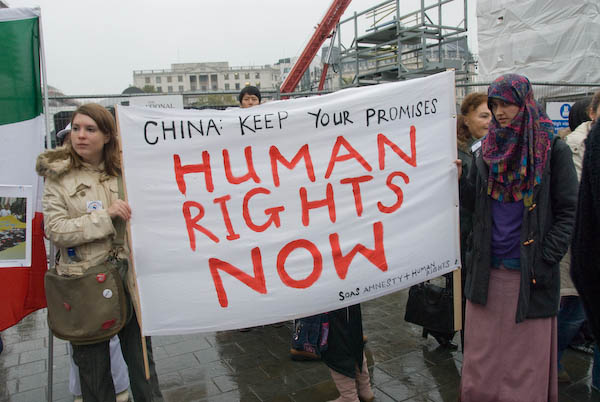
St Patrick’s Day – 2008: A parade in Willesden on Monday March 17th 2008 celebrated St Patrick’s Day. I came to it from a protest by the all-Irish environmental and social justice movement Gluaiseacht against the Corrib Gas Project in Mayo outside the Shell Centre, and had to rush away for a protest by Tibetans at the Chinese Embassy.

St Patrick's Day - 2008

Brent St Patrick’s Day Parade – Willesden Green

St Patrick's Day - 2008

Brent is one of London’s more diverse boroughs and has a large population of Irish and Anglo-Irish residents, particularly in what was sometimes called “County Kilburn“. As a borough it promoted various events to celebrate and unite its different communities, and among them I think was the only London borough to have its own St Patrick’s Day Parade.

St Patrick's Day - 2008

Or it did until government cuts in funding to local authorities which hit particularly hard on boroughs like Brent meant it could no longer afford to support these community events.

St Patrick's Day - 2008

London does now celebrate St Patrick’s Day with a march and event in Trafalgar Square on the nearest Sunday to the day itself, and I photographed the first of these, promoted by then London Mayor Ken Livingstone in 2002, though I only put a few black and white images on to My London Diary.

But the parade in Brent, though often involving some of the same people and floats was always a more interesting and intimate event, with the large local element giving it greater authenticity and I was sorry to see it go.

Local people came to view the parade, some waiting patiently on the pavement, others spilling out of packed bars drinks in hand as it arrived.

Local schools got involved, with children of all ethnicities becoming involved – and their families coming to watch.

I went to where the march was to start, at an Islamic Centre close to Willesden Green Underground Station, where the streets were most crowded and followed the procession as it made its way to the library in High Road Willesden where there were various musical performances and a bit of a funfair.

St Patrick was there of course, with the Mayor of Brent and others leading the parade. People walked with flags of the Irish counties (or at least the 26 of the 32 that are in the Republic of Ireland.)

I had to rush away shortly after the parade began to cover another protest.

More pictures at Brent St Patrick’s Day Parade.


Irish Protest Brings Pipeline to Shell – Waterloo

All-Irish environmental and social justice movement Gluaiseacht were in London for the weekend, and on St Patrick’s Day itself gathered outside the Shell HQ at Waterloo, bringing with them a very large pipeline.

The protest was over the Corrib Gas Project in Mayo in the north-west of Ireland, which the Irish Government has given at a knock-down price to Shell, Statoil and Marathon. It’s a project estimated to be worth over 50 billion Euros, but the Irish people will hardly benefit from the profits – and Shell gets the largest share.

Even worse the people in Mayo will suffer from the pollution around an inland refinery and a high pressure pipeline that will endanger local communities. Protests in Ireland have led to innocent people being jailed.

More text and many more pictures at Protest Brings Pipeline to Shell.


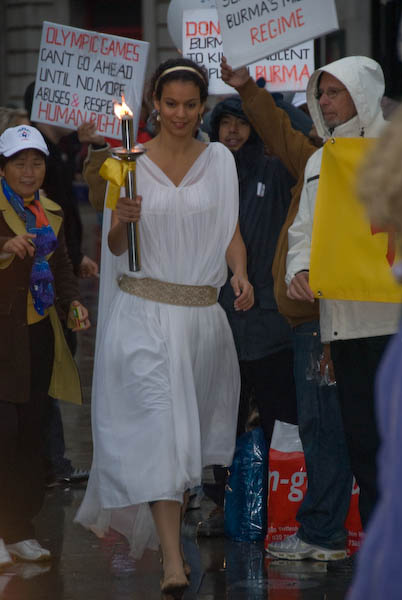
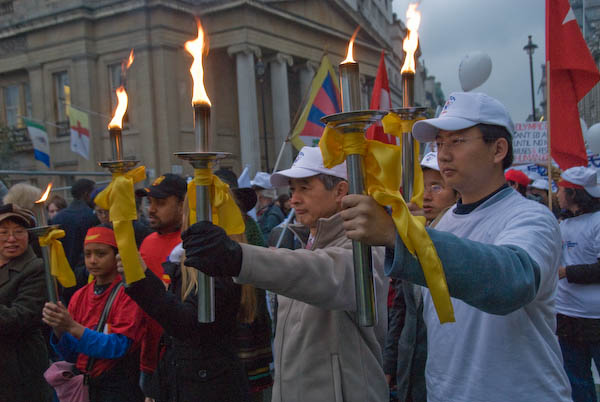
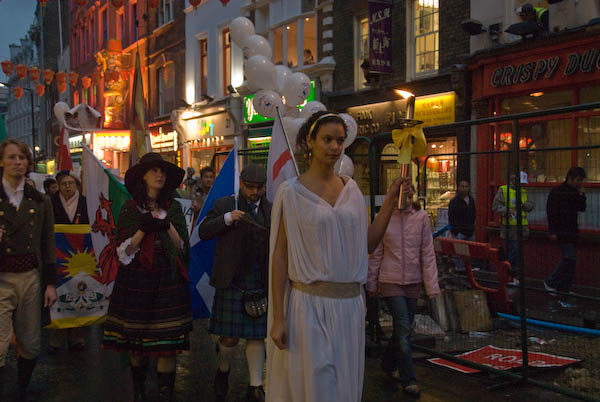
Tibet Vigil at Chinese Embassy – Portland Place

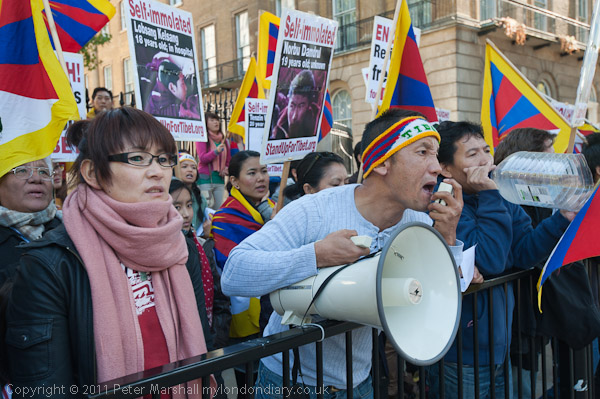
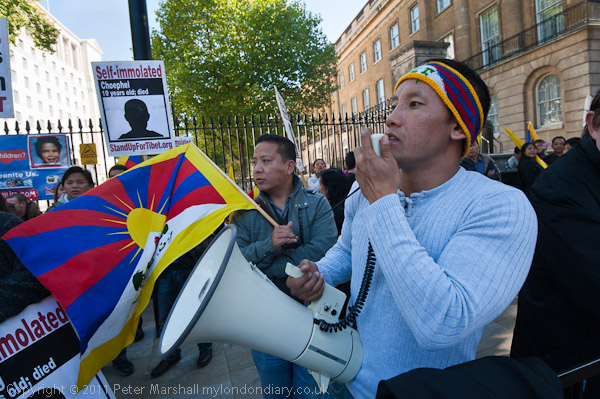
According to the Chinese Authorities, they “exercised restraint” in dealing with the Lhasa protests, using only non-lethal weapons and only killing 13 innocent civilians. Monday afternoon’s demonstration in Portland Place opposite the Chinese Embassy was timed to coincide with the midnight deadline in Lhasa for protesters to surrender.

After protesting for around an hour on the opposite side of the wide dual carriageway, one man jumped over the barriers and rushed across towards the embassy door waving a Tibetan flag. Others followed and police were unable to stop them.

The stewards from the protest tried to get them to make back and were eventually able to persuade them with some gentle pushing to make back to the central island in the road where the protest continued, with some of the protesters sitting down.

Eventually police reinforcements arrived and after failing to persuade them them to move an officer read out something over a loudspeaker. The protest was too noisy for me to hear it, but I think it was a warning that the protesters would be arrested if they didn’t go back to the pavement. The stewards then persuaded everyone to move back to the pavement to continue their vigil, and I went home.

Tibet Vigil at Chinese Embassy


FlickrFacebookMy London DiaryHull PhotosLea ValleyParis
London’s Industrial HeritageLondon Photos

All photographs on this page are copyright © Peter Marshall.
Contact me to buy prints or licence to reproduce.


LSE Cleaners Protest, Lisa Arrested – 2017

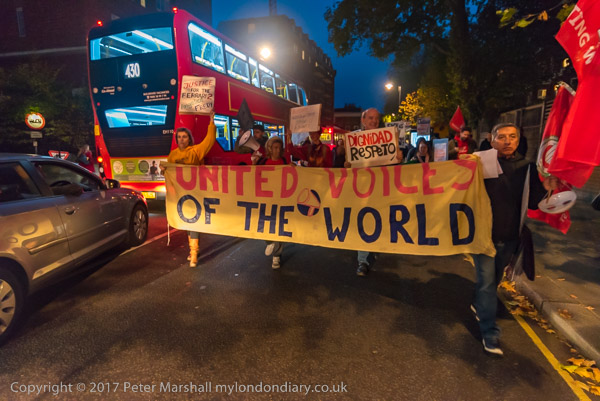
LSE Cleaners Protest, Lisa Arrested: Wednesday 15th March 2017 was the first day of a two-day strike by cleaners at the LSE in support of their campaign demanding equal sick pay, holidays and pensions etc to similar workers directly employed by the LSE and an end to bullying and discrimination by their employer Noonan.

LSE Cleaners Protest, Lisa Arrested
LSE Cleaner Mildred Simpson

I had photographed the start of their campaign at a meeting led by their union, the United Voices of the World, as a part of the LSE’s 3-day ‘Resist’ Festival on 29th September 2016 and a number of protests at the LSE since then.

LSE Cleaners Protest, Lisa Arrested

On 15th March the cleaners had a picket line since the early morning – cleaners start work while most of us are still in bed – and I joined them for a lunchtime rally. Their campaign had a great deal of support from students at the LSE and had a large banner ‘L$E: The London School of Exploitation‘.

LSE Cleaners Protest, Lisa Arrested
Grim Chip recited several of his short poems

Others who had come to support the cleaners included Grim Chip of Poets on the Picket Line and LSE academics Lisa McKenzie and David Graeber and a few from Class War. But there were passionate and effective speeches from a number of the cleaners, including Mildred Simpson, one of the LSE cleaners and others in the UVW.

LSE Cleaners Protest, Lisa Arrested
Alba, right, a LSE cleaner unfairly dismissed in September 2016

At the end of the rally, the protesters marched through the campus and across Kingsway to the building which houses the LSE Estates Office where a large group walked into the foyer demanding to see the Estates Manager. Some were carrying mops and buckets to show their support for the cleaners.

Security came to talk with the protesters, though the protesters were making too much noise to hear them and the protest continued with a short speech from UVW General Secretary Petros Elia to explain when the foyer was being occupied.

Eventually the protesters sat down and waited, still making a lot of noise . People working in the building were still able to leave or enter the building unhindered walking past the protest – but would hear and read why the noisy protest was taking place.

Eventually police arrived and talked with the building security and some of the protesters who soon began dancing in the foyer to music on the public address system the UVW had brought.

More police arrived and decided to stop people entering or leaving the offices. They talked with UVW General Secretary Petros Elia who told them it was a peaceful protest and they would leave after they had made their point to the LSE facilities manager – if the police could persuade him to talk to them.

Eventually this talk did take place, though some way back from the foyer where we could only see them from a distance. The talk went on for around five minutes, and Petros then returned smiling to tell the protesters that the LSE who had until now been refusing to talk to the cleaners had agreed to a meeting.

The protesters then walked out to join those who had been continuing to protest on the pavement outside, and they prepared to end the protest.

But unexpectedly police moved in and surrounded Lisa McKenzie telling her she was under arrest.

They pushed her roughly to the wall of the building and handcuffed her pushing away excessively roughly those who tried to stop the arrest and taking her to a waiting police van.

Apparently Lisa was being charged with assault on the receptionist when the protesters entered the building. I was close behind and neither I nor the other protesters saw any evidence of assault by her as she entered the offices holding one end of the banner with others.

Everyone was shocked, both by the arrest and by the police violence. The fact that none of the others holding the banner were arrested strongly suggested that her arrest was politically motivated, probably due to pressure from the LSE for her support for the cleaners – she had organised the ‘Resist’ Festival where the cleaners campaign had been launched.

Lisa had previously been the subject of a clearly political arrest when she was wrongly charged with three offences at a protest in February 2015 while she was standing in the General Election against Iain Duncan Smith. Perhaps the police were still feeling aggrieved after failing signally to achieve a conviction. This time they were not stupid enough to take her to court.

Much more from Wednesday 15th March 2017 on My London Diary:
LSE cleaners strike and protest
Police arrest Lisa again


FlickrFacebookMy London DiaryHull PhotosLea ValleyParis
London’s Industrial HeritageLondon Photos

All photographs on this page are copyright © Peter Marshall.
Contact me to buy prints or licence to reproduce.

No Trident Lobby & Rally 2007

No Trident Lobby & Rally: On March 14th 2007 the House of Commons were debating the principle to replace the existing UK nuclear weapons and begin a process to design, build and commission submarines to replace the existing Vanguard-class submarines carrying Trident nuclear missiles with updated systems over the coming 17 years. The New Labour government, led by PM Tony Blair and the Foreign Secretary Margaret Beckett were supported by the Conservatives and one DUP member and won the final division by 408 votes to 160.

No Trident Lobby & Rally 2007

Voting against were many Labour MPs and almost all the Liberal Democrats, SNP and other minority parties, although there were a few absentees.

No Trident Lobby & Rally 2007
Protestors at the front of Parliament Square included Christian ministers and Buddhists.

Around Parliament Square there was a day of protest by Greenpeace and others with the main CND rally called for 5pm and continuing into the evening. Here is the account I wrote of the day for My London Diary – with the usual minor corrections and a few of the pictures I posted – more are still on My London Diary

No Trident Lobby & Rally – Parliament Square, London

No Trident Lobby & Rally 2007

I missed Bianca and Annie and the others, but I didn’t miss them as there was plenty else going on. As I walked over Westminster bridge there was the banner flying on the crane in front of the houses of parliament, and there were quite a few people stopping to look at it.

No Trident Lobby & Rally 2007
Protestors from Block the Builders and Aldermaston Women’s Peace Camp had earlier blocked the road. They were dragged rather roughly to the side. Police stood round as pneumatic drill and saws are used to remove the concrete filled bins

Later, Greenpeace activists got on their bikes and cycled across Westminster Bridge to Parliament Square, where they were stopped by police and threatened with arrest unless they left the roadway and moved onto the square. After a while they all did, many cycling away after a few minutes to cycle around London before joining the ‘fish on a bicycle‘ critical mass that arrived back at the square a few hours later, and got the same ‘off your bike‘ treatment from the police.

Cyclists are ordered off the road and onto the pavement of Parliament Square under threat of arrest

The square started to fill up rather more from around 5pm when a silent protest attended by a couple of hundred took place in the far corner of the square. By the time the speeches started at 6.15 there was a respectable crowd, perhaps around 500, but people were still arriving and with the addition of the cyclists there were perhaps closer to a thousand present.

A brief attempt by Greenpeace to protest on the pavement in front of the Houses Of Parliament took the police by surprise, but the group were soon escorted back across the road.

Greenpeace demonstrators on the pavement outside Parliament
Veteran peace campaigner Pat Arrowsmith was among those in the crowd

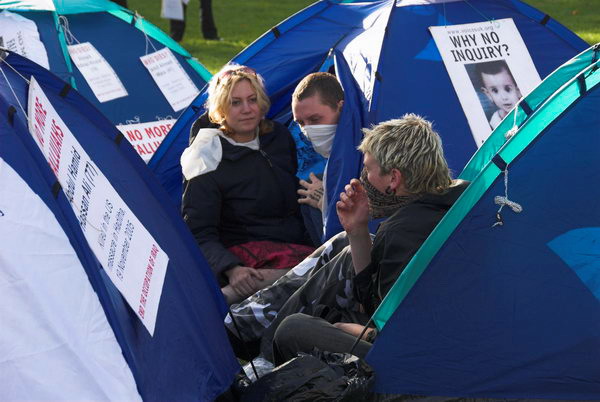
Throughout the day there had been plenty of signs of the personal vendetta between some Met officers and the regular protesters in the square. Two hapless officers appear to have been deployed just to stand in front of one fluorescent pink placard, and there were some incidents of minor harassment. The injunction thrown out by the judge at Southwark Court recently showed how the police are wasting our money in this respect.

Brian Haw: Find Your Courage; Share Your Vision; Change Your World. (T-shirt from Dan Wilkins, The Nth Degree.)

Apparently the latest approach to try and remove the protesters from the square comes from London Mayor Ken Livingstone who is worried about the grass being damaged by the tents there. As I remarked when this was mentioned, “grass regenerates, dead children don’t.” Perhaps we should start a ‘Brian [Haw] For Mayor‘ campaign.

We need Trident “like a fish needs a bicycle”

Several Labour MPs came out from the house to address the meeting, along with many activists. Bruce Kent started his speech by thanking Brian Haw for allowing the demo to use his back garden, and Brian later came from his protest at the front of the square to address the meeting.

This time the government got its vote, but there will be later occasions to oppose Trident, as well as the continuing actions at Faslane which those at the demo were urged to take part in.

Trident replacement is still continuing in 2025, with the government being committed to the building of four replacement submarines by the early 2030s and an extension to the life of the Trident missiles potentially to the early 2060s as well as work taking place now to produce replacement nuclear warheads in the 2030s. It is an important support to the UK arms industry but of little or no military consequence with its obscene cost threatening our ability to defend the country by conventional means and it remains – like all nuclear weapons – a definite threat to the peace and future of the world.

Many more pictures on My London Diary beginning here.


FlickrFacebookMy London DiaryHull PhotosLea ValleyParis
London’s Industrial HeritageLondon Photos

All photographs on this page are copyright © Peter Marshall.
Contact me to buy prints or licence to reproduce.

Immigration, Lions, Poverty Pay & Palestine – 2015

Immigration, Lions, Poverty Pay & Palestine: Ten years ago on Friday 13th March 2015 I photographed four very different protests in London, beginning outside an immigration tribunal in Feltham, going from there to Trafalgar Square where people where protesting against ‘canned hunting’ of lions, on to Kensington Gore where cleaners were demanding a living wage at the Royal College of Art and finally to the offices of G4S on Victoria St, Westminster for a protest against the imprisonment and torture of four young Palestinian boys by Israel.


Let Ife Stay in the UK! – York House Immigration Tribunal, Feltham

Immigration, Lions, Poverty Pay & Palestine - 2015

York House where the Immigration Tribunal is based is on an industrial estate halfway between Feltham and Heathrow on the western fringes of London and protesters had not found it easy to get there. I arrived a little late and other protesters only arrived shortly before I left, with others still on their way.

The protest had been held up at the start when security at the tribunal had told the protesters they were not allowed to protest outside the offices, and had called the police. But the police had come and confirmed that not only they had the right to protest there but also that people could take photographs outside the tribunal – though of course cameras and recording equipment were not allowed inside the tribunal.
Immigration, Lions, Poverty Pay & Palestine - 2015

The protesters had come to demand that 2-year-old Ife, who had Down’s syndrome, and her mother should be allowed to stay at their Peckham home where she can receive essential healthcare and support and not be deported to Nigeria. They intended to stay until after the end of the tribunal hearing later in the day.

Immigration, Lions, Poverty Pay & Palestine - 2015

The protesters from the Revolutionary Communist Group had brought with them posters covered with the sheets of a local petition to keep Ife here with nearly a thousand signatures, as well was posters denouncing the UK’s racist immigration laws and also calling for justice for Jimmy Mubenga, killed by racist G4S deportation officers during his forced deportation flight from Britain.

Let Ife Stay in the UK!


Save Our Lions – ban Canned Hunting – Trafalgar Square

Immigration, Lions, Poverty Pay & Palestine - 2015

Several hundred gathered in Trafalgar Square to protest against ‘canned hunting’, where lions are bred and raised tame on farms in South Africa for rich visitors to pet, to ‘walk with lions’ and to shoot as trophy heads.

The protesters say this degrades a noble animals and threatens wild lions, which are captured for farm breeding to improve the quality of the stock.

Only very young cubs are safe to pet and young female lions are often killed once they become too large to pet as there is much less demand for female lions as hunting trophies.

After speeches and photographs on the North Terrace I was invited to go with one of the protesters to South Africa House where he stood in the entrance with a placard and poster until security told us to leave.
Save Our Lions – ban Canned Hunting


Poverty pay at the Royal College of Art – Kensington Gore

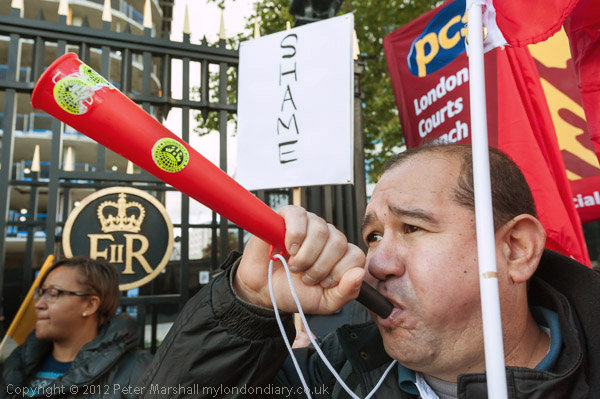
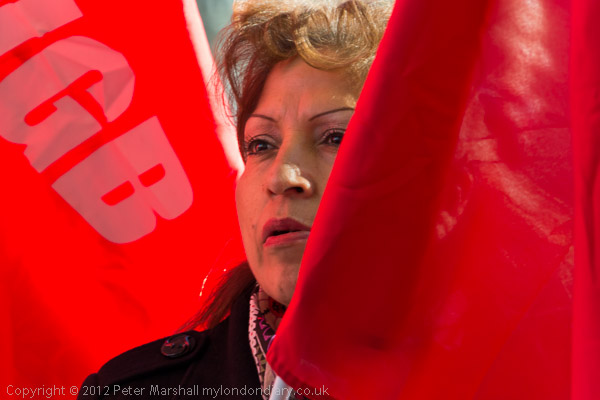
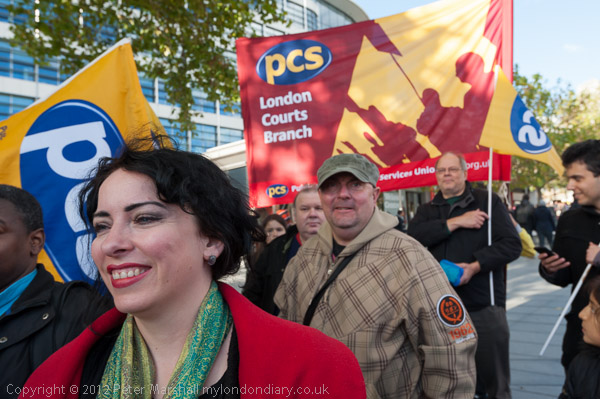
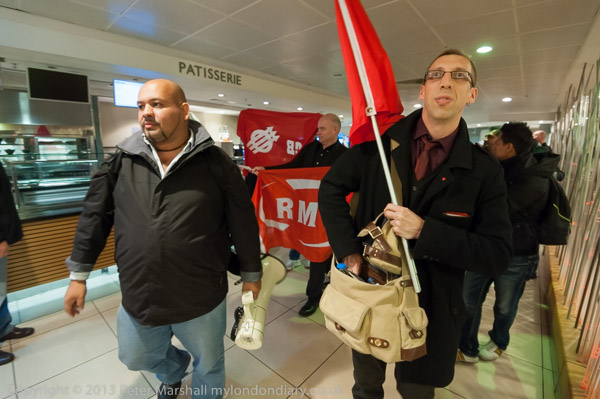
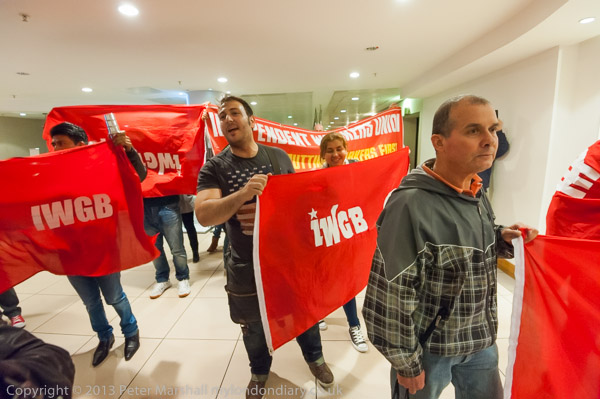
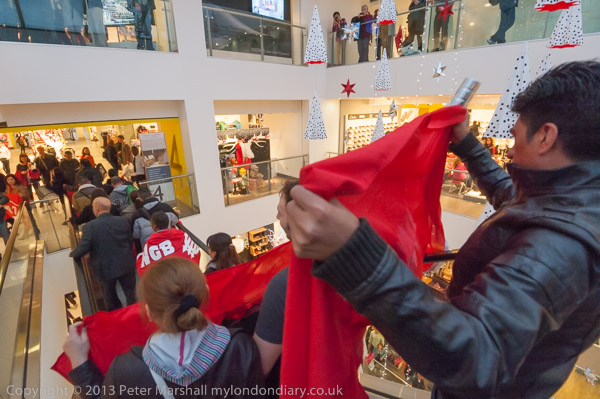
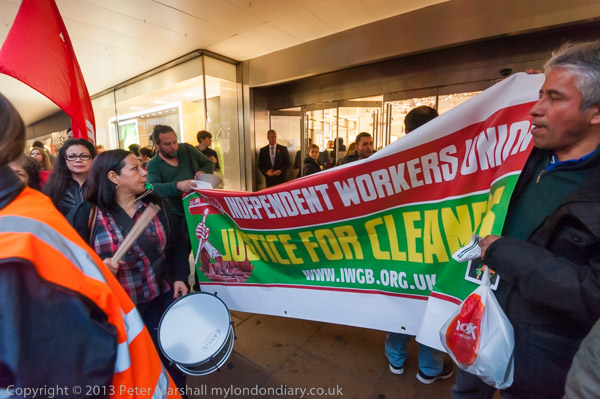
I met with protesters from the IWGB (Independent Workers’ Union of Great Britain) at the Royal College of Art where they had come at lunchtime to demand that cleaners be immediately paid the London Living Wage. Previous pressure from the IWGB had led to the RCA saying it would pay the living wage from September 2015, but the cleaners needed it now, not in sixth months time.
After a noisy protest outside the college entrance in a mews just off the main road where they were joined by around 50 students in support the marched onto Kensington Gore for a more public protest on the east side of the college facing the Royal Albert Hall.

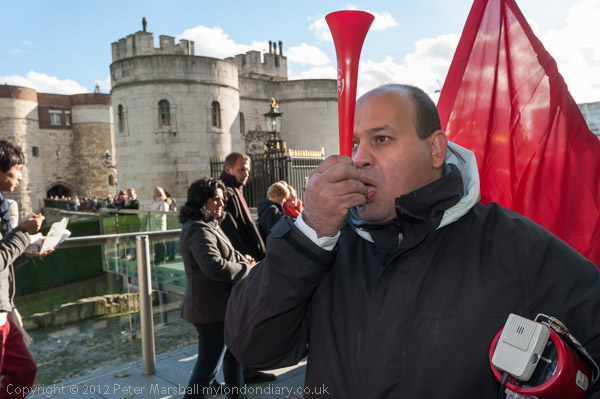
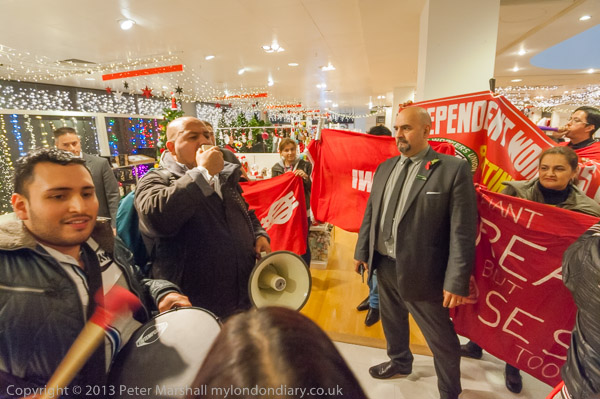
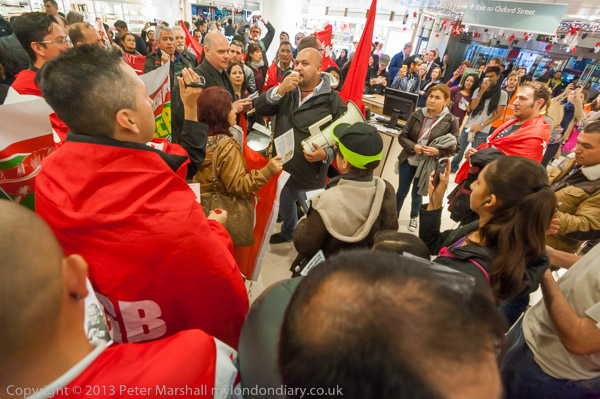
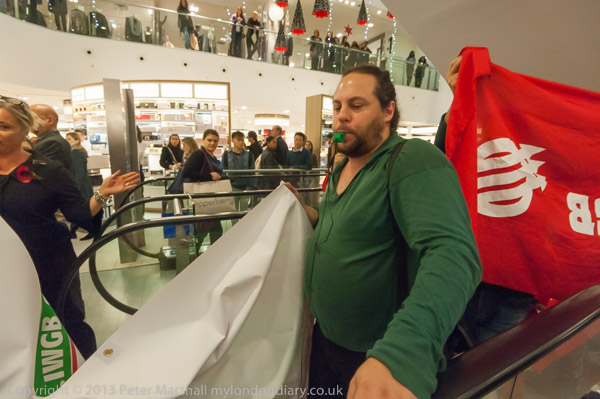
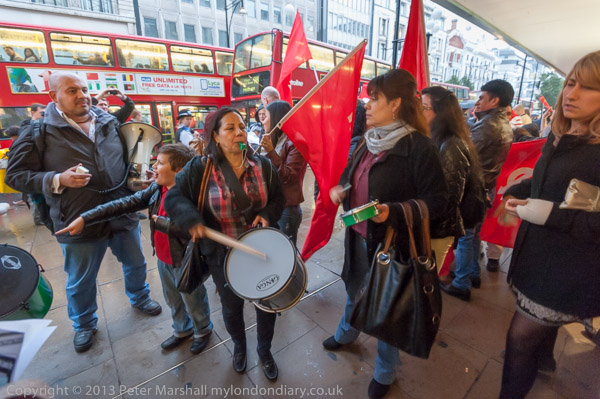
Here there were speeches and chanting and a great deal of noise from the drums and vuvuzelas before the protesters went back to continue their protest at the college entrance.
From here they moved further down the mews and to an almost enclosed yard at the rear of the college next to a dining area keeping up a barrage of noise. After keeping up their loud protest for around an hour they finished with a warning to RCA management that they would be back and keep up the protests until their demands were met.
Poverty pay at the Royal College of Art


Free the Hares boys protest at G4S – Victoria St

British multinational private security company G4S plays a key role in running jails in Israel where thousands of Palestinians are held.

Among the prisoners being held and tortured were 5 young boys from Hares in the northern West Bank of Palestine, and the Islamic Inminds Human Rights Group were protesting outside the G4S offices on Victoria St demanding their immediate release.

The boys were arrested after an Israeli illegal settler crashed into the back of an Israeli truck and they were alleged to have caused the collision by throwing stones.

That had happened two years earlier and the boys had now been held without trial for two years for the alleged crime – for which there appeared to be no evidence.

One of the five, Mohammed Mahdi Saleh Suleiman, was convicted by a military court and sentenced to 15 years in prison on the basis of a statement obtained by torture that he was not allowed to read before being forced to sign.

In 2016 the United Nations Working Group on Arbitrary Detention published its opinion on his case. They called his detention ‘discriminatory’ and ‘arbitrary’ and called for his immediate release by Israel. Israel ignores most if not all UN opinions.

Free the Hares boys protest at G4S


FlickrFacebookMy London DiaryHull PhotosLea ValleyParis
London’s Industrial HeritageLondon Photos

All photographs on this page are copyright © Peter Marshall.
Contact me to buy prints or licence to reproduce.