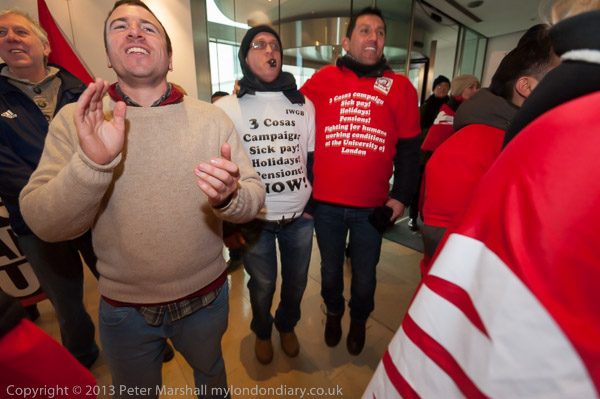
Cleaners Protest at Tower of London – 2012

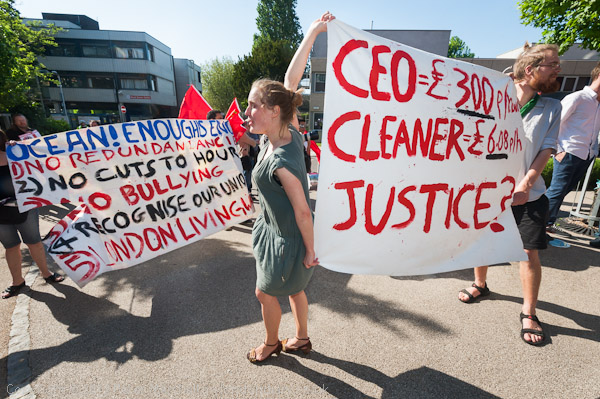
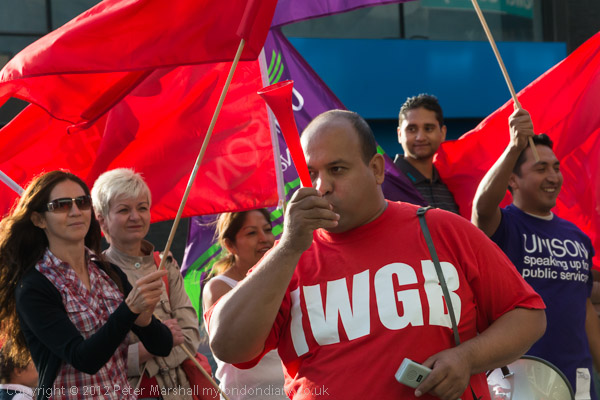
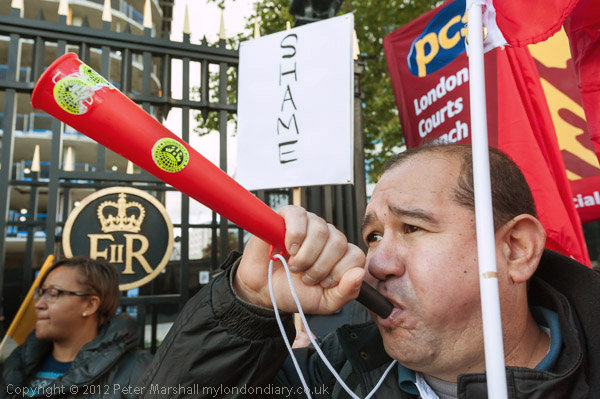
Cleaners Protest at Tower of London: On Saturday 3rd November 2012 the trade union Industrial Workers of Great Britain (IWGB) held a high profile protest outside the Tower of London as a part of their campaign to get the London Living Wage, better contracts and improved working condition and management for the workers who clean the Tower, one of London’s major tourist attractions.
Cleaners Protest at Tower of London - 2012

The Tower of London is run by a charity, ‘Historic Royal Palaces’, which also runs other royal palaces on behalf of the Crown, but they employ no cleaners. Instead they were using the cleaning contractor MITIE to employ the workers who clean the Tower and make it fit for visitors. By outsourcing the work in this way they try to deny responsibility for the poverty wages, lousy pensions, holidays and sick pay, poor physical conditions, overworking and bad management of their workers.
Cleaners Protest at Tower of London - 2012

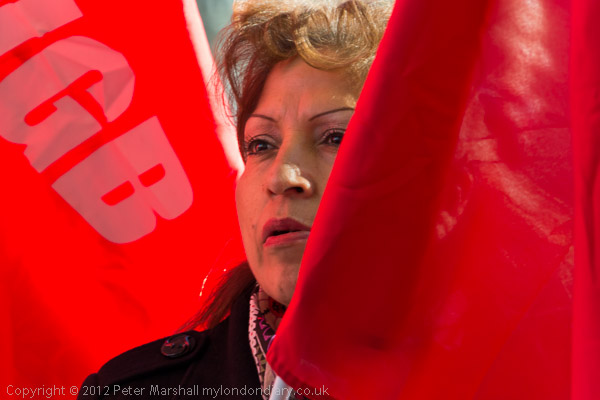
The IWGB was formed by Latin American cleaners organising for better working conditions earlier in 2012 after they had become disillusioned with the lack of support for lower paid workers by some of our traditional unions as “a worker led union organising the unorganised, the abandoned and the betrayed.”
Cleaners Protest at Tower of London - 2012
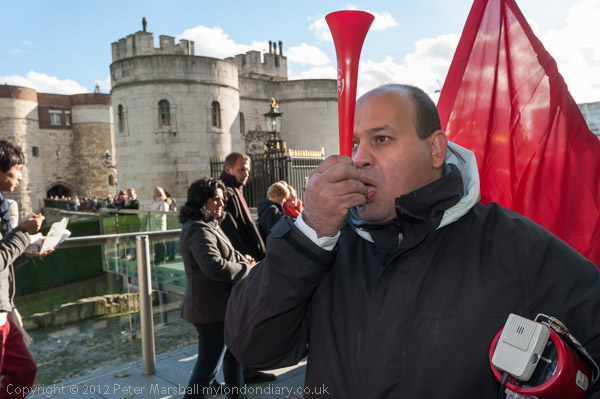
IWGB organiser Alberto Durango at the Tower

It remains a powerful grass-roots trade union, based on building workers’ power and developing leadership by its members, taking action through strikes, powerful protests and legal actions and developing solidarity across cultural and language barriers.
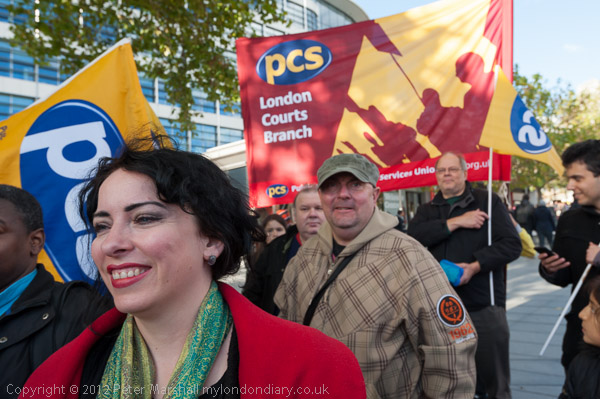
Cleaners Protest at Tower of London - 2012
PCS members came to support the protest

The union has developed significantly since 2012 and has had many victories in its campaigns to improve the conditions of low paid workers. It now “organises couriers, cycling instructors, charity workers, yoga teachers, cleaners, security officers, video game workers, nannies, university workers, foster carers, private hire drivers and more.”
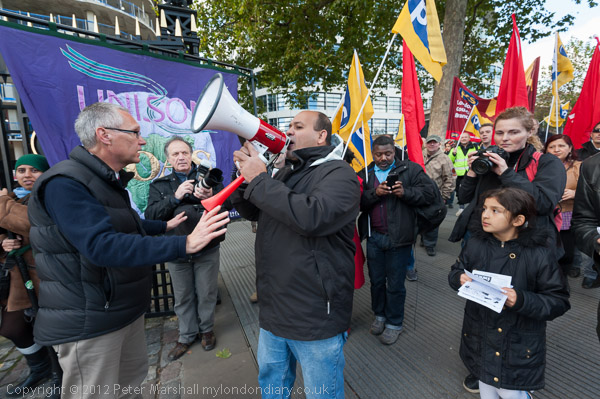
Cleaners Protest at Tower of London - 2012
Security stop the protesters at the gate, where the protest continues

I reported on many of the protests by the IWGB and other grass-roots unions including the United Voices of the World (UVW) over the years – and you can see many of my reports on My London Diary. There had been a number of protests by cleaners before these unions were formed, but they brought a new level of activity and creativity to the protests.
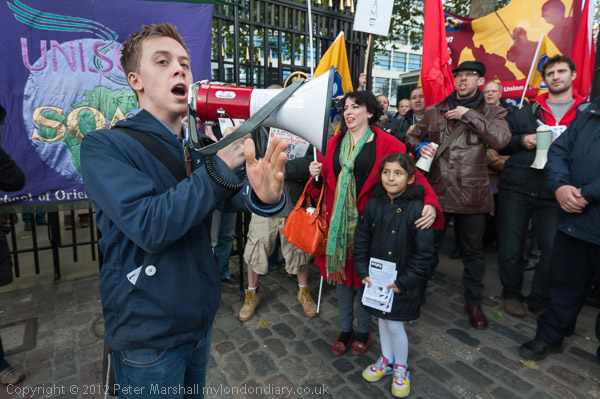
Owen Jones speaking

The campaign for a London Living Wage was started by London Citizens in 2001 and recognises the extra costs of living in the city – something that had long been recognised in professions such as teaching, where teachers in Greater London received a London allowance. The London Living Wage level is calculated independently and supported by successive Mayors of London, but companies are not obliged to pay the extra amount above the National Minimum Wage (rebranded the National Living Wage for those over 21 a few years ago.)

A speaker from PCS

As I wrote in 2012, the London Living Wage “still meets with bitter opposition from some of the most profitable companies around who are low pay employers, including MITIE, who last year increased their profit margins to 5.6% and had a pre-tax profit of £104.5m.”
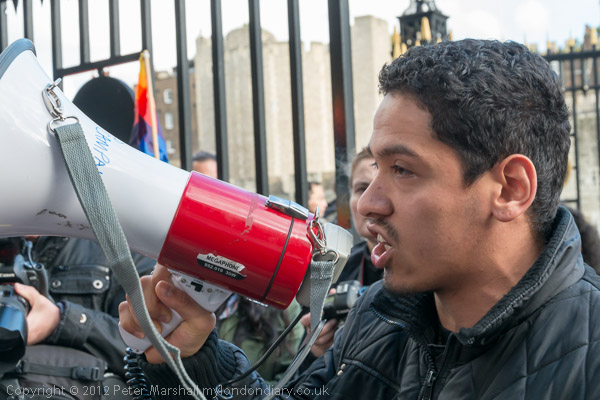
A cleaner speaking

The IWGB’s campaign as I also wrote, is “not only about wages, but also about civil rights, dignity and respect. MITIE seems to be treating its workers and employment law with contempt. The cleaners demand justice and fair treatment, and say they are treated as medieval serfs. They are asking for:

• the London Living Wage of £8.30 per hour
• proper contracts which reflect the actual hours of work and provide
    holidays and other normal employment benefits
• adequate staffing levels to cope with the workload
• proper changing and washing facilities
• proper Health & Safety training for managers and workers, and risk
    assessments of tasks
• proper safety equipment including protective gloves etc"
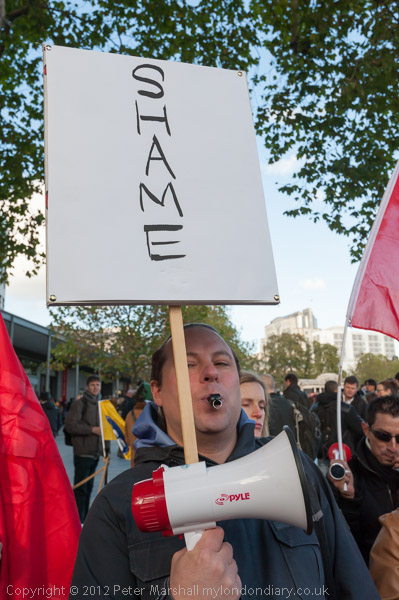
MITIE’s response to the campaign was simply “to ban the IWGB. Senior HR Manager Kevin Watson-Griffin stated ‘IWGB representatives will not be permitted access to any MITIE site, including the Tower of London, Barbican etc. to support the IWGB members who are employed by MITIE.'”

After an hour or so of noisy protest it was time to go – but with the message “We’ll be back

On My London Diary you can read more about the protest at the Tower, including what actually happened at this very public, very visible and very noisy protest which received considerable support from trade unionists from other unions involved with cleaners including the PCS, RMT and Unison. I also wrote about some of the speakers and their speeches and the photographs include most of them including journalist Owen Jones.

More on My London Diary at Cleaners Protest at Tower.


FlickrFacebookMy London DiaryHull PhotosLea ValleyParis
London’s Industrial HeritageLondon Photos

All photographs on this page are copyright © Peter Marshall.
Contact me to buy prints or licence to reproduce.
IWGB – Ten Years

IWGB - Ten Years

The union, originally known as the Industrial Workers of Great Britain was founded by Latin American cleaners in August 2012 as “a worker led union organising the unorganised, the abandoned and the betrayed“.

IWGB - Ten Years

Since then it has seen a remarkable growth thanks to its successes in achieving better pay and conditions of service for its members, expanding from cleaners into various other sector, including some never before unionised in what has become the ‘gig economy’ and has branches for cleaners, couriers, private hire drivers, foster carers, the video games industry, charity workers, nannies, security and receptionists, au pairs, yoga teachers as well as Universities of London and general members branches.

IWGB - Ten Years

The union was formed after cleaners in traditional trade unions such as Unite and Unison saw that they were not getting the support they needed to improve their pay and conditions. The unions that were recognised by the employers seemed unwilling to confront the employers and press the workers’ case and were failing to organise actions at the workplace.

I had met some of those involved at earlier protests organised by union branches, at times in defiance of the union bureaucracy, and earlier in 2012 by the cleaners’ branch of the Industrial Workers of the World (IWW), including at John Lewis in July 2012 and the LSE and the Royal Bank of Canada in June.

At St Georges Tooting, May 2012

Earlier in May 2012 the I photographed a protest for cleaners led by the IWW at St George’s Hospital in Tooting, where only one of the hospital cleaners was still a member of Unison, the recognised union, as “UNISON have never campaigned for the London Living Wage at St Georges and have actively assisted the management in their efforts to undermine the cleaners resistance to cuts.” Unison had written to the cleaners, instructing them not to take part in the protest and describing the IWW as “a non TUC anti union organisation.”

Justice for Cleaners at Société Générale, 6 Sep 2012

I first became aware of the miserable pay and conditions of cleaners and photographed some of them back in 2006 when the London Citizens Workers’ Association with the support of faith organisations, trade unions (notably the T&GWU) and social justice organisations launched the ‘Justice for Cleaners’ campaign in May Day. Things seem to move slowly but I met them again in 2007 and in 2008 at noisy high-profile but peaceuful demonstrations on the streets outside companies to shame them into ensuring that their outsourced cleaners got better conditions. That success appears to have prompted government action to make such protests, continued by the IWGB and others, illegal, though it seems unlikely to actually prevent them.

Since the IWGB was formed I’ve photographed many of their protests – too many to list, and including many I’ve written about on this site as well as My London Diary – where a search on ‘IWGB’ will reveal many of them. They are not the only grass roots union representing precarious workers and I’ve also photographed many actions by the United Voices of the World. Both are very much worker-led trade unions and work in similar ways, using the law in tribunals and court cases and holding noisy protests to shame companies.

The IWGB say they are the UK’s leading union for precarious workers. They are a democratic and member-led organisation with workers in the branches leading them and determining the policies they follow. There are no high-paid union leaders, and the union has a great record of empowering its members.

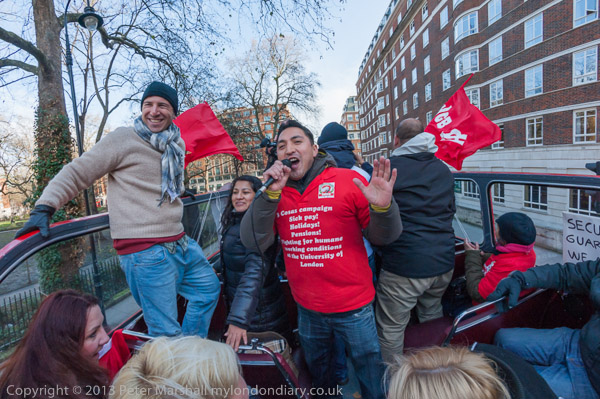
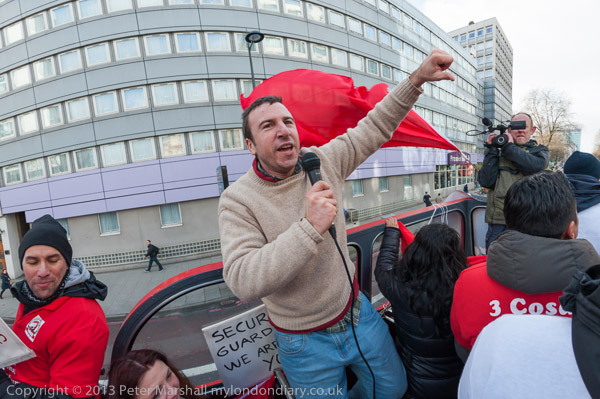
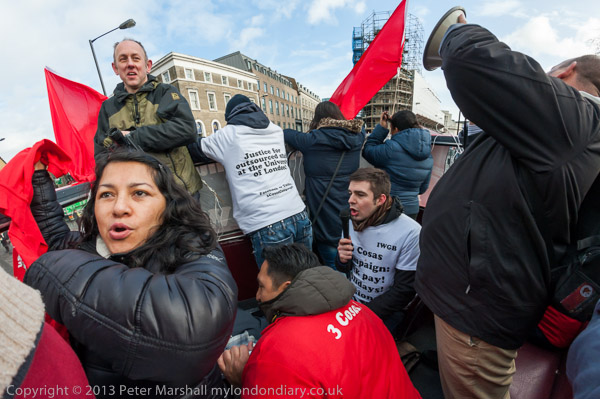
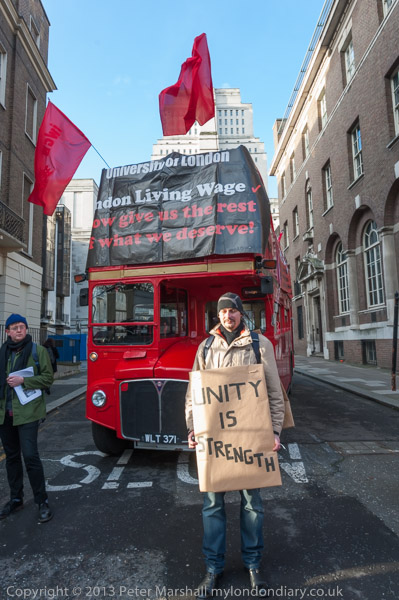
The Wikipedia article lists some of their successes though it is in need of considerable updating and some minor corrections. But it does point out some of their success, particularly in the 3 Cosas campaign for proper sick pay, holidays and pensions for workers at the University of London, in attracting support from politicians including Green Party leader Natalie Bennett and Labour MPs Jeremy Corbyn and John McDonnell. And the IWGB have certainly led in challenging employment law relating to the ‘gig economy’.

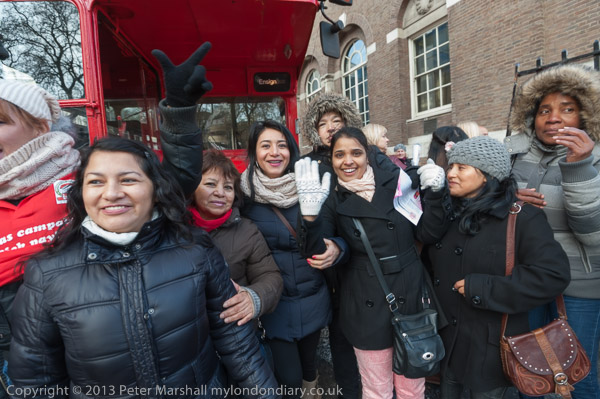
I could fill a book (or two) with my pictures of the IWGB and the UVW, and perhaps one day I will, and I could write much more, though others could do it better. The pictures with this post, with two exceptions come from one day, 28th January 2014, when as a part of the ‘3 Cosas’ campaign low paid workers at the University of London on the second day of their 3 day strike for union recognition and better conditions took their dispute around London on the open-top IWGB battle bus, stopping at key sites, including Parliament Square and the Royal Opera House for a rally and protests.