Republic Day: 26 January 2011

Republic Day has been celebrated in India on the 26th January since 1950, and marks the day in 1950 when the Constitution of India came into effect. India had gained independence on 15 August 1947, but that left the country as a British dominion, still under British Law and with King George VI as head of state. It took until November 1949 for the new constitution to be agreed, and the January 26 was chosen for its introduction as the Indian National Congress had declared it as Independence Day in 1929.
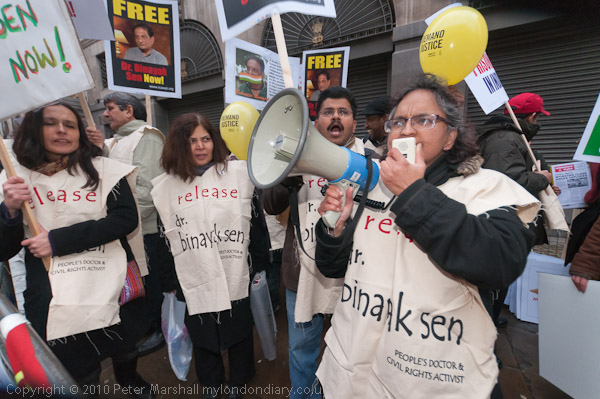
Along with Independence Day it is a day when there are often protests outside India House in London and on 26th January 2011, ten years ago today, there were at least two taking place. One called for the release of leading paediatrician and public health specialist Binayak Sen, a member of the People’s Union for Civil Liberties who has gained international recognition for his work in Chhattisgarh, India, where he “helped establish a hospital serving poor mine workers in the region, founded a health and human rights organization that supports community health workers in 20 villages.”
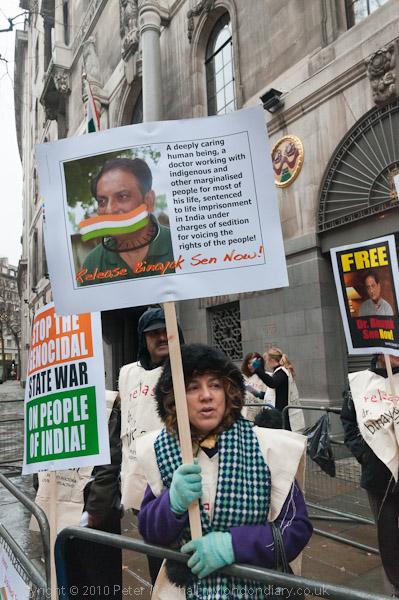
Dr Sen also criticised the Chhattisgarh state government’s atrocities against indigenous people fighting the handover of their lands for mining and their establishment of an armed militia, the Salwa Judum, to fight against the Naxalite (Maoist) rebels in the area, and was arrested and sentenced to life imprisonment by a Chhattisgarh court for sedition and helping the Naxalites. His case and appeal attracted support from around the world including from 22 Nobel laureates who sent a letter to the Indian President and Prime Minister and Chhattisgarh state authorities asking for him to be allowed to travel to the US to receive the Jonathan Mann Award for Global Health and Human Rights. Later in 2011 he was granted bail by the Indian Supreme Court.
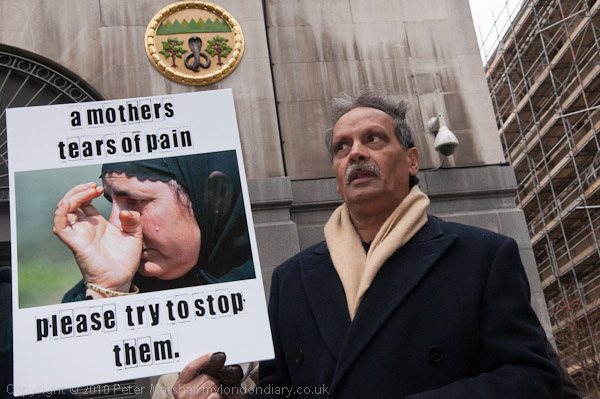
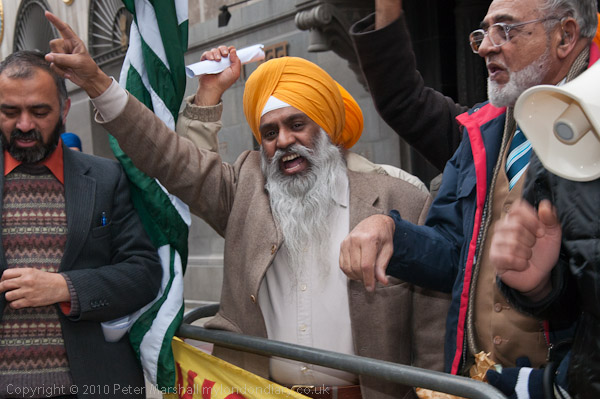
Also protesting outside India House were Kashmiris and Sikhs calling for the freedom for their nations which has been denied by Indian military repression. Kashmir is one of the oldest countries in the world, dating back to the Iron Age and became a Muslim monarchy in 1349, was later a part of the Sikh empire but was established later as a kingdom under British guidance. At partition the ruler ceded the country to India against the wishes of the majority of its inhabitants for military protection after Pakistan invaded the country, which is now in three parts, under military rule by India, Pakistan and a small part China.
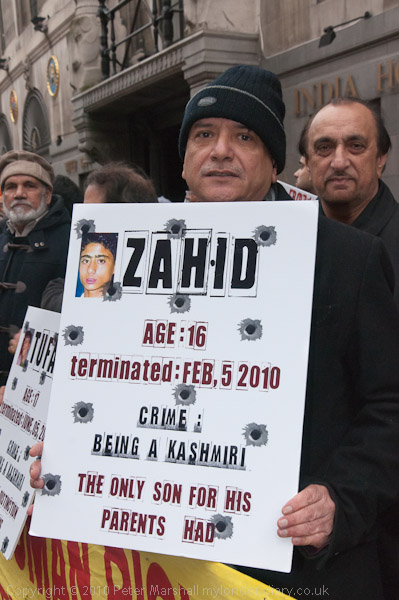
The Indian administered area, known as Jammu and Kashmir and Ladakh had limited autonomy which was revoked on 5 August 2019 and has a huge occupying force accused by human rights organisations of imposing strict military law in a systematically brutal fashion, with deaths during interrogation of suspects, detention without trail, censorship, arson, beatings, rape, mass murder, and tortures of all kinds.
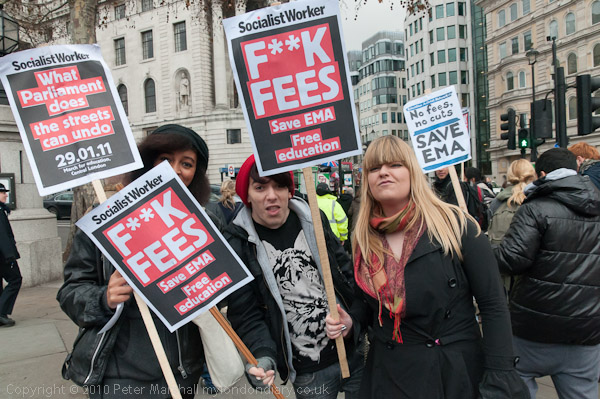
It was a busy Wednesday, with other protests taking place, including a student day of action against fees and cuts, including the loss of the Education Maintenance Allowance which has allowed many 16-18 year olds to remain in education. Axed in England it is still available in Wales, Scotland and Northern Ireland. Unfortunately although there had been publicity about students walking out of schools and college there was very little information available about the protests they might attend, and only perhaps qa hundred made their way to the rally in Trafalgar Square.
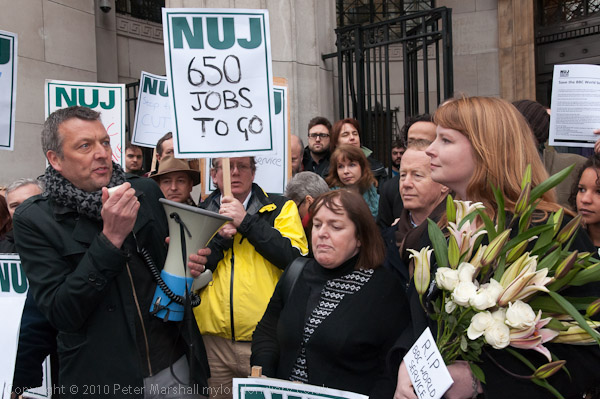
After some speeches there was a discussion about what to do next, and most of those present decided to join the NUJ demonstration outside Bush House against the savage cuts announced by the BBC for the World Service broadcasting, with up to 650 job losses, switching off of radio services and the complete loss of services in 5 languages. This was particularly convenient for me as I was also going to join this protest as a member of the NUJ – and it was just a few yards from India House were I was going to photograph other events.

More at:
Release Binayak Sen Now
Free Kashmir & Khalistan
Save the BBC World Service
Student Day of Action


All photographs on this and my other sites, unless otherwise stated, are taken by and copyright of Peter Marshall, and are available for reproduction or can be bought as prints.
Outsourcing and Covid

One of the reasons why the UK has suffered so badly from the corona virus has been outsourcing. Not of course the major reason, which has been government incompetence and failure to take effective action, always a case of too little too late. A year after the outbreak began it is only now considering the kind of travel restrictions that would have saved many thousands of lives (and which even one government minister has said she was arguing in favour of at the start.) Three weeks before we had the first lock-down I was getting urgent messages from relatives who were in touch with the medical advice that was going to the government that, because of my age and diabetes, I should isolate myself.

And of course there has been the failure to work properly with existing public bodies, instead preferring to give huge payments to cronies to set up an ineffectual systems for testing and tracing, to source inadequate PPE and take large consultancy fees to no particular purpose, wasting billions.

Government has deliberately promoted policies which have increased the spreading of the virus, failing to stop much unnecessary work or ensure that proper protective measures are enforced and giving offers to people to go out for meals largely in indoor settings where the spread of infection was almost inevitable. Although they now deny it, their polices were based on ideas of herd immunity, where infection gives a large proportion of the population some immunity and stops the virus spreading; for this to work, perhaps 80% of us would need to have had it, and a quick back of envelope calculation showed that would mean perhaps 400,000 deaths – and I would have been rather too likely to be one of them. It’s a figure we may still reach, though 200,000 seems more likely now – and we are over half way there.

A couple of days ago on the Today programme on Radio 4 I heard Maria, a cleaner from the IWGB being interviewed. She contracted the virus, probably while travelling to work on crowded public transport, and tested positive. Before the test she had been ill at work and had asked her employer if she could go home, but had been told she had to stay. After the positive result, she had to continue to go to work, as the sick pay she would have received was simply not enough to live on.

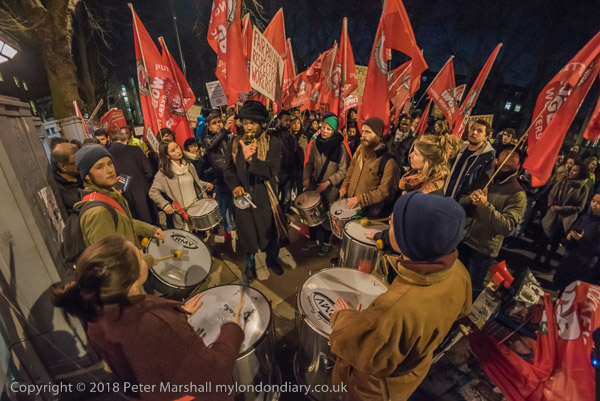
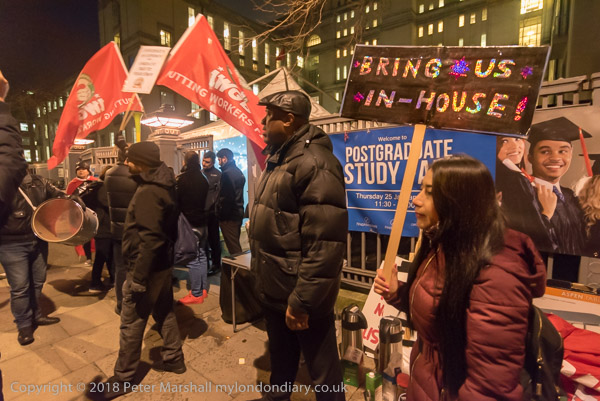
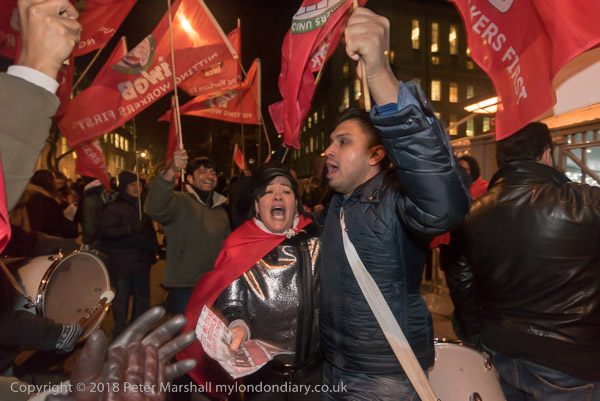
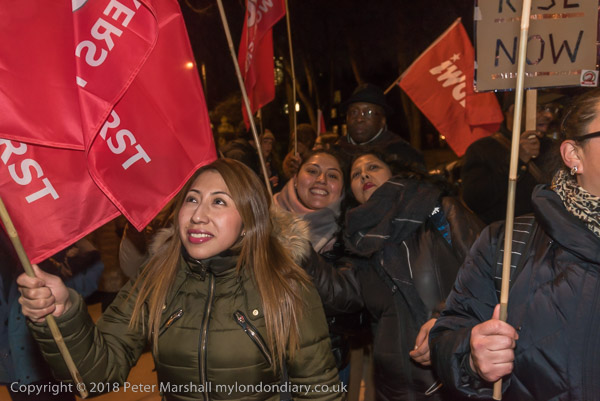
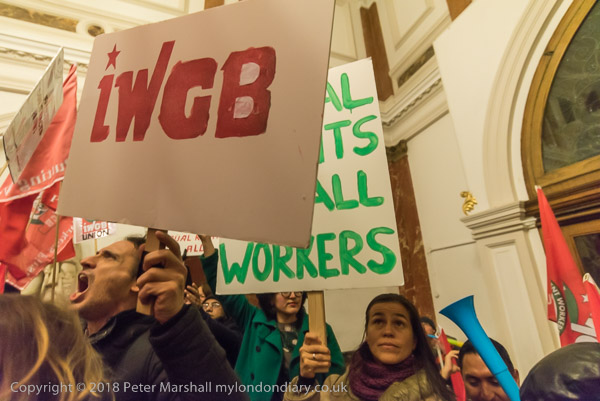
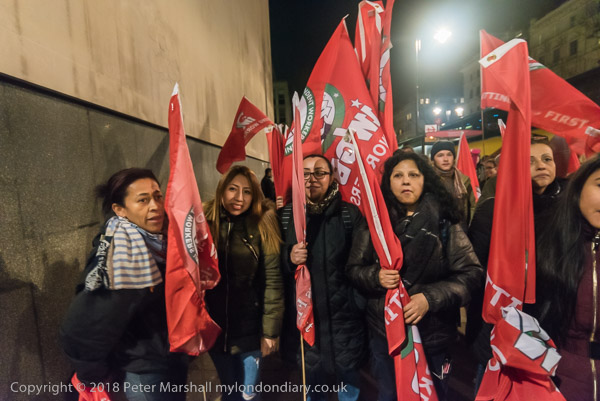
Maria is probably one of those IWGB members in the pictures I took on 25 Jan 2018, and the other pictures I’ve taken at IWGB protests against outsourcing. Outsourced workers are employed not by the company at their work place – on this occasion the University of London – but by a company that is given a contract for the services they provide. Contracts are usually awarded to the lowest bidder, and outsourcing companies cut their costs by paying low wages, giving only the statutory minimum in conditions – including sick pay, holidays, pensions etc – and often bullying the workers, demanding impossible workloads and failing to provide proper safety equipment – so that they can gain contracts and also make a profit for the company owners.

Usually too both the contractors and the workplace management refuse (often illegally) to recognise the trade unions to which the outsourced workers belong – such as the IWGB, and refuse to discuss any of the workplace issues with them. Often union members are disciplined and sacked for their union activities.

Had Maria been one of the cleaners at the various places where the IWGB have been able by organising protests like this and forcing the management to talk with them and to get the workers directly employed she would have got the kind of conditions that other workers at these places take for granted. She would have been able to call in to work when she knew she was ill and have time off, and would have been able to self-isolate after her positive corona test, as she would have been able to rely on proper sick pay.

Outsourcing and other poisonous working arrangements, particularly zero hours contracts, have been a major factor in directly spreading the infection, and are a part of the reason for its increased prevalence among our black and ethnic minority communities. Low pay too has an indirect effect, leading to more crowded housing conditions. Many low paid jobs too are ones that involve considerable contact with others, and often involve travel in crowded public transport to workplaces.

The first protest on that Thursday evening in January was calling for the University of London to directly employ the cleaners, receptionists, security officers, porters and post room staff that work in the premises that are part of the central administration, including offices and halls of residence, and took place outside the University’s Senate House. Earlier protests have persuaded the University to consider direct employment for some of these workers, but the IWGB call for all of them to be brought in-house as soon as possible. Students and some teaching staff from various colleges came to support the protest.

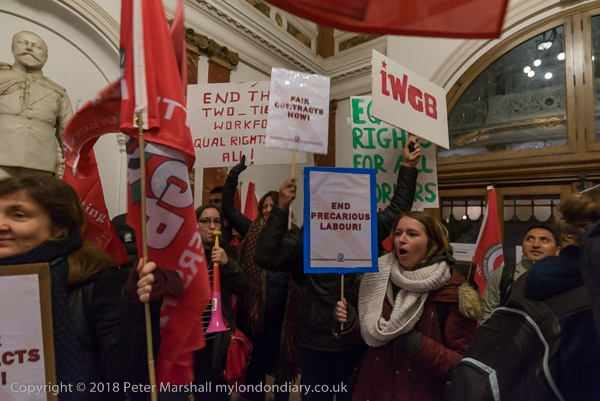
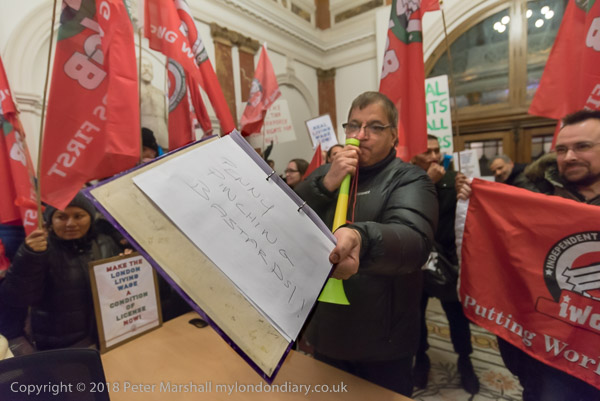
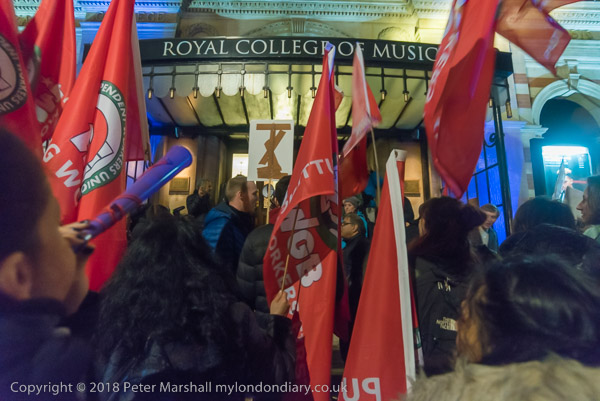
At the end of this protest a double-decker bus hired by the union arrived to take those present to a ‘secret location’ for a further protest and I was invited to go with them. It dropped us off around the corner from the Royal College of Music, and the protesters ran into the building. A new contractor had taken over the RCM cleaning contract and decided to halve the hours worked by cleaners and change shift times. Most of the cleaners have to work on several jobs like this to make ends meet and so were unable to change to the new hours and had been threatened with dismissal. The RCM and the contractor had refused to discuss the changes with the IWGB who had launched a collective grievance; the cleaners have balloted for strike action and the union is also considering a legal challenge under law governing the transfer of undertakings.

It was a short and very noisy protest inside the foyer, and the protesters who had been very careful to avoid any damage left when the police arrived after 12 minutes and continued their protest outside.

More at:
Cleaners rush into Royal College of Music
End Outsourcing at University of London


All photographs on this and my other sites, unless otherwise stated, are taken by and copyright of Peter Marshall, and are available for reproduction or can be bought as prints.

End Nuclear Weapons Now

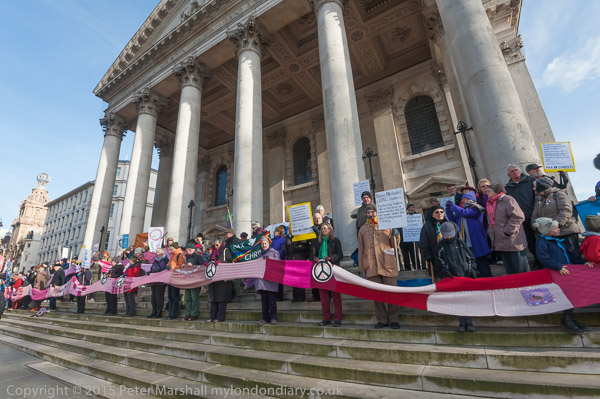
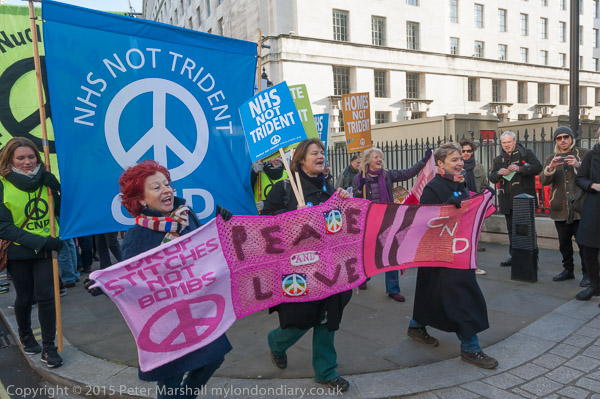
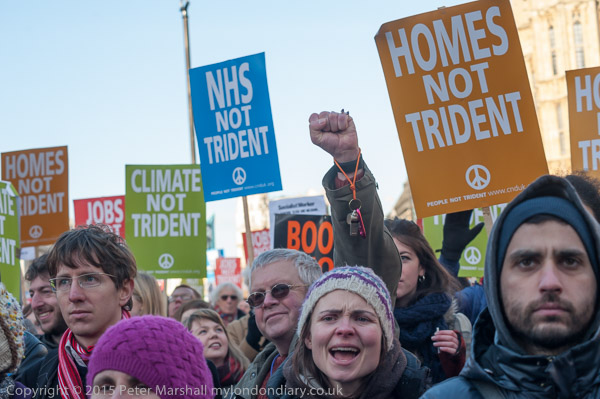
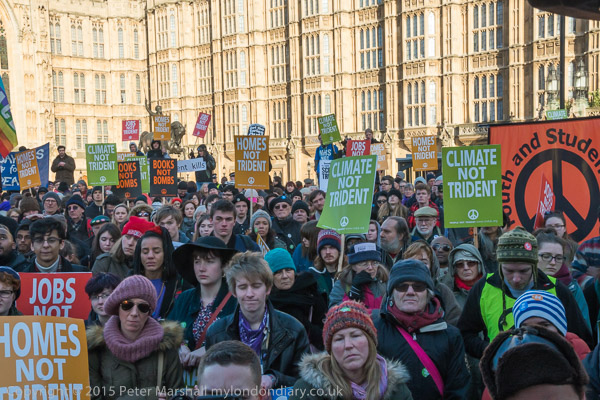
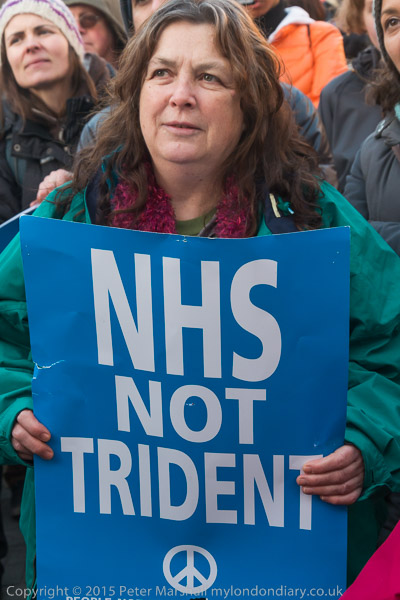
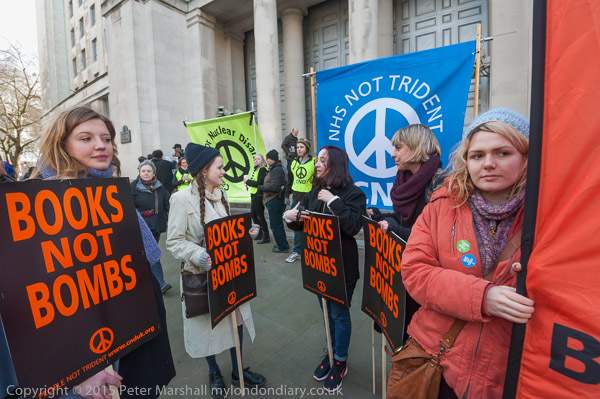
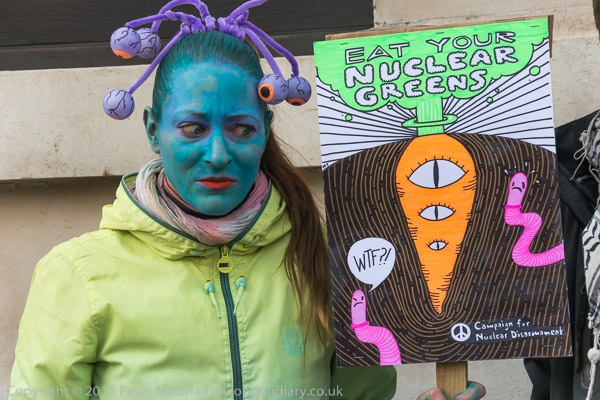
Six years ago on 24 January 2015 I photographed a large protest in London calling on the UK to end its huge and pointless investment in nuclear weapons, calling for Trident to be scrapped and not replaced. We waste many billions on procuring and maintaining nuclear weapons – currently around £3 billion a year according to government estimates – on weapons that hopefully will never be used as the consequences would be too disastrous and also ultimately futile as it would lead to retaliation that inevitably would entirely destroy a small and densely populated country like ours.

Our nuclear weapons take up around 6% of the defence budget but offer no defence but are entirely a matter of prestige, something we use to continue to justify our continuing permanent seat on the UN Security Council as founding members under the 1945 UN Charter – along with China, France, Russia and the United States. And along with direct expenditure on the weapons we have also paid more for our electricity as the military nuclear weapon programme has depended on expensive civil nuclear power to provide materials.

Thanks to a sustained campaign by The International Campaign to Abolish Nuclear Weapons (ICAN) and others, the UN in 2017 adopted the UN Treaty on the Prohibition of Nuclear Weapons (TPNW) and last October this had been signed and ratified by the required 50 nations and so entered into force on 22 January 2021. Ireland and Austria are so far the only major European countries to have signed up, along with Mexico, but the majority of Caribbean and South American countries have ratified it (and most of the others signed but not yet ratified) among with others from around the world. Altogether 137 countries have now signed up, though 86 have yet to ratify. ICAN were awarded the 2017 Nobel Peace Prize for its acheivement.

So far none of the nine states which actually have nuclear weapons – Russia, USA, France, UK, China, Pakistan, India, Israel and North Korea (in order of the number of warheads they hold) – have signed the up to TPNW. Nor have any of the other 27 NATO countries – essentially a part of the US military empire, many with US nuclear weapons on their soil. Only around another 20 states have yet to sign the TPNW.

ICAN has a list ‘What makes nuclear weapons the worst’, which makes the following points.

1 A single nuclear weapon can destroy a city and kill most of its people. Several nuclear explosions over modern cities would kill tens of millions of people. Casualties from a major nuclear war between the US and Russia would reach hundreds of millions.

2 The extreme destruction caused by nuclear weapons cannot be limited to military targets or to combatants.

3 Nuclear weapons produce ionizing radiation, which kills or sickens those exposed, contaminates the environment, and has long-term health consequences, including cancer and genetic damage.

4 Less than one percent of the nuclear weapons in the world could disrupt the global climate and threaten as many as two billion people with starvation in a nuclear famine. The thousands of nuclear weapons possessed by the US and Russia could bring about a nuclear winter, destroying the essential ecosystems on which all life depends.

5 Physicians and first responders would be unable to work in devastated, radioactively contaminated areas. Even a single nuclear detonation in a modern city would strain existing disaster relief resources to the breaking point; a nuclear war would overwhelm any relief system we could build in advance. Displaced populations from a nuclear war will produce a refugee crisis that is orders of magnitude larger than any we have ever experienced.

6 Whether or not they are detonated, nuclear weapons cause widespread harm to health and to the environment.

7 Spending on nuclear weapons detracts limited resources away from vital social services.

ICAN: catastrophic harm

The Treaty on the Prohibition of Nuclear Weapons includes a comprehensive set of prohibitions on participating in any nuclear weapon activities. These include undertakings not to develop, test, produce, acquire, possess, stockpile, deploy, use or threaten to use nuclear weapons. It also has provisions for assistance to individuals affected by nuclear weapons testing and for environmental remediation.

Public opinion in the UK in a recent Survation Poll conducted for https://cnduk.org/tpnw/ CND showed 77% of the UK public support a total global ban on nuclear weapons and 59% want the British government to sign the UN Nuclear Ban Treaty.

CND Scrap Trident rally at Parliament
‘Wrap Up Trident’ surrounds Defence Ministry
Christian CND against Trident Replacement


All photographs on this and my other sites, unless otherwise stated, are taken by and copyright of Peter Marshall, and are available for reproduction or can be bought as prints.

Stratford 2005

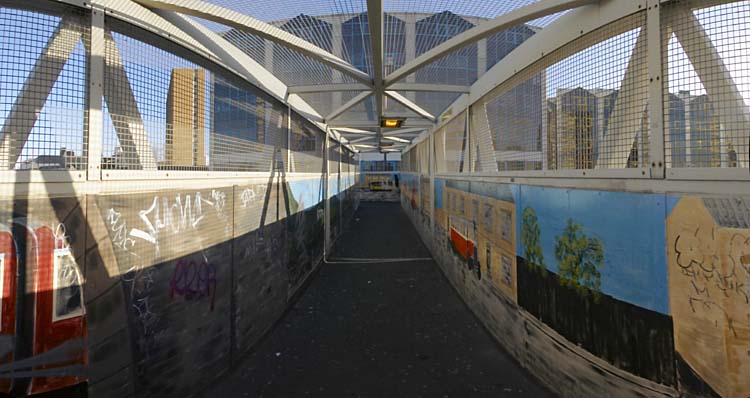
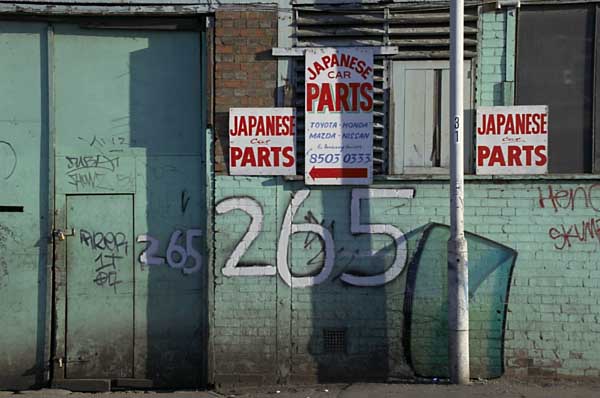
Footbridge at Stratford to Carpenters Estate

Back in 2005 many were still hoping that London would not win their bid to hold the Olympics, particularly those who lived in the area who could see how their lives would be disrupted by this huge event (though in the end it was far worse than they had imagined.)

One of many businesses on Carpenters Road

They also saw how it would impact on the longer term development of the area. Many planners warned how it would distort the proper planning of the area and its future; although investment in the area was welcome, much or most of it would be put into white elephants which would have little long-term utility.

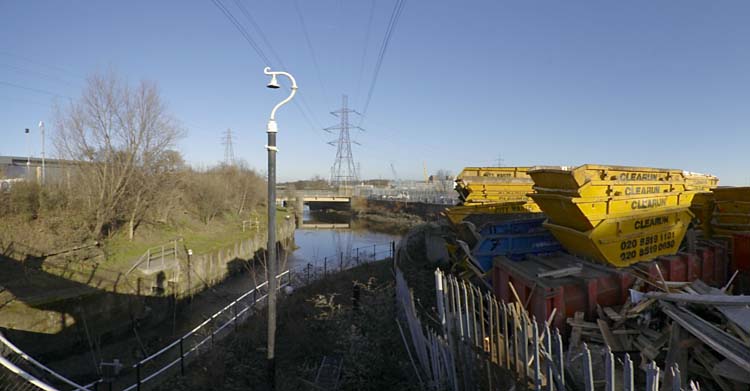
Waterworks River and Old River Lea at Carpenters Lock

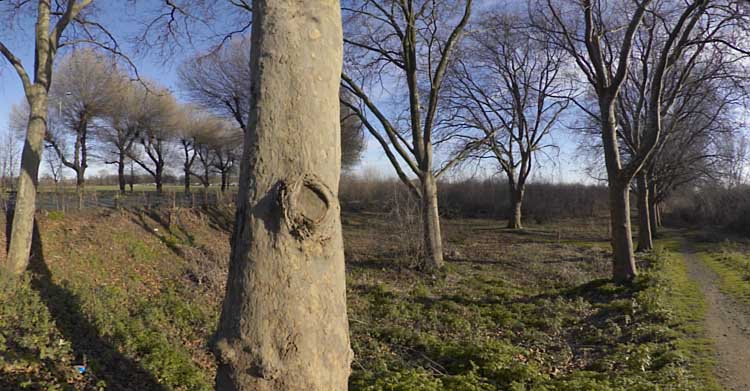
On Sunday 23 January 2005 I took my bike with me to Stratford and cycled to the meeting point at Temple Mills for a tour of the Olympic area with No to London 2012, a coalition of east london community groups and social justice campaigners.

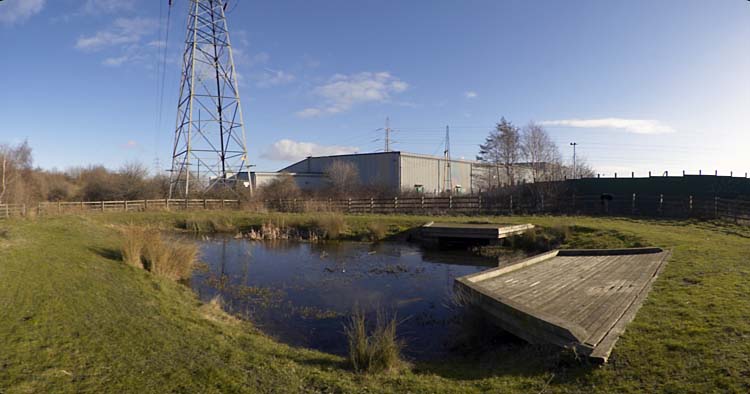
Bully Point Nature Reserve

Around 20 of us then took a walk around the area, getting some informative comments at a number of locations. As I remarked in my write-up of the event in My London Diary:

It was an opportunity that IOC delegates are not likely to have, with their view of these particular areas expected to be with a pair of binoculars from a distant tower block.

My London Diary: January 2005

I was already familiar with the area, having photographed around it since the 1980s, but still learnt a lot from some of those who spoke – and had just a little to add.

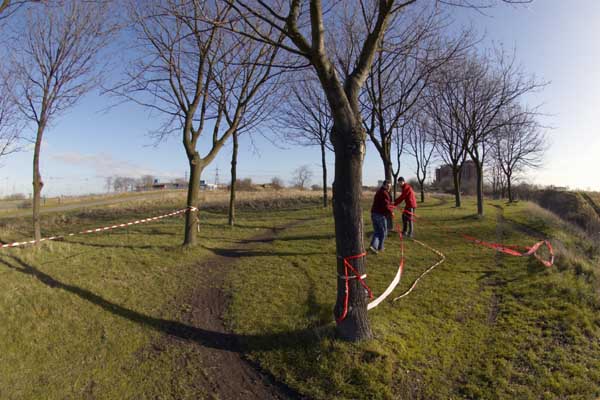
BMX track at Eastway Cycle Circuit is marked out

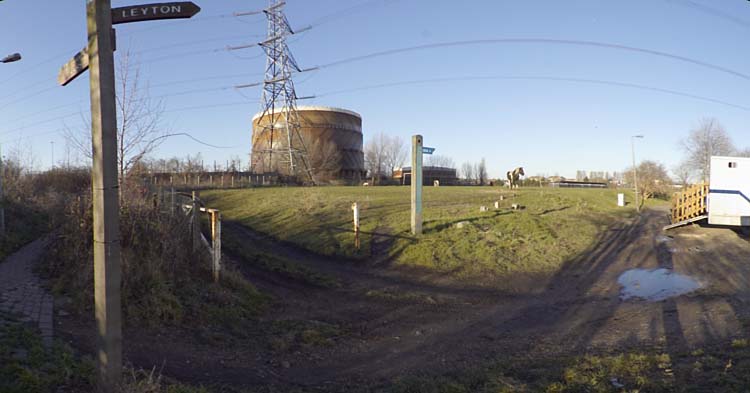
On our route around and also on my way to the meeting point I took the opportunity to take a few pictures, and after I’d sat down after the tour to eat my sandwiches by the Lea Navigation, to cycle to another area which was to be affected by the Olympics, Marsh Lane in Leyton, before making my way back to Stratford.

Wick Field, Hackney Wick

We were lucky with the weather, mild for January and with some sunshine, and I’d enjoyed the fairly short rides as well as the guided tour. I’d made several hundred pictures, including a number of panoramic images and felt I’d had a good day.

Leyton Marsh

Of course, London lost – and was condemned to host the Olympics. It was an event that caught the imagination of many of the public for the few weeks it was on, but has left a toxic legacy that will last decades.

You can see more of these pictures on My London Diary, where I’ve also written more about it.


All photographs on this and my other sites, unless otherwise stated, are taken by and copyright of Peter Marshall, and are available for reproduction or can be bought as prints.

Marching for Justice


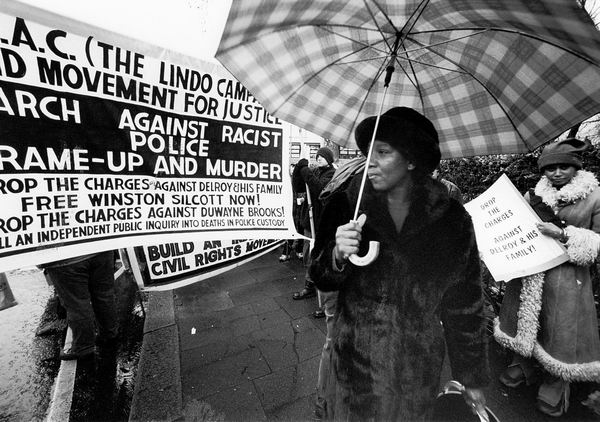
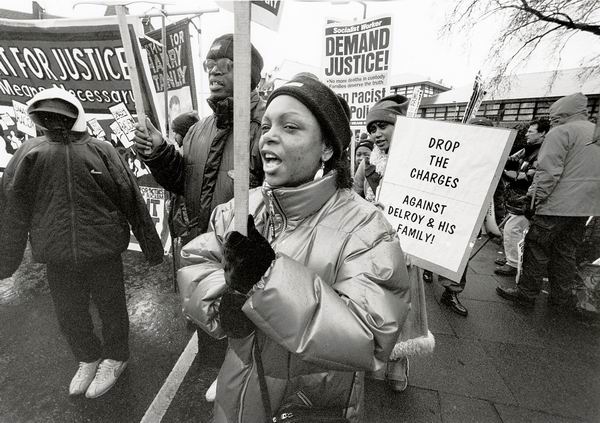
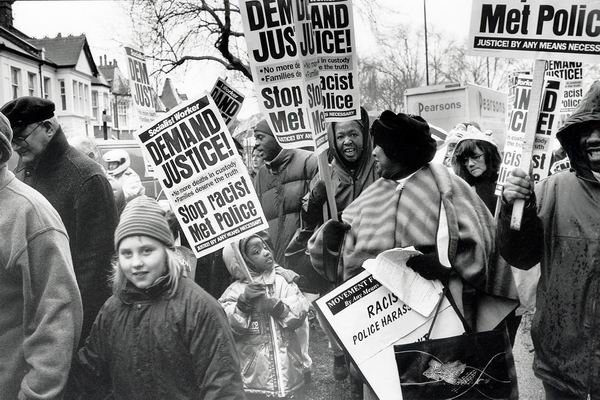
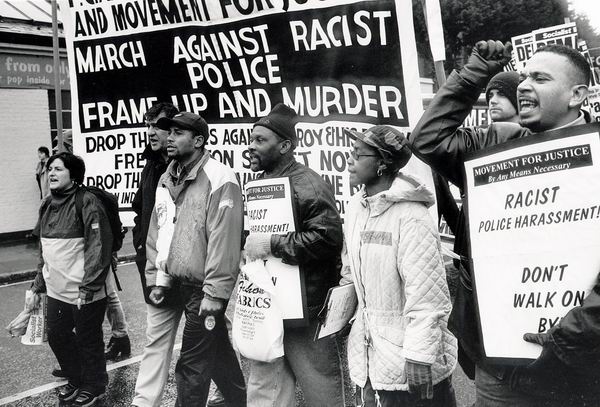
21 years ago on 22 Jan 2000 I photographed a March against police racism organised by the Movement For Justice in Wood Green, and it is one of the earlier protests that I featured on my web site My London Diary.

It wasn’t of course the first protest that I had photographed, which had been around 25 years earlier, and through the 1990s I had increasingly begun to attend and photograph various political events, although the bulk of my work was still in other areas.

My London Diary didn’t exist in January 2000, but when I set up the site a year or two later I scanned some of my 8×10″ file prints from 1999 and 2000 to put some content on the site from the start.

At the time I was still working mainly in black and white and sending prints to the library that handled my work; they also worked with colour transparencies, but I had given up taking these 15 years earlier and moved to colour negative. The library then couldn’t handle digital files, and also my flatbed scanner was only black and white. At the start there was little or no colour work on My London Diary, though things soon changed as I first used a consumer digital camera as a personal notebook, then moved to working with a Nikon DSLR.

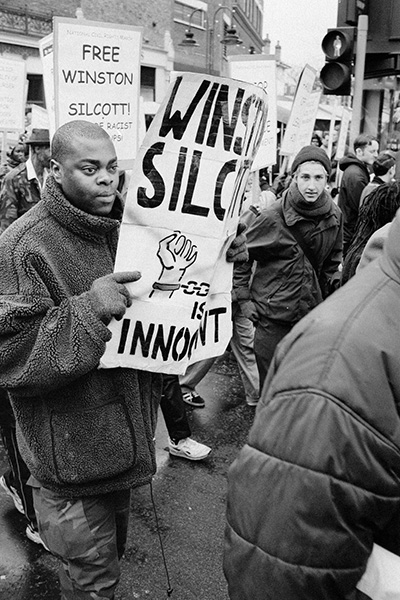
The earliest protest to be featured on My London Diary was from Brixton in February 1999, and over a similar issue, a National Civil Rights march calling for the release of Winston Silcott. So many years later things perhaps have changed very little – just the names, as the recent death of Mohamud Mohammed Hassan shows.

It wasn’t in 2000 easy to find out when and where protests other than the big national events organised by groups such as CND and the anti-war protests were taking place, but in June 1999 Indymedia had been founded around the global justice anticapitalist protest Carnival Against Capital and around this time many groups involved in protests were beginning to use the web to communicate through e-mail and web sites.

From around 2000 I began to cover many more protests, partly because I left full-time teaching and could attend more, but also because it became easier to find out about them. It was some time later that I began to put my pictures from protests on Indymedia, as a way of sharing my work with those I had photographed. I was also sending them to photo agencies in order to finance the work, as well as working as a writer on photography. I began My London Diary as a way to get my work to a wider audience, and hoped it would generate enough direct sales to at least cover the costs involved.

It has managed to do that and has also provided a great deal of feedback over the years, but hasn’t been a huge financial success.

My London Diary 2000

Sewage & Sulphuric Acid

Channelsea River, Northern Outfall Sewer, Greenway, Stratford, Newham, 1983 36p-53_2400

The Channelsea River used to be a fairly important stream of the River Lea as it made its way down to Bow Creek, and the size of the bridge which carries the Northern Outfall Sewer over it close to Abbey Mills Pumping Station reflects this. Now in the few places that it remains visible it is little more than a ditch, and I couldn’t see any water flowing from it, and the Channelsea here is simply a tidal creek, often now called Abbey Creek.

Sewage storm outfall,  Channelsea River, West Ham, 1982 32g-63_2400

Except for this row of openings. When heavy rain falls on London, it pours from the streets into the sewers, augmenting considerably their normal load of sewage. When the system was established in the Victorian era the flows were considerably smaller, but London has grown, with more people, more houses, more streets and more paved, concreted and tarmaced areas to rapidly drain away the water that might have once largely soaked into soil. The excess water (and not just water) has to go somewhere, and that somewhere is here on the Channelsea River.

Sewage storm outfall,  Channelsea River, West Ham, 1982 32g-61_2400

Which certainly accounts for the lushness of the growth around the banks of the stream and on Channelsea Island and which was noticeable (along sometimes with a noticeable odour) as I walked along the path past the rather large pipe on the bank. To the right of the picture you can see a part of the pumping station, which back then was fairly well hidden behind vegetation as you walked along the ‘Greenway’ – you get a much better view now. And at the left are the Bromley-by-Bow gasholders, still present while many others in London have disappeared.

Channelsea River, Stratford, Newham, 1983 36p-61_2400

Looking across the Channelsea from beside that giant pipe showed an industrial landscape, now all gone. Channelsea House, the large six-storey 1960’s office block at right of the top picture, is now flats. But beyond it used to be large factories, including those making sulphuric acid, where there is now mainly empty space, with a small area now the London Markaz (Masjid-e-Ilyas), one of the biggest purpose-built mosques in London with space for 6,000 male worshippers.

Works, Channelsea River, West Ham, 1982 32g-51_2400

These works stretched some way along the bank of the river and between it and the railway lines to the south, as you can see in the picture below, taken looking up the creek with Channelsea House at its left.

Chemical Works, Channelsea River, West Ham, 1982 32g-52p_2400

Immediately north of the bridge over the Channelsea River is the West Ham Sewage Pumping Station built in 1897 by West Ham Corporation to raise their sewage into the Northern Outfall Sewer. Previously they had released it into the creek. This contained three steam pumping engines which were decommissioned in 1972.

Abbey Rd, Stratford, Newham, 1983 36p-42_2400

I didn’t photograph Abbey Mills on my walks along the Northern Outfall as it was hidden or largely so by the vegetation along the edge of the embankment, since largely cleared. But also a part of Bazalgette’s work were a row of houses on Abbey Lane built in 1865 for the workers at the pumping station, with steps at one end leading up to the path along the top of the Outfall.

Northern  Outfall Sewer, Abbey Lane, Stratford, 1983 33x-55_2400

Clicking on any of the pictures will take you to a larger version on Flickr from where you can explore other pictures in the album.


All photographs on this and my other sites, unless otherwise stated, are taken by and copyright of Peter Marshall, and are available for reproduction or can be bought as prints.

Inauguration Day

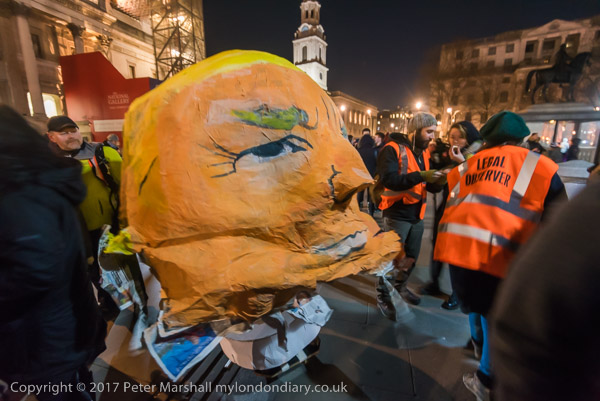
Trafalgar Square, 20/1/2017

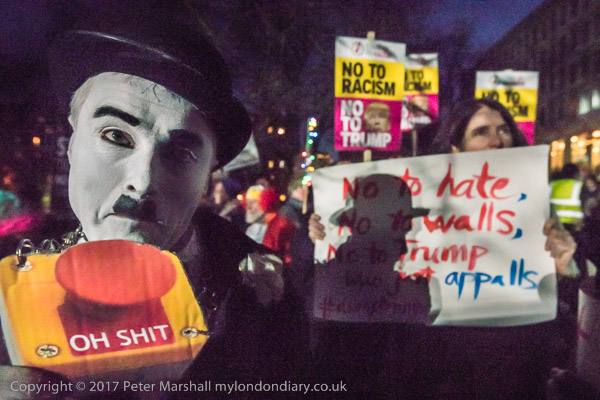
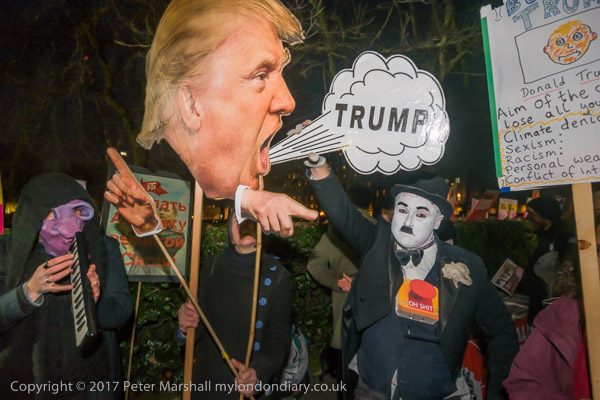
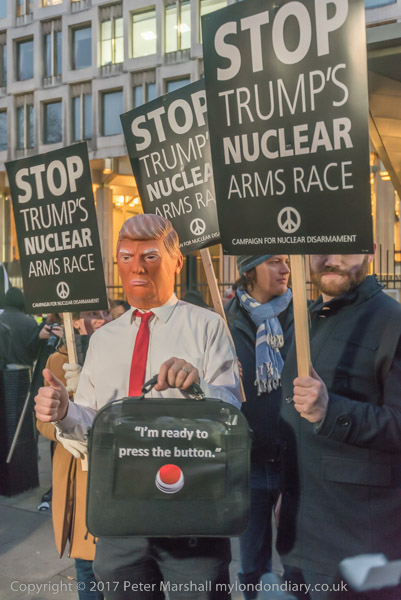
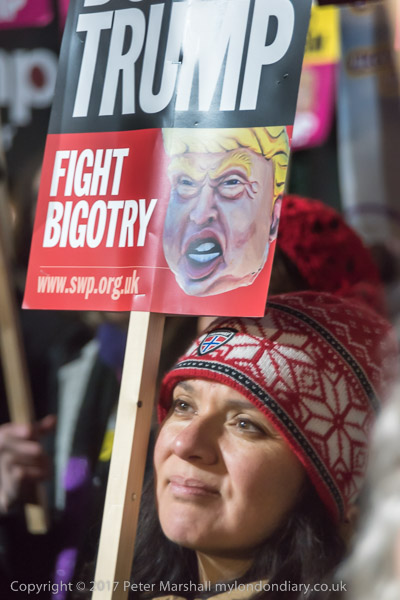
Four years ago, on 20 Jan 2017, London was protesting against another inauguration, that of Donald Trump. Commenting on those protesting outside the US Embassy – still then in Grosvenor Square I wrote:

All were appalled at the thought of a president who is a climate change denier, has a long history of racist and Islamophobic outbursts, has boasted of sexually assaulting women and has downplayed the severity of sexual violence.

Crowds protest Trump’s Inauguration

The four years that followed have confirmed most of our worst fears and in some ways gone further than we imagined, for example with disastrous polices in the Middle East and in particular over Israel and Palestine.

There will not be significant protests in London today, and even if police were not enforcing Covid restrictions particularly rigorously against protests I don’t think there would have been. We may not have any particularly high hopes for Biden and Harris, but at least they are almost certain to be better than Trump.

At least the US seems certain to re-engage with climate change – although probably still intent on keeping the US as the world’s largest polluter and allowing US companies to plunder the world for resources. And though it’s good to have a slightly saner finger close to that nuclear button it seems unlikely that the US will stop supporting corrupt fiefdoms in the Middle East and elsewhere and desist from supporting coups against popular governments that attempt to regain control over their own resources in South America and elsewhere.

Though I do hope for some positive surprises in the first hundred days, and there have certainly been rumours of some. Perhaps we will see the cancellation of some of the more environmentally damaging projects given the go-ahead by Trump. Almost certainly there will be fewer racist rants and tweets and there could even be some real progress on civil rights.

But while we may have some hopes for the United States of America, the future for our United Kingdom remains depressing. Suffering under the burden of Brexit and Covid, with a government that continually proves itself both corrupt and inept and an opposition which is ineffectual and sycophantic – and currently outclassed, outgunned and outplayed by a young footballer.

And that ‘United’ is less and less than ever appropriate; Brexit divided the country, and most of us now realise it was a terrible mistake – even increasingly more of the 34% who voted for it. It has created a border between the mainland and Northern Ireland and exacerbated the gap between England and Scotland. Even Wales seems more distant, though it has protected our relationships with those tax havens that make us possibly the most corrupt country in the world.

There is one small glimmer of hope, apart from the vaccinations that may just eventually allow us to gain some accommodation if not exactly control over Covid. Last Sunday saw the inauguration of the Project for Peace and Justice, founded by Jeremy Corbyn, an international campaign which describes itself as “a hub for discussion and action, building solidarity and hope for a more decent world.”

F**k Trump
Crowds protest Trump’s Inauguration


All photographs on this and my other sites, unless otherwise stated, are taken by and copyright of Peter Marshall, and are available for reproduction or can be bought as prints.

Around High St Stratford

St Thomas's Creek, Cook's Road, Stratford, Newham, 1983 35q-34_2400
St Thomas’s Creek, Cook’s Road, Stratford, Newham, 1983

There is and long seems to have been some confusion about the naming of this part of the canal system that links the main line of the Lea Navigation at Bow Bridge to the City Mill River and City Mill Lock. On some maps (including Google’s) it is simply referred to as ‘Bow Back Rivers’ but I find it less confusing to give it the more local name, St Thomas’s Creek, sometimes written as St Thomas Creek. The creek got its name from St. Thomas’s Mill, sometimes called ‘Pudding Mill’, I think because of its shape, which also gave its name to the small stream the Pudding Mill River and was actually on that stream on Pudding Mill Lane. For those interested there is a good map of the area before the flood relief works of 1931-5 on British History Online.

Yardley's Box Factory, Stratford High St, Stratford, Newham, 198336m-63-positive_2400
Warton House, former Yardley’s Box Factory, High St, Stratford, 1983

The earliest connection of the Yardley name to soap-making was in the first half of the 17th century, when a Yardley was given the concession to produce soap for the whole of London, but the company dated its founding as ‘Clever Brothers’ to 1770. This company making soaps and perfumes was taken over by William Yardley in 1823 and passed on to his son Charles when he died the following year. The company moved from Bloomsbury to a large factory on Carpenters Road Stratford in 1904 and bought land on Stratford High St in 1918. In 1913 they had trade-marked a picture by Francis Wheatley from his 1793 series, the ‘Cries of London’ to use in their advertising, replacing the primroses in his picture by lavender, and when they built a new art deco box factory in 1938 this was installed at a large scale on the building. Yardleys moved to Basildon in 1966, needing large premises, but in 1967 were taken over by British American Tobacco who sold the business to Beecham in 1985, who again sold it on after they merged to be SmithKlein Beecham. The company went into receivership in 1998. Parts of the box factory – including this section on the High St next to the Northern Outfall Sewer and the Waterworks River are still there, all that is left of Yardley’s in Stratford.

Stratford High St area, Stratford, Newham, 1983 36m-14_2400
Stratford High St area, 1982

I cannot remember exactly where I took this or the next picture, though from other exposures on the same films both are clearly somewhere not far from Stratford High St. I think the canal seen at right here is probably St Thomas’s Creek.

Timber yard, Stratford, Newham, 1982 32v-22_2400
Timber yard, Stratford High St area, 1982

Timber was the main product carried on the Lea Navigation in the later years of its use, and I think this timber yard was probably close to the main stream of the navigation. My attempts to find it again in later years were unsuccesful.

Cafe, Stratford market, Stratford, Newham, 1983 36p-35_2400
Cafe, Stratford market, Stratford, Newham, 1983

The notices on the door offer not just ‘Jellied Eels’ but ‘Best Jellied Eels’, along with ‘Loch Fine Kippers’. My contact sheet puts its location as Stratford Market in Burford Road, just off High St to the south.

Barge, Lea Navigation, Bow Bridge, Bow Flyover, Tower Hamlets, Newham, 1981 29t-26p_2400
Barges, Bow Bridge, October 1981

These last two pictures were some of the first I took in the area after I heard on a radio interview that commercial traffic on the Lea Navigation was to come to an end in a few weeks time.

I think it was the same day that I picked up my camera bag and got on the train to come to look for and photograph any remaining activity. It was a slow journey to Bromley-by-Bow from where I spent an hour or so walking along beside the navigation between Bow Locks and Bow Bridge, where I found three barges loaded with cut timber, photographing all three from the bridge and going down onto the wharf for another picture.

Barge, Lea Navigation, Bow Bridge, Tower Hamlets, Newham, 1981 29t-25_2400
Barges, Bow Bridge, October 1981

I find it hard now to understand why I took so few pictures – only around 30 exposures on the entire visit, and just these two where I found evidence of any remaining commercial traffic.

More pictures from the area on page 3 of my Flickr album River Lea – Lea Navigation 1981-1992.


All photographs on this and my other sites, unless otherwise stated, are taken by and copyright of Peter Marshall, and are available for reproduction or can be bought as prints.


Just a year ago

Just a year ago on Saturday 18th January I was going up to London as usual on a Saturday morning to photograph a number of protests. The day didn’t get off to a good start, as when I arrived at the location for the first event I was the only person there. I was a few minutes early, so I hung around, but when the actual time arrived and there was still only one person there (and even the organiser on Facebook hadn’t turned up) I gave up and left.

Before Facebook it was rather more difficult to share information about any protest, but now anyone can post an event. There is some indication of how much support any event has attracted, with Facebook showing the number of people who have clicked to show an interest or attend, but the numbers are incredibly unreliable. Interest means little or nothing, and often the great majority of those who perhaps thought on a Wednesday evening they might go change their minds if it means getting out of bed early on a wet Saturday morning. So its not unusual to find something doesn’t happen, though it is sometimes rather unpredictable.

Fortunately it was a fairly short walk to Downing St, where on the pavement opposite there was something for me to photograph. While a few of the global rich were meeting at the World Economic Forum on the exclusive Swiss mountain resort of Davos, The Equality Trust, who I’d not heard of, but get funding from the EU, together with nine other organisations were holding holding an event as part of what they described as “a mobilisation by thousands of people in more than 30 countries worldwide to demand a fairer, more equal and sustainable future.” And for once the 94 who had said they were going on FB wasn’t that far from the actual attendance.

And though it wasn’t the most exciting protest I’ve covered it was certainly hard to disagree with what they were calling for:

  • good quality education, accessible housing, decent jobs and healthcare for all
  • an end to poverty wages, cuts in public spending and the decimation of social rights
  • an end to hunger and homelessness in the world’s sixth-largest economy
    fair and progressive taxation and an end to tax breaks for the wealthy
  • a wellbeing economy that serves people and planet, instead of profiting from environmental destruction.

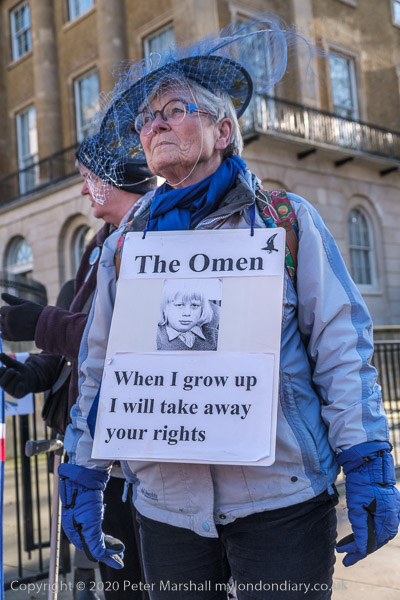
As often when I’m covering a protest at Downing St, there was another taking place that I hadn’t been aware of, with a small group of protesters against Brexit calling for the release a report that had been completed before the December election but was held up by Boris Johnson because it revealed important Russian interference in UK politics including large donations to the Conservative Party and pro-Brexit campaigns.

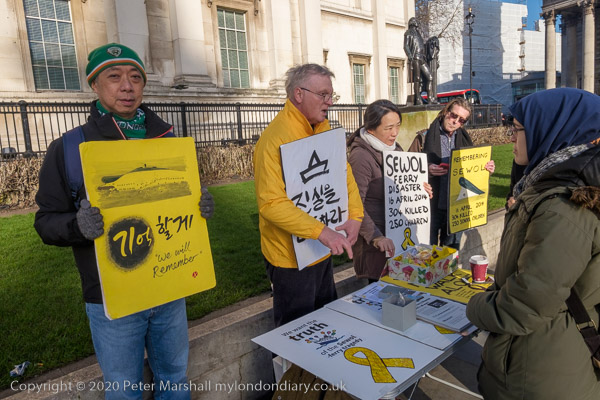
From Downing St I walked up to the North Terrace of Trafalgar Square where two events were taking place. Since the Sewol ferry disaster on April 16 2014 there have been regular vigils in memory of the 304 victims, including the 250 high school children who were drowned after being told to ‘stay put’ on a lower deck. These silent vigils, mainly by Koreans or those with Korean relatives took place monthly for several years but are now quarterly.

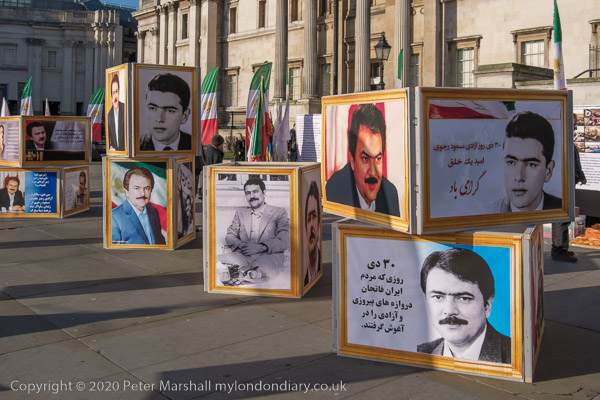
Also on the north Terrace, elaborate preparations were taking place by Anglo-Iranian Communities in the UK and supporters of the People’s Mujahedin of Iran’s National Council of Resistance of Iran for a rally in support of the anti-regime protests following the admission that the Islamic Revolutionary Guard Corps (IRGC) had shot down the Ukrainian passenger plane. These protest in Iran have been suppressed with illegal force by the clerical regime. I was unable to wait for the start of the protest as I wanted to cover another event, and later abandoned my plans to return.

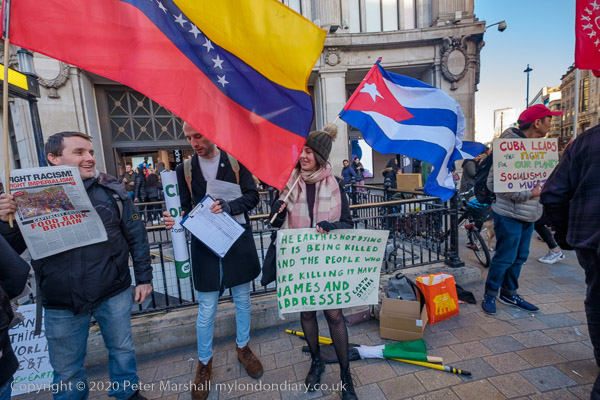
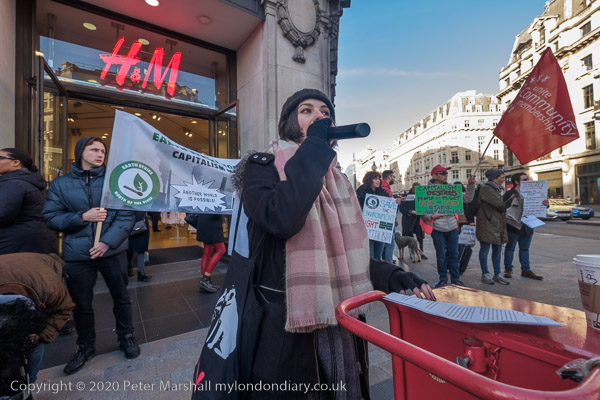
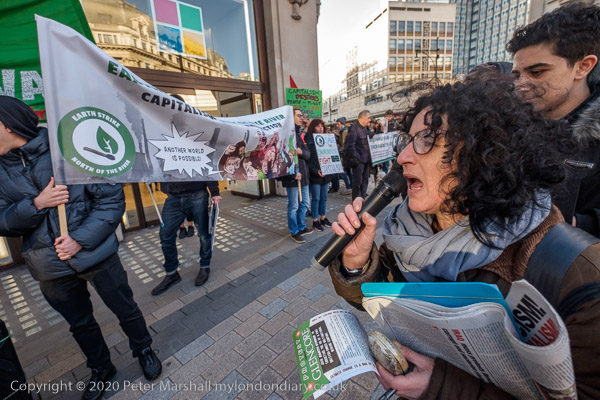
At Oxford Circus I joined protesters from Earth Strike, organised by the Revolutionary Socialist Group, who were handing out leaflets before their series of protests along Oxford Street outside banks and stores involved in the exploitation of the Global South and the destruction of the environment.

I went with them as they walked up and down Oxford St, stopping outside shops including HSBC, H&M, Microsoft, ee, McDonald’s and Zara for short speeches about the particular contributions these companies are making to climate change and how they exploit workers and resources in the South.

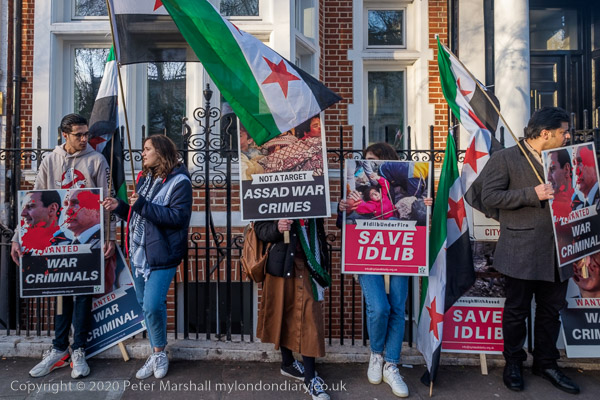
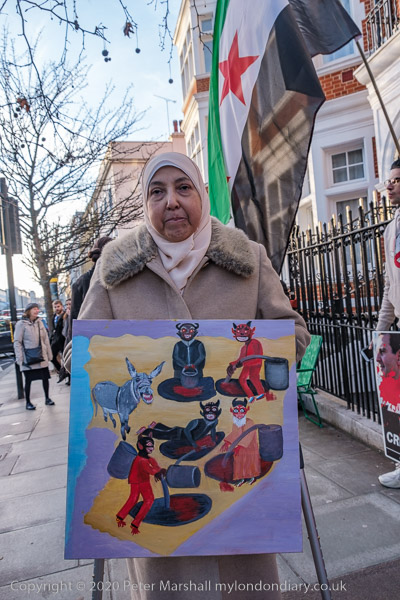
By the time it had got too late to be worth returning to Trafalgar Square and instead I went west to a protest close to the Russian Embassy in Kensington. Russia’s support has saved President Assad in Syria and they were protesting the war crimes of Assad and Putin against the people of Syria in Idlib province.

Russian support, particularly air support has enabled Assad to defeat and drive back the Syrian rebels who would otherwise probably have driven him from office and set up a more democratic government. Since mid-December Assad has waged a brutal and unprecedented military campaign with air raids that have targeted hospitals and markets and killed hundreds of civilians. Over 500,000 have fled from their homes but are unable to escape as the Turkish border is closed.

I talked with the protesters, many of whom I recognised from earlier Syrian protests. The situation in Syria is desperate and the Syrians, given hope in the early years by Western countries, have now been abandoned by the international community. One of the women had been saying her prayers at the protest, and unfortunately as I said to her there seems now to be little else we can do but pray and hope.

Against war crimes in Idlib
Earth Strike Oxford St rolling protest
‘Stay Put’ Sewol silent protest
Support for Anti-regime Protests in Iran
Release the Russia Report
Fight Inequality Global Protest


All photographs on this and my other sites, unless otherwise stated, are taken by and copyright of Peter Marshall, and are available for reproduction or can be bought as prints.

Young Mums Party in Protest

One of the more encouraging series of protests it has been my privilege to photograph over recent years has been that begun by young single mothers who when threatened with eviction from their hostel in Stratford with Newham Council intending to disperse them into private rented accomodation often hundreds of miles away from their friends and families stood up and fought for their rights.

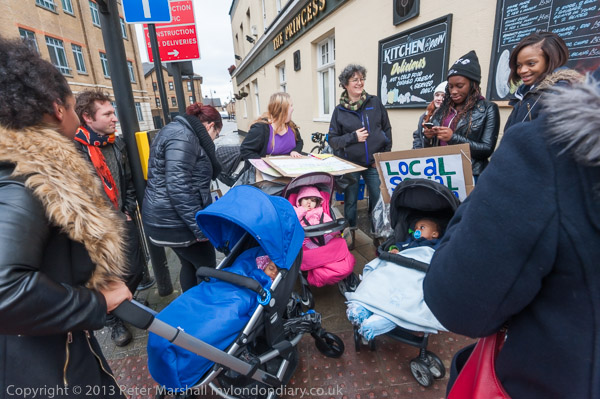
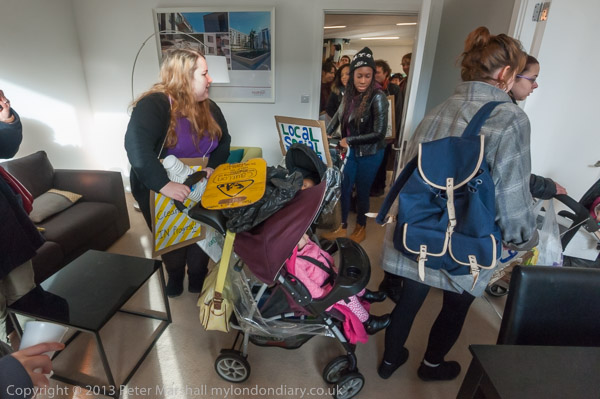
The mothers and their supporters met on a street corner close to East Thames Housing

The campaign by the mums from Focus E15 gained a great deal of publicity and support for their cause, and some of them became rather unlikely celebrities, speaking at conferences and other events and appearing in theatre performances. And they were largely successful both in getting the council to rehouse them locally, and also in bringing some of the worst aspects of housing policies, both national and by local authorities to the attention of a wider public. They even got me on stage in 2017.

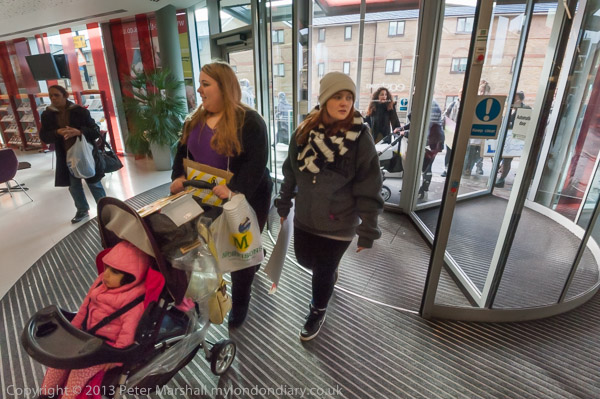
And made their way into the foyer of East Thames Housing

Their campaign widened to a more general campaign over housing problems, particularly in the London Borough of Newham, but also becoming involved in other campaigns across London and elsewhere. Newham is a borough with huge housing problems, but also one that the local Labour Party has managed to make much worse, with policies that have deliberately left good quality council housing empty for years despite one of the longest housing waiting lists in the country.

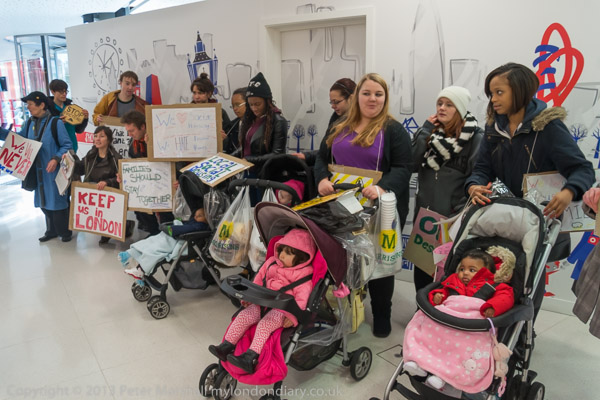
They pose for a photograph for the local newspaper

Part of the problem with Newham lies in the creation of a directly elected mayor in 2002, the first such mayor in England. This put more power into the hands of the mayor, Robin Wales, and a small cabal of right-wing Labour members, who pursued policies to increase the economic prosperity of the area with little regard for the poorer members of the community, encouraging businesses and bringing wealthier people into the area into new private developments. Focus E15 accused Robin Wales of being a kind of reverse Robin Hood, robbing the poor to give to the rich through his policies which they labelled as ‘social cleansing’.

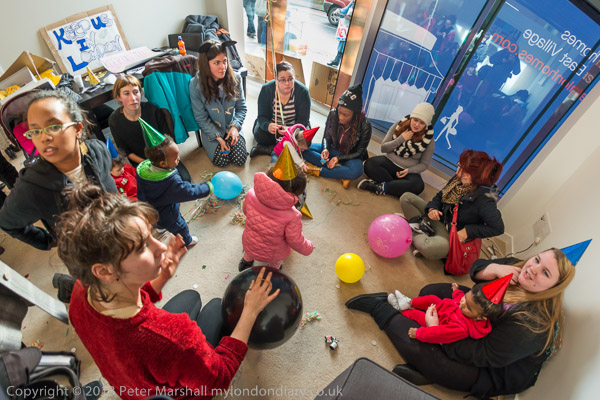
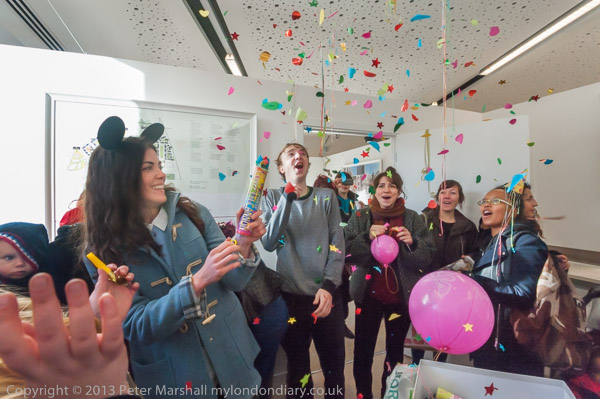
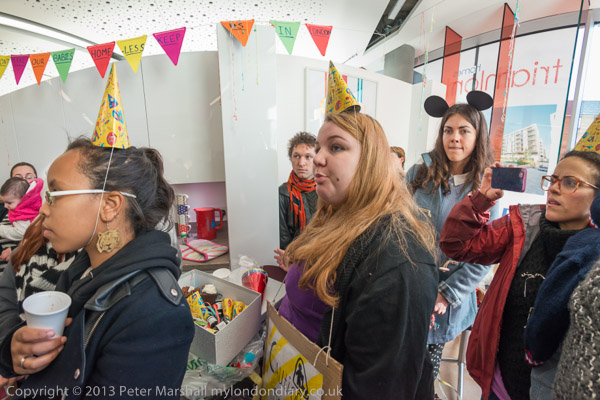
And then occupy the East Thames show flat for a party

Focus E15 confronted Wales on a number of occasions, and he reacted angrily at times – and later was forced to apologise. Earlier he had been involved in another fight against local residents when he wanted to replace Queen’s Market with a new development including a 31 storey tower; it was seen as so bad that even then London Mayor Boris Johnson stopped it going ahead. And under Wales, the council made some disastrous investments which have lumbered the council with huge interest payments. Newham is essentially a one-party state, but by 2016 many in the local Labour party had become disillusioned with him and wanted change. Wales managed to rig a vote to prevent other candidates standing for Mayor in 2018, but this was overturned after an outcry in the party, and in 2018 Rokhsana Fiaz was elected as mayor. Wales went off to work for the influential right-wing free-market think tank Policy Exchange.

the air is filled with hearts, stars and other shapes

I’m proud to have done a little to promote the campaigns of Focus E15 through photographing some of their events – though I”ve been unable to do so over the past year. They continued to hold a regular weekly outdoor street stall on Stratford Broadway and socially distanced protests through 2020 and hope to do so this year, despite the increased restrictions. You can read about them on their web site, where they make clear that despite the new mayor in Newham little has changed:

The struggle must go on and Focus E15 campaign enters 2021 determined to continue to build a housing movement, challenge the Labour council, give solidarity to all those fighting for housing justice, and…. Educate! Agitate! Organise! so that we expose this ruthless capitalist system and begin to work in unity together for a better future for everyone.
Focus E15 web site
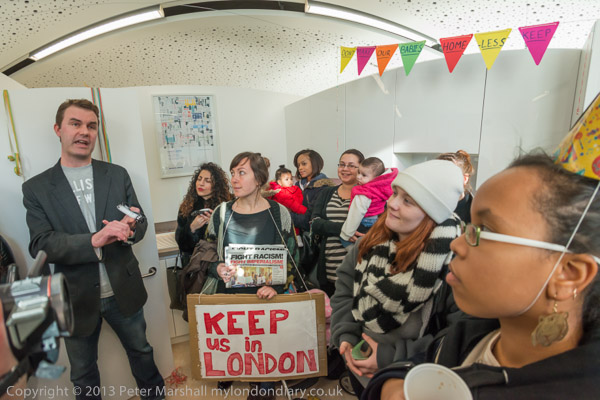
An East Thames officer comes to discuss their sitation with them

The pictures here are from a protest seven years ago today, on Fri 17 Jan 2014, and I hope illustrate something of why I found them so interesting to photograph. They went into the offices of the housing association that ran the Focus E15 hostel and held a party inside the show flat there. They had good reasons to be angry and protest, and were fearless and imaginative in how made their views clear – and provided great opportunites for photography. Many protests are rather dour occasions which are hard to make interesting though our pictures, but their protests were always lively and never run-of-the-mill.

He gets some tough questioning – and states that although it’s up to the council to rehouse them, East Thames will not evict them.

At the protest they did get an assurance that they would not be evicited, though it was clear than there was a lack of trust from the mothers in this statement. I left them still partying to file my story, and after a while they also left and went to protest at the nearby council housing offices.

More at Focus E5 Mothers Party Against Eviction.


All photographs on this and my other sites, unless otherwise stated, are taken by and copyright of Peter Marshall, and are available for reproduction or can be bought as prints.