EDL Outnumbered in Chelmsford – 2012

EDL Outnumbered in Chelmsford: On Saturday 18th August I made my first (and quite possibly my last) trip to Chelmsford, Essex where the extreme right English Defence League were marching against plans to build a large mosque in the city. Chelmsford, the County Town of Essex, had in the previous month been given City status to mark the Queen’s Diamond Jubilee.

EDL Outnumbered in Chelmsford - 2012
EDL members in the pub garden before their march

Until 1979 Muslims living in Chelmsford, Essex had to travel to London or Southend to attend Friday prayers. That year a house was rented for prayers and the following year the first floor of a restaurant became a mosque. As congregations grew other premises were found for worship. Permission to build a mosque was granted in 1992 but it was only fully completed in 1997.

EDL Outnumbered in Chelmsford - 2012
EDL Essex Division spokesman Paul Pitt

Soon that mosque was becoming overcrowded and by 2012 plans were being made for a new larger building but there were a number of set-backs, including some strange and possibly racially motivated behaviour by the council, as well as financial problems and it was not built. In 2020 the Chelmsford Muslim Society were able to buy the Hamptons Sports & Leisure Centre which is now in use for both worship and leisure. The older Central Mosque in Moulsham Street is also still in use.

EDL Outnumbered in Chelmsford - 2012
The EDL march gets ready to leave

Over two hundred people had come to the centre of Chelmsford for a rally called by Unite Against Fascism to oppose the EDL march. I went to photograph them first and then went along to the pub where the EDL were meeting. There were far fewer EDL, perhaps 80 in all, and most were in the garden of the pub.

EDL Outnumbered in Chelmsford - 2012

I went close to the fence around the beer garden in Cottage Place and took a few pictures of the EDL inside. I was met with abuse and one man complained to the police – who told him I was acting within the law. Others made V’ signs and other gestures for the camera, and I was pleased there was a fence between us.

EDL Outnumbered in Chelmsford - 2012
Police hold the Essex Unite Against Fascism march until the EDL are inside the cordon around their rally

After I had taken a few more pictures the officer politely requested I move away to avoid further upsetting the marchers and I complied as I felt I had already done all I could. Across the road in New Street EDL Essex Division spokesman Paul Pitt was being interviewed for TV, claiming the EDL were not racist and not generally opposed to mosques being built. He said that the size and location of the proposed building was unsuitable and that local people had invited them to come to Chelmsford and protest against it.

A few minutes later the EDL came out of the pub and formed up behind several banners for the march. I kept close to the banners at the front and to the police who were watching the marchers. They began singing racist EDL songs and as I stood on the corner photographing the march going past one man came menacingly right up to me and said “I hope all your family die of cancer.”

I was shocked, but followed the march as they were escorted by police for a short march around largely empty streets city and into a pen for their rally. Once they were inside police, sealed the street and allowed the UAF to sstart their much larger and more public march, far louder and with many more people, placards and banners than the EDL.

There was a single small incident where two EDL supporters came to the roadside and began to loudly shout ‘EDL!, EDL!‘ Police dragged them to a bench some distance away and held them until the march had passed and made clear they would be arrested if they interfered with it again.

There were several people in clerical dress, including this local hospital chaplain

The EDL were behind a couple of police lines perhaps 200 yards away as the march came to an end, but they will have been clearly able to hear the strength of the opposition.

I concluded my account on My London Diary: “Although the EDL managed to hold their march, it was a small event and went around the outskirts of the centre, seen by very few. The UAF and others held a long meeting right in the centre of the shopping area with much greater support, and clearly were far more successful and widely supported.”

Many more pictures at EDL Outnumbered in Chelmsford.


FlickrFacebookMy London DiaryHull PhotosLea ValleyParis
London’s Industrial HeritageLondon Photos

All photographs on this page are copyright © Peter Marshall.
Contact me to buy prints or licence to reproduce.
A Scottish Protest – SDL and UAF in Edinburgh 2013

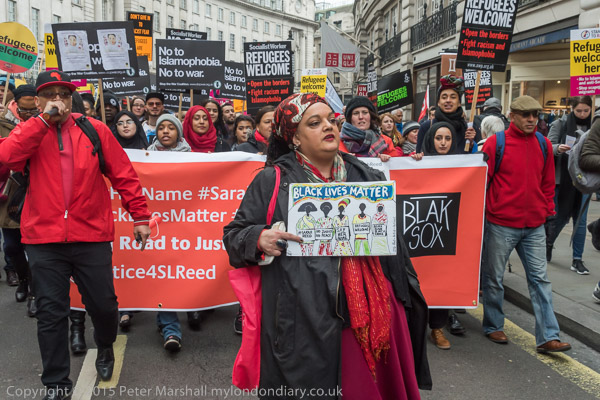
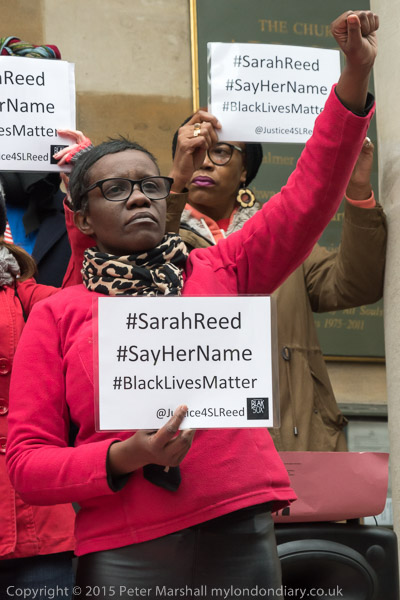
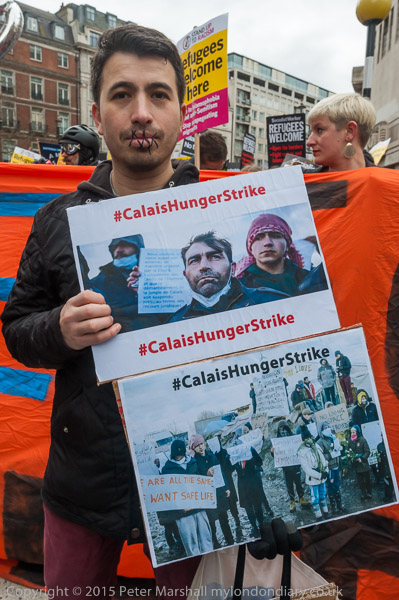
A Scottish Protest: On Saturday 17th August I photographed anti-fascists in Edinburgh protesting a march by the Scottish EDL in Edinburgh, the only time I have ever photographed a protest in Scotland.

A Scottish Protest - SDL and UAF in Edinburgh 2013
Anti-faascists march to Hollyrood

I was in the city for the Edinburgh Festival, which I was also attending for the first and only time, having been invited to share a flat for the week with others. We did have a good time and went to quite a few performances and events but should I ever visit the city again I’d prefer to do so when things there were more normal – as I did back in 2003.

A Scottish Protest - SDL and UAF in Edinburgh 2013

I found photographing the protest at times more stressful than usual. Partly because of the slightly different policing and the fact that I knew none of the protesters or the other photographers covering the event, (though I did recognise a few in the Scottish Defence Leagure protest from EDL protests in London) but also because I was using different equipment, working just with the Fuji X-E1 which was then my ‘travel’ camera rather than the brace of Nikons of my professional kit.

A Scottish Protest - SDL and UAF in Edinburgh 2013

Not that the X-E1 wasn’t a good camera – and I’ve now been working for some years with other Fuji cameras to cut down the weight of my camera bag on my ageing shoulder. The Fuji lenses are fine but I still miss the directness of an optical viewfinder and the relative simplicity of the Nikon interface.

A Scottish Protest - SDL and UAF in Edinburgh 2013

And the Nikon reliability. Often with various Fuji cameras I find it hard to get the cameras to behave as I want them too. Last Saturday checking my kit before I left home I could find no way to persuade my Fuji X-E3 to let me work in RAW rather than jpeg mode, eventually abandoning it for an older Fuji body. I did all the things that should have allowed it, but I suspect I will have to go to a full factory reset and then restore my favourite settings.

A Scottish Protest - SDL and UAF in Edinburgh 2013

With the X-E1 I found the autofocus noticeably slower than with my Nikons and I did miss some pictures, but the results on those I did take were fine. Fuji glass really is good and the XF 18-55 is possibly the best ‘kit’ lens ever, though I did at times miss not having something wider than its 27mm equivalent and something longer then its 82mm equivalent.

I left the protest while it was still taking place and made my way to meet my wife and go to the postgrad show at the Edinburgh College of Art and then on to the ‘Attack of the 50 Foot German Comedian’, both something of a disappontment, before a restaurant meal with the others from the flat to celebrate the end of a week together. The next morning we were up early to catch the 10.30 train back to London.

You can read more about our week at the festival on My London Diary, with more from the protest at SDL and UAF in Edinburgh.


FlickrFacebookMy London DiaryHull PhotosLea ValleyParis
London’s Industrial HeritageLondon Photos

All photographs on this page are copyright © Peter Marshall.
Contact me to buy prints or licence to reproduce.


Give Our Kids A Future – 2011

Give Our Kids A Future – Dalston to Tottenham. A week after the police killing of Mark Duggan and the disturbances which followed in Tottenham, across London and in other towns and cities, community groups in North London came together on Saturday 13th August 2011 with around 1500 people marching from Dalston to Tottenham Town Hall pleading “Give Our Kids a Future.”

Give Our Kids A Future - 2011
The march starts from Gillet Square

These disturbances were seen by many without surprise as tensions were rising in the more deprived areas of London and across the country as a result of the cuts to youth services and other support begun under New Labour and continued more savagely by the Coalition government.

Give Our Kids A Future - 2011

Local Authorites were being starved of resources and had little choice but to make cuts where they could, cuts which disproportionately affected young people, the elderly and the disabled who rely more on their services. In particular many youth clbbs and other facilities had been closed.

Give Our Kids A Future - 2011

Young people had also been hit by the announcement that the Educational Maintenance Allowance (EMA) which enabled many in lower icnome homes to continue their eduction was to end this summer. Many school students had been radicalised and had taken part in sometimes disorderly student protests, joining in the protests over university fee rises and other changes in education.

Give Our Kids A Future - 2011


On these protests they had seen and suffered from heavy-handed policing with kettling, excessive use of batons and charges into crowds by police horses. And on the streets where they lived many had experienced police harassment, with racially discriminatory stop and searches and being moved away from areas where they met with friends.

Give Our Kids A Future - 2011

People in these areas were becoming more aware of unexplained deaths in police custody, with anger and resentment “multiplied by the lies told by police to the press, and the various cover-ups and white-washing by the IPCC, CPS and other authorities that have been used to prevent bringing those responsible to justice.

Some saw the shooting of Mark Duggan as an execution by police, and the undisguised glee of some of our right-wing media at his death, having taken the police lies and convicted him, clearly raised tempers. It was the total failure of Tottenham police to engage with the family members and others who held a peaceful vigil last Saturday and the police attack and beating of 15 year old girl that sparked the outbreak of rage that spread rapidly.

The march was not organised to condone any illegal behaviour but was an attempt by a long list of local organisations with the support of some wider political groups (a long list on My London Diary) “to bring all sections of local communities together to promote unity and to urge for positive action working together to find solutions to some of the long-standing problems of the area which made it fertile ground for the disturbances.

Some of the many Kurds on the march

“They want an end to the cuts in public services and for investment to be made into regeneration of the communities, with housing, jobs, education and leisure facilities and a restoration of all the youth services that have been cut”.

“More specifically about the riots they want a community led regeneration of the damaged areas and support for those affected, including the immediate rehousing of those made homeless and grants for small businesses.”

“But perhaps the most important of their demands was one for a cultural change, moving away from the demonisation of youth and the unemployed towards a culture of valuing all people.”

Their leaflet ended with the statement:

Let’s work together for a decent society, based not on greed, inequality and poor conditions, but on justice, freedom, sharing and cooperation.

More, including many more pictures, on My London Diary at Give Our Kids A Future.


FlickrFacebookMy London DiaryHull PhotosLea ValleyParis
London’s Industrial HeritageLondon Photos

All photographs on this page are copyright © Peter Marshall.
Contact me to buy prints or licence to reproduce.

Broadwater Farm & Mark Duggan – 2017

Broadwater Farm & Mark Duggan: On Sunday 4th August 2017 I went to Tottenham to cover the march on the 6th anniversary of Mark Duggan being killed by police, and arriving early I took a walk around the Broadwater Farm Estate.


Broadwater Farm Estate – Tottenham

Broadwater Farm & Mark Duggan - 2017

You can read the real story of the Broadwater Farm Estate on the excellent Municipal Dreams web site. In 1961 Haringey Council had a shortfall of 14,000 homes with many families living in squalid conditions in rented accommodation in overcrowded and run down Victorian back to back slums.

Broadwater Farm & Mark Duggan - 2017

The estate was built on former allotments next to the Lordship Recreation Ground and above the River Moselle which was culverted. Its design was strongly influenced by the work of Le Corbusier and used ‘piloti’ to raise the homes above ground level both to combat the perceived flood risk from the river and to segregate pedestrians from traffic on walkways with the the ground level providing extensive parking for residents’ cars.

Broadwater Farm & Mark Duggan - 2017

Construction began in 1967 and ended in the early 1970’s. The 1063 new homes were built to high standards, spacious and with all the ‘mod cons‘ expected in that era and with ‘constant hot water for heating and domestic use…supplied to all homes from the central oil-fired boiler’.

Broadwater Farm & Mark Duggan - 2017
There are large green spaces between the blocks which were named after RAF wartime airfields

Things didn’t work out quite as expected, and although people were delighted at first, problems soon emerged. Flat roofs leaked, the heating system proved inefficient and noisy and there were cockroach infestations, lift breakdowns and fires of rubbish.

Broadwater Farm & Mark Duggan - 2017

The huge parking spaces under the buildings were underlit and hidden from sight and “physically created a concrete ‘underworld’ for crime to thrive” and the many pedestrian walkways proved ‘impossible to police‘.” There were racial tensions too – the Tenants’ Association initially excluded black members and “its president was forced to resign in 1974 after a TV appearance speaking on behalf of the National Front.”

It became harder for the council to find tenants for the flats and the estate became a ‘dumping ground’ for difficult and disadvantaged tenants. In 1979 it became part of the government’s Priority Estates Project and Haringey council and the estate residents had mobilised to improve things. By 1984 homes were no longer hard to let and crime had been much lowered.

But policing was increasingly a problem, with many residents experiencing “heavy-handed and oppressive policing“. Things – as a second post on Muncipal Dreams details – came to a head after police raided the home of Cynthia Jarrett close to the estate looking for her son Floyd, a leading member of the Broadwater Farm Youth Association (BFYFA). She died of heart failure during the raid, and the following day, Sunday 6th August 1985, protesters set out from the estate to march for a peaceful protest outside Tottenham Police Station.

They were met and stopped by police in full riot gear, who sealed off all routes from the estate and a seven-hour riot began. As I wrote in 2017 “more and more police came into the estate with firefighters who put out a small fire. Faced by increasing attacks from residents the police withdrew, but two officers failed to escape. PC Richard Coombes was seriously injured and PC Keith Blakelock was beaten and hacked to death.”

After the disturbances shops were moved down to Willan Rd

Municipal Dreams continues: “A full-scale state of siege followed. Four hundred police officers occupied the Estate over the following weeks and some 270 police raids took place over the next six months. Some 159 arrests were made.” The inquiry into the disturbances at Broadwater Farm concluded that it “was essentially about policing – police activity and police attitudes.

Work to improve the estate continued, helped in 1986 by a £33m grant from the Government’s Estate Action programme which enabled huge changes to the structures, eventually removing the walkways and bringing life to the ground level and with the BYFA leading improvements in the environment. By 2003 dit had become “a stable and safe community.”

The shooting of Mark Duggan, raised on the estate, by police on 4th August 2011 led to another march from Broadwater Farm to Tottenham Police Station three days later which sparked riots on Tottenham High Road and other areas of London and other towns and cities. Broadwater Farm was not the cause of these disturbances, which again were largely provoked by “a widespread resentment of police behaviour.

Improvements to the estate continued after this but it is now under threat from further so-called regeneration which would see it “as ‘improved’ by importing middle-class owner-occupiers and private renters.

Broadwater Farm Estate


Tottenham remembers Mark Duggan

People met on Willan Road in the centre of the Broadwater Farm Estate for a peaceful march to a rally at Tottenham Police Station on the sixth anniversary of the shooting of Mark Duggan by police. The marchers included members of his family and the family of Jermaine Baker, shot dead by police on 11th December 2015 in Wood Green.

Baker was unarmed and although a public inquiry found there had been a failings in the police operation that his killing was lawful and no criminal charges would be brought against any police officers although one would face gross misconduct proceedings.

Mark Duggan’s shooting had been accompanied by various false reports from the police and officers gave contradictory evidence at the inquest, where finally after weeks of deliberation the jury in January 2014 returned an 8–2 majority verdict that his death was a lawful killing. Legal challenges to the verdict were later rejected but in 2019 Duggan’s family accepted a settlement of their civil claim from the Met.

Mark Duggan’s mother Pamela Duggan (centre) with family and friends

Speakers outside Tottenham Police station remembered the police killing of other members of the Tottenham community apart from Duggan and Baker – Cynthia Jarrett, Joy Gardner, Roger Sylvester, and the recent murders of Rashan Charles, Darren Cumberbatch and Edson Da Costa.

As well as a minute of silence, speakers from the two families and local activists including Stafford Scott there were also speeches from Becky Shah of the Hillsborough campaign and from the Justice for Grenfell campaign.

The crowd spread out into the street with a large group of mainly young men on the opposite side of the street

Many more pictures on My London Diary at Tottenham remembers Mark Duggan.


FlickrFacebookMy London DiaryHull PhotosLea ValleyParis
London’s Industrial HeritageLondon Photos

All photographs on this page are copyright © Peter Marshall.
Contact me to buy prints or licence to reproduce.

Al Quds & Roma Holocaust Memorial Day – 2013

Al Quds & Roma Holocaust Memorial Day: On Friday 2nd August 2013 I photographed the annual al-Quds Day march in London, leaving before it reached a rally at the US Embassy to attend a ceremony at the Holocaust Memorial in Hyde Park for Roma Holocaust Memorial Day.


Al Quds Day March – Portland Place to US Embassy

Al Quds & Roma Holocaust Memorial Day - 2013

Thousands marched peacefully for outside Broadcasting House to the US Embassy calling for the liberation of Palestine, with a few carrying banners and chanting in support of Hezbollah.

Al Quds & Roma Holocaust Memorial Day - 2013

The starting point was chosen because of the continuing pro-Israel bias of the BBC and their failure to adequately cover the Israeli apartheid, the continuing occupation of Palestine and the oppression of the Palestinian people, as well as the siege of Gaza, which already 12 years ago was denying sufficient essential medical supplies and restricting food and other materials.

Al Quds & Roma Holocaust Memorial Day - 2013

The celebration of Al Quds day on the last Friday of Ramadan was introduced by Ayatollah Khomeini in Iran in 1979 and its observance has spread, mainly in Arab and Muslim countries, and for many years there has been an annual march in London in support of Palestine as a show of solidarity with the people of Palestine and oppressed people everywhere.

Al Quds & Roma Holocaust Memorial Day - 2013

Often the march has been met with opposition from various Zionist and Iranian freedom, communist and royalist movements as well as fringe UK right wing groups including the EDL and March for England, but there was no sign of protests against it this year, though I imagine there will have been a counter-protest to the rally at the US Embassy, but I had to leave for another event before the march reached this.

Al Quds & Roma Holocaust Memorial Day - 2013

There were also Jews taking part in the march calling for freedom for Palestine, both from the obvious and small group of ultra-orthodox Neturei Karta Jews and others from the British left.

Al Quds & Roma Holocaust Memorial Day - 2013

The march, attended by many Muslim families from mosques across England, was heavily policed but was as always an entirely peaceful and closely stewarded event that requires no policing other than traffic control unless others come to try and disrupt it.

Many more pictures at Al Quds Day March.


Roma Genocide Commemorated – Hyde Park

Grattan Puxon speaking in front of the Holocaust Memorial which was draped with a Roma flag

A ceremony at the Holocaust Memorial in Hyde Park on Roma Holocaust Memorial Day remembered the mass killing of 3,000 Romas at Auschwitz on 2nd August 1944 and protested against the rise of neo-Nazi attacks against the Romas in the Czech Republic and Slovakia.

A few of the 3000 who died on the night of the ‘Porajmos’ on 2nd August 1944

Around a quarter of a million Sinti and Roma were killed by the Nazis in Germany, and many others in Romania and Croatia. A Jewish socialist, who spoke at the event regretted the fact that the memorial only refers to the Jewish victims of the holocaust, which also included many others.

Professor Rainer Schulze

After a short introduction there was a two minute silence followed by speeches in Czech and in English including by Professor Rainer Schulze who spoke in some detail about the way Sinti and Roma were treated by the Nazis and of the fight they put up even as they were being forced into the gas chambers.

As well as speakers from various Roma and Sinti communities others included a Japanese peace activist who brought a statement of support from Hiroshima. Some of those present had earlier protested against the rise of Neo-Nazi attacks against the Roma in the Czech Republic and Slovakia, and were going on to protest at the French Embassy against deportation of Roma from France.

Recent years have seen increasing discrimination against Roma across Europe and here in the UK, including harassment of those sleeping rough on the streets of London.

More pictures at Roma Genocide Commemorated.


FlickrFacebookMy London DiaryHull PhotosLea ValleyParis
London’s Industrial HeritageLondon Photos

All photographs on this page are copyright © Peter Marshall.
Contact me to buy prints or licence to reproduce.

Hunger Strikers & Sotheby’s – 2015

Hunger Strikers & Sotheby’s: Ten years ago today this protest over Palestine was about Palestinians on hunger strike in Israeli jails against the use of indefinite illegal administration. Later I went to Mayfair where cleaners and their supporters were protesting for the reinstatement of two cleaners sacked and victimised because of their trade union activities.

BBC protest over Palestinian Hunger Strikes – Broadcasting House

Hunger Strikers & Sotheby's - 2015

The hunger strike by Palestinian prisoners Muhammad Allan and Uday Isteiti held in Israeli jails under administrative detention was in its sixth week, but the BBC had failed to report this and other hunger strikes.

Hunger Strikers & Sotheby's - 2015

So Innovative Minds in cooperation with The Prisoner’s Centre for Studies in Jerusalem had come to the BBC to protest against the continuing pro-Israel bias among management and some reporters. It’s a bias that has often been confirmed by academic studies and is continuing, though the recent use of starvation in Gaza and its appalling consequences we have all seen has resulting in some toughening of the BBC reporting on Israel’s war crimes.

Hunger Strikers & Sotheby's - 2015

Administrative detention allows people to be held without any real evidence and without trial and although in Palestine it is supposedly time-limited, in practice many are immediately re-arrested when their sentence ends to begin another term and so is in practice indefinite.

As I concluded in 2015: “Many who used to regard the BBC as a great institution and praised its high standards are now disillusioned and feel that they need to listen and watch other broadcasters to get an impartial and more complete view of both overseas and UK news.”

Hunger Strikers & Sotheby's - 2015

The BBC has some fine reporters but they often come under pressure from their managers – who themselves are under pressure from powerful lobbying groups and politicians with strong sympathies for the Zionist cause, including leading figures in our government. But they also misinterpret their ideas of impartiality, often ignoring the facts of the situation in a misguided attempt to show both sides. As it has been said “there are no two sides to genocide.”

More at BBC protest over Palestinian Hunger Strikers.


Reinstate the Sotheby’s 2 – New Bond St

Early in 2015 the United Voices of the World union had come to an agreement with the company who then employed the outsourced cleaners at auction house Sotheby’s which had guaranteed the workers non-toxic products, reinstatements, fairer schedules and the London Living Wage (backdated.)

Sotheby’s, who make huge profits by selling art works and other items, decided to sabotage that deal by ending the contract with that company and starting a new contract with Servest, who decided not to honour the agreement that had been reached earlier.

This led the UVW to organise a series of protests, including a large and noisy one outside a “blockbuster £130m art sale” on July 1st. Sotheby’s responded by sacking four of the most active trade union members who had taken part in the protest, though later were forced by threats of legal action to reinstate two of them.

The protest on 31 July outside another auction demanded the reinstatement of the ‘Sotheby’s 2‘, as well as repeating the cleaners demands for proper sick pay, paid holidays and pensions and the London Living Wage.

The UVW continued with protests in Autumn 2015 and were able to announce in early 2016 that “ALL outsourced workers at Sotheby’s, including cleaners, caterers, porters and security guards would receive both the London Living Wage and contractual (much improved) sick pay.”

More at Reinstate the Sotheby’s 2.


FlickrFacebookMy London DiaryHull PhotosLea ValleyParis
London’s Industrial HeritageLondon Photos

All photographs on this page are copyright © Peter Marshall.
Contact me to buy prints or licence to reproduce.

Al Quds Day March in London – 2014

Al Quds Day March in London: International Quds Day is an annual event at the end of the Islamic holy month of Ramadan which expresses support for Palestinians and oppose Israel and Zionism. In particular it is a protest against the Israeli occupation of East Jerusalem – al-Quds in Arabic.

Al Quds Day March in London - 2014
Neturei Karta ultra-orthodox Jews oppose Zionism

A peaceful Al Quds march has taken place every year in London for over 40 years and the organisers describe it as having a “family atmosphere with demonstrators coming from all walks of life. Christians, Jews, Muslims, people of other faiths and none all march in common cause side by side.”

Al Quds Day March in London - 2014

This is largely true, but the march in London attracts counter-protests from Zionists and others (including Iranian freedom, communist and royalist movements and UK right wing fringe groups), which have sometimes led to confrontations and delays and increased security with some marchers becoming mistrustful of photographers.

Al Quds Day March in London - 2014

It has at times been a difficult event for me to cover in the close way I like work. Many of my pictures are made with wide angle or extreme wide angle lenses, 28mm or less focal length down to fisheye, working inside or on the edge of crowds. I want to be close to people, if not within touching distance, seldom more than a couple of metres away to give greater interaction and immediacy.

Al Quds Day March in London - 2014

The Quds Day march and rally in 2025 was on Sunday 23rd March, but chaotic rail services that day prevented me from covering it, though I had photographed a pro-Palestine rally close to the Israeli Embassy the previous day. The organisers pointed out that it was taking place “amid an ongoing genocide in Gaza where Israeli forces have slaughtered 50,000 civilians in Gaza, most of them women and children. At the same time armed colonial settlers and troops are running rampage in the occupied West Bank, invading, looting and attacking Palestinian towns and villages with the international community turning a blind eye or actively complicit in the slaughter.”

Al Quds Day March in London - 2014

Back in 2014, the situation in Gaza was dire. As UNRWA states, “During the 50 days of hostilities lasting from 8 July until 26 August 2014, 2,251 Palestinians were killed; 1,462 of them are believed to be civilians, including 551 children and 299 women. 66 Israeli soldiers and five civilians, including one child, were also killed. Overall, 11,231 Palestinians were injured during the conflict, including 3,540 women and 3,436 children.”

83 schools and 10 health centres were damaged, over 12,600 homes were totally destroyed and there was “a massive displacement crisis in Gaza, with almost 500,000 persons internally displaced at its peak.” The “scale of human loss, destruction, devastation and displacement caused by the 2014 conflict in Gaza – the third within seven years – was catastrophic, unprecedented and unparalleled in Gaza.”

But of course Gaza is now experiencing something far worse – and humanitarian agencies including UNWRA are being prevented by Israel from supporting the people and supplies of food and other necessities are largely being blocked. Inadequate amounts are brought in by the so-called “Gaza Humanitarian Foundation” and people desperate to get it are being shot by the Israeli Defence Forces.

Of course we all know this npw – even though the Israeli government has tried to hide it by preventing international journalists from entering Gaza – and also systematically targeting the Palestinians who are able to report. An article in Modern Times Review on July 15, 2025 quoted the Cost of War project as stating “more journalists have been killed in Gaza in the past 18 months than were killed in the U.S. Civil War, World War I, World War II, the Korean War, Vietnam, and Afghanistan combined.” Early in July the number killed in Gaza had risen to 226.

On 24th July 2014, the march began close to the BBC and went to a rally outside the US Embassy, then still in Grosvenor Square. It was covered by several foreign media organisations but – as with most UK demonstrations – willfully ignored by the BBC.

Protesters called for a boycott of Israel and an end to the occupation of Palestine as well as an end to the attacks on Gaza.

On My London Diary I give a list of the organisations supporting the march – and there is a rather longer list of those supporting the 2025 march. One of the major organisations in both is the Innovative Minds Human Rights Group (InMinds). Founded in 1997 and alleged to have links to the Iranian Islamic Republic it has held regular protests in London against companies supporting the Israeli military, against the arbitrary detention of Palestinians, the torture and imprisonment of Palestinian children and calling for an end to apartheid in Israel.

In the pictures you will see many flags and posters from Inminds – and also a few images of Ayatollah Khomeini who started the celebration of Al Quds Day in Iran in 1979 as well as the current Supreme Leader of Iran, Ali Khamenei.

Also standing out in my pictures are the ultra-orthodox anti-Zionist Neturei Karta Jews who state clearly their belief that Judaism is a religion and not a state, and “Judaism rejects the Zionist state And condemns its ATROCITIES”

One contentious issue in 2014 was over the carrying of flags of the Lebanese Shia Islamist political party and paramilitary group Hezbollah. In 2014 the political party, which was part of the government of Lebanon had not been proscribed and it was only illegal to carry it if there was other evidence to show support of the proscribed terrorist group. I was looking for these flags but only found a very few to photograph.

As the march made its way down Regent Street there were shouts against it from an upper floor window and vegetables were thrown down at the marchers who shouted back angrily. The march organisers asked police to investigate and urged to people to march on.

I left the march well before it reached the US Embassy and saw no other protests against the march. You can see more pictures from the march on My London Diary at Al Quds Day march for Jerusalem.


FlickrFacebookMy London DiaryHull PhotosLea ValleyParis
London’s Industrial HeritageLondon Photos

All photographs on this page are copyright © Peter Marshall.
Contact me to buy prints or licence to reproduce.


End the Genocide, Stop Arming Israel – 19 July 2025

End the Genocide, Stop Arming Israel: Last Saturday, 19th July 2025, the weather forecast for London was dire. Thunderstorms and heavy rain until clearing a little later in the afternoon, with up to several inches of rain leading to some localised flooding. In the event it was a bit under two inches, with small rivers running along the side of some streets.

End the Genocide, Stop Arming Israel - 19 July 2025
London, UK. 19 July 2025. Many thousands march in pouring rain in London

In this account I intend to write about my personal experiences and working as a photographer on the day rather than my views on the terrible situation in Palestine and the reprehensible actions of the Israeli government and army – and Hamas. I’ve often written about the need for peace and justice, for an end to occupation and destruction and for the release of hostages and prisoners.

End the Genocide, Stop Arming Israel - 19 July 2025
London, UK. 19 July 2025.

Linda and I were determined to go out and join the national demonstration, to show our support for the people of Gaza, to demand our government stop selling arms to Israel and to call on the Israeli government to end its terrible destruction and genocidal attacks and to allow humanitarian aid for the people of Gaza, many now starving. A little rain was not going to stop us.

As usual I checked online for our trains, only to find that our services into London were subject to delay and cancellation due to signalling problems. We dropped everything and hurried to get an earlier train than we had intended – and which actually was more punctual than usual – only two or three minutes late into Waterloo.

End the Genocide, Stop Arming Israel - 19 July 2025

It was raining fairly heavily as we walked out of the station and by the time we’d crossed the Jubilee bridge to the Embankment where the march was gathering we were already quite wet.

As the forecast was for afternoon temperatures in the low to mid twenties I’d grabbed a lightweight waterproof jacket on my way out, which was a mistake. It did keep the water off to start with but was soon getting soaked through in places. I realised too late that I should have worn my poncho – or a heavier jacket that although too warm would have kept me dry. At least I’d had the sense to put on my truly waterproof walking boots rather than my usual trainers.

End the Genocide, Stop Arming Israel - 19 July 2025

We joined the large crowd that was sheltering under the bridge carrying the rail lines into Charing Cross and I started to take photographs. It was dry – so long as you avoided the areas where water was leaking down from above – but rather dark.

End the Genocide, Stop Arming Israel - 19 July 2025

I was working with my Olympus OM-D E-M5 Mark III (what a crazy mouthful of a name) a camera that came out over 5 years ago. It’s a Micro 43 camera with a sensor only around half the size of full-frame, but that does mean it can be significantly smaller and lighter – something increasingly important to me as I get less able to carry heavy camera bags. And, vitally important today, it is a camera that has good weather protection.

I also had my Fuji X-T30 in my camera bag, with a 10-24 zoom fitted. Had I not rushed out I might have chosen a more suitable body and wide angle for use in wet weather. Neither that camera or lens are weather sealed (the more recent 10-24mm is) and for most of the day they stayed in my bag. I did take them out a couple of times when the rain had eased off, but hardly any of the pictures I took with them were usable.

Under the bridge light was low, but the Olympus has good image stablisation and the main problem was subject movement, as people shouted slogans, jumped up and down, banged drums and more. Being very crowded also meant people were often banging into me as I was working.

I also use small and light lenses – in the case the Olympus 14-150mm F4-5.6 – equivalent to 28-300mm on full frame, going from a decent but not extreme wide-angle to a long telephoto. Its a small, light and incredibly versatile lens, but not one at its best in low light with its rather small aperture.

I started off working with the lens on the P setting, the programme choosing suitable shutter speed and aperture – with the lens wide open and shutter speeds of around 1/15 to 1/25 second. But I soon realised to stop action I would need a faster speed and switched to manual, deliberating underexposing at 1/100th second, f5.0 and at ISO 3200. The RAW images were dark but I knew that I could get Lightroom to make them look fine – if sometimes lacking in shadow detail.

Eventually people began to move out into the rain and march and I went with them, holding my camera under my jacket and only taking it out quickly to take pictures. I looked in my bag for the chamois leather I usually hold to dry and hold in front of the lens filter and it wasn’t there – I’d left it back home in the pocket of the jacket I was wearing when it last rained while I was taking pictures. I had to make do with a handkerchief instead, giving the protective filter a quick wipe before each exposure.

Outside it was a little brighter and I was able to increase the shutter speed to something more sensible, and was using manual settings of 1/160 f5.6 with auto-ISO giving me correct exposure. I was mainly working at the wider focal lengths of the lens and f5.6 gave me enough depth of field.

I hadn’t got out my umbrella, but of course many others were carrying them to keep dry. I find it hard to work with one hand while holding an umbrella in the other. But other people’s umbrellas were a little of a nuisance, with water often pouring from them onto me as I took pictures, adding to the effect of the rain.

So I was getting increasing wet – and soon retreated to the sheltered area under the bridge where different groups were now coming through. Keeping close to the end of the sheltered area I was able to keep working at the same settings, with the ISO now 3200.

London, UK. 19 July 2025. Stephen Kapos and another holocaust survivor on the march.

After a while I went out into the wet again – the rain had eased off slightly, and took more pictures. Then I noticed the banner for the Jewish holocaust survivors and their descendants and went over to greet Stephen Kapos, photograph him and another survivor as they set off on the march.

Shortly after I decided I would move to Westminster Bridge to take pictures of the marchers with the Houses of Parliament in the background, and walked as quickly as I could to there. Crowds of marchers and tourists watching the march slowed my progress somewhat.

The bridge is open to light and I was now using 1/250 second, but still with the Olympus lens at its wide-angle lens there was no need to stop down and I was working at around ISO 640.

I think around half of the march had gone over the bridge before I got there and I stayed taking pictures around halfway across the bridge for around half an hour, only leaving when I could see the end of the march coming on to the bridge. Fortunately the rain had eased off, but I was still getting wet.

End the Genocide, Stop Arming Israel - 19 July 2025

I then hurried taking a short cut to get to Waterloo Bridge, taking just a few pictures where hurried past the march again on York Road. I took more photographs as people came onto Waterloo Bridge and then saw that a large group had stopped in the shelter underneath the railyway bridge and were having a spirited protest there – so I went to photograph them. When they marched off I went with them to Waterloo Bridge.

I looked at my watch. I had thought about taking the tube to Westminster and then going to photograph the rally in Whitehall, but decided it was perhaps too late to bother. I’d taken a lot of photographs and was rather wet and also hungry and decided it was time to go home.

I went to Waterloo and got on a train. Eventually, 15 minutes late, it decided to leave, and with a few stoppages at signals got me home around 25 minutes later than it should. Fortunately I’d packed some sandwiches and was able to eat them sitting at Waterloo, though the view wasn’t interesting. I’d edited and filed my pictures by the time Linda arrived home.

More pictures on Alamy and Facebook.


FlickrFacebookMy London DiaryHull PhotosLea ValleyParis
London’s Industrial HeritageLondon Photos

All photographs on this page are copyright © Peter Marshall.
Contact me to buy prints or licence to reproduce.
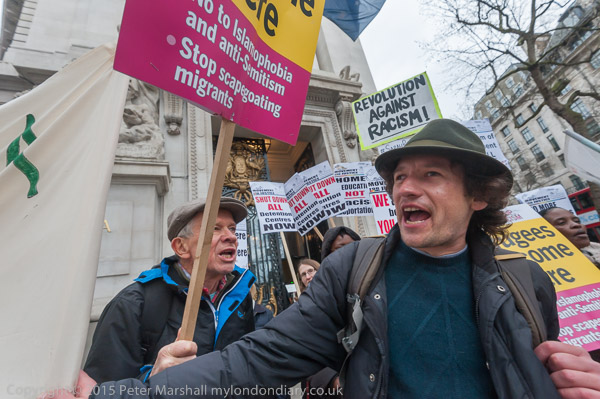

Shut Down Yarl’s Wood 14 – 2018

Shut Down Yarl’s Wood 14 – Yarl’s Wood immigration prison, near Bedford

Shut Down Yarl's Wood 14 - 2018

The protest outside Yarl’s Wood Immigration Detention Centre on Saturday 14th July 2018 was the fourteenth on the remote site built on a wartime air base organised by Movement for Justice, although I had been covering protests in and around London calling for the closure of this and the other immigrant prisons for over 10 years.

Shut Down Yarl's Wood 14 - 2018
Antonia of Movement for Justice tells people what is happening. We are waiting for a final coach

I’d been at most of the previous thirteen at the site, although I had missed the first, largely because of transport problems – living outside London it wasn’t practical for me to travel on one of the coaches organised from London. In July 2018 I came with my bike on the train to Bedford and then cycled the 5 hilly miles to the event.

Shut Down Yarl's Wood 14 - 2018
The march starts along the road

This protest was the smallest of them all I had attended there, with only a little over a hundred protesters. Many of those present had themselves been held for some time in this or other detention centres.

Shut Down Yarl's Wood 14 - 2018
And then along a public footpath

Yarl’s Wood was being used to hold women and a few families, and previous protests had been widely supported by other groups including many feminist groups, who on this occasion stayed away. Later some other groups organised protests but on a smaller scale than the previous protests.

and through a gate into the field next to the detention centre

A woman who had been part of Movement for Justice and active in earlier protests here had left the group, complaining bitterly about the way the group had treated her. She had received widespread support including from some other former members leading to many boycotting this protest. I knew both her and others in MfJ and commented: “However justified her personal complaint, it revealed little if anything about the group that was not already public knowledge, and MfJ has played a major role in protests against our racist immigration detention system, and still seems to be supported by the former detainees.”

Shut Down Yarl's Wood 14 - 2018
Where they stand and greet the women held inside over the fence

You can read about that public knowlege of MfJ on Wikipedia and on the complaints on the “Speak The Plain Truth” blog. I was saddened by the dispute but more so at the effect it had in weakening this and related campaigns – and I had never had any illusions about the nature of the organisation which I had first met in the 1990s.

A woman looks out at the protesters who were obviously welcomed

The protest followed the usual pattern, meeting on the public highway and, after a rally there marching a mile or so along a public footpath to a field next to the prison and overlooking a part of the site across a 20 foot high metal fence.

Others hold messages in the windows which only open a narrow slit

The lower 10ft of the fence is solid metal sheeting but the upper 10ft is a thick metal gauze (out of focus in the picture above.) Standing back on a slope I could see women held inside greeting the protesters. Guards inside had apparently tried to keep them away from the windows – even enticing them to another part of the building with offers of free ice-cream!

They could hear the protest and know that there were people outside who supported them, and some inside were able to speak to us over a mobile phone link. Some of those who spoke outside were able to greet friends still inside – some are held for long periods, with one released a day under three years.

Mabel had spent 3 years inside and knew many of those still held there

Most asylum seekers are genuine and are eventually released, but the Home Office has long appeared to have a policy of putting as many hurdles as possible in their way, often demanding records that are impossible for the detainees to provide – a similar tactic to that used in the Windrush scandal. Many were deported under illegal “fast-track” procedures – and MfJ has also managed to take legal action along with others to stop some individuals being deported.

Between speeches many banged on the fence to make a great deal of noise

Most of our legal system is based on the principle that people are innocent until they are tried and proven guilty. But our asylum system works in the opposite way, assuming claims are fraudulent and demanding that asylum seekers prove they are genuine.

It was hot in the sun and I got tired. The protest was still continuing as I got on my bike to ride back to Bedford station.

More pictures from Saturday 14th July 2018 at Shut Down Yarl’s Wood 14.


FlickrFacebookMy London DiaryHull PhotosLea ValleyParis
London’s Industrial HeritageLondon Photos

All photographs on this page are copyright © Peter Marshall.
Contact me to buy prints or licence to reproduce.


Battersea, Jesus, Bonkers & Peckham – 2008

Battersea, Jesus, Bonkers & Peckham: On Saturday 19 July 2008 I began my day at an open day at Battersea Power Station by developers proposing a comprehensive redevelopment before photographing the Jesus Army marching along Piccadilly and, going on to Camberwell Green for Bonkersfest and a brief visit to I Love Peckham.


Battersea Power Station

Battersea, Jesus, Bonkers & Peckham - 2008

Developers Real Estate Opportunities had bought the site for around £400 million and were showing the latest development of their plans for it to the public. These then involved re-building the chimneys and filling the space around with various buildings including an eco-dome and a 980ft eco-tower which dwarfed the power station – and which London Mayor Boris Johnson described as an “inverted toilet-roll holder”. You can see it in my photograph of their model on My London Diary, and to be fair I think it perhaps looks more like some high-tech lavatory brush.

Battersea, Jesus, Bonkers & Peckham - 2008
The pictures suggested the power station would hardly be visible from ground level

This tower was soon dropped from the scheme which was approved in 2010 but building never started. The only aspect of the scheme which did eventually get built was the Northern Line extension from Kennington, partly because of a £100 million contribution from the sale of the site to a Malaysian consortium in 2012 – who ten years later opened the power station building to the public.

Battersea, Jesus, Bonkers & Peckham - 2008

The central turbine hall had been open to the elements since the late 1980s when the roof was removed to lift out the machinery.

Battersea, Jesus, Bonkers & Peckham - 2008

Local organisations had been formed in the 1980s to oppose unsuitable development and were then still active and asking questions about the proposals. They were concerned both about the loss of the power station as an iconic landmark and also the lack of affordable housing and facilities of any use to local people in the plans. The web site I linked to in 2008 is no longer active and the domain is for sale.
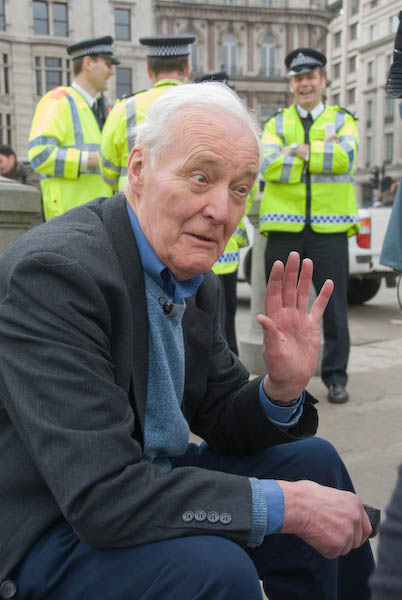
More on My London Diary at Battersea Power Station.


Jesus Army Marches on London – Piccadilly

Battersea, Jesus, Bonkers & Peckham - 2008

The Jesus Army describes itself as “an evangelical Christian Church with a charismatic emphasis” while others have labelled it as a sect or a cult. There are certainly ex-members who talk openly about it, and particularly about leaving it as a traumatic experience, while others simply feel that they could not personally give the level of commitment it requires of them.
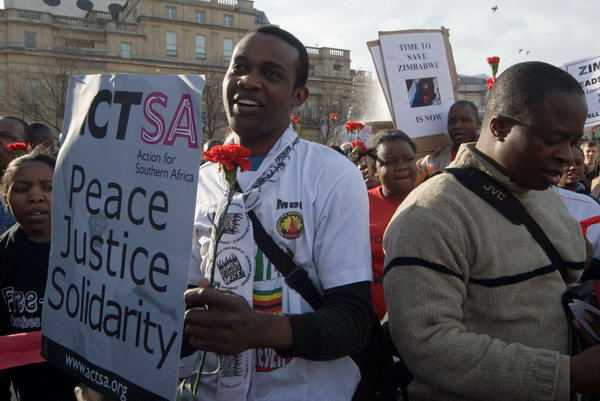
I found their march through London a dispiriting event, too uniform in many ways and I soon found it depressing to photograph. But as I told the woman who came out of the crowd passing by to hug me, “Jesus loves you too, sister” although I’m sure the guy I’ve read about in the gospels would have had no truck with this organisation. London Transport might have a problem with their logo [on some t-shirts] too!

Jesus Army Marches on London


Bonkersfest – Camberwell Green

Creative Routes, an interdisciplinary arts organisation run by and for those who have survived the mental health system and mental distress, organise the annual Bonkersfest as “a showcase of mad creativity.”

I wasn’t greatly impressed by what I saw happening this year, and left after taking a few pictures, including those of “some enterprising women were making the most of the occasion by organising a yard sale” in front of Brighton House on the edge of the green and a small memorial which had been unveiled in 2007 to the Wright family and four others killed by a direct bomb hit on the shelter here on the afternoon of 17th September 1940.

They had taken shelter while celebrating the wedding of Sidney and Patricia Wright. Bride and groom, Sidney’s parents and five sisters were among the 13 who were killed.

Bonkersfest


I Love Peckham – Peckham Square

There is an energy about Peckham that I really do like, and some of it was on display here, watched by a small crowd including the Mayor of Southwark, Councillor Eliza Mann – in pink.

There were a few things going on for me to photograph, and clearly there had been various other mainly art-related activities by local people, particularly children in the week of the festival, but it seemed to have attracted rather less interest than the previous year when I had photographer the march of the human rights jukebox.

More on My London Diary I Love Peckham.


FlickrFacebookMy London DiaryHull PhotosLea ValleyParis
London’s Industrial HeritageLondon Photos

All photographs on this page are copyright © Peter Marshall.
Contact me to buy prints or licence to reproduce.