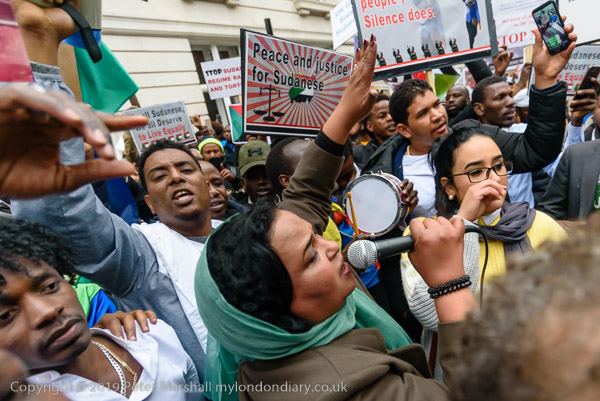
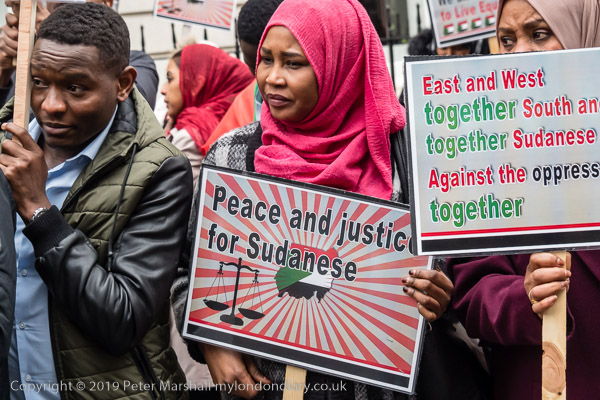
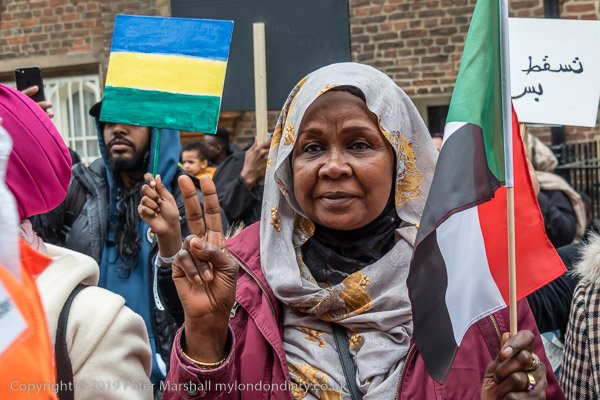
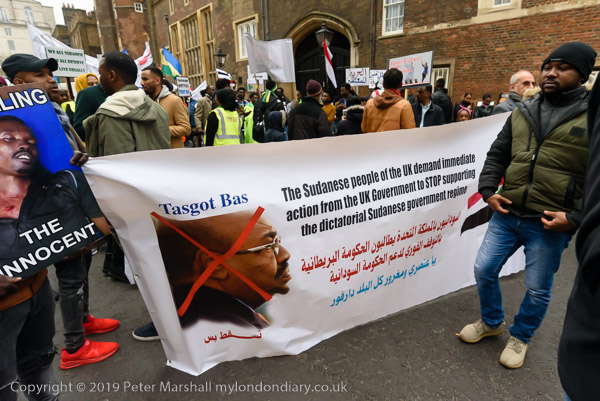
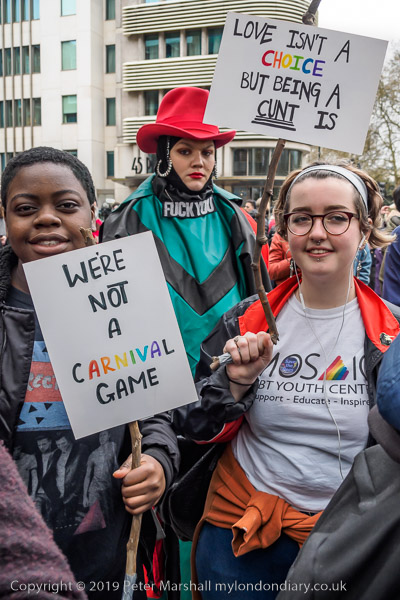
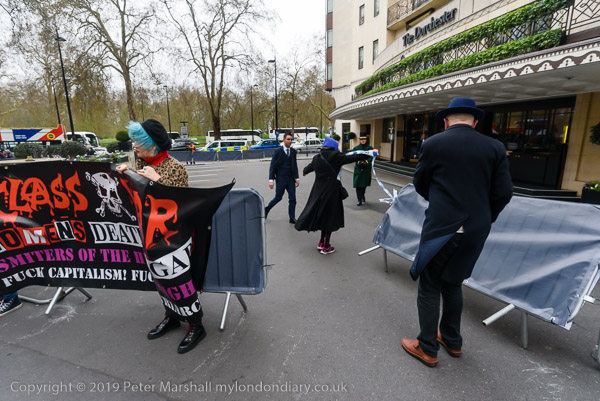
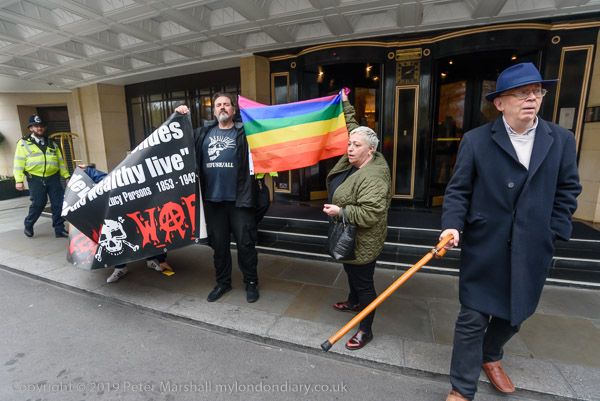
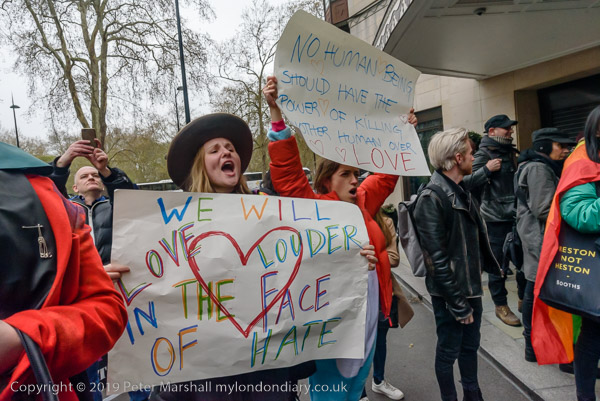
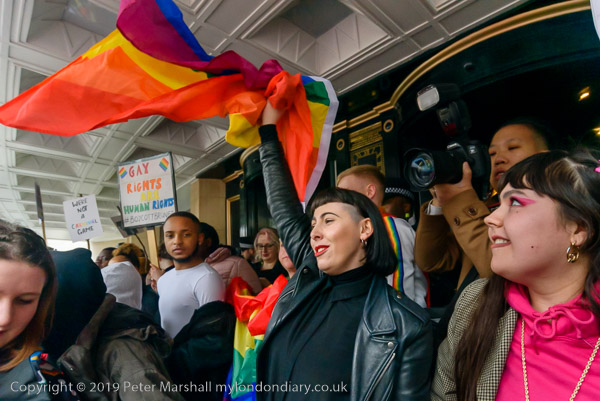
Sudan and Brunei Gay Sex: I began work on Saturday 6th April 2019 at the Sudanese Embassy and then left for the Dorchester Hotel in Mayfair where protesters had come after the Sultan of Brunei had announced death by stoning as a punishment for gay sex, adultery and blasphemy.
Sudanese for Freedom, Peace and Justice – Sudan Embassy
War is raging again now in Sudan between between the Sudanese Armed Forces (SAF) and the Rapid Support Forces (RSF).
Back in 2019 people were protesting against the extreme violence in Sudan against peaceful protests calling for for an end to the violent and corrupt Sudanese regime and for president Omar al-Bashir to ‘Just Fall’ and stand trial by the ICC for genocide in Darfur, the Nuba Mountains and South Blue Nile.
People in Sudan had been protesting for 17 weeks and over 70 protesters had been killed and thousands injured.
Five days later, Omar al-Bashir was deposed by the Sudanese Armed Forces and in May 2019 was charged al-Bashir with “inciting and participating in” the killing of protesters. Later other charges were brought, including of corruption and money laundering. Other trials followed and he has been accused of genocide. The prison in which he was being held has been overrun by the current fighting between forces led by the generals who deposed him and he is currently held in a military hospital in Khartoum.
I left the protesters still in and around the protest pen outside the embassy opposite St James Palace in Cleveland Row and rushed the three quarters of a mile or so to the Dorchester Hotel in Park Lane, where I knew the protest had already begun.
Brunei Sultan gay sex stoning protest – Dorchester Hotel
A large crowd had gathered on the streets in front of the Dorchester Hotel behind barriers that kept them out of the area directly in front of the entrance.
There were a number of speeches including those by Labour Shadow Secretary of State for Foreign and Commonwealth Emily Thornberry MP and activist Peter Tatchell condemining the announcement by the Sultan of Brunei of death by stoning as a punishment for gay sex, adultery and blasphemy.
It was a colourful protest with many from the gay community with some interesting posters and placards. Police continually harassed protesters to keep the roads open, although there were really too many people to make this sensible.
After an hour or so, Class War decided to move from behind the barriers and pushed some aside to protest directly in front of the hotel doors. They were followed by many of the other protesters and a noisy protest continued there.
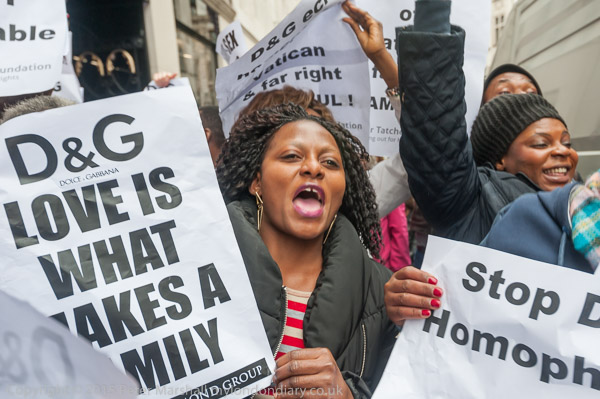
Dolce & Gabbana, Sanctions & Poor Doors Thursday 19th March 2015 -protests at a Mayfair fashion store, the Department of Work and Pensions and another of Class War’s long series of protests at One Commercial St, Aldgate.
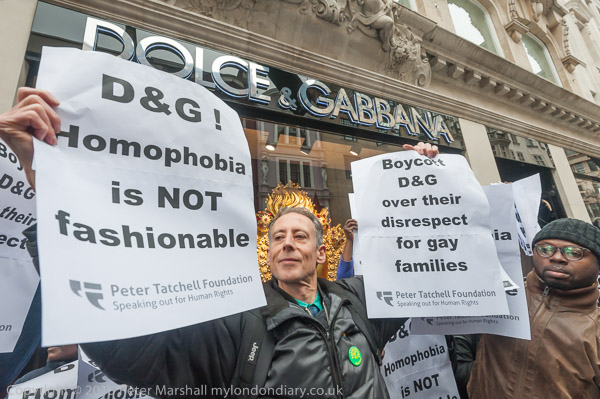
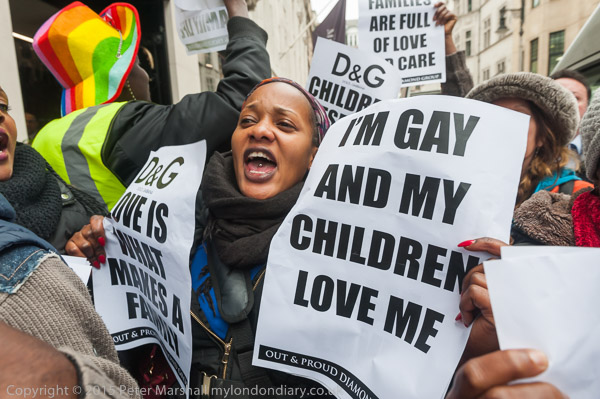
Dolce & Gabbana Boycott – Old Bond St
Domenico Dolce and his business partner Stefano Gabbana are apparently well known fashion designers and have a range of over 200 shops in plush areas of cities in 41 countries dedicated exclusively to selling their overpriced clothing. In London I think they have one in Sloane Square as well as the Mayfair store this protest took place outside.
For some reason our media treats anything to do with fashion as important news, and there were more photographers and TV crews packing the narrow pavement than protesters when I arrived making covering the protest difficult, particularly for those of us who prefer to work at close range.
The Peter Tatchell Foundation and the Out and Proud Diamond Group had called the protest in support of the international boycott over homophobic statements by the two designers. Almost certainly a much higher proportion of the shop’s customers are gay than in the general population and Dolce & Gabbana have profited massively from sales to the gay community over the years.
Unite protest against Benefit Sanctions – Caxton House, Westminster
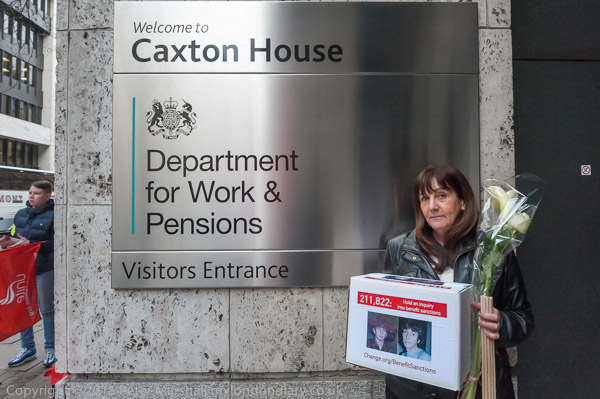
Gill Thompson, whose brother died after being sanctioned holds her 211,822 signature petition
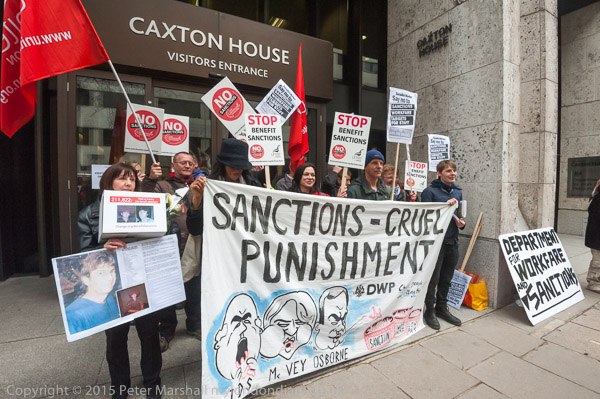
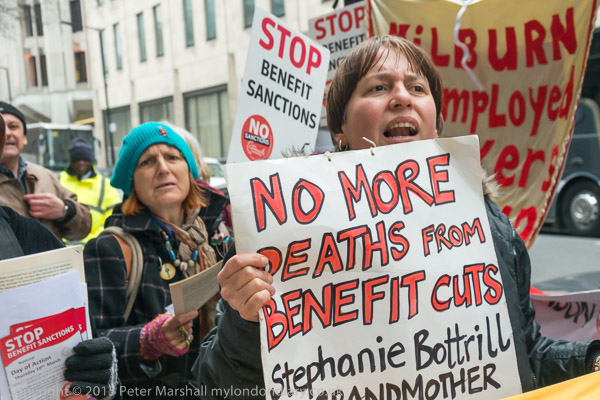
Unite here and at Job Centres around the country were having a day of action against punitive benefit sanctions on over 2m people which had led to increased poverty, misery and even death. They say the are a ‘grotesque cruelty’ and are often imposed for trivial reasons.
People have been sanctioned because postal delays meant they never got notification of an appointment they missed, or because they were 5 minutes late as a bus was cancelled. Often job centre staff are under pressure to issue sanctions and may be penalised if they do not sanction enough of their clients.
At the protest was Gill Thompson, whose brother, David Clapson, a diabetic ex-soldier, died after being sanctioned. She had brought her 211,822 signature petition calling for an inquiry into benefit sanctions to the protest to present to the DWP.
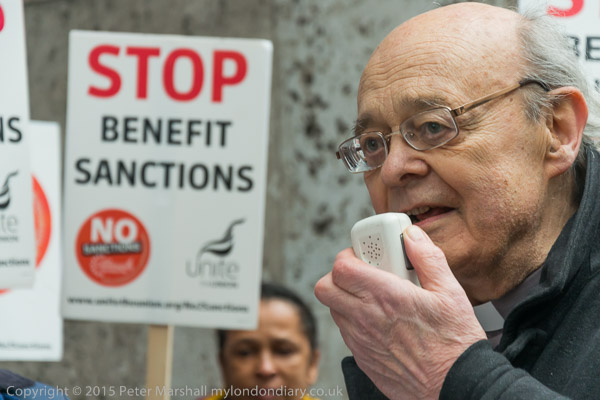
Among others who spoke was Rev Paul Nicholson of Taxpayers Against Poverty.
Poor Doors Protest Blocks Rich Door – One Commercial St, Aldgate
When Class War read a newspaper article about the separate entrances for rich residents and those in social housing in a new block at One Commercial Street in July 2014 they were disgusted and decided to launch a series of weekly protests outside the block every Thursday evening.
I missed the first of these but you can find reports of almost all of the rest of them, at least 29 in all, on My London Diary. For an overview you can read John Bigger’s article on Freedom in which he gives an insider’s view and assesses the impact of these protests, and the ‘zine’ I published Class War: Rich Door, Poor Door with over 200 photographs from 29 protests is still available. But though this is reasonably priced, postage costs roughly double this – so you really need to buy half a dozen copies or more and give or sell some to your friends. Be warned the print quality in what Blurb calls a MAGAZINE is pretty low.
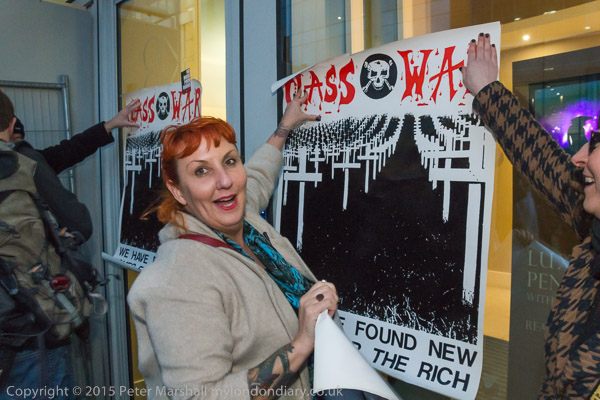
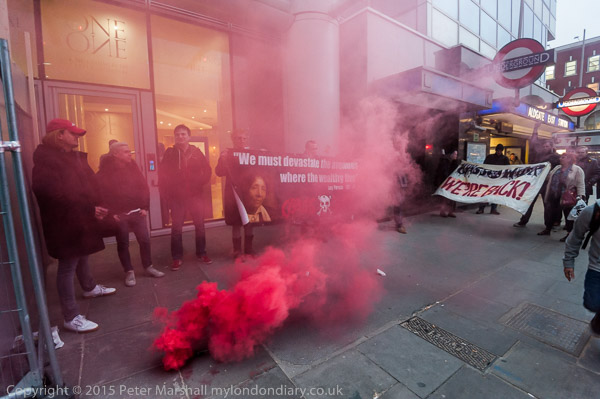
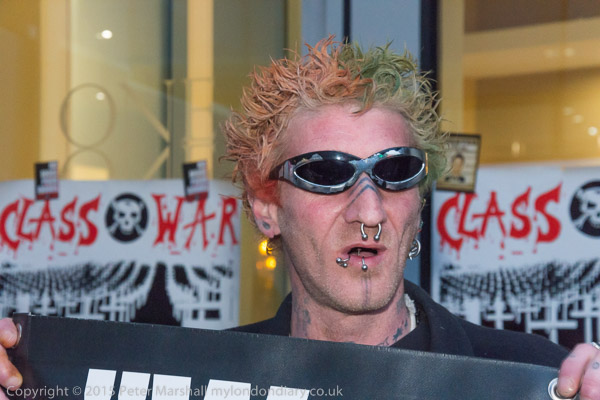
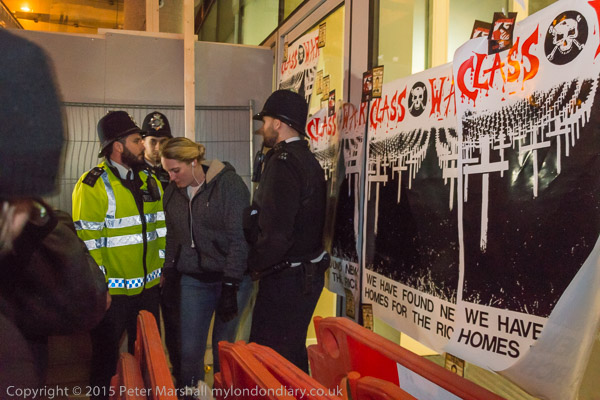
The protest on 19th March was a lively one and the management at One Commercial Street had locked the rich door and were I think telling the rich residents of that section to enter and leave instead through the hotel at the Commercial Street side of the building. Class War held up banners and posters and some stuck stickers onto the glass of door and large windows. Someone lit a red smoke flare and threw it onto the pavement. There was a lot of loud chanting and some short speeches.
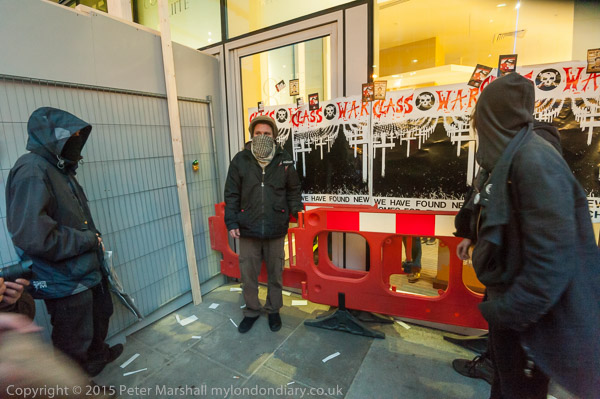
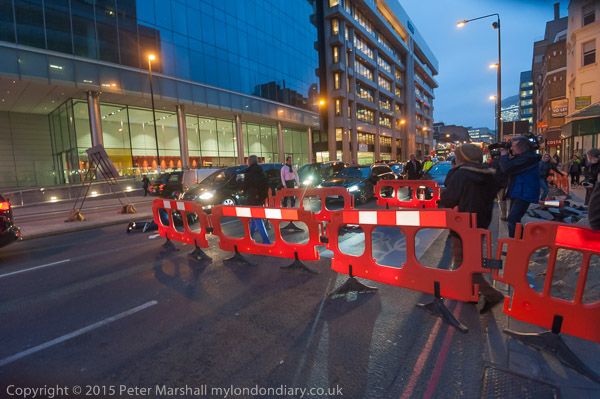
Some younger anarchists present took plastic barriers from the works taking place on the pavement and piled them in front of the locked door. Others took them onto the busy Whitechapel High Street and blocked the traffic.
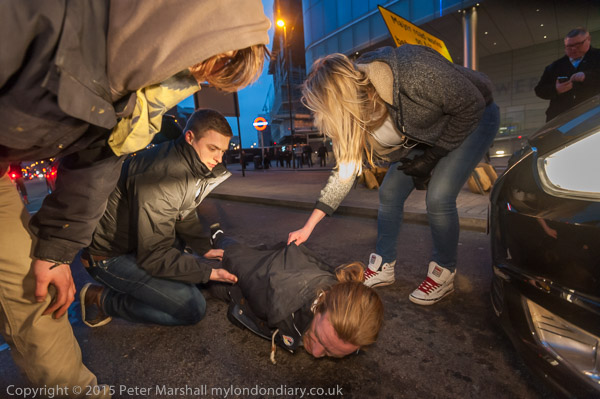
A man and a woman who had been watching suddenly grabbed one of those present, threw him to the floor and handcuffed him, holding up their warrant cards to show they were plain clothes police. I didn’t recognise the man they arrested who was not one of the regular Class War protesters, and as usual they refused to answer questions about why he was being arrested. But their arrest effectively blocked the only lane of the road which the protesters had not already blocked.
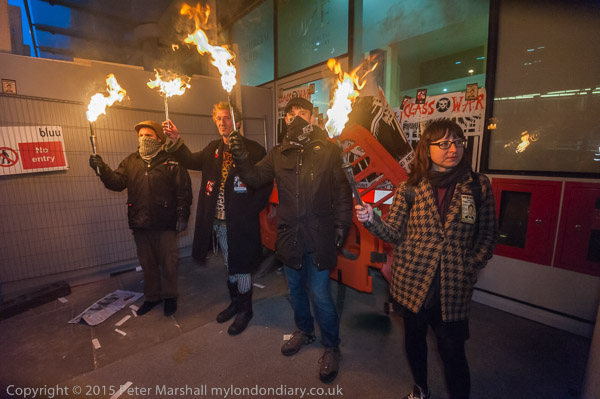
More uniformed police arrived and dragged the arrested man away to a police van, removed the barriers and protesters from the road and the protest continued with Class War holding up flaming torches in front of the rich door.
There were a few more short speeches and then the protesters left as usual after about an hour, leaving their posters attached to the glass on the front of the building by Class War stickers.
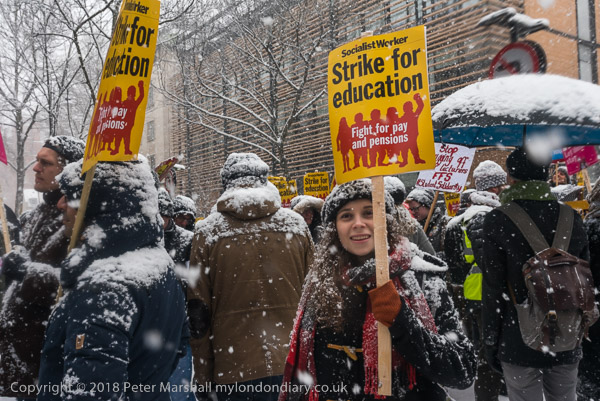
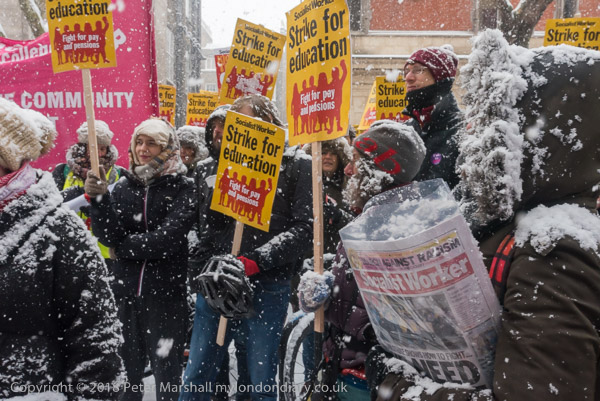
Blizzard, Education and Hunger Strike – London hasn’t had a great deal of snow for some years, but when I got off the bus on Wednesday 28th February 2018 close to London University I found myself walking into a blizzard. There was a couple of inches of snow underfoot and the biting wind was driving dense snowflakes into my face making it both difficult to walk and hard to see where I was going.
I slipped a few times and almost fell as I walked through Byng Place, only just managing to stop myself and my camera bag falling into the snow, and for the first 15 or 20 minutes after I reached the meeting point for the march it was difficult to take pictures, with snowflakes landing on the lens surface as soon as I took away the cloth I had stuffed against it inside the lens hood and raised the camera to my eye.
Most of the pictures from the start of the protest were ruined by snow on the lens making some areas soft and diffuse. It might sometimes have been an arty effect but wasn’t what I wanted. Fortunately after a while the snow died down and I was able to work more normally, though the occasional flake kept coming and there were a few thick flurries later on the march.
HE and FE march for pensions and jobs
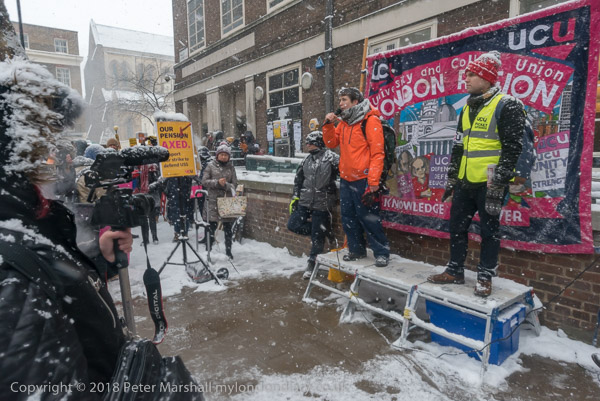
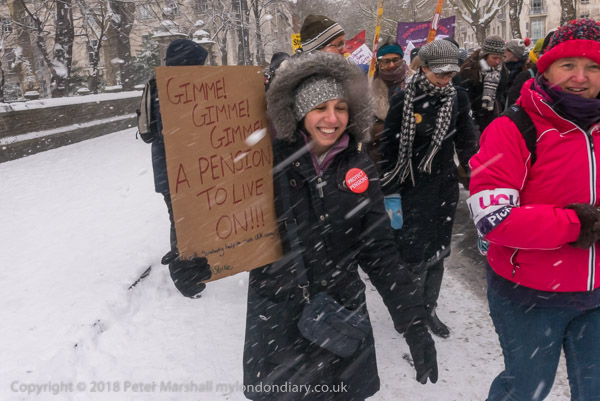
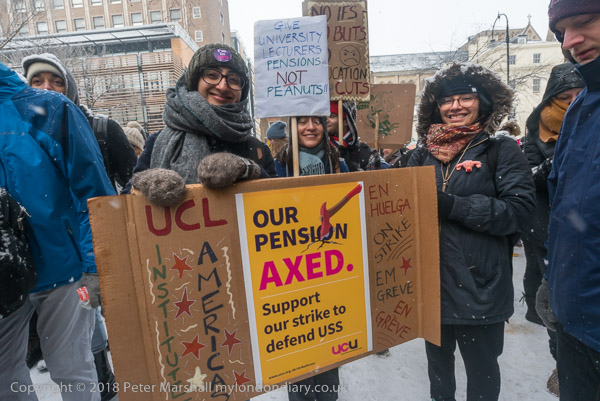
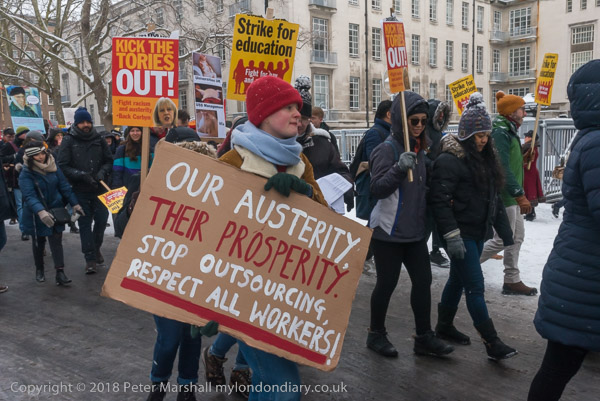
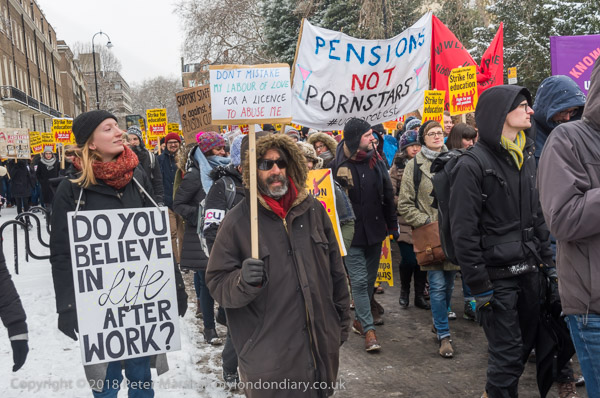
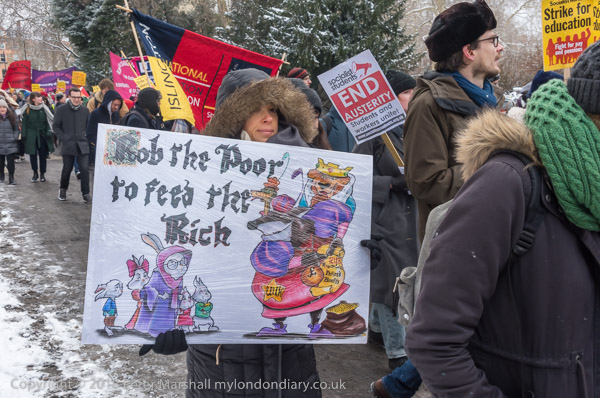
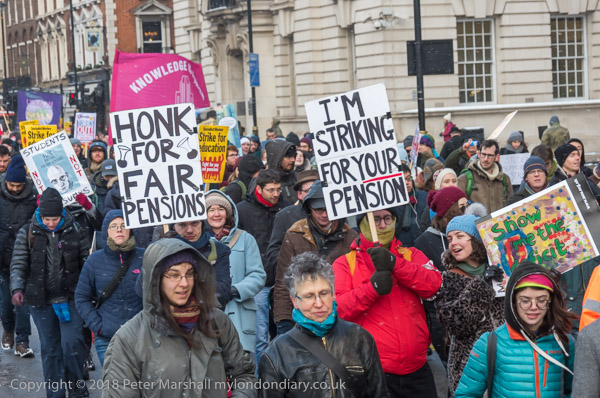
The UCU was on the fifth day of a strike to try and get the universities to talk with them about pay and pensions. On this march to a rally in Methodist Central Hall in Westminster, close to the Houses of Parliament, they were joined by staff from London FE colleges on the first day of a two-day strike over pay and conditions. And plenty of their students had come along to show their support.
Although students are now paying high fees for their university courses, the pay of university teachers has not benefited from this, and has not kept up with inflation. Much more teaching at universities is also being done by graduate students and others on part-time or often zero hours contracts.
What particularly inflamed the situation was the intention of the universities to end the long-established pension scheme, replacing it with one that would greatly reduce pensions, and their refusal to discuss this with their union, the UCU.
The 5 day strike was supported overwhelmingly by UCU members and had shut down 61 UK universities, despite draconian threats by the management at some of them such as Royal Holloway (RHUL). Pickets had stood in the freezing weather and few people had crossed the picket line.
The move away from the pension scheme was largely driven by a small number of universities, particularly the Oxbridge colleges. Many of these are extremely wealthy, some owning huge areas of land including large parts of London and having vast reserves, not least in their wine cellars. A number of college principals had given their support to the union.
The dispute between the employers and the UCU continued for five years and was only ended in October 2023 when the employer body UUK made an offer of full restoration. This came after 69 days of strikes by the UCU and was a historic victory for UCU members and reversed further cuts made in 2022.
University teachers continue to fight for better pay, more appropriate workloads and job security. FE teachers, marching because of the loss of 15,000 jobs in the sector particularly as adult education has been savaged by austerity, and whose wages had been cut by 21% since 2009, continue to be treated unfairly.
I went into the rally in Central Hall largely to try to get warm after the freezing march, and was fortunate to arrive early enough to get inside – many of the marchers were left outside the the cold where the speakers went outside to speak after making their contributions in the hall.
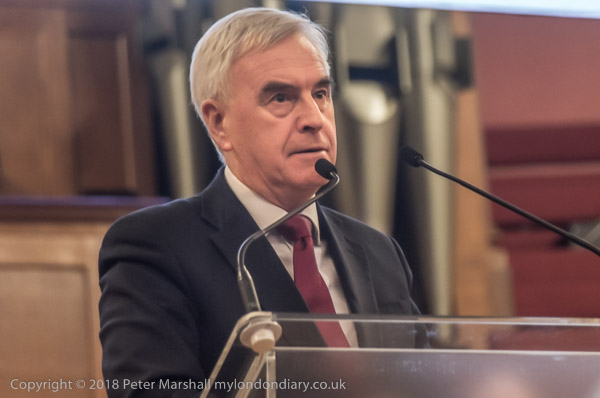
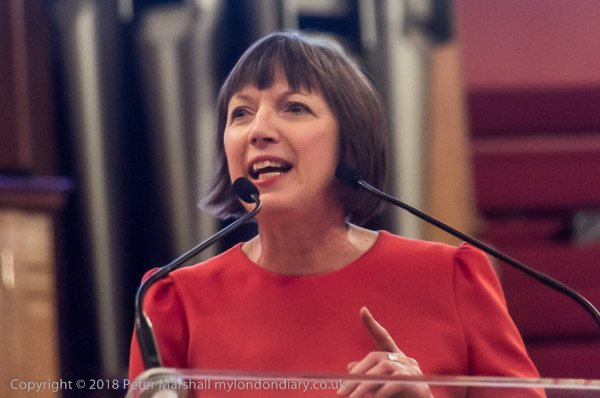
The event was running late because of the larger than expected number of people on the march, and by the time the main speakers, John McDonnell and Frances O’Grady had performed I’d missed the time for another event I’d planned to cover, the handing in of some NHS petitions at the Department of Health. I But I was pleased to be able to stay longer in the warm.
Solidarity with Yarl’s Wood hunger strikers – Home Office
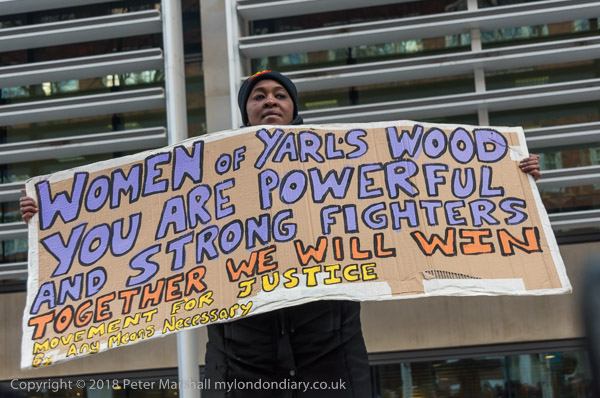
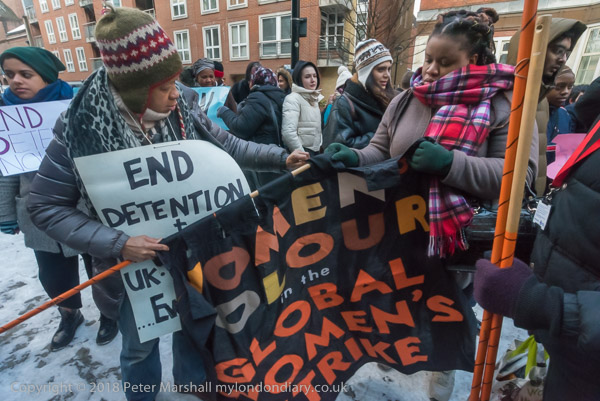
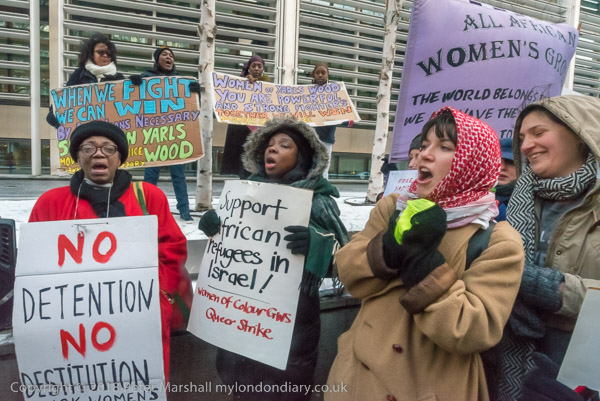
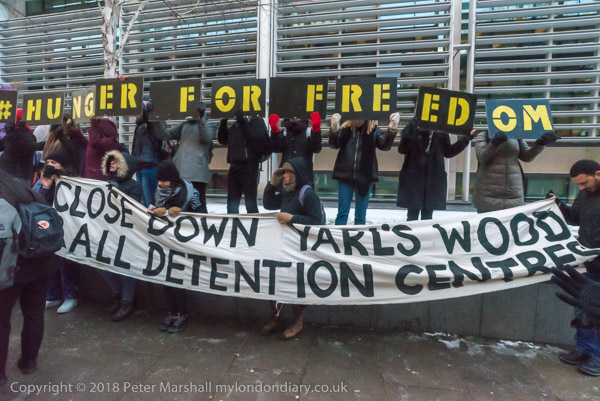
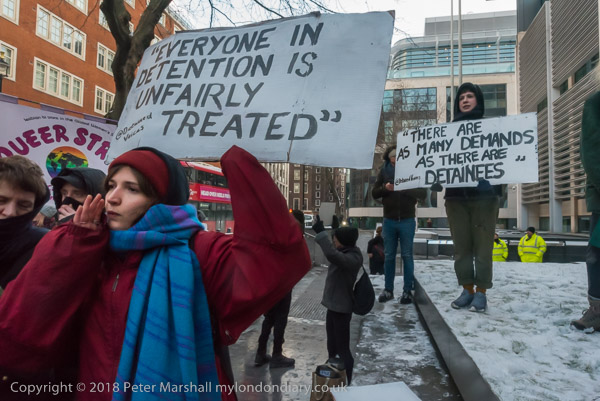
I left the Methodist Central Hall and walked down to the Home Office where an emergency protest was taking place to support the hunger strike and refusal to work by the 120 women and a few men in immigration detention at Yarl’s Wood.
They had begun their action a week earlier to demand the Home Office respect the European Convention of Human Rights and end the separation of families, end indefinite detention with a 28 day maximum detention period, end charter flights which deport people without notice, and end the re-detention of those released from detention.
Their statement also called for an amnesty for those who have been in the UK for more than ten years and for the Home Office to stop deporting people before cases and appeals have been completed, as well as making full disclosure of all evidence to immigration tribunals.
They called for those in detention centres to be treated with dignity and respect and be given proper health care and an end to the detention of highly vulnerable people. They also want an end to employment in detention centres at ‘prison wages’ of £1 an hour.
Among the groups supporting the protest were the Movement for Justice, All African Women’s Group, Queer Strike and No Borders. Some of those taking part in the protest had previously served time in detention centres and knew first hand about the shameful way the UK treats them and some spoke at the event and several of those taking part in the hunger strike were able to speak to the protest from inside Yarls Wood by mobile phone.
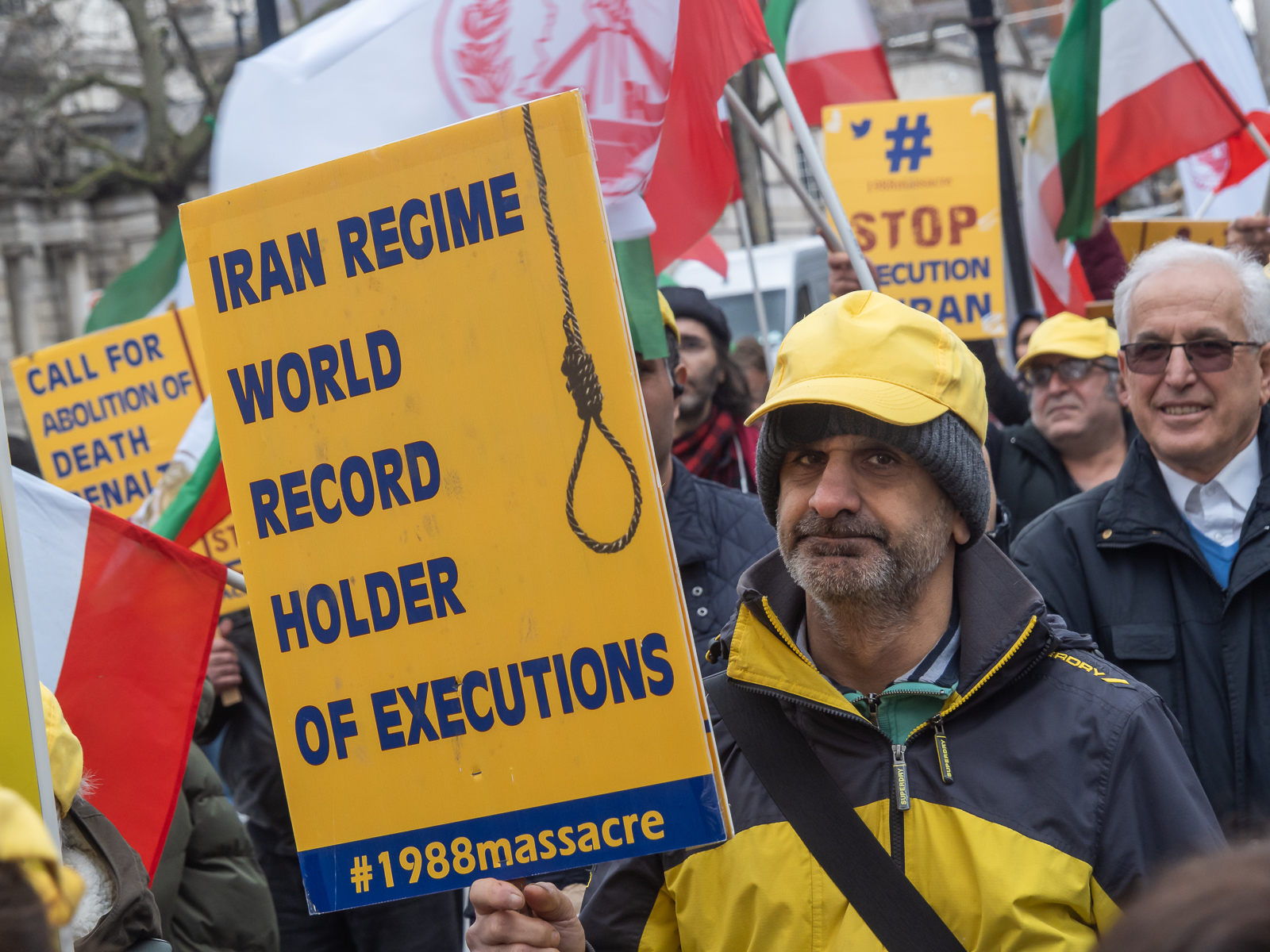
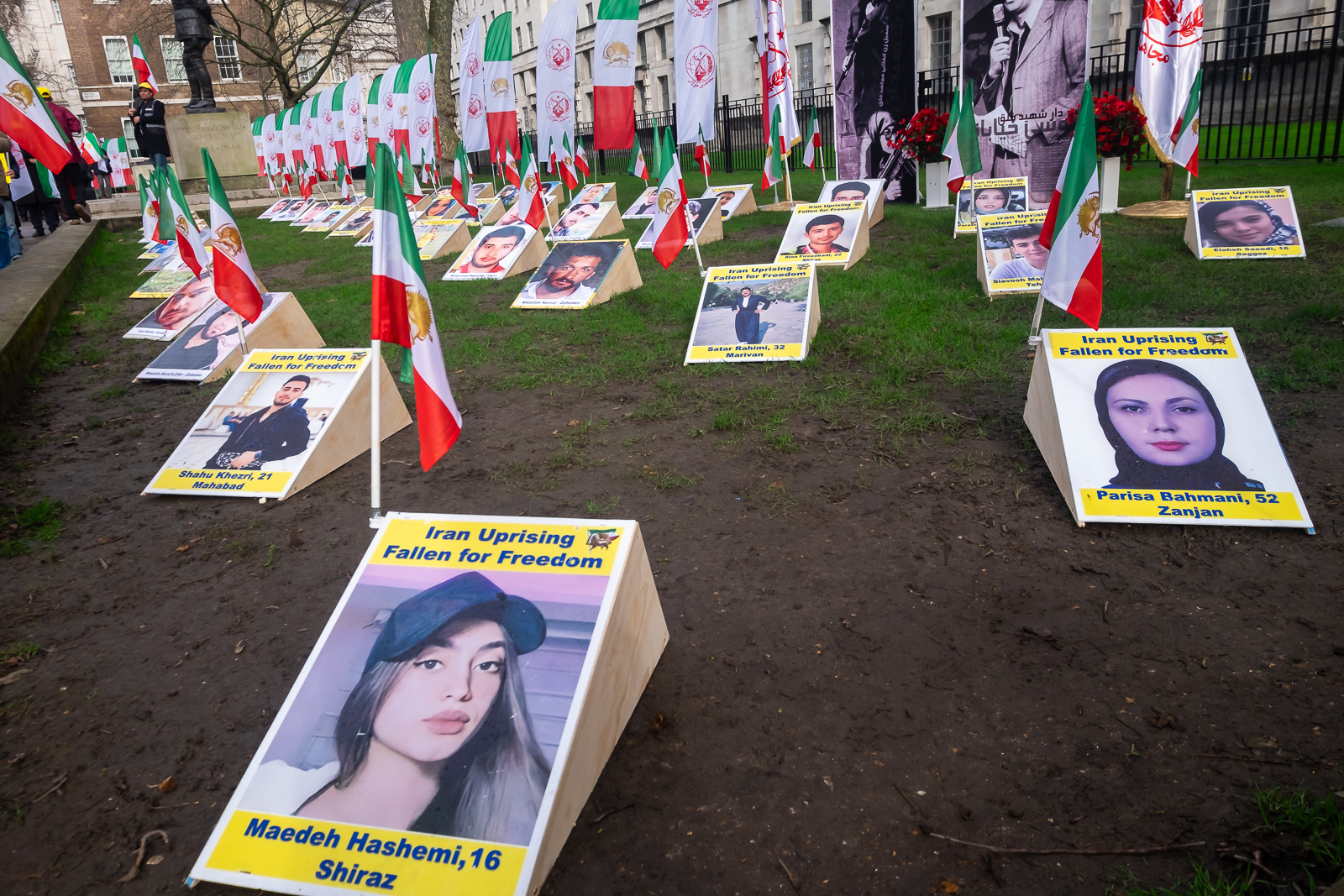
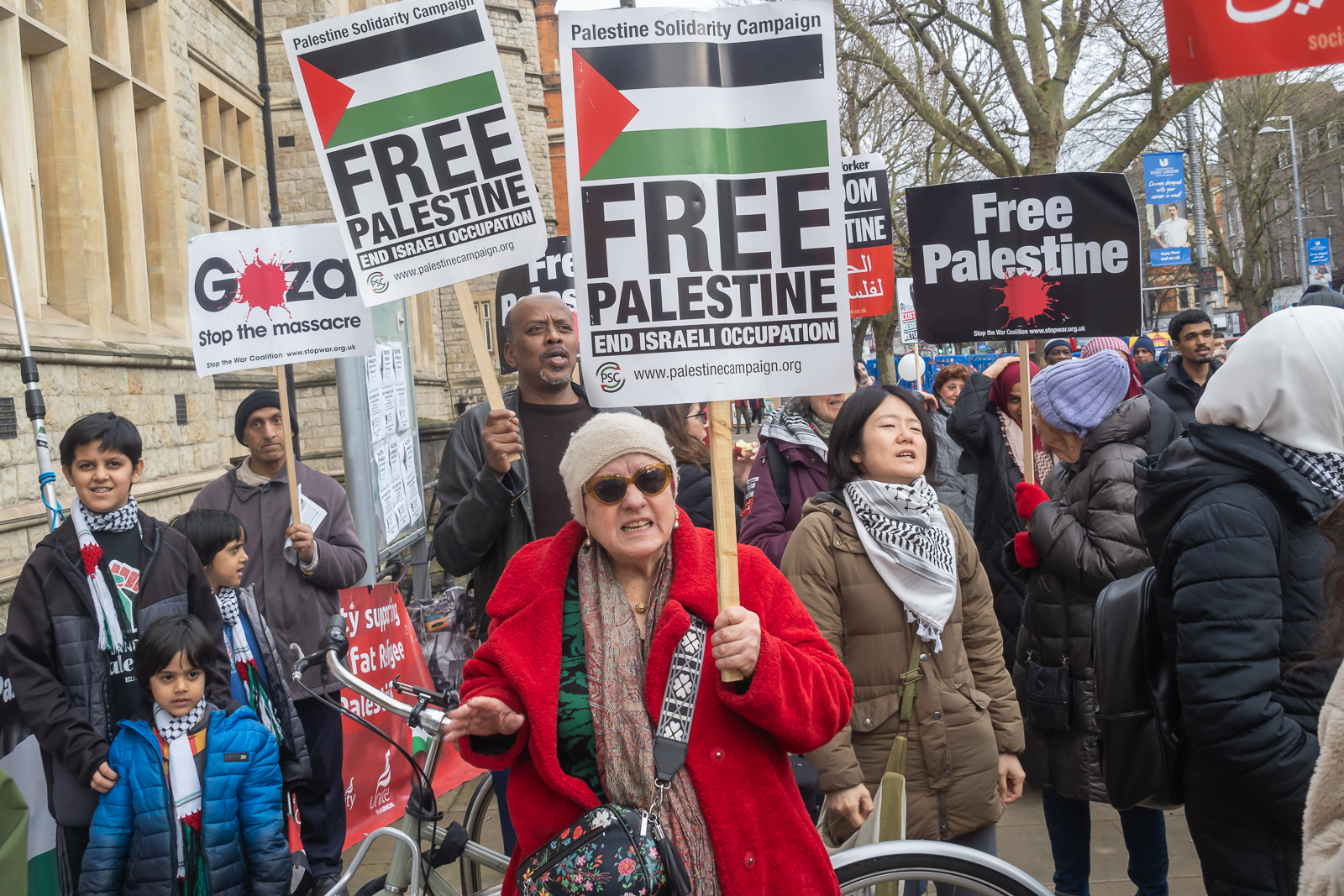
Saturday 10th February 2024 – Gaza & Iran – Saturday 10th February was another day of local actions around the country calling for and end to the horrific genocide now taking place in Gaza. I went to two of the local events in London as well as photographing an annual event on the anniversary of the 1979 revolution in Iran, calling for democracy there.
Ceasefire Now – Stop The Genocide In Gaza, Southwark
London, UK. 10 Feb 2024. Camberwell Green
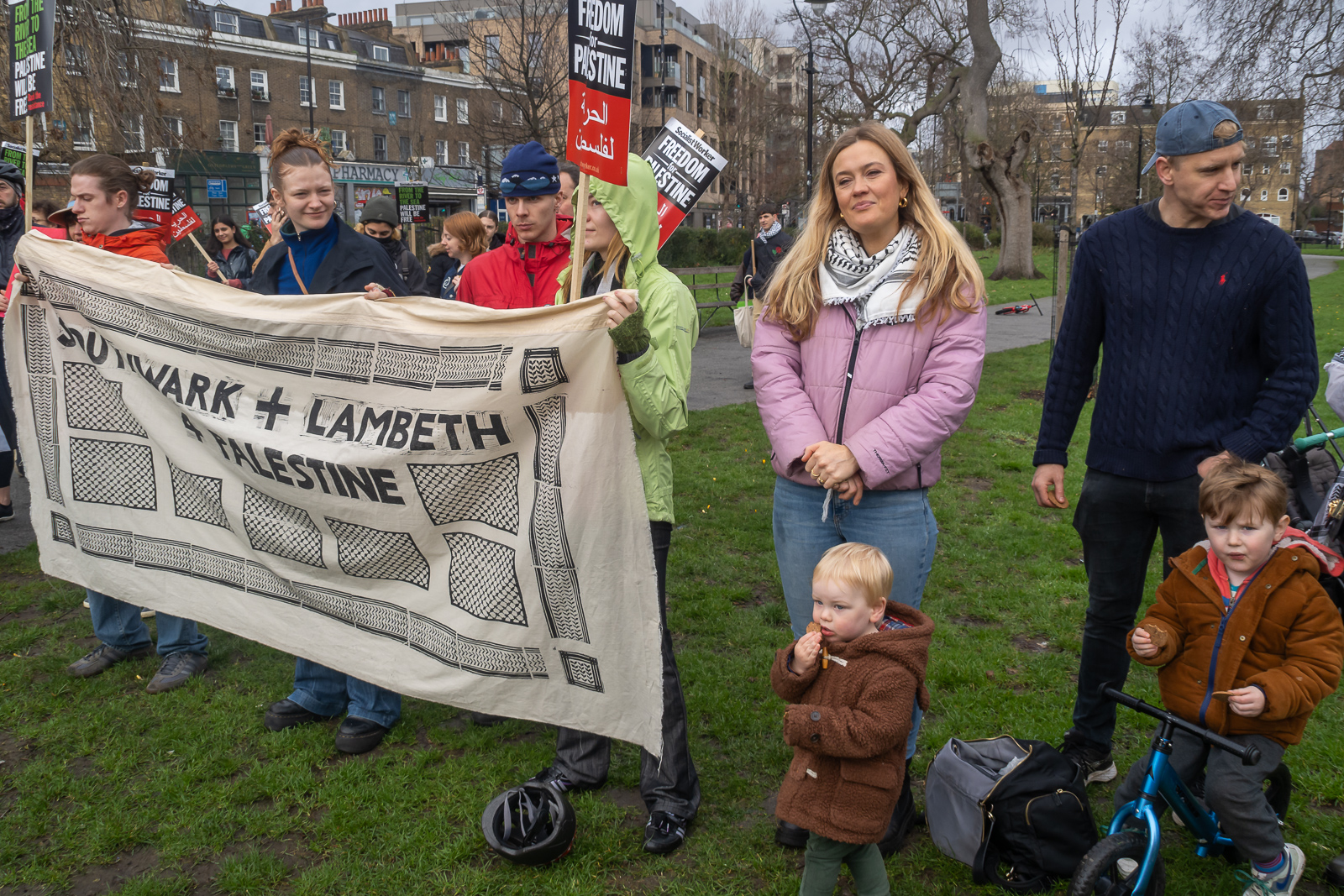
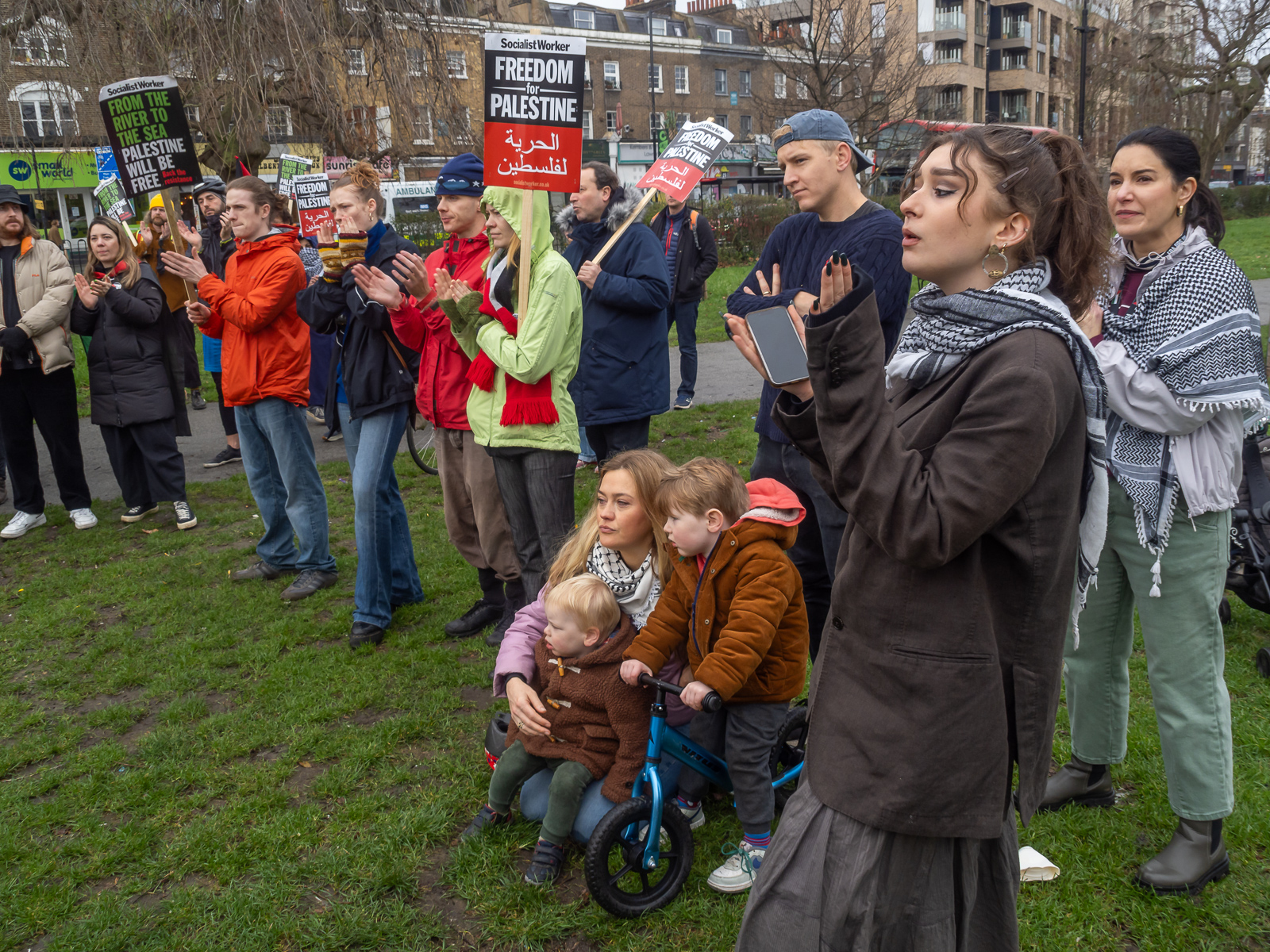
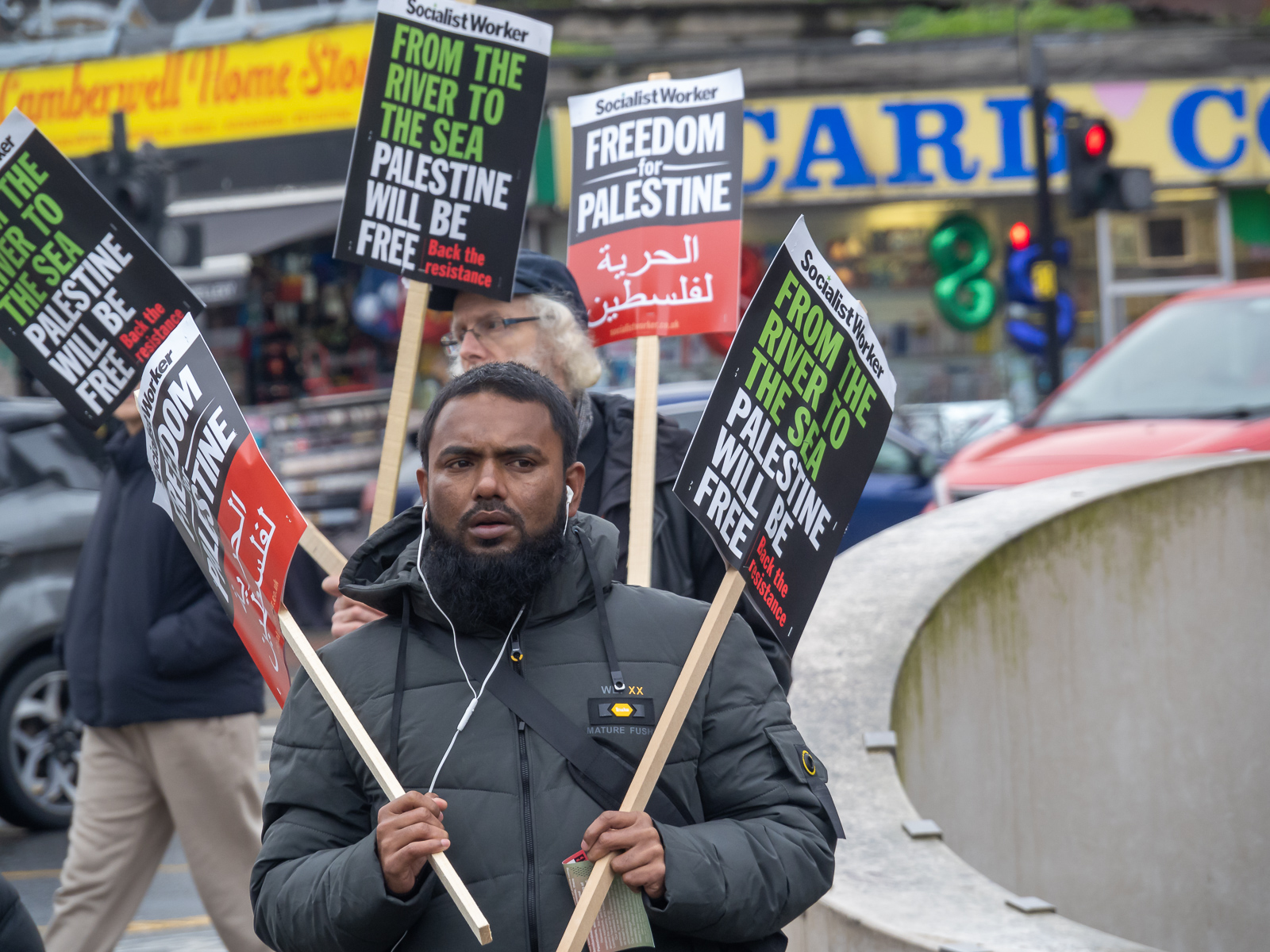
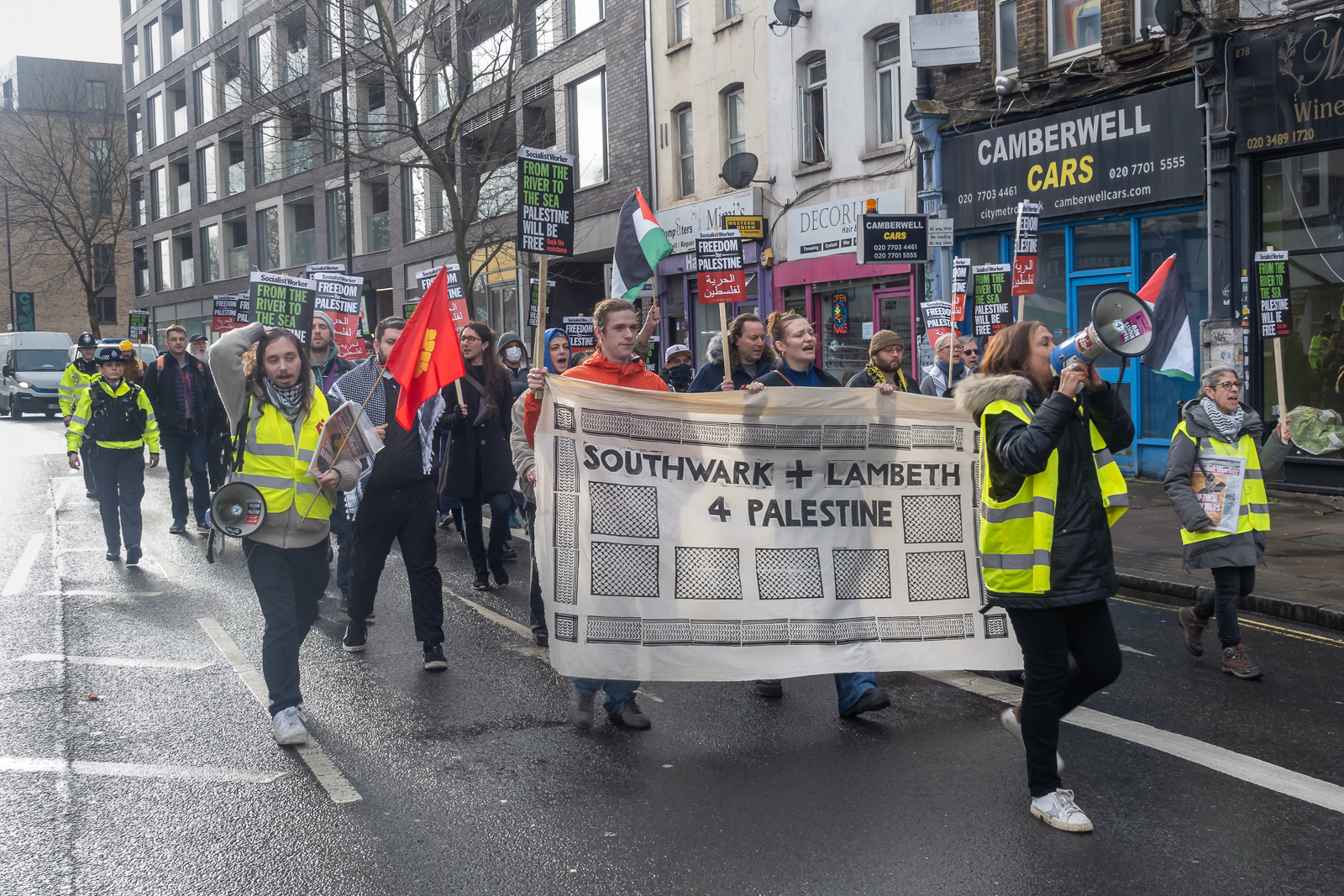
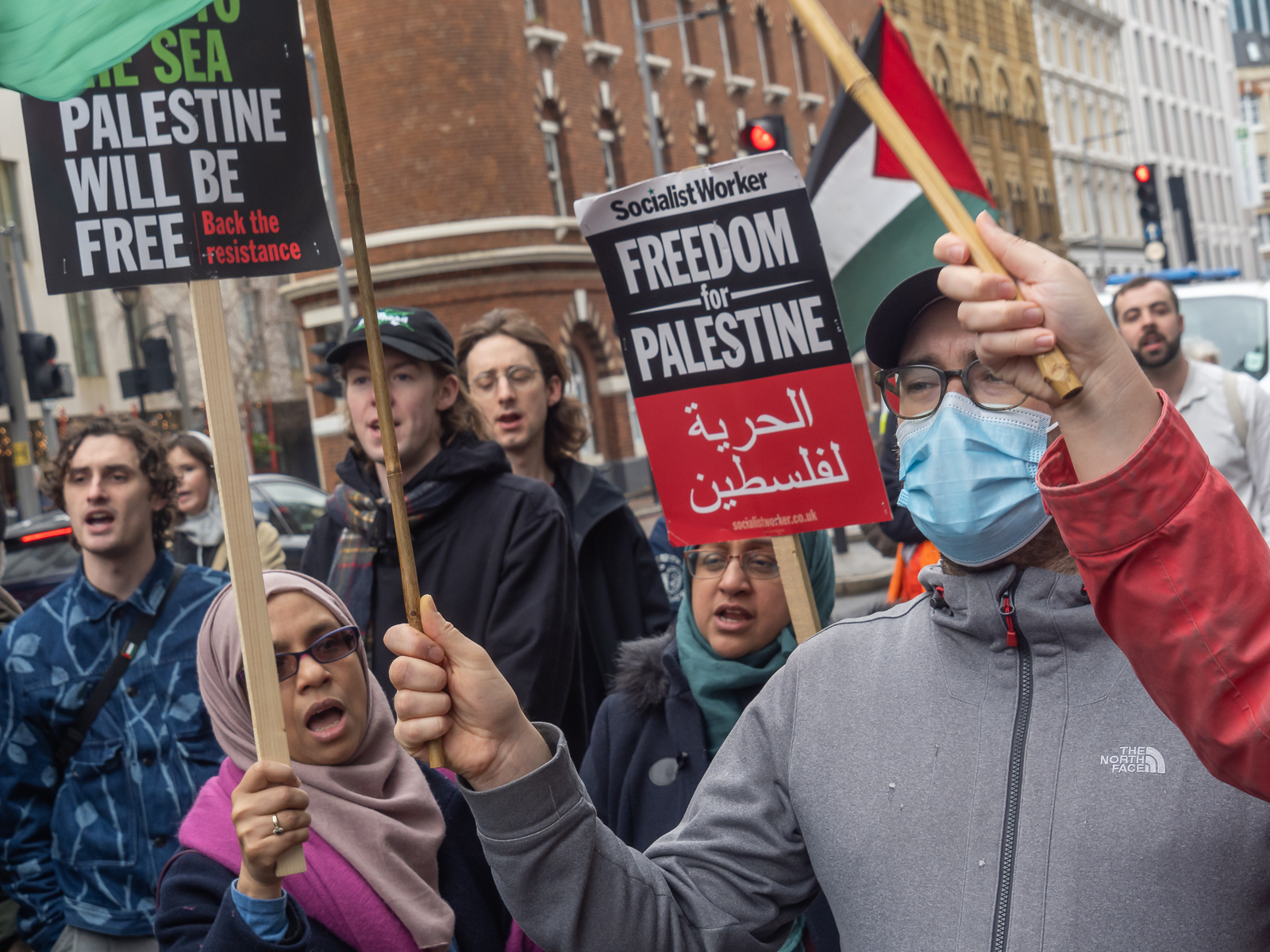
Southwark and Lambeth 4 Palestine had organised another march from Camberwell Green to BAE Systems offices on Southwark Street against the terrible genocide now being carried out by Israeli forces in Gaza. It turned out to be rather smaller than previous local marches, perhaps because many people in the area had demonstrated in workplace-based protests earlier in the week.
London, UK. 10 Feb 2024.
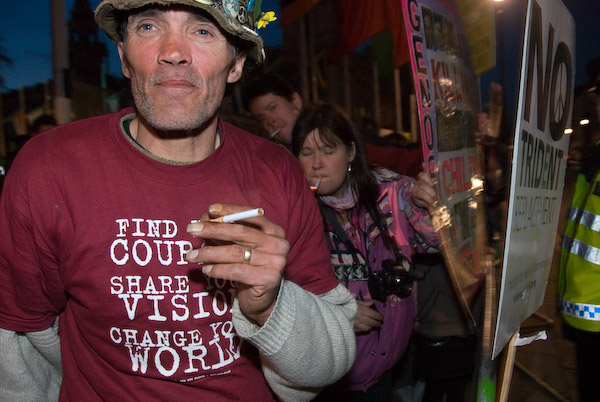
The event started with a few short speeches on Camberwell Green, including one from a student activist from the UAL at the Elephant where they had had a large protest. She talked about how she had been inspired by the example of Brian Haw’s protest over many years in Parliament Square who had carried on calling for peace and an ending to the killing of children until shortly before his death in June 2011, almost ten years after his protest there had begun.
Brian Haw: Find Your Courage; Share Your Vision; Change Your World. (T-shirt from Dan Wilkins, The Nth Degree.)March 2007, Peter Marshall
I got to know Brian well, going to speak with him every time I went to photograph in Westminster and often photographing him, as you can see on-line at My London Diary. He suffered regular harassment from police, council officials and thugs encouraged by the authorities, some of whom were I think plain clothes officers or military. An Act of Parliament was passed largely to try to end his peace camp there, though it also severely restricted other protests within a kilometre of Parliament.
London, UK. 10 Feb 2024
Later, after his ill-health took him to hospital, his protest there was continued by Barbara Tucker who had joined his campaign there in 2005. She was subjected to even more severe police harassment, was arrested at least 47 times and served two periods in prison, of two weeks and nine weeks. In January 2012 police removed her protection against the elements – tent, blankets and sleeping bag and later they came back for her chair. She continued to protest there despite needing hospital treatment for exposure until May 2013.
London, UK. 10 Feb 2024.
The march set off with around a hundred people marching behind the banner though more joined the later at the end. There was considerable support from people on the roadside, particularly when it went past the busy section of Walworth Road close to East Street Market, and many drivers going in the opposite direction beeped their horns in support. Although the UK government continues its support of the Israeli genocide clearly the majority of the British people do not.
London, UK. 10 Feb 2024
I found it a rather long march – well over two and a half miles – and was wishing I’ve brought my bicycle by the time we got to the Bluefin Building on Southwark Street. The march stopped for a few minutes in front of the building where BAE Systems have offices on an upper floor.
London, UK. 10 Feb 2024.
BAE Systems is the world’s seventh-largest military contractor, and the largest in Europe and supplies Israel with a wide range of weapons which for years have been used against Palestinian citizens and civilian infrastructure “including hospitals, schools, and water and electric systems.” There is much more about their activities in arming Israel on the American Friends Service Committee web site.
London, UK. 10 Feb 2024
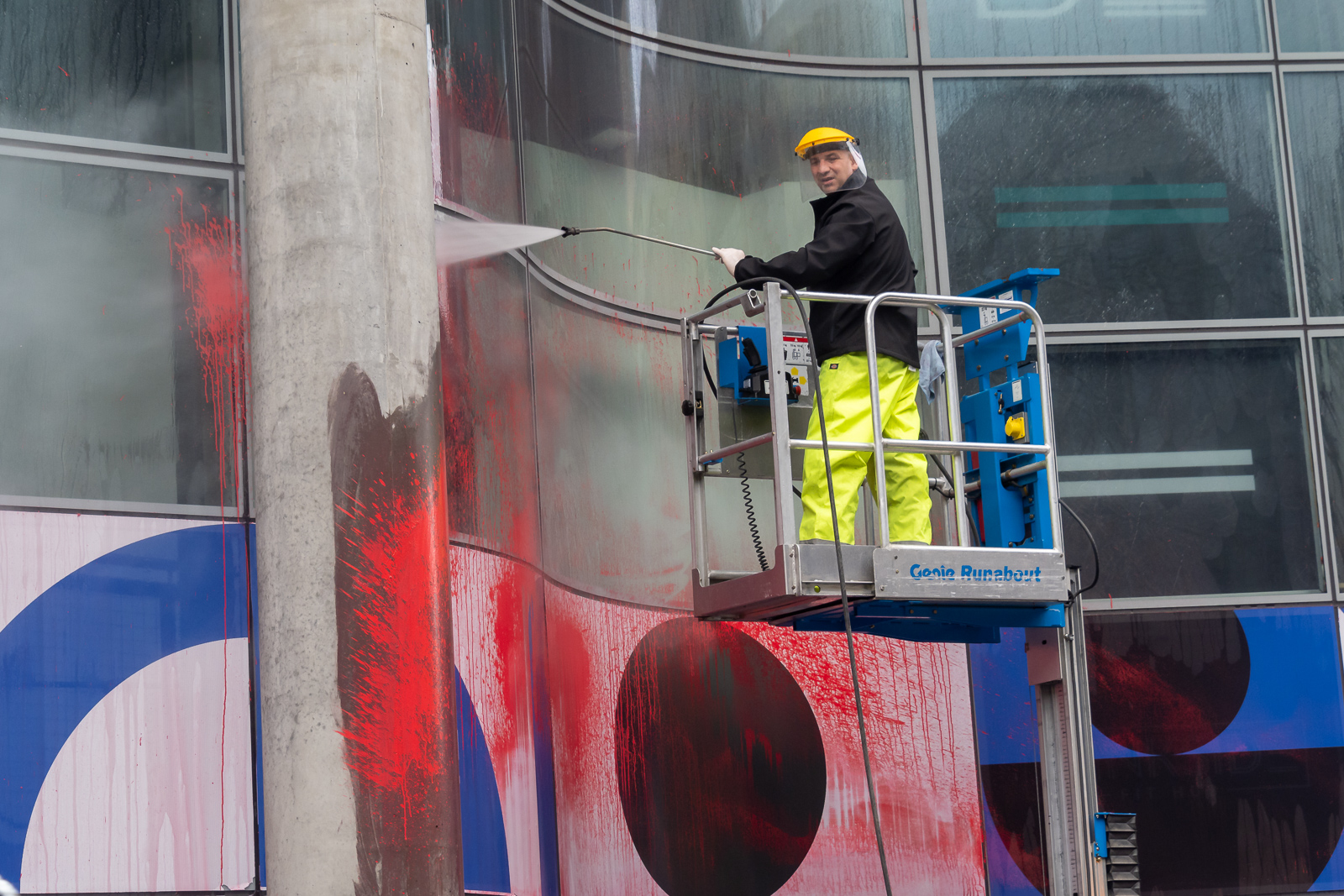
When we arrived at Bluefin, we saw that others had been there before us, and a large area of the frontage had been sprayed with red paint. A team of contractors were busy cleaning it off. I took a few pictures of them as the marchers moved off down the side of the building for another rally, but I walked back to Southwark Station to catch the Elizabeth line to Westminster.
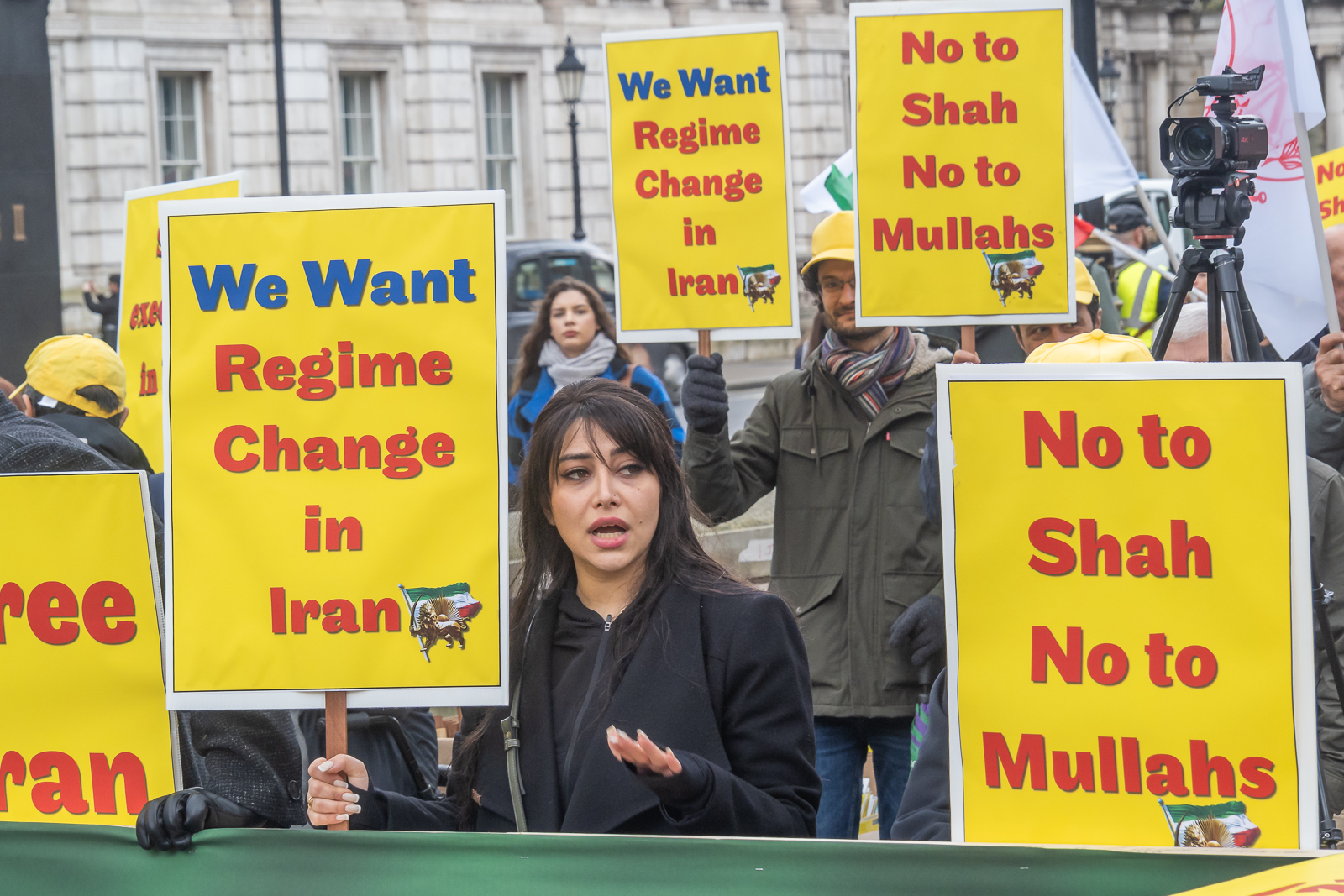
45 years after the Shah of Iran was forced into exile by a popular revolution following repression under the Pahvlavi regime, the Anglo-Iranian community and the National Council of Resistance of Iran call for a new revolution to end the oppressive theocratic regime with democracy and for the UK to declare the Islamic Revolutionary Guard a terrorist group.
They say Khomeini who had been invited back by the acting government after the revolution stole the leadership of the country revolution in a rigged vote, imposing the current oppressive theocratic regime.
London, UK. 10 Feb 2024.
The National Council of Resistance of Iran (NCRI) has put forward a ten point plan for a future democratic republic in Iran, with secular government, democratic elections, freedom of expression, equal rights for women and human rights and an independent judiciary and legal system.
The NCRI is a coalition with representation from five bodies, the major of which is the People’s Mojahedin Organization of Iran (PMOI), which currently has its headquarters in Albania. It was largely disarmed after the US/UK invasion of Iraq and its camp in Iraq was attacked after US forces withdrew.
London, UK. 10 Feb 2024
On Feb 1st this year, the House of Commons agreed to a motion in support of freedom and democracy in Iran. The motion condemns the violent state crackdown on the protests and urgest the government to proscribe Iran’s Islamic Revolutionary Guard Corps.
As I left the protest, two men came to try and disrupt the protest and there were brief scuffles as security and others tried to move them away. After a few minutes police came and held one of them, talking to him and suggesting he leave – the other was already a few yard down the road.
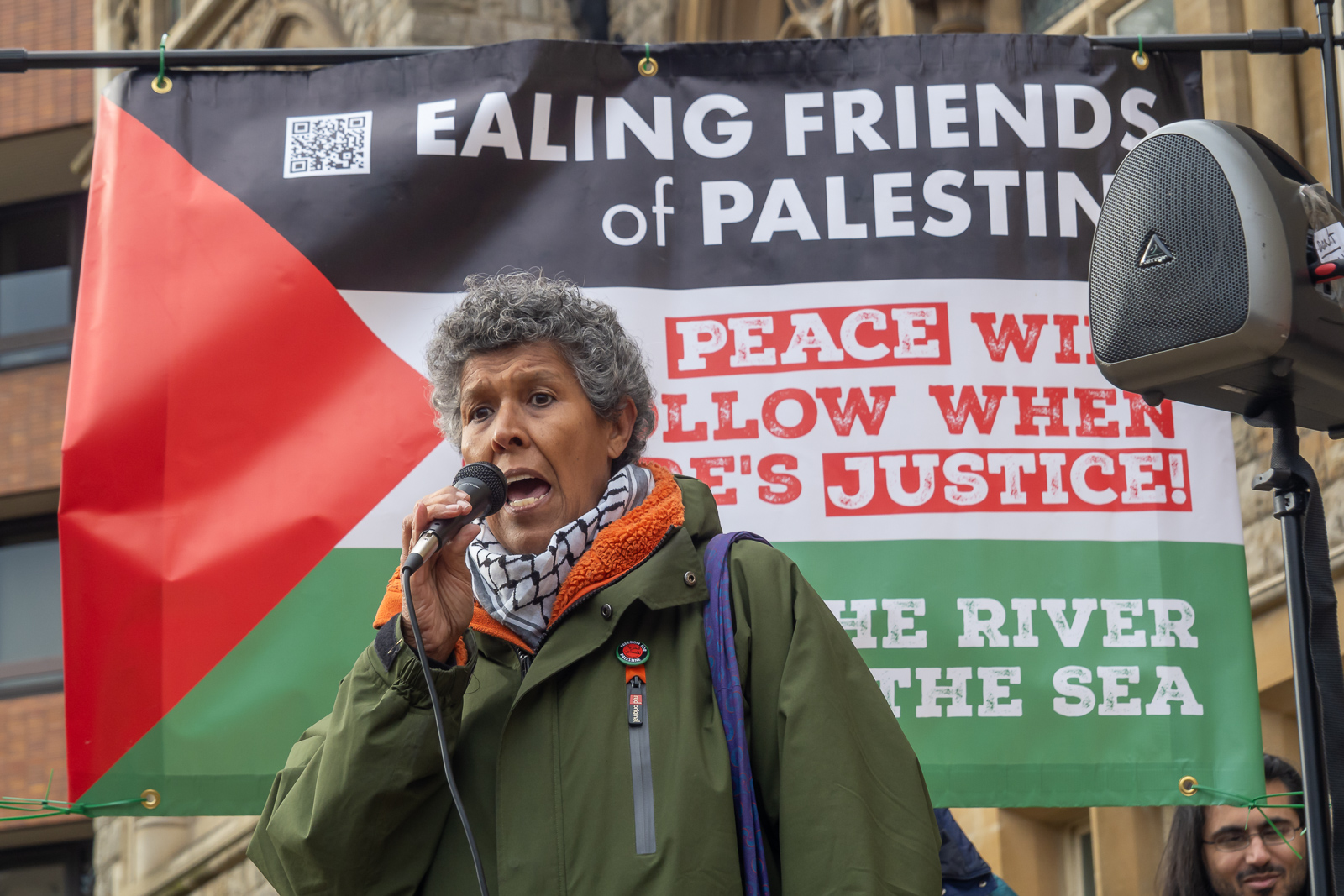
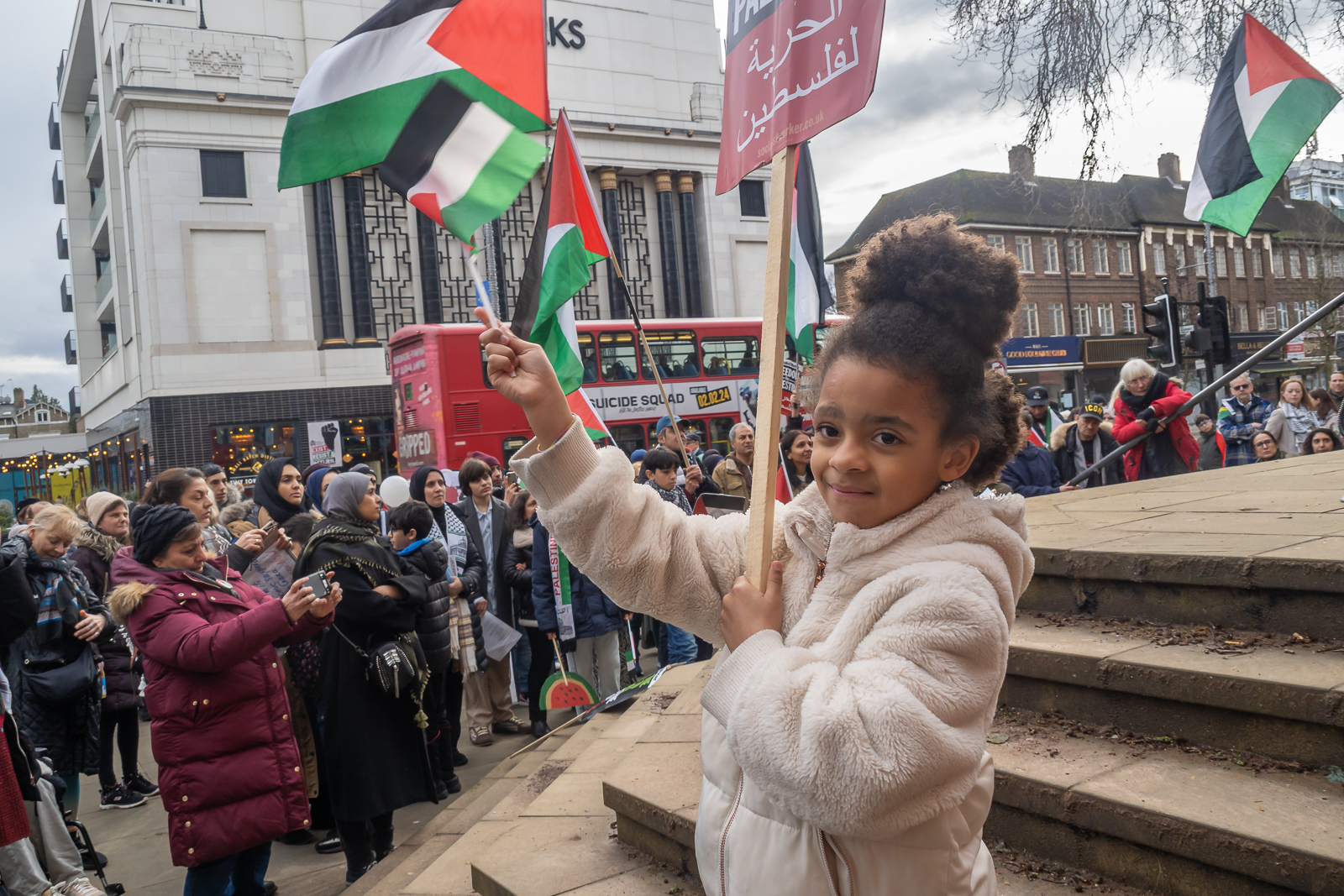
Ceasefire Now – Stop The Genocide In Gaza, Ealing, London, UK
London, UK. 10 Feb 2024
I was on my way to Ealing, fortunately a much faster journey now the Elizabeth Line goes to Ealing Broadway, although I still arrived well after the rally outside the town hall there had started. There was a large crowd around the steps on the main road in front of Ealing Town Hall, another of the many local protests around the country calling for an immediate ceasefire and an end to the genocide in Gaza which has now killed 28,000 mainly women and children and severely injured around 68,000.
London, UK. 10 Feb 2024
The entire population of Gaza is now living in desperate conditions with constant threat of bombing, shelling, famine and disease. Speakers condemned the failure to respond to the ICJ ruling to prevent acts of genocide and for the continued killing taking place there with precision targeted attacks on ambulances, aid workers, schools, hospitals, refugee camps, medical staff, journalists and others.
London, UK. 10 Feb 2024. Grenfell campaigner Moyra Samuels.
I think most of the speakers were from Ealing and Southall, but Grenfell campaigner Moyra Samuels had also come to speak both about the shameful attack on Gaza and also share some experiences of campaigning over the Grenfell fire, where continued protests had helped to keep the fight for justice alive – though there is little sign of justice so far.
London, UK. 10 Feb 2024.
I left as the rally was coming to a close, taking my final pictures of it from the top deck of the bus which was taking me to Brentford and a train home from there.
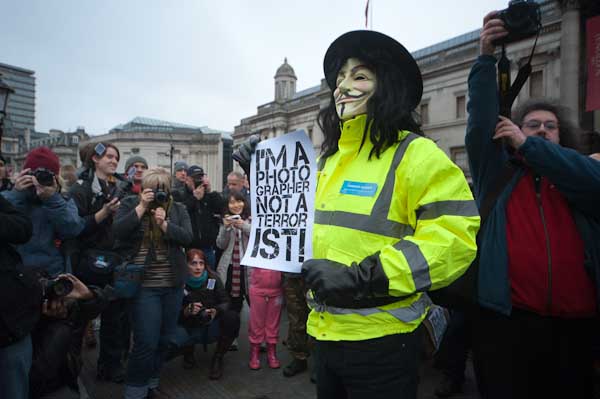
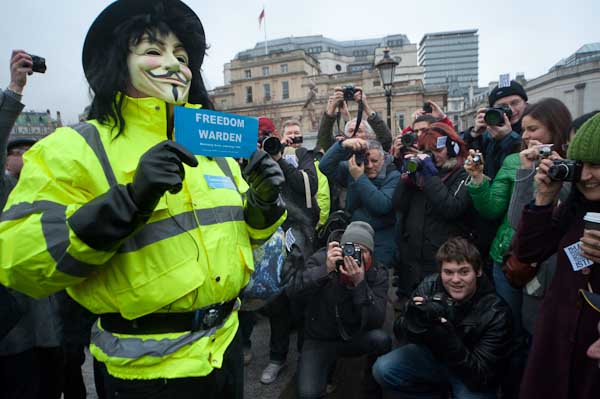
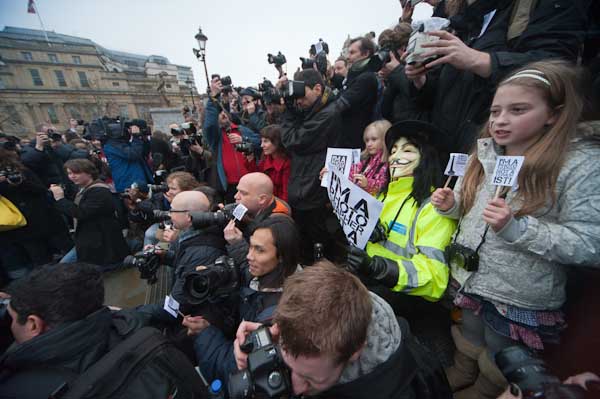
Freedom Protests in London: Two protests on Saturday 23rd January, 2010 were against the increasing powers which have been given to police and misused by them to control and harass lawful actions on the street.
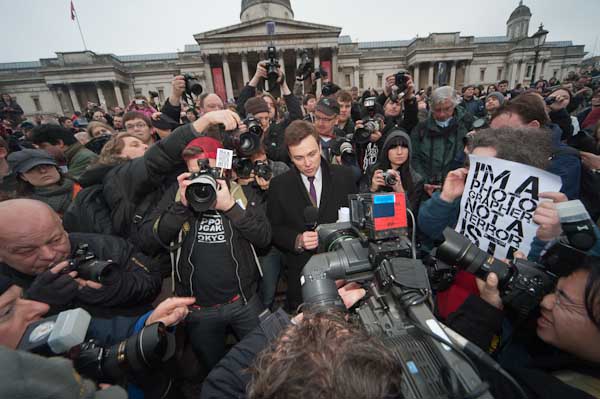
I’m A Photographer Not A Terrorist – Tragalgar Square
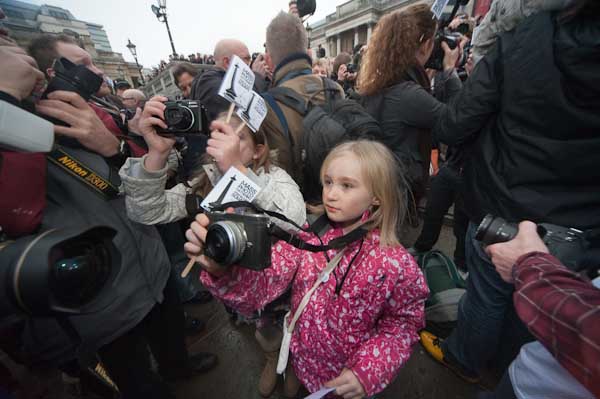
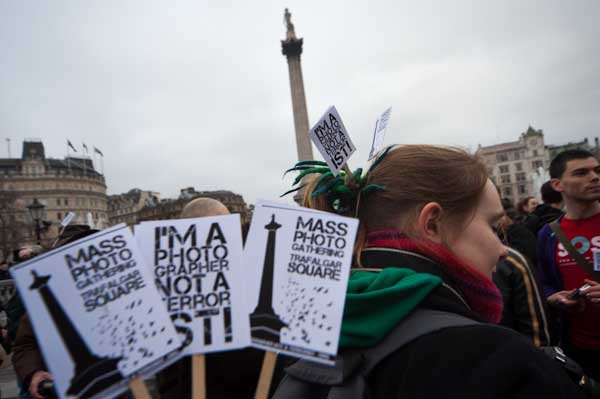
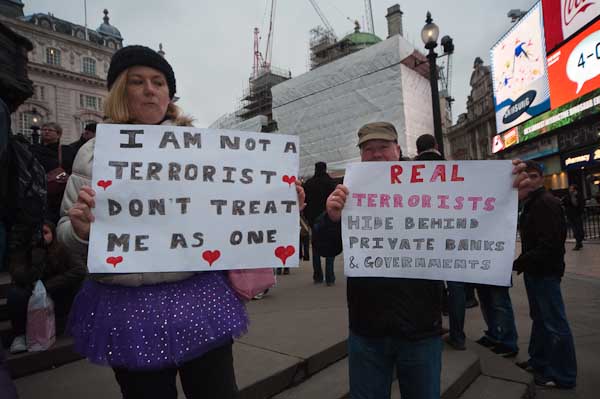
Around 1,500 photographers and supporters turned up to the I’m A Photographer Not A Terrorist rally in Trafalgar Square to protest at the increasing harassment of people taking photographs by police, and in particular their abuse of powers under the Terrorism Act.
I think those there included virtually every photographer who works in London as well as many amateurs. Almost all of us who work on the streets have been approached by police, questioned and then subjected to a search, usually under Section 44 of the Terrorism Act 2000 (S44.)
As I commented in 2010:
These stop and searches appear to have continued unabated despite a Home Office Circular in September that made it clear they should not be used to target photographers. Searches can also be carried out under Section 43 of the act, but for this officers must have reasonable grounds to suspect someone of being a terrorist. S44 stops can only be carried out in “authorised areas”, which although intended by Parliament to apply in very restricted areas for short lengths of time have been used by police – for example – to permanently to cover central London and some other areas.
The Press Card that we carry has the text “The Association of Chief Police Officers of England Wales and Northern Ireland and the Association of Chief Police Officers in Scotland recognise the holder of this card as a bona-fide newsgatherer.” But despite this, one of my colleagues was the subject of roughly 30 searches in 2009.
Personally although I’ve been approached and asked why why I’m taking pictures on a number of occasions I’ve only been been subjected to a S44 stop once. Being a still photographer I tend to work fast and keep on the move and I think videographers who stay around longer have suffered more. But certainly there was a lack of cooperation from the police and I was often finding my Press Card being unrecognised by offiers. Others told me that they didn’t regard those issued through the NUJ, one of the recognised gatekeepers to the system, as being valid. And most months if not most weeks I would be threatened with arrest when taking pictures.
Perhaps the most distressing aspect of this protest was listening to a BBC News reporter, standing in the middle of a crowd of experienced journalists and giving a report in which he gave the number attending the protest as “three hundred“. It drew immediate shouts of protest from those of us standing around him and was certainly “not a good advertisement for the competence or impartiality of the BBC who appear to have a policy of playing down dissent.” It’s a policy which still seems to govern the BBC reporting of protests in the UK which are either simply ignored or very much played down.
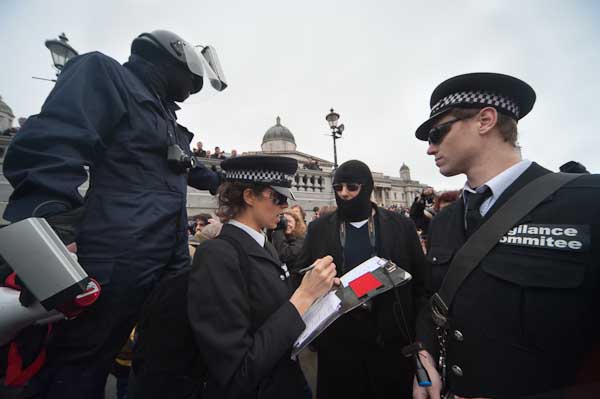
Among the protesters was a small “Vigilance Committee with a man on stilts wearing a number of CCTV cameras accompanied by a male and female vigilance officer, who picked on individuals and questioned them, taking their fingerprints before finding them guilty and sentencing them to a choice of six years hard labour or contributing to the Vigilance Committee.”
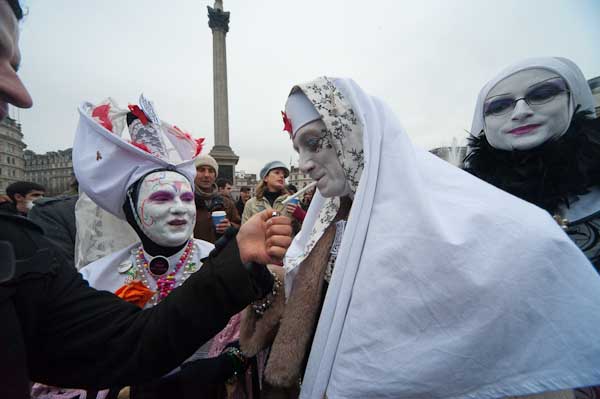
Also present were three Sisters of Perpetual Indulgence, but police and ‘heritage wardens’ largely kept away. Although this had been planned as an illegal protest taking place without the permission from the Mayor required by the bylaws, the authority had put in an application for it without any reference to the protesters.
Life Is Too Short to be Controlled – St Pancras to Piccadilly Circus,
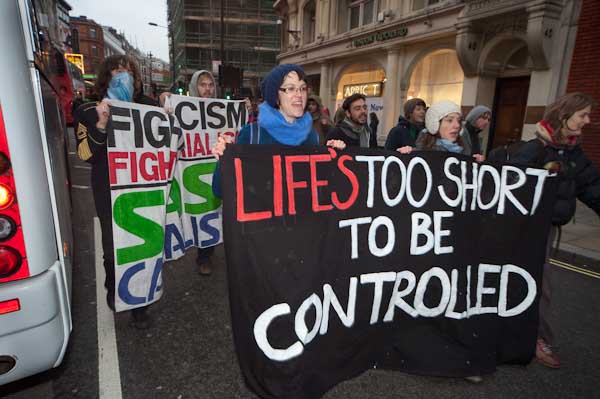
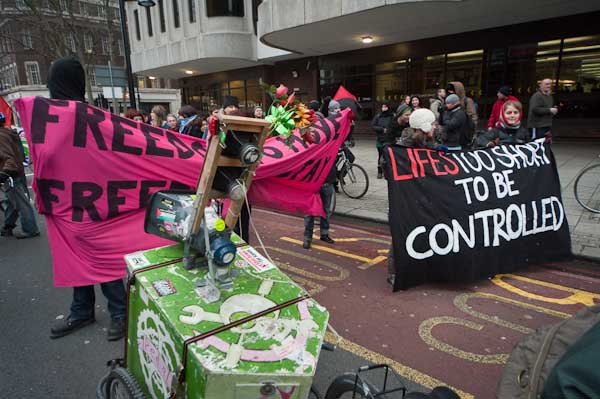
Later in the day protesters met at St Pancras for the ‘Life Is Too Short to be Controlled’ protest against the increasing control over our lives through increased police powers to stop and search, increased surveillance and controls on freedom of movement.
The protest, organised by ‘London NoBorders’ began outside St Pancras Station where the Border Authority detains migrants arriving by Eurostar and marched to Piccadilly Circus, beneath which Westminster’s CCTV HQ keeps a constant watch on the streets of London, the “City of CCTV”. Across the city there were then over 500,000 CCTV cameras watching us, installed by councils, public bodies, companies and individuals and on a typical day the average person in London will be recorded by 300 of them.
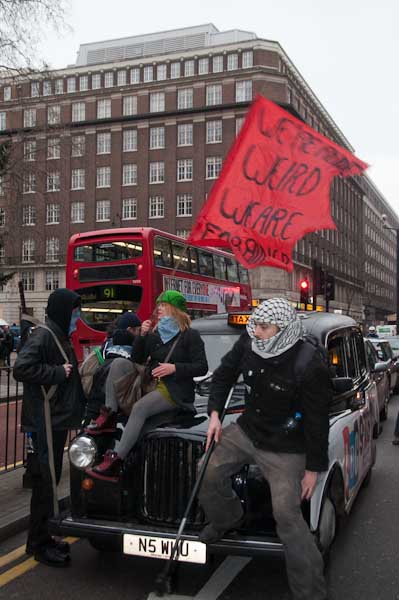
Police kept a relatively discrete watch on the event, with police vans parked out of site and even when the group marched along the busy Euston Road, holding up traffic for a few minutes not a single officer appeared. The march was well-ordered “and when an ambulance answering an emergency came along, the whole march cleared the road for it with remarkable speed. At Russell Square, one taxi driver decided to try to force his way through the marchers, but was soon stopped, with several people sitting on the bonnet of his vehicle.”
At Piccadilly Circus there was a short token road block before the protesters moved to the pavement around Eros for more speeches and some dancing. A Police Community Support Officer appeared briefly after someone climbed up and taped a Palestinian flag to Eros’s bow and tried to identify who had done this. The statue is rather fragile and could have been damaged. He soon gave up and went away and was replaced a few minutes later by a single police officer who was embarrassed by being greeted with hugs, and moved back a few yards to watch.
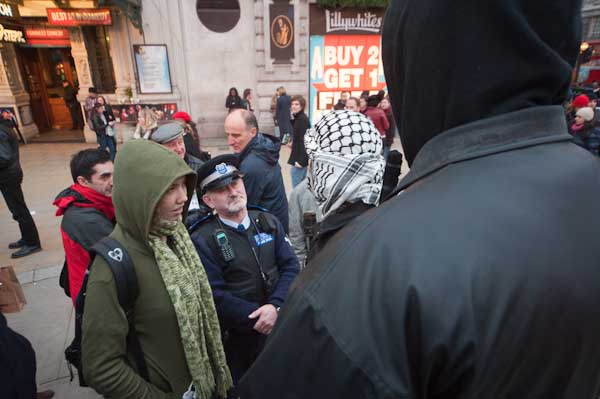
“Not me officer, someone borrowed my scarf”
The police had monitored the progress of the protest as it marched through London, both from some distance on the streets and also on CCTV. It had been peaceful and had caused only very minor disturbance. Few protests do, and the kind of heavy policing sometimes employed often means police cause more disruption that the protest, as well as sometimes provoking a response from protesters who would otherwise have protested peacefully.
Goodbye & Good Riddance – September 2003: Of course there were times in 2023 that I remember warmly, and the first week of September when I was with a group of friends in a holiday let in Barmouth was full of them, though getting there and back was harder going with a rail strike and several long rail replacement bus journeys. But even those long bus journeys had their compensations, with some splendid views and clean windows through which I photographed some of them.
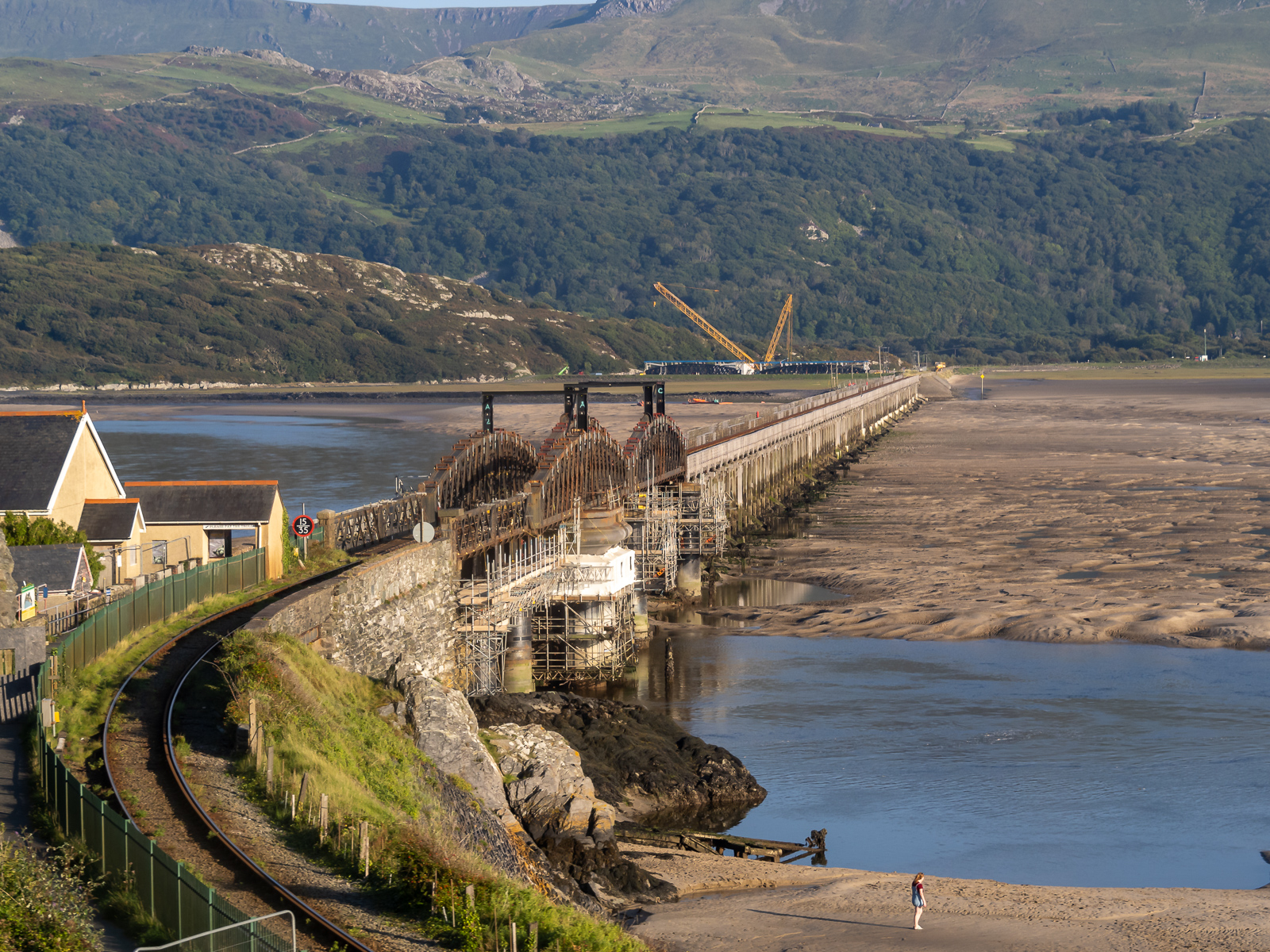
Barmouth September 2023 The rail and footbridge across the estuary at Barmouth closed for major engineering work the day before we arrived so we came and left on a rail replacement buses. The footpath across was also closed, which was a dissapointment as it would have allowed more great walks.
The holiday had been a very welcome break, and we were very fortunate with the weather, but too soon we had to return home – starting with two bus journeys to Machynlleth and then on to Shrewsbury and I returned to photographing protests the following day.
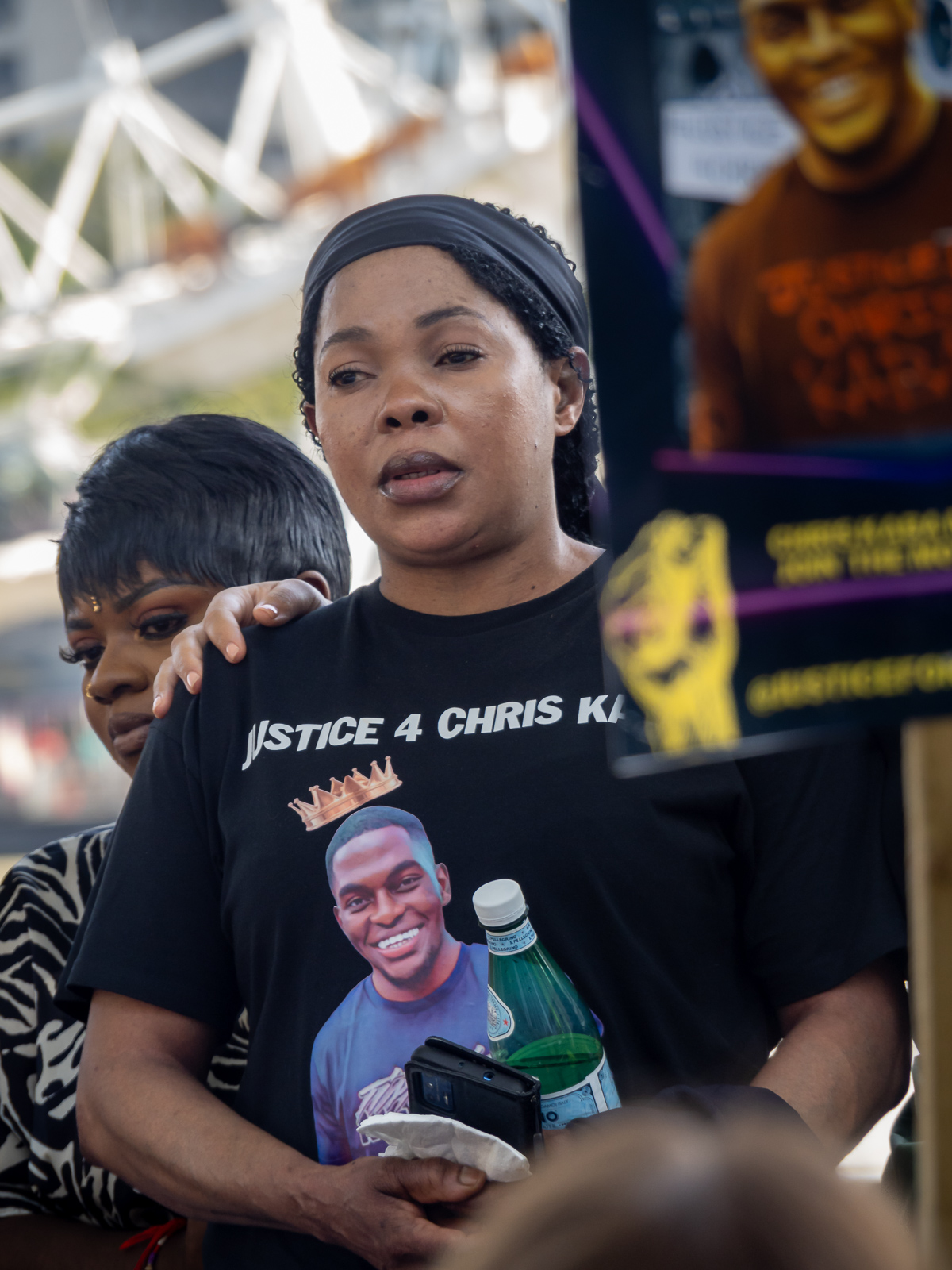
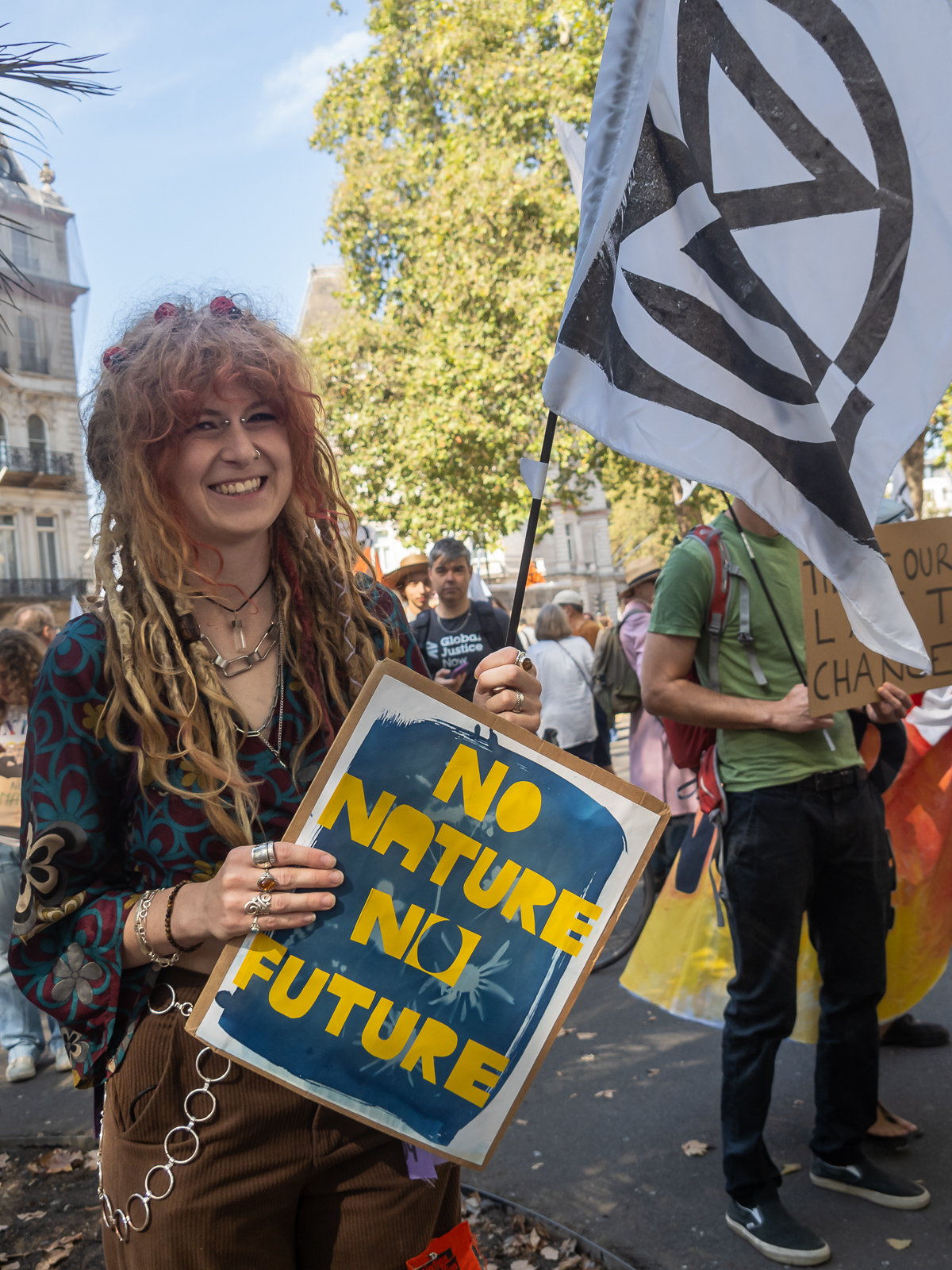
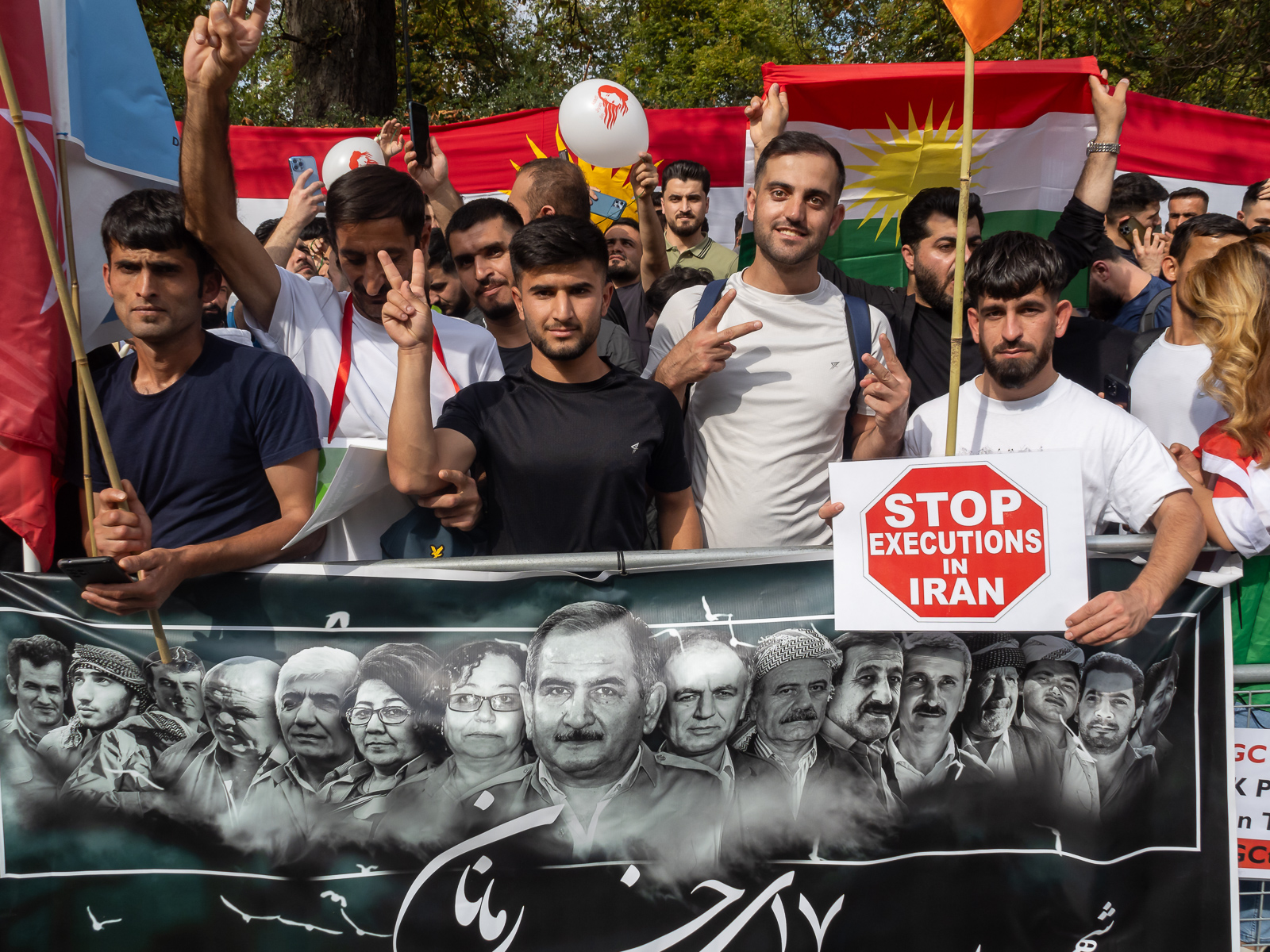
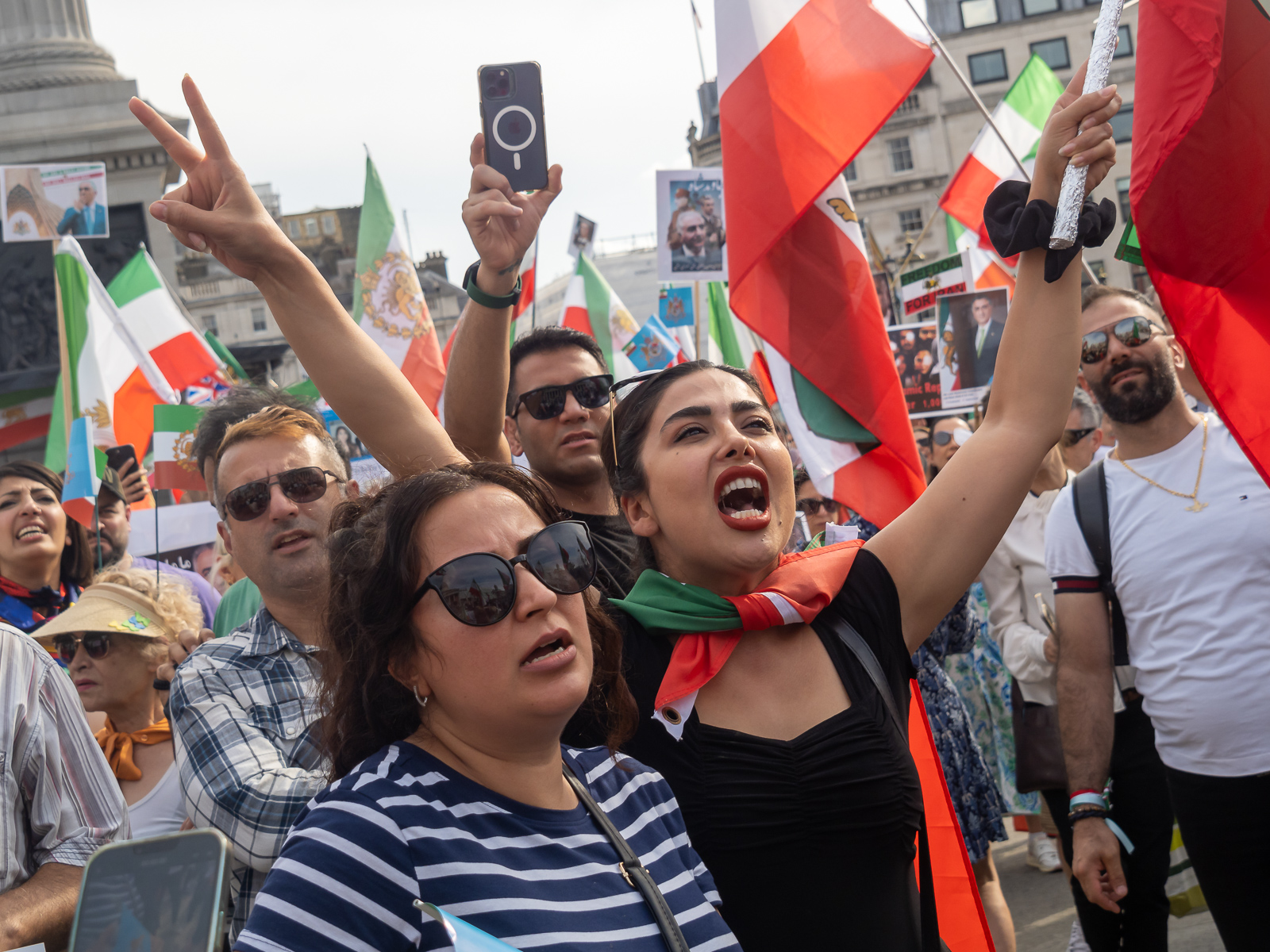
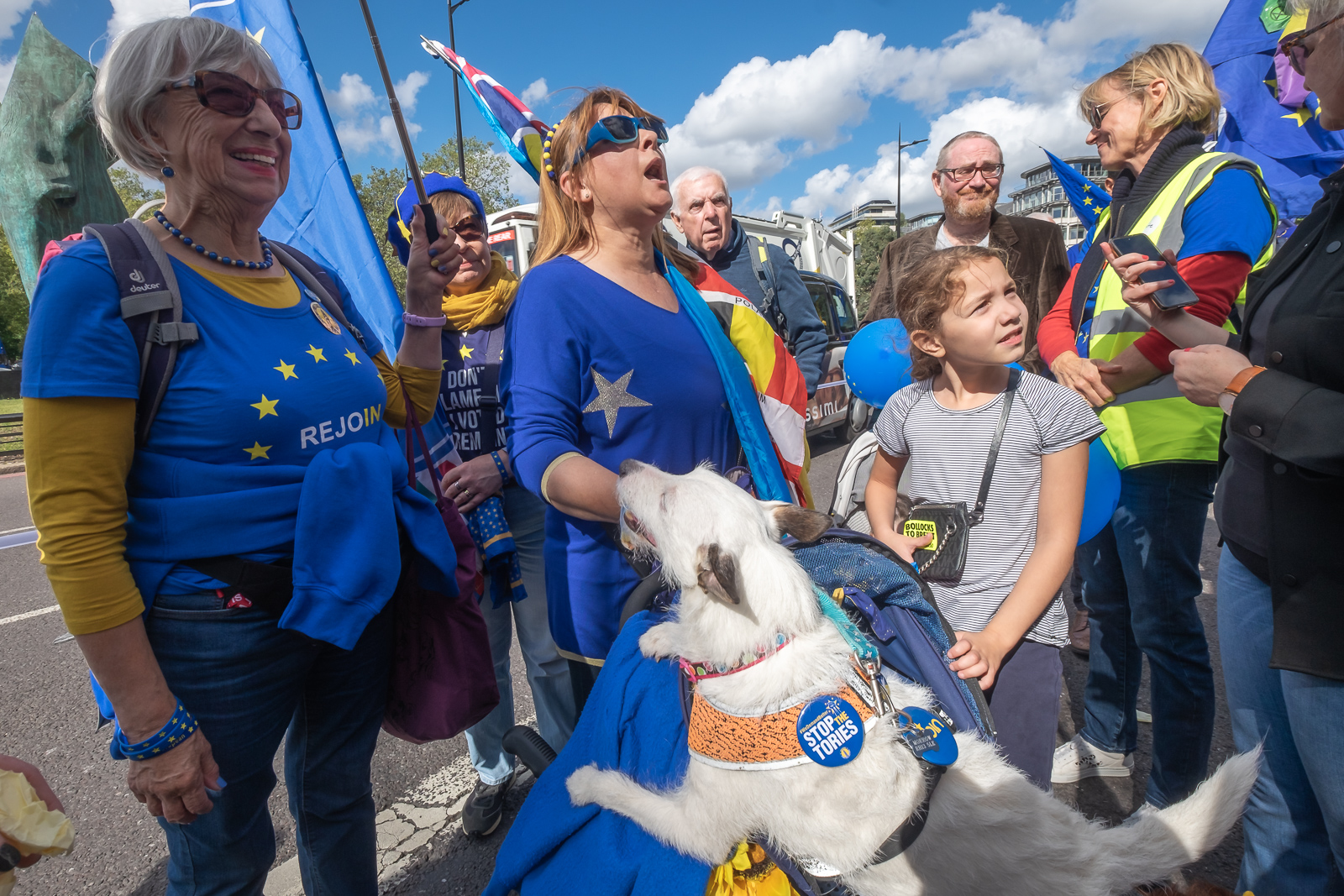
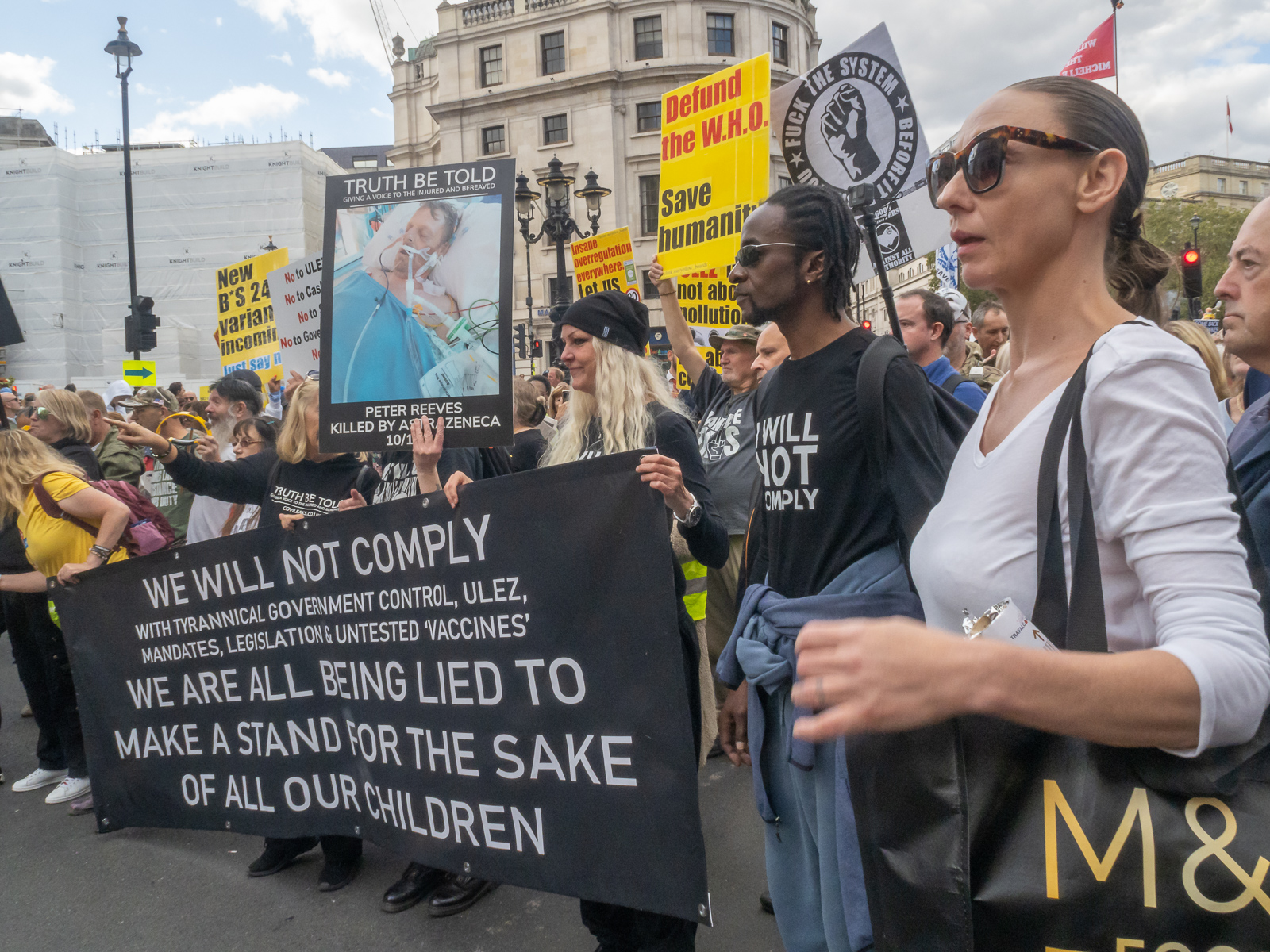
Justice For Chris Kaba – One Year On. London, 9 Sept 2023. Chris Kaba, a 24-year-old unarmed black man, was driving a friend’s car in Camberwell when police stopped the car and fired a single shot through the windscreen killing him. The CPS received a report on the case in March but have yet to decide if the officer should be charged. Hundreds came a year after his killing to support the family and demand justice at a march from New Scotland Yard and rally in Parliament Square. Peter MarshallMarch to End Fossil Fuels, London. 16 Sept 2023. People march in London as a part of actions by millions around the world to demand the world leaders gathering in New York for the United Nations Secretary General’s Climate Ambition Summit take the urgent action needed for a rapid, just and equitable end to the use of all fossil fuels. Peter MarshallMahsa Amini Day – Woman Life Freedom, Iranian Embassy, Kensington. 16 Sept 2023. Protests took place in London and around the world in support of the Woman Life Freedom revolution in Iran on the first anniversary of the killing of Iranian Kurdish woman Mahsa Amini by the IGRC. People in Iran are suffering immense oppression and injustice. There were protests at the Iranian Embassy and a march to Trafalgar Square where a rally and other protests were taking place. Peter MarshallMahsa Amini Day – Woman Life Freedom, Trafalgar Square. 16 Sept 2023. Protests took place in London and around the world in support of the Woman Life Freedom revolution in Iran on the first anniversary of the killing of Iranian Kurdish woman Mahsa Amini by the IGRC. People in Iran are suffering immense oppression and injustice. There were protests at the Iranian Embassy and a march to Trafalgar Square where a rally and other protests were taking place. Pictures are in the same album as those from the Iranian Embassy above. Peter MarshallMarch To Rejoin The EU, London. 23 Sep 2023. Thousands march in National Rejoin March from Hyde Park calling for an end to Brexit and to restore freedom of movement and reverse the attacks on living standards, public services and workers rights Brexit has caused. The march was followed by a rally in Parliament Square. Peter MarshallWorld Wide Rally for Freedom. London, 23 Sept 2023. More than a thousand people marched from Hyde Park in the World Wide Rally For Freedom of speech, movement, assembly, health and choice.The march included many anti-vaxxers, climate change deniers and others but was dominated by those condemning London Mayor Sadiq Khan’s ULEZ expansion to include all of London. They called for mass non-compliance with this and other tyrannical government control. Peter Marshall
The Rally For Freedom was in opposition to the various government bills and acts which have seriously restricted our freedom – such as those aimed at preventing protests and severely restricting the right to strike. But we urgently need to take action against climate change “FOR THE SAKE OF ALL OUR CHILDREN” and the vaccinations have certainly saved many, many more lives than few deaths they have caused. Any responsible mayor of London would be taking similar action to improve London’s air quality, and while there may be details in Khan’s approach which could have been better, he has proved a considerably better mayor for London than his predecessor, and deserves to beat the Tory candidate in the 2024 election.
More on the 2023 protests I photographed in later posts.
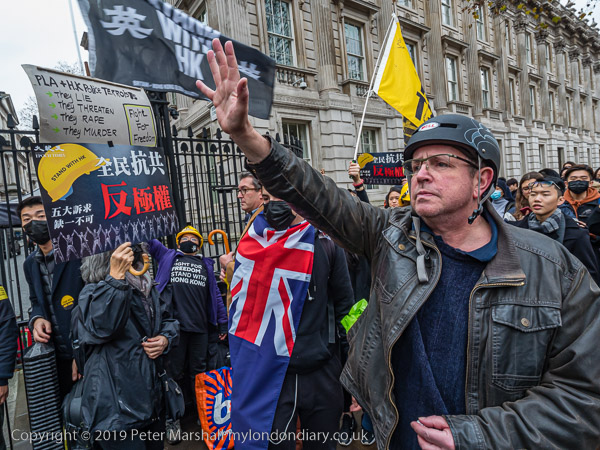
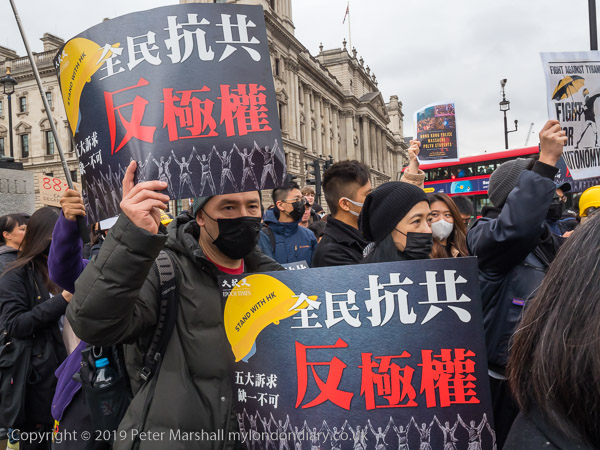
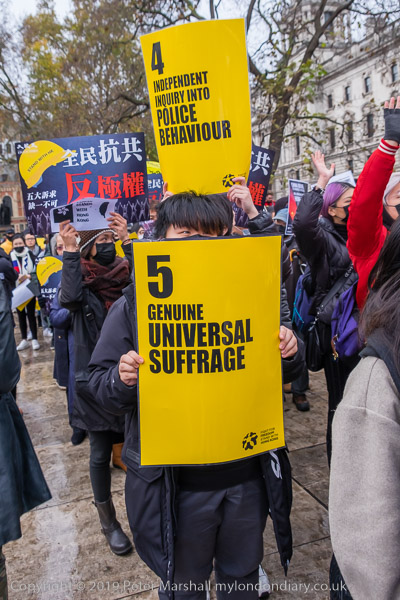
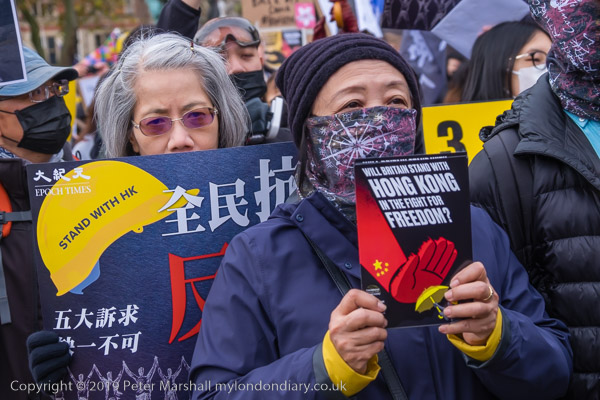
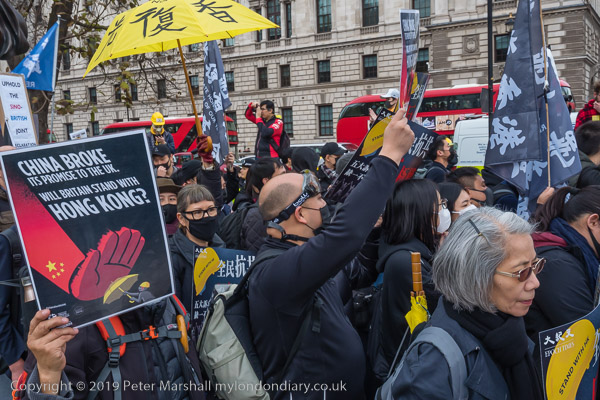
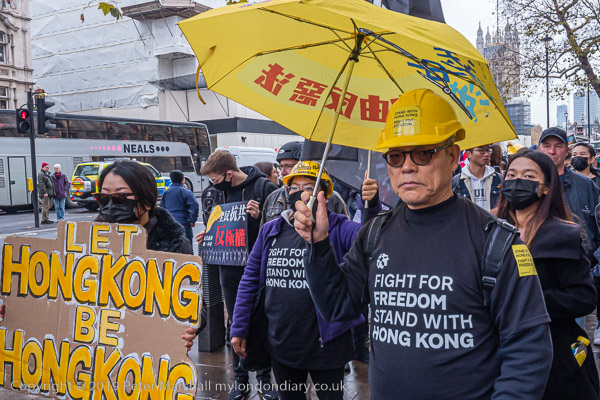
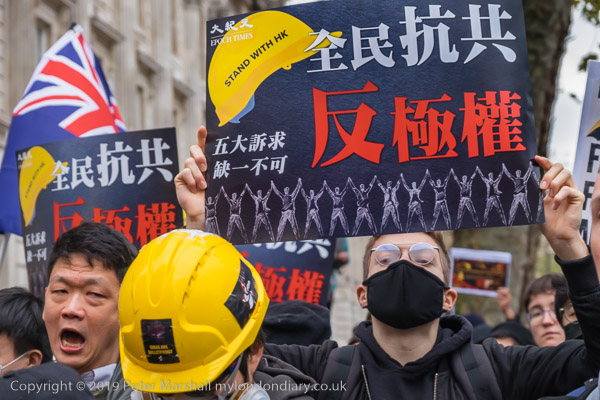
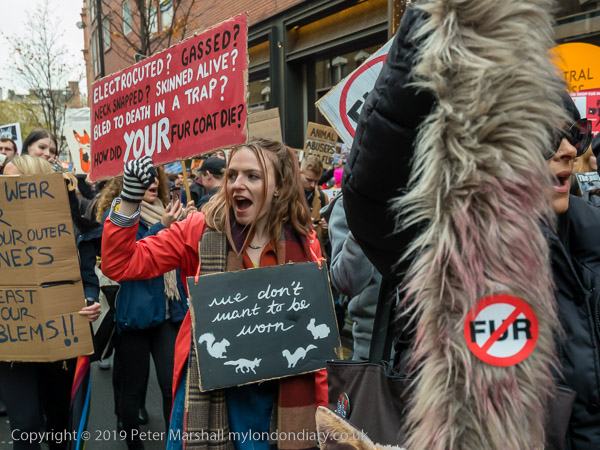
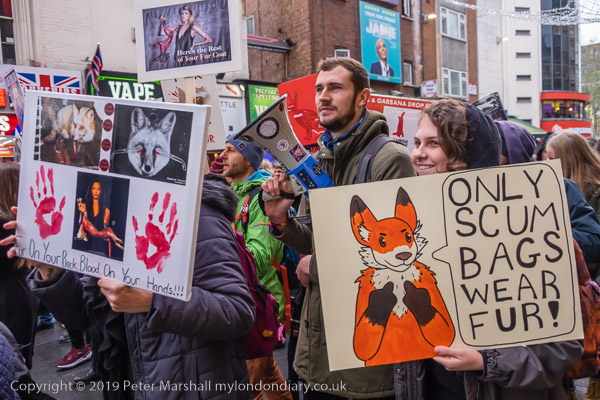
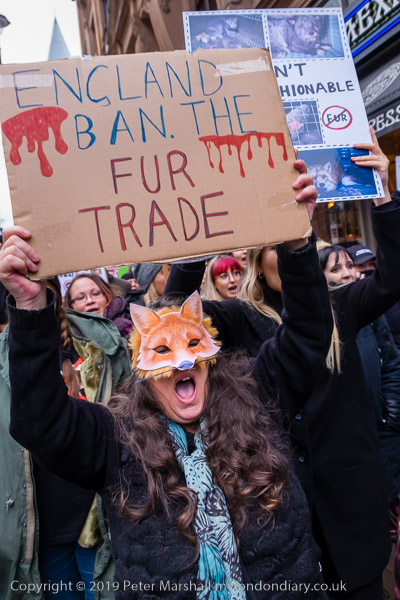
Hong Kong, Fur, Brixton & Carnaby – There were five events listed in my diary for Saturday 23rd November 2019, but I only photographed two of them, the Stand With Hong Kong march and rally and the annual March Against Fur, though I missed the others. But I did take a couple of short walks. I can’t remember now why I went to Brixton, but my trip to Carnaby Street was to see a small exhibition in a shop I had three pictures in.
Stand With Hong Kong – Westminster
Sadly the idea that the British Government could in 2019 have any real influence on China over the breaches of Sino-British Joint Declaration agreed in 1984 when Margaret Thatcher was in power was always an illusion.
In 2014 the Chinese government had said it regarded the agreement had already met its objectives following the handover in 1997 and they regarded it as now having no legal effect. The British government disagree but have no possibility of doing anything to change Chinese minds or actions.
So while I had great sympathy with people of Hong Kong who had been protesting there as well as their supporters in foreign countries including UK, it was clear that these protests would not change policies in Hong Kong.
Finally the British government had to admit this and it led to the setting up of the Hong Kong British National (Overseas) visa scheme in 2021, which allowed Hong Kong British National (Overseas) citizens (BNOs) and their close family members to move the the UK for five years after which they can apply for leave to remain and, after a further year for British citizenship.
Perhaps protests such as these did influence the government in how the scheme was set up, with a fairly generous interpretation of the rules governing family members, although the route to becoming a British citizen seems unnecessarily long and complicated.
BNO status was set up by an Act of Parliament following the 1984 declaration for Hong Kong residents who wished to retain a connection with the UK after the handover to China and had to be claimed before that too place in 1997. About a third of Hong Kong residents had BNO status and the scheme would also allow a similar number of their families to get visas.
Although the total number of people eligible to come to the UK was thought to be over 5 million, the number expected to take up the offer was expected to be around 320,000 and so far is only roughly half this. Although much cheaper than other visa schemes it remains quite expensive as a health charge is also applied and for a family with one child the total costs over the period to obtain British citizenship is around £20,000.
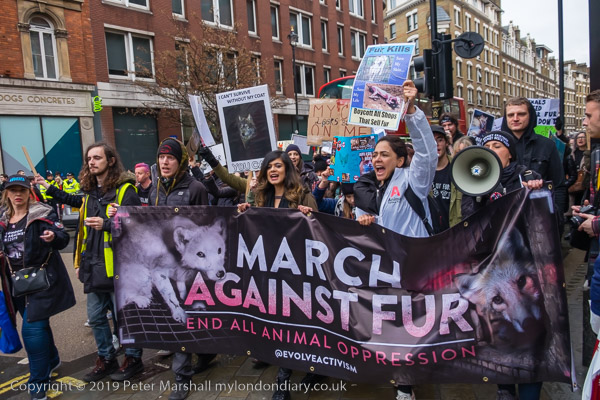
After a rally in Leicester Square the march set off through central London.
The march went along the pavement along Charing Cross Road, which was extremely crowded.
Though it spilled out onto the road.
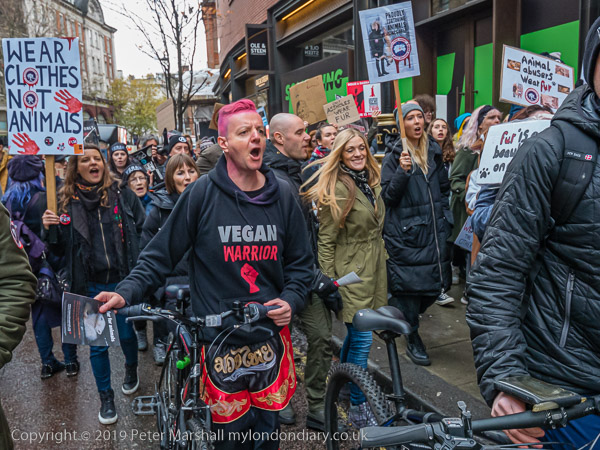
Although the main focus of the many posters was against fur and the ending of the fur trade, the main banner called for an end to all forms of animal oppression and many on the march were vegans.
I left the march as it turned down Shaftesbury Avenue for a tour of the West End and stores selling fur products, calling for an end not just to using fur in clothing but against all exploitation of animals of all species, whether for meat, dairy, wool, leather or other products.
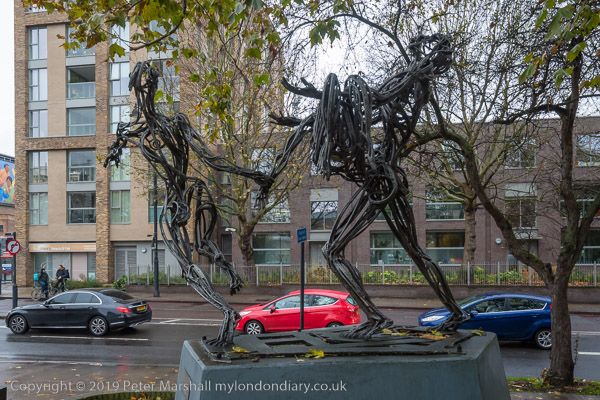
First Child by Raymond Watson, a memorial to 116 children murdered by the Afrikaner police force in Soweto in 1976 was the first public sculpture by a Black artist in the UK, commissioned in 1998 by the 198 Gallery.
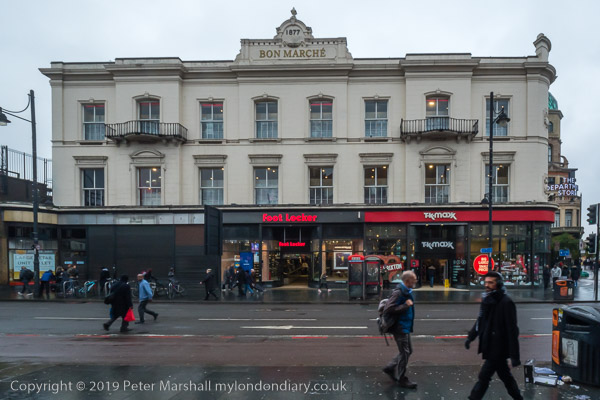
Bon Marché, Britains first purpose built department store, was opened in 1877. Its founder went bankrupt but the store continued in business with various owners until 1975. Since then it has been refurbished with almost all ground floor detail lost.
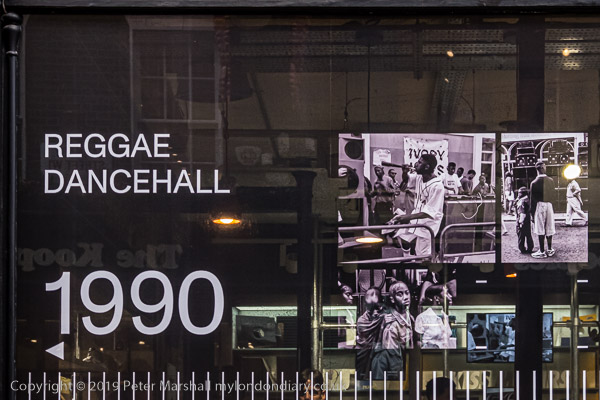
I paid a brief visit to Carnaby Street where 3 of my pictures were in the window of a shop called Size? in a temporary display celebrating the apparently iconic Nike Air Max 90 introduced in 1990. I took the three rather maroon images in this picture of the window and the one at the right, taken at Notting Hill Carnival in 1990 shows a man in rather long shorts wearing those trainers. There were ten panels in the display, the other nine using later pictures taken by other photographers.
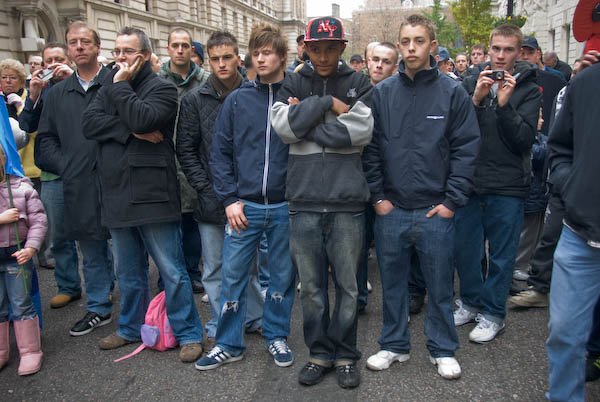
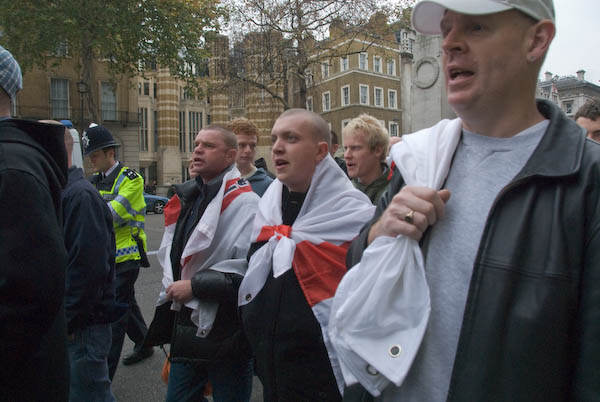
Our Flag & Olympic Site – On Saturday 17th November 2007 I had a more varied day than usual, beginning with a march my football supporters, then a walk around the outside of the then fenced off Olympic site followed by an Olympic-related symposium. I can’t remember anything about the symposium, though I think it was almost certainly critical of what was being done to London, its future being sacrificed to a highly commercial sports festival.
March For Our Flag – Westminster
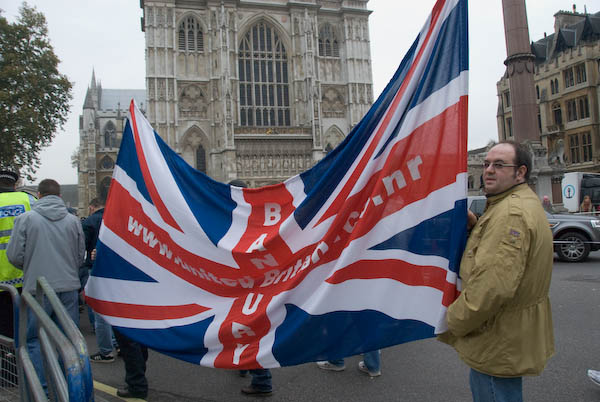
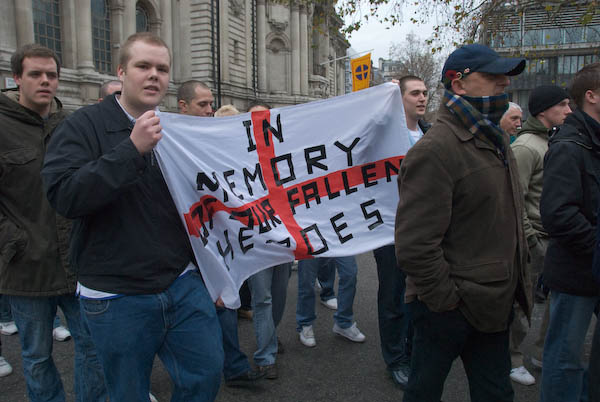
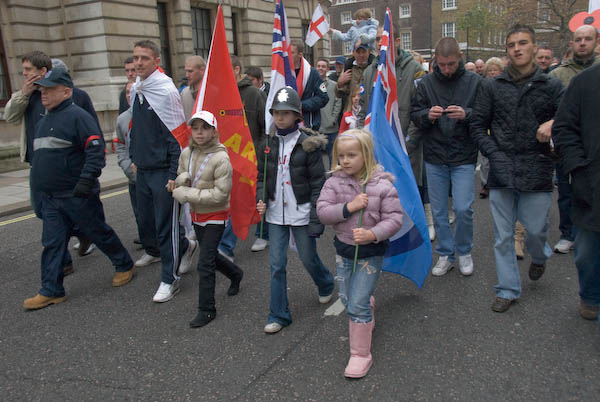
A few months earlier in February 2007 I’d photographed and written about a ‘March for Our Flag’ organised by football supporters, particularly Tottenham fans. The main group backing that – and the repeat march this month through Westminster – was the United British Alliance. There was a suggestion that, although a patriotic event, it was at least trying to detach itself from the racism of the far right.
The UBA web site described itself as “a multi-ethnic, multi-faith organisation with a passionate interest in reclaiming our once proud nation from the grip of international terror and political correctness gone-mad,with a view to re-installing some pride in our communities and way of life.”
As I commented in November 2007:
Although individuals may well be sincere in these attempts, it isn’t so easy to shake off this impression. Some of the links on the [UBA] web site are to people and groups who I would consider as having extreme views, and the discussion you can find on football forums and elsewhere seems clearly Islamophobic.
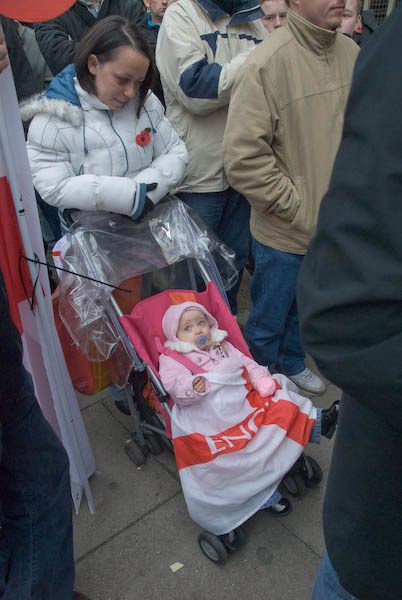
Although there were even fewer supporters this time – well under 200 – there did seem to be a slightly calmer attitude and a slightly wider range of people attending, although still only one or two black faces.
Curiously enough, on the UBA web site galleries, all the marchers have their faces – or at least their eyes – blacked out. The only people not given this treatment are the police escorting the event.
As I’ve often said, the only way to protect our freedom is by being free. That includes standing up for what you believe – and being seen to do so. So I’m totally opposed to this kind of censorship of the news. Freedom of expression is a part of the British heritage of which I’m proud. As too are Morris Dancing, Association and Rugby football along with the many other things, including the way we have successfully integrated elements from other cultures and religions into our way of life over the years – and continue to do so.
My pictures from the 17th November do show one or two families and their children took part and I can see just one darker face among the young men. In view of recent events and the behavior of Suella Braverman my final two sentences are very appropriate and very relevant: “We all need far more positive messages and actions from our politicians to lead us all – including Britain’s muslims to a new and united vision of our society. Islamophobia needs combating, not encouraging.”
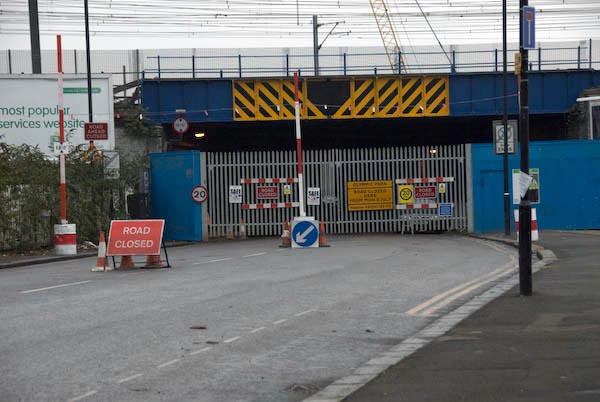
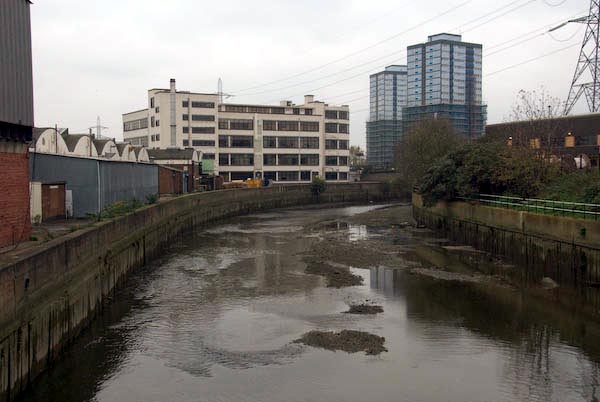
I walked out of Stratford Station and across the footbridge leading to the Carpenters Estate and on to Bridgewater Road, a dead end with a bridge across the tidal Waterworks River.
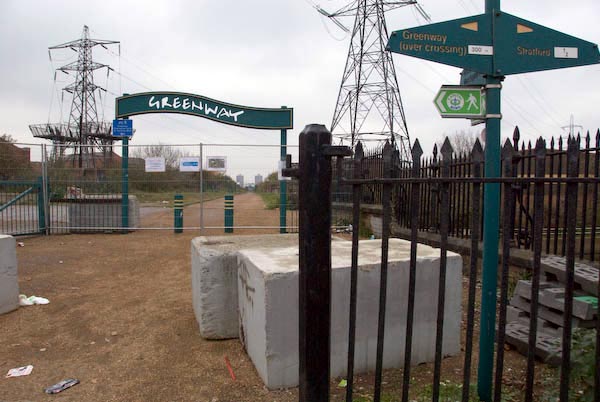
The road to Hackney Wick is firmly closed and so too was the Greenway just a few yards from the entrance on Stratford High Street.
You could walk down it just a few yards, and I took another picture looking back along the Waterworks River towards Bridgewater Road where I had been standing earlier.
I took a few pictures around the edge of the area, then walked back along the High Street towards the centre of Stratford.
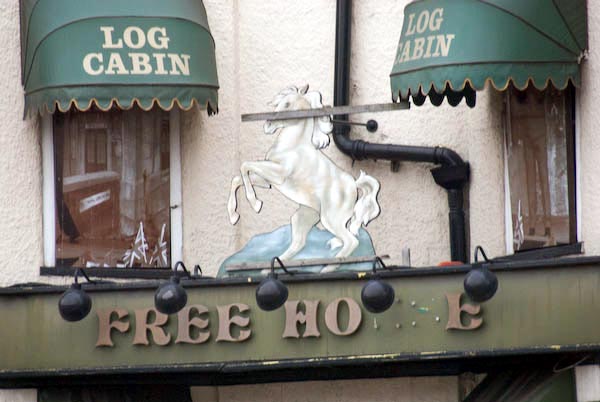
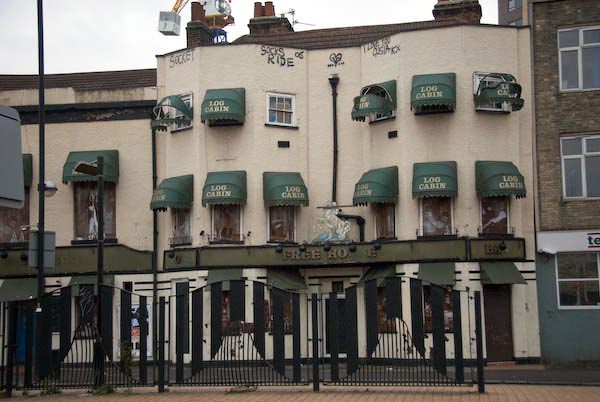
The Log Cabin pub had been here at 335-337 High Street, Stratford as a coaching inn since at least the mid-18th century, though it was known as The Yorkshire Gray before being renamed around 1997 when the hiddeous green excresenes were added. The building was Grade II listed in 2003, almost certainly saving it from demolition and is thought to date from around 1740, and though parts were rebuilt in the late nineteenth century much of the interior had survived more or less intact. It closed in 2001 and is now a hotel.
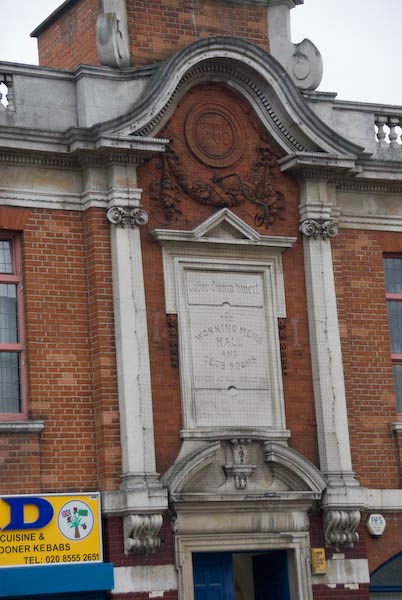
My final picture was at The Working Mens Hall and Club Rooms on Romford Road, founded in 1865 and rebuilt in 1905, with the motto Labor Omnia Vincit (Work Conquers All). Perhaps it was here that the symposium was held, and I have a very vague recollection of a talk by Iain Sinclair, although that could have been on quite a different occasion.
Refugees, Sharia and Islamophobia: In 2000 the UN June General Assembly declared that June 20th every year is World Refugee Day on which, as the UNHCR web site puts it, ‘the world celebrates the strength and courage of people who have been forced to flee their home country to escape conflict or persecution. The 2023 theme of World Refugee Day is “hope away from home.”’
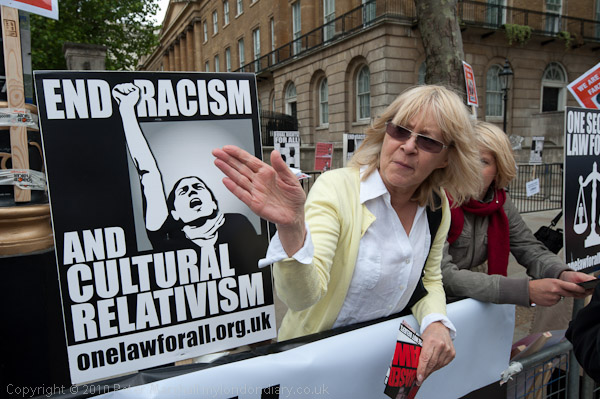
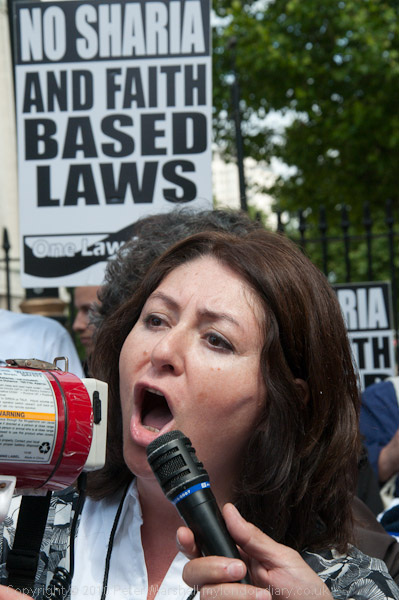
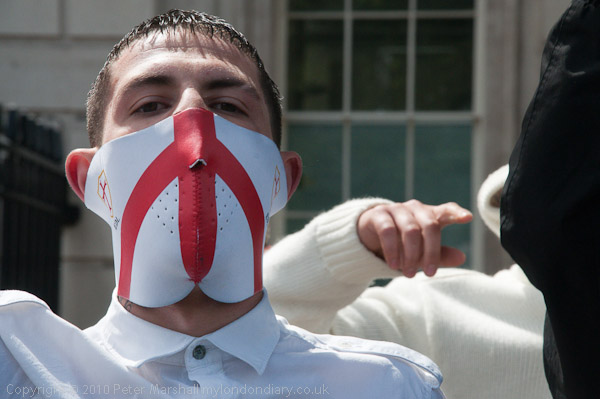
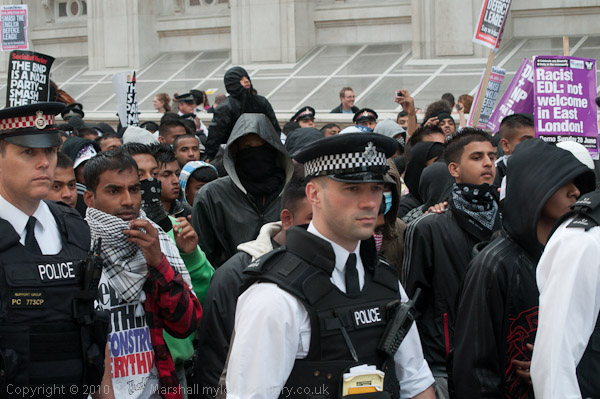
Back in 2010 it was celebrated with parades including one in London. Also on Sunday 20th June there was a rally by One Law For All calling for an end to Sharia and other religious laws, opposed by a small group of Islamic extremists, who were opposed by Islamophobic EDL supporters, in turn opposed by largely Asian East Londoners.
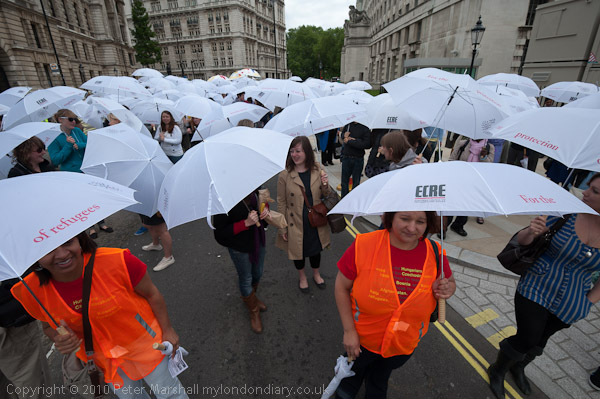
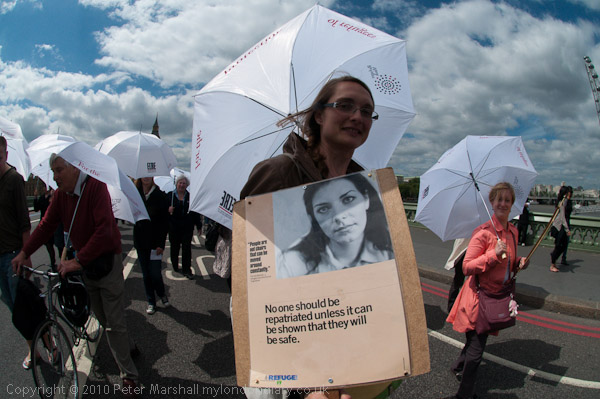
Umbrella Parade for Refugees – Whitehall to Geraldine Mary Harmsworth Park.
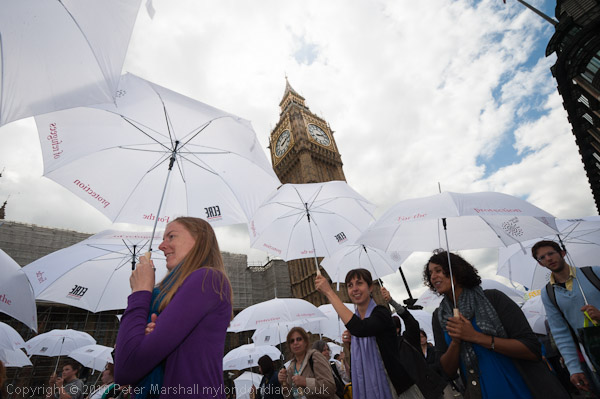
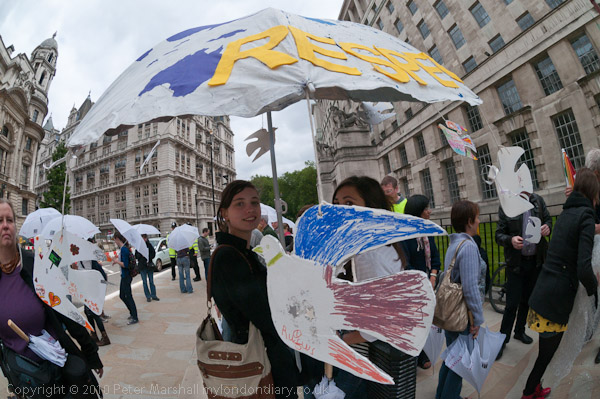
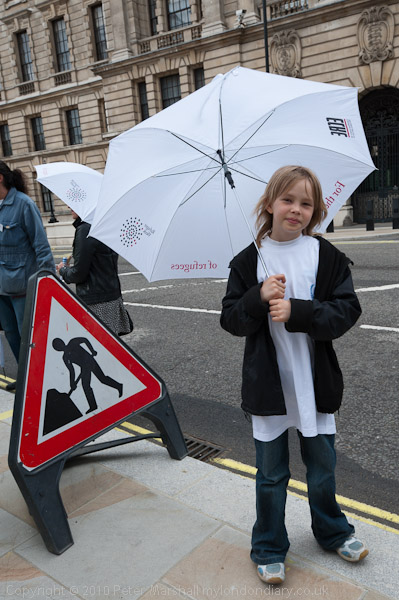
The London Umbrella Parade for refugees was organised by a partnership of groups including Amnesty International, British Red Cross, Oxfam, Refugee Action and Student Action for Refugees working with ECRE, the European Council on Refugees and Exiles, and the United Nations High Commissioner for Refugees.
The umbrella was “a symbol of care and shelter, representing our proud tradition of offering safety to those in need of international protection,” a tradition that was then clearly under threat from the UK Borders Agency, with forced deportation flights in which refugees are returned to an uncertain future in Iraq, with beatings on the flight and on arrival.
Since then we have seen successive Home Secretaries racheting up increasingly racist anti-refugee policies, now clearly and deliberately flouting international laws. The UK once had proud tradition and well-deserved reputation for upholding human rights, playing a leading role in establishing these human rights laws it is now breaking.
IN 2010 I wrote “Competition between the political parties to be even tougher on immigration and appease the right-wing press have serious eroded the chances of refugees and asylum seekers receiving humane treatment and proper consideration in the UK.” Things have travelled much further only this inhumane path since then.
I walked with the campaigners from the Defence Ministry in Horseguards Avenue down Whitehall, past the Houses of Parliament and across Westminster Bridge. The march ended with a picnic in Geraldine Mary Harmsworth Park outside the Imperial War Museum. The start and finishing places were chosen appropriately as most refugees and asylum seekers are a result of war.
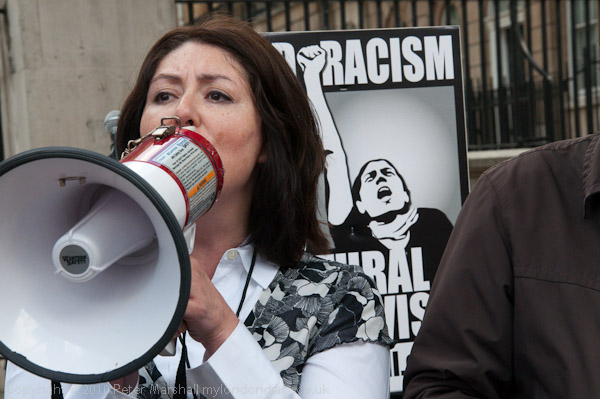
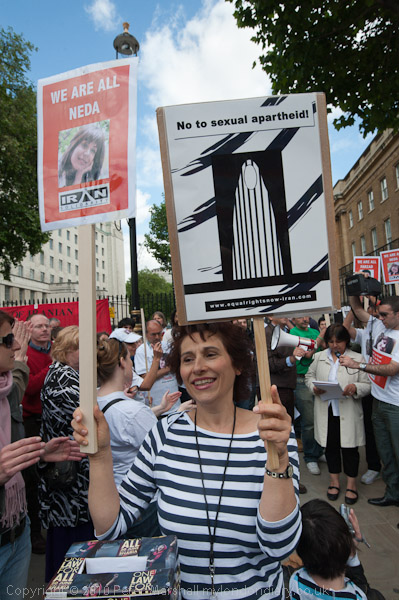
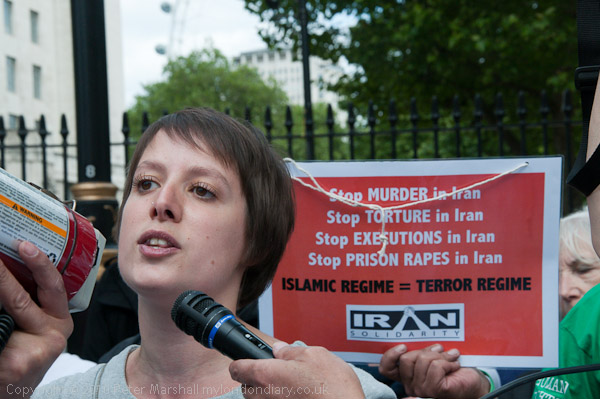
One Law for All campaigns against Sharia and religious arbitration in the UK, Iran and across the globe. They say these religious laws are discriminatory against and promote violence against women and have no place in the 21st century.
They want to end “religious laws and theocracy and promote secularism and the separation of religion from the state, education, law and public policy as a minimum precondition for the respect of human, women and LGBT rights.”
They have have campaigned for an end to Islamic regimes in Iran and Afghanistan, and have recently been involved in the Woman, Life, Freedom protests in London and elsewhere, promoting the Woman, Life, Freedom Charter.
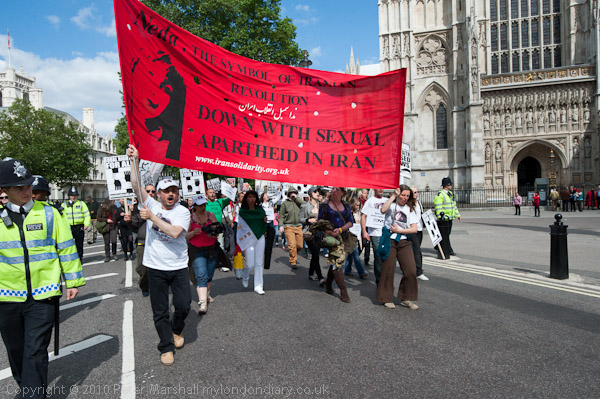
Their rally opposite Downing St on 20th June 2010 came on the anniversary of the the killing of Neda Agha-Soltan in Iran, and after the rally the several hundred taking part marched to the Iranian Embassy in Kensington.
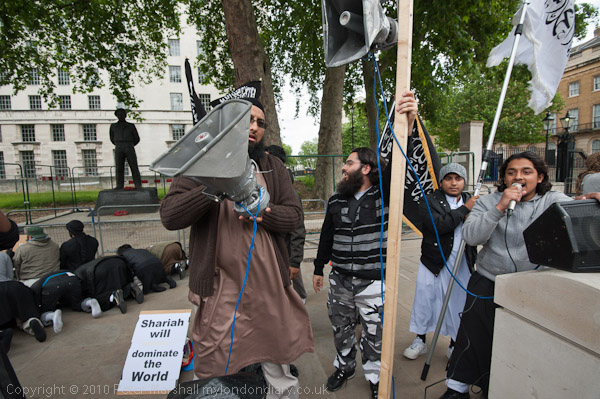
A short distance away were a group of mainly young Muslim men dressed in black and holding posters and flags. The called themselves ‘Muslims Against the Crusades’ or ‘Muslims Against Crusaders’ widely thought to be a reincarnation of the banned ‘Islam4UK’ (itself a relaunch of the banned Al-Muhajiroun.) One of their banners proclaimed ‘Sharia Will Dominate The World’.
In my 2010 account I quote from Maryam Namazie of One Law for all, writing on the Iran Solidarity blog:
“The battle against Sharia law is a battle against Islamism not Muslims, immigrants and people living under Sharia law here or elsewhere. So it is very apt for the Islamists to hold a counter-demonstration against our rally. This is where the real battleground lies. Anyone wanting to defend universal rights, secularism and a life worthy of the 21st century must join us now in order to push back the Islamists as well as fringe far Right groups like the English Defence League and the British National Party that aims to scapegoat and blame many of our citizens for Islamism.”
During the rally police escorted a small group of EDL supporters along Whitehall to opposite the Muslim protesters where they shouted insults and threat at both them and the photographers who went to take their pictures. After a few minutes they were led away to a penned protest area further south of the One Law For All rally.
A second much larger group were then brought down Whitehall, much more carefully surrounded by police, making them hard to photograph. Some carried Unite Against Fascism placards and most of the several hundred were young British Asians. Earlier the UAF and United East End had marched frpm Stepney Green to a rally at Whitechapel against the EDL and this group had marched to confront them in Westminster. But by the time they arrived the One Law for All rally had ended and the Muslims Against the Crusades had left.
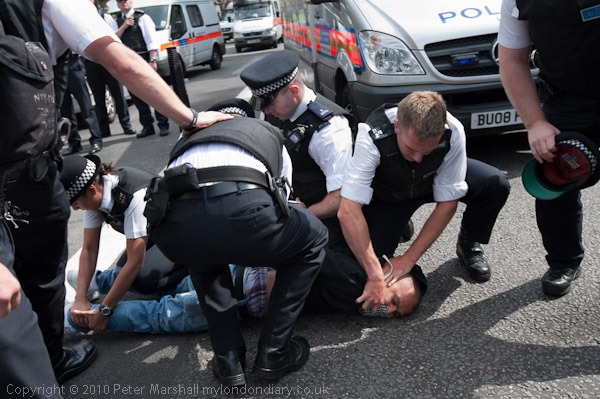
After some minutes photographing the young Asians, including one man being rather forcefully arrested, mainly having to work over the heads or between their police escorts, I rushed after the One Law For All marchers to take more pictures.
I didn’t make it to the Iranian embassy. By the time the march was passing Victoria Station I decided I was tired and had taken enough pictures and got on a train to begin my journey home.
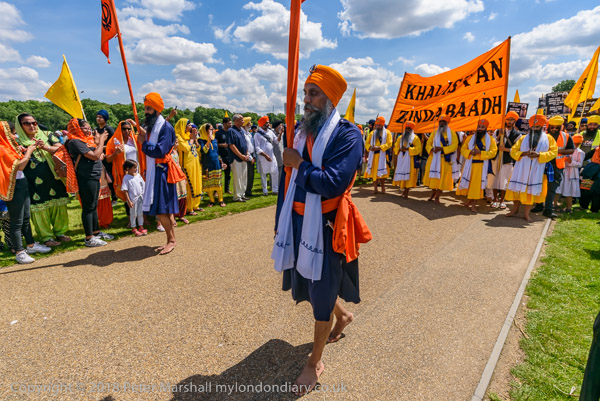
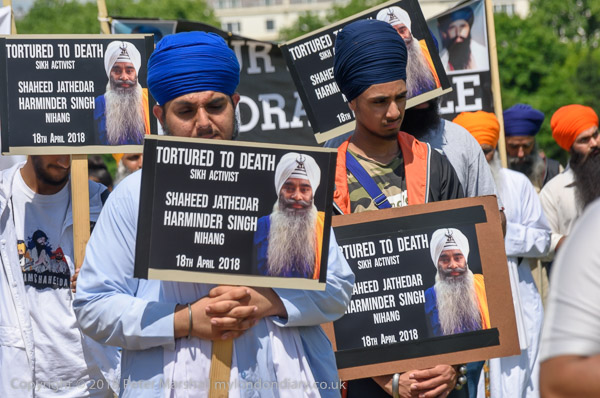
Five years ago today on Saturday 3rd June 2018 I photographed two events in London, beginning with a protest opposite Downing Street by campaigners against gun and knife crime and moving on to an annual march remembering the 1984 Indian Army attack on the Golden Temple in Amritsar where thousands of Sikhs were massacred, and the Indian government encouraged mob killings of Sikhs across the country following the assassination of Indira Gandhi by her Sikh bodyguards later in the year.
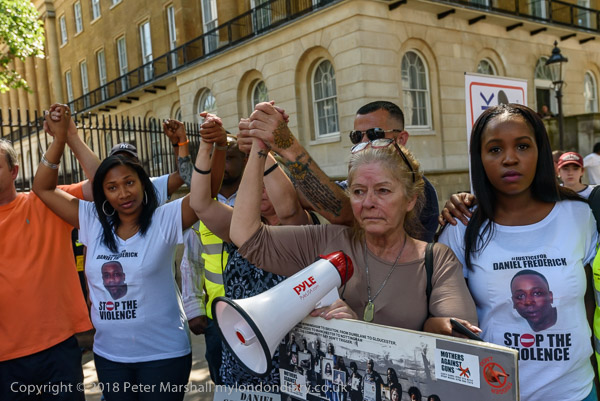
Anti-Knife UK protest – Downing St
The event was organised by Anti-Knife UK, founded by Danny O’Brien in 2008 which monitors knife crime incidents from across the UK on a daily basis. 2008 had been a particularly bad year for the murder of teenagers on London’s streets, with 29 deaths, and thought the numbers had gone down until 2012 when there were 9 such deaths by 2017 they back up to 27.
All of these deaths are tragedies for the teenagers and their families, and the numbers of crimes involving knives across England and Wales is huge – now over 45,000, though many of those are for possession of knives – and the total number of deaths is the year ending march 2022 was 261.
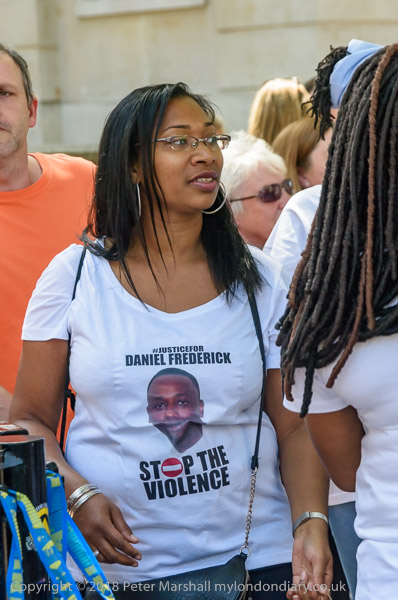
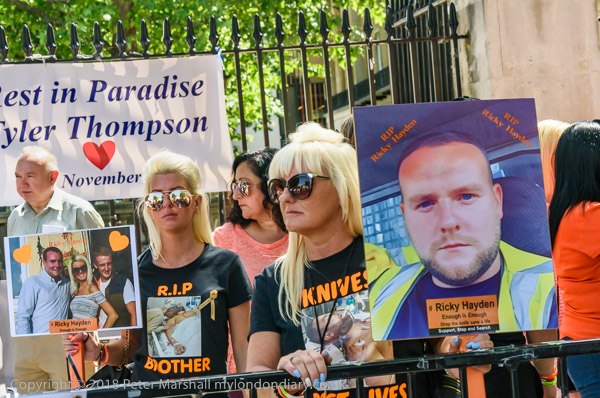
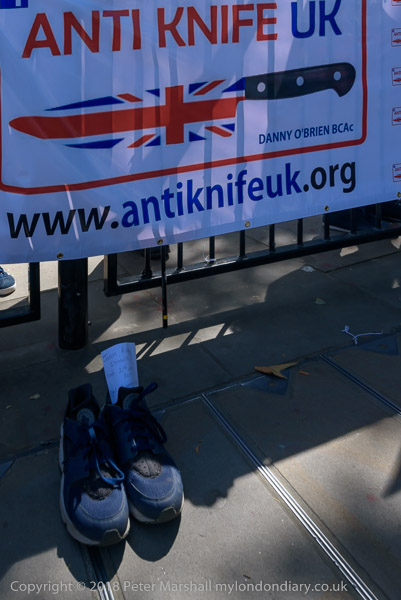
Many of those at the protest were bereaved family members and their supporters and were wearing t-shirts or holding placards with photographs of the knife victims and pairs of empty shoes as well as banners.
Speakers called for measures to tackle the problem including tougher sentences, tagging of all knives, knife arches in night clubs, equal rights for victims and families, a review of the laws governing self-defence and reasonable force and work in schools and communities.
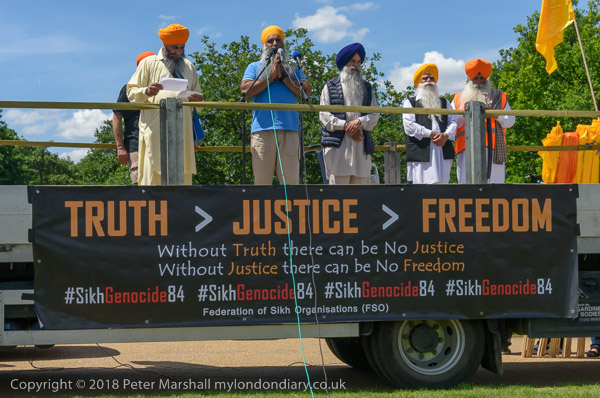
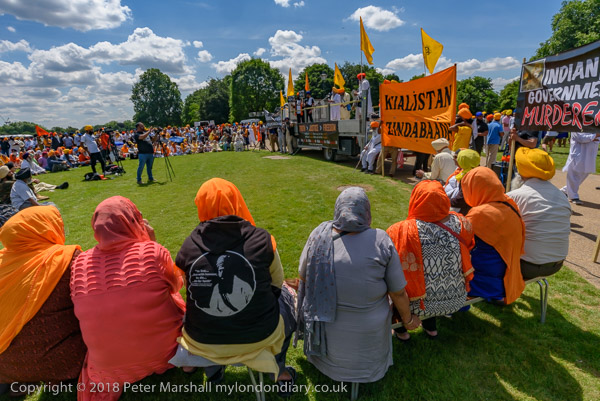
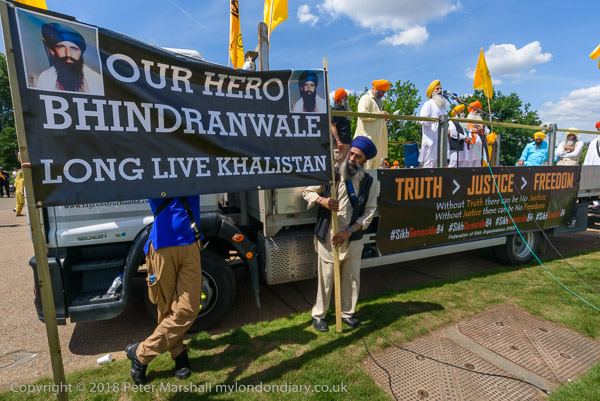
I went to meet a large crowd of Sikhs at a rally in Hyde Park before the march, sitting on the grass. It was 24 degrees in London, and without any shade I was far too hot. Few of the speeches were in English, but many of the placards were and others graphically made their message clear.
Sikhs were badly treated by the British at the time of partition which divided the country up between the Hindus and Muslims, with millions of people having to flee across the borders of the new states and millions were terribly killed in doing so. Sikhs had called for an independent Sikh state in the Punjab, but most were simply lumped in, along with Buddhists and Jains with Hindu dominated India, although large numbers also remained in the part of the Punjab which had been designated as Muslum Pakistan.
Although there were large numbers of Sikhs across the Punjab before partition were still a minority population and they were not united in their demands for an independent state of Khalistan. Althugh they would probably have been better joining Pakistan, their cultural ties to Hinduism as well as a history of persecution by Muslims led them to instead unite with India. Many Sikh leaders had been involved with the Indian Congress Party which had made them promises about their position in India where the are less than 1% of the population but these were never kept.
The idea of a separate Khalistan became talked about more widely particularly in the diaspora in the 1970s, with the movement in Punjab led by Jarnail Singh Bhindranwale advocating an autonomous state within India. The movement had become increasingly militant with a number of armed supporters, setting up in 1982 what Wikipedia describes as ‘what amounted to a “parallel government” in Punjab‘.
In June 1984, the Indian Army launched Operation Blue Star to remove Bhindranwale and his armed followers from the Golden Temple complex in Amritsar, killing Bhindranwale and large number of his supporters as well as many civilians as the temple was packed with pilgrims. The figures for deaths are disputed but probably between 5-7,000, with around 700 of the Indian army also dying.
In 2018 I commented “Since this 1984 Sikh genocide there has been a continuing program of police arrests, torture and killing of Sikh males in the Punjab and crippling economic and social policies. Sikhs demand independence from India and a Sikh state, Khalistan.”
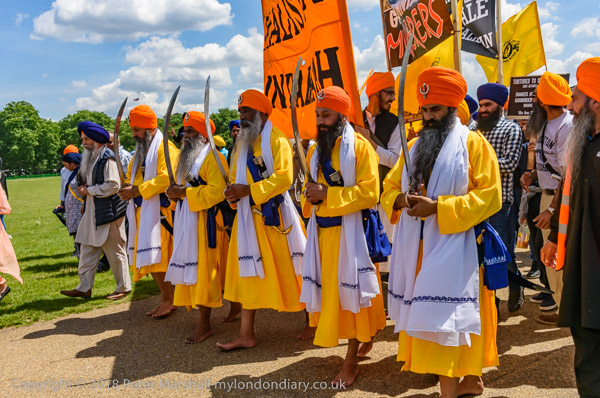
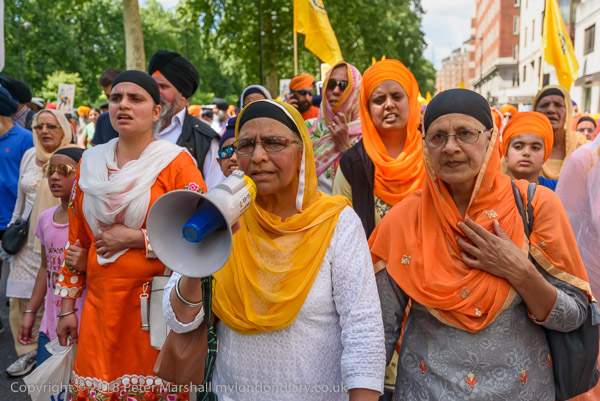
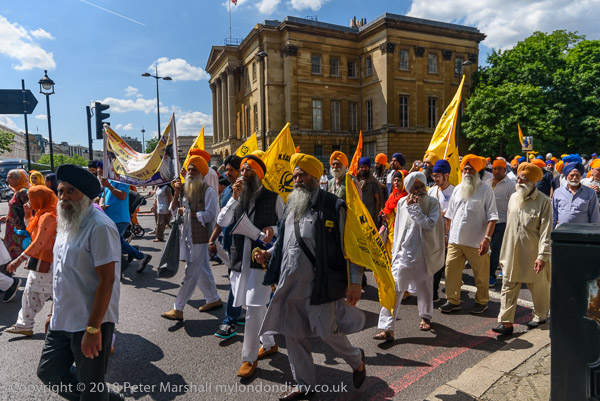
After the rally the march set off, led by Sikh standard bearers and five Khalsa representing the Five Blessed Ones or Panj Pyare holding swords and walking barefoot in their orange robes and followed by several thousand Sikhs with flags, placards and banners. I talked with them past Marble Arch and down to Hyde Park Corner where I left them going down Piccadilly towards another rally at the end of the march in Trafalgar Square.