May Day

Today’s May Day will be very different, with no march in London, no meeting in Trafalgar Square and none of the other activities we have seen in recent years. There will be online events, but it really isn’t the same. And I think I will take few if any pictures.
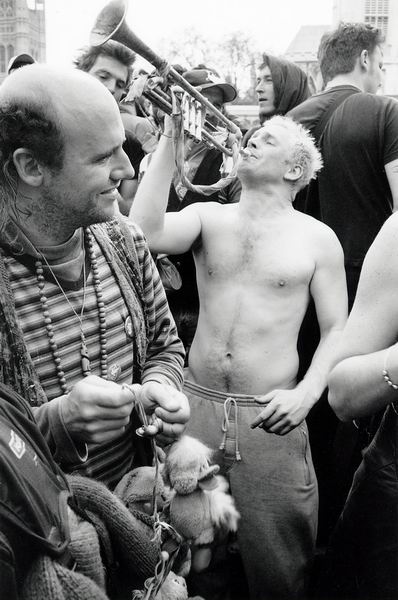
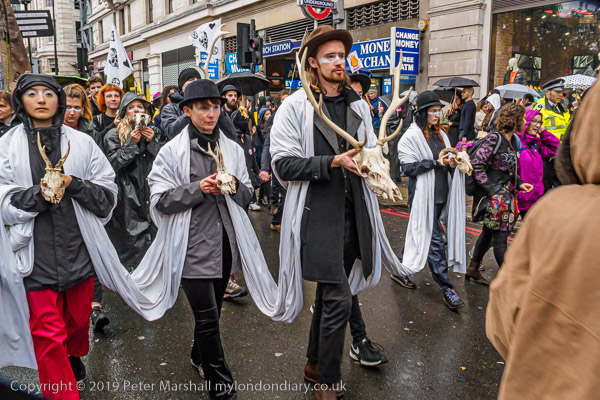
Until 2000, I was working on May Day most years and missed the May Day celebrations, except, when as in 1999 they fell on a weekend. In 2000 things were a little different, and while doubtless the usual trade union celebrations went on, rather more of us gathered in Parliament Square on May Day, a Monday, for an anti-capitalist protest, indulging in a little guerilla gardening. It wasn’t as the BBC and newspapers recorded a riot, but a good-natured protest with people having fun and a little minor law-breaking and only became nasty when the police charged in after windows were broken at a McDonald’s. I went home as I didn’t want to be kettled.
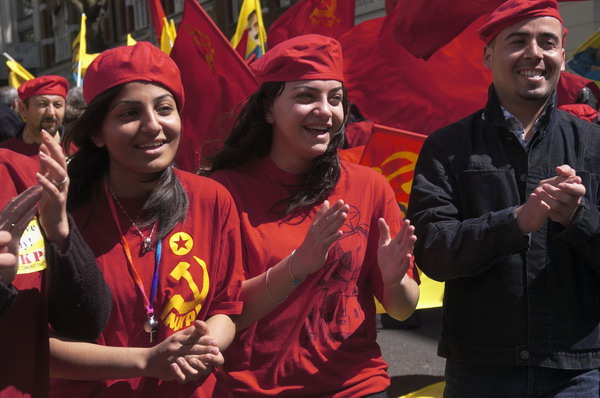
It was 2003 before I returned to photograph May Day events, and I wrote:

may day has perhaps settled into a rather predictable event now. the socialist left – and what is left seems to be a few unions and a number of ethnic communist party groups – march from clerkenwell to trafalgar square, while anti-capitalist protestors do not a lot around town.

My London Diary
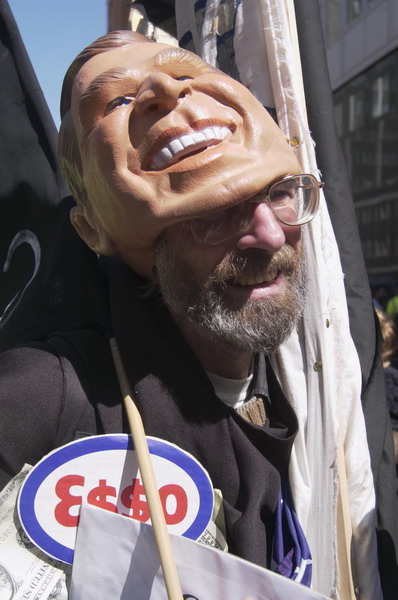
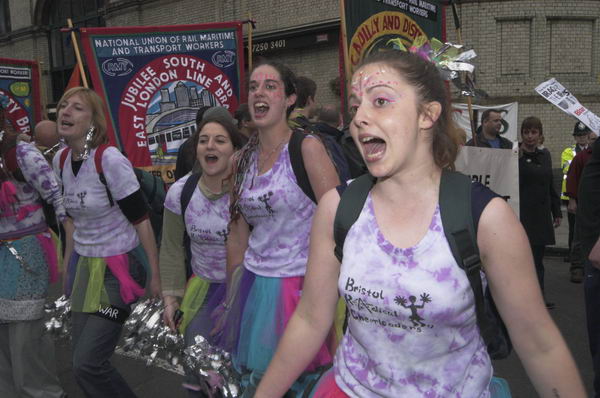
and the few images I put on line reflect this. My coverage the following year, 2004, was a little more upbeat, perhaps because I met up again with the Bristol Radical Cheerleaders who certainly livened things up, but also because I was getting better at using a digital camera. But most of my coverage then was still in black and white and I still haven’t added the pictures I said would follow.
I photographed May Day and the march again in 2005, but the highlight of the day was provided by the Space Hijackers who had challenged our 600 odd MPs to an Anarchist Cricket match to be held in Parliament Square.
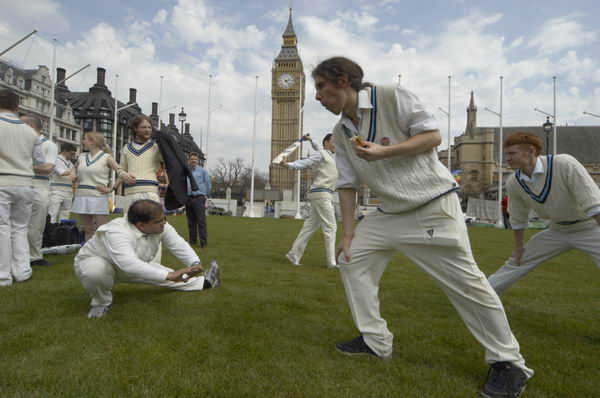
I wasn’t surprised when no members of the opposing team actually turned up, but their absence didn’t detract from the event.

2006 was perhaps my busiest May Day ever, beginning with the launch of the London Citizens Workers’ Association at Westminster Cathedral, then photographing the London May Day March, which included a strong autonomous anti-capitalist bloc.
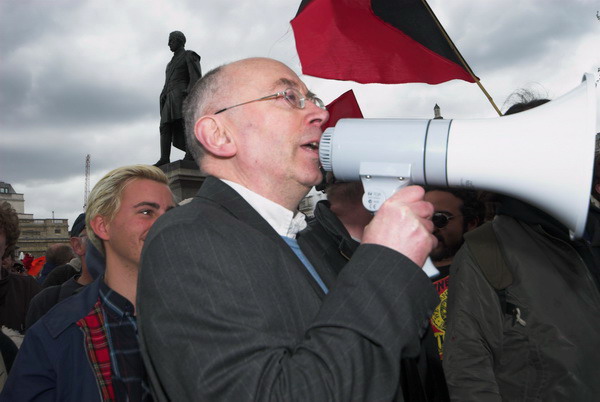
Among the speakers at Trafalgar Square, though not on the main platform was Ian Bone of Class War, once labelled the most dangerous man in England, and even at this event attracting considerable police attention.
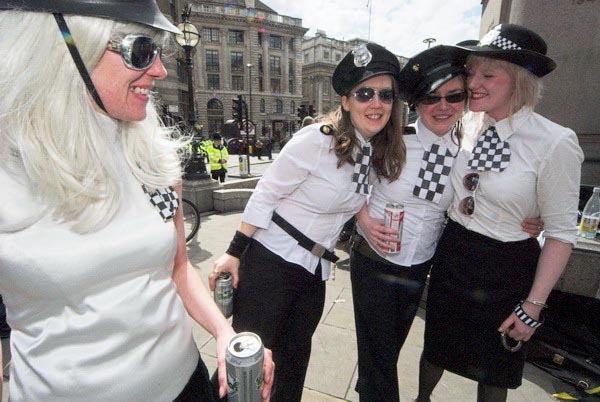
I went on from Trafalgar Square to the Bank of England where the Space Hijackers were holding their Police Victory Party. Unlike at their cricket match there was a large attendance by the opposition, though they didn’t really join in the party organised for them.

Long Live May Day!


All photographs on this and my other sites, unless otherwise stated, are taken by and copyright of Peter Marshall, and are available for reproduction or can be bought as prints.


Sue Davies (1933-2020)

I was sad to read yesterday of the death of Sue Davies, who was the inspiration and for around 20 years director of London’s Photographers’ Gallery, the first permanent space in the UK dedicated to showing photography.

You can read as I did her obituary by Michael Pritchard on the British photographic history blog which gives details of her life and her great contribution to photographic life in this country, beginning at the ICA before founding the gallery, and I won’t repeat what he says here, but add my own personal thoughts, not about Sue Davies, who I never knew well, but about the gallery she founded.

Before I became an active photographer I had been for a short time a member of the ICA but cannot remember which exhibitions and events I attended there (it was the ’60s and a long time ago.) But the opening of the gallery in Great Newport St more or less co-incided with my moving back down south and my beginnings as an active photographer, and though I missed its start I was soon a member and a regular attender at openings and talks there.

I never really got to know Sue Davies, though I did occasionally talk to her at events over the years, but I did get to know some of the staff who worked with her, particularly in the bookshop and cafe, as well as volunteers who staffed the library and photographers who like me would drop in occasionally when they were around in London, perhaps for a coffee and to browse in the bookshop. After lectures and openings some of us would find our way to the Porcupine pub close by where the discussions were often intense and opinions rather more frank than in the gallery.

For some years too the gallery hosted a group of “young” photographers, though some were even older than me and we would bring in our own work for discussion, sometimes with more established photographers – such as Martin Parr – coming to add their views. And although I never found taking my work to show the gallery curators helpful, I did benefit from an insightful and embarrassingly public review at a gallery event by Ralph Gibson.

As Pritchard states, “Davies was encouraged to step down as director in 1991” possibly because of problems with funding and somehow after she left the gallery was never the same for me. Of course there had been other changes – the young photographers group had been dropped, probably because it was too anti-establishment (and the gallery did have a clique of the old guard we considered as the dead hand of UK photography.) And a few years earlier Clare de Rouen had left the bookshop to work at Zwemmers around the corner where many of us spent more time.

But there were other changes, with programming that appeared to me in general less interesting, and certainly in more recent years often showing work that seems of relatively little photographic interest. So much so that I decided a few years back not to renew my membership, despite still feeling considerable gratitude for its past.


1986 Complete – Page 2

Varden St, Whitechapel, Tower Hamlets 86-5d-11_2400

Images in this post are embedded from Flickr where you can view them at a large size by clicking on the image. You will need to use your browser back button to return to this post. Or you can right-click and select ‘Open link in new tab’.

My album 1986 London Photographs is now complete on Flickr, and this is the second of a short series of posts pointing out a few of my favourite images from the year.

Fashion St, Spitalfields, Tower Hamlets 86-4r-16_2400

Several things come out strongly to me as I look through these pictures, mostly taken around Brick Lane and other areas of Whitechapel. One of the major themes that has run through much of my photography is the writing on the wall, whether graffiti or signs and posters. Language is such an important aspect of our social interactions and its inclusion in these images makes them into a record of how people lived and thought.

Brick Lane, Spitalfields, Tower Hamlets 86-5a-01_2400

In 1984 London was rapidly becoming the multicultural city we now know, though of course it had been so on a lesser scale for many years if not centuries. Spitalfields where some of these pictures were made had long been a home for new communities moving to London and there was still abundant evidence of its Jewish population as well as the Bangladeshis who had by then largely replaced them.

Commercial Rd, Whitechapel, Tower Hamlets 86-5c-64_2400

Housing, then as now, was an important issue in London in particular, and some of these pictures reflect this and other issues such as racism. Although I think some of these pictures are well-composed and even attractive compositionally, I’ve always considered the formal aspects – line, shape, tone, texture, form etc to be the means to communicate a message rather than an end in themselves. I aimed to make photography that had something to say and said it well rather than to produce well composed, attractive or even striking or popular images.

Limehouse, Tower Hamlets 86-5h-66_2400

There are another 95 pictures on the second page of the album, all with a location, taken from the usually rather incomplete information I recorded on the contact sheets. I’ve tried to check these before posting, but corrections and other comments are always welcome. I’m happy for these pictures – with suitable attribution – to be shared on social media, but they remain copyright and any commercial or editorial use requires a licence from me.


All photographs on this and my other sites, unless otherwise stated, are taken by and copyright of Peter Marshall, and are available for reproduction or can be bought as prints.

There are no adverts on this site and it receives no sponsorship, and I like to keep it that way. But it does take a considerable amount of my time and thought, and if you enjoy reading it, please share on social media.
And small donations via Paypal – perhaps the cost of a beer – would be appreciated.


Tags: 

South of the River 1985

Container ship, biker, Shornemead Fort, Shorne, Gravesend, Gravesham 85-6c-43_2400

In 1984, I more or less came to an end of my work on the River Lea (though I returned to it later) and the major focus of my photography shifted to London’s Docklands, and I’d photographed the West India and Millwall Docks as well as the Royal Docks, pictures from which I’m currently posting daily on Facebook. And later in that year I also went to the Surrey Docks, where work by the London Docklands Development Corporation was well advanced.

I was very aware of the political dimensions of the redevelopment, with the LDDC taking over from the elected local authorities and imposing its own largely business-led priorities which although accelerating the development distorted it away from the needs of the local area, and particularly away from the still pressing need for more social housing and for better employment opportunities for local people.

Northfleet, Gravesham 85-8e-35_2400

In those years I read every book in my local library on the history and geography of London, and began to build up my own collection of older works bought from secondhand bookshops and by post. Before the days of on-line listings I used to receive a monthly duplicated list of books on offer from a dealer I think in Brighton, and found many topographic and photographic items of interest, often very cheaply, and would look forward to receiving heavy parcels wrapped in several layers of newspaper. Yes, there was mail order before Amazon, and it was rather more exciting.

Cement Works, Northfleet, Gravesham 85-8e-53_2400

It was reading one of the books, Donald Maxwells ‘A pilgrimage of The Thames’, published in 1932 with his imaginative text and evocative drawings (some originally printed in the Church Times) that prompted me to walk in 1985 as he did from Gravesend west through Northfleet and Greenhithe exploring what he christened ‘the Switzerland of England’. As a rather more down-to-earth guide I also had the more academic ‘Lower Thameside’ picked up for pennies in a secondhand bookshop, which included a chapter on its 1971 cement industry by geographers Roy Millward and Adrian Robinson.

Crossness Marshes, Belvedere Power Station, Belvedere, Erith 85-9j-53_2400

My series of walks traversed what was an incredible industrial and post-industrial landscape, altered on a huge scale by quarrying and industry, continuing past Gravesend along the riverside path past Erith and Woolwich to Greenwich and Deptford (areas also covered in my 1985 London Pictures), as well as walking further east to Cliffe and Cooling.

Cement Works, Manor Way, Swanscombe, Dartford 85-9g-36_2400

It was a project that I returned to for several years – and I went back to the area more recently when the Channel Tunnel Rail Link was being built as will as the occasional walk or bike ride over the years.

You can see 280 of my pictures from 1984 now on Flickr in the album
1985: South of the River: Deptford to Cliffe


All photographs on this and my other sites, unless otherwise stated, are taken by and copyright of Peter Marshall, and are available for reproduction or can be bought as prints.

There are no adverts on this site and it receives no sponsorship, and I like to keep it that way. But it does take a considerable amount of my time and thought, and if you enjoy reading it, please share on social media.
And small donations via Paypal – perhaps the cost of a beer – would be appreciated.


Regents Canal 200

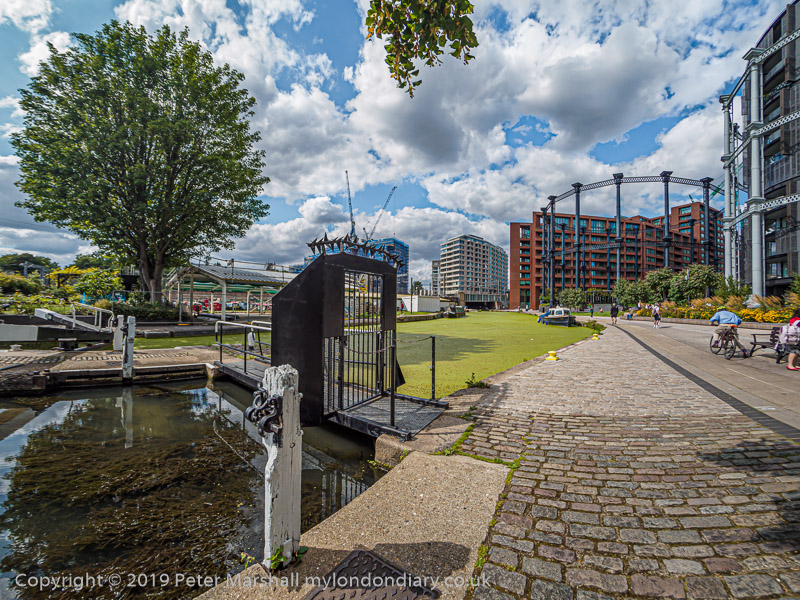
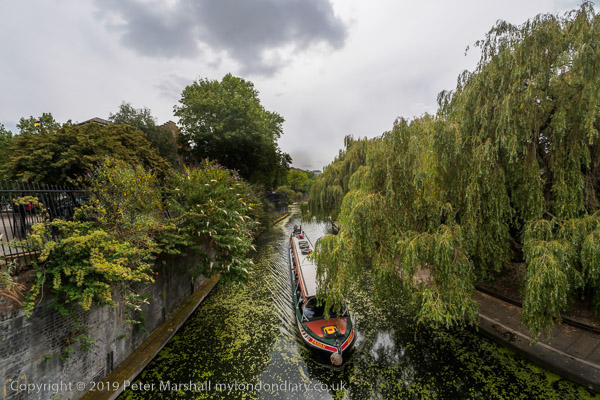
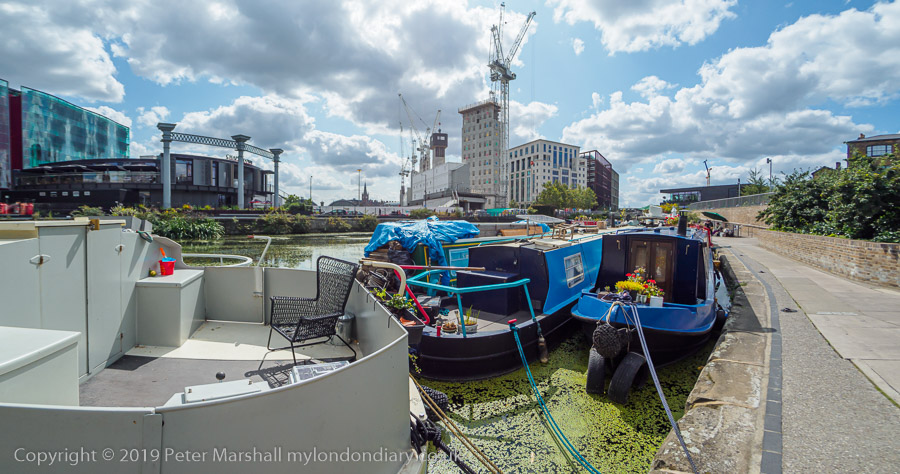
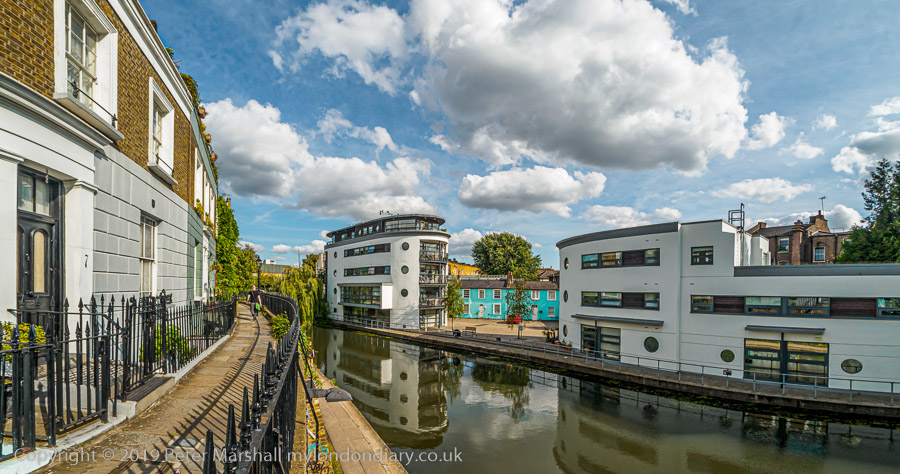
For various reasons it took rather longer than expected to build the Regent’s Canal around the north of London, joining the Grand Union Canal Paddington Arm to the River Thames at Limehouse, but the full length was finally opened in 1820, two hundred years ago this year.

Having realised this anniversary was approaching, early in 2019 I began a series of pictures to celebrate it, and had been intending to present these in a small show I was to have along with an artist friend, Hilary Rosen, at the Street Gallery in University College Hospital London.

The show was to have opened on 19th March this year, but a few days before we realised that it would be impossible because of the Coronavirus pandemic. We had to cancel the opening, but then it became clear to us that it would not be sensible to invite people to go to a hospital to look at an exhibition, and told the gallery that it had to be postponed. A few days later, the government realised they had to do something too, and on March 23 imposed the lockdown.

I’d picked just a dozen images for this show, but had taken hundreds if not thousands in preparation. I’d had the pictures printed and had spent a day mounting and framing them on the Sunday before the show was to start, but simply had to take them back up into my loft rather than to be hung at the gallery.

In making my selection I’d obviously wanted to show what I thought were the best images, but also to show work along the length of the canal from its start at Little Venice to its end at Regent’s Canal Dock (now Limehouse Dock marina.) My preliminary selection included several images from some of the more interesting areas, as well as a few from other places that didn’t make the final cut.

Rather than go back and make a new selection for an on-line presentation I’ve decided to simply put the 42 from my preliminary selection on-line, and to do so on Flickr, where they are displayed at a higher resolution than on Facebook or my own web site (where I think most or all have already appeared at smaller size.)

The images appear in two different aspect ratios, though they all have more or less the same horizontal angle of view, roughly equivalent to the full human binocular field of clear vision. Some are cropped at top and bottom, enabling me to move the horizon away from the centre line and to avoid the more extreme curvature at the edges which the necessary non-rectilinear perspective needed for such extreme angles of view dictates.

You can see them at Regents Canal 200 on Flickr.

C-type prints from the exhibition were to be on sale unframed and printed with images 42×22 cm or 36×24 cm (and a white border) at £200. For this online show they can be ordered direct from 6me at half this price, £100, including postage and packing to the UK. Overseas orders will cost a little more.


All photographs on this and my other sites, unless otherwise stated, are taken by and copyright of Peter Marshall, and are available for reproduction or can be bought as prints.

1986 Complete – Page 1

Images in this post are embedded from Flickr where you can view them at a large size by clicking on the image. You will need to use your browser back button to return to this post. Or you can right-click and select ‘Open link in new tab’.

Commercial St, Tower Hamlets 86-2d-51_2400

My album 1986 London Photographs is now complete on Flickr, and this is the first of a short series of posts pointing out a few of my favourite images from the year.

Of course the 1370 pictures in the album are not all I took that year, but perhaps about a quarter or a fifth. Quite a lot more than I would have selected or shown back in 1986, but the content has aged well, even if sometimes the actual physical negatives have deteriorated. Images that might have seemed a little mundane when I first saw them on the contact sheets have often gained considerably in interest as historical records.

There is a little redundancy in those 1370, and I’ve sometimes included several pictures of the same subject, where I’ve tried different ways to approach it. But the great majority of subjects were treated to only a single frame.

Crosby Row, Southwark 86-4f-11_2400

Many of those not included still have interest and value as historical records, but preparing them to go on line is tedious and time-consuming, particular as some need quite extensive digital retouching after the ‘scanning’ stage – mostly done by photographing the negatives with a Nikon D810 and Nikon 60mm macro lens. Some of my negatives were damaged by minute insects in search of gelatine, leaving their track as they chewed their way across them and depositing their frass and occasional body parts and complete restoration isn’t always possible.

Reuter, Royal Exchange, City 86-4l-66_2400

I’ve also been having problems in getting even lighting at the negative edges. This isn’t a problem with mounted slides, where the image is cropped, but I want the whole image, and possibly the problem is with light diffusing from the clear film edges. But it does mean every frame needs correction in Photoshop – rather like the little bit of edge-burning we used to do under the enlarger.

Courtenay Square, Kennington, Lambeth 86-4q-45_2400

I was working on a number of themes at the time and as well as recording buildings that interested me was particularly interest in sculptures, shopfronts, shop window displays and trees in the city. The first page of pictures on Flickr (100 images) includes work mainly from Southwark, the City of London and Spitalfields.

Brick Lane area, Spitalfields, Tower Hamlets 86-4p-55_2400

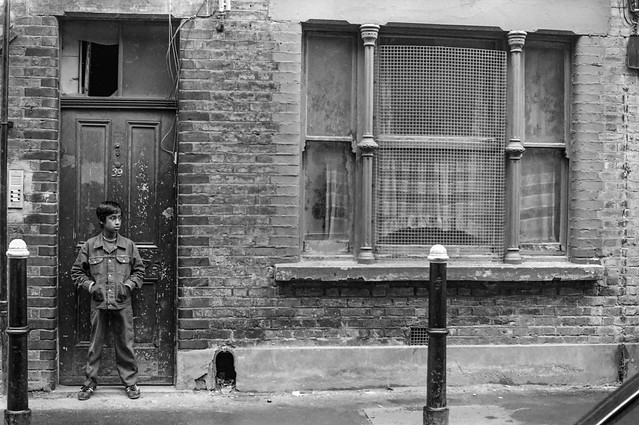
I took very few pictures of people at this time, partly because I was rather shy, but more that I had been affected by some feelings being strongly expressed by some at the time about privacy and arguments that it was wrong to photograph people without first seeking their permission. I was never convinced by these, but they were off-putting, and I was sometimes shouted at when taking pictures. Perhaps more importantly I wanted to direct attention to the things being photographed, and was aware that people almost always steal the frame.

There are another 95 pictures on the first page of the album, all with a location, taken from the usually rather incomplete information I recorded on the contact sheets. I’ve tried to check these before posting, but corrections and other comments are always welcome. I’m happy for these pictures – with suitable attribution – to be shared on social media, but they remain copyright and any commercial or editorial use requires a licence from me.


All photographs on this and my other sites, unless otherwise stated, are taken by and copyright of Peter Marshall, and are available for reproduction or can be bought as prints.

There are no adverts on this site and it receives no sponsorship, and I like to keep it that way. But it does take a considerable amount of my time and thought, and if you enjoy reading it, please share on social media.
And small donations via Paypal – perhaps the cost of a beer – would be appreciated.


Strength in Grief

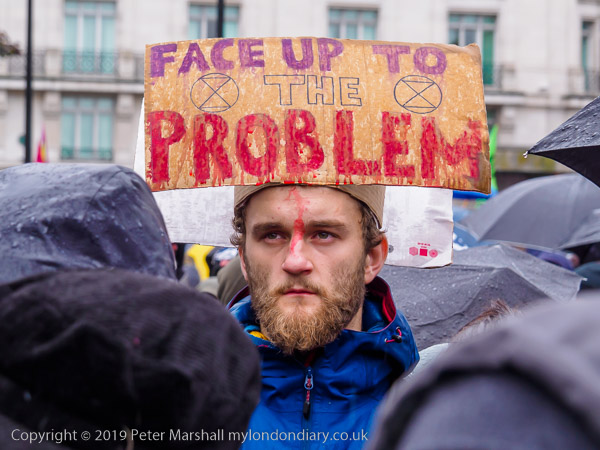
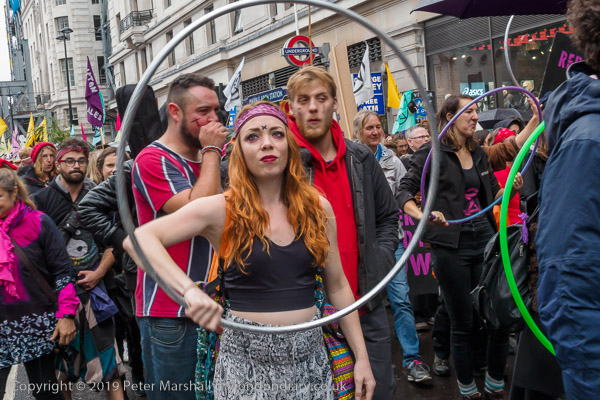
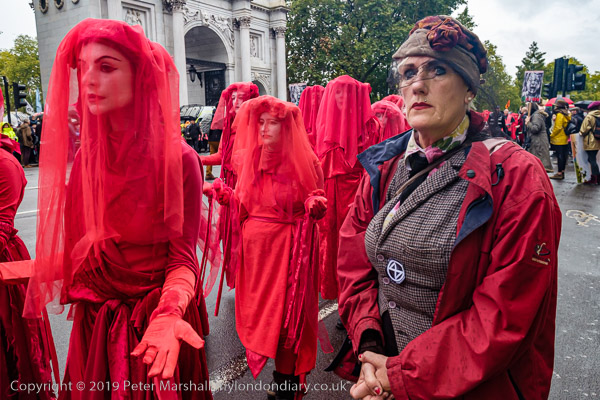
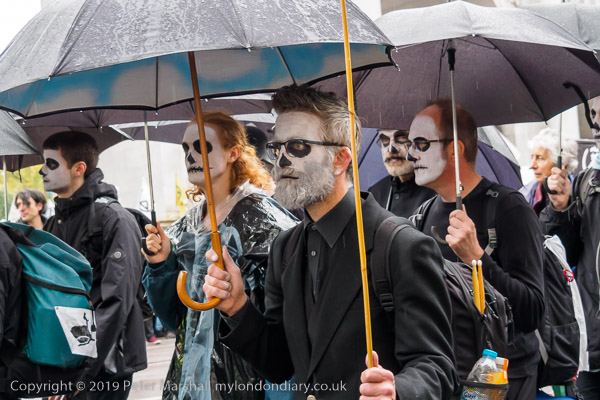
With so much bad news around I hesitate to write about a funeral, but in October Extinction Rebellion held their ‘Strength in Grief’ rally at Marble Arch to express their profound grief at the extinction of species taking place due to global warming and which threatens the future of human life, and followed this with a funeral procession along Oxford St.

We are now facing another great threat to human life, one we are all personally threatened with, and many of us are at particular risk from, some because they are having to work closely with people suffering from coronavirus, others because they are particularly likely to die should they catch it. As someone in the high risk category, though not with governmental ‘extremely vulnerable’ status I’m worried and also isolating myself as much as possible.

The XR rally and march took place on the anniversary of Colombus landing in South America, truly a black day for the population of that continent, bringing disease and exploitation. While some celebrate Columbus Day, for many others the 31st October is the Day of Indigenous Resistance, and a number of the speakers reminded us of this. Climate Change has already killed many in the Global South.

While in the UK the lack of preparation has been a matter of government policy, part of their programme to run down and sell off the NHS through the back door to private health companies and their more general cuts to public services and local authority spending, for many countries it is impoverishment through centuries of colonialism and neo-colonialism that has left them unable to cope with the current pandemic.

The UK is one of the world’s richest nations – thanks in large part to our imperial past which fed our economy and fertilised the inventiveness of which we can still be proud. I grew up in the immediate post-war period when the experience of the war had led to the realisation that we had to work together as a society. From that came secondary education for all, the NHS and the whole welfare state. I hope COVID-19 will have the same galvanising effect as we can’t afford to go back to ‘business as usual’. The world needs to wake up and ‘Face Up to the Problem’. I hope I’ll still be around to see it starting to happen; at least I’ve not yet had a letter from my doctor with a DNR form, though it could still come.

More pictures at XR Strength in Grief Procession.


All photographs on this and my other sites, unless otherwise stated, are taken by and copyright of Peter Marshall, and are available for reproduction or can be bought as prints.

There are no adverts on this site and it receives no sponsorship, and I like to keep it that way. But it does take a considerable amount of my time and thought, and if you enjoy reading it, please share on social media.
And small donations via Paypal – perhaps the cost of a beer – would be appreciated.


A Slice of London

What do the following have in common?

Crystal Palace
Peckham Rye
Bermondsey
Wapping
Whitechapel
Bethnal Green
Hackney

ANSWER

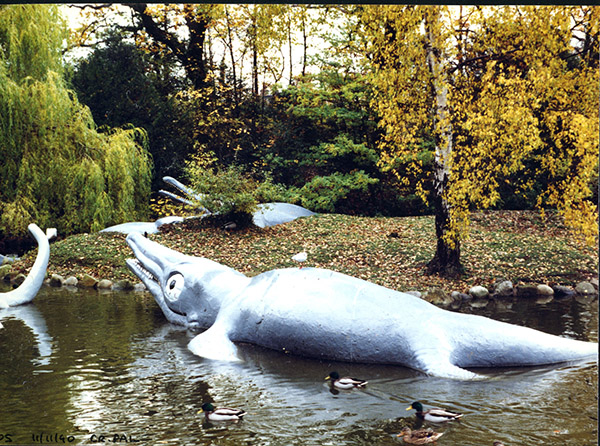
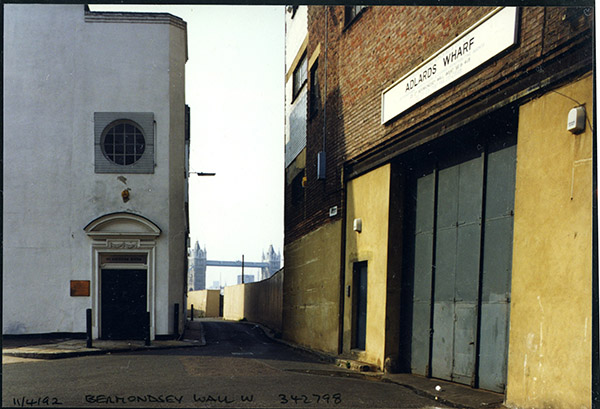
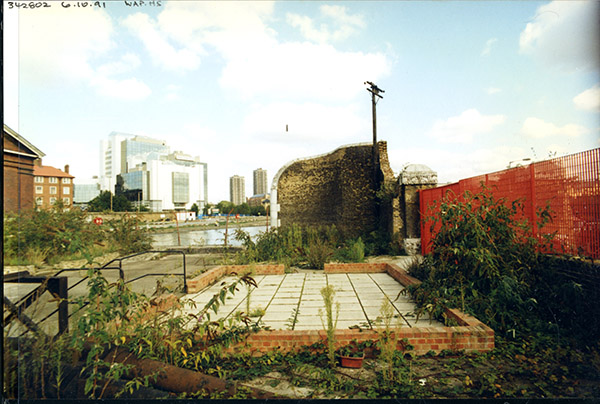
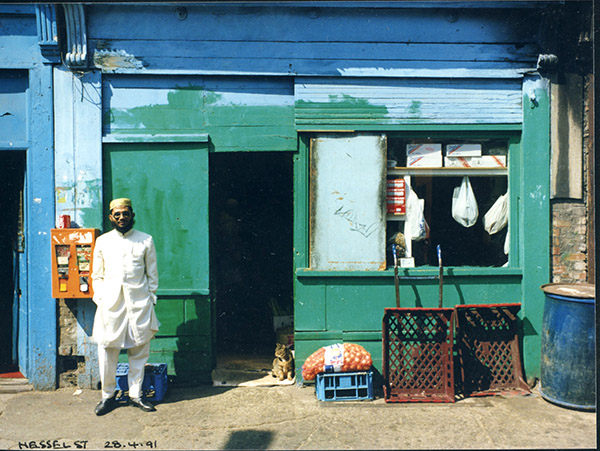
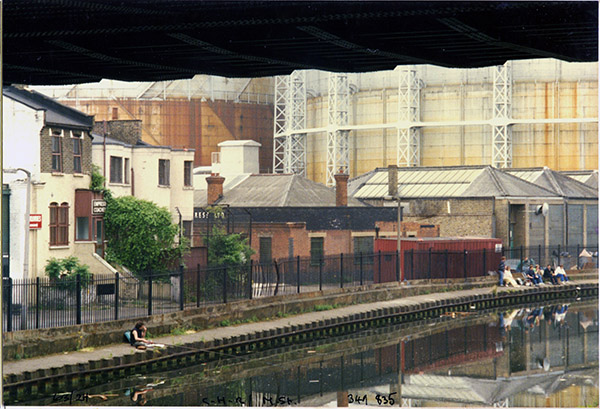
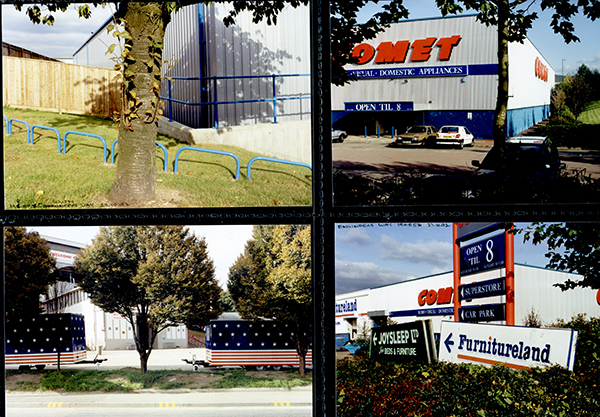
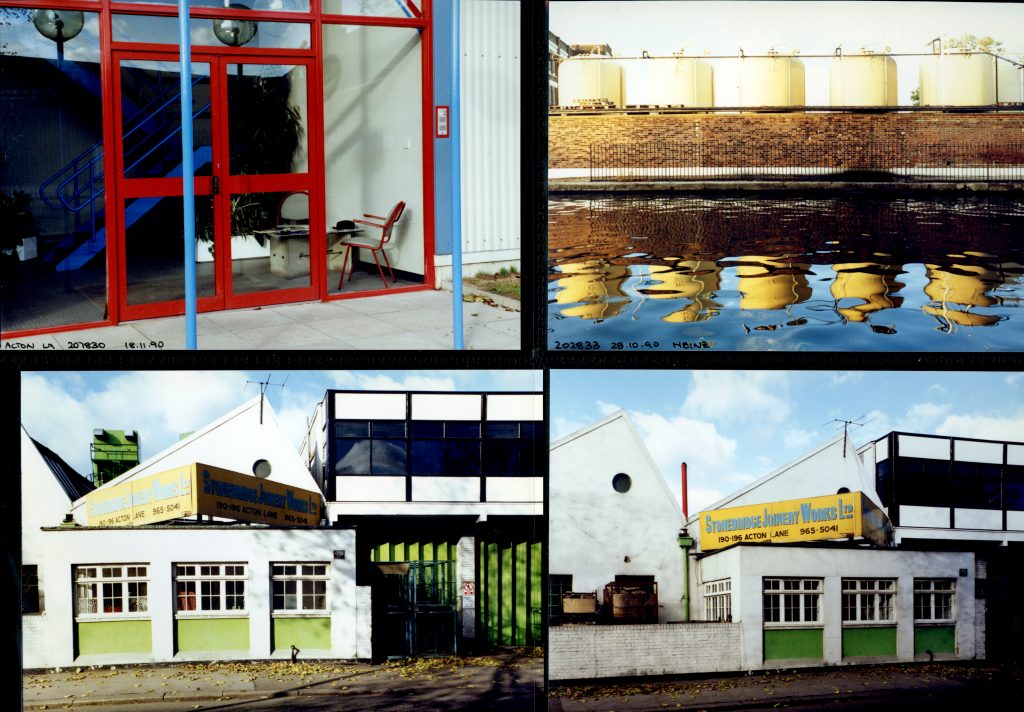
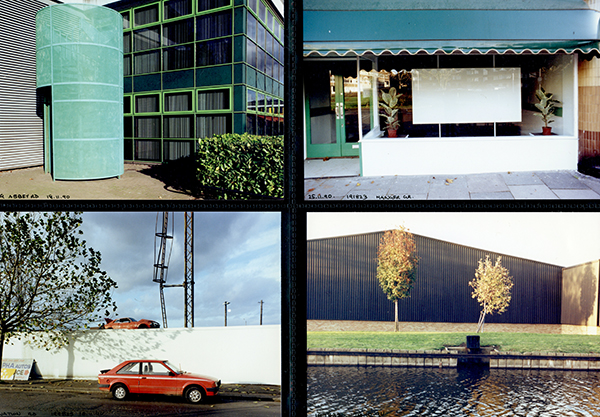
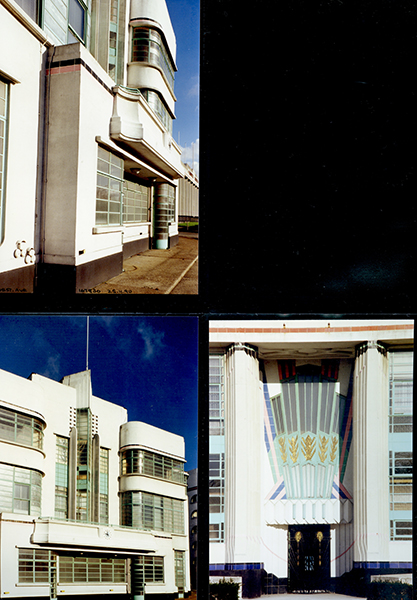
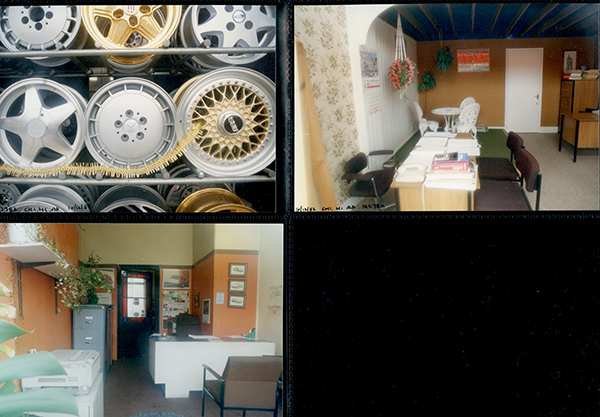
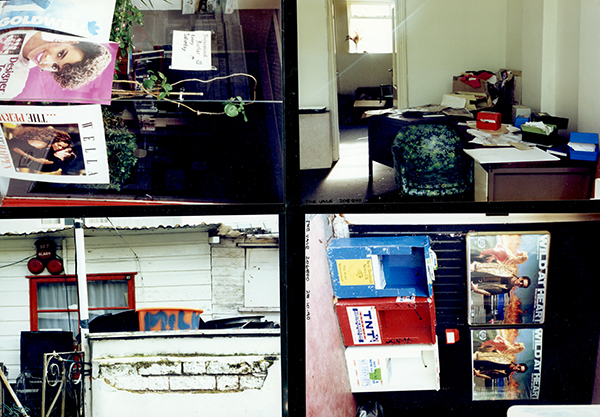
They all fall on the National Grid in the vertical column TQ34, and there are more pictures from all of them in the albums of colour enprints I put together from 1986 to 1992 as a project with the rather tentative title ‘Cross-section’. TQ34 is just one km wide and I have a row of A4 files covering around 20 such columns across the city, though those at the outer edges have fewer images.

The roughly A4 album pages could each hold four 6″ x 4″ enprints. I started by gluing the prints in place on scrap cartridge paper (unused from A level Art exams and cut down to size) but though that worked well it became tedious, and I moved on to purpose-designed plastic filing sheets, at first transparent and later black.

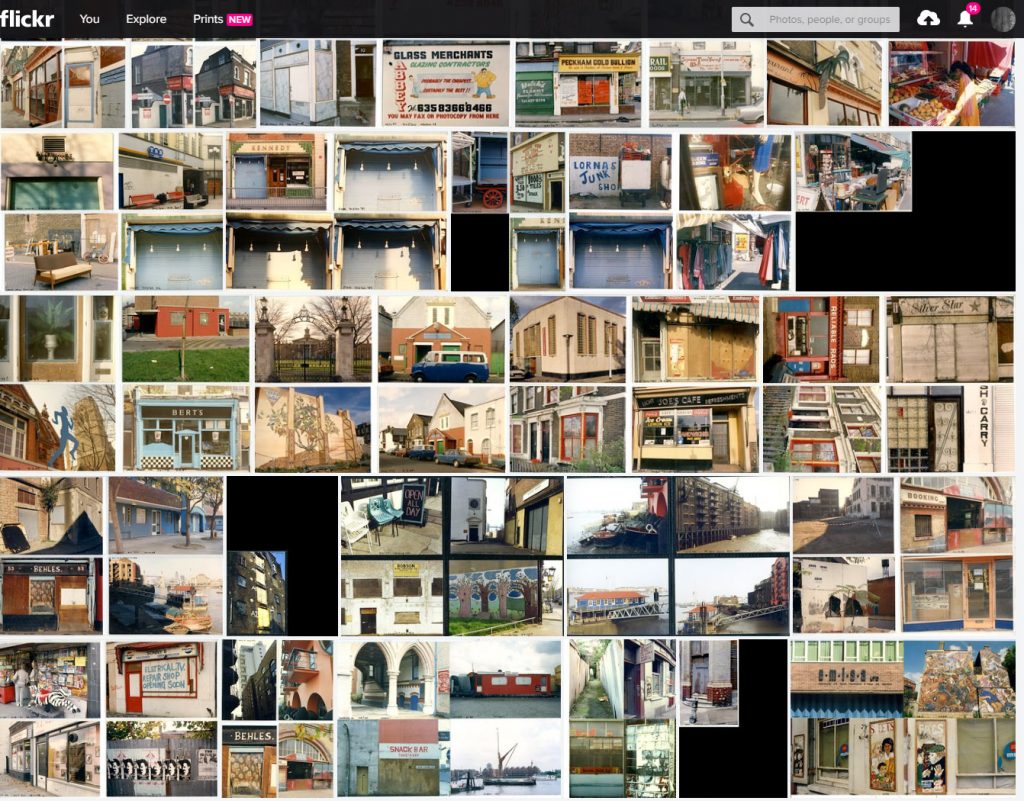
I tried at first to keep all four prints on any page either landscape or portrait format and from the same kilometre grid square, but as you will see on Flickr there are a few exceptions. The album TQ34 includes just over 70 pages and is shown on Flickr as in the album with most images having four prints.

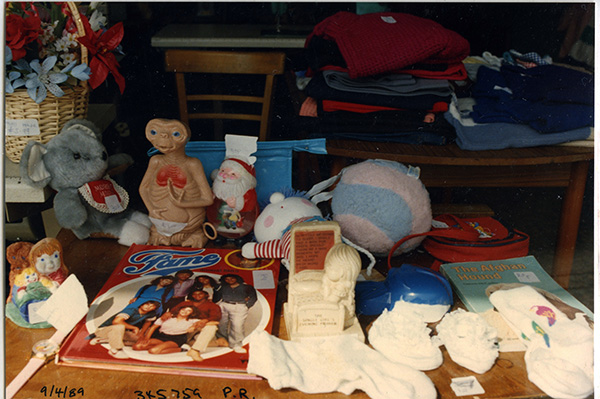
These enprints were all trade processed and I sent the films off to various cheap consumer labs. The different colour casts they produced for each roll of 35mm film I felt added to the project, and I accepted some packets of pictures where I really should have demanded a reprint. A few of the worst I have done a little colour correction before posting online.

I finished – or rather abandoned – this project around 1992 when I installed a print processing line in my own darkroom and going over to bulk loading and home processing of my colour negative film. Producing enprints was too slow and fiddly, but I was able to make larger prints, and a small selection of these images where exhibited and sold over the years.

We are all stuck inside but you can take a virtual walk through London with me on Flickr.

July 1986 on Flickr

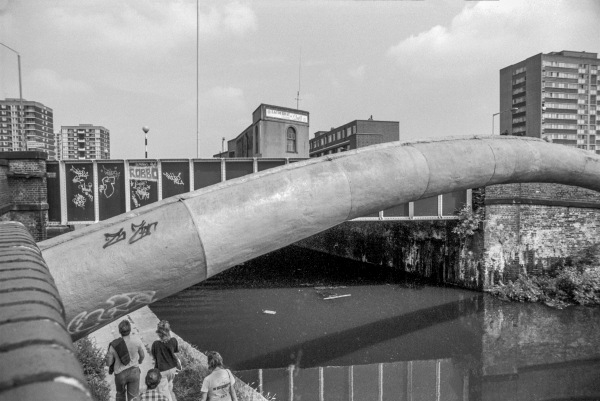
Pipe Bridge, Regent’s Canal, Baring St, Islington

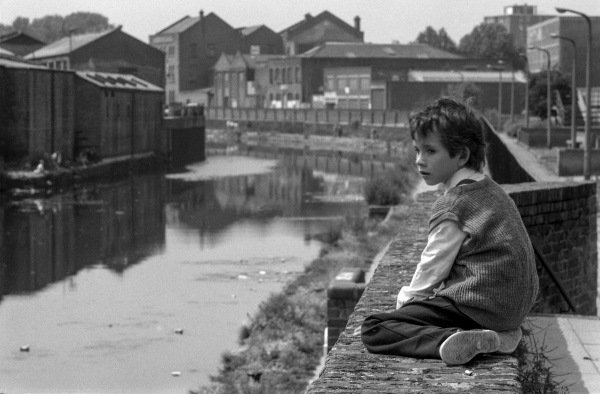
I had more time to take pictures in July as my teaching came to an end for the summer vacation around halfway through the month. This meant I could go up to London on some weekdays, though I still had two small boys to look after on days my wife was working. That usually meant staying at home, but sometimes I took them both out with me to London.

Regent’s Canal

I spent some time in Shadwell and Bethnal Green, but also further north in Shoreditch, Hoxton and Dalston, occasionally wandering into Islington. Though I obviously photographed on foot, I had to travel from my home outside London and then around London to the starting point for my walks, and the One Day Capitalcard, valid on all public transport in London after 9.30am made this much simpler after its introduction in June 1986 – the one-day Travelcard launched in 1984 had been for bus and tube only.

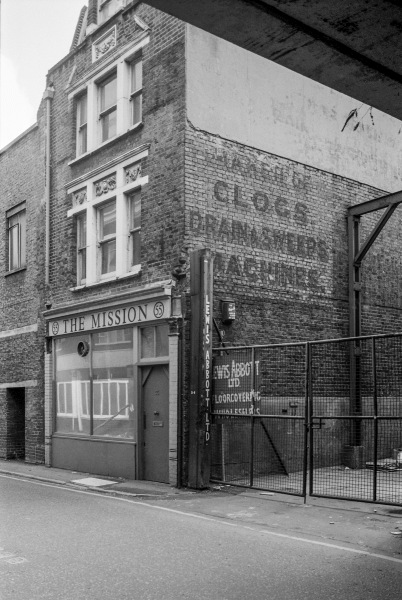
The Mission, Holywell Lane, Shoreditch, Hackney

Towards the end of the month I moved my focus to the City of London, even easier for transport then as the Waterloo and City line was still run by British Rail and my ‘London Terminals’ ticket was valid all the way to Bank.

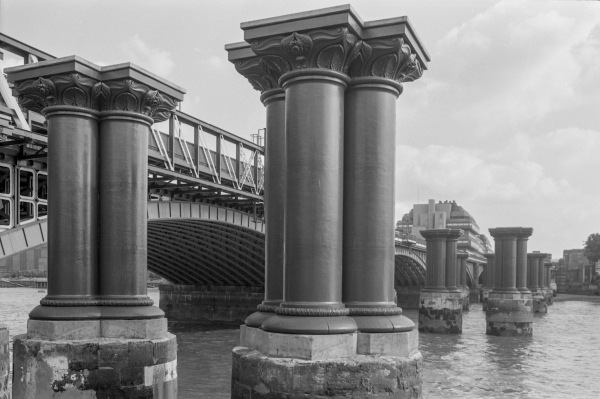
Blackfriars Rail Bridges

When I began photographing London there were two railway bridges across the River Thames at Blackfriars, but all that remained of one of these by 1986 were the pillars that had supported it. And while these were rather a fine set of pillars they were (and remain) a rather curious river feature, presumably left in position simply to save the cost of removing them.

Queenhithe and the River Thames

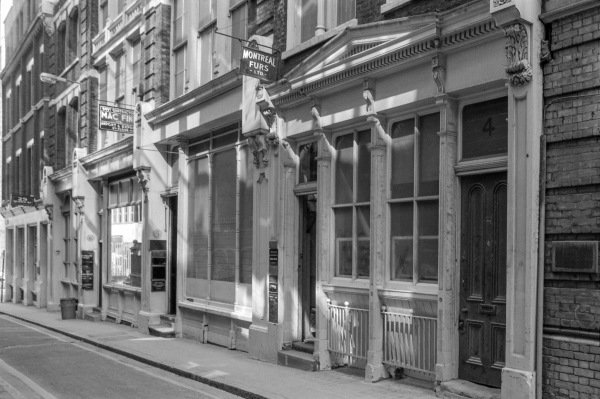
Queenhithe, a small inlet on the City side of the river has a long history. The Romans built a quay here, and buried deep down in the wet mud some of the timbers they put here survive, as do remains of the dock contructed when Alfred the Great, King of Wessex re-established the City of London aroudn 886 AD. It got the name Queenhithe (a hythe is a small harbour) when Henry I gave the right to levy dues on goods landed there to his wife Matilda around the time of their marriage in 1100. Queenhithe was still a major harbour for the city hundreds of years later and remained in use, with lighters bringing skins for the fur trade which was based a short distance to the north until the Second World War.

Fur shops in Great St Thomas Apostle

Around 300 of the black and white pictures I took in July 1986 are now online:
Peter Marshall: 1986 London Photographs on Flickr.
July’s pictures start here.

The images are copyright but may be shared on non-commercial personal social media. A licence is required for any corporate, commercial or editorial use.


All photographs on this and my other sites, unless otherwise stated, are taken by and copyright of Peter Marshall, and are available for reproduction or can be bought as prints.

There are no adverts on this site and it receives no sponsorship, and I like to keep it that way. But it does take a considerable amount of my time and thought, and if you enjoy reading it, please share on social media.
And small donations via Paypal – perhaps the cost of a beer – would be appreciated.


Scanning London

TQ1985

A few months back I was lying prone inside a giant metal tube on a flat bed which moved me slowly backwards as successive slices across my body were scanned for the purposes of research, and the CT scan reminded me of a project on London which I began in the 1980s.

Nowadays we are all familiar with the idea of geotagging and some cameras can add geotags to the Exif date as you photograph, while gadgets can be fixed onto other cameras to add the data. Smartphones do the same, as they always track you position. The web site https://www.geograph.org.uk Geograph was set up in 2005 to “collect geographically representative photographs and information for every square kilometre of Great Britain and Ireland” and so far 13,114 contributors have submitted 6,397,064 images covering 280,384 of the 1km grid squares, still leaving around 15% should you wish to strike new ground.

TQ2083

I’ve occasionally added geotags to my own landscape pictures in Lightroom, using a free little phone app by one of my sons, ‘Easy GPS Logger’ which records GPS location and time data to a file. You load this into LR along with the pictures, match up any one of them with a particular place on a map and LR then uses the file to add the information to the other pictures. There are only two problems – remembering to turn on the logger at the start of your walk, and secondly to turn it off when you finish!

TQ1982

Back in 1986, the only way to add location data to your photographs was by hand, using a map to find the grid reference. Of course you had to know where you were to do so. I had the idea of doing a series of South to North cross-sections of London based on the Eastings and Northings of the National Grid using colour negative film.

Rather than attempting a series of south-north walks, I simply took a camera with colour negative film on more normal walks while I was photographing London in black and white, then sent the films for processing and printing 6×4″ enprints. When these came back from processing I’d sort out those I wanted to keep and use a map to find the grid references and add these and the date with a technical pen along the lower edge of the print. The date meant (at least in theory) I could find the negatives in my files.

TQ1683

At first I glued the prints onto card sheets to file them under the grid reference in a set of A4 files, but this soon became tedious and I bought filing sheets which held 8 prints, four on each side. Each of the kilometre grid squares had its own filing sheet, and some soon had several, with the series expanding to fill around a dozen A4 files. Each file holds around 50 double-sided sheets and so could hold around 400 prints, though many sheets are not full, so the project probably has around 3,000 or 4,000 prints.
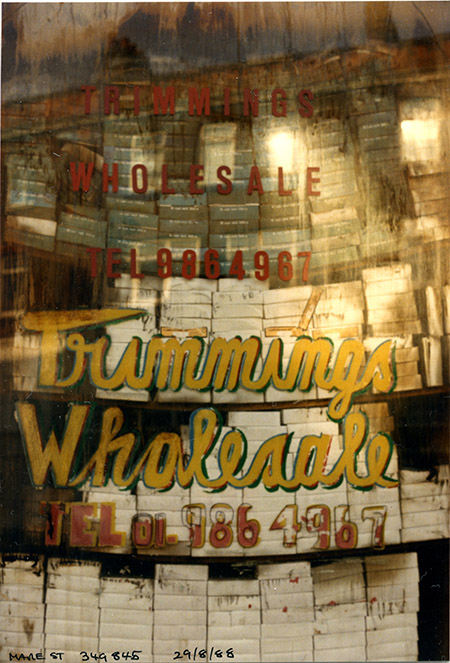
TQ1978

Of course what was more important were the scenes I chose to photograph. I carried in my wallet a reminder of things I was interested in photographing (an idea picked up from reading a list made by Walker Evans), in a small zipped pocket together with a folded £20 note for emergencies. Of course colour was important, not just for itself, but as an illustration of how and why colour was used, and I had a great interest in representations of people and things, in ethnic differences and in the evolution and fashion of colour.

I can’t remember exactly when I ended the project, though it certainly continued well into the 1990s. But at some point I stopped sending colour negative film to be processed and began developing it myself, and producing enprints wasn’t really an option. Instead I made 8×10″ contact prints and worked from these, producing very many fewer but larger prints.
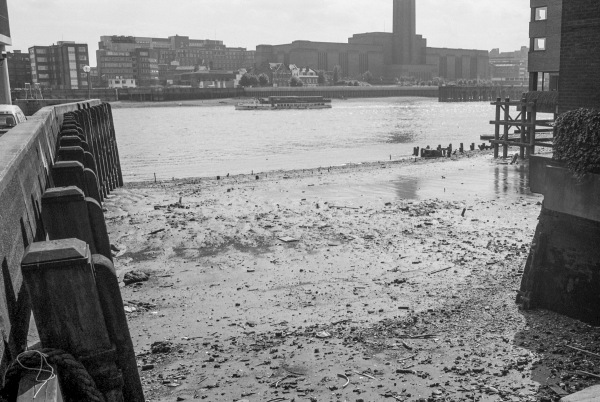
TQ2080

Over the years I’ve probably published or shown only around a hundred of these pictures, the largest group from 1986-90 in the book dummy and web site ‘Café Ideal, Cool Blondes, and Paradise

As with my black and white images of London, this is a body of work which I think has a great deal of historical interest as well as some photographic interest and it would be good to see it in some permanent museum or similar collection rather than simply gathering dust on my shelves.

There are no adverts on this site and it receives no sponsorship, and I like to keep it that way. But it does take a considerable amount of my time and thought, and if you enjoy reading it, please share on social media.
And small donations via Paypal – perhaps the cost of a beer – would be appreciated.