Save Our NHS March, London, 2017

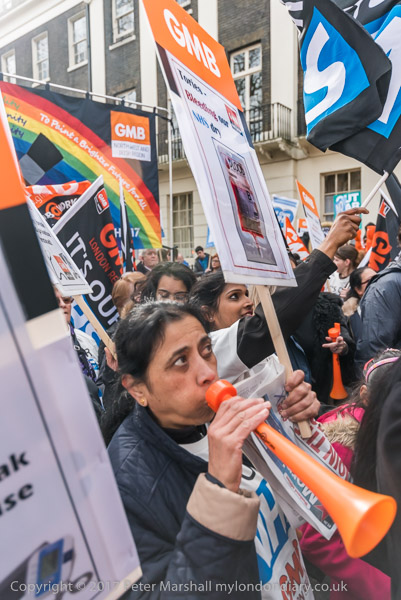
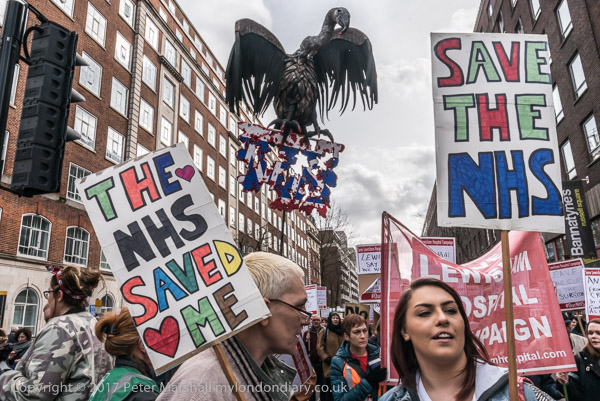
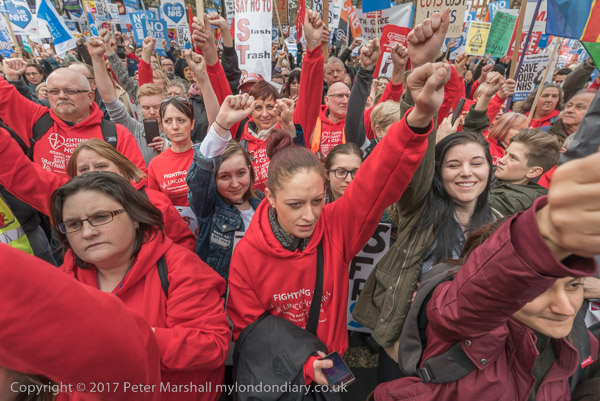
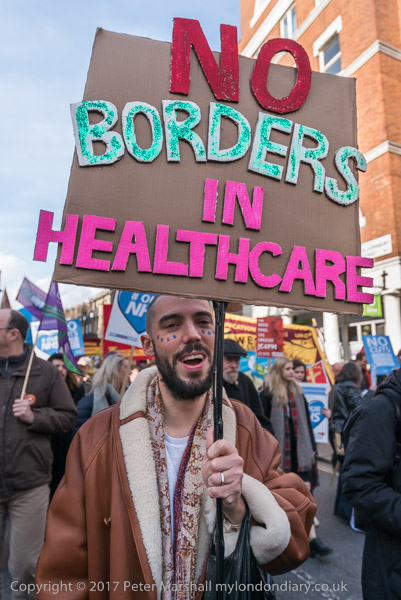
Save Our NHS March, London, 2017. On 4th March many thousands marched through London from Tavistock Square where the BMA have their headquarters to a rally in Parliament Square in protest against the cuts and privatisation of the NHS.
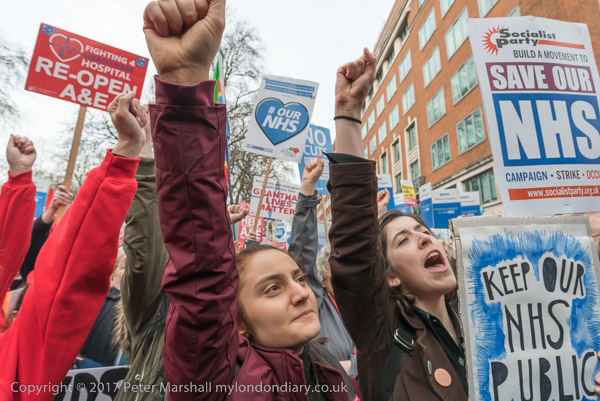
The Conservative Party were against the formation of the NHS from the start, and voted against both the Second and Third readings of the National Health Service Bill in the House of Commons in 1946.
The formation of a public state heath service had been advocated by Beatrice Webb as early as 1909, and the idea of a free, comprehensive and universal health provision had been gaining public support over the years, becoming official Labour policy under George Lansbury in 1934. By 1942 even the British Medical Association had proposed having regional councils running hospitals with consultants as paid staff, although they opposed the 1946 bill as they though doctors would lose money under the NHS.
But it was the 1942 report by William Beveridge, Social Insurance and Allied Services, that put the NHS firmly on the political agenda, with even Tory Prime Minister Winston Churchill suggesting in 1943 it would be a part of the rebuilding of Britain after the war, and both Liberals and Conservatives supporting consultations with doctors and others that resulted in a 1944 White Paper, ‘A National Health Service’.
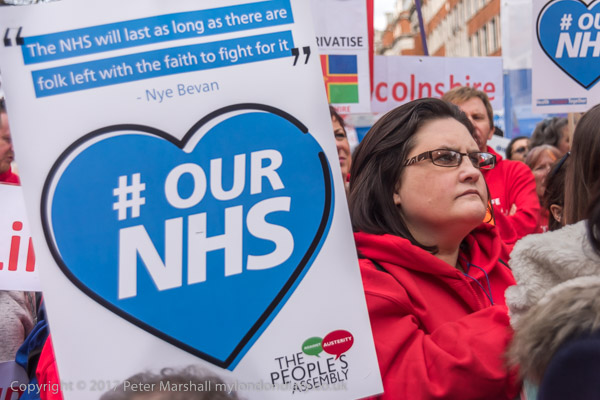
When Labour’s Health Minister Aneurin Bevan put his National Health Service Bill to parliament in 1946, there was general agreement on the idea of a comprehensive health service, but the Tories were opposed to doctors becoming full-time employees and thus being unable to continue in hugely lucrative private practice. And the BMA shared their position, continuing their opposition after the Act was passed and eventually were able to force Bevan to amend the act and remove the introduction of a salaried service for GPs.
So, although it was a great day when the NHS came into being on 5th July 1948, and was from the start a little hamstrung by commercial interests – in this case of individual doctors. Dentistry has never been properly integrated into the system, and many find it impossible to get NHS dental treatment as relatively few dentists are prepared to work at the rates offered by the NHS. Even for those who are able to get registered as NHS patients, their are fees which for those not qualifying for exemption can be prohibitive despite being subsidised by the NHS.
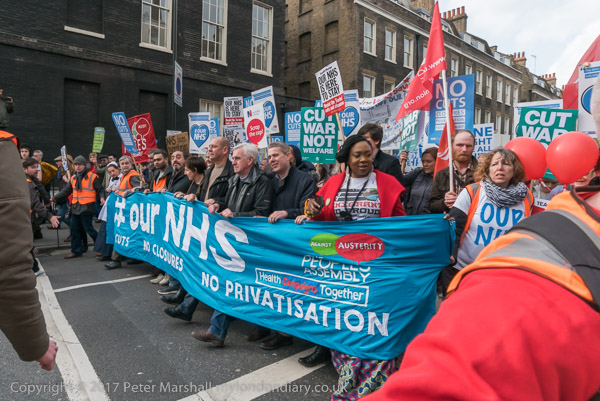
The march sets of with John McDonnell, Mark Serwotka and others holding the main banner

It was a Labour government that proposed the idea of prescription charges in a 1949 Act, prompting the resignation of Aneurin Bevan from the Labour government, but it was a Conservative Government that introduced them in 1952. They were abolished under Labour by Harold Wilson in 1965 but he brought them back in 1968 though with significant exemptions based on age, income and medical conditions. Wales, Nothern Ireland and Scotland have now abolished charges, but in England each item now costs £9.35.
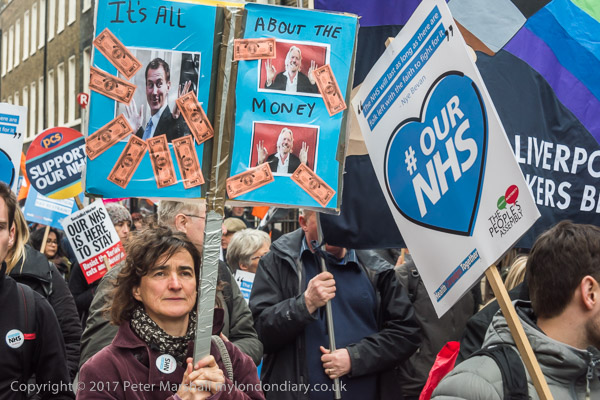
Since the 1990s many politicians, particularly Tories but also some of the leading figures in the New Labour government and on the right of the party have backed changing from the current universal system to a personal insurance-based system, and there has also been a huge increase in those taking out private insurance, with now around 4 million having this, mainly through the companies they work for.
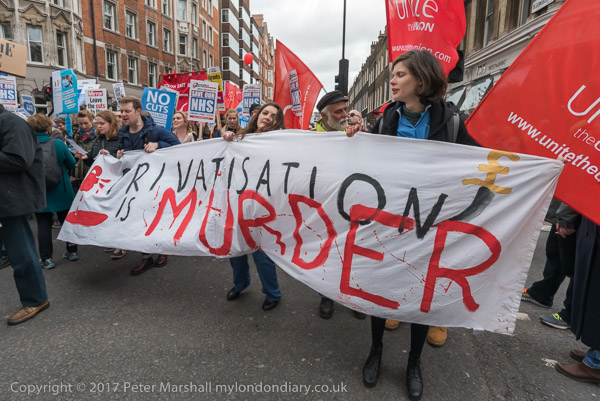
Healthcare is now a massive industry in the UK, enabling the wealthy to avoid delays in receiving treatment in the underfunded NHS. The NHS also massively funds the private system, with some private healthcare providers receiving as much as 80% of their income for providing services to NHS patients. Some NHS hospitals also get in on the act by offering private care.
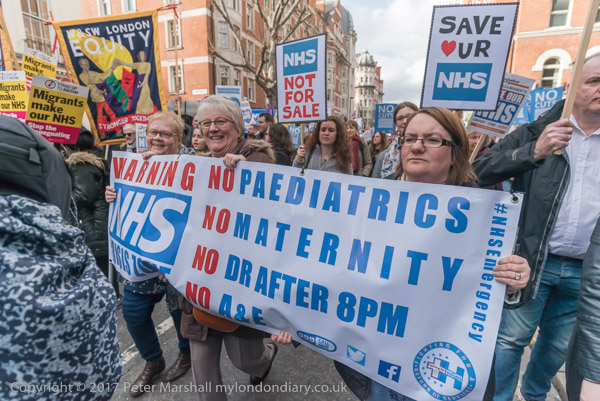
Many of the more routine services provided by the NHS have now been outsourced to private providers and over the years various changes in the way the NHS works have meant more and more has to be made available for tender by outside bodies. In some cases the level of services provided has been extremely poor – when I was in one hospital the outsourced cleaners had insufficient time to clean the floor under the beds, and accidentally putting down my hand I found a dirty dressing and a used needle from a previous occupant. Probably such outsourcing was a significant cause of various hospital-acquired infections.
But much private medicine is of a high standard – using the same surgeons and consultants others expensively trained by the NHS who work both for the NHS and private hospitals. The best private hospitals will have more equipment and more up-to-date equipment than the NHS hospitals that have suffered from years of cuts, and will also provide better conditions for their patients, with private rooms and more.
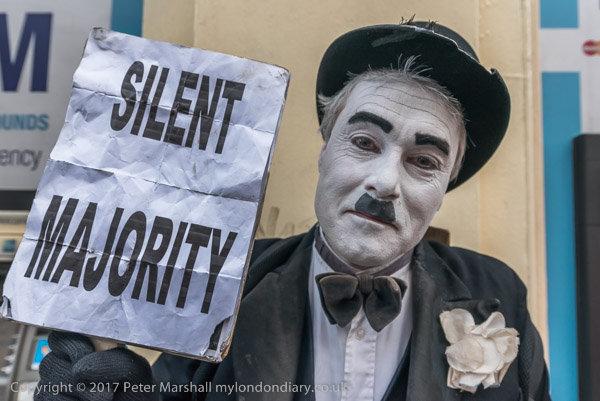
Having a two-tier system which is rapidly growing means that politicians, themselves wealthy and overwhelmingly representing the interests of the better off, and the more vocal wealthier groups in society, as well of course as the well-paid lobbyists for private health, are less likely to provide the NHS with the funding it needs to provide modern healthcare.
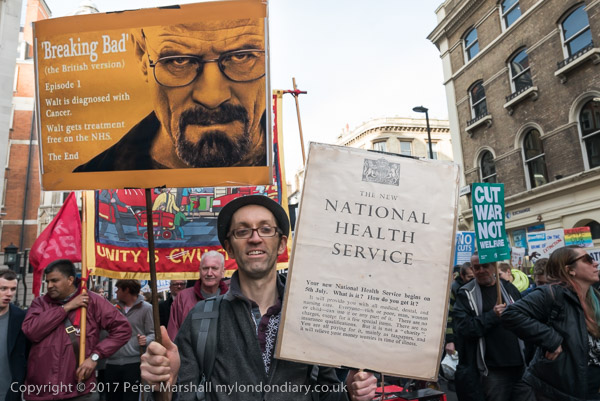
Many believe that our NHS is under threat, slowly and step by step being sold off to private healthcare companies, many based in the US, and that before long the NHS will be a name only, a branding used by private companies (as in many areas it already is.) The country is slowly being prepared for a complete move to an insurance based system, which will be brought in by politicians – Labour or Conservative- still chanting the mantra ‘The NHS is safe in our hands‘.

More at Save our NHS March.


Spratt’s, Far Famed Cakes and Bromley by Bow

Spratt’s, Far Famed Cakes and Bromley by Bow. My walk on 31st February 1988 was coming to an end as I made my way towards Bromley-by-Bow District Line station to begin my journey home. You can see the previous part at Lansbury, Brownfield, Teviot and St Leonards Road.

Footbridge, Railway, Spratt's Patent, Clutton St, Poplar, Tower Hamlets, 1988 88-7t-15-positive_2400
Footbridge, Railway, Spratt’s Patent, Clutton St, Poplar, Tower Hamlets, 1988 88-7t-15

St Leonard’s Road beyond Langdon Park becomes Uamvar St, an odd name whose origin I can’t find. It used to be a little west of its current route and I think with St Leonard’s Road used earlier to be Bow Lane. I soon turned left onto Clutton St and climbed onto the footbridge over the railway. The bridge has now been replaced by a metal structure on which it would be rather harder to write ‘Happy Birthday’ and ‘I Love You’.

The railway line here carries the Docklands Light Railway line from Poplar to Stratford, but had been a part of the North London Railway (founded in 1846 as the East and West India Docks and Birmingham Junction Railway.) The Spratt’s Patent Limited Offices Fenchurch St are still there, with an entrance from Fawe St.

Farfamed Cake Company, Fawe St, Footbridge, Poplar, Tower Hamlets, 1988 88-7t-16-positive_2400
Far Famed Cake Company, Fawe St, Footbridge, Poplar, Tower Hamlets, 1988 88-7t-16

The Far Famed Cake Company began in 1881, and was bought by Fitch Lovell in 1950. They merged it with another company to form Hales Trent Cakes in 1962. In 1974 this was bought by Lyons. The factory had employed around 320 people. I think this site is now occupied by a large new block of flats with some shops on Morris Road.

Spratt's Patent Limited, Fawe St, Poplar, 1988 88-8a-62-Edit_2400
Spratt’s Patent Limited, Fawe St, Poplar, 1988 88-8a-62

Separated by a long yard from the block of Spratt’s Patent beside the DLR is another block of Spratt’s Patent Limited, still there and now the A B Fine Art Foundry.

Foresters Arms, pub, St Leonards Road , Poplar, Tower Hamlets, 1988 88-8a-63-Edit_2400
Foresters Arms, pub, St Leonards Road , Poplar, Tower Hamlets, 1988 88-8a-63

The Foresters Arms at 253 St Leonards Road, on the corner with Clutton St, a former Charrington & Co pub closed in 2004 and was sold. It was extended and converted to 6 flats in 2005. There had been a pub on this site since before 1856. It still has an address on St Leonards Road lthough my map calls the road huere Uamvar St.

Limehouse Cut, Blackwall Tunnel Northern Approach, Bromley-by-Bow, Tower Hamlets, 1988 88-8a-64-Edit_2400
Limehouse Cut, Blackwall Tunnel Northern Approach, Bromley-by-Bow, Tower Hamlets, 1988 88-8a-64

I continued my walk up Uamver St and on to the Blackwall Tunnel Northern Approach, and this picture was taken beside Tweed House, part of which can be seen at the extreme left. The buildings in the centre have now been replaced by a lower-rise redevelopment but that visible above the wall at the right of the picture is still there.

This section of the Limehouse Cut towpath was then rather overgrown and little used. It is now much busier, with a new floating section taking the path from Bow Locks under the busy tunnel approach road.

Nursery, Flats, Blackwall Tunnel Northern Approach, Bromley-by-Bow, Tower Hamlets, 1988 88-8a-52-Edit_2400
Nursery, Flats, Blackwall Tunnel Northern Approach, Bromley-by-Bow, Tower Hamlets, 1988 88-8a-52

I photographed this mural on a nursery and clinic in the flats beside the Blackwall Tunnel North Approach close to Devas St. This was part of the Coventry Cross West Estate, built by the LCC in the early 1950s as an addition to their 1935 Coventry Cross Estate. The name Coventry Cross came from a long-closed pub in the area since 1690 – at 68 St Leonards Street in 1861. The estate passed to the GLC and then TOwer Hamlets before after consultation and vote they joined Poplar HARCA.

From here is was a short distance to the end of my walk at Bromley-By-Bow District line station – from where I began my next walk in early August 1988

This had been an good walk for me and I hope readers will have found the pictures and text about them interesting. There are some more pictures from it in my album 1988 London Photos including some from earlier in the day at Petticoat Lane, in Whitechapel and Tower Hamlets cemetery before I started the walk proper.


Stop The War – 2nd March 2002

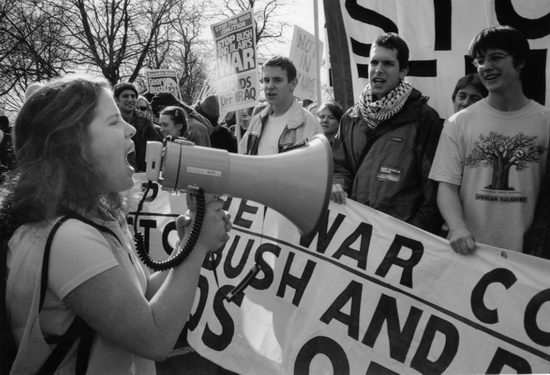
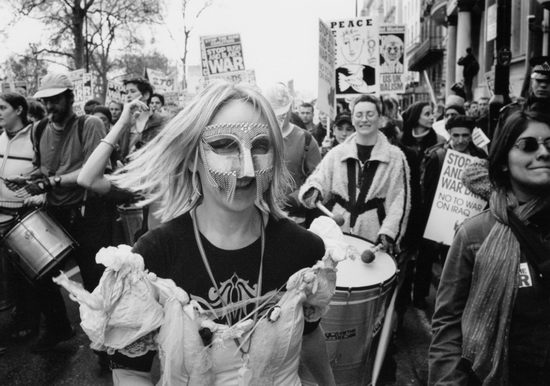
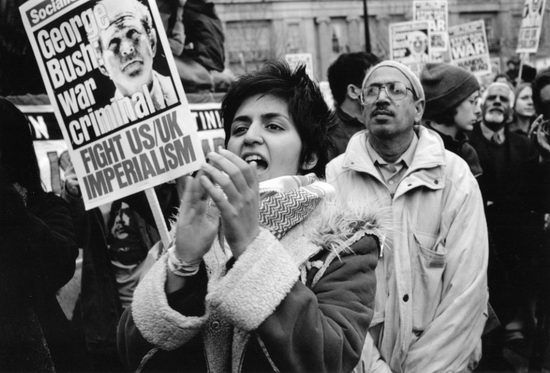
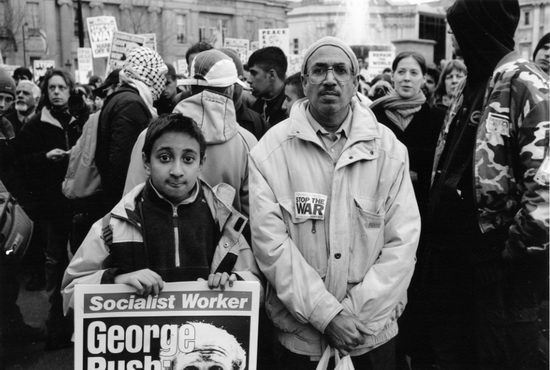
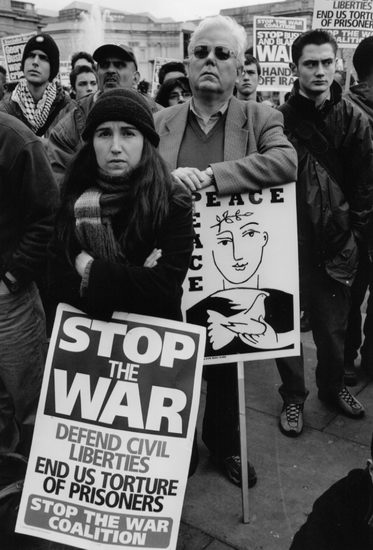
Stop The War – 2nd March 2002. Along with many thousands of others I went to Hyde Park to join the march from there to a rally in Trafalgar Square against any British involvement in the invasion of Iraq by the USA that seemed to be increasingly inevitable.

It certainly wasn’t the first march against the Iraq War I had photographed, and not the first protest against it I had taken part in. As well as those that I photographed there were also local protests close to where I live where we stood with placards and a banner on the busy road bridge across the River Thames at rush hours each Friday.

Tony Benn

Almost a year later came the largest protest the UK has ever seen – and I was unable to take part or photograph, having only been discharged from hospital the previous day. The operation had gone well, but I’d collapsed the following night thanks to a problem with a drug which had taken my blood pressure dangerously low, and when I came out several days later I was still weak and shaking. I was devastated to miss the protest, left alone at home while the others went, but walking more than a few yards was still a problem.

Despite the protests – and the clear indications that Tony Blair was lying and the evidence he stressed was fabricated, we went to war with Iraq, and destroyed the country. As with most if not all wars the only people to gain were the arms manufacturers – and the oil giants.

In March 2002, my My London Diary web site was in its early infancy, though I had put up a few pictures from the previous couple of years to fill a few pages. But the Stop The War protest on 2nd March was I think the first story to be covered in any real depth, with a short text and a couple of dozen pictures. I photographed the event on film in black and white and colour, but at the time my scanner could only scan in black and white so there are no colour pictures on line.

Here’s the complete text (apart from some picture captions) and this post is illustrated with a few of the pictures. On the web site these are posted three or four to a page, as internet connections then went at a snail’s pace and pages with more pictures took too long to load.

the Stop the War, Hands off Iraq demonstration on 2 march as a large sign of public opinion. people were still leaving hyde park at the start of the march when trafalgar square was full to overflowing two and a half hours later.

police estimates of the number were risible as usual – and can only reflect an attempt to marginalise the significant body of opinion opposed to the war or a complete mathematical inability on behalf of the police.

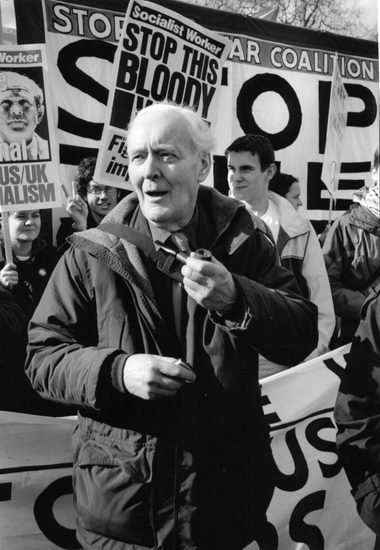
tony benn told us it wasn’t worth taking his picture – ‘it won’t get in the papers unless i go and kick a policeman’ but he didn’t and was quite right

My London Diary March 2002

Follow the link from the March 2002 page for more pictures.


Lansbury, Brownfield, Teviot and St Leonards Road

Lansbury, Brownfield, Teviot and St Leonards Road. My previous post in the series on this walk, Back to Poplar in 1988 contained information about George Lansbury, a leading politician in Poplar and around from when first elected as an MP in 1910 to his death in 1940. From 1932-35 leader of the Labour Party he was forced to resign because he stuck to his principles.

Lodore St, Poplar, Tower Hamlets, 1988  88-7t-45-positive_2400
Lodore St, Poplar, Tower Hamlets, 1988 88-7t-45

Because of its closeness to the docks and the River Thames Poplar had been one of the worst hit areas by bombs from German Zeppelins and bombers in World War I, but suffered far great damage in WW2, with almost a quarter of the buildings in the area being destroyed.

Redvelopment of the area after the war was slow, although part was finished in time to be included as the Live Architecture Exhibition section of the 1951 Festival of Britain, development of the whole of the area designated as the Lansbury Estate, between the East India Dock Road, Burdett Road, Limehouse Cut, and the North London railway line was only completed in the 1980s. The area at the south-east of this was developed by the GLC as an eastern extension to Lansbury, now known as the Brownfield Estate, designated in 1958.

By then its nature had changed with the original and highly praised plans begun under Patrick Abercrombie in 1943 and carried forward by Frederick Gibberd and the LCC Architect’s Department for the Festival being greatly modified, particularly after the Conservative Government which came to power in 1950 altered the housing priorities to provide more homes – which meant more high-rise.

From the GLC, the Lansbury estate passed to Tower Hamlets Council and was badly affected by Thatcher’s ‘right to buy’ and other policies against council housing. Much was transferred in 1988 to Poplar HARCA.

Balfron Tower, Willis St, Poplar, Tower Hamlets, 1988  88-7t-46-positive_2400
Balfron Tower, Willis St, Poplar, Tower Hamlets, 1988 88-7t-46

The iconic block of Balfron Tower is one of three – Balfron Tower, Carradale House
and Glenkerry House – listed blocks by architect Erno Goldfinger on the Brownfield Estate and dates from 1965-8. His development of Carradale House was held back so displaced local residents could be housed in Balfron and it was comleted in 1967-8, with Glenkerry House by Goldfinger’s studio being completed in 1972-5.

Goldfinger and his wife lived in one of the flats in Balfron for 8 weeks after completion. Balfron passed from Tower Hamlets to Poplar HARCA in 2007, promising residents to refurbish the building and re-house them there. They reneged on that promise, converting the block to luxury flats sold at market prices.

St Leonard's Arms, St Leonard's Rd, Poplar, Tower Hamlets, 1988  88-7t-32-positive_2400
St Leonard’s Arms, St Leonard’s Rd, Poplar, Tower Hamlets, 1988 88-7t-32

The St Leonard Arms at 162 St Leonards Rd is said to have closed in 1988 and was later converted to flats, probably in 2002. It had been there at least since 1861, when its address was 17 Wilson Terrace and St Leonard’s Road was then Bow Lane. In my picture from 1988 it looks as if it had closed some time earlier.

At the left the Grade II listed St Michael and All Angels, built 1864-5 is undergoing extensive building work – probably part of its conversion to flats as St Michael’s Court.

Five Ways Mission, War Memorial, St Leonard's Rd, Poplar, Tower Hamlets, 1988  88-7t-33-positive_2400
Five Ways Mission, War Memorial, St Leonard’s Rd, Poplar, Tower Hamlets, 1988 88-7t-33

Close to the church is an impressive war memorial with the “Christ with one hand raised in blessing and the other holding a wreath above the head of a kneeling warrior in the armour of a crusader“, sculptor A R Adams erected in 1920 with funds from a public “appeal, a football match and tickets for a special matinee performance at the queen’s theatre, high street on Saturday 24 April 1920“.

On the opposite side of the road is the former Fiveways Mission and a car hire service. This building is now smartened and extended at right as private housing.

Five Ways Mission, St Leonard's Rd, Poplar, Tower Hamlets, 1988  88-7t-34-positive_2400
Five Ways Mission, St Leonard’s Rd, Poplar, Tower Hamlets, 1988 88-7t-34

A closer, head-on view of the properties at 161-165 St Leonard’s Rd, with some light flare.

St Leonard's Rd, Bright St, Poplar, Tower Hamlets, 1988  88-7t-36-positive_2400
St Leonard’s Rd, Bright St, Poplar, Tower Hamlets, 1988 88-7t-36

A view of from the side of the two properties and the adjoining former London Cooperative Society with a fading and crumbling advertisement for BALSAM for COUGHS and Colds (perhaps the word FRIARS’ had already gone.) Above the shuttered frontage is the word HEADACHES.

St Leonard's Rd, Bright St, Poplar, Tower Hamlets, 1988  88-7t-22-positive_2400
St Leonard’s Rd, Bright St, Poplar, Tower Hamlets, 1988 88-7t-22

On the side of the building is a giant sign for the TEVIOT FESTIVAL, OPEN TO ALL and an arrow pointing in its direction. I also photographed this sign in colour. Much of this area was redeveloped as the Teviot Estate, which is now being redeveloped by Poplar HARCA. It is now often called Langdon Park, a green area at the end of Bright St where there is a newish DLR station.

Teviot Festival, Bright St, Poplar, 1988TQ3881-001

My walk will continue in a later post.


Snow, Pensions & Jobs, Hunger Strikers – 2018

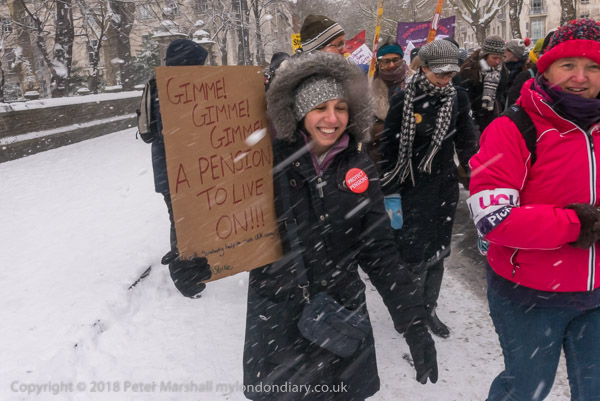
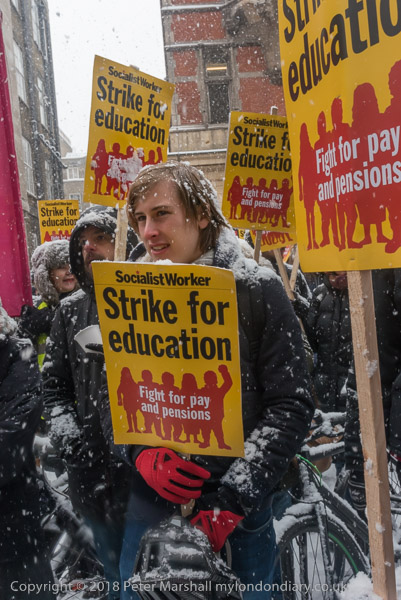
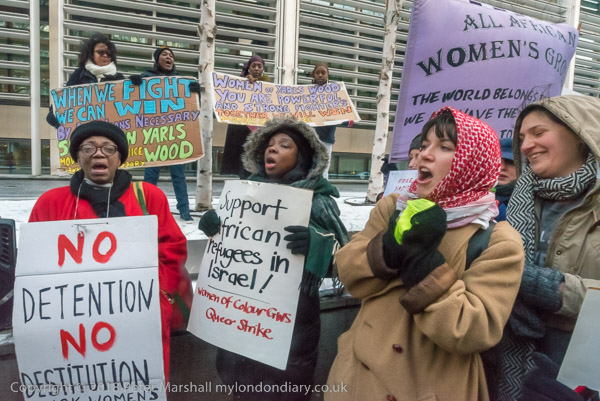
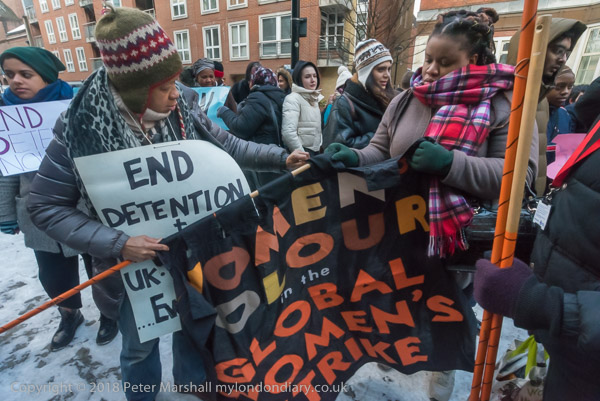
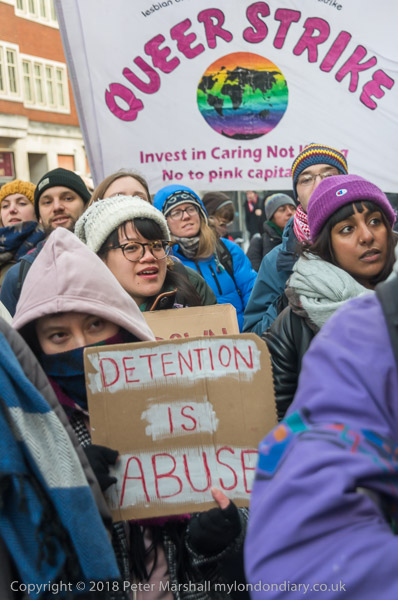
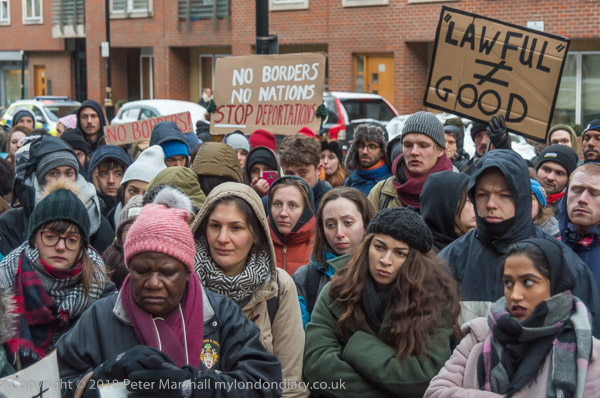
Snow, Pensions & Jobs, Hunger Strikers – 2018. On Wednesday 28th February 2018 there was a blizzard in London. University and FE teachers marched through it to a rally about pay and pensions and people came to the Home Office to support hunger strikers in the immigration prison at Yarl’s Wood.

London Snow

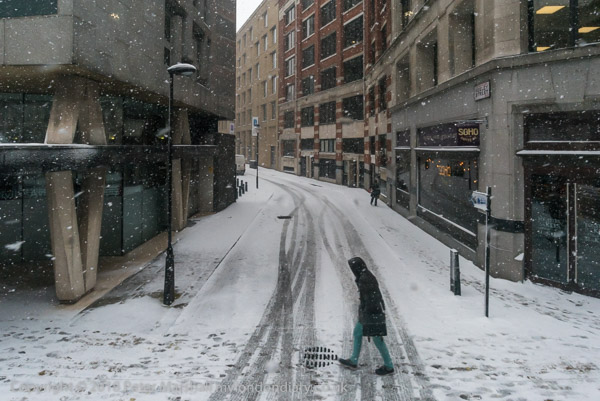
The snow slacked off a little when I was on the bus but got worse as I walked to Malet St for the start of a march. Most of the pictures I tried to take were ruined by snow flakes landing on the front of the lens faster than I could wipe them off.
London Snow

HE and FE march for pensions and jobs

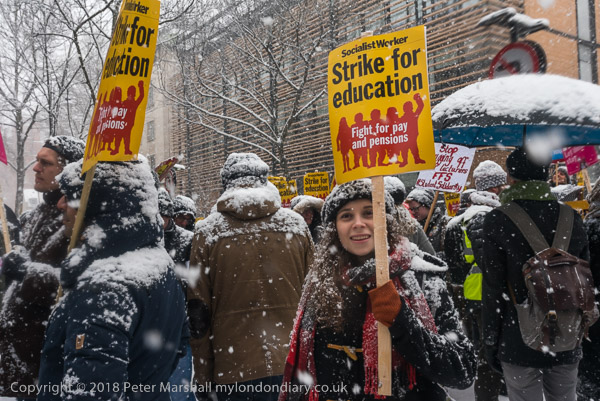
UCU members were on the the fifth day of their strike to get the universities to talk with them about pensions and pay, and marched from Malet St to Methodist Central Hall close to Parliament for a rally.

They were joined by staff from London FE colleges on the first day of a two-day strike over pay and conditions, and both groups were supported by large numbers of students. The snow made it difficult to take pictures, and at times it was hard to stop from slipping over on compacted snow. Fortunately it eased off a little after the march started, with just occasional showers as we walked through London.

HE and FE march for pensions and jobs

HE & FE rally for pensions and jobs

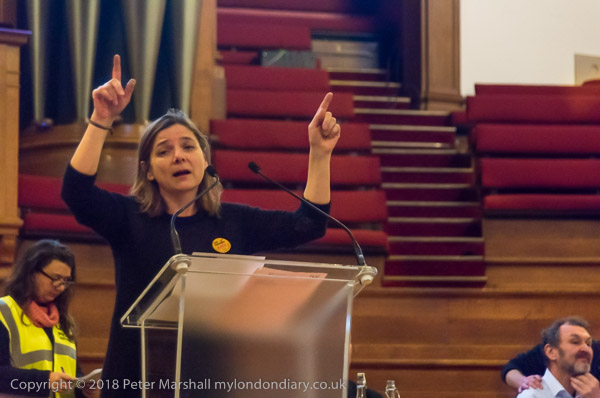
Sally Hunt of UCU speaks and Kevin Courtney NEU listens at right

Despite the terrible weather there were more marchers than expected and many were left outside the hall. I don’t usually bother to photograph at indoor rallies and haven’t really got the best equipment for it, but on this occasion I was glad to be able to get inside and warm up a little. My camera lenses were also getting a little steamed up and needed to dry out.

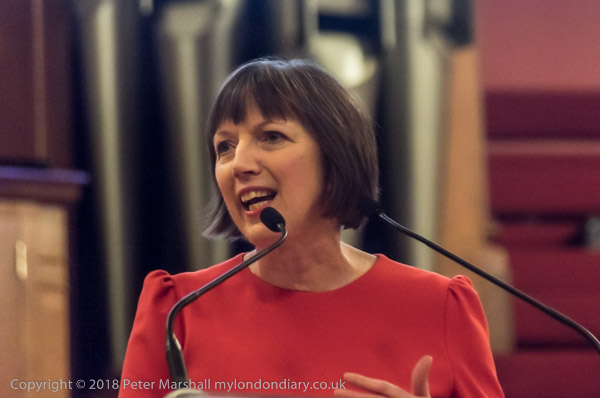
Frances O’Grady praises the way that Sally Hunt and the UCU are fighting to keep the pension scheme

I’ve written more about the reasons for the strikes and a little about the rally on My London Diary and won’t repeat that here. Click the link to find more.

HE & FE rally for pensions and jobs


Solidarity with Yarl’s Wood hunger strikers

I stayed longer inside the rally than intended, partly because I was reluctant to leave t he warm hall, but as it came to an end I left to walk to the Home Office, where a protest was taking place in solidarity with the 120 women and men in immigration detention at Yarl’s Wood who were refusing to work and had gone on a hunger strike.

Their action in Yarl’s Wood had started a week earlier and was demanding the Home Office respect the European Convention of Human Rights, end the separation of families, end indefinite detention, with a 28 day maximum detention period, end charter flights which deport people without notice, and end to re-detention of those released from detention.

The also called for an amnesty for those who have been in the country for over 10 years, a stop to deportations before cases are decided and any appeals heard, the proper disclosure of all evidence to the immigration tribunals, adequate health care, an end to detaining of highly vulnerable people, an end to employment at £1 per hour and to be treated with the dignity and respect due to all human beings.

It was a fairly large protest, supported by many groups including Lesbians and Gays Support the Migrants, Detained Voices, Black Women’s Rape Action Project, All African Women’s Group, The London Latinxs, Right to Remain, Docs Not Cops and End Deportations as well as Movement for Justice who have organised many protests outside Yarl’s Wood as well as those at other detention centres and led campaigns to close detention centres and support detainees.

Solidarity with Yarl’s Wood hunger strikers


For Refugee Rights and Against Trident

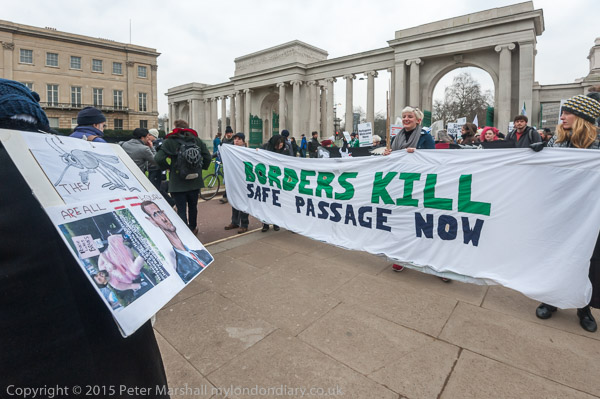
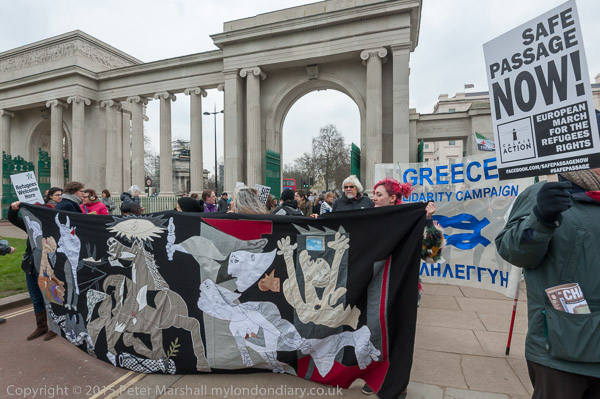
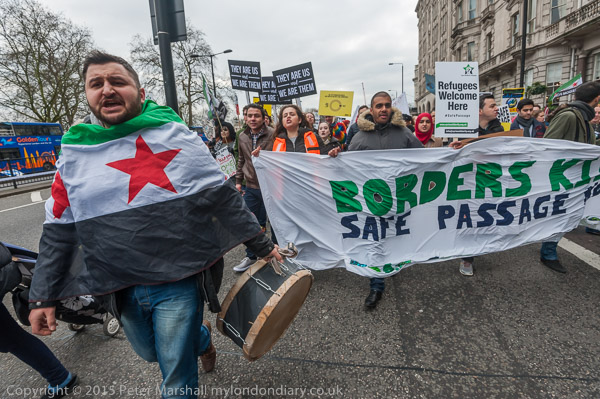
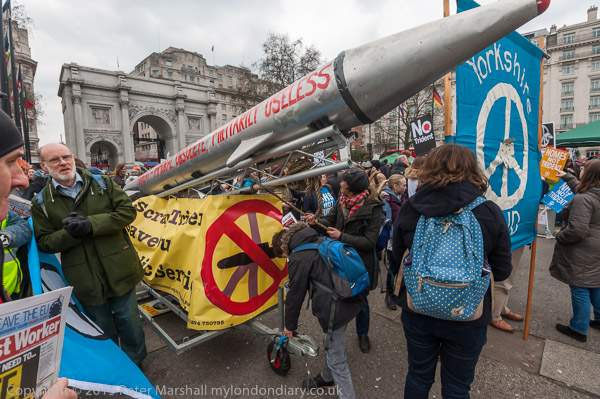
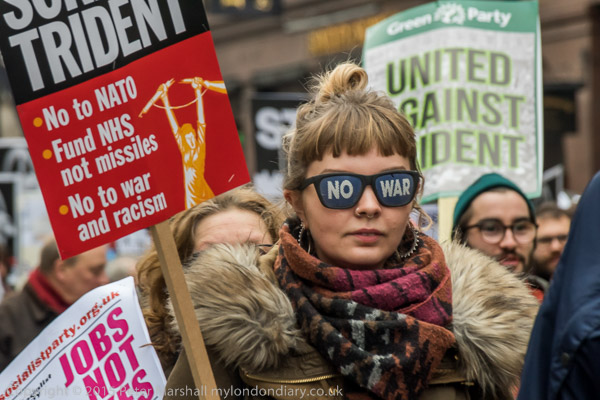
For Refugee Rights and Against Trident. I covered two marches in London on 27th February 2016, the first calling for safe passage for refugees seeking protection in Europe and following this a much larger march against government plans to waste £180 billion or more on replacing the UK’s Trident nuclear weapons.

European March for Refugee Rights

The European March for Refugee Rights was part of a day of protests in cities across Europe demanding action by governments to provide secure safe passage routes for all refugees and asylum seekers seeking protection in Europe. They want an end to deaths at borders and drownings and for refugees to be allowed to keep their possessions and be reunited with their families.

Among those taking part were people who had been to aid refugees in Lesvos and at the Calais camps and others who had volunteered with Medicins Sans Frontiers in Syria. The protest was supported by many groups including the Syria Solidarity Campaign, Solidarity with Refugees, London2Calais, Migrants’ Rights Network, SOAS Solidarity with Refugees & Displaced People Soc, Wonder Foundation, Calais Action, UK Action for Refugees, Refugee Aid Initiative, No Borders and the Greece Solidarity Campaign.

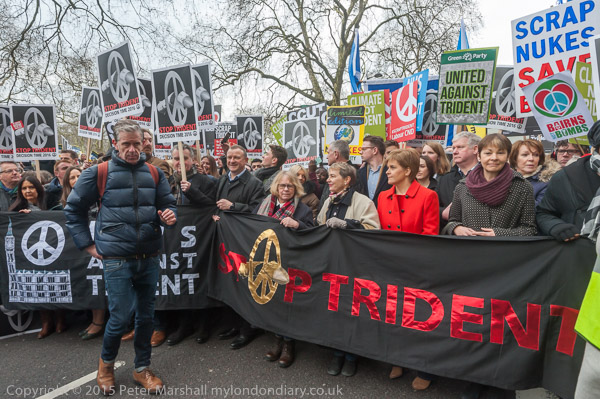
This was a short march taking place unusually inside Hyde Park, gathering at Hyde Park Corner and walking up to Speakers Corner where there was a rally. This made it possible for those taking part to join the Stop Trident Rally which was starting from Marble Arch, and going down Park Lane on its way to Trafalgar Square. Some of the marchers decided to form a block to march in front of the main Stop Trident banner and march on to Trafalgar Square.

Stop Trident march stewards tried briefly to stop them but then gave up and halted their march for around ten minutes to create a gap between the two groups.

European March for Refugee Rights


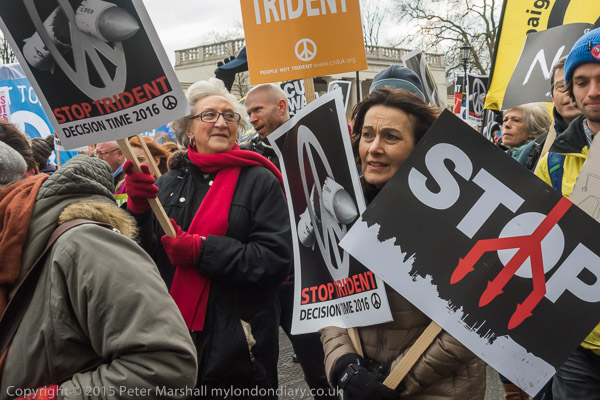
Stop Trident March

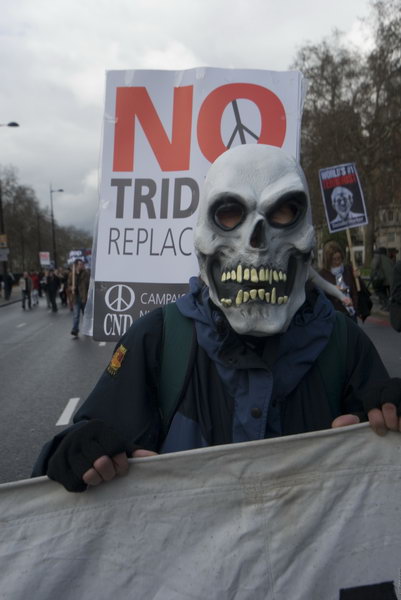
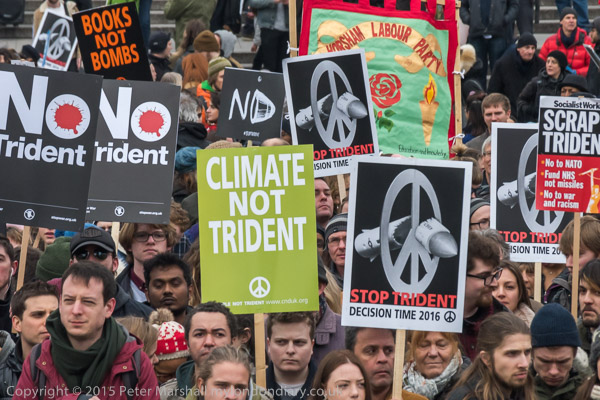
According to CND there were 60,000 people marching from Marble Arch to a mass rally in Trafalgar Square, and although their estimate may have been a little on the high side, this was definitely a very large protest, starting with a densely packed crowd on Park Lane. When the rally began in Trafalgar Square the tail of the march was still around half a mile away, and I think many gave up before reaching the rally as the streets leading to it became blocked.

Few people outside the military and arms manufacturers – probably the most powerful of all lobbies in the country can really believe the expenditure of £180 billion or more on replacing the UK’s Trident nuclear weapons is either necessary or cost-effective. The huge majority of nations in the world have no nuclear capability, and by December 2021, 59 states had ratified or acceded to the UN Treaty on the Prohibition of Nuclear Weapons (TPNW) which entered into force on 22 January 2021.

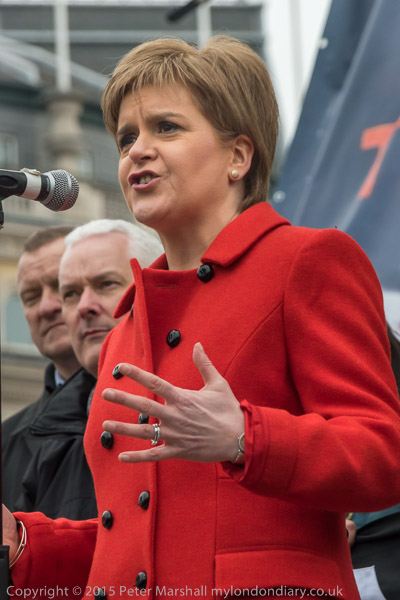
Lindsey German, Stop the War, Kate Hudson, CND General Secretary, Nicola Sturgeon, SNP First Minister, Scotland and Green Party MP Caroline Lucas hold the Stop Trident banner

A national survey by Survation at the start of 2021 for CND showed 59% of the public supported the UK government signing up to the TPNW, including 50% of Conservative voters and 68% of Labour voters. An even higher 77% supported a ‘total ban on all nuclear weapons globally’ with majority support from young and old, in all regions of the country, from Conservative as well as Labour voters, leavers and remainers. The government remains resolutely opposed to the treaty.

This widespread opposition to nuclear weapons isn’t largely a matter of their cost but on both moral and pragmatic grounds. As CND say, using nuclear weapons would cause catastrophic global damage; these weapons of mass destruction don’t keep us safe and divert resources from essential spending on services like the NHS, schools and housing and “it is clearer than ever that real security for Britain requires addressing the risks posed by the climate emergency and pandemics on a global scale.

Stop Trident March


Stop Trident Rally

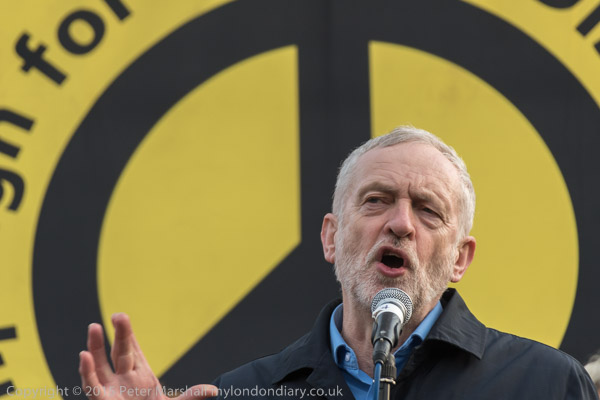
Trafalgar square was unusually packed for the long rally that followed the march, with people listening and applauding a long list of speakers, including Nicola Sturgeon, Caroline Lucas, Leanne Wood, Vanessa Redgrave, Bruce Kent, Christine Blower, Mark Serwotka and Tariq Ali, as well as many less well-known names. There were many marchers who found it impossible to get into the square.

Nicola Sturgeon First Minister Scotland

All the speakers opposed the spending of an estimated £180 billion or more on renewal of Trident which they dismissed as out of date, totally irrelevant to our defence and a complete waste of money which could be put to so much better use providing proper jobs and services.

It was a long wait, around two hours standing in the cold for the final speech by Jeremy Corbyn who had earlier in the day been speaking in Sheffield and whose train had been a little delayed. He was greeted by a tremendous response from the crowd, and gave a rousing speech to end the protest on a high note. Despite the dismissive remarks from many political commentators on the media, Corbyn is one of the most powerful political speakers of current years.

Stop Trident Rally


Outsourcing, North Woolwich & Class War v. Rees-Mogg

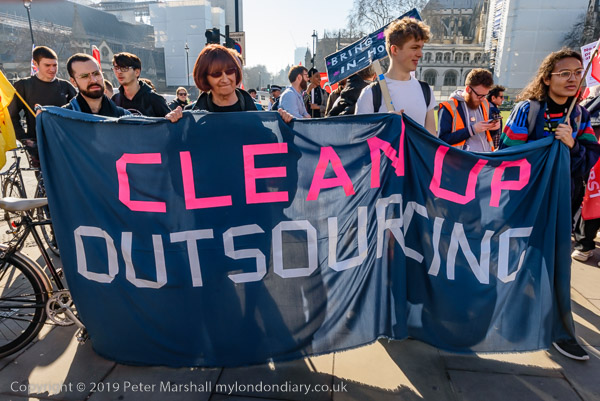
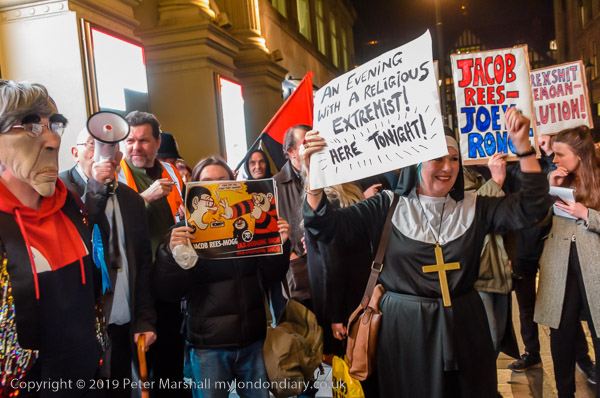
Outsourcing, North Woolwich & Class War v. Rees-Mogg. Three years ago on Tuesday 26th February I spent the morning photographing several protests against outsourcing, had a rather late pub lunch, then went to North Woolwich for a short walk before rushing back to meet Class War who were protesting outside a Palladium show by Jacob Rees-Mogg.


Rally for an end to Outsourcing

A legal challenge was taking place at the High Court on this day to extend the employment rights of the 3.3 million workers whose jobs are outsourced from the companies where they work to contracting companies which then sell them back to their place of employment at cut rates.

Labour Shadow Business minister Laura Pidcock

The contractors do this by cutting wages, trimming things such as pensions, maternity pay and holiday pay to the bare legal minimum, increasing workload and reducing hours of work and often bullying managers. Outsourced workers generally have little job security and are often denied necessary safety equipment and not given proper safety training.

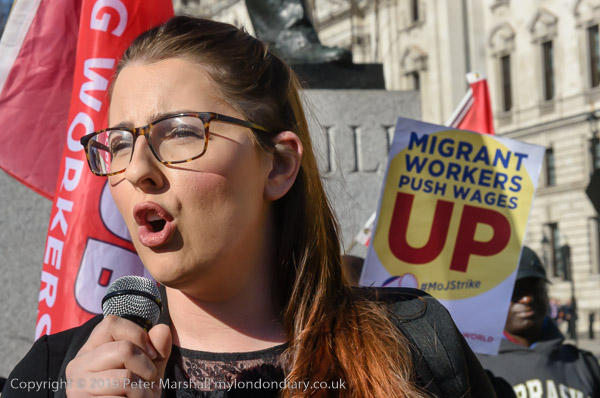
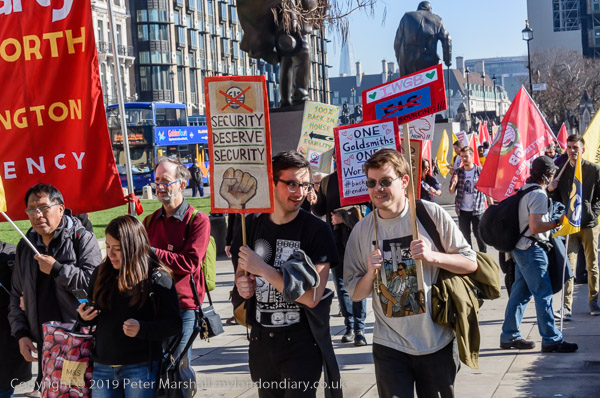
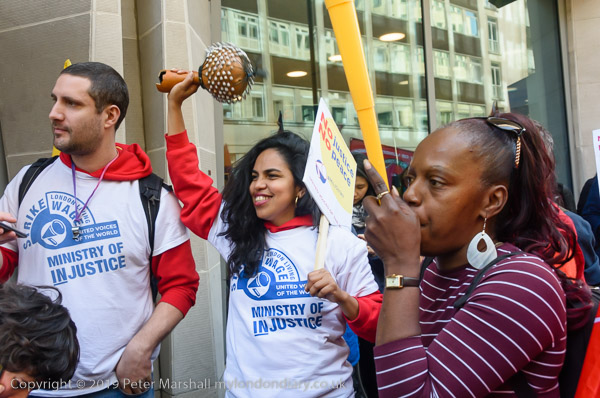
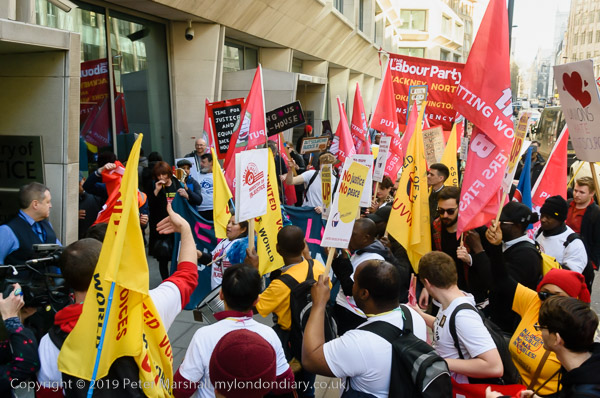
Workers, mainly migrants who work for the Ministry of Justice, Dept for Business, Energy & Industrial Strategy and the University of London were taking part in a one day strike in a coordinated action by the UVW and IWGB trade unions and the BEIS PCS branch to demand an end to outsourcing and the insecurity, discrimination and low pay it causes. They had started their march at 8.00am at the University of London and after a rally outside the High Court had marched to Parliament Square where I met them at 11am.

Rally for an end to Outsourcing


Outsourced Workers protest at BEIS

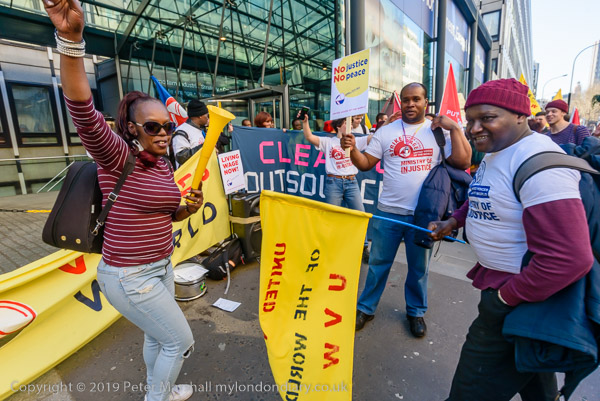
From Parliament Square the marchers went on to hold a further rally outside the Dept for Business, Energy & Industrial Strategy in Victoria St. Those striking at the BEIS included catering and security staff who are members of the PCS and are demanding the London Living Wage as well as end to outsourcing and the insecurity, discrimination and low pay it causes.

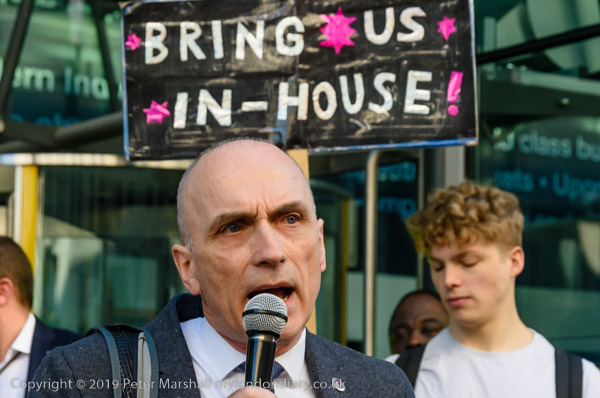
The PCS strikers led a lively rally with plenty of singing, dancing and shouting of slogans expressing their demands, which was followed by several speeches, including from Labour MP Chris Williamson, who brought messages of support from Labour shadow cabinet members and promises that a Labour government would end outsourcing.

Outsourced Workers protest at BEIS


Outsourced Workers at Justice ministry

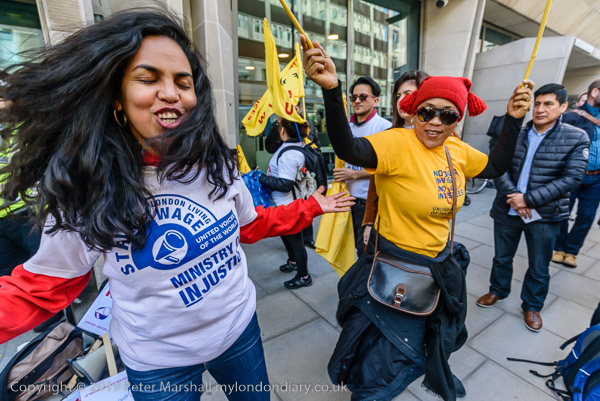
The marchers continued the short walk to the Ministry of Justice in Petty France, where low paid workers belonging to the United Voices of the World union at the Ministry of Justice have been campaigning for some time to get the London Living wage, but the Justice Minister has refused to talk with them. Many wore t-shirts calling it the Ministry of Injustice.

During the rally outside the building some of the UVW workers who had already been on strike for 24 hours went back into the ministry to resume work, to cheers and hugs from those on the street outside. The rally ended with music and dancing on the pavement, and I left for a rather late pub lunch in Holborn.

Outsourced Workers at Justice ministry


North Woolwich

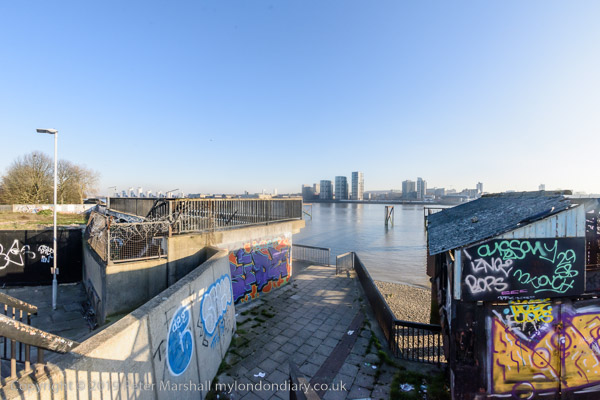
I’d been intending to walk a short section of the Capital Ring, mainly beside the River Thames, for some months as it had been quite a few years since I’d last been there and wanted to see how it had changed. I had an afternoon with nothing else I needed to photograph and although the sunny weather with clear blue skies was not ideal it seemed a good opportunity.

Panoramic photographs almost always have large expanses of sky, and on days like this it tends lack interest, as well as often giving unnatural looking variations in tone when getting closer to the sun. Getting to North Woolwich should have been simple and reasonably fast, but unfortunately there was trouble on the DLR and I had to make a less direct route, so had to rather rush on the walk and leave it half-finished. It was a few months later before I found time to go back and complete it.

North Woolwich


Class War protest Rees-Mogg freak show

I find it hard to understand why anyone should want to come and listen to Jacob Rees-Mogg, let alone pay £38 for a ticket to do so at the London Palladium.

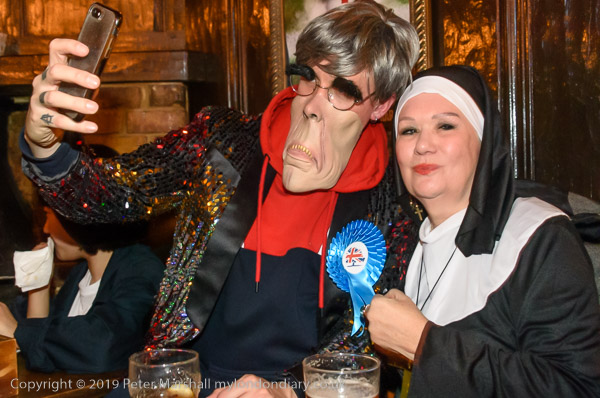
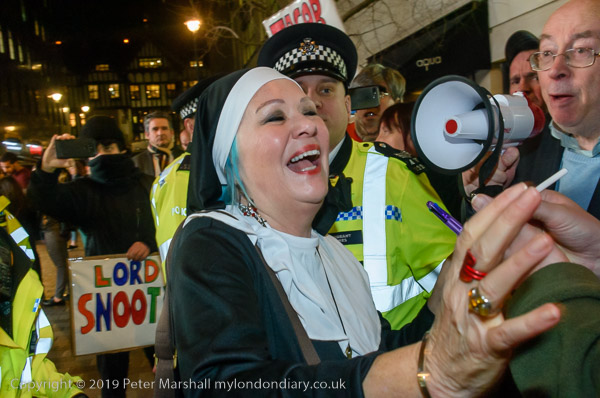
So too did Class War, and with Jane Nicholl dressed as a nun, Mother Hysteria, and Adam Clifford as Jacob Rees Mogg they loudly asked why people had come to listen to him “spout homophobic, transphobic, racist, pro-hunting, misogynist, classist, privileged” nonsense.

Their show on the street outside was almost certainly a better show than anything that would take place later inside the venue, and all for free. Police spent a considerable amount of public money on harassing them, and provided their own rather hilarious input by searching Mother Hysteria and threatening to arrest her for carrying offensive weapons after some novelty stink bombs were found in her handbag. When I left the officer who had stopped and searched her had already spent 20 minutes trying to write her notice of stop and search, probably at a loss trying to find some way to put it that doesn’t make it sound incredibly stupid.

Class War protest Rees-Mogg freak show


Guantanamo, Firefighters, Advocacy, RMT & Lambeth Cuts

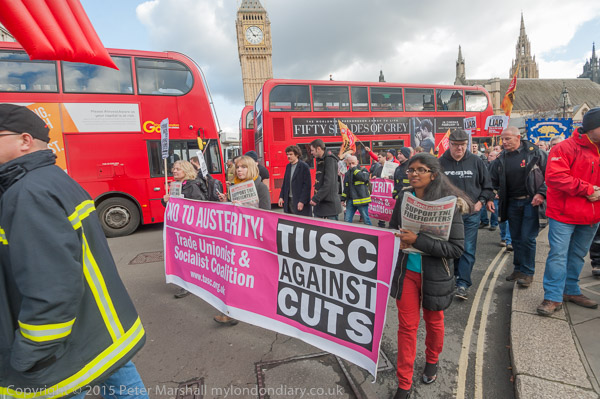
Guantanamo, Firefighters, Advocacy, RMT & Lambeth Cuts. Wednesday 25th February 2015 was a busy day for protests in London, and I photographed five events.


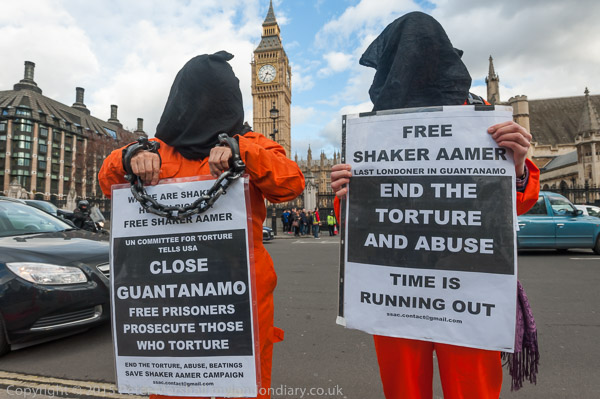
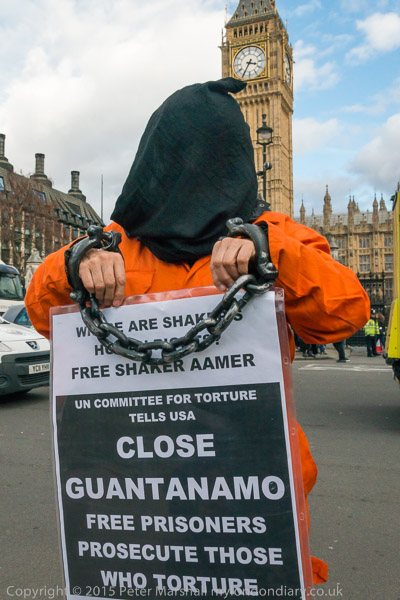
Free Shaker Aamer at Parliament

The Free Shaker Aamer campaign protested for 4 hours at Parliament calling for the urgent release of London resident Shaker Aamer from Guantanamo, where he had been held for over 13 years and regularly tortured. Of course I didn’t stay with them that long – there aren’t really that many ways to photograph a fairly small group in orange jumpsuits – but it meant they were still there when I arrived over three hours after their protest began.

Usually their protests are at lunchtime, but because they had stayed longer I was able to photograph their weekly protest at around 3.30pm on my way to an event outside Downing St. They continued these protests while parliament was sitting until Shaker was released towards the end of 2015.


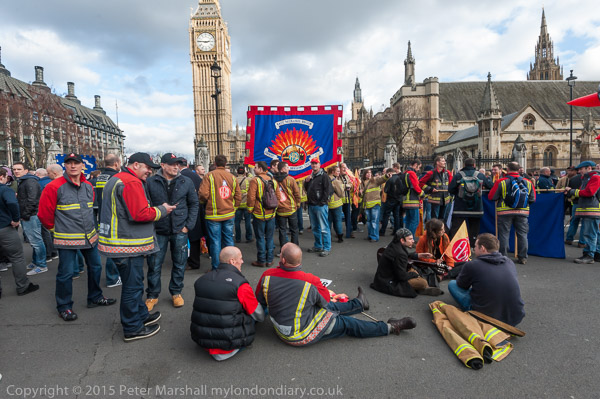
Striking Firefighters block traffic

Firefighters came out of their rally in Central Hall and blocked the road in front of Parliament. I don’t think the police tried to move their fellow public servants, who had a large black balloon with the message ‘FBU – WE RESCUE PEOPLE, NOT BANKS! STOP THE CUTS’ as well as several banners.

After around ten minutes they marched down to Downing St, blocking much of Whitehall. In front of the gates to Downing St there was a very noisy protest, and police did come and talk with In front of the gates to Downing St there was a very noisy protest, and police did come and talk with FBU leader Matt Wrack and promised to try to get someone to come out and talk with them.

They were still waiting when I left – and I think they would still be waiting now before anyone representing our Tory government came.


Welfare Advocacy not a Crime

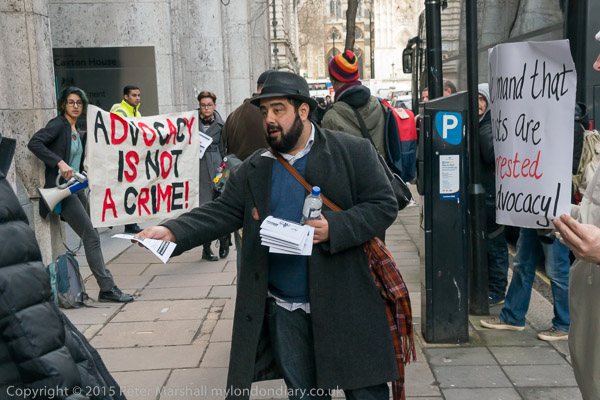
A short walk away in Caxton Street people were protesting outside the Dept of Work & Pensions in a nationwide day of action over the arrest of welfare rights activist Tony Cox.

Although by law welfare claimants are allowed to have an adviser present with them at job centre interviews, when a claimant arrived together with Cox his interview was cancelled. And later that day police arrived at Cox’s home, arresting him and charging him with threatening behaviour.

When his case came to court in October the prosecution had to drop the main charges. A month after the first hearing Cox was found guilty of refusing to supply person details to the police and fined £200 and admonished on the charge of hindering the officers.


RMT protest Underground Job Cuts

Despite earlier promises, Transport for London were planning to go ahead with a 50% cut in station staffing, closing ticket offices such as the well-used one at the busy Edgware Road station on the Bakerloo Line.

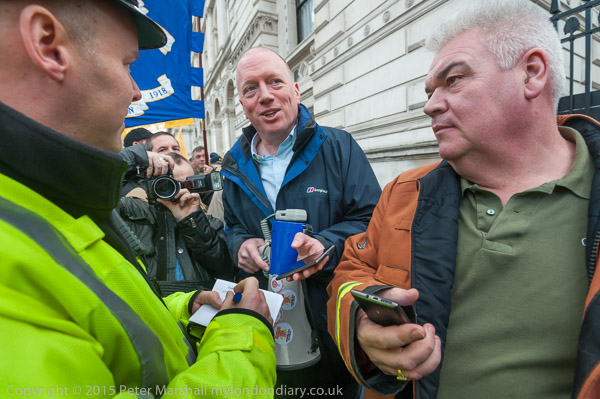
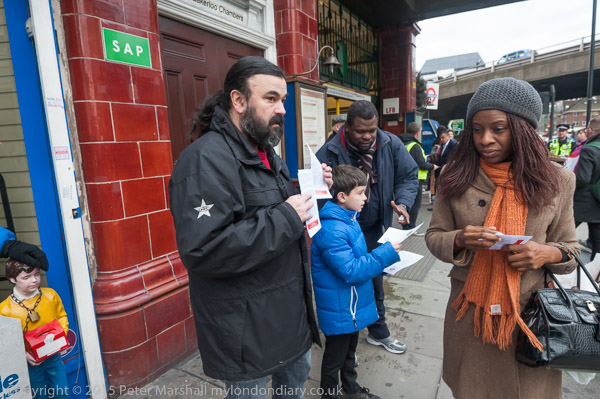
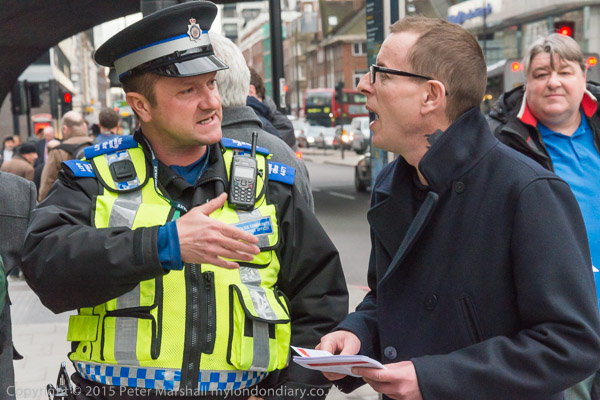
Things threatened to get nasty with some angry exchanges when police tried to move RMT members handing out leaflets to the public, but the RMT members insisted on their right to do so on the pavement outside the station entrance.


Lambeth against £90m cuts

Another tube journey changing at Oxford Circus from the Bakerloo to the Victoria Line took me south of the river to Brixton where a short distance from the station a lively rally was taking place on the street corner outside Lambeth Town Hall.

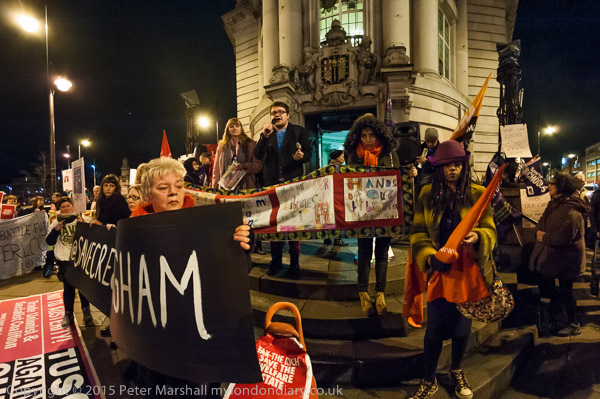
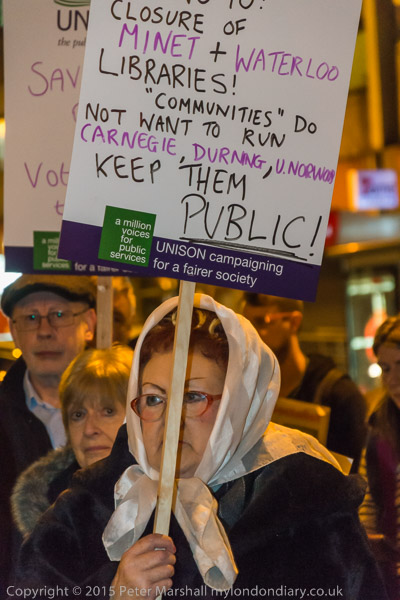
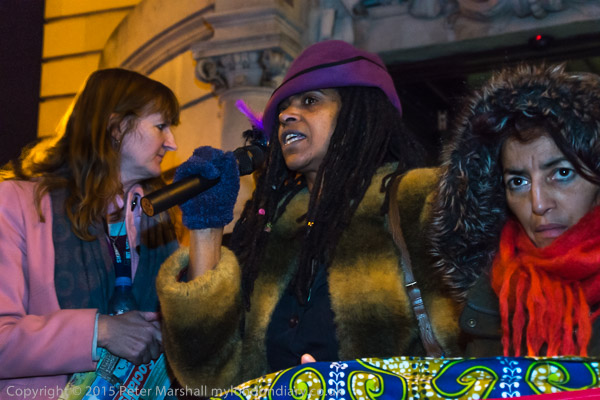
Around a hundred trade unionists, pensioners, library and other council staff, social housing tenants and other residents were there to tell councillors arriving for a council meeting to reject library closures and other £90 millon cuts.

It was now around 6pm, and in late February the sun sets around 5.30, so it was getting rather dark. Although I had both flash and LED lighting, neither is much use for lighting larger groups of people, and even on the corner of two major roads the streetlighting a few yards back was pretty poor. Thankfully digital cameras are considerably better than film under such conditions and I was able to get good results at ISO 3200.


More on all these on My London Diary:

Lambeth against £90m cuts
RMT protest Underground Job Cuts
Welfare Advocacy not a Crime
Striking Firefighters block traffic
Free Shaker Aamer at Parliament


Stop Trident, Troops out of Iraq – 2007

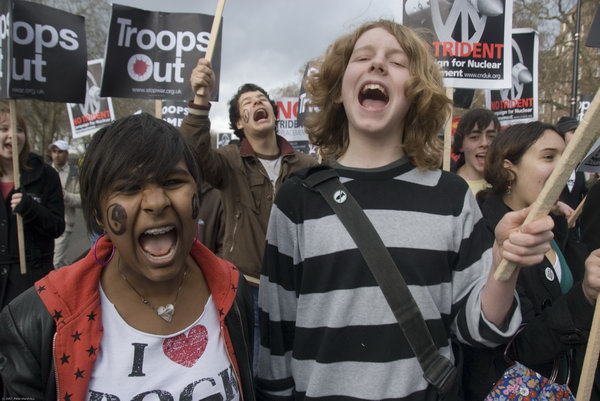
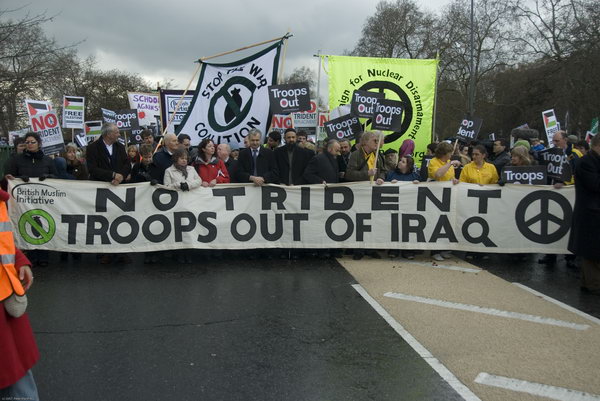
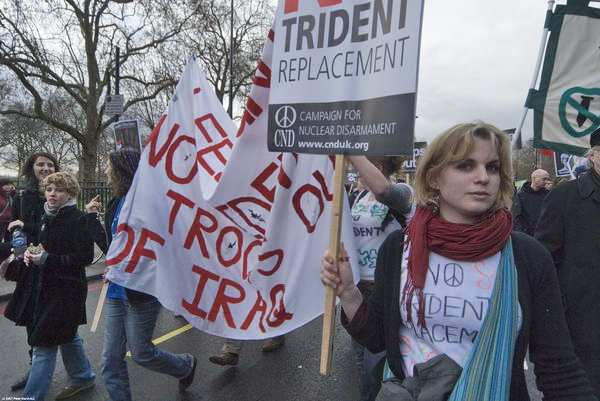
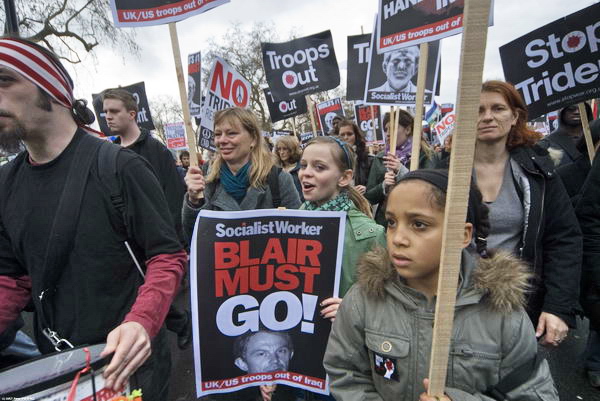
Stop Trident, Troops out of Iraq – 2007. On Saturday 24th February 15 years ago I spent a long afternoon photographing around 50,000 protesters marching through London calling for an end to Britain’s nuclear weapons and for our troops to be withdrawn from Iraq.

The march was organised by Stop The War, the Campaign For Nuclear Disarmament and the British Muslim Initiative, and on My London Diary – back then still only in lower case – I made clear my support for the marchers:

i’ve for many years been opposed to the so-called independent british nuclear weapons. even at the height of the cold war they were never credible as an independent deterrent. if they have ever had any justification it was that they made the usa feel less guilty, although american guilt at its huge nuclear arsenal and at being the only country ever to have used nuclear weapons has always been an incredibly stunted growth.
i was also firmly against the invasion of iraq. it was always clear to those who didn’t want to be deluded that the so-called ‘intelligence’ on weapons of mass destruction was laughable. blair was either a liar or a fool as he misled a minority of the british people and a majority of their mps. or most probably both. (saddam may also have been deluded and certainly was an evil dictator, but we had long failed those who tried to oppose him.) the invasion was criminal, but the lack of planning for the occupation that inevitably followed even more so.
My London Diary – Feb 2007

My account also points out the ridiculously low estimate of the numbers taking part given by the police of 4,000 – though I think they were eventually forced to increase this somewhat – and gives my own method of assessing numbers on such large demonstrations as this. The marchers took 90 minutes to pass me as I photographed them in Park Lane. My usual rule of thumb was to double the police estimate, but on this occasion they surpassed themselves, being an order of magnitude out.

There certainly is always a policy by our establishment, backed up by the BBC and the press, except on rare occasions to minimise dissent, particularly left-wing dissent, in this country while often exaggerating any protests against left-wing governments abroad. It’s a bias which has been very obvious in the coverage of events in Latin-American countries such as Venezuela.

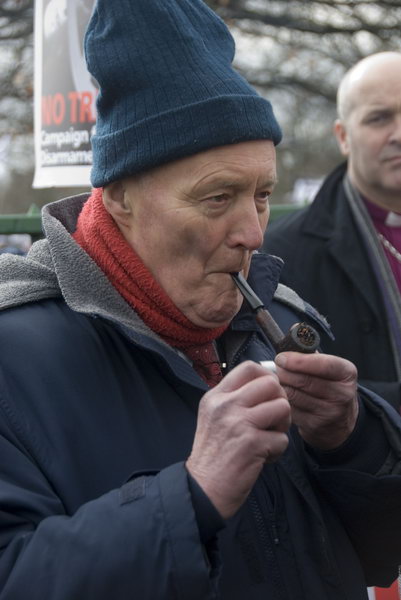
Tony Benn

The BBC and some of our newspapers have some excellent reporters and correspondents, and it is more in the selection of what they are asked to report on and the editing of their reports and the context in which they are placed that the bias occurs. Some things are just not ‘news’, while others, often trivial or flippant, get major attention.

Fortunately there are other sources with different biases, including the almost invisibly small left-wing press in the UK (the two daily papers – the Communist Morning Star and Workers Revolutionary Party’s The News Line together have a circulation probably well under 10,000), but more importantly large news organisations such as the Russian-funded RT International and the Qatari Al Jazeera English – the latter particularly interesting about current events in the Ukraine.

Every journalist has a point of view and while we may strive to be factual I don’t think there is such a thing as objectivity. Our reporting is always subjective, based on what we feel and what we think is of importance. Every photograph I take involves choice – and the rejection of other things I don’t photograph – even at times things I think would make eye-catching images but would misrepresent people or the event. Further choices come in the selection of which images to send to an agency, and also which I choose to put on My London Diary.

On this occasion I chose rather too many to put on-line, with 17 pages of pictures, though this reflects the typical internet speeds of 15 years ago, when pages with more than ten small images were too slow to load even though I compressed the images as lower quality jpegs than I would now. But the number of pictures also reflected my intention to tell the story of the event as fully as possible rather than creating a single image for the event that might appeal to a picture editor.

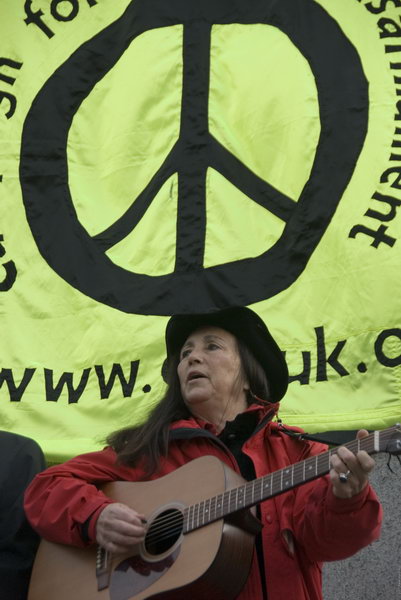
Julie Felix

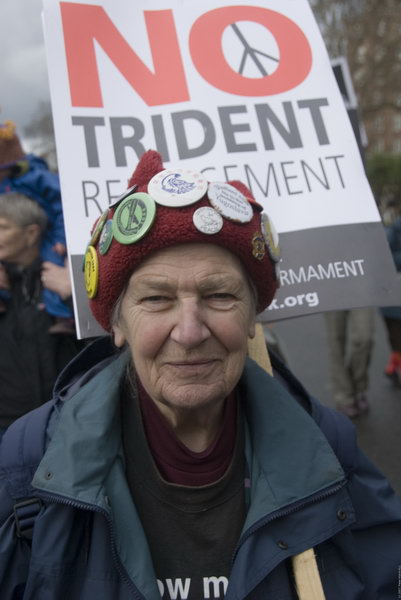
Looking at the report now I feel there are rather too many images particularly of some of the well-known faces I photographed at the rally. Perhaps also I made too many of the marchers, some of which might be of far more interest to the people shown in them than the general public. But if people make an effort to make an interesting placard or banner I think it deserves a little recognition.

You can read more of my report of the event and see another 160 or so pictures on My London Diary, beginning on the February 2007 page, though you will need to scroll a long way down the page to reach this march and rally.


Back to Poplar in 1988

My previous post, Around Devons Road, Bow 1988, ended outside Spratt’s Patent Limited on Morris Road on the south bank of the Limehouse Cut. My walk continued south down Chrisp St to the East India Dock Road, then turning east for around 350 yards and then back up the next main route north, St Leonards Road.

Plaque, George Lansbury, Poplar Councillors, East India Dock Rd, Poplar, Tower Hamlets, 1988  88-7t-66-positive_2400
Plaque, George Lansbury, Poplar Councillors, East India Dock Rd, Poplar, Tower Hamlets, 1988 88-7t-66-positive_2400

This ‘blue plaque’ is actually and appropriately a red one, placed here by Tower Hamlets Environment Trust with the text ‘Near this place on July 29th 1921 George Lansbury led the people and councillors of Poplar on their march to the high court for the equalisation of rates to poor boroughs.’

According to a long article in Wikipedia, as a youth Lansbury was a supporter of the Liberal Party and particularly Gladstone, but while campaigning for the party he became greatly influenced by leading socialists including William Morris, Eleanor Marx, John Burns and Henry Hyndman, and resigned in 1892, joining the Social Democratic Federation. He worked for a short period as the SDF paid national organiser, leaving that job to return to Bow to take over the running of the sawmill owned by his wife’s family.

Lansbury was first elected to Poplar Borough council in 1903 and in 1910 became MP for Bow and Bromley. He resigned in 1912 in order to fight a by-election in the constituency standing as the ‘Women’s Suffrage and Socialist’ candidate, and although neither Labour nor Liberal parties put up candidates to oppose him he lost to a Conservative candidate with the name of Blair. Reginald Blair had campaigned under the slogan “No Petticoat Government”.

Earlier in 1912 Lansbury had campaigned with others to found a daily socialist newspaper, the Daily Herald, and became editor in 1914. Under his editorship the paper opposed the 1914-18 Great War with Germany and supported the 2017 Russian Revolution.

Lansbury and 29 fellow Poplar councillors were jailed in 1921 for refusing to pay unfair sums from the rates to fund the London County Council, Metropolitan police and other London-wide bodies, instead using the money to support the local poor. Their imprisonment led to public outcry and they were released after six weeks, with a law hastily passed to make richer London boroughs pay their fair share. The campaign made Lansbury a popular hero, and the following year he was elected as local MP with a large majority, holding the seat until his death in 1940.

From 1932 to 1935 Lansbury was the Leader of the Labour Party, but was forced to resign because his Christian pacifist principles became increasingly unacceptable as war with Germany and Italy looked increasingly inevitable. Ernest Bevin put in the final knife, pointing out at conference that his beliefs contradicted the party policy to oppose fascist aggression. Lansbury resigned a few days later, his deputy Clement Atlee becoming leader.

The Falcon, pub, East India Dock Rd, Poplar, Tower Hamlets, 1988  88-7t-51-positive_2400
The Falcon, pub, East India Dock Rd, Poplar, Tower Hamlets, 1988 88-7t-51

The Falcon was at 202a East India Dock from 1869 until it closed in 1985. In my picture you can see some of the windows are boarded up inside and one in Bullivant Street is broken. The first building here was around 1819 and was owned by a Poplar wine merchant, so it may have been a pub earlier. The Truman, Hanbury & Buxton building in the picture dates from 1911 and was demolished shortly after I took this picture.

The A13 here has been widened and nothing on the south side of the road here remains. There are flats on the corner of Bullivant St, a few yards further south than the front of the former pub.

Chinese, East India Dock Rd, Poplar, Tower Hamlets, 1988  88-7t-52-positive_2400
Chinese, East India Dock Rd, Poplar, Tower Hamlets, 1988 88-7t-52

I think this heavily metal shuttered frontage was a Chinese restaurant on the north side of East India Dock Road, probably in the block opposite Bullivant St. Unfortunately I can’t read the two Chinese characters but was intrigued by them and the hanging curtain behind them in this small aperture at the bottom of the doorway.

Tunnel Furnishers Ltd, East India Dock Rd, Poplar, Tower Hamlets, 1988  88-7t-53-positive_2400
Tunnel Furnishers Ltd, East India Dock Rd, Poplar, Tower Hamlets, 1988 88-7t-53

Tunnel Furnishers, a furniture warehouse, was as few doors along East India Dock Road east from The Falcon pub on the corner of Bullivant St. A rather fine 1930s building, this was also lost in the widening of the road not long after I photographed it.

It looks rather like a cinema, but was built in 1938 for the Borough of Poplar as Electricity Showrooms and Offices, replacing an earlier showroom on the site. Closed in 1972, the upper floors continued to be used for training by the London Electricity Board until 1975, after which it was sold for commercial use. Like the rest of the block it was demolished in 1991.

Lodore St, Poplar, Tower Hamlets, 1988  88-7t-55-positive_2400
Lodore St, Poplar, Tower Hamlets, 1988 88-7t-55-positive_2400

My walk took me into what is now the St Frideswide’s Mission House Conservation Area, where a couple of days earlier I had photographed the Follett St Seamen’s Mission, and I took another, very similar picture of that building, before going further along the street and turning into Lodore St.

The view above is I think from Follett St, and shows the rear of one of the buildings of St Frideswide’s on Lodore St, but I think the archway, probably part of the chapel, has been demolished.

Christ Church, Oxford was originally the church of St. Frideswide’s priory, and St Frideswide’s Mission was set up by members of Christ Church College led by the father of Alice in Wonderland, Dean Liddell. A church was built here around 1892, with the Mission house opened in 1893, devoted to a girl’s and mother’s group.

St Frideswide's, Mission House, Lodore St, Poplar, Tower Hamlets, 1988  88-7t-41-positive_2400
St Frideswide’s, Mission House, Lodore St, Poplar, Tower Hamlets, 1988 88-7t-41

The building was paid for by Miss Catherine Phillimore (1847-1929) , who I think was then well-known as an author as well as a translator of Italian books on artists, a wealthy spinster living at Shiplake House in Henley-on-Thames. A number of her books have been reprinted in recent years and are still available.

St Agnes House, Follett Street Poplar, Tower Hamlets, 1988 88-7t-43-positive_2400
St Agnes House, 18, Follett Street Poplar, Tower Hamlets, 1988 88-7t-43

This was built to allow the work of the mission to expand in 1899, and also paid for by Catherine Phillimore. In 1900 it became the Hostel of the Poplar Association for Befriending Girls. The washing on the balcony shows it was still in use in 1988.

St Frideswide’s was the inspiration for the TV series ‘Call the Midwife’ and there is a good article on the Poplar London web site which praises the accuracy of the series and its depiction of the Religious Sisters of Saint John the Divine and their midwives, though complaining that it unfairly makes the residents of Poplar look dirty.


My walk will continue in a later post. You can see larger versions of the pictures by clicking on any of them, which will take you to the album where you can browse more.