Smash EDO Protest Moulsecoomb Arms Factory – 2010

Protests had begun against a small EDO-MBM factory at Moulsecoomb on the outskirts of Brighton in 2003 after the press had revealed that it was making parts for a guided bomb that was being used in the invasion of Iraq.
Smash EDO Protest Moulsecoomb Arms Factory
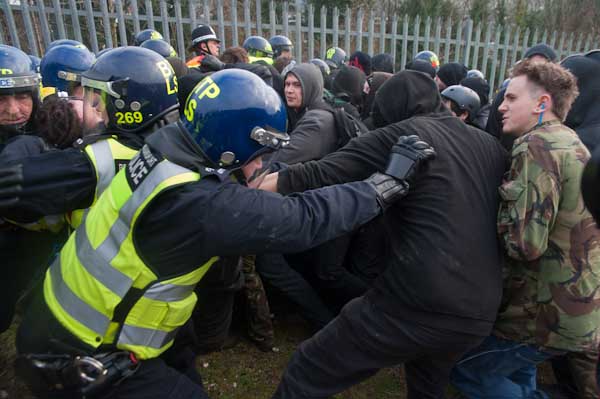
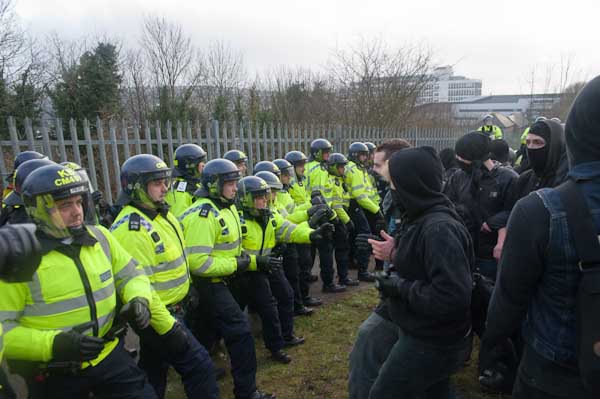
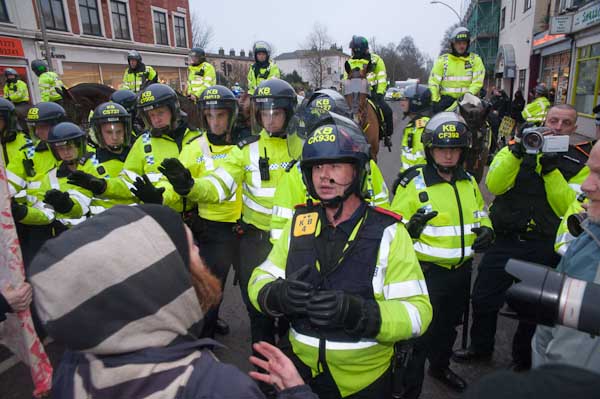
Police push Smash EDO protesters, 2010

In April 2005, EDO attempted to get a wide-ranging injunction to prevent protests at the site, including stepping onto the road outside the factory, playing music and taking photographs. This was the start of a lengthy legal action in which the UK Attorney-General became involved, as the defendants had submitted a detailed dossier on war crimes involving air strikes on civilian areas and infrastructure and were arguing that the invasion was an illegal war of aggression in breach of the UN Charter.
Smash EDO Protest Moulsecoomb Arms Factory

The Wikipedia article states “The court found that if there was an imminent war crime that the protesters believed on reasonable grounds, was about to take place, in which EDO were complicit, then preventative direct action could lawfully be taken against the company without waiting for the authorities of the state to intervene. This ruling effectively allowed proportionate direct action against companies by protesters, if the threat of the crime was imminent and specific.”
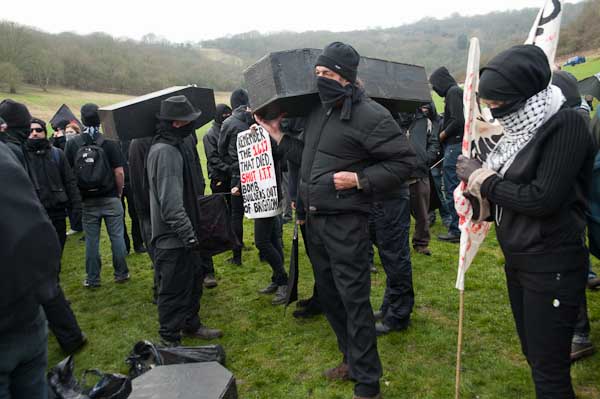
Smash EDO Protest Moulsecoomb Arms Factory
Coffins to remember the 1417 Palestinians killed – some by Brighton-made bombs

Some of the defendants signed an out of court settlement with EDO in April 2005 after it was put forward by Keir Starmer and they were then told legal aid would be withdrawn unless they agreed. They then intervened with a suggestion which was them he would withdraw their legal aid and they signed “undertakings not to do certain things that they had never done and had no intention of doing” with EDO agreeing to pay their costs, as well as their own, and the injunction against those not in court was lifted.
The case against three defendants who were conducting their own defence continued as they refused to sign these undertakings. In March 2006 a judge agreed with them that EDO had failed to make the preparations for a speedy trial as ordered by the court, and the company dropped the case rather than face further proceedings for abuse of process, paying the full costs of all those involved. The whole legal business is thought to have cost EDO between £1-1.5m, more than a years annual profit for the Brighton factory.
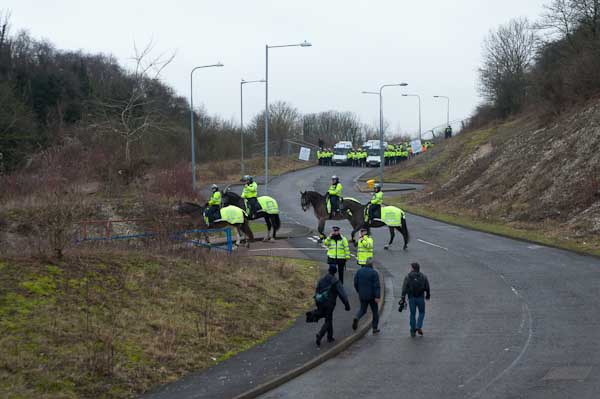
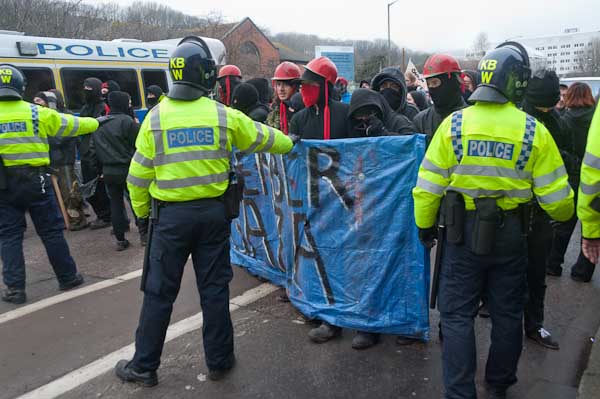
Police block the road to the factory

In 2009 weapons supplied by EDO were being used in the Israeli attacks on Gaza and a small group of activists decommissioned’ the factory to prevent exports to Israel. Again EDO went to court and they were again unsuccessful with the court finding all of those charged not guilty.
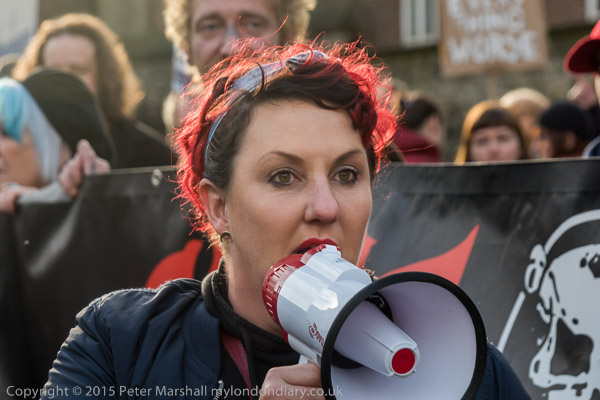
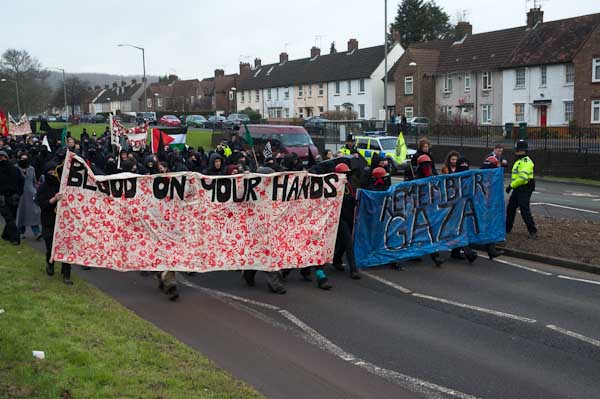
On Monday 18th January 2010, the first anniversary of the end of the Israeli war against Gaza, I went to photography Smash EDO activists in Brighton who were protesting against arms manufacturer EDO MBM/ITT who made some of the weapons that killed 1417 Palestinians, mainly the elderly, women and children, during the three-week assault.
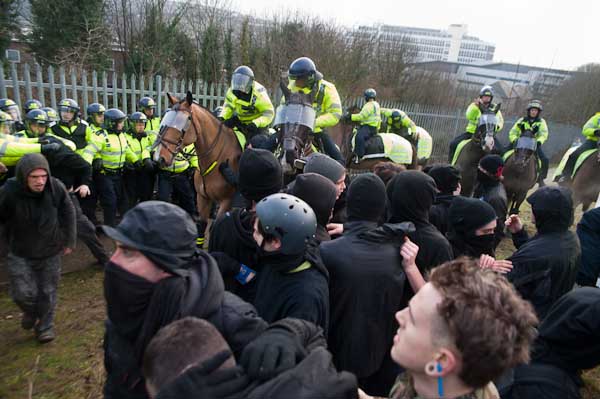
Despite earlier rulings that such protests were legal, the police had come determined to stop this one taking place, responding to the protesters who they probably outnumbered with an impressive display of force and violence as they attempted to make their way to protest at the factory.
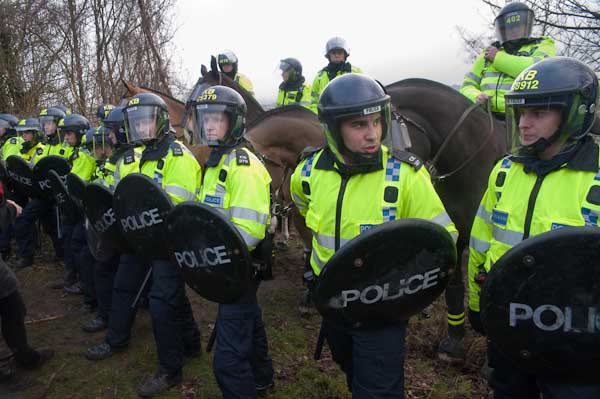
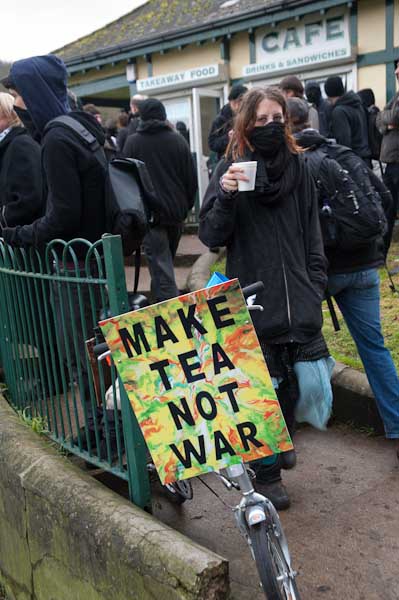
I went with the protesters as they tried to go around the police lines through the woods and along a footpath and was able to photograph some of the confrontations. You can see more of what happened on that day in the pictures and the captions in my post on My London Diary.
What I don’t mention there is that like many of the protesters I was also assaulted several times by some of the officers while taking pictures, and at one point only just managed to stop myself going over a roughly 50ft drop when pushed violently by one of them. Other officers helped me up and to move away from the edge, but it was at times a scary event to cover. I was bruised and shaken as well as tired and left Brighton while the police were still harassing the protesters who had marched back towards the centre of the town.
Protests continue at EDO’s factory, now led by Brighton Against the Arms Trade, after the Moulsecoomb factory was found in 2019 to have produced arms used in a Saudi ‘attack that violated international law’ against a civilian target in Yemen and to be involved in helping Turkey to get around US attempts to prevent the proliferation of drone warfare.
Refugees, Animal Cruelty, Syria and International Times

Saturday 16th January 2016 was a busy day for me, ending rather unusually with taking some photographs at a party which I also put on-line.


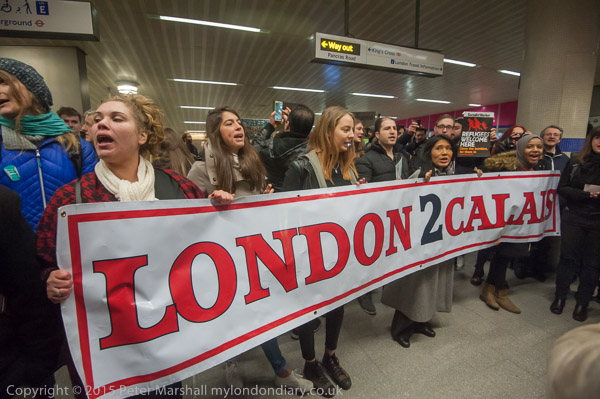
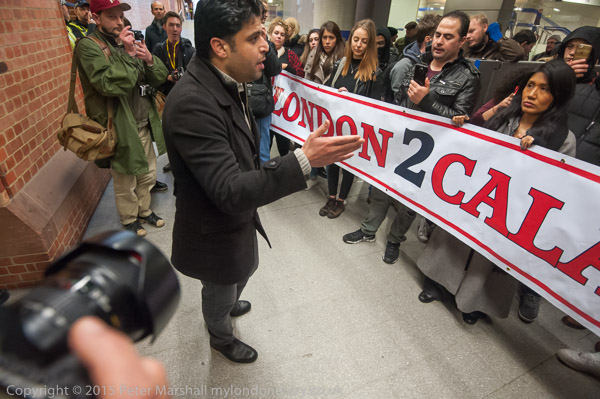
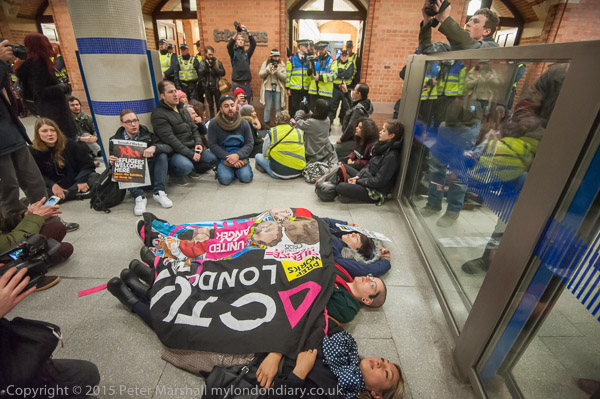
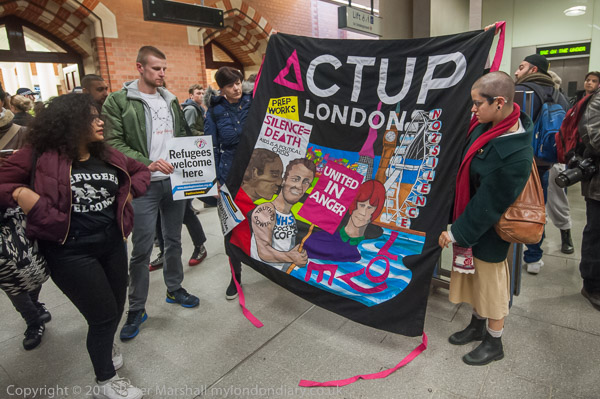
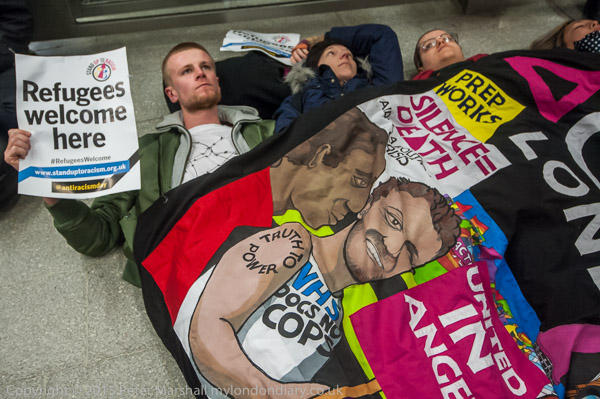
St Pancras Die-In for Calais refugees

Refugees, Animal Cruelty, Syria and International Times

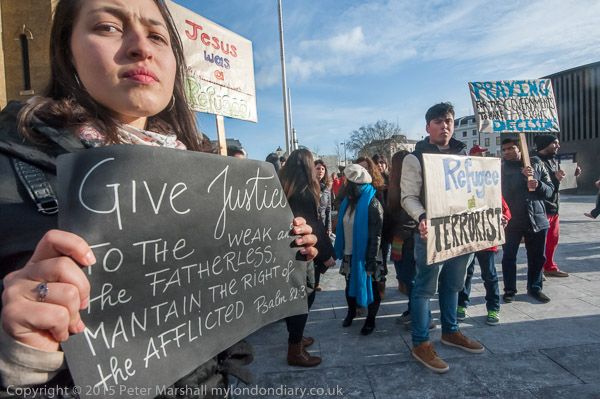
Saturday 16th January 2016 was an International Day of Action in solidarity with refugees and there were protests in Calais and Dunkirk as well as in many cities. The protests were held at short notice against the clearing the Calais refugee ‘Jungle’ and urged the UK government to give refugees at Calais safe passage into the UK to claim asylum.

Refugees, Animal Cruelty, Syria and International Times

Many of those in the camps have family and friends in the UK, which has failed to take a fair share of the migrants. Protesters included people from the London2Calais convoy as well as a Christian contingent with some bible-based placards.

Refugees, Animal Cruelty, Syria and International Times

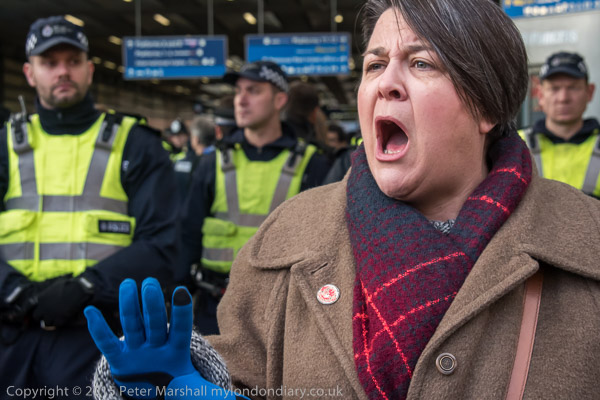
After a brief speech on the wide pavement in front of Kings Cross station the protesters walked to the main entrance of St Pancras International where a large group of police prevented them from entering and they held a short rally.

The protesters then marched off down to Euston Road accompanied by a large group of police. While some continued to march along Euston Road many caught the police unaware by rushing down the steps into the underground entrance and along past the ticket offices before being stopped by more police at the underground entrance to the long shopping mall in St Pancras Station.

They held a protest there with several speakers calling for refugees at Calais and Dunkirk, who include many unaccompanied minors and others with relatives living in the UK, to be allowed to enter the UK and make asylum claims. Actup London then staged a die-in with others sitting down to join them for around ten minutes, ending with a final speech.

Apparently a few protesters had managed to get in and protest with fake body bags at the Eurostar entrance. The protesters had been careful throughout to leave a path for people catching trains to enter the station, but some had been held up by police who mistook them for protesters.

More at St Pancras Die-In for Calais refugees.


March against Taiji Dolphin Slaughter – Regent St

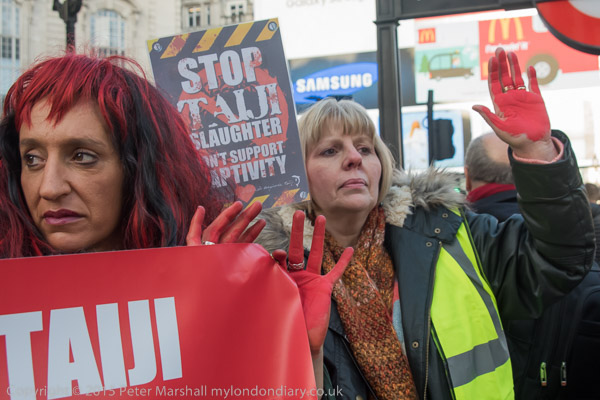
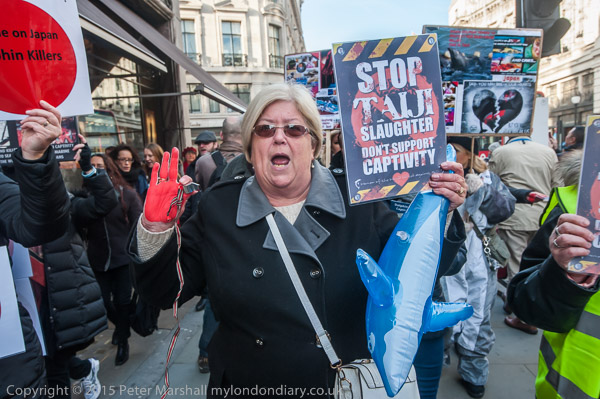
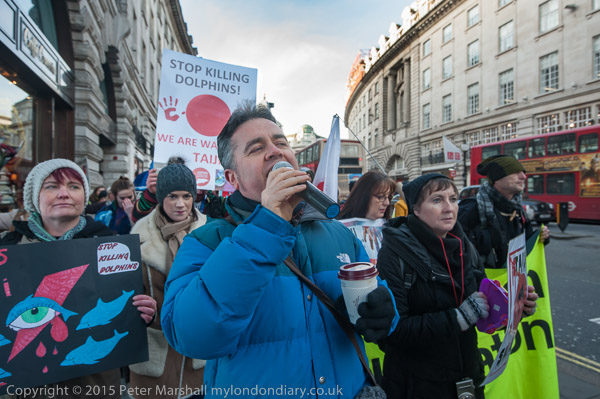
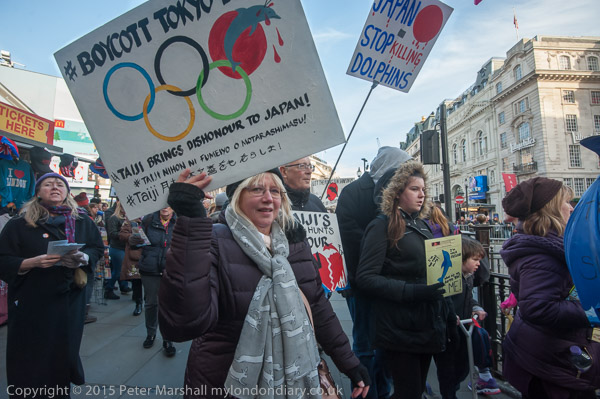
I was late and missed the start of the march against the annual inhumane slaughter of dolphins and small whales at Taiji in Japan. They had met in Cavendish Square but were marching down Regent St when I caught up with them on their way to the Japanese Embassy.

Although there were several hundred taking part, the marchers kept to the pavement rather than take to the road, which seemed rather strange and perhaps reduces their impact, though it did mean that shoppers who often appear to be sleepwalking did have to move out of the way.

Dominic Dyer of the Born Free Foundation, Care for the Wild and CEO of The Badger Trust led the march down the street. As usual many of the marchers had made their own posters and placards and some carried dolphins. This year many of the placards called for a boycott of the Tokyo Olympics for the shame that this inhumane slaughter brings to Japan.

I walked with the marchers taking pictures as far as Oxford Circus, waiting until all of them had passed on their way down Piccadilly to the Japanese Embassy and then left.

More pictures at March against Taiji Dolphin Slaughter.


Vegans ‘Awakening Compassion’ – Piccadilly Circus

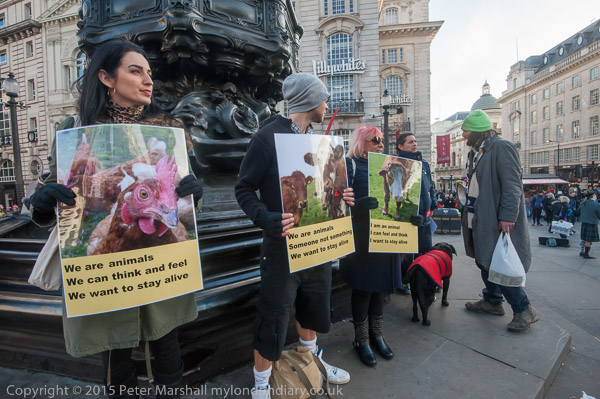
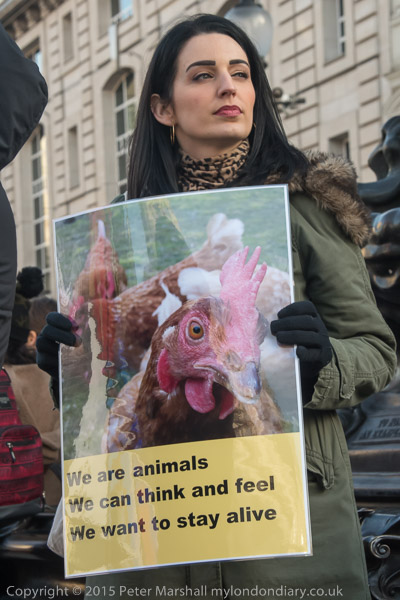
Around the statue of Erost were a group of Vegans from ‘Awakening Compassion’, standing and holding posters with large photographs of animals we farm for food – chickens, cows, sheep, goats, pigs- with messages such as ‘I am an animal – Someone not something – I want to stay alive.

Although I’m opposed to the cruel treatment of animals, the animals in these pictures owe their existence to the farmers who over millennia have bred them and now raise them. If we gave up eating meat and dairy products our countryside would be a very different place. We should be eating less meat for various reasons, and I do often have meals without it and pay more for meat and eggs produced with less cruelty, but farm animals form a vital part of the ecosystem and I’d hate to lose them.

Vegans ‘Awakening Compassion’


Drop Food Not Bombs on Syria – Trafalgar Square

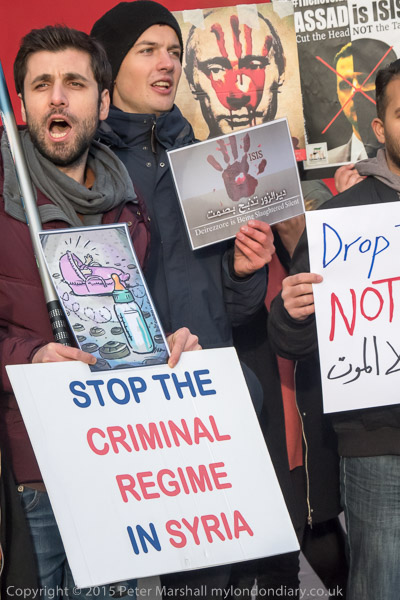
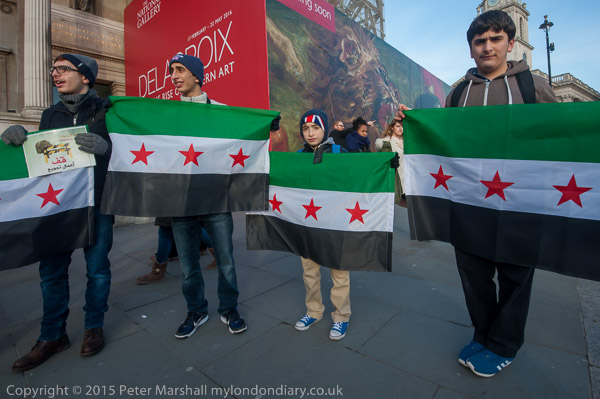
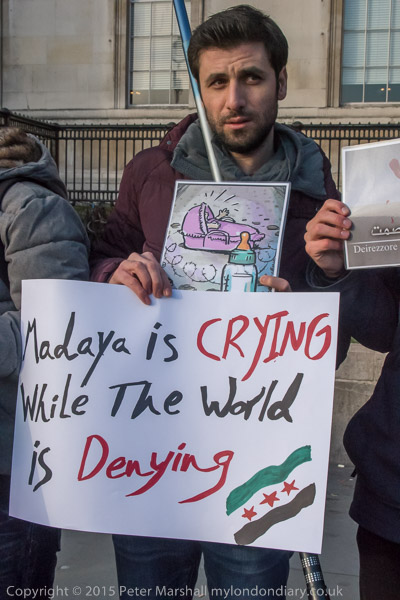
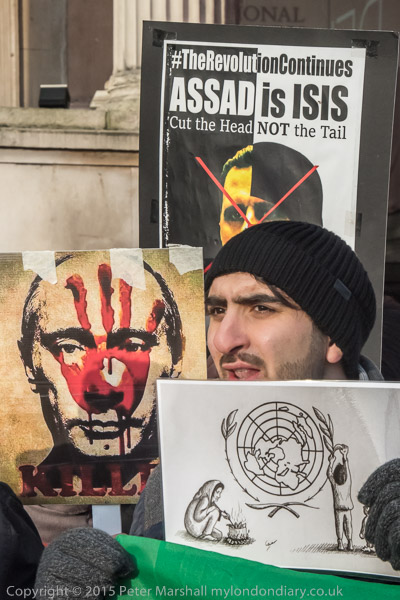
The message of the Syrians who had come to protest in Trafalgar Square was clear – Drop Food Not Bombs on Syria. Instead of spending billions on bombs and weapons they want the money to be spent on humanitarian aid for those under siege across Syria, including those in Madaya and the Yarmouk refugee camp.

Many wore or held the Free Syria flag with its green, black and white strips and three red stars, and various posters which made clear they condemnation of ISS, the Russian bombings and the Assad regime.

One poster read ‘Syrians started the Revolution – Assad started the war’ while others made clear what they were calling for; ‘Drop the Food, Not Bombs’ and ‘Medaya is Crying While the World is Denying’

More pictures: Drop Food Not Bombs on Syria


International Times new ‘Issue Zero’ – Mayfair Rooms, Fleet St

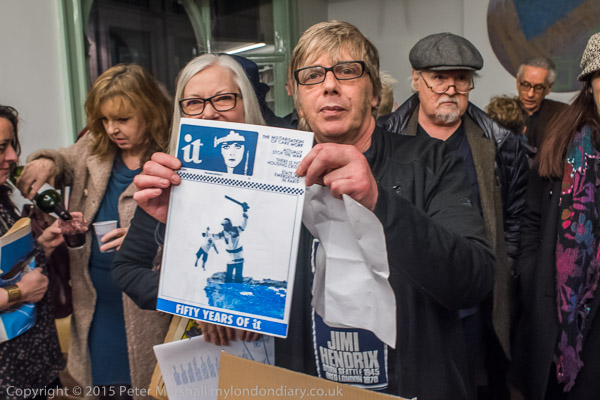
Hot from the press – but long sold out

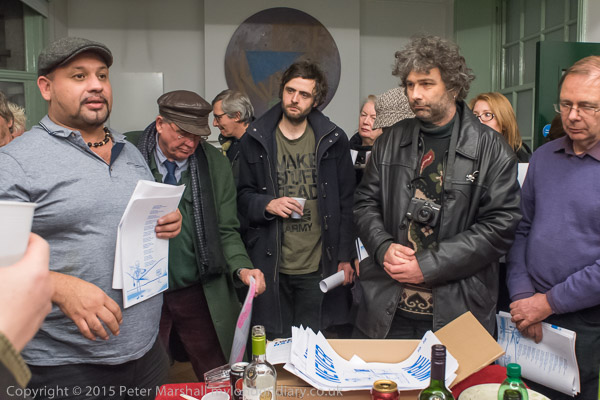
Notorious London underground paper International Times, first published in 1966 and closed down in 1973 (with several re-incarnations and a web site since 2009) started again for its 50th anniversary with a launch party for the 36 page ‘Issue Zero’.

Among those writing for the new issue were stalwarts from its early days, including Heathcote Williams, and the issue was edited by Heathcote Ruthven with subediting by Emily McCarthy, Heather Williams, David Graeber and Heathcote Williams, design by Darren Cullen and art by Nick Victor and Claire Palmer.

Heathcote Williams

More about the issue and more pictures at International Times new ‘Issue Zero’.


UK Uncut VAT rise & a Pillow Fight

Two protests in London on Saturday 15th January 2011.


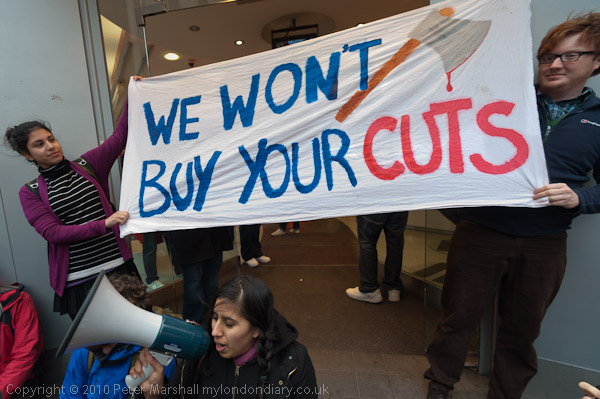
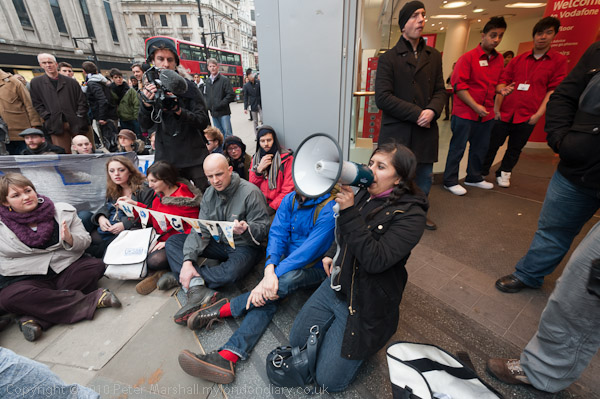
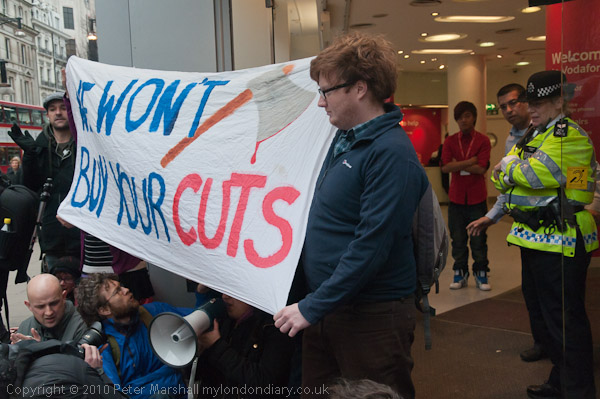
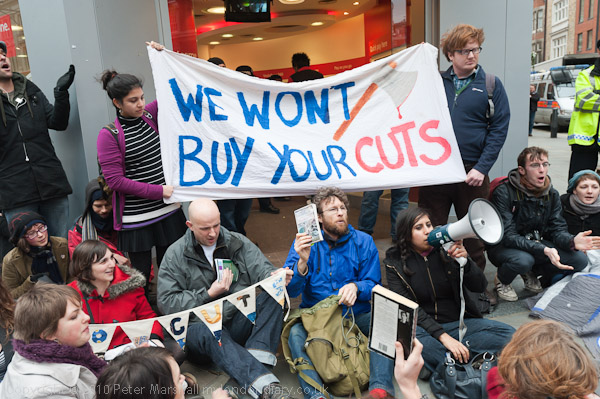
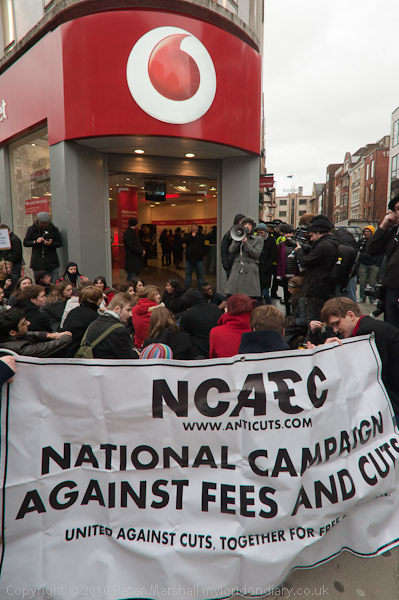
UK Uncut Protest VAT Rise at Vodaphone – Oxford St, 15 Jan 2011

UK Uncut VAT rise & a Pillow Fight

A couple of days ago in 2023 the Commons Public Accounts Committee reported that £42bn is outstanding in tax debt, with HMRC failing to collect around 5% of tax owing each year. Committee chair Meg Hiller commented “The eye-watering £42bn now owed to HMRC in unpaid taxes would have filled a lot of this year’s infamous public spending black hole.” The report states that for every £1 the HMRC spends on compliance it recovers £18 in unpaid tax, and the MPs say it simply isn’t trying hard enough.

UK Uncut VAT rise & a Pillow Fight

In addition, they point to the pathetic effort our tax authorities are making to recover the £4.5 billion lost by fraud over Covid support schemes, only even “trying to recover less than a quarter of estimated losses in schemes such as furlough.

UK Uncut VAT rise & a Pillow Fight

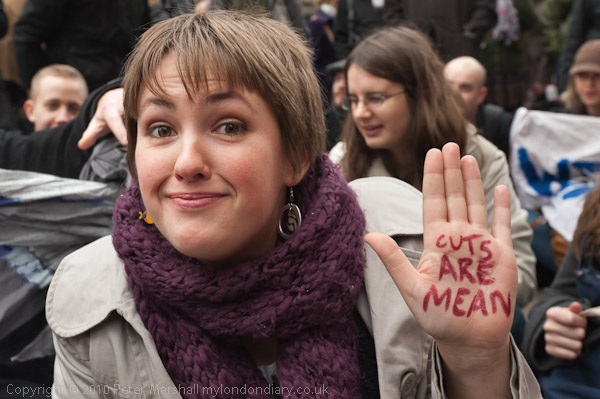
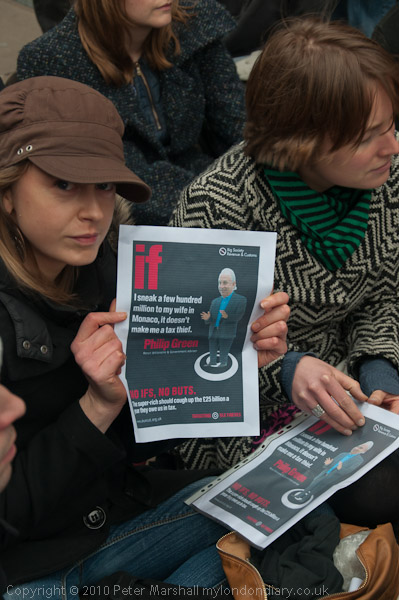
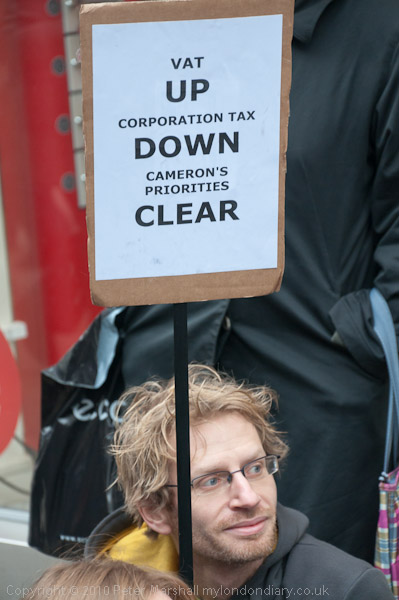
Back in 2011, anti-cuts activists UK Uncut were campaigning to force the government to clamp down on tax avoidance rather than cut public services and increase the tax burden on the poor. This protest took place following a rise in VAT from 17.5% to 20% and a couple a weeks before the UK deadline for tax returns by the self-employed of January 31st.

They said then that rich individuals and companies such as Vodafone, Philip Green, HSBC, Grolsch, HMV, Boots, Barclays, KPMG and others employ armies of lawyers and accountants to exploit legal loopholes and dodge around £25 billions in tax while the rest of us on PAYE or ordinary people sending in self-assessment tax forms pay the full amount.

Little has changed since then – except the amounts involved will have increased, but nothing has been done to move to a fairer approach to taxation which would eliminate the legal dodges and loopholes and insist that tax is paid on money earned in the UK rather than being squirrelled away in overseas tax havens. It should be a general principle that any scheme to deliberately avoid tax is illegal.

Many believe the main impetus for the Brexit campaign was the intention announced by Europe to clamp down on tax avoidance, which would have cost the wealthy backers of Vote Leave millions by cutting down their dodgy dealings.

UK Uncut held a rally on the pavement on Oxford Street outside Vodaphone, one of the companies that manage to pay little or no UK tax. Large numbers of shoppers walked by, some stopping briefly to listen and applauding the protest.

Speakers pointed out the regressive nature of VAT, applying to all purchases of goods (except those exempt from VAT) by everyone regardless of their incomes. Income tax should be fairer, as it is related to income and the ability to pay – and it would be fairer if the loopholes allowing tax avoidance were closed.

One speaker made the point that multinational companies not only use tricky accounting to avoid UK tax but also by shifting profits to tax havens they deny desperately needed funds to the poorer countries of the world.

Others spoke about the effects of the government cuts on education, with rising university fees and the removal of the maintenance allowance that had enabled many poorer students to remain in sixth-forms. At one point people held up books as a reminder of the cuts in library services being forced on local authorities by the government.

A member of the PCS spoke of his concern that the government was actually cutting down on the staff who combat tax evasion as well as relaxing the rules on tax avoidance rather than trying to collect more from the rich.

Prime Minister David Cameron had called for a ‘Big Society’ with charities and community organisations playing a larger role – presumably to replace the public services which were disappearing under his austerity programme. But many of these organisations were also under pressure as hard-pressed local authorities were having to slash funding grants.

More at UK Uncut Protest VAT Rise at Vodaphone.


Pillow Fight Against Solum at Walthamstow, 15 Jan 2011

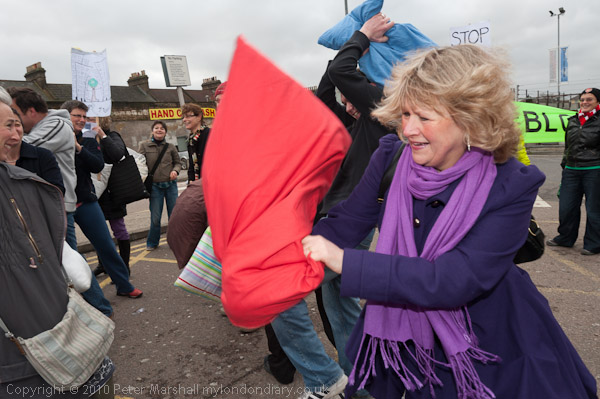
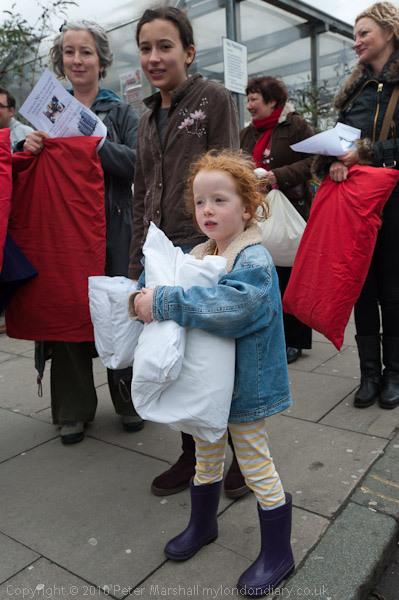
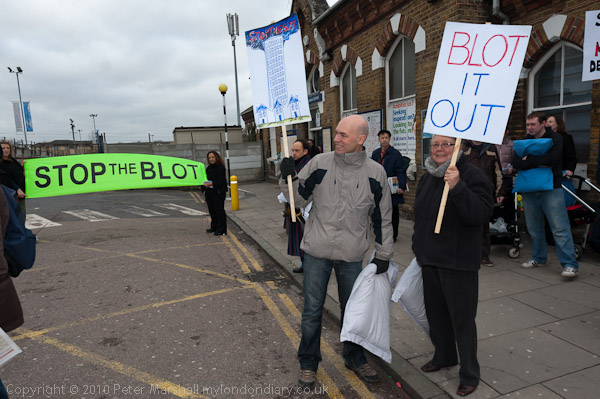
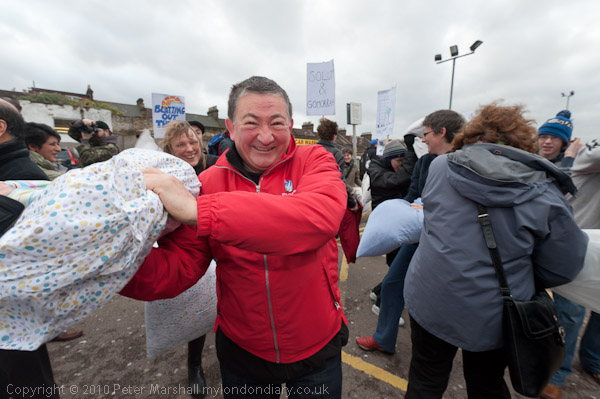
Ealier I had photographed Walthamstow residents staging a pillow fight in protest against plans for inappropriate high rise development on Walthamstow Central Station car park which were tocome to the council planning committee meeting the following Thursday.

Solum Regeneration had plans to build a 14 storey hotel and 8 storey blocks of flats there, towering over the surrounding area of largely late-Victorian low rise development.

The scheme had been condemned the previous year by CABE, the Commission for Architecture and the Built Environment set up in 1999 to provide impartial advice to the government “on architecture, urban design and public space“, and the developers had made minor changes which made it even less acceptable to the local objectors.

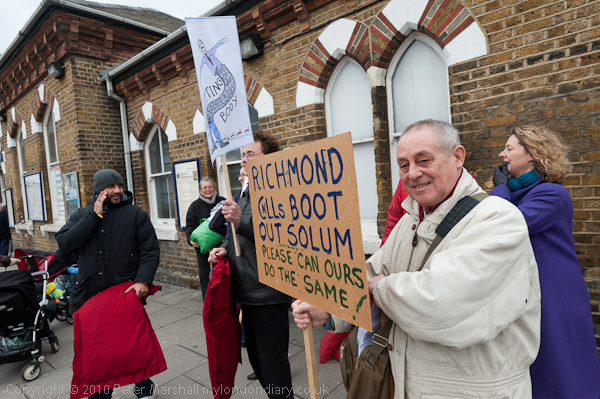
Solum Regeneration was set up by Network Rail and Kier Property to redevelop land around railway stations, including Walthamstow Central. One of their other plans was for a huge redevelopment at Twickenham station, now completed after some years of considerable inconvenience to station users. Richmond Council had initially turned down this scheme.

Despite the pillow fight and the other activities of local campaigners, the Walthamstow scheme also got the go-ahead, with building work beginning in 2012. Other high rise schemes have also been approved in the surrounding area, the character of which has changed considerably.

Pillow Fight Against Solum Walthamstow


Blessing The River Thames

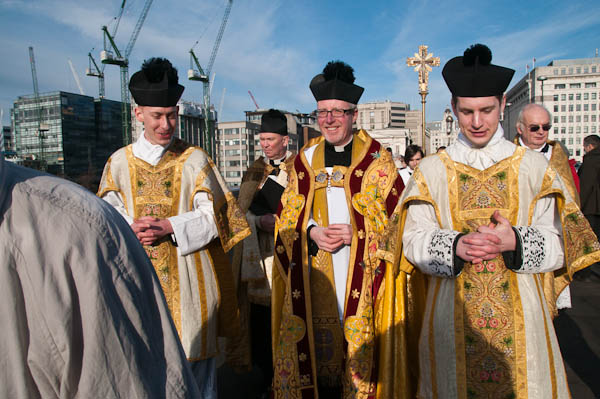
Blessing the Thames London Bridge, Sunday 11th January, 2009

Blessing The River Thames
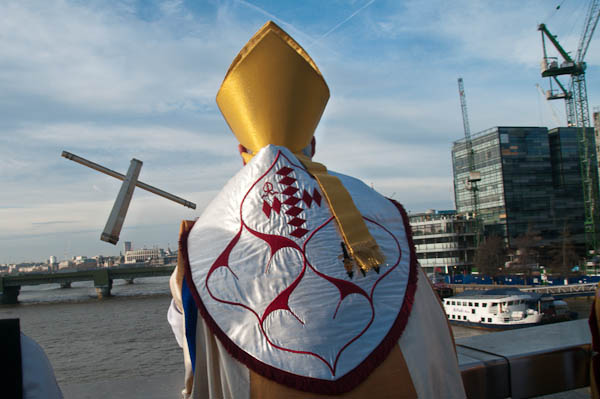
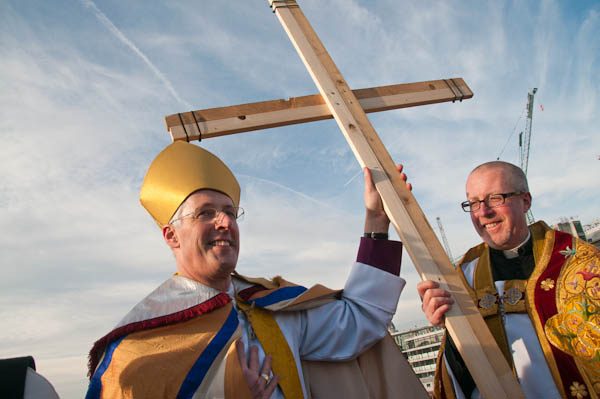
The Bishop of Woolwich throws a cross into the River Thames – below another cross in the sky

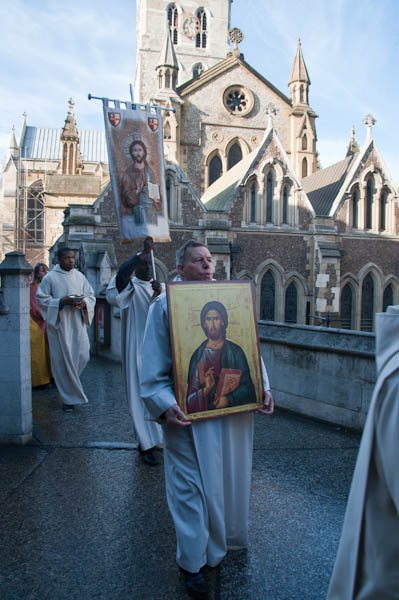
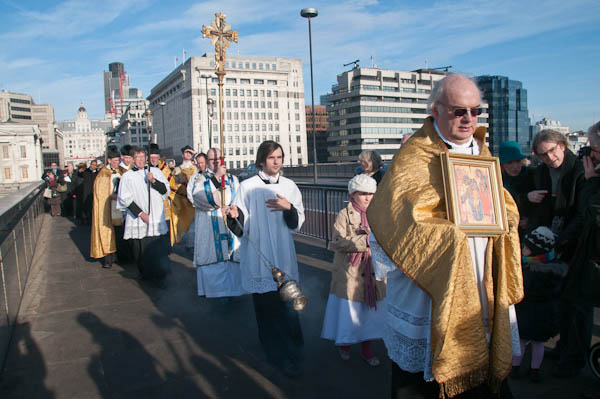
Fr Philip Warner was impressed by the annual Blessing of the Waters ceremony he saw in the Orthodox churches of Serbia. When he became the priest at St Magnus the Martyr at the City end of the old London Bridge he decided to begin an annual ceremony to bless the River Thames.

Blessing The River Thames
The procession from Southwark Cathedral

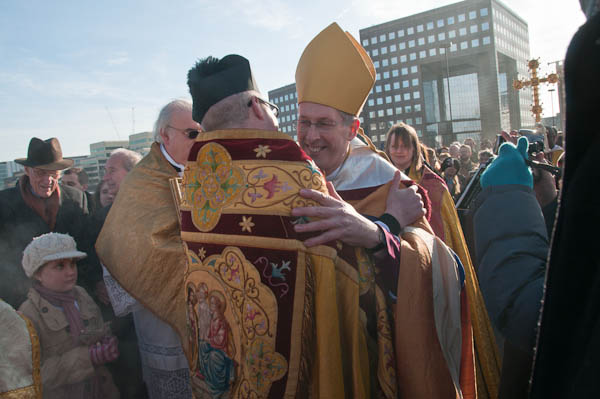
His parish and that of Southwark Cathedral meet at the centre of the current London Bridge, and in 2004 processions from both churches met there on the Sunday closest to Epiphany (January 6th) for a short service.

Blessing The River Thames
The procession from St Magnus the Martyr comes to join them

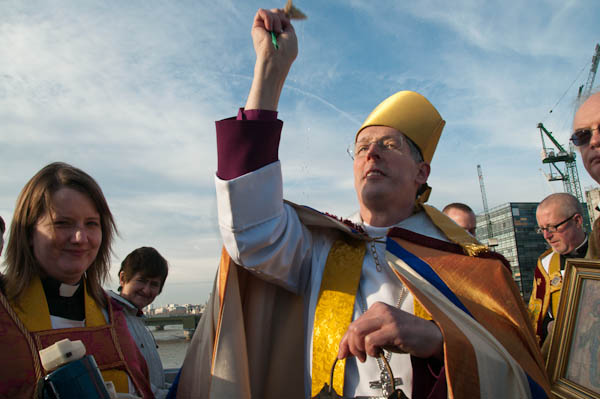
Prayers were said for all those who work on the river and in particular for those killed close to this point in the 1989 sinking of the Marchioness. Incense was swung around liberally, but dispersed by the breeze. The river was then blessed by throwing in a large wooden cross. Water was then sprinkled over those taking part in the ceremony before all those present were invited to process to one of the churches for a lunch.

They meet

I photographed this event in 2007 and 2008 as well as 2009, though it was only in 2008 that I was able to stay for the lunch, that year at St Magnus. By the third of these years the event had grown, with too many photographers, mainly amateurs, coming along and getting both in my way and in the way of those celebrating. I felt I had already taken enough pictures by then and crossed it off my list of annual events to cover.

The bishop prepares to throw the cross in the river

When I first began photographing events in London, both protests and cultural events, there were few photographers at most of them except the large national marches. At many smaller events I would find myself the only person with a camera, and of course everything was still on film. But in the last 15 or so years things have changed.

And we all get sprinkled with water

Back then even when there were more of us taking pictures we were all photographers and at least doing so in a professional way. We tried to respect the others and so far as possible keep out of each others way, though of course that wasn’t always possible. Sometimes there were arguments between those of us who liked to work close to our subjects with wide-angle lenses and those who carried giant, heavy, usually white, telephoto zooms and always wanted to use them from a distance. But generally we worked together.

And everyone (except me) goes back to Southwark Cathedral for lunch

Then came cheap digital cameras and camera phones. Everyone now has something that can take picture, and can readily share them on social media. And there has been huge movement from taking still images to recording video. Video leads to a different attitude, with many becoming unaware of anything outside the screen of their phone around them. At any event now I can be sure that at least one person will walk in front of my lens talking into their phone totally oblivious of my presence and blocking my view.

Of course I don’t claim any special right to take pictures, and others have the same rights as me. But unless we respect the rights of others it becomes difficult and frustrating to work; we have to work together.

More pictures from 2009 Blessing the Thames.


Protests on January 11th

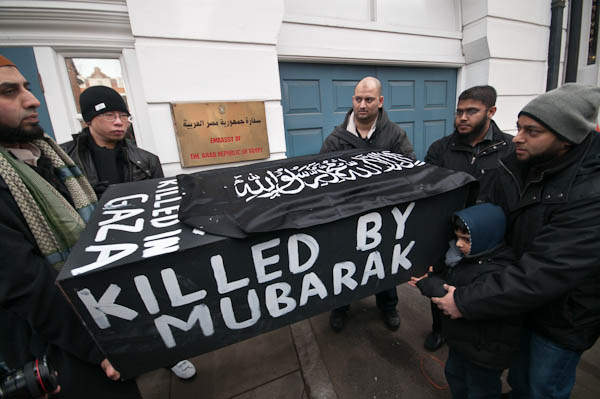
In 2009 I was sorry not to have time to stay for the lunch at Southwark Cathedral, particularly as two of my friends were present, one a frequent worshipper there. But there were a couple of protests to photograph. The first was a march by Hizb ut-Tahrir Britain against the Israeli attacks on Gaza, aimed at Arab dictators who collude with Israeli terrorism and going to Egyptian, Syrian and Saudi Embassies.

More at Hizb ut-Tahrir Britain Gaza march.

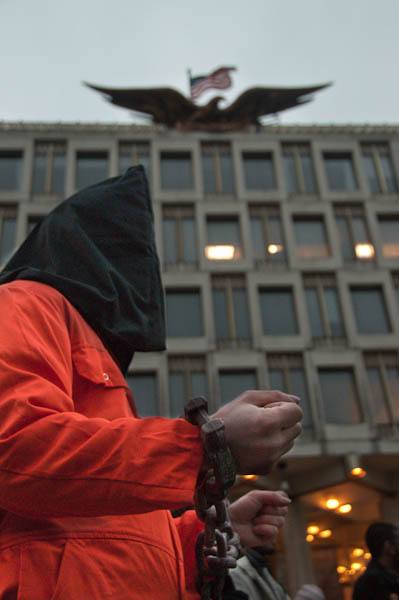
And it was the 11th of January, and the anniversary of the setting up of the US torture camp at Guantanamo in 2004 was marked by a late afternoon protest at the US Embassy, still then in Grosvenor Square.
More at Guantanámo – 7 Years


Stop the Gaza Massacre – National March

National March, Hyde Park to Israeli Embassy, London, Saturday 10 January 2010

Stop the Gaza Massacre - National March

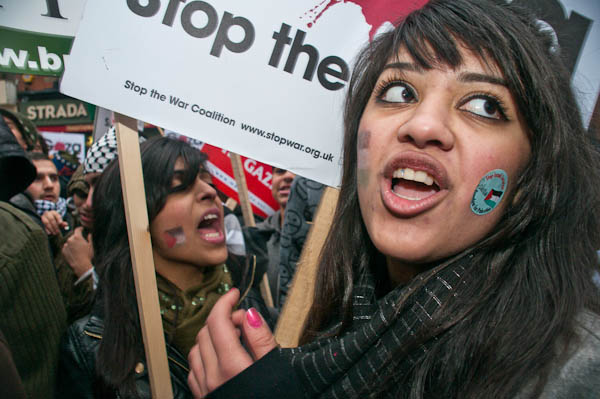
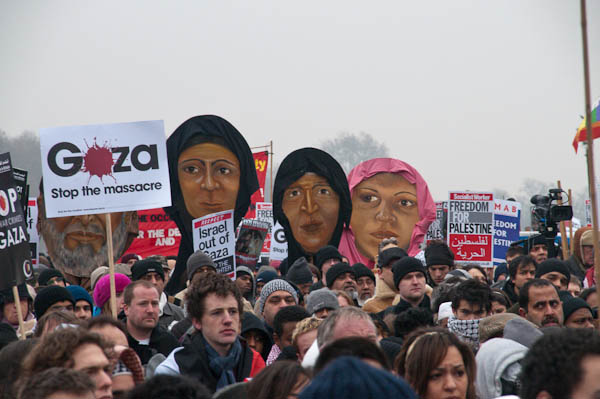
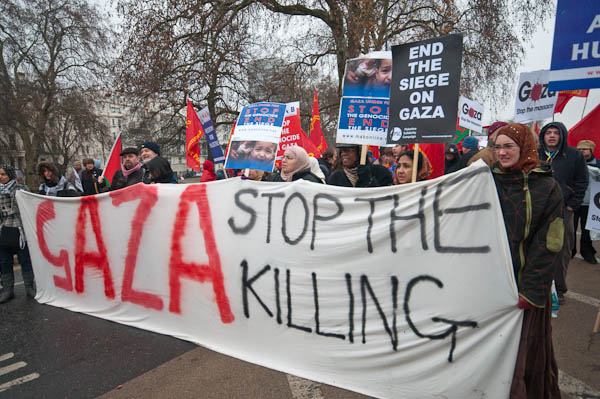
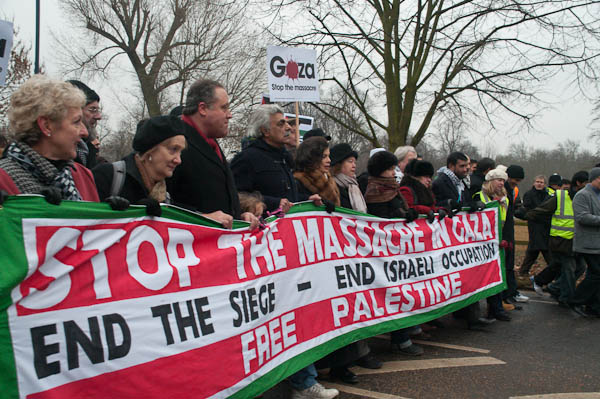
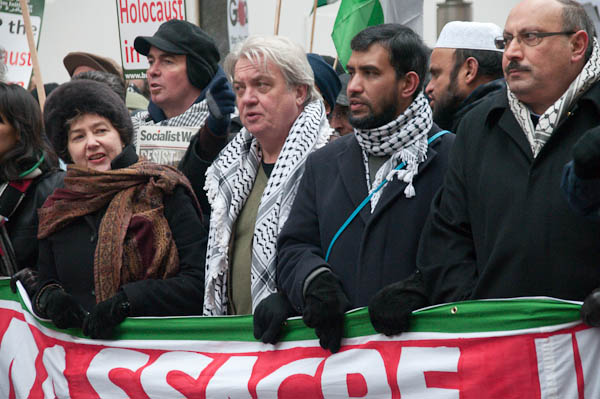
Well over 100,000 marchers turned up to Hyde Park in London on Saturday 10 January 2010 to show their opposition to the Israeli attacks on Gaza and call for an end to the killing there. After a rally there they marched
Stop the Gaza Massacre - National March

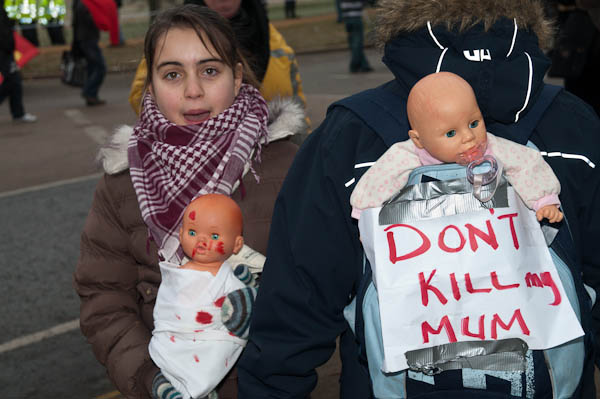
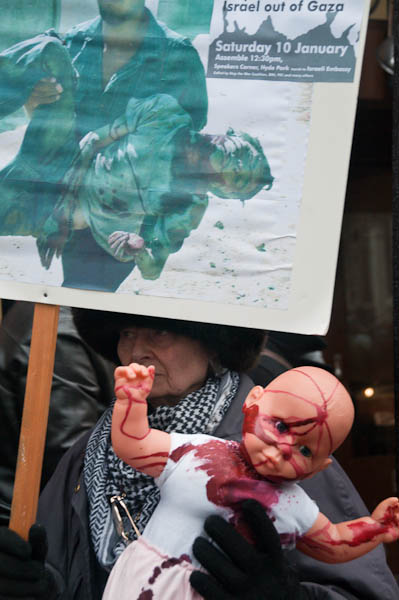
As well as posters and banners, some carried dolls as a reminder of the 300 or so children already killed by the Israeli attacks in the current offensive, the Israeli Operation Cast Lead which had begun on 27th December 2008 and was still continuing.

Stop the Gaza Massacre - National March

The Gaza Massacre ended with Israel declaring a ceasefire eight days after this protest on 19th January 2009, by which time the Israeli attacks and killed (figures from Wikipedia) between 1,166 and 1,417 Palestinians. There had been 13 Israeli deaths, four of them killed by their own Israeli forces.

Stop the Gaza Massacre - National March

Many children were among the Palestinians killed and some protesters carried dolls or bundles of blood-stained clothing to represent the 300 already known to have died at the time the protest took place. It remains unclear exactly how many civilians were among the killed as Israel allowed few international workers into the area and denied access to journalists. Around a sixth of those killed were police officers in Gaza.
The attacks severely damaged half of Gaza’s hospitals and health facilities. A survey by the United Nations Development Programme estimated that 14,000 homes, 68 government buildings, and 31 non-governmental organisation offices were either totally or partially destroyed. The Israeli blockade on Gaza meant that it was not possible to import the building materials needed for essential repairs and rebuilding.

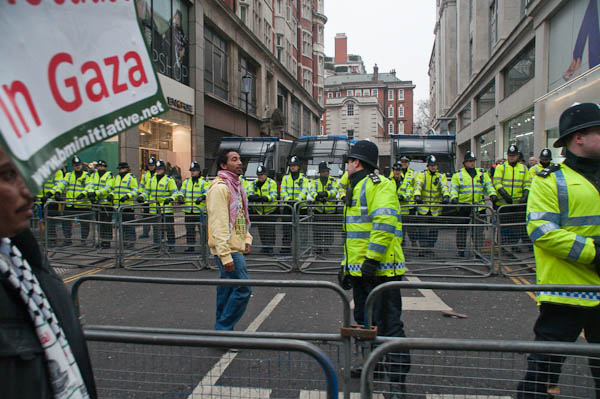
The police had severely under-estimated the likely size of the protest, failing to believe the figures suggested by the march organisers. They had planned for a much smaller protest and this led to problems. Quite rightly, feelings run very high over Gaza and there were many who wanted to get to the Israeli Embassy and make their feelings clear.

I had no problems with the police, but was assaulted close to the Embassy by several Stop the War stewards some of whom do seem to have a real problem with the press. They pushed me around and tried to stop me from working, although other stewards who who saw what happened did apologise to me for the treatment I received.

The official front of the march – well behind some of the angrier protesters eventually arrived and paused briefly close to the embassy, safe down a private road behind barriers and police before moving on and dispersing. But many of those on the march remained in the area and the street soon became completely blocked. I could only watch from a distance over the heads of the densely packed crowd as there seemed to be some fighting with police as demonstrators tried to climb the barriers. Placards, sticks and shoes were being thrown either towards the embassy or at the police.

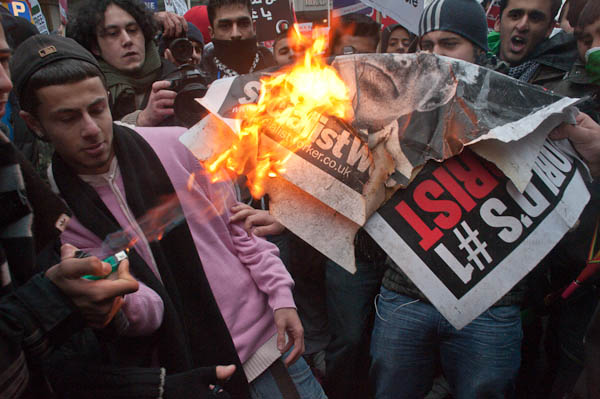
I walked a few yards further down the road where a group of young men burning placards with a picture of the “World’s #1 Terrorist”. A little further still things were much quieter with some Muslim men saying prayers. It looked as if there would be protests here continuing long into the night, but I had to leave as I had promised to take pictures elsewhere at a private event.

Much more at Gaza Massacre – National March.


Bikes Alive Say Stop Killing Cyclists

Bikes Alive Say Stop Killing Cyclists
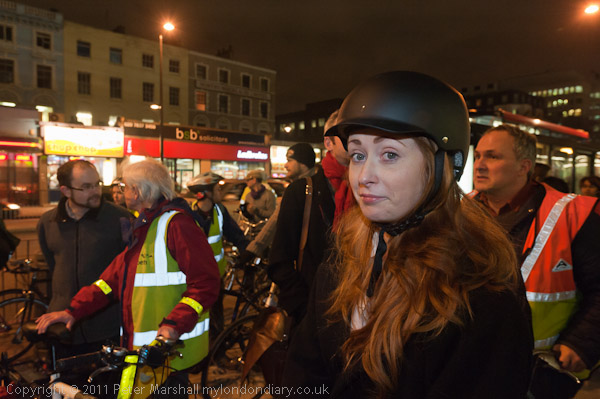
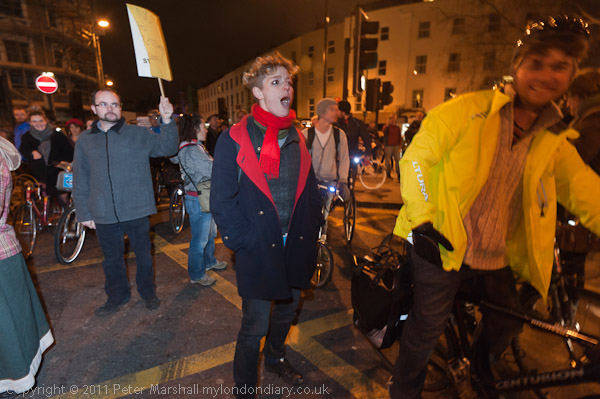
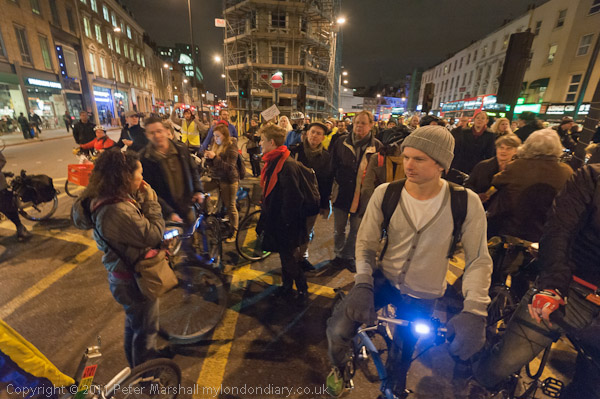
At Kings Cross wiaiting for the protest to begin

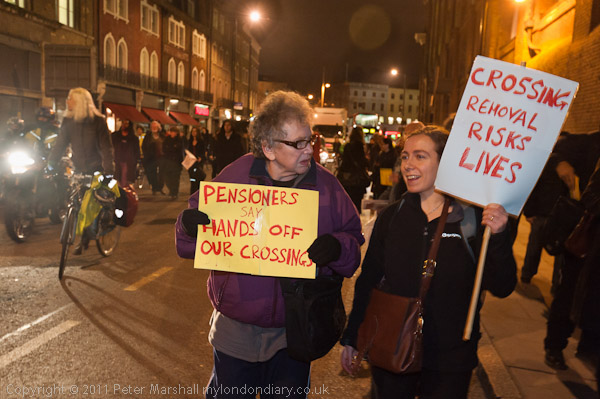
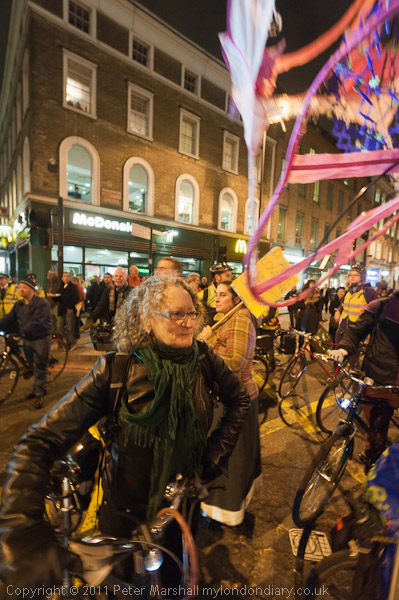
On the evening of Monday 9th January 2012 cyclists and pedestrians protested at Kings Cross in the evening rush hour calling for an end to the killing of cyclists on city roads.

Bikes Alive Say Stop Killing Cyclists
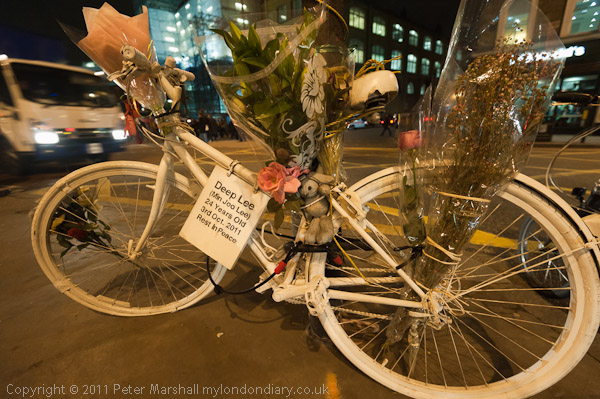
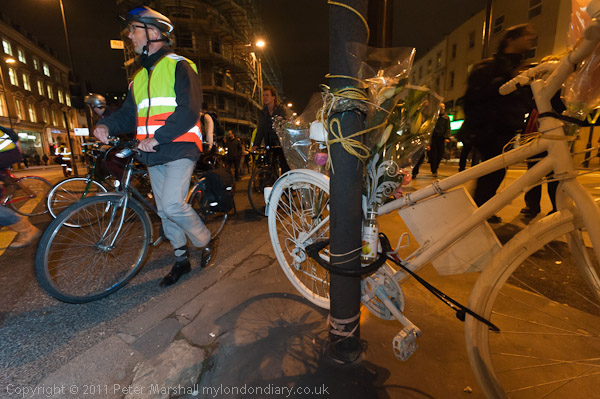
Ghost bike’ for Deep Lee killed here in October 2011

Bikes Alive wanted Transport for London to make changes in their policies which are leading to too many cyclists being killed on London’s Streets and were taking more direct but peaceful action to put pressure on them to make cycling in the city safer.

Bikes Alive Say Stop Killing Cyclists
Jenny Jones holds her at right

Kings Cross was chosen as one of the most dangerous areas for cyclists with major roads including Euston Road, Pentonville Road, Caledonian Road, Kings Cross Road all meeting in a gyratory system of confusing one-way streets.

In particular they want changes at all major road junctions with longer gaps between different phases that would allow both pedestrians and cyclists to clear junctions before traffic from other directions dashes across, as well as changes that will lead to reductions in private car use in London and an increase in bike use.

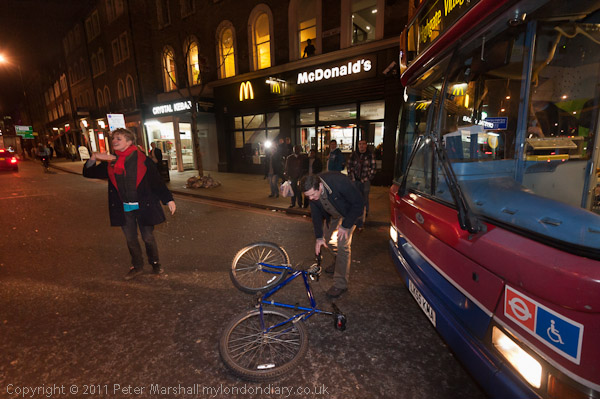
Tamsin and a man with a bike block traffic for the ride to start

Similar protests in later years have been organised by Stop Killing Cyclists who began with a major ‘die-in’ protest outside TfL’s HQ in November 2013.

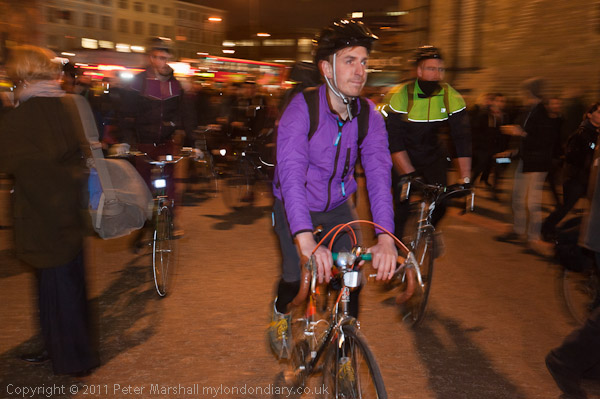
Cyclists take to the road

I arrived early for the Bikes Alive protest and found a group of friends of cyclist Deep Lee (Min Joo Lee), a 24-year old student who was killed riding her bike there on 3 Oct 2011 came to put fresh flowers on the ‘ghost bike’ which is chained to a lamp post at the centre of the junction.

and some people on foot

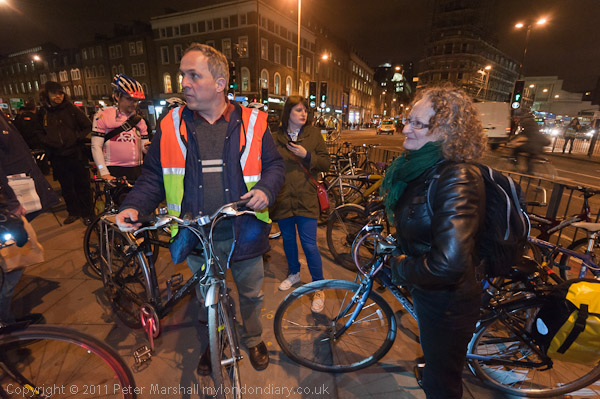
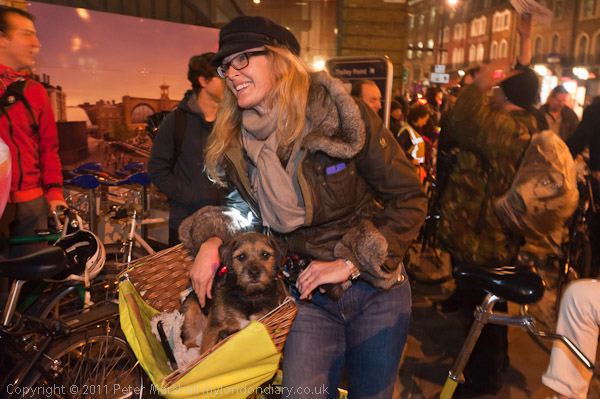
Others soon began to arrive on bikes and on foot, gathering on the wide pavement in front of Kings Cross Station, including a dozen or so police officers on bikes. As well as Bikes Alive spokesperson Albert Beale who had said that this protest “is the first step in a campaign to stop – by whatever nonviolent means needed – the completely unnecessary level of deaths, injuries and fear inflicted by motorists on the more vulnerable“.

The ride goes past the ‘ghost bike’

Green Party mayoral candidate Jenny Jones took part, stating “London’s roads must be fixed urgently if we are to make them safe for cyclists and all other road users. This is the Mayor’s responsibility, and I hope that if we make a statement through peaceful, direct action he will start to listen.”

The protest blocks the box junction and Tamsin leads some chanting

Also present was Tamsin Omond of Climate Rush, who have organised several cycle protests, including one in July 2011 against London’s terrible air quality with briefly blocked a junction a little to the west of tonight’s protest.

Jenny Jones

Eventually the protester began to cycle slowly, accompanied by protesters on foot on the roads around the junction, turning up York Way and then returning back down Caledonian Road and returning to Kings Cross where some stopped to block the box junction. When police came and told them they had to move they made a few circuits along a short section of the Euston Road in front of Kings Cross, making a ‘U’ turn at the traffic lights and going back east along the road to go around the one-way system again. By the time they were on their second or third circuit I felt I had seen enough and left.

London’s roads eleven years later remain dangerous for cyclists, and this junction in particular was among the three still named as the most dangerous of 22 that the London Cycling Campaign named in parliament in November 2022 as needing urgent action. There have been some improvements, with new cycle ‘super-highways’ and changes in traffic light phasing, but much more still needs to be done to make the city safer, with huge benefits in public health as many more people who would cycle if they felt safe. Unfortunately some London councils, partly thanks to lobbying from taxi drivers and others, still have virulent anti-cycling policies.

More at Bikes Alive – End Killing Of Cyclists.


Bhopal: Drop Dow From London Olympics

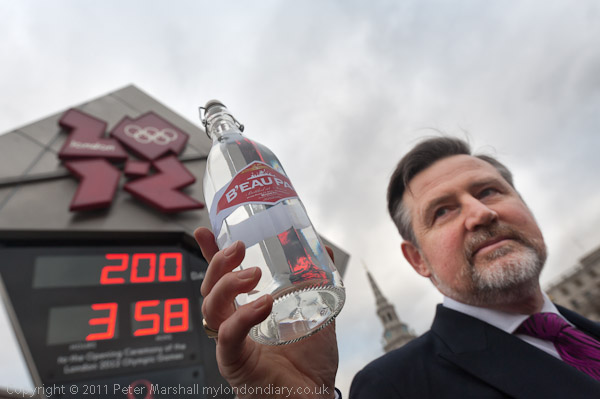
Earlier that day I had photographed another protest, where Farah Edwards, a survivor of the Bhopal Disaster, challenged Lord Coe, and Mayor Boris Johnson, to taste some Bhopal drinking water, bottled as ‘B’eauPal’ mineral water. 200 days before the start of the London Olympics they called for London to drop Dow Chemicals as a major sponsor, as thousand of families in Bhopal are still being poisoned by the Bhopal disaster, when Union Carbide, a subsidiary of Dow Chemicals, released a huge dense cloud of lethal gas from their plant on the night of December 2-3, 1984.

Barry Gardiner MP holds a bottle of contaminated Bhopal water in Trafalgar Square

Government estimates say more than 3,700 died immediately and since deaths have risen to between 8,000 and 25,000 people. Around 100,000 to 200,000 people are thought to have permanent injuries and the number continues to grow as much of the contamination produced by the disaster has not been cleaned up.

But of course the idea that Lord Coe or Johnson would worry for even a split second about taking dirty money for the Olympic project was ridiculous.

Bhopal: Drop Dow From London Olympics


Asylum Protest and Bow Walk – 2008

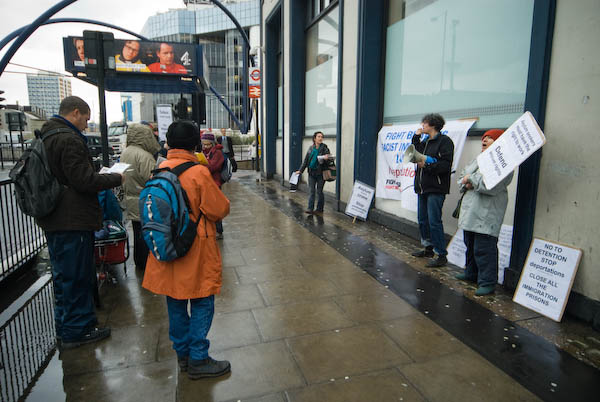
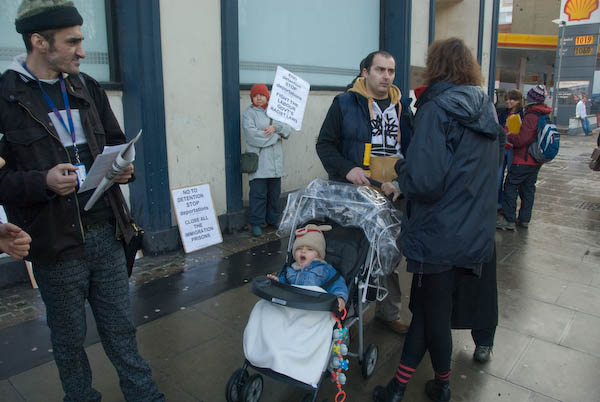
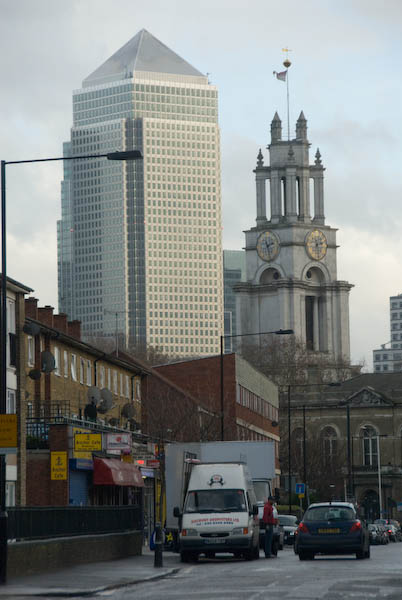
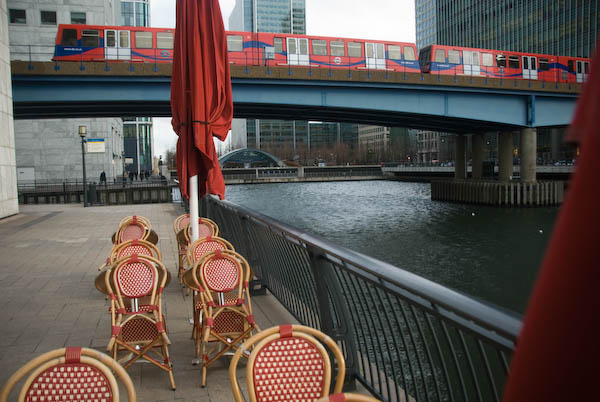
I went up to London on Tuesday 8 January, 2008 for two reasons. To photograph the monthly protest outside one of our asylum reporting centres and to collect three pictures that had been in a group exhibition. I took advantage of this to have a walk around Bow starting at Limehouse DLR station and after collecting the four pictures continuing to Canary Wharf to catch the Jubilee Line back to Waterloo.


Defend Asylum Seekers: Monthly London Protest – Communications House, Old Street

Asylum Protest and Bow Walk - 2008

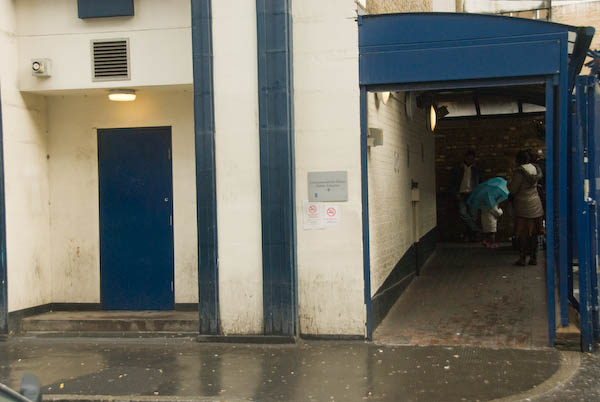
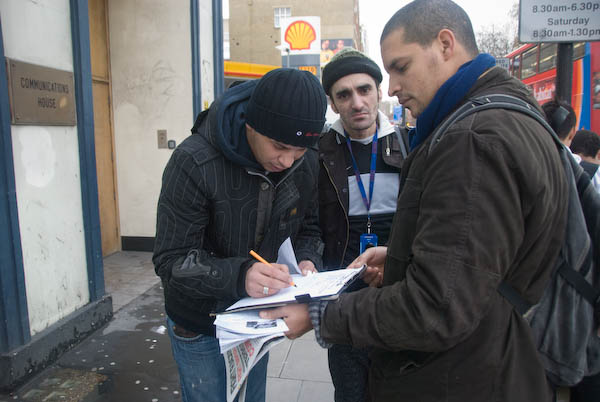
Communications House on the south-west corner of the Old Street roundabout a few yards from Old Street station has now been demolished and replaced by newer offices, and asylum seekers now have to report at either Lunar House in Croydon or Eaton House out to the west on Hounslow Heath.

Asylum Protest and Bow Walk - 2008

So asylum seekers no longer have to enter the dingy entrance down a side street, Mallow St but many have longer and less convenient journeys to make their regular visits. They still know when they enter that these may be their last steps as free persons on British soil, and they may emerge in the back of a van on their way to a detention centre to wait for a flight back to possible imprisonment and torture in their country of origin.

Asylum Protest and Bow Walk - 2008

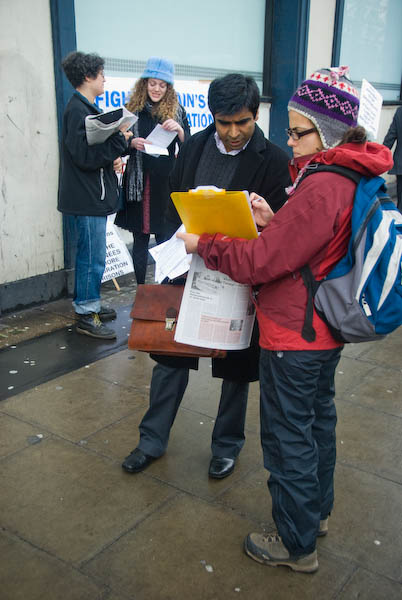
Few of those who walked past the protest knew what went on in the rather anonymous building on their lunch break knew what went on inside, and those who bothered to listen or take leaflets from the protesters, were surprised when they were told, with many stopping to add their names to the petition. The monthly protests here were organised by London Fight Racism! Fight Imperialism! (FRFI) but others including some asylum seekers came to speak.

Asylum Protest and Bow Walk - 2008

I commented back then: “It is hard to take the claims that this is a Christian country seriously when you look at the way we treat those who are seeking asylum here, or indeed other migrants who are here. With the recent news frenzies about Tony Blair becoming a Catholic my thoughts were that he should be spending some awfully long and difficult sessions in the confessional, and his policies towards the asylum seekers would be one of many difficult items. And surely that father in the manse that Mr Brown likes to parade should be screaming “Gordon, Read your effing Bible!”
Neither the Church of England nor the Roman Catholic authorities have taken the kind of firm and clear public stand they should to oppose the UK’s increasingly racist policies over immigration. There have been statements by the leaders of the churches and others but these are soon lost in the media. But there has been a lack of the concerted action and a failure to arouse popular opinion to bring about an end to the ‘more racist than thou‘ race between the parties to appeal to the right – and our right-wing billionaire press. Fewer people than in past years populate the pews, but if mobilised they could still be an important body, forcing governments to provide safe routes and fair treatment rather than trying to simply send back people to where they had fled persecution and fly asylum seekers to Rwanda.

Defend Asylum Seekers


Bow and Roof Unit

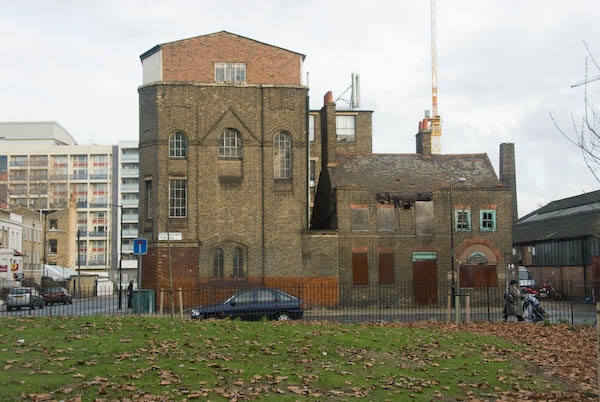
Rood Unit is a working space for photographers and was then based in a former furniture (or soap or perhaps both) factory in Bow, later moving to a floor above the Four Corners photography gallery in Roman Road. I had been invited to take part in a show they were presenting, Roof Unit Foundations, at [space] in Hackney and had shown four colour pictures from around River Lea in the 1980s.

This was one of them – and the others as well as a review of the show are in a post on this blog at the time, ROOF UNIT at [ space ]. And you can see these and many other of my pictures of the Lea Valley and the Lea Navigation in my River Lea web site, as well as in my book ‘Before the Olympics‘.

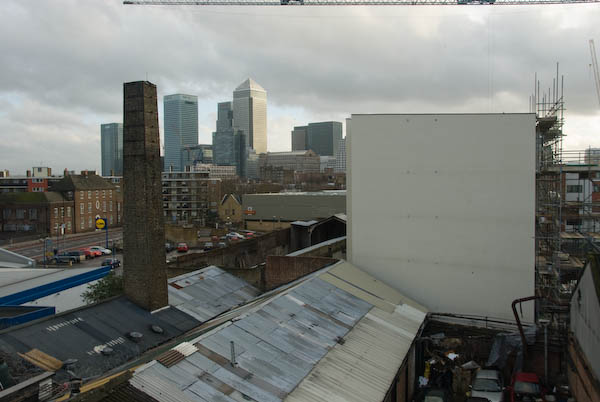
I took the DLR to Limehouse and made my way rather indirectly to their studio in Pixley Street on the corner with Copenhagen Place. The old factory is still there, though Roof Unit have moved out. I spent a short time talking with some of the photographers and was taken up onto their roof terrace where I took some more pictures, all using my Nikon D200.
I couldn’t resist adding the factory chimney to those at Canary Wharf as another tower, and the long arm of a crane made a little of a border across most of the top of the image. But I took quite a few more pictures – a few of which are in the post on My London Diary.

Fortunately my exhibition prints were quite small, 30x20cm, and unframed on dibond aluminium, so it wasn’t hard to carry them, though I didn’t stop to take many more pictures before the short bus ride to Canary Wharf. By now the light was beginning to fade, but I took a short walk around – and a few more pictures – before getting the underground back to Waterloo.

Bow and Roof Unit


Cuba, Guantanamo and Iran

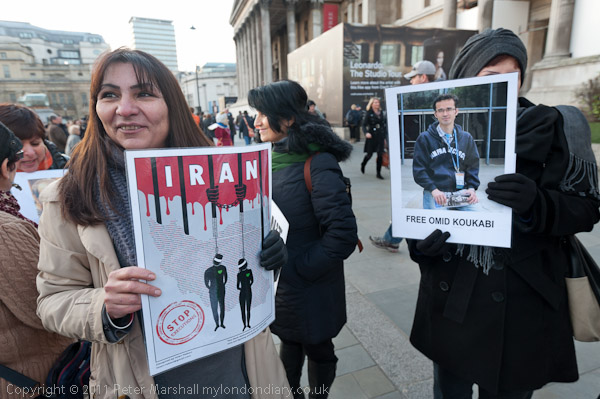
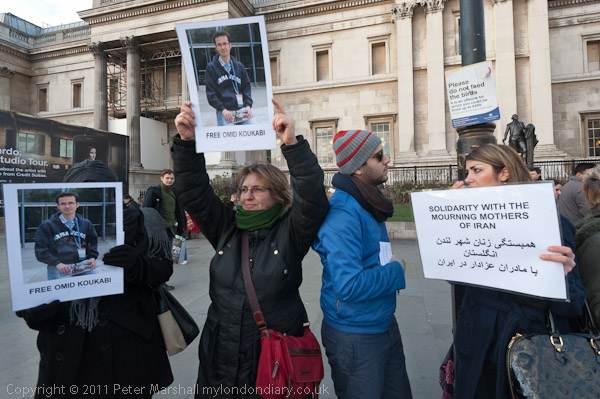
On Saturday 7th January 2012 I photographed three events in London. Two were associated with Cuba, one celebrating the Cuban revolution and the second calling for the closure of US Guantanamo Bay torture camp there. The third was a protest in solidarity with the mothers of political prisoners and those murdered by the Islamic Republic of Iran since 1979. Now there will be many more of these human rights abuses as Iran clamps down on the current ‘Women, Life, Freedom’ protests there.


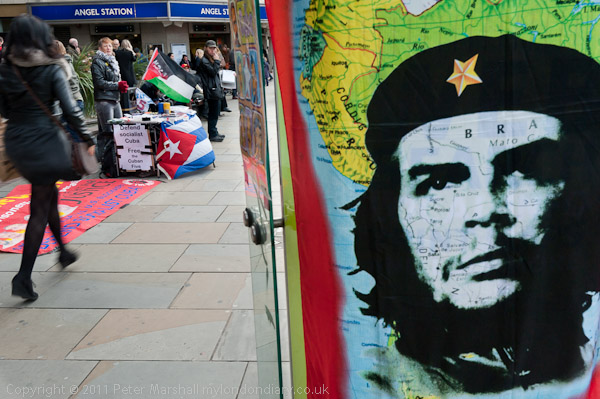
53 Years Of Cuban Revolution – Angel, Islington

Cuba, Guantanamo and Iran

Although Cuba celebrates 26 July 1953 as the ‘Día de la Revolución’ (Day of the Revolution), this was the start of the movement with an unsuccessful armed attack on the Cuban military’s Moncada Barracks which resulted in the leaders being captured and jailed. It was not until 31 December 1958 that the rebels finally ousted Batista and Fidel Castro came to power, leading the country as prime minister from 1959 to 1976 and president from 1976 to 2008.

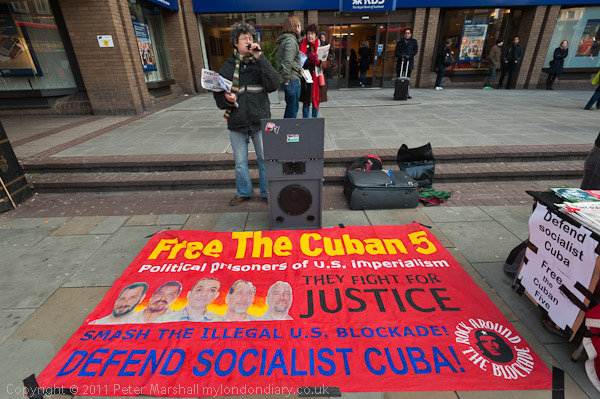
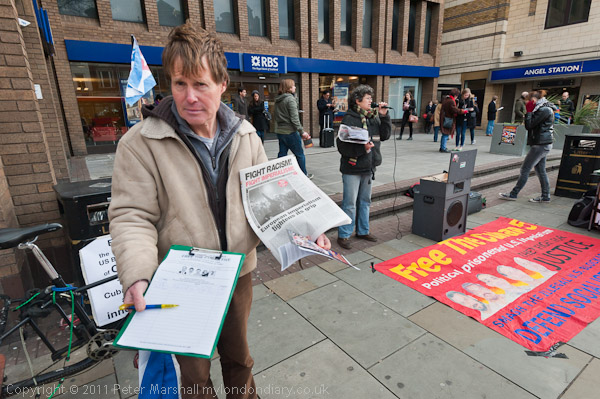
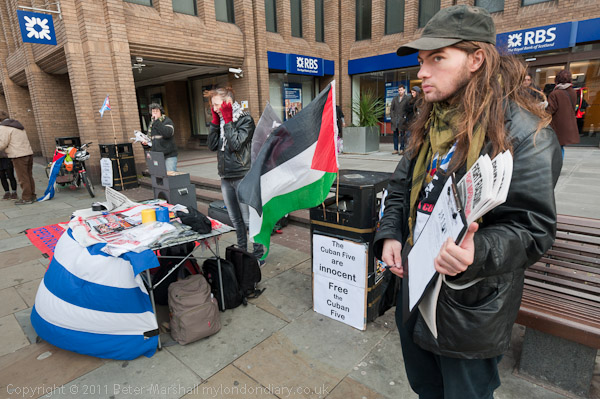
53 years and one week later a street rally at the Angel Islington organised for Rock around the Blockade by Fight Racism Fight Imperialism celebrated the Cuban revolution’s building of a socialist country despite the blockade by its powerful neighbour USA, and demanded justice for the Cuban Five.

Cuba, Guantanamo and Iran

The Cuban 5 were arrested in 1998 in Miami for spying on groups of Cuban refugees who were planning illegal acts against Cuba. Their treatment in US courts has been criticised as unfair by the UN Commission on Human Rights and by Amnesty International, who also condemned their treatment in jail as “unnecessarily punitive.”

Among many internationally calling for their release were Eight Nobel prize winners from around the world including Nadine Gordimer, Desmond Tutu, Wole Soyinka and Gunter Grass. A panel of US judges had overturned their convictions in 2005, but this was overruled by the full court and the US Supreme Court declined to review their case. One of the Cuban 5 was released in 2011 having served 13 years in prison, but at the time of this rally four remained in jail. The others were later released in December 2014 in a prisoner swap for a US spy captured in Cuba.

Cuba, Guantanamo and Iran

The rally stressed the remarkable changes the revolution had made in Cuba which in 1958 was a poor and corruptly governed country, its natural resources exploited by foreign companies, its people largely living in poverty with low educational standards and life expectancy. Now it has probably the best health service in the world, low infant mortality and a life expectancy better than many parts of the UK. Free education is provided for all, and soon most will follow it to graduate level.

Cuba has also been generous in providing free medical training for students from many African and South American countries, and also has sent many doctors and nurses to work in them, making a major contribution to controlling AIDS in Africa. Although there some criticise it for a lack of freedom, it has shown that there is a real alternative to capitalism, and that has provided a healthy and dignified life for its people, improving their condition over more than 50 years. And it has done all this despite US blockade and sanctions and continuing US support for counter-revolutionary groups – including the failed Bay of Pigs military invasion in 1961.

Speakers also condemned the continuing US occupation of the Guantanamo Bay Naval Base in Cuba, there since 1903 when the US was given a permanent lease on 45 square miles of Cuba. The lease clearly limits US activities there to those to fit the needs of a coaling and naval station and prohibits the setting up of any commercial or other enterprise in the area. The setting up of the Guantanamo Bay detention camp would appear to be a breach of these terms. The Cuban government claim that the lease was “imposed on Cuba by force” and is “illegal under international law” and have refused to accept US payments for it since 1960.

53 Years Of Cuban Revolution


Shut Guantánamo – End 10 Years of Shame – Trafalgar Square

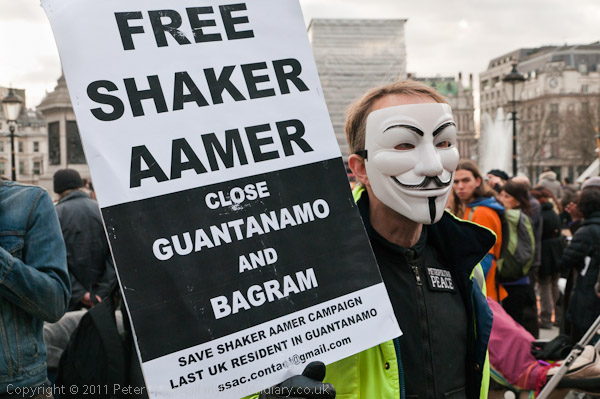
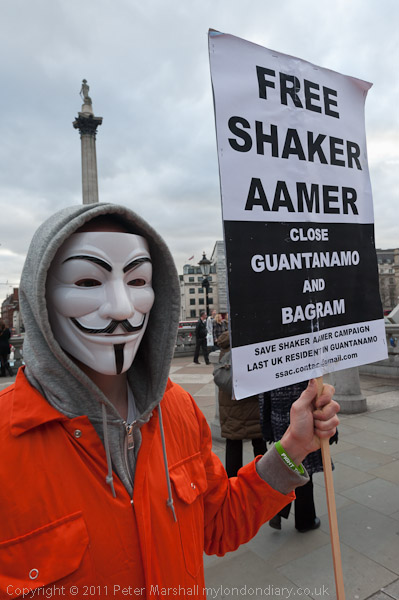
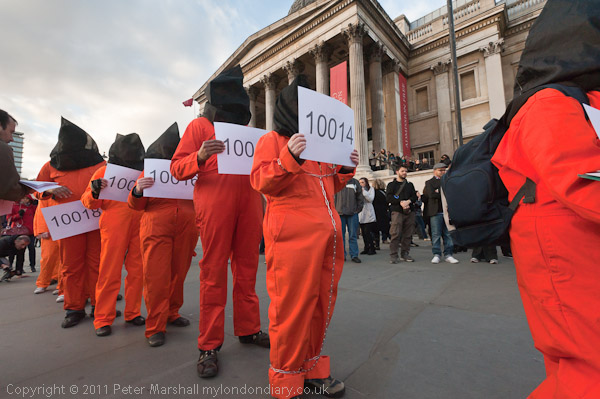
A rally marking the 10th anniversary of the setting up of the illegal US prison camp at in the US military base at Guantánamo Bay, Cuba on 11 January 2002 called for its closure and in particular the release of the two remaining prisoners with UK links held there.

Although President Obama came into office pledging to close the camp down and end the discredited military trials there, he has failed to do so, authorising the continued regime of arbitrary detention without charge or trial. 171 prisoners were still detained there at the start of January 2012.

Louise Christian

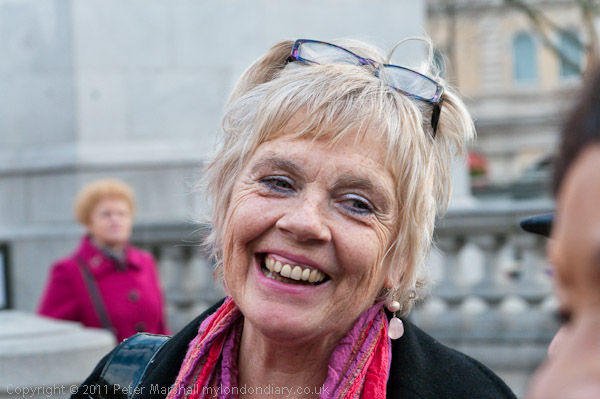
Several hundred came to the protest and listed to speeches by Lib Dem Baroness Sarah Ludford MEP, solicitor Louise Christian, Lindsey German of Stop the War, Kate Hudson of CND, journalist Victoria Brittain and others, including student representatives, trade unionists and other activists.

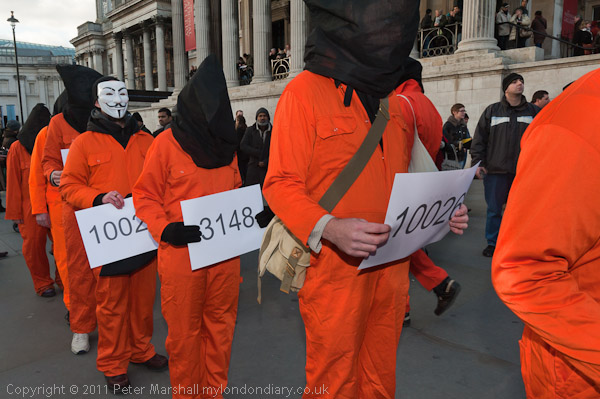
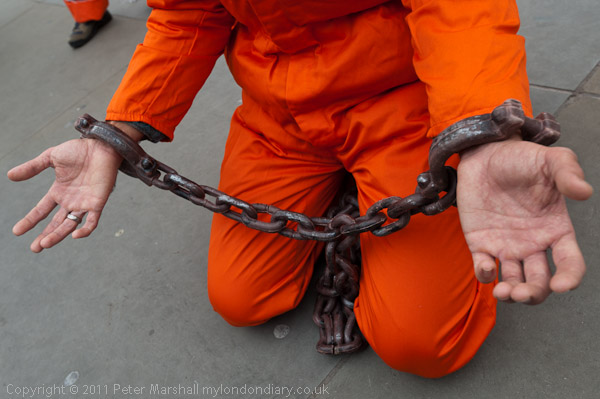
A group of activists wore orange jumpsuits and black hoods as used at Guantanamo, and some were also in chains. They marched in line holding up the prison numbers of the 177 prisoners still in Guantanamo, and their numbers were called and their names read out. Among those taking part and wearing ‘V’ for Vendetta Guy Fawkes masks were ‘Anonymous’ protesters who had come from the Occupy London protest camp at St Paul’s Cathedral.

Ahmed Belbacha, an Algerian national who had a residence permit and lived in Bournemouth from 1999 to 2001 while claiming asyluk was cleared for release in 2007 and 2009. In 2009 he was sentenced in absentia in Algeria to 20 years for membership of a foreign terrorist group abroad – though no evidence was given at his trial. It appears that the US intervened on his behalf in Algeria and he was finally released and returned to his family in 2014.

Shaker Aamer was similarly cleared for release in 2007 and 2009, but was thought to still be detained as his revelations of torture over his ten years of imprisonment by the US authorities (and on one occasion in the presence of a British intelligence agent) would be embarrassing to the US and UK governments. I was pleased to be able to photograph him at a rally at the US Embassy in London in January 2016 after his release at the end of October 2015.

Shut Guantánamo: End 10 Years of Shame.


London Mourning Mothers of Iran – Trafalgar Square

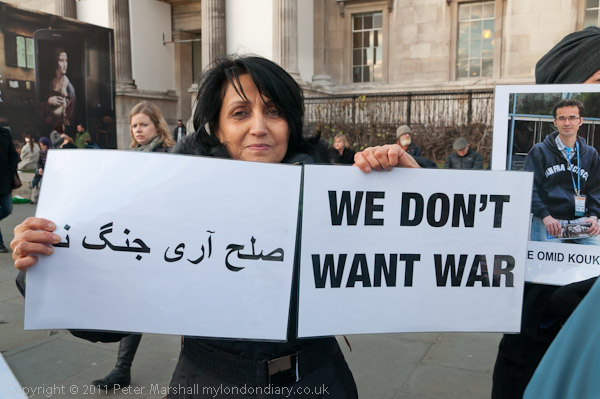
Also in Trafalgar Square were The London Mourning Mothers of Iran who had been coming there every first Saturday of the month to show solidarity with the mothers of political prisoners and those murdered by the Islamic Republic of Iran since 1979.

The Mothers of Laleh Park (formerly known as the Mourning Mothers of Iran), women whose children or husbands were killed or imprisoned after the 2009 Iranian election, come regularly to Laleh Park in central Tehran and other locations on Saturdays and stand together to bring attention to these injustices.

Iranian security agents often come and attack the mothers. On January 9, 2010 over 30 of them were attacked and arrested and held in jail for several days, and leading members have received long prison sentences. The call for the release of political prisoners, the abolition of the death sentence and the trial of those who have ordered the killings of the last 30 years.

London Mourning Mothers of Iran.


Tories Threatens Social Housing & Turkey Kills Kurds

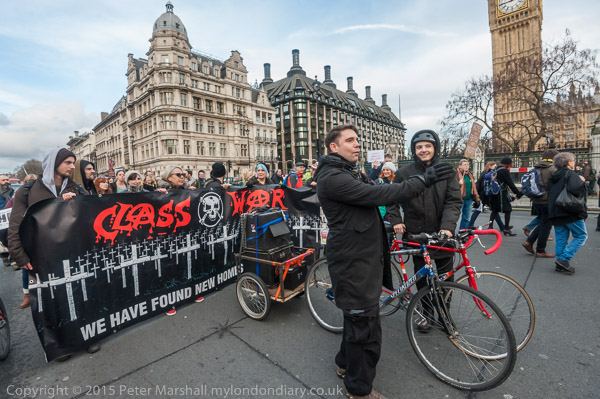
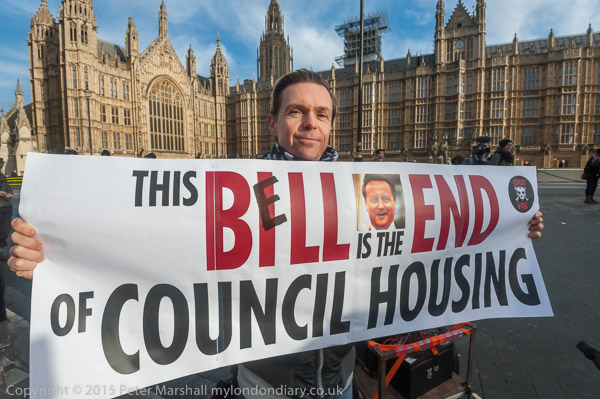
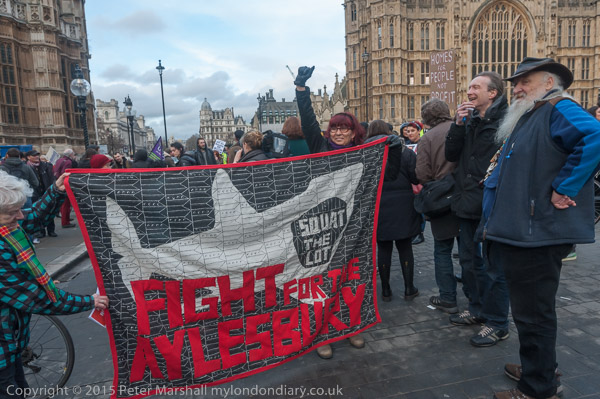
Protests in Westminster on Tuesday 5th January 2016 by housing groups who say ‘Tories Threatens Social Housing’ and Kurds protesting against Turkish support for ISIS and the genocide of Kurds.


Kill the Housing Bill protest – Westminster

Tories Threatens Social Housing & Turkey Kills Kurds

The Housing and Planning Act 2016 passed by the Tory government was said to be a landmark in housing policy aimed a promoting home ownership and it was claimed would lead to an increase in the number of homes being built.

Tories Threatens Social Housing

In practice it seemed to have little impact on home building, which continued to show a small annual increase from its low point in 2010-2011. But the act did radically incorporate Tory views about housing and in particular the individual ownership of homes, both through the extension of ‘right to buy’ to housing association tenants and its attack on social housing which seem aimed at increasingly marginalising what many of us see as the most sensible and cost-effective way to provide housing certainly for those on below average incomes, if not more widely.

Tories Threatens Social Housing

Tory housing policies changed radically over the years. In 1968 local authorities built over 190,000 new homes and although this had roughly halved by the Thatcher became PM in 1979, by the time she left office this was down to 17,000 with numbers continuing to drop both under the Tories and New Labour – with only 130 new local authority homes in 2004.

Aspects of the bill were opposed by over 150 housing sector organisations, but their submissions were ignored by the government. As well as its attack on both housing association and local authority housing the act also brought in a discriminatory reduction of available housing sites for Gypsies and Travellers and also hit barge dwellers.

Architects for Social Housing prepared a summary of its effects which I quoted on My London Dairy:

  • Replace the obligation to build homes for social rent with a duty to build starter homes capped at £450,000 in London and £250,000 in England;
  • Extend the Right to Buy to housing associations without the obligation to replace them, further depleting the number of hoems for social rent;
  • Compel local authorities to sell ‘high value’ housing, either transfering public housing into private hands or freeing up the land it sits on for property developers;
  • Force so-called ‘high income’ tenants with a total household income over £30,000 (£40,000 in London) to pay market rents;
  • Grant planning permission in principle for housing estates designated as such to be redeveloped as ‘brownfield land’;
  • Phase out secure tenancies and their succession to children and replace them with 2-5 year tenancies – with such tenancies also being applicable to tenants who have been ‘decanted’ for the purposes of redevelopment.

    The only ‘good’ housing so far as the Tories are concerned is housing which creates profits for the private sector, many of whom make large contributions to party funds, These include house builders and private renters, including ‘buy to let’ owners who use their ability to borrow money to get tenants to buy properties for them. Buy to let mortgages first became available in 1996 and since then have seen a huge growth, particularly with the exceptionally low interest rates available until recently.

    The protest on Tuesday 5th January 2016 in Old Palace Yard was on a day when the bill was being rushed through in parliament, and was supported by a very wide range of organisations, though most were only represented by a handful of people.

    As I reported, “there were clearly differences in the way some thought the protest should be conducted. While Class War and others protested loudly at the front of the crowd facing Parliament, with some powerful speeches from Lisa McKenzie and Martin Smith among others and some housing songs led by John Hamilton of Lewisham People Before Profit and the Strawberry Thieves Choir, a smaller group at the back in front of George V seemed determined to hold a separate and more organised event. And when someone set off a green smoke flare, a SWP newspaper seller came and picked it up to carry away from the protest.”

    Eventually after a number of speeches, Class War and friends decided it was time for a more active protest and decided to go on a march. Police tried to prevent them, but when this didn’t work gave up and facilitated a short march along the Embankment and up Horseguards Avenue to Whitehall and Downing St, where they blocked the road for a few minutes before moving on to protest in front of the Houses of Parliament in Parliament Square and then rejoin the smaller group who were still in Old Palace Yard, where speeches were continuing.

    More at Kill the Housing Bill protest.


    Kurds protest Turkish army killings – Parliament Square

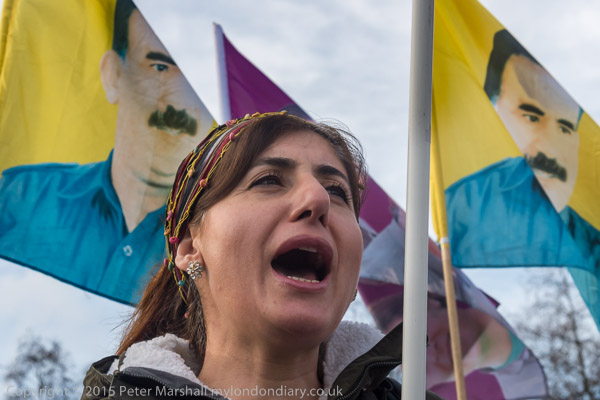
    Also in Parliament Square were Kurds protesting against the Turkish support for ISIS and the attacks on Kurds in Syria by ISIS and the Turkish army. Turkey is carrying out a policy of genocide against the Kurdish people, who have suffered years of oppression in Turkey.

    More at Kurds protest Turkish army killings.


    Transgender Rights & Justice For the Cleaners

    On Saturday 3rd January 2015 I photographed two protests. First was a vigil following the suicide of a transgender teenage girl and the second another protest in the long series of actions calling on John Lewis to pay their cleaners a living wage.


    Vigil for Leelah Alcorn – Trafalgar Square, Saturday 3rd January 2015

    Transgender Rights & Justice For the Cleaners

    Leelah Alcorn was a 17-year-old who threw herself under a lorry after her Christian parents forced her into ‘conversion therapy’, refusing to acknowledge her gender and forbidding her from transitioning.

    Transgender Rights & Justice For the Cleaners

    Before her death Leelah had written a poignant suicide note on her Tumblr blog blaming her Christian parents, saying that from the age of four she had felt she was “like a girl trapped in a boy’s body” and describing her relief when she found the possibility of transgender transitions – but her feeling of hopelessness after she realised that her parents “would never come around” to her transition.

    Transgender Rights & Justice For the Cleaners
    Roz Kaveney reads her poem for Leelah Alcorn

    Leelah wrote: “The only way I will rest in peace is if one day transgender people aren’t treated the way I was, they’re treated like humans, with valid feelings and human rights.”

    Gender needs to be taught about in schools, the earlier the better. My death needs to mean something. My death needs to be counted in the number of transgender people who commit suicide this year. I want someone to look at that number and say ‘that’s f**ked up’ and fix it. Fix society.

    Even after her suicide her parents remained unwilling to accept her transition, burying her with a gravestone under her former name ‘Joshua’.

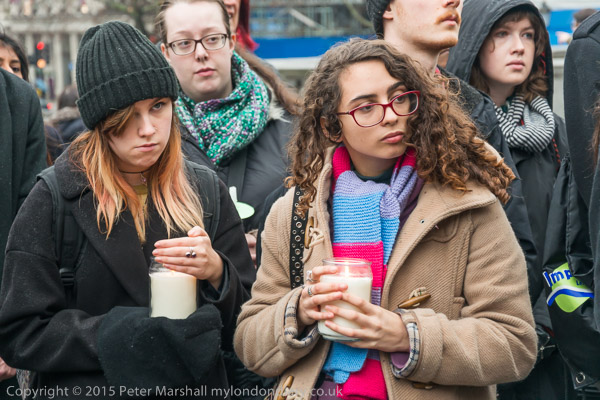
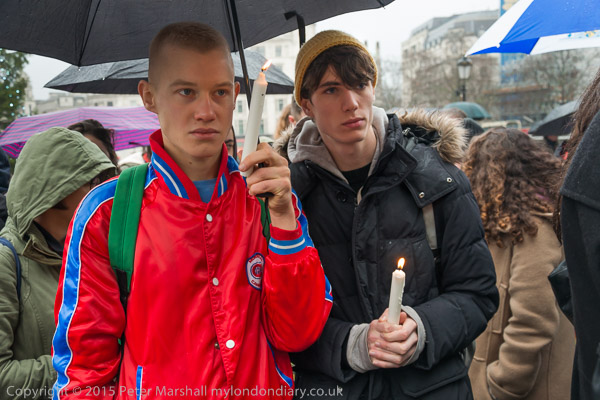
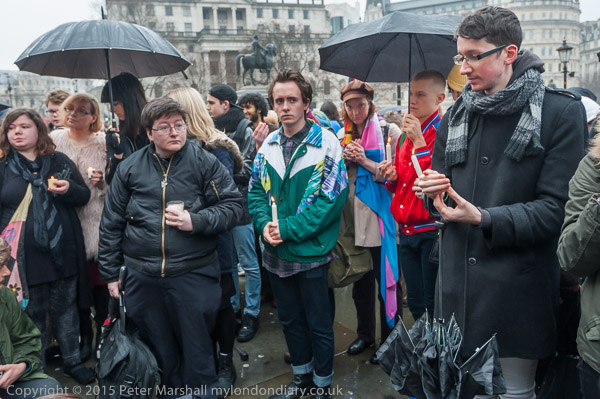
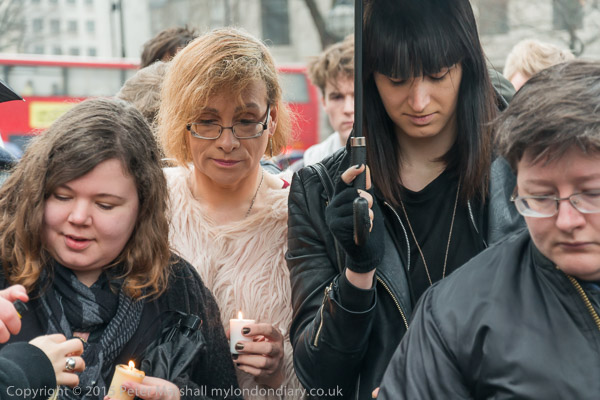
    Those taking part in the vigil included a number of people who had also transitioned as well as other supporters of transgender rights. Speakers condemned the practice of ‘conversion therapy’ which has no basis in medical science and carries a high risk of suicide, calling for it to be banned and for those carrying it out to be prosecuted. It is already banned in some US states. They also demanded that her gravestone carry her chosen name of Leelah.

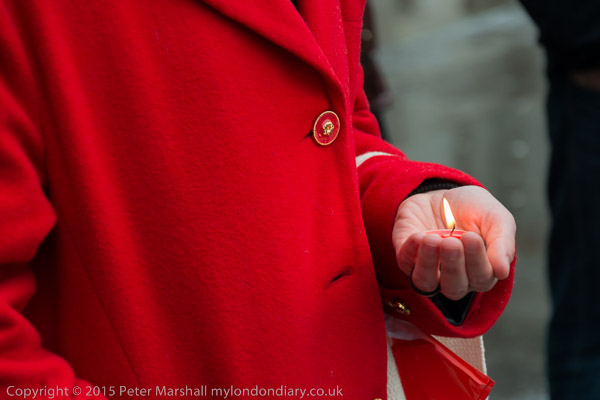
    The protest ended with the lighting of candles and a two minute silence in memory of Leelah.

    More at Vigil for Leelah Alcorn


    Pay John Lewis Cleaners a Living Wage – Oxford St, Saturday 3rd January 2015

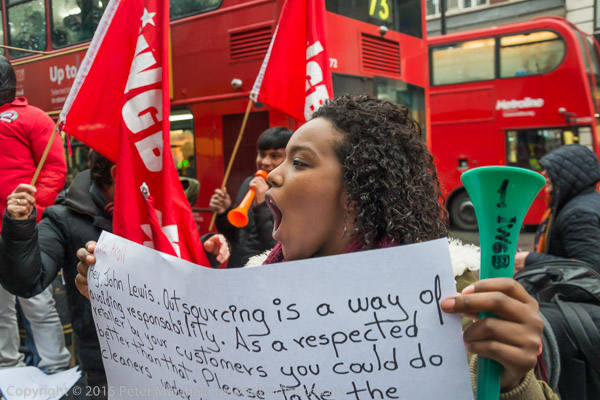
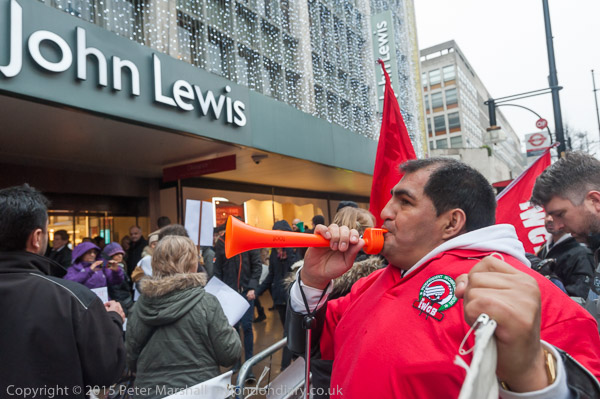
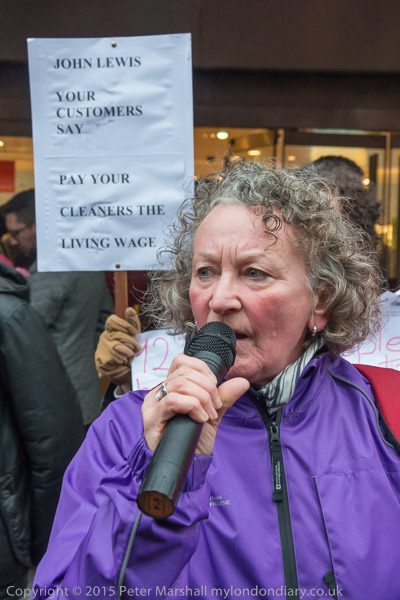
    Members of the Cleaners And Facilities Branch of the IWGB (Independent Workers Union of Great Britain) protested along with John Lewis customers protested outside the flagship Oxford St John Lewis store calling for them to live up to their ethical reputation and pay those who keep the shop clean a living wage. The cleaners complain the company treats them as second class citizens.

    They were also protesting at the assaults on protesters by police at their previous month’s protest inside the store, where many were attacked as they were trying to leave after a peaceful protest. This time the protesters made no attempt to enter the store which was guarded by a line of police and extra security officers, but protested on the wide pavement outside.

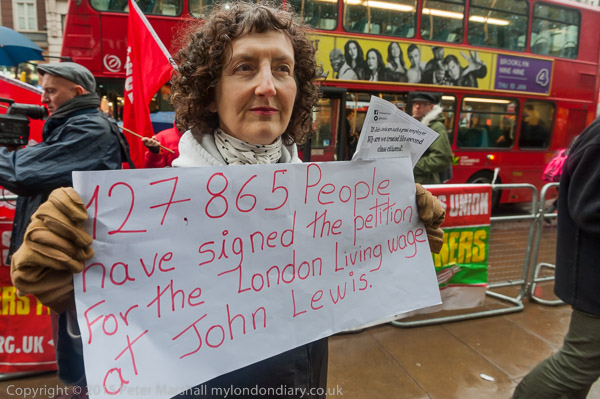
    Over 125,000 John Lewis customers had signed a petition calling on the company to ensure that it live up to its ethical reputation and ensure that the cleaning contractor pays all cleaners working in the store the London Living Wage. Neither John Lewis or the contractor recognise the IWGB as representing the workers, although it is the registered trade union which almost all the cleaners belong to.

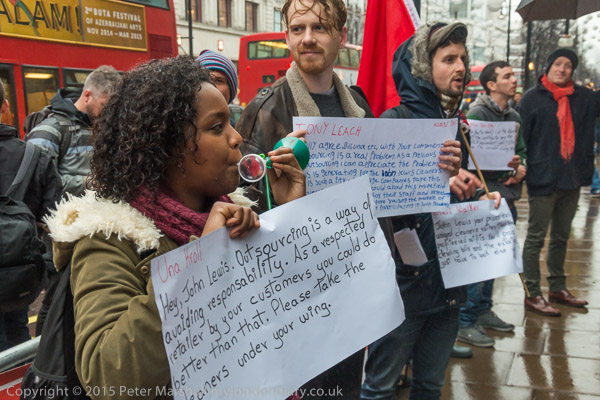
    As well as not being paid enough to live on, the cleaners have much poorer conditions of service than the directly employed staff they work alongside – who also get a large annual bonus as “partners” in the business. By outsourcing the cleaning John Lewis is refusing responsibility for work done in its store and vital for its running. They could include conditions for proper pay and conditions for the cleaners in the specification of their contracts but fail to do so.

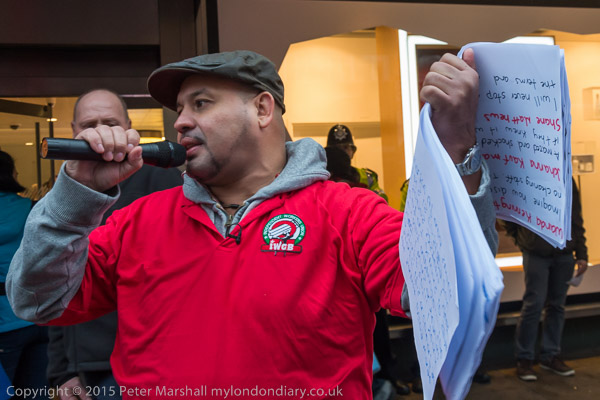
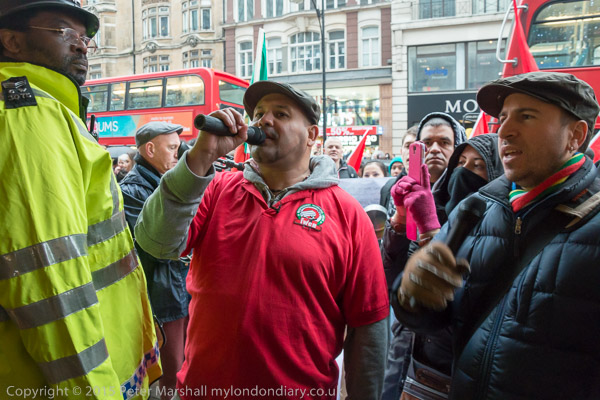
    IWGB (Independent Workers Union of, Great Britain) General Secretary Alberto Durango

    The protest was led by IWGB General Secretary Alberto Durango and President Jason Moyer-Lee. There were short speeches of support by others including Green Party London Assembly member Jenny Jones, (Baroness Jones of Moulsecoomb) and Mick Dooley of London TUSC, as well as a great deal of noisy shouting and blowing of horns.

    Green Party London Assembly member Jenny Jones, Baroness Jones of Moulsecoomb

    Many of the public on busy Oxford Street took the flyers being handed out and expressed support for a proper wage for the workers and disgust at the failure of John Lewis to treat them properly.

    After around an hour and a quarter the event ended with a march around the outside of the large building, with security and police rushing inside the shop to meet them at every door. But even though the protesters sometimes arrived before them, they made no attempt to go inside.

    More pictures at Pay John Lewis Cleaners a Living Wage