Carnival, Political Prisoners & Naked Bike Ride: On Saturday 14th June 2008 I called in at Hampton Hill on my way into London for the 30th annual Hampton Hill & Hampton Carnival Parade, but it turned out to be a rather small event. In Trafalgar Square there was a protest outside South Africa House calling for the release of political prisoners held in prisons around the world and after this I went to Hyde Park for the start of the London World Naked Bike Ride.
Hampton & Hampton Hill 30th Anniversary Parade
Hampton Hill
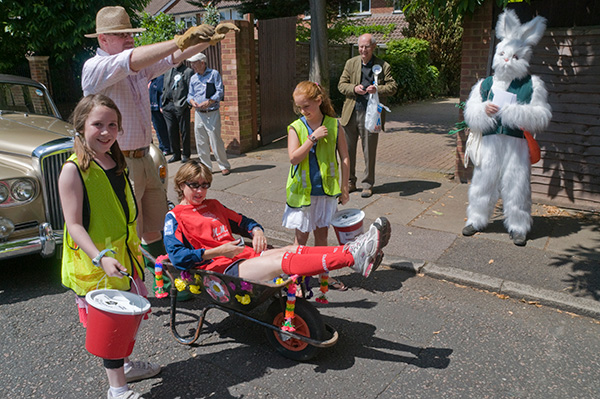
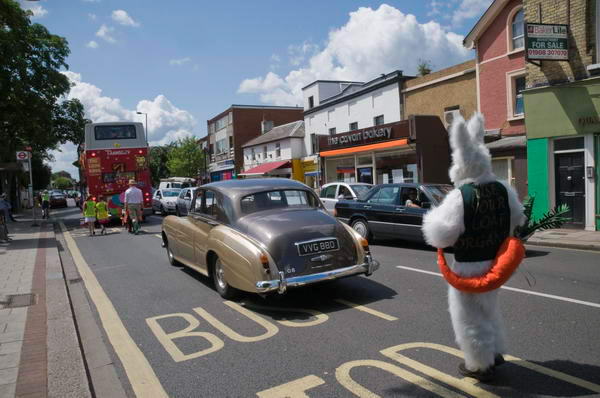
In Hampton Hill I found cows on the High Street and a large rabbit as well as a few cars and some people on foot including a gardener with a wheelbarrow, but it was a small and rather disappointing parade and I left to continue my journey to London as it made its way towards Hampton.
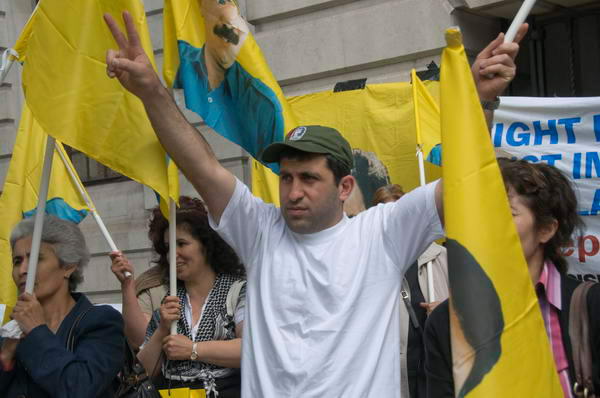
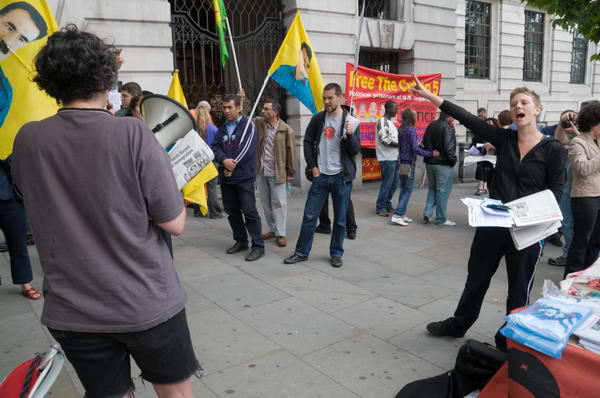
The protest here was also rather smaller than I had hoped but included a group of Kurds calling for the release of their leader, Abdullah Ocalan from a Turkish jail.
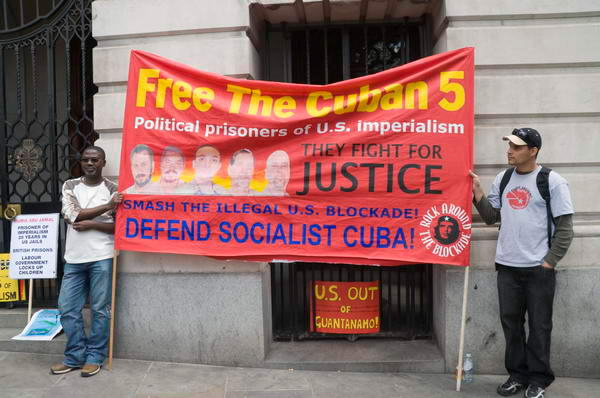
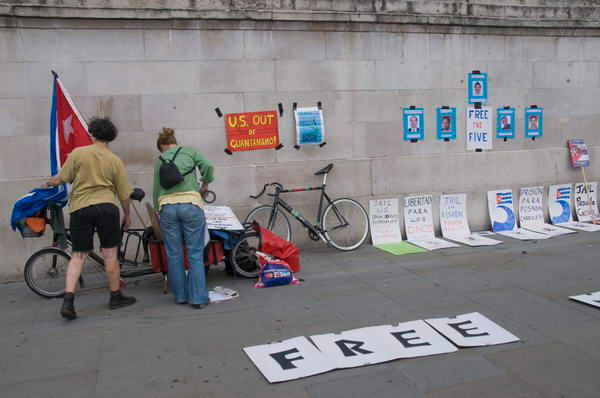
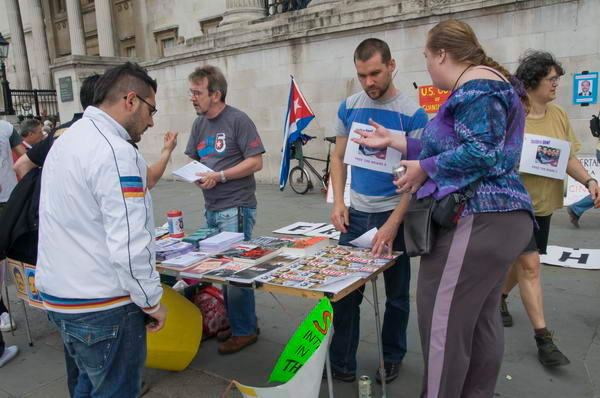
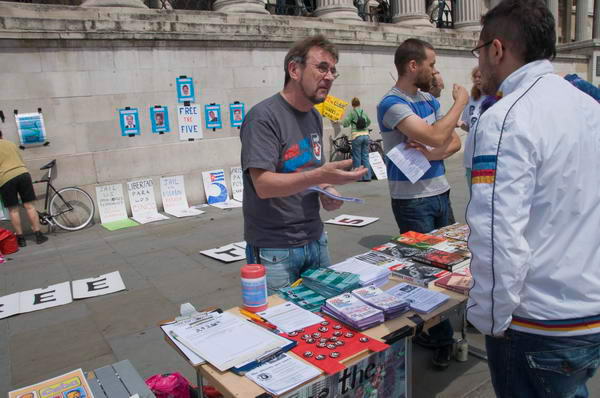
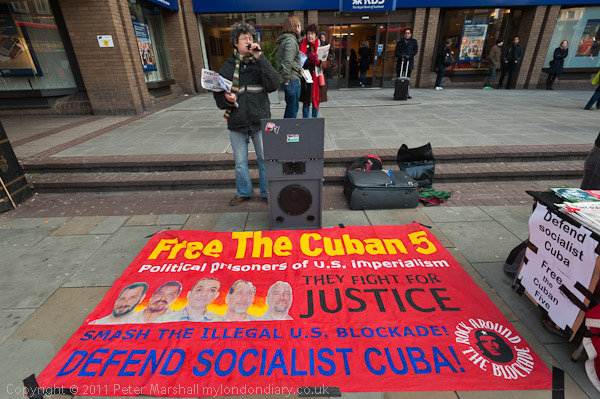
Others called for the release of the Miami Five, Cubans who came to Miami to disrupt terrorist raids made by right-wing Cuban exiles living there against Cuba and imprisoned by the USA.
There were also calls for the closure of the illegal US prison camp at Guantanamo Bay and for an end to the continuing torture there and release of refugees and asylum seekers locked in detention centres in the UK.
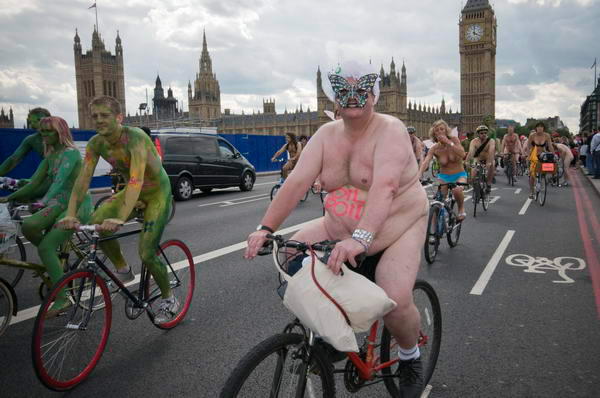
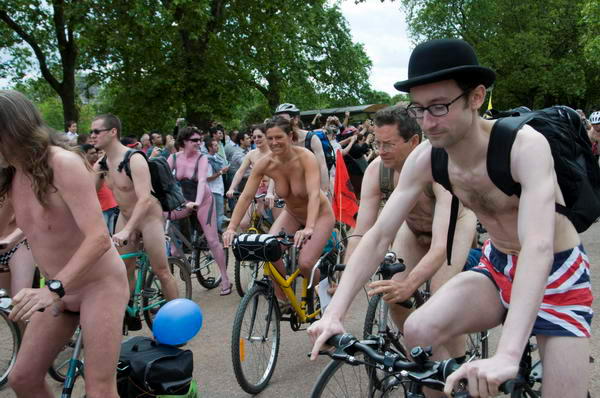
In 2008 the London World Naked Bike Ride began in Hyde Park, and I went there to photograph the riders getting ready and setting off. The start was very crowded mainly with tourists eager to view the spectacle.
When all had left I took the tube to Westminster to photograph the ride going over Westminster Bridge and then as the ride regrouped I rushed to the footbridge into Waterloo Station (now demolished) for pictures from above as it came down York Road. As the last cyclist passed below me I walked into the station to catch my train home.
As I commented “while bodies are very much on display environmental messages seemed at times to be rather well-hidden, leaving many of the public along the route bemused.” And on My London Diary I recount briefly the reactions of some of the people I talked to and heard as we watched the event.
Those organising the ride say it is a “peaceful, imaginative and fun protest against oil dependency and car culture. A celebration of the bicycle and also a celebration of the power and individuality of the human body. A symbol of the vulnerability of the cyclist in traffic.”
The annual ride continues to take place in London and in other cities. The 2026 London ride is today, Sunday 14th June 2026. Riders are starting from Clapham Junction, Croydon, Deptford, Hackney Wick, Kew Bridge, Regents Park, Tower Hill, Hyde Park Corner and all meeting up close to the south end of Westminster Bridge to ride together around Central London.
Cuban 5, Knives & Peace Strike: Saturday 7th June 2008 I photographed a protest following the dismissal of an appeal in Miami by five Cuban men held in the USA since 1998, a Seventh Day Adventist Church march against knife crime and a rally by the Peace Strike camped in Parliament Square.
Release the Cuban 5
Trafalgar Square
The Cuban 5 were Cuban intelligence officers who came to Miami to spy and infiltrate on the Cuban exile community after terrorist bombings by Cuban exiles had taken place in Havana, organised with the support of the CIA.
The five men were arrested in September 1998 and later convicted in Miami and given lengthy jail sentences. International concerns about their lack of a fair trial led an Atlanta Court of Appeals hearing which overturned their convictions in 2005, but this decision was soon overturned by the full court, who re-instated the original convictions.
In the week before this protest an appeal court in Miami upheld the convictions and the life sentence against Gerardo Hernandez and that of 15 years against Rene Gonzalez, but referred Ramon Labanino, Antonio Guerrero and Fernando Gonzalez for re-sentencing in Miami.
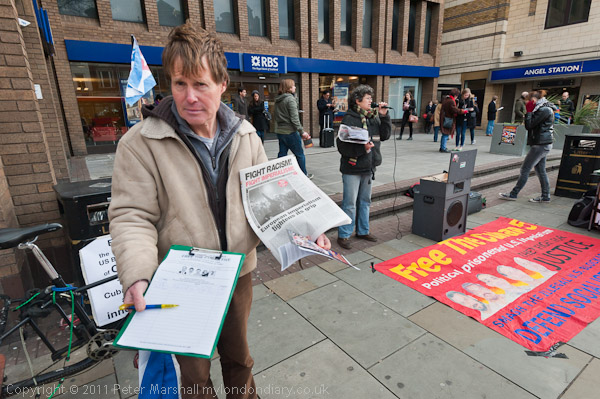
Rock Around the Blockade had protested at the US Embassy the previous Thursday as a part of an international day of protest and were in Trafalgar Square on Saturday to raise awareness and collect signatures for a petition calling for the release of the men.
Rene Gonzales was eventually allowed to return to Cuba for his father’s funeral in 2013 having served 13 years of his sentence and Fernando Gonzalez was released in February 2014. The three remaining prisoners were released later that year in a prisoner swap.
Adventist Youth March against Knives, Guns & Violence
Trafalgar Square- Kennington Park
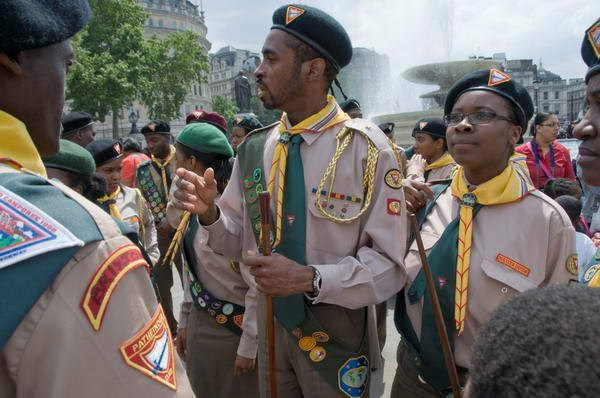
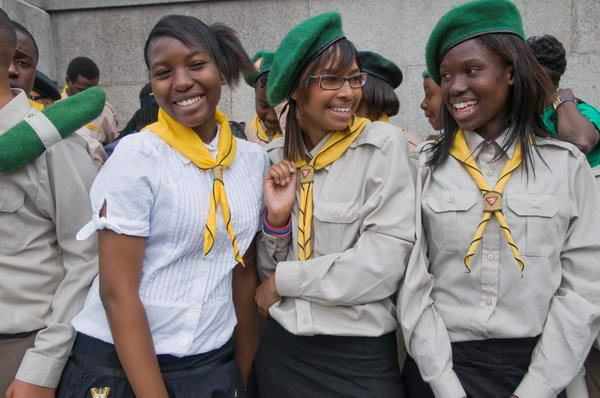
Pathfinders – an Adventist youth group – wait for the march to start
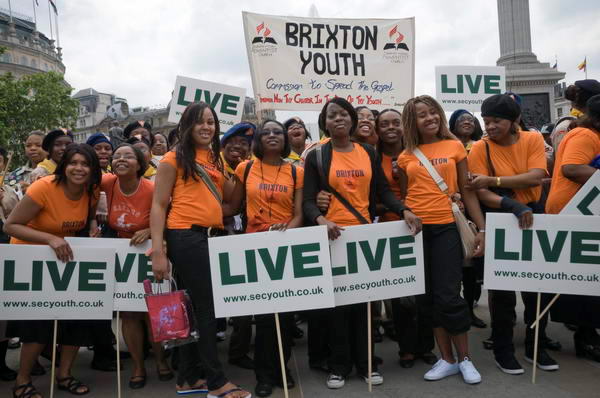
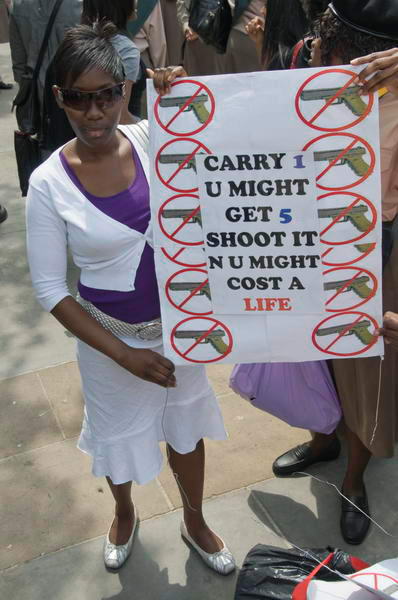
Seventh Day Adventist Church organisations had organised a youth rally in Trafalgar Square before marching to Kennington Park to make young people realise the dangers they face if they carry a knife.
Many feel that they need a knife to defend themselves if they are attacked by someone with a knife, but we know that meeting aggression with aggression carries a high risk.
Carrying a gun can get you a five years, use it and you could get a life sentence
I wrote: “Communities need to police themselves more effectively and to cooperate with the police when they cannot deal with situations without them. The problem is one that needs both strong community organisations and sensitive policing. I hope that Boris will be encouraging and putting resources into community organisation in the inner city and not just stepping up policing.”
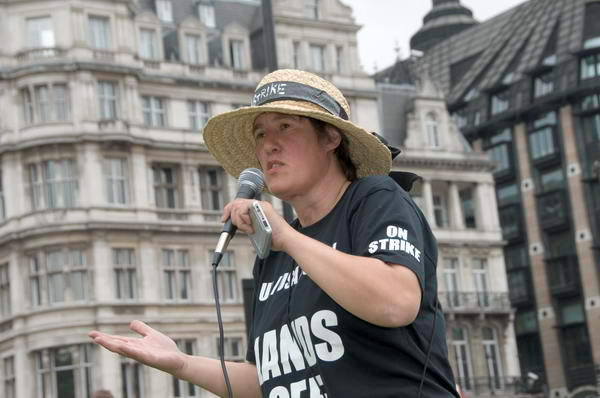
The Peace Strike had joined the peace protesters already in Parliament Square in Brian Haw’s Peace Campaign there since 2001.
Maria Gallastegui had set up Peace Strike to call on people to take effective action for peace by striking, withdrawing their labour if only for short periods. The campaign against the invasion of Iraq had shown the marches, even huge marches, did not stop the war.
At the marches before the invasion began, speakers including Tony Benn had called for people to strike if the war went ahead, but when it happened Stop The War had simply decided to call yet another march.
Peace Strike aimed to build actions not just in the UK but globally which will demonstrate that people are willing to strike for peace and the future of humanity. In June 2008 an attack on Iran was a major threat, with the US building up forces.
As well as speeches we all enjoyed the playing and singing of singer/songwriter Harry Loco who had come from Holland, and as well as his own songs he gave a fine performance of a Dylan number.
On Saturday 7th January 2012 I photographed three events in London. Two were associated with Cuba, one celebrating the Cuban revolution and the second calling for the closure of US Guantanamo Bay torture camp there. The third was a protest in solidarity with the mothers of political prisoners and those murdered by the Islamic Republic of Iran since 1979. Now there will be many more of these human rights abuses as Iran clamps down on the current ‘Women, Life, Freedom’ protests there.
53 Years Of Cuban Revolution – Angel, Islington
Although Cuba celebrates 26 July 1953 as the ‘Día de la Revolución’ (Day of the Revolution), this was the start of the movement with an unsuccessful armed attack on the Cuban military’s Moncada Barracks which resulted in the leaders being captured and jailed. It was not until 31 December 1958 that the rebels finally ousted Batista and Fidel Castro came to power, leading the country as prime minister from 1959 to 1976 and president from 1976 to 2008.
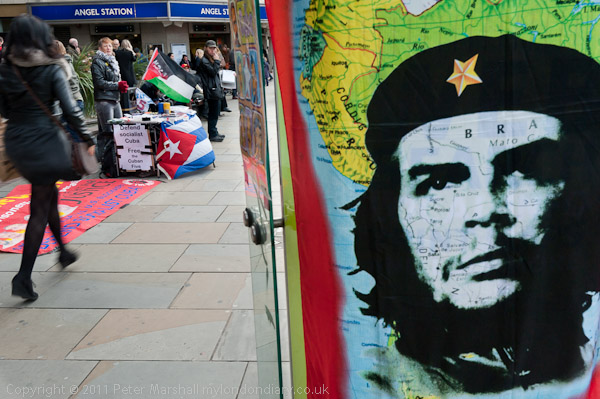
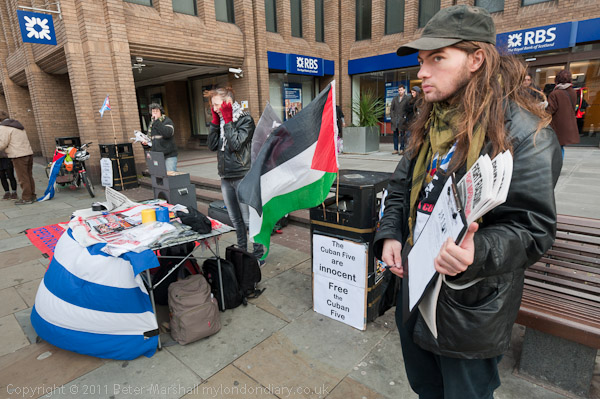
53 years and one week later a street rally at the Angel Islington organised for Rock around the Blockade by Fight Racism Fight Imperialism celebrated the Cuban revolution’s building of a socialist country despite the blockade by its powerful neighbour USA, and demanded justice for the Cuban Five.
The Cuban 5 were arrested in 1998 in Miami for spying on groups of Cuban refugees who were planning illegal acts against Cuba. Their treatment in US courts has been criticised as unfair by the UN Commission on Human Rights and by Amnesty International, who also condemned their treatment in jail as “unnecessarily punitive.”
Among many internationally calling for their release were Eight Nobel prize winners from around the world including Nadine Gordimer, Desmond Tutu, Wole Soyinka and Gunter Grass. A panel of US judges had overturned their convictions in 2005, but this was overruled by the full court and the US Supreme Court declined to review their case. One of the Cuban 5 was released in 2011 having served 13 years in prison, but at the time of this rally four remained in jail. The others were later released in December 2014 in a prisoner swap for a US spy captured in Cuba.
The rally stressed the remarkable changes the revolution had made in Cuba which in 1958 was a poor and corruptly governed country, its natural resources exploited by foreign companies, its people largely living in poverty with low educational standards and life expectancy. Now it has probably the best health service in the world, low infant mortality and a life expectancy better than many parts of the UK. Free education is provided for all, and soon most will follow it to graduate level.
Cuba has also been generous in providing free medical training for students from many African and South American countries, and also has sent many doctors and nurses to work in them, making a major contribution to controlling AIDS in Africa. Although there some criticise it for a lack of freedom, it has shown that there is a real alternative to capitalism, and that has provided a healthy and dignified life for its people, improving their condition over more than 50 years. And it has done all this despite US blockade and sanctions and continuing US support for counter-revolutionary groups – including the failed Bay of Pigs military invasion in 1961.
Speakers also condemned the continuing US occupation of the Guantanamo Bay Naval Base in Cuba, there since 1903 when the US was given a permanent lease on 45 square miles of Cuba. The lease clearly limits US activities there to those to fit the needs of a coaling and naval station and prohibits the setting up of any commercial or other enterprise in the area. The setting up of the Guantanamo Bay detention camp would appear to be a breach of these terms. The Cuban government claim that the lease was “imposed on Cuba by force” and is “illegal under international law” and have refused to accept US payments for it since 1960.
Shut Guantánamo – End 10 Years of Shame – Trafalgar Square
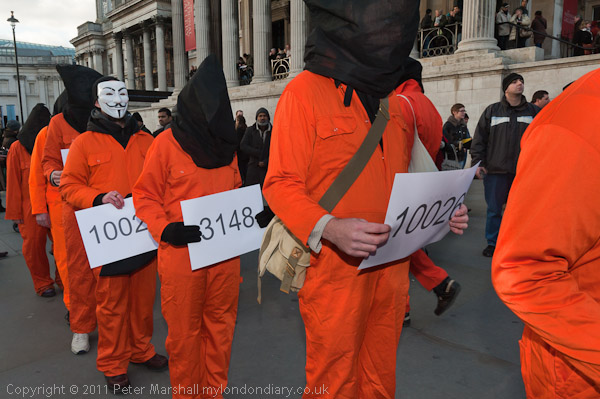
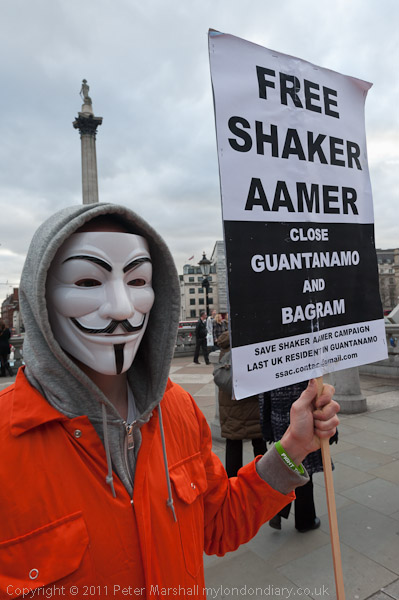
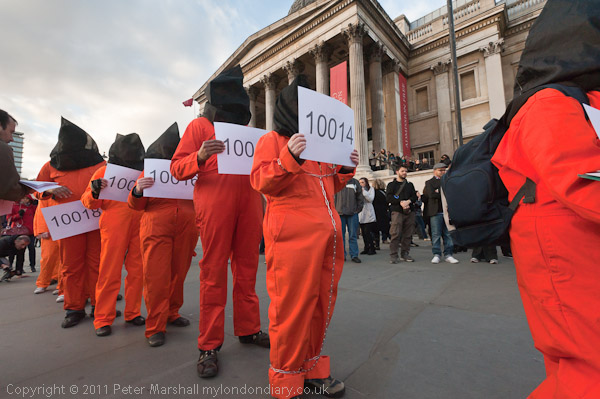
A rally marking the 10th anniversary of the setting up of the illegal US prison camp at in the US military base at Guantánamo Bay, Cuba on 11 January 2002 called for its closure and in particular the release of the two remaining prisoners with UK links held there.
Although President Obama came into office pledging to close the camp down and end the discredited military trials there, he has failed to do so, authorising the continued regime of arbitrary detention without charge or trial. 171 prisoners were still detained there at the start of January 2012.
Louise Christian
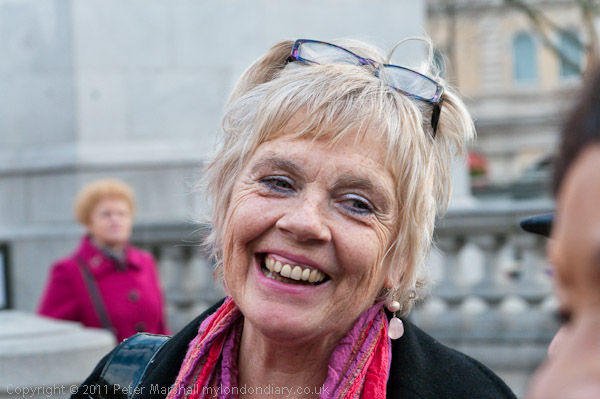
Several hundred came to the protest and listed to speeches by Lib Dem Baroness Sarah Ludford MEP, solicitor Louise Christian, Lindsey German of Stop the War, Kate Hudson of CND, journalist Victoria Brittain and others, including student representatives, trade unionists and other activists.
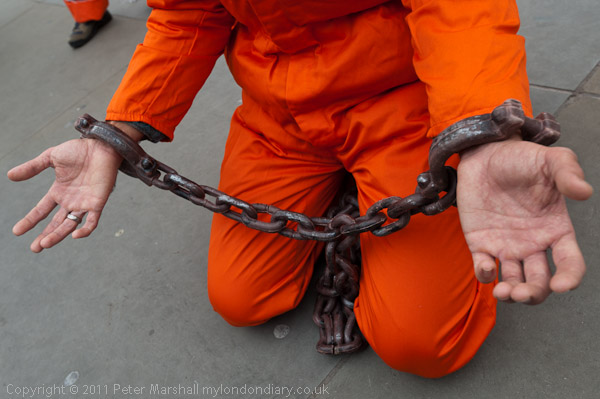
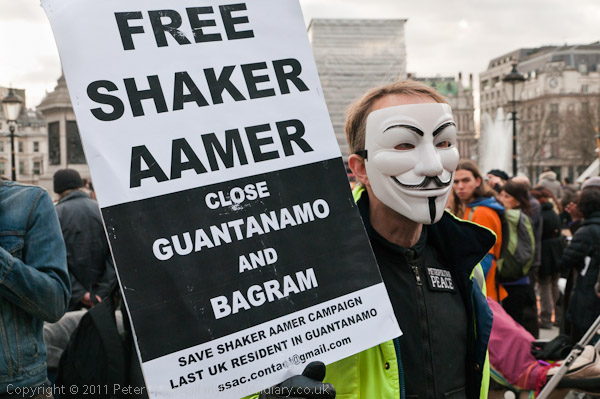
A group of activists wore orange jumpsuits and black hoods as used at Guantanamo, and some were also in chains. They marched in line holding up the prison numbers of the 177 prisoners still in Guantanamo, and their numbers were called and their names read out. Among those taking part and wearing ‘V’ for Vendetta Guy Fawkes masks were ‘Anonymous’ protesters who had come from the Occupy London protest camp at St Paul’s Cathedral.
Ahmed Belbacha, an Algerian national who had a residence permit and lived in Bournemouth from 1999 to 2001 while claiming asyluk was cleared for release in 2007 and 2009. In 2009 he was sentenced in absentia in Algeria to 20 years for membership of a foreign terrorist group abroad – though no evidence was given at his trial. It appears that the US intervened on his behalf in Algeria and he was finally released and returned to his family in 2014.
Shaker Aamer was similarly cleared for release in 2007 and 2009, but was thought to still be detained as his revelations of torture over his ten years of imprisonment by the US authorities (and on one occasion in the presence of a British intelligence agent) would be embarrassing to the US and UK governments. I was pleased to be able to photograph him at a rally at the US Embassy in London in January 2016 after his release at the end of October 2015.
London Mourning Mothers of Iran – Trafalgar Square
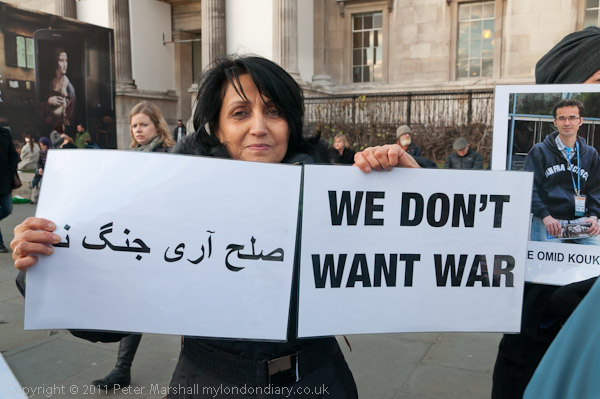
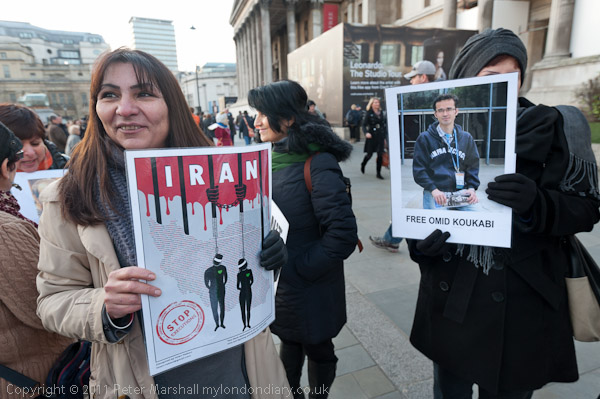
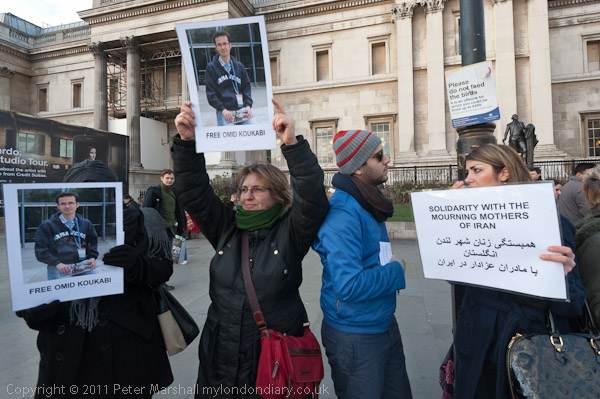
Also in Trafalgar Square were The London Mourning Mothers of Iran who had been coming there every first Saturday of the month to show solidarity with the mothers of political prisoners and those murdered by the Islamic Republic of Iran since 1979.
The Mothers of Laleh Park (formerly known as the Mourning Mothers of Iran), women whose children or husbands were killed or imprisoned after the 2009 Iranian election, come regularly to Laleh Park in central Tehran and other locations on Saturdays and stand together to bring attention to these injustices.
Iranian security agents often come and attack the mothers. On January 9, 2010 over 30 of them were attacked and arrested and held in jail for several days, and leading members have received long prison sentences. The call for the release of political prisoners, the abolition of the death sentence and the trial of those who have ordered the killings of the last 30 years.