Budget Day – 2010

Budget Day - 2010

Budget Day: Tuesday 22nd June 2010 came after the May general election which had resulted in a hung Parliament, with the Tories winning 306 votes, 20 short of the number needed to for a majority. It had been a defeat for New Labour, in power since 1997, who only achieved 258 MPs. The Lib-Dems were the third party with 57 seats. Theoretically an anti-Tory coalition might have achieved a small but workable majority, but instead Nick Clegg decided to join a coalition government with the Tories which would have a clear majority – and lasted until the 2015 General Election.

Budget Day - 2010

Their decision resulted in a programme of austerity and cuts along with increases in tax which began with George Osborne’s budget on 22nd June. This included a rise in VAT from 17.5% to 20%, cuts in public services and a 2 year pay freeze for workers in the public sector, freezing of child benefit for 3 years, pegging state benefits and public service pensions to a lower price index, capping of housing benefit , cutting research and development and more.

Budget Day - 2010
PCS outside the Treasury

Most of these changes had been widely signposted before the budget speech and opponents had made clear that they were likely to stifle growth and to have a disproportionate effect on the poor, women, disabled people and ethnic minorities. It was the most controversial budget in recent history and so it was unsurprising that so many came out to protest. And later the changes it introduced were probably a major factor in both the disastrous Brexit vote and the succession of hopeless Tory governments that led to the 2024 Labour landslide.

Budget Day - 2010
‘Can’t Pay Won’t Pay’s funeral procession with coffin, widow and gravestones

Brian Haw’s Parliament Square Peace Campaign was also still in Parliament Square, although Brian himself was in court on the morning of the budget. But they had been joined there at the start of the previous month by the Democracy Village who were still camping there, and though relations between the two groups were not positive, both were still protesting, and on Budget Day others including the PCS union, ‘Can’t Pay Won’t Pay’, Stop the War and CND also came to protest at Westminster too.

Budget Day - 2010

I missed what was probably the largest protest of the day opposite Downing Street, having been held up photographing the Democracy Camp calling for an end to the war in Afghanistan.

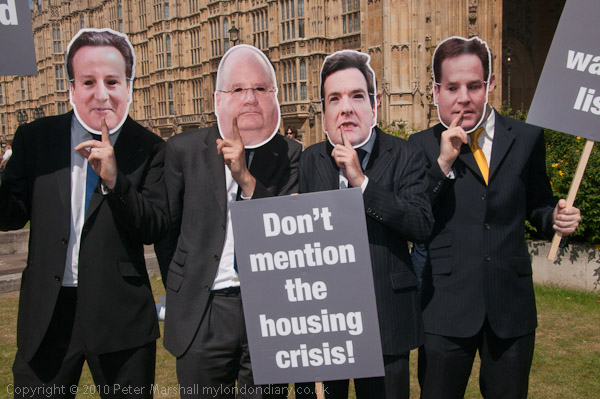
‘Cameron’ and ‘Clegg’

The PCS were protesting outside the Treasury. Democracy campers went with their banner to the media village. ‘Can’t Pay Won’t Pay’ campaigners arrived with a coffin and a little street theatre (it even got them a short mention on the BBC) and I followed them back to Parliament Square, missing two attempts to make citizens arrests on Labour politicians.
You can read more about the events on My London Diary, as well as a police incident involving gun violence campaigner ‘King David’ who was holding a brass ornamental pistol – clearly not a weapon – but was stopped and searched under terrorist legislation.

King David was searched under the Terrorism act for holding this brass ornament

More protesters arrived with placards and masks protesting about the housing crisis and the lack of affordable homes, and there was a man with a megaphone lampooning the whole thing and getting some attention from the police who today seemed clearly did not want to make arrests.
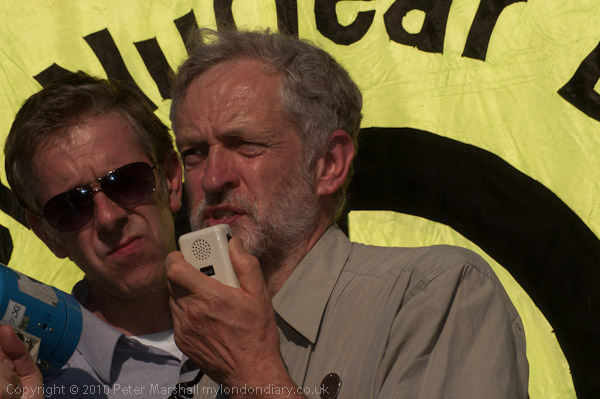
Jeremy Corbyn

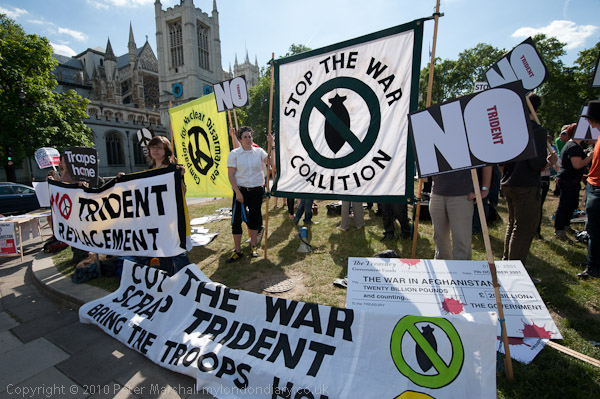
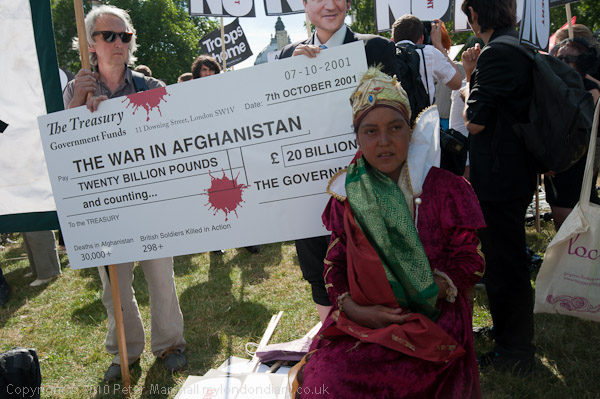
The final event I photographed before leaving Parliament Square was by Stop the War and CND, pointing out that the war in Afghanistan had cost more than £20 billion, and that a large saving could be made by deferring or cancelling the replacement of our Trident nuclear deterrent, for which there was no longer any possible military justification.

More on My London Diary: Budget Day in Westminster


Admiral of the Port’s Challenge
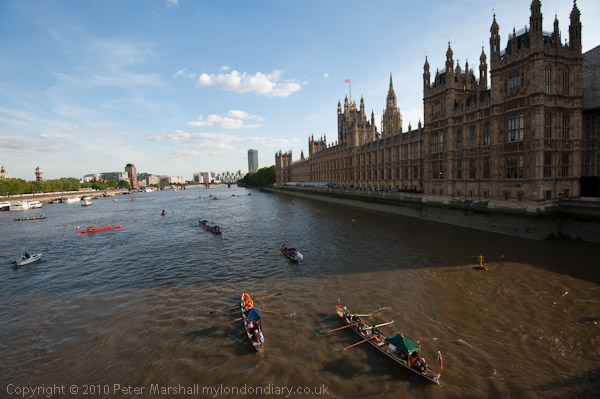
The race starts in several waves from outside the Houses of Parliament

As I walked back across Westminster Bridge towards Waterloo Station I noticed a number of boats being rowed upriver in what appeared to be a race.

The Admiral of the Port’s Challenge, a “historic tradition”, appears to have started around 2008 by the London livery companies, liverymen rowing “traditional” Thames Waterman’s Cutters, 34 feet long and 4 feet 6 inches wide, with fixed seats for 4 rowers and a canopy over 2 passengers, to the rear of which the cox sits. The boats start in waves from outside the Hoses of Parliament and row around a mile and a third to a boat club in Pimlico.

These boats, though based on those shown in 18th century paintings, are actually a modern design, adapted and built to be fast and stable for modern use for the Thames ‘Great River Race’ which started in the 1980s. Unlike modern racing craft they can cope with choppy waters on the river or even in coastal waters. And at the end of the race there is a champagne reception for those taking part.

More about this race at Admiral of the Port’s Challenge.

And more about the budget protests at Budget Day in Westminster.


FlickrFacebookMy London DiaryHull PhotosLea ValleyParis
London’s Industrial HeritageLondon Photos

All photographs on this page are copyright © Peter Marshall.
Contact me to buy prints or licence to reproduce.
UK Uncut VAT rise & a Pillow Fight

Two protests in London on Saturday 15th January 2011.


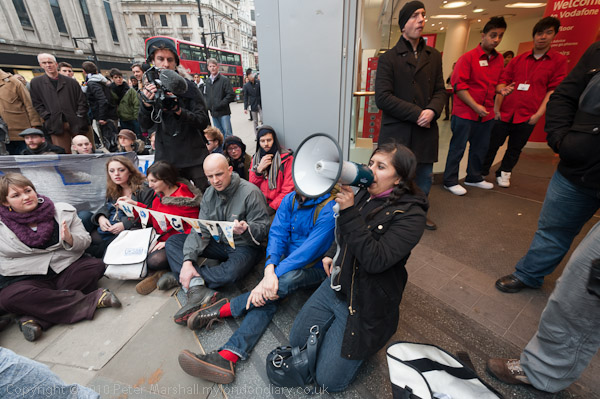
UK Uncut Protest VAT Rise at Vodaphone – Oxford St, 15 Jan 2011

UK Uncut VAT rise & a Pillow Fight

A couple of days ago in 2023 the Commons Public Accounts Committee reported that £42bn is outstanding in tax debt, with HMRC failing to collect around 5% of tax owing each year. Committee chair Meg Hiller commented “The eye-watering £42bn now owed to HMRC in unpaid taxes would have filled a lot of this year’s infamous public spending black hole.” The report states that for every £1 the HMRC spends on compliance it recovers £18 in unpaid tax, and the MPs say it simply isn’t trying hard enough.

UK Uncut VAT rise & a Pillow Fight

In addition, they point to the pathetic effort our tax authorities are making to recover the £4.5 billion lost by fraud over Covid support schemes, only even “trying to recover less than a quarter of estimated losses in schemes such as furlough.

UK Uncut VAT rise & a Pillow Fight

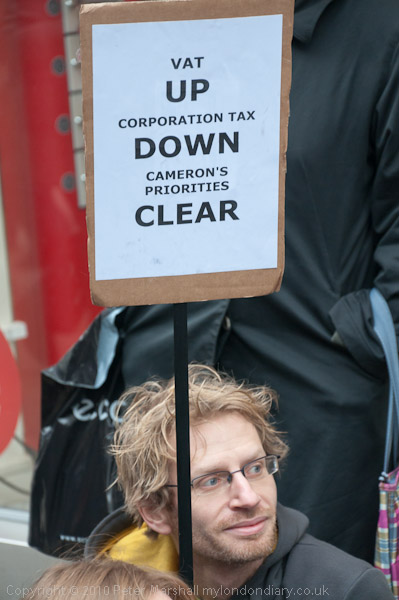
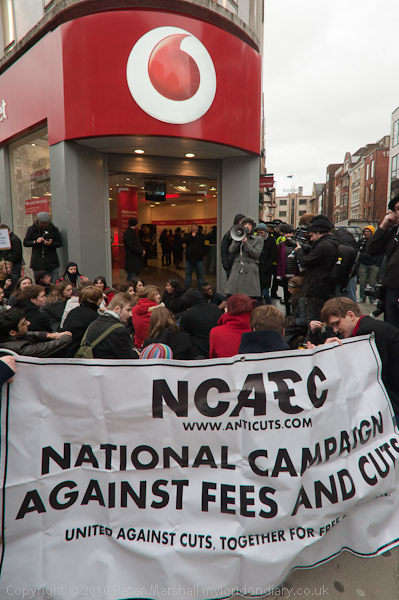
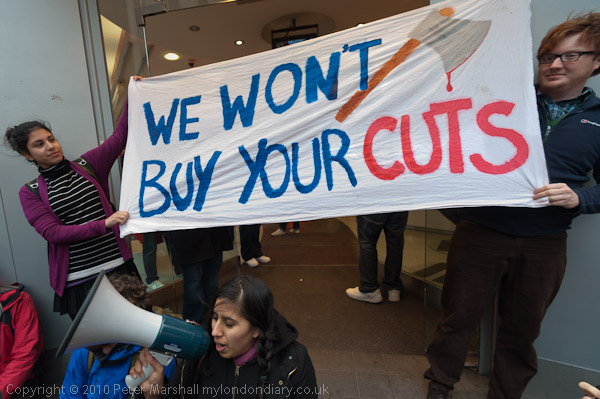
Back in 2011, anti-cuts activists UK Uncut were campaigning to force the government to clamp down on tax avoidance rather than cut public services and increase the tax burden on the poor. This protest took place following a rise in VAT from 17.5% to 20% and a couple a weeks before the UK deadline for tax returns by the self-employed of January 31st.

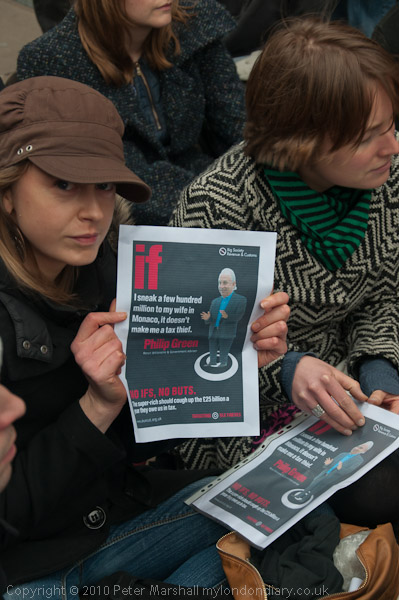
They said then that rich individuals and companies such as Vodafone, Philip Green, HSBC, Grolsch, HMV, Boots, Barclays, KPMG and others employ armies of lawyers and accountants to exploit legal loopholes and dodge around £25 billions in tax while the rest of us on PAYE or ordinary people sending in self-assessment tax forms pay the full amount.

Little has changed since then – except the amounts involved will have increased, but nothing has been done to move to a fairer approach to taxation which would eliminate the legal dodges and loopholes and insist that tax is paid on money earned in the UK rather than being squirrelled away in overseas tax havens. It should be a general principle that any scheme to deliberately avoid tax is illegal.

Many believe the main impetus for the Brexit campaign was the intention announced by Europe to clamp down on tax avoidance, which would have cost the wealthy backers of Vote Leave millions by cutting down their dodgy dealings.

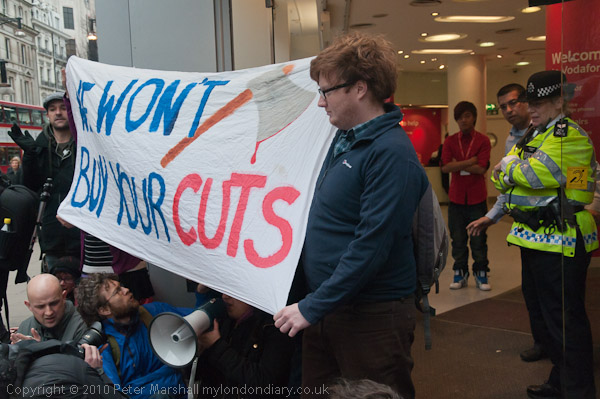
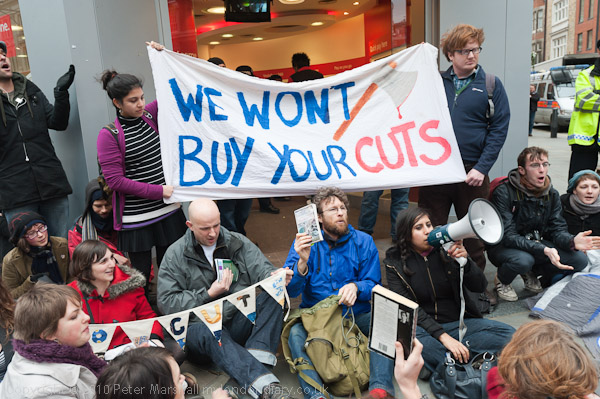
UK Uncut held a rally on the pavement on Oxford Street outside Vodaphone, one of the companies that manage to pay little or no UK tax. Large numbers of shoppers walked by, some stopping briefly to listen and applauding the protest.

Speakers pointed out the regressive nature of VAT, applying to all purchases of goods (except those exempt from VAT) by everyone regardless of their incomes. Income tax should be fairer, as it is related to income and the ability to pay – and it would be fairer if the loopholes allowing tax avoidance were closed.

One speaker made the point that multinational companies not only use tricky accounting to avoid UK tax but also by shifting profits to tax havens they deny desperately needed funds to the poorer countries of the world.

Others spoke about the effects of the government cuts on education, with rising university fees and the removal of the maintenance allowance that had enabled many poorer students to remain in sixth-forms. At one point people held up books as a reminder of the cuts in library services being forced on local authorities by the government.

A member of the PCS spoke of his concern that the government was actually cutting down on the staff who combat tax evasion as well as relaxing the rules on tax avoidance rather than trying to collect more from the rich.

Prime Minister David Cameron had called for a ‘Big Society’ with charities and community organisations playing a larger role – presumably to replace the public services which were disappearing under his austerity programme. But many of these organisations were also under pressure as hard-pressed local authorities were having to slash funding grants.

More at UK Uncut Protest VAT Rise at Vodaphone.


Pillow Fight Against Solum at Walthamstow, 15 Jan 2011

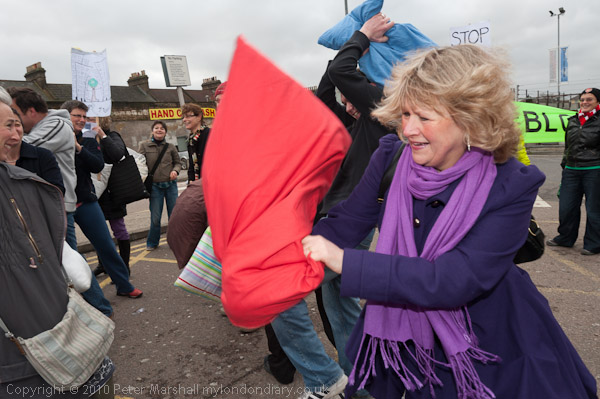
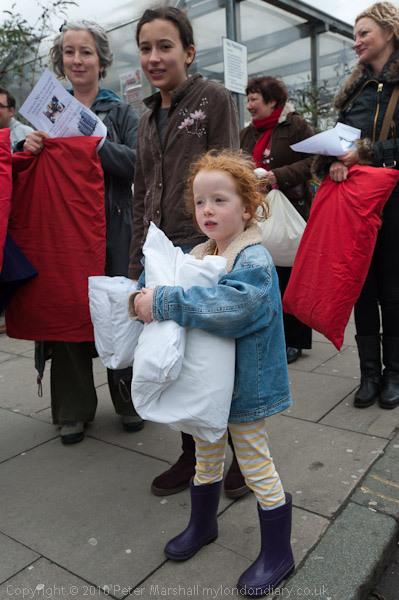
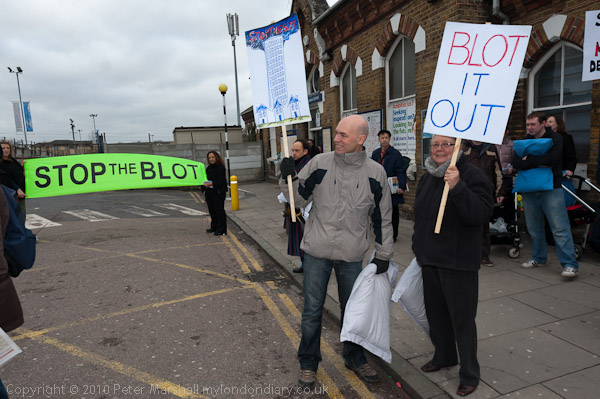
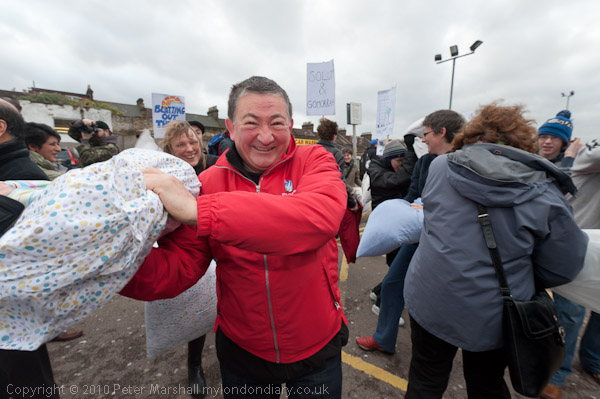
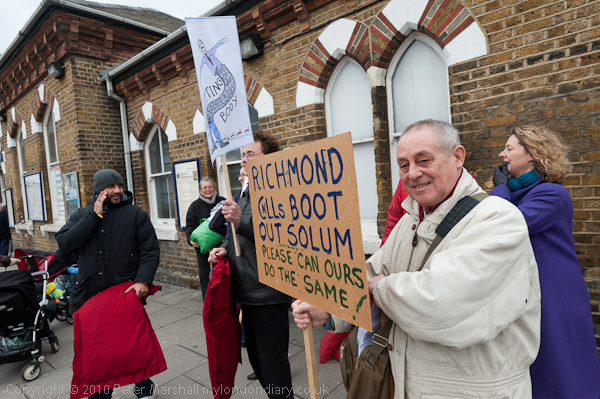
Ealier I had photographed Walthamstow residents staging a pillow fight in protest against plans for inappropriate high rise development on Walthamstow Central Station car park which were tocome to the council planning committee meeting the following Thursday.

Solum Regeneration had plans to build a 14 storey hotel and 8 storey blocks of flats there, towering over the surrounding area of largely late-Victorian low rise development.

The scheme had been condemned the previous year by CABE, the Commission for Architecture and the Built Environment set up in 1999 to provide impartial advice to the government “on architecture, urban design and public space“, and the developers had made minor changes which made it even less acceptable to the local objectors.

Solum Regeneration was set up by Network Rail and Kier Property to redevelop land around railway stations, including Walthamstow Central. One of their other plans was for a huge redevelopment at Twickenham station, now completed after some years of considerable inconvenience to station users. Richmond Council had initially turned down this scheme.

Despite the pillow fight and the other activities of local campaigners, the Walthamstow scheme also got the go-ahead, with building work beginning in 2012. Other high rise schemes have also been approved in the surrounding area, the character of which has changed considerably.

Pillow Fight Against Solum Walthamstow