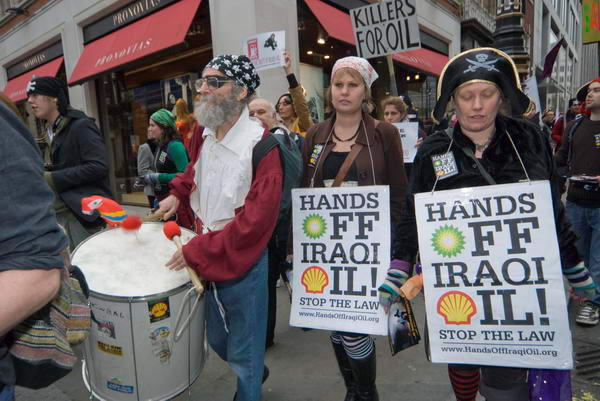
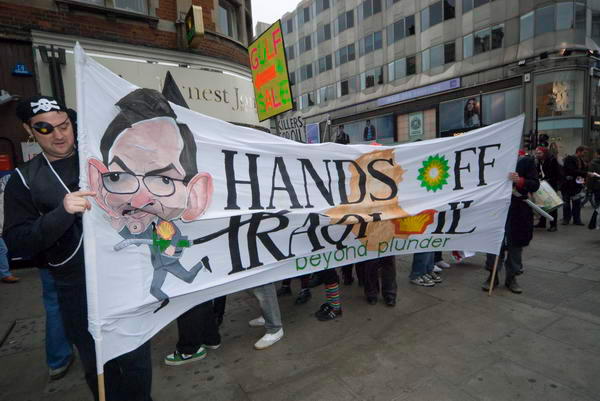
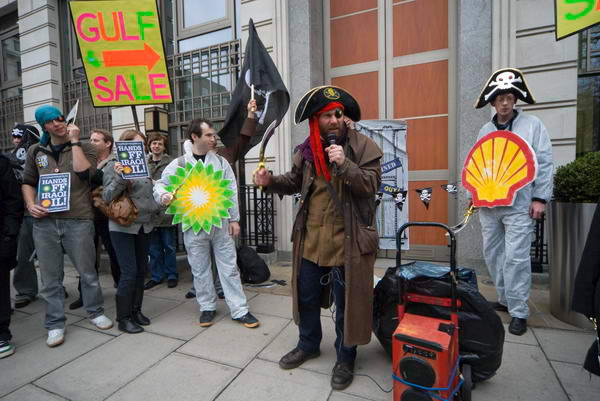
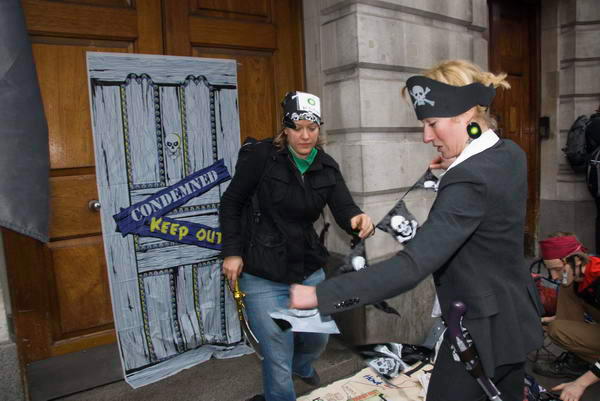
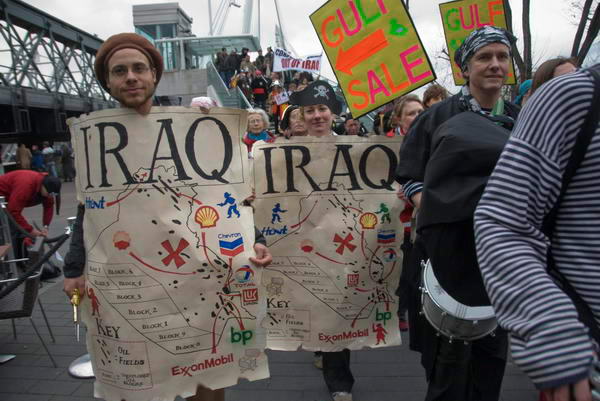
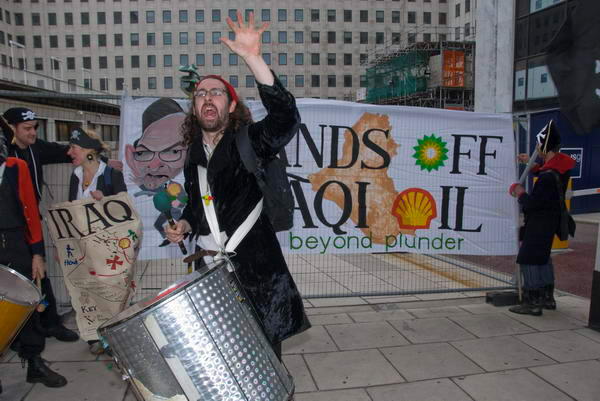
Hands off Iraqi Oil Piratical Action Tour: Many thought that the driving force behind the US invasion of Iraq, shamefully assisted by the UK and a few others, was oil. It was clear that there were no real ‘weapons of mass destruction’ and by 2008 it had become clear that the only rational basis “was a desire to open up the Iraqi economy to economic exploitation by the multinationals, with oil as the chief goal.”
As I wrote in 2008, “Few liked Saddam, but the oil giants had a particular reason to get rid of him. As long as he was dictator, oil would remain a public sector industry in Iraq. Now Shell, BP and other majors in the oil business are pressing for the spoils of victory, production sharing agreements that will give them effective control over Iraqi oil for the next 25 years…. Under the occupation laws are being imposed, regulations changed and institutions set up to ensure that US and multinational companies can profit from and dominate the Iraqi economy.”
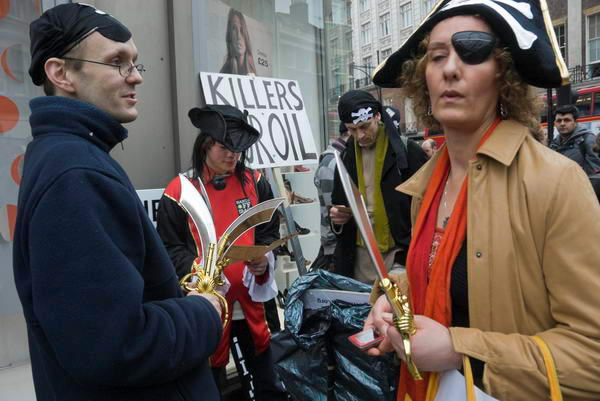
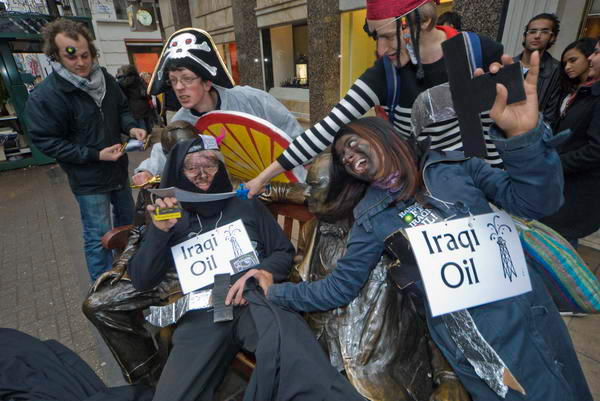
The Hands off Iraqi Oil Piratical Action Tour of London was a part of an international campaign in solidarity with the Iraqi people against the corporate theft of Iraq’s oil, and it was also rather a fun piece of street theatre with pirate costumes and a samba band, pointing out various London-based companies that were involved in the theft of Iraqi oil.
I met the protesters as they were getting ready for the tour and walked with them down Oxford Street to the New Bond Street to a mock battle outside the offices of Erinys International Limited, a private military security company with a reputation for using excessive force which provides security services in Iraq as well as training Iraq’s Oil Protection force.
A short walk took us to BP in St James’s Square. “Former BP CEOs worked as advisers to the Iraqi Oil Ministry, and their advice was (what a surprise) to let companies like BP come in a make vast profits. They helped to draft the Iraqi hydrocarbon laws and have plans for giant oil fields. “
We stopped briefly outside the National Portrait Gallery – earlier in the day there had been a brief protest inside there as their major wards are sponsored by BP.
Around the corner in Duncannon Street they protested at the offices of the International Tax and Investment Centre, paid by the big oil companies to lobby for a free-market approach which would let them dominate Iraqi oil.
There were two venues the protesters ran out to time to visit: The Foreign and Commonwealth Office employed former oil executives as advisers on economic policy to work on the new Iraqi laws in support of BP and Shell and Development Program Worldwide Ltd (previously Windrush Communications) promotes private enterprises in areas such as conflict zones where there are few controls over their activities and no effective government to represent the public interest.
We crossed the river over the Jubilee footbridge to the Shell Centre and a slightly longer rally. Shell has played a leading role in the re-purposing of the Iraqi oil industry from a state asset to a multinational profit opportunity and have plans for three major oil fields there.
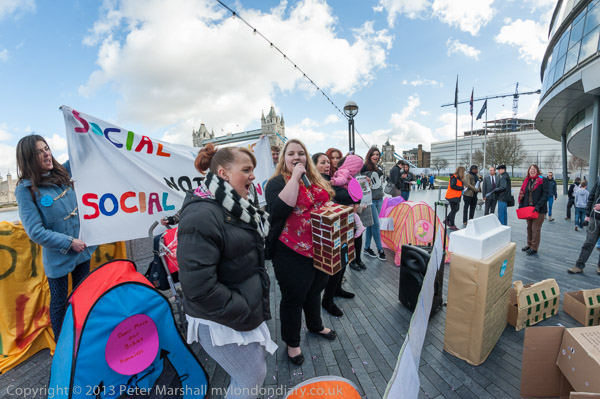
I’d first met the young mothers facing eviction from the Focus E15 hostel in Stratford around a month earlier when I had gone with them into the offices of East Thames Housing Association to occupy the show flat there and hold a party in protest against the threat of being evicted from their nearby hostel because Newham Council had decided to cut its funding.
Newham Council seemed clearly to be failing these mothers and children and were trying to move them away from Newham into private rented accommodation, sometimes hundreds of miles away from their friends, families, colleges, nurseries and support networks in Newham in order to evade their responsibility for them.
Clearly the council, then led by Newham Mayor Robin Wales, had not expected these young women to put up much if any fight against this unjust treatment, but the Focus E15 women were determined not to move away from London. Their continued protests, always powerful and colourful attracted media coverage and made their case into a national scandal, and they revealed the serious mismanagement of the council.
‘Boris Build More Homes’
Stratford was at the centre of a housing boom, particularly around the former 2012 Olympic site but this was largely for private sale, which many flats being bought up by investors, many from abroad wanting to cash in on London’s housing price boom, despite Newham having the highest waiting list for social housing in London.
Focus E15 and others pointed to the Carpenters Estate, a well-designed and highly popular council estate in a highly desirable location next to Stratford Station and the Olympic site where there were large numbers of empty flats and houses – some having been left empty for 10 years. Rather than seeing this as successful housing for the people of the borough, the council had regarded it as an asset to be sold off.
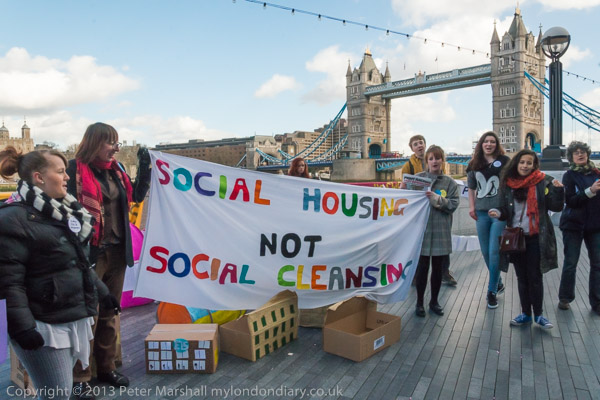
In February 2014 the mothers and children were still all living in the Focus E15 Mother and Baby Unit despite having been served eviction orders the previous October – East Thames had promised they would not be forced out until they had alternative accomodation. And they hired an open-top bus to bring themselves to City Hall.
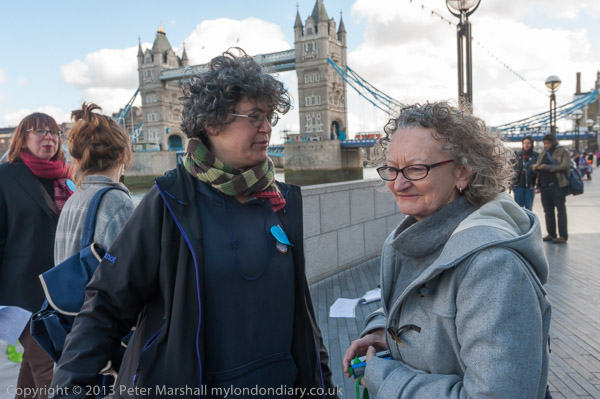
Green Party GLA member Jenny Jones visited the protest
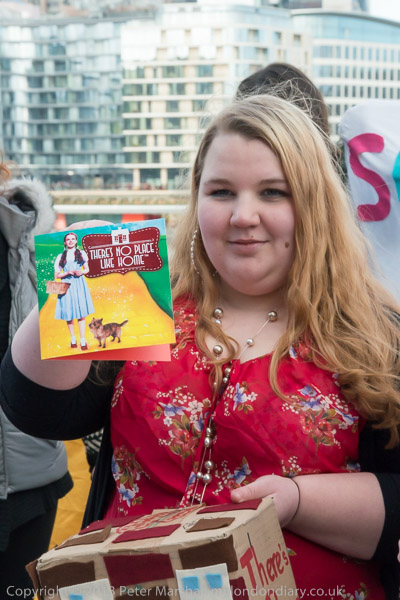
City Hall has now moved out to the Royal Docks, but in 2014 was in an unusually shaped Norman Foster building on Queens Walk next to the Thames on the privately More London office development owned by the Kuwaiti sovereign wealth fund (Ken Livingstone called it a ‘glass testicle’.) And although Focus E15 were allowed to protest by the security there, they were told they must not hand out leaflets. And no one at City Hall was prepared to accept the card the mothers signed for Boris Johnson.
The card for Boris
Their protests did result in them being rehoused in London, but the women didn’t stop there, developing into a ‘Housing For All’ protest, including an occupation of empty flats on the Carpenters Estate which achieved national news coverage. Locally they fought for others, going with them into Newham’s housing office and demanding the council meet its legal requirements and also stopping evictions.
They set up a housing advice and support stall every Saturday on Stratford Broadway and more. I’m sure that it was due to their activities that eventually the local Labour party turned against Robin Wales, getting rid of him.
Assistant director of the affordable homes programme in London, Jamie Ratcliff came to meet the E15 Mums
Their Focus E15 campaign, still continuing and still demanding ‘social housing, not social cleansing!’ became the most effective housing campaign in the country. I’m pleased to have been able to give them some support.
The mothers take their card for Boris into City Hall, but staff refused to accept it
The pictures on this post are all from Friday 21st February 2014 and there are more together with the text I wrote in 2014 at Focus E15 Mums at City Hall.
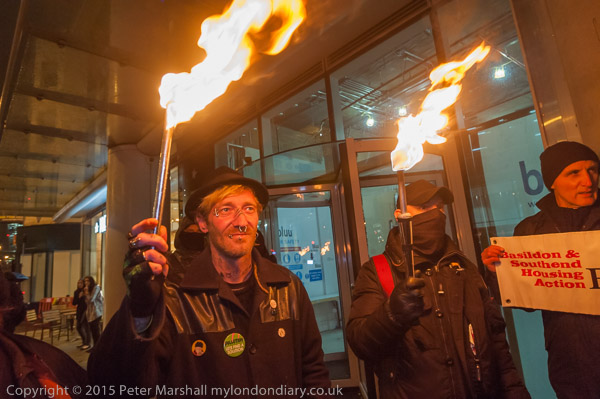
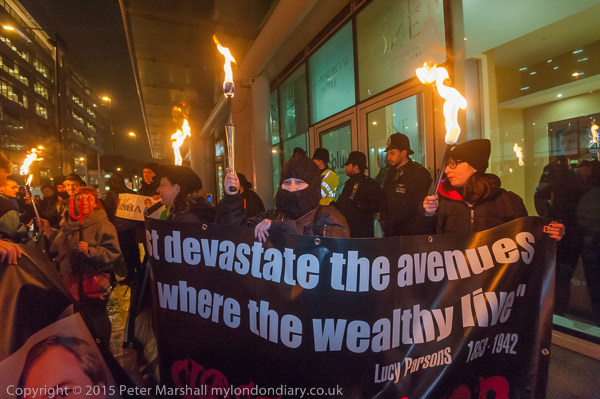
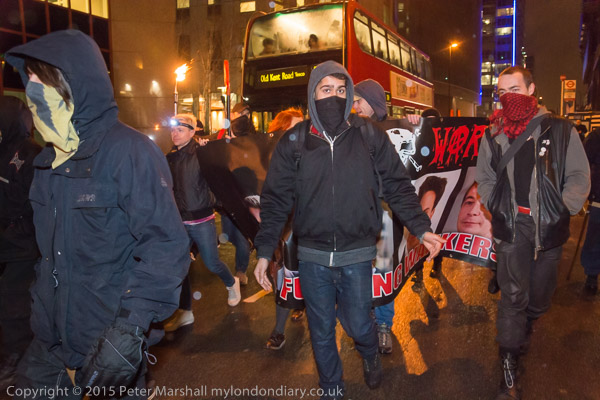
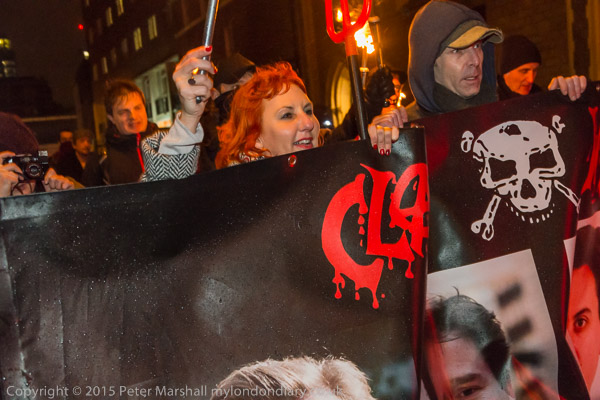
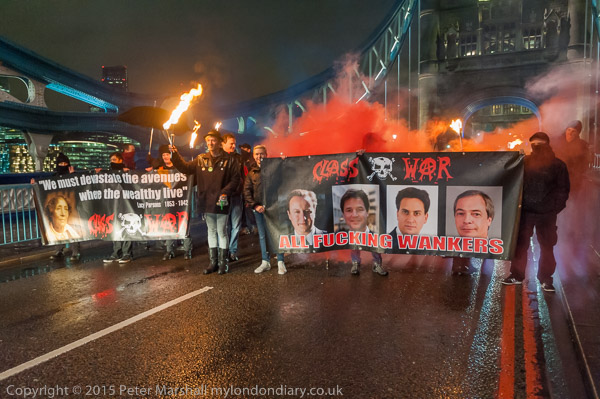
On Thursday 19th February 2015 after a ‘poor doors’ protest at One Commercial Street against the separate entrances for rich and poor residents lit up by flaming torches, Class War marched with these across Tower Bridge to protest at new luxury flats at One Tower Bridge in Southwark on the south bank of the River Thames where social housing residents are to be denied access to the private garden.
It was raining slightly and the ‘poor doors’ protest had started with only the core protesters outside the entrance to the private flats next to Aldgate East Station on Whitechapel High Street (residents to the social housing enter by a side alley.)
A van of police had driven up as Ian Bone was speaking and came to guard the door, though the protesters were not on this occasion attempting to enter the building. An officer tried to talk to Bone but he wasn’t interested. The police had asked Class War to pay for their march to be policed, but had been very firmly told that the fewer police there were the better.
After around half an hour Class War decided it was time to light up ready for the march and torches were handed out and were soon flaming. They cheered up the rather damp night and provided a little more light for photography, but did make things look rather warm coloured.
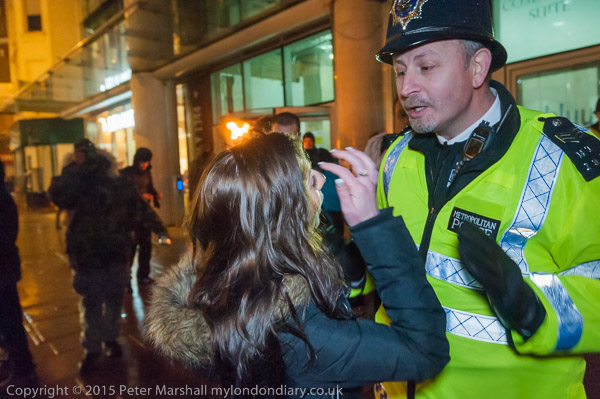
There was a little light relief for the protesters when a woman who I think worked for an estate agents came to complain about the protest to the police telling them they should stop it. She got a little shouty when police told her that people had a right to protest, but police soon persuaded her to move away.
There had been some discussion about whether the march should take place, but numbers had grown and people were keen to march despite the weather and the march set off down Leman St led by the Class War banners and flaming torches.
There were some disputes about the best route to take, and some small diversions down seriously dark side streets where it was hard to photograph without the help of the torches. On the busy roads the march spread out across the whole carriageway to stop traffic behind it – with much hooting from frustrated drivers, though the delay was only short.
On Tower Bridge the marchers took over both carriageways bringing both the ‘Lucy Parsons’ and ‘Party Leaders’ banners beside each other.
Orange flares were set off and there was a short pause as the flaming torches were refilled with paraffin before the marchers moved onto the pavement and set off again, crossing the road and down an alley into the new luxury flat development where police were waiting for them.
The development here consisted of eight blocks of luxury apartments and one of affordable homes and includes a private garden area. In the original planning application this was to have been used by all tenants, but a few days before this protest Southwark Council had agreed to the developers changing this to deny access to the social housing residents, which led to this march by Class War against another aspect of social apartheid.
March For Our Flag & Chinese New Year: Sunday 18th February 2007 was very much a day of two halves for me, photographing ‘football supporters‘ on an extreme right march and then going to Chinatown for a brief visit to the New Year celebrations. Here’s what I wrote back in 2007 about the day (with the usual minor corrections) and some of the pictures – with links to a few more on My London Diary.
March For Our Flag – United British Alliance
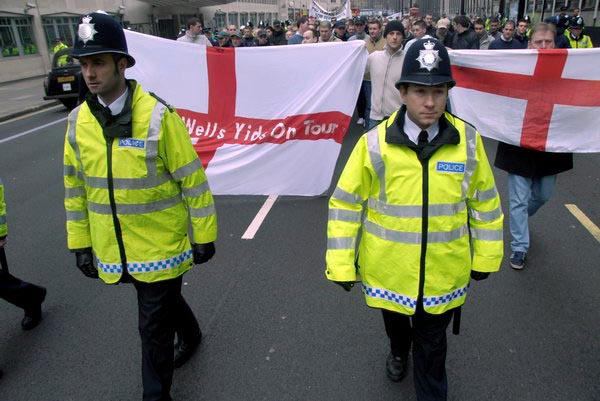
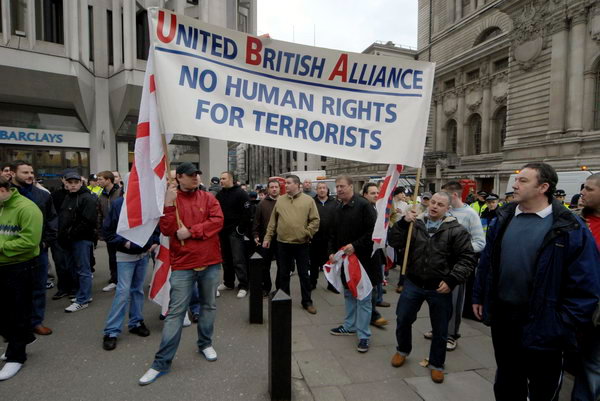
There were around 200 football supporters in the right-wing march.
There were perhaps just over 200 marchers in the ‘March For Our Flag’ which made its way from Westminster to Marble Arch on Sunday. Organised by football supporters, it was billed as “a peaceful march consisting of Whites, Blacks, Asians” and the invitation was clearly made for people to attend “regardless of colour or creed or firm or team.” However it was also an event that members of the National Front Youth ‘Bulldogs’ were urged to support in one of their forums with the hope of attracting new members.
Marchers at the start in Tothill St
Englishness has been officially relegated to a fringe activity, and to a great extent politically appropriated by the ultra-right. So it isn’t surprising that we get populist outbreaks such as this, under the banner of the ‘United British Alliance’. This seems to be largely an anti-Islamic movement of football supporters, many of whom seem to take a pride in their membership of noted hooligan groups (the ‘firms‘.) On its web page, UBA describes itself as “a multi-ethnic, multi-faith organisation with a passionate interest in reclaiming our once proud nation from the grip of international terror and political correctness gone-mad, with a view to re-installing some pride in our communities and way of life.”
So I was hardly surprised to find the march almost solidly white and male; I noted only one Black and one Asian face – and only three women. What was overwhelming was the drab surliness of it all, with rather few English flags in evidence – probably fewer on hats and shirts than in the average crowd, now that many England soccer and rugby fans regularly appear covered with St George symbols.
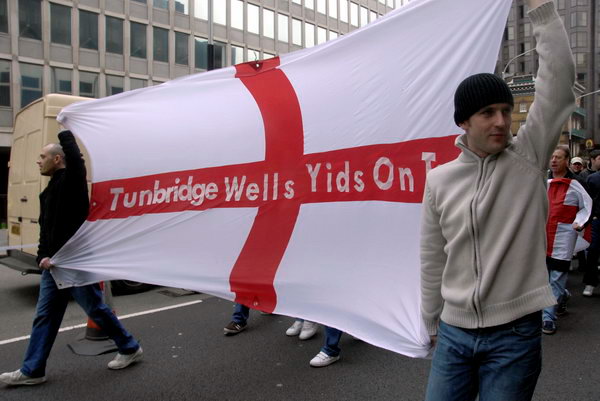
At its front was a large St George’s flag with the message ‘Tunbridge Wells Yids On Tour.’ Although generally a term of racist abuse, here it is a name Spurs fans use with pride, having christened themselves ‘Yids’ in response to the anti-Semitic chants from fans of other clubs.
Events such as this, organised by a fringe extreme right group, do represent a widespread feeling among many people that we need to do more to promote English culture and a pride in being English. Nothing prevents us celebrating St George’s Day, [but] such celebrations have never attracted the official support and funding that attend the other national saints days in the UK.
In the arts, there has been a reluctance or even a refusal to finance traditional English folk arts, while those from many other ethnic groups have often received generous support. In part this comes from the elitist snobbishness of an establishment that massively funds opera while being unable to stomach grants to Morris dancing, brass bands, folk singers and English choirs and other elements of a genuinely popular and largely working class English culture.
Even, if not especially, on the left, we have generally left official culture and the patronage it gives to be run by the champagne socialists in Islington and Hampstead rather than supporting the kind of activities that came with our roots in the co-operative movement, the Methodist and other [non-conformist] churches and the Working Mens Clubs and unions.
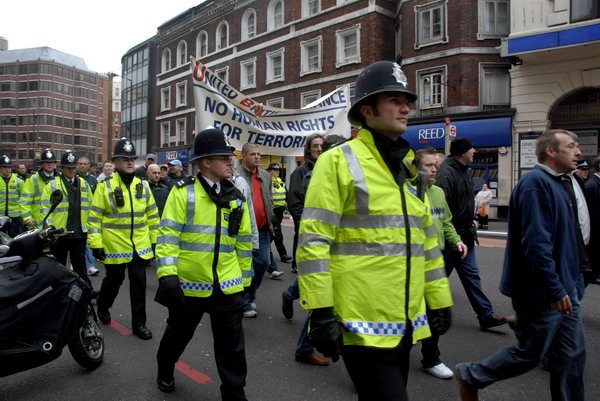
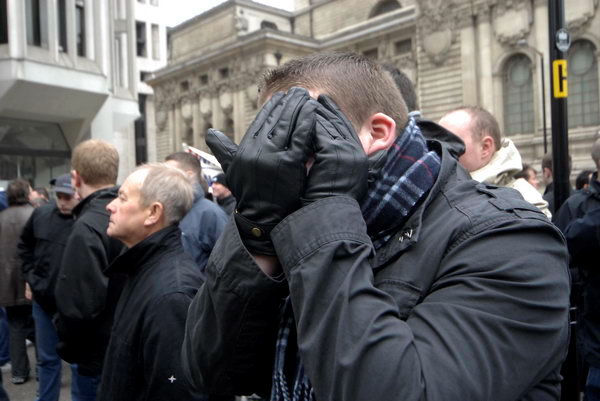
The police took a very obvious interest in the event, and in the few of us trying to photograph it. I was twice questioned by them, and my press card details were noted down both times, while I was photographed [by police.] There were probably more police than marchers covering the event, both at Liverpool Street, where many of the marchers had met, and also on the march itself.
Some of the marchers did not want to be photographed
The police were polite and made sure I was aware that some of the marchers resented being photographed and suggested it would not be sensible for me to attend the rally at the end of the march. I hadn’t intended to do so, although this almost made me change my mind.
[More specifically I was told that they “would not be able to guarantee my safety” if I went on to the rally.]
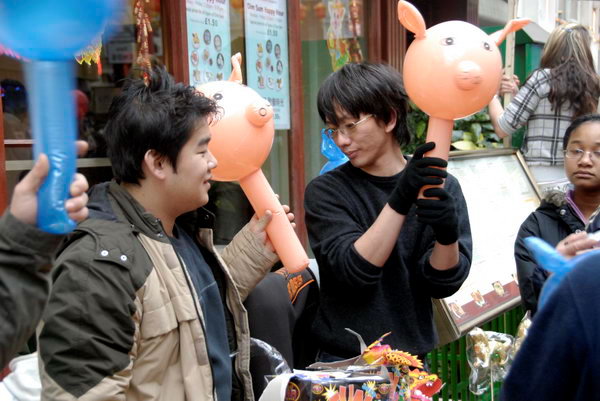
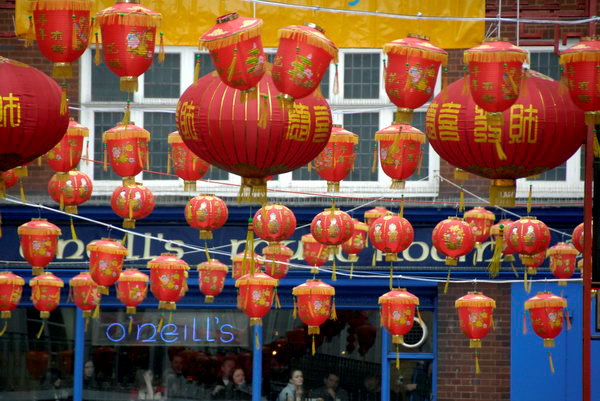
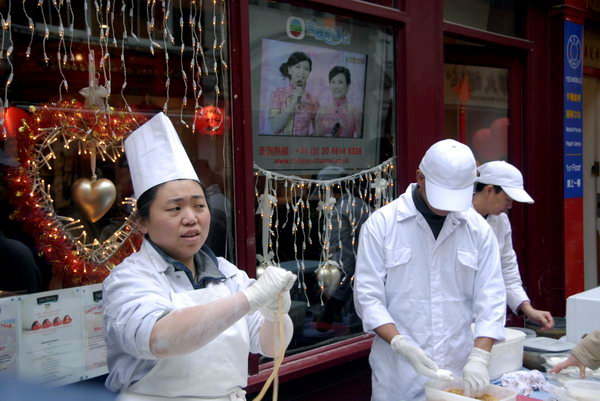
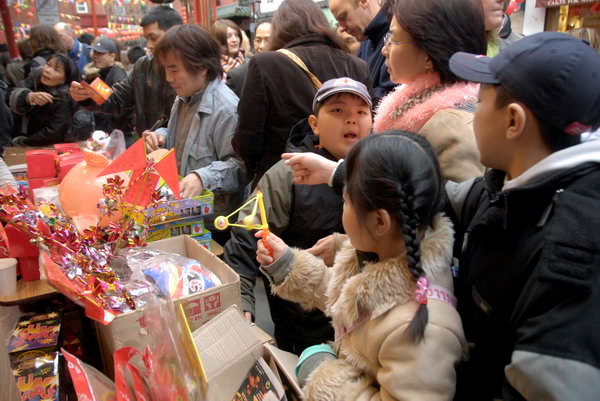
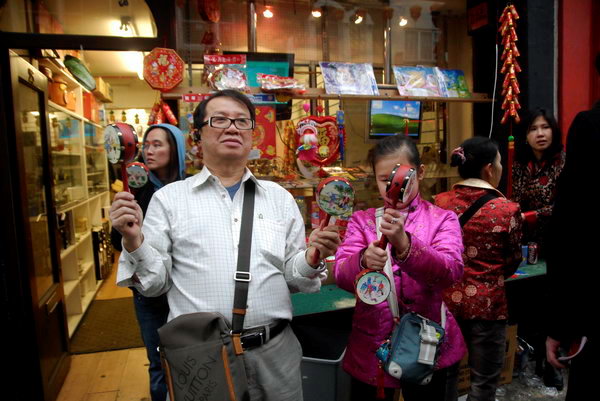
I’m very much in favour of London celebrating the Chinese New Year (as well as St George’s Day) but it now seems hardly worth me photographing it. Partly because I’ve done it so often that there seems to be little more to say, and in part because it is just too crowded with far too many people trying to take pictures.
Controlling crowds such as this is a tricky affair, but there never seems to be much reason in it, with police lines often blocking off relatively quiet areas and thus creating jams elsewhere. I wandered round a little and took a few pictures before going home. There are better days to come to Chinatown.
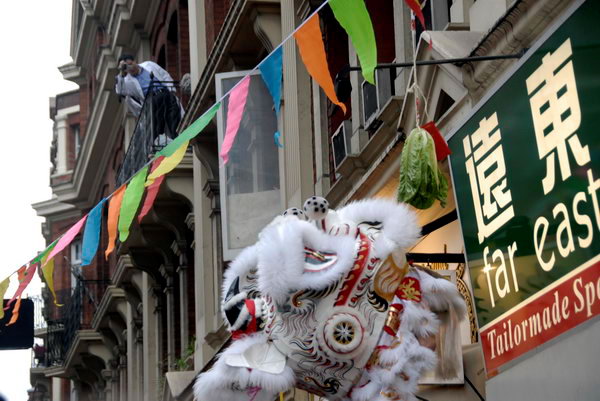
I’ve taken many pictures of the lions in previous years, so didn’t really bother this year
Alevi, Union Flags, Fuel Poverty & Reclaim Love: Saturday 16th Feb was a busy day for me, beginning with a protest by Alevi against religious discrimination in Turkey, on to an extreme right protest in support of Belfast ‘loyalists’. Then a rally over fuel poverty which ended with a road block by disabled protesters. My day in London ended in Piccadilly Circus at the Reclaim Love Valentine Party, though I arrived there rather late.
You can read longer accounts and see more pictures of all these events on My London Diary.
Alevi Protest Discrimination in Turkey & UK
Trafalgar Square
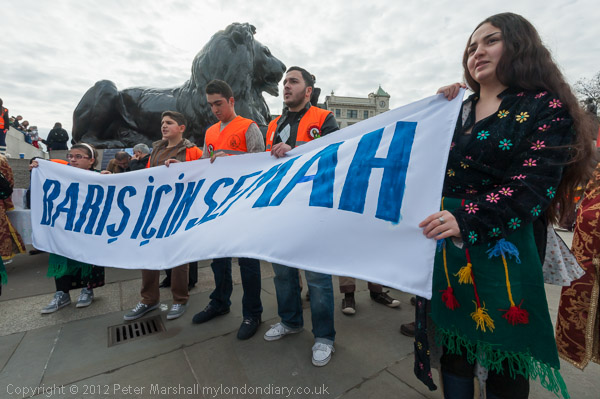
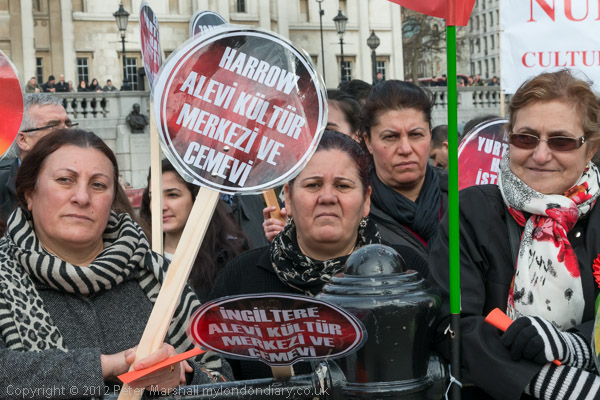
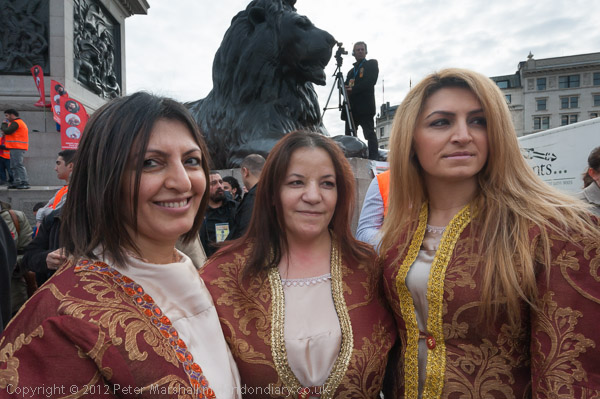
A woman in traditional costume holds a banner (Semah For Peace) in Trafalgar Square.
Estimates of the number of Alevi in Turkey vary widely but they probably make around 15% of the population, including many Kurds. Their religion is generally considered a part of Shi’ism, but they worship in their own languages, men and women together; women are not required to cover their hair, and their worship incorporates their rich traditions of poetry, music and dance – Semah.
Turkey is a country ruled and dominated by Sunni Muslims and the Alevi have suffered centuries of religious persecution – sometimes violent, and while Christian and Jewish children in Turkish schools are exempted from the compulsory Sunni Muslim religious classes, Alevi are not.
The rally called for democracy in Turkey, an end to discrimination and persecution, and an end to this compulsory religious education.
They also called for all immigrant cultures in the UK to unite and fight to remind the UK government of its responsibilities towards them, saying they face “ignorance from institutions such as the health, education, police, social and political bodies.” They call for an equal education system which considers the needs of all different cultural backgrounds.
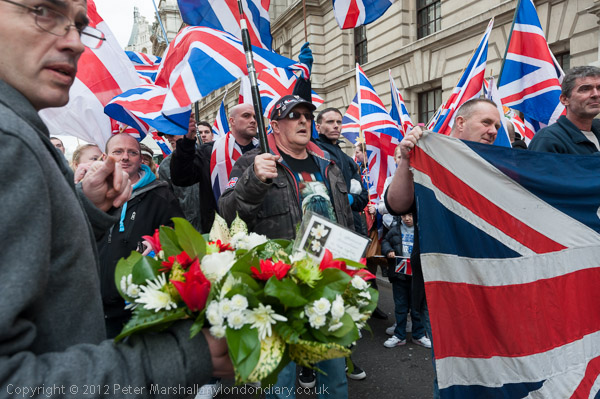
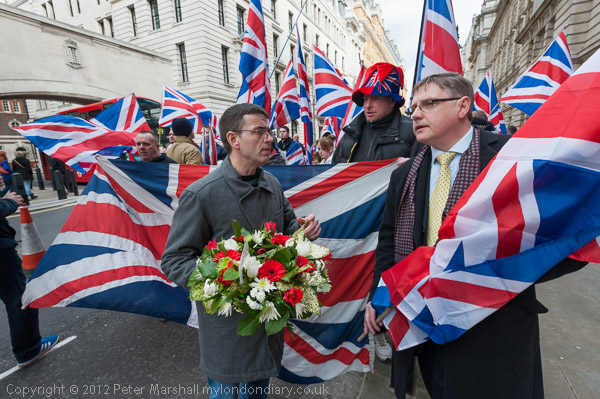
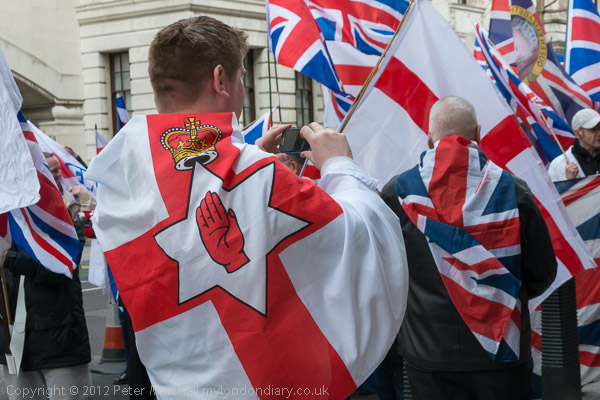
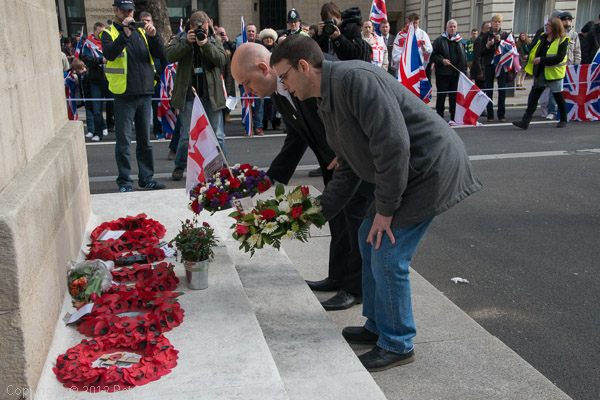
Around a hundred ‘patriots’ from the ‘South East Alliance’ marched down Whitehall carrying Union Flags to a rally with speakers from Britain First in support of Loyalist Flag protesters in Belfast.
Britain First Northern Ireland organiser Jim Dowson with the man carrying the wreath
Belfast City Council had decided only to fly the Union Flag on eighteen days a year as elsewhere in the UK, resulting in series of protests outside Belfast City Hall organised by a breakaway unionist group which disagrees with the peace process.
Around a hundred people came to the protest, mostly carrying Union flags, though there were a few Ulster and Orange flags also on show.
The marchers became silent at the Cenotaph where two wreaths were laid, one by the Kent Somme Society commemorating the Irishmen who died in the Battle of the Somme. They then marched on to Old Palace Yard for a rally.
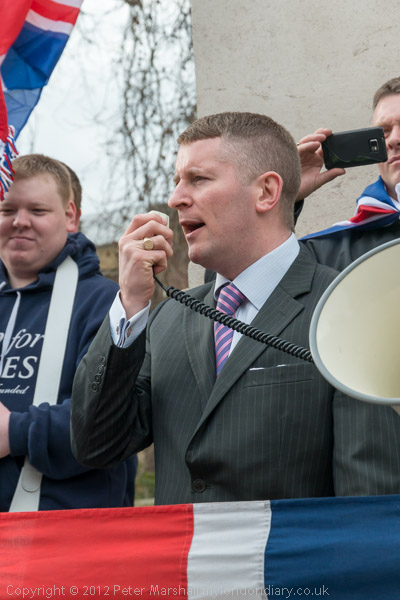
Paul Golding of Britain First, a former BNP councillor in Swanley on Sevenoaks District Council
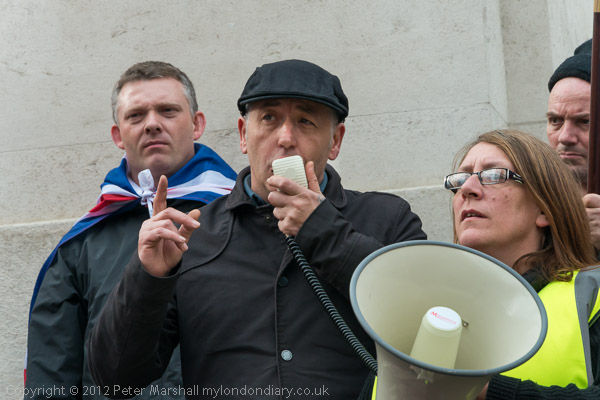
There were speeches from Paul Golding of Britain First, Paul Pitt of the South East Alliance and Britain First’s Northern Ireland organiser Jim Dowson who had been involved in the protests there.
Paul Pitt of South East Alliance, formerly the EDL’s South East organiser.
A few photographers were threatened by protesters but I suffered only some mainly relatively friendly banter from several who recognised me from other extreme right marches I had photographed, including some who mistook me for a Searchlight photographer.
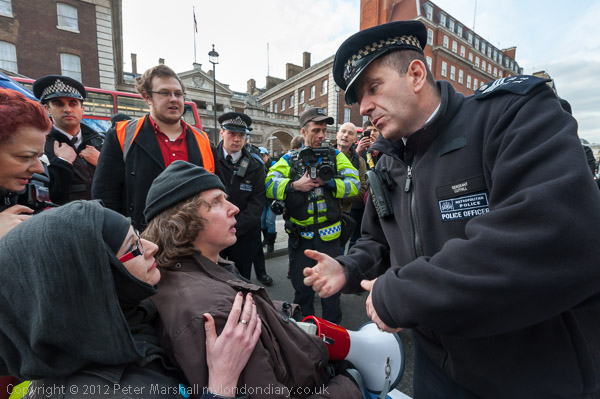
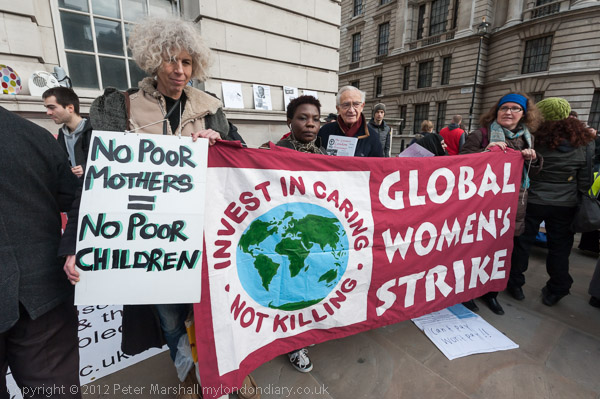
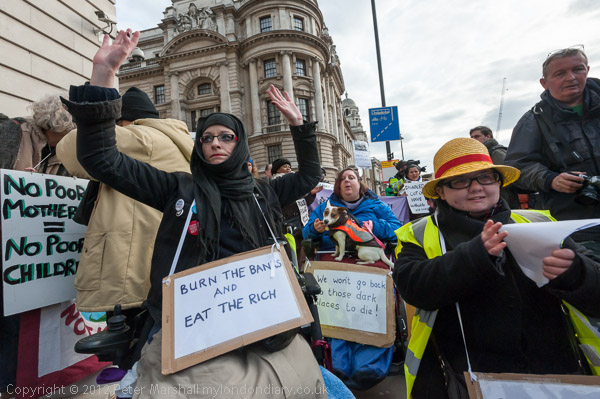
A rally organised by Fuel Poverty Action and supported by Disabled People Against Cuts, Greater London Pensioners’ Association, Redbridge Pensioners’ Forum, Southwark Pensioners’ Action Group, Global Women’s Strike and others was a part of a national day of action against fuel price rises and the government’s energy policies
Cuts and rising prices now meant one in four families now have had to choose between heating their homes adequately or eating properly. Many children were going to school hungry and we had seen a phenomenal rise in the need for food banks – now even in the wealthier suburbs, with many unable to buy food.
Fuel Poverty Action say that the government was doing everything it could to keep the big six enery companies making profts while “disabled and elderly people are forced into libraries and shopping centres to keep warm and people with cancer freeze in their homes with the heating off” as crucial benefits are slashed.
Many also suffer from benefit sanctions, losing financial support often for trivial reasons or for things beyond their control – such as a cancelled bus making them arrive late for an appointment. There seems to be a particularly vindictive approach encouraged (or mandated) at job centres towards claimants.
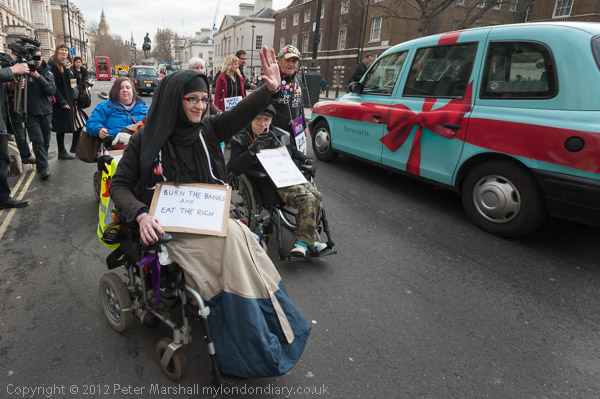
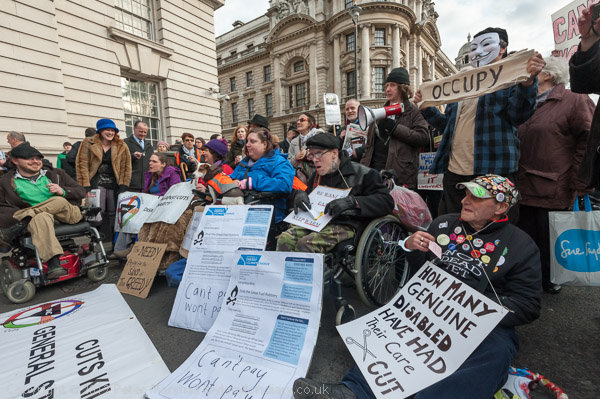
At the end of the rally disabled activists, many in wheelchairs went out onto Whitehall blocking the southbound carriageway. Some pensioners joined them, handcuffing themselves to the wheelchairs and others came to stand around them in the roadway. There were some more speeches from some of the protesters.
Protesters from the Disabled Peoples Direct Action Network move to block the road
After around a quarter of an hour police came and talked with the protesters asking them to leave. They were still asking 15 minutes later and by then many of the protesters were feeling they had made their point and were ready to go for a cup of tea. When they told police they would leave in ten minutes I left to rush to the Reclaim Love party which had started over an hour earlier.
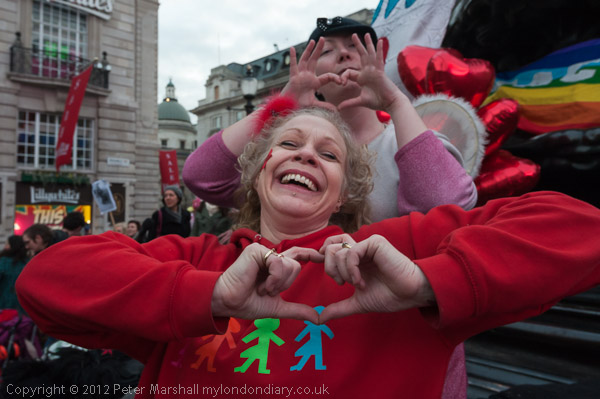
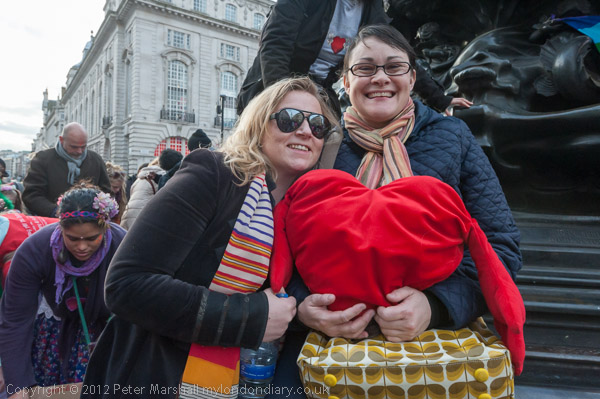
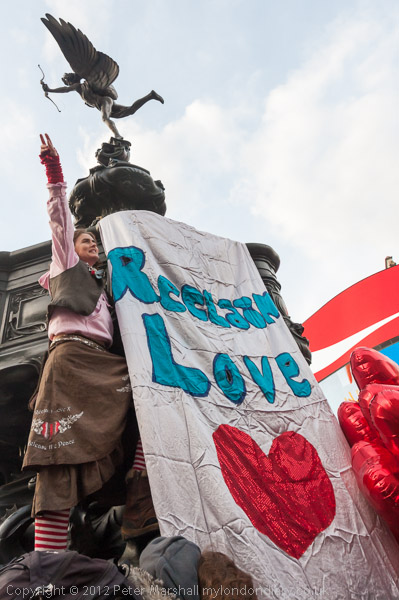
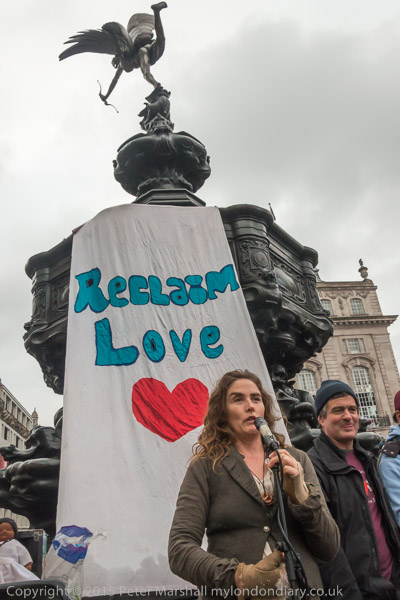
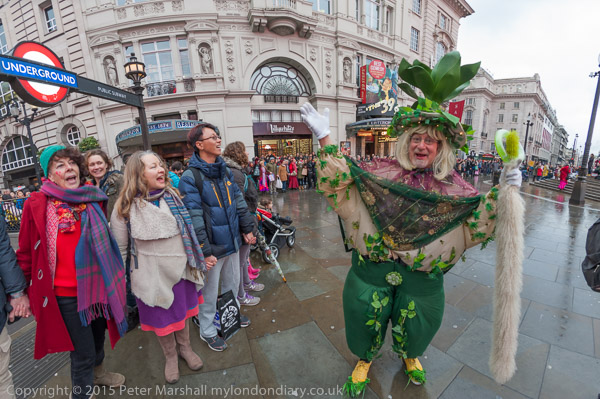
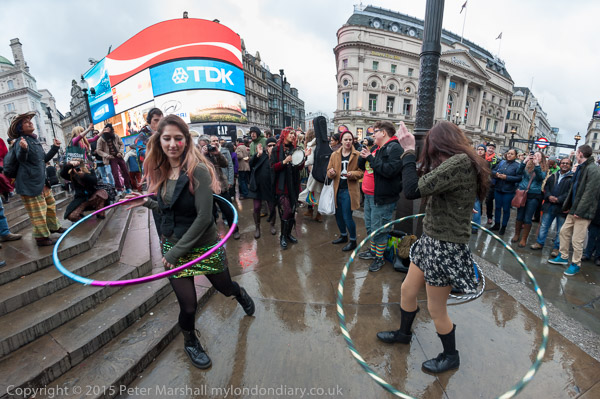
The 11th Reclaim Love free Valentine’s Party – and the 10th organised by Venus CuMara who started the whole thing in 2004 – took place around Eros in Piccadilly Circus, aiming to spread peace and love around the world, and to reclaim love from its commercial exploitation.
I arrived late, after people had joined hands in the large circle around Eros to make their call for peace and happiness around the world, but the party was continuing and I took rather a lot of pictures – here are a few.
Venus CuMara straightens up the Reclaim Love bannerFree T-shirts – for the first time a donation was requested
I’ve written more about Reclaim Love on My London Diary over the years, and there is some more, along with many more pictures from the 2013 event at Reclaim Love Valentine Party.
Democracy, Greece & Pakistan: Events I covered on Sunday 15th February 2015.
Occupy Democracy Return
Parliament Square
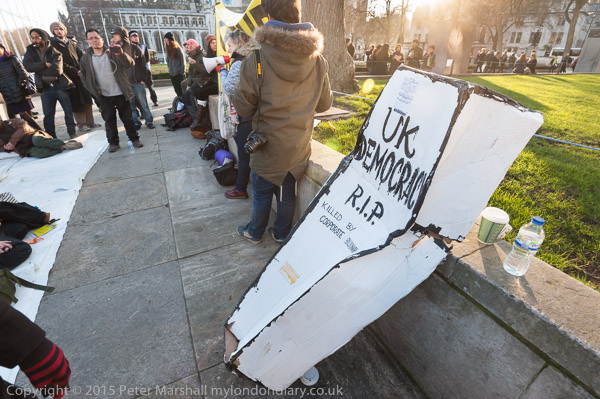
I hadn’t been at Parliament Square the previous evening when Occupy Democracy had returned to take up residence and hold a protest and workshops there, but had heard about the arrests. Police following instructions from Boris Johnson’s Greater London Authority private security wardens arrested five of the protesters including Donnachadh McCarthy, along with the white cardboard coffin he was holding with the message ‘UK Democracy R.I.P. Killed by Corporate Billionaires‘ which was returned in a rather damaged condition.
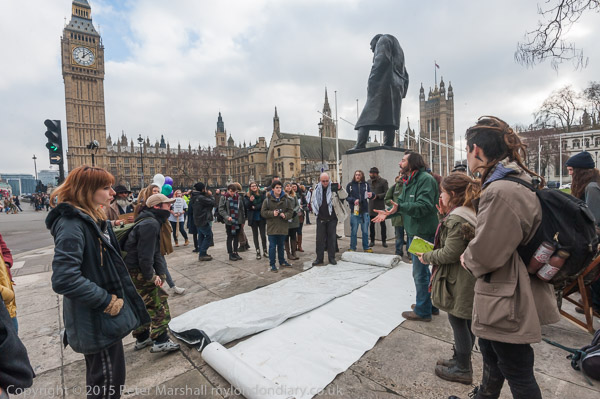
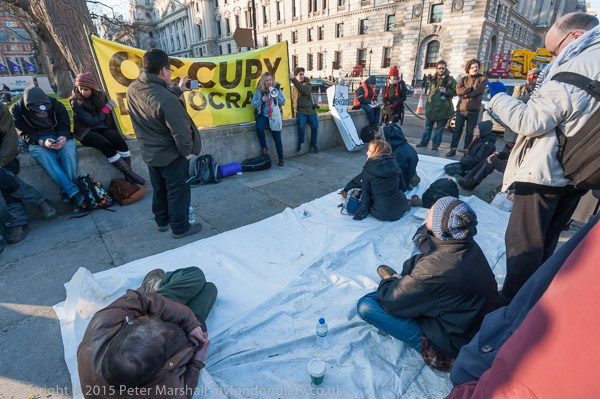
On Sunday morning my first call was to the square where Occupy Democracy talks and workshops were continuing on the pavement area around Churchill’s statue.
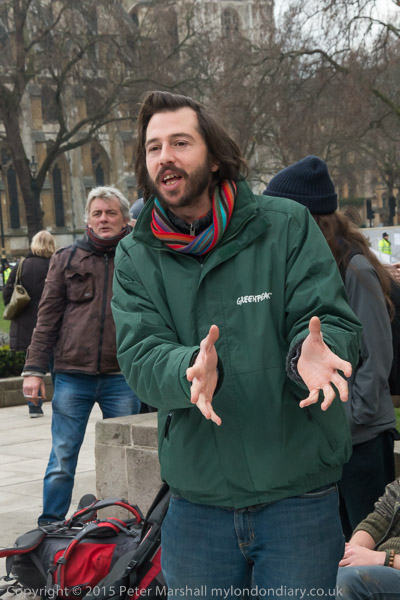
While I was there George Barda spoke introducing the ‘Love Activists’ and Danny talked about their plans for future activities.
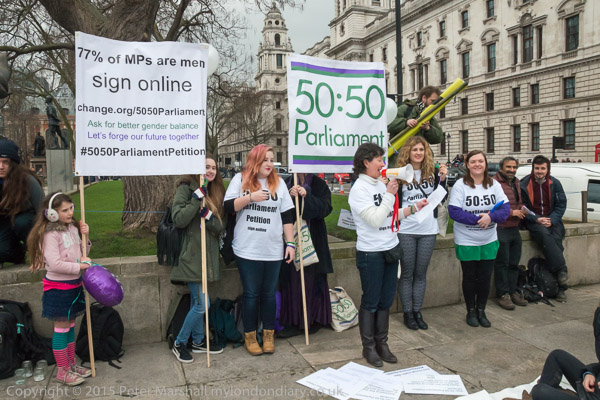
Another event in the square was led by Frances Scott of the 50:50 Parliament campaign to get equal numbers of men and women in Parliament, arguing that this would lead to much better government.
Although I agree there should be better representation of women, I feel that it’s more important that we have politicians who better represent the needs of the people and the country. More Thatchers, Trusses and Badenochs would hardly be an advance on Kinnochs, Blairs and Mandelsons. We need a far more radical system change.
I left to cover the other events, but returned on my way home in the afternoon when the workshops were continuing. Police and GLA security watched but did not interfere. As I commented, “They prefer to take action when fewer press are around and it is dark.”
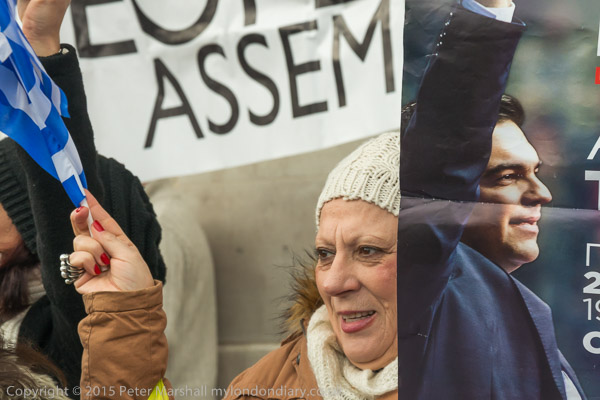
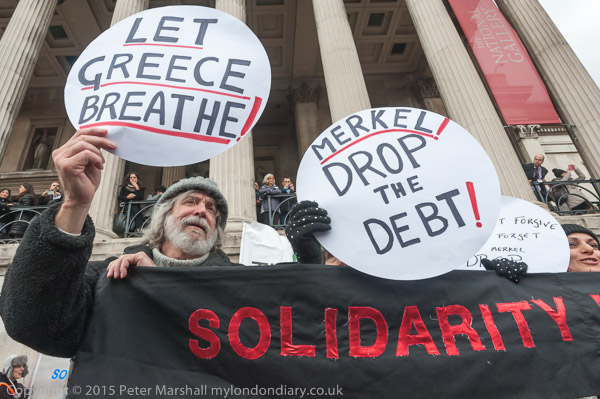
A large crowd had come to the North Terrace of Trafalgar Square for a rally to celebrate the victory of the anti-austerity Syriza party in the Greek General Election in January and to support them in resisting the imposed austerity programme.
Greek voters had decisively rejected the the EU’s austerity plans, largely pushed by Germany and backed by the International Monetary Fund (IMF) and European Central Bank (ECB) but the new government was having to revise its plans, facing stiff opposition and was having to compromise on many of its promises.
Speakers at the rally, including Jeremy Corby, Owen Jones, CWU’s Billy Hayes, Paul Mackney, Green Party’s Romayne Phoenix and John Sinha from Occupy Democracy, praised the Greek struggle against austerity, but their pleas for the country to be let to breathe fell on deaf ears in Germany and the financial institutions.
Many in Syriza felt betrayed by its actions and some left the party, but in a snap election in September 2015 the party polled well enough to remain as the leading party in the coalition. They did badly in the 2019 election, becoming a part of the opposition.
Pakistanis from Imran Khan’s PTI party called on the UK government to arrest and deport Altaf Hussain, the founder of the rival rival MQM party who fled to the UK in 1991 following an attack on his life in advance of a police crackdown of his party and was granted asylum here in 1992.
The protesters say Hussain and his party have an armed mafia wing in Karachi which indulges in extortion, blackmail and murder and were behind the Baldia Town factory fire in which at least 258 workers died, the Karachi Massacre of May 2007, as well as the murder of PTI leader Zahra Shahid in her driveway in Karachi in 2013 and many other crimes.
Since 2015 he has been a wanted man in Pakistan on charges of ‘murder, targeted killing, treason, inciting violence and hate speech‘. In the UK he was tried in 2022 charged with ‘promoting terrorism and unrest through hate speech in Pakistan‘ but was acquitted.
Global Divestment, Guantanamo & Venus: Saturday 14th February 2015 was Global Divestment Day, designed by the UN to “to draw attention to the importance of divesting from fossil fuels, which are the main cause of global warming.” But of course it was also St Valentine’s Day, and two events reflected this.
‘Bad Boy Borises’ in Global Divestment Day
London City Hall
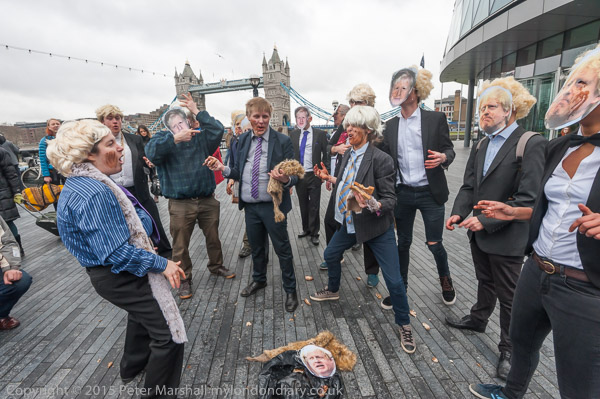
One of the Boris bloc at the rally in front of City Hall and Tower Bridge
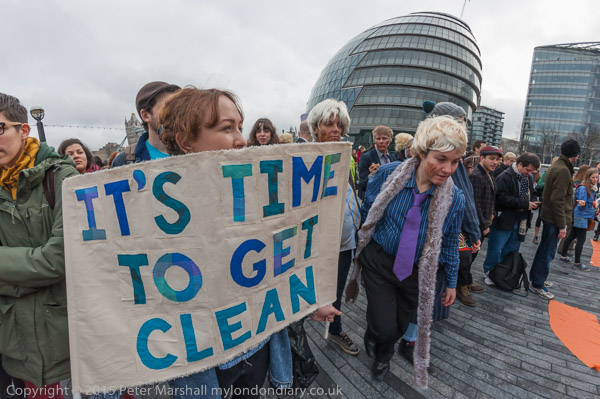
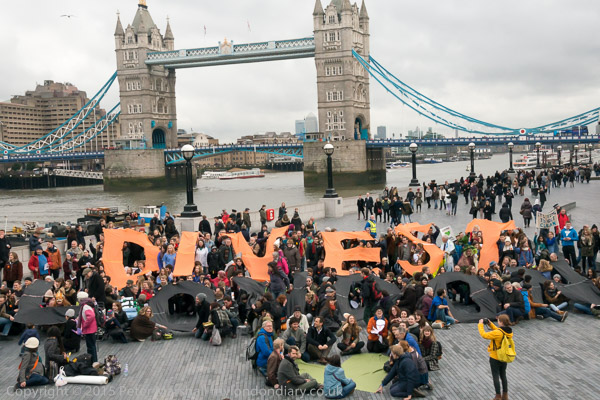
The protest at London City Hall, then at More London close to Tower Bridge, called on the Mayor and London Assembly to end their pension fund investments in climate wrecking fossil fuels and lead a fossil-free London.
The event began with a nightmare vision as multiple Mayor Borises arrived, revelling in dirty fuel. They were greeted by a choir singing songs specially written for the occasion and fed with some disgusting looking things supposed to be dirty fuel.
After several speeches the protesters split up around 3 metre tall letters which they eventually lifted up to spell out the word ‘DIVEST’.
They called for an end to investment in fossil fuels which are causing catastrophic climate change.
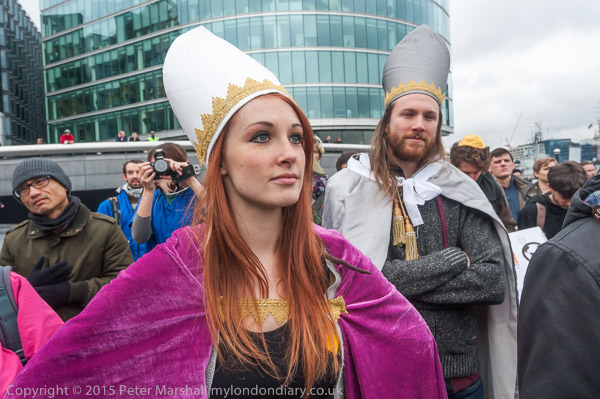
Two dressed as bishops called on the Church of England to get its act together and take its investments out of fossil fuels. Many churches have already divested, and campaigners were pressing others including the Church of England to do so.
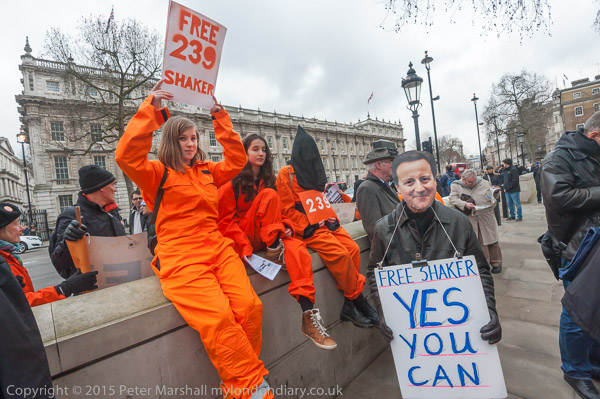
A person in an Obama mask has a message for the President, ‘Free Shaker – Yes YOU Can’
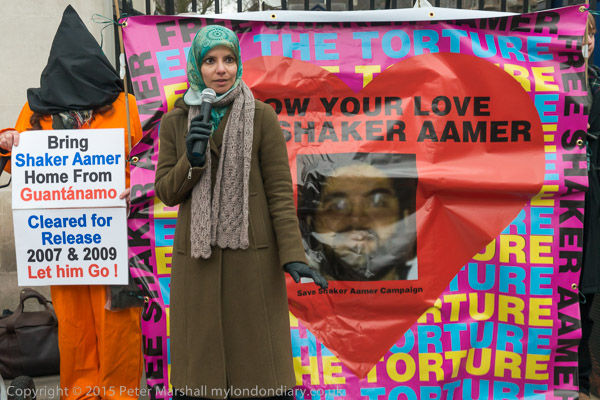
A march from Parliament Square to a rally opposite Downing Street called for the urgent release of London resident Shaker Aamer from Guantanamo, where he arrived has been held and regularly abused for 13 years without charge or trial.
Aamer had been in Afghanistan helping to build a school for an Islamic charity when he was captured by an Afghan militia and sold to US forces for a £5,000 reward. After the US and tortured him, aided by MI5, in Bagram Air Base they illegally rendered him to Guantanamo, on Feb 14, 2002.
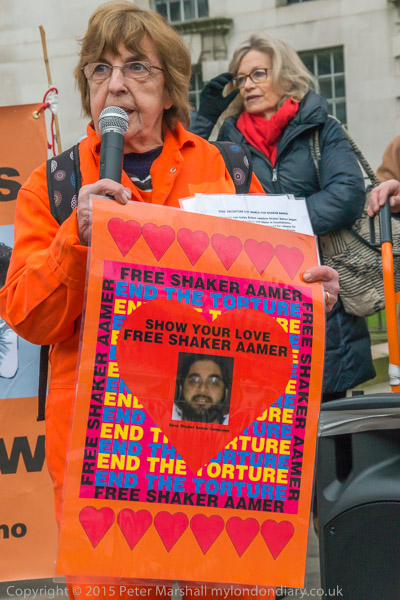
Joy Hurcome holds a Valentine for David Cameron asking him to ‘Show your Love – Free Shaker Aamer’
There his torture continued – and he was lucky to escape death in 2006 when he was one of four prisoners taken to a special secret interrogation site – and the only one to survive the ordeal.
Bruce Kent – and a large inflatable Shaker Aamer
Aamer has permanent resident status in the UK and his British wife and family were living in Battersea, but it was not until 2007 that the UK government began to request his release. And despite doing so, the government also spent over a quarter of a million pounds in legal fees to prevent his legal team gaining access to evidence which might prove his innocence.
The years of torture of him and others at the hands of the US military have failed to come up with any evidence against him, and he was twice cleared for release in 2007 and 2009 – but only if he went to his native Saudi Arabia where he would almost certainly disappear without trace. Both UK and US intelligence agencies are thought to have prevented his release to the UK as the evidence he would give about their use of torture would be highly embarrassing.
Aisha Maniar, London Guantánamo Campaign organiser
The protest was the start of a new ‘We Stand With Shaker’ campaign bringing together groups including the Free Shaker Aamer Campaign, the London Guantánamo Campaign, Amnesty International and others. Among the long list of speakers at the rally were Joy Hurcombe of the Free Shaker Aamer Campaign, writer Victoria Brittain, Lindsey German of Stop the War, veteran peace campaigner Bruce Kent of CND, Katie Taylor from Reprieve, Yvonne Ridley, Aisha Maniar from the London Guantánamo Campaign, campaigner Andy Worthington and Joanne MacInnes of We Stand With Shaker.
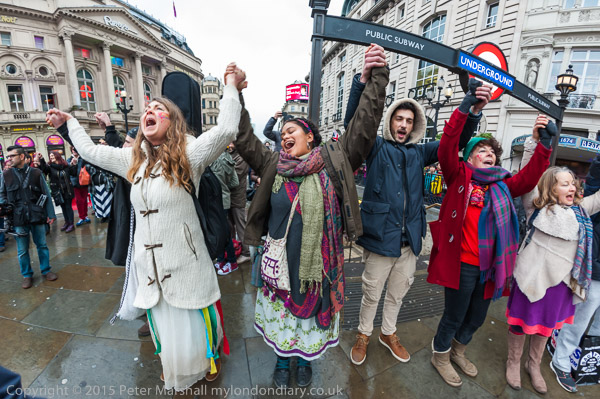
People in the Reclaim Love Meditation Circle in Piccadilly Circys lift up their arms and chant the mantra
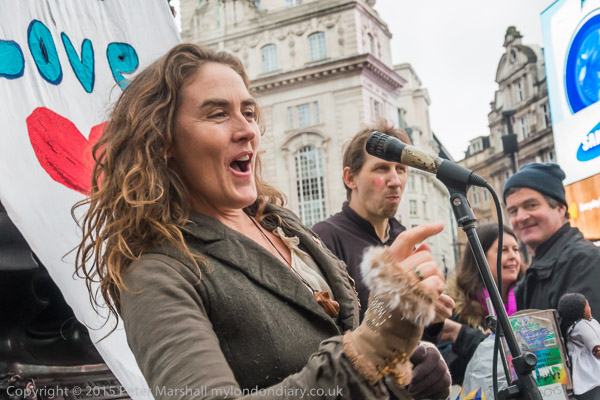
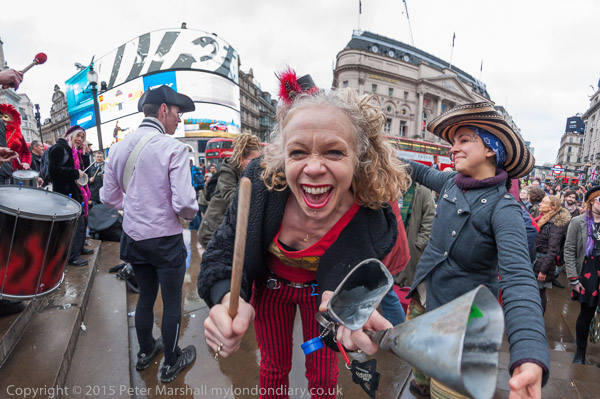
Venus CuMara’s 13th Reclaim Love Valentine Party at Eros in Piccadilly Circus included bands, dancing and a “Massive Healing Reclaim Love Meditation Circle beaming Love and Happiness and our Vision for world peace out into the cosmos“.
As usual there was a great atmosphere as people came together to share in love and party together in opposition the the huge commercialisation of Valentine’s Day and indeed of love itself. It is nothing to do with money, just about people.
Venus speaks to everyone and tells them to form the Massive Healing Reclaim Love Meditation Circle…
beaming Love and Happiness and our Vision for world peace out into the cosmos and together they chant the mantra: “May All The Beings In All The Worlds Be Happy & At Peace“
After which the music and dancing continued, along with hugging and other activities, and was still continuing when I left for home.
Human Rights, Intifada, Copyright & Free Speech: Four protests on Saturday 11th February 2012 all have a connection with with human rights and freedom of expression.
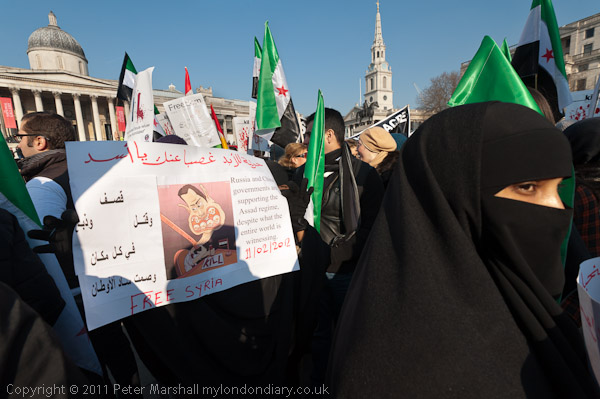
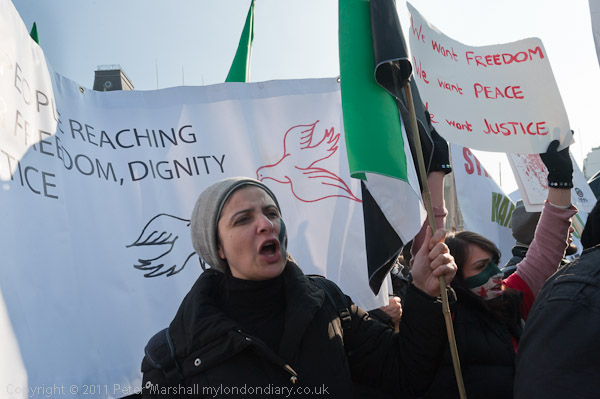
Muslim women carrying posters for Free Syria
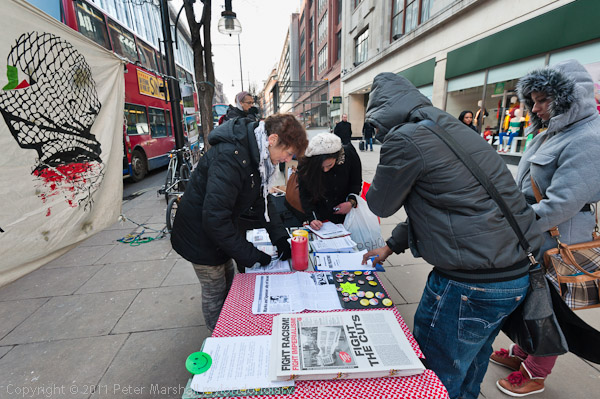
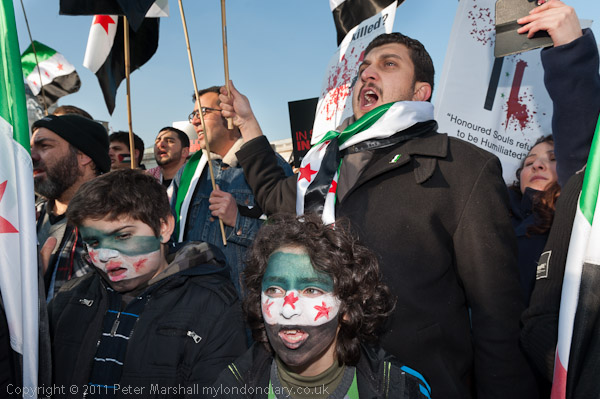
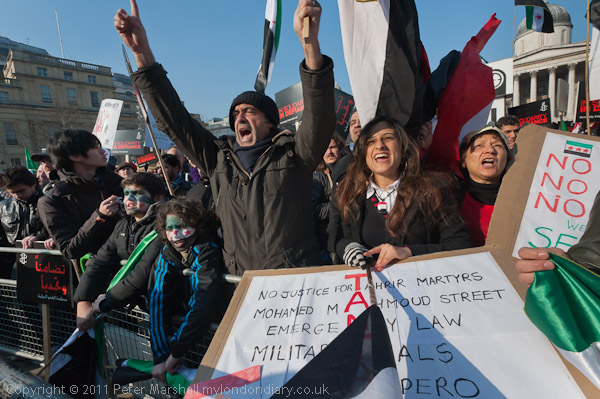
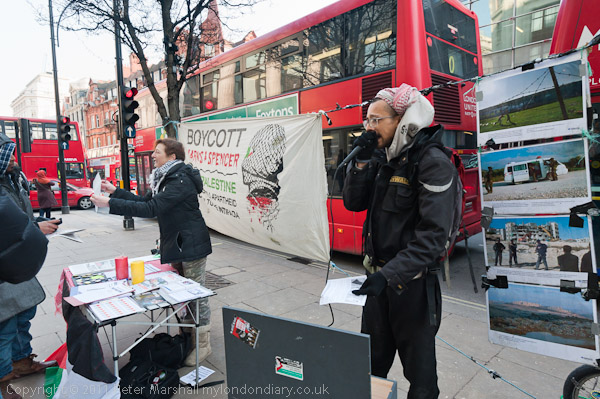
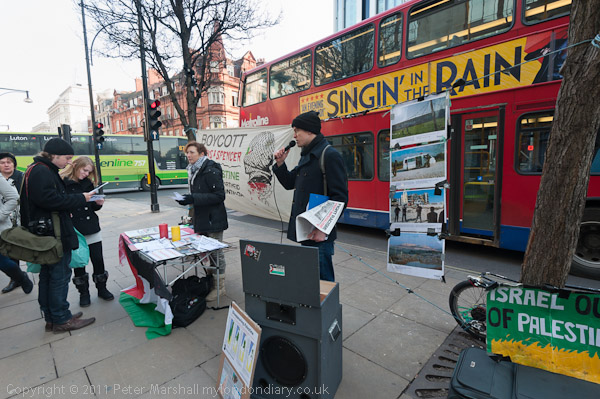
Amnesty International’s rally was in solidarity with protesters in Syria, Egypt and elsewhere, and the Victory to the Intifada protest outside Marks and Spencers also expressed solidarity with protesters in Syria, Iran and Somalia as well as support for Palestinians.
A shopper stops to sign the petition on the stall
Recent arrests at protests in the UK are attempting to criminalise any expression of support for the Palestinian Intifada – a word which refers to any resistance by Palestinians to the Israeli occupation, whether violent or non-violent. It remains to be seen whether our courts will throw out their attack on human rights and freedom of expression.
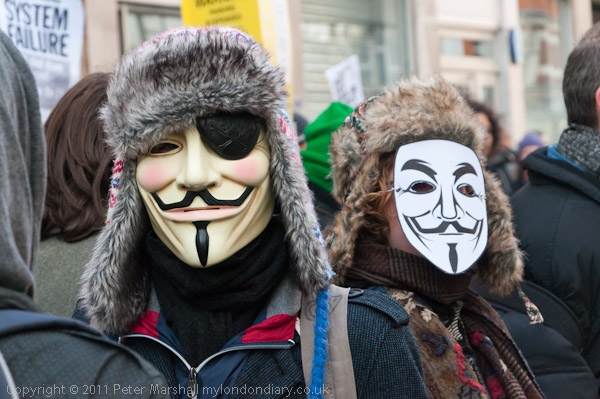
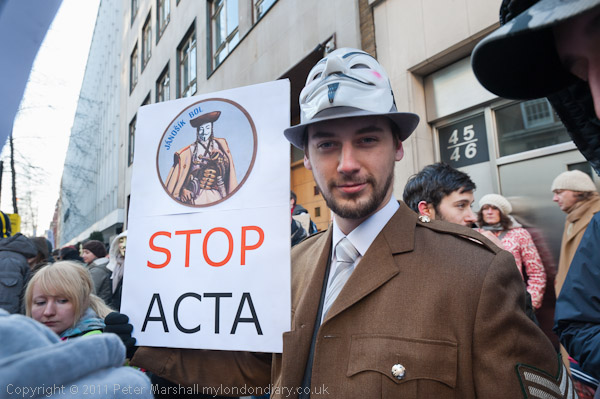
A protester wears an ‘Anonymous’ mask and a pirate patch
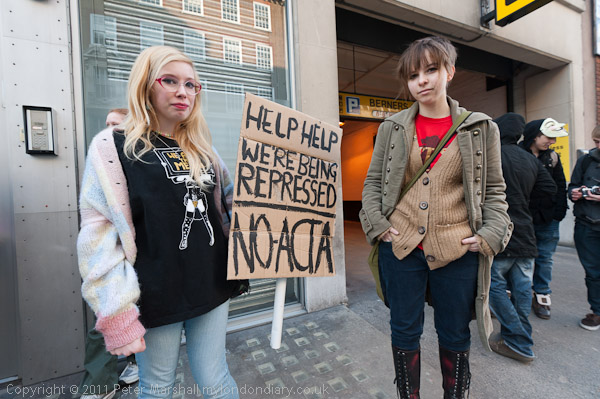
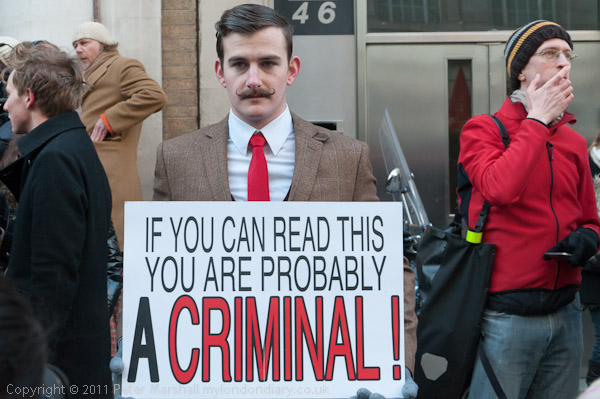
ACTA, the Anti-Counterfeiting Trade Agreement, was widely seen as an attempt by major film and music companies, drug manufacturers and other multinationals to infringe fundamental rights including freedom of expression and privacy for their own commercial interests and its ratification was eventually definitively rejected by the EU in July 2012.
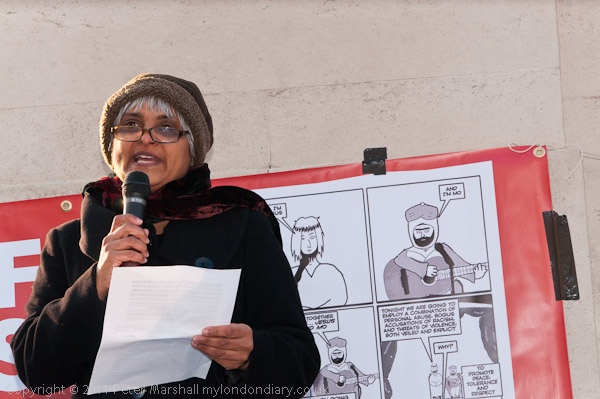
Pragna Patel of Southall Black sisters speaking in front of a ‘Jesus and Mo’ cartoon
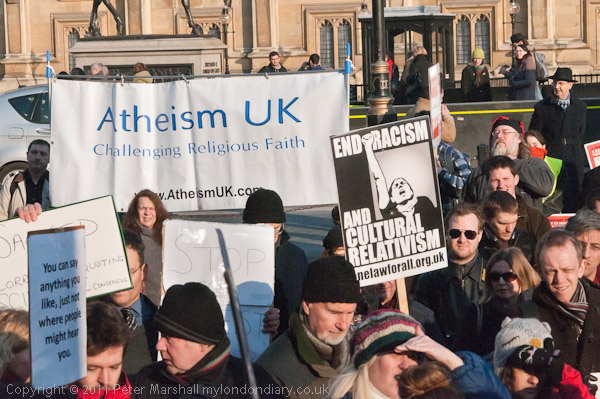
Finally I covered a rally by One Law for All defending freedom of expression, called following increasing pressure from Islamists asking for censorship of cartoons, meetings and expressions they regard as blasphemies.
Amnesty Protest For Human Rights
Trafalgar Square
Syrians march into Trafalgar Square
The large rally by Amnesty International was one a number of similar events in major cities across Europe, as well as in Iceland, Morocco, Nepal, Peru and Paraguay and sent thhe message to the people of the Middle East and North Africa that “you are not alone in your struggle. We are with you.”
Large numbers of Syrian protesters formed a circle around a clock tower representing that in Homs, where Clock Square has been at the centre of the protests, and danced around it, waving Syrian freedom flags, and at the rally which followed there were live link ups to protesters in two Syrian towns
There were many Egyptians also present and they and protesters from other countries spoke to an enthusiastic welcome from the crowd in the square.
Syrians stamp on the face of War Criminal President Asad
Victory to the Intifada had been holding regular pickets outside Oxford St flagship store since 2000 and this week were also stressing solidarity with Syrian, Iran and Somalia.
Their protests showing solidarity with Palestine began at the start of the Al Aqsa Intifada in 2000, and have continued once or twice a week since then. The location on the wide pavement here was chosen as M&S is Britain’s largest corporate backer of Zionist initiatives in Israel.
They urged shoppers to oppose British support for Israel and to boycott Israeli goods and support the Palestinian people’s right to self-determination.
The Anti-Counterfeiting Trade Agreement (ACTA) was a treaty negotiated in secret talks with little or no public debate between major countries including the United States, the European Community, Switzerland, Japan, Australia, the Republic of Korea, New Zealand, Mexico, Jordan, Morocco, Singapore, the United Arab Emirates, and Canada to protect the commercial interests of major film and music companies, drug manufacturers and other multinationals.
During the talks there was little if any representation from the artists and others who actually create the intellectual property from which these companies profit, or from the general public who pay for them.
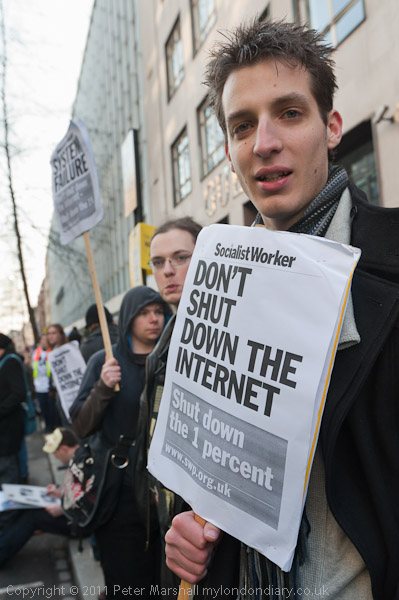
The protesters say that ACTSA would threaten free speech on the Internet and allow governments too much control over what could be put on the web. It would also make it possible for companies to prevent the making of parodies, which would stop proper creative and critical engagement with cultural works.
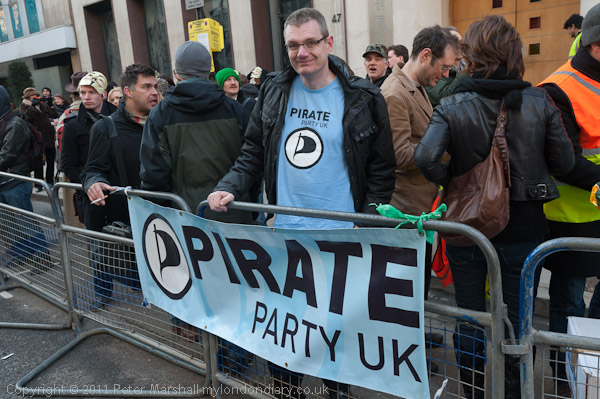
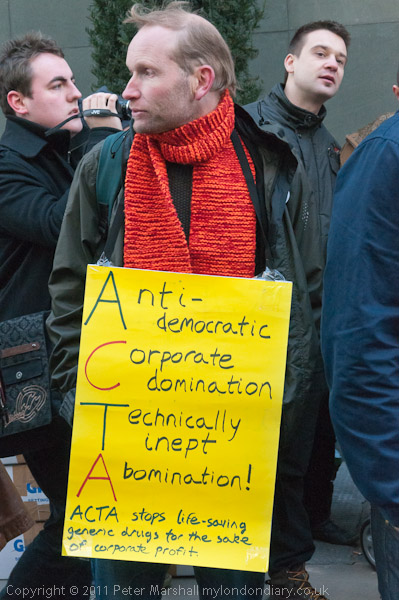
The protest was opposite British Music House where the Music Publishers Association, the Performing Rights Society for Music and other groups were based, and was called by an Anonymous group calling themselves ‘Stop Acta For Freedom’ and the ‘Open Rights Group’ and was joined by the ‘Pirate Party UK’. Many of those taking part wore ‘Anonymous’ masks, some with a black pirate eye patch.
Anti-democratic Corporate domination Technically inept Abomination – ACTA stops life-saving generic drugs for the sake of corporate profit’
Apart from its effect on web freedom, ACTA would be used to prevent the production of cheap drugs which have a vital role in treating disease in the majority world.
Although quite a few countries initially signed up to ACTA, few ratified it and public pressure finally resulted in it being abandoned. The full European Parliament rejected it in July 2012 by 478 votes to 39.
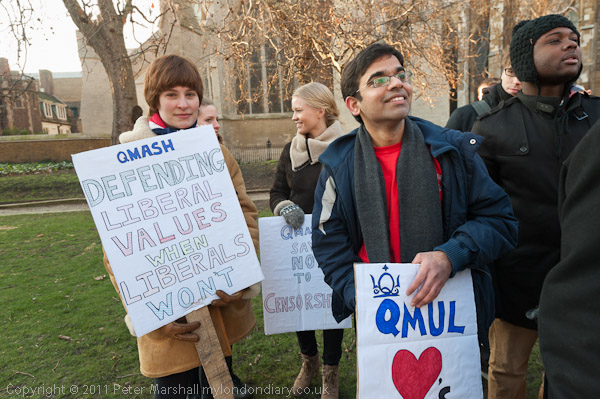
Queen Mary College poster ‘Tolerance of Intolerance is Cowardice’
I arrived late to join the roughly 500 people listening intently to speeches at the One Law for All rally opposite the Houses of Parliament.
The event like that by Amnesty International was part of a wider international Day of Action For Free Expression, with other events in Melbourne, Brazil, Paris, Gambia, Germany, Warsaw (and elsewhere in Poland), Portugal, South Africa and the US. In the UK the Day of Action was endorsed by nearly 100 groups and individuals including Jessica Ahlquist, Richard Dawkins, Equal Rights Now, Taslima Nasrin, National Federation of Atheist, Humanist and Secular Student Societies, National Secular Society, Salman Rushdie, Southall Black Sisters, and Peter Tatchell.
I felt that a few of the speakers were taking the opportunity to criticise religions in general and Christianity in particular in something of an anti-religious crusade in a way I felt was unsuitable; as I commented “atheist bigots are surely no more acceptable than religious ones“.
The protest was in response to actions taken by various authorities in this country, including at Queen Mary University and University College London acceding to demands by Islamists for the censorhip of individuals and organisations. We still see this attack on freedom of expression in institutions over this as well as other issues such as trans rights and accusations of anti-semitism by those who oppose Zionism and the activities of the Israeli government.
No Borders and the West End: On Saturday 10th February 2007 I went to photograph a protest against our racist, cruel and arbitrary detention of immigrants and asylum seekers at the neighbouring Colnbrook and Harmondsworth detention centres on the Colnbrook By-Pass immediately north of Heathrow Airport – now known as Heathrow Immigration Removal Centre. Like the first protest I covered there in April 2006 it was organised by No Borders, though several later events there were and at Yarls Wood were by Movement for Justice who were taking part in this protest with a Fight Racism! Fight Imprerialism! banner and others.
Harmondsworth (or rather Longford where both centres are located) was only a few miles bike ride from home, and after around an hour I jumped back on my bike, cycled home and took the train into London where I had arranged to meet a friend, I think probably to hand over some material.
We took a wander around Piccadilly Circus, Trafalgar Square and other parts of central London before saying goodbye and my making my way to Waterloo Station, photographing a few things on the way.
Here with the usual corrections is what I wrote about the day in 2007 on My London Diary and a few of the pictures with links more.
No Borders Demo at London Detention Centres
Colnbrook & Harmondsworth
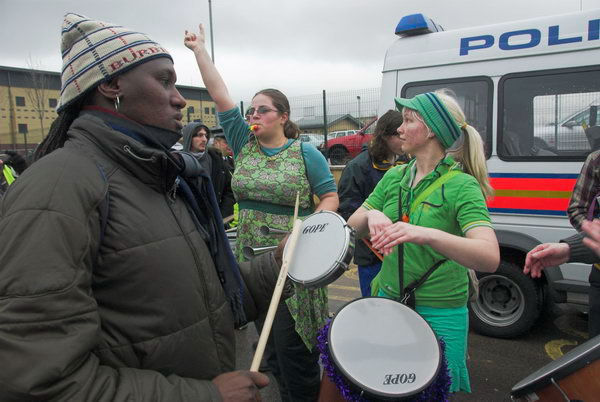
Rhythms of Resistance players outside the detention centres – Harmondsworth centre in background.
I arrived at the detention centres at Harmondsworth (Colnbrook and Harmondsworth are separated only by a narrow private road) just as the people who had come by coach from London marched onto the roadway leading to the two sites, with banners and the street band of Rhythms Of Resistance.
Fight Racism, Fight Imperialism’
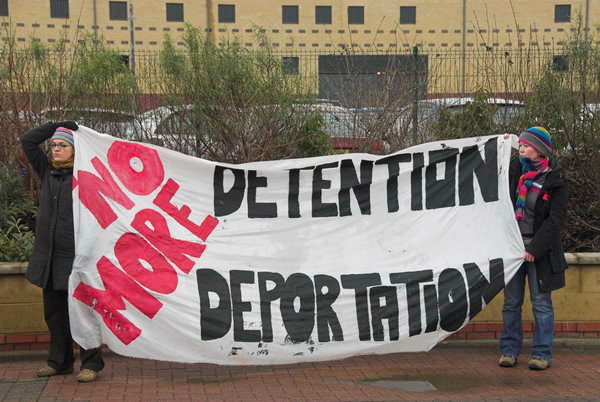
We had come to give support to migrants and refugees, and to demand the closure of detention centres, a stop to deportations and and end to immigration controls.
Since I was last here the windows of the two detention centres seem to have been blocked off, giving them a more sinister appearance, but although those imprisoned within the blocks were not allowed to see us, I imagine they could hear the noise that was being made.
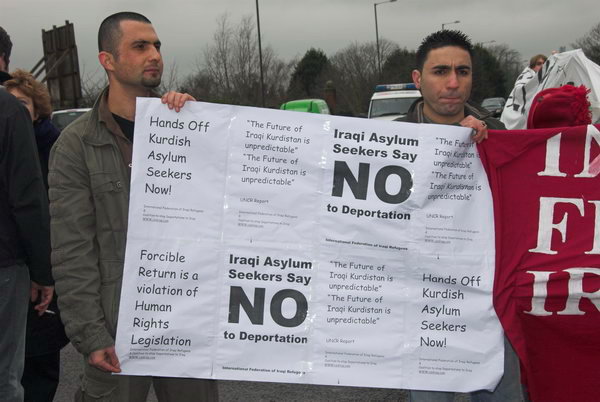
Hands off Kurdish Asylum Seekers Now
I left after around an hour, when a few people were still arriving. As well as the crowd in the road, there were also a number of people lined up along the main road in front of the two ‘prisons’.
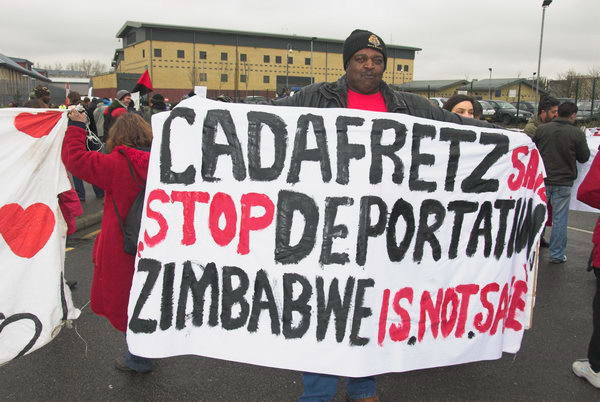
The Campaign For The Defence Of Africans Returned To Zimbabwe make the point Zimbabwe is not a safe place
There didn’t seem to be a huge police presence, although probably there were rather more on hand not far away. I left to meet a friend I’d arranged to see in the centre of London.
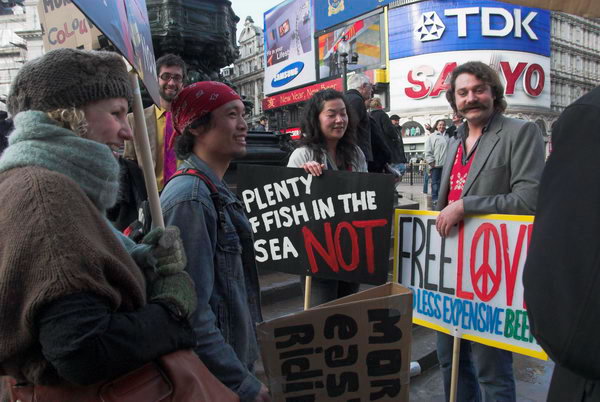
There wasn’t a great deal special happening as I walked through the streets of the West End of London. At Piccadilly Circus we bumped into some people with placards, but they were just celebrating someones birthday.
It was as boring as it looks
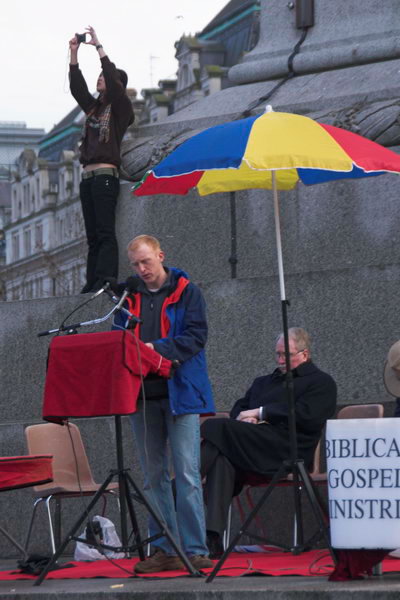
In Trafalgar Square we found the Biblical Gospel Mission preaching and handing out free bibles, though I told them I had several already at home.
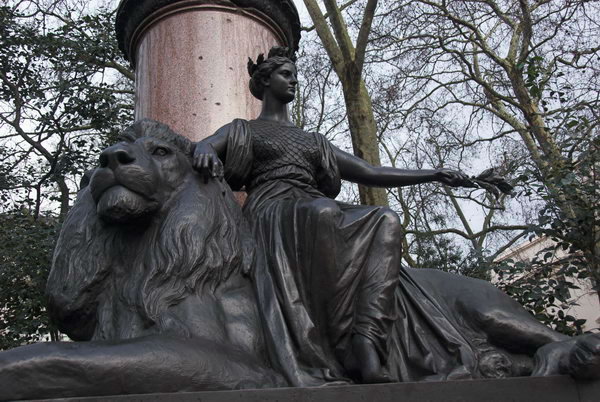
One of several sculptures and statues I photographed
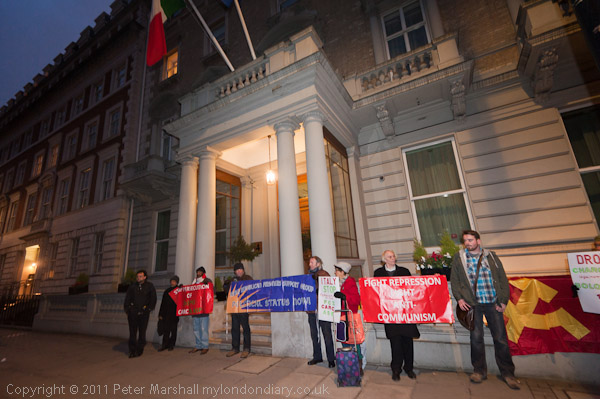
NHS Privatisation, Iran & the Bologna 12: On Wednesday 8th February 2012 I photographed a mock trial of Health Minister Andrew Lansley against his disastrous Health and Social Care Bill, visited the two peace camps then in Parliament Square and finally went to the Italian Embassy for a protest calling for the release of the Bologna 12, accused of terrorism through their membership of communist organisations, much like those who support Palestine Action in the UK now.
Stop NHS Privatisation – Kill Lansley’s Bill
Old Palace Yard, Westminster
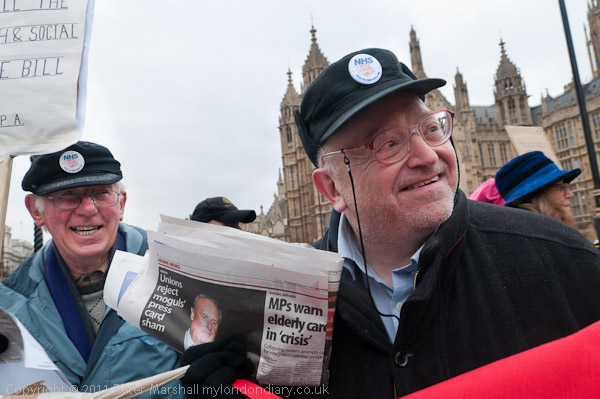
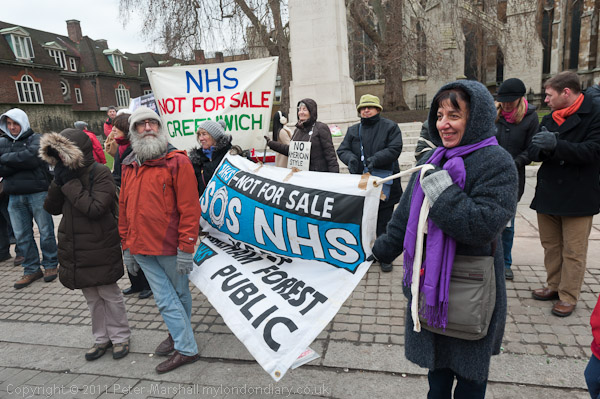
Pensioners in the protest outside Parliament
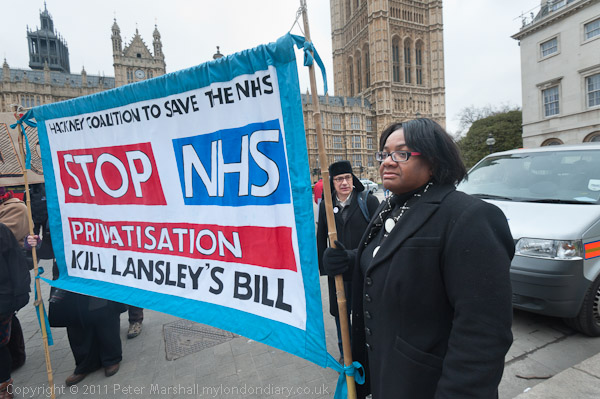
The protest, organised by Hackney Keep Our NHS Public, drew campaigners from across the country for speeches and a mock trial of Health Minister Andrew Lansley as his bill was entering into its report stage. Among those taking part – if briefly – was shadow health minister Diane Abbott MP.
Diane Abbott was the only MP I saw at the protest
Lansley’s proposals were a clear step towards the privatisation of the NHS, still a continuing process under Labour’s Wes Streeting, despite many of the changes brought in by Lansley having been later abandoned after, according to the Darzi report commissioned by Streeting it “imprisoned more than a million NHS staff in a broken system for the best part of a decade.”
Lord Darzi’s report concluded that “The Health and Social Care Act of 2012 was a calamity without international precedent – it proved disastrous. The result of the disruption was a permanent loss of capability from the NHS“. As Streeting commented it ” led to the longest waiting times, lowest patient satisfaction, and most expensive NHS in history”, but that hasn’t stopped Streeting pursuing his own policies to further prepare the NHS and the country for its privatisation. Of course Lansley was awarded a life peerage in 2015 for his services to capitalism.
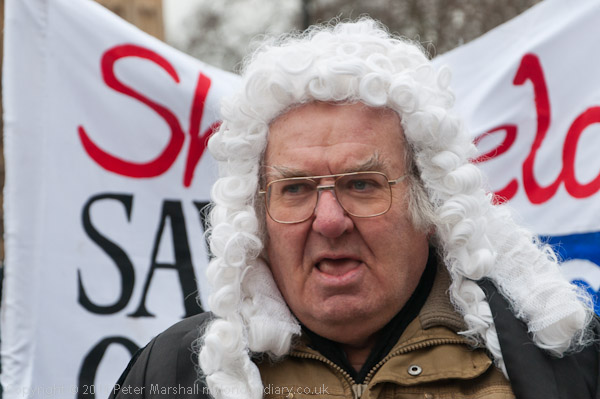
At the centre of the protest was the mock trial of Lansley with a judge with an impressive white wig and witnesses for the prosecution who spoke about their own experiences as patients and workers in the NHS.
Most still see the NHS, along with the other welfare state reforms of the period, as the greatest British achievements of the last century and for all its problems it still provides quality healthcare at a fraction of the cost of the US system which Lansley and his colleagues appeared to take as a model
Most importantly, provides services to the whole population including those who would be unable to pay expensive medical insurance. Over 60% of the two million personal bankruptcies filed each year in the US are a result of medical debt.
I don’t think there was much if any defence for Lansley, and the guilty verdict was inevitable. After the trial and a few stops a small group took the protest around Parliament Square, walking onto the various pedestrian crossings and facing the traffic holding up placards and the letters ‘S’, ‘T’, ‘O’ and ‘P’, usually but not quite always in that order and with a bed pan in the middle.
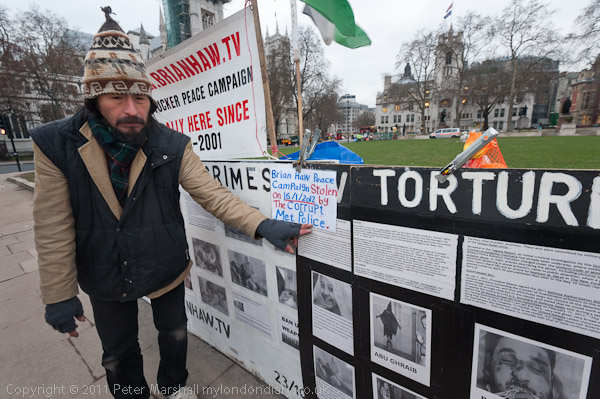
It was a cold day and I had to keep moving, walking around Parliament Square and stopping to talk with peace protesters still then protesting 24/7 in the square. Police and new laws against protest had resulted in the removal of all tents and in restricting the protests to the pavement facing Parliament, but the protests were continuing.
Brian Haw who began his Peace Campaign on 2 June 2001 had left the square on 1 January 2011 for treatment in Berlin for lung cancer, dying there on 18 June 2011. Since he left his campaign had been continued by his supporters, led by Babs Tucker, who had protested for some years with Haw. They on Day 3903 of the protest, continuing in the brutal winter weather despite police having taken away all tents, chairs and other items three weeks earlier.
Maria Gallastegui’s tent and one box remaining in the square
Maria Gallastegui, for some years a regular supporter of Brian Haw, had broken with him and begun her separate Peace Strike in the square several years earlier. She had cooperated with the police in various ways – such as covering her displays for the 2011 royal wedding – and had been granted a temporary injunction restraining police actions agaist her; police had left her tent and her large ‘peace’ box – modelled on the old police boxes – on the square until her case was heard.
Haw’s Peace Camp had been subject to lying and of devious and underhand actions throughout the ten and a half years of their presence in the square, and they told me the police had intentionally delayed their legal action so they could take away their property before the claim came to court.
I went with the three people from the Peace Strike to the weekly protest with others opposite the Foreign and Commonwealth Office in King Charles Street to remind Foreign Secretary William Hague of their opposition to war in Iran. Their protest was continuing when I needed to leave to go to the Italian Embassy.
The trial which was starting in Bologna that day of the twelve was being made under section 270bis of the Penal code introduced by the Fascist regime under Mussolini. They were brought as a part of a long campaign by Public Prosecutor Paolo Giovagnoli for the Authorities of the Papal Republic, aimed against freedom of expression and organisation of the left in Italy.
The twelve were accused of “subversive association for purposes of terrorism” for their membership of communist organisations and if they were convicted, similar prosecutions would be brought against those belonging to other groups outside the official left, including anarchists, Maoists and the Occupy movement.
It was a small token protest, with representative from groups including ‘Democracy and Class War’, ‘Socialist Fight’ and ‘Irish Republican Prisoners Support Group’ and began outside the impressive door in my picture in Grosvenor Square.
But after 20 minutes police came and very helpfully told them that they were in the wrong place. This was the back door of the embassy and they should be in Kings Yard at the front door. A man came out from the embassy and confirmed this and we all walked round to the gates outside the yard, while I went inside with two people who handed in a letter.