Heathrow, Gaza & the Tamils – 2009

Heathrow, Gaza & the Tamils: On Saturday 17th January 2009 I took a bus to Heathrow for a flash mob against a third runway, then the tube into Westminster for a protest against Israeli attacks on Gaza in Trafalgar Square which ended with a march to protest at Downing Street, where Tamils were protesting against the genocide taking place in Sri Lanka.


No Third Runway Decision Day Flashmob – Terminal 5, Heathrow Airport
Heathrow, Gaza & the Tamils - 2009

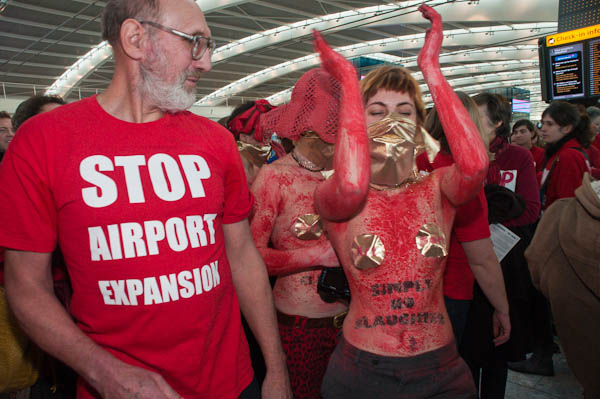
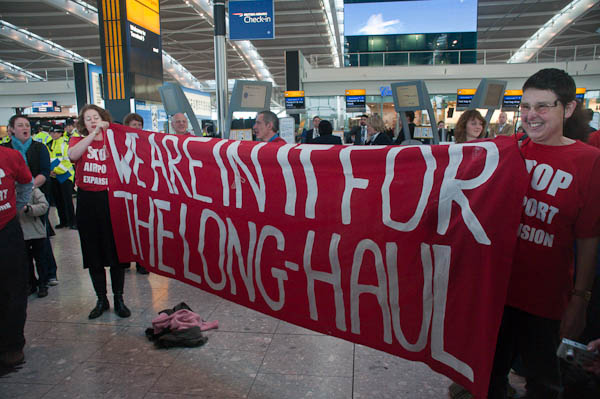
Earlier in the week the Labour government under Gordon Brown had announced they were to press ahead with airport expansion and build a third runway at Heathrow despite the environmental consequences. Several hundred people turned up at Terminal 5 for a ‘flashmob’ protest at 12 noon.
Heathrow, Gaza & the Tamils - 2009

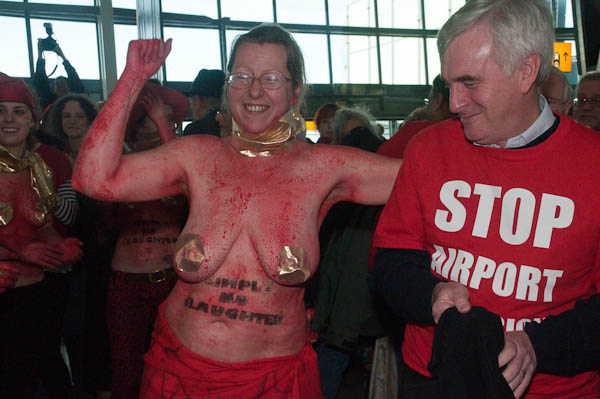
“Attracting most press attention were four brave young ladies who had saved the ten quid for a red ‘STOP AIRPORT EXPANSION’ t-shirt and instead opted for red body paint with a black message across their midriffs, ‘Simply No Slaughter‘ and a pair of strategically placed gold sticking plasters proclaiming ‘art‘ and ‘port‘ (port was indeed on the left.)”
Heathrow, Gaza & the Tamils - 2009
Local MP John McDonnell looks a little embarassed

Many local residents were there, some with their children, along with John Stewart of HACAN (Heathrow Association for the Control of Aircraft Noise) the organisers of the event, and local MP John McDonnell who was being congratulated for his seizing the mace in the House of Commons when the announcement was made.
Heathrow, Gaza & the Tamils - 2009
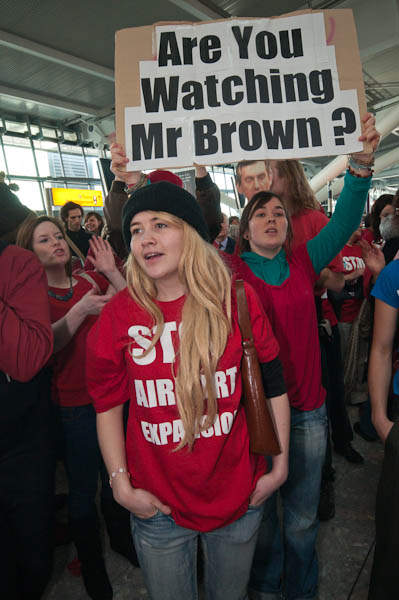
Prime Minister Gordon Brown had approved the airport expansion

The demonstrators chanted, thrown red balloons in the air, red tennis balls at an ‘Aunt Sally’ of Transport Secretary Geoff Hoon and conga’ed around the area while a large squad of photographers photographed and videoed.

The campaigners were surrounded in a loose ring by police and airport security who made no attempt to stop them, though police had made some searches before the event began. Some of them were clearly amused by the event as were a few passengers making their way through the departure area.

John Stewart of HACAN thanks everyone for coming

After almost three-quarters of an hour of protest John Stewart thanked everyone for coming and repeated the determination of all those involved to keep up the fight to ensure that, despite the decision, the runway will never be built. So far it has been prevented, though it seems likely that despite the increasingly obvious and critical environmental crisis our current Labour government will resurrect this enviornmental catastrophe, though it remains doubtful if the private finance required can be found.

A cheer for John McDonnell

And there was a cheer for John McDonnell’s action in Parliament and a final chance to pelt the Transport Secretary before we all left for buses or tube.

Many more pictures at No Third Runway Decision Day Flashmob.


1000 Dead and Nothing Said – End the Slaughter of Gaza – Trafalgar Square
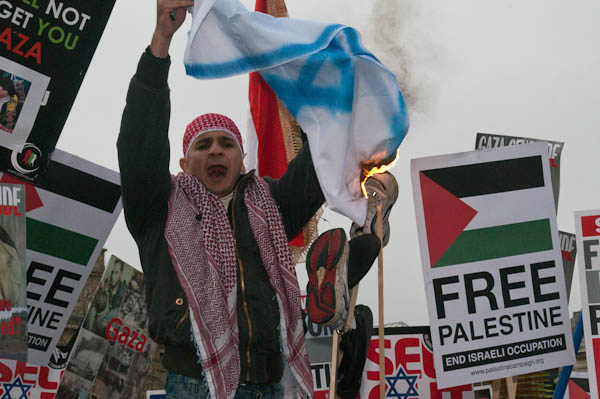
A man burns an Israeli flag in at the rally in Trafalgar Square

I was a little late arriving at the rally in Trafalgar Square but got there just in time to hear Tony Benn being announced and getting a huge greeting. As I commented he was “One of the greatest political figures of the last 50 years, [and} it’s a national tragedy that while he has so often been right on major issues, governments have seldom if ever followed his lead.”
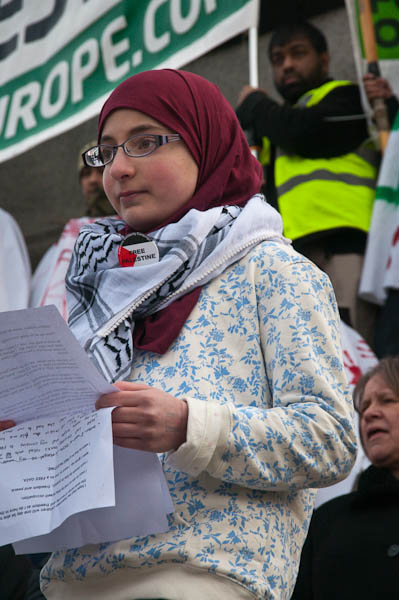
An 11 year old Palestinian girl, now living in Manchester speaks

The square was fairly full with perhaps 5-10,000 protesters though there had been a much larger national protest in London a week earlier against the attacks on Gaza in previous weeks that had killed over a thousand Palestinians including more than 300 children.

Palestinian singer Reem Kelani spoke before singing a traditional song

After some more speeches a group of children all dressed in white robes marked with bloody red handprints who had been standing on the plinth came down and went with a deputation to take a letter from the rally to Downing St, calling for an immediate ceasefire and reparations for the war damage inflicted by the Israeli attacks.

I went with them down Whitehall to Downing St, where police led them into a pen close to the gates.

While Diane Abbott, MP, PSC General Secretary Betty Hunter and Lindsay German of Stop the War with others took the letter into Downing St, the children posed for pictures, at first while standing and then lying on the ground as if the innocent victims of an Israeli attack.

But unlike those 300 childen in Gaza, these children were just playing dead.

A few hours after this protest Israel announced a ceasefire on its own terms. The end of the killing was welcome, but there was no justice for Palestine.

Much more and many more pictures at Gaza: 1000 Dead and Nothing Said.


Tamils protest Sri Lankan Genocide – Downing St
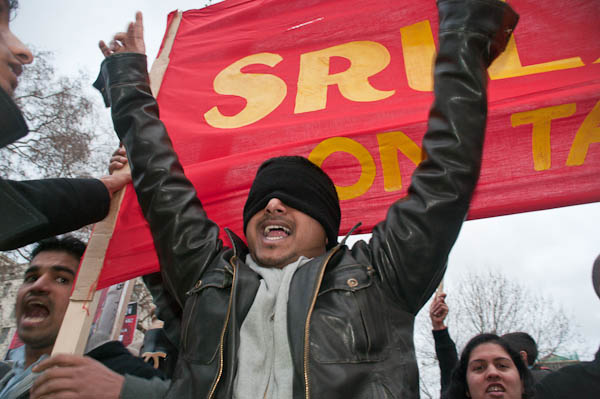
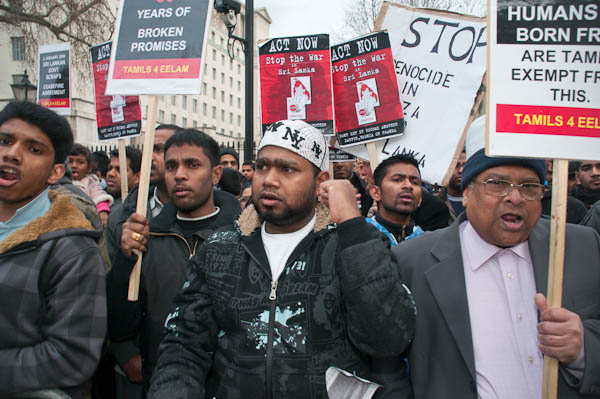
Several hundred Tamils were densely packed into a pen opposite opposite Downing Street to draw attention to the continuing attacks on Tamil civilians, schools, hospitals and churches by the Sri Lankan Army and Air Force and to call for an independent Tamil state, Tamil Eelam, in Sri Lanka.
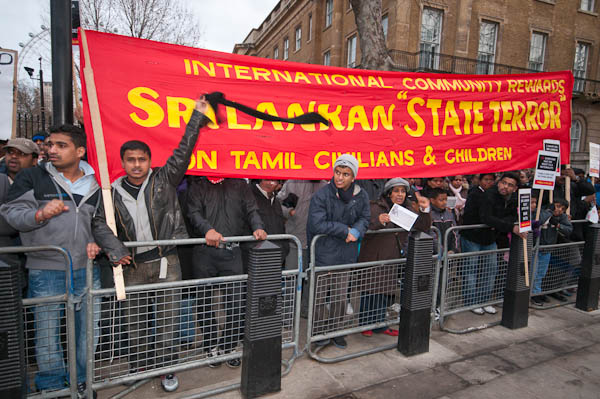
Tamils accuse the Sri Lankan government of genocide, and claim that in the past month alone over 300,000 Tamils have been forced to move out of their homes by the bombardment.
The decades long civil war which ended in May 2009 with the defeat of the Tamil Tigers had attracted relatively little attention in the mainstream media, but the assasination of leading Sri Lankan opposition newspaper editor Lasantha Wickramatunga on his way to work a week earlier and the publication of the obituary he had written for himself, And then they came for me, was the subject of a two page article in The Guardian on the day of this protest.

Tamils protest Sri Lankan Genocide


FlickrFacebookMy London DiaryHull PhotosLea ValleyParis
London’s Industrial HeritageLondon Photos

All photographs on this page are copyright © Peter Marshall.
Contact me to buy prints or licence to reproduce.
Hackney Wick & Manor Gardens – 2007

Hackney Wick & Manor Gardens: On Tuesday January 16 2007 I took a walk in Hackney Wick on my way to what was to become one of many casualties to the London Olympics, the Manor Gardens allotments, for an open day when the press and public were invited to see the vibrant site that was under threat.

Hackney Wick & Manor Gardens

Here with a few corrections and some of the pictures is what I wrote about the day. Many more pictures are still on My London Diary.


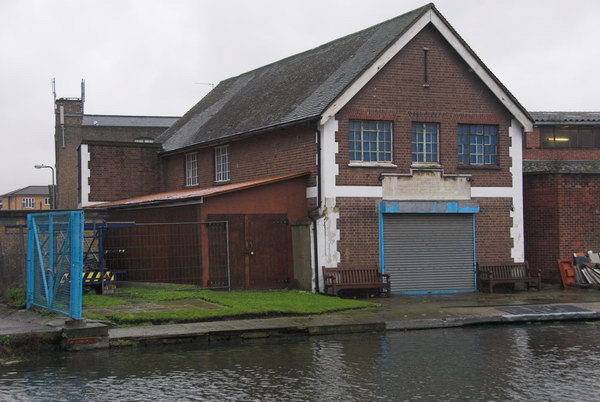
Hackney Wick remains one of the more interesting areas of London, and I took a few pictures despite the light rain on my rather meandering way to the Manor Gardens Allotments off Waterden Road.

Hackney Wick & Manor Gardens
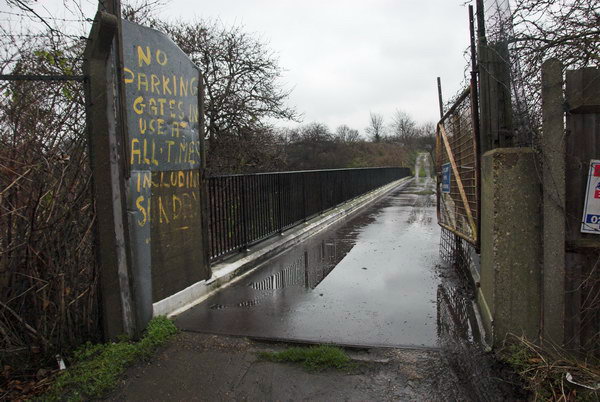
A bridge over the River Lea led to Manor Garden Allotments

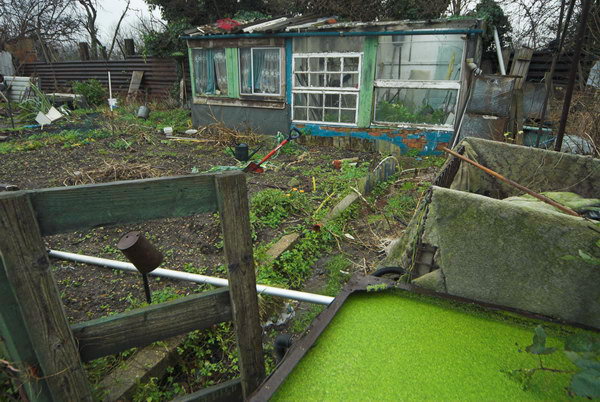
The Manor Gardens Allotments were another of the charitable provisions that came out of the link with Eton College and the Eton College Mission set up in Hackney Wick.

Hackney Wick & Manor Gardens

Arthur Villiers was one of four Old Etonians (the others were Gerald Wellesley, founder of the Eton Manor Old Boys Club for over 18s, Alfred Wagg and Sir Edward Cadogan) who in 1924 set up a charitable trust to keep the clubs running.

Hackney Wick & Manor Gardens

Villiers, who was a director of Barings Bank, had previously in around 1900 provided the Manor Gardens Allotments on an adjoining site as a means of providing both healthy exercise as well as suitable nutrition for the young men of the area. The land was provided for the community to use in perpetuity.

Since then it has continued in use, with a short break when the area was used for a wartime gun battery. At least a couple of the allotment ‘sheds’ are heavy concrete structures left over from this use.

Over the years it has been a thriving community of cultivators, recovering in recent years from some slight loss of interest, with the current renewal of interest in green and healthy living and eating.

Then came the London Bid for the 2012 Olympics, which put the allotments within the site. It could have been seen as a golden opportunity to give the games some green credibility behind the lip-service the bid gave to biodiversity and sustainability, and certainly as a commitment to the post-2012 legacy of the games – to leave sites such as Manor Gardens and the adjoining nature reserve as a green centerpiece to the site. Unfortunately the architects and developers seem hell-bent to create a brown Olympics, creating an irredeemably distressed site that will only be economically recoverable when all the concrete has crumbled.

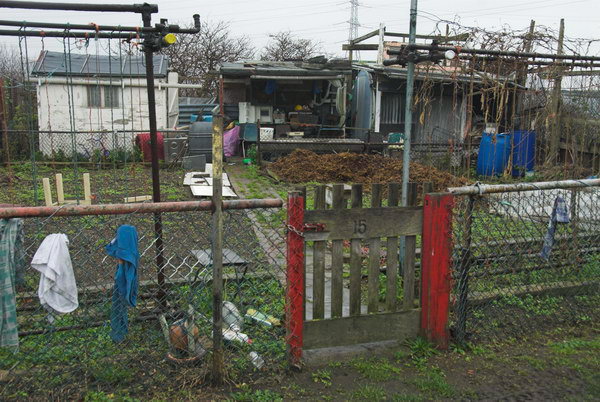
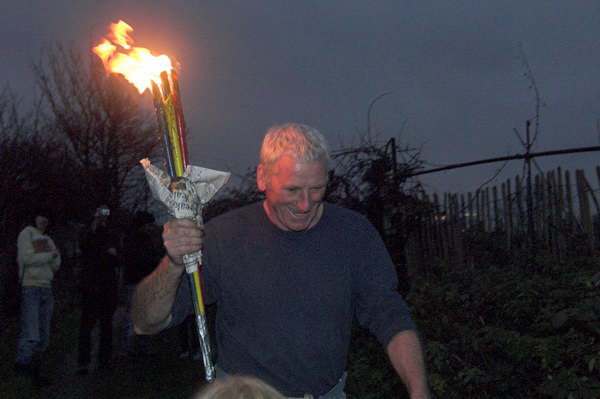
The New Year Feast was an Open Day at Manor Garden Allotments, inviting the public and press to see the site and the 80 plots for themselves. A rather low-tech ‘Olympic torch’ was carried across the bridge to the site and used to start a bonfire.

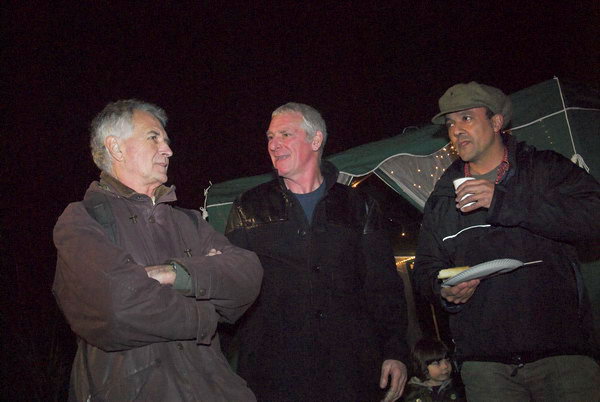
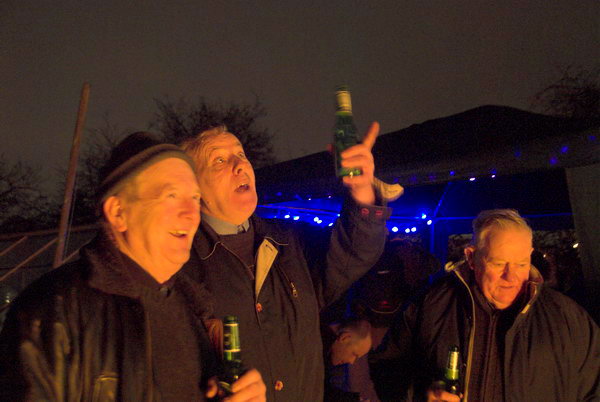
Then we had a party around it, with a couple of speeches and some tasty refreshments. There was support from some celebrities, as well as the opportunity to meet some of the plot-holders, some of whom have raised crops here since the 1940s – and those whose parents had plots in the 1920s. There are also many newer tenants, very much reflecting the multicultural nature of the surrounding area.

It would be a great shame to lose this splendid facility for four weeks of use in 2012, when it could easily be built around. It isn’t in a critical area but will simply be under concrete as a footpath, and probably also the site of a huge advertising ‘scoreboard’ for the games sponsor.

What will it say about the 2012 Olympics for a site that is currently a beacon for healthy green eating to be selling Big Macs?

The planning application was to submitted on 1st Feb 2007, with eviction expected on 2nd April 2007. it is unlikely that the replacement site offered at Marsh Lane can be ready before 2008. Hopes are not high, but it would certainly be a great green miracle if the allotments survive.


Of course the miracle did not happen, and the Olympic juggernaut took its course, destroying the allotments and much else. By June 2008 allotment holders were struggling to grow crops on a new site on common land at Leyton. The move was expensive and the contractors used to prepare the site had ruined it by sterilising and compacting soil with heavy equipment and much of the site was waterlogged, with the only healthy crops being grown in grow-bags.

The allotment holders had been promised they would be able to return to their old home after the Olympics, but this promise was not kept. Eventually in 2017 some were able to go to a much smaller new site at Pudding Mill Lane. It’s future came under threat in 2022 by plans for extensive development around its edges which will overshadow it restricting cultivation on much of the site.

Many more pictures of the allotments, some of the surrounding areas and of the New Year Feast on My London Diary.


FlickrFacebookMy London DiaryHull PhotosLea ValleyParis
London’s Industrial HeritageLondon Photos

All photographs on this page are copyright © Peter Marshall.
Contact me to buy prints or licence to reproduce.

Arbaeen Procession in London – 2012

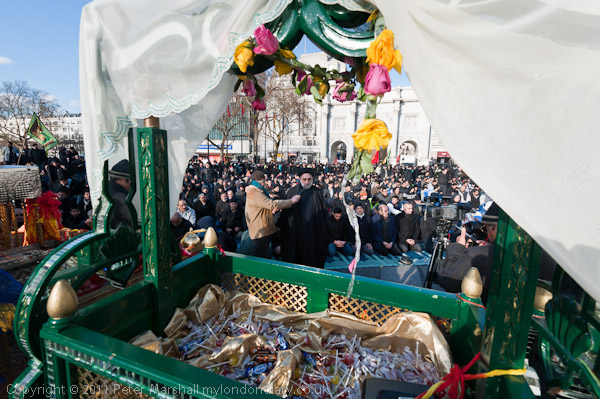
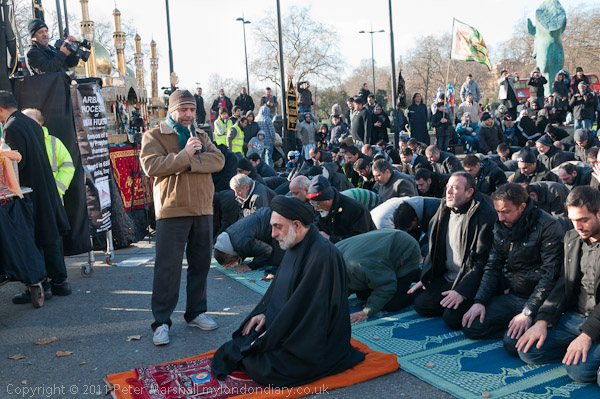
Arbaeen Procession in London: On Sunday 15 January 2012 around 5000 Shi’ite Muslims gathered at Marble Arch for London’s 31st annual Arbaeen procession.

Arbaeen Procession in London - 2012
The cradle commemorating Imam Husain’s murdered baby son and people at prayer before the procession.

Organised by the Hussaini Islamic Trust UK, the process with its colourful flags, large gold and silver replica shrines and men and women beating their breasts in a symbol of mourning for Imam Husain went along Park Avenue.

Arbaeen Procession in London - 2012

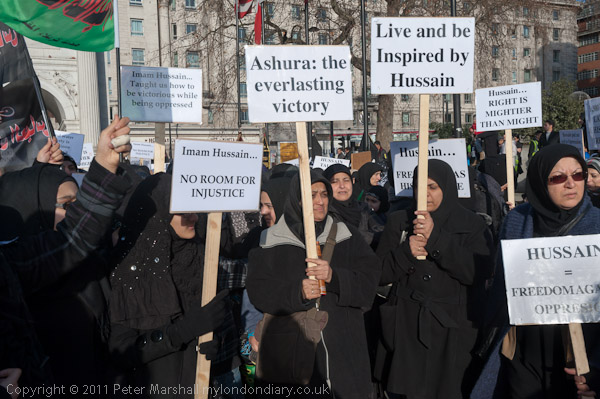
Imam Husain, the grandson of Mohammed, was killed with his family and companions at Kerbala in 680AD. Shi’ites celebrate his martydom with 40 days of mourning each year, beginning with Ashura and ending with Arbaeen.

Arbaeen Procession in London - 2012

Husain is seen by Shia Muslims as making a great stand against the oppression of a tyrant and representing the forces of good against evil. Although hugely outnumbered he and his companions chose to fight on to death rather than compromise their beliefs.

Arbaeen Procession in London - 2012

Their stand remains a symbol of freedom and dignity, and an aspiration to people and nations to strive for freedom, justice and equality. Among many who have admired Husain are Ghandi, Charles Dickens and historians Edward Gibbon and Thomas Carlyle.

Arbaeen also celebrates the return of the wives and families of the martyrs to Kerbala the following year from Damascus where the had been marched as captives.

Millions now attend the annual Arbaeen event in Kerbala although it was banned when Saddam Hussein was in power.

The London procession was first held in 1982 and is the oldest Arbaeen/Chelum Procession of Imam Husain in the west. It was the first annual Muslim procession to take place in Central London and is still one of the larger annual Muslim processions in the UK, attracting Muslims from across the UK.

I arrived at Marble Arch in time for the prayers, recitation, speeches and chanting at the start of the event and to admire the three large gold and silver replicas of the shrines of Karbala; known as Shabbih, over 10 feet high and the largest in Europe,the decorated and blood-stained white horse Zuljana, the cradle remembering his 6 month old child Hazrat Ali Asghar and a ceremonial coffin before the procession began.

Both men and women on the procession beat their breasts – the men with great energy and the women much more decorously as they moved slowly down Park Lane.

The event was continuing when I left hours later.

You can read more about the procession and follow it in my pictures on My London Diary at Arbaeen Procession in London.


FlickrFacebookMy London DiaryHull PhotosLea ValleyParis
London’s Industrial HeritageLondon Photos

All photographs on this page are copyright © Peter Marshall.
Contact me to buy prints or licence to reproduce.

EDL March in Barking – 2012

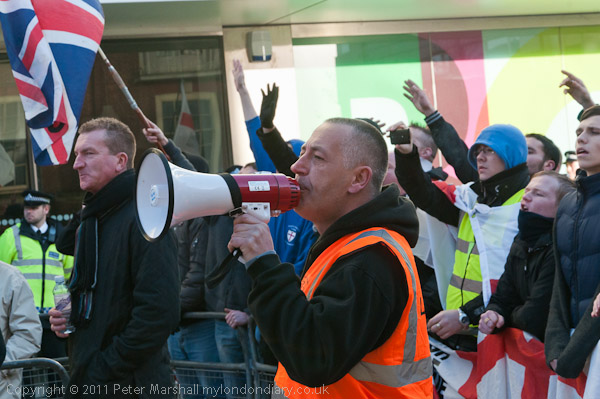
EDL March in Barking: On Saturday 14 January 2012 around 200 EDL supporters gathered outside the ‘The Barking Dog’ Wetherspoons and marched from Barking Station to a rally outside the town hall, calling for an end to Islamic influence in England. Their protest was opposed by a smaller group of Unite Against Fascism supporters.

EDL March in Barking - 2012

This pub had remained open while another nearby pub had closed, refusing to serve them. There was a large police presence watching them as well as journalists and photographers coming to record the EDL’s first march of 2012, organised by the Essex and Dagenham Divisions of the English Defence League.

EDL March in Barking - 2012

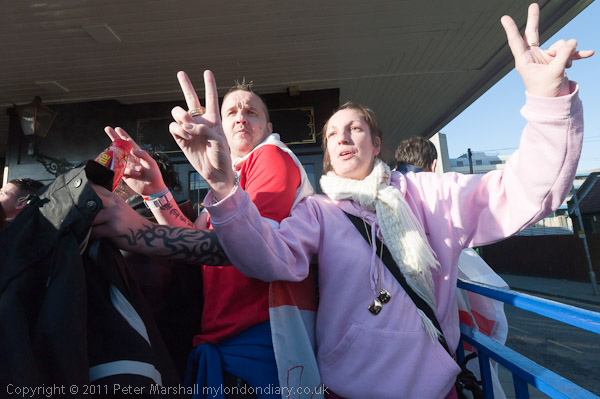
Most of the marchers were keen to be photographed and posed for photographers, including one man who later pulled down his trousers to show the tattoos on his rear, while others joked and played up to the cameras.

EDL March in Barking - 2012

The march organisers had been clear to stress that this was to be an entirely peaceful protest, and they made some attempts to curb the activities of their supporters, with stewards and others quickly stopping a small group who began an offensive chant about Allah. But there were plenty of other chants many of us find offensive.

EDL March in Barking - 2012

Among those taking part were some who I recognised from earlier protests by racist organisations such as the National Front or BNP. Although the EDL claimed not to be racist it was hard to fine their claims in the slightest credible.

Police kept the marchers apart from a smaller group of counter-protesters, mainly from the local area, organised at short notice by UAF (Unite Against Fascism) who had only become aware of the EDL march two days earlier. They describe the EDL as “an organisation of racist and fascist thugs, who particularly target Muslims” and described the march through Barking as “as part of its attempts to stir up racism and division in the area.

The EDL marched to a pen outside Barking Town Hall with another pen for the counter-protest some distance away, though the two groups were within shouting distance – and kept that up for most of the next hour and a half, with the UAF waving placards and the EDL making V signs and other gestures towards them.

A large crowd of perhaps a hundred police ensured that the two groups were kept apart. Police led away a couple of EDL supporters who made their way close to the UAF pen.

EDL leader Stephen Yaxley-Lennon (aka Tommy Robinson) was present but it was announced that he was not sufficiently recovered from the attack by “islamofascist thugs” to speak at the rally. The attackers were actually widely thought to be Luton Town football hooligans with whom he is associated. He talked with police for some minutes and then apparently asked them to escort him to his car.

At the end of the rally police escorted the remaining EDL supporters back to Barking station. Reports said that a group of them went on to Whitechapel where they had to be escorted out of the area by police for their own safety.

More about the event and many more pictures on My London Diary at EDL March in Barking.


FlickrFacebookMy London DiaryHull PhotosLea ValleyParis
London’s Industrial HeritageLondon Photos

All photographs on this page are copyright © Peter Marshall.
Contact me to buy prints or licence to reproduce.

Palestine & Syria – 2018

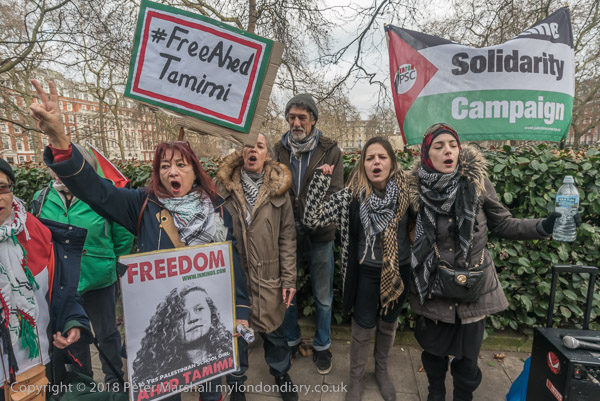
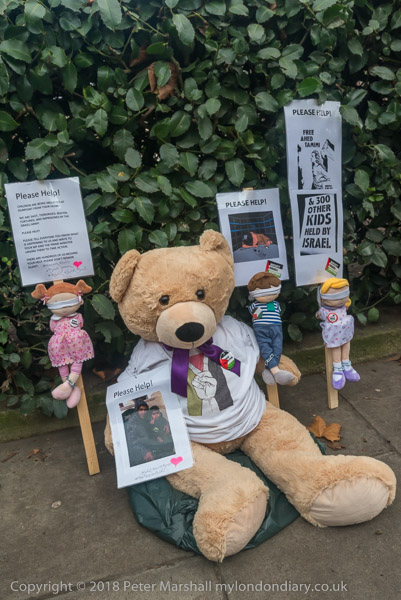
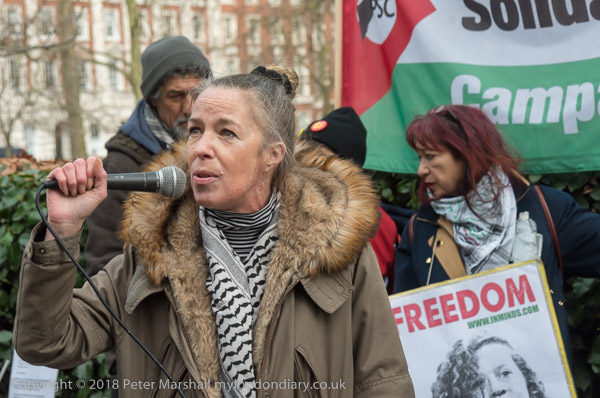
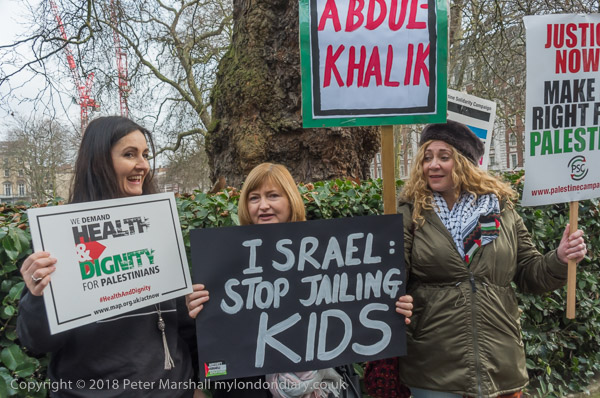
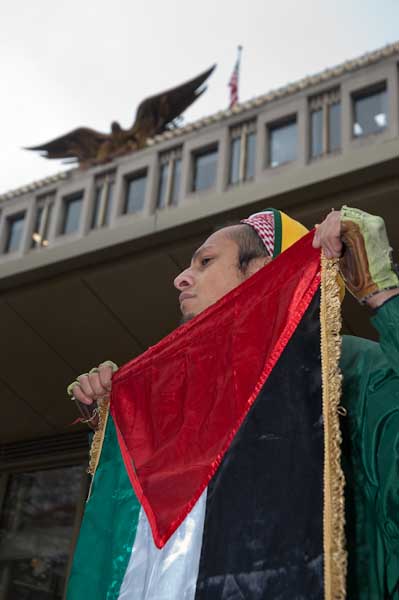
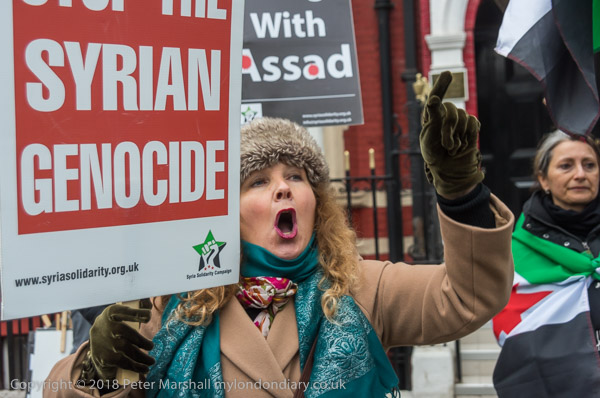
Palestine & Syria: On Saturday 13th January 2018 I photographed a protest at the London US Embassy in Grosvenor Square against the continuing imprisonment of children in Palestine and another opposite the Russian Consulate over their continuing support for the Assad regime in Syria including the bombing of civilians.


Free Ahed Tamimi & All Child Prisoners

Palestine & Syria - 2018

Teenager Ahed Tamimi was in prison in Israel for slapping an Israeli soldier who came into her family’s garden shortly after she had learnt that a relative had been shot by Israeli forces.

Palestine & Syria - 2018

Her detention made the news and prompted this protest, but she was only one of the thousands of Palestinian children have been detained by Israel since 2000 in a systematic policy which the UN has said includes abuse and ill-treatment. Many Palestinian children have been kept for many days in solitary confinement in small underground cells in Israeli jails.

Palestine & Syria - 2018

Israel is an apartheid state, with very different laws and police treatment for Palestinians in the occupied West Bank who are subject to Israeli military law and dealt with in military courts which offer little or no chance of justice. Many are held without any real trials in ‘administrative detention‘ which can be essentially indefinite, with prisoners being released at the end of one sentence and immediately re-arrested for another period of detention.

Palestine & Syria - 2018

A number of those taking part were relatives or friends of Tamimi’s family, including her father’s cousin Nana Hourriyah, or of other prisoners in Israeli jails. One man who spoke had recently spent 3 months in Palestine and had stayed with the family of another child prisoner. He had then been deported for taking part in a peaceful protest.

During the hour I stayed at the protest a single Zionist protester in a pen at the end of the street waved an Israeli flag, shouting insults at the protesters and accusing them of supporting Hamas, which they firmly denied.

More at Free Ahed Tamimi.


Stop the Massacres in Syria

Protesters lined the street opposite the Russian Consulate calling for an end to the massacres taking place in Syria. Protests are not allowed in the private road a few yards away outside the Embassy.

Russia and Assad’s forces were bombing civilians in Idlib, Hama and Eastern Ghouta, specifically targeting medical workers and facilities, with 8 hospitals in Idlib bombed since the start of December.

Many of those still living in Idlib had fled there from other towns and cities previously bombed by Assad and his Russian allies who were attempting to complete the destruction of all groups opposed to the Assad regime and bomb or starve to death the civilian population in areas held by opposition forces.

Only now after the fall of the Assad regime has the full scale of their human rights abuses become widely known with over 150,000 people thought to have been tortured and killed in his infamous prisons. As many as 620,000 were killed in the 14 years of civil war – around 1 in 35 of its prewar population, with around half these being civilians.

More than 14 million – almost two thirds of the Syrian population – were forced to leave their homes in the civil war. Half remained elsewhere in Syria, around 5.5 million in surrounding countries. Around a fifth of the countries pre-war population made their way to Europe, with the majority of these going to Germany. The UK set up a scheme to take Syrians but the numbers here remain relatively small at around 40,000.

Stop the Massacres in Syria


FlickrFacebookMy London DiaryHull PhotosLea ValleyParis
London’s Industrial HeritageLondon Photos

All photographs on this page are copyright © Peter Marshall.
Contact me to buy prints or licence to reproduce.


Crouch End & Upper Holloway – 1989

The final post on my walk on Sunday 19th November 1989 which had begun in Highgate. You can read the previous part at A Reservoir, Flats, a Cockerel and a Café.

Gateway, Albert Mansions, Crouch Hill, Crouch End, Islington, Haringey, 1989 89-11i-61
Gateway, Albert Mansions, Crouch Hill, Crouch End, Haringey, 1989 89-11i-61

I walked down Haslemere Road and then turned down Vicarage Path, following this to Crouch Hill.

Albert Mansions, described by various estate agents as “a hidden gem in Crouch Hill” dates from 1903. Although the driveway is clearly marked ‘PRIVATE residents only‘, Vicarage Path goes past the building and emerges at the side of the left gatepost in my photograph. I clearly found this gateway more interesting than the actual mansion building where three and four bedroom leashold flats now sell for approaching a million.

House, Heathville Rd, Highcroft Rd, Crouch End, Islington, 1989 89-11i-64
House, Heathville Rd, 6, Highcroft Rd, Crouch End, Islington, 1989 89-11i-64

I walked down Crouch Hill and turned west down Ashley Rd. When I reached Highcroft Road I saw an interesting roof a short distance down and walked up to take this picture. Taken from just across the street it rather fails to show clearly the pyramidal cap to the roof, which is more evident in the previous frame (not on-line) taken of the row along this side of the street. But does give a good idea of the architectural detailing, including a fancily written date which I can’t quite read but is perhaps 1897 or 9 and a rather striking head – I wondered who was the model for this intense face. I’m rather suprised that this building does not appear to be locally listed

House, Highcroft Rd, Crouch End, Islington, 1989 89-11i-65

This locally listed house at 3 Highcroft Road was built in 1875 as the vicarage to St Mary’s Church opposite, and has rather fine porch with a somewhat ecclesiastical look. Like many of the large vicarages provided for Victorian clerics who were expected to have large families and servants I imagine it was sold off some years before I made the picture.

Houses, Hornsey Rise, Upper Holloway, Islington, 1989 89-11i-66

I returned to Ashley Road, walking past St Mary’s church without photographing it. Most of our Anglican churches seem to have been photographed time after time from the Victorian period on, not least because many vicars with time on their hands took up photography as a hobby. I seldom chose to add to the multitude.

There is a line of similar fine houses between Ashley Road and Shaftestbury Road, at 2-20 facing Elthorne Park, but I chose to photograph these because of the wall with its sculptures and irorwork in front of what I think was 6 Hornsey Rise. The wall and ironwork are still there but the figures next to the pavement have long gone. At the right of the picture you can see the Shaftesbury Tavern.

House, Hornsey Rise, Upper Holloway, Islington, 1989 89-11i-53

Hornsey Rise was developed from 1848, although it only got the name almost 40 years later replaceing the different names of various short lengths such as this. This picture gives a closer view of one of the two ornamental gates and the house , with the doorway to number 4 at the right of the image.

The Shaftesbury Tavern, Shaftesbury Rd, Hornsey Rise, Upper Holloway, Islington, 1989 89-11i-54

This pub at 534 is the last building on Hornsey Road, which becomes Hornsey Rise beyond Shaftesbury Rd. According to its local listing it “was built in 1858, by speculative builder Thomas Beall, as the area around it began to be developed. It is a handsome well-preserved building with contrasting brickwork in red and London stock, and pilasters and arches at the upper storey level.

I choose to photograph not the main pub building but its “1897 addition” on Shaftesbury Rd. However CAMRA states that the pub itself was built “in 1897 with rich wood and glasswork, so typical of the golden age of pub-building.” Looking at the pub exterior I am inclined to believe them and the current building probably replaced or significantly altered Beall’s. As they also state, “The pub was restored in 2014 from a ‘very tired’ state by the small pub chain Remarkable Restaurants Ltd“.

Shops, Fairbridge Rd, Hornsey Rd, Upper Holloway, Islington, 1989 89-11i-55

I continued walking down Hornsey Road I photographed this handsome late Victorian building at 471 Hornsey Rd on the corner with Fairbridge Road. Then it was a timber merchant with T C TIMBER on the first floor corner blind window and a rather jaunty-looking painted figure of a town crier in ancient dress looking like a poor piece of advertising clip-art in that above it on the second floor. The shop is now Hornsey Carpets and that figure now looks very washed out and on the first floor is some strange image I make no sense of.

Kokayi, Supplementary School, Hanley Rd, Upper Holloway, Islington, 1989 89-11i-56

Further down Hornsey Road I went down Hanley Road where I photographed the doorway of the Kokayi Supplementary School. A charity of this name was later registered in 1997 “To advance the education of children and young people particularly children and young people of African and Afro-Caribbean descent by the provision of a supplementary school: By the provision of advice and guidance in matters concerning their education and career development; And by such other charitable ways as the charity through its trustees may from time to time decide.” The charity was removed in 2014 as it had ceased to function.

I was at the end of my walk and made my way to Finsbury Park Station. It was several weeks before I was able to go out and take photographs again.


FlickrFacebookMy London DiaryHull PhotosLea ValleyParis
London’s Industrial HeritageLondon Photos

All photographs on this page are copyright © Peter Marshall.
Contact me to buy prints or licence to reproduce.

Guantanamo Day – 11th January

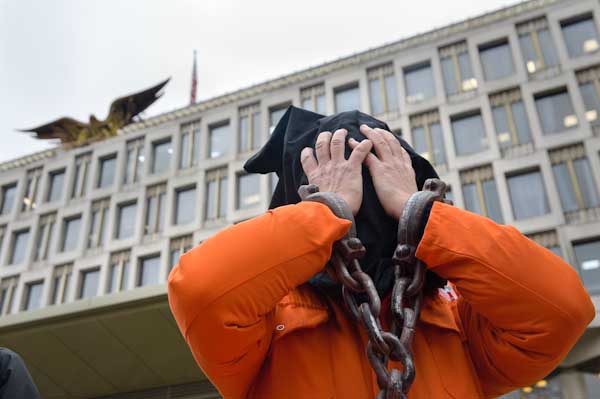
Guantanamo Day – 11th January: Today is the 23rd anniversary of the setting up by U.S. President George W. Bush of the illegal prison camp at Guantanamo Bay inside the US Naval base on Cuba.

Guantanamo Day - 11th January 2010

Bush had issued a military order in November 2001 “for the indefinite detention of foreign nationals without charge and preventing them from legally challenging their detention” and to their shame the US Department of Justice claimed that the principle of ‘habeas corpus‘ did not apply to the camp as it was not on US territory.

Guantanamo Day - 11th January 2010

At first a temporary camp called ‘Camp X-Ray’ was set up at Guantanamo and the first twenty detainees arrived there on 11 January 2002. Later they were moved to a more permanent Guantanamo Bay detention camp.

Guantanamo Day - 11th January 2010

The US administration argued that the site was not US territory as it was only held under a lease from Cuba last updated in 1934 “under which Cuba retains ultimate sovereignty but the U.S. exercises sole jurisdiction.” Cuba since the 1959 revolution has argued that the US presence there is illegal and has called repeatedly for them to leave and return the territory to Cuba.

Guantanamo Day - 11th January 2010

The USA also argued that the Geneva Conventions did not apply to ‘unlawful enemy combatants’, and went ahead holding prisoners there in cruel, inhumane and degrading conditions and torturing them. The Wikipedia article gives some details of the condemnations by the Red Cross and human rights organisations as well as the testimonies of released prisoners.

There was little if any evidence against great majority of the at least 780 men who were held in Guantanamo and most were finally released without charge, although today 15 detainees remain at Guantanamo Bay. Nine died while being held there. Only 16 detainees have ever been charged by the U.S. with criminal offences. Most were just foreigners who were in Afghanistan for various reasons and were captured and sold to the US forces by bounty hunters.

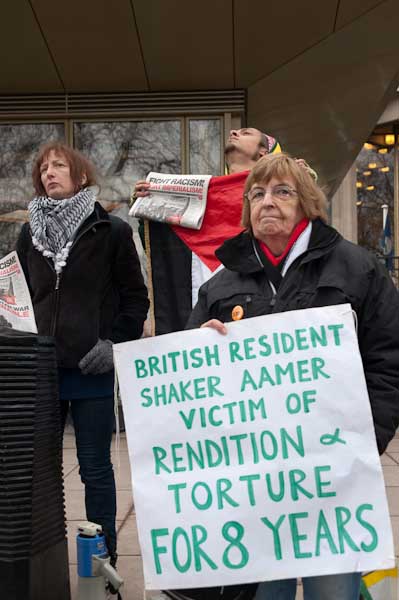
The last detainee with a British connection to be released was Shaker Aamer, born in Saudi Arabia but with British Resident status and a wife and family in Battersea, London who had gone to Afghanistan as a charity worker. He was captured by bandits and sold to the US in December 2001 and transferred to Guantanamo on 14 February 2002 after having been interrogated and tortured in the prison at the US Bagram air base. He was eventually released in October 2015 having been held for over thirteen years.

Green MEP for London Jean Lambert

Some large protests against Guantanamo took place in London over the years, as well as smaller regular vigils at the US Embassy and in front of Parliament. I photographed many of these over the years, putting accounts and pictures on My London Diary as well as sending them to agencies. The pictures here come from my post about a small protest by active campaigners against the camp at the US Embassy on Monday 11th January 2010, Guantanamo Bay – 8 Shameful Years.


FlickrFacebookMy London DiaryHull PhotosLea ValleyParis
London’s Industrial HeritageLondon Photos

All photographs on this page are copyright © Peter Marshall.
Contact me to buy prints or licence to reproduce.

A Reservoir, Flats, a Cockerel and a Café

A Reservoir, Flats, a Cockerel and a Café: More from my walk in Highgate on Sunday 19th November. You can read the previous part at Churches, Flats, Houses & a Pineapple – Highgate 1989

New River Company, Reservoir, Engine House, Hornsey Lane, Haringey, 1989 89-11h-43

Beyond these large red-brick buildings that line the north side of Hornsey Lane is the grass covered reservoir built by the New River Company and just beyond that across Tile Kiln Lane is their Engine House dating from around 1859. Now called the Pump House the site includes the base of a large chimney for a steam-driven pump. This reservoir and pump and others in the area became necessary as higher areas in Hampstead and Highgate were developed. The locally listed building has more recently been converted to residential use.

Northwood Hall, Flats, Hornsey Lane, 89-11h-35

A few yards further east I crossed the Archway Bridge, where perhaps surprisingly I didn’t take any pictures of the view down the road. I did take three photographs of one of the ornamental lamposts but haven’t digitised any of these. The two at the east end seem rather similar to some of those on the Thames embankment with entwined fish swimming around them. About 5 years ago the fairly low ornamental fence on each side of the bridge has been augmented with a tall metal fence to prevent people jumping to their death on the road below.

Further east of the bridge is Northwood Hall, an art deco block built as “ultra modern labour-saving” luxury flats in 1935 and designed in a cross shape by George Edward Bright who had earlier worked as an assistant to Herbert Baker, Edwin Lutyens and Guy Dawber. The almost 200 flats were set in extensive gardens with “a restaurant for residents, guest rooms and outdoor amenities including a tennis court. Indoors, there were uniformed porters available 24/7 and an optional maids’ service charged at hourly rates. In kitchens, double door cupboards opening onto the corridors were used to provide additional services including rubbish collection, shoe cleaning and delivery of papers, food and even cooked meals.”

Sat on a hill overlooking London the residents on all but its ground floor have extensive views across London ‘on a clear day as far as Crystal Palace‘ and the building is a landmark visible from much of north London.

Cockerel, Bronze, John Willaas, Ashmount Primary School, Hornsey Lane, Crouch End, Islington, 1989 89-11h-24

This sculpture was commission by and paid for by the architect of the LCC’s Ashmount School, H.T. Cadbury-Brown. Built in 1954-6 it was an important early example of an all-glass curtain wall construction.
The cockerel now stands on top of the wall outside the Whitehall Park School, built on part of the Ashmount site with the rest being used for housing.

Crouch End Hill, Crouch End, Haringey, 1989 89-11h-13

Advertising for Nautilus Fitness and Tree Surgery on Crouch End Hill, immediately south of the former Crouch End Station – where the old track is now the Parkland Walk. I wondered what the large letters BSG on the wall stood for but could come up with no sensible solution. I think the picture is looking down Stroud Green Road.

Crescent Cafe, Crouch End Hill, Crouch End, Haringey, 1989 89-11h-15
Crescent Café, Crouch End Hill, Crouch End, Haringey, 1989 89-11h-15

The Crescent Café was in part of the former Crouch End Station buildings. A Cafe continues here – with a name change to Sercem Cafe for a couple of years before going back to being Crescent Cafe again until around 2021-2 and is now Merro. The station probably dates from when the line opened in 1867; the station closed in 1954 but goods traffic along the line continued until 1970.

The Café was closed on the Sunday I took this picture. At right you can see one of the tall brick pillars on top a a curved wall that go beside and across the bridge across the former railway. I’d photographed the cafe and these twelve years earlier but hadn’t put the wall picture online.

Monkridge, Crouch End Hill, Crouch End, Haringey, 1989 89-11h-16

I turned north up Crouch End Hill and photographed another mansion block, Monkridge, just a few yards further on. This was apparently built between 1912 and 1935 with around 40 flats and a lower building. The two blocks are very similar in design with this being slightly large actually on Crouch End Hill and the other behind on Haslemere Road.

The final post on this walk will follow shortly.


FlickrFacebookMy London DiaryHull PhotosLea ValleyParis
London’s Industrial HeritageLondon Photos

All photographs on this page are copyright © Peter Marshall.
Contact me to buy prints or licence to reproduce.

1995 Colour – Part 1

1995 Colour – Part 1: The first of a series of posts on my colour work, mainly in London, from 1995, 35 years ago and when I’d been working extensively with colour negative film for ten years, though still continuing to work with black and white.

1995 Colour - Part 1
Car Wash, St Paul’s Cray, Bromley, 1995, 95c01-122

Although I’d always taken both colour and black and white photographs since I began in photography, black and white had dominated my work. It was still the serious side of photography in the 1970s; almost all gallery shows then were black and white, and most publications were still only printed in monochrome, including photographic magazines, although some occasionally had a few colour pages.

1995 Colour - Part 1
Frost & Smith, Accident Repairs, Cray Rd, Bexley, 1995, 95c01-123

And back then, almost all professional colour was taken using colour slide film such as Ektachrome and Kodachrome. Films were mainly sold inclusive of processing and you sent away your exposed film and a few days later s box of slides came back through the post. Professionals might use Ektachrome and take it to a lab for processing, but that worked out more expensive, though you could get the results in an hour or so.

1995 Colour - Part 1
St Paul’s Cray, Bromley, 1995, 95c01-132

I was interested in colour but in the early years took far fewer colour images, largely because of the cost, though I did cut this down by buying colour film in bulk and home processing, though this needed much tighter control of time and temperature than black and white and the results were not always quite as they should have been.

1995 Colour - Part 1
Hi-Q, Tyres, Sevenoaks Way, St Paul’s Cray, Bromley, 1995, 95c01-133

Most photographers at the time felt that colour negative film was only for amateurs, but two things changed that for me. One was my frustration with transparency film which simply could not handle many of the high contrast scenes I was interested in, giving impenetrable shadows where I wanted detail and the second was seeing some prints produced by another photographer, printed on Fuji paper.

1995 Colour - Part 1
Opticians, Walthamstow, 1994, Waltham Forest, 95c01-141

There was a clarity about the colours that this paper gave when compared with Kodak, Agfa and the others, but the other great advantage was that there was little or no colour shift with exposure. This meant that I could dodge and burn prints with a similar creative control to working with black and white.

Chinese Takeaway, Hoe St, Walthamstow, 1994, 95c01-155

Some time early in 1985 I made the decision to switch entirely from transparency to negative for all of my personal colour work.

Belvedere, Bexley, 1994, 95c01-161

This post is the first of a number which will show some of my colour images from 1995.

Belvedere, Bexley, 1994, 95c01-163

These pictures were all made in December 1994 or January 1995 with some 1994 images only being processed in January 1995.

War Memorial, Callender’s Cables, Church Manorway, Belvedere, Bexley, 1994, 95c01-165

I’ll publish more in later posts, perhaps also including some of the colour panoramas I made. There is much more of my colour work on film in a number of Flickr albums.


FlickrFacebookMy London DiaryHull PhotosLea ValleyParis
London’s Industrial HeritageLondon Photos

All photographs on this page are copyright © Peter Marshall.
Contact me to buy prints or licence to reproduce.


Uganda Anti-gay Law & Guantanamo – 2014

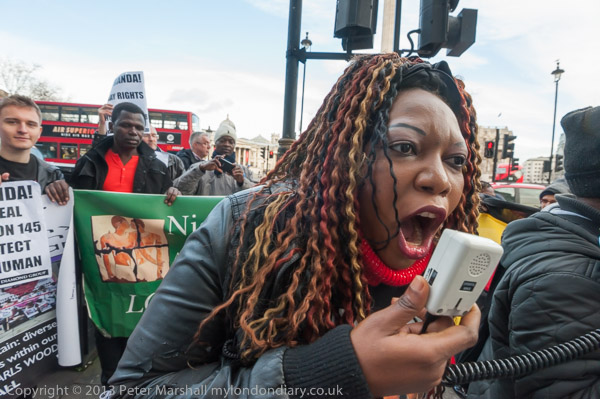
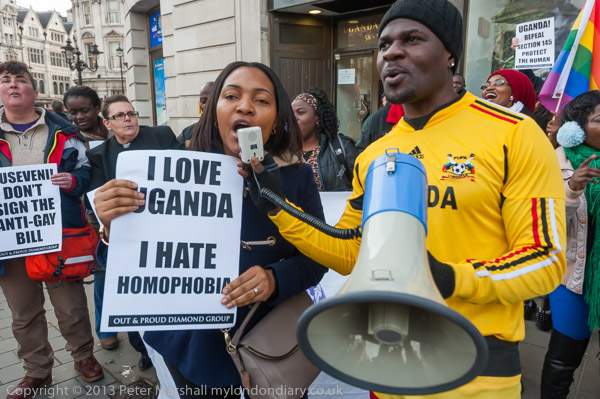
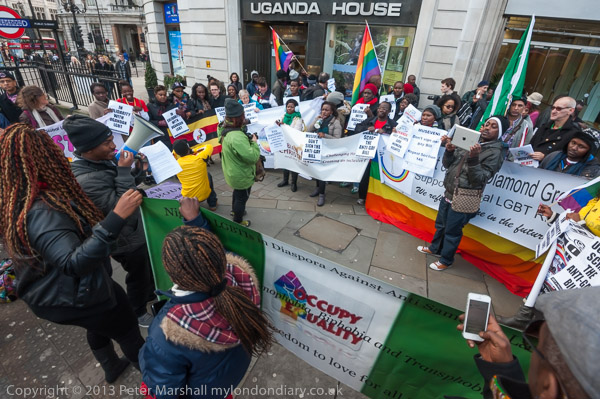
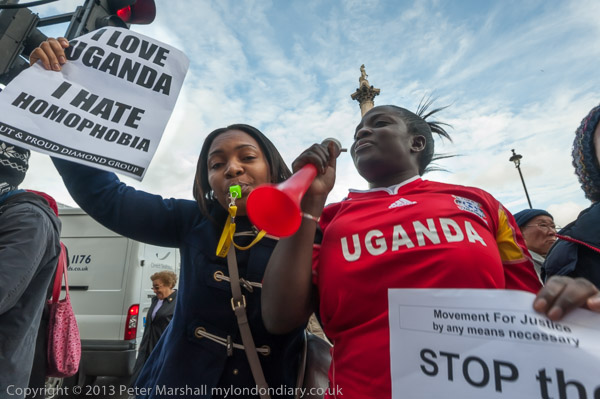
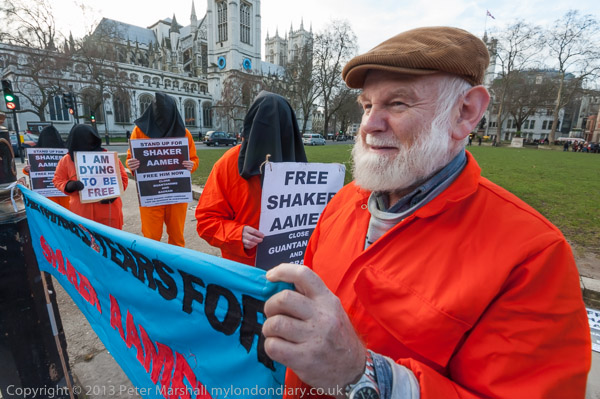
Uganda Anti-gay Law & Guantanamo: Wednesday 8th January 2014 I photographed two protests in central London, the first in front of Uganda House in Trafalgar Square against the Anti-Homosexuality Act which had been passed by the Ugandan parliament but was awaiting signature by the President, and the second in Parliament Square calling for the closure of the illegal Guantanamo torture camp and the release of UK Resident Shaker Aamer.


Against Uganda’s Anti-Gay Law – Uganda House

Uganda Anti-gay Law & Guantanamo

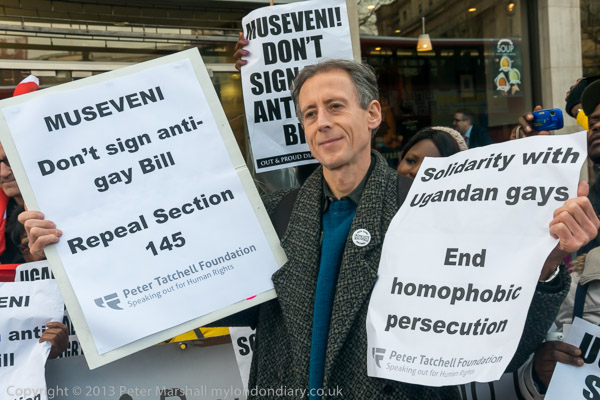
A crowd filled the pavement outside Uganda House on Trafalgar Square in a protest organised by the African LGBTI Out & Proud Diamond Group and Peter Tatchell Foundation and supported by other groups including Queer Strike, Movement for Justice, Lesbian Gay Christians, Rainbows Across Borders, the RMT, Nigerian LGBTIs and Women of Colour.

Uganda Anti-gay Law & Guantanamo

They called on President Museveni not to sign the Anti-Homosexuality Bill, (often referred to as the ‘Kill the Gays’ Bill.) Originally the Bill had called for the death penalty for what it described as “aggravated homosexuality”, but this was reduced to life imprisonment when it was passed by an inquorate Ugandan Parliament in December despite not being on the day’s order of business.

Uganda Anti-gay Law & Guantanamo
Peter Tatchell

Museveni eventually signed and the Act became law on 24th February 2014. The bill, under consideration by the Ugandan parliament since 2009 had provoked a huge amount of international condemnation and in June 2014 the US announced various sanctions against Uganda.

Uganda Anti-gay Law & Guantanamo

This Act was annulled by Uganda’s Constitutional Court in August 2014 as it had been passed without the necessary parliamentary quorum.

But in 2023, the Ugandan Parliament passed a new Anti-Homosexuality Act. Museveni passed it back to them for reconsideration when it was passed with minor amendments by a vote of 348 to 1 and he then signed it into law. It provided life imprisonment for homosexual acts and the death penalty for acts involving various groups of vulnerable people including those under 18 or over 75, disabled or mentally ill and repeat offenders or acts which transmit serious infectious diseases.

In 2024, the Constitutional Court upheld the 2023 Anti-Homosexuality Act, making a few minor changes, asserting “In defiance of international law, the judges ruled that the act does not violate fundamental rights to equality and nondiscrimination, privacy, freedom of expression, or the right to work for LGBT people.”

More about the 2014 protest at Against Uganda’s Anti-Gay Law.


Free Shaker Aamer Vigil – Parliament Square

The Save Shaker Aamer campaign mounted its first vigil in 2014 opposite Parliament calling for the Londoner’s urgent release. Held there without charge of trial since Feb 14, 2002 he was first cleared for release in 2007.
A dozen protesters in orange Guantanamo-style jump suits and black hoods lined the pavement opposite Parliament with posters and banners, occasionally walking slowly up and down to remind MPs of the need to press the US for his release. Although there has never been any evidence against him, his release and evidence of his continuing torture and the complicity in this of the British security service MI6 would greatly embarrass both the UK and US

You can read more about his case in my account on My London Diary. Eventually after years of public pressure and protests such as this he was finally released to the UK on 30 October 2015.

Free Shaker Aamer Vigil


FlickrFacebookMy London DiaryHull PhotosLea ValleyParis
London’s Industrial HeritageLondon Photos

All photographs on this page are copyright © Peter Marshall.
Contact me to buy prints or licence to reproduce.