The New Trafalgar Dispatch – 2005

Staines, Sunday 4th September 2005

The New Trafalgar Dispatch - 2005 Staines
The coach carrying the dispatch is led across Staines Bridge by the mayors of Spelthorne and Runnymede.

The New Trafalgar Dispatch: At a protest in Whitehall the previous day, I had “made the mistake of climbing up onto the small wall by the edge of the grass, which produced a nasty snapping feeling in my knee, leaving me in pain.” So on Sunday 4th September I didn’t feel up to travelling to cover events in London, and instead went to photograph this local event – part of a wider national event – in Staines celebrating the rapid journey to London after the first ship docked at Falmouth following the battle of Trafalgar and brought the news both of the victory and of the death of Admiral Nelson.

The New Trafalgar Dispatch - 2005 Staines
Actor Alex Price plays Lt John Richards Lapontiere, who brought news of Trafalgar from the battle to London

Despite limping badly and painfully I seem to have managed a very full coverage of the event – which you can still view on My London Diary. Here below is the text I wrote in 2005 and a few of the pictures.
The New Trafalgar Dispatch - 2005 Staines
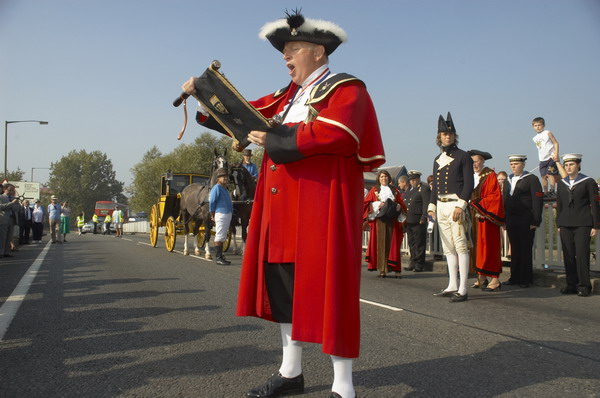
Shepperton town crier Bill Wright reads out the news while mayors, Lieutenant Lapontiere and coach wait on Staines Bridge

Nelson’s final prayer, on 21 October 1804 [the day of the Battle of Trafalgar] included a plea for God to grant victory “to my country and for the benefit of Europe in general.” He continued: “may no misconduct, in any one, tarnish it, and may humanity after victory be the predominant feature in the British fleet.” These noble sentiments were not empty words, and when the battle was over, British sailors would risk their lives to save those of their French counterparts.
The New Trafalgar Dispatch - 2005 Staines
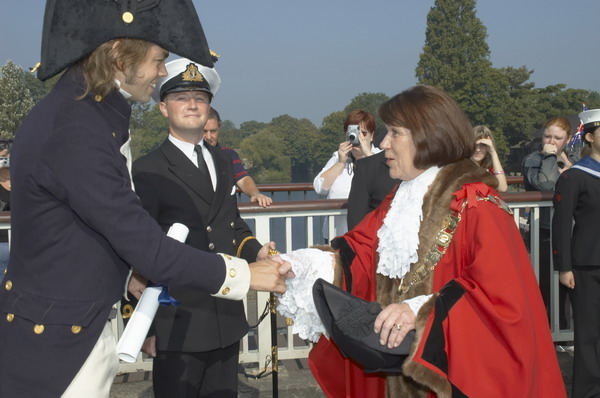
Lapontiere is greeted by Runnymede mayor, Councillor Frances Barden on Staines Bridge

I thought about the humanity towards refugees and asylum seekers currently being shown by our New Labour government during the new Trafalgar Dispatch events at Staines on Sunday and felt a sense of shame about my country.
The New Trafalgar Dispatch - 2005 Staines
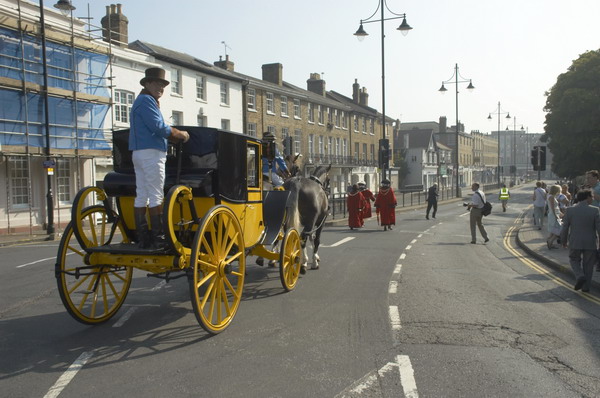
Coming into Staines – on a street built between 1828 and 1832, some years after Trafalgar

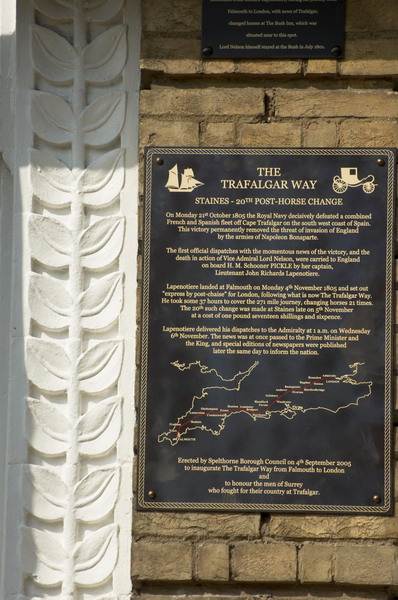
But we were celebrating greater times, although 200 years ago the events were also tinged with great sadness. Along with news of Britain’s great victory, Lt John Richards Lapontiere also brought news of Nelson’s death on his rapid voyage to Falmouth and express post-chaise journey from there to London – covering the 271 miles on land in 37 hours. One of the many places his coach picked up fresh horses was the Bush Inn at Staines, then one of the major market towns of Middlesex, and only two stages from the Admiralty in London.
The New Trafalgar Dispatch - 2005 Staines
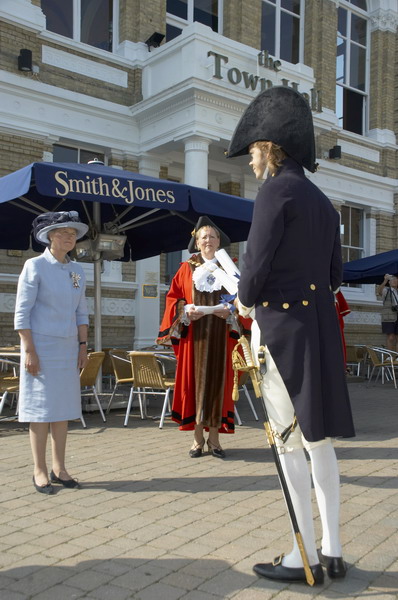
Lieutenant Lapontiere should have been very surprised to see Mrs Sarah Goad, Lord Lieutenant of Surrey, on the wrong side of the Thames in Middlesex.

The Bush is long gone, as also is the bridge across which his coach ran, but Sunday saw actor Alex Price playing the role of Lapontiere coming by coach – from Homebase just down the road (more or less on the old Staines boundary) – into Staines and onto the bridge where he was met by the Mayors of Runnymede and Spelthorne and the Lord Lieutenant Of Surrey (all women.) It was a day full of anachronism, as neither Runnymede or Spelthorne existed at the time of Trafalgar, when Staines was one of the main market towns of Middlesex.
The New Trafalgar Dispatch - 2005 Staines
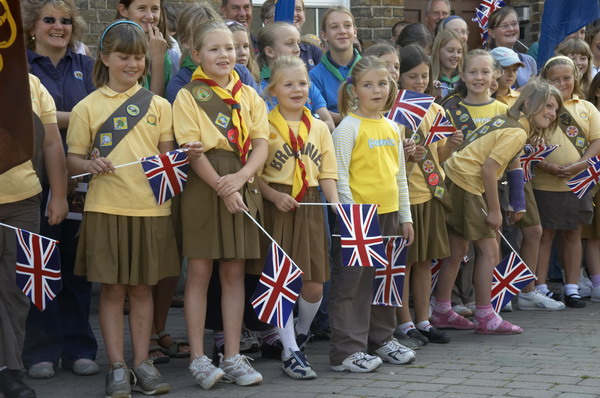
Brownies were formed in 1914 as “Rosebuds”, renamed the following year, but the flag does date from 1801.
The New Trafalgar Dispatch - 2005 Staines
The Trafalgar Way plaque and above it a smaller Spelthorne plaque were unveiled by the Mayor

After a brief ceremony on the bridge, proceedings moved on to Staines Old Town Hall, a fine Victorian building given away at a derisory price recently by the local council to the disgust of most if not all locals to become a [short-lived] pub.
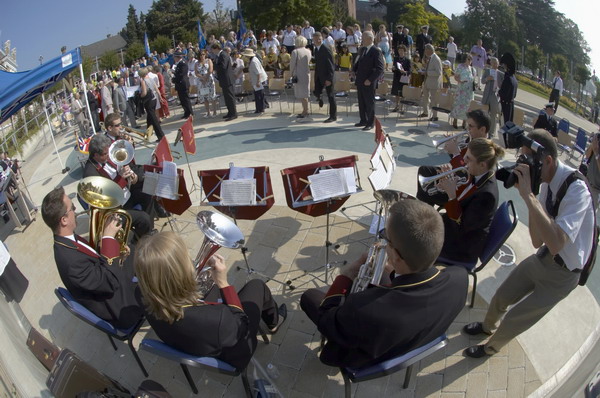
A septet from Staines Brass Band, founded as Staines United Temperance Band in 1930, provided the music for the Trafalgar service

Another short performance there ended with copies of the new Trafalgar Dispatch and a copy of the original being officially presented to the Mayors and Surrey, before a plaque was unveiled on the town hall wall and an Anglican service held at a ‘drumhead church‘ in the fountains in the Market Square – turned off for the day [and more or less ever since].)
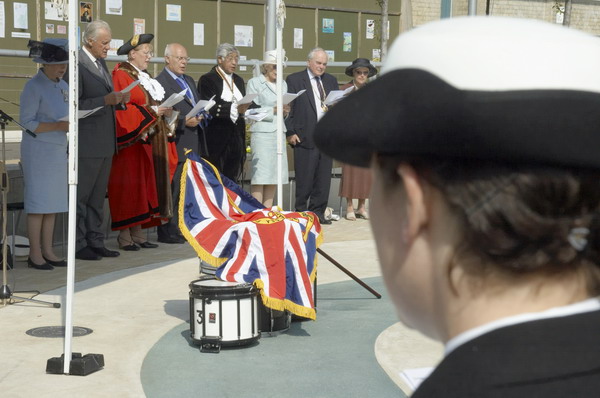
I’d stayed in Staines for this event partly because of my painful knee. I was surprised to find how much I had to move around even to cover a relatively simple event such as this. And yes, it hurt.

More pictures on My London Diary.


A few days later I added:

“A visit to my doctor’s [the following day] produced some [powerful prescription only] tablets that soothed the pain, and the advice that physiotherapy on the national health involves a wait of several months – by which time it would probably be fine anyway. Private treatment of course is available more or less on the spot, and he recommended the physios based at a local sports centre.

It’s not the cost, but the principle that stopped me ringing them to make an appointment. I grew up with the national health, orange juice and cod liver oil from the clinic, medicines and treatment when you needed them – not just if you could afford them. Prescription charges were a first step in the dismantling of the system, now more and more of it is being privatised in one way or another. National Health dentistry has more or less disappeared (and looks like going completely with government reforms next year.)

So I’m limping on, or rather trying not to limp, but get some gentle exercise without causing more damage and hoping time will heal.”

Slowly it did, and after a week’s rest I felt able to take some short walks in London and a couple of weeks later was back covering protests. But it was some months before I could walk without any pain.


FlickrFacebookMy London DiaryHull PhotosLea ValleyParis
London’s Industrial HeritageLondon Photos

All photographs on this page are copyright © Peter Marshall.
Contact me to buy prints or licence to reproduce.


Crouch End & Upper Holloway – 1989

The final post on my walk on Sunday 19th November 1989 which had begun in Highgate. You can read the previous part at A Reservoir, Flats, a Cockerel and a Café.

Gateway, Albert Mansions, Crouch Hill, Crouch End, Islington, Haringey, 1989 89-11i-61
Gateway, Albert Mansions, Crouch Hill, Crouch End, Haringey, 1989 89-11i-61

I walked down Haslemere Road and then turned down Vicarage Path, following this to Crouch Hill.

Albert Mansions, described by various estate agents as “a hidden gem in Crouch Hill” dates from 1903. Although the driveway is clearly marked ‘PRIVATE residents only‘, Vicarage Path goes past the building and emerges at the side of the left gatepost in my photograph. I clearly found this gateway more interesting than the actual mansion building where three and four bedroom leashold flats now sell for approaching a million.

House, Heathville Rd, Highcroft Rd, Crouch End, Islington, 1989 89-11i-64
House, Heathville Rd, 6, Highcroft Rd, Crouch End, Islington, 1989 89-11i-64

I walked down Crouch Hill and turned west down Ashley Rd. When I reached Highcroft Road I saw an interesting roof a short distance down and walked up to take this picture. Taken from just across the street it rather fails to show clearly the pyramidal cap to the roof, which is more evident in the previous frame (not on-line) taken of the row along this side of the street. But does give a good idea of the architectural detailing, including a fancily written date which I can’t quite read but is perhaps 1897 or 9 and a rather striking head – I wondered who was the model for this intense face. I’m rather suprised that this building does not appear to be locally listed

House, Highcroft Rd, Crouch End, Islington, 1989 89-11i-65

This locally listed house at 3 Highcroft Road was built in 1875 as the vicarage to St Mary’s Church opposite, and has rather fine porch with a somewhat ecclesiastical look. Like many of the large vicarages provided for Victorian clerics who were expected to have large families and servants I imagine it was sold off some years before I made the picture.

Houses, Hornsey Rise, Upper Holloway, Islington, 1989 89-11i-66

I returned to Ashley Road, walking past St Mary’s church without photographing it. Most of our Anglican churches seem to have been photographed time after time from the Victorian period on, not least because many vicars with time on their hands took up photography as a hobby. I seldom chose to add to the multitude.

There is a line of similar fine houses between Ashley Road and Shaftestbury Road, at 2-20 facing Elthorne Park, but I chose to photograph these because of the wall with its sculptures and irorwork in front of what I think was 6 Hornsey Rise. The wall and ironwork are still there but the figures next to the pavement have long gone. At the right of the picture you can see the Shaftesbury Tavern.

House, Hornsey Rise, Upper Holloway, Islington, 1989 89-11i-53

Hornsey Rise was developed from 1848, although it only got the name almost 40 years later replaceing the different names of various short lengths such as this. This picture gives a closer view of one of the two ornamental gates and the house , with the doorway to number 4 at the right of the image.

The Shaftesbury Tavern, Shaftesbury Rd, Hornsey Rise, Upper Holloway, Islington, 1989 89-11i-54

This pub at 534 is the last building on Hornsey Road, which becomes Hornsey Rise beyond Shaftesbury Rd. According to its local listing it “was built in 1858, by speculative builder Thomas Beall, as the area around it began to be developed. It is a handsome well-preserved building with contrasting brickwork in red and London stock, and pilasters and arches at the upper storey level.

I choose to photograph not the main pub building but its “1897 addition” on Shaftesbury Rd. However CAMRA states that the pub itself was built “in 1897 with rich wood and glasswork, so typical of the golden age of pub-building.” Looking at the pub exterior I am inclined to believe them and the current building probably replaced or significantly altered Beall’s. As they also state, “The pub was restored in 2014 from a ‘very tired’ state by the small pub chain Remarkable Restaurants Ltd“.

Shops, Fairbridge Rd, Hornsey Rd, Upper Holloway, Islington, 1989 89-11i-55

I continued walking down Hornsey Road I photographed this handsome late Victorian building at 471 Hornsey Rd on the corner with Fairbridge Road. Then it was a timber merchant with T C TIMBER on the first floor corner blind window and a rather jaunty-looking painted figure of a town crier in ancient dress looking like a poor piece of advertising clip-art in that above it on the second floor. The shop is now Hornsey Carpets and that figure now looks very washed out and on the first floor is some strange image I make no sense of.

Kokayi, Supplementary School, Hanley Rd, Upper Holloway, Islington, 1989 89-11i-56

Further down Hornsey Road I went down Hanley Road where I photographed the doorway of the Kokayi Supplementary School. A charity of this name was later registered in 1997 “To advance the education of children and young people particularly children and young people of African and Afro-Caribbean descent by the provision of a supplementary school: By the provision of advice and guidance in matters concerning their education and career development; And by such other charitable ways as the charity through its trustees may from time to time decide.” The charity was removed in 2014 as it had ceased to function.

I was at the end of my walk and made my way to Finsbury Park Station. It was several weeks before I was able to go out and take photographs again.


FlickrFacebookMy London DiaryHull PhotosLea ValleyParis
London’s Industrial HeritageLondon Photos

All photographs on this page are copyright © Peter Marshall.
Contact me to buy prints or licence to reproduce.