University of London 3 Cosas Strike

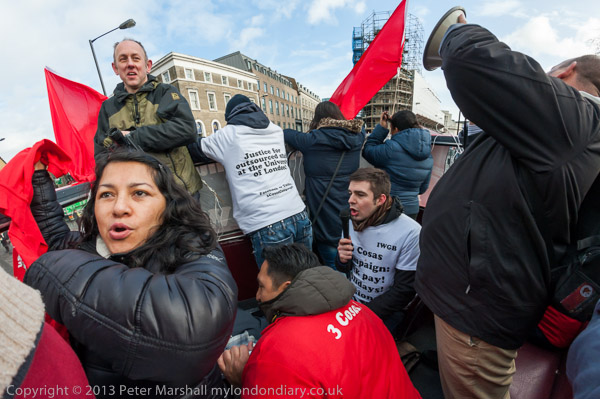
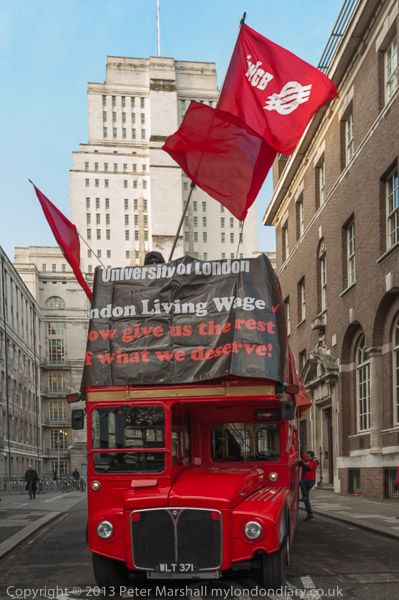
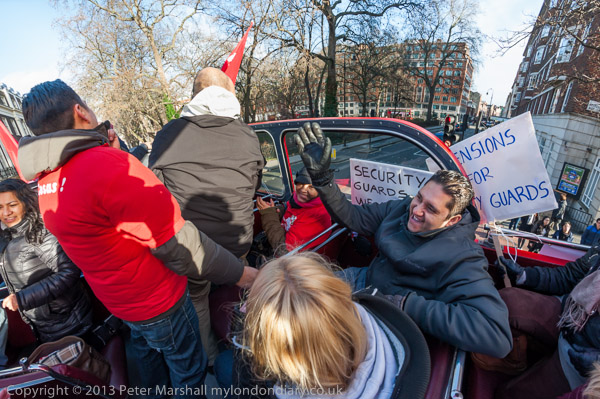
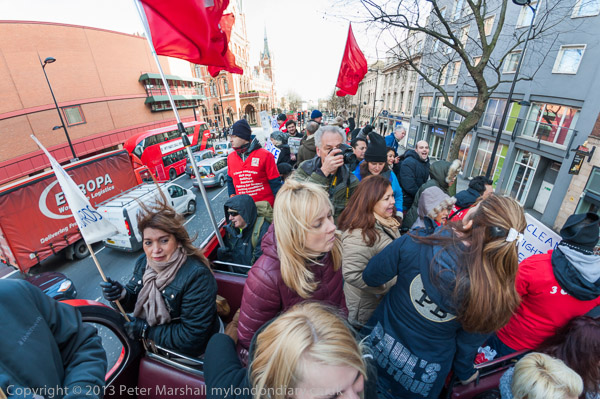
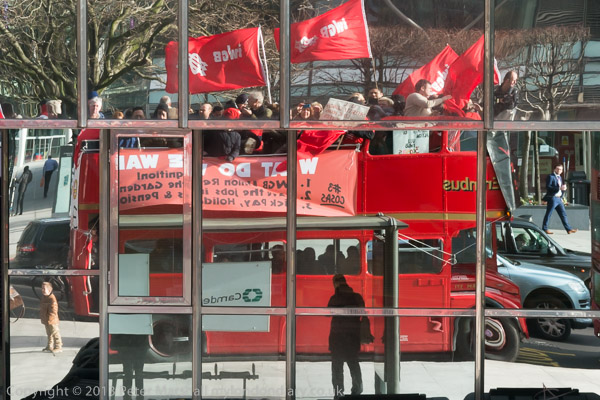
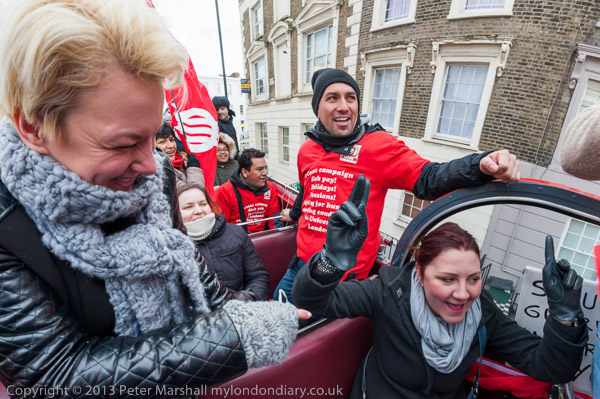
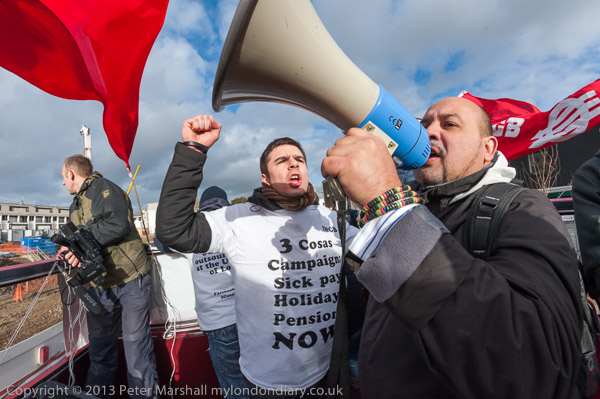
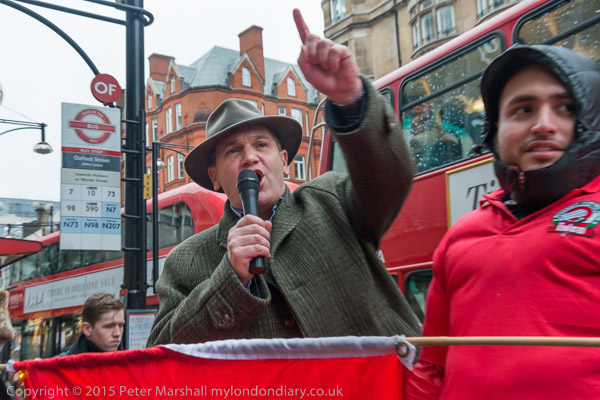
On the IWGB battlebus

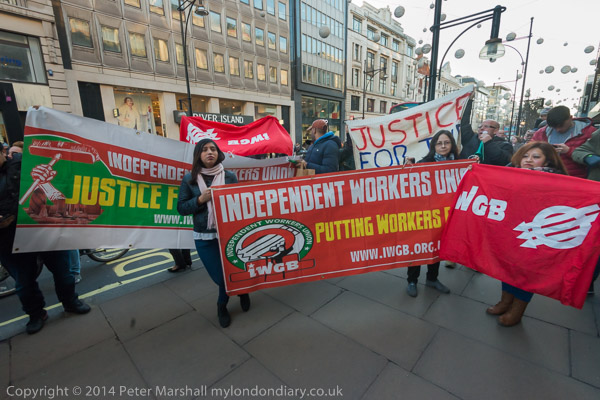
Eight years ago on Tuesday 28th January 2014 low paid workers at the University of London were on the second day of their 3 day strike. Their union had organised a day of action around London and I had been invited to come and photograph it, having photographed a number of their previous protests.

University cleaners, maintenance and security staff were demanding that the University recognise their trade union, the IWGB (Independent Workers’ Union of Great Britain) and give them better pay and conditions, comparable with other university staff they work alongside. The ‘3 Cosas’ were sick pay, paid holidays and pensions – all areas where these staff were only being given the legal minimum (and sometime not even that.)

As I wrote in 2014:

“although these workers work at the university and carry out work essential for the running of the university, the university does not employ them. Most low paid workers – cleaners, maintenance and security staff, catering works and others – at the University of London are no longer directly employed by the University, but work in the University on contracts from contractors Cofely GDF-Suez (who took over the former contractor Balfour Beatty Workplace at the end of last year.) The policy of outsourcing these workers seems largely intended to evade the responsibilities of London University towards an essential part of their workforce.”

3 Cosas’ Strike Picket and Battle Bus

It meant an early start for me, although the pickets had been outside Senate House for four hours when I arrived at 9am. Living outside London though on its edge I seldom arrive before 10am as it doubles my travel costs and I’ve never been a happy early riser. Fortunately the weather was good, a bright winter day and I’d dressed for the weather with thermal underwear, thick socks and a woolly hat, though it was still pretty chilly on top of the open-top bus.

The bus turned out to be a 1960 Routemaster which was sold by London Transport in 1986 but only converted to open-top in 2001. (I’d long thought that there was a plentiful supply of such vehicles after drivers attempted routes under low bridges, but apparently not, although a couple of bridges near where I live have had quite a few victims over the years.) Compared to modern buses, Routemasters offered a very bumpy ride with considerable vibration, and taking pictures on the upper deck required some faster than normal shutter speeds and most of the time working one-handed while clinging on with the other.

Space on bus tops is also quite small and moving around impeded both by the seats and the other riders (I think it’s a more appropriate term than passengers) and though they were very cooperative the top of the bus was pretty full. Most of the pictures I made were taken when the bus was stopped either at junctions or for short protests and my fisheye lens proved really useful.

The bus trip began at Senate House, and then began an extensive tour around central London, making a tour of various university sites where IWGB members were striking. There was a great deal of booing as we passed the Unison headquarters on Euston Road, as many of the workers had left Unison in disgust as they felt the were not supporting the demands of low-paid workers. The IWGB had intended to stop outside the offices of The Guardian newspaper, but had been held up too much by London’s traffic and drove past and on to Parliament Square.

Here we jumped off the bus and marched to Parliament where the IWGB had arranged to meet Labour MPs John McDonnell and Jeremy Corbyn for a short rally (and Andy Burnham sent a short message of support.)

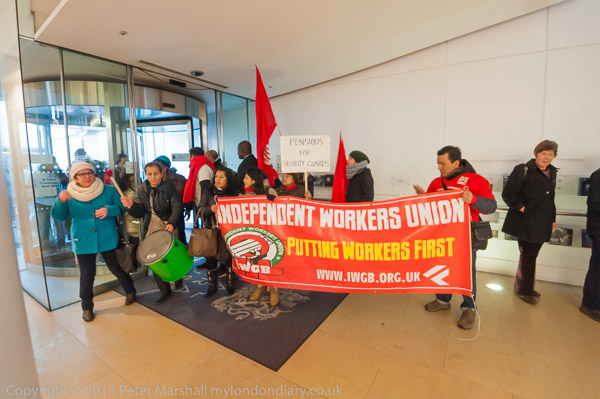
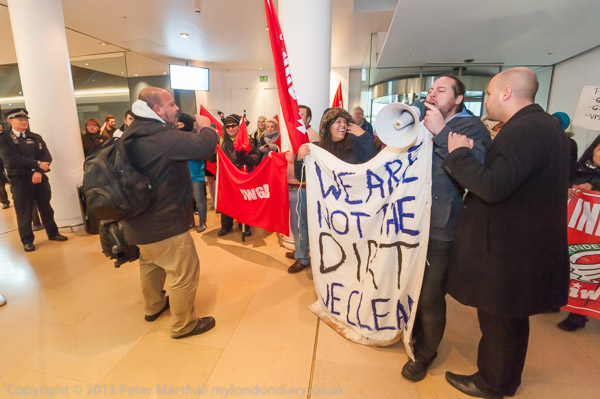
There was a short shower before the bus came to pick us up on the Embankment, taking us to a side street near the Royal Opera House. Everyone kept quiet as we got off, then rushed around the corner and into the foyer. IWGB members there had voted for a strike the following month for union recognition and the London Living Wage.

In the foyer we were met by a man who introduced himself as the Unison Health & Safety rep and told the IWGB President and the other protesters that the ROH had already agreed that the cleaners will get the Living Wage, but had not yet told them. The Opera House recognises Unison, despite the workers almost entirely being IWGB members. It’s a ridiculous situation but one which is allowed under our poor trade union laws, though not one that makes sense for either workers or employers.

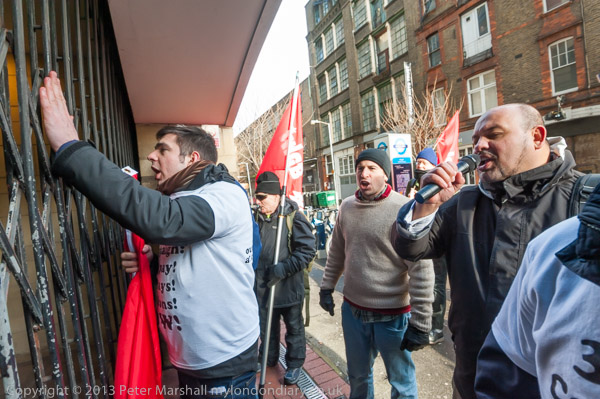
After making their views clear the IWGB members left quietly and got back onto the bus for the final visit of the day, to the Angel Islington, where Cofely GDF-Suez (who took over employing the workers at the University of London from the former contractor Balfour Beatty Workplace in December) has its offices. As at the Royal Opera House, there were plenty of police present and waiting for the protesters, but here they managed to lock the metal gates on the two entrances to Angel Square as the bus arrived, leaving the protest to take place in front of one of them in Torrens Place.

From here the bus was going on to the union offices at the Elephant and Castle and I was invited to join them for a very late mid-afternoon lunch but unfortunately I had work to do on the many pictures I had taken and had to leave them and make my way home.

IWGB at Cofely GDF-Suez
IWGB in Royal Opera House
IWGB at Parliament
‘3 Cosas’ Strike Picket and Battle Bus


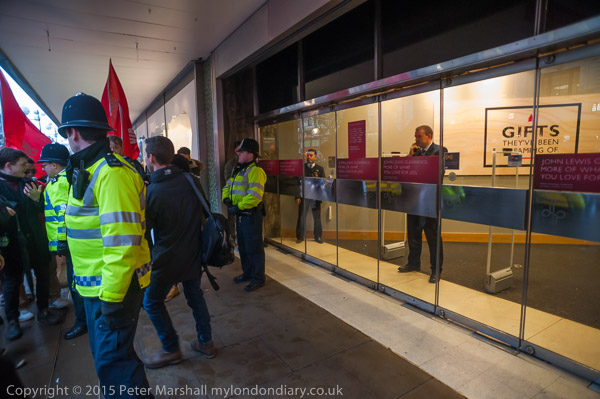
John Lewis Cleaners Protest

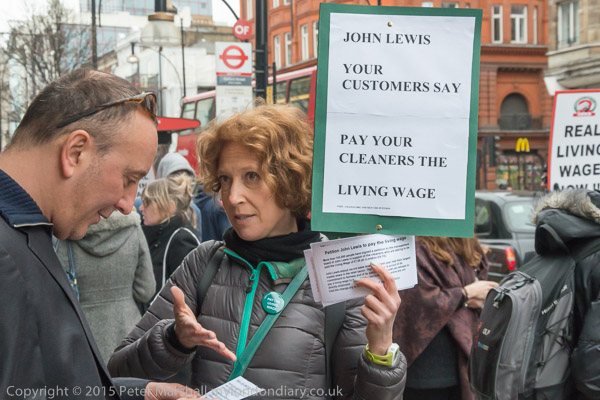
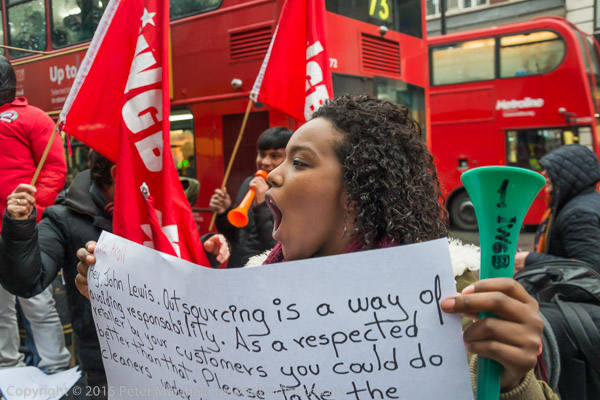
A protester holds a message from John Lewis customer Una Kroll: ‘Outsourcing is a way of avoiding responsibility’

John Lewis Cleaners Protest
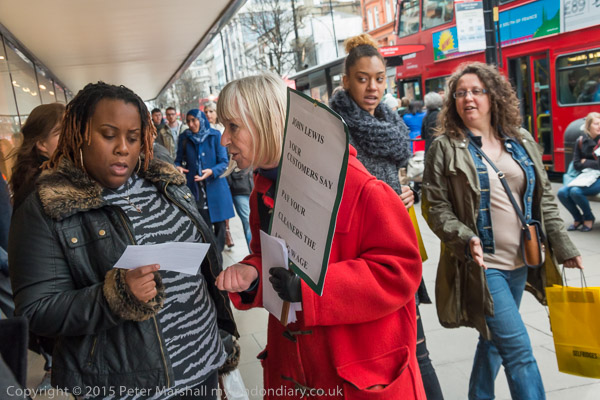
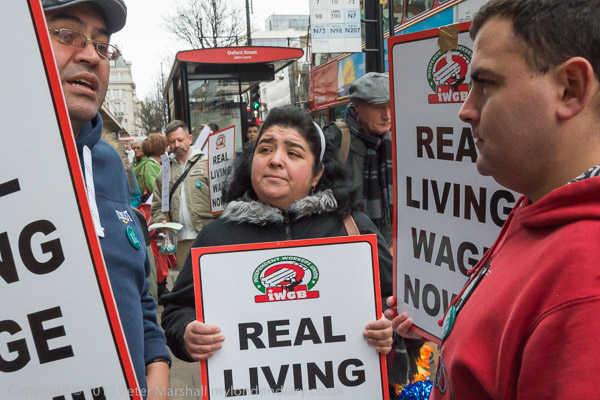
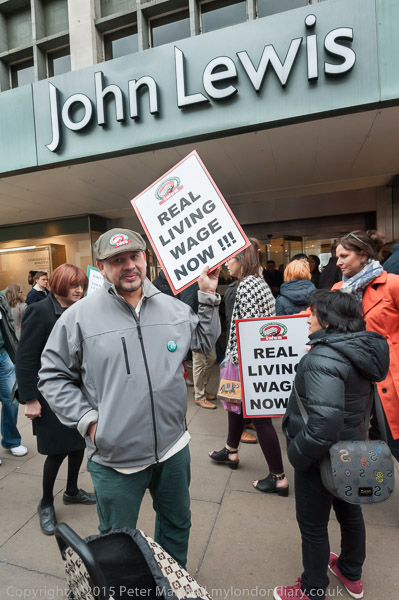
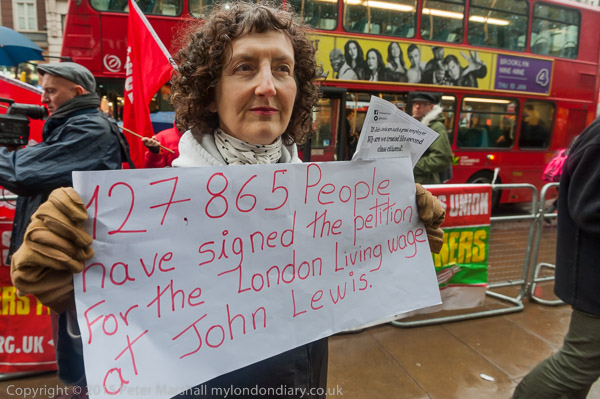
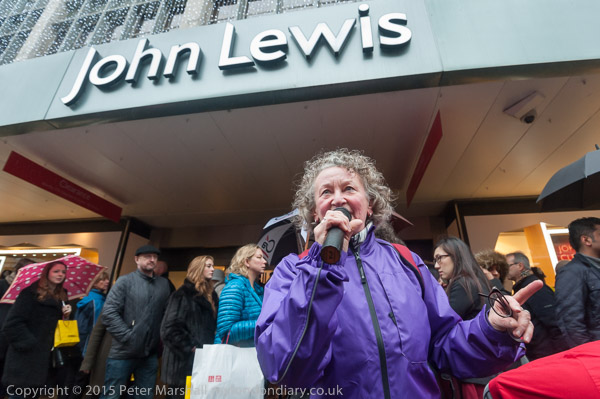
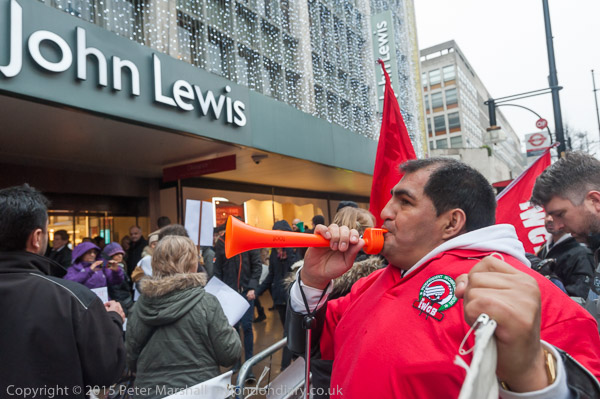
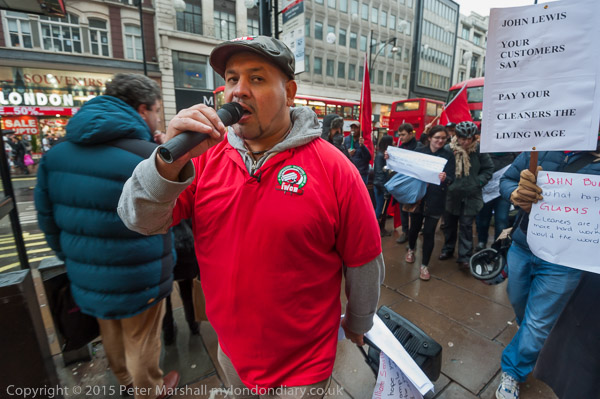
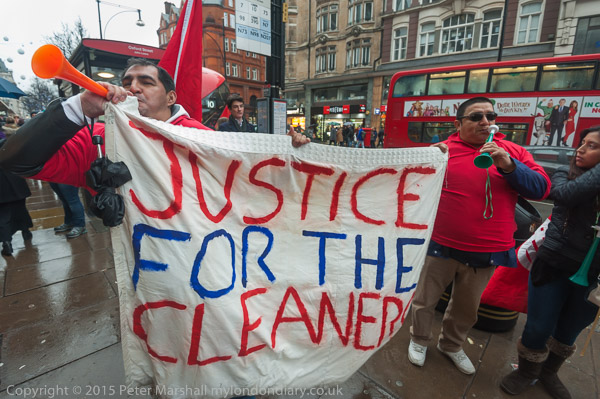
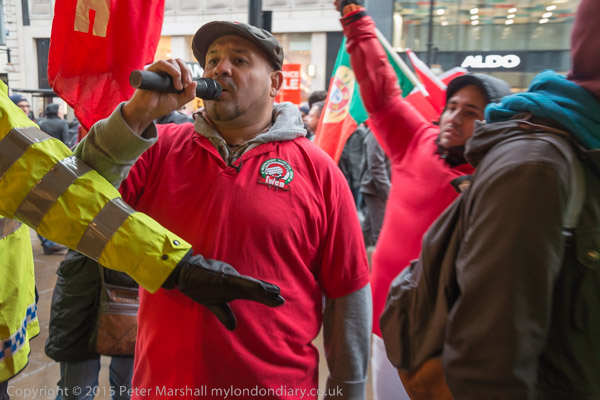
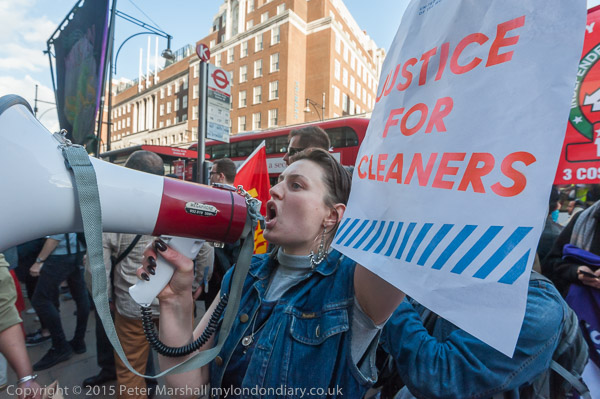
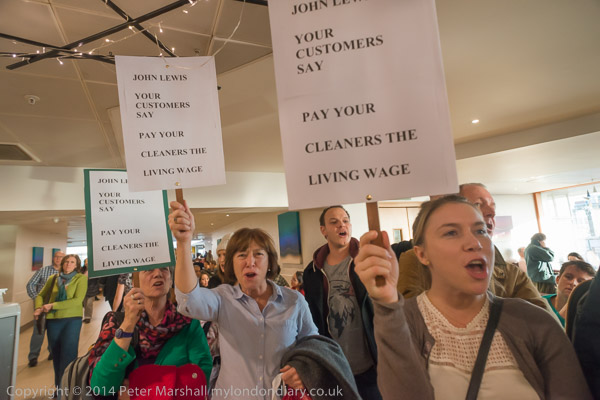
On Saturday 3rd January 2015 I met cleaners from the Cleaners And Facilities Branch of the IWGB (Independent Workers Union of Great Britain) outside John Lewis’s flagship Oxford Street store. They were there to hold a protest rally demanding the company lived up to its ethical reputation and paid the workers who keep the shop clean a living wage.

When John Spedan Lewis set up his small drapers shop on Oxford Street in 1864 he had the revolutionary idea of involving those who worked for him in the running and progress of the business, setting up a constitution that made all of them partners.

The ultimate purpose was expressed in Principle 1 of this consitution:

The happiness of all its members, through their worthwhile and satisfying employment in a successful business.
Because the Partnership is owned in trust for its members, they share the responsibilities of ownership as well as its rewards – profit, knowledge and power.

John Lewis Partnership

Green Party London Assembly member Jenny Jones, Baroness Jones of Moulsecoomb, speaking at the protest

But although staff on the counters and running other aspects of the business remain partners – and almost every year get an extra bonus payment as a share of the profits, the cleaners who work in the store who are not included in the scheme and say that in this and other respects they are being treated as second-class citizens.

Although the cleaners work in the store next to the John Lewis partners they are not employed by John Lewis. John Lewis pays a cleaning contractor to employ its cleaners, who get lower rates of pay and far inferior conditions of service than staff who are directly employed.

This lets John Lewis maintain the pretence of being an ethical employer while these people who work there get bullied, work under poor and often unsafe conditions, are paid less than a living wage and get only statutory minimum holidays and sick pay.

Mick Dooley of London TUSC

Neither John Lewis nor the cleaning contractor recognise the IWGB although a large majority of the cleaners belong to it, and neither had been willing to engage in talks about the dispute. John Lewis attempts to disclaim any responsibility for the cleaners, but the trade unionists and others who came to speak dismissed this as a a shallow attempt at deception. The work done by the cleaners takes place in the store and is essential to its running and should be properly recognised and paid.

In a protest before Christmas I had met with members of the IWGB in the restuarant at the top of the store and photographed an unannounced protest by them inside the store. This time was very different, with the protest being held on the wide pavement outside and given as much advance publicity as possible.

The union had received considerable support from John Lewis customers, with over 125,00 signing a petition calling on the company to live up to its ethical reputation and ensure that the cleaners are paid a living wage. Some of them came to protest with the union.

After speeches in front of the store on Oxford St, the protesters marched around the block containing the store which has entrances for shoppers on three sides. Although they arrived at some of these before the police and security they made no attempt to go inside, determined to avoid any trespass, though there were some arguments with police over a thin metal line in the pavement which marked the edge of the property.

Many shoppers on the street stopped briefly to find what the protest was about and most expressed support for the workers. The main doors to the store were closed by John Lewis security staff for much of the roughly an hour and a half protest.

Xmas Protests – Low Wages, Evictions, John Lewis – 2014

Three Xmas Protests – Low wages, Evictions, John Lewis – in Brixton, Mayfair and Oxford St on December 14th 2014.

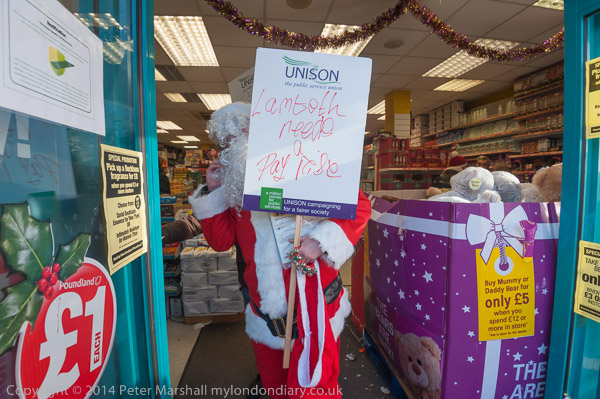
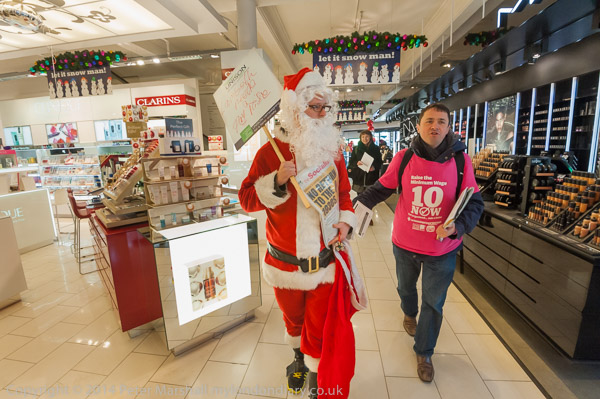
‘Santa’s Naughty List’ Living Wage
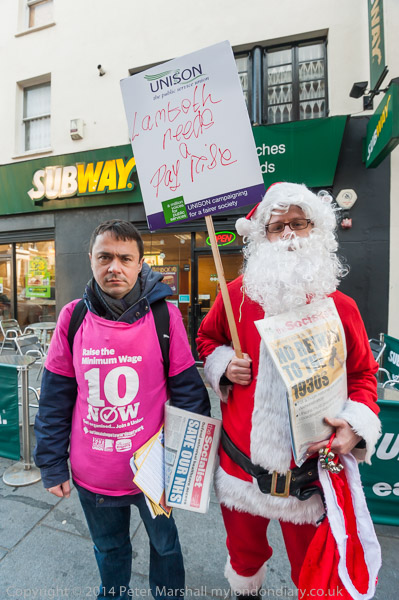
Lambeth Living Wage campaigners, led by an impressive Santa, protested in and outside shops in the centre of Brixton, handing out flyers calling for all workers to be paid a living wage. They urged shop workers to join a union and gave out forms.
While I was with them they visited department store Morleys, Subway and Poundland and they were going on to other stores in Brixton paying poverty wages. The protest was supported by Unite the Resistance, the Socialist Party, Unison (who provided the Santa costume), the Fast Food Rights Hungry for Justice campaign supported by the Bakers, Food & Allied Workers Union, BFWAWU, the National Shop Stewards Network and other groups.

‘Santa’s Naughty List’ Living Wage

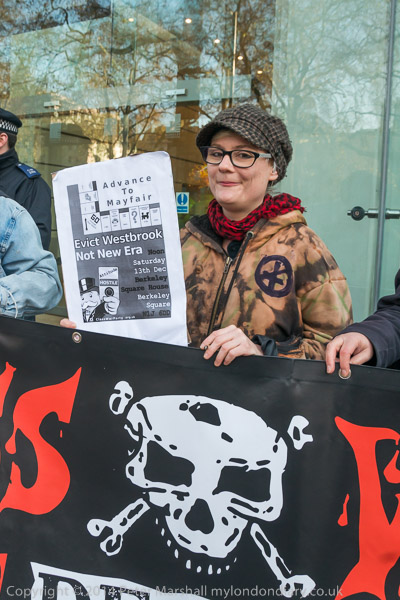
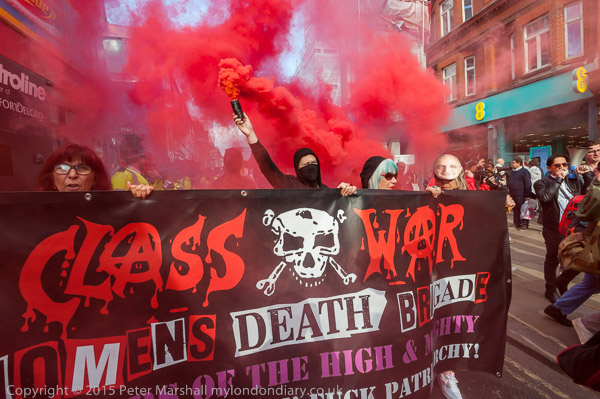
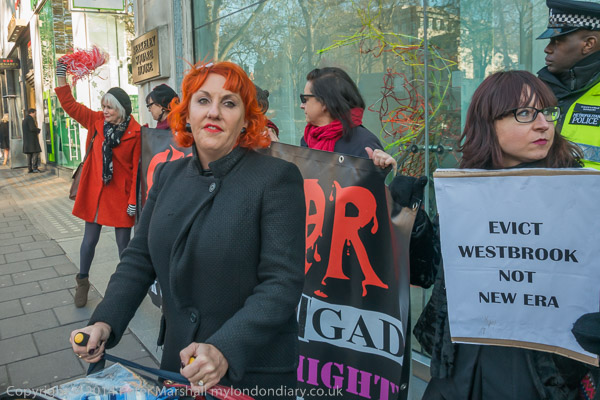
Class War: ‘Evict Westbrook, Not New Era’

Scrooge at Christmas 2014 was US property developers Westbrook Partners who were intending to evict the tenants of the Hackney New Era Estate by Christmas so they can refurbish these low rent social properties and re-let them at market rents at roughly four times the current rents. Class War and friends protested at their Mayfair offices of in solidarity with the tenants.

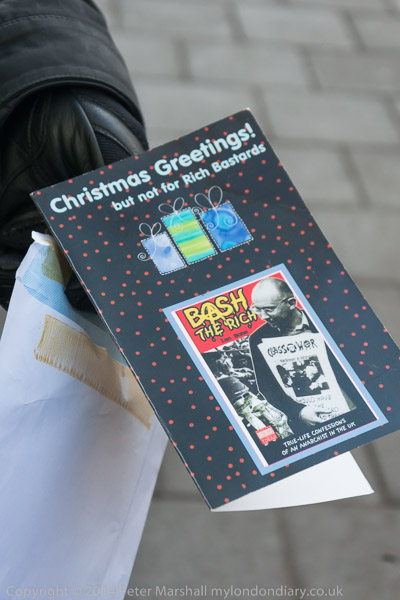
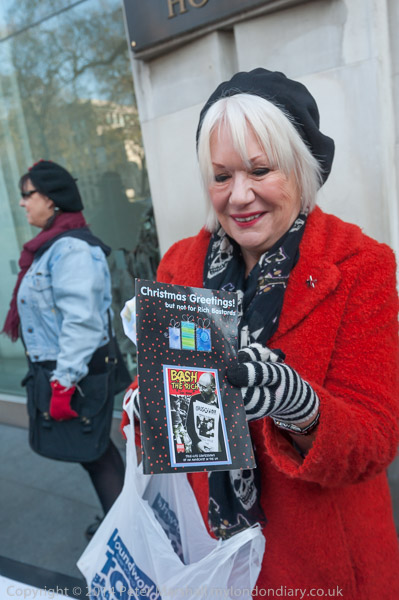
Class War came with banners and posters and a Christmas Card which they presented to Westbrook with the message ‘Christmas Greetings! – but not for Rich Bastards’ and a pictures of wrapped gifts and the cover image from Ian Bone’s autobiography ‘BASH THE RICH’. It’s an interesting read and might make a friend a good Christmas Present, available from Freedom Press at a special discount.

This was one of a number of protests by the residents, Class War and other housing activists, with a video by Russell Brand going viral and a petition with 350,000 signatures that led to Hackney Council entering into talks with Westbrook and resulted in the estate being sold to the affordable housing group Dolphin Living.

Class War: ‘Evict Westbrook, Not New Era’


Cleaners Xmas Protest in John Lewis

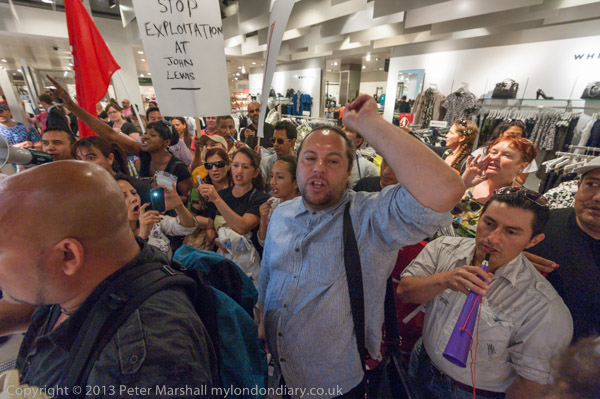
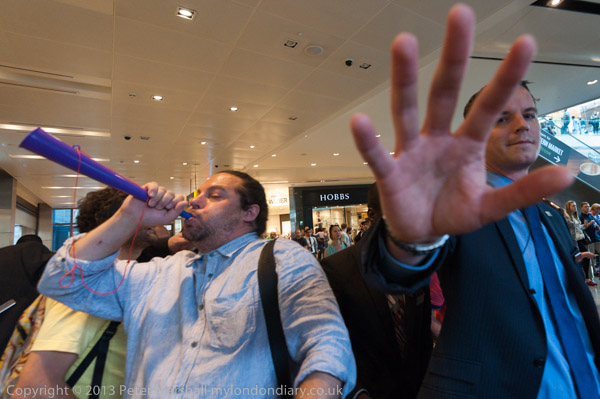
Many shoppers who can afford it go to John Lewis to buy Christmas presents, but members of te IWGB trade union and supporters including some John Lewis customers were there not to buy gifts but calling for the London Living Wage for cleaners there and an end to their treatment as second-class citizens. Many of the Christmas shoppers applauded their noisy protest.
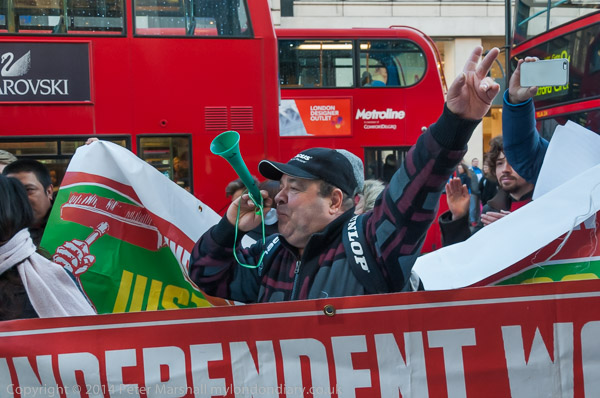
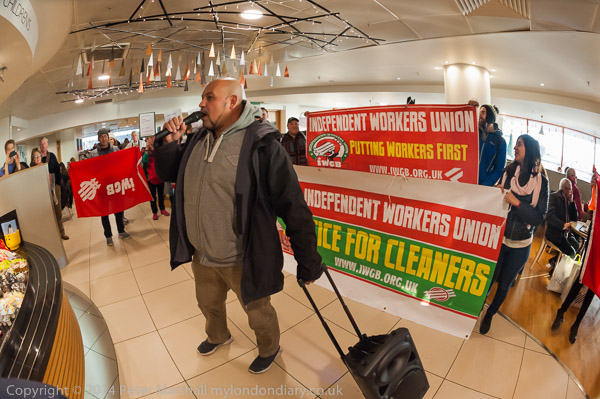
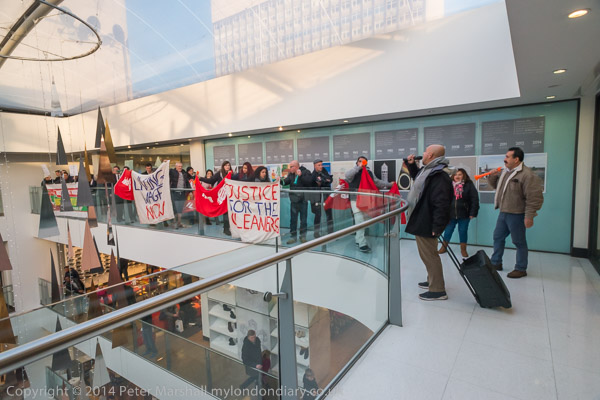
I met the cleaners on the top floor of the store where they had gathered in the restaurant before getting out banners and flags and a megaphone, with IWGB organiser Alberto Durango used to inform customers why they were holding the protest.

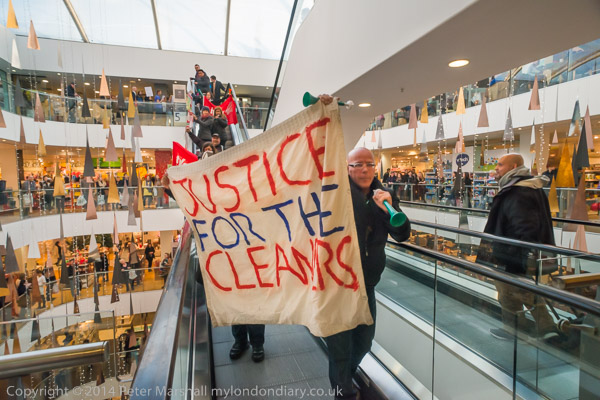
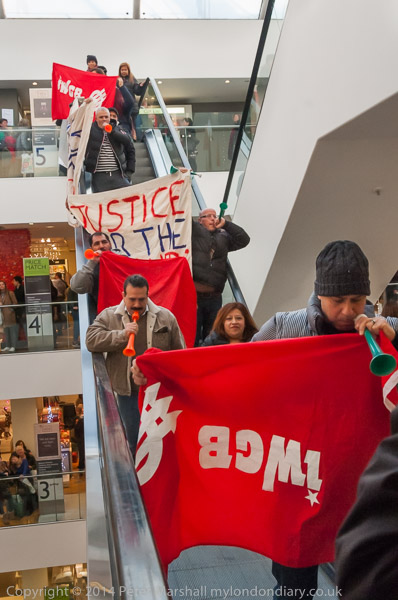
The together with a group of John Lewis customers they slowly and loudly made their way around the top floor to the escalator, moving carefully through the gangways to avoid any damage.

They made their way down floor by floor, pausing on the balconies to display their banners.

John Lewis security staff and managers met the protesters and asked them to stop protesting and leave the store. They continued their way protesting until they reached the ground floor, where police stopped them from leaving. Here the situation became confused, with a great deal of unnecessary pushing by the police which blurred many of the pictures I made. The protesters were trying to get out, store security was pushing them out and the police were pushing them back. Eventually most of the protesters managed to get past the police and the protest continued on the pavement outside. The protest inside the store had been totally non-violent for a little over a quarter of an hour and had the police not decided to push the protesters back they would simply have walked out.

A police officer made an attempt to seize the amplifier the protesters were using, but they held onto it and eventually he gave up. At least one person was arrested and carried out of the store by police, though I think charges were later dropped.

Cleaners Xmas Protest in John Lewis


Low Pay, Lousy Conditions. 3rd Aug 2013

IWGB are harassed by Westfield security after their protest in John Lewis

The two events I covered on Saturday 3rd August 2013 both concerned the fight to get decent wages and conditions for low paid workers in London, something which has largely been left to the left wing and grass roots unions to fight for rather than the big trade unions or the Labour Party.

Outside Sports Direct in Oxford St

The two major ways that low paid workers are cruelly exploited in modern Britain are through zero-hours contracts and outsourcing, and these were at the heart of the two protests.

Security stop protesters from going down the escalator in Sports Direct

The first, at Sports Direct in Oxford St called on the company to abandon the use of zero-hour contracts which deprive all their 20,000 part-time workforce (over 85% of staff) sick pay, holiday pay and other employment rights.

The protest continues inside Sports Direct

Zero hours contracts, as I explained on My London Diary “are a peculiar legal casuistry that in essence denies the whole concept of a contract as normally understood, agreements without substance which gravely disadvantage workers … Although they give no guarantee of any income, they oblige the workers to be available for work at the employer’s whim, making it impossible for them to take on other work.”

IWGB get out flags, placards and banners on the top floor of John Lewis

All the advantages are for the employer who has a contract which imposes great constraints on workers while denying them the employment rights which are a part of normal employment and leaving them open to the whims of managers as to whether they work or not. A limited reform in 2015 prohibited terms in them which prevented people working for other employers, but if that leads to them being unable to work when the employer demands them to, they may still find their hours very much reduced in future or their contracts terminated.

And begin their protest in John Lewis in Stratford Westfield

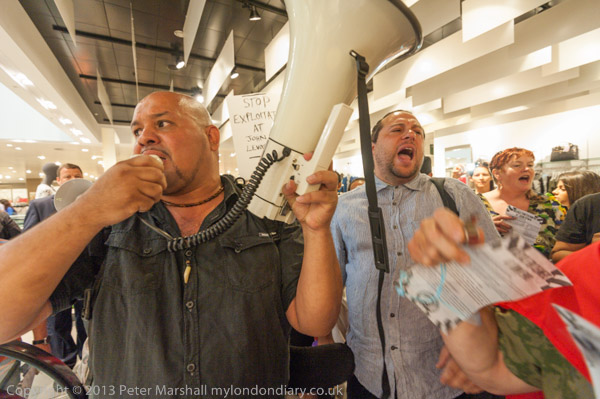
The protest was a noisy one and after around 50 minutes handing out leaflets and speaking to shoppers on the street outside, they surged into the small street level area of the shop, where they made no attempt to push post security men who stopped them at the entry to the escalator leading down to the main store. They continued the protest inside the store being careful not to cause any damage. After around five minutes one of the police officers who were watching came to talk to one of the leading protesters and was told they would leave shortly, and after a few more minutes they did, ending the protest on the pavement a few minutes later.

They take the escalator to continue the protest on the floor below

I made my way to Stratford to join the IWGB union who were making a surprise visit to protest inside the John Lewis store in Stratford Westfield. The cleaners there are outsourced to sub-contractor ICM of the Compass Group, who had recently announced pre-tax profits for the year of £575 million. They pay the cleaners £6.72 per hour, considerably less than the London Living Wage of £8.55 an hour set by the GLA and backed by the London Mayor.
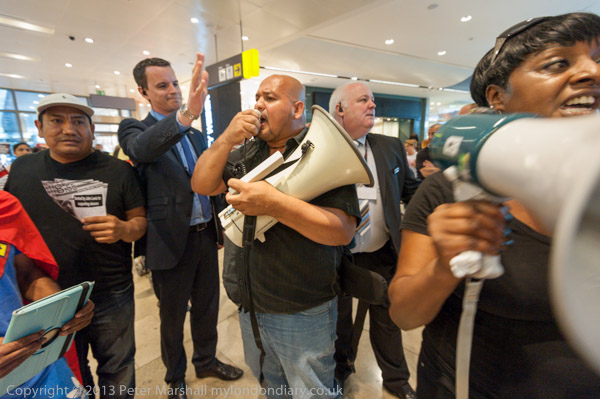
Everyone in John Lewis could hear the protest and stopped to look and listen

Outsourcing enables John Lewis to distance itself from the low pay and poor conditions of service of these workers who share the workplace with the much-lauded John Lewis ‘partners’, who as well as higher pay and better benefits, also get a share in the company’s profits, enabling John Lewis to claim it is a ‘different sort of company’ with a strong ethical basis, but still leave its cleaners – a vital part of its workforce – on poverty wages.

I met the cleaners outside Westfield and walked with them through the shopping centre to John Lewis at its far end, trying with them to look inconspicuous. In the store we went up to the cafe area on the top floor where they got out banners, placards and a large megaphone from their bags and then proceeded to walk around in a noisy protest.

They then took the escalator to the floor below and walked around that making the case for a fair deal for the cleaners to management and customers. Among those protesting (centre, above) was a man who had been a ‘partner’ in the Westfield store and was dismissed after he gave an interview to The Guardian supporting the cleaners’ case for equal treatment, and he was greeted by many of his former colleagues on the shop floor.

I get told I can’t take photographs

After protesting on each floor of the store, there were a numbber of final speeches, including one by the dismissed ‘partner’, on the ground floor before the group left, going out into the Westfield Centre in front of John Lewis. Here they were met by the centre manager and security staff who tried to stop the protest, with some pushing them (and me) around. Here I was told I was not allowed to take pictures, but took little notice. Very slowly we all made our way out of the centre by the nearest exit, still followed by Westfield security, and were met by two police officers who were told the protest was finishing.

Many more pictures at:

Cleaners in John Lewis Westfield
End Zero Hours Contracts – Sports Direct


All photographs on this and my other sites, unless otherwise stated, are taken by and copyright of Peter Marshall, and are available for reproduction or can be bought as prints.


Cake, Yacht and Dodo

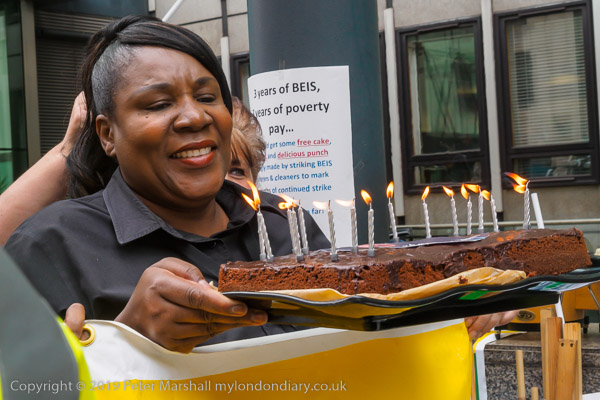
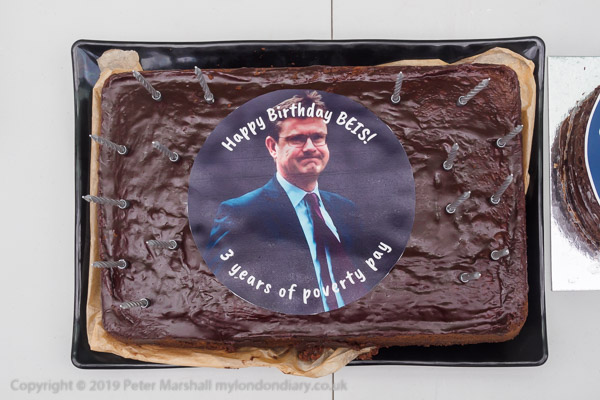
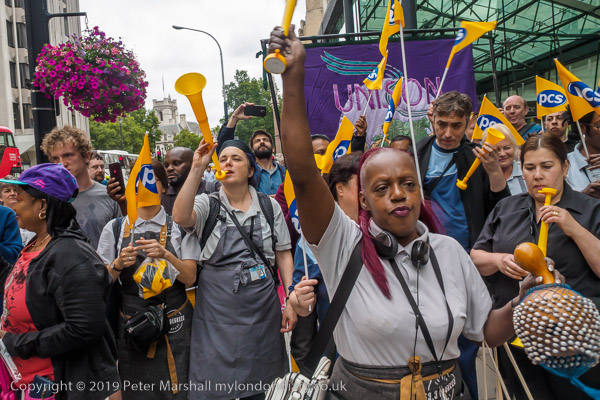
The cake came outside the Department for Business, Energy and Industrial Strategy (BEIS) where PCS members who work as cleaners and catering workers were beginning the first ever indefinite strike at a government ministry, demanding they be paid the London Living Wage, and get decent conditions of employment.

It was the third anniversary of the founding of the BEIS, and also the third anniversary of the campaign to get the workers there decent pay and to be employed directly by the BEIS, rather than outsourcing companies ISS and Aramark whose only concern is cutting costs to the bone by exploiting the workers so they can undercut competitors for the contracts and make profits at the workers’ expense.

A crowd of around a hundred supporters was there to cheer the strikers when they came out of the BEIS to begin their strike and there were speeches from trade unionists including PCS General Secretary Mark Serwotka, RMT General Secretary Mick Cash, and UCU’s Jo Grady as well as then Shadow Chancellor John McDonnell MP and some of the BEIS workers. I did manage to get a piece of the cake before I had to leave for the Royal Courts of Justice.

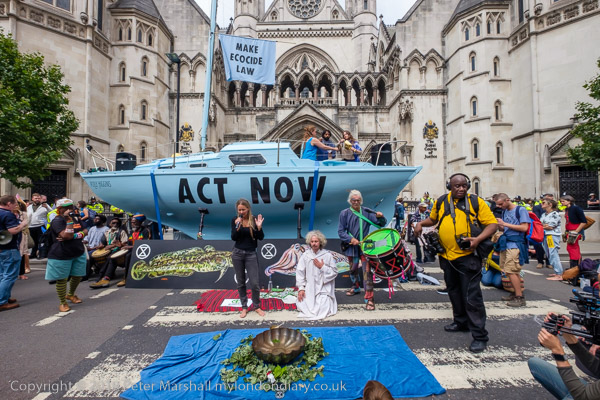
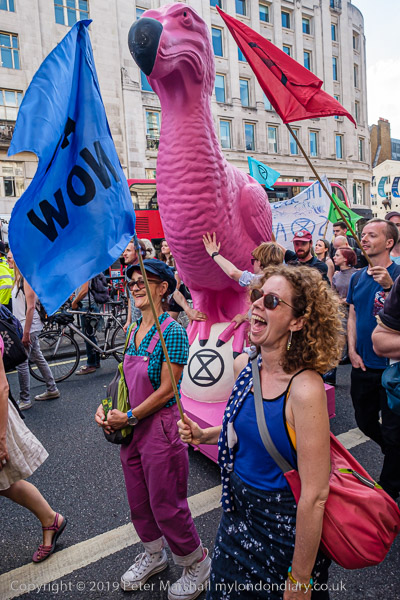
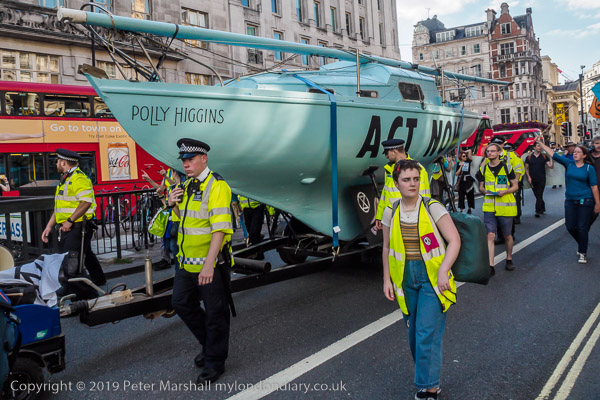
Extinction Rebellion had brought the yacht to to court to begin their ‘Summer Uprising’, another series of protests in five major cities against the criminal inaction by the government on climate and ecological collapse. The yacht was named Polly Higgins after the Scottish barrister who fought for years for an Ecocide Law and had died of cancer 3 months earlier, only 50.

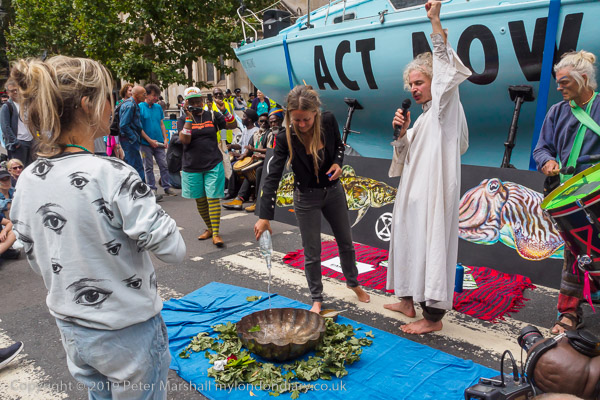
When I arrived some kind of new age ceremony was taking place with people bringing water from across the country to pour into a large bowl and a Druid celebrant in long white robes. It’s one of the kind of things that makes it hard for many to take XR seriously as a movement.

But of course it is serious and the crisis that we face is existential. An ecocide law would be a powerful way to restrain some of the worst excesses of companies that are driving us to extinction. There were some good speeches at the event, with some very clear thinking, but also a few which made me cringe a little.

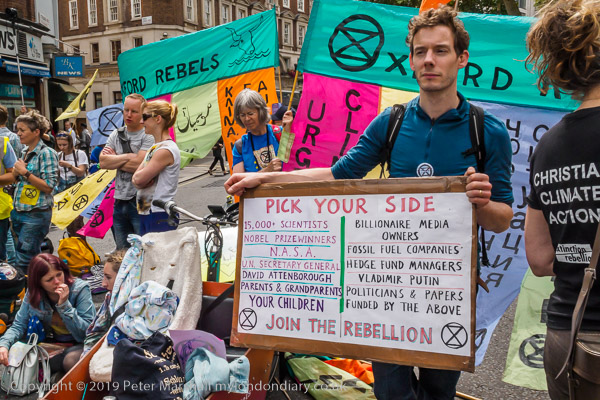
Eventually it was time to march, with the pink Dodo and the yacht, making our way across the river towards Waterloo where XR was to set up a camp on Waterloo Millenium Green.

There really is a climate and ecological emergency, with too many species going the way of the dodo, and we do need governments to tell the truth and make real and difficult actions to halt what seems an inevitable slide into irreversible heating which will make the world uninhabitable for many species, probably including our own. It’s time to end the kind of lip-service which has our government setting targets long into the future while ramping up disastrous policies like Heathrow expansion, road-building and coal mines.

The yacht went with them at the back of the procession, which halted for some time to block Waterloo Bridge, remembering the many arrests there in the previous XR protests, before continuing. It was then stopped by police on Waterloo Rd, causing far more rush hour traffic chaos than necessary by completely blocking the Waterloo roundabout. Eventually they were allowed to continue and occupy the green space they were heading for, but by that time I had left and walked into Waterloo station to catch my train home.

XR Summer Uprising procession
XR call for Ecocide Law
BEIS workers begin indefinite strike


All photographs on this and my other sites, unless otherwise stated, are taken by and copyright of Peter Marshall, and are available for reproduction or can be bought as prints.


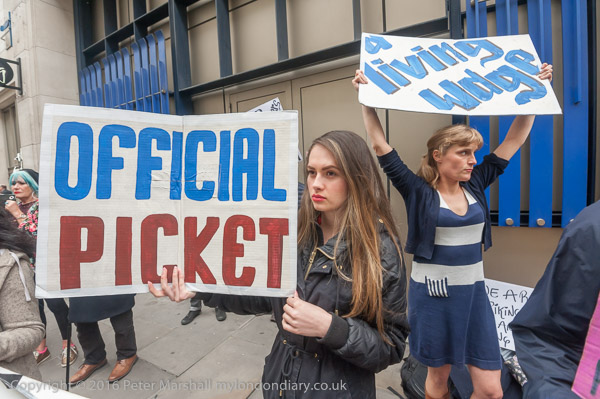
UVW at Wood St – 29 June 2016

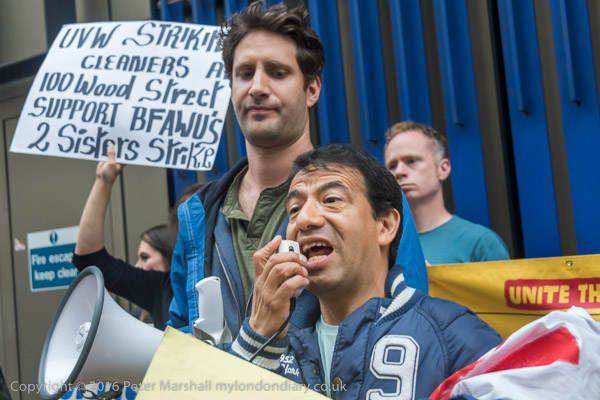
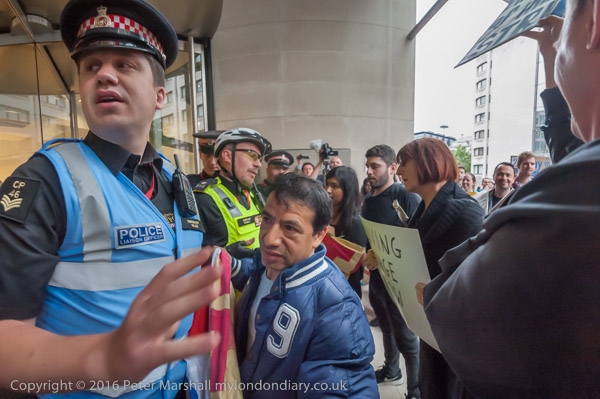
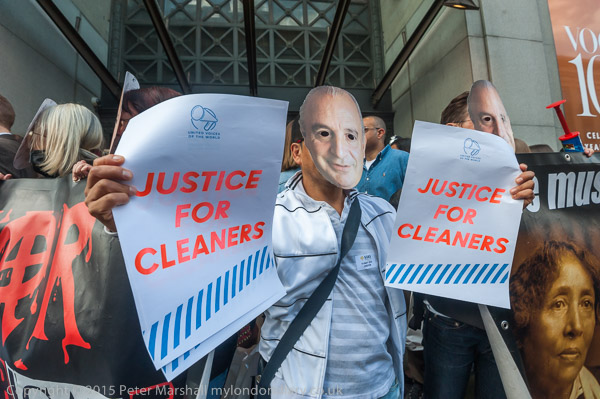
The strike and protests organised by the United Voices of the World union against anti-union cleaning contractor Thames Cleaning who employed the cleaners at the 100 Wood St offices in the City of London, managed by CBRE and mainly let to Schroders and J P Morgan is a good example of one of the things the current Police, Crime, Sentencing and Courts Bill is aiming to prevent.

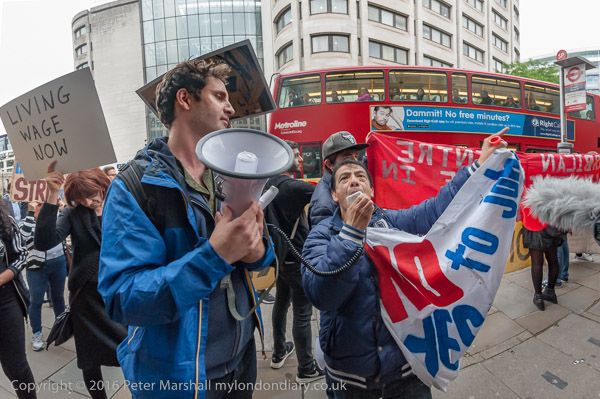
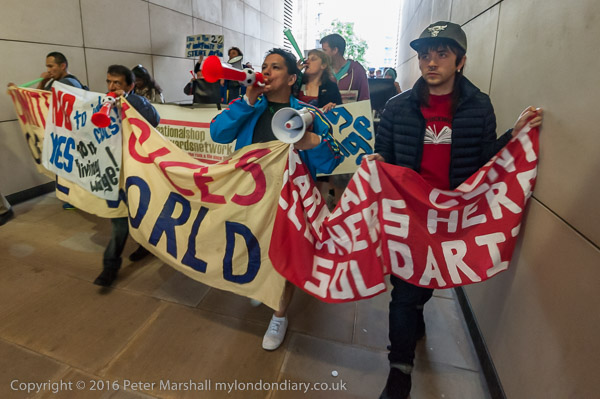
The UVW use loud rallies and protests outside workplaces (and sometimes in their foyers) to shame employers who are exploiting low paid workers, many migrants, into talking to the union. These workers, often employed by small and intensely anti-union companies, are often on minimum legal rates of pay, well below the London Living Wage and usually on the statutory minimum (and minimal) conditions of service – and sometimes even have problems getting these.
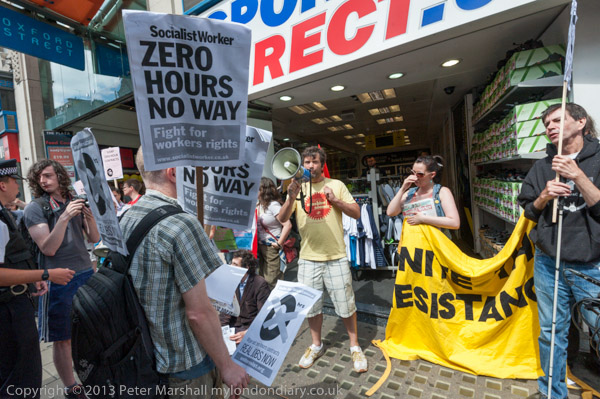
Outsourcing of low paid work such as cleaning is widespread, and contractors get the contracts by cutting costs – such as wages and conditions of service – and also by using bullying management to over-work their employees. Often too they cut costs by ignoring safety issues and failing to supply protective clothing and other essential safety material.

The UVW strike at Wood St was the longest industrial dispute in the history of the City of London, and it continued after Thames Cleaning had agreed to pay the London Living Wage for some days until they also agreed to re-instate the two workers who had been sacked. These pictures come from a rally on day 22 of the 58 day strike.
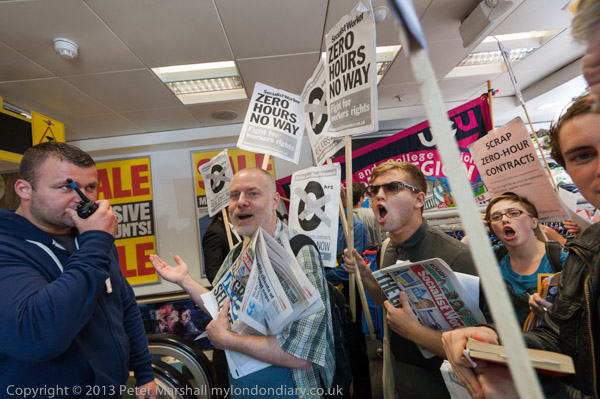
The strike was only successful because of the continuing pressure provided by loud protests such as this one, which made the companies working in the offices very aware of what was happening and made them and the building owners put pressure on the contracting company to meet the union and agree to their demands. Protests such as these, by the UVW and other grass-roots unions including CAIWU, the IWGB and a few branches of major unions have been successful in getting many of London’s lowest paid workers a living wage.

The PCSC bill, if it becomes law, will make these activities illegal. Already under existing laws, the company was able to take legal action to try and get an injunction to stop the strike. Although this failed it did get strict conditions put on the UVW’s actions at Wood St, and landed the union with crippling legal costs. Fortunately many supporters came forward with donations.

I came to take pictures on a number of occasions during the strike, which you can find on My London Diary. These pictures are all from Day 22: UVW Wood St Strike continues.

London 14 May 2016

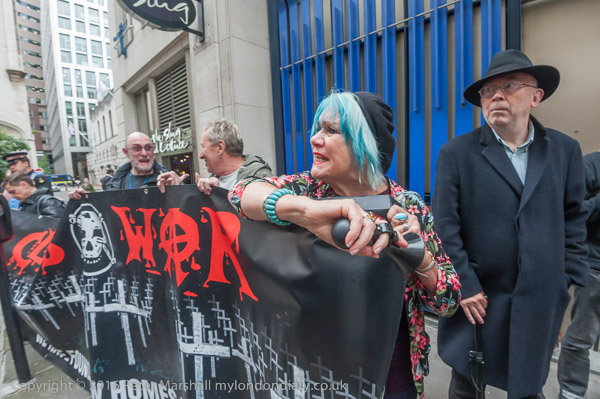
Class War at UVW protest against Topshop sacking and suspensions of cleaners

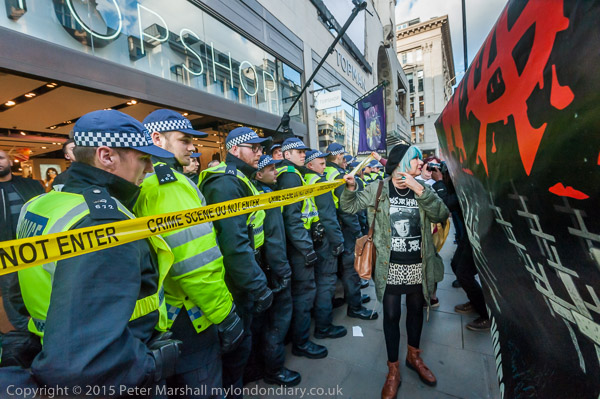
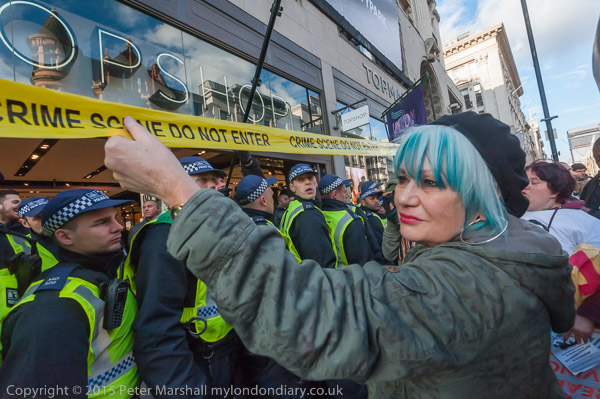
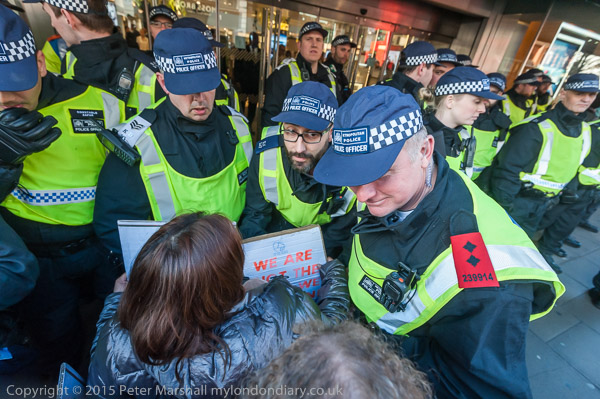
May 14 has always been a special day for me, and five years ago I celebrated my birthday on the streets of London photographing various protests around town before going home to a more private event. The day’s work ended for me on Oxford St, where the United Voices of the World union were protesting against Philip Green’s Topshop after members who work as cleaners were suspended and one sacked for their union activities – demanding the London Living Wage. The protest was supported by other groups including Class War, cleaners from the CAIWU and other trade unionists including Ian Hodson, General Secretary of the BWAFU and Shadow Chancellor John McDonnell. Although Philip Green makes millions, the cleaners were on the national minimum of £6.70 per hour, nothing like a enough to live on in London.

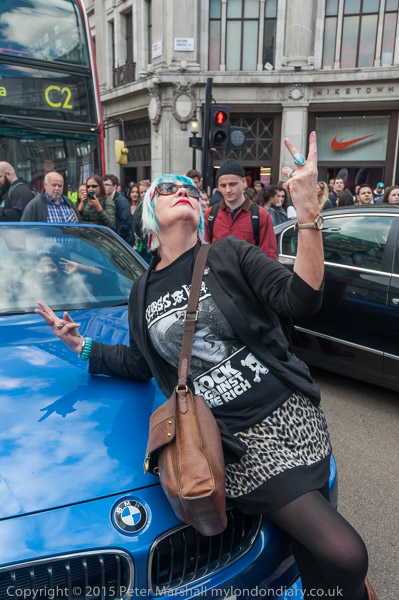
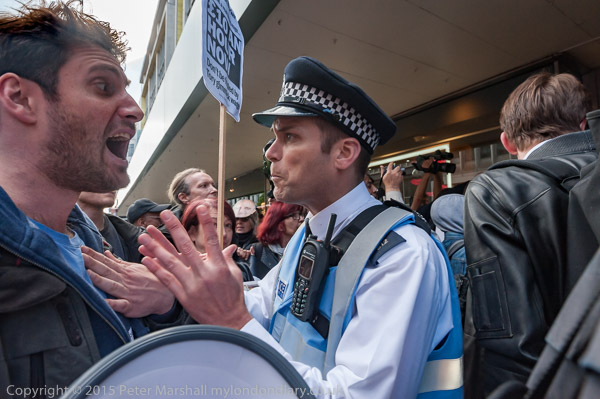
Police were out in force to prevent the protesters entering the Topshop store and there was a noisy protest on the pavement for some time facing the line of police before Class War led the protesters into the centre of the road to block Oxford St.

Police tried to clear the road, and began threatening arrests and the protesters decided to march west down Oxford St, briefly blocking Oxford Circus

before stopping to protest outside John Lewis, where the UVW have been campaigning for several years to get the cleaners recognised as a part of the workforce with similar respect and conditions of service to other John Lewis staff.

There were heated arguments as police manhandled some of the protesters there, but things calmed down a little and the campaigners moved on for a final protest outside the Marble Arch Topshop.

Things seemed to be coming to an end and I was late for dinner so I hurried away.

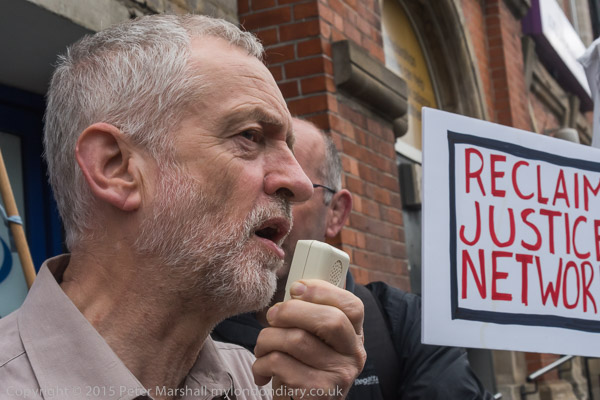
My day’s work had begun in Holloway, where Islington Hands Off Our Public Services, Islington Kill the Housing Bill and the Reclaim Justice Network were holding a rally and march to HMP Holloway, demanding that when the prison closed the site be used for much-needed social housing and community facilities, rather than for expensive private flats. Local MP and Labour Party leader Jeremy Corbyn rode up on his bike to speak at the rally.

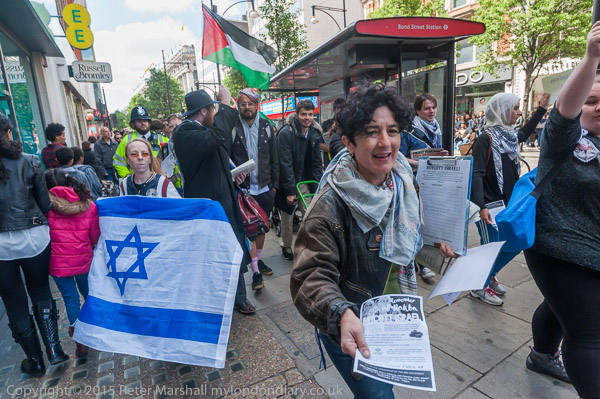
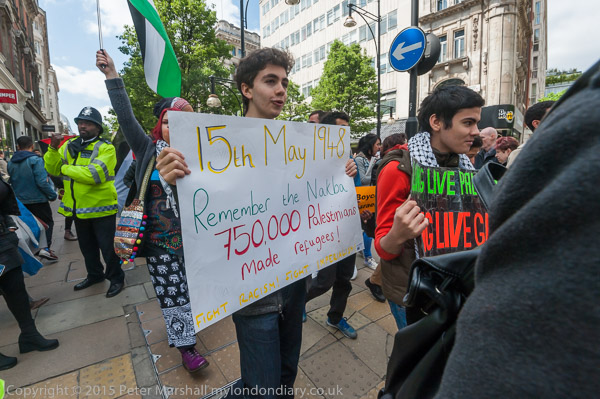
I moved on from the rally at the end of the march outside Holloway Prison to Oxford St, where the Revolutionary Communist Group and friends were reminding shoppers of the continuing oppression of the Palestinian people, and opposing attempts to criminalise and censor the anti-Zionist boycott, divestment and sanctions (BDS) movement. The rolling picket urged shoppers to boycott stores which support and fund Israel, including Marks and Spencer, and stopped for brief speeches in front of some of them for short speeches.

A small group of militant Zionists had come along to wave Israeli flags and shout insults at them. The protesters (who included several Jews and some Palestinians) made clear that this was not an anti-Semitic protest but against some actions of the Israeli government and it took place the day before Nabka Day, the ‘day of the catastrophe’, remembering when roughly 80% of the Palestinian population were forced to leave their homes between December 1947 and January 1949, and later prevented by Israeli law from returning to their homes, or claiming their property. This year the attacks on Palestinians in Jerusalem have largely been precipitated by the continuing attempts by Jewish settlers to displace the Palestinian population of Sheikh Jarrah in East Jerusalem. Founded in 1865, the area became home to Jerusalem’s Muslim elite, but in 1948 became home to Palestinian refugees from Jerusalem.

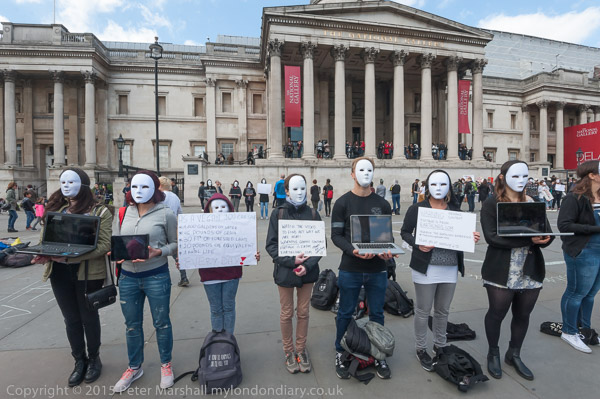
Vegans had come to Trafalgar Square holding laptops and tablets and wearing masks to show the film ‘Earthlings’ which includes scenes of horrific cruelty to animals and calling for an end to the farming and eating of animals. Some also pointed out the contribution that becoming vegan could make towards solving the climate crisis as Vegan dietts use less water, land and grain and produce less CO2.

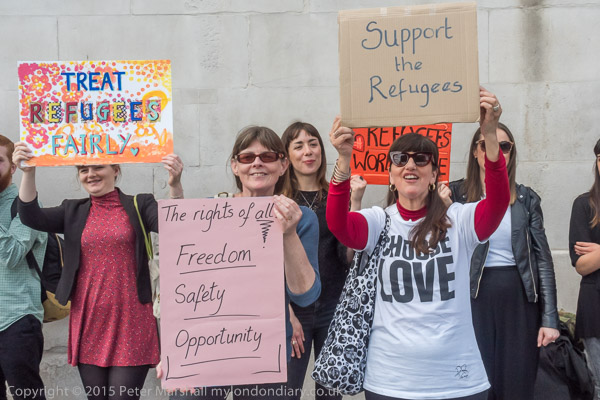
Also on the North Terrace of Trafalgar Square were a small group of protesters standing in front of the National Gallery who held posters calling for human rights, fair treatment and support for refugees. Some held a banner with the message ‘free movement for People Not Weapons’.

More about all these protests on My London Diary:

Topshop protest after cleaners sacked
Refugees Welcome say protesters
Vegan Earthlings masked video protest
68th Anniversary Nabka Day
Reclaim Holloway

Saturday 16th April 2016

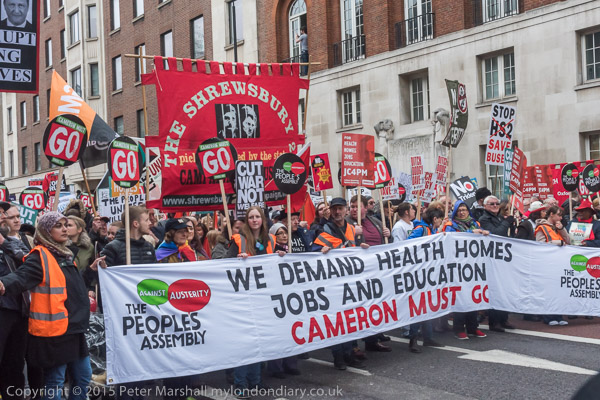
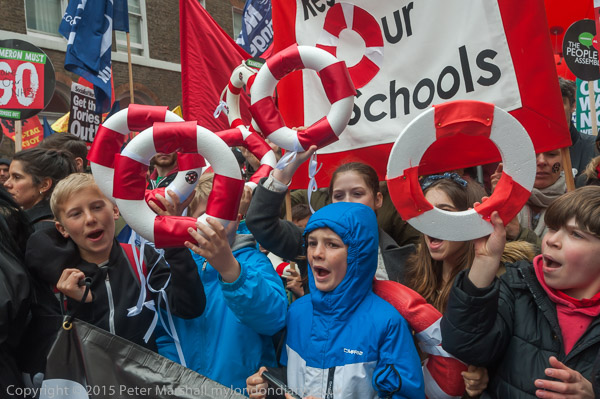
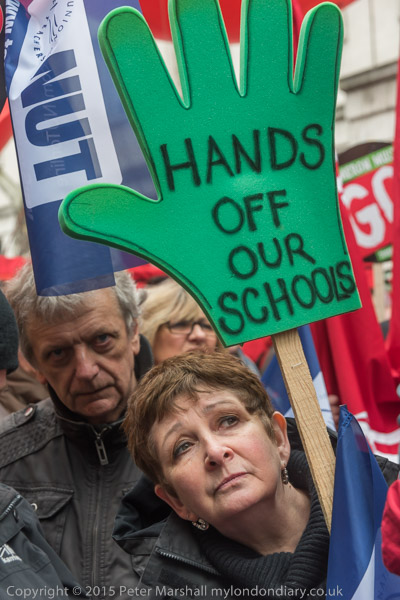
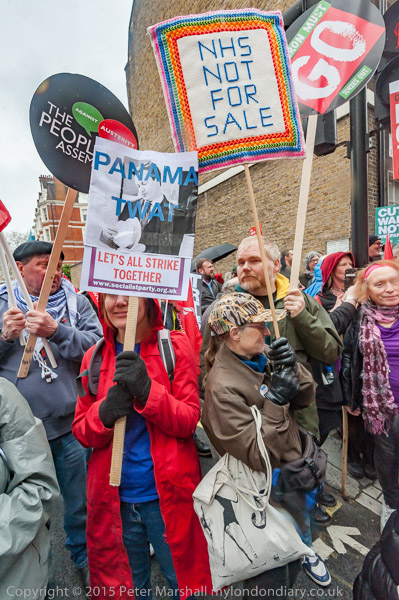
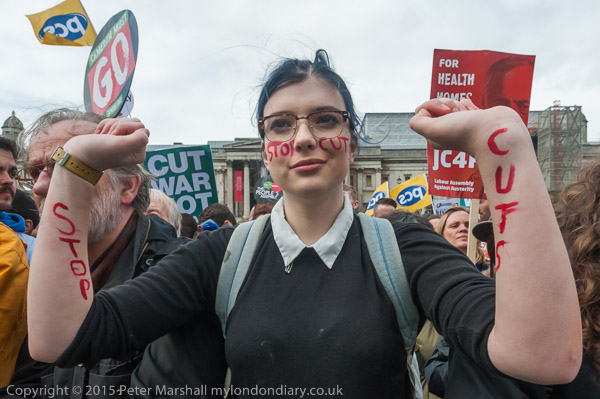
There was a lot happening in London on Saturday 16th April 2016, and I managed to catch some of it. The largest march was organised by the Peoples Assembly Against Austerity. It demanded an end to privatisation of the NHS, secure homes for all, rent control and an end to attacks on social housing, an end to insecure jobs and the scrapping of the Trade Union Bill, tuition fees and the marketisation of education.

It was a large march and by the time I arrived people were fairly tightly packed on around 500 metres of Gower St waiting for the march to start, and it took me some time to make my way through to the gazebo where speeches were being made before the start of the the march – though I found plenty to photograph as I moved through the crowd.

Finally I made my way to the front of the march and photographed some of the main banners lined up there, but police held up the start of the march and I had to leave before it moved off.

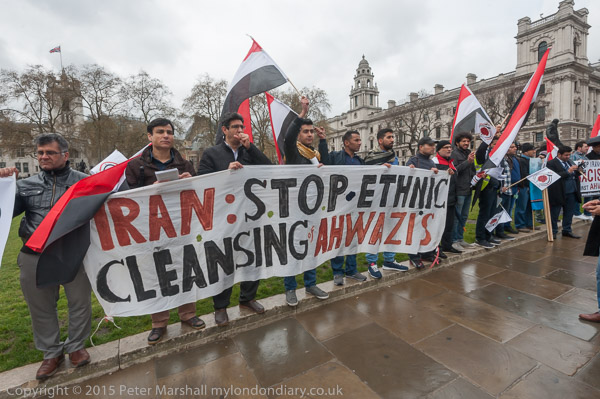
I was disappointed in Whitehall as there was no sign of an event I had been expecting to take place there – or perhaps I was too late. But in Parliament Square I met Ahwazi Arabs from the Ahwazi Arab People’s Democratic Popular Front and the Democratic Solidarity Party of Alahwaz who have demonstrated London in solidarity with anti-government protests in Iran every April since 2005, on the anniversary of the peaceful Ahwazi intifada in which many were killed and hundreds arrested by the Iranian regime.

The Ahwaz region, an autonomous Arab state, was occupied by Iran in 1925 iand they incorporated it into the country in 1935 largely to allow the British Anglo-Iranian Oil Company (BP since 1954) to exploit its rich oil reserves. Since then Iran has pursued a campaign to eliminate Ahwazi culture and change the ethnic makeup of the region by encouraging Persian settlers. BP dominated Iranian oil until Iran nationalised it in 1951, and again became an important force there after the CIA (and MI6) engineered coup in 1953 and the company is still the major partner supplied by the National Iranian Oil Company.

I walked back up Whitehall to Trafalgar Square, by which time the Peoples Assembly marchers were arriving for a rally.

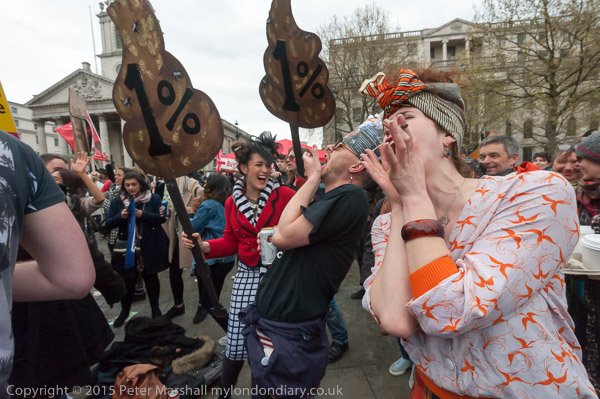
Things were visually rather more interesting on the North Terrace, where people were dancing to the ‘dig it sound system’, which carried a message from Tom Paine: “The World is my country – All people are my brethren – To do good is my religion”.

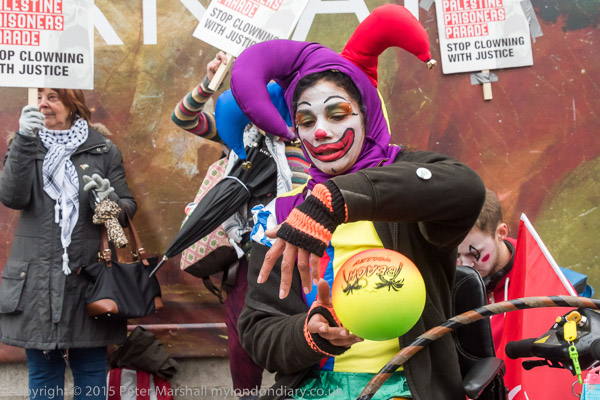
And in one corner the Palestine Prisoners Parade were attracting attention with juggling, hula hoops and speeches to the often arbitrary detention without proper trial suffered by many Palestinians held in Israeli jails. Many of them are on rolling detention orders, released and immediately re-arrested and put back in prison.

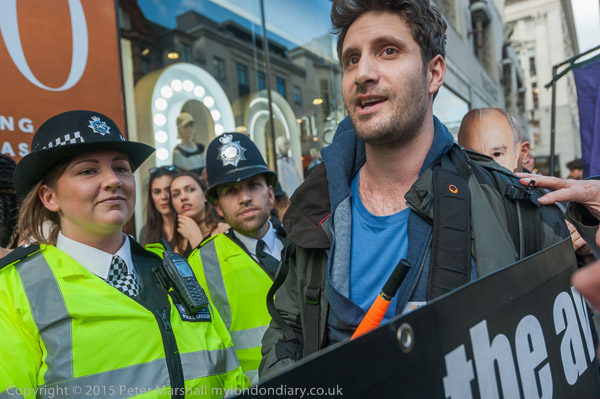
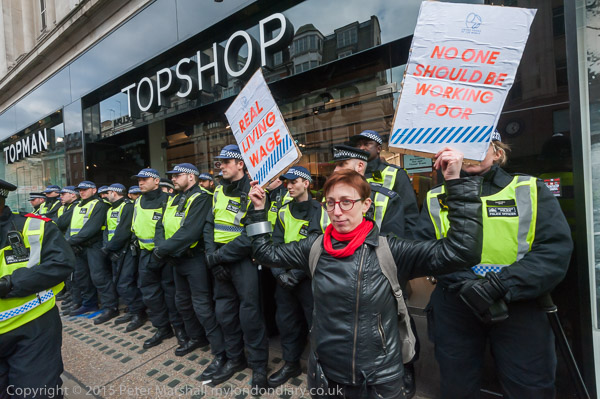
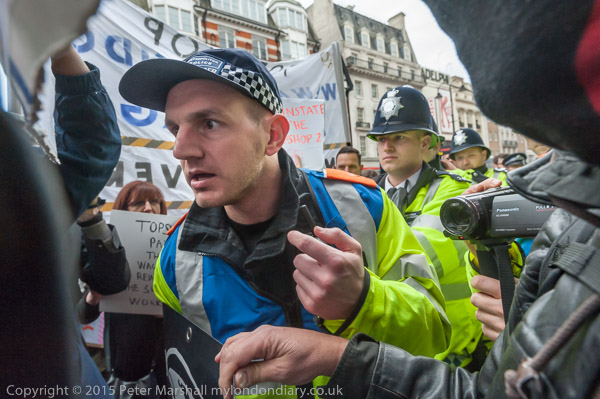
As the rally came to an end the United Voices of the World trade union began a protest a short distance away on the Strand, supported by Class War and others, demanding the reinstatement of 2 workers suspended by cleaning contractor Britannia for calling for the London Living Wage of £9.40 an hour for all those working at Topshop. The UVW say Brittania is systematically victimising, bullying and threatening cleaners and Topshop refuse to intervene.
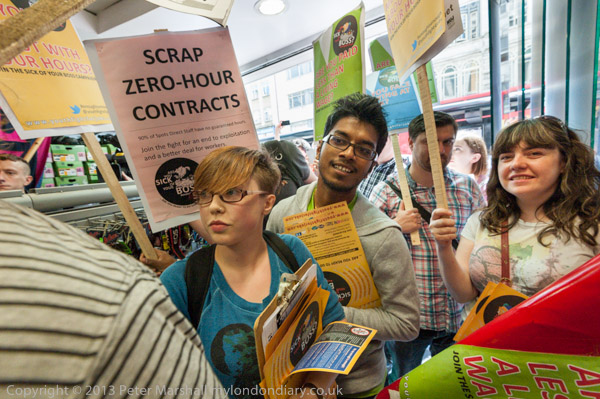
The fairly small crowd held a noisy protest outside the shop entrance, with was blocked by security men, and a large group of police arrived and began to try to move the protesters, and began pushing them around. The protesters didn’t retaliate but simply moved back; some holding up placards in front of the police cameraman who was filming the event were threatened with arrest.

Eventually the protesters marched away, walking back along the North Terrace of Trafalgar Square where they picked up a few more supporters and then on to Top Shop at Oxford Circus for another protest and stand-off with the police.

After a fairly short protest there the protesters marched on to John Lewis, where the UVW have a long-standing dispute calling for the cleaners to be treated equally with others who work there. As they approached the store some police became more violent and one woman was thrown bodily to the ground several yards away.

Other police and protesters went to help her and the protesters called for – and eventually got – an apology for the inappropriate use of force. Things calmed down and the protest continued, but as it moved off after several speeches with many leaving for home the police picked on two individuals and began searching them and threatening arrest and the situation became more tense, with police threatening both protesters and press.

More on My London Diary
UVW Topshop & John Lewis Protest
UVW Topshop 2 protest – Strand
Palestine Prisoners Parade
Dancing for Homes, Health, Jobs, Education
Homes, Health, Jobs, Education Rally
Ahwazi protest against Iranian repression
March for Homes, Health, Jobs, Education

13 December 2014

I started work on December 13th 2014 in Brixton, where a well-dressed Santa was with other Lambeth Living Wage protesters including National Shop Stewards Network chair Rob Williams, calling for all workers to be paid a living wage. They entered a number of shops on the main shopping street where workers are only paid the minimum wage, spreading their message through a megaphone and placards and handing out leaflets and union membership forms to shop workers.
They left when asked to do so by security staff and continued along the street to the next shop on ‘Santa’s Naughty List’.
‘Santa’s Naughty List’ Living Wage

The Victoria line from Brixton tube took me to Green Park and I made my way to join the ‘Advance to Mayfair’ protest organised by Class War at the Mayfair offices of US property developers Westbrook Partners. The protest was in solidarity with the tenants of the Hackney New Era Estate who Westbrook are intended to evict before Christmas.
There had been some disagreements expressed on social media before the protest and the organiser was ill and unable to publicise the event over the previous few days and the protest was rather smaller than anticipated. The police had however come out in force for what was a small and well-behaved protest in which after some speeches, Class War delivered a Christmas card to Westbrook – and someone came out from their office to accept it.

This and other protests by and in support of the residents and the publicity they generated in the media worked, and a few days later Westbrook sold their interest in the New Era estate to the Dolphin Square Foundation and the New Era tenants were saved from eviction.
Class War: ‘Evict Westbrook, Not New Era’


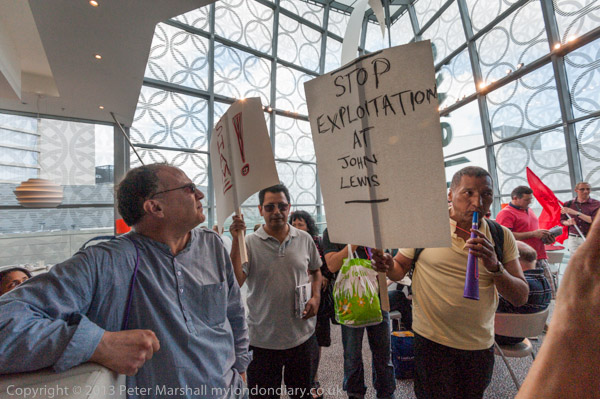
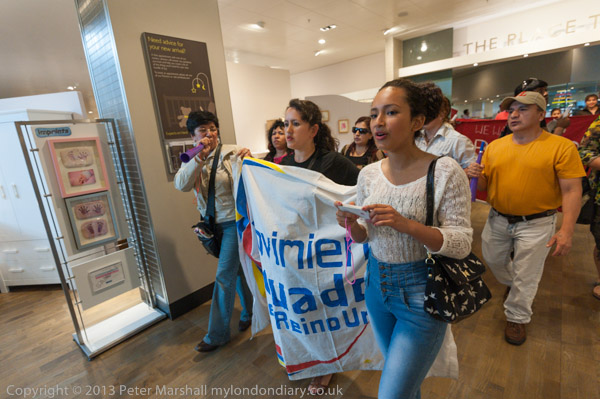
My final destination for the day was the flagship John Lewis Store in Oxford St, not for some Christmas shopping, but to meet with members of the IWGB and John Lewis customers who were campaigning for equality for the cleaners. Cleaners who work in the store receive less than the living wage, and are not entitled to the considerable bonus payments that other staff who work in John Lewis receive as ‘partners’ in the business. John Lewis outsources the cleaning to cleaning contractors to avoid having to give them decent wages and conditions while retaining its reputation as a decent employer.

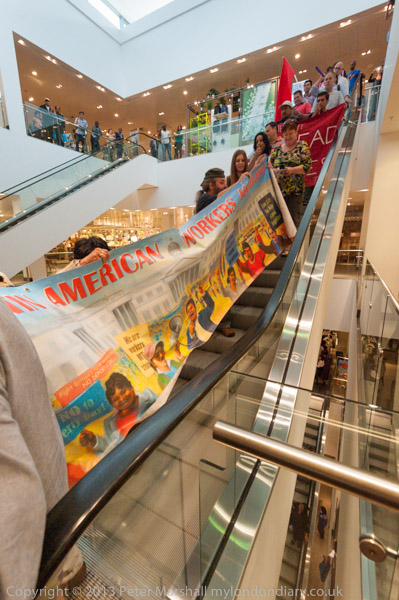
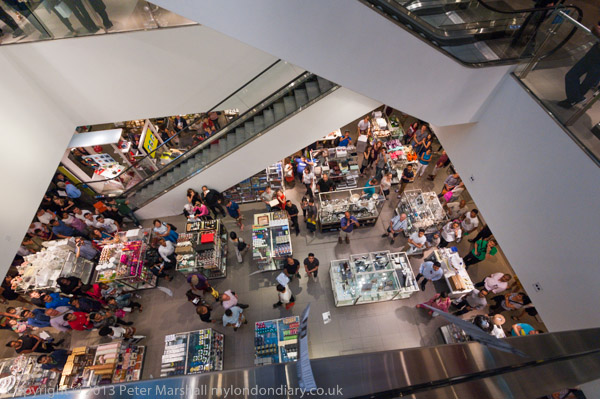
We met up in the café on the fifth floor of the store, and after unrolling there banners there was a brief speech about the unfair treatment of the cleaners from Alberto Durango before the protesters marched around the top floor to the escalator blowing vuvuzelas. They made their way slowly around to the down escalator on each floor, pausing to hang their banners over the balcony and continuing the noisy protest.

By the time they arrived at the ground floor, police had arrived and were confusing the issue, with some trying to stop the protesters leaving the store and others trying to force them out. Most of the protesters were trying to leave and like me had to push our way past police to get onto the pavement where the protest continued. Police made one or two arrests, though I think all were released without charge as John Lewis would not welcome the publicity a court appearance would provide.

Cleaners Xmas Protest in John Lewis


All photographs on this and my other sites, unless otherwise stated, are taken by and copyright of Peter Marshall, and are available for reproduction or can be bought as prints.


UVW celebrate victory

The United Voices of the World had been planning to protest in support of the cleaners at Chanel in the West End who had held a strike ballot, and were planning to strike for the London Living Wage, but instead were meeting to celebrate the successful negotiation of the deal with the employers.

£10.55 an hour is the minimum that is calculated to be needed for workers to live in London, rather than the minimum wage that the government dishonestly calls a living wage, and which many low-paid workers are still paid in London.

Migrant workers in small grass-roots unions like the UVW have gained a living wage for many of their members in London, managing to unionise workers where the large established unions have – with a few honourable local branch exceptions – largely failed. One of the reasons for failure is language, with many of our low-paid migrant workers being speakers of Spanish or other languages and often with a limited grasp of English.

Unions like the UVW work in both Spanish and English, and also put on classes in English (and sometimes other subjects) for their members, many of whom have qualifications and experience in the countries they come from which they are unable to gain employment from here.

The UVW is one of several such small unions active in London, including CAIWU and the IWGB, and members of one often support others on their picket lines and protests. There is often support too from branches of some of the major unions such as RMT and Unison and Unite Community and other groups including Class War.

There are a few more pictures at UVW celebrate LLW at Chanel .


All photographs on this and my other sites, unless otherwise stated, are taken by and copyright of Peter Marshall, and are available for reproduction or can be bought as prints.

There are no adverts on this site and it receives no sponsorship, and I like to keep it that way. But it does take a considerable amount of my time and thought, and if you enjoy reading it, please share on social media.
And small donations via Paypal – perhaps the cost of a beer – would be appreciated.