Vaisakhi, Uganda & Freedom Umbrella – 2011

Vaisakhi, Uganda & Freedom Umbrella: On Saturday 9th April 2011 After visiting Woolwich to photograph the Vaisakhi celebrations I came back into central London to photograph Ugandans and Kurds protesting for freedom and democracy.


Vaisakhi Celebrations in Woolwich

Vaisakhi, Uganda & Freedom Umbrella

For some years I had been documenting religious festivals in and around London and had photographed a number of Sikh Gurdwaras at their Vaisakhi festivals.

Vaisakhi, Uganda & Freedom Umbrella

On Saturday 9th April 2011 I went to the Ramgarhia Association Gurdwara in Mason’s Hill Woolwich. The Ramgarhia are a Sikh community who originally came from the close to Amritsar in the Punjab and traditionally they were carpenters, blacksmiths and other artisan workers but were renowned for their military prowess and the victories of the armies.

Vaisakhi, Uganda & Freedom Umbrella

When I turned up I was warmly welcomed and taken to the Langar hall where I enjoyed some of the free vegetarian food on offer to all, prepared and served by members of the congregation who volunteer their services as a part of their religious practice and was able to talk with people there and wander around taking photographs.

Vaisakhi, Uganda & Freedom Umbrella

The Gurdwara was established in 1970 in an existing landmark building, the Victorian Freemasons Hall, just over the Woolwich border in Plumstead on a street which was then called Mount Pleasant.

The Freemason’s Hall was where the Royal Arsenal Football Club held its annual meetings and dinners, and on 16th May 1891 that the Annual General Meeting of the Royal Arsenal Football Club (earlier known as Dial Square) the committee announced it had decided two weeks earlier to turn professional and had thus resigned from the amateur Kent and London Associations.

In 1913, the club moved across the river to a new stadium at Highbury, where it continued to play until 2006, when it moved the short distance to its new Emirates stadium. Apparently it is doing quite well at the moment.

The Vaisakhi festival, which takes place on April 14 each year marks the formation of the Khalsa by Guru Gobind Singh, the tenth Sikh Guru, in 1699. You can read more about this and the Vaisakhi Nagar Kirtan procession which is lead by five Khalsa – baptised Sikhs – dressed in saffron robes and turbans and carrying swords in the account I wrote on My London Diary, Vaisakhi Celebrations in Woolwich, as well as in the posts on other Vaisakhi processions on that site.

On My London Diary I wrote in more detail about the origins of Vaisakhi and the 10th Sikh Guru who gave Sikhism its modern form with its symbols and the eternal guru, the Guru Granth Sahib, the holy religious scripture being reverently carried out to the procession in th picture above.

Unfortunately the start of the procession was delayed and although I had photographed the preparations for it I had to run to catch a train before the actual start of the colourful procession, with its joyful singing of Sikh hymns, martial arts demonstrations and Dhol drumming through the town, expected to take several hours.

More at Vaisakhi Celebrations in Woolwich.


Ugandans Demand Democracy – Uganda House, Trafalgar Square

Ugandans had come to protest outside Uganda House in Trafalgar Square, calling for new free and fair elections after the rigged Parliamentary and Presidential elections in February.

The election on 18 Feb had resulted in the re-election of the sitting president Yoweri Museveni, in power for 25 years, apparently getting 68% of the vote.

But the EU Election Observation Mission which had been in Uganda for the vote reported the election, with a turnout of only 59% had been “marred by avoidable administrative and logistical failures which led to an unacceptable number of Ugandan citizens being disenfranchised” and that Museveni had used his presidential power to “compromise severely the level playing filed between the competing candidates and political parties.”

As well as the state owned Uganda Broadcasting Corporation giving much more coverage to the ruling NRM party, there had been extenisve human rights abuses with the police failing to take action against groups attacking opposition political meetings, intimidation and assaults on journalists and the cancellation of broadcasts.

Ugandans Demand Democracy


Freedom Umbrella Kurds March Through London – Old Marylebone Rd – Downing St

Freedom Umbrella (Chatri Azadi), a coalition of British-based Kurdish organisations and supporters, had organised a demonstration in front of the offices of the Kurdistan Regional Government in Old Marylebone Road followed by a march to a rally opposite Downing St.

They called for support of the people’s uprising for freedom and social justice in the autonomous region of Iraqi Kurdistan which had begun on 17th February but had hardly been noticed by UK media.

Two Kurdish militia groups dominate Iraqi Kurdistan and remain in power. On 19th April their security forces began a more organised violent crackdown on the protests which brought them to an end.

I met the protesters as the march neared Trafalgar Square and photographed their rally opposite Downing Street.

More pictures Freedom Umbrella Kurds March In London.


FlickrFacebookMy London DiaryHull PhotosLea ValleyParis
London’s Industrial HeritageLondon Photos

All photographs on this page are copyright © Peter Marshall.
Contact me to buy prints or licence to reproduce.
Zuma, Boat Dwellers, Syria & Latin Village – 2017

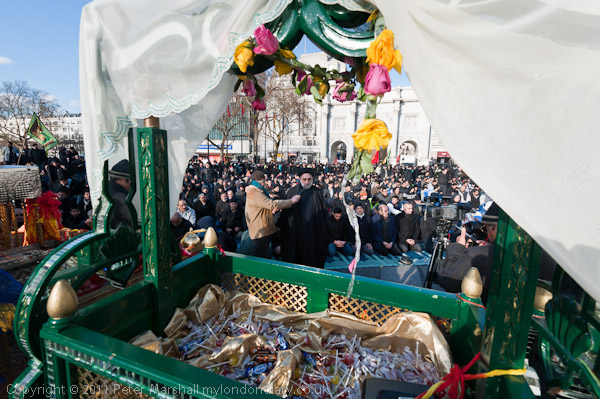
Zuma, Boat Dwellers, Syria & Latin Village: Saturday 8th April 2017 was another varied day for me in London with protests against South African President Zuma, the Canal & River Trust, chemical warfare in Syra and against the planned demolition of the largest Latin American community market in England.


Zuma Must Go – Trafalgar Square

Zuma, Boat Dwellers, Syria & Latin Village

South Africans living in the UK had come to protest outside the South African High Commission after President Zuma sacked the Finance Minister and his deputy.

Zuma, Boat Dwellers, Syria & Latin Village

They accuse Zuma and the African National Congress government of wrecking the South African economy and say that “Zuma must fall”.

Zuma, Boat Dwellers, Syria & Latin Village

Police had set barriers outside the High Commission for the protest and the protesters were so densely packed into the area that it was very difficult to move around an take photographs.

Zuma, Boat Dwellers, Syria & Latin Village

It was a colourful protest and certainly demonstrated the anger of those taking part but the ANC would still remain the leading party and if Zuma resigned he would be replaced by another ANC leader.

Zuma did finally go, replaced by Cyril Ramaphosa in 2018 because of the increasing allegations of corruption and cronyism and in 2021 was given a 15 month contempt of court sentence for refusing to testify. Ramaphosa is also a controversial figure with various allegations of corruption, and as as London Platinum non-executive director urged the police to take the action which lead to the police massacre at Marikana on August 16, 2012 which lead to the deaths of 44 miners and over 70 more with serious injuries.

The elections next month, May 2024 are expected to be the first since the end of apartheid in 1994 in which the ANC will not gain over 50% of the vote and the country may get a coalition government. Zuma who has now joined the opposition Umkhonto weSizwe (MK) party has been banned from standing in the election but has appealed the ban.

Zuma Must Go


Boat dwellers fight evictions – Embankment Gardens

Boat dwellers held a rally in Embankment Gardens before marching to Downing St and DEFRA to demand the Canal & River Trust (CRT) stops evicting or threatening to evict boat dwellers without permanent moorings.

The say the British Waterways Act 1995 includes the right to live on a boat without a permanent mooring and that the CRT is acting illegally in evicting or threatening to evict boat dwellers.

Although boats can be required to move after 14 days at a mooring, the law requires at least 28 days notice and does not lay down restrictions on the distance boats have to move or that they should be making a “progressive journey.”

Some of the speakers at the rally had horror stories about boats being seized and other illegal activities by the trust, a charity set up in 2012 to look after the canals and navigable rivers.

Boat dwellers also oppose the plans being made for chargeable bookable moorings and want the trust to maintain the canals properly. The rally was still continuing when I needed to leave.

Boat dwellers fight evictions


March Against Chemical Warfare in Syria – Marble Arch

RefugEase and Syria Solidarity Campaign had organised this march calling on the UK Government to protect civilians in Syria.

President Assad’s forces used Sarin nerve agent three years earlier at Ghouta, and a few days before the protest there had been another attack using Sarin at Khan Sheikhoon near Idlib on April 4th.

The West’s response to the Syrian Revolution has been confusing and largely ineffectual. The US and Turkey encouraged and aided the setting up of an Islamic state and allowed it to export oil to finance its operations – and later the US gave air support to the Kurds to defeat ISIS. And although there were strong words over the use of chemical weapons at Ghouta, there was no real action. Nor has their been any opposition to the invasion and occupation of large parts of Syria by Turkish forces.

The march to Downing St began at Marble Arch and I walked with it down Oxford Street as far as Oxford Circus Station where I caught the Victoria Line to Seven Sisters.

Against Chemical Warfare in Syria


Human Chain at Latin Village – Seven Sisters

The indoor market next to Seven Sisters station in South Tottenham had been reinvigorated in recent years by the local Latin American community and had become the largest Latin American community market in England.

Part of the site at Ward’s Corner has been derelict for some years and the local authority, Haringey Council, wants to demolish the who block together with property developers which would convert it to expensive flats and chain stores, profiting investors at the expense of the community.

In 2008 the community gained the support of London Mayor Boris Johnson who wrote to the council asking them to review the scheme. But the council were determined to go ahead along with property developer Grainger PLC and issued a compulsory purchase order in 2016 which was finally approved by the secretary of state for housing, communities, and local government James Brokenshire in 2019.

The community in the area had been fighting since 2002 to save the Latin Village from this social cleansing and gentrification and on Saturday 8th April 2017 held a festival there. The speeches and performances paused for everyone to join hands in a human chain around a quarter of a mile long around the whole block.

In 2020 Transport for London who had taken over the management of the indoor market closed it down. But in 2021 Grainger PLC withdrew from the plans for the site. You can read more about the Wards Corner Community Plan online. The Community Benefit Society was launched in 2022 and planned to reopen the site in 2024.

Many more pictures at Human Chain at Latin Village


FlickrFacebookMy London DiaryHull PhotosLea ValleyParis
London’s Industrial HeritageLondon Photos

All photographs on this page are copyright © Peter Marshall.
Contact me to buy prints or licence to reproduce.


Colindale and West Hendon Estate 2017

Colindale and West Hendon Estate: I’d actually gone to Colindale on Tuesday 28th March 2017 to attend the public inquiry into the second phase of the demolition of the West Hendon estate which was beginning at the RAF Museum there.

Colindale and West Hendon Estate 2017
New buildings on York Memorial Park and the West Hendon Estate across the Welsh Harp

But the proceedings there were tedious and while such things are important unless you are personally involved it soon becomes hard to remain involved. Nothing I heard in the short time I stayed would not have better been submitted as documents and probably had been. And it was a nice day outside.

Colindale and West Hendon Estate 2017
RAF Museum

I left and paid a short visit to the rest of the RAF Museum before going to photograph Grahame Park across the road from the museum, a large council estate built by the GLC and Barnet Council on the rest of the old Hendon Aerodrome site in the 60s and 70s, the first residents moving there in 1971.

Colindale and West Hendon Estate 2017
Grahame Park Estate

By the time I first visited to photograph the estate in 1994, some changes had been made, removing connecting walkways to split the flats into smaller units and replacing some flat roofs with pitched roofs. A more dramatic phased regeneration began in 2003 and considerable building work was still taking place in 2017.

Colindale and West Hendon Estate 2017

The regeneration will greatly increase the number of homes on the estate, and the new properties are more energy efficient, but the original number of council rented properties of almost 1800 will be reduced to around 300. Around 900 of the new properties were to be at so-called “affordable rents” and the remaining 1800 for sale or rent at market prices.

A few hundred existing residents with secure tenancies will be rehoused, but most of the estate residents do not qualify for rehousing, including some who had lived here for over 15 years. They will need to find private rented properties elsewhere in a typical example of social cleansing by Barnet Council, in league with developer and social landlord Genesis Housing Association.

As is the case in other regeneration projects on council estates around London this results in a huge transfer of land from public to private ownership and fails to meet the housing needs of poorer residents, many of whom are forced to move further from jobs, friends and families.

Colindale Ave

I walked from the estate to Colindale Station through another large area of building work, mainly of expensive private housing in large blocks of flats with an area action plan for of expensive private housing in large blocks of flats. Of course we need new housing but should be concentrating on providing it a reasonable cost for those most in need – which means social housing. Not building homes that will take up to 46% of tenants incomes in London, well above the “30 per cent of income” affordability threshold set by the ONS.

WestHendon Estate

I could have walked from Grahame Park to the West Hendon Estate about a mile and a half away but couldn’t see a decent route on the map, so took the tube to Hendon Central and caught a bus from there. The West Hendon Estate owes its genesis to a large bomb on 13th February 1941 which destroyed or rendered uninhabitable 366 houses, damaging a further 400 in the area, killing 75 people and severely injuring another 145. Over 1500 people were made homeless.

York Park there became York Memorial Park, a green open common designated as “a War Memorial in perpetuity” as a mark of respect to all who lost their lives. In the 1960s the remaining houses in the area were replaced by the West Hendon estate, comprising of 680 one-bedroom flats, two-bedroom maisonettes and three-bedroom council houses, along with open space, a community centre and a play area.

Barnet Council handed the memorial park – at least £12 million of public land – over to developers Barratt and they built a 29 storey tower block on the park – “perpetuity” becoming shorter than living memory. The West Hendon estate is being demolished in phases and being replaced by Hendon Waterside, largely expensive flats with views across the Welsh Harp. There will be an increase in the number of homes to 2,171 but many will go to overseas buyers and will be kept empty as investments whose value is expected to rise steeply. And somewhere at the back of the estate will probably be a little social housing – but only a small fraction of the original 680.

Few of the residents will qualify for rehousing but with higher rents and less security of tenure. Most will lose their homes and be ‘socially cleansed’, forced to move out of the area and away from friends, jobs, schools etc. Housing isn’t just a crisis but a shamefull twentyfirst century scandal.

More pictures on My London Diary:
West Hendon Estate
Colindale


FlickrFacebookMy London DiaryHull PhotosLea ValleyParis
London’s Industrial HeritageLondon Photos

All photographs on this page are copyright © Peter Marshall.
Contact me to buy prints or licence to reproduce.


Riverside Brentford – 2016

Riverside Brentford – Saturday 26th March 2016

Riverside Brentford - 2016

As a child I grew up in Middlesex, by then a rather truncated county on the north and west of London, though once it had included the cities of London and Westminster and many of London’s Metropolitan boroughs north of the Thames and west of the River Lea. Brentford, a couple of miles from where I was born, was the nearest thing the county had to a county town, though it had few if any of the normal attributes of one, with no town-hall or other public building.

Riverside Brentford - 2016

Often on Bank Holidays our father would take us on a 237 bus from Hounslow to Kew Bridge Station, the route going through Brentford High Street where it was often held up as we gazed through the top deck windows at the sites. Under the railway bridge leading to Brentford Docks where we might see a steam hauled goods train, over the canal bridge where the locks and dock area were normally busy with barges,past the Beehive on the corner of Half Acre with its tower topped by a giant beehive and on through the noisy, smelly gas works to Kew Bridge.

Riverside Brentford - 2016

We walked across Kew Bridge and then turned down the side of Kew Green to the gate of Kew Gardens, where a penny – an old penny, 240 to the pound led us into the extensive gardens where we could wander all day. This was before the days of garden centres and my father would always have a small pair of scissors in his pocket to take the odd cutting or pick up a seed or two on our walks.

Riverside Brentford - 2016

Later, in the early and mid 1950’s I would ride my bicycle around much of Middlesex and Surrey – and that included Brentford, but I think it was only much later when I became a photographer that I really explored the area and found out what an important communication link it had been. Brentford is where the inland waterways system with the busy Grand Union Canal joined the River Thames, just a few miles upriver from the great Port of London.

In 1978 three of my photographs from Brentford were published in Creative Camera Collection: No. 5, a prestigious collection of contemporary photography published by Coo Press, the publishers of the monthly magazine Creative Camera and edited by Colin Osman and Peter Turner. It wasn’t the first time my work had been published but was great to be on the pages with some very well known photographers, including one who much later became a friend, John Benton-Harris.

Brentford has changed greatly since then, with much of the riverside now lined with expensive flats rather than commerce and industry. The gasworks site became a riverside park and an arts centre, where I took part in and helped organise a number of exhibitions. But there is still enough of the old Brentford untouched, though less each time I go there.

I first returned in the 1990s, when I was teaching a few miles down the road, bringing students to see shows there and to wander around the area taking pictures. Later I came back for walks on my own or with friends, such as this one on Saturday 26th March 2016 with my elder son. Brentford hadn’t been my first choice by railway engineering works that week end made travelling out further to the east of London impossible.

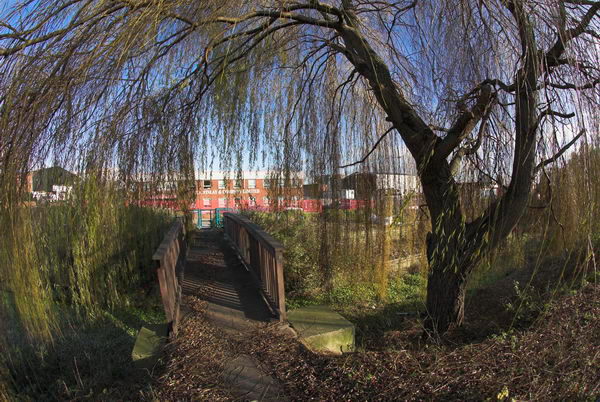
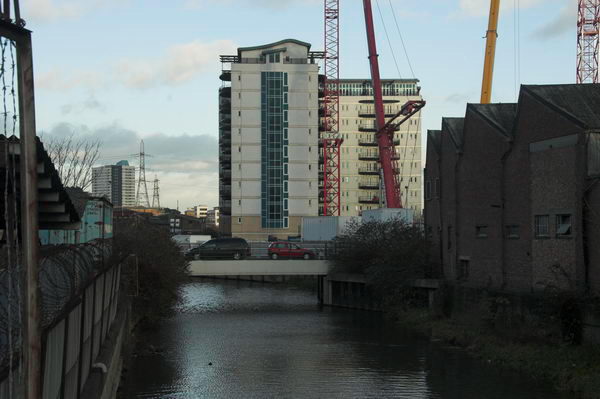
As well as making ‘normal’ pictures with lenses giving a horizontal angle of view of between 10 and 84 degrees (focal lengths 20 to 200mm) there were some pictures where I felt an even wider view was needed and I made some panoramss with a roughly 145 degree angle of view. The pictures above and below illustrate the difference.

We didn’t end our walk in Brentford, but continued on past Syon House to Isleworth where we ate our sandwiches in a relatively sheltered square before following the Duke of Northumberland’s River through Mogden Sewage Works to Kneller Park and then Whitton Station for the train home. You can see a much wider range of pictures online on My London Diary at these three links:
Syon, Isleworth & Mogden
Riverside Brentford Panoramas
Riverside Brentford


FlickrFacebookMy London DiaryHull PhotosLea ValleyParis
London’s Industrial HeritageLondon Photos

All photographs on this page are copyright © Peter Marshall.
Contact me to buy prints or licence to reproduce.


Bermondsey Equinox 2015

Bermondsey Equinox: Spring, or rather Astronomical Spring, officially starts today, 20th March, though meteorologists see things differently and start it on March 1st and the weather has its own ideas. Botanists too make up their own minds by looking at plants.

Bermondsey Equinox

Today is the Spring Equinox, which I always assumed meant equal lengths of day and night, but checking the tables I find that today we get 24 minutes more day than night.

Bermondsey Equinox

The actual definition of the Equinox is apparently the moment when the Sun is directly above the equator and the Earth’s rotational axis passes through from being tilted towards the southern hemisphere to the north. So it really is just a moment, this year at 3.06 am UTC 20th March. Most years it falls on 20th March, but in 2007 it was on the 21st in the UK, and this year will be on the 19th across the USA.

Bermondsey Equinox

But watch out for Druids, particularly should you be near Tower Hill, where in some previous years I’ve photographed their celebrations which begin at noon, I think Greenwich Mean Time.

Bermondsey Equinox

It’s an interesting event to watch, and doubtless important for those taking part, and also good to photograph at least once or twice, but when you’ve done it a few times difficult to find anything new to say.

So I won’t be there today. And I won’t write about it here, as last year I posted Druid Order – Spring Equinox at Tower Hill and you can still read all about it there as well on the various other posts here and on My London Diary.

Back in 2015 I didn’t go to Tower Hill but was instead on the opposite side of the River Thames in Bermondsey, out for a walk around one of my favourite areas of London with a few photographer friends.

As I wrote then, it was “really just an excuse to meet up, go to a couple of pubs and then end up with a meal” and though it was a fine afternoon I don’t think any of us took many pictures. I’d photographed the area fairly extensively in previous years and had even written a leaflet with a walk for part of it.

The leaflet came about back in the dark ages of computing, when Desk Top Publishing had more or less just been invented and I was teaching an evening class in the use of Aldus Pagemaker, bought up by Adobe in 1994 who then killed it and brought out Indesign, more powerful but far more difficult to use. West Bermondsey – The leather area was an industrial archaeology walk which I made use of to illustrate some of my lessons.

Over the next few years I printed hundreds of copies on my Epson Dot-Matrix printer – which accounts for the crude illustrations – and sold them at 20p a time – hardly a money spinner but it covered my costs. They were bought and given out by local historian Stephen Humphrey (1952-2017), chief archivist at Southwark’s Local Studies Library for 30 years on his local history walks and sold at the Bermondsey festival. I met Stephen who wrote a number of publications on the history of the area a few times – and had visited him in the Library when researching the leaflet, which also relied on information from a walk led by Tim Smith for the Greater London Industrial Archaeology Society where it is one of a very long list of interesting walks in London.

The area has changed considerably since I wrote it, but most of what is mentioned remains despite considerable gentrification. You can find several hundreds of my older images of Bermondsey in colour and black and white on Flickr – including those used in illustrating the leaflet in much better reproduction.

There are a few more images from my 2015 walk on My London Diary at Bermondsey Walk.


FlickrFacebookMy London DiaryHull PhotosLea ValleyParis
London’s Industrial HeritageLondon Photos

All photographs on this page are copyright © Peter Marshall.
Contact me to buy prints or licence to reproduce.


Brent St Patrick’s Day Parade – Willesden Green 2007

Brent St Patrick’s Day Parade – Willesden Green

Brent St Patrick's Day Parade

In 2007 St Patrick’s Day, 17th March, fell on a Saturday and the parade in Willesden Green held on the day itself was well attended. I found it rather more interesting than the big London celebration with a march from Hyde Park to Trafalgar Square the following day, though I met some of the same peopleand groups again there.

Brent St Patrick's Day Parade

It had been a busy day for me, starting with a protest about problems for young doctors in the NHS whose managers had managed to make a complete mess of their workforce planning with thousands of junior doctors likely to find themselves without a place to continue their careers in the coming August, and there being no consultant posts for thousands of registrars in 2010-11. Among the speakers was the then Leader of the Opposition, David Cameron who I found hard to photograph. More on this on My London Diary, with pictures starting here.

Brent St Patrick's Day Parade

Next up was a protest four years after the invasion of Iraq, where 655,000 had by then died. My comment in 2007: “It is always easy to be right in hindsight, but the majority of the British people were right at the time of the invasion, and the government held its telescope firmly to its blind eye of mis-interpreted, faulty and partly invented intelligence. unfortunately both Britain and even more Iraq will suffer for Blair’s shameful mistake for many years to come.” And they are still suffering. It was a small protest in Trafalgar Square, mainly by Iraqis and there are just a few pictures here.

Brent St Patrick's Day Parade

Also in Trafalgar Square, close to Canada House was a protest against the annual slaughter of seal cubs in Canada, clubbed to death in a way that “is certainly inhumane and a public relations disaster, with blood staining the ice and clubbed animals at times being skinned while still conscious.”

But then I took the underground to Willesden Green, where “a much happier event was taking place … the borough of Brent was celebrating St Patrick’s day with a parade and cultural activities.” Mainly but not exclusively Irish, but with many from Brent’s other communities taking part and watching.

It’s great to photograph the people out on the street to celebrate, and wanting to have their pictures taken, and there was plenty to photograph, including of course St Patrick himself leading the procession, along with the mayor, Kensal Green councillor Bertha Joseph, in her second term as mayor.

She was brent’s first African Caribbean mayor in 1998. but of course the real stars of the event were the people of all ages who were taking part and having a fine time.”

After the parade there was time for the culture – in the form of a pint of Guinness in a real Irish bar, after which I went to watch the band ‘Neck’ performing, and the people dancing to their music.

It was a fine event, the band clearly setting out not just to play but to entertain the audience and doing so in great style.

More pictures of Brent St Patrick’s Day Parade begin here, and you can also view those I took on the following day at London Celebrates St Patrick’s Day.


FlickrFacebookMy London DiaryHull PhotosLea ValleyParis
London’s Industrial HeritageLondon Photos

All photographs on this page are copyright © Peter Marshall.
Contact me to buy prints or licence to reproduce.


Whittington, Syria and St Patrick – 2013

Whittington, Syria and St Patrick – Saturday 16th March 2013 saw me travelling around London to cover three events, starting at a march against hospital cuts, then a march supporting the Syrian revoltuion on its second anniversary and finally an Irish parade on the day before St Patrick’s Day.


Whittington Hospital March Against Cuts – Highbury & Islington

Whittington, Syria and St Patrick

Dick Whittington, more formally Sir Richard Whittington (c1354 – 1423) was four times Lord Mayor of London and did a lot for the medieval city, including financing drainage systems in its poorer areas and setting up a hospital ward for unmarried mothers and leaving his considerable fortune to set up a charity which still 600 years later helps those in need.

Whittington, Syria and St Patrick

He made his fortune as a mercer, importing luxury fabrics such as silk and velvet and exporting English woollen cloth and later as a money lender to wealthy noblemen and kings. It isn’t clear if he ever had a cat, but the legend about him fleeing London with one and turning back when he heard Bow Bells from Highgate Hill first made it to print in 1612.

Whittington, Syria and St Patrick

The Whittington Stone was placed at the foot of Highgate Hill in 1821, though earlier it had been the base of a cross there; it only gained a cat on top in 1964. But Whittington’s name is remembered in a number of pubs across the country, including The Whittington & Cat on Highgate Hill, which closed in 2014. Islington Council and local residents fought to keep it, and prevented its demolition in 2012 by declaring it to be an asset of community value, but it became a flooring shop.

Whittington, Syria and St Patrick

More importantly Whittington’s name became that of the major hospital formed when earlier hospitals on three nearby sites were amalgamated when the National Health Service was formed in 1948.

Three years before this march, huge local oppositin had forced the cancellation of plans to end Accident and Emergency, Paediatrics, Maternity and Intensive Care at the Whittington Hospital, but now it was threatened again by a new hospital trust with plans to reduce maternity services, close wards, provide fewer beds for the elderly, cut 570 jobs privatise some services and sell off around a third of the site, closing all onsite accommodation for nursing staff.

I met several thousand protesters close to Highbury & Islington Station where they were preparing to march to a rally outside the hospital. Among those marching were local MPs, Green Party Leader Natalie Bennett, Bruce Kent and various celebrity supporters of the campaign, as well as the truly remarkable Hetty Bower, born in 1905, who became a pacifist at the time of the ‘Great War’, and took part in the 1926 General Strike.

You can read more about the event and see my pictures of many of the marchers on My London Diary. I left the march shortly after it started to go to my next event.
Whittington Hospital March Against Cuts.


Syria – Two Years Fight for Freedom

I arrived outside the Syrian Embassy in Belgrave Square while the rally before the march was taking place with members of the Syrian Community in Britain speaking.

Most of the speeches and chanting were not in English, and the Free Syria campaign appears to have little support from the British left who might have been expected to support their freedom fight. There were a few protests at the start, but often confused and mainly opposing any involvement in Syria by British forces.

The Syrian revolution against the Assad regime had also received little actual support from the UK Government and US support seemed halfhearted. When Assad began using chemical weapons against the Syrian rebel held areas there was strong condemnation but no action and any threats soon melted away once Russia became involved in supporting Assad.

One of the placards carried by marchers included a question which now seems particularly relevant in view of what has been happening in Gaza: ‘Hey World, How Many Kids Should Be Killed Before You Do Something?’

I walked with the marchers on their way to Downing Street as far as the Hyde Park underpass where it looked impressive as it made its way under the Hyde Park underpass, fairly densely packed and with flags waving it spread wide across the road, stretching back into Wilton Place over 200 yards away. Then left for Willesden Green.

Syria – Two Years Fight for Freedom


St Patrick’s Parade Brent – Willesden Green

For several years I had enjoyed the Brent St Patrick’s Day parade, sometimes going together with friends including John Benton-Harris who had photographed St Patrick’s Day here and across the USA as well as in Ireland over many years. The parade in Brent, usually on the day itself, had always seemed rather more authentically Irish than the larger London parade held on the nearest Sunday since Ken Livingstone introduced it in 2002 and I made some pictures.

Brent Council had a fine record of supporting cultural events celebrating its various communities including the Irish, but with government cuts since 2010 no longer had the funds to do so.

This year too, the main London event was taking place the following day, St Patrick’s Day itself, so the Brent event was on the day before. So the crowds were rather thinner than in previous years, and the poor weather may have put some off too.

More pictures at St Patrick’s Parade Brent.


FlickrFacebookMy London DiaryHull PhotosLea ValleyParis
London’s Industrial HeritageLondon Photos

All photographs on this page are copyright © Peter Marshall.
Contact me to buy prints or licence to reproduce.


Elsynge, Services Rendered, Pistons & Faces

Elsynge, Services Rendered, Pistons & Faces completes my walk on Friday 4th August 1989 in Battersea. continuing from the previous post, Charterhouse, A Diary, School, Church & Houses. This walk began with Council flats, Piles of Bricks, A House Hospital and Brasserie.

Stanhope House, 13, Elsynge Rd,  Wandsworth, 1989 89-8c-56
Stanhope House, 13, Elsynge Rd, Wandsworth, 1989 89-8c-56

A short distance down Spencer Road I turned right into Elsynge Road, a street full of large mainly semi-detached Victorian houses. It got its current name only in 1937, when Park Road was renamed to distinguish it from other Park Roads in London, including one not far away close to Battersea Park.

Local legend has it that some of the houses in this and Spencer Road were built for the Great Exibition of 1851, but in fact development only began in the area a little later, with the first houses in Spencer Road appearing in 1853-7 and in Park Road in 1856-7. Most were built in the 1860s with a handful of later additions.

The area draft Conservation Appraisal Document notes “Nos.9-11 and 13 are of particular interest, being of three and a half storeys with rustication to the lower storeys, canted bays, and projecting porches supported by Corinthian columns. Dentil cornices and decorative architraves to windows add richness of detail.”

As for the name of the house it could refer to one of the various Earl Stanhopes several of whom were prominent Tory politicians, one of the two English and one Scottish villages of that name, or be simply the family name of the residents.

House, Elsynge Rd,  Wandsworth, 1989 89-8c-41
House, Elsynge Rd, Wandsworth, 1989 89-8c-41

The draft Survey of London tells us that the area was initially called the Clapham Station Estate, named after a short-lived station on the line to the east of the area, not Clapham Junction which was only built in 1863.

Number 33 and 35 are rather plainer houses in the street but still large with a basement and three floors above. 35 is unusual for being one of few detached houses in the street and its current valuation is over £4 million. Both were build by the same builder, Richard Down a joiner from Princes Street, Westminster around 1863.

Pillars, 19, Elsynge Rd,  Wandsworth, 1989 89-8c-43
Pillars, 19, Elsynge Rd, Wandsworth, 1989 89-8c-43

There are six of these large pillars in front of the impressive edifice Elsynge Mansions at 19-23 Elsynge Rd. The Survey of London suggests that this was built as a semi-detached property and converted into flats by the 1890s, a date when the building of mansions was becoming common across London.

Its name will have come from the Tudor Elsynge (or Elsyng) Palace in Enfield which had been used as a hunting lodge by Henry VIII but was part demolished in 1608 and completly not long after; it later became part of the Forty Hall estate. Its exact location had been lost until redicovered from 1960 on by the Enfield Archaeological Society. And clearly it was this name – in some elegant tiling on its front path – which led to the new name for Park Road.

Services Rendered Club (Battersea) Ltd,  4 North Side, Wandsworth Common, Wandsworth, 1989 89-8c-31
Services Rendered Club (Battersea) Ltd, 4 North Side, Wandsworth Common, Wandsworth, 1989 89-8c-31

At the west end of Elsynge Road I turned into Marcilly Road, photographing a house there (not yet digitised) and walked down to the South Ciercular Road on the north side of Wandsworth Common. These buildings are still there at 4 North Side and are now home to Bright Horizons Day Nursery and Preschool.

There are still a number of Services Rendered Clubs in the UK and I think most of them were formed in or immediately after the Great War particularly for ex-servicemen who had been honourably discharged after becoming permanently unfit to serve. They were awarded the Silver War Medal, also known as the ‘Services Rendered Badge’, a lapel badge designed to be worn on civilian clothing. During the war this would have protected them from being harassed to serve ‘King and Country’. Most also got a printed King’s Certificate of Discharge.

According to the survey of London this was the coachhouse for Devon Villa, “designed by G.H. Page for G. H. Swonnell, maltster, and built in 1861, probably by George Bass“. The former Servicemen’s Club was converted into the nursery and 7 flats in 2005-6..

Pistons, 99 St John's Hill, Battersea, Wandsworth, 1989 89-8c-33
Pistons, 99, St John’s Hill, Battersea, Wandsworth, 1989 89-8c-33

I walked up Strathblaine Rd and Sangora Rd but took no more pictures until I turned into St John’s Hill where Pistons, a shop appearing to sell accessories for motorists including numberplates, warning triangles and superglue with a rather phallic sign caught my eye.

The shopfront is still there but for some years this was a furniture shop, ‘inform’ selling Scandinavian designs but the shop here was recently advertised for rent. The advert dated the shop as 1900 but it was built as part of the Strathblaine area development around 1882-6. Never believe what estate agents say.

Terrace, 6-11, Boutflower Road,  Battersea, Wandsworth, 1989 89-8c-34
Terrace, 6-11, Boutflower Road, Battersea, Wandsworth, 1989 89-8c-34

I took a short detour down Strath Terrace, across the railway bridge and down Boutflower Road. Henry Boutflower Verdon was the first vicar-designate of St Mark’s, Battersea Rise and was much loved in the area by the time he died at the age of 32 in 1879.

A curate under Canon J. Erskine Clarke, Vicar of St. Mary’s Batersea, Verdon was to become Vicar of St Mark’s which was then being transformed from a tin tabernacle a Victorian Gothic church by William White, now Grade II* listed. The new church was dedicated as a memorial to him and Philip Cazenove, a local benefactor who had paid for the building of the church school.

Boutflower’s name was given to the road when Alfred Heaver developed what he called the St John’s Park estate in 1885–9. Heaver must have had a huge production line making these faces in the picture to be spread liberally across the estate. Probably he made a nice profit selling them to the builders.

It was time to end this walk and make my way to Clapham Junction for the train home. It was August and I was shortly off on my travels to Hull, where my next frame was taken and later on to a week in Scotland. So my next walks were rather different.


FlickrFacebookMy London DiaryHull PhotosLea ValleyParis
London’s Industrial HeritageLondon Photos

All photographs on this page are copyright © Peter Marshall.
Contact me to buy prints or licence to reproduce.


Class War’s Notting Hill Pub Stroll

Class War’s Notting Hill Pub Stroll – Class War’s peaceful pub crawl on Saturday 5th March 2016 had been widely advertised arousing considerable paranoia and a fairly large police presence with several businesses deciding to close for all or part of the day. Foxton’s even went so far as to get their offices boarded up, though it was unlikely they would have otherwise had suffered more than a few stickers on their windows.

Class War's Notting Hill Pub Stroll

Notting Hill has played an important part in Class War’s history. It was here, actually in Grenfell Tower, that some early issues of the Class War magazine were put together, and here on 27 August 1983 where the first Class War conference was held, here where Ian Bone in 1988 met Joe Strummer and his enthusiasm led to the ‘Rock Against the Rich’ tour.

Class War's Notting Hill Pub Stroll

You can view a short RoughlerTV video of Class War’s ‘Bash The Rich‘ protest on 3 November 2007 in Notting Hill and see my pictures of the event on My London Diary. Policing on that occasion was large and heavy-handed while in 2016 they largely remained in the background, at least until the group reached Foxtons.

Class War's Notting Hill Pub Stroll

I wrote at some length about the pub crawl in 2016, when some from Class War took a walk around some of the key sites in the area, led by Ian Bone, and you can still read Class War’s Notting Hill Pub Stroll on My London Diary, as well as a shorter version with fewer pictures posted here on >Re:PHOTO a couple of years ago. I’ll use different pictures in this post and only give a brief outline of the event.

Class War's Notting Hill Pub Stroll

Some of us met at the start of the walk outside the Ground Floor Bar on the corner of Talbot Road and Portobello Road, where the first Class War conference took place in an upper room in what was then the Colville Hotel. Unfortunately this bar had closed down for good a few days after it had been advertised as the meeting point for the pub stroll, so we had to stand outside to listen to Ian Bone speaking about the event. It reopened some months later as a gin bar.

We crossed the Portobello Road to the next stop, formerly the Warwick Castle pub where ‘Rock Against The Rich‘ was conceived, no longer a proper pub in 2016 but a rather ghastly gastro-bistro, The Castle. It had decided to close for a few hours for “maintenance” and staff inside cast us apprehensive glances as we heard another speech and some adorned the windows with ‘blue plaques’ (blue paper plates) and Class War stickers.

H H Finch’s bar on the Portobello Rd had long closed but had been replaced by Young’s with a tourist pub in 1991. In 2016 it still also had the name Finch’s Dining Rooms on its frontage along with their new name. This venue had stayed open despite the Class War event though I think with some extra bouncers on the door, but we all walked in and enjoyed a few rather pricey beers, with a few others coming to join the group. I think all Class War had done here in the past was drink and talk and drink…

We walked down Portobello to the only remaining real pub on the street, the Earl of Lonsdale, formerly Henekeys. Its Victorian interior had been gutted in the 1960s but was restored after Sam Smiths took the pub over and changed its name.

The beer here was cheaper and better and it was hard to drag ourselves out and rejoin our route, but most of us managed to continue the stroll down to the house where George Orwell lived from 1927 to 1929. Ouside here Lisa McKenzie praised him for his recognition of the war by the elites against the working classes.

Next came Foxton’s boarded up for the occasion, where Simon Elmer of Architects for Social Housing spoke about the housing crisis and the role of estate agents in gentrification. After he had been speaking for a few minutes a large group of police vans and motorbikes arrived and Class War quickly disappeared into a local pub and the stroll finished.

You can read more about the history of Class War in Ian Bone’s highly entertaining book, Bash the Rich, still widely available.

And there is much more about the 2016 event at Class War’s Notting Hill Pub Stroll.


FlickrFacebookMy London DiaryHull PhotosLea ValleyParis
London’s Industrial HeritageLondon Photos

All photographs on this page are copyright © Peter Marshall.
Contact me to buy prints or licence to reproduce.


Charterhouse, A Diary, School, Church & Houses

Charterhouse, A Diary, School, Church & Houses continues my walk on Friday 4th August 1989 in Battersea from the previous post, St Peter & St Paul, Candles, A Pub & Distillery. My walk began with Council flats, Piles of Bricks, A House Hospital and Brasserie.
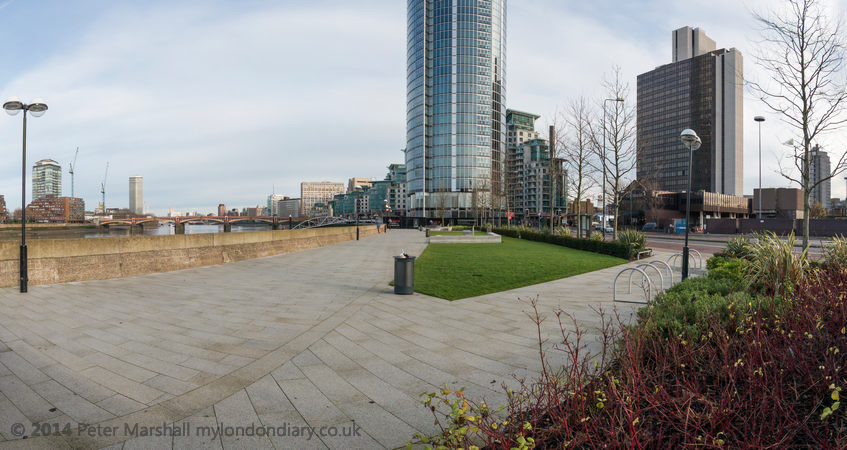
Charterhouse Works, Eltringham St, Battersea, Wandsworth, 1989 89-8c-65

I turned south from York Road into Petergate and turned int Eltringham Street where I think I took this picture of the Charterhouse Works. It’s hard to read the peeling paint of the notice on the side, but I think these were once the works of Sandle Brothers, Manufacturing Stationers, Wholesale & Export with City Offices & Showroom at 4 Snow Hill EC4. You can see more about them on Spitalfields Life.
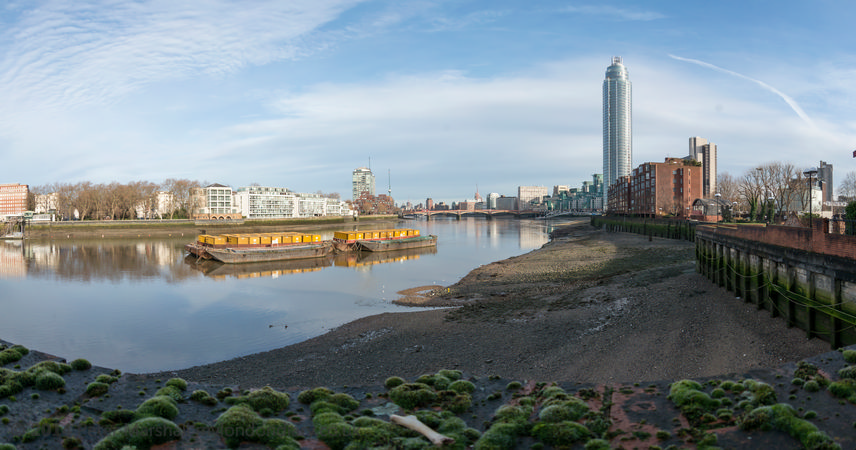
There appears to be a very long list of current occupants on the front of the building and on the full size image I can make out some of the names of what appear to be small businesses with workshops or offices in the building.

I think this is now the site of Charterhouse Appartments at 21 Eltringham St, a large modern block.

Nicholson & Co, 115, 119, Plough Rd, Battersea, Wandsworth, 1989 89-8c-52

I made my way through the back streets to Plough Road, probably going along the footpath beside the railway line, Tours Passage. On the way I passed a heap of black sacks of rubbish with horse that had come from a fair roundabout, which I photographed but have not yet digitised.

Going under a railway bridge and walking down the road took me opposite the works of Nicholson & Co Ltd at 115-7 Plough Road, Heating – Ventilating – Air Conditioning Engineers established in 1904. Next door at 119 is a rather more ornate building with the date 1902 in its gable. The 2013 Survey of London tells me this was a former diary “designed by William Clinch Poole for the Dairy Supply Company Ltd.”

Plough Road School, Plough Terrace, Battersea, Wandsworth, 1989 89-8c-53

Plough Road School is Grade II listed as Highview Primary School and was built in 1889-90 (the date 1890 appears on it though not in my picture) designed for the London School Board by its architect T J Bailey who was proud of his work and exbibted the designs at the Royal Academy in 1891.

My view is of the back of the building, probably because much of the rest was covered by scaffolding when I made it, but perhaps becuase I thought the architectural influence was more evident. At the right of my picture is a little of the schoolkeeper’s house built at the same time.

St Pauls, Church, Community Centre, Vardens Rd, St John's Hill, Wandsworth, 1989 89-8c-54
St Pauls, Church, Community Centre, Vardens Rd, St John’s Hill, Wandsworth, 1989 89-8c-54

At the bottom of Plough Road I turned right into St John’s Hill and took this picture of St Paul’s Church from the corner of Vardens Road, I think to contrast the slender spire with the pillars of the corner doorway of 129 St John’s Hill. This block, shops with flats above has a rather more delicate entrance to the flats, Harvard Mansions, on Vardens Road. Those pillars seemed unusual in that they clearly were not supporting anything – with a top looking like a chimney. The block was built in the late 1890s in an Arts and Crafts style.

Although this is on St John’s Hill it was built in 1868 as St Paul’s church, as a part of the parish of St John’s Battersea which was on Usk Road. It was needed to accommodate the growing number of worshippers in the area which was beginning to expand rapidly. Later numbers fell and St John’s closed in 1950. This church became part of the parish of St. Peter & St Paul Battersea. Chad Varah who founded the Samaritans was its vicar from 1949-53.

Designed by H E Coe this Victorian Gothic church was build in a Decorated style using Kentish ragstone. Despite some on-line statements it appears to be only locally listed. When I made this picture it was in use as a community centre for the local residents association and as a nursery and it seems only to have been formally de-consecrated in 2013 to allow parts to be converted to flats.

Houses, 13-17, Spencer Rd, Wandsworth, 1989 89-8c-55

I walked west to the next turning on St John’s Hill and went down Spencer Road where a short distance down I found these splendid Victorian villas. Much of the housing in the road is interesting but I was particularly interested in these for their combination of Victorian Gothic and Dutch gables.

Spencer Road presumably gets its name from the various Spencers who were Lords of the Manor in this area. The street was laid out before 1871 but was developed piecemeal and these houses are I think probably a little later.

This walk will conclude in a later post.


FlickrFacebookMy London DiaryHull PhotosLea ValleyParis
London’s Industrial HeritageLondon Photos

All photographs on this page are copyright © Peter Marshall.
Contact me to buy prints or licence to reproduce.