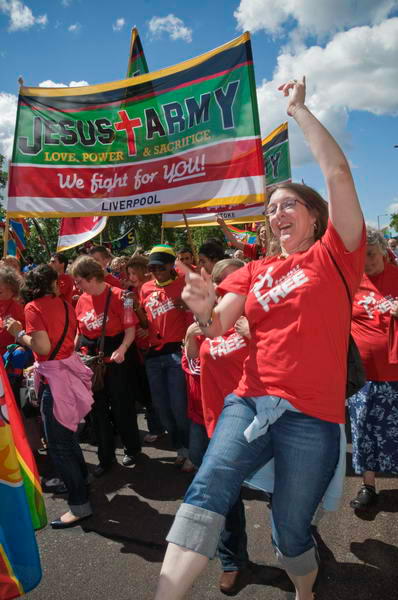
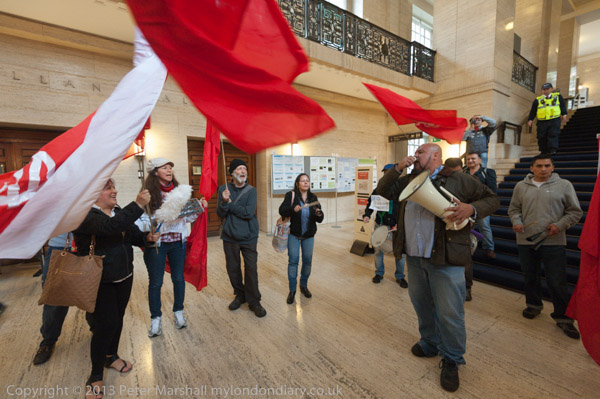
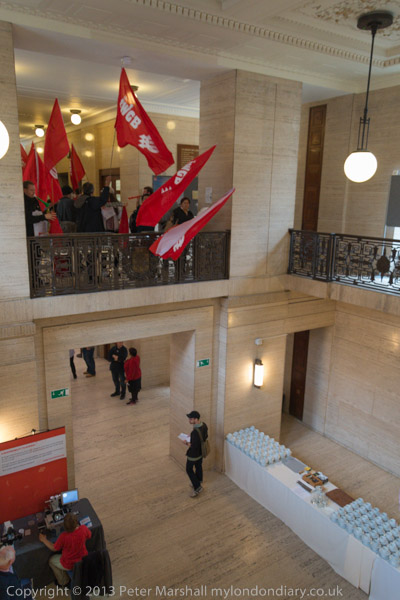
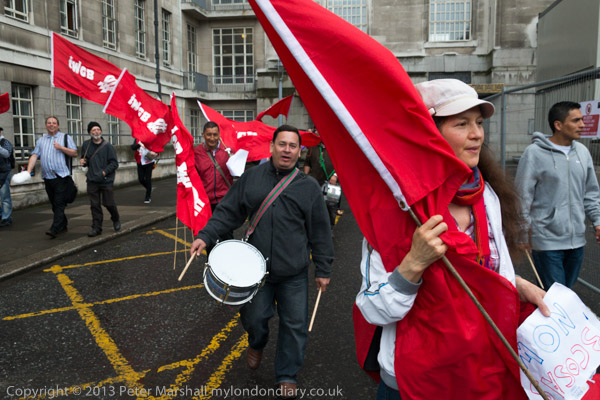
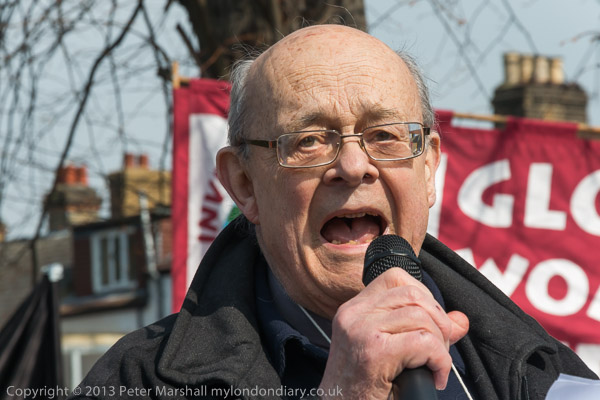
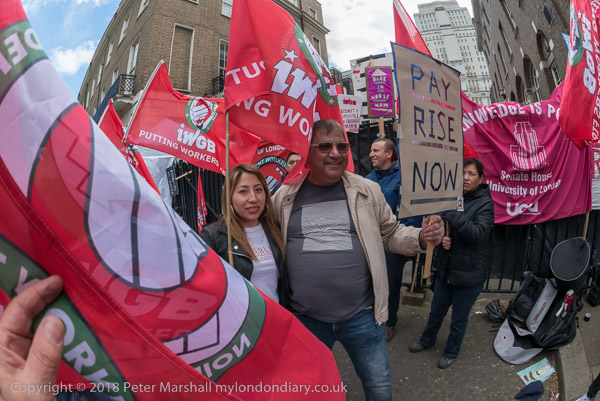
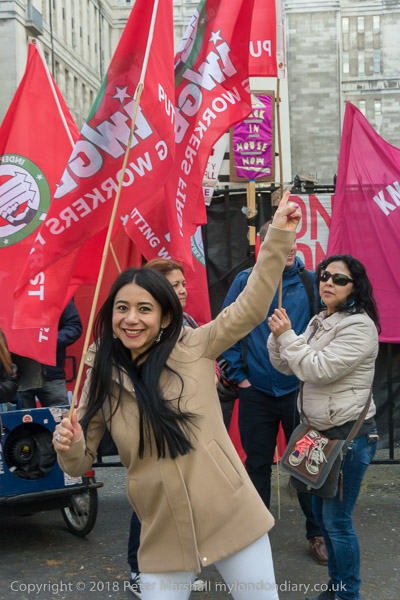
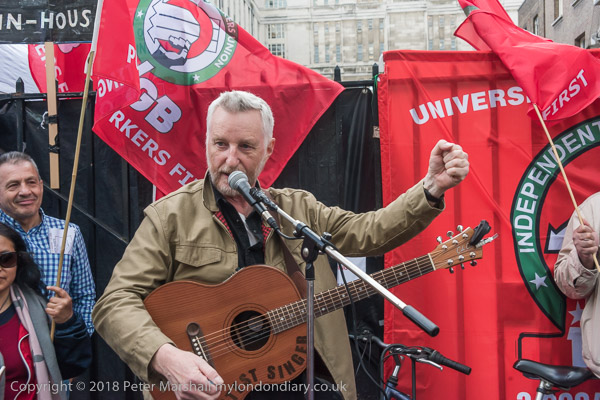
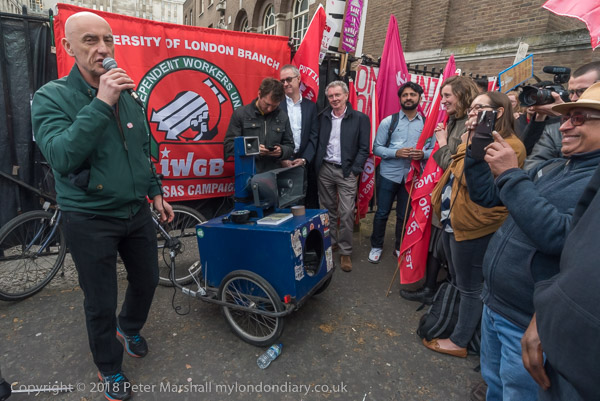
End outsourcing at University of London: Five years ago, on Wednesday 25th April 2018 I was with workers from the Independent Workers Union of Great Britain – IWGB on the first day of a two day strike at the University of London central administration by over 100 cleaners, porters, security officers, receptionists, gardeners, post room staff and audiovisual staff.
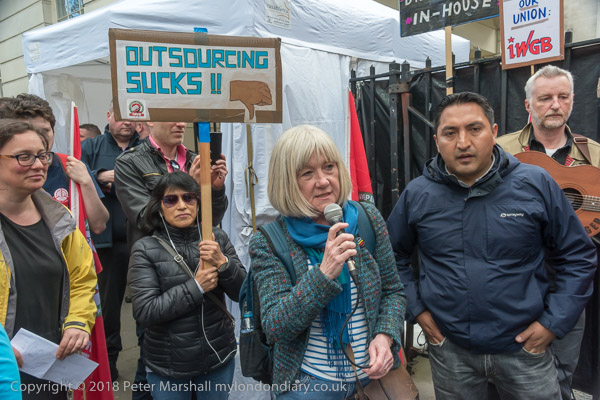
They were calling for an end to the outsourcing of their jobs in the university to various contracting companies and demanding to be directly employed by the University, and receive the same conditions and benefits as directly employed colleagues. As well as the workers, academics, students and other trade unionists came to support them in a lively rally outside the gates to Stewart House in Russell Square..
The rally was part of a successful campaign led by the IWGB which began in 2010 and ten years later the university central administration changed to directly employ porters, receptionists, post room and audio visual technicians, with cleaners following shortly after in November 2020.
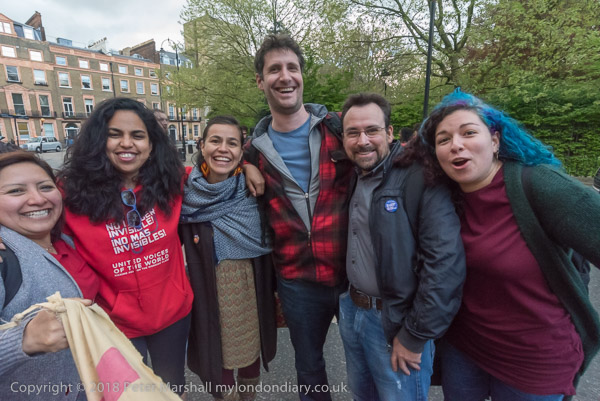
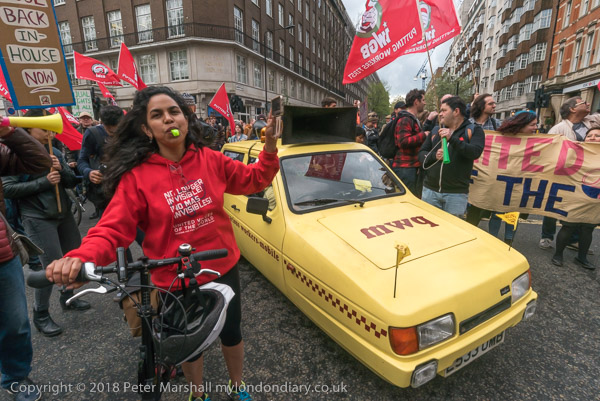
The IWGB are still campaigning to bring workers in-house in other universities in London, including UCL, and they and other unions have been successful elsewhere. United Voices of the World are one of these and some of their members had come to the rally to show their support.
Cleaners and security staff at universities across London are organising for equality with directly-employed staff!
Outsourced workers suffer from far worse terms and conditions than directly-employed colleagues, facing no sick pay, bare minimum holiday entitlement and meagre pensions. Bullying, mismanagement and discrimination by unaccountable outsourced managers are common.
Workers in the IWGB union are leading the fightback. Through public campaigning and strike action we can end outsourcing at London universities!
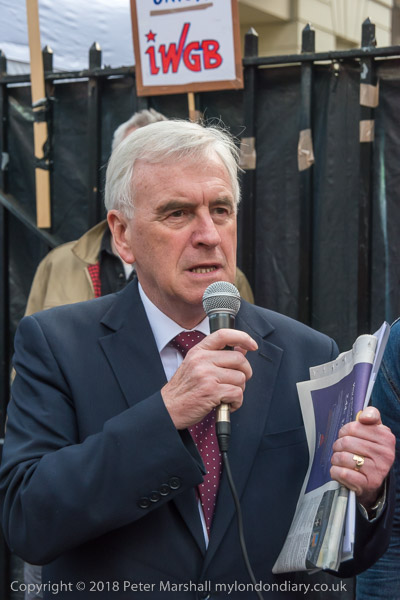
Among the speakers at the gates of Senate House was Shadow Chancellor John McDonnell who also brought support from Jeremy Corbyn and promised a Labour government would bring in new trade union laws and end the unfairness of outsourcing. Unfortunately should we now get a Labour government at the next election its policies will be more about protecting company profits than protecting workers.
There were plenty of others as well as IWGB members who spoke, and one was a woman from UCU at Goldsmiths University who had come with a large donation from them to the strike fund.
Billy Bragg came to give his support, singing three songs, and got us joining in on some of them, and Archie Shuttlebrace sang with Rebecca Wade Morris. Chip Hamer (Grim Chip) and another of the poets from Poetry on the Picket Line performed some of their work.
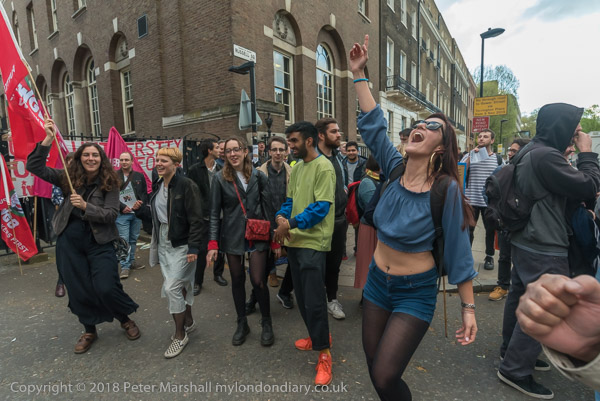
Then it was time for a march around Russell Square, with over 200 people briefly holding up traffic. The march was lead by the yellow Precarious Workers Mobile three-wheeler and a samba band.
They returned to the gates of Stewart House and the rally continued with more music, poetry and dancing.
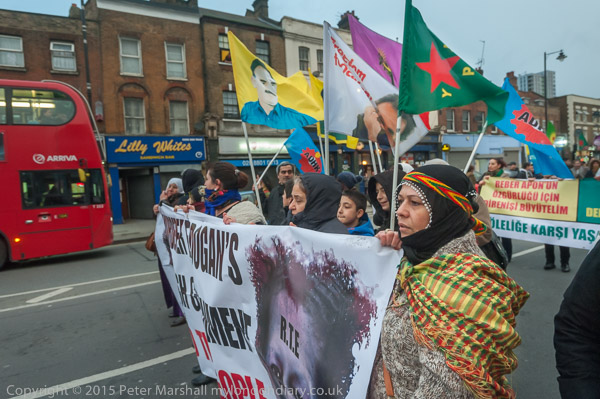
Seven years ago on February 7th 2016 I made my way on a Sunday afternoon to Edmonton in north London. I don’t now much like working on Sundays, when I often go out for a walk with my wife and catch up with things from the week that’s just ended. And public transport, on which I rely to get into and around London is often disrupted by engineering work on the railways and poorer or non-existent bus services.
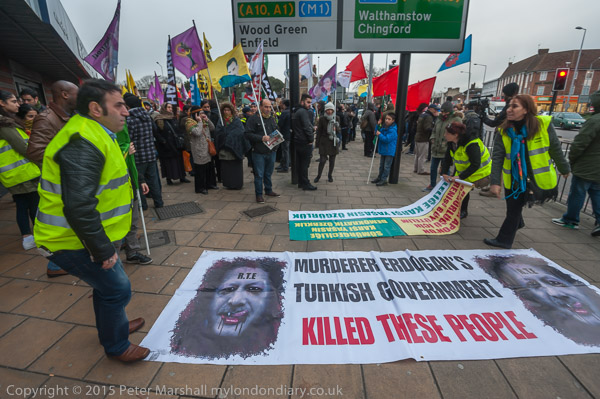
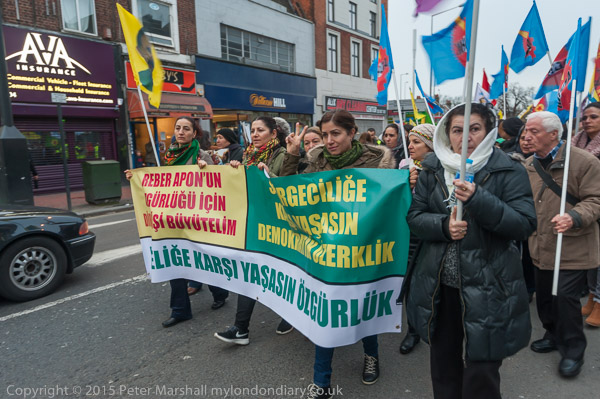
But the trains and underground on that day took me smoothly if rather slowly to Silver Street from where it was just a short walk along the street to the corner with Fore Street where Kurds were meeting up for a march. Angel Road is now I think the underpass which carries most of the traffic along the North Circular under this junction, but this is still the Angel junction.
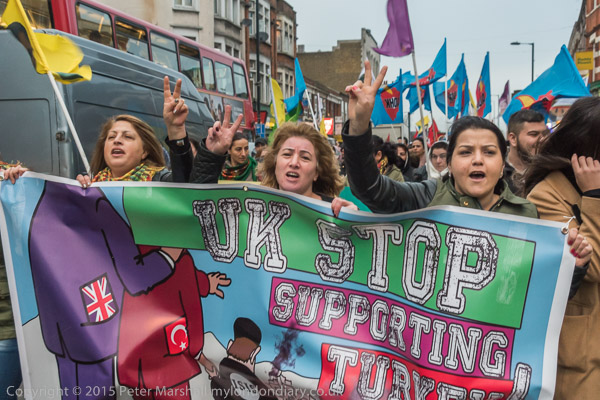
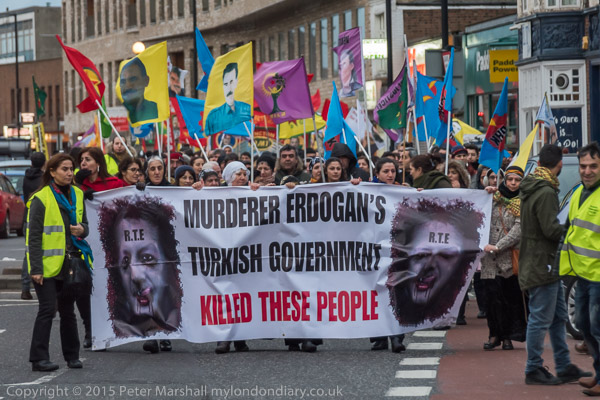
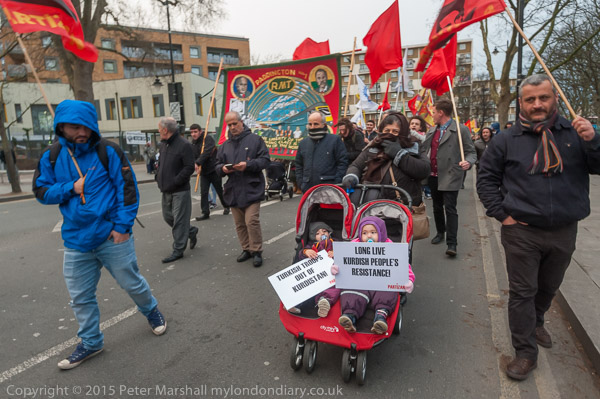
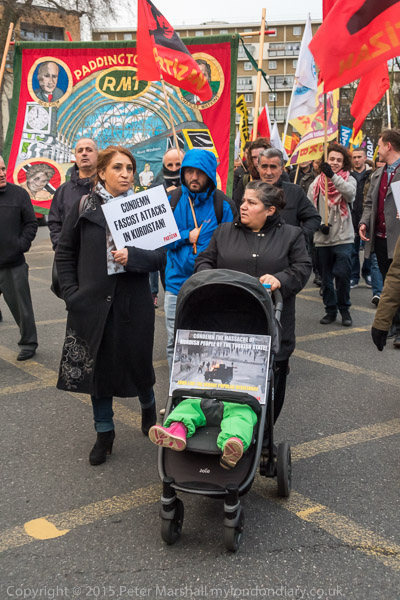
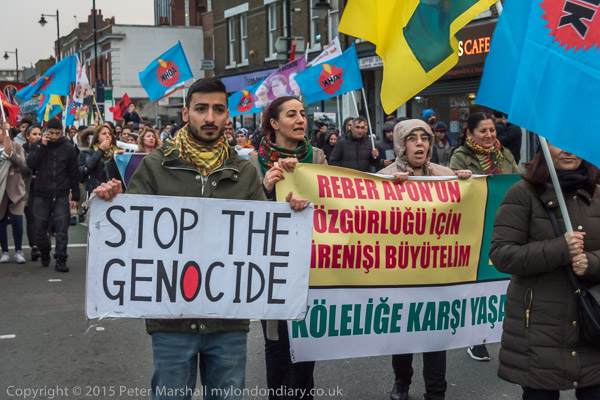
I’d responded to an invitation to cover the event with the title ‘End the siege of North Kurdistan! Turkey out of Rojava!’ which read (in part) “Kurdish, Turkish and left organisation call on the unions, left, progressive, feminist and antifascist groups of London to join a march through the heart of the community from Upper Edmonton to Haringay. We are calling for the end of the siege of the Kurdish regions by the Turkish army, and the withdrawal of Turkish troops from Rojava. We must show our solidarity with the resistance and popular assemblies in both regions, and build our links with this heroic and inspiring movement.”
The time given for the protest was 16:00 and I’d arrived a little before 4pm, hoping to take as many pictures as possible before the light faded. Sunset here in early February is just before 5pm, not that there was much if any sign of the sun on that dry but very overcast day. By the time the march moved off a little after 4.30pm the light was dropping fast, and before long I was working at ISO 2000 and 3200 on the two Nikons I was using. Even then many pictures were a little blurred due to people moving at walking pace.
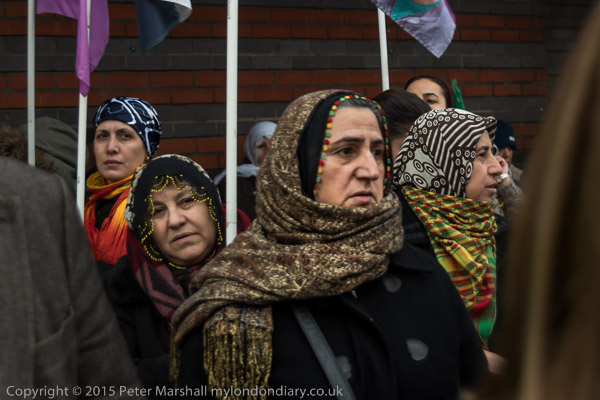
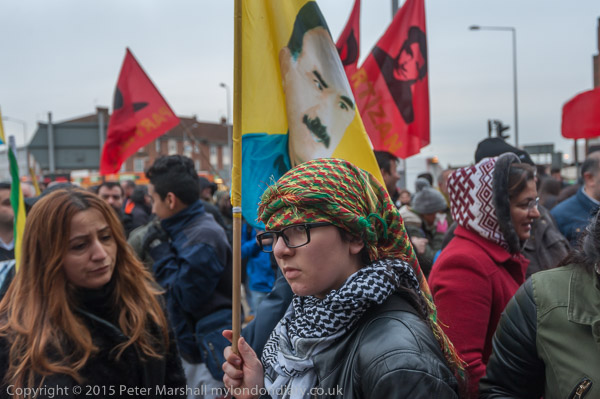
On My London Diary I write more about the groups involved and the reasons for the protest. Almost all those on the march were from Kurdish groups and as I commented “Apart from a banner from the Paddington Branch of the RMT there was no presence from the British left, who don’t appear to have woken up to what is happening in Turkey and in Kurdistan.”
Our governments too over the years appear to have kept a deliberately blind eye to events in Turkey, standing up for it as a member of NATO rather than standing up to it and supporting the human and civil rights of the Kurds, who have long been oppressed.
Things got worse in Turkey after the success of Recep Tayyip Erdogan’s AKP party in the June 2015 elections with curfews, the imposition of martial law, and arrests of anyone opposed to the Turkish government, with attacks by tanks and artillery, and snipers targeting homes, killing more than 400 civilians in the last 7 months. Politicians, human rights activists, journalists, students and 30 mayors had been imprisoned and hundreds of thousands have been threatened and forced to flee their homes.
Britain and the EU have turned that blind eye to the support of Turkey for ISIS, aiding them to smuggle oil whose sale finances their activities. Kurds have led the fight against ISIS and Turkish attacks on them have hindered them.
Since 2016 the situation in Kurdish areas of Syria has worsened with Turkish forces invading parts of the area with the help of former ISIS fighters in 2018. Hundreds of Kurds were killed and Turkey has instituted a policy of ethnic cleansing, depopulating the area. The remaining Kurds face death, extortion, and kidnappings by various armed groups backed by Turkey. Kurdish-owned homes and farms are confiscated, and new settlements for non-Kurds are being built.
I left the march shortly after it passed White Hart Lane. I was getting tired and it was getting too dark to take more pictures without flash, and I thought I had done enough.
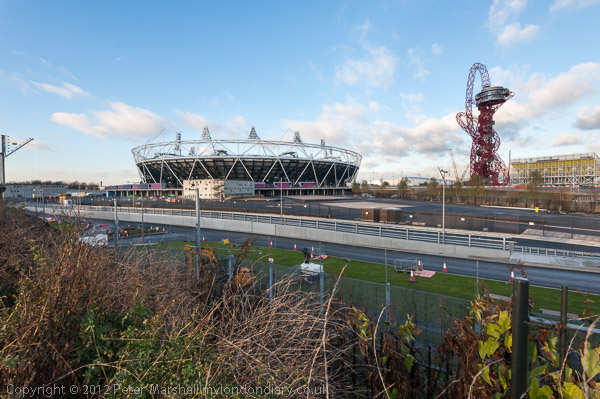
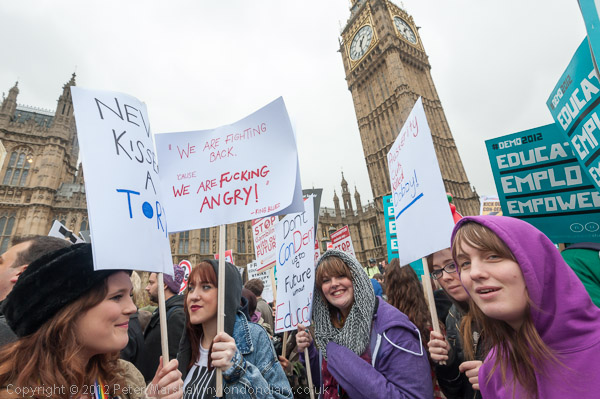
December 5th 2012 was a fine winter’s day and I took advantage of the weather to try and walk around the area which had been fenced off for the London Olympics for around 5 years. In the evening I joined a protest in Westminster against the continuing cuts being aimed at the poorest and most vulnerable by George Osborne and the Conservative-led government.
Olympic Area Slightly Open – Stratford Marsh. Wed 5 Dec 2012
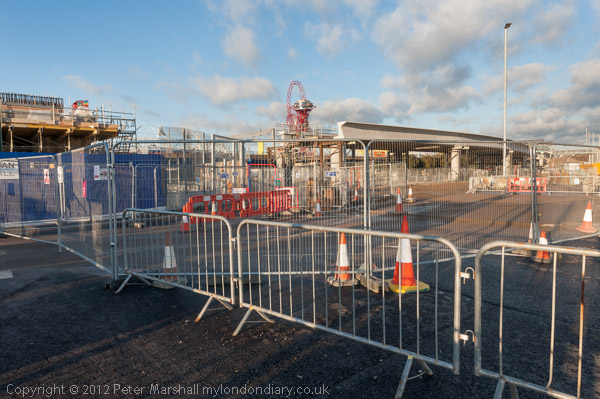
It was around April 2007 that an 11 mile long blue fence went up around the whole of the London Olympic site at Stratford, barring access to the whole site except for those working on it. Parts were replaced in 2012 with a 5,000 volt 4m tall electrified perimeter fence in 2012 for the games itself.
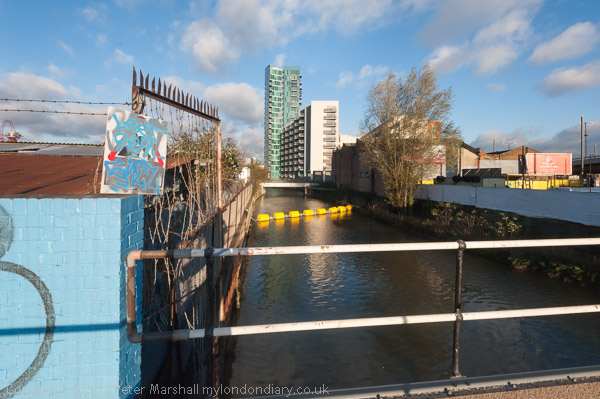
St Thomas’ Creek still blocked to boats
Even the public footpath along the Northern Sewage Outfall, the Greenway, had been closed in May 2012, but after I heard this had reopened on December 1st I had been wanting to visit the area again to walk along it.
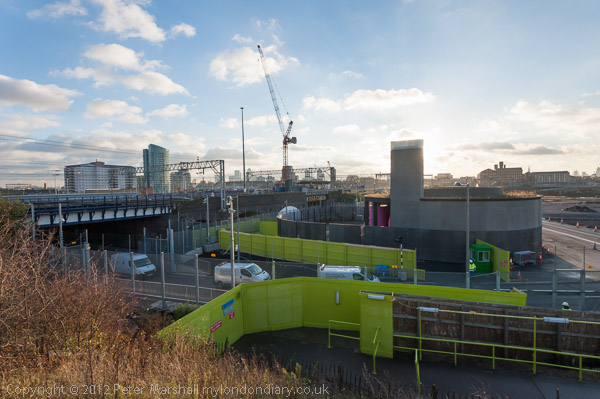
Crossrail works
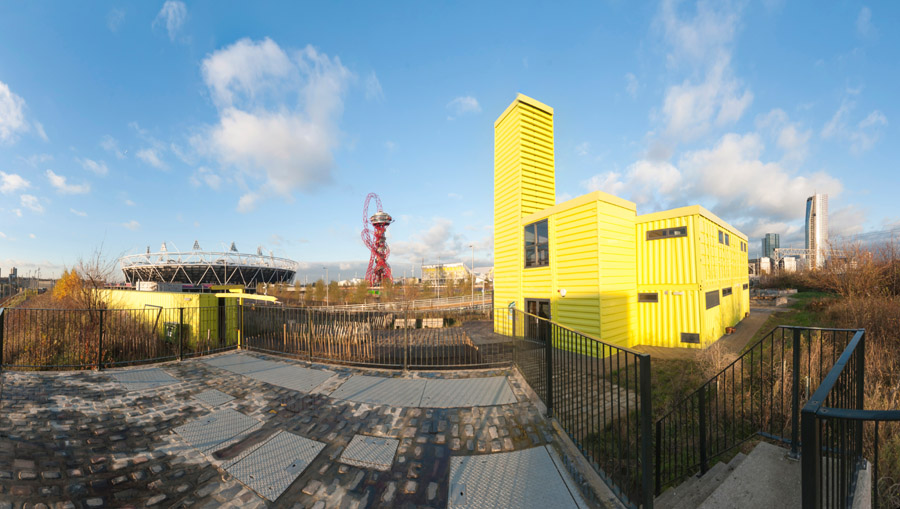
The View Tube, a cafe and viewing area set up on the Greenway had also reopened, under new management, and it was only signs for this that kept me going past a maze of fencing and hostile signage. The Greenway was still closed between Stratford High Street and the main railway lines because of ongoing work for Crossrail, and roads north of the railway were still fenced off.
Wire fences and yellow fences have replaced the blue
Despite it being a fine afternoon for a walk I was the only customer to enter the View Tube while I was there and the Greenway, normally a useful through route for cyclists and pedestrians, was still deserted.
I could see no signs of work going on to bring the area back into use. Ten years later the area is still largely a desert and most of the promises about the ‘Olympic Legacy’ have been reneged on. This is still an Olympic waste; though the developers have done well out of it, the people haven’t.
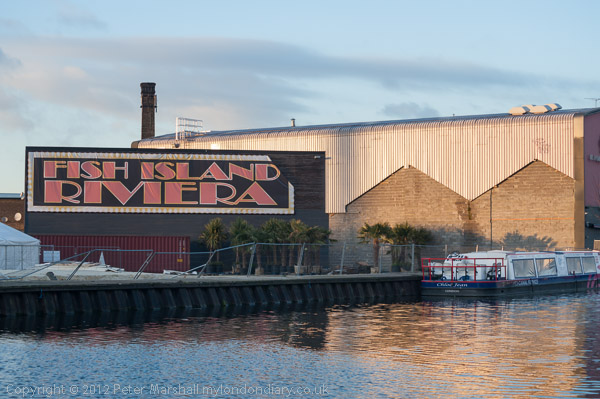
I walked along the Greenway, finding there was no access from it to any part of the area, with those electric wire fences still in place, and made my way along the Lea Navigation to Hackney Wick, making a number of pictures on my way.
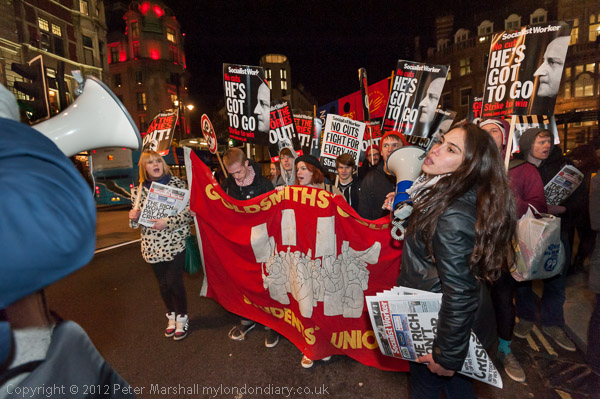
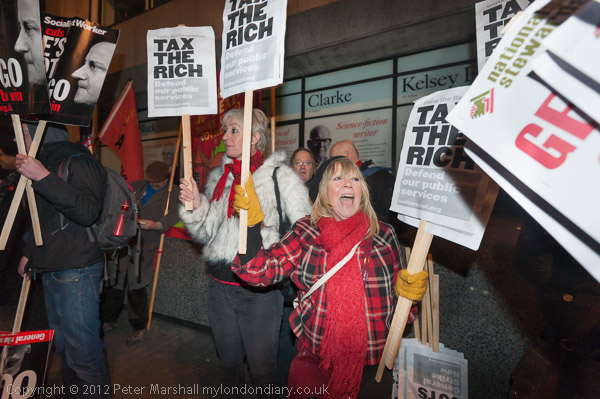
Osborne’s Budget Cuts – Strand to Westminster, Wed 5 Dec 2012
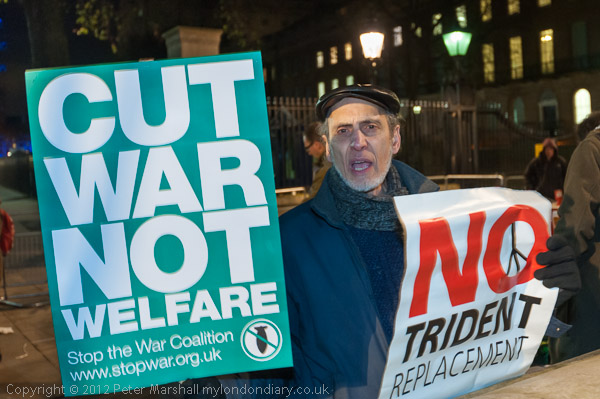
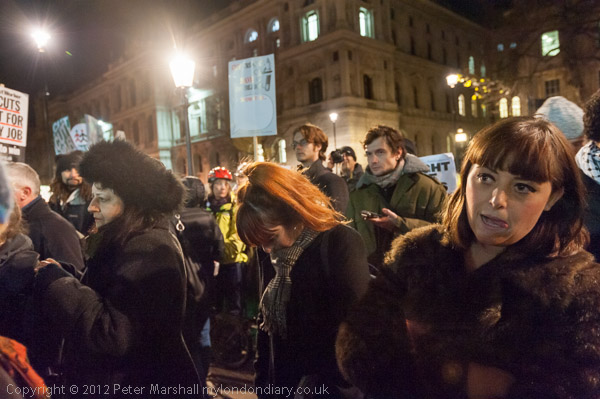
I around 200 people outside Kings College at Aldwych who were meeting to march to join the rally at Downing St where Stop the War and CND were protesting against Osborne’s attacks on the vulnerable, continued in his autumn statement.
The march had been called by the UCU London Region, and was joined by students, trade unionists, socialists and others, and went down the Strand and into Whitehall shouting slogans against public service cuts, the rich, David Cameron and George Osborne in particular to join a similar number already protesting at Downing St.
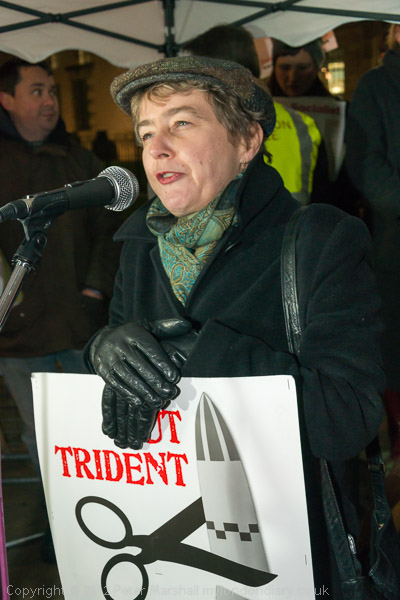
Speakers at the rally pointed out the huge cost of military expenditure which was being poured into futile projects – and the pockets of the arms manufacturers:
“The Afghanistan war — which everyone knows is futile and lost — is costing around £6 billion a year. The yearly maintenance costs for Trident are £2.2 billion a year. The cost of renewing the Trident system — which this government is committed to do — would cost up to £130 billion. Two aircraft carriers are being built at a cost of £7 billion. Then there’s the £15 billion to be spent buying 150 F-35 jets from the US, each of which will cost £85 million plus an extra £16 million for the engine.”
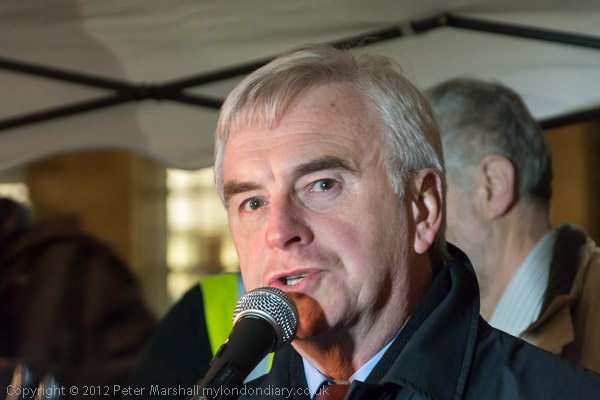
John McDonnell MP
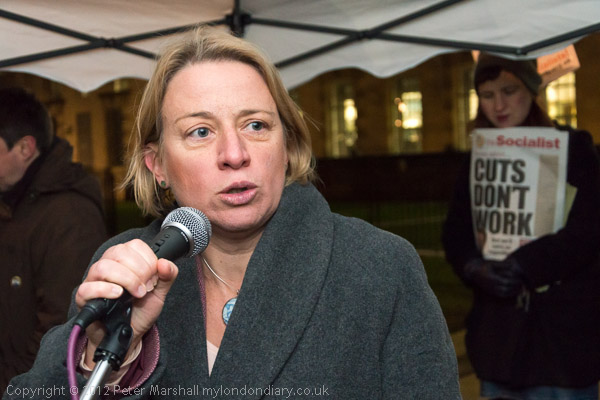
By now it was freezing, and when the speeches began the speakers were asked to cut their contributions short because of the extreme cold. Among those who spoke were John McDonnell MP, Kate Hudson of CND, author Owen Jones, Andy Greene of DPAC and Green Party leader Natalie Bennett.
Kate Hudson CND
We heard from a nurse about the campaign to keep Lewisham hospital open, where a few days earlier 15,000 had marched and formed a human chain around the hospital. The hospital is successful and well run, but huge PFI debts from another hospital in the area threaten its future.
Green Party Leader Natalie Bennett
A NUT member talked about the problems the cuts were making in education and campaigners had come from Connaught School in Waltham Forest where they are striking against the decision by school governors to pursue academy status despite the opposition of the teachers, parents, the local MP and councillors.
A speaker from UK Uncut urged people to join the protests against Starbucks the following Saturday and many of those who spoke called for trade unions to take action against the cuts, calling on union leaders to stop simply speaking against them and start organising strike action.
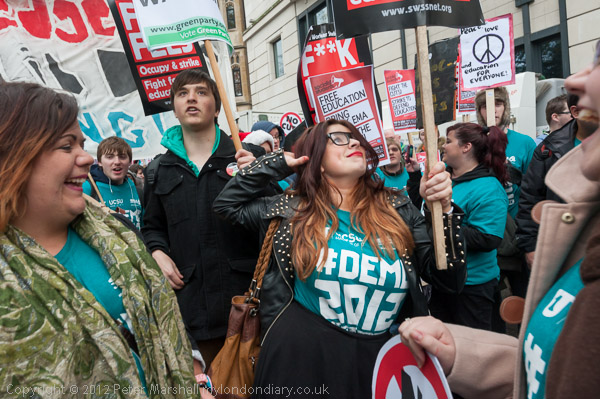
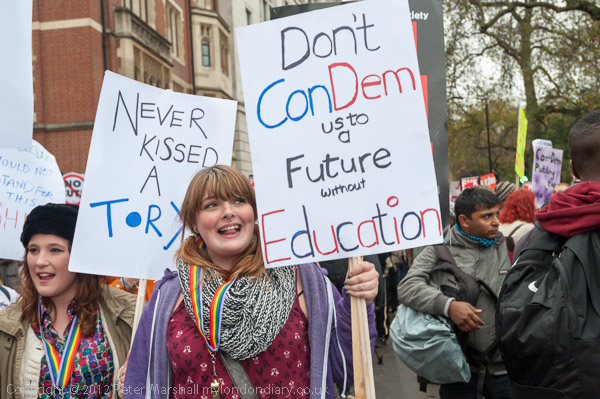
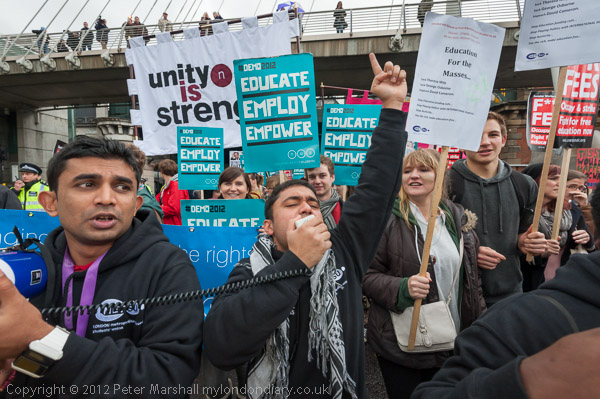
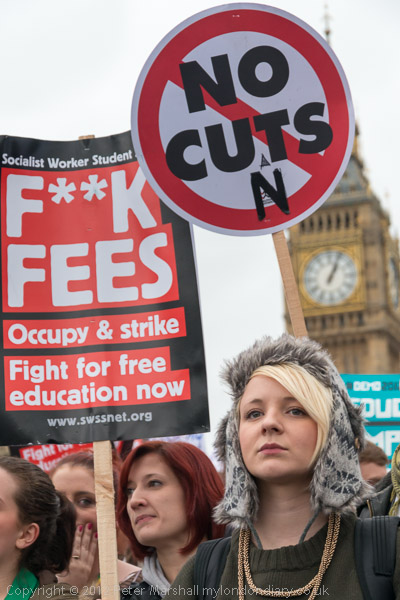
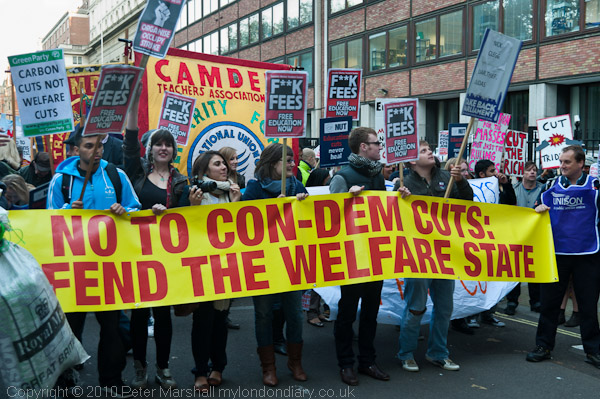
One of the main issues that led to a huge slump in votes for the Liberal Democrats in the 2015 General Election was their support as a part of the Conservative-Lib Dem coalition government for increasing student fees. In 2010, there were 57 Liberal Democrat MPs, but their number fell to 8 in 2015, and has only recovered slightly in the two following elections, with currently 11 MPs. Of course the drop is exaggerated by our first past the post electoral system which is grossly unfair to minority parties, but it still reflects an enormous drop in public confidence in the party.
Before the 2010 election, the Lib-Dems had been seen as a moderate centrist party opposed to both Tories and Labour, but their actions in the coalition shifted perceptions; in many eyes they became seen as simply a rather lightweight branch of the Conservative Party and certainly no longer a credible opposition.
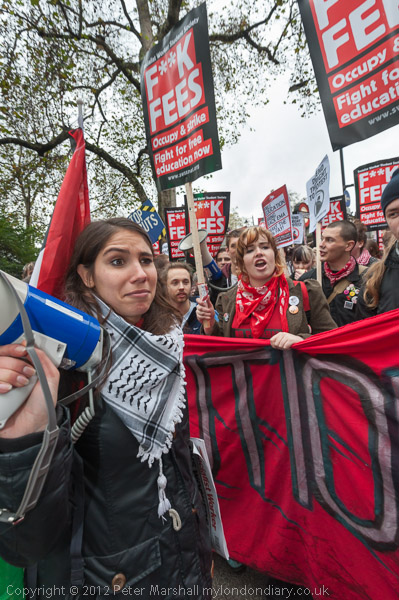
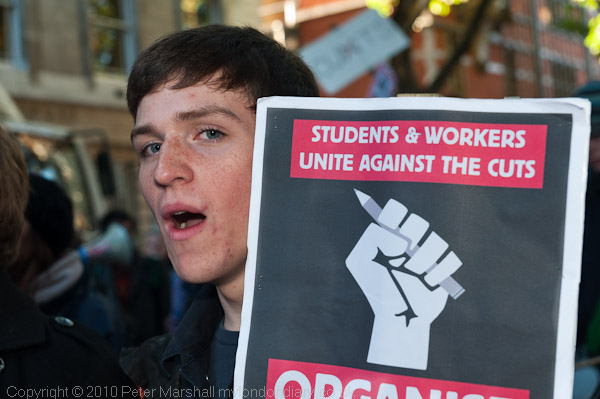
It was the Labour Party who had introduced student tuition fees under Blair’s New Labour government in 1998, setting them at £1,000 a year. New Labour again raised them in 2006 to £3,000. But in 2012 the Tory Lib-Dem coalition tripled them again, to £9,000 – so totalling £27,000 for a normal 3 year course. The fees were stated to be a maximum, but it was soon what almost all universities were charging.
After World War 2, most local authorities had provided maintenance grants for students, enough to cover their living costs for the roughly 30 weeks a year of most courses. The 1962 Education Act made this a legal obligation; the grants were means-tested with a minimum of around a third of the full grant, with wealthier parents being expected but not obliged to make up the difference. But all of us from poorer families got the full grant.
When the Tories under Mrs Thatcher replaced these grants with student loans in 1980 there was an immediate fall in university applications – the 1981 figures showed a drop of 57% from 1979. The loan system was a boon to students from wealthy homes, taking the obligation from their parents for supporting them – and at the start the terms of the loans made it an advantage for rich students who had no need for them to take them out. Since then the terms of the student loans have worsened considerably.
Many have since found that with rising costs the maintenance loan available isn’t enough to pay for their accommodation and food and some need to take out more expensive loans than the student loan to keep alive during their course. I’ve seen too the long queues for the free food offered by Hare Krishna in Bloomsbury at lunchtimes, and students have also had to go to food banks and other places offering support.
Many students now work during term-time, some putting in long hours in bars and other part-time work which must affect their studies. When I was a student, taking paid work could have led to me being thrown off my course, although of course I did work during vacations, and needed to, as these were not covered by the grant.
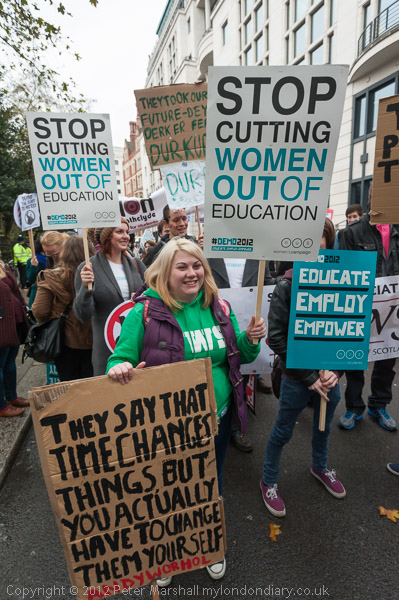
Higher education students are not the only ones who were suffering from the cuts made by the Coalition government. Younger students, 16-18 year olds still in schools, sixth form colleges and FE, were angry at the loss of the Educational Maintenance Allowance (EMA) of up to £30 per week, which many needed to pay their fares to college and to buy midday meals while studying.
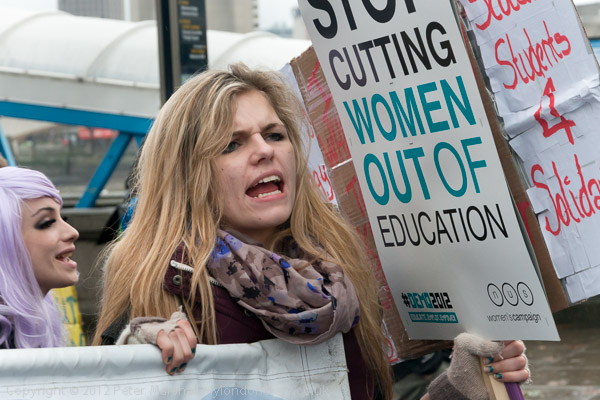
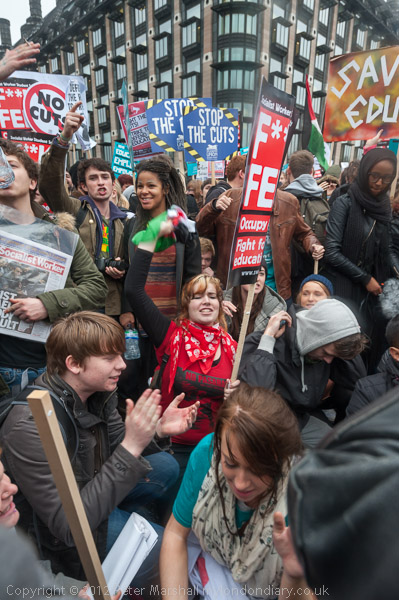
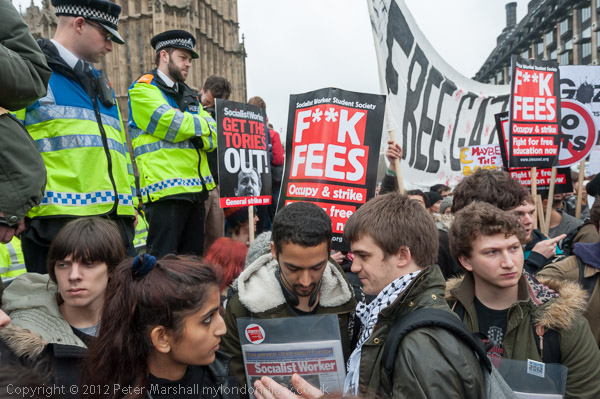
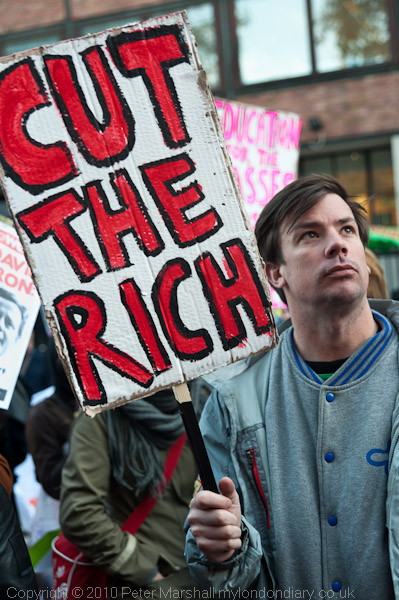
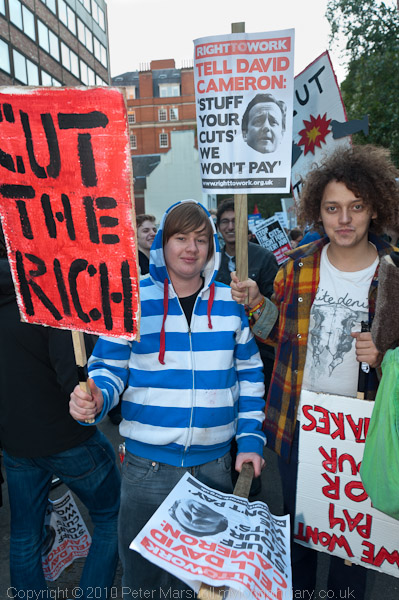
And as I pointed out “Students are also concerned about other cuts being made by the government which will affect them, and also by the increasing efforts to privatise the education system at all levels. There were also many placards pointing out the class-based nature of our education system and our government, with a cabinet stuffed with privately educated millionaires who appear to have little idea of how difficult times are for ordinary people and no real sympathy for them.”
Since the student protests of November and December 2010 the police had become very worried about the possibility of violent scenes – often provoked by police action – at student protests, and were out in force. The march organisers too had agreed a route with the police which would cut down the possibilities, taking the marchers across Westminster Bridge to end with a rally in Kennington Park, well away from any government ministries and Tory and Lib-Dem party headquarters. This was a peaceful protest although the roughly 10,000 attending were clearly very angry and small groups who attempted to break away from the protest in Parliament Square where the march stopped for a photocall and many sat down on the road were fairly soon moved on.
There were still a few sitting on the road or standing around outside parliament when I decided to leave; it was raining slightly and dark clouds suggested a downpour was on the way. I decided nothing more was likely to happen at Westminster and that a rally in pouring rain was unlikely to be of great interest and started on my way home.
Wednesday 20th October 2020 was a rather different day for me. I started photographing speakers at an indoor rally, something I rarely do, went off to meet with my MP in a pub, then photographed a march against cuts in welfare and the loss of public sector jobs, ending the day at the opening of a show featuring myself and two other photographers, one of whom, Paul Baldesare took two of the pictures in that section of today’s post.
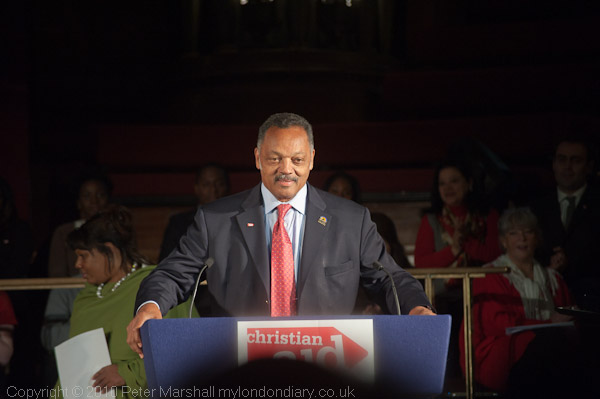
Jesse Jackson & Christian Aid Lobby – Westminster, Wednesday 20 October 2010
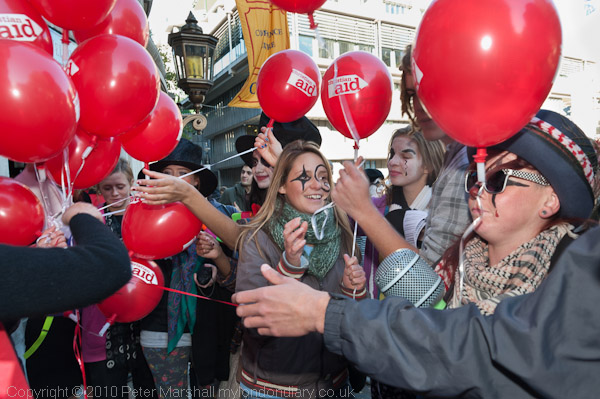
I was one of the 2,500 or so Christian Aid supporters who came to Westminster to lobby their MPs on 20.10.2010, asking them to press for transparency and fairness in the global tax system and for action on climate change.
The day started with a rally in the Methodist palace of Westminster Central Hall, opposite Westminster Abbey, the hall where the inaugural meeting of the United Nations General Assembly took place in January 1946. The Methodists had then moved out for a few months to allow this to take place, and special seating, translation booths installed, along with extra lighting to allow the event to be photographed and televised. But I think that lighting must have been removed as it was pretty dim inside for me to photograph the speakers. But I and a small group from my constituency were fortunate to be inside as there wasn’t enough room for all who came.
Supporters outside Methodist Central Hall
There were speakers from this country and abroad, but the star of the event was undoubtedly the Rev Jesse Jackson, a noted US civil rights and political activist, president and founder of the Rainbow PUSH Coalition, a candidate for the Democratic presidential nomination in 1984 and 1988.
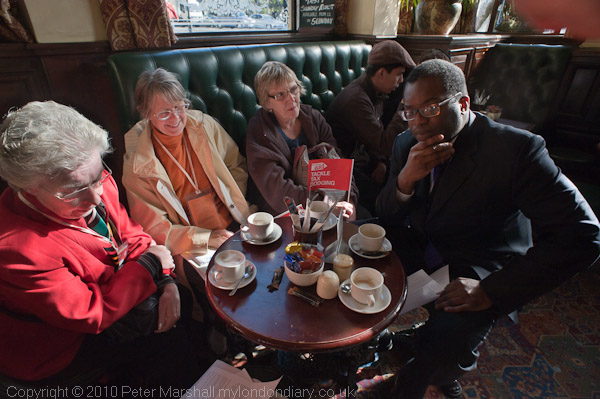
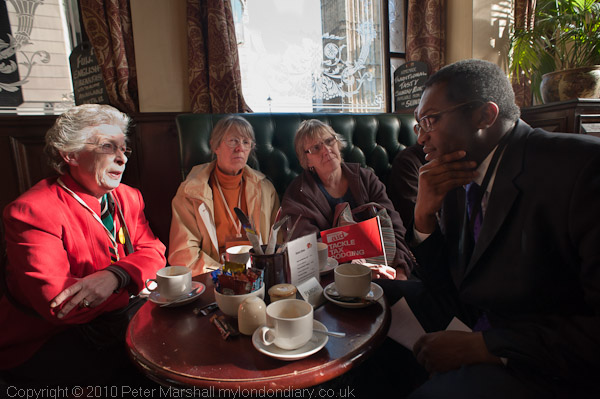
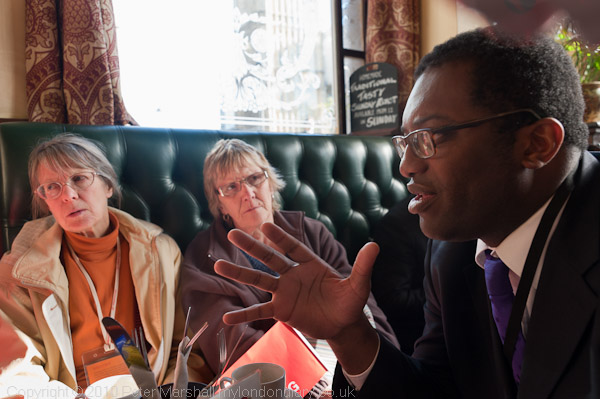
After the rally and a hurried lunch a small group of us from his Spelthorne constituency met with our then recently elected MP, Kwasi Kwarteng, who suggested we find a place in the St Stephen’s Tavern to talk rather than have to go through the tedious business of queueing to go through security to meet inside the parlimentary offices. Although he was still relatively unknown it was rather easy to find him, as there are relatively few extremely tall black male MPs. Though rather more share his educational background of prep school and Eton.
Since then his rise to fame has been rapid, though after his recent sacking after only 38 days as Chancellor of the Exchequer, perhaps that should be notoriety. He has only visited his constituency on fairly rare occasions and I’ve yet to meet him again, though have seen him from a distance outside parliament.
He listened – or at least stayed fairly quiet – while my wife and others talked about the campaign for tax justice and the need for reforms to stop the various forms of tax dodging by major companies robs poor countries of more than $160bn a year, while climate change and the natural disasters it is bringing have a vastly greater impact on the poorer countries who are most vulnerable, despite their much lower per capita carbon footprints. They suffer from the results of our high dependence on fossil fuels.
But his response to the lobbying was perhaps best described as ‘mansplaining’; we were not at the time aware of his work as a consultant for the Odey Asset Management hedge fund or the recent allegations by Private Eye that he has continued to receive undeclared contributions from them. Certainly his activities as Chancellor have resulted in them and other hedge funds who bet against the pound making millions.
March Against Spending Cuts – Malet St & Lincolns Inn Fields, Wed 20 Oct 2010
This was the day that the government announced the results of their comprenhensive spending review (CSR) which involved considerable cuts in welfare benefits and the loss of many public sector jobs as services are cut. The deficit left by the outgoing New Labour government had given the Tories in the Con-Dem coalition a perfect excuse to slash the public sector and privatise services in a way they would never have dared before.
More than a million public sector jobs were expected to be lost, with some being replaced by private sector workers on lower wages, fewer benefits, lower standards of delivery and safety and higher workloads. There will be more cases of people suffering as private companies expand into healthcare, putting profits before the needs of people, and similar changes in other areas.
The Coalition of Resistance who called the protest say the £83 billion to be cut from public services will plunge the economy into a slump. Rather than cutting jobs, pay, pensions, benefits, and public services that will hit the poor ten times harder than the rich, they urge the government to cut bank profits and bonuses, tax the rich and big business. Rather than contract out the NHS, they should axe Trident and withdraw from Afghanistan.
I had to leave before the rally at the end of the march at Downing Street to prepare for the opening of an exhibition I had organised in Hoxton.
Paris • New York • London Opening – Shoreditch Gallery, Hoxton Market. Wed 20 Oct 2010
Paris, 1988
Together with two photographer friends I had put on the show Paris • New York • London at the Shoreditch Gallery which was attached to a cafe in Hoxton Market, a small street just off Great Eastern Street, close to Hoxton Square. Rather confusingly this is not where the actual Hoxton Market is now held which is in Hoxton St.
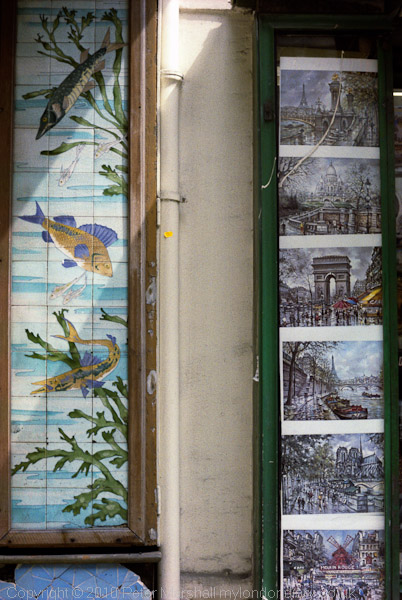
The show was a part of the East London Photomonth annual photography festival, and over the month it was on attracted a decent number of visitors and comments. My section was Paris, and I’d ordered a decent number of copies of my book, Photo Paris, still available at Blurb, most of which sold at the show. Unfortunately I think it now costs around twice as much as I was able to sell it for then.
Paul Baldesare’s pictures of London and pictures taken by John Benton-Harris in New York completed the show and you can still see the work online on a small web site I wrote for the event. Thanks to Paul for some pictures taken at the opening where I was too busy talking to use a camera.
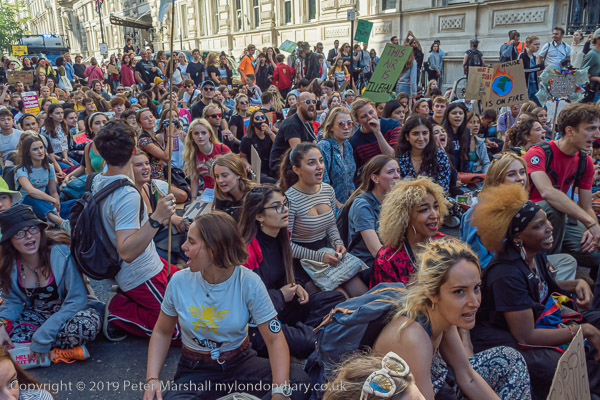
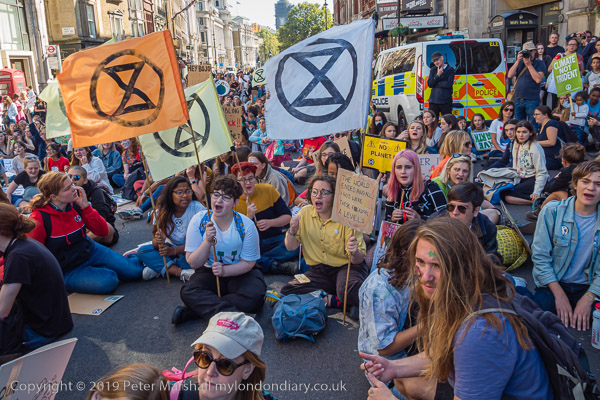
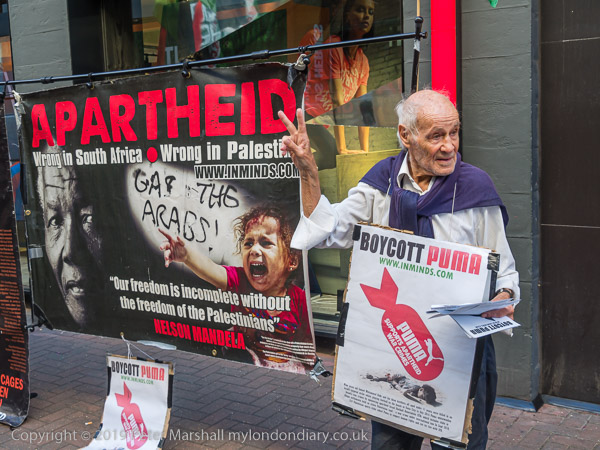
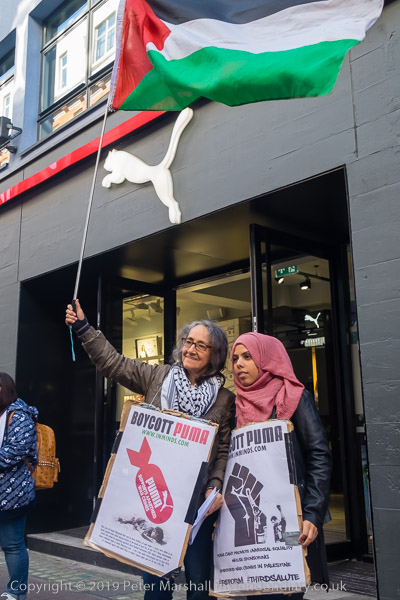
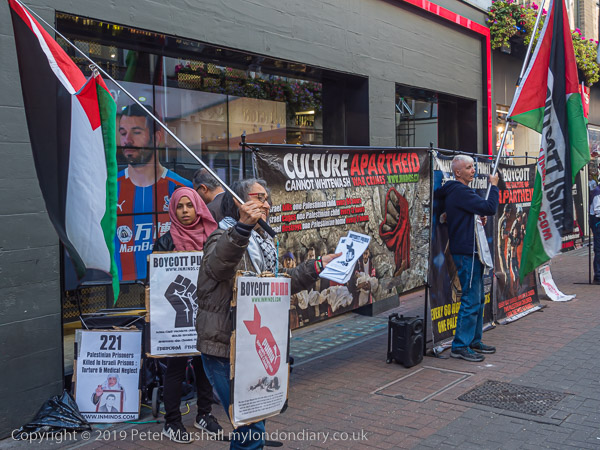
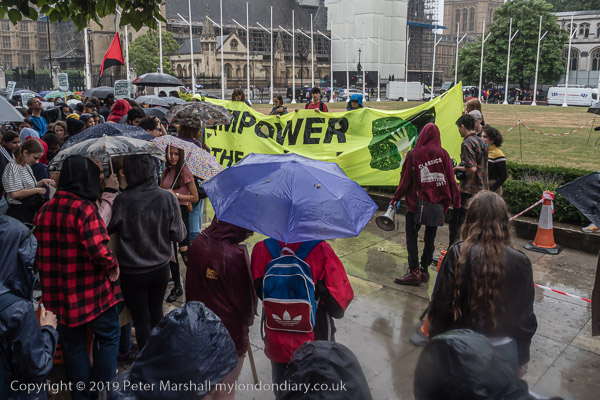
I spend most of my time on Friday 20th September covering the Earth Day Global Climate Strike inspired by Greta Thunberg which brought huge numbers of schoolchildren along with teachers, parents and other older supporters to a rally filling Millbank. Others were starting later from various parts of London to join in and I made short visits to both the Elephant and Castle and Windrush Square in Brixton to photograph them there, returning to Whitehall to photograph a large crowd who were continuing the protests there. Finally I went to Carnaby Street where the Islamic human rights group Inminds were protest outside the Puma store calling for a boycott of Puma products.
Global Climate Strike Rally – Millbank, London
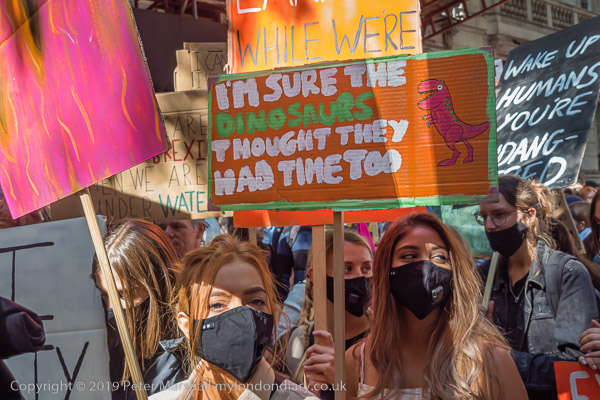
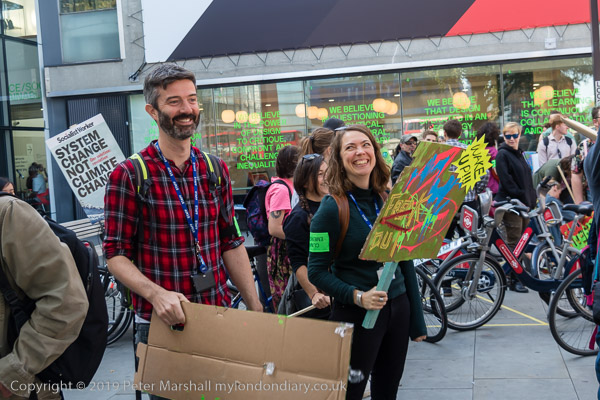
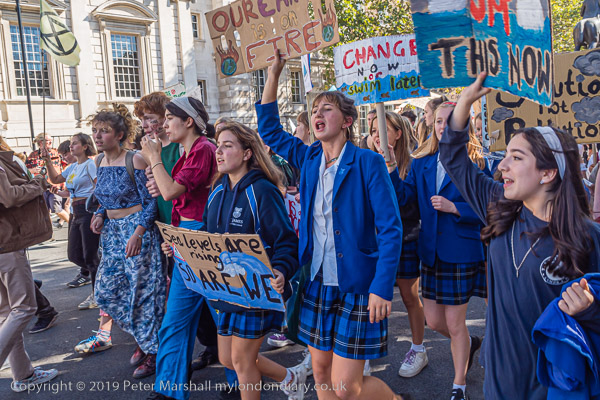
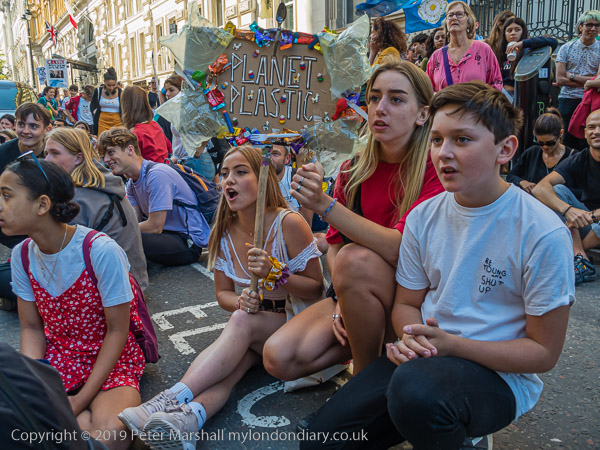
I began taking pictures of people going to the rally when I entered Parliament Square. Many schools had brought large groups of pupils to take part in the protest, and had obviously spent some time preparing hand-painted placards and banners. Greta Thunberg’s example has led to a great awareness among many young people of the existential threat posed by global warming, as too have the television programmes by the ageing David Attenborough, and they showed themselves to be convinced of the need for urgent action.
Unfortunately politicians and companies – particularly those with interests in fossil fuels – have been rather less convinced, and although we have seen plenty of words and promises, real actions have so far failed to come anywhere close to meeting the desperate need. Our new UK government under Liz Truss has started by going backwards on the issue, issuing licences for fracking, and almost certainly in the first few days following the Queen’s funeral will be bringing forward other measures which will make climate disaster even more inevitable.
Crowds got so packed that I had to give up trying to walk up Millbank to the lorry on which the speakers, bands and others were to perform both live and on large screens, and I had to divert through the side streets to approach it from behind.
I spent some time photographing those at the front of the protest, then decided to move back through the crowd taking pictures. It was slow going both because I stopped to take pictures, but also because I needed to keep asking people to let me squeeze past them, but eventually I got back to Old Palace Yard and Parliament Square where movement was now easy, though there were still groups of protesters.
I took the tube from Westminster Station, changing at Embankment to the Bakerloo Line which took me to the Elephant and Castle. Outside the University of the Arts was a poster display and people were gathering to march to join the protests. I photographed a small march setting off to join with workers at Southwark Council’s offices in Tooley St, but left them after a few hundred yards to go back to the Northern Line, changing at Stockwell to get to Brixton.
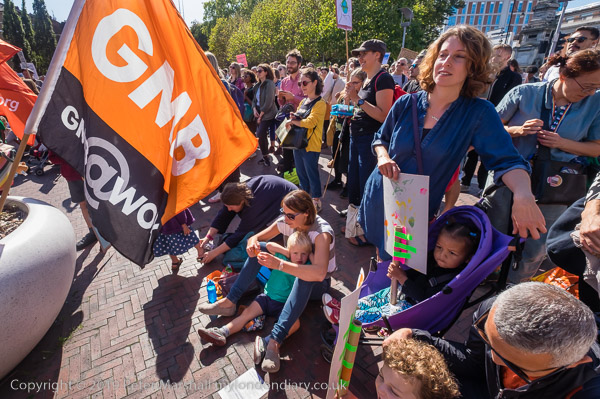
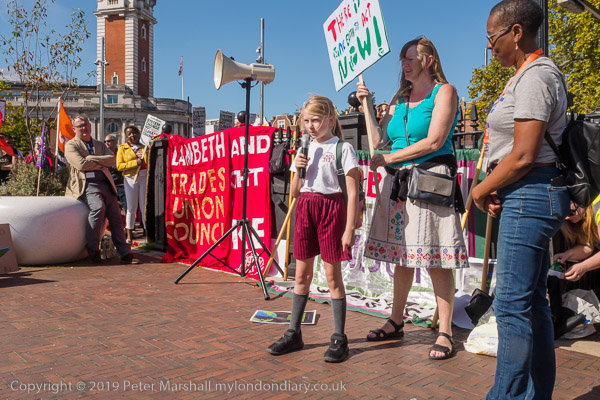
Teachers and parents had come with children from Lambeth schools for a rally in Brixton Square which was still in progress as I arrived.
There was an impressive speech from a young protester and support from a local MP before the rally ended and many of those present got ready to take the tube to join in the protest outside Parliament.
Global Climate Strike Protest continues – Whitehall
I hurried to the tube ahead of the children and arrived in Westminster where people were sitting on the road and blocking Whitehall, with police trying to persuade them to move.
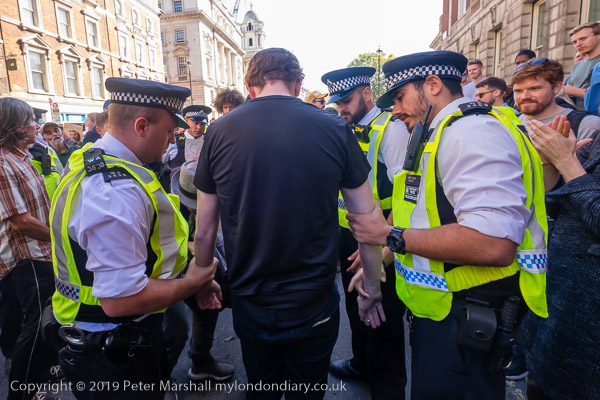
I saw one man being arrested and led away towards a waiting police van, and the road was almost cleared when a large crowd of school students came from Parliament Square to march up Whitehall blocking it again.
Police tried to stop them and they turned down Horseguards Ave, then up Whitehall Court and into Whitehall Place where they were finally stopped at the junction with Northumberland Avenue and sat down on the road.
There were a few sort speeches and a lot of chanting slogans as police attempted to get them to move. I couldn’t understand why the police were bothering as they were on a road that has very little traffic and were causing no problem in sitting there.
Eventually they did decide to do as the police said and got up and moved – back to sit down and block Whitehall again. Eventually they stood up and began to march towards Parliament Square, nicely in time for me to cover a different protest in Carnaby Street.
Whenever tourists come up to me in London and ask me (as sometimes happens) the way to Carnaby Street I’m always tempted to say “You just go back 50 years“, but I’m actually more helpful. But it always surprises me that this rather ordinary street of mainly small shops still attracts tourists so long after it was the touted as the epi-centre of ‘Swinging London’. It still puts on something of an effort, but I find it rather sad. Somehow not the same if you are not wearing flares.
Puma is the third largest sportswear manufacturer in the world, coming from a company founded in Bavaria in 1924 by two brothers. Both brothers were members of the Nazi party during the war and after bitter arguments split up in 1948 to form Adidas and Puma, two companies engaged in bitter rivalry. Adidas is now the second largest sports manufacturer in the world.
The Israel Football Association began life in 1928 as the Palestine Football Association, changing its name following the foundation of the state of Israel in 1948. It only represents Israeli clubs and there is a separate Palestinian Football Association covering the West Bank. But the IFA includes six clubs based in illegal Israeli settlements in the West Bank.
Adidas sponsored the IFA until 2018, when under pressure from Palestinian sports clubs and the international BDS movement they ended their sponsorship. Rivals Puma then took it up, becoming their only international sponsorship and over 200 Palestinian athletes and sports clubs have called for a Puma boycott.
Inminds Islamic human rights group organises protests in London at companies and events which support the Israeli regime and call for the release of Palestinian prisoners. At a previous protest outside Puma the protesters were violently attacked by some members of a small group of Zionists, but there was no sign of any counter-protest while I was present.
River Thames and bridge to Eel Pie Island, The Embankment, Twickenham 1988 8812a-51
Twickenham Riverside – December 1988 I was teaching on Tuesday 13th December 1988, and together with a colleague took a group of photography students from the college to Twickenham, possibly to view an exhibition at the Orleans House Gallery, or perhaps just as a photographic outing.
My first thought when I looked at the contact sheet today was that it could be for the show I helped to organise there in 1988, city news urban blues…. It had been an interesting show, with images from ten of us who were part of a group called Framework, each showing their own group of pictures – those exhibiting were Carol Hudson, Peter Jennings, Terry King, myself, Tony Mayne, Derek Ridgers, John RJ Taylor, Laurence Ward, Randall Webb and Anton Williams. Terry was the main organiser and I worked with him to keep the group running.
But on checking I find that show was rather earlier in the year and I think we were just taking college students to a reasonably safe and interesting area a short train journey away where they could first be taken for a walk to suitable locations around the riverside and parks and then be left to work unsupervised taking pictures while their tutors probably took a lunch hour rest in a riverside pub.
It was surprisingly difficult to get some students to actually take photographs, so we arranged outings such as this where we would provide a suitable location and brief to make sure even they had some material to work with in the darkroom. They were all required to make at least 36 exposures so they had a film (black and white of course) to develop and make prints. Some students made sure they had time to get to a pub too, though there were enough in Twickenham for them to avoid the same as their two tutors.
River Thames, The Embankment, Twickenham, Richmond, 1988 88-11f-55
But I did take some pictures myself during the outing, and here are a few of them. I took two versions of this image, looking upriver from the west end of the Embankment, one with the new Minox GTE and the second I think with a Leica M5 using the 35mm Summilux f1.4 lens. The image above is with the Minox, which had a MC Minoxar 35mm/2.8 lens and is just a little sharper, though the difference might well be in the exact focus distance chosen. But though the Minox was incredibly small and light – the smallest 35mm full-frame camera ever made, it could deliver exceptional results.
River Thames, Twickenham, Richmond, 1988 88-12a-32
You can still launch boats at Twickenham, where at the junction of Church Land and Riverside a roadway leads down into the river. When the tide is low you can walk down this and get a view downriver. On the right boats are moored by Eel Pie Island and in the centre of the image you can just see Richmond Hill between the trees.
And although there is a footbridge across to Eel Pie Island as shown in the top image of this post, residents still need to keep tide tables handy, as the Twickenham Embankment end of the bridge still floods on those days when the moon aligns with the sun at full and new moon to give Spring Tides.
River Thames, The Embankment, Twickenham, Richmond, 1988 88-12a-36
The balustrade is around what is now Champion’s Wharf Play Beach, and the wall is around the end of the riverside section of York House Gardens and a part of the archway leading through to this is just visible. The previous picture showed the narrow sloping pebbles above the waterline which I walked out on to take this picture.
Surprisingly I don’t appear on this occasion to have walked through York House Gardens and didn’t photograph the ‘Naked Ladies’ or Italian Fountain just through that gateway and on the left, but continued along Riverside, taking a few pictures of the houses beside it before reaching the splendid building of the White Swan pub.
You can now drink The Naked Ladies, the bestselling beer produced by Twickenham Brewery, a 4.4% golden ale made with Herkules, Celeia and Chinook hops and CAMRA’s 2019 Champion Golden Ale of London. But the brewery only opened in 2004, and Naked Ladies was first launched in 2013, so I can’t recall if or what I drank there in 1988. But I have enjoyed it at the White Swan and elsewhere more recently.
River Thames, Twickenham, Richmond, 1988 88-12a-15
Before going in a pub we did go down to the riverside a little along from the White Swan, and I made several pictures of this boat covered in vegetation. Apart from this it seemed in quite usable condition and was still firmly moored. The Thames here is still tidal, though the Richmond half-lock downstream stops the water entirely flowing out.
River Thames, Twickenham, Richmond, 1988 88-12b-64
A second picture in much the same area shows a smaller boat in rather cleaner condition, firmly moored and roped down on the mud. In the background at right is the white house on the corner of Lebanon Park and Riverside. This is where Twickenham Ferry used to run across the Thames to Ham House, passing just downstream of Eel Pie Island.
The ferry was licensed by the owners of Ham House, the Dysart family (and sometimes known as Dysart’s Ferry) and the first written mention of it was in 1652. I last went across with my father to see Ham House in the mid-1970s, not long before it ceased operation. There had for some years been a dispute about its right of way on this slipway. I took the photograph below in 1979 when the river was flooded and there were boats moored there which were those used for the ferry in better weather to row people across and there were still notices for waiting passengers still on the fence.
Twickenham Ferry, River Thames flooding at Twickenham, Richmond, January 1979
My contact sheet from December 1988 shows we walked further on, with pictures of moored boats close to where the still operational Hammerton’s Ferry, a Johnny-come-lately from 1908, still runs when weather and water conditions allow. An on one of these frames (not digitised) a small figure by the water’s edge stands taking a photograph, with the balding head of my teaching colleague, another Peter. This was where I made my final image of the day, after which I strongly suspect we made our way back towards a riverside pub before meeting our students for the train back to college.
Most mornings when I sit down to write a post for >Re:PHOTO I start by searching on My London Diary for events I photographed on that particular day (or rather the day two or three ahead when I will schedule the post to appear.)
Occasionally there may be something else I feel moved to write about – some new development in photography, discovery about the history of photography, ethical debate or cataclysmic event – but these seem to come up less frequently than they used to, though I’m not entirely sure why this should be.
Perhaps it’s because I spend more time now looking at my own old work, digitising images I made on film in the 1970s, 1980s and 1990s and worrying about what will happen to all this work after my death and rather less on going out, taking new work and meeting other photographers. Covid meant that for a long period there were few exhibitions to go to, and I haven’t yet got back into the habit.
My bookshelves have long all been full and overcrowded and I seldom buy new books unless they are by personal friends, and have cancelled my subscription to most of those expensive magazines I could never bring myself to throw away – the shelves once allocated to them are also full. I’m beginning also to wonder about the future of this large library – whether to try and set up an on-line bookshop to sell it, or to try to find some worthy institution to gift it to.
Fortunately almost all of the posts in My London Diary give their date somewhere making it easy to locate the pictures I took on July 19 from around 1999 until 2021 using the Freefind search box on many of the site’s pages. Though in the early years of this period when I was still using film there were many events that didn’t make the site as I hadn’t digitised them, and the search somehow misses the occasional thing.
But searching for ’19 Jul’ and ’19th July turns up events in 2008, 2014, 2015, 2017 and 2019 and I open the pages from those years and look through them to see what I photographed on those days. This gives me a choice of things to write about, either picking one or two of the twelve events, or about all those I did on a particular day.
So how do I choose? Perhaps I eliminate some topics I know I’ve already written about too often or too recently. I don’t want to rant yet another time – at least for a while – on Israel’s attacks on Gaza and seasonal events like the Swan Upping which happen on a particular day of the week perhaps don’t merit more than one post through the 7 dates on which they can occur.
Then there are some events I have very little to say about and others where I think the photographs are rather run-of-the-mill. Very occasionally some where what I would like to say might be legally unwise.
So you can choose if you want to read more about any of them – there are more pictures and text about them which I wrote at the time I took them on My London Diary.
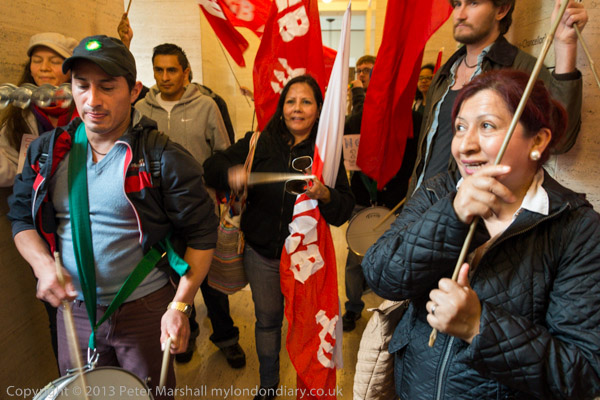
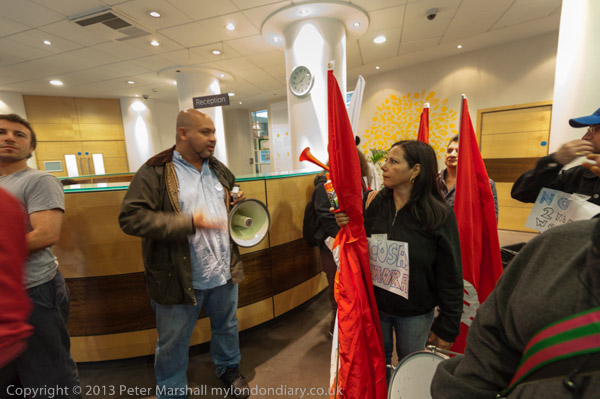
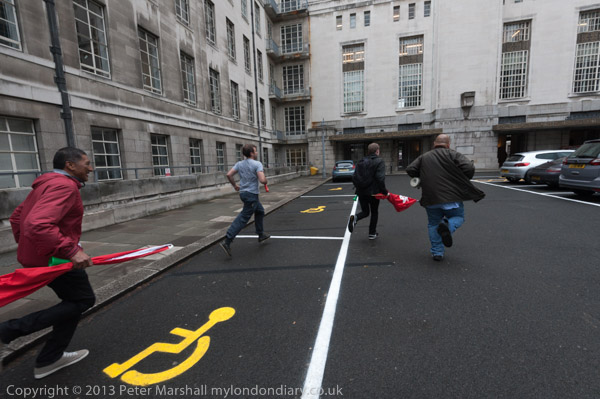
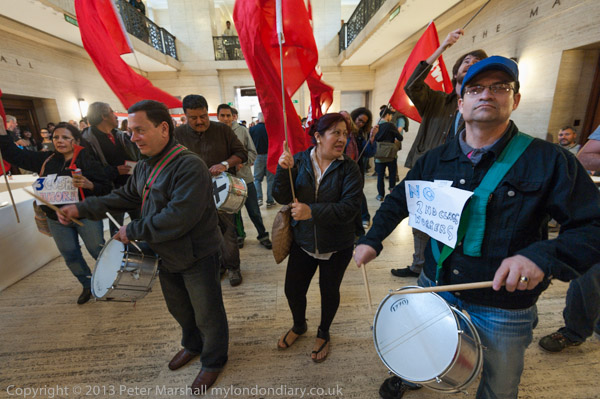
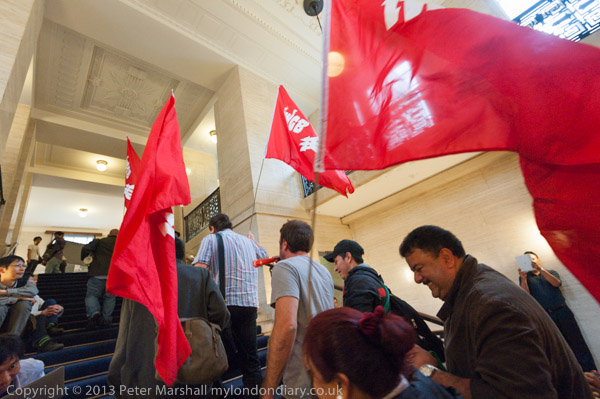
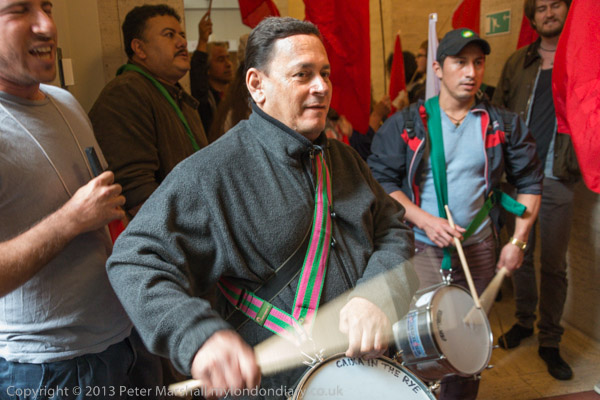
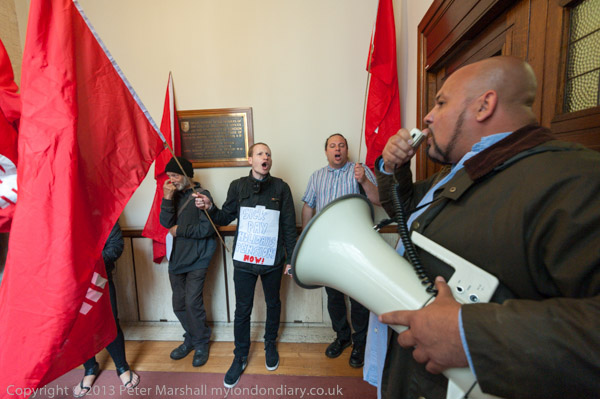
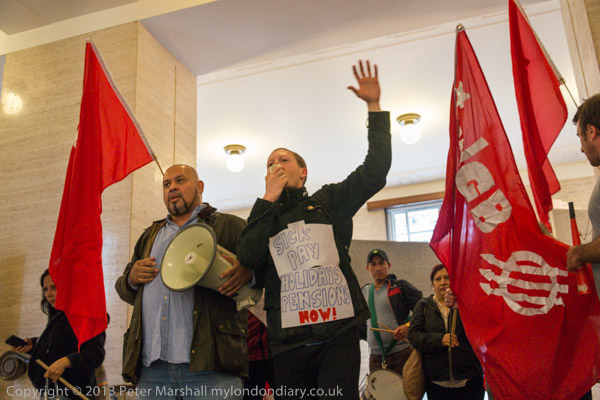
Sick Pay, Holidays And Pensions – End Outsourcing – Nine years ago on Friday 28th June 2013 I photographed a protest by low-paid workers at the University of London who with their supporters ran into the Senate House and protested noisily inside the building for sick pay, holidays and pensions for all workers at the University.
I’ve spent some time over the past few days thinking about strikes and industrial actions, partly because of the rail strikes. My local station is one of the few that still has a train service, but out of solidarity with the workers I won’t be using it on strike days, and on the days in between it is still likely to be unreliable.
The campaigners met up at SOAS before the protest
Of course I support the strikers, many of them low paid workers and all of whom have seen the value of their wages cut over the last few years. And these have been years when for all the problems that politicians and media state many of the wealthy have got considerably wealthier – and some made huge fortunes over Brexit and profited greatly (and not always legally) over Covid. We are living in an increasingly unfair society, and with a government which despite claims about levelling up is doing its damnedest to make the rich richer while making the poor poorer.
After marching quietly past university buildings they dashed towards Senate House
The government and train operating companies make much of the need to modernise the railways and I can only agree with them. We desperately need to get back to a sensible structure for running railways, to reverse the breakup of the system into small pieces, each with its highly paid management, caused by the doctrinaire privatisation of the 1990s. And yes, there are other changes which could greatly improve the system, but what the companies mean by modernisation is largely slashing the additional rates for overtime, weekend and night work. It’s ‘we’ll give you more pay if we can cut your wages at the same time’.
and were all inside the building before security noticed
June 28th is said to be the date on which new restrictions on the right to protest pushed through parliament in the last session come into effect. I think the protest by the IWGB on behalf of low paid workers employed by contract companies at London University on Friday 28th January 2013 would clearly have been illegal in several ways had this law been in place then. And it would be precisely those aspects that made this and most other protests over low pay effective that could have resulted in arrests.
They swarmed up the stairs towards the Vice-Chancellor’s office
I don’t know how (or even if) the police will enforce the new laws. Although I think they will have little appetite to do so, there will be considerably political pressure on them. And while the large unions will worry about the huge impact legal measures would have on their funds and largely play safe, perhaps the small grass-roots unions who have been so much more effective for low paid workers will feel they have less to lose.
They held a noisy protest outside the Vice-Chancellor’s office
Back in 2013, the low paid workers who keep London University running were taking part in a ‘Summer of Action’, supported by the grass roots IWGB union (Independent Workers of Great Britain) and the students of the ULU (University of London Union.)
making sure he and his staff could hear why they were protesting
Many of the the cleaners, security guards and catering staff who work in the same buildings as other service staff employed by the university have brutally inferior conditions of service as they employed on behalf of the university by contracting companies who give them none of the kind or working conditions that any considerate employer would provide.
They then returned to the large lobby below to tell those attending conferences why workers were protesting.
Often they are not provided with proper safety equipment and expected to work in unsafe ways to get the job done, and may have to put up with harsh and unreasonable demands over workload, derogatory treatment and even racism from the managers employed by contract companies.
But this ‘3 Cosas’ protest was largely about three things, sick pay, holidays and pensions, on which these outsourced staff often have to fight even to get the rock-bottom statutory minimum provisions. Statutory sick pay is so low that few workers can afford to take time off when they are sick. Even at the height of Covid, many who were unwell had to drag themselves into work, putting their own health and that of others at risk to pay their rent and feed their families.
They continued a noisy protest in the lobby and its balconies for a few minutes
It took many protests such as this to persuade the University and other bodies to end the unfair outsourcing – even when studies showed there were considerable advantages in having a properly employed workforce and little if any financial loss. At SOAS, where the protesters met before the protest the Justice for Workers Campaign led by SOAS Unison branch began in 2006 and was only finally successful in 2018.
and then decided it was time to leave, pleased that the protest had gone so well.
The IWGB is still campaigning against outsourcing at University College London (UCL) and London School of Hygiene and Tropical Medicine (LSHTM) as well as other campaigns. A few days ago I photographed them outside the London offices of the world’s largest healthcare multinational Health Corporation of America (HCA) Healthcare, who run the private London Bridge Hospital, and they also support other groups of low-paid workers, including foster carers, delivery drivers, minicab drivers and cycling instructors.
Tottenham, Kilburn and Ponders End – I travelled to Tottenham and Kilburn to photograph protests but fortunately the people from Ponders End had come to protest at Westminster. All three protests I photographed on Saturday 29th March 2014 were about the inhumane policies of the Tory Government.
Mothers march for justice – Tottenham
Rev Paul Nicolson
Rev Paul Nicolson of Taxpayers Against Poverty, an indefatigable lifelong campaigner on behalf of the poor died in 2020, aged 87. His first job after National Service in the Army had been with the family firm selling champagne around London, but after a dozen years until he discovered a vocation to become a worker-priest and was ordained as a deacon in 1967 and then a priest in 1968. Around 1981 he became a parish priest in Turville, the location chosen for The Vicar of Dibley, making his priority the support of the poor in a area of extremes of wealth.
He resurrected the practice, now common of being a McKenzie Friend, which allowed him to stand with and represent those brought to court over debts, particularly those unable to pay the Poll Tax. His revelations on the activities of bailiffs enforcing debts lead to a Code of Practice which, at least when enforced, gives some protection to the vulnerable, and it was his initiative in commissioning the Family Budget Unit to investigate the actual costs of living that led the the UK and London Living Wage being established.
Spiderman led the march
His work in later years was largely about housing and homelessness, and I met and photographed him on many protests. He set up the charity Zacchaeus 2000 (Z2K) but then resigned as its chair so he could campaign politically through Taxpayers Against Poverty.
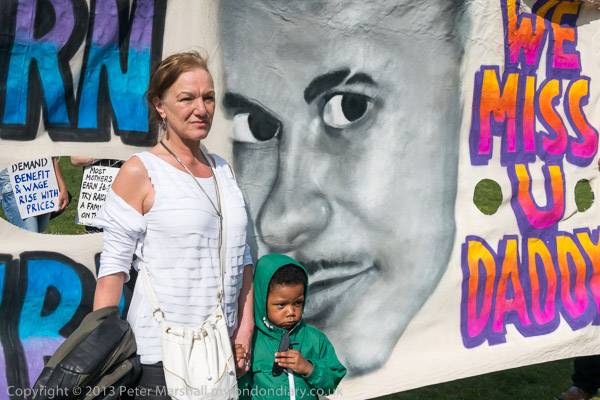
Carole Duggan, the aunt of Mark Duggan, murdered by police in front of a banner with his picture
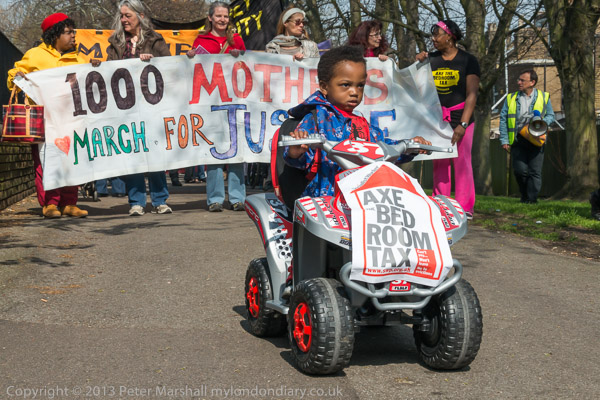
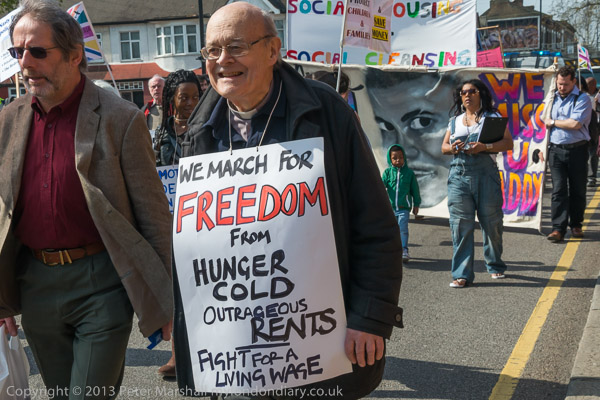
The march in Tottenham on 29th March 2014 organised by the Rev Paul Nicolson of Taxpayers Against Poverty demanded living incomes and decent truly affordable homes and rejected the unfair Tory bedroom tax, the housing benefit cap, unfair taxes, which were the cause of hunger and cold homes. He spoke before the march and walked on it with a placard hanging from a string around his neck: ‘We march for Freedom from Hunger, Cold, Outrageous Rents – Fight for a Living Wage’.
The march was smaller than hoped, several hundred rather than the hoped for ‘1000 Mothers March for Justice’, though more were expected to turn up at Tottenham Green East for the rally at its end, unfortunately after I had left. Those on the march included representatives from many local groups as well as others around London, and they carried an impressive number of banners.
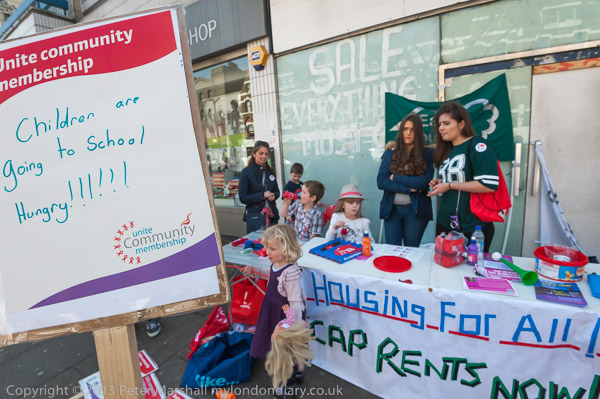
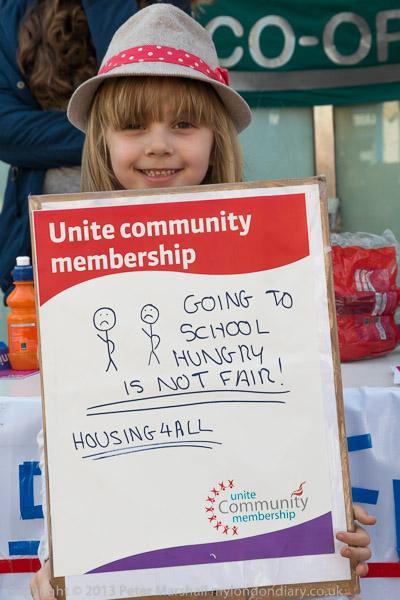
A few miles to the west, the Counihan Battlebus Housing For All campaign, along with the TUSC Against Cuts and Unite Community was holding a two hour protest in Kilburn Square on the main Kilburn High Road over child hunger and housing problems, calling for rents to be capped and for everyone to have a home.
In 2010 food banks were rare things in the UK, used over the year by around 60,000 people. After ten years of Tory policies this had increased to around 2.5 million, around 40 times as many. Much of that increase is a direct result of government policies, including its inhuman sanctions policy against benefit claimants, as well as of poverty wages and unfair employment practices such as zero hours contracts.
Moving people onto Universal Credit resulted in many being without resources for five weeks, sometimes considerably longer. As I wrote “Our government appear to be completely out of touch with how many people in the country live. They simply cannot comprehend what it means to be without money, or without friends or family you can rely on for a few thousand when you have a problem. Many people on low income simply don’t have any such resources – all they have is debts and bills to pay.”
Things have got worse since 2014, and soaring energy prices along with the additional National Insurance payments coming in next month will again put more families into desperate levels of poverty – and increase those evicted as they cannot pay the rent. It isn’t that the country doesn’t have the money – we are still one of the richest countries in the world – but that increasingly the already wealthy are getting richer while the poor sink into more desperate poverty.
And it’s successive governments – including New Labour – that are to blame, with a failure to build sensible amounts of social housing, the encouragement of high cost private housing and buy to rent. The wealthy have got tax breaks while many working full-time have been finding it harder and harder to make ends meet. And tax avoidance has reached huge levels thanks to a failure to plug silly loopholes and face up to the problems caused by off-shoring. We should have a zero-avoidance policy not one that encourages it.
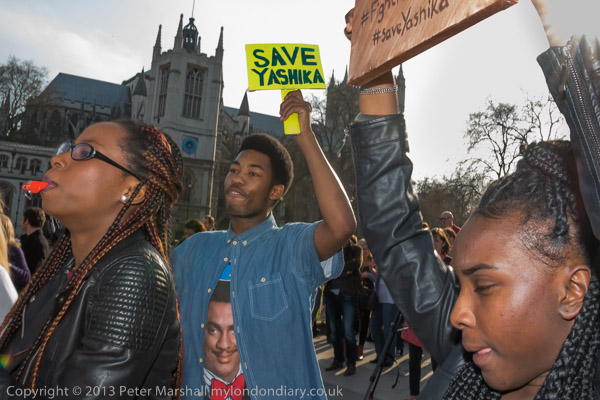
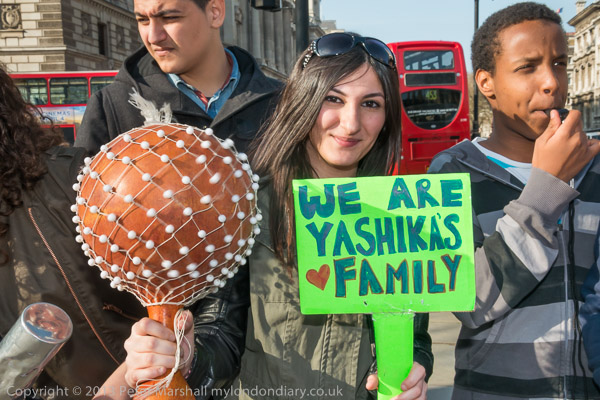
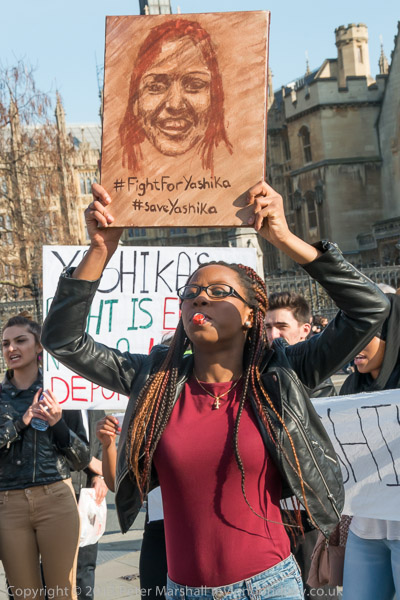
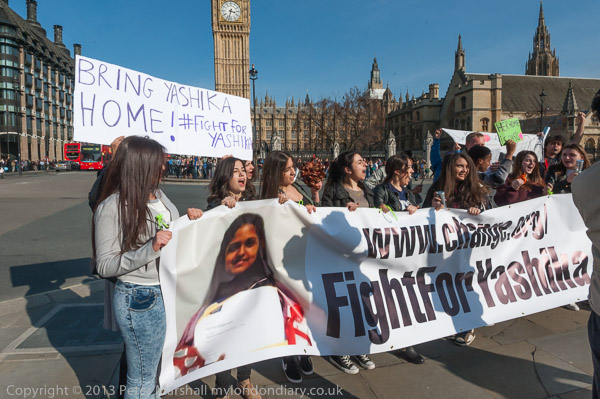
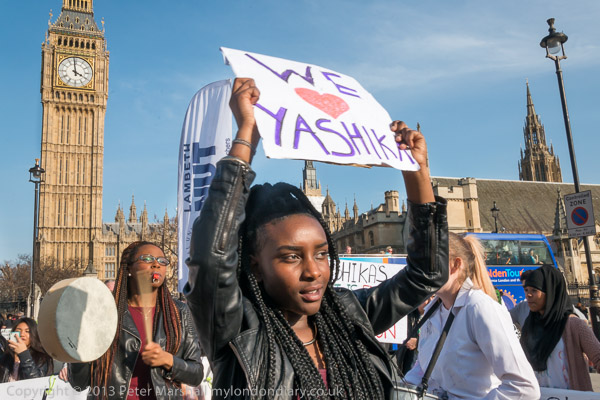
Fellow Students Fight for Yashika – Parliament Square
The final event I photographed was a lively protest by fellow students and supporters at Parliament urged then Home Secretary Theresa May to abandon the planned deportation of 19 year old model A-level student Yashika Bageerathi to Mauritius due to take place on Mothers Day.
She came here with her family who claimed asylum after physical abuse from a relative in Mauritius in 2012, but the claim was rejected and the whole family are under threat of eviction – and as she is now 19 they decided to deport her alone weeks before she was due to take her A levels in Ponders End.
We continue to see “a ‘tougher than you’ shift to the right over immigration played out by both government and opposition over the past years, each trying to outdo each other … So we get foolish and desperate measures like the immigration vans, and raids at tube stations and other public places by the Border Force based unlawfully on racial profiling.”
Migrants, including many who are here without legal right to remain, play an important part in keeping London running despite government attempts to identify and remove them. Estimates in 2014 were that there were around half a million in the city and without them, “London would grind to a halt. They do mainly the low paid dirty jobs no one else would want for pay that isn’t enough to live properly on in London – often at below the minimum wage because of their immigration status.”
The protests and a petition with over 170,000 signatures failed to have any effect on the heartless Home Office and Yashika was deported. But good news came later. Perhaps because of the huge publicity around her case she was welcomed and supported back in Mauritius and was able to take her exams there. Despite her studies having been interrupted by spells in Yarl’s Wood immigration prison she was able to gain her A levels and go on to university – and keep out of the media limelight.


.JPG)
.JPG)