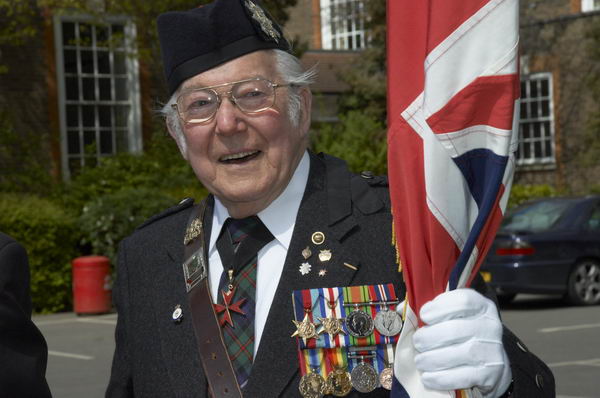
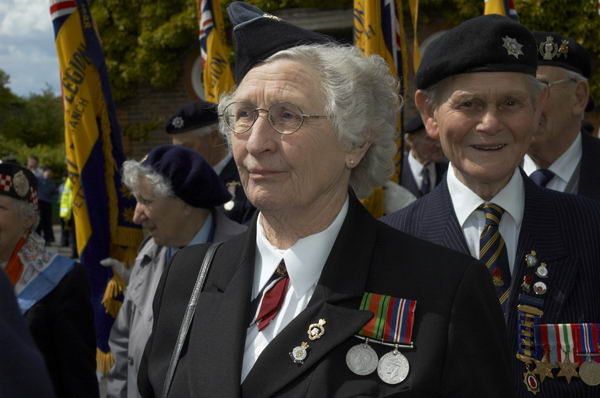
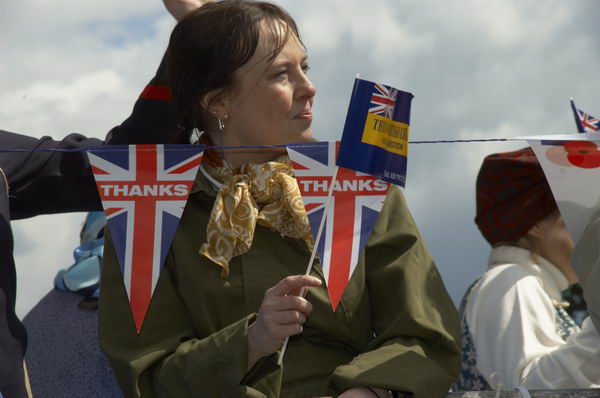
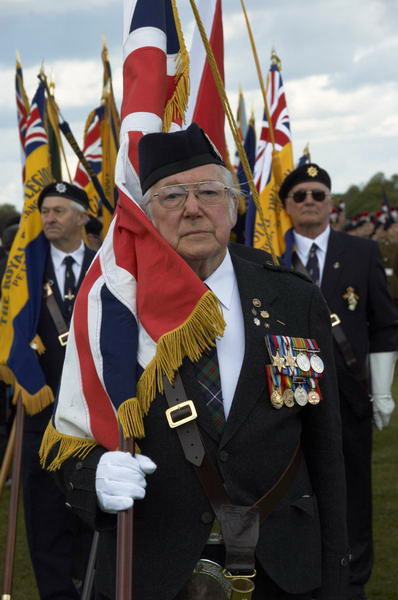
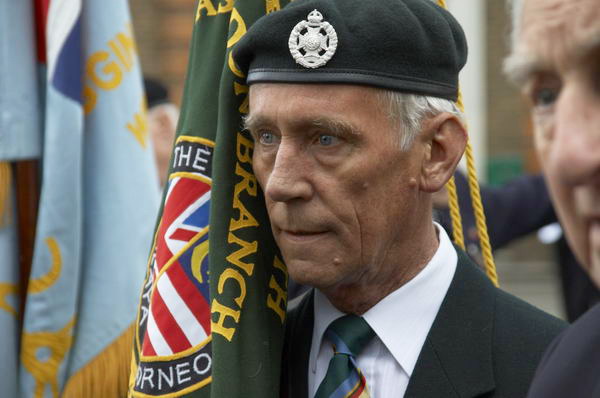
VE Day 60 Years On: Twenty Years ago Britain had a two day major celebration of the end of the war in Europe on 8th May 1945, and I wrote about this both at the time on My London Diary and last year here on >Re:PHOTO at VE Day 60 Years On – 2005.
Of course it wasn’t the end of the war, which continued against Japan for another 3 months, only brought to an end following the dreadful revelation of the power of nuclear weapons to destroy whole cities at Hiroshima and Nagasaki. The huge civilian deaths these caused may have shortened the war by a few days, but probably a USA determined to bring it to an end might have achieved a settlement earlier had some not wanted this more spectacular and deadly finale.
I grew up among many who had fought in WW2 and some who had lost fathers, uncles, cousins and brothers. There was a strong feeling that while the First World War which had been known as ‘The War to end all Wars’ had not proved to do so, this one should lead to an era of peace on the world.
It was this spirit that led to the foundation of the United Nations, and to developments such as the 1948 Universal Declaration of Human Rights, both of which are now very much under threat. And of course the war led to a Labour government which brought in reforms including the setting up of the NHS.
Peace did not last long, at least in part because it was not good for business. In part it was replaced by the ‘Cold War’ but there have been plenty of hot wars too. The world has seen war after war since VE day, many of which have involved either the USA or the UK, either actively with “boots on the ground”, or supporting one or sometimes both sides in the conflict openly or clandestinely and selling them the weapons with which to fight. There is a long list of wars the UK has been actively involved in on Wikipedia, since 1946 as well as a longer list for the USA which includes some others the UK was involved in.
The Cold War should have come to an end with the end of the Soviet Union in August 1991, but the ‘hawks’ were determined to keep it going rather than work with Russia. Had they not done so things might have been very different and Russia would not have felt the need for a strong president which led to the appointment of Putin.
Recently British jets have bombed the Houthis in Yemen, and the UK has sold arms to Saudi Arabia to be used against them in the war there. And the UK has given diplomatic support and supplied arms for the Israeli government for the genocide in Gaza, as well as carrying out reconnaissance flights for Israel over Gaza from RAF Akrotiri in Cyprus to enable them to locate targets.
There are now relatively few survivors who actually fought in World War 2, although it was estimated that “under 70,000” British WW2 veterans were still alive, aged between 95 and 112.
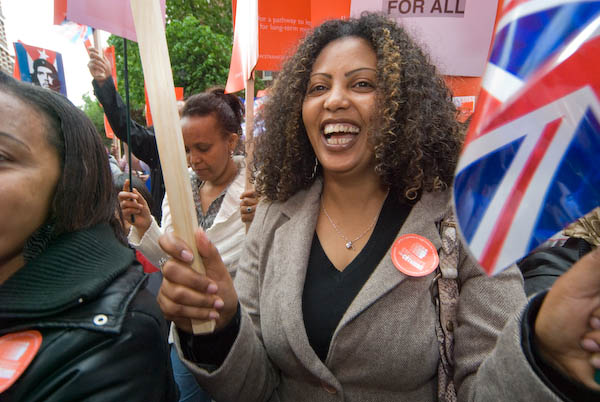
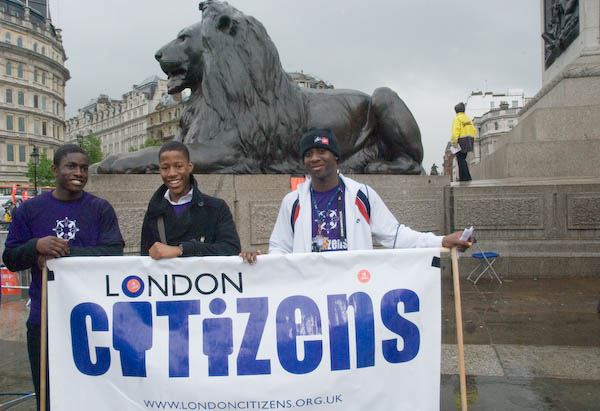
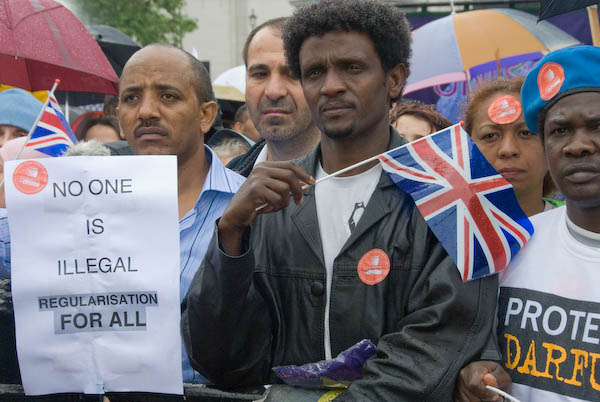
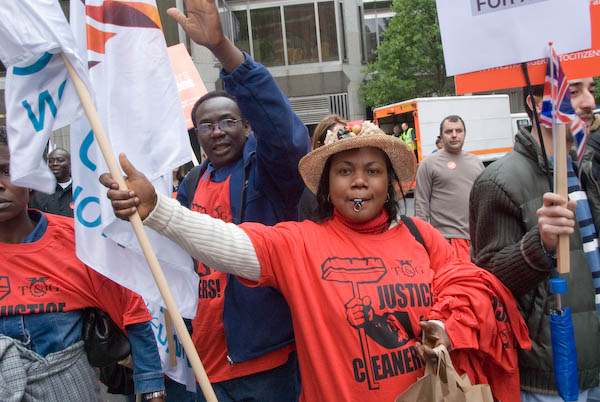
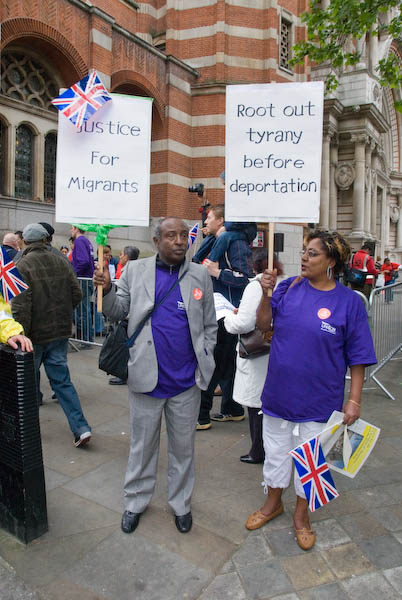
Strangers into Citizens March and Rally: On Monday 7th May 2007 on the Bank Holiday, London Citizens, an organisatioin working for social change through ‘community organising‘ inspired by the US civil rights movement and earlier struggles in the UK by “the Levellers, the Abolitionists, the Chartists, early trade unionists like the match girls and dock strikers, and the Suffragettes” organised a march and rally to launch their ‘Strangers Into Citizens’ campaign, This called “for the mass regularisation of people without immigration status, who have put down roots in this country over years but are vulnerable to exploitation and hardship.”
I attended this, took photographs and published a post about it on My London Diary, which is a little hard to find and to connect with the pictures there. Here it is again with the usual corrections and a few of the pictures – with links to the rest.
Strangers into Citizens March and Rally
Westminster, London. Monday 7 May, 2007
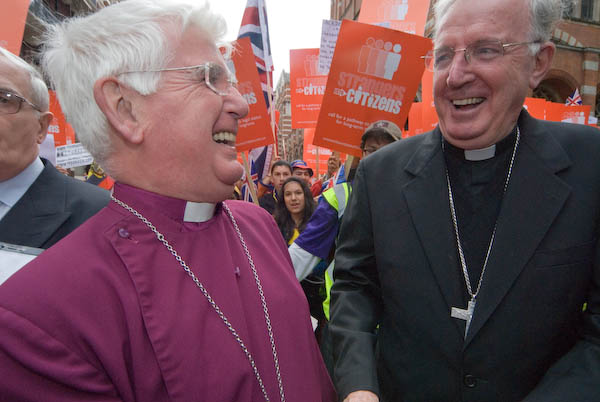
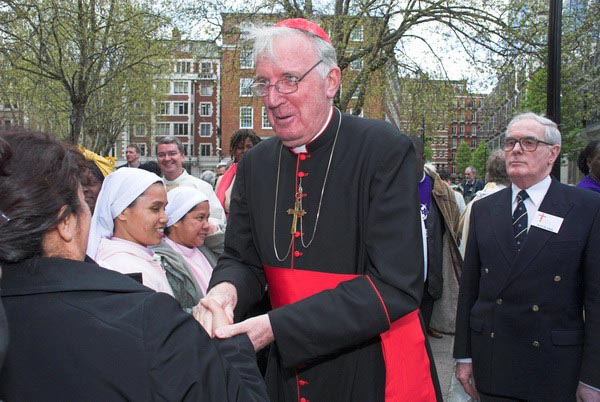
Bishop Tom Butler of Southwark and Cardinal Cormac Murphy O’Connor led the march
Over the past years, many people without British passports had come to live in our country. Some of course had the right to do so as EU nationals. Many have claimed asylum, often refused for trivial reasons of paperwork or formalities even when people were clearly endangered in their home countries. Some claims drag on for years before a decision is made. Others have simply stayed on after studies or holidays, or entered the country without any permission.
Almost all of these people have one thing in common; they want to work and earn a living. Their work – often for very low wages at or below the national minimum – has helped to keep our economy buoyant, although in many cases they do not have the correct papers to work legally. They are thus open to exploitation and often unable to access medical services or even open bank accounts. One in 100 of those living in Britain is currently in this kind of limbo.
Many have lived here for years, paid their taxes and contributed to society in various ways – helping to run the parent teacher associations at their children’s schools, supporting local churches and mosques, volunteering for charities – as well as their work. Most of them will remain here – as the government admits there are just too many for them to be removed in any remotely civilised manner.
Not that it is civilised for the unfortunate few picked out by the authorities for a 4.30am raid, not given the opportunity to properly pack their belongings or say goodbye to friends and neighbours, taken to the airport and put on a plane back to a country where they may well face persecution for their political or religious beliefs.
This is a problem that needs a sensible, humane and pragmatic solution. Strangers Into Citizens have proposed one: – those irregular migrants who have lived here for more than 4 years should be given a 2 year work permit; at the end of this, provided they get suitable employer and character references, they would be given leave to remain indefinitely.
Although a great advance on the current treatment of these people it seems to me not to go far enough; too many would still be left out in the cold. It’s also a a one-off measure, and needs (as Strangers Into Citizens propose) to be a part of a wider package of fair treatment for those applying for asylum or immigration.
Since 2007 our political parties have shifted dramatically to the right, strengthening their already racist stances and now a new extreme-right party has gained significant votes in elections although still only having 5 MPs. At the last General election only the Lib-Dems and Green Party had more sensible and positive policies on migration.
So while the proposals by Strangers into Citizens seem sensible and humane – if rather limited – there seems to be no political possibility of them or anything like them becoming law.
May Queen in Chislehurst – 2006. Chislehurst has maintained the tradition of crowning the Chislehurst May Queen on the first Saturday of May each year since 1923 and last Saturday held its ceremony to crown its 2025 Queen. I was busy elsewhere this year, but spent an enjoyable day photographing the event on Saturday 6th May 2006. Here is the post I wrote back then (with the usual minor corrections) with a few of the pictures – and links to more on My London Diary
Chislehurst May Queen Ceremonies
Chislehurst, 6 May 2006
May Day celebrations were traditionally times (known as Beltane) when the New Year and Spring was celebrated, and young men and women danced together, and a Queen of the May was chosen to lead the event. Cromwell banned them as sinful pagan events, and although they came back with the restoration in 1660, in most places the traditions slowly died out or were made more formal.
There was a revival of interest in old customs in the Victorian era, with various ‘Merrie England‘ events being organised. Some schools had maypoles and learnt the dances and many Sunday Schools had their May Queens who often took a leading part in Whit Walks.
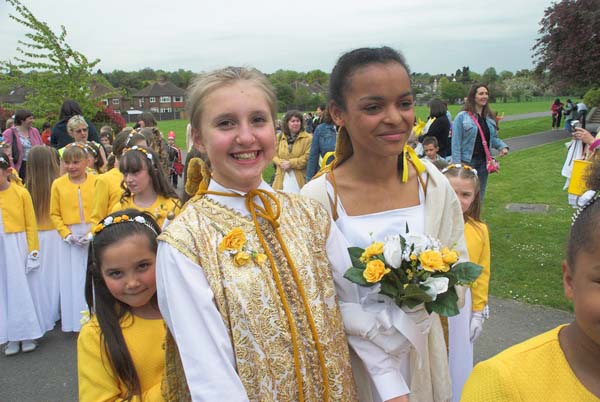
The Prince and the May Queen
In 2005 I photographed the Hayes Merrie England And London May Queen Festival, which began in 1913 and is probably the largest as well as the oldest continuing event of its type (Brentham had its “gaily dressed maidens” dancing around a maypole in 1906, but it isn’t clear if there were festivals in all of the early years. Certainly there appear to have been none in 1927-30.)
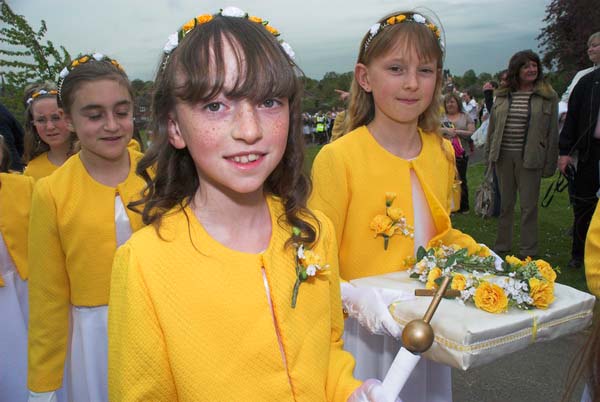
Attendants with Sceptre and Scroll and Crown and Cushion.
Chislehurst got its first May Queen in 1923, when the organisers of the Merrie England Festival at Hayes, which had been going for around 10 years, asked Agnes Everist to organise a new ‘realm‘ with her daughter Olive as the May Queen. Agnes continued to organise the ceremonies until 1945, when the ceremony was delayed until June to be a part of the World War II Victory Celebrations. Her grand-daughter and Olive’s daughter Beryl was May Queen that year, but sadly Agnes died 2 days later.
The Lantern
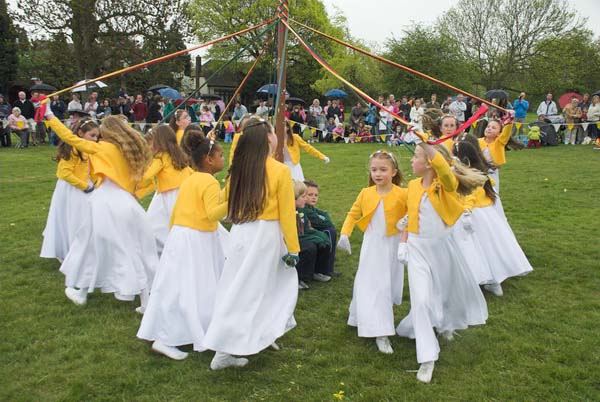
The Everist family continued to organise the festival for some years, but others then took over. Any girl five or over who lives or has grandparents who live in Chislehurst can join the retinue. They then work their way up the ranks, with the oldest girl of the year of joining having the choice of being Queen or Prince. Several months of twice-weekly rehearsals are required, and as well as the festival they also perform at other events over the year.
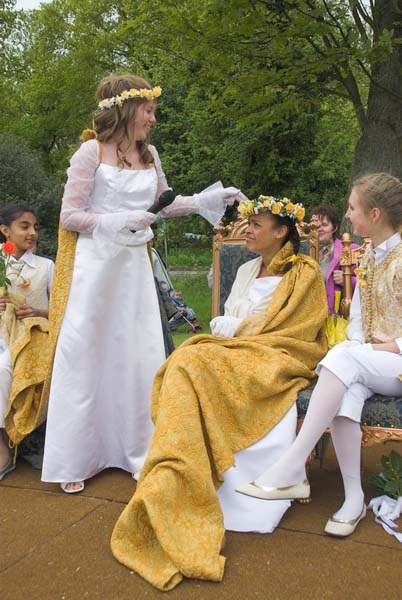
The retiring May Queen puts the crown on the new May Queen’s head
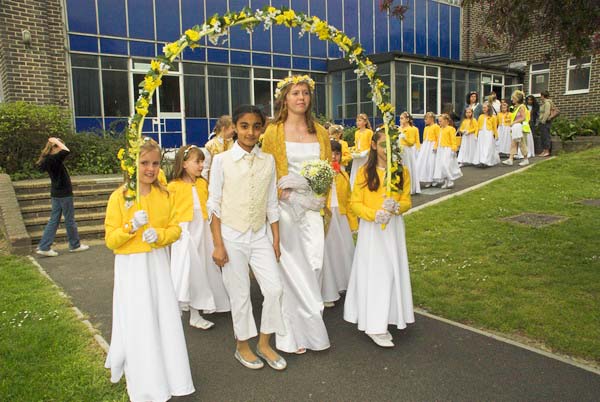
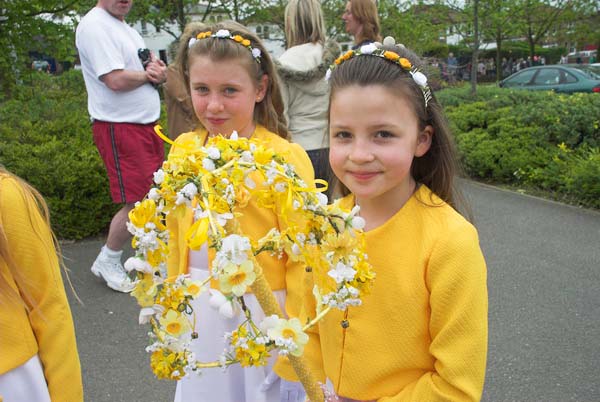
The procession is led by a Banner Bearer, and each of the ‘realms’ that takes part in the Hayes festival is also identified by a distinctive colour. The May Queen and Prince walk under a hoop garland held by two of their retinue, while others hold the Queen’s train. Before the crowning, the retiring Queen and Prince are at the head of the procession with the Queen and Prince elect in the middle, but after the crowning they change their places. Also in the procession are three attendants carrying the basket of flowers, the crown on a cushion and the sceptre and scroll. At the rear of the group is a decorated cage or lantern on a pole.
The new May Queen and Prince take their place under the hoop garland for the return procession
Chislehurst is one of the few may queen societies that still dance round the maypole properly, and they performed 4 different dances during the event with surprising precision.
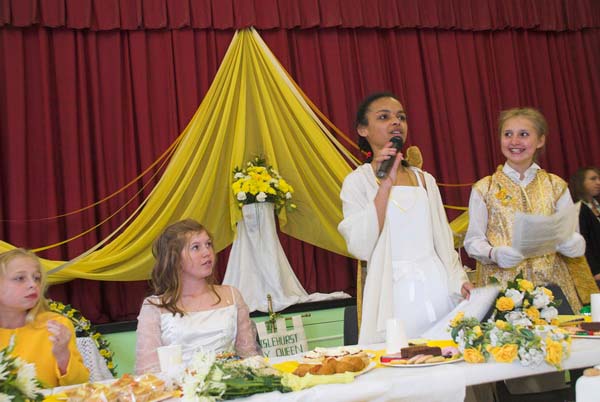
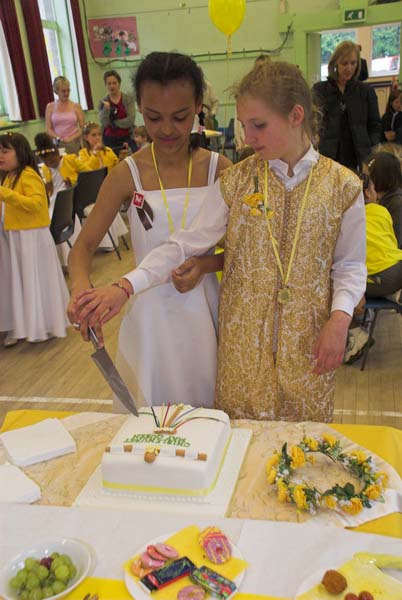
The May Queen speaks at the teaAnd the May Queen cuts the cake with the Prince
At the end of the day the various groups marched off down the road for tea and cakes in the Methodist hall, along with a little more ceremony. I stayed until they had cut the cake, then had to run to the station to catch my train home.
You can read more about the May Queen tradition and London May Queen in particular in the preview of my book, London May Queens. The book is available as a PDF or more expensively in print
Long Live Mayday! London 2015: I don’t often post recent work I’ve taken on this site but I am still covering events in London though not on the scale I used to. I no longer post regularly on My London Diary as there are almost the maximum possible number of files on that site and I would have to delete older work to continue posting there. But all my new work – or at least my selection of it – now gets posted on Facebook – and you can follow me there.
London, UK. 1 May 2025. Musicians Union prepare to lead the May Day march
As well as albums of new work I also post one of my earlier images every morning – currently colour images from around 1986.
I’m still working on putting a large selection of my earlier work on film on Flickr, both black and white and colour images, mainly of buildings and events in London but also pictures from Paris, Hull and elsewhere. Currently I’ve uploaded almost 40,000 images, mainly from 1974 to 1987, probably around a quarter of those I took. It’s now one of the largest archives of images of London, including many of its less well known parts.
London, UK. 1 May 2025. Stop executions in Iran.
But on Thursday 1st of May, International Workers Day, I was out again on the streets of London, meeting friends and taking pictures at the start of the London May Day March at Clerkenwell Green.
London, UK. 1 May 2025. Socialist Women’s Union.
It was London’s hottest May Day since records began, and I couldn’t walk the whole length of the march taking pictures now. So I started with the marchers and then stopped for the whole long march to go past me, photographing people and banners. Then I walked down the shaded side of Farringdon Road to Farringdon Station to catch the Elizabeth Line – cool in several ways – the one stop to Tottenham Court Road where I changed to the rather warmer Northern Line, arriving at Charing Cross well before the march.
London, UK. 1 May 2025. Kurds call for Freedom for Ocalan.
I walked along Strand and sat down at a bus stop. Traffic had already been stopped along the road ahead of the march, but the TfL indicator board was still showing buses due which would not arrive until after the march had passed and I passed on the news to those waiting so they could find other transport – or stay to watch the march.
London, UK. 1 May 2025. United Voices of the World.
Sitting at the bus stop I was able to eat my sandwich lunch before the march drew close and I walked towards it, continuing moving slowly east as it came past me taking more pictures. I was on my way to the Indian High Commission where I had heard another protest was taking place.
London, UK, 1 May 2025. Sikhs protest opposite the Indian High Commission against Modi over Kashmir
When I arrived at Aldwych I found there were actually two groups of protesters, both there because of the killing of tourists last month in Kashmir. Opposite the High Commission were a group of Sikhs with a effigy of Indian Prime Minister Modi hanging upside down, opposed to his extreme-fight Hindu nationalist government which has threatened Pakistan, suspended the water-sharing agreement and made savage reprisals against Kashmiris after the 22 April attack.
London, UK, 1 May 2025. Supporters of Indian Prime Minister Modi protest against terrorism in Kashmir
After spending a few minutes photographing them I walked across the road to another group of protesters at the side of the High Commission. They had come to support Modi and protest against Pakistan which he claims had supported the militant group which carried out the killing. Part of Kashmir became a disputed territory at partition in 1947 when the local ruler decided to join India despite a majority Muslim population. It was granted some autonomy under an article of the Indian constitution, but this was recently rescinded. The country has been under a savage military occupation by India for many years. Other parts of Kashmir are administered by Pakistan and a smaller area by China.
On May Day I sent three groups of pictures to on-lin agency Alamy, a total of 84 pictures. The pictures in the three albums on Facebook are smaller versions of the same 84 images I posted the following day and a few of them are in this post. Unfortunately I think you need a Facebook login (free) to view the rest.
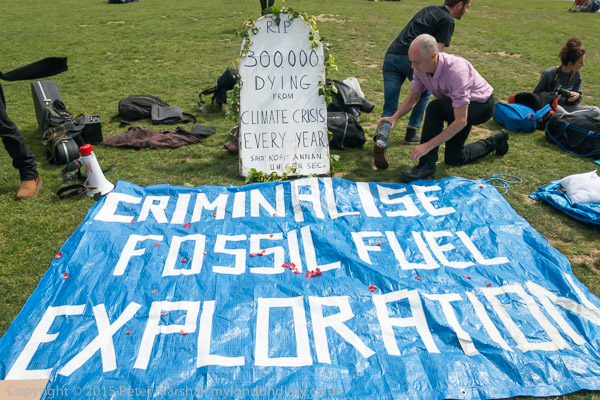
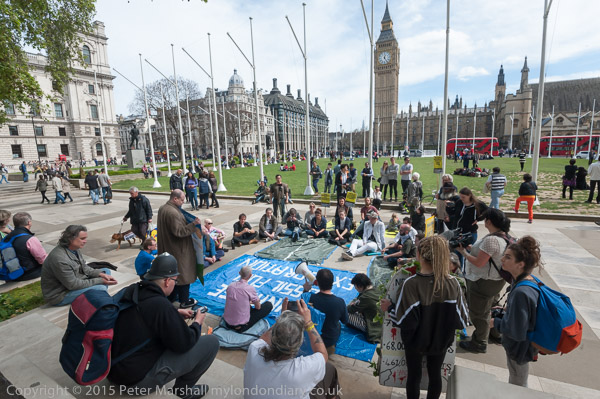
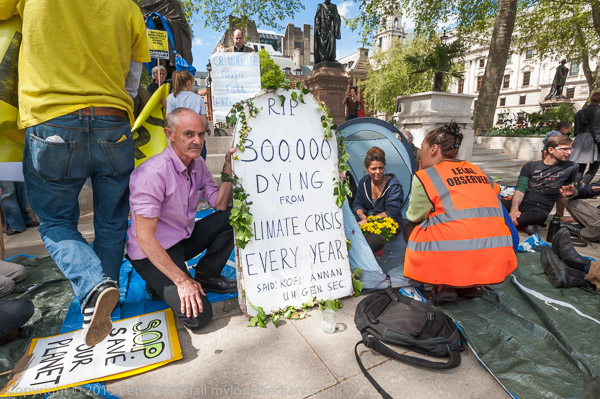
Occupy Gandhi – stop fossil fuel criminals: Monday 4th May 2015 was the third day of Occupy Democracy’s 10 day ‘Festival of Democracy‘ in Parliament Square “building a movement for real democracy: free from corporate control, working for people and planet!“
I arrived in time for the meditation in front of the statue of Gandhi, noted for his direct action civil disobedience, which called for fossil fuel exploration and investment to be made a crime.
Blue tarpaulins had become a symbol of protest by the Occupy movement worldwide, and particularly in Parliament Square where the Police Reform and Social Responsibility Act 2011 had allowed police to seize tents and anything else “adapted, (solely or mainly) for the purpose of facilitating sleeping or staying in a place for any period” and there had been many battles between police and protesters over the seizing of blue tarps.
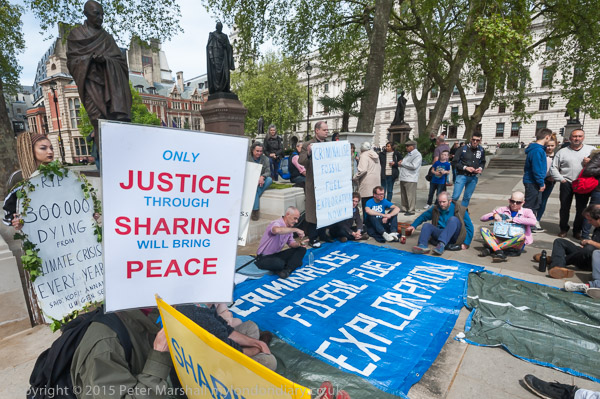
Donnachadh McCarthy spoke at the start of the rally and tarps were put into placeon the paved area in front of the statue of Gandhi. Occupy protesters then sat on them in a circle with others standing around and watching.
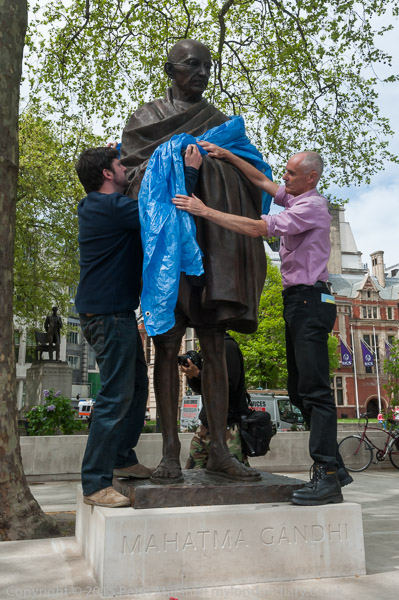
At the centre of the circle was a blue tarp with the message ‘CRIMINALISE FOSSIL FUEL EXPLORATION’ and there were some short speeches and a time for meditations, during one of which Donnachadh and another person leading the event got up and wrapped a blue tarpaulin around Gandhi.
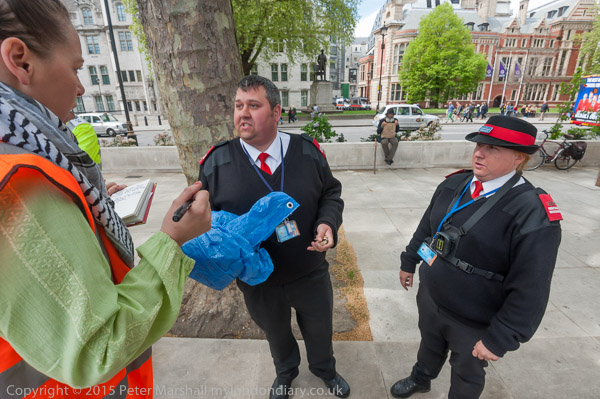
Heritage wardens came and asked for the tarp to be removed, but were ignored and they then removed it themselves.
Two protesters than brought up a another tarp, putting it around Gandhi but taking care – at least until the wardens moved a little away – not to letting it actually touch the statue.
The tarp slips down a littleDonnachadherects the tent
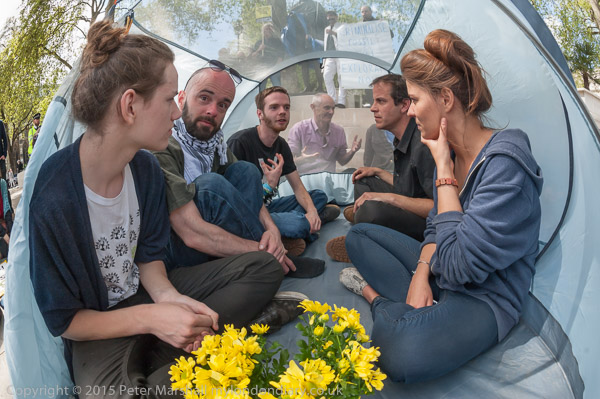
At the end of the meditation, Donnachadh announced an act of civil disobedience and pulled a folding tent onto the tarpaulin on the pavement in front of him and erected it. Several people then came and sat inside it, and the protest continued around the tent with Donnachadh joining the others inside.
Heritage wardens talked with police and after around half an hour a few police officers came to tell those in the tent they were committing an offence and might be arrested if they failed to leave. The police then walked away.
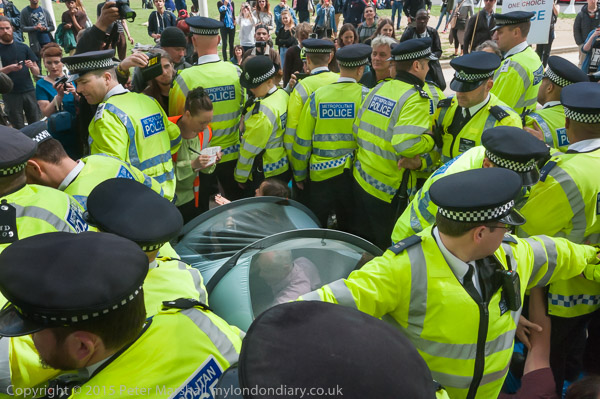
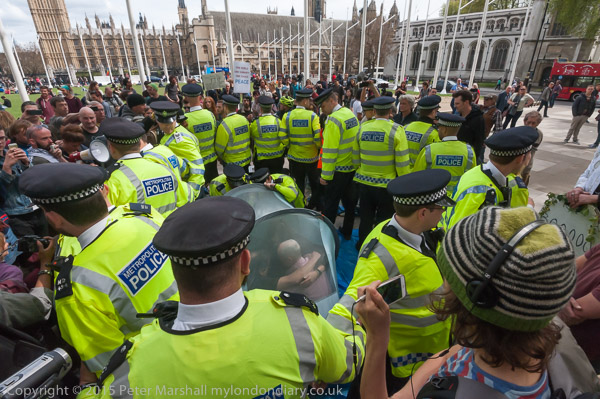
The protest continued and twelve minutes later as Big Ben was striking for 2pm a group of around 20 police marched in and surrounded the tent. Donnachadh had been standing in front of it but quickly jumped back in as they arrived.
Police surround the tent
Those inside the tent were told they would be arrested unless they left immediately. With officers surrounding the tent it was had to see or photograph what was happening, but only three remained.
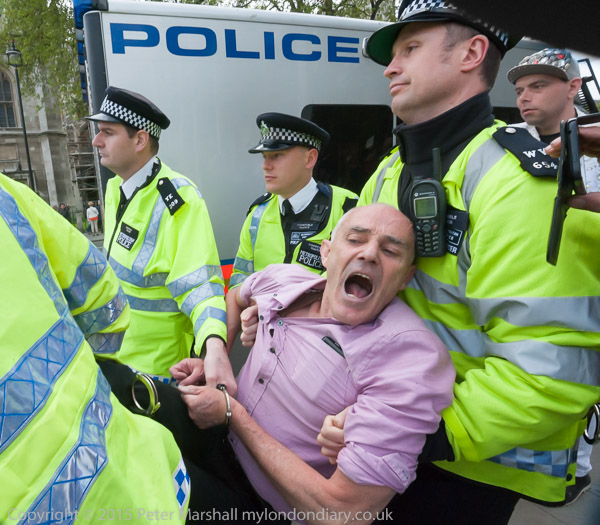
Police then went inside the tent where the protesters had linked arms around each other and slowly managed to drag them out, one by one.
When Donnachadh was dragged out and carried away to a police van he was still shouting against fossil fuels. After the police had pulled out the final protester and the torn and broken remains of the tent the protest continued around the statue of Gandhi, but many including myself soon left.
Many more pictures, particularly of the final scened when police surrounded the tent and dragged Donnachadh away on My London Diary at Occupy Gandhi – stop fossil fuel criminals.
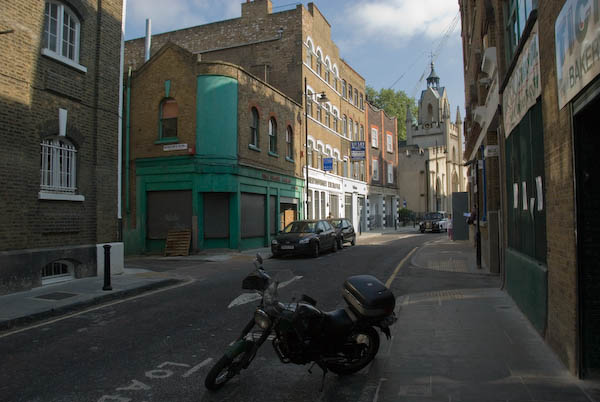
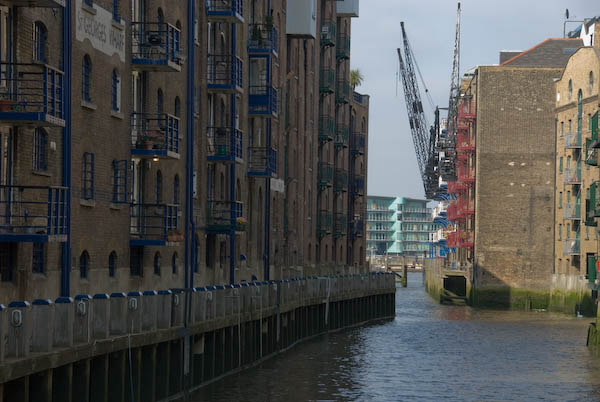
Southwark, Bermondsey & Rotherhithe: On Thursday 3rd May, 2007 I took a walk “south of the River” in Southwark, Bermondsey & Rotherhithe.
I was going to meet a few photographer friends in the evening, but when I’d finished lunch the weather looked so good and I had nothing vital to work on that afternoon so I took an early train to Waterloo, and then started to wander for the nexy three hours or so, taking a few pictures as I went.
Most of the area had been familiar to me since I began photographing London seriously back in the 1970s – some of my earlier pictures then were along parts of the riverside walkway much of which later in 1977 became part of the Silver Jubilee Walkway or later the Thames Path.
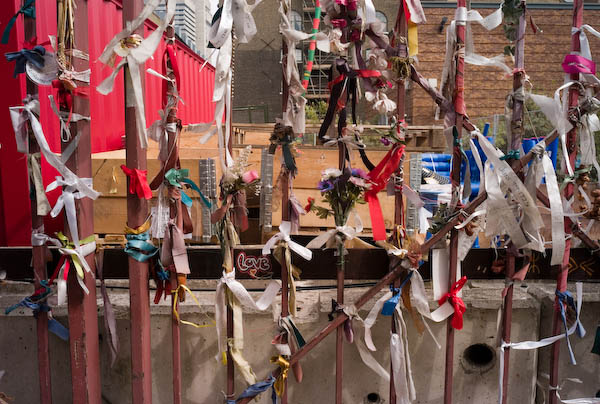
But I started away from the Thames on Southwark Street, turning down Redcross Way to the gates of Crossbones Graveyard, decorated with ribbons and strips of fabric in memory of the ‘Winchester Geese’, young women licensed by the Bishop Of Winchester to work within the liberty of the clink, where activities such as brothels, theatres (including Shakespeare’s Globe), bull and bear baiting were permitted to entertain gentlemen who were rowed across from the City.
The graveyard closed for burials in 1853, by which time there were thought to have been as many as 15,000 buried there, graves for those the church would not bury in consecrated ground, including many of the prostitutes and their young infants, but latterly many too poor to afford a proper burial. In 2007 much was still a building site but now there is a memorial garden there.
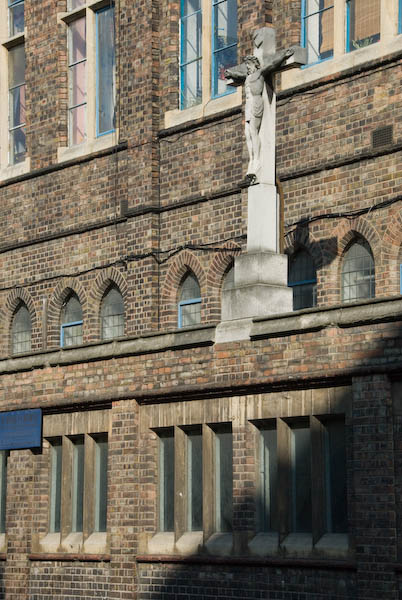
I continued in Southwark past the Charterhouse-in-Southwark Mission, on the corner of Crosby Row and Porlock St – demolished in 2011 to build affordable housing and along Long Lane to Bermondsey.
Years earlier I had written and published a folded A4 leaflet for an industrial archaeology walk around here, printing and selling several hundreds of copies on my dot-matrix printer which were used for a number of guided local history walks around the area, particularly those led by now the late local historian Stephen Humphrey. You can still download a free PDF, West Bermondsey – The leather area though parts of it are now out of date and the dot-matrix pictures are primitive but still recognisable.
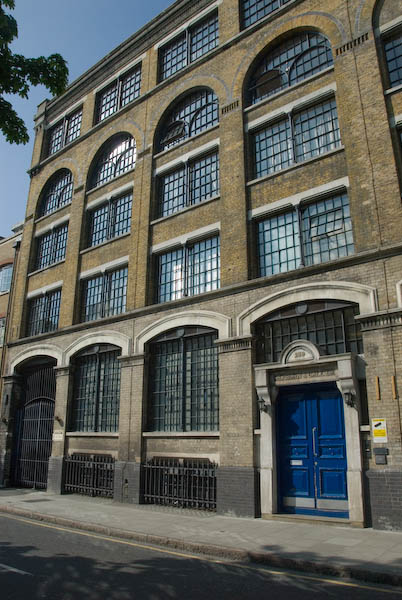
I found quite a few buildings of interest in Bermondsey Street, I think all I’d photographed on previous visits, but some only previously in black and white. And some other things I had photographed, particularly in some of the alleys off the main street were either gone or changed completely, now tidily gentrified.
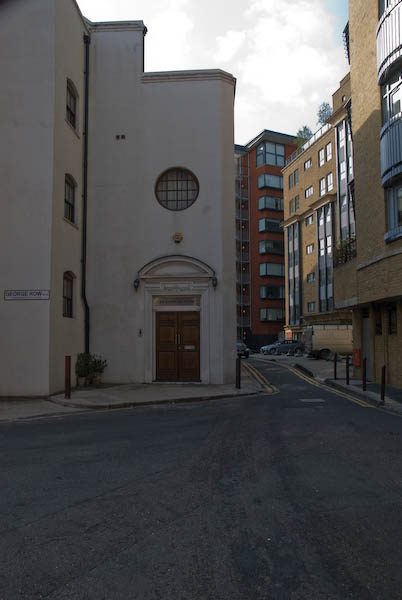
I came back to the river – or one of its creeks, St Saviours Creek at Dockhead, often said to be the mouth of the River Neckinger. It was probably never that though possibly of a very minor destributary with the main course of the river running alongside George Row several hundred yards to the east. The creek is simply that, a tidal creek, which possibly may have been used as a landing place for Bermondsey Abbey and the tide mill in this area.
Any connection with the Neckinger was lost when London’s sewers were reorganised by Bazalgette and the trickle sometimes visible into the creek is local drainage.
Going down Mill Street took me to the Thames and Bermondsey Wall West where I joined the riverside path, though mostly on the land side of warehouses, going past the huge Chambers Wharf on Chambers St with a huge cold store on the land side of the street before reaching the river again.
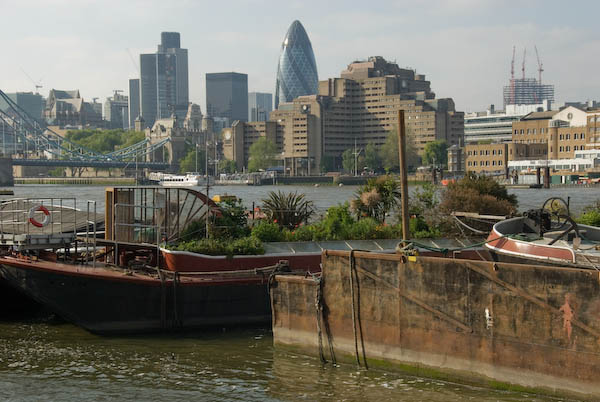
The path then runs beside the river to Rotherhithe, with view across the river to the City and Wapping as well as downriver to RRotherithe and Canary Wharf.
Near the well-known Angel pub was Diane Gorvin’s 1991 three part sculpture “Dr. Salter’s Daydream” which showed the doctor, his daughter Joyce who died as a child of scarlet fever, and their cat. Salter became the local MP and ran a pioneering local health service 20 or more years before the NHS. He died in 1945.
His wife Ada became the first woman mayor in London and the first Labour mayor in Britain in 1922. In 2011 the statue of Dr Salter was stolen for the metal in it. A local campaign raised £60,000 to replace it and a new statue of Ada was added to the group.
On the grass south of the riverside path are the low ruined walls a small of a small then moated manor house built by King Edward III around 1350. After his death the house was given to the abbey of St Mary Graces by the Tower and in 1399 it passed to Bermondsey Abbey.
A few yards east is the Angel pub, one of only two buildings standing on this long section of riverside. A short distance along is the second, sometimes called ‘The Leaning Tower of Rotherhithe’, four storeys tall and only around 11 foot wide. Once part of a long row of adjoining buildings it was more or less the only one left standing by bombing during the Blitz. It was the offices of lighterage firm Braithwaite & Dean, where lighters would pull in to get their orders and, importantly, their pay. They sold it in the early 1990s.
Finally I arrived in Rotherhithe where there were more pictures to be made – including several buildings and another sculpture, this showing Brunel driving a staem engine which now appears to have disappeared.
Just Shares, Riverside & No to the Crook, the Toff, The Fascist or Cop: Friday 2nd May 2008 was the day the results came out for the election for London Mayor and it turned out to be a sad day for London. Earlier I’d covered a protest calling on the City of London to move away from its unjust economic prcarices and then gone to an exhibition and walked along the riverside while I waited for the mayoral declaration, though it came after I had given up and left for home
Just Shares Take On The Bank – Royal Exchange, Bank
Other speakers listen as Ann Pettifor speaksat Royal Exchange. Larry Elliott at right.
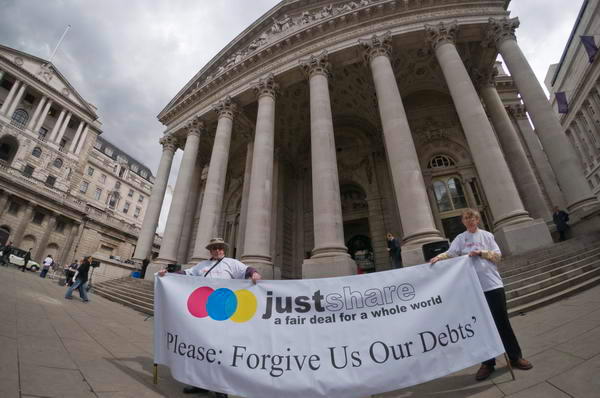
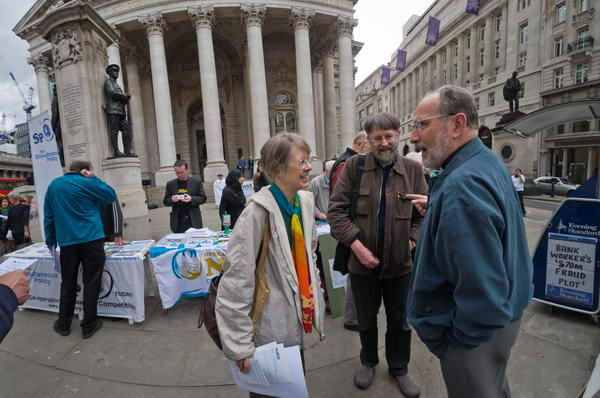
‘Just Share’, “a coalition of churches and development agencies seeking to engage with the City of London on issues of global economic injustice” and to “address the widening gap between rich and poor in the global economy” based at St Mary-le-Bow church in Cheapside had organised a protest in the heart of the City, in front of the Royal Exchange and at the side of the Bank of England.
I don’t think anyone at the Bank was listening to Ann Pettifor, Guardian economist Larry Elliott or the others as they spoke on the steps of the Royal Exchange, or took seriously the seminar later by Pettifor in one of Hawksmoor’s finest churches, St Mary Woolnoth, where former slave captain John Newton, writer of ‘Amazing Grace‘, preached his last 28 years.
She argued that current global debt-based financial systems are unsustainable and that structural change is necessary which gives proper regard to actual production, and the rediscovery of the insights of earlier Christian (and of course Muslim) traditions.
After visiting an exhibition at the Hayward Gallery on the South Bank next to Waterloo Bridge I walked slowly along the riverside and took a few pictures.
I was on my way to London’s City Hall, then close to Tower Bridge, owned by the government of Kuwait. In 2021 City Hall moved to a GLA-owned property in Newham, some miles to the east. The results of the London Mayoral Election were expected to be announced there in the early evening.
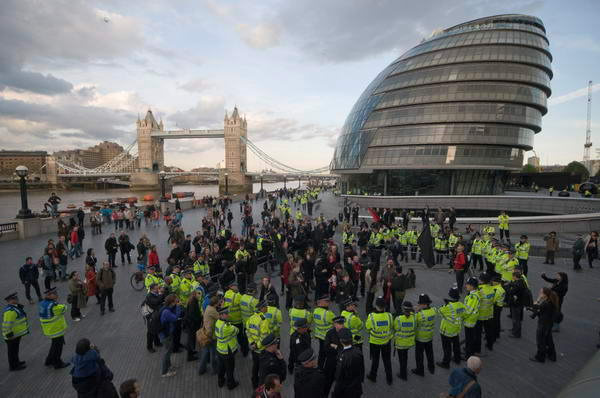
No to the Crook, the Toff, The Fascist or Cop -City Hall, Southwark
I sat on a wall close to City Hall reading John Updike’s novel ‘Terrorist’ which is perhaps why I attracted quite so much attention from a Metropolitan police FIT team (Forward Intelligence Team) photographer who took a number of photographs of me sitting there. I don’t object to being photographed, but was a little surprised when later I put in a Freedom of Information request to find the Met claimed they had no pictures of me, despite having photographed me working at many protests.
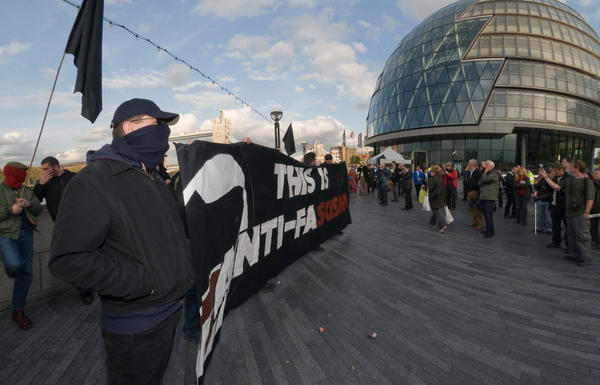
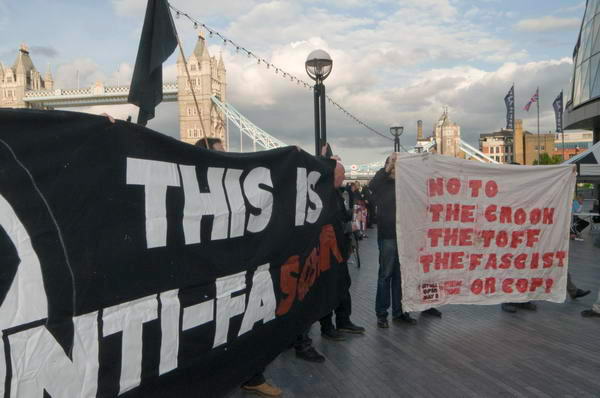
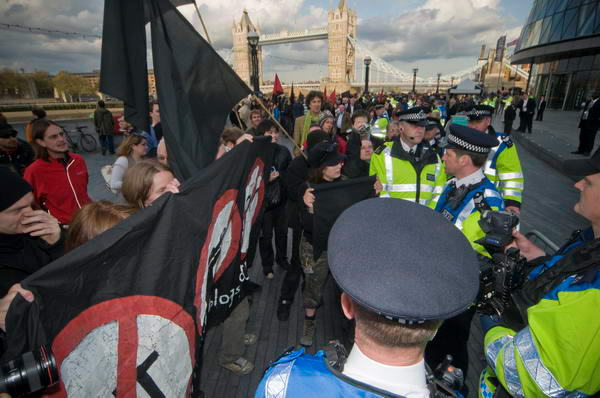
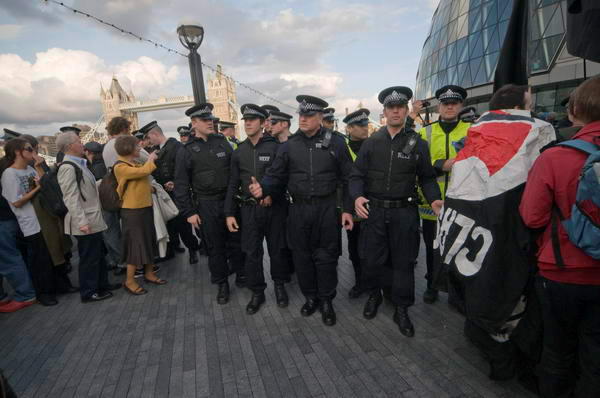
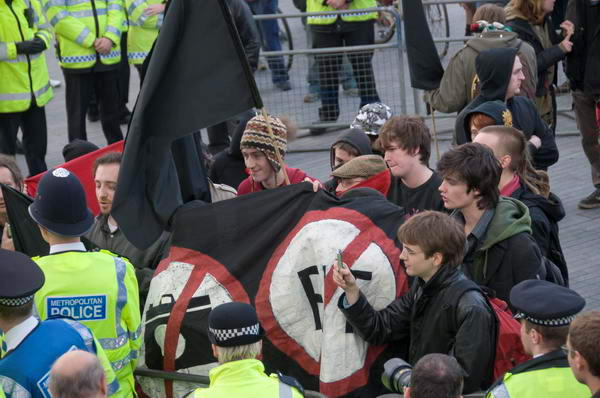
Protesters from various anarchist groups including Class War had come to City Hall to wait for the new London Mayor to be announced, though they were clear that they were against all the candidates – who they described as the Crook, the Toff, The Fascist and the Cop (there were six others also standing including Green Party candidate Sian Berry who got more votes than “the fascist” BNP candidate.
The protesters were allowed to protest in front of City Hall for around 35 minutes until Fitwatch went into action to frustrate the FIT teams (who could really use a little more intelligence) enclosing one of them in their banner.
Police called up their waiting reinforcements and the TSG arrived four minutles later and began to push the demonstrators, along with some bystanders, mainly tourists, towards the waiting pen which had been set up a short distance away.
One French woman was bemused. “But why are they just letting themselves be pushed” she asked me as I took photographs. “Because this is England and not France” I replied.
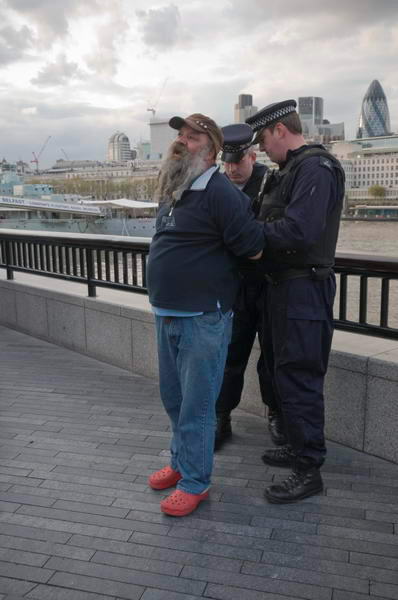
I watched as police told a man leaning peacefully on the river wall watching that he had to move as he was “obstructing the highway“. Clearly he wasn’t (though the police were) and he refused to move. They dragged him from the wall, claimed he was struggling (visibly he wasn’t), handcuffed him and led him away to one of the over 40 police vans parked nearby.
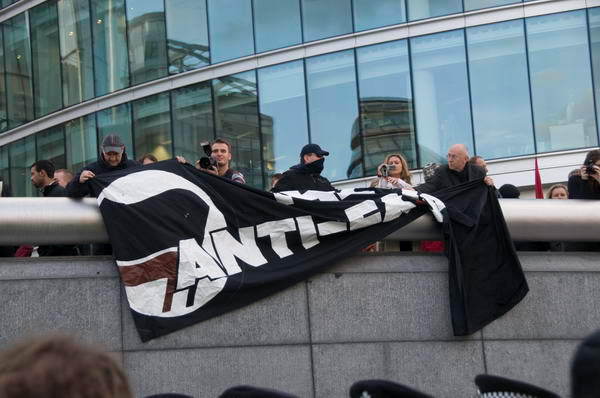
I showed my press card and for once was allowed through the police line obstructing the riverside path and made my way to a public balcony overlooking the area. “Cannier protesters had moved away faster, and were able to display their banner” for a couple of minutes but as I arrived they saw the police coming after them and made a run for a nearby pub.
“The police obviously couldn’t be bothered to chase them, and contented themselves with moving the innocent public away from the balcony, and after a short time, also moving the press.” I joined the protesters in the pub for a drink before leaving for home.
By the time I arrived home Boris Johnson (the Toff) had been announced as the winner and London suffered from a dysfunctional mayor for the next 8 years as he was again elected in 2012. Later those the police had penned were allowed to go home.
Workers, May Day March & Police Party: May 1st is of course May Day, International Workers’ Day, and I will be at Clerkenwell for the annual May Day march in London, and perhaps some other events to celebrate the day. For Catholics it is also dedicated to Saint Joseph the Worker, the husband of Mary, the mother of Jesus and approopriately in 2006 my day started outside Westminster Cathedral with the launch of the London Citizens Workers’ Association. Here is what I posted back on May Day in 2006 – with the usual corrections and links to more pictures on My London Diary.
London Citizens Workers’ Association – Westminster Cathedral
May 1st saw the launch of the London Citizens Workers’ Association, a new organisation to support low-wage and migrant workers across London, backed by faith organisations, trade unions and social justice organisations. May 1 is the feast of St Joseph the Worker and the event began with a procession into the cathedral and a ‘Mass For Workers’, but I didn’t bother to get up in time for that.
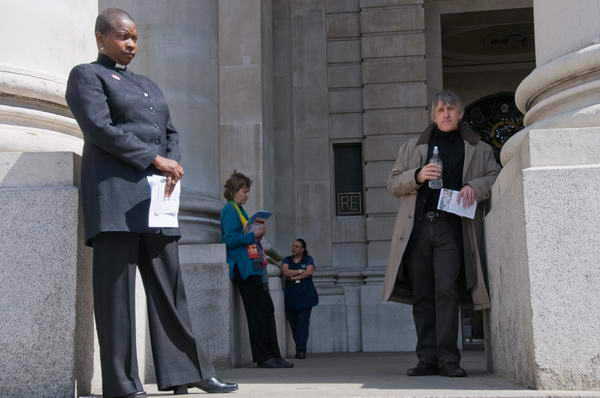
After the mass was a ‘Living Wage rally’ outside the cathedral, with speakers including Cardinal Cormac Murphy O’Connor (then leader of the Catholic Church in England & Wales), Sir Iqbal Sacranie (Secretary General, Muslim Council of Britain), and Jack Dromey (General Secretary of the TGWU) along with representatives of other unions and faiths, and of the new association.
The association aims to fight a campaign for a living wage for low paid workers as well as training them to organise and campaign and providing free advice on rights at work and legal support. Workers in low paid jobs often also lack decent working conditions and there was in 2006 little trade union representation*. It will also provide english classes.
Several large employers who have already taken steps to improve conditions were awarded ‘Living Wage Employers awards’ at the rally, but I didn’t wait around for this. more pictures
[* Since 2006 we have seen the rise of several grass roots trade unions taking a strong stance for the rights of low paid workers, particularly migrant workers, including the United Voices of the World and the Independent Workers’ Union of Great Britain.]
London May Day March – Clerkenwell
Around half of London’s tube network seemed to be down for planned engineering works, and getting around was a bit like playing Mornington Crescent to some very special rules. But the Victoria Line and Thameslink got me to Farringdon well before the start of the annual May Day parade.
This seemed larger than in previous years, with a few more trade unions there, with particularly strong support from the RMT, but many others also took part, including my own – the NUJ (and there were many of us members covering the event as well.)
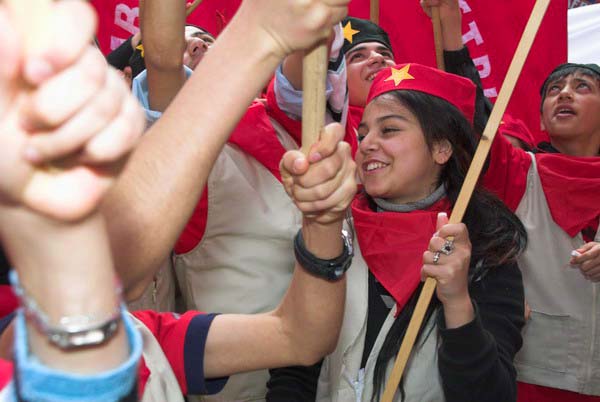
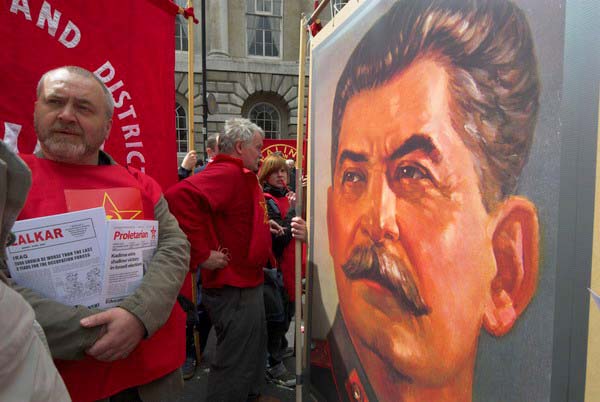
As usual, the most colourful aspect of the march was provided by the various Turkish communist parties, with strong youth wings. MKLP (and its KGO youth), the DHKC, the TIKB, the TKP/ML and probably more. There were some powerful reminders of the repression in Turkey in the portraits of some of those who have died in terrorist actions or death fasts.
Movements in a number of other countries were also represented, including Iraq, Iran Greece and Sri Lanka as well as the Kurds. Also taking part was the African Liberation Support Campaign Network.
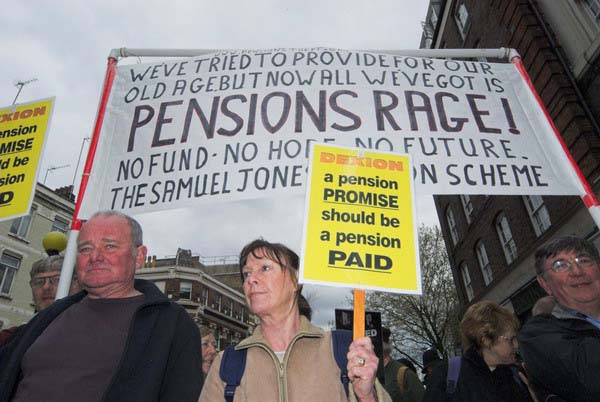
Gate Gourmet strikers marching behind their banner chanted “Tony Woodley – out out!” denouncing the attempts of the TGWU to force them to sign the compromise agreement which waives their rights to further work or legal redress. Others demanded that Remploy factories be kept open. There were protests over the Dexion and Samuel Jones pension outrages, and other causes.
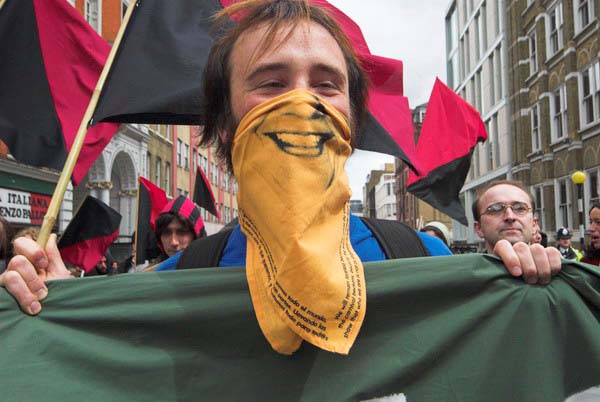
More or less bringing up the rear of the march were around 500-1000 in the Autonomous Bloc, an anti-capitalist grouping marching against ‘precarity’, the working environment of late capitalism.
Increasingly there is a polarisation of the employment market in our service-based economies, characterised at one end by poor conditions, lack of job security, temporary employment, use of migrant labour at one extreme, and at the other by increasing encroachment of work into the private lives of more highly paid employees, making them into company property in exchange for their security.
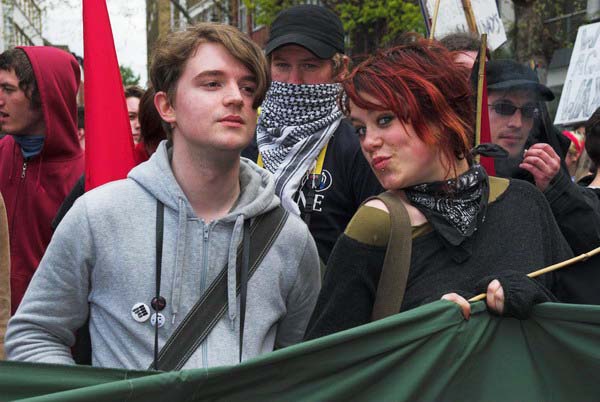
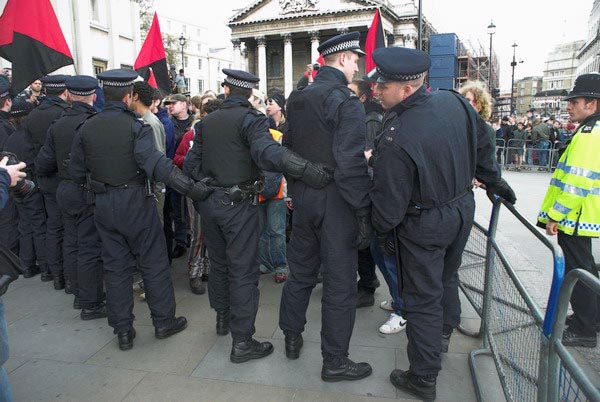
In contrast to the relatively low-profile police presence for the rest of the event, this bloc was flanked on both sides by a line of uniformed police. Many of the marchers in this section wore scarves covering the lower half of their faces, and some carried anarchist flags. Leading the block were a number of bicycles, and a pedal powered sound system.
The march continued on its way to Trafalgar Square, where people stood around mainly looking pretty bored. I didn’t catch much of the speeches but if what I heard was typical I could understand why.
When the Autonomous Bloc arrived at the square, the police barred their entry on the grounds of public order and seized the sound system. More than half those marching left at this point, with the police making little attempt to stop individuals who wandered into the square.
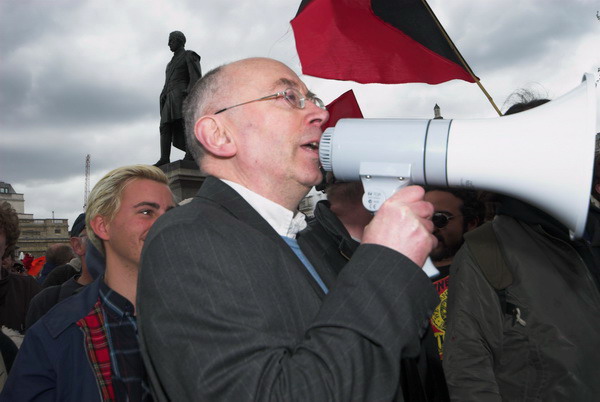
The rest of the bloc stayed on the road, with a few short speeches over a loud hailer, then moved up the side of the square towards the national gallery, where there was another short meeting. This was interrupted by the news that the police tactical support group was on its way, and they soon surrounded the relatively small group who had decided to stay.
I walked through the police line at this point, and they seemed to be making little attempt to stop anyone leaving, or at least didn’t detain them for more than a few minutes.
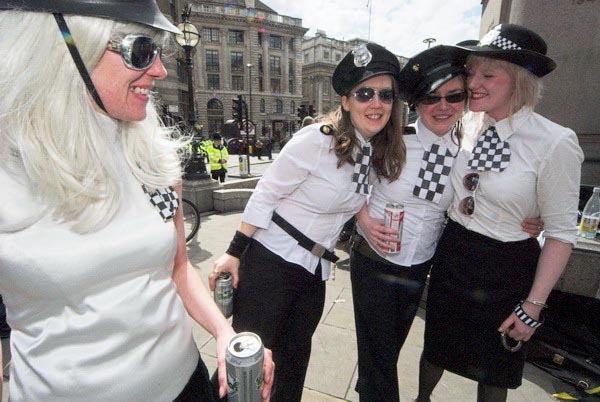
While the marchers were walking to Trafalgar Square, I took what was left of the tube to Bank and the ‘Police Victory Party‘ organised on their behalf by the Space Hijackers.
There I watched Tony Blair and some rather more attractive than usual police (and with pink fluffy hand-cuffs) being watched by some other police. A couple of the latter walked away when asked if they would mind being photographed, but some others seemed to be rather amused by the proceedings.
Of course, the police (both lots) were taking lots of pictures of the events too, and I can imagine some of them causing amusement at section house parties.
There was a ‘pin the blame on the anarchist’ game, a pinata (ta for the mini Mars bar) and some dancing before I had to rush off to make the gig at Trafalgar Square. Where the politics were perhaps less serious.
Muslims, Our Railways & Little Venice: Twenty years ago I published this post on My London Dairy about my day taking pictures, but it isn’t easy to find. So here it is again with the usual minor corrections and a few pictures, with links to the others already on-line.
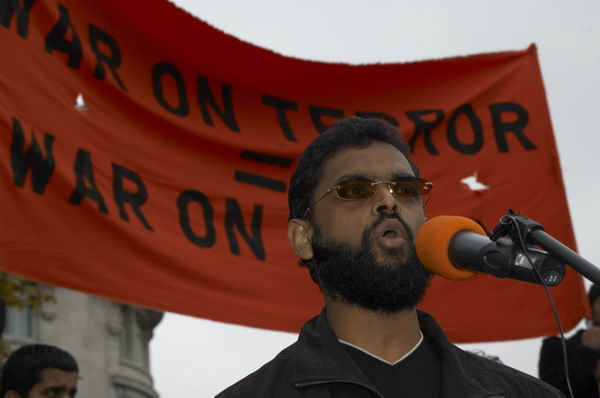
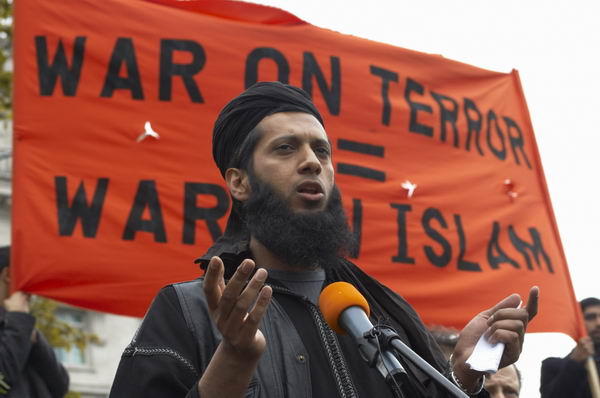
Muslims United Against Oppression – Marble Arch
Mozzam Begg reads his poem. War on Terror = War on Islam
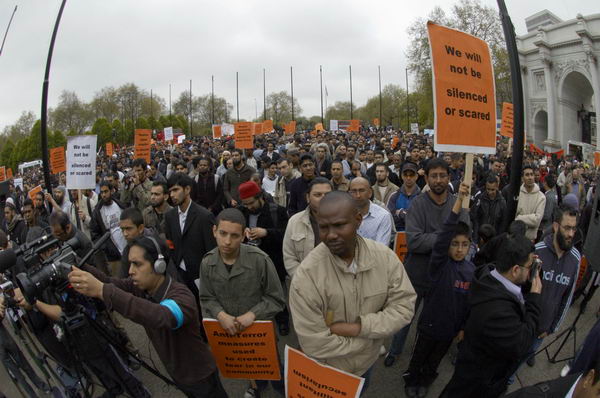
Saturday 30th April 2005 was a busy day. I started at Marble Arch where a number of Muslim organisations were showing their unity in protesting against the anti-terrorism laws and the way the ‘war on terror‘ was used to detain prisoners at Guantanamo Bay and Bellmarsh, to carry out increased stop and searches on Muslims in the UK, and threaten them with extradition, and to label the liberation struggles in Palestine, Kashmir, Iraq and Chechnya as terrorism.
The ‘Muslims United Against Oppression’ march and rally was organised by ‘Stop Political Terror’, the ‘Islamic Human Rights Commission’, ‘Hizb ut-Tahrir Britain’, ‘Cage Prisoners’, the ‘Islamic Party Of Britain’, ‘Muslim Directory’ and other organisations, and representatives of many of these spoke at Marble Arch. There were also two former Guantanamo detainees who spoke, Martin Mubanga and Mozzam Begg, who read a moving poem.
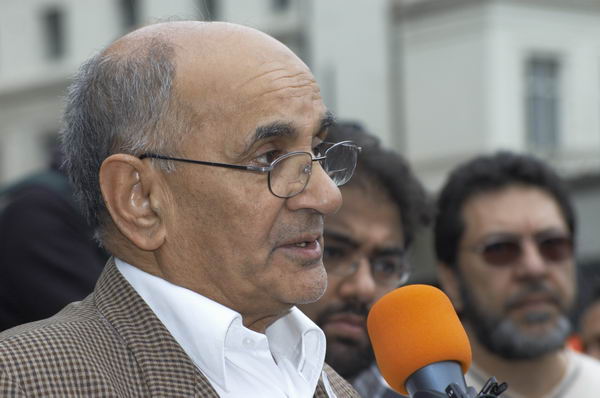
Ashfaq Ahmad
Ashfaq Ahmad spoke about the detention of his son, Babar Ahmad, who was born and brought up in south London. On December 2nd 2003, anti-terrorist police broke into his house in the early hours, and assaulted him brutally in front of his wife before taking him away. Six days later he was released without charge. He had over 50 injuries to his body, two potentially life-threatening, but despite this the Crown Prosecution Service decided there was insufficient evidence to prosecute any of the officers involved.
Babar Ahmad was again arrested on 5th August 2004 following an extradition request by the US government. In 2005 he was still in prison awaiting a final verdict on whether he will be sent to the USA, although a fair trial there seems unlikely.* The allegations against him appear to be that he emailed a US sailor on two dates (one was Babar’s wedding day, the other in the middle of his honeymoon on a remote island without internet access), that he had a brochure from the Empire State Building (true, his father had got it on a visit there in 1973) and that he had travelled on a false passport, despite the fact that his real one has the appropriate entry and exit stamps.
Unfortunately our extradition agreement with the USA apparently does not allow Britain to refuse requests on the grounds of evidence.
Having failed to treat Babar with any justice in this country following his arrest – almost certainly a case of mistaken identity that too many would lose face over to readily admit – it now looks as if we will hand him over to our American allies for further mistreatment.
Around 5000 Muslims made there way from Marble Arch and along the Edgeware Road towards Paddington Green Police Station for a further rally.
* Babar Ahmed spent 8 years in a UK prison before eventually being sent the the USA for trial. Although there was huge pressure to try him in the UK the CPS decided there was “insufficient evidence to prosecute” him. In 2009 he was awarded £60,000 compensation for the “serious gratuitous prolonged unjustified violence” and “religious abuse” during his arrest; the four officers who were accused of this and dozens of other assaults on black and Asian men were tried but acquitted in 2011. After his extradition in 2012 he spent two years in solitary confinement in pre-trial detention in a Supermax prison. Eventually he came to a plea bargain which led to his release in July 2015.
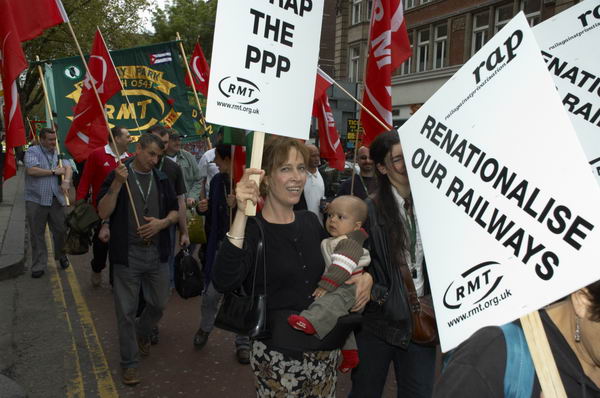
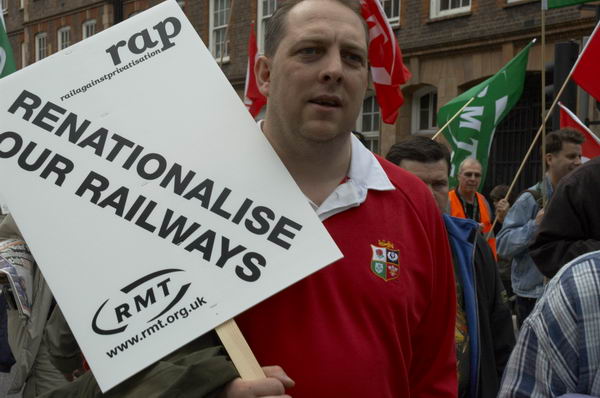
RMT march to Renationalise the Railways – Bloomsbury
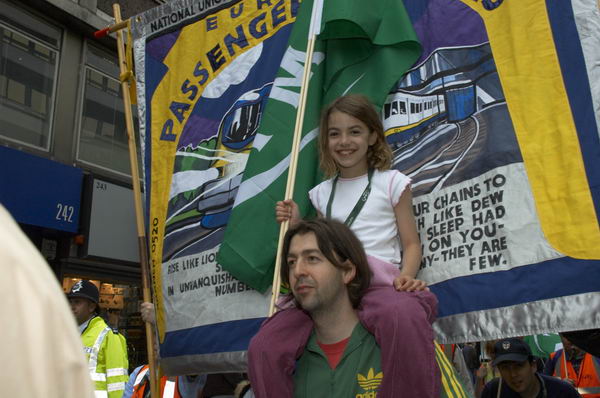
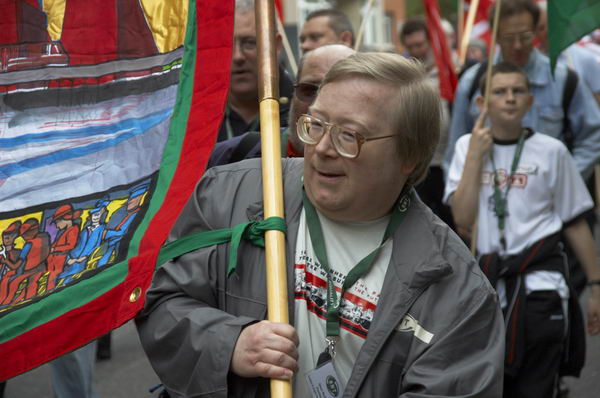
I made my way to the Charing Cross Road to meet the RMT march against rail privatisation, a two-week, 14-city national mobile demonstration from Glasgow to London to make the case for re-nationalising the rail network.
As someone who travels frequently by rail, I’m fully convinced of the need for some action. On my line to London, services are less frequent and less reliable and slower than when I moved here thirty years ago. The latest trick has been to write yet more ‘spare minutes’ into the timetables so that more trains will arrive on time. Journeys that a few years ago took 28 minutes are now timetabled for 34 minutes. [Now in 2025 this has increased to 37 minutes.]
There certainly seem to be a great problem over signalling on the lines, with trains that should have a clear run on green with miles of clear track in front of them continually finding amber or double amber and occasionally red. Either systems are not working or there are not the signallers to work them.
The whole fare structure is also a nonsense, far too complex for anyone to understand. None of the enquiry services ever seem to be able to tell you anything other than standard fares (if that) and journeys covering more than one operator are a nightmare. Try several online systems and you are likely to get several different answers as to fares and availability. As a first move back to a sensible system why not set up a national fare structure, with train operators paid for running trains from a central body?
It was a good-natured demonstration making a real point, but unfortunately not one any likely government wants to hear.
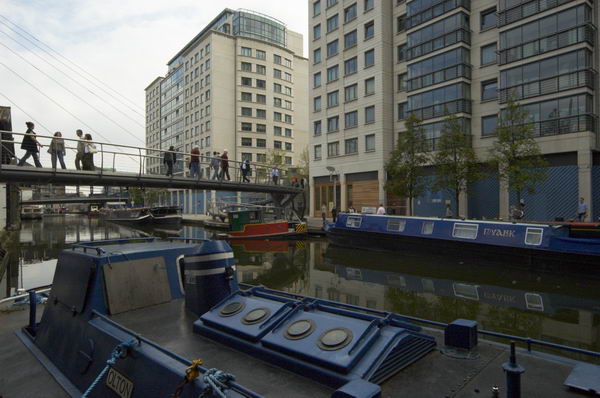
Finally I went off to Little Venice, where the Inland Waterways Association was having a three day Canalway Cavalcade celebrating the bicentenary of the Battle of Trafalgar. In 1805, canals were growing as the main form of inland transport, and it was the year two of the major civil engineering structures of our canals, the Pontcysyllte Aqueduct and the Blisworth Tunnel were completed.
I’m not a great canal person, though I often cycle along the towpaths. But the first time I ever drove a narrowboat, I found myself in charge of 70 feet of steel hull through the dark narrow length of Blisworth, and later the same year also took the marginally overwide craft across Pontcysyllte, where there was considerable resistance to its movement through the narrow channel. Getting through some of the locks on the way there and back was harder, and we learnt some less conventional locking techniques, opening the upper gates for the water to force the marginally over-wide hull through, scraping its sides past the brickwork.
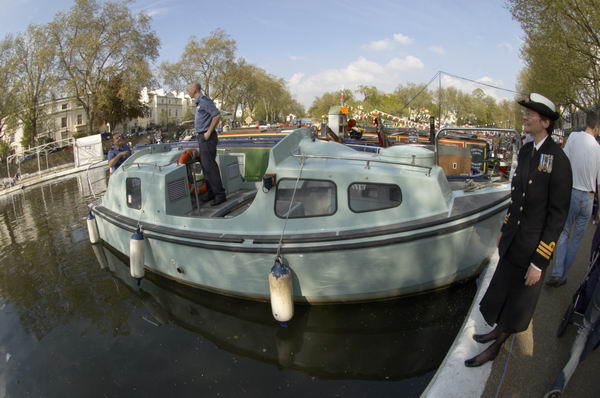
However I’d not come to see the boats, even though the navy were taking part, with one of our smaller ships, a crew of three and commander from the Royal Naval Reserve.
London Isn’t Venice, Yet! – Mutiny Arts, Little Venice
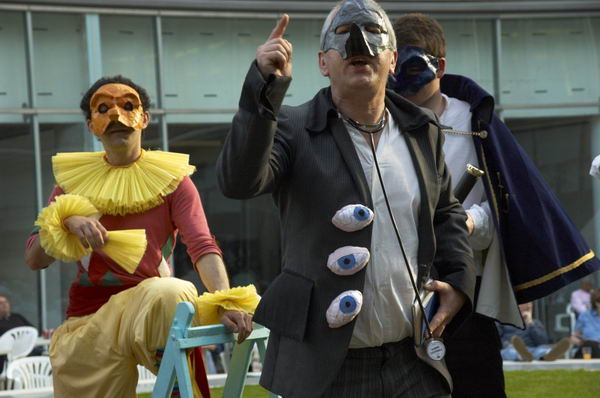
Mutiny Arts from Brixton were to perform an ecological drama, London Isn’t Venice, Yet!, warning of the dangers of global warming and rising sea levels.
The sea level is rising fast
The play went down well with the audience in the Sheldon Square ampitheatre, part of a new office development in Paddington.
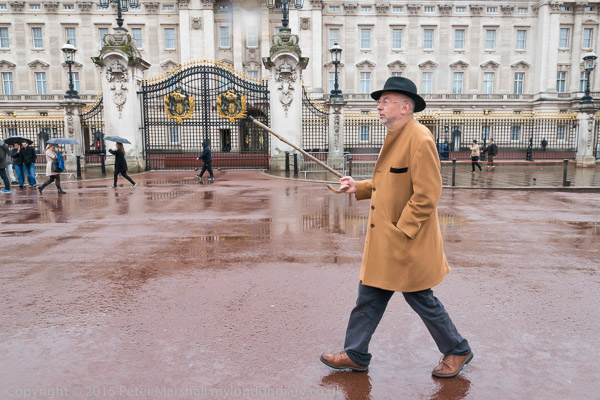
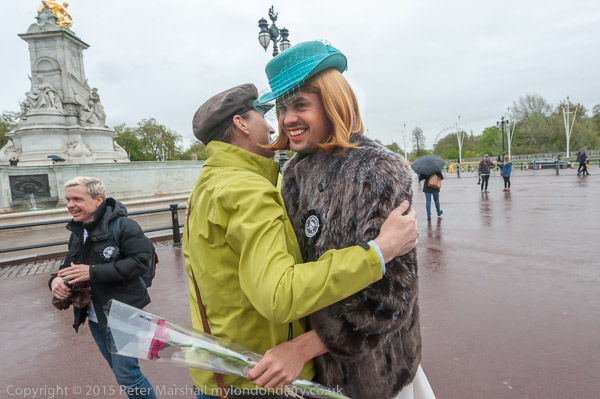
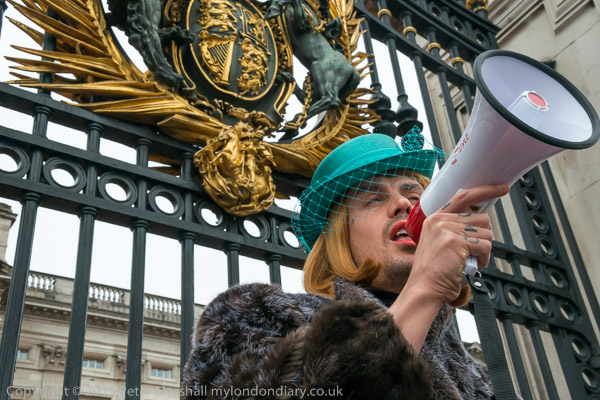
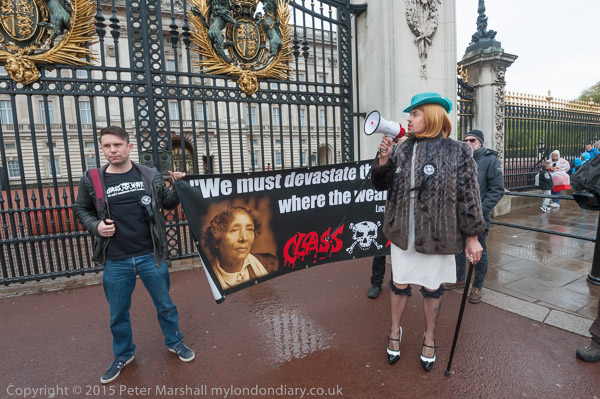
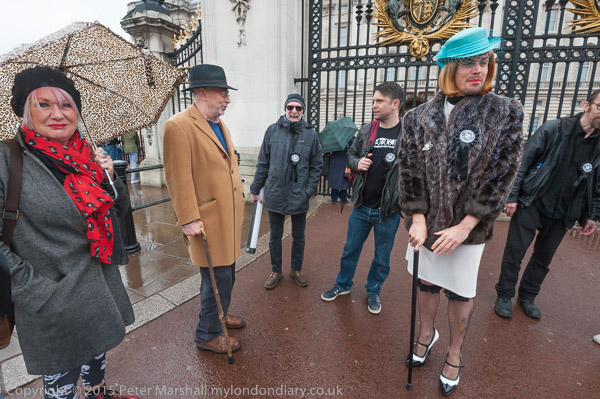
Class War Election Manifesto Launch at Buckingham Palace: On Wednesday 29th April 2015 I went with Class War to Buckingham Palace for the launch of their manifesto for the 2015 General Election.
Although as good anarchists Class War are not in favour of our flawed electoral system they had decided the election campaign would be a good opportunity to generate some interest in working class attitudes and issues, get some publicity – and have a little fun.
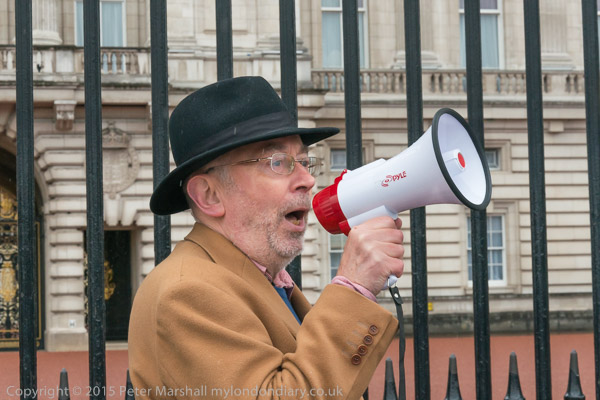
Ian Bone of Class War arrives at Buckingham Palace for the manifesto launch
So they had registered as a political party and invited their friends to stand for seats. There were quite a few volunteers but finding the funding for the deposits they knew they would lose and getting the required number of nominations in the constituencies whittled the numbers down in the end to seven candidates for the roughly 650 seats.
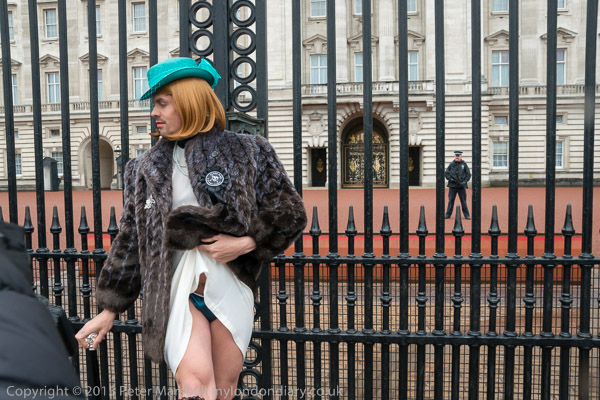
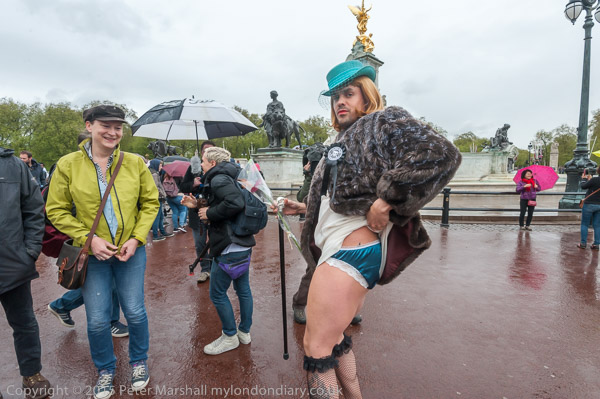
Class War’s Westminster candidate Adam Clifford is greeted on arrival
Three of these were in the Greater London Area and I was able to cover all three in the constituencies where they were standing, John Bigger in South Croydon, Lisa McKenzie in Chingford, and on this occasion Adam Clifford who was standing in Westminster.
and shows off his lace-fringed knickers.
The campaign that attracted most media attention was that of Lisa McKenzie because was standing against former leader of the Tory party and Secretary of State for Work and Pensions Iain Duncan Smith.
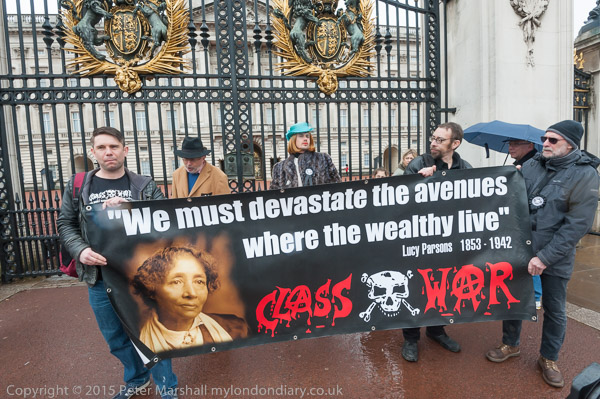
Class War supporters pose in front of the palace gates with their Lucy Parsons banner
Adam Clifford was standing in Westminster and there were 31 of his potential voters registered in Buckingham Palace so he had come to the gates of the Palace to demand his democratic right as a candidate to canvass their votes, but was not allowed to enter.
Adam Clifford speaks in front of the gates
But the event was also the launch of the Class War Party’s campaign, with a simple five point manifesto which had largely been drawn up as I walked with them from the White Hart to one of their many ‘Poor Doors’ protests at One Commercial Street – all of 110 metres away. It was simple and to the point.
Double Dole,
Double Pension,
Double Other Benefits,
50% Mansion Tax,
Abolish the Monarchy,
Abolish all Public Schools
As well as myself, BBC News were there to record the manifesto launch, though I don’t know if it ever made the airwaves.
However the electorate was not ready for the radical proposals of Class War and at the election their seven candidates recorded only a total of 526 votes.
Ian Bone speaks
But since one of the key anarchist policies has long been ‘Don’t Vote – It only encourages them‘ they could claim that the 97,870 spoilt votes and the roughly 35% of registered voters who didn’t bother actually put those who shared their views in a majority. Though most of us might see it as a near victory – the Conservatives actually got slighly more votes than this – for apathy rather than anarchy.
And Class War decides its time to leave before the police become too interested.