Stroud Green to Grand Parade, November 1989

Stroud Green to Grand Parade: Continuing my walk on Sunday 5th November 1989 from where the previous post left me on Stroud Green Road close to Finsbury Park Station.

Boys Entrance, Stroud Green Primary School, Ennis Rd, Stroud Green, Haringey, 1989 89-11d-46

The Girls Entrance to Stroud Green Primary is still there on the corner of Perth Road and Woodstock Road, but the BOYS was recently removed from above the gate at the other end of the school site in Ennis Road, where extensive building work was taking place – so perhaps it will return. The two entrances were over a 100 metres apart, an unusually safe distance. There is also a similar gate for INFANTS on Woodstock Road.

I think most of the school dates from 1897, although Google’s AI unhelpfully told me “Stroud Green Primary School was established in 1997” when I asked when it was built. The Grade II listing text for Woodcock Road School begins “Late C19 building of shallow U-shape with projecting gabled wings and slightly projecting 5 bay centrepiece under higher hipped roof crowned by cupola.” The area had fairly recently been developed with housing, some of which had to be demolished to build the school.

Oxford House, Oxford Rd, Stroud Green, Haringey, 1989 89-11d-33

I turned left into Woodstock Road and then right into Oxford Road, heading for the Oxford Road Gate to Finsbury Park.

On the right just before the gate is Oxford House. In the 1960s this was the cinematographic film processor Kay Laboratories, later absorbed into MGM (possibly via Rank Xerox). For some years it was a studio and office space and housed a private college. For some years this 1930s Art Deco building was in a poor state but has recently been refurbished as offices and co-working space.

Pipe Bridge, New River, Houses, Endymion Rd, Haringay, Haringey, 1989 89-11d-23
Pipe Bridge, New River, Houses, Endymion Road, Harringay, Haringey, 1989 89-11d-23

I walked through Finsbury Park on what is now part of Section 12 of the Capital Ring a circular walking route around London, first put forward as an idea the following year but only completed in 2005, but turning north onto the New River Path to exit onto Endymion Road where the houses on this picture are.

Houses, Endymion Rd, Stroud Green, Haringey, 1989 89-11d-24

These south-facing houses on Endymion Road were lit by early afternoon winter sun. The road was the first constructed in the area after Finsbury Park was established and the development was begun by the Metropolitan Board of Works around 1875. The road goes around the northwest and north sides of the park, giving the houses attractive views over it. Development of the area to the north, West Harringay, began shortly after.

Endymion was in one of several Greek myths a handsome shepherd prince who moon goddess Selene fell in love with and persuaded Zeus to make immortal and to put in eternal sleep so she could visit him every night. John Keats wrote a famous extremely long poem in four sections, each around a thousand lines base on the myth and first published in 1818.

But the name more likely came to Harringay from HMS Endymion, “the fastest sailing-ship in the Royal Navy during the Age of Sail“, built in 1797 and in active service during the Napoleonic Wars and until the First Opium War around 1850 and only finally broken up in 1868.

Building, Green Lanes area, Haringey, 1989 89-11d-25

I think this building was probably on Warham Road, just a few yards down from Green Lanes, but if so there is no trace of it now. I wonder what it was built for, but there are few clues in the picture – perhaps someone local to the area can tell us in the comments.

Shop Window, Grand Parade, Green Lanes, Haringey, 1989 89-11d-11

The Grand Parade on the east side of Green Lanes of shops with middle class flats above them was developed by J C Hill and completed in 1899, with its relatively consistent facades interrupted only by an earlier bank, built five years earlier.

I can’t think who the peculiar bedroom suite in the window of this shop might appeal to, but it seemed like something out a a peculiar nightmare to me, but I guess it was someones’ dream.

Tory Scum, Grand Parade, Green Lanes, Haringey, 1989 89-11d-13

Also and rather more prosaically on Grand Parade on an empty shop front, fly-posting and the carefully stencilled graffiti:

TORY SCUM
OFF OUR BACKS
WE CAN’T PAY
WE WON’T PAY
NO POLL TAX

My walk continued, and I’ll post more soon.


FlickrFacebookMy London DiaryHull PhotosLea ValleyParis
London’s Industrial HeritageLondon Photos

All photographs on this page are copyright © Peter Marshall.
Contact me to buy prints or licence to reproduce.


Wine, Bingo, Market Tower and Houses

Wine, Bingo, Market Tower and Houses continues my walk in Islington on Sunday 15th October 1989 which began with the post Memorials, Eros and More. The previous post was Liverpool Road, Highbury Corner & Caledonian Rd.

The Wine Press, Caledonian Rd, Lower Holloway, Islington, 1989 89-10h-26

The Wine Press sold wine by the case at wholesale prices and its doorway had once been surrounded by 15 labelled barrel ends, but the lower four had been removed by the time I made this picture.

At the top you can just see the bottom of a large 2D representation of a wine bottle and out of picture to the right on the wall was a similar flat picture of a bottle of Anglias Brandy, a brandy from Cyprus. I took a second picture – not yet digitised – showing more of the frontage.

Wine was still very much a drink of the metropolitan middle classes and an establishment such as this very much a sign of the gentrification of Islington and other former working class areas of London.

Top Rank Bingo, 474, Caledonian Rd, Lower Holloway, Islington, 1989 89-10h-13

Designed by architect Frederick E Tasker and, opened in 1937 as Mayfair Cinema, it was briefly renamed The Eagle in 1942 but reverted after a popular outcry. Taken over by Essoldo in 1952, it became Essoldo Caledonian Road until 1965 when it became Essoldo Bingo Club. Later it was Top Rank Bingo and finally Jasmine Bingo, closing in 1996. Demolished in 1998.

Clock Tower, Caledonian Market, Caledonian Park, Lower Holloway, Islington, 1989 89-10h-16

Grade II* listed, built as the clock tower of the Caledonian Market in 1855, designed by James Bunstone Bunning, Architect and Surveyor to the Corporation of the City of London. The market was built on Copenhagen Fields which had been the meeting point for the crowd of 100,000 who marched from here through London to support the Tolpuddle Martyrs on 21 April 1834. 175 years later I photographed TUC General Secretary Frances O’Grady unveiling a plaque on the tower to commemorate this on 25th April 2009.

The ‘Grand Demonstration‘ was I think the first mass demonstration by trade unions and the start of a successful popular campaign that led eventually to the men being released – a pardon was granted in 1835 (but it was 1837 before they arrived back in the UK.) The 2009 march that followed the unveiling was rather smaller, but colourful with some trade union banners including that of the Tolpuddle Branch Dorset County of the National Union of Agricultural Workers.

House, 348-352, Camden Rd, Holloway, Islington, 1989 89-10i-65

This remarkable Victorian property on Camden Road appears to have been built as three houses as the three entrances and street numbers suggest, with 350 having a much grander entrance than its two neighbours. 348 appears to be called ‘The Cottage’. Perhaps someone reading this will know more about the history of this building and enlighten us.

Cambridge House, 354-6, Camden Rd, Holloway, Islington, 1989 89-10i-66

The lettering on the front of this house has been changed since I took this photograph, with the addition of the word ‘Collegiate School’ in a central line. There was a Collegiate School at first in Camden St and then at 202 Camden Road before moving to Sandal Rd and Edgware, but so far as I can ascertain with no connection to this building which is now flats.

I think this large semi-detached residence dates from the mid-19th century but again have been unable to find any more about it.

Macready Place, Holloway Rd, Holloway, Islington, 1989 89-10i-52

This building has been demolished and replace by ‘The Arcade’ student accommodation with the Big Red bar at ground floor level on Holloway Road.

The lettering at top right appears to have once read CYCLES and was presumably a shop on the corner with Holloway Road. The posters on the wall below it are for an event at the Hackney Empire by the Campaign For Free Speech on Ireland on Tuesday October 17th 1989.

Albemarle Mansions, 542-554, Holloway Rd, Holloway, Islington, 1989 89-10i-55

The frontage of Albemarle Mansions stands out above the shops on Holloway Road and was clearly meant to distinguish these mansion flats built in 1898 from the various working class blocks of the same era built by philanthropic companies. Albemarle is a name brought over from France with the Norman Conquest and the title Earl of Albemarle was created several times over the century since then.

My walk on 15th October 1989 more or less came to an end here, and I made only one more picture – not on line – on the short walk to Holloway Road station on the North London Line on my way home.


FlickrFacebookMy London DiaryHull PhotosLea ValleyParis
London’s Industrial HeritageLondon Photos

All photographs on this page are copyright © Peter Marshall.
Contact me to buy prints or licence to reproduce.


Ninety from Narbeth, Pembrokeshire:

Ninety from Narbeth: Narberth (Arbeth to Welsh speakers) was until recently a place I had never hear of, a small town in Pembrokeshire with ancient origins. I spent a week staying there with a small group of friends at the start of September 2024, returning last Saturday.

Ninety from Narbeth

Narbeth apparently grew up around the palace of a Welsh king and in the great collection of ancient Welsh stories preserved by oral tradition until first written down around 1350, the Mabinogion, is the chief palace of Pwyll, Prince of Dyfed. There were ancient camps nearby and the Romans came – and went.

Ninety from Narbeth

But it was the Normans who, having invaded England in 1066, a few years later turned their attention to Wales and left a great mark on the area, building more than 50 massive castles to invade and occupy the area. Thee wars here were a complex and changing situation and other castles were built by the Welsh to defend their land.

Ninety from Narbeth

A castle was first built at Narbeth by the Normans around 1116, but rebuilt in stone in the following century. It formed a part of what is now called the Landsker Line, defending the territory they controlled against the Welsh. The castle is now in ruins but open to the public, though the buildings are fenced off for safety reasons.

Ninety from Narbeth

The Landsker Line divided the largely English-speaking area of south Pembrokeshire, dominated by the Normans from Welsh-speaking Wales, and the area to the south of it was often called ‘Little England’.

Now only around a fifth of the roughly four thousand residents of Narberth are Welsh-speaking. For a town of its size it has a remarkable number of independent shops and particularly at weekends the place is crowded. Ten years ago The Guardian called it “a gastronomic hub for West Wales” and named it as “one of the liveliest, most likeable little towns in the UK.

I can’t comment on the gastronomy, though I did help to cook some interesting meals for our small group staying there, but it does have a very fine shop making artisanal ice cream with some unusual flavours. And I only visited one of its many pubs, which was a very friendly place, though I just missed the live music there.

As well as more traditional shops, the town also has more than its share of arty shops and some with a hippy or ‘New Age’ vibe. And its certainly a very friendly place compared to suburban London and one of a number of locals we met in a pub shook my hand when I revealed one of my Grandmothers had come from Wales. I’m not surprised that Narberth was “named one of the best places to live in Wales in 2017

It has an excellent local museum and of course a number of churches and chapels, though some now in other uses. These are among its 70 listed buildings, most of which I think are in the pictures I took, though many of the more interesting are unlisted.

It isn’t far to drive to many other attractions of the area – more castles, mills, the rugged coastal path and more sedate seaside resorts with some fine beaches. Friends took me to some of these but there were many more.

Perhaps the most disappointing thing about Narberth is the railway station, around three-quarters of a mile from the centre of town. On the map the railway seems useful, but in reality there are too few trains to be of much use. The station building is now a joinery though Platform 1 (and only) still stands, with an announcement telling us that this was a request stop, and we should indicate clearly to the driver as the train approached that we wanted to board. Fortunately it did stop when we began our journey home.

All the pictures here are from Narberth town centre, and there are more on Facebook in the album ‘Ninety From Narbeth‘. I’ll make some later posts about some of the places in the area we were able to visit during our holiday.


FlickrFacebookMy London DiaryHull PhotosLea ValleyParis
London’s Industrial HeritageLondon Photos

All photographs on this page are copyright © Peter Marshall.
Contact me to buy prints or licence to reproduce.


Schools, Warner Estate, Baptists & Art Deco – 1989

Schools, Warner Estate, Baptists & Art Deco: My motivation for this return to Walthamstow was I think to photograph the building whose pictures end this post. On a previous visit I had – for the only time I can remember – lost a cassette of exposed film. I’d realised this later in the same morning and had gone back on my tracks to search for it to where I changed films, but without success. And there had been one building I had photographed that I was keen to have pictures of as Art Deco was one of my particular themes at the time, working for a never published book, London Moderne. But I’d decided to walk around some other areas again before going to take those pictures.

Markhouse Road Schools, Markhouse Rd, Walthamstow, Waltham Forest, 1989 89-9e-63

Markhouse Road Schools it tells us on the building were ‘REBUILT 1907’. Walthamstow was forced by the government Education ministry to set up a school board 1880, before which there were “5 Anglican schools, 5 run by Protestant nonconformists, and 3, including an orphanage and an industrial school, by Roman Catholics.” The school boards provided elementary education for 5-13 year olds. Mark House Road board school opened in 1891 with infants, boys and girls departments.

Unfortunately the schools burnt down a few days before Christmas in 1906 and were almost completely destroyed. Walthamstow Urban Distric Council who had been running elementary schools in the area since 1903 rebuilt them and they reopened in 1908.

The school became a secondary modern school in 1946 and closed in 1966, though the building remained in use for various educational purposes for some years until it was finally demolished a few years after I made this picture.

Nat West, Bank, 10, St James's St, Walthamstow, Waltham Forest, 1989 89-9e-66
Nat West, Bank, 10, St James St, Walthamstow, Waltham Forest, 1989 89-9e-66

The rather fine entrance to the NatWest bank in St James St; the building on the north of the corner with Leucha Road, is still there, one of the two blocks built by the Warner Estate featured in the previous post on this walk, but the doorway, now for a food store, is sadly bereft of dragons and decoration.

Houses, Leucha Rd, Walthamstow, Waltham Forest, 1989 89-9e-51

Leucha Road, one many streets built as part of the Warner Estate in Walthamstow got its name from one of the family, Leucha Diana Maude who was the daughter of Clementina and Cornwallis Viscount Hawarden Earl de Montalt, a Conservative politician with an Irish peerage. Clementina was a noted amateur photographer and had ten children, eight of whom survived infancy, so there was no shortage of names for streets around here.

This was one of the earliest to be developed on the Warner Estate in 1895 and the buildings on it are two storey maisonettes, called “half houses” by the Warners.

Leucha Road was acquired by Waltham Forest Council in the late 1960’s and they repainted the doors which had been green like all other Warner properties in what the Conservation Area statement describes as “a pale and inappropriate “Council-house” blue“. The Warner Estate sold off 2400 of their properties to Circle 33 Housing Trust (now part of Circle Housing Group) in 2000 and of these 600 still had outside toilets.

Shops, High St, Walthamstow, Waltham Forest, 1989 89-9e-52

Another picture of some of the Warner estate shops in the High Street with at the left a rather strange ‘streamline’ feature which I think must have belonged to a building to the left demolished in some road-widening scheme.

Pretoria Ave, Walthamstow, Waltham Forest, 1989 89-9e-55

A house at 2-4 Pretoria Avenue with a rather nice gable, I think also a Warner building.

Baptist Church, Blackhorse Rd, Walthamstow, Waltham Forest, 1989 89-9e-41
Baptist Church, 65, Blackhorse Rd, Walthamstow, Waltham Forest, 1989 89-9e-41

A curiously barn-like structure dated 1932, Walthamstow (Blackhorse Rd) Baptist Church. This building replaced a ‘tin tabernacle’ in which the congregation had been meeting since 1898. The church is still a “friendly multi-cultural church in Walthamstow.”

Hammond & Champnesss Ltd, Works, Blackhorse Lane, Walthamstow, Waltham Forest, 1989 89-9e-45
Hammond & Champnesss Ltd, Works, 52, Blackhorse Lane, Walthamstow, Waltham Forest, 1989 89-9e-33

Not dated but also obviously from the 1930s was this building for Hammond & Champnesss Ltd on Blackhorse Lane.

Hammond & Champnesss Ltd was established as in 1905 by cousins Ernest Hammond and Harold Champness to make hydraulic water-powered lifts. They were joined by Ernest’s brother Leonard and for some time the company was Hammond Brothers and Champness Ltd.

Hydraulic lifts are raised and lowered by a piston inside a long cylinder with fluid pumped in to move the piston which is connected either directly or by ropes and pulleys to the lift cabin. They can be used in buildings up to five of six stories high.

Hammond & Champnesss Ltd, Works, Blackhorse Lane, Walthamstow, Waltham Forest, 1989 89-9e-32
Hammond & Champnesss Ltd, Works, 52, Blackhorse Lane, Walthamstow, Waltham Forest, 1989 89-9e-32

Hammond Brothers and Champness Ltd went bust in 1932 and the company was taken over by E Pollard & Co. Ltd who renamed it to Hammond & Champnesss Ltd but kept it operating as a separate company. This was taken over by US company Dover Corporation in 1971 but they continued to make lift components in Walthamstow until that company was taken over by Thyssen in 1999.

The building became Kings Family Network. It was refurbished in 2014 and is now Creative Works Co-Working office space.

This wasn’t the end of my walk that day, but after taking three pictures of this building I made my way to Blackhorse Road station and took the train to Crouch Hill.


FlickrFacebookMy London DiaryHull PhotosLea ValleyParis
London’s Industrial HeritageLondon Photos

All photographs on this page are copyright © Peter Marshall.
Contact me to buy prints or licence to reproduce.


Hull General Cemetery and Princes Avenue 1989

More pictures from Hull General Cemetery and Princes Avenue that I took on walks in the area in August 1989. You can see more pictures of the cemetery in 1989 at Hull General Cemetery – 1989.

Quaker Burial Ground, Spring Bank, Hull, 1989 89-8d-42
Quaker Burial Ground, Spring Bank West, Hull, 1989 89-8d-42

According to the article by Chris Coulson on the Friends Of Hull General Cemetery web site, the Quakers bought a 999 years lease on a 0.23 acre plot, about 55 yards by 20 yards and burials took place there from 1855 until 1974.

The graves in this plot, still there, include those of many of Hull’s leading Quaker families and include some whose family names gained international recognition for there products including members of the Reckitt family and engineer William Priestman.

The graves in the foreground of my picture have stones recording seven members of the Reckitt family and there are some others in those behind. All except one of the burials and some whose ashes were scattered here have the same simple design for their memorials.

Hull General Cemetery, Spring Bank, Hull, 1989 89-8d-41
Hull General Cemetery, Spring Bank West, Hull, 1989 89-8d-41

Back in 1989 the cemetery was home to a number of feral cats who I think scrounged for food in the bins and at the back doors of some nearby houses, though I did see (but not photograph) old women bringing scraps into the cemetery for them. The cats generally scrambled away when I approached, but I caught one clinging to the trunk of a tree.

In the background you can see a grassed largely cleared area of the cemetery, then kept mown short by the council.

Fallen Angel, Hull General Cemetery, Spring Bank, Hull, 1989 89-8d-55
Fallen Angel, Hull General Cemetery, Spring Bank West, Hull, 1989 89-8d-55

I don’t know what happened to the many headstones that the council removed from the cemetery, though when the work was taking place there were quite a few piles of them and many had been broken as much of the work was done by unskilled and poorly supervised youth labour.

Vandalism continued in the cemetery after the council had done their worst, and many of the more ornate memorials were damaged and some completely destroyed by youths who roamed at night in the unfenced cemetery.

Dr William Atkin Thompson, Ely House, 149, Princes Avenue, Hull, 1989 89-8d-52

Princes Avenue was only a country lane at the start of the nineteenth century and the first significant development on it were the ornate gates of Hull General Cemetery close to Spring Bank West. A few years later the railway branch to the Hornsea and Withernsea lines was constructed with a level crossing across Spring Bank and a station, Cemetery Gates, later called Botanic, opened in 1864. Further down the road, Pearson Park, Hull’s first public park, was opened in 1862.

Dr William Atkin Thompson (1978-1961) qualified at Owens College, Manchester in 1899 and became a GP in Hull in 1907. He served in the Royal Army Medical Corps from 1914, and after the war continued in service in the army and later the Territorial Army while also practising in Hull. There is a profile of him on the RAMC in the Great War site. He was one of Hull’s most distinguished doctors, continuing to practice well past normal retirement age.

Houses, Princes Avenue, Hull, 1989 89-8d-65

Princes Avenue was laid out to lead to the Westbourne Park Estate, now known as The Avenues, and opened in 1875, with the houses facing the Park at its north some of the first built on it.

Shops, Princes Avenue, Hull, 1989 89-8d-64

Further south on Princes Avenue most of the development took place between 1890 and 1910, but the cemetery entrance was still on the west side at the southern end. I think these shops are on the long parade south of Welbeck Street which probably dates from around 1900, but those on the corner with Spring Bank West, which later housed one of Hull’s most internationally famous shops, Gwenap, were only added after the cemetery gates were moved to Spring Bank West.

Gwenap is said to have opened in 1903, though it was rather a different business back then and I think may have been in other premises as I think the shop the business occupied until 2013 was probably only built in the 1920s. The windows where it used to be are now of no interest.

More from Hull in August 1989 in later posts.


FlickrFacebookMy London DiaryHull PhotosLea ValleyParis
London’s Industrial HeritageLondon Photos

All photographs on this page are copyright © Peter Marshall.
Contact me to buy prints or licence to reproduce.


Hull – Spurn Lightship & Spring Bank – August 1989

Hull – Spurn Lightship & Spring Bank – In August 1989 I went with my family for a week with friends in Scotland and we spent a few days staying at my wife’s family home in Hull on our way there and again on our way home.

Spurn Lightship, Humber Dock, Hull, 1989 89-8c-35

In the 70s and early 80s I’d photographed the city extensively and had exhibited some of this work at the Ferens Art Gallery in the city. I think most of the over 140 pictures in that show are among those I posted online during 2017 when Hull was UK City of Culture – and I added a picture each day throughout that year to my website ‘Still Occupied – A View of Hull‘ – the same title as my show and my self-published book – still available but ridiculously expensive except as a pdf.

Spurn Lightship, Warehouses, Castle St, Humber Dock, Hull, 1989 89-8c-36

Going back to Hull again in 1989 I was still drawn to many of the same places I had photographed in previous years, particularly the docks, the River Hull and the Old Town, and it was sometimes difficult to find anything new to say.

Shop window, Spring Bank, Hull, 1989 89-8c-11

All of these pictures – and many more – are in my Flickr album Hull Black and White.

Phoenix Fitness Centre, Oderma House, 101, Spring Bank, Hull, 1989 89-8c-12

I had taken a bus into the city centre with my family and we had gone to visit the Spurn Lightship which was moored in what was by then Humber Dock Marina. The lightship was opened here as a floating museum by Hull Council in 1983 and has recently been restored and returned to the Marina to a new berth close to the end of the Murdoch’s Connection footbridge, just a few yards west from where it was in 1989. In the top picture in this post one of my sons is looking out of the ship and to his left you can see the tower of Holy Trinity Church, now Hull Minster.

Sunnybank Antiques, Spring Bank, Hull, 1989 89-8c-14

The second picture taken from the lightship is looking towards the City Centre and at Warehouse 6 on the north side of Castle Street at the end of Princes Dock Street. This warehouse survived the demolitions of the 1970s and is now home to an Italian restaurant chain. I found the place excessively noisy when I ate there.

We walked back from the City centre and along Spring Bank. A shop window included the book Batman:The Killing Joke a DC Comics graphic novel written by Alan Moore and illustrated by Brian Bolland with the Joker using, a Witz camera with a 50mm f1.8 lens – Witz is German for ‘Joke’ . There was also a poster for American rock band Kiss, who were to perform at Donington Park, Castle Donington, Derby in ten days time. They had released their fourteenth studio album Crazy Nights in September 1987.

Houses, Spring Bank, Hull, 1989 89-8d-61

The Phoenix Fitness Centre at 101 Spring Bank is now Victory Socialcare Enterprise providing accommodation for adults requiring nursing or personal care.

Sunnybank Antiques and the St John Ambulance were in Georgian houses dating from around 1820. The St John’s HQ and its attached railings were Grade II listed in 1994.

Even the drainpipes on Eastfield House/Eastfield Villas at 226-8 on the corner with Louis Street are ornate, though you cannot see these in my picture.

As these houses show Spring Bank was once one of Hull’s ‘best’ addresses, but that was long ago, and much has been lost, both by wartime bombing and later developments.

More from Hull in a later post.


FlickrFacebookMy London DiaryHull PhotosLea ValleyParis
London’s Industrial HeritageLondon Photos

All photographs on this page are copyright © Peter Marshall.
Contact me to buy prints or licence to reproduce.


St Peter & St Paul, Candles, A Pub & Distillery

St Peter & St Paul, Candles, A Pub & Distillery continues my walk on Friday 4th August 1989 in Battersea from the previous post, River Thames, St Mary’s, Church Rd, Chelsea Harbour & A Bridge. The walk began with Council flats, Piles of Bricks, A House Hospital and Brasserie.

St Peter & St Paul, Church, l21, Plough Road, Battersea, Wandsworth, 1989 89-8c-74
St Peter & St Paul, Church, 121, Plough Road, Battersea, Wandsworth, 1989 89-8c-74

I left the riverside and walked down Lombard Road and crossed York Road into York Gardens probably to find a pleasant spot to rest a while and eat my sandwiches before going through the gardens to exit on Plough Road close to the church.

St Peter’s Church is still very much alive now on Plough Road, but SPB looks very different to my picture in 1989. The first St Peter’s Battersea was built in 1875 but was seriously damaged by fire in 1970 and the church moved into the building in my picture which had been its church and school hall.

According to ‘Clapham Junction Insider’ Cyril Ritchert, the demolition of this Grade II listed building, “an accomplished example of the free gothic style“, was opposed by the Ancient Monuments Society, English Heritage, the Battersea Society and the Wandsworth Society but was approved by Wandsworth Council in 2010. The developers made a second application in 2015 before any building on the site had started. Google Street View shows the church still in use in 2012.

To finance the new church the developers had been granted permission for an 8 storey block of flats also on the site. Local residents were angered that the developers managed to game the planning system to eventually build a 10 storey block of housing with minimal affordable housing on the site.

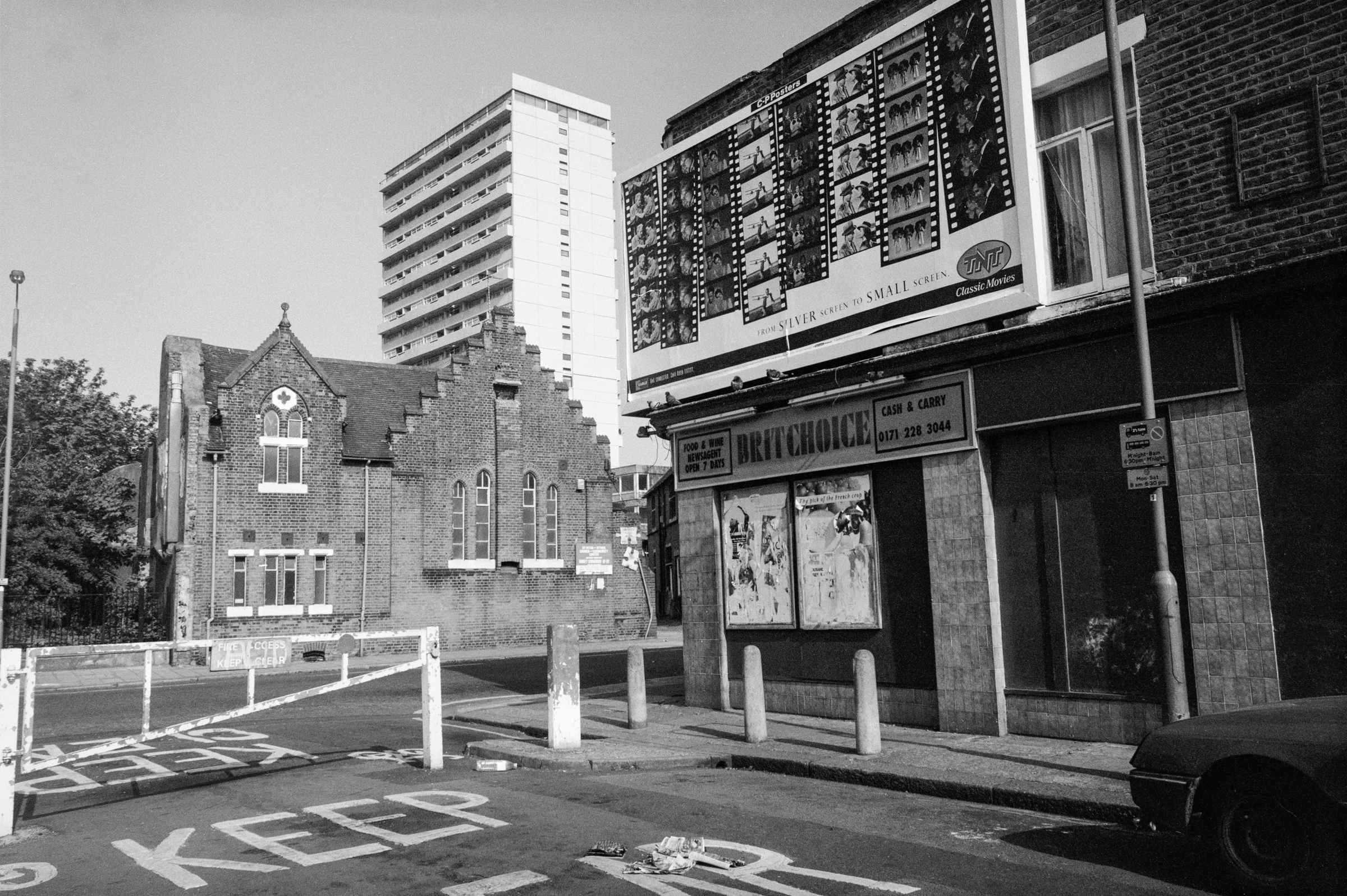
Shop, St Peter & St Paul, Church, Flats, Holgate Ave, Plough Rd, Battersea, Wandsworth, 1989

The view of the church from Holgate Avenue shows clearly the position of the church on the edge of the Winstanley Estate to the north of Clapham Junction station. The view of the tower block Sporle Court is now blocked by the new 10 storey block on the church site. The trees at left are in York Gardens.

There is still a billboard and a shop on the corner of Holgate Avenue, but what was then BRITCHOICE is now SUNRISER EXPRESS POLSKI SKLEP. Holgate Avenue was until 1931 known as Brittania Place or Brittania Street and took its name from the Brittania beer house which was possibly in this shop, part of a group of two buildings at 38-40 Plough Lane which are the only remnants of the original 1860s development of the area.

Apparently the Revd Chad Varah, the founder of The Samaritans, was vicar at Saint Peter’s during the 1950’s. St Peter’s was amalgamated with St Paul’s at some time after 1969 – and St Paul’s had been amalgamated with St John in Usk Road in 1938.

Houses, Holgate Avenue, Battersea, Wandsworth, 1989 89-8c-75

According to the Survey of London, “Holgate Avenue, started in the 1920s, was Battersea’s first
successful slum-clearance scheme
.” Poorly built Victorian houses from the 1860s were replaced by these three-storey tenements built by Battersea’s Labour Council in 1924-37 to high standards with some impressive brickwork and detailing. Probably more importantly for the residents they were provided with electric cooking, heating and lighting facilities, unusual luxury for the time.

There was little land in Battersea for building and while the council would have liked to build single family homes it had to compromise with these. But at least tenants at most had only to walk up three flights of stairs, while most new council building by the LCC in the interwar period was in five-storey tenement walk-up blocks.

Price's Candles, York Rd, Battersea, Wandsworth, 1989 89-8c-62
Price’s Candles, York Rd, Battersea, Wandsworth, 1989 89-8c-62

I walked back up Plough Road to York Road, and continued my walk towards Wandsworth Bridge. There was no access to the River Thames on this stretch before the bridge, as the area was still occupied by industrial premises.

Price’s Candles on York Rd was built on part of the site of York House, the London residence of the Archbishop of York from which York Road got its name. You can read more than you will ever want to know about York House in All about Battersea, by Henry S Simmonds published in 1882 and now on Project Gutenberg, which also has a long section on the Belmont Works or Price’s Patent Candle Factory.

Price’s Candles was begun in 1830 by William Wilson and Benjamin Lancaster who had purchased a patent for the separation of coconut fats. They chose the name Price for the business to remain anonymous as candle-making was not at the time a respectable occupation.

They moved to this site in 1847 setting up a large factory and workforce, making candles, soap and other products with stearine wax for the candles and the by products of glycerine and light oils coming cocunuts grown on a plantation they bought in Ceylon. In 1854 they began to import large quantities of crude petroleum from Burma and developed paraffin wax candles. Later they developed processes to work with other industrial wastes, animal fats and fish oils. By 1900 they were the largest candle manufacturer in the world.

The company was taken over by Unilever in 1919, and became owned by other oil companies including BP, who sold part of the site which opened in 1959 as the Battersea Heliport. A few of Price’s buildings remain, though most with added floors, and the rest of the site is mostly new blocks of flats.

York Tavern, pub, 347, York Rd, Battersea, Wandsworth, 1989 89-8c-63

The York Tavern was on the corner of York Road and Usk Road in the late 1850s but was given a makeover later in the century in the typical 1890s Queen Anne style with fake gable facades. I can’t find a date for the closing of this pub but it was clearly very shut when I made this picture. The building was demolished in 2003.

John Watney & Co Ltd, Wandsworth Distillery, York Rd, Battersea, Wandsworth, 1989 89-8c-64

Wandsworth Distillery on York Rd was founded by Richard Bush at Gargoyle Wharf around 1780. By 1874 it was owned by John and Daniel Watney. Gin was produced here, having become popular after heavy taxes were imposed on French brandy, and later particularly in the colonies to counteract the unpleasantly bitter taste of the anti-malarial quinine.

Acquired by Guinness, the distillery was demolished in 1992, and I photographed its occupation as the ‘Pure Genius Eco Village‘ by The Land is Ours in 1996. It was redeveloped as Battersea Reach housing from 2002 on.

More from this walk in another post.


FlickrFacebookMy London DiaryHull PhotosLea ValleyParis
London’s Industrial HeritageLondon Photos

All photographs on this page are copyright © Peter Marshall.
Contact me to buy prints or licence to reproduce.


Some Madness and Houses in Clapham

Some Madness and Houses in Clapham: On the 29th July 1989 my walk began in Clapham and I found this sign on The Pavement. I could make very little of it then and still can’t now.

Notice, The Pavement, Clapham, Lambeth, 1989 89-7n-43

At the top of the painting on the wall is a geometric device surround by a circle with a square inside divided into four quarters and various triangles inside and on its two vertical edges. Four arrows from the circle have a 90 degree left turn and point anticlockwise and to the letters ‘PH.’, ‘MAY’, ‘MARY’ and ‘C.R.’. Underneath I can just make out the scrawled word ‘MADONNA’, though I think think this has been overwritten at the start to read ‘CRAP’ and there are some other letters and numbers including a ‘6’.

Below this, boldly painted in the same script as the words around the device are a series of words or rather letters in which there are some actual words and some plausible inventions. The whole is a mystery though I rather suspect one that many have involved copious amounts of illegal substances. There was some colour in this notice which you can see in the different shades of grey, and a few sections were in red, particularly the only lower case line just above the bottom, ‘dunhillthwaiton’ while the bottom line, ‘HYPOSTASISTA’ was in green.

I think this was a part of the block called The Polygon which was demolished in the early 2000s. But it is difficult to understand street names in this area of Clapham, and this writing on the wall is impossible.

Houses, Rectory Gardens, Clapham, Lambeth, 1989 89-7n-45

I wrote about Rectory Gardens at more length in the post about an earlier visit there in May 1989. Built in the 1870s as philanthropic housing for low paid workers after being damaged in the war they were squatted in the late 1960s and 70s and a unique artistic community grew up there. Lambeth Council bought the area and intended to develop it in 1970, but there was strong local opposition both from residents and others in the local area.

Houses, Rectory Gardens, Clapham, Lambeth, 1989 89-7n-46

The Clapham Society wanted them to be kept as a group and run by a housing association but eventually Lambeth Council evicted the residents and in 2016 sold them off to a developer to build expensive luxury properties in “a triangular mews-style development“.

Porch, 39, Turret Grove, Clapham, Lambeth, 1989 89-7n-32

I walked up Rectory Grove to Turret Grove, developed on the site of the Elzabethan manor house, Clapham Manor, demolished in 1837. Some of the houses in it date from 1844-5 and are in the Rectory Grove Conservation Area which notes their “attractive trellis style porches“.

Doorways, Clapham Common Northside area, Clapham, Lambeth, 1989 89-7n-35

I made my way through the backstreets towards Clapham Common. One of the streets I walked down was Macaulay Road and this has some impressive doorways and I think this pair were probably on this road.

Zachary Macaulay, born in Scotland had emigrated to Jamaica in 1784 when he was 16 and worked as an assistant manager on a sugar plantation, returning to London five years later. In 1790 he visited Sierra Leone, set up as a home for emancipated slaves many of whom had fought for Britain in the American War of Independence, returning in 1792 and becoming its Governor from 1794-9. He became one of the leading members of the Clapham Sect working for the abolition of slavery, able to provide William Wilberforce with first-hand information and statistics.

In 1799 he came back to Clapham with 25 children from Sierra Leone and set up a the School of Africans to train them with skills to support the development of their country when they returned. Unfortunately “one by one they succumbed to the cold“, though in fact what killed most of them was measles and only six survived.

Further down the street was once the site of the Ross Optical Works which made cameras, lenses and projectors which moved here in 1891 and expanded greatly in 1916 when their work was considered essential to the war effort. At its peak the company employed 1200 people. Ross Ensign was said to be the premier optical company in the United Kingdom, but was unable to compete with foreign competition and closed in 1975.

Clapham Common Northside, Clapham, Lambeth, 1989 89-7n-23

I think I probably photographed this house on the corner of Clapham Common Northside and The Chase mainly because it was so different from the rest of the properties, terraces and blocks along there. A large house, but only two storeys and with an attractive upper floor window, but largely hidden behind its rampant bushes and trees in its front garden.

On its side in The Chase are three plaques commemorating street parties for the Queen’s Birthday, a royal wedding and the Golden Jubilee in recent years.

To be continued.


FlickrFacebookMy London DiaryHull PhotosLea ValleyParis
London’s Industrial HeritageLondon Photos

All photographs on this page are copyright © Peter Marshall.
Contact me to buy prints or licence to reproduce.


Rail, Housing, Matrimony & A Warning

Rail, Housing, Matrimony & A Warning: More pictures from my walk which began at Vauxhall on Friday 28th July 1989 with Nine Elms Riverside. The previous post was Marco Polo, Chelsea Bridge, MAN holder & Convent.

Works, Silverthorne Rd, Battersea, Wandsworth, 1989  89-7m-43
Works, Silverthorne Rd, Battersea, Wandsworth, 1989 89-7m-43

These buildings are still there in a side turning from Silverthorne Road now leading to Battersea Studios. Battersea Studios were built in 1970 as a warehouse for BT and in 1994 became the home of the short-lived BBC Arabic Television, closed precipitately on Sunday, April 21, 1996 having angered the Saudi regime (and the UK government) by its accurate and impartial reporting. At extreme left you can see the barrier leading to that site.

The buildings in the picture were part of the Stewarts Lane Goods Depot, a huge area bounded by this and Dickens Street to the south and going east to the railway lines at Portslade Rd. It was first set up by the London, Chatham and Dover Railway in 1860 as Longhedge and used to build and house locomotives for their services from Victoria Station a short distance away north of the river. The original buildings were demolished in 1880/1 and replaced by these as Stewarts Lane which housed steam locomotives until 1963 and then diesels. Much of the building was destroyed by fire in 1967.

The depot remains in use as the Stewarts Lane Traction Maintenance Depot and is used by both DB Cargo UK and Govia Thameslink Railway.

Houses, 133-139, Heath Rd, Clapham, Lambeth, 1989 89-7m-44

Further down Silverthorne Road to its west is Heath Road, the north side of which retains its attractive Victorian housing, with a block of four houses with basements and steps to their paired entrances followed by five without basements but with the same style and decoration. At the end at left of picture is the recently build Kingdom Hall of Jehovah’s Witnesses.

Heath Terrace, Silverthorne Rd, 514 Wandsworth Rd, Clapham, Lambeth, 1989 89-7m-46

Heath Terrace is on the corner of Silverthorne Road and Wandsworth Road and as well as this corner entrance has two similar but slightly less ornate doorways on Wandsworth Road leading to sixteen Flats A to P as well as another door for a shop on Silverthorne Road part visible in my picture then occupied by taxi and transport company Guy Payne Of London Limited.

The building was built in 1897 and the corner door, in use when I made my picture in 1989 by Dr A J K Ala, still led to a surgery until around 2012. At the front of the traffic queue is a man on a moped with a large clipboard, studying the ‘knowledge’ required of taxi drivers.

Matrimony Place, Wandsworth Rd, Clapham, Lambeth, 1989 89-7m-32

Matrimony Place is one of my favourite street names, though this place is only an alley with steps leading from Wandsworth Road to St. Paul’s Churchyard. I’d photographed it a few years earlier and made a deliberate detour to see if had changed – it was still much the same.

Possibly it was once the custom for local couples to walk up the 29 steps to the church to be married – or down them after the ceremony, and the name appears to of some antiquity. The railings have since been replaced by a fake antique design (probably thanks to the Clapham Society) which I find rather less attractive. It’s probably still a place to avoid after dark unless you a looking for drugs.

St Paul’s, Clapham was built on the site of the original parish church of Clapham, St Mary’s, renamed Trinity Church at the Protestant Reformation, then demolished in 1774 to be replace by Holy Trinity on Clapham Common. St Paul’s was built simply in 1815, became a rather odd lump after later extension by Sir Arthur Blomfield in 1875, was burnt down in World War 2 and restored in 1955 and is Grade II* listed.

Houses, Victoria Rise, Clapham, Lambeth, 1989 89-7m-34

I didn’t go up Matrimony Place but instead turned back westwards down Wandsworth Road, hardly stopping until I came to the top of Victoria Rise which has these rather impressive Victorian Terraces on both sides. Looked at from this end the street should perhaps have been called Victoria Fall as it goes down noticeably to Clapham Common, but you can see why the developers decided against this. In fact they called it Victoria Road, but it was changed later as there were too many of these in London.

The street was laid out around 1853 its lower end on the site of an C18 villa built for the banker Henry Hoare by Henry Flitcroft known as The Wilderness. These houses on the east side were there by the time of the 1869/70 OS survey, though those on the west side are a little later.

Doorway, 144, Victoria Rise, Clapham, Lambeth, 1989 89-7m-35

A notice in the window at right states:
YOU ARE WARNED
REPENT AND RECEIVE
THE LORD JESUS AS
YOUR SAVIOUR FOR
LIFE ETERNAL, LEST
YOU DIE SUDDENLY
AND GO TO HELL
WITH THE DEVIL
THE MURDERER.

Victoria Rise, Clapham, Lambeth, 1989 89-7m-36

At left is a window on the corner with Wandsworth Rd with plaster mouldings in a shop demolished in 1998, and at right is Clapham Baptist Church on the opposite corner.

The houses on this side of Victoria rise were built between the 1869/70 survey and the 1893 to 1894 revision. There was also a chapel here, the Victoria Baptist Church, built in 1873 but this was badly damaged by bombs in 1941. it was rebuilt in the 1950s, incorporating some of the Victorian remains on its west end on Wandsworth Road.

My walk continued – more later.


FlickrFacebookMy London DiaryHull PhotosLea ValleyParis
London’s Industrial HeritageLondon Photos

All photographs on this page are copyright © Peter Marshall.
Contact me to buy prints or licence to reproduce.


More From Stockwell & South Lambeth

More From Stockwell & South Lambeth: My apologies that the previous post in this series from my walk on 19th July 1989, Tradescant, Old South Lambeth Rd and Caron, ended with a repeat of three images taken on Fentiman Road from my walk two days earlier.

After taking pictures on Old South Lambeth Road I probably simply walked to Vauxhall Station without taking more pictures. But I have now found a few more pictures I took probably at the start of the walk which began with Stockwell Park, Bus Garage, Tower and Mason, and also some at the end of my walk in Vauxhall.

Houses, 43-49, Lansdowne Gardens, Stockwell, Lambeth, 1989  89-7h-14
Houses, 43-49, Lansdowne Gardens, Stockwell, Lambeth, 1989 89-7h-14

These fine houses were built in the mid-nineteenth century and are Grade II listed. The closer and further houses are semi-detached pairs while 47 in the middle is detached. Behind them is the tower block Edrich House on Lansdowne Way.

House, 93, Priory Grove, Stockwell, Lambeth, 1989 89-7i-62

Priory Grove runs south from Lansdowne Way (formerly Priory Road) and much of it is beside Larkhill Park. This four-storey block, with the name at the top Priory Building is close to its end at Larkhall Lane. In 1989 it had two doors, but now there is only one at the left giving access to the four flats inside. The ground floor has been coated with stucco eliminating the architraves which are a feature of the upper floors.

Larkhall Lane, Stockwell, Lambeth, 1989 89-7i-65

Larkhall Lane has a listed building and several on the local list, but all I chose to photograph were a couple of odd corners, the first perhaps showing something of the state of the property with a fine stone hidden pillar. I think this has now disappeared.

Larkhall Lane, Stockwell, Lambeth, 1989 89-7i-52

66 Larkhall Lane is now much improved rendering, a tidy garden and the anachronistic shutter removed. The tree has also gone and I suspect much of the interior has also been remodelled. A property listing on the web describes it now as “This is an attractive 2 bed, 1 bath semi-detached house in Lambeth, London. This efficient home is 753 square feet in size with 2 fireplaces and has been extended 3 times since construction before 1900” and estimates its value at £1m-£1.2m.

341-9, Wandsworth Rd, South Lambeth, Lambeth, 1989 89-7i-56

I think I took this rather rapidly through a gap in the traffic which perhaps accounts for its rather odd tilt. At left is a rather odd Gothic Grade II listed building trying to be a castle, with shops on the ground floor and an octagonal tower at each end. The building dates from the mid-19th century but the shops reaching out to the main road were added probably around 40 years later over what was originally a front garden and have since been much altered.

Tucked away in the centre of the picture is a slim building with some interesting polychromatic brickwork at No 345, small and rather unusual Victorian infill.

Wilbraham House,  Wandsworth Road, Nine Elms, Lambeth, 1989  89-7i-41
Wilbraham House, Wandsworth Road, Nine Elms, Lambeth, 1989 89-7i-41

Through the imposing three story vehicle entrance of Wilbraham House we can see Fosbrooke House behind. This long block of flats occupies most of the block between Thorncroft St and Wilcox Road. One web site helpfully tells me it was built between 1930 and 1949 and my guess would have been it was at the end of that period. Four impressive sets of steps on the frontage lead to the 36 flats, with glass bricks providing natural lighting for the stairs. Nine Elms underground station opened in 2021 is just a few yards up the road.

The Elephant And Castle, pub, South Lambeth Place, Vauxhall, Lambeth, 1989 89-7k-11

You get a good view of these elephants from trains going through Vauxhall Station on the Windsor and Reading lines I normally go to Waterloo on. This picture is taken from immediately outside Vauxhall Station entrance. The pub building is still there but closed in 1997 and is now a Starbucks, but its upper floors look much the same. The local list dates it as mid-late 19th century, but the building replaced an earlier one on the site.

The name Elephant And Castle thought to have been first used for pubs around 1770 in nearby Southwark probably derives from the coat of arms of the Cutler’s Company who adopted it in 1622. They used ivory to make knife handles. Though if so it may have been used first for a pub in the City for which we have no record.

I’ll post the other pictures I’ve found from the end of the walk in Vauxhall later.