The Pymmes Brook is a stream in north London which runs from Barnet and joins the River Lea at Tottenham. It got its name from William Pymme who was given land in Edmonton by Edward II in the fourteenth century.
Although it begins from underground springs at Monken Hadley Common in the London Borough of Barnet, these supply relatively little of the water which reaches the River Lea, particularly when the river is in flood, augmented by water runoff from streets and sewage overflows along with the more normal industrial effluent. Because it used often to flood in its lower course, much is now in deep concrete channels, and in some places is culverted.
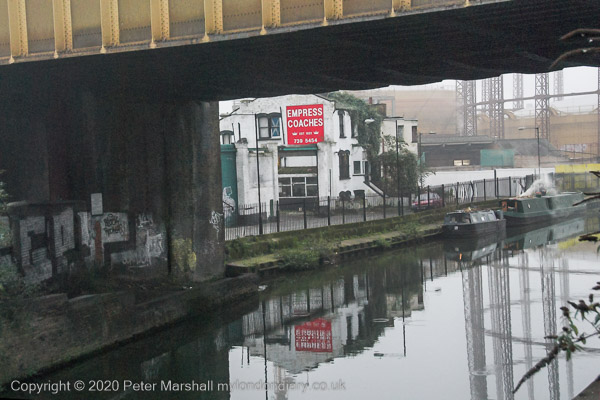
I’m no longer sure exactly where I took most of these pictures of the Pymmes Brook, but I think they were just a little after it flowed under the North Circular. I think some may actually be of the Salmons Brook which runs down from Enfield and joins it in Upper Edmonton. This gets its name not from the fish – which were probably once found in it before the area became urban and industrial – but from the 13th century landowner John Salemon.
The river runs more or less parallel to the Lea Navigation just a few yards away across Tottenham Marshes and only finally flows into the Lea close to Ferry Lane in Tottenham Hale.
My pictures of the Lea continue south from Chalk Bridge and past Tottenham Marshes.
On the east side are the large Banbury and Lockwood reservoirs, part of a series up the Lea Valley providing water for much of east London.
This is one of the most picturesque sections of the River Lea, certainly in its lower reaches. I could almost imagine Izaak Walton walking along here in conversation (as Piscator) with his friends Venator and Auceps on May Day holding the discussion of the relative merits of fishing, hunting and fowling as recorded in his ‘The Compleat Angler‘.
All photographs on this and my other sites, unless otherwise stated, are taken by and copyright of Peter Marshall, and are available for reproduction or can be bought as prints.
I’m writing this a couple of days before Christmas, as I hope not to be spending much time on my computer on Christmas Day, and certainly not working on it, though of course it won’t be Christmas as usual.
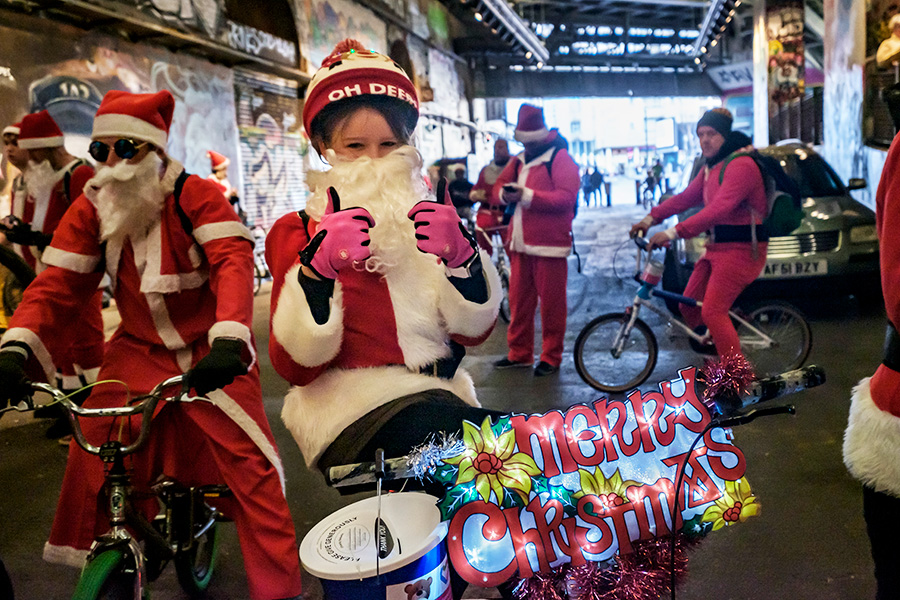
Here is the picture from the Christmas Card picture that I’ve already sent to some of my photographer friends (other people get more normal cards from Traidcraft as they might not appreciate some of the things I’ve chosen some years.)
I had to use a picture from December 2019 as I’d not been out to take any suitable images this year.
I hope you’ll all have a good day; at least I think mine will be a little more relaxed than usual though of course I’ll miss seeing family members; doubtless some will appear on Skype. But it isn’t the same.
I’ll still drink a glass or two of a decent wine and still decline the Chrismas pudding in favour of some ice cream, perhaps with some homemade bamble sorbet. If the weather is fine the two of us here will perhaps go for a walk after our Christmas dinner. We certainly won’t watch that speech, in line with my Christmas tradition of avoiding it for at least 60 years.
And perhaps we will look at some photographs or watch a film. And try hard to avoid the tedious jollity of Christmas radio (and TV) programming. It won’t be a bad day here even if there is much we will miss. One thing I’ll be glad to miss this year is the travelling, not on Christmas Day itself but usually on the days before or around the New Year, long journeys in over-crowded trains.
So my best wishes for today to you all. And let’s just hope that things will soon be better.
Some time last Saturday (19th December 2020) the total number of views of my photographs on Flickr passed the two million mark. Of course I have rather a lot of pictures on show, precisely 11,236 at the moment, so that’s only an average of around 178 views per picture if my arithmetic is correct.
Most of those 2 million views have been this year. Until the start of December 2019 I only had a free Flickr account which I had been required to set up to join a web forum, with a total of about 100 pictures on it. I set up a paid account and began uploading pictures seriously on December 3rd 2019, wanting to find a better way to share pictures with a wider public than my various web sites.
I looked at several alternatives, including Instagram before deciding to go with Flickr. I think Instagram would probably have provided greater visibility for my work, but I couldn’t find an easy way to upload large numbers of images. Flickr certainly isn’t perfect, and in particular those 2m views have largely been by other Flickr users rather than a more general public. But if you are thinking of using Flickr for showing pictures taken on film you may find my workflow described below useful.
It’s still taken considerable time to put over 10,000 images onto Flickr, but most of that time is in the digitisation of the negatives – now mainly using a Nikon D810 and a 60mm macro lens with the Nikon ES-2 adaptor which is far quicker than scanning – and their preparation.
Currently I import the photographs of the negatives into Lightroom, where I roughly crop off the borders and rotate them as necessary, rename them to my negative file numbers and use Negative Lab Pro to batch invert them to positives. I don’t really need NLP for black and white negatives, but it’s convenient and does a good job needing very little user intervention.
From LR I then export the original files to Photoshop for accurate rotation and cropping, and of course dust removal. Generally I’m finding that images digitised using the camera require less retouching than scanned images and except for some old negatives that are badly damaged this seldom takes more than a minute; using a cheap XP-PEN stylus and tablet makes this far easier and faster than a mouse. A Photoshop action does a little edge-burning to correct slight light fall-off at the edges, and to convert black and white images from 64bit colour to 16bit grey and I make any necessary slight adjustments to black and white points, curves etc before saving back as 16bit Tiff files to LR. These then become my master images and I remove the RAW files from LR, keeping them as a backup.
It’s taken me almost a year to work out the best way to add the Titles, Description and Tags for Flikr is to do this in LR – and you then have them available for other uses. The answer is of course metadata.
The keywords you put into LR are picked up by Flickr as ‘Tags’;
The IPTC Headline becomes the image title on Flickr (if the IPTC field is blank this defaults to the filename);
The IPTC Description becomes the Description on Flickr.
Some of my descriptions are several hundred words, but so far I’ve not come across any limits on either IPTC or Flickr. It’s better to enter the data in LR, partly because it is a little easier to do, but mainly because you have a copy safely on your computer. The Flickr web uploader does occasionally freeze or crash and lose data which can be very annoying if you have spent several hours on getting a large batch ready. The only things I need to do in the uploader is to drag in the files, select them all and chose an album for them to go in. I also usually drag the files around into the order I want them to appear in the album (or rather its reverse as Flickr seems to do things back to front.)
Entering the data in LR also has the advantage that I have it with the pictures on my computer for when Flickr’s life comes to an end or changes in such a way that I no longer wish to use it.
All photographs on this and my other sites, unless otherwise stated, are taken by and copyright of Peter Marshall, and are available for reproduction or can be bought as prints.
Fortunately I am not a member of the Labour Party, so can speak freely about Israel and Palestine without fear of being expelled from the party. I’ve never actually been a member, though in my teenage years used to occasionally attend the meetings for young socialists at the local Cooperative hall, mainly I think because they would offer cigarettes around very freely. As a fresher I joined the Labour Students and attended meetings until they were closed down by the national party for being socialist. But by then I was involved with various other groups campaigning on various political issues but outside the party system. That remains the case and I’m still a member of groups including Friends of the Earth, CND and Global Justice Now.
The only political party I’ve ever actually joined was the Green Party, though I think back then it may still have been called the Ecology Party. After a year I didn’t renew my membership, partly because it seemed to be spending most of its time on internal feuding, but also because of the strange cranks it seemed to attract. Of course it also includes some of the most honest and sensible politicians around but our crazy electoral system means few of them getting elected. But most years Caroline Lucas would get my vote as politician of the year, and a few have made it as local politicians and also MEPs. Though sadly the latter opportunity is about to end.
Back in my student years and later, virtually everyone on the left including myself admired and supported Israel. It wasn’t just the Holocaust, but also their fight to free themselves from the British mandate and their determination to build a future. I think we remained largely ignorant about the 1948 ‘Nakba’ when around half of the Palestinians fled or were expelled from their homes. Several of my friends went to volunteer in kibbutz and we envied them and thought seriously about doing the same to help build a socialist future.
Over the years we’ve learnt more about what actually happens in Israel and Palestine, and the government of Israel has become very much more right wing. While almost none deny the right of Israel to exist (and to that extent are Zionists), we all want a fair solution in the area which recognises the civil and human rights of Palestinians. The Balfour declaration as well as favouring the establishment of a national home for the Jewish people also insisted “it being clearly understood that nothing shall be done which may prejudice the civil and religious rights of existing non-Jewish communities in Palestine” and in 2017 the British government recognised the declaration should also have called for protection of the Palestinian Arabs’ political rights.
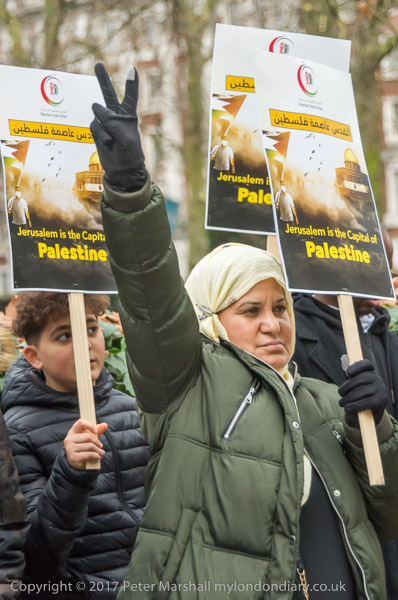
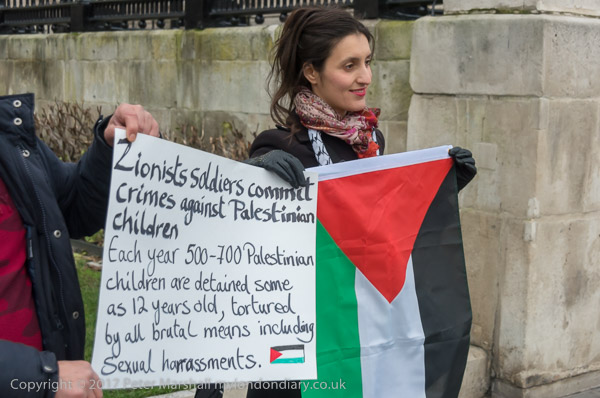
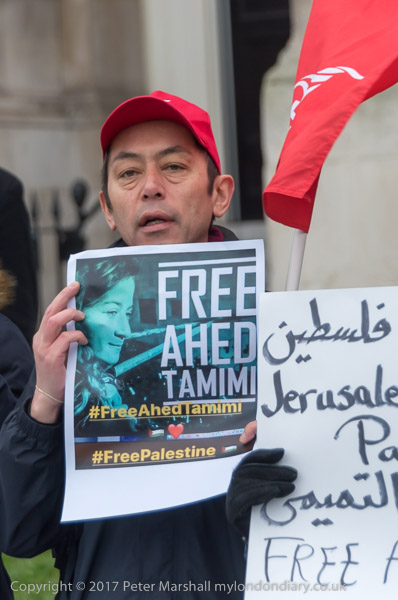
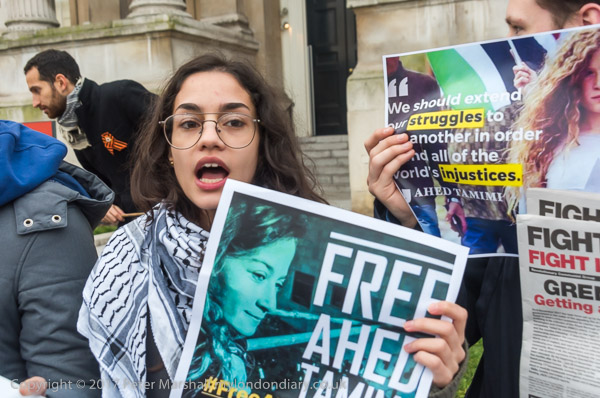
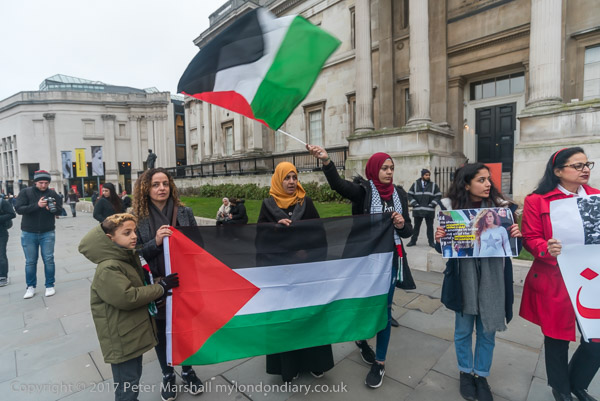
I’ve been labelled by a few militant ultra-right anti-Palestinians as an “anti-Semitic photographer” because I have photographed protests against human rights abuses by Israeli government forces – like these I photographed on 23rd December 2017 – and against laws that make people – including notably Nelson Mandela – describe Israel as an “apartheid state”. And also for photographing protests calling for support for the BDS movement, which calls for boycotts, divestment and sanctions “to end international support for Israel’s oppression of Palestinians and pressure Israel to comply with international law.” None of these things are anti-Semitic, though they are opposed to policies of the current government of Israel.
I’m fairly certain however that were I a member of the Labour Party I would now be suspended and expelled for my views – along with many of the leading Jewish (and non-Jewish) Labour activists who express any support for human and civil rights for Palestinians. But fortunately you can’t be expelled if you are not a member.
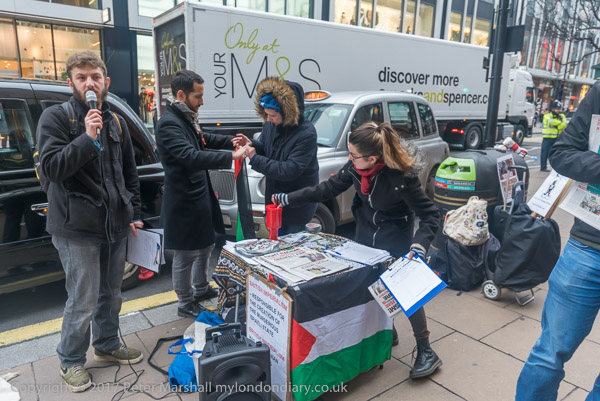
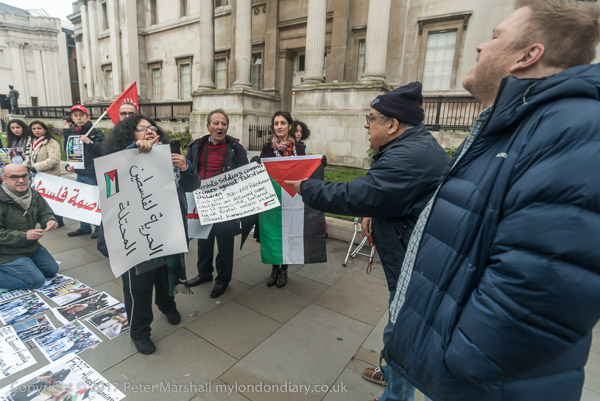
The protests on this date were prompted by two events. The Palestinian Forum in Britain protested outside the US Embassy after US President Trump’s announcement that the US Embassy in Israel will move to Jerusalem, there was a regular protest calling for a boycott of goods from Israel outside Marks and Spencers on Oxford St and a protest in Trafalgar Square condemned the kidnap, beating up and arrest of 16-year-old Ahed Tamimi by Israeli soldiers – which was also condemned at the two earlier protests.
A few militant supporters of the Israeli oppression of Palestinians came to insult and shout down the event in Trafalgar Square, with one man making clearly racist comments about one of the protesters. A police officer eventually arrived and suggested firmly they go away, but took no action over the complaints of racist abuse made against one of them. The man in a hat in my picture above was found guilty of disorderly behaviour likely to cause harassment, alarm or distress for similar behaviour at a BDS protest the following year.
All photographs on this and my other sites, unless otherwise stated, are taken by and copyright of Peter Marshall, and are available for reproduction or can be bought as prints.
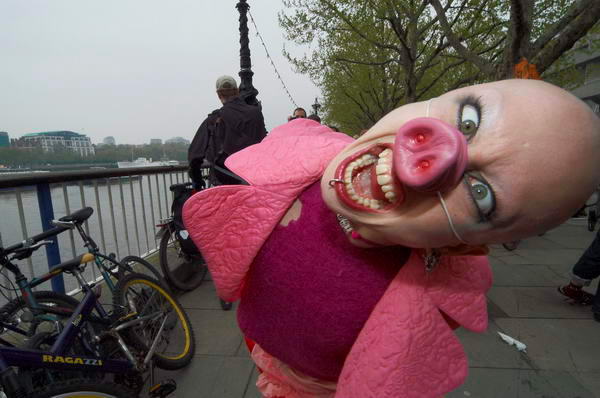
Cyclists protest. Critical Mass 10th anniversary, South Bank, London, April 2004.
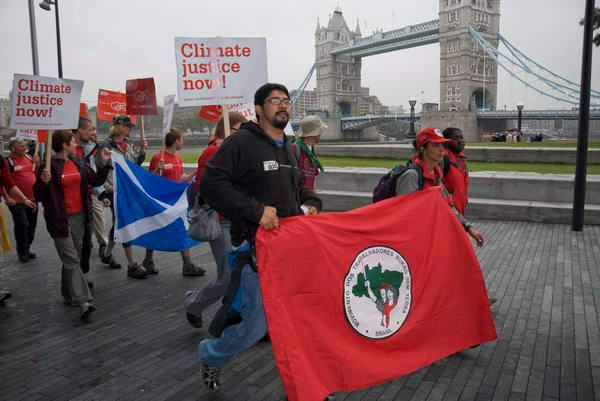
Thirteen years ago in 2007 I was not in London but in Brasilia, where I had gone for the opening of my show on environmental protests in London, part of Foto Arte 2007, a huge photography event that stretches on for 3 months with over 20 international shows and more than a hundred individual and group shows from Brazil, apparently in 57 locations across the city. The theme of the festival was ‘Natureza, Meio Ambiente e Sustentabilidade‘ or in English, ‘Nature, The Environment and Sustainability’ and my contribution representing the UK was a set of 24 colour pictures of environmental protests in London – including a picture of Brazilians leading the last mile of a 1000 mile Christian Aid ‘Cut the Carbon’ march past Tower Bridge.
My work was in show in a local community centre in one of the ‘Quadra’ which make up the living quarters of the city around its central core. My show was backed by the British Embassy and they had also arranged for me to give a lecture – and provided simultaneous translation for my Portuguese speaking audience.
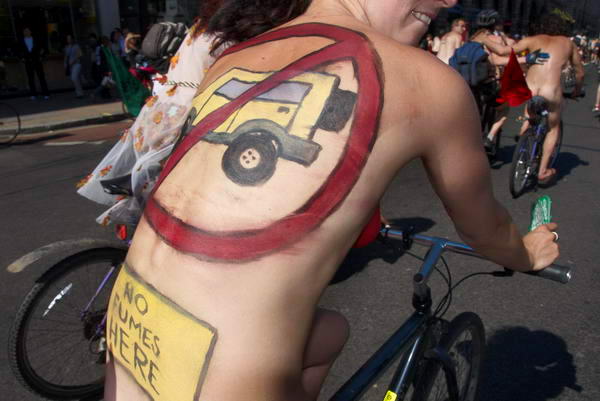
‘No Fumes Here’. World Naked Bike Ride, London, June 2006.
Because I was very aware of the planned nature of Brasilia, a new capital city built from scratch, which I described as “really the ultimate flowering of the modern movement in architecture and planning, planned by Lúcio Costa (1902-98) and with many buildings by the famous architect Oscar Niemeyer, 100 on December 15, 2007 and still working” I had decided my talk would be about my own photographs around London and more generally about “the photography of the urban environment and some of the changing ideas in planning, and how the invention of the car had completely altered our cities. Ideas about Garden Cities at the end of the nineteenth century had been overtaken by urban sprawl.”
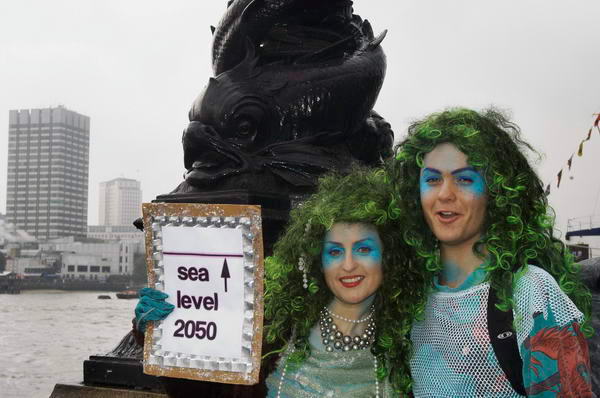
‘London Underwater 2050 Tour of the G8 Climate Criminals’, European Social Forum, London, October 2004.
During my stay I also got to see all the other shows then taking place, and also was treated to several of the finest restaurants in the city (including a lunch with the Ambassador and the director of the festival) and was taken around the various sites of the city – including the many Niemeyer buildings by a daughter of one of Costa’s team of planners. It was an exciting few days, though very stressful at times.
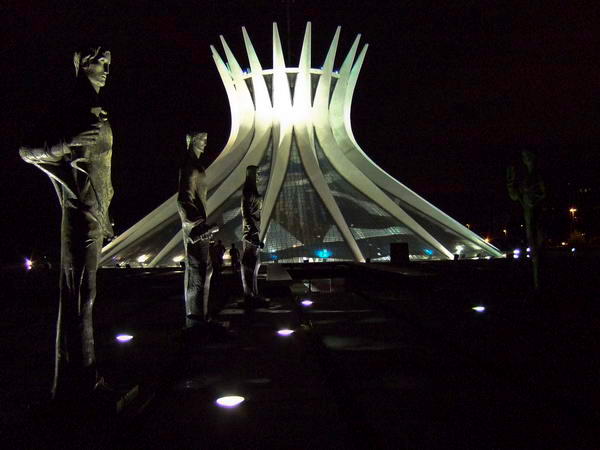
One of Niemeyer’s most famous buildings, the cathedral in Brasilia – Fuji FinePix F31fd
I’d known I would have a busy time with little chance for any serious photography and had taken with me just a small pocketable digital camera, a 6Mp Fuji FinePix F31fd, and used it as a notebook during my stay. A few of the almost a thousand pictures I took are on My London Diary, but there are many more which I now find of some interest, and perhaps I’ll upload more onto Flikr shortly.
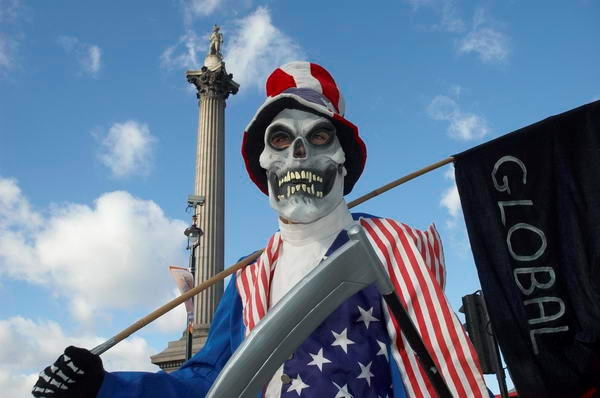
Uncle Sam’ as the Grim Reaper in Trafalgar Square, Kyoto Climate March, London, February 2005
I wrote quite a few posts about the visit here on >Re:PHOTO, including brief review of some of the other exhibitions in Foto Arte 2007, starting with one just before I caught the plane, Foto Arte 2007 Brasilia with my full set of 24 pictures and continuing after I arrived home and into January 2008.
All photographs on this and my other sites, unless otherwise stated, are taken by and copyright of Peter Marshall, and are available for reproduction or can be bought as prints.
Today, 21 December 2020 is the Winter Solstice, when in London we have only 7 hours 49 minutes and 41 seconds (or 42 seconds) between sunrise at 8.03 am and sunset at 15.53 pm. It’s a depressing time of year for photographers who work outdoors, though we have now passed the earliest sunset which was on 12 December at 15.51pm. Sunrise continues to get later until almost the end of the month, but at 8.06am I’m usually still eating my breakfast rather than wanting to take pictures.
I had forgotten when I began this piece what it was that dragged me away from the fireside and out to take pictures on 21st December 2006, but I had been working on a set of pictures for the book by Cathy Ross, ‘The Romance of Bethnal Green‘. As my text below makes clear, although most of my pictures which feature in it (and I get a credit on the cover and title page) are from the 1980s and 90s, I think she had wanted a picture of the frieze on the Bethnal Green Museum (a double page black and white spread on p36-7) and I had gone up to take this, but I also took a short walk around the area and made a few more pictures.
You can see some of these in My London Diary, beginning towards the bottom of the page for December 2006 under the title Bethnal Green Solstice. In the colum to the left is the following text:
thursday was a cold dark day, the mercury hanging on zero and grey in the air, a fog which never quite cleared. i needed just one more picture for the project on bethnal green and emerged from the underground half an bour before the shortest day of the year officially turned to night. having done what i had to do, i kept walking as it got darker still, and more lights came on.
My London Diary then was a rather more tentative and arty production , even less polished than in later years, and I then eschewed capitalisation, writing in a rather less formal style.
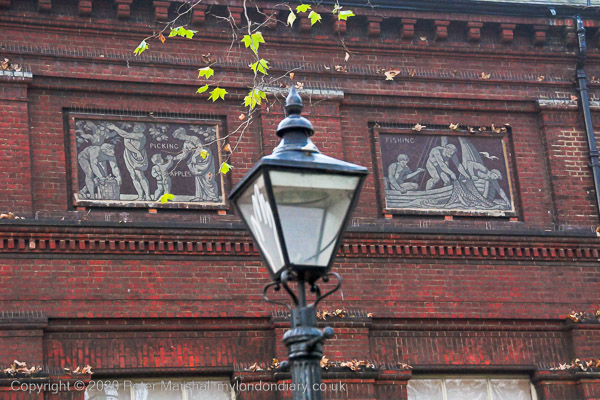
There are 13 panels along the side of the museum facing the park, each depicting a rural pasttime, and I photographed thoroughly in the dying light in various combinations and some singly. I was working by then with a Nikon D200, with a much improved viewfinder over the D100 I’d started with and which gave 10Mp files. Later when I got home I chose the image above – with ‘Picking Apples’ and ‘Fishing’ – and converted it to black and white for publication, cropping it slightly at the right to fit the double page.
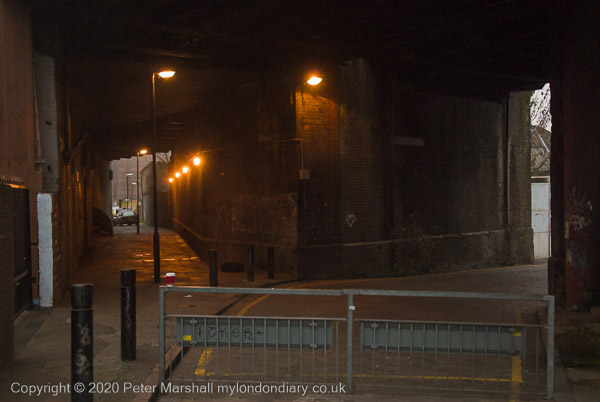
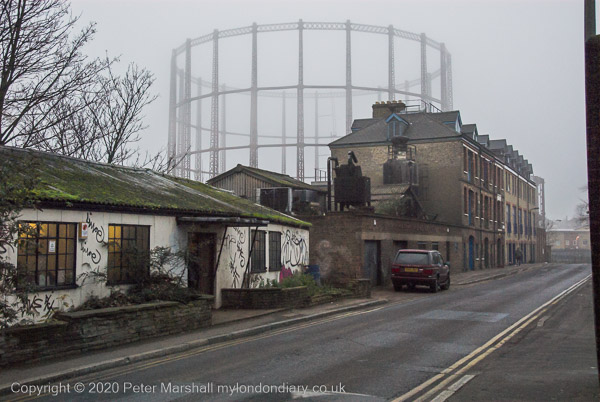
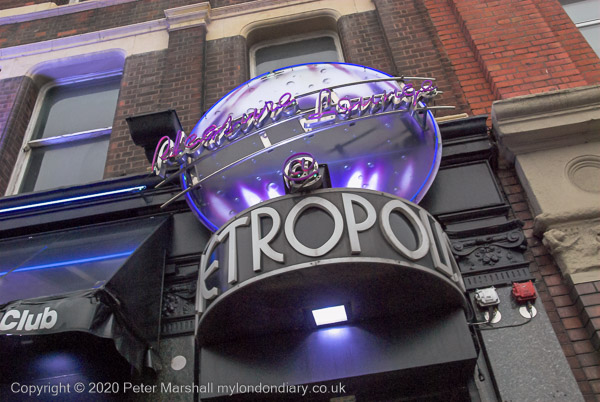
Having taken the necessary image, I walked north up Cambridge Heath Road to the canal, taking a few pictures as I went and on my way back, including a couple more of the museum. The light had been dim when I was photographing the frieze, but it was now definitely dark, with most of the lighting coming from the street lights. I was soon back on the train having spent around an hour on the streets taking pictures.
These pictures were all made at ISO 800, though on at least one the shutter speed was only 1/13s. Even at this relatively low speed some have a high degree of noise. They may have been underexposed but I think that comparing them to pictures taken with the D750 or D810 shows the great advance in sensor quality over the past decade or so. And I suspect re-editing the files in Lightroom now would show the improvements made in software too. The noise isn’t (at least to me) objectionable, any more than the grain in a black and white film image would be, but it is noticeable.
All photographs on this and my other sites, unless otherwise stated, are taken by and copyright of Peter Marshall, and are available for reproduction or can be bought as prints.
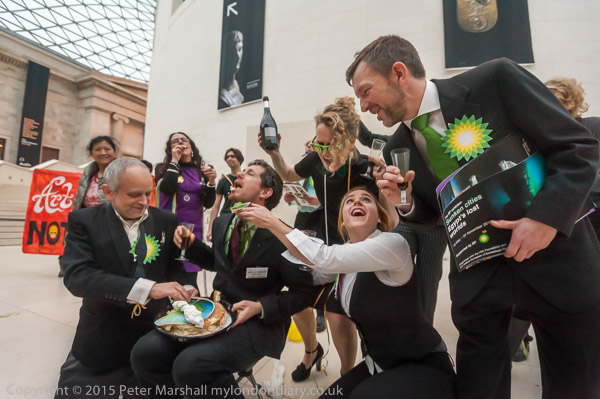
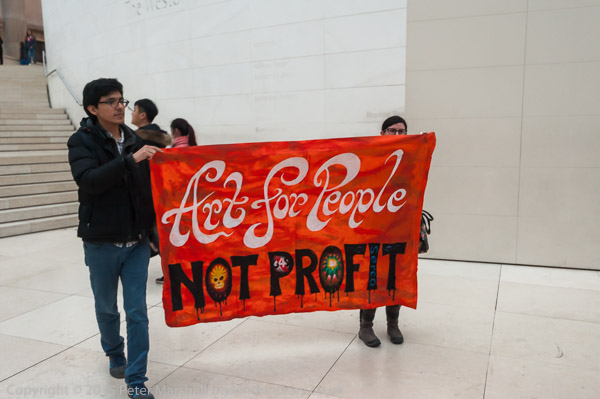
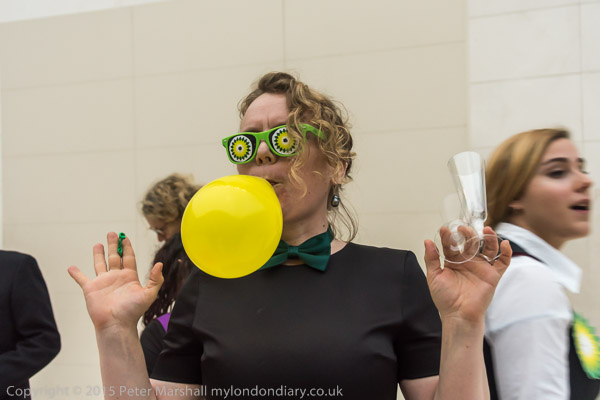
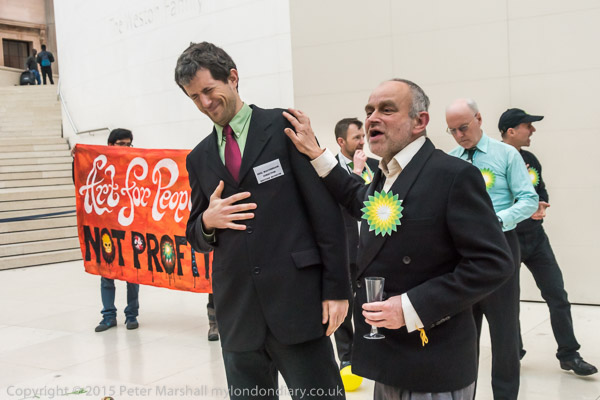
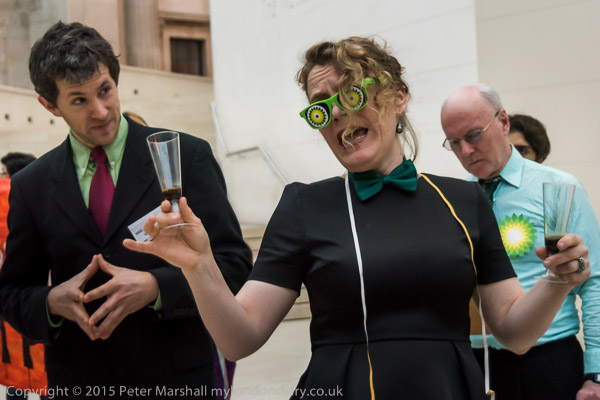
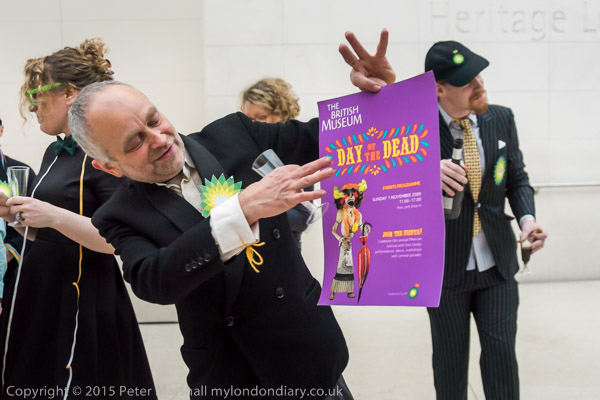
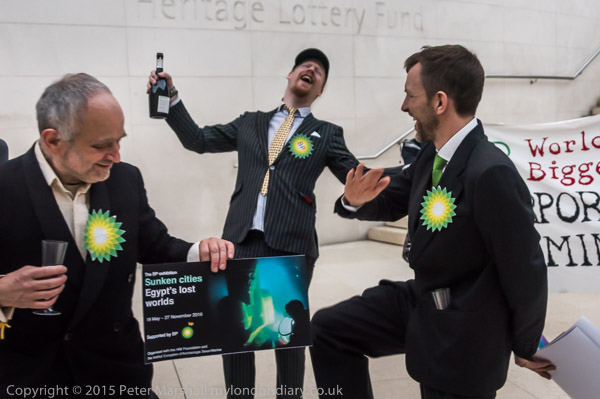
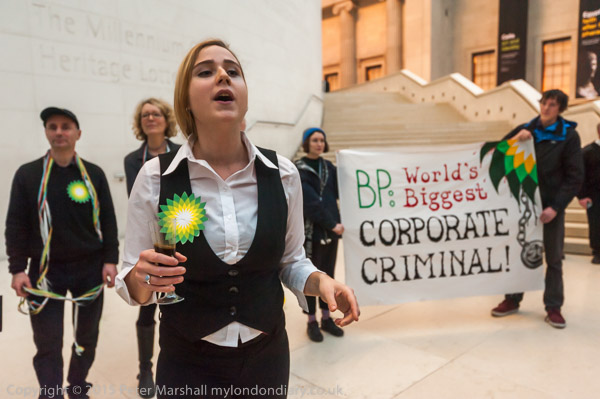
Five years ago today on 20th December 2015 I went into the British Museum with “actor-vists” from ‘BP or not BP‘ to photograph their ‘A Farewell to Neil MacGregor – Director of the British Museum‘ who had enjoyed a “cosy relationship” with the museum’s sponsor, BP.
Fossil-fuel companies make their profits largely through the combustion of the hydrocarbons they produce in the engines of cars, lorries and aeroplanes and the boilers used to generate electricity and heat buildings and other processes which turn the carbon in these fuels into the greenhouse gas carbon dioxide, the main cause of the global warming which is currently threatening the future of human life.
As well as that, the prospecting and exploitation of oil resources, now more and more taking place in environmentally fragile areas such as the Arctic, together with spillages, some inevitable but others demonstrating a remarkable lack of care are causing terrible damage to our environment. And of course most of what doesn’t get burned is made into plastics and we are now becoming aware of the huge amounts of this that ends up in the marine environment with disastrous consequences.
While continuing to fuel the global crisis, companies such as BP have invested heavily in promoting themselves as good guys, publicising the relatively small investments they have been making in renewable energies and other green areas. It’s a short-sighted policy as their long-term future – and ours – depends on a complete move away from carbon fuels, but one which keeps current investors rich at the cost of the rest of us.
Almost certainly the most cost-effective part of the ‘green-washing’ of BP’s ecologically disastrous activities has been their sponsorship of many of our major cultural institutions including the British Museum, something which the cultural activists of ‘BP or not BP’ have highlighted in a number of artistic interventions. I was pleased to be able to photograph their play depicting ‘BP executives’ giving a farewell party to departing Museum director ‘Neil MacGregor’ inside the British Museum’s Great Court.
Although BP’s contribution is only a fraction of the museum’s budget, they get an engraved message on the wall of the rotunda in the Great Court and their logo prominently on the publicity for the museum’s major exhibitions which have included Vikings, Ming, Indigenous Australia: Enduring Civilisation, the Mexican Day of the Dead and Sunken Cities. As BP or Not BP point out, the last two are particularly unfortunate as BP has been given the largest corporate criminal fine in history of $18.7 billion for the underwater Deepwater Horizon oil spill which caused huge pollution of the ocean around the coast of Mexico.
My write-up on My London Diary gives a fairly full account of what happened with a lot more pictures. Many museum staff are unhappy about taking cash from BP and welcome the publicity protests like this give. The protesters assured the museum security that they would cause no damage and leave without any trouble after the relatively short performance which continued without any interruption and entertained a number of the visitors to the museum.
You can also read a fuller account, with some of my pictures and including the full text of the play on the on the BP or not BP website.
All photographs on this and my other sites, unless otherwise stated, are taken by and copyright of Peter Marshall, and are available for reproduction or can be bought as prints.
Timber made up a very large proportion of the commercial traffic on the Lea Navigation, certainly in the twentieth century. In its earlier years barge traffic on the River Lea and its canalised sections was largely of agricultural products – malt, meal and grain – being carried down to London, with barges being returned empty or carrying coal upstream. Trade was substantial even before the construction of the navigation began following plans by John Smeaton and the 1767 Act of Parliament, and the river carried an estimated 30,000 tons a year coming mainly from around Ware and Stanstead Abbotts.
The flash locks then in use, with gates that were removed to allow barges to pass wasted large quantities of water and tolls were high, and they also meant that loads going upstream were restricted to a third or a quarter of the 35-40 tons of a downstream load. There were many later improvements to the navigation, though most of the current system comes from an 1866 Act of Parliament.
In the twentieth century barges carried loads of 100 tons on the waterway and the main traffic was timber, carried upstream from the Surrey docks to a number of timber wharves, one of the larger of which was the Edmonton Wharf at the Lea Valley Trading Estate, which I think was operated by Hahn & Co Ltd, though I can find no further details.
I made several visits to this large site and took pictures, and returned in later years when it had become a bus depot. Back in 1983 there was another timber yard on the opposite bank of the navigation, which I think was called Dornford Wharf, though the old street plan I used labels this area of the east bank with this name.
In the Flickr album River Lea – Lea Navigation 1981-1992 I’ve captioned these images as being in Dornford Wharf, Towpath Rd, and I’ve also included a few more images which are simply slight variations on those show here – as well as many other images taken along the river.
If these huge trunks had been brought here by the navigation they will have been here some time as commercial traffic ended a couple of years earlier in 1981. There didn’t appear to be any work being carried on in the timber yard when I took these pictures, but they were possibly made on a Sunday.
At the side of the yard close to the towpath I came across an area that had clearly been used fairly recently to cut up some wood on a rather smaller scale but which had produced a prolific amount of sawdust.
Although the Flickr album River Lea – Lea Navigation 1981-1992 only currently contains black and white pictures, I did also make some colour transparencies when I was photographing the Lea Valley. Three of them, including the image above, were my contribution to the show Roof Unit Foundations at [ space ] in Hackney in 2007.
All photographs on this and my other sites, unless otherwise stated, are taken by and copyright of Peter Marshall, and are available for reproduction or can be bought as prints.
I find that I was wrong to suggest in an earlier post that covering seven events on Human Rights Day was a personal record, as on Saturday 17th December 2011 I managed to photograph eight protests.
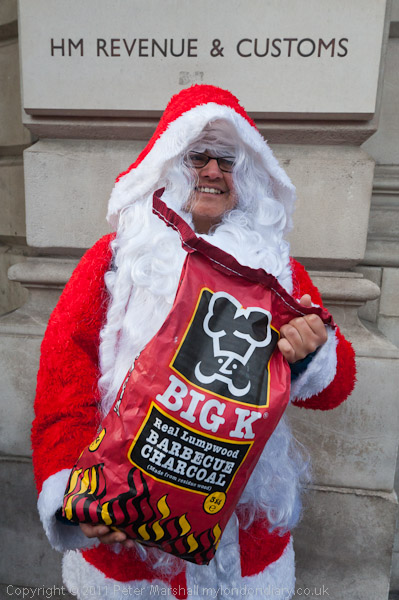
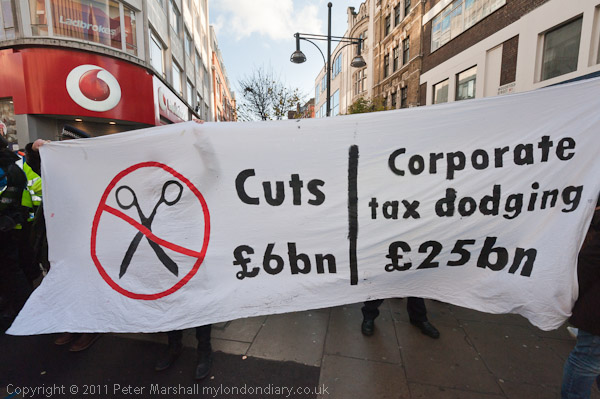
It was a big day for UK Uncut, protesting about the failure of Her Majesty’s Revenue and Customs to get major companies operating in the UK to make proper contributions to our tax revenue. If HMRC had got them to pay up, there would be no need for the massive cuts in public services that were being imposed by the government after the financial crisis. UK Uncut claim that corporate tax doging costs the UK £25 billion a year, four times the amount of the cuts.
Their protest began with UK Uncut’s Santa and two helpers calling at the Westminster offices of the head of UK tax collection with a present, a card and a sack of barbecue charcoal. Dave Hartnett, the man in charge of HMRC had recently let Vodaphone who owed £6 billion pay only around a fifth of what they owed, losing taxpayers £4.75 billion as well as giving an £8 million handout to Goldman Sachs. Mr Hartnett was about to retire with a massive pension despite a series of blunders which cost us a fortune.
As I wrote:
The UK seems to be loophole central for the rich, not just for taxes but also for the kind of fraudulent unregulated creation of imaginary money that has sustained and grown the City since the ‘big bang’ and lies at the epicentre of our current world financial crisis. Doubtless it is too much to hope that Mr Hartnett will be called to account for his relatively small part in this process, but as a taxpayer it pains me to think of him retiring and enjoying an excessive civil service pension for his misdeeds.
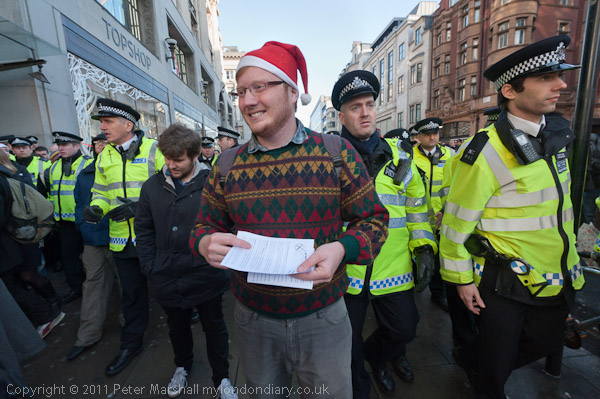
A rather larger group of protesters met on Oxford St to protest outside Topshop against the failure of the Arcadia group to pay UK tax on its UK earnings. Sir Philip Green, who took huge amounts of money out of the group eventually leading this year to its collapse with a vast hole in its pension fund, runs a vast empire that includes Topshop, BHS and Dorothy Perkins, but exploits a loophole in that the business is owned by his Monaco-based wife who does not have to pay income tax.
Police had come out in large numbers to protect Topshop, although the protest was expected to be (and was) entirely peaceful. They obstructed the press who were attempting to report on the event, lying to us that we would be allowed to re-enter the store to cover the protest inside, and then aggressively moved on the protesters claiming with little justification that they were causing an obstruction; as I commented, it was clearly a large block of police that were obstructing the pavement and not the protesters.
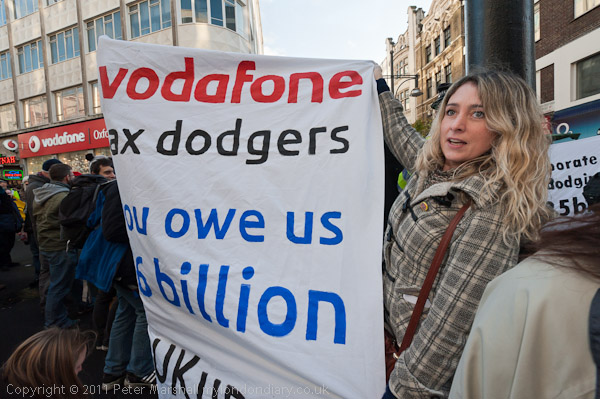
Police behaved rather better when the protest moved on to Vodaphone, making no attempt to stop the protest on the pavement outside the shop, while forming a line to prevent more than a few early arrivals to get inside the shop.
The protesters made effective use of a ‘Human Microphone’ to shout out in unison a series of short statements about the reason for the protest; they stated that when they first protested about Vodaphone they were told the £6 billion of tax dodged was “an urban myth”, but they had now been told it may have been £8 billion. The protest continued with them singing a number of Christmas carols specially adapted for the event, including:
Away in a mansion
On my four poster bed
You lie outside freezing
While I'm resting my head

The stars in the bright sky
They sparkle like jewels
The ones that I paid for
By robbing you fools
and as I left had begun dancing on the pavement.
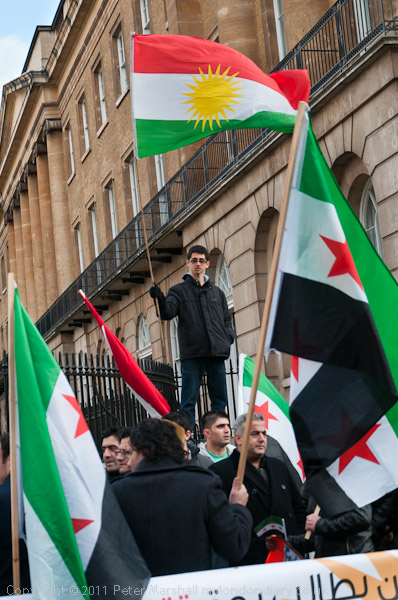
I left for Downing St, where Syrian Kurds were calling for an end to the massacres being carried out in Syria by the Assad regime forces – and on that day alone at least 32 civilians including two children were killed.
Kurds form almost a fifth of the Syrian population, and during the continuing civil war in the country have formed an autonomous region in the north of the country which became called Rojava. At the protest they were arguing for Syria after the war to become a federation, with considerable autonomy continuing for regions such as this, though many Kurds also support the formation of a separate nation of Kurdistan, including the Kurdish areas of Iraq and Turkey. Since the end of 2011 the situation has moved on with Turkey invading and occupying some of the Kurdish areas of Syria and the support of Russia for Assad which makes his eventual victory seem inevitable and the future looks even bleaker for the Kurds.
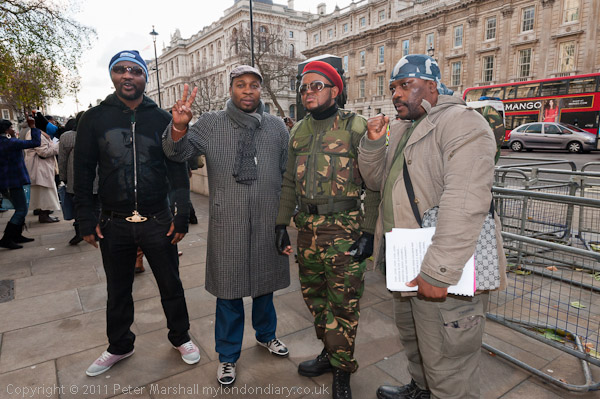
Also protesting opposite Downing St were a group of Congolese, continuing the protests in London against the election fraud, rapes and massacres and calling on the British government to withdraw its support from the immoral regime of President Kabila responsible for the atrocities and voted out by the people.
The continuing problems in the Congo region are the terrible consequence of the western exploitation of the area’s mineral resources such as Coltan – needed for mobile phones, the computers and other electronic devices on which our lives and the media now depend. But those media “have so far taken relatively little interest in the desperate situation of the people in the Congo. They seem to be being sacrificed while the vast natural resources of their country are being largely stolen by underhand deals which enrich a few in their and neighbouring countries while the industrialised world turns an almost totally blind eye to the violence and injustice.”
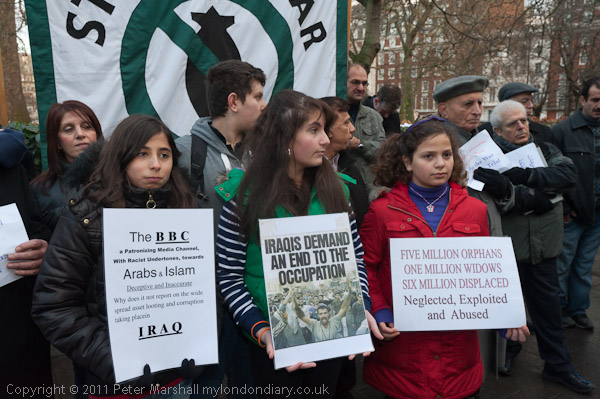
The protest outside the US Embassy celebrated the withdrawal of US troops, but also demanded that mercenaries still in Iraq should also be expelled, and the war criminals prosecuted. Iraqis also want an end to the looting and pillaging of Iraq’s natural resources and an end to government sponsored executions there. They were joined by Syrian supported of the Assad regime want the US to stop their attempts to interfere with events in Syria through UN resolutions and other means.
The BBC came in for criticism from the Iraqis as “a Patronizing Media Channel, With Racist Undertones, towards Arabs & Islam” and being “Deceptive and Inaccurate” and they asked “Why does it not report on the wide spread asset looting and corruption taking place in Iraq?”
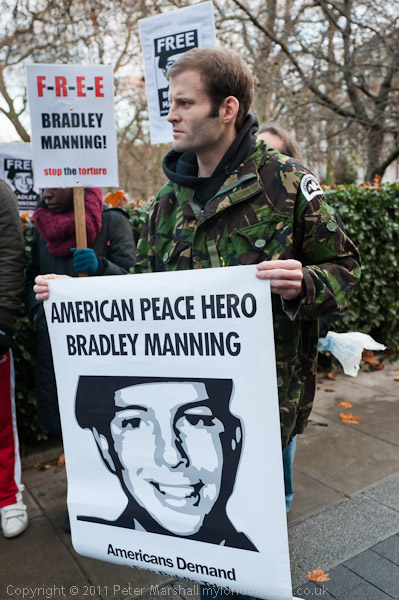
Also outside the US Embassy was a vigil on the 24th birthday of Bradley (now Chelsea) Manning whose pre-trail hearing was taking place. The protesters who included members of Veterans for Peace and Payday Men’s Network called him an American Peace Hero for leaking evidence of US war crimes.
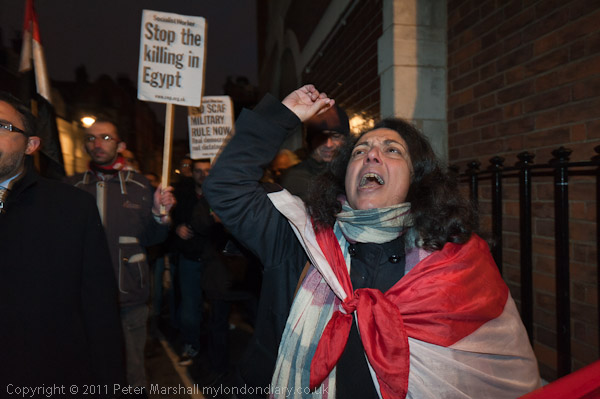
It was beginning to get dark by the time I reached the Egyptian embassy where Egyptians had come to protest after the military attacks on protesters in Cairo, killing at least 10 and injuring more than 500.
It was a protest that was slow to start – and when I arrived on time I found only one person there. I waited, feeling increasingly frustrated as the light was disappearing rather faster than protesters were arriving. Half an hour later around 25 people had come and more were arriving and I took my pictures and left.
All photographs on this and my other sites, unless otherwise stated, are taken by and copyright of Peter Marshall, and are available for reproduction or can be bought as prints.
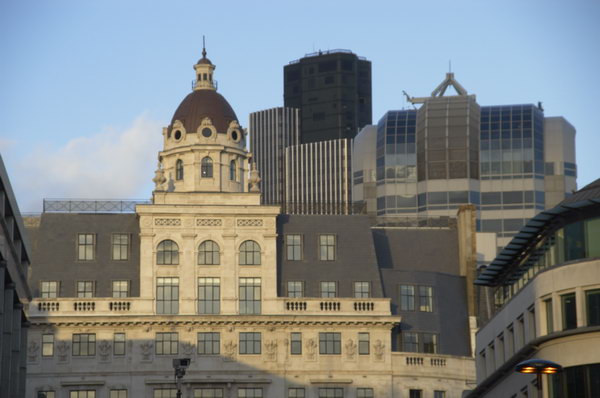
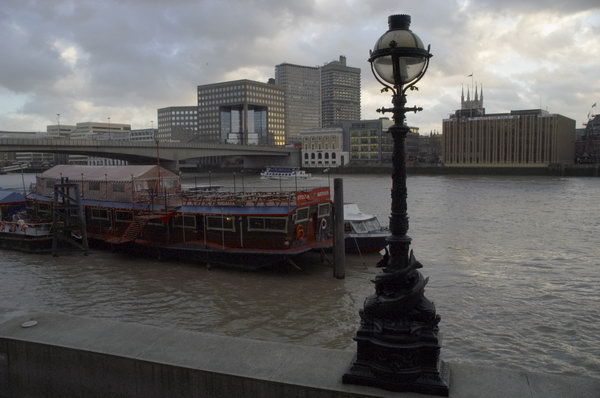
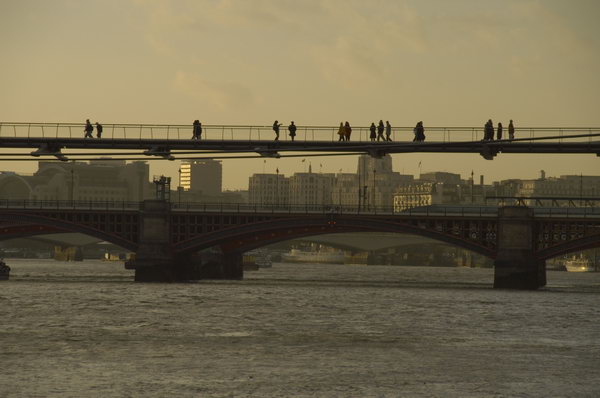
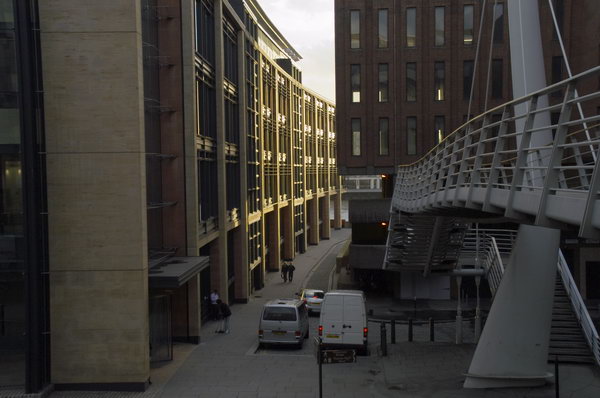
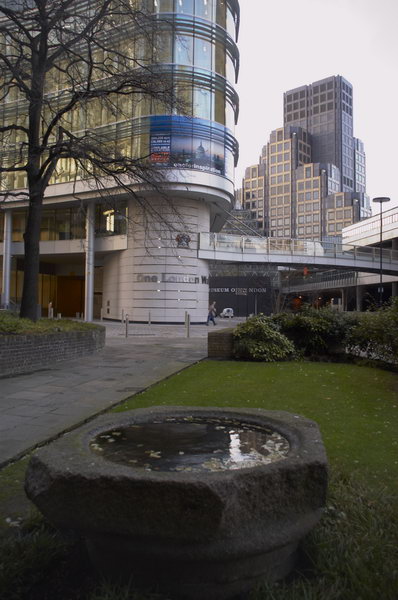
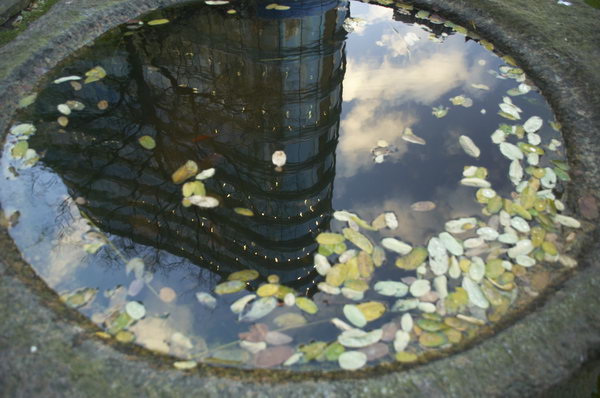
I can’t remember exactly why I went up to London on 16th December 2004, but my pictures taken that day tell me fairly clearly the route that I took, taking me in a rather roundabout fashion from London Bridge to a meeting with someone at the Museum of London.
It was a fine day, and I’d obviously decided to take an early train to give me time to wander and take a few photographs before the meeting, arriving at London Bridge Station over an hour before. I can tell this because I was using a digital camera, my first interchangeable lens digital camera, a Nikon D100 and can read the times the images were made from the Exif data embedded in the files – such as the example below.
1/200s, f/7.1, ISO 400 Mode: P, Meter: Matrix, No Flash, Auto WB Focal: 52mm, 16/12/2004 14:49:27, Adobe RGB (1998) 6.1MP (3,030×2,021) NIKON D100
I only used one lens, the very versatile 18-125mm f3.5-f5.6 Sigma lens, a relatively light and compact zoom that really showed the advantage of the DX system over the later bulkier full-frame lenses. I imagine its test results wouldn’t quite match those of more expensive Nikon glass, but the images seem fine and sharp looking at them now.
Although the D100 was only a 6 Mp camera, this provided images at 3030 x 2021 that were large enough for most repro purposes and gave me excellent prints at 12×8″ and even larger – one picture from it – taken with another Sigma lens – went on exhibition 2.3m wide and paid well.
I think I will have taken these pictures using RAW files, though it would take me a while to locate these on a backup disk, and I only have jpegs and some tiff files to view on my current system. Software for converting from RAW has improved significantly since 2004 and I would almost certainly be able to produce some improvements, in particular reducing the little colour noise present in some. But I think they are fine as they stand.
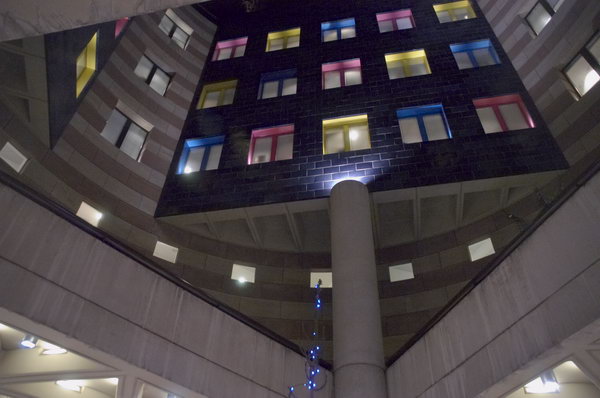
I arrived at the meeting presumably on time but can tell you nothing about it other than it probably lasted for a little over an hour and came out to make my way home a little after 4.30pm, by which time it was dark. I took a picture of Shakespeare’s bust using the D100’s built-in flash – which came out as badly as you would expect, one in the interior of No 1 Poultry you see here, and then stood still for a final picture on the moving walkway taking me down to the ‘drain’ (Waterloo & City line) to Waterloo for the train home.
A few more pictures from the walk and others from December 2004 on My London Diary. It was a month I also visited Mucking (its in Essex) and photographed ‘Fathers For Justice’ protesting in Santa suits and took a couple of walks close to where I live. All have something of a sepia quality – thanks to the raw conversion – which I find quite appealing and perhaps nostalgically appropriate.
All photographs on this and my other sites, unless otherwise stated, are taken by and copyright of Peter Marshall, and are available for reproduction or can be bought as prints.