North St, Rectory Gardens & Rectory Grove

North St, Rectory Gardens & Rectory Grove: Continuing with my walk on Sunday 28th May 1989. The first and previous post about this was Lavender Hill & Wandsworth Rd – 1989 which ended with a picture of the Hibbert Almshouses still on Wandsworth Road in Clapham.

M S Automobiles, 97-9 North St, Clapham, Lambeth, 1989 89-5i-24

From Wandsworth Road I turned down North Street and took this picture just a few yards down the street. This rather elegant group of three of houses at 97-1010 have been altered somewhat since my picture and the entrance to the rear yard of M S Automobiles Ltd now leads to North Street Mews workshops and studios, the the two properties on the street now residential.

The doorway for West One Carriers is now a bay window (and was probably originally built as one) and the flower pots and ventilators have disappeared. 99 now has a small plain painted brick wall joining to the post at the right of my picture.

Unfortunately I can’t make out the sign at the left of the door to 99, though it looks rather like a pigeon. Scooter geeks would doubtless be able to tell me more about that parked underneath.

Doorway, 28 North St, Rozel Rd, Clapham, Lambeth, 1989 89-5i-11

A small terrace two storey houses with shopfronts on North Street has its north end on Rozel Road, and just behind the shop front – here with a metal shutter at right – is this doorway which is now to 28a North Street which has been considerably extended to the rear.

There were some similar decorations above the doors of most of the houses on Rozel Road, and some with similar brickwork which I imagine were all built around the same time in the late nineteenth century, probably in the 1880s. I’m not sure what the mirrored objects in the relief are meant to represent, possibly a coornucopia or horn of plenty. But for many the bubblegum machine at right of the door will have been of more interest.

NECO, Electric Motors, North St, Clapham, Lambeth, 1989 89-5i-13

Normand Electrical Company were manufacturers and suppliers of ‘NECO’ electric motors and gearboxes here in Clapham from around 1938. The company was bought by P C Henderson in 1982, and later they sold it to FKI Electricals. The NECO brand is still used. The factory was demolished and replaced by gated housing, Floris Place, its entrance in Fitzwilliam Road.

Rectory Gardens, Rectory Grove, Clapham, Lambeth, 1989 89-5i-14

Rectory Gardens was built around 1870-80 as philanthropic housing for low paid workers. Many of the 28 houses were in very poor repair after war damage and had been squatted in the late 60s and 70s to form a unique community. In 1969 Lambeth Council planned to redevelop this area and acquired Rectory Gardens in 1970.

Rectory Gardens, Rectory Grove, Clapham, Lambeth, 1989 89-5i-16

The redevelopment was opposed by the Rectory Gardens Squatters’ Association (RAGS) and Clapham Action Rectory Grove (CARG) and at a public inquiry the council lost an appeal over the compulsory purchase of adjoining properties needed for the redevelopment. The council refused to formalise the occupation by residents who had formed a housing cooperative, but continued to try to evict the squatters who had turned the area into a flourishing artistic community.

Rectory Gardens, Rectory Grove, Clapham, Lambeth, 1989 89-5j-63

Eventually Lambeth Labour Council under Cabinet Member for Housing Matthew Bennett began evictions and put in ‘security guardians’ and in 2016-7 sold off the properties. The very active Clapham Society lobbied for the retention of these houses as a group run by a housing association but developer Lexadon is rebuilding them and marketing them as luxury properties, “a triangular mews-style development” as a private close in an expensive area.

You can read more about Rectory Gardens in posts on The Spectacle Blog.

49, Rectory Grove, Clapham, Lambeth, 1989 89-5j-65

49 Rectory Grove is Grade II listed as an early 19th century two storey house with attic and basement. When I made this picture there were new houses being built on both sides of it behind the tall corrugated iron fences topped with barbed wire.

The area behind the house had been the printing works of Clark & Fenn Ltd and was redevelped as the Charles Barry Estate, taking its name from Sir Charles Barry, the designer of the Houses of Parliament and Trafalgar Square who lived not far away at 29-32 Clapham Common North Side.

20-28,Rectory Grove, Clapham, Lambeth, 1989 89-5j-66
20-28, Rectory Grove, Clapham, Lambeth, 1989 89-5j-66

This fine terrace on Rectory Grove, ending at Turret Grove has the name above it Cromwell Cottages is unlisted, unlike many other properties along the street. Rectory Grove leads to the churchyard of St Paul’s Church which was the original parish church of Clapham around which the village from the 12th century, although the current church dates from 1815.

The tiny village began to grow when people fled London during the plague and the Great Fire and it became a fashionable place to live in the l8th century. By then the area further south and around the common was becoming the centre of the village which expanded greatly in the early nineteenth century.

More from Rectory Grove and Clapham in the next instalment of pictures from this walk shortly.


Lavender Hill & Wandsworth Rd – 1989

Lavender Hill & Wandsworth Rd: On Sunday 28th May 1989 I again took the train to Clapham Junction, with time for a rather longer walk than I had made the previous day.

Battersea Reference Library, Altenburg Gardens, Battersea, 1989 89-5i-54

A short walk up Lavender Hill from the station brought me to Altenburg Gardens and this remarkable Grade II listed ‘Arts and Crafts’ Reference Library. Initial designs by Borough Surveyor 1924 T W A Hayward were treated to considerable improvements by his architectural assistant Henry Hyams who was appointed in January 1924 and was responsible for the unusual building we see today.

Hyams was – as the Survey of London at UCL Bartlett suggests “an obscure but intriguing figure, who had spent time in central Europe in the Edwardian decade before settling in Devon. He had advanced views – Esperanto, theosophy – perhaps atypical of a Hackney publican’s son, and had spent time in Wandsworth jail during the First World War for his trenchant pacifism”. His rather eclectic “Arts and Crafts” design came well after the style had gone out of fashion and included some unusual decoration as well as the Council’s motto ‘ NON MIHI, NON TIBI, SED NOBIS’ (Not for Me, Not for You, But for Us) over the main doorway.

Altenberg Gardens had been developed in the late 1880s, and has some substantial late Victorian housing but I didn’t continue along it to photograph these but returned to Lavender Hill.

Battersea Arts Centre, Lavender Hill, Battersea, Wandsworth, 1989 89-5i-56

The reference library was an extension linked to the main Battersea Central Library on Lavender Hill which had been built in 1889-90, shortly after Battersea had managed to gain its status as a separate vestry from Wandsworth.

Battersea Vestry held a competition for the building of the central Library and the winner was local architect Edward Mountford who had submitted the only design of ten submissions that was within the Vestry’s budget of £6,000.

Edward Mountford went on to win a further competition against designs by another 11 architects to design a new town hall for the Vestry of St Mary Battersea which was erected in 1891-3 and continued to serve the local authority until 1965. Here the budget was considerably larger and it shows in this Grade II* building, which according to the listing text has “Relief sculpture by Paul R Montford. Decorative plasterwork by Gilbert Seale of Camberwell. Mosaic floors by the Vitreous Mosaic Co, Battersea.

Battersea Arts Centre, Lavender Hill, Battersea, Wandsworth, 1989 89-5i-44

This is the Grand Hall Entrance on Town Hall Road, of which I made several pictures. The design was described by Mountford as ‘essentially English Renaissance, though perhaps treated somewhat freely’. And it had included this separate entrance on the east side to the large public hall at the rear of the building. There are detailed descriptions of the building in the Survey of London on the UCL Bartlett School of Architecture site.

Battersea Arts Centre, Lavender Hill, Battersea, Wandsworth, 1989 89-5i-46

When Battersea became again united with Wandsworth in the London Borough of Wandsworth in 1965, this building was made redundant. Wandworth’s plans to demolish much of it were defeated by a public campaign by the Victorian Society and Battersea Society and it was Grade II* listed in 1970. It became a community arts centre in 1974 and despite a major fire in 2015 which required extensive rebuilding continues in use as Battersea Arts Centre. I appeared briefly on stage there in 2017 in a after-performance panel discussion ‘Art & Accidental Activism’ after a Lung Theatre performance of ‘E15’.

Scrap Metal Merchants, Lavender Hill, Battersea, Wandsworth, 1989 89-5i-34

This whole section of Lavender Hill including the scrap metal merchants Chase Metals at 92 has been demolished. There is a building dating from 2015 at 100 Lavender Hill but nothing on the street between this an No 66 except a hedge in front of the five storey housing blocks on Wandsworth’s Gideon Road Estate.

Houses, Lambourn Rd, Clapham, Lambeth, 1989 89-5i-35

I walked to the end of Lavender Hill and continued along Wandsworth Road, walking a short distance down Lambourn Road to photograph these houses before returning to Wandsworth Road. This road was laid out at the start of large scale development of the area in the 1860s by Eken and Williams and the houses this terrace are larger than most with three storeys and a basement.

I liked the steps up in the roofline, partly with an extra storey but also as the houses go up the hill, as well as the repeated decoration abouve the windows and doors.

Hibbert Almshouses, 715-729 Wandsworth Rd, Clapham, Lambeth, 1989 89-5i-22
Hibbert Almshouses, 715-729, Wandsworth Rd, Clapham, Lambeth, 1989 89-5i-22

The Hibbert Almshouses were built in 1859 to provide accommodation for older women from the Ancient Parish of Clapham, commissioned by Sarah and Mary Ann Hibbert, in memory of their father William Hibbert, a long-term resident of Clapham.

The Hibbert Almshouse Charity was established in 1864 to take over the running from the sisters and still manages the buildings for their orginal purpose, although married couples and single men of the appropriate age are now also accepted as residents – though preference is given to women if there is more than one applicant when a house falls vacant.

The architect of these Grade II listed almshouses was Edward I’Anson and the building is largely unchanged although bathrooms were added in the 1960s. The charity is currently raising funds for a manor renovation and donations are welcome.

The account of my walk will continue in a later post.


Clapham and The Grand

Clapham and The Grand: It was not until near the end of May 1989 that I found time to return and take pictures in south London. On Saturday 27th May I took the train to Clapham Junction and a bus up Lavender Hill to begin my walk in Clapham.

Shops, Spiritualist Church entrance, North St, Clapham, Lambeth, 1989 89-5h-21

I took a couple of pictures at the east end of Lavender Hill and the start of Wandsworth Road, not on-line, and then walked down North Street to make a couple of pictures of the entrance to the Spiritualist Church and the shops on each side.

Shops, Old Town, Clapham, Lambeth, 1989 89-5h-22

Walking down the street took me the Old Town, where the light was showing the device on the house at No 12 here with its proverb ‘CONTENTEMENT PASSE RICHESSE’, the motto of the Atkins-Bowyer family. Richard Bowyer (d1820) had taken on the name when he inherited the Manor of Clapham from Sir Richard Atkins of Clapham. I’ve never quite worked out what the relief which is thought to have come from the old Manor House is meant to depict.

My walk continued along Clapham Common Northside, but it was some distance before I made my next picture.

60 Clapham Common Northside, Lambeth, 1989 89-5h-23

Maitland House at 60 Clapham Common Northside dates from 1790-1792 and is Grade II listed. According to the Survey of London it was one of a pair and “was built originally for one John Bleaden, but took its name from its next occupant, Ebenezer Maitland, a Coleman Street merchant, who lived here from 1796 until his death in 1834“. Maitland House’s “distinctive entrance porch of Tuscan columns supporting a bowed first-floor window” in my pictures appears not to have been a part of the original design but to have been added a few years after the pair was built. The other half of the once matching pair, Bell House, was demolished in the 1890s for the building of Taybridge Road and replaced by the current house at No 61, built along with No 59 in 1894-5.

Forthbridge Rd, Clapham, Wandsworth, 1989 89-5h-25

I continued along Clapham Common Northside but made no more pictures there. My next stop came after I turned up Forthbridge Road, one of streets built here between 1890 and 1895 by developers John Cathles Hill and Charles J Bentley who bought and demolished some of the earlier large detached houses.

These streets are not without detail of architectural interest but are relatively standard late-Victorian two-storey houses. However this particular house at No 20 stood out for its later added embellishments, perhaps not entirely appropriate or consonant with the Victorian doorways with the leaf motif concrete blocks and rather kitsch sculpture which occupied my next three near-identical frames – only one of which I’ve put on line.

Sisters Avenue, Battersea, Wandsworth, 1989 89-5h-16

I continued walking north, going up Nansen Road and Stormont Road to Lavender Hill and then walking west, looking down the various turnings but not finding much to excite my interest until
I came to Sisters Ave.

I made a picture of this row of three-story houses, but it was the incredibly solid gate posts that held my interest – and which I have put this picture online. I think I saw them as some giant row of pawns on the chessboard of Clapham, or perhaps some Maginot Line of soliders defending against marauders from Battersea, where I was now heading.

The Grand Theatre,  St John's Hill, Battersea, Wandsworth, 1989 89-5i-51
The Grand Theatre, St John’s Hill, Battersea, Wandsworth, 1989 89-5i-51

I continued walking down Lavender Hill and across the junction at The Falcon to St John’s Hill to photograph this building while the light was right. Designed by Ernest Woodrow and built for a group led by well-known music hall stars including Dan Leno it opened in 1900 as The New Grand Theatre of Varieties with a huge stage and room for an audience of 3,000.

It was a highly successful venue for many years and in 1927 began to show films as well as live variety shows as The Grand Theater. From 1950 to 1963 it was only a cinema, and after it was bought by Essoldo became Essoldo Cinema. Essoldo opened it as a Bingo club after closing it as a cinema and it continued under others as a bingo club until 1979. It was Grade II listed in 1983.

In 1989 when I took this picture it was still closed, but that year it was bought to be converted to a live music venue, opening in 1991 and closing in 1997. Wetherspoons then wanted to open it as a pub but were refused a licence. Eventually it was reopened as “an independently run venue which functions as a nightclub, live music venue, theatre and event space.”

Conveniently the entrance to Clapham Junction was now opposite and it was time for me to take the train home. This was a rather shorter walk than most of my wanderings and I had made relatively few pictures, but I was to return the following day to continue my photography of the area on my next walk.


Ghost Sign, Cooltan and a Cinema

The final episode in in the series of posts on my walk in south London on Sunday 6th May 1989. The walk began with Hanover, Belgrave, Chapel, Shops, Taxis. The previous post was Railton Road, Herne Hill.

Ghost Sign, S.Errington, Dulwich Road, Brixton, Lambeth, 1989 89-5f-41
Ghost Sign, S.Errington, Dulwich Road, Herne Hill, Lambeth, 1989 89-5f-41

I turned into Dulwich Road and walked up it towards Brixton, stopping to make very few pictures, perhaps keen to get to the end of the walk. Just before reaching Water Lane on the side of what was then Ellis Newsagents at 1a Dulwich Road I couldn’t resist the finely painted sign ‘
S Cooltan
ERRINGTON
DEALER IN
ANTIQUE
&
MODERN

FURNITURE

FURNITURE
BOUGHT
SOLD OR

in drop capitals, decorated with some fine curly bits. Clearly something at the bottom following the ‘OR’ had been painted over, but I couldn’t decide what it might have been. Perhaps ‘EXCHANGED’ or ‘HIRED’?

The property now looks to be residential, but on Google Maps it still appears as:
S Errington Dealer In Antique & Modern Furniture
Home Furniture Shop
Temporarily closed

and that sign is still there, rather more faded and with the lettering now looking very much plainer. Unfortunately although I will have had a camera body with colour film in my bag I did’t photograph this in colour. Some days I only thought in black and white.

CoolTan Suntan Lotion factory, Effra Rd, Brixton, Lambeth, 1989  89-5f-44
CoolTan, Suntan Lotion factory, Effra Rd, Brixton, Lambeth, 1989 89-5f-44

I walked along Brixton Water Lane, taking a couple of pictures (not digitised) on my way to Effra Road. The the names suggest I was following the route of the River Effra, underground since the early nineteenth century, but in fact I had been doing so all the way down from Herne Hill and was now walking away from it. Effra Road got its name from Effra Farm which was on the bank of the river.

CoolTan Suntan Lotion factory, Effra Rd, Brixton, Lambeth, 1989  89-5f-33
CoolTan Suntan Lotion factory, Effra Rd, Brixton, Lambeth, 1989 89-5f-33

The former Suntan lotion factory was squatted and in June 1991 became the CoolTan Arts Centre. They were evicted in February 1992, and the centre moved first to offices above Brixton Cycles before squatting the former Unemployment Benefit Offices in Coldharbour Lane. There it became a thriving art space, with a cafe, live music and offices for various campaign groups including Reclaim the Streets, Earth First! and the Green Party until 1995, when the building was taken over by The Voice newspaper – who boarded it up and left it empty and rotting. The Effra Road factory was demolished shortly after their eviction and remained as empty unused ground for over ten years.

CoolTan Suntan Lotion factory, Effra Rd, Brixton, Lambeth, 1989  89-5f-34
CoolTan Suntan Lotion factory, Effra Rd, Brixton, Lambeth, 1989 89-5f-34

But Cooltan Arts continued. From 1993-2016 Michelle Baharier was, as she writes in her statement on the South London Women Artists site, “Founder, Artistic Director and CEO of CoolTan Arts, London. In twenty-five years, I grew CoolTan Arts from an old suntan lotion factory squatted social centre in Brixton to a user-led disabled people’s arts and mental health charity. CoolTan Arts worked with over three thousand people face-to-face per year with its participatory art programme. The charity improved the lives of individuals with mental distress through creativity, self-advocacy, and volunteer opportunities within the arts. During my tenure at CoolTan I developed psycho-geography walks and other collaborative events with different communities.”

CoolTan Suntan Lotion factory, Effra Rd, Brixton, Lambeth, 1989  89-5f-35
CoolTan Suntan Lotion factory, Effra Rd, Brixton, Lambeth, 1989 89-5f-35

Clearly I was intrigued by this empty 1930s moderne factory and by its gates and their shadows. Unfortunately the gates were locked and although the fence was fairly low the location seemed a little public for me to climb over and explore the site further though it was more decorative than a real barrier. Eventually I managed to tear myself away and continue my walk, taking a few pictures not online as I walked past St Matthews Church and on to Brixton Hill.

Former Cinema, 101-3 Brixton Hill, Brixton, Lambeth, 1989 89-5f-24

The Tarpaulin & Ten Mfg Co, T&T was for many years in the former cinema, which was converted from shops and opened on 10th March 1911 as Brixton Hill Cinematograph Theatre, and was 13th of Montagu A. Pyke’s chain of Cinematograph Theatres. Pyke went out of business when he was jailed after his projectionist in his cinema died in a fire in 1914, and the cinema was taken over by others. It changed its name then and several other times over the years, operating under names including ‘New Royalty’, ‘New Royalty Kinema’ and finally the Clifton.

It showed its last film in 1957 and deteriorated badly before becoming the T&T shop. I think this kept going into this century and the building was up for sale in 2004 and became the Dalxiis Somalian restaurant. By 2008 the auditorium had been demolished and the front of the cinema had become the South Beach Bar, which lost its licence in 2012. In 2015-6 it was ‘Believers Home Chapel’ , in 2018 the S.G.H Events Hall and in 2019 the TAMI Gospel Centre of The Anointed Ministry International, though still with the South Beach Bar sign on that metal structure, empty in my picture at roof level that had once carried the The New Royalty Kinema and Camping Centre signs.

Post Office Building, Blenheim  Gardens, Brixton, Lambeth, 1989 89-5f-11
Post Office Building, Blenheim Gardens, Brixton, Lambeth, 1989 89-5f-11

I went down Blenheim Gardens, photographing this building, dating from 1891 and still in use by the Royal Mail as Brixton Delivery Office, and the windmill, before walking through the back streets between Brixton Hill and Tulse Hill on a roundabout way to Brixton Water Lane to catch a bus on my way home at the end of my long walk.


Railton Road, Herne Hill

The next episode in in the series of posts on my walk in south London on Sunday 7th May 1989. The walk began with Hanover, Belgrave, Chapel, Shops, Taxis. The previous post was Herne Hill, Dorchester and Carnegie.

Shops, Railton Rd, Herne Hill, Lambeth, 1989 89-5f-62

I wandered up Railton Road from the junction with Dulwich Road towards Herne Hill station. Herne Hill only appears to have got its name relatively recently, with the Herne Hill Society stating that the first documented reference dates from 1801. Earlier maps show it as King’s Hill or Dulwich Hill.

Neither of the two derivations they give seems particularly likely, with an Old English root hyrne (corner, angle) hyll seeming unlikely from the late appearance of the name and a roost of large numbers of heron on the nearby River Effra seems fanciful. Other possibilities put forward have been that it was named after a family called Herne who apparently lived here in the 17th century.

Perhaps the name really does come from Herne the Hunter, the mythical resident of Herne’s Oak in the Windsor Forest some twenty five miles or more to the west, transferred here by an early developer of the area who perhaps saw oak trees which reminded him of that place, perhaps also hearing the rattling of chains and ghostly moans in this area. Who knows?

Railton Road was apparently one of the roads developed in 1868, a few years after the coming of the railway, the station on this road opening in 1862. Until then the area had been one of large villas with leafy gardens for the wealthy, but soon became full of “smaller houses for clerks, artisans, craftsmen and their families, the workers taking advantage of cheap fares for commuting into London.

Shops, Railton Rd, Herne Hill, Lambeth, 1989 89-5f-63

The building at 222 Railton Road, here the Herne Hill Bingo and Social Club, was the Herne Hill Cinema, said to have opened in 1914, although there appears according to a postcard on Brixton Buzz to have been a cinema around here earlier than that. It’s narrow facade opened to a much wider auditorium behind which could seat 750.

Brixton Buzz quotes Cinema Treasures giving more information about its 1932 design by George Coles and closure as a cinema in 1959, but says it continued in use as a bingo club until 1986, then becoming shuttered and empty. Clearly it was locked and barred when I photographed it in 1989, and has a notice too small to read on its door, but doesn’t look in too poor condition. It is now a private bar, but apparently the auditorium area behind was demolished and housing built on the site.

Herne Hill Station, Railton Rd, Herne Hill, Lambeth, 1989 89-5f-66

Herne Hill Station was opened at the bottom of Herne Hill on Railton Road by the London, Chatham and Dover Railway in 1862. At first it was a terminus, with services only towards Victoria, but a year later the line was extended to Beckenham and by the end of the decade there were also services to “the City of London, King’s Cross, Kingston via Wimbledon, and Kent, including express trains to Dover Harbour for continental Europe.

The building with its polychrome brick Gothic tower seems excessive for what was a small suburban station, and was certainly intended to impress. The tower held the water tank needed by steam locomotives. The Wikipedia article quotes The Building News description of the station from 1863 as “spacious and convenient … and of the very best quality” and states “an unusual amount of decorative taste has been displayed“. It became an exempler of Victorian railway architecture.

Shops, Railton Rd, Herne Hill, Lambeth, 1989 89-5f-65

This view looks toward the corner with Rymer St, which now takes traffic from Railton Road to Dulwich Road as Railton Road a little further north is now a no-entry street for motorised traffic other than buses.

At left is 200 Railton Road and at right, next to an alley is an accomodation bureau and letting service at 289, now the home of Herne Hill Books. Apparently this stretch of road was until 1888 known as Lett Street. The alley was once a public footpath, and looks as if it was still in 1989.

This view still looks much the same now, with the two 19-storey blocks of Park View House and Herne Hill House in Hurst Street, each built in 1966 with 72 flats, towering over the neighbourhood. Park View House many be blessed with a view of Brockwell Park, but unfortunately you can see it and its neighbouring tower from the park.

Railton Rd, Rymer St, Herne Hill, Lambeth, 1989 89-5f-51

A closer view of 200 Railton Road. I have been unable to find out more about this building. Two of the three ground-floor shops appear to have been converted to to residential use by the time I made this picture.

Shops, Railton Rd, Herne Hill, Lambeth, 1989 89-5f-55

I walked back down south down Railton Road to the junction with Dulwich Rd, stopping to photograph this terrace of shops at 315-323 Railton Road. This is now a pedestrian area and the shops are rather different in nature.

I liked the sign at left on 315, ‘Only the best is good enough for me‘ though with the metal shutters up on a Sunday I could not be sure what it sold, though I think it was probably a greengrocers.

To be concluded in another post.


Our Lady of Mount Carmel

If you go to the web site of St. Peter’s Italian Church in Clerkenwell today you will find the programme for this year’s Procession in Honour of Our Lady of Mount Carmel, which has been taking place there since 1883. It will probably be taken down soon after the event, and at some time be replaced by the programme for next years event on Sunday 21st July 2024.

Our Lady of Mount Carmel

Theis year it takes place this afternoon, 16th July 2023, and the programme has some photographs from previous years, along with a map of the area showing the location of the church on Clerkenwell Road, roughly opposite Hatton Garden, the route of the march, this year going down Leather Lane and across Greville Street to Return up Hatton Garden, and the location of the Sagra in Warner Street. There is also a long list of the 38 groups in the order of the procession, the final one following Our Lady of Mount Carmel being the crowd of Parishioners.

Our Lady of Mount Carmel

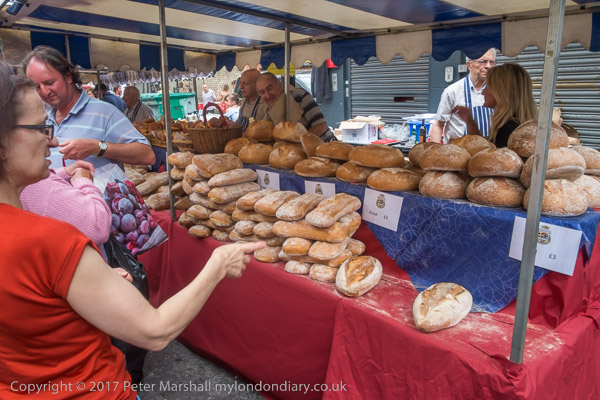
Of course if you go there you will be able to pick up a printed copy. It’s best to arrive in plenty of time to enjoy an ice-cream, snack or plastic cup of wine or two at the Sagra before the procession begins at 3.30pm – and you can go back there again after the procession. It’s an event where everyone is welcome and there are no tickets or booking required.

Our Lady of Mount Carmel

The pavement on Clerkenwell Road gets very crowded so unless you are tall you will want to get there at least a few minutes before the start to find a good place to stand, though once the end of the procession has gone past you can walk to see it coming back to the church.

Our Lady of Mount Carmel

Many also go into the church well before the procession and even if you don’t wish to pray it is worth a visit. According to the web site it has been described as “one of the most beautiful churches in London“. When built in 1863 its “Irish architect John Miller Bryson worked from plans drawn by Francesco Gualandi of Bologna, modelled on the Basilica of San Crisogno in Rome.” And while it may not be entirely to my taste it is certainly remarkable.

Our Lady of Mount Carmel

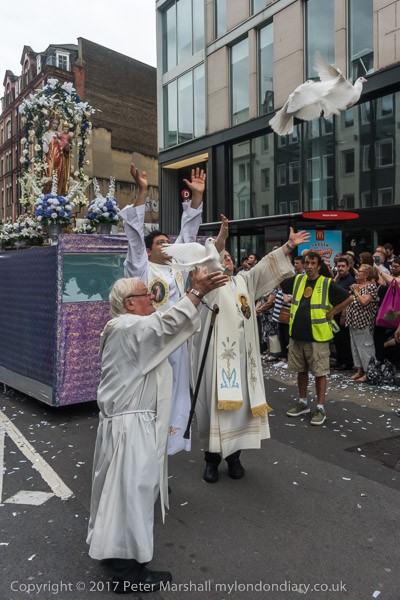
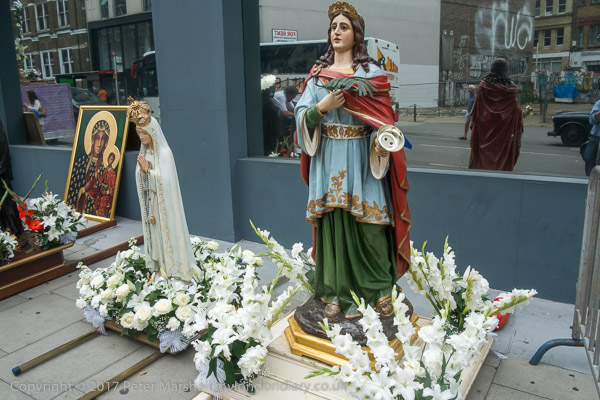
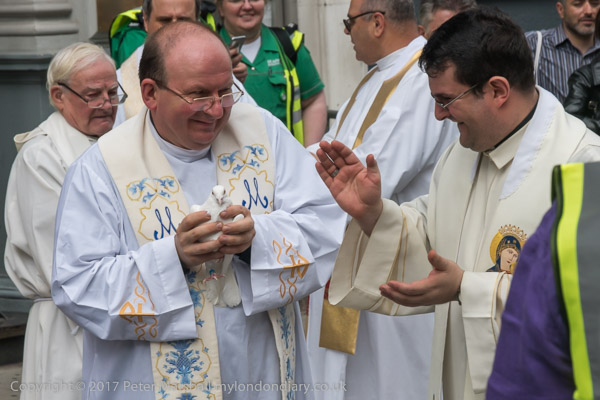
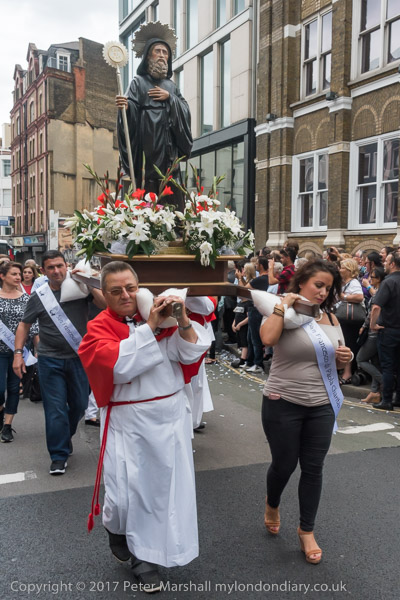
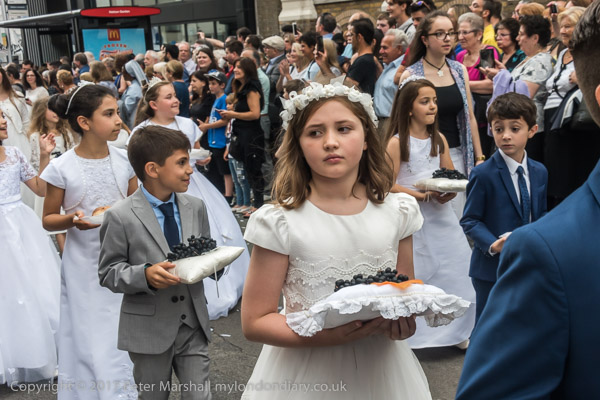
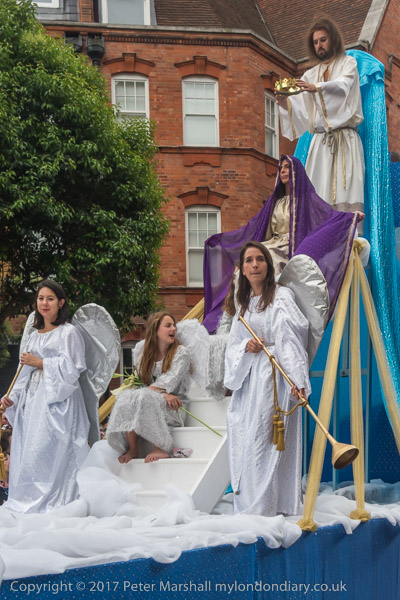
As too is the procession, with its floats on lorries and walking groups in costumes related to the life of Jesus , the first communicants, and various groups and associations, some carrying the heavy statues from the church decorated for the occasion.

Our Lady of Mount Carmel

Our Lady of Mount Carmel is one of the titles of the Virgin Mary, who was adopted as the patroness of the Carmelite Order which was begun by hermits on Mt Carmel in Palestine around the end of the 12th century. July 16 became the liturgical feast of Our Lady of Mount Carmel and the procession takes place on the closest Sunday – and this year, as in 2017, it is on the actual saint’s day.

Our Lady of Mount Carmel

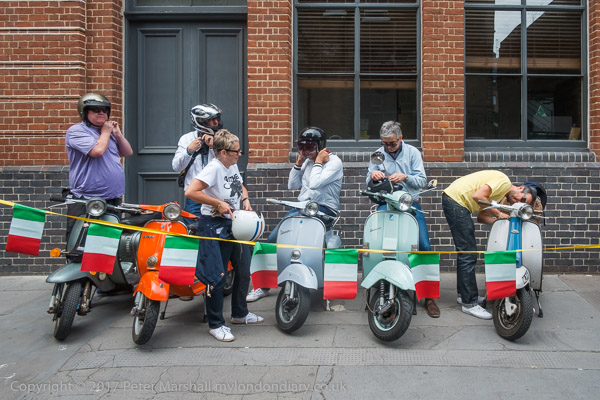
The pictures here are all from Sunday 16th July 2017 – and there are many more on My London Diary at Processione della Madonna del Carmine as well as more from other years.

You can also see the pictures I made the first year I went to the festival, in 1992, in an album on Flickr with 50 black and white and 19 colour pictures. In some ways I think this remains the best set of images I’ve made of the event over the years.


Ruskin & Half Moon, Herne Hill

Ruskin & Half Moon, Herne Hill is another in the series of posts on my walk in Kennington and Brixton on Sunday 6th May 1989. The walk began with Hanover, Belgrave, Chapel, Shops, Taxis. The previous post was A Couple, Shops, Shakespeare and a Green Man.

Parish Hall, St Saviour's Church, Ruskin Park, Herne Hill, Lambeth 1989 89-5e-51
Parish Hall, St Saviour’s Church, Ruskin Park, Herne Hill, Lambeth 1989 89-5e-51

I walked back towards Loughborough Junction station and then turned right down Herne Hill Road, but nothing caught my attention until I came to St Saviour’s Parish Hall on the corner of Finsen Rd. This was erected next door to the church in 1914 and is Grade II listed, its architect Beresford Pite. The hall is now in use as St Saviour’s Church.

St Saviour’s Church was an impressive Victorian building designed by A.D. Gough and consecrated in 1867. It was a short distance to the north on Herne Hill Road in what are now the grounds of St Saviours Church of England Primary School. It was made redundant in 1980 and demolished in 1982 as it was in danger of falling down.

Ruskin Park, named after the named after the noted Victorian writer and naturalist John Ruskin who grew up in the area is just on the other side of Finsen Road, and although I took no photographs here I think I may have found a seat in it to eat my sandwiches before continuing.

Houses, Milkwood Rd, Herne Hill, Lambeth, 1989 89-5e-42
Houses, Milkwood Road, Herne Hill, Lambeth, 1989 89-5e-42

I walked back up Herne Hill Road, taking a picture of one of the houses with distinctive porches in the terrace on the west side at 17-35 (not online) and then walking down Wingmore Road to the junction with Hinton Road and Milkwood Road and turning south to go along Milkwood Road towards the centre of Herne Hill.

Milkwood Manor covered a large area including Denmark Hill. The development around Herne Hill began in earnest after the railway station was opened in 1862, and more importantly later in the decade when services began to the City and Kings Cross. In 1868 the Suburban Village and General Dwellings Company took out a 99-year lease to develop twenty-four acres with houses that working men could afford, and cheap worken’s tickets made living in the suburbs possible. Most of those houses are now beyond the means of most working men.

Gubyon Avenue, Fawnbrake Avenue, Kestrel Avenue were all first developed at around the same time, I think largely from the 1880s with development continuing until a little after the end of the century. Much of the land was owned by a family called Gubbins, who perhaps thought Gubyon a more distinctive version of their name. 13 Gubyon Avenue is thought by the Sherlock Holmes Society to have been the location of Major Sholto’s residence, visited by Holmes and Watson accompanying Miss Mary Morstan in The Sign of Four, written in 1889.

The houses in my picture are probably older, in a similar but slightly less grand style and are closer to the centre of Herne Hill at 352 to 373 Milkwood Road. It’s perhaps surprising they lie just outside the Herne Hill Conservation Area.

Wandles, Car Sales, Flats, Milkwood Rd, Herne Hill, Lambeth, 1989 89-5e-4489-5e-44

Just a few yards from the end of Milkwood Road, these flats which have a frontage on Herne Hill are now hard to see from Milkwood Road, hidden by a two-storey block of Sainsbury’s Local and other buildings where the car sales once were.

What I have called flats its actually the rear of the 1906 LCC Fire Station at 130 Herne Hill, its rear with this rather odd gabled tower considerably more interesting than its rather plain Queen Anne frontage.

Half Moon, pub, Half Moon Lane, Herne Hill, Southwark, 1989 89-5e-45
Half Moon, pub, Half Moon Lane, Herne Hill, Lambeth, 1989 89-5e-45

Herne Hill is split in two by the boundary between the London boroughs of Southwark and Lambeth which runs along the centre of Herne Hill and Norwood Road – all the buildings in this picture are in Southwark borough.

There had been a pub here since 1760, although the current grade II* listed building dates from 1896. It was once one of London’s more famous music venues in London for around 50 years hosting among others U2, Van Morrison, Van Morrison, Dr. Feelgood and David Bowie. Even Frank Sinatra gave an impromptu performance here when he came to visit his former chauffeur on his first night as landlord in 1970.

Closed for around 4 years in 2013 after flooding from a burst water main it has been restored and reopened but no longer features live music. The Dulwich Estate which owns it had wanted to convert the pub to flats, but was prevented when it was listed as an Asset of Community Value by the council and the pub was bought by Fullers.

Shops, Half Moon, pub, Herne Hill, Half Moon Lane, Herne Hill, Lambeth, 1989 89-5e-46

Another view of the Half Moon pub, this time from a few yards up Herne Hill, with shops along the east side of that road. The Half Moon is one of a number of pubs which Dylan Thomas frequented on his visits to London, coming to watch London Welsh play Rugby at the nearby Velodrome. No alcohol was available there and after games the members retired to the Half Moon.

He is said to have found the name for his radio drama Under Milk Wood standing in in the doorway of the Half Moon looking across to Milkwood Road. I can find no evidence for the claims on web sites that he once lived in the road, but I don’t have a detailed biography.

Herne Hill Mansions, Flats, Herne Hill, Herne Hill, Lambeth, 1989 89-5e-32

I continued walking up Herne Hill (confusingly the name of a road as well as the area) and immediately past the Mobil garage – now replaced by Tesco Express – came to this large block of flats.

Houses, Herne Hill, Gubyon Ave, Herne Hill, Lambeth, 1989 89-5e-33

Continuing uphill up Herne Hill were an number of large late Victorian or Edwardian detached houses. This one on the corner of Gubyon Avenue was perhaps just a little larger and certainly had two sides clearly visible. As you can see there are other large houses further up the hill.

My walk will continue in later posts.


A Couple, Shops, Shakespeare and a Green Man

A Couple, Shops, Shakespeare and a Green Man is the fourth post on my walk in Kennington and Brixton on Sunday 6th May 1989. The posts began with Hanover, Belgrave, Chapel, Shops, Taxis. The previous post was Loughborough Estate, Angell Town & A Garage – 1989

Couple, Loughborough Jct, Lambeth, 1989 89-5d-11
Couple, Loughborough Junction, Station, Lambeth, 1989 89-5d-11

I turned right at the end of Ridgway Road onto Loughborough Road and walked under the railway bridge to the junction with Coldharbour Lane, turning east and walking a few yards under another bridge to the station entrance. Outside the station which was then closed at the weekends were a young couple who saw my cameras and asked me what I was photographing. We had a short talk and then they asked me to take their picture.

The Flower Box, Coldharbour Lane, Loughborough Jct, Lambeth, 1989 89-5d-12

A few yards further on I was back to the small parade of shops in front of the alley leading to the Celestial Church of Christ where I had made some photographs a month earlier.

I don’t know how long The Flower Box had been closed, but clearly it was some time, although I could still read its faded signage, ‘FLOWERS FOR EVERY OCCASION’ and ‘SAY IT WITH FLOWERS’.

Perhaps surprisingly this building with the triple decoration at left is still standing at No 208, now a Chinese takeaway, with the demolished shop at right under the hoarding rebuilt and now serving Caribbean Cuisine.

Shops, Coldharbour Lane, Loughborough Jct, Lambeth, 1989 89-5d-13
Shops, Coldharbour Lane, Loughborough Jct, Lambeth, 1989

My next picture came just a couple of yards away, when a young man riding a bike emerged from the alley. I could see him coming as the shop at left had been demolished. I was rather surprised that the two floors above, hidden by the hoarding were still standing as there didn’t appear to be very much holding them up.

Shops, Coldharbour Lane, Loughborough Jct, Lambeth, 1989 89-5d-15

I turned around and walked back westwards along Coldharbour Lane which bends southwards under more railway lines before almost immediately swinging west again, creating the narrow space for this building between viaduct and road. That end wall of the property is only six bricks wide – around 4ft 6inches, though the building widens out further away.

This block is still there, looking perhaps a little better than when I made this picture. The first floor window on the end wall has been bricked up. It appears to be leaning a little in my picture because I did not have the camera level.

Jubilee Terrace, Shakespeare Rd, Loughborough Jct, Lambeth, 1989 89-5d-16
Jubilee Terrace, Shakespeare Rd, Loughborough Jct, Lambeth, 1989

Shakespeare Road runs south here and I walked a short distance down it to photograph Jubilee Terrace. The road was obviously named for William S, and as the plaque states, Jubilee Terrace was built in 1887, the year of Queen Victoria’s Golden Jubillee, 50 years after her accession on 20 June 1837. It was the occasion for her to start making public appearances again after a long period of isolation following the death of her husband in 1861.

I think these were built as a terrace of houses in conjunction with the business premises to the north shown in the next picture. The houses at both ends and the central pair are three-storey while the others only have two.

Shakespeare Business Centre, Shakespeare Rd, Loughborough Jct, Lambeth, 1989 89-5e-62

At the north end of Jubilee Terrace and joined to it, this was built as commercial premises for Osborne and Young corn merchants, with an entrance for horse-drawn vehicles at its centre. Later it became known as Coldharbour Works.

You can read more about the history of the building on Brixton Buzz, including the rather surprising finding underneath that underneath the blank boards of the shopfronts at right were those you can now see on the building for bird seed specialists B.O.Y, Brinkler, Osborne & Young, including the original owners of the premises – B.O.Y were apparently in business here from around 1932 until they were taken over around 1974.

Houses, Anna French, Fabrics, Lace, Wallpaper, Shakespeare Rd, Loughborough Jct, Lambeth, 1989 89-5e-63

The southern end of Jubilee Terrace and in the yard of Coldharbour Works behind the shop of Anna French, Fabrics Lace Wallpapers in what I assume was one the store of the corn merchants. Anna French started a company in Scotland in 1976 to make her designs and is one of the best-known wallpaper and fabric designers. The company is now part of Thibaut, the oldest US company in wallpaper and fabrics.

Anna French moved to smaller premisess in Hinton Rd and the building is now Kings College Hospital Therapies Department

The Green Man, Coldharbour Lane, Loughborough Jct, Lambeth, 1989 89-5e-64

The Green Man on the corner of Coldharbour Lane and Hinton Road had been at the edge of one of the pictures I’d taken on an April walk, but here in a picture taken looking from the end of Belinda Rd it is in the centre of the picture and we can see its name and pub sign.

It closed in 2003, not because it was unprofitable, but because it was too popular with drug dealers and petty criminals and was asked to close. There had been a pub of that name on the site since before 1800, but this building dates from 1881. In 2016 the building, now a skills zone and careers advice centre, was given a Shimmer Wall Green Man artwork on the second floor above its entrance.

There will be further posts on this walk later.


Darent Valley Path & Thames

Darent Valley Path & Thames, Dartford, Kent. On Saturday 4th July 2015 I went by train with my wife and elder son to Dartford for a day’s walking mainly beside the River Darent and River Thames.

Darent Valley Path & Thames

It was a hot summer day and the sky was blue with just a few small patches of white cloud. It probably wasn’t the best day to have chosen, as this was a walk with relatively little shade, but as usual there was a little breeze by the rivers to cool us slightly.

Darent Valley Path & Thames

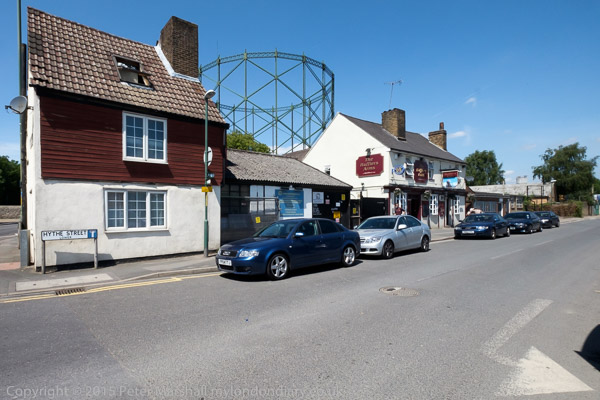
I’d walked (and cycled) along the paths we took several times before, first in the 1980s, but they were new to my companions. After taking a short look at the Darent in Dartford we made our way to Hythe Street. Its name means a landing place or small port, and the Darent was once an important navigation at least as far as the mills in the centre of Dartford. The has been a pub here since 1764 and the Hufflers Arms gets its name from the men who guided and pulled the barges up the river to here.

Darent Valley Path & Thames

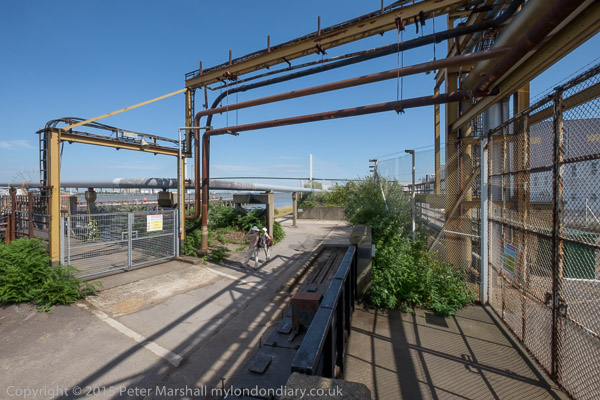
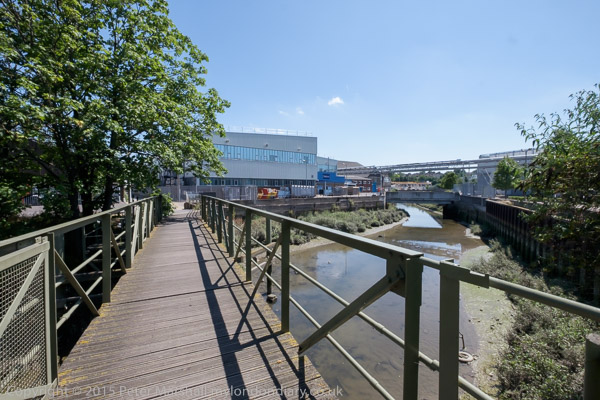
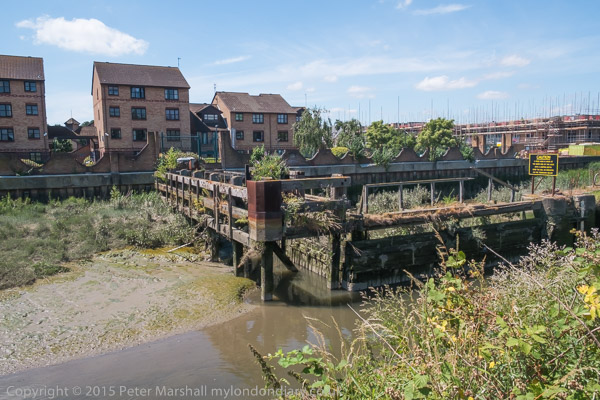
A footbridge takes the path across the Darent here, and past the backs of some industrial sites on towards the half-lock which stopped the river above it drying out at low tide, long derelict. It was something of a surprise to see a narrow boat moored close to it.

Darent Valley Path & Thames

There has been a huge change here since 2015, with volunteers working on and around the lock and the river. You can read more about the work of the Dartford and Crayford Creek Restoration Trust on the Facebook page of the Friends of Dartford and Crayford Creek, and see some of the changes in the pictures there.

Darent Valley Path & Thames

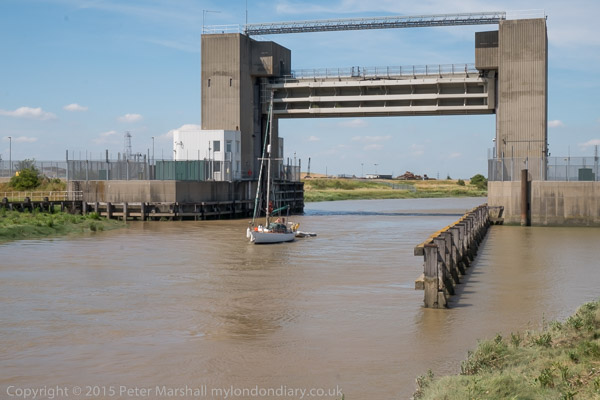
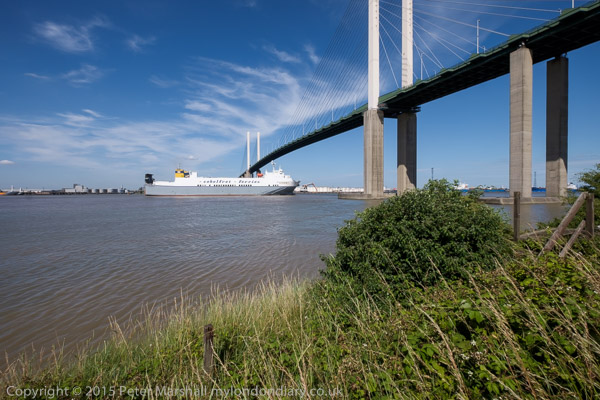
Later in the day I photographed a yacht making its way through the flood barrier from the Thames and going upriver. I heard afterwards that it had reached the recent bridge under the Bob Dunn Way bypass when the tide was just a fraction too high for it to creep underneath with its mast lowered.

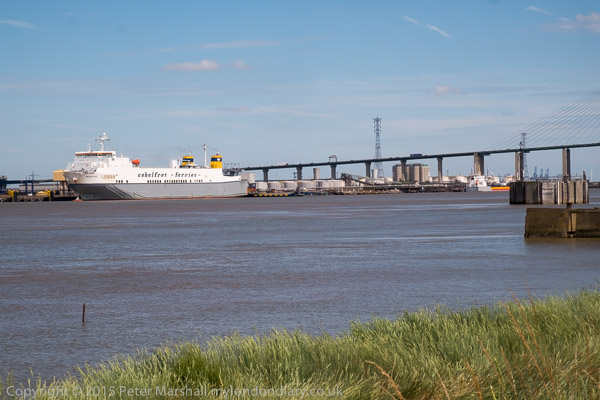
The Thames is pretty wide here and the channel deep enough to take fairly large ships, with the ferries including the ship in the picture operating regular contianer services to Rotterdam and Zeebrugge.

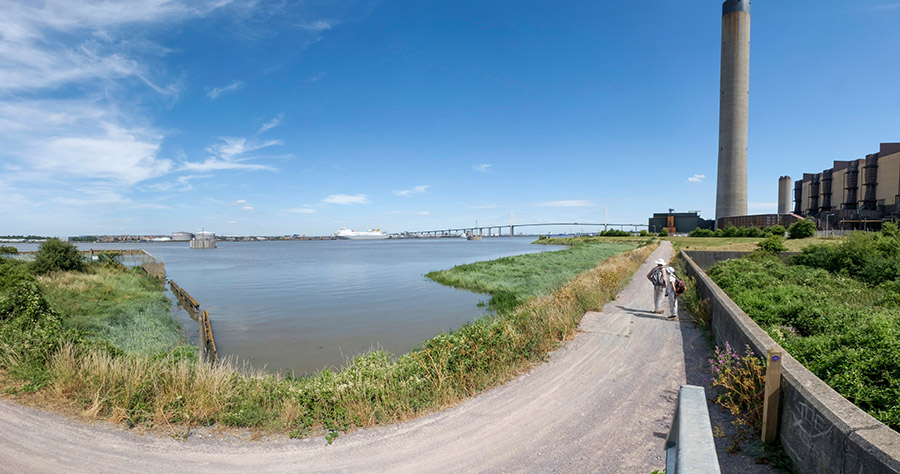
I made a few panoramic images, but the sky was a little empty and blue for it really to be a good day for that. This one which shows my two companions walking on ahead is interesting to me as I have managed to make use of the curvature inherent in these very wide angle views. The path on which I was standing to make the image was more or less straight, though in the picture it seems to bend at roughly a right angle.

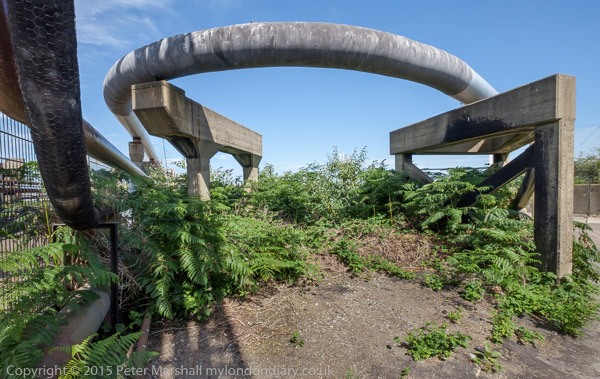
The Littlebrook Power Station had only recently ceased operation, and we walked past some interesting structures there before making our way under the Dartford Bridge.

I was pleased that the ferry was leaving and I was able to take a series of photographs of it going under the bridge and sailing on downriver. Some of the pictures give a better impression of the relative heights of ship and bridge with an enormous amount of headroom for the passage.

By now I was getting tired, mainly from the heat and the lack of any shade, and I took few pictures on the rest of the walk to the station at Greenhithe. We didn’t see any sign of the path marked on the map which would have taken us up to the church at Stone as I had planned, but I think I was releived not to have had to climb up the hill, and perhaps didn’t look too hard. After all I’d been there and taken pictures on various occasions before. And if you are walking this way it’s worth the detour.

More about the walk and more pictures at Darent Valley Path & Thames.


Loughborough Estate, Angell Town & a Garage – 1989

The fourth post on my walk in Kennington and Brixton on Sunday 6th May 1989. The posts began with Hanover, Belgrave, Chapel, Shops, Taxis. The previous post was Brixton Road and Angell Town -1989

Loughborough Estate, Flats, Loughborough Rd, Brixton, Lambeth, 1989 89-5d-44

I’m not sure which of the nine eleven-story slab blocks on the estate is shown in my picture; the estate was and remains a rather confusing area. Possibly this is Leicester House on Loughborough Road, or more likely Harpur House on Angell Road where I think I walked to next, but the lower buildings in front of the block appear to have gone.

The sign ‘NO HATS’ is not a reference to any headgear but to Housing Action Trusts, an important part of Margaret Thatcher’s marginalisation of local authorities. Having ochestrated the run-down of council estates by earlier restrictions on council spending and the right to buy schemes, the Housing Act 1988 aimed to transfer these estates to non-departmental public bodies which were to redevelop or renovate them so they could be transferred into private ownership.

Opposition to HATs was intense, with the Labour Part, local authorities and estate residents all fighting their imposition, and the first six areas intended to becom HATs managed to avoid implementation, though later six were formed, but none in south London.

Lunch Club, Loughborough Estate, Angell Rd, Brixton, Lambeth, 1989 89-5d-45

I think this rather temporary-looking building as on Angell Road close to Harpur House, but no sign of it remains. I photographed it largely for the posters showing opposition to Housing Action Trusts in Broxton.

As well as a Luncheon Club for pensioners it also has a sign for the Loughborough Sports & Social Club.

Fence, St John the Evangelist, Angell Park Gardens Angell Town, Lambeth, 1989 89-5d-32
Fence, St John the Evangelist, Angell Park Gardens, Angell Town, Lambeth, 1989 89-5d-32

Further along Angell Road – named like the area after the Angell family who had owned large parts of the Lambeth and developed this area in the 1850s. In 1852 Benedict John Angell gave a site here for the building of St John the Evangelist Church which was consecrated in 1853. Unfortunately trees along the edge of the site along Angell Road and Angell Park Gardens had too many leaves in May to clearly see the church.

These paintings on the fence around the church are still visible but rather faded. I took a few pictures of them both in black and white and in colour before walking on past the church and across Wiltshire Road into Villa Road and back onto Brixton Road, where I photographed the rather austere Our Lady of the Rosary Catholic Church (not yet digitised.)

Abeng Youth Community Centre, Gresham Rd, Brixton, Lambeth, 1989 89-5d-22

I walked on down Brixton Road to the Police Station where I turned back east along Gresham Road, stopping to photograph what looked to me to be a former chapel. In 1877 this was the Angell Town Institution and later became Brixtons first telephone exchange.

In the 1970s the Rev Tony Ottey founded the Abeng Centre here to provide supplementary education and youth services to the local children. In 2003 it was relaunched with new management as the Karibu Centre, its Swahili name Karibu meaning welcome, with similar aims. It is also hired for weddings, funerals, birthdays and business meetings.

Wyck Gardens, Loughborough Estate, Millbrook Rd, Brixton, Lambeth, 1989 89-5d-24

Soon I was walking through the Loughborough Estate again, going along Millbrook Road and through Wyck Gardens, a public open space which is thought to be the remnant of a larger wood knwon as Wickwood in the Manor of Lambeth Wick which had been cleared by the end of the 17th century.

The land had belonged to the Archbishops of Canterbury and was bought by the London County Council from the Church Commissioners for a new public open space, opened in 1959 and since extended and improved. You can see more pictures from the park on Brixton Buzz.

I think the large block here is Barrington Court, the first of three I walked past on my way through the park towards Loughborough Junction.

Garage, Railway Arch, Ridgway Rd, Loughborough Jct, Lambeth, 1989 89-5d-25

I left the park and walked along Ridgeway Rd, beside the railway line from Brixton which curves around to a junction just north of Loughborough Junction Station. The next station on this line is at Elephant & Castle.

Some extensive work seems to be in progress on what I am reliably informed (thanks to comments on Flickr) is a Ford Escort, while inside the garage a Renault 4 and a Rover P5 await their turn.

Arch 500 was empty for some years but later became home to the very Brixton Buzwakk Records Recording Studio a few years ago. The arches on both sides are still garages.

More about this walk in May 1989 in a later post.