G8 Protest Day 2 – 2013

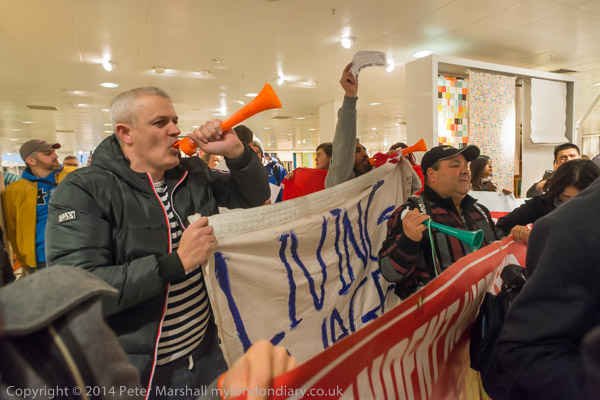
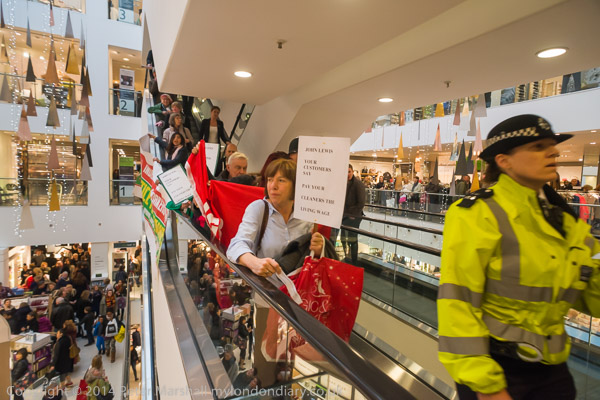
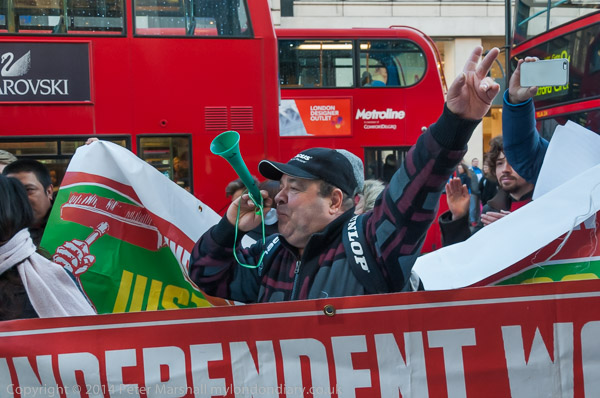
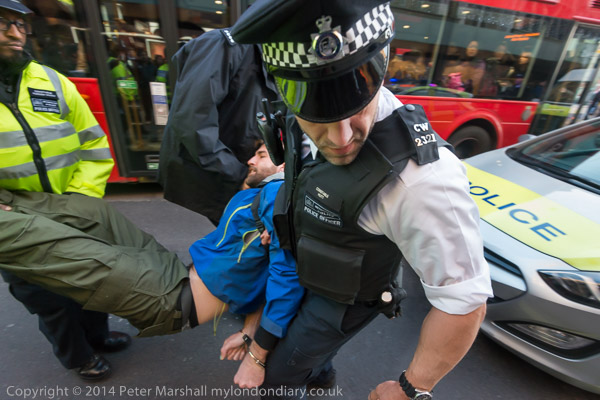
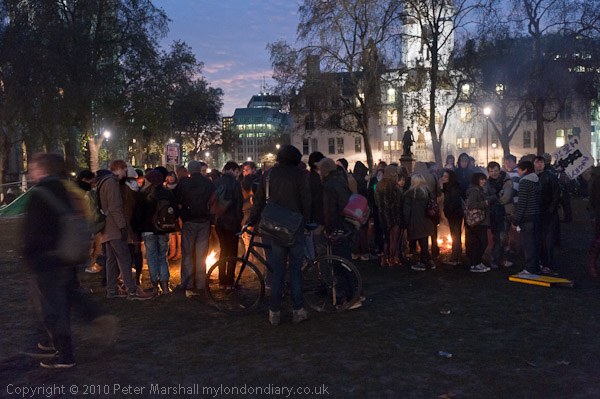
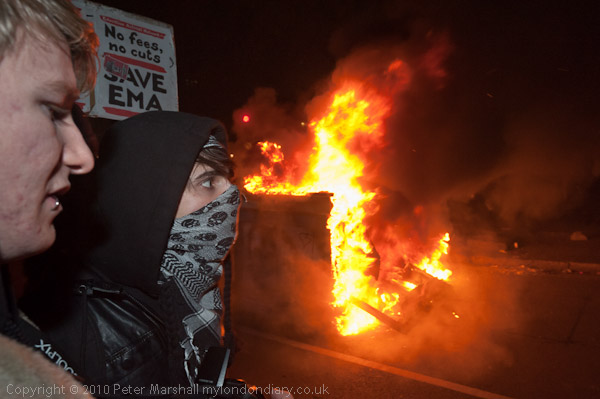
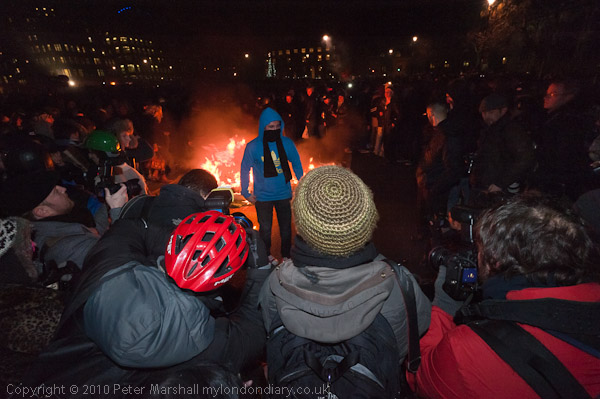
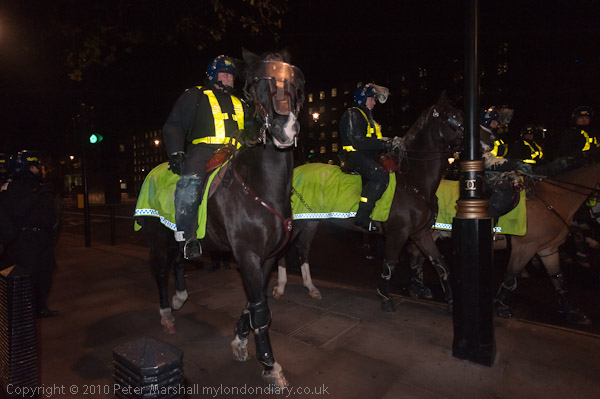
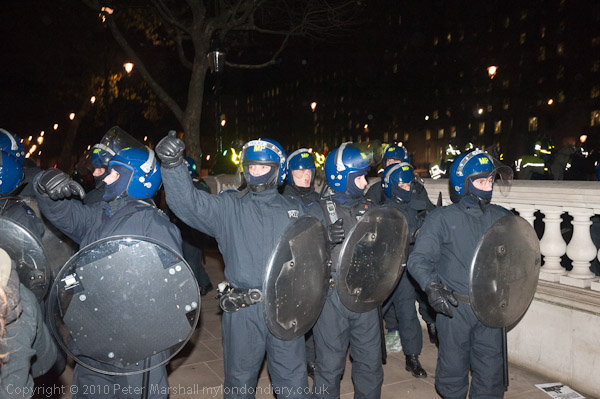
G8 Protest Day 2 – 2013: What a difference a day makes. The previous day police had raided the squat where many of the Stop G8 protesters had been staying, tazering many of those inside, injuring a man who was trying to climb down a ladder from a roof area, and finding little evidence of intended wrong-doing. They had done their utmost to prevent peaceful protest, searching hundreds on the streets and making 30 arrests, many following incidents where police had rushed in and forcefully grabbed protesters.

G8 Protest Day 2

The police actions had made the news headlines, not always in favour of the police actions. Many of those reporters who had been on the streets and seen what was happening shared some of my opinions over their heavy-handed and anti-democratic behaviour and some of this got through past the usual editorial pro-police line.

G8 Protest Day 2

Police too had failed to find any evidence that this would have been anything but a peaceful protest without their provocations, and perhaps the media were rather disappointed to realise that senior officers had before the event been lying to them, spreading unsupported rumours. And although some of the officers on the ground had clearly been enjoying being given the licence to have a go at the protesters, I think there were plenty who had been rather embarrassed.

G8 Protest Day 2

Whatever the reasons, the police acted very differently when the Stop G8 protests continued on their second day, touring the offices of arms company and holding peaceful protests against them.

G8 Protest Day 2

A group of protesters were dressed in black robes with ghost or skull masks and carrying mock scythes as well as a black banner with the message ‘Think we’re SCARY? You’ll find ‘ARMS DEALERS INSIDE‘. Others had changed into white plastic overalls suitable for what they said was a ‘weapons inspection.’

Others carried banners about arms companies including BAE where this tour began and Brighton-based EDO or to the continuing Campaign Against the Arms Trade protests over the huge DSEi arms fair held in London’s Docklands. BAE with offices in Carlton Gardens is the third largest arms company in the world and notable for several corruption cases – and they have been fined £48.7m by the US government for braking their military export laws.

Outside BAE and at each of further stops there were short speeches with details about the immoral (and sometimes illegal) activities of the company. After a little street theatre the protesters moved on peacefully. Occasionally where they were blocking roads the police came and politely asked them to let cars through, and the protesters obliged. They also at times tried to protect the protesters from traffic, but otherwise stood back and watched. Quite a few of the press who had turned up at the start soon left, seeing the event was proceeding peacefully.

The next stop was the offices of Thales, the world’s 11 largest arms company with a wide range of surveillance equipment, drones, armoured vehicles, missiles and more. From there they returned to Lockheed Martin where police had harassed them the previous day. On the other side of Piccadilly Circus in a street close to Leicester Square they protested outside the offices of Northrop Grumman UK, one of the world’s largest defence contractors and the largest builder of naval vessels.

A short distance further on at Strand they protested briefly at the officers of missile developer MBDA and then went to protest outside Charing Cross Police station where those arrested for protesting the previous day had been taken. The final stop on the tour was in Chandos Place, at the offices of QinetiQ, a major defence contractor which manufactures drones and armed robots used in Afghanistan and Iraq.

I left to go home. As I noted, “As yesterday, the intention of those taking part (or at least the vast majority) had been to have a visible and audible but peaceful protest which was a clear statement of their views, and today the police had not interfered with this.” But I don’t think this protest made the news.

More at G8 Protest Against Arms Dealers.


J11 Carnival against Capitalism – 2013

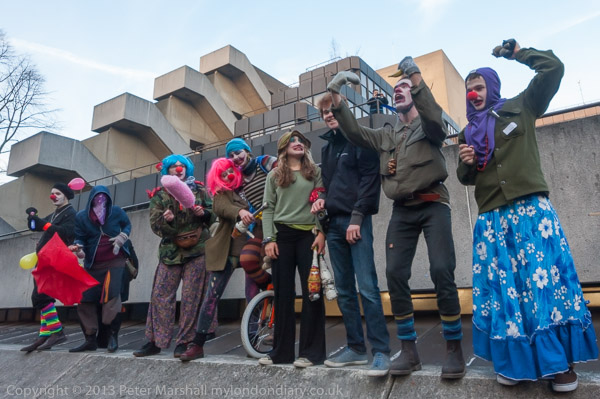
J11 Carnival against Capitalism: Ten years ago on 11th June 2013 we saw one of the worst examples to date of police opposing the right to protest in London. The day had been billed by protesters as a Carnival Against Capitalism and was intended in the week before the G8 talks to point out that “London is the heart of capitalism, and to expose the offices of companies they think are brutal and polluting or exploitative, financiers who are holding the world to ransom, the embassies of tyrants and the playgrounds of the mega-rich.

J11 Carnival against Capitalism - 2013

The organisers had said it would be “an open, inclusive, and lively event” and it would certainly have been noisy and high-spirited, theatrical in some ways but unlikely to cause a great deal of damage.

J11 Carnival against Capitalism - 2013

The police, almost certainly under political pressure had decided to treat it as a major insurgency, leaking invented scare stories to the media and getting a Section 60 order for the whole of the cities of London and Westminster which gave them the power to stop or search anyone on the streets without the need to show any suspicion. These orders are only meant to be put in place for a clearly defined area over a specific time when a senior officer believes there is a possibility of serious violence, or weapons being carried, and this seemed to be a considerable and probably illegal overkill.

J11 Carnival against Capitalism - 2013

This was not a huge protest, probably expected to involve less than a thousand protesters. Quite a few had gathered the previous day at a large squatted former police station in Beak St. Police invented a story that those inside had paint bombs and intended to cause criminal damage and used this to get a search warrant, entering the building early on the day of the protest.

J11 Carnival against Capitalism - 2013

Police turned up intending to arrest all those inside, and came with a couple of double decker buses to take them away.They sealed off a long stretch of the street and held the people inside, preventing them from joining the start of the protest, but the search found nothing.

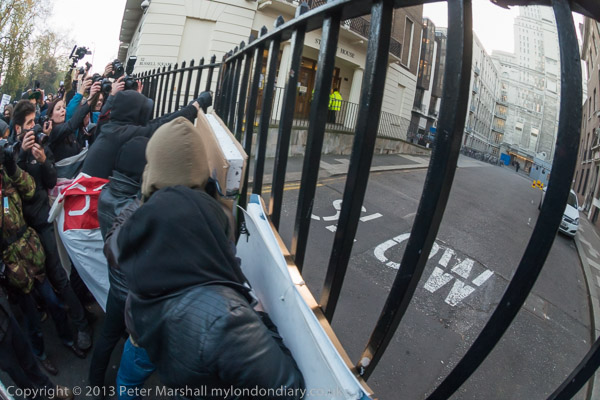
Along with the rest of the press covering the story I was kept out, and could only see a little of what was happening from a distance, photographing with a very long lens. The police were blocking an number of side streets too and I had to make a lengthy detour to get to the other end of the block where the view was little if any better.

Police were stopping people on the streets and searching them, particularly anyone dressed in black or otherwise looking as if they might be a protester. Most were searched and released but there were a number hand-cuffed and led away. The only arrest where could find the reason was when a woman was arrested and put in a police van on Regent St for having a small marker pen in her handbag.

The protest from Piccadilly Circus began much later than intended. Around a couple of hundred people had eventually made it there, including a samba band, and left for their intended tour of the offices of some of the most powerful and greedy companies, “oil and mining giants, arms dealers, vulture funds, companies that launder blood money, invest in war and speculate on food supplies, and the offices, embassies of tyrants.”

Police kept stopping the protesters and when they did there were some short speeches and the samba band played. Police occasionally rushed in and grabbed a protester, and there were some scuffles as people tried to protect their friends. Police vans blocked some of the major roads in the area, turning what would have been relatively minor traffic stoppages into long major disruptions.

The tour stopped outside the Lower Regent Street offices of arms manufacturer Lockheed Martin for speeches against its activities – including making Trident missiles, after which the samba band began to play. One of the police ‘Liaison Officers’ came and told the band that they needed a licence from Westminster Council to play music in the street and would be committing an offence if they continued to play. He was greeted by shouts of derision from the crowd, but the band were clearly worried and held a consultation before deciding to continue on to protest outside BP around the corner in St James’s Square.

Westminster licences buskers not music on the streets. Many processions and protests take place with marching bands – including military events, the Salvation Army, Orange Lodges and many other protests. This warning was clearly another attempt by the police to harass the protest by applying laws inappropriately.

The protest moved on to the offices of BP in St James’s Square, where after a few minutes I left them, I’d been on my feet too long. The protesters still had a number of calls to make and doubtless the police would keep up their harassment.

The Stop G8 protesters had despite the police carried out at least in part their intention to “party in the streets, point out the hiding places of power, and take back the heart of our city for a day.” The police had wasted huge amounts of public money, provoked some minor disorder, disrupted traffic for much of the day in a large area of London and shown themselves happy to lie and act outside the law to support the interests of the rich and powerful.

Read more and see more pictures at J11 Carnival against Capitalism.


Nicaragua, Votes for Women & Al Quds

Nicaragua, Votes for Women & Al Quds – Events in London on Sunday 10th June 2018


End Government Killings in Nicaragua – Trafalgar Square

Nicaragua, Votes for Women & Al Quds

Nicaraguans protested in Trafalgar Square against the violence in their country where since the 19th of April police had killed over 100 protesters and a injured more than 600, and many have been unjustly detained, tortured and raped.

Nicaragua, Votes for Women & Al Quds

President Daniel Ortega first came to power during the Nicaraguan Revolution as a leader of the Sandinista National Liberation Front which ousted the US-supported Samoza dictatorship, becoming leader of the ruling junta which replaced them in 1984 and getting a large majority in the country’s first free and fair presidential election in 1985. His government then implemented a number of leftist policies despite widespread campaigns against him by the US who supported rebel forces and imposed a full trade embargo on the country, even mining its ports.

Nicaragua, Votes for Women & Al Quds

Massive US interference in the 1990 Nicaraguan general election led to his surprise defeat and he also stood and lost in 2001, but was returned to power following the 2006 elections, though on a much lower vote than in 1985 against a very split opposition.

Nicaragua, Votes for Women & Al Quds

Since coming to power in 2007, Ortega has abandoned most of his leftist principles, becoming increasingly dictatorial and alienating many of his earlier supporters. Popular protests which began in 2018 against his social security reforms which increased taxes and reduced benefits were violently repressed and further measures have included closing down newspapers, universities and NGOs. Leaders of the political opposition including some former colleagues were jailed for the 2021 election.

This repression has led to many fleeing the country, particularly to neighbouring Costa Rica where over 30,000 Nicaraguans have claimed asylum. Ortega remains in power, with his wife Rosario Murillo as Vice President since 2017.

End government killings in Nicaragua


100 years of Votes for Women

Women marched through London in three strands wearing head scarves in one of the purple, white and green suffragette colours to celebrate a hundred years since the 1918 act gave wealthier older women the vote.

The 1918 Act brought the vote to all men over 21, as well as those like my father over18 serving in the armed forces, but women had to be both over 30 and meet a property requirement. It was another ten years before my mother and other women could vote on the same terms as men with the Representation of the People Act 1928.

Under the 1918 Act, “Women over 30 years old received the vote, but only if they were registered property occupiers (or married to a registered property occupier) of land or premises with a rateable value greater than £5 or of a dwelling-house and not subject to any legal incapacity, or were graduates voting in a university constituency.”

Around 8.4 million women in the UK got the vote in 1918, but there were still around 5 million of women over 21 without a vote – and there were still around 7% of the population, mainly male middle-class university graduates who had an extra vote either in university constituencies or in the constituency where they owned business premises.

Sadly when my mother did get the vote she used it to support the Conservative Party, displaying their poster in our front window at every election. My father, who kept quiet about his politics to avoid conflict at home, went into the polling station every time to cancel out her vote with one for Labour.

Many more pictures at 100 years of Votes for Women.


Al Quds Day Protests – Saudi embassy, Mayfair

A large crowd squashed into barriers on the street in front of the Saudi Arabian embassy for a rally in support of the oppressed people of Palestine and others around the world.

The event, organised by the Justice for Palestine Committee, was supported by the Islamic Human Rights Commission and a wide range of pro-Palestinian organisations, and opposed by the Zionist Federation and some right wing hooligans, who were stopped from attacking the peaceful event by a large police presence in the area.

The official Zionist Federation protest which was perhaps a little smaller than in some previous years kept behind the barriers provided for them a short distance from the Palestinian protest, and the two groups shouted insults at each other.

There were also a number of well-known Zionist protesters along with some right-wing football supporters active in the EDL and other racist organisations wandering the streets of Mayfair. Police made an effort to keep them away from the Palestine protest, and at one point this involved some fairly forceful policing as the thugs were taken away. Not all of the right-wing are thugs, and later when I went home I was pleased to meet a man who knew me and walked with me to make sure I didn’t get troubled by any of the others still around.

As a colleague remarked to me, there may well have been more Jews taking part in the pro-Palestine rally than opposing it, as the Al Quds day event was supported by several groups and numerous individuals from the Jewish left as well as the ultra-orthodox Neturei Karta, who as always attracted a great deal of venomous anti-Semitic shouting from the Zionists.

Celebrated in many countries, Al Quds Day, established by the Islamic Republic of Iran in 1979, has been marked in London for over 30 years.

This year’s event was a gesture of defiance to the demonisation campaign and the ongoing murders by Israeli troops of innocent Palestinian protestors in the Gaza Strip commemorating 70 years since Israel was formed on expropriated Palestinian land.

More about the protest and many more pictures on My London Diary:
Al Quds (Jerusalem) Day
Zionists protest against AlQuds Day


Naked Cyclists Ride Against Oil

Naked Cyclists Ride Against Oil: I thought people might like some more naked cyclists so here are some pictures from the 2012 ride, eleven years ago today on 9th June 2012. Men were in a fairly large majority in the thousand or so riders taking part and photographically they represent rather more of a challenge, at least to make pictures that editors think suitable for family viewing. So I’ve chosen pictures of men, though there is a woman in one of them.

Naked Cyclists Ride Against Oil

The only country from where I’ve had any negative feedback about my pictures of naked cyclists is the USA, where I’ve had emails from teachers and librarians requesting that I remove these pictures from My London Diary as they say they make the site unsuitable for young people.

Naked Cyclists Ride Against Oil

I find this difficult to understand but reply politely refusing to do so. Their complaints seem to come from some kind of warped religious objection and I like to remind them “So God created mankind in his own image, in the image of God he created them; male and female he created them.” and to somehow find that image offensive seems to me to be blasphemy.

Naked Cyclists Ride Against Oil

Perhaps the most striking thing about the ride is not the nudity in itself but the variety of the human form it illustrates compared to the photographs of naked or near-naked people we usually find in newspapers or on our screens.

Naked Cyclists Ride Against Oil

I tried hard to find pictures that reflected the purpose of the ride, a protest against dependence on oil and other forms of non-renewable energy and a culture based on cars and to “expose the unique dangers faced by cyclists and pedestrians” in modern cities. Some of the riders did so with a considerable sense of humour.

Naked Cyclists Ride Against Oil

And some good drawing skills.

Careful timing and cropping sometimes makes the pictures more acceptable to a wider range of publications. And a bus with the message ‘Get Your Socks Off’ seemed rather appropriate though few in the frame were wearing them.

Another bus had three men in dark glasses who unlike all those watching the event from the pavements seemed to view it rather sternly. This is an event that causes a tremendous amount of hilarity on the streets as it goes past, but they are clearly not amused.

And finally, close to the former City Hall I photographed The Vitruvian Man.

There is a description of the ride and many more photographs – including some that would apparently shock some people at Naked Cyclists Ride Against Oil.


Food Sovereignty, Big IF & Naked Cyclists

Food Sovereignty, Big IF & Naked Cyclists: Saturday 8th June 2013 was another varied day of protests in London.


Food Sovereignty not Food Security – Unilever House, Blackfriars

Food Sovereignty, Big IF & Naked Cyclists

Friends of the Earth, War On Want and others held a protest outside Unilever House where David Cameron was addressing carefully picked delegates at his ‘Hunger Summit’. They were protesting against the ‘new alliance for food security and nutrition’, a special initiative launched by the G8 in 2012.

Food Sovereignty, Big IF & Naked Cyclists

Cameron’s ‘summit’ and the protest came before a G8 meeting and Unilever’s iconic London offices overlooking the Thames at Blackfriars, was particularly appropriate as Unilever, along with other global agribusinesses such as Monsanto and Cargill are the major beneficiaries of the ‘new alliance.’

Food Sovereignty, Big IF & Naked Cyclists

The G8 initiative will spend billions of dollars to finance the expansion of these agribusiness in Africa but damage existing landowners and farmers, who will either have to sign agreements to land grabs by the giant corporations and replace their traditional plants and seed with GM and other high-tech seeds and supplies or see their markets disappear.

Food Sovereignty, Big IF & Naked Cyclists

The initiative will marginalise small African farmers, driving them from their traditionally owned land, increasing unemployment and the movement to cities. As in India some will be driven to suicide as their only solution. It should increase agricultural output in the short term but most of it will be food for export or biofuels, and hunger will increase – along with the profits of the mega-corporations. Almost certainly all these technological fixes will in the long term fail, leading to further desertification.

African farmers need support that increases their economic, social and cultural resilience, methods to increase their productivity through simple low-tech improvements in land use, that preserve and improve the soil, and increase water retention, that improve traditional crop varieties by proven old-fashioned methods. Various projects have demonstrated the success of these approaches – but they fail to increase the profits of multinational companies so do not attract support from the G8.

Food Sovereignty, Big IF & Naked Cyclists

Almost 200 African groups signed a Statement By Civil Society In Africa which condemned the proposals, describing them as “a new wave of colonialism”, pointing out that they work to the benefit of the corporations and not for Africa.

This was a peaceful and family-friendly protest, with campaigners bringing containers with growing plants and baskets of fruit and vegetables to set up a small garden on the road island in front of the main entrance to Unilever House.

More about the protest and the Statement by Civil Society in Africa at No to G8 New Alliance on Food Security.


Big IF Solidarity Walk – Westminster to Hyde Park

The second protest I photographed was also about global hunger, with thousands marching in solidarity with the one in eight people around the world who go hungry and to demand that the G8 world leaders tackle the root causes of global hunger.

The problem isn’t about producing food as “The world produces enough food for everyone, but more than two million children die every year because they can’t get enough to eat.” The problem is the unfair distribution of wealth and power which means many of those who need food don’t get it, while others have more they can eat.

The walk to send a message to the G8 was supported by a wide range of organisations including Christian Aid, Oxfam, Cafod, Save the Children and many more who work in countries around the world, and many had begun the event by attending a service in a packed Westminster Central Hall in Westminster, the Methodist church where the first meeting of the UN General Assembly was held in 1946.

This wasn’t a march but a walk, with people taking a rather circuitous route and walking in small groups on the pavements, which made it rather more difficult to photograph.

More at Big IF Solidarity Walk.


World Naked Bike Ride – Marble Arch & Westminster

The World Naked Bike Ride is an annual protest against oil dependency and and the negative social and environmental impacts of a car dominated culture as well as a demonstration of the vulnerability of cyclists in traffic and to celebrate body freedom. It began in Spain in 2001 and has spread to London and round 70 other cities in over 30 countries.

In London it has usually attracted around a thousand cyclists, along with a few others on skateboards etc, and provides considerable interest, with crowds of tourists stopping to watch and to photograph, and although everyone around me seemed to be greatly amused, there seemed to be little or no appreciation of the reasons behind the protest.

Not all riders are naked for the event, some riding partially clothed. The dress code is that people should ride ‘as bare as they dare’ and only the wearing of footwear is compulsory for safety reasons. Many riders have some creative body paint, some with slogans on their body to promote the ideas behind the ride, and I’ve chosen images for this post that show these.

In 2013 the ride began at four different points, Marble Arch, West Norwood, Clapham Junction and near Kings Cross, with the routes converging on Westminster Bridge, from where they went on to ride to St Paul’s Cathedral and back through Holborn and Trafalgar Square to Hyde Park Corner.

I went to Marble Arch for the start of the event there and later took photographs on Westminster Bridge where the four groups were intended to meet up, but tho cyclists from Marble Arch were held up and arrived after the others had left.

It’s a ride that attracts considerably more men than women as riders, although my pictures might seem to suggest the opposite. There are several reasons why I find the women more interesting, partly because I think more of them make an effort with body painting and other ways to create an impression. It’s also rather harder to photograph nude male cyclists in ways that many publications would find acceptable, and my selection of images is largely for submission to agencies.

There are many more pictures on My London Diary at World Naked Bike Ride. At the top of each page of pictures I included the statement “These pictures include some nudity – don’t view them if this might offend you” above a long area of empty white space, with two links to either take viewers down the page to see them or back to the main June page.


Shaker, Uganda, Legal Aid & Gay Marriage

Shaker, Uganda, Legal Aid & Gay Marriage: Tuesday 4th June 2013 saw quite a mixture of protests around Westminster with a regular daily protest during the Parliamentary session calling for the return of Shake Aamer and in solidarity with Guantanamo hunger strikers, a protest at the Home Office against the deportation of gay asylum seekers to Uganda, at the Ministry of Justice against privatisation of legal aid and protesters for and against outside the House of Lords were debating the gay marriage bill.


Bring Shaker Aamer Home Vigil – Parliament Square

Shaker, Uganda, Legal Aid & Gay Marriage

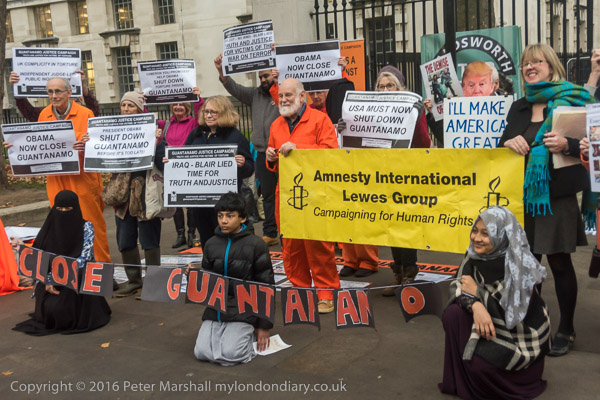
Protesters were keeping up their daily vigil opposite the Houses of Parliament to remind MPs that British resident Shaker Aamer was still held in Guantanamo despite being cleared twice for release. They called on the UK government to urge President Obama to release him and close down the illegal prison camp.

The Guantanamo hunger strike was now putting the lives of the hunger strikers in danger, with over 40 of more than a hundred taking part now being forcibly fed, including ‘prisoner 239’, Shaker Aamer from Battersea.

Shaker, Uganda, Legal Aid & Gay Marriage

Although today the daily protest was small it drew attention to itself with large bright orange banners and those taking part all in black hoods and orange jumpsuits, and one wearing ‘chains’ around hands and feet.

Bring Shaker Aamer Home Vigil


Stop Deporting Lesbians to Uganda – Home Office, Marsham St

Shaker, Uganda, Legal Aid & Gay Marriage

A few days ago on 30th May 2023, Uganda’s President Museveni signed the Anti-Homosexuality Act which is said to be among the harshest anti-LGBTQ laws in the world. It imposes the death penalty for some so-called aggravated cases and largely repeats a similar 2014 law which was declared unconstitutional by Uganda’s constitutional court.

Uganda was a British protectorate from 1894 to 1962 and inherited anti-gay laws from colonial penal code, which have been widened since independence. Wikipedia puts it clearly “Lesbian, gay, bisexual, and transgender (LGBT) persons in Uganda face severe legal challenges, active discrimination, state persecution and stigmatisation not experienced by non-LGBT residents.” It goes on to state “Violent and brutal attacks against LGBT people are common, often performed by state officials.

Despite the dangers the Home Office was continuing to deport gay people who had fled Uganda because of the danger and often violence they had suffered because of their sexuality back to where they faced persecution and probably death.

Shaker, Uganda, Legal Aid & Gay Marriage

The protest came after lesbian Jackie Nanyonjo died following injuries inflicted on her during her forced deportation by thugs contracted to the UKBA in March, and a day before flights were due to return ‘Linda N’ on Qatar Airways and ‘Josephine’ by Royal Air Maroc.


Linda N, a known lesbian activist and member of the Movement for Justice was dealt with under a ‘fast track’ procedure designed to prevent proper consideration of cases, and despite a great deal of evidence was told she had not done enough to prove that she was gay. Josephine, a woman aged 62 with family in the UK, came here for sanctuary after refusing to carry out female genital mutilation (FGM). If returned she will be subjected to punishment beatings for her refusal and possibly killed.

The protesters called for an end to racist immigration policies and the release of these women and others held in Yarls Wood and an end to deportations still taking place to Uganda and other unsafe countries including Afghanistan.

Stop Deporting Lesbians to Uganda


Save Legal Aid & British Justice – Ministry of Justice, Petty France

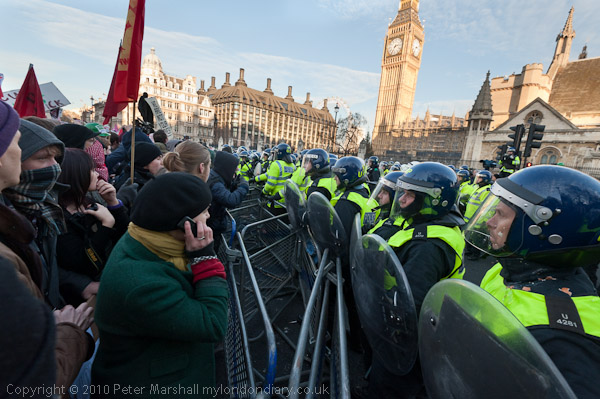
Around a thousand people including many lawyers and other campaigners for justice blocked the road in front of the Ministry of Justice for a lengthy rally against proposed changes to the legal aid system which would mean that instead of people being defended by lawyers with the relevant expertise they would be assigned to the company who had made the cheapest bid. Large companies with little legal connection including Eddie Stobart and Tesco were expected to bid for the work, putting the many small specialist law firms which currently exist out of business.

As speakers pointed out these changes threaten the very heart of our legal system, severely reducing the chances of those who are not rich to get justice.
The changes were being proposed without proper consultation and regulations to bring them were tocome into effect within 3 months, without any pilot scheme, without an debate in the Houses of Parliament and with no proper examination of the evidence.
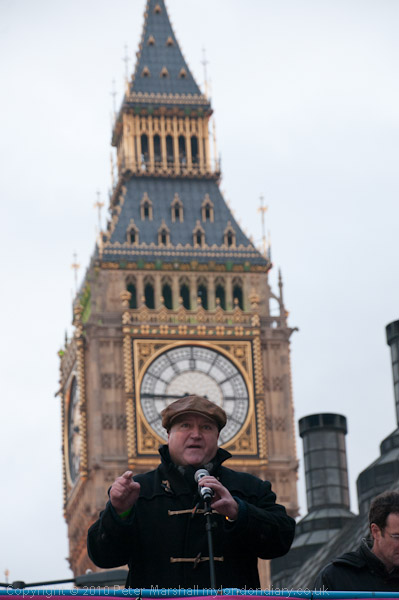
Among the speakers were several QCs, including Dinah Rose, Geoffrey Robertson and Michael Fordham, representatives of human rights organisations and charities, MPs David Lammy, Jeremy Corbyn, shadow justice minister Andy Slaughter and Bianca Jagger.

Many more pictures including those of most of the speakers at Save Legal Aid & British Justice.

For and against Gay Marriage – Old Palace Yard

Two groups of protesters were in Old Palace Yard. Stonewall had come with posters, t-shirts and vuvuzelas along with other LGBT protesters including Peter Tatchell and there were others including one in drag waving a rainbow flag.

A short distance to the side were a similar sized group organised by Christian Concern, an evangelical organisation who prayed and sang, murdering ‘Amazing Grace’ several times while I was there. At there centre were a black couple dressed as a bride and groom standing on a base resembling a wedding cake.
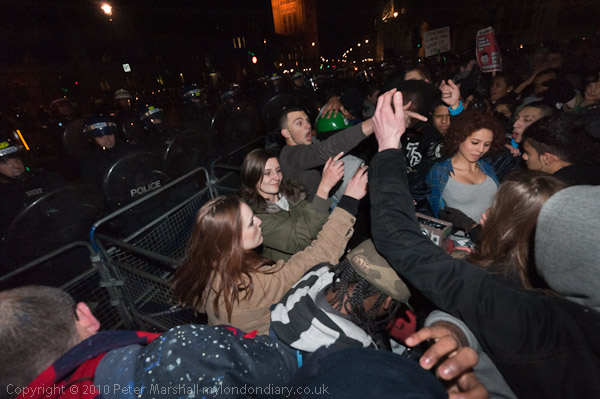
As well as these two groups which carefully avoided any direct conflict – one woman from ‘Christian Concern’ who came and began to tell the LGBT protesters that she was praying for them was quickly dragged away by one of their organisers – there were also a number of religious extremists also wandering around the area and protesting much of the day, some holding up large print posters of Bible texts, others standing still and preaching – though as I pointed out there there seemed to be nobody listening to their amplified sermonising.

I think the real debate is not about marriage but about having an established church which has made marriage both a civil and a religious contract. The law should clearly separate the two and religious bodies can now outside the established church do so should they chose. Some Christians would have no problems with having religious ceremonies for gay marriages, but others would not be forced to do so.

My elder son and his bride had two ceremonies some weeks apart, one a religious one with an Imam officiating and the other, some weeks later, with an official registrar present. Marriage law is essentially about the civil contract and I can see no reason against this applying to any couple whatever their genders – nor did the House of Lords.

More pictures at For and against Gay Marriage.


Knife Crime & 1984 Sikh Genocide

Five years ago today on Saturday 3rd June 2018 I photographed two events in London, beginning with a protest opposite Downing Street by campaigners against gun and knife crime and moving on to an annual march remembering the 1984 Indian Army attack on the Golden Temple in Amritsar where thousands of Sikhs were massacred, and the Indian government encouraged mob killings of Sikhs across the country following the assassination of Indira Gandhi by her Sikh bodyguards later in the year.


Anti-Knife UK protest – Downing St

Knife Crime & 1984 Sikh Genocide

The event was organised by Anti-Knife UK, founded by Danny O’Brien in 2008 which monitors knife crime incidents from across the UK on a daily basis. 2008 had been a particularly bad year for the murder of teenagers on London’s streets, with 29 deaths, and thought the numbers had gone down until 2012 when there were 9 such deaths by 2017 they back up to 27.

Knife Crime & 1984 Sikh Genocide

All of these deaths are tragedies for the teenagers and their families, and the numbers of crimes involving knives across England and Wales is huge – now over 45,000, though many of those are for possession of knives – and the total number of deaths is the year ending march 2022 was 261.

Knife Crime & 1984 Sikh Genocide

Many of those at the protest were bereaved family members and their supporters and were wearing t-shirts or holding placards with photographs of the knife victims and pairs of empty shoes as well as banners.

Knife Crime & 1984 Sikh Genocide

Speakers called for measures to tackle the problem including tougher sentences, tagging of all knives, knife arches in night clubs, equal rights for victims and families, a review of the laws governing self-defence and reasonable force and work in schools and communities.

More pictures at Anti-Knife UK protest.


Sikhs remember the 1984 genocide

I went to meet a large crowd of Sikhs at a rally in Hyde Park before the march, sitting on the grass. It was 24 degrees in London, and without any shade I was far too hot. Few of the speeches were in English, but many of the placards were and others graphically made their message clear.

Sikhs were badly treated by the British at the time of partition which divided the country up between the Hindus and Muslims, with millions of people having to flee across the borders of the new states and millions were terribly killed in doing so. Sikhs had called for an independent Sikh state in the Punjab, but most were simply lumped in, along with Buddhists and Jains with Hindu dominated India, although large numbers also remained in the part of the Punjab which had been designated as Muslum Pakistan.

Although there were large numbers of Sikhs across the Punjab before partition were still a minority population and they were not united in their demands for an independent state of Khalistan. Althugh they would probably have been better joining Pakistan, their cultural ties to Hinduism as well as a history of persecution by Muslims led them to instead unite with India. Many Sikh leaders had been involved with the Indian Congress Party which had made them promises about their position in India where the are less than 1% of the population but these were never kept.

The idea of a separate Khalistan became talked about more widely particularly in the diaspora in the 1970s, with the movement in Punjab led by Jarnail Singh Bhindranwale advocating an autonomous state within India. The movement had become increasingly militant with a number of armed supporters, setting up in 1982 what Wikipedia describes as ‘what amounted to a “parallel government” in Punjab‘.

In June 1984, the Indian Army launched Operation Blue Star to remove Bhindranwale and his armed followers from the Golden Temple complex in Amritsar, killing Bhindranwale and large number of his supporters as well as many civilians as the temple was packed with pilgrims. The figures for deaths are disputed but probably between 5-7,000, with around 700 of the Indian army also dying.

In 2018 I commented “Since this 1984 Sikh genocide there has been a continuing program of police arrests, torture and killing of Sikh males in the Punjab and crippling economic and social policies. Sikhs demand independence from India and a Sikh state, Khalistan.”

After the rally the march set off, led by Sikh standard bearers and five Khalsa representing the Five Blessed Ones or Panj Pyare holding swords and walking barefoot in their orange robes and followed by several thousand Sikhs with flags, placards and banners. I talked with them past Marble Arch and down to Hyde Park Corner where I left them going down Piccadilly towards another rally at the end of the march in Trafalgar Square.

You can see many more pictures and captions describing the event on My London Diary at Sikhs remember the 1984 genocide.

Turkish Spring, Badgers and BNP – 2013

Turkish Spring, Badgers and BNP: Ten Years ago on Saturday 1st June 2013 Turks in London were celebrating the start of the Turkish Spring, but now they are mourning last Sundays’ election results with the Islamist dictator winning another term in office. Badger culling was just beginning and there is still no sign it will actually end and over 210,000 badgers have now been killed to little effect – and Defra is still failing to introduce more effective methods to control bovine TB. Anti-fascists managed to prevent the BNP laying a wreath to exploit the killing of Lee Rigby – but despite the family’s clearly stated wishes and MoD condemnation – racists including a leading Tory MP are still using the murder to whip up hatred.


London Supports Turkish Spring – Marble Arch

Saturday 1st June 2013

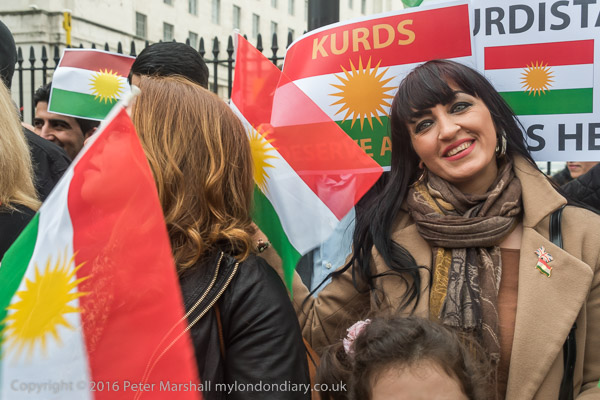
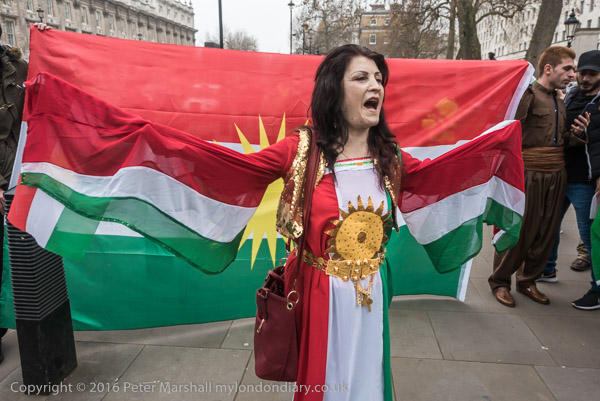
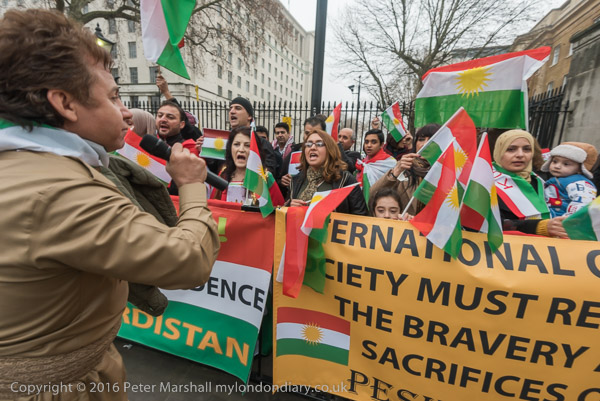
A large crowd, mainly Turks and Kurds from North London, met in Hyde Park close to Marble Arch for a march in support of the popular protests that had erupted over the previous few days over Gezi Park.

Saturday 1st June 2013

At first there had been small protests against the loss of one of Istanbul’s few remaining green spaces for a shopping mall. But brutal police repression, with tear gas and water cannon used indiscriminately on people in the area angered many and the protests grew, becoming protests calling for an end of the authoritarian Erdogan regime.

Saturday 1st June 2013

Many Turks were then disturbed at Erdogan and his Justice and Development Party (AKP), abandoning the secular state established as the basis for modern Turkey in the 1920s by Kemal Atatürk towards a conservative authoritarian Islamic dictatorship.

Saturday 1st June 2013

This process has continued, and Turkey has also been involved in the supporting of wider Islamic movements in the Middle East, particularly ISIS, as well as supporting Russia in its intervention in crushing the anti-Assad revolt in Syria. Last week’s election came as a huge blow to democracy in Turkey.

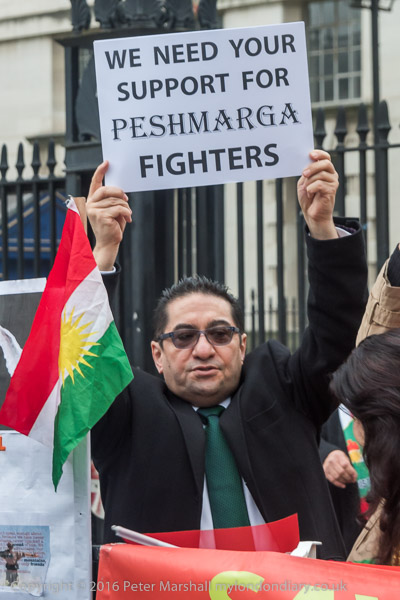
The 2013 protest was high-spirited and noisy, with many young men including Turkish football supporters. Many of London’s Turkish and Kurdish community are people who had to flee Turkey for political reasons and their sons and daughters. Kurds in particular have long been subjected to huge discrimination and oppression with the Turkish government attempting to eliminate their culture.

I had to leave before the march to the Turkish Embassy were around four thousand protested in support of the ‘Turkish Spring’.

London Supports Turkish Spring


Cull Politicians, Not Badgers – Westminster

I joined a large crowd at a rally in front of Tate Modern for the National March Against the Badger Cull, where the speakers included Queen Guitarist Brian May.

Many at the protest had come up to London from country areas, particularly from the pilot areas in west Gloucestershire and west Somerset where culling was to start later in the year. Many more licences were issued in later years and culling is continuing. Detailed statistical analysis suggests in some areas culling has led to a slight decease in bovine TB but overall it has had no real effect as badgers are only responsible for a small amount of the transmission, with 94% of infection being passed from cow to cow.

Defra’s support for culling and their reluctance to bring in more accurate cattle testing, controls on the movement of cattle, vaccination, proper slurry management and other effective measures seems largely to be driven by lobbying from farmers who want to avoid more controls on their activities.

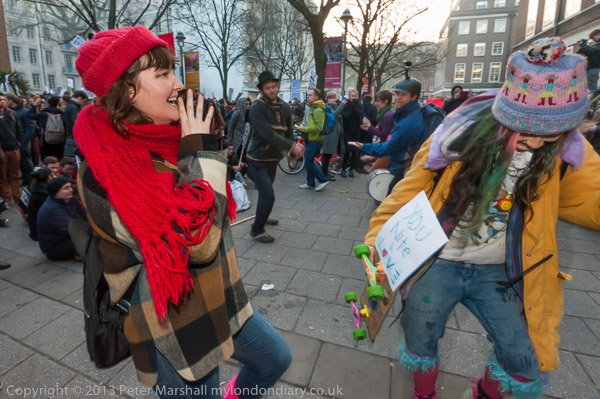
After the rally there was a short march to Parliament where some of those taking part danced on the street, with many then going on to join the protest taking place opposing the racist British National Party.

Cull Politicians, Not Badgers


Anti-Fascists Prevent BNP Exploiting Brutal Killing

Anonymous were there along with Antifa, trade unionists and the UAF to oppose the BNP hate

On May 22nd 2013, off-duty Fusilier Lee Rigby was brutally murdered on a Woolwich street, run over then stabbed by two Muslim men who tried to decapitate him. The killing was universally condemned, including by Britain’s Muslim community, and I had two days ago photographed a march and rally in East London by Muslims to show solidarity and sympathy with the family of Lee Rigby and to denounce his brutal killing, describing it as against all the tenets of Islam.

Nick Griffin answers questions under a placard ‘Hate Preachers Out’ and fails to appreciate the irony

The BNP had wanted to organise a mass protest in Woolwich to exploit the killing, making use of his senseless slaughter there to gain support for their anti-Muslim rhetoric, but police had banned their plans for a march as it would have endangered public safety, enraging many in the local area. Lee Rigby’s father had made clear that he and his family did not want his son’s death to be used to stir up hatred.

Instead, BNP leader Nick Griffin had planned to march to the Cenotaph and lay a wreath there, and had come with a small group of supporters to Old Palace Yard to start the march. It was only a very small group, even for the BNP, with perhaps as I wrote suggesting “it was something that even the ultra-right membership of the BNP could not stomach”.

Griffin himself blamed the low turnout on the police turning many of his followers away, stating that the whole area around Westminster was “a virtual exclusion zone“. I’d just walked there seeing no unusual police activity, and certainly large numbers who had come to oppose his wreath laying found no problems in getting in to do so.

Police arrest an anti-fascist

It would have been possible for anyone – BNP member or not – to go to the Cenotaph on any of the days following the brutal murder and even on this morning to lay a wreath, though not today a well-known racist face like Griffin himself. But Grffin’s intentions were not about expressing sympathy. He wanted a triumphal march with flags flying to gain support for his Islamophobic hate, and given the opposition this never seemed likely to happen.

Police tried hard to clear a way for the BNP to march, but anti-fascists held their ground and refused to move. Police told them they were acting illegally and would be arrested if they did not move – and I saw a couple of double-decker buses being filled with arrested protesters and driven away, but there were simply too many for police to arrest them all.

The protest brought back memories of Cable Street, though few if any there were old enough to have actually been there back in 1936, though rather more had been at the http://mylondondiary.co.uk/2006/10/oct.htm 70th anniversary. But as then the slogan was ‘They shall not pass’, and on this occasion there were not enough police to force a way through. After the two buses of arrested protesters had been driven away police tactics changed and they simply maintained a standoff keeping the opposing groups apart.

Police told the BNP that they expected the anti-fascists to go home and they expected be able to clear the route by half past four, but they stayed on. It was the BNP who gave up, turning around and walking back to waiting coaches and leaving. When the anti-fascists were told the BNP had gone, they marched to Old Palace Yard for a brief rally to celebrate the victory.

Much more about the BNP and the protest which stopped them on My London Diary:
Anti-Fascists Stop BNP Wreath Laying
BNP Exploiting Woolwich Killing Stopped


No Third Runway at Heathrow – 2016

No Third Runway at Heathrow

No Third Runway at Heathrow: Heathrow Airport celebrated its 70th anniversary on Monday 30th May 2016. and local residents marked the occasion with a protest on the village green at Harmondsworth against the plans to build a third runway which would destroy over 750 local homes.

No Third Runway at Heathrow

I grew up under the flightpath a couple of miles from touchdown on the main runway used for incoming flights, standing in my back garden and crossing off the registration letters of the planes passing rather close overhead in my spotters book. Those early planes – like the Douglas DC3 and the Vickers Viscount – were small and relatively quiet and gave young boys like me hours of interest with little disruption of normal life, but the generations that followed were very different, larger and ear-shattering. The complaints against their noise grew rapidly – and those easy to read letters on the underside of the wings disappeared so it was harder to identify flights in our complaints.

No Third Runway at Heathrow

Heathrow had been planted on the edge of London’s built up area by deception, beginning as a ‘military’ airport towards the end of the Second World War when it was known it would never be used as such, by people who were determined to make it London’s major civil airport. They did it to get around the objecteons there would have been later to a civil airport here.

No Third Runway at Heathrow
A huge mis-cake’ Heathrow Airport: Celebrating 70 years of unrelenting Aircraft Noise for local communities’

Over the years Heathrow continued to grow and grow. More flights and more terminals. More local traffic and more pollution. Every new development was made with promises that were later broken. T4 was promised to be the last new terminal – but then came the application to build T5. With this came the promise that Heathrow would never ask for another runway – but this was broken even before T5 had opened.

The enquiry into the third runway was said to be final – but while the local community were still celebrating their victory – and David Cameron was saying ” No Ifs, No Buts, No Third Runway”, Heathrow Airport was already plotting the setting up of a new inquiry that would somehow against all the evidence come up with the result they wanted – the Davies Commission.

John Stewart – HACAN – Heathrow want taxpayers to pay for the new roads, tunnels etc needed

In 2016 the threat of the new ‘third runway’ loomed dangerously over the area again, with the Conservative Government backing the proposals. Many of those who came to the event at Harmondsworth feared they would soon lose their homes – and property in the area was blighted as it had been for many years. Others outside the actual development would find their lives made impossible by aircraft noise, with people from almost the whole of West London suffering, particularly from flights in the early morning, with plane after plane passing overhead.

The Heathrow Adobe Hat, with portable air purifier and environmentally biodiverse suitcase

Heathrow’s noise and pollution affect a surprisingly large area of London. Twenty years ago I was in a hospital bed in Tooting in south London, around 12 miles away as the jet flies, awake early in the morning partly by their noise, watching and hearing a whole line of plane after plane in line for touchdown.

Neil Keveren, Chair of Stop Heathrow Expansion (SHE)

In our local area we get the pollution from the planes, both from running their engines on the ground and also from takeoff and landing. But more importantly the airport generates huge amounts of road traffic, both on local roads and the motorways serving the area – M3, M4 and M25.

Seven years on it seems increasingly unlikely that there will ever be a third runway built. Even the most jet-headed politicians are beginning to see that we cannot continue with airport expansion and meet the need to cut carbon emissions. Financial constraints increasingly make it less likely too.

My post on My London Diary has the details about the event on Monday 30th May 2016 and of course more pictures, including some of the village itself, including its pubs, church and remarkable Grade I listed tithe barn, said to be the largest wooden structure in the country, dating from 1426. Local campaigners saved that a few years ago and it was bought by English Heritage in 2012 and has been much restored. It lies just outside the area the airport would take over for the new runway and would be at serous danger from vibration – and would almost certainly need to be re-sited.

A church window remembers Ann & Bryan Sobey who led the ‘Right to Sleep’ campaign for restrictions on night flights into Heathrow

Though on the edge of London Harmondsworth still has a village atmosphere, and still seems much like the village I cycled through in my youth. I hope it remains that way.

More at No 3rd Runway Heathrow 70th Birthday.