Margaretta D’Arcy, Education & African Refugees – 2014

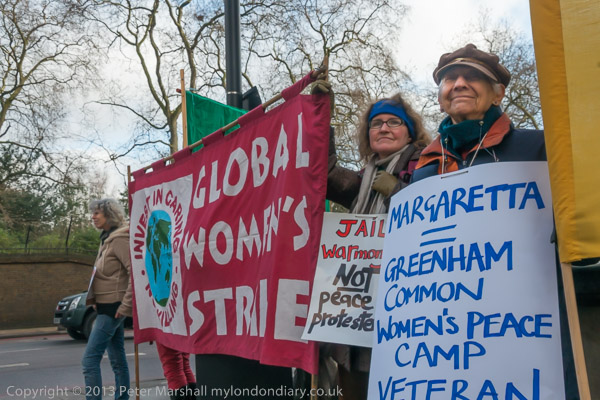
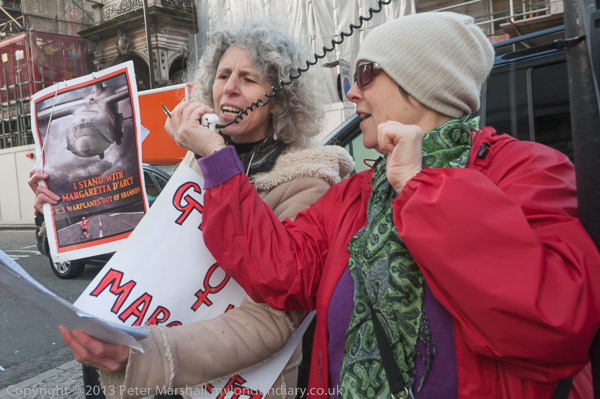
Margaretta D’Arcy, Education & African Refugees: On Wednesday 22nd January I photographed a protest at the Irish Embassy demanding the release of anti-war activist Margaretta D’Arcy before going to a peaceful march by London Universitry students for democratic, public education free from exploitation and police violence. Finally I went to a protest close to the Israeli Embassy in Kensington in solidarity with African asylum seekers in Israel who are protesting their against arbitrary arrests, imprisonment and inhumane treatment.


Release Margaretta D’Arcy Now!

Irish Embassy
Margaretta D'Arcy, Education & African Refugees - 2014
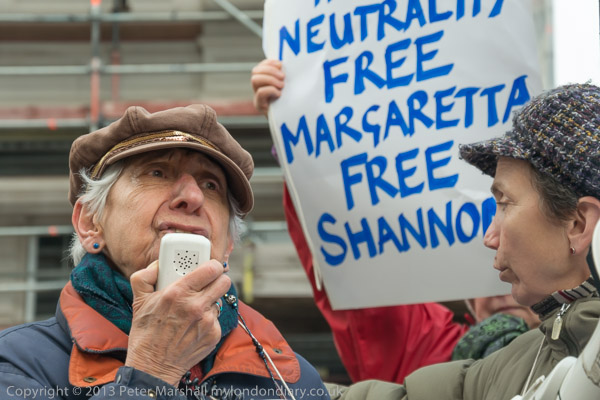
Selma James calls for the release of Margaretta D’Arcy

Margaretta D’Arcy (1934 – 2025) was an prominent Irish actress, writer, playwright and anti-war activist and a veteran of the Women’s Peace Camp at the US airbase on Greenham Common, where she had been a powerful member of the group at the ‘Yellow Gate’; protests by the Peace Camp eventually led to a legal challenge and the closure of the US Base with its cruise missiles.
Margaretta D'Arcy, Education & African Refugees - 2014

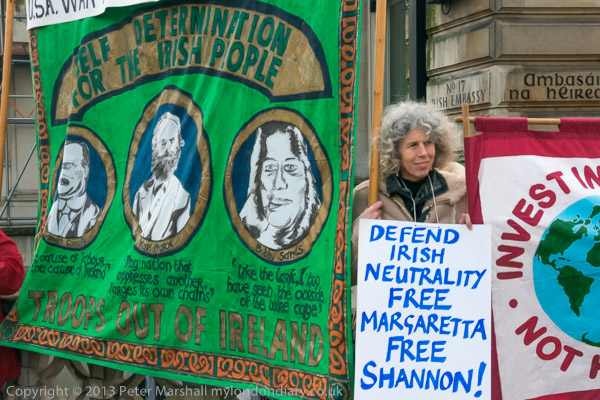
Earlier in 1961 D’Arcy had joined the anti-nuclear Committee of 100 and in 1981 had been imprisoned for the first time after defacing a display at the Ulster Museum. Active in many campaigns in Ireland including the Shell to Sea campaign against the Corrib gas project and the Ireland Palestine Solidarity Campaign, she was arrested in October 2012 for lying down on the runway at Shannon in a peaceful direct action by members of Galway Alliance Against War against the use since 2001 of Shannon by Galway Alliance Against War in violation of Irish neutrality.
Margaretta D'Arcy, Education & African Refugees - 2014

D’Arcy received a suspended sentence but after she had been arrested again on the runway at Shannon in September 2013 and she refused to sign a bond to keep out of restricted areas at Shannon the suspended 12-week sentence was reactivated. After serving nine and a half weeks of this she was released from Dublin prison in March 2014. She continued her activism until a few days before her death in 2025.
Margaretta D'Arcy, Education & African Refugees - 2014

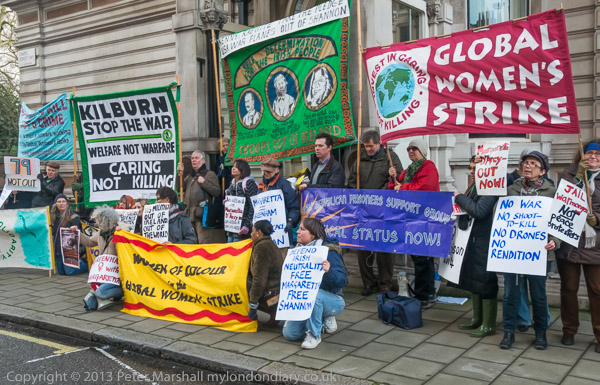
The protest at the Irish Embassy in London took place a week after D’Arcy was arrested to serve her suspended sentence, and around 50 people had come with banners and posters for a protest outside the Irish Embassy in London and to deliver a petition calling for her immediate release.
Margaretta D'Arcy, Education & African Refugees - 2014

On My London Diary I list some of the many groups who supported the protest and most of those who spoke.

Release Margaretta D’Arcy Now!


Students March to Protect Education

London University & Holborn
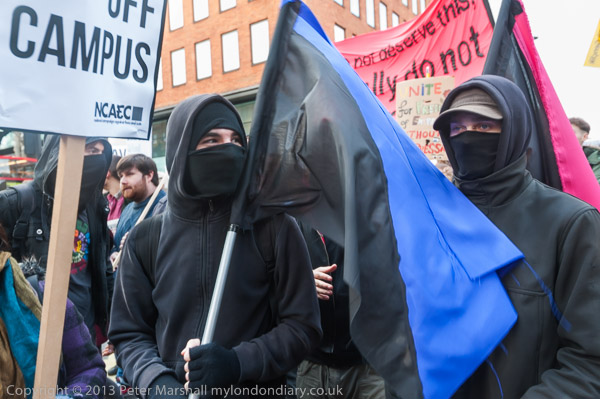
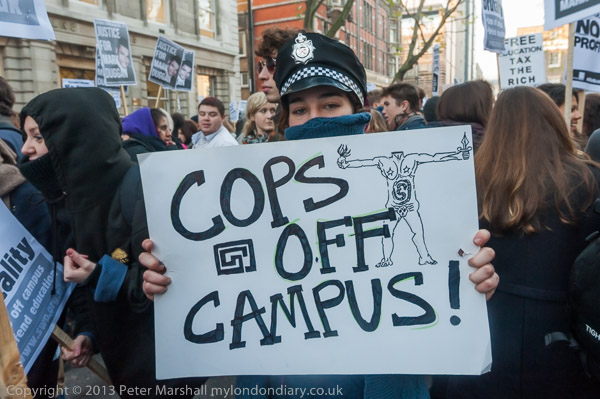
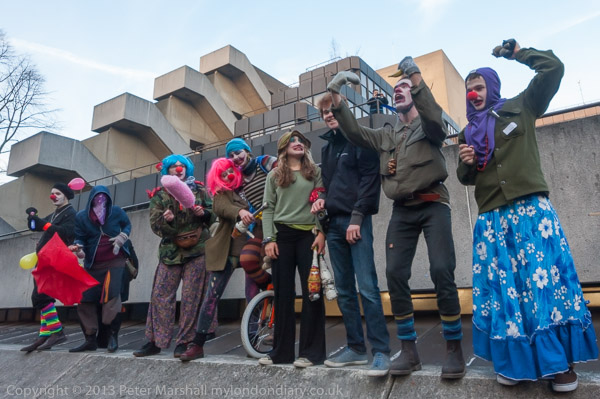
The protest by London University students took place following a number of incidents in London and elsewhere the previous term when university management had called police onto the campus or gone to the courts to prevent or oppose student protests or to harass students. This had led in December 2013 to a Cops Off Campus National Student Protest.
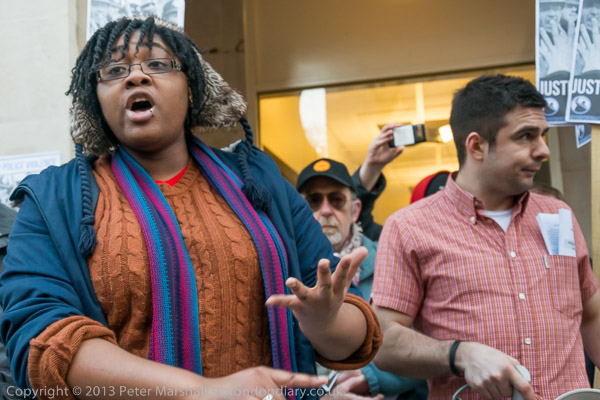
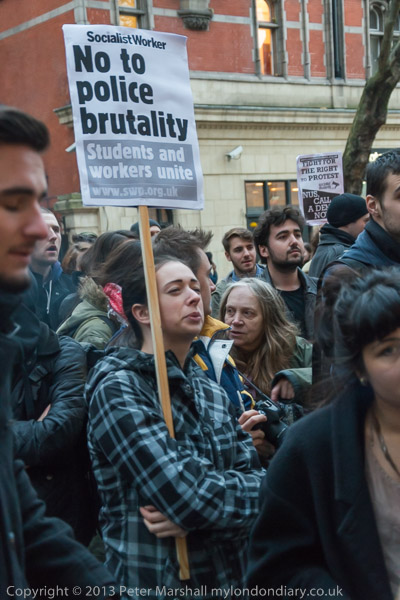
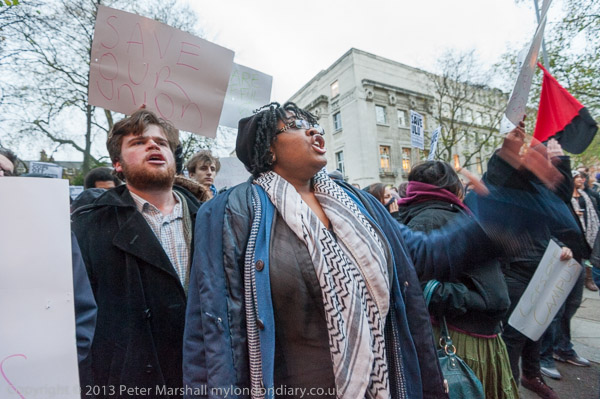
A student speaks about police violence, and in particular violence directed at the black community including the killing of Mark Duggan

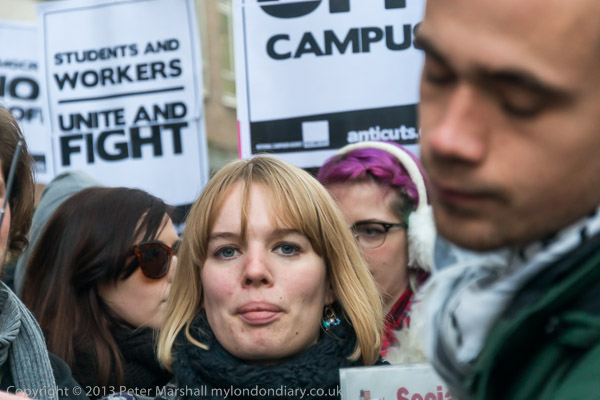
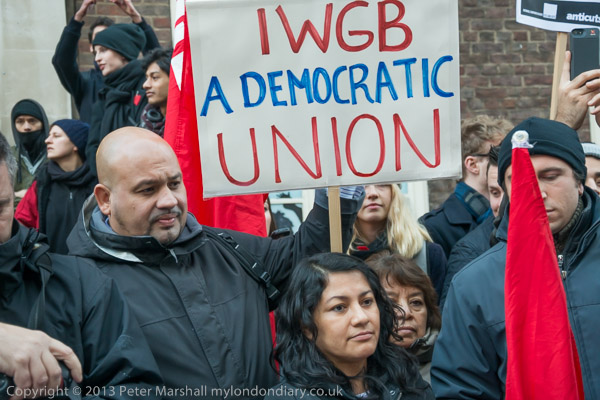
The protest began outside the University of London Union which the university is closing down with a speech by ULU President Michael Chessum and also by representatives of the lecturers who were taking action that week and the cleaners, maintenance and security staff who were about to hold a 3-day strike in their ‘3 Cosas’ campaign for sick pay, holidays and pensions, as well as for recognition for their union, the ndependent Workers’ Union of Great Britain (IWGB). Another student spoke about police violence, in particular against the black community.
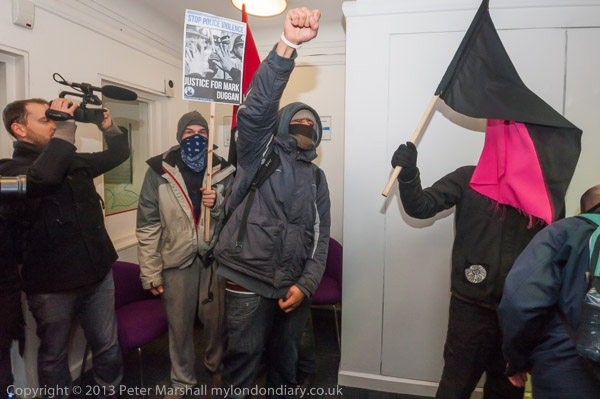
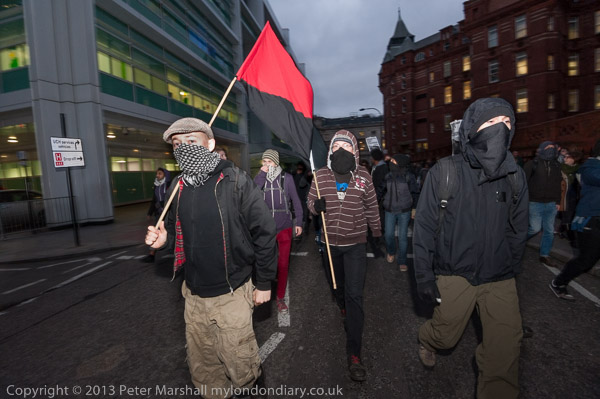
A few from the black bloc enter Woburn House, home to theUniversity & Colleges Employers Association but it was only a token gesture

The marchers then went on a tour of key university sites including Senate House and the University & Colleges Employers Association in Tavistock Square where there was a brief token occupation of the lobby before going on to protest outside Holborn Police Station. Here as well as protesting against police violence they also protested the police execution of Mark Duggan.
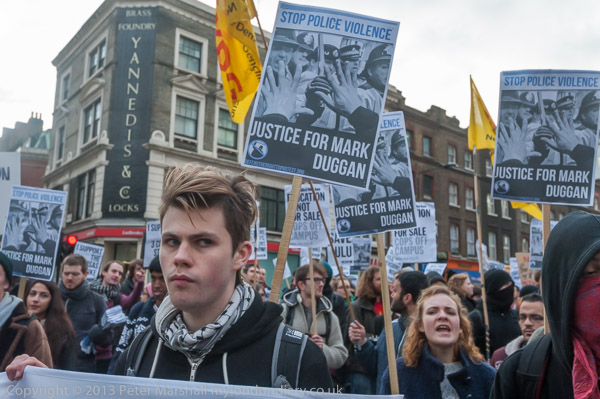
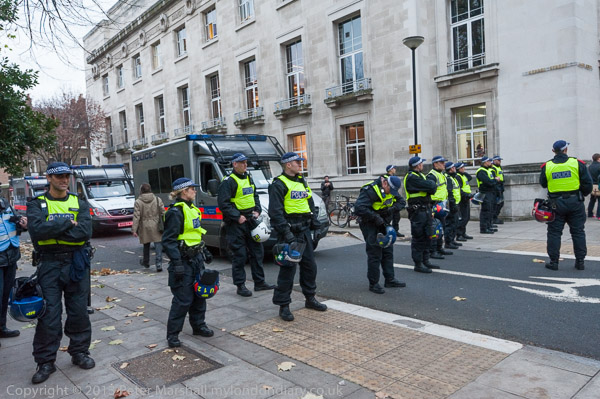
They continued down Kingsway to Aldwych and the Strand, ending the march with a short rally outside the Royal Courts of Justice. The police had kept at a discreet distance while the students were in the university area but both the police station and the law courts were guarded by a line of police.
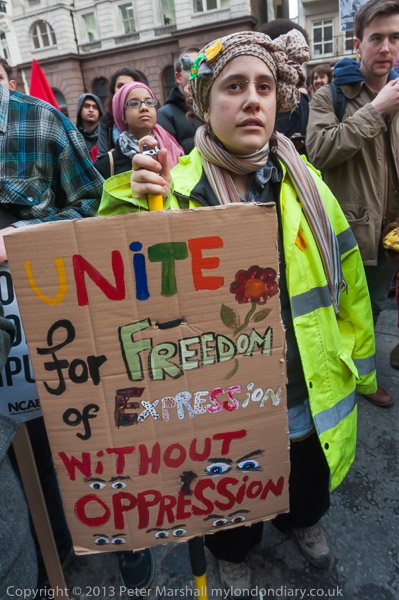
At the end of the rally Alfie Meadows suggested people might like to go on to a protest at the Royal Opera House, where the cleaners are also going on strike the next month for a living wage and proper conditions of work. About half the students then marched off with him, but I needed to leave for another event.

Students march to protect Education


Solidarity with African Refugees in Israel

Israeli Embassy, Kensington
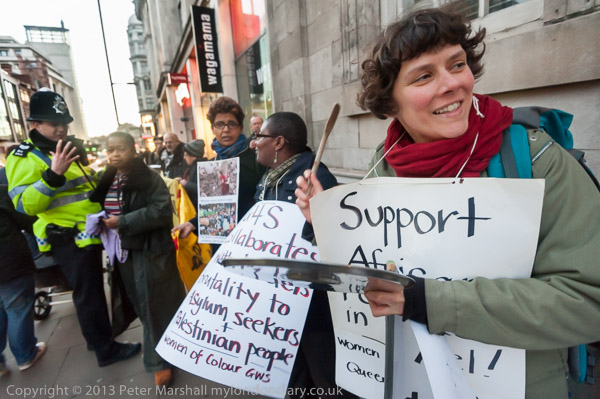
Tens of thousands of African asylum seekers had been protesting in Israel since the start of the year holding mass rallies against their treatment by the Israeli authorities.

Protesters stand on the pavement in front of the private road in which the Israeli embassy is located

In December new laws in Israel had meant entering the country without proper papers could be held for up to a year without trial, and those already in the country could be held in indefinite detention. The detention facility in the Negev desert, like many other Israeli prisons, is run by the private security company G4S.
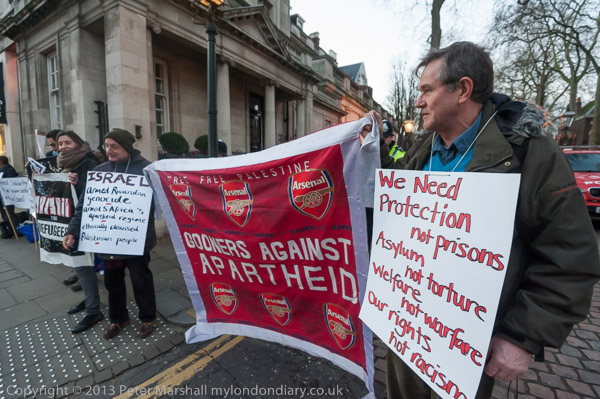
There were around 50,000 refugees currently living in Israel, most who had fled brutal conflicts in Sudan and Eritrea, with only a few hundred of their applications had been processed. Most keep alive by working illegally, exploited and in fear of arrest.
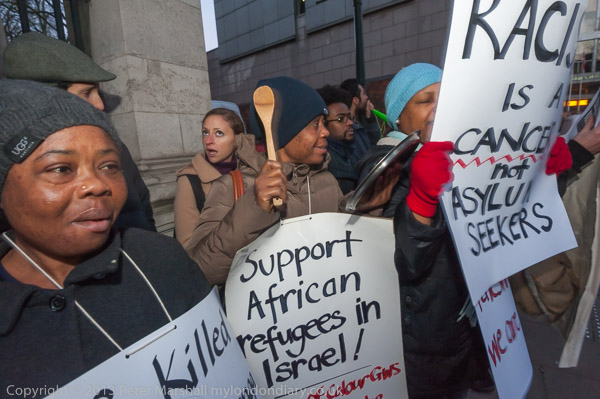
Recently a strike by those working as cleaners, cooks, dishwashers and other low paid workers had brought many restaurants, hotels and businesses to a standstill. They held a rally with over 20,000 in Rabin Square in the centre of Tel Aviv with banners saying ‘We are refugees, not criminals’ and demanding their rights.
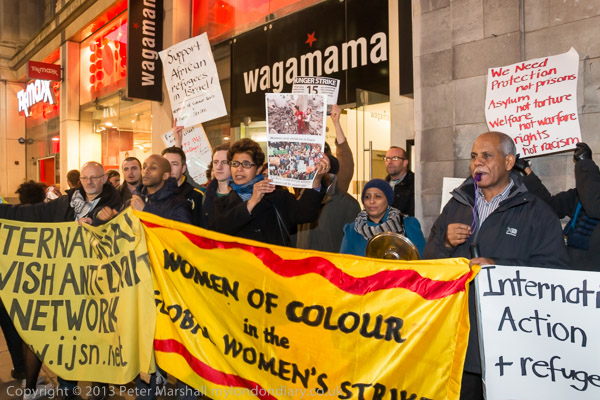
The London protest was one of many around the world following a call by the African Asylum Seekers Community in Israel for international solidarity. It isn’t possible to protest outside the Israeli Embassy in London which is down a well-guarded private street, but the protesters gathered on the pavement in front of the entrance to this street, refusing police attempts to move them further away.

More pictures at Solidarity with African Refugees in Israel


FlickrFacebookMy London DiaryHull PhotosLea ValleyParis
London’s Industrial HeritageLondon Photos

All photographs on this page are copyright © Peter Marshall.
Contact me to buy prints or licence to reproduce.

Marine A, Mandela, CPS Failures, Cops off Campus – 2013

Marine A, Mandela, CPS Failures, Cops off Campus: On Friday 6th Decemeber 2013 some very varied events were taking place in Central London. Here they are in the order I photographed them.


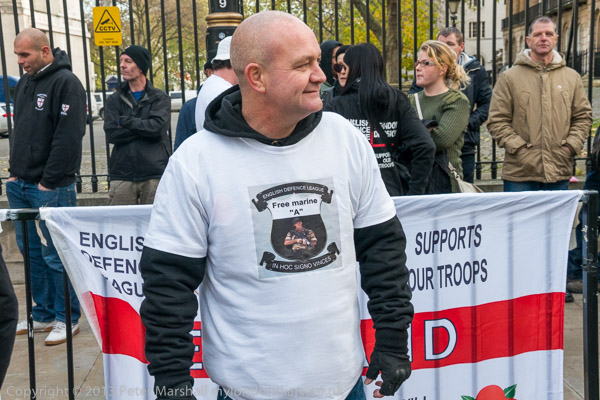
EDL Protest Supports Marine A – Downing St

Marine A, Mandela, CPS Failures, Cops off Campus - 2013

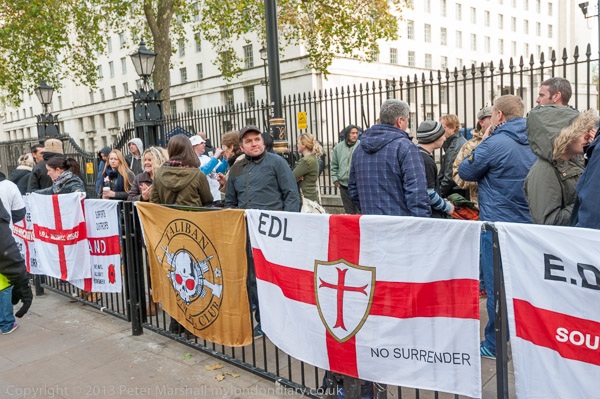
The EDL had called for a major protest at Downing Street on the day that ‘Marine A’, Sergeant Alexander Blackman, was to be sentenced, but only around 50 supporters were there when I arrived.

Blackman was being tried for the murder of a wounded Taliban insurgent in Afghanistan in contravention of the Armed Forces Act 2006, and became the “first British soldier to be convicted of a battlefield murder whilst serving abroad since the Second World War.

Marine A, Mandela, CPS Failures, Cops off Campus - 2013

I commented “I doubt if there are many serving soldiers who would wish to see the Geneva conventions disregarded, and wonder what support if any this protest would have from serving soldiers, many of whom have condemned strongly the cold-blooded killing of a prisoner by Marine A and called for an appropriate sentence.

However many did feel when later that day he was sentenced to “life imprisonment with a minimum term of ten years and dismissed with disgrace from the Royal Marines” he had been treated harshly, and in 2014 the sentence was reduced to eight years, then after a public campaign overturned on appeal and reduced to manslaughter on the grounds of diminished responsibility. Given the time he had served he was released in April 2017.

EDL Protest Supports Marine A


Tributes to Mandela – Parliament Square & South Africa House

Marine A, Mandela, CPS Failures, Cops off Campus - 2013

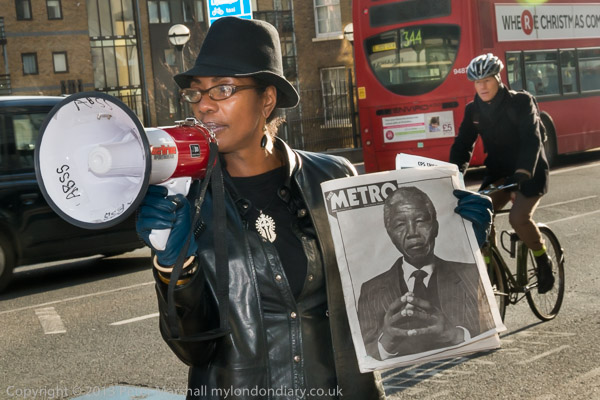
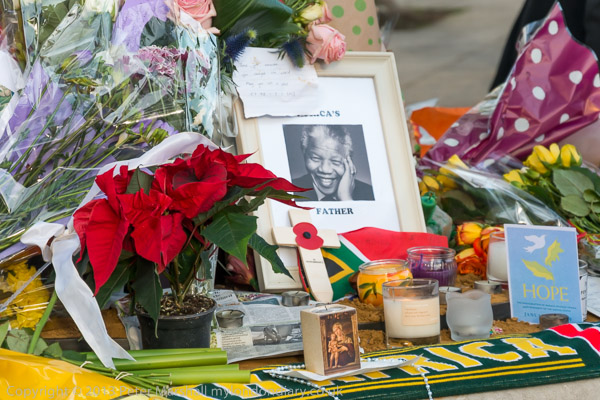
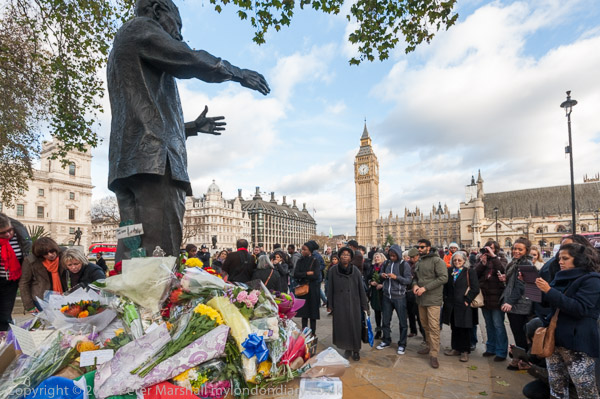
Nelson Mandela, the “Father of the Nation” who had become the first president of a new post-apartheid South Africa from 1994-1999, having previously spent 27 years in prison before his release in 1990, had died the previous day, 5th December 2013.

Marine A, Mandela, CPS Failures, Cops off Campus - 2013

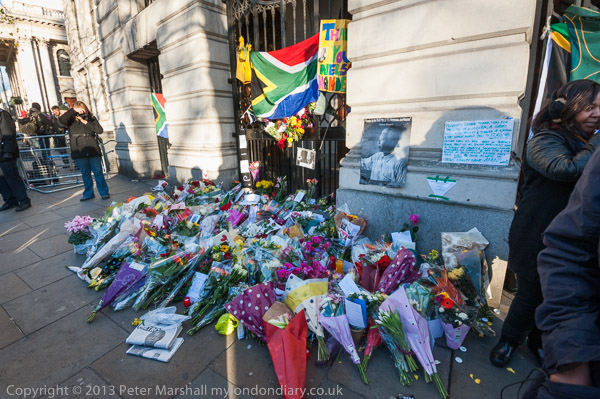
People brought flowers to the Nelson Mandela statue in Parliament Square and to South Africa House in Trafalgar Square, where a long queue waited patiently for several hours to sign a book of remembrance in the High Commission.

Tributes to Mandela


Bereaved protest at CPS Failure – Southwark Bridge

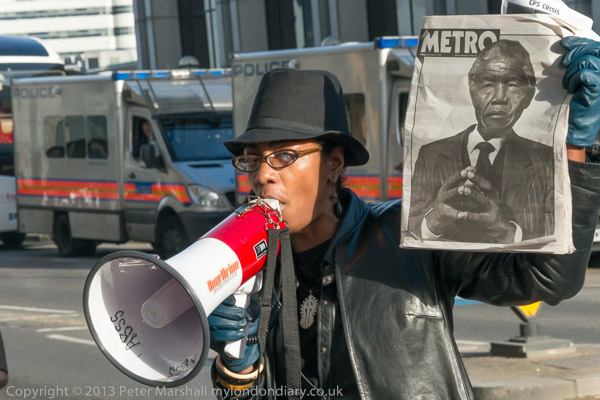
Marcia Rigg holds a picture of Mandela as she addresses the protest against the PCS

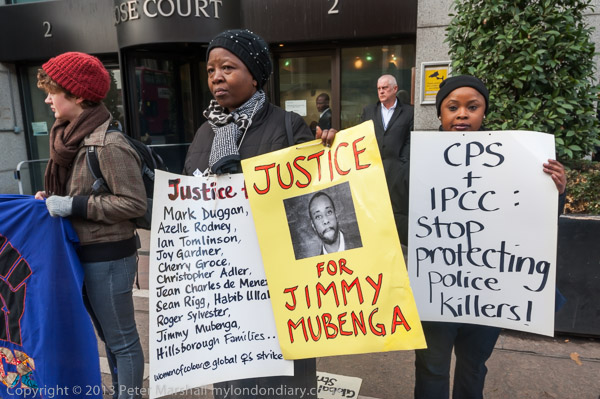
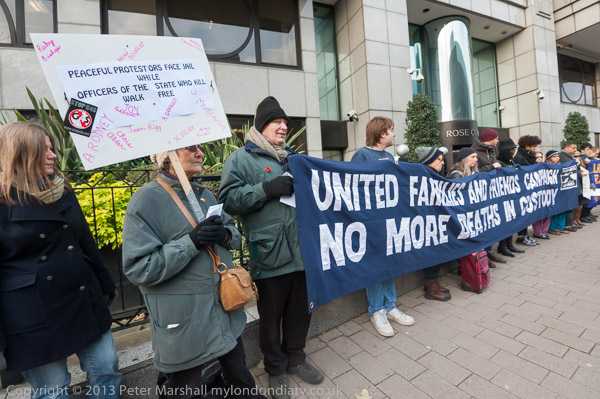
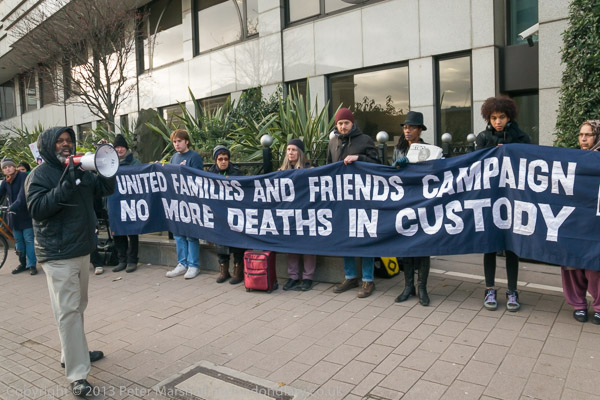
Since 1990 there had been 1433 deaths of people in custody, many under highly suspicious circumstances and not a single conviction of any police, prison officers or security guards who have either failed in their duty of care or more actively caused their deaths.

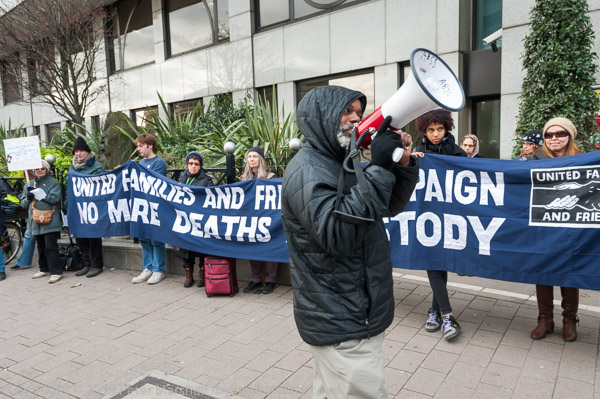
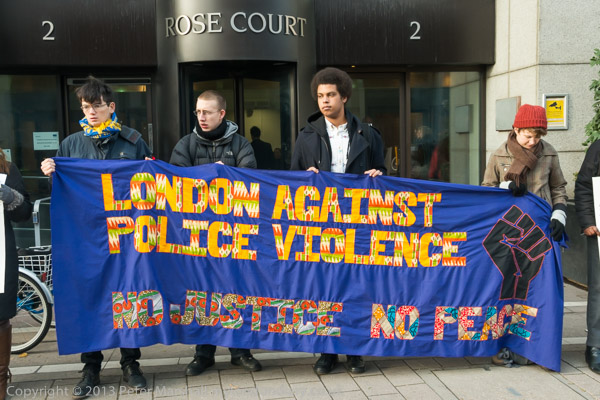
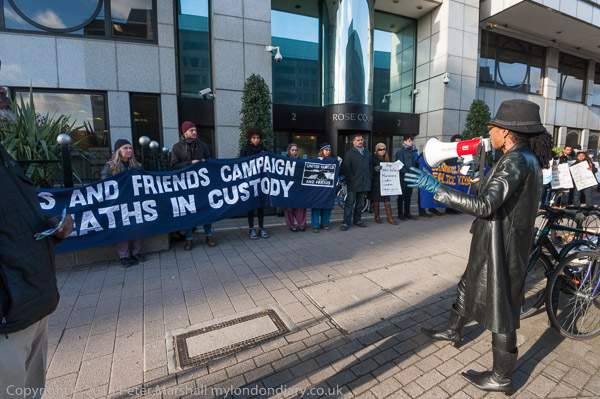
Relatives and friends of those who dies had come to protest outside Rose Court, the home of the Crown Prosecution Service. The last successful prosecution brought against a police officer was for involvement in a black death in custody was in 1972, after the death of David Oluwale in 1969. Police officers have been prosecuted for several other black deaths in custody – Joy Gardner, Christopher Alder and Mikey Powell – but none was successful.

The standard response from the CPS – led by Keir Starmer from 2008-2013 – is that there is ‘not enough evidence to prosecute’, largely because the cases have not been properly investigated. Often the police involved are simply not questioned, and in some other cases they simply refuse to answer questions.

Bereaved protest at CPS Failures


‘Cops Off Campus’ Protest Police Brutality – Bloomsbury

Following protests by students and others against student fees and cuts, the closure of the student union and calling for acceptable pay and conditions for low paid largely migrant cleaners, catering staff, security staff and others, the University management had tried to ban protests on campus and had brought in numbers of police to enforce that ban.

This protest was called after the previous day police had brutally assaulted a group of students who had briefly occupied a part of Senate House, arresting a number of students including the Editor of the student newspaper and a legal observer.

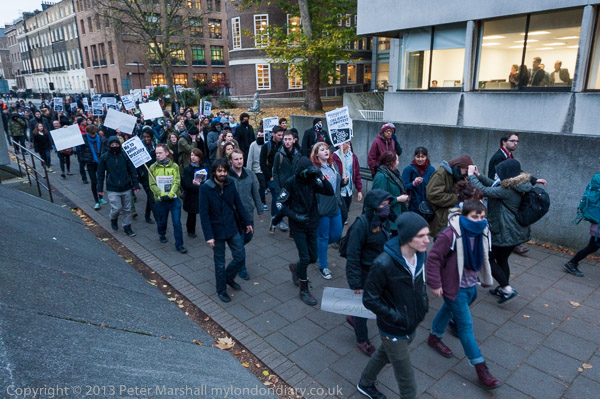
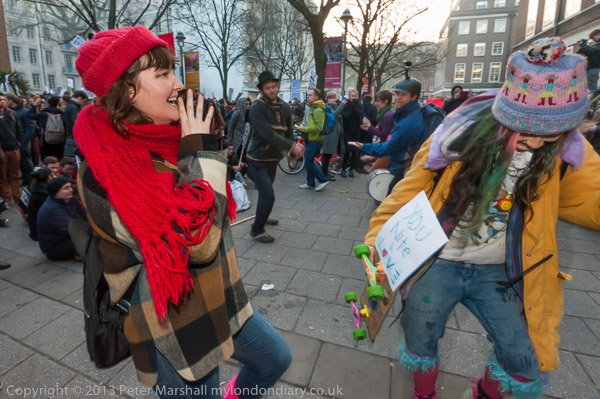
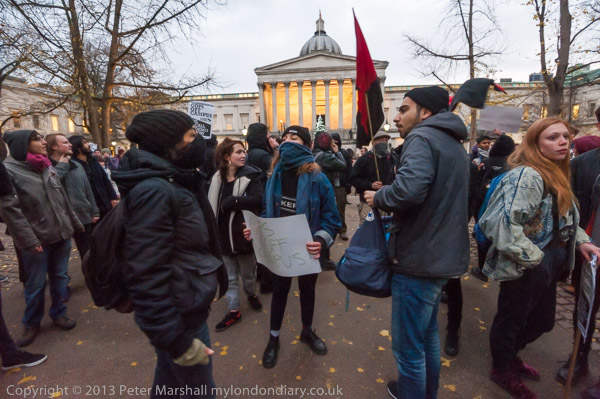
The organisers had intended this to be an entirely peaceful march around the various s sites of the university in the area to the west and north of Russell Square, but it was clear that the police had other ideas. There seemed to be police vans down every side-street in the area as students assembled on the pavement outside the University of London Union in Malet St.

There were a few short speeches before the march set off to walk around the block but were stopped by a line of police across the street, with those who tried to walk through it thrown roughly backwards.

They turned around only to find police blocking both the other end of the street and a side street leading to Gower Street and their only way open was to go onto the campus, walking past SOAS and out onto Thornhaugh Street. There they turned up into Woburn Square and then turned to make their way into UCL, only to find the gates from Torrington Place were locked and guarded by security.

They then turned into Gower Street where they saw another group of police rushing towards them and they then rushed through the gates into the Main Quad. Here there was a lot of discussion about what to do next and they eventually decided to take a back street route to Torrington Square, and set off at a rapid pace. I took a more direct route to meet them there. But by now it was dark and I was tired of walking around London and decided to go home.

The police operation seemed to me “an incredible and pointless waste of public money, and it resulted in more inconvenience to the public than if the event had not been policed at all.” Perhaps more importantly this kind of policing alienates a large proportion of young people, acting strongly to destroy the ‘policing by consent’ which has always been the the basis of our police system.

More at ‘Cops Off Campus’ Protest Police Brutality.


FlickrFacebookMy London DiaryHull PhotosLea ValleyParis
London’s Industrial HeritageLondon Photos

All photographs on this page are copyright © Peter Marshall.
Contact me to buy prints or licence to reproduce.

Cops Off Campus National Student Protest – 2013

Cops Off Campus National Student Protest – Ten years ago today on Wednesday 11th December 2013 I was at the University of London for a large national student protest over the use of police against student protests on campus at several universities around the country.

Cops Off Campus National Student Protest

At Sussex University the management had called the police onto the campus or gone to the courts to prevent or oppose student protests or harass students. A number of students had been arrested.

Cops Off Campus National Student Protest

In London police had been called to protests over the closing down by management of the University of London Union and the 3 Cosas campaign supported by students for a living wage and decent conditions of employment – sick pay, holiday pay and pensions – for the low paid workers on campus. The cleaners union, the IWGB, had come to support the students at this protest.

Cops Off Campus National Student Protest

The previous week in London there had been a large police presence harassing and arresting students at an emergency protest over police brutality in their eviction of students from the Senate House that Wednesday, with a total of over 40 arrests on that day and the following day.

Cops Off Campus National Student Protest

When I had arrived for that protest, there were police vans parked in all the side streets around and later the police made several failed attempts to kettle the large group of students at the protest despite it being intended as an entirely peaceful and orderly march around some of the various sites of the university in the area.

The police actions on that occasion seemed totally unnecessary and it was hard not to see them as a deliberate attempt to provoke a violent response, but the students kept their heads, moved rapidly and outwitted them. My account of the protest at ‘Cops Off Campus’ Protest Police Brutality‘ ended with the sentence: “It did seem an incredible and pointless waste of public money, and it resulted in more inconvenience to the public than if the event had not been policed at all.”

I don’t for a moment imagine the police had been influenced by my account, though I do know from occasional comments made to me by officers at various protests that some of them at least followed me. I’m sure that they had come to the same obvious conclusion independently, and for the protest on 11th December there was not an officer in sight in the whole area.

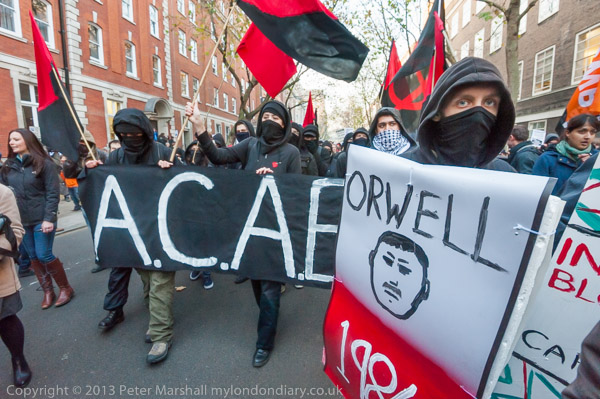
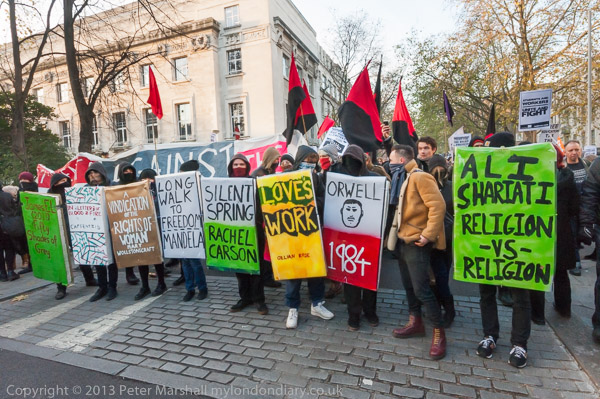
There were speeched outside the University of London Union before the march moved off, at its front a ‘Book Bloc’ carrying large backed polystyrene foam shields with book titles, including George Orwell’s ‘1984’, particularly appropriate as the Senate House is said to have inspired Orwell’s ‘Ministry of Truth’, and alongside it were Mandela’s Long Walk to Freedom, Mary Woolstonecraft’s ‘A Vindication of the Rights of Women’, E P Thompson’s ‘The Making of the English Working Class’ and other classics.

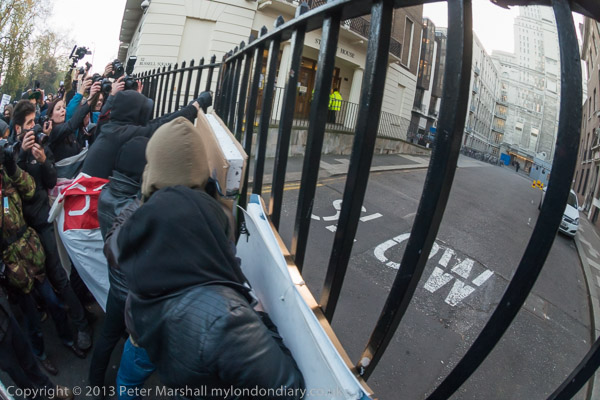
When the march came to the gates to Senate House from Russell Square they found that these gates, normally open, had been locked and chained to prevent them entering, despite most of those present being members of the university. They are stout metal gates but the chains could not for long resist the bodies pushing against them and they gave way and the crowd surged into the car park.

After a few minutes the marchers made their way back to Russell Square and continued to march around the area, eventually coming to a halt outside SOAS, where the samba band was playing and they sat down, stood around or danced.

Later some went on to protest outside the law courts where the inquest on Mark Duggan, shot by police in 2011, was ending and then to Whitehall, but I left as I was getting tired and needed to file my pictures.

More at Cops Off Campus National Student Protest.


Marine A, Mandela, CPS Fail & Cops Off Campus

Four unrelated events kept me busy on Friday 6th December 2013.


EDL Protest Supports Marine A – Downing St, Friday 6th December 2013

Marine A, Mandela, CPS Fail & Cops Off Campus

In November 2014, a court martial found Marine A, Sergeant Alexander Blackman guilty of murder for his killing of a wounded Taliban insurgent in Helmand Province, Afghanistan. On the day his sentence was due to be announced the extreme right-wing EDL called a protest opposite Downing St, calling for a minimal sentence, arguing that he acted under extreme pressure and that his victim was a terrorist.

Marine A, Mandela, CPS Fail & Cops Off Campus

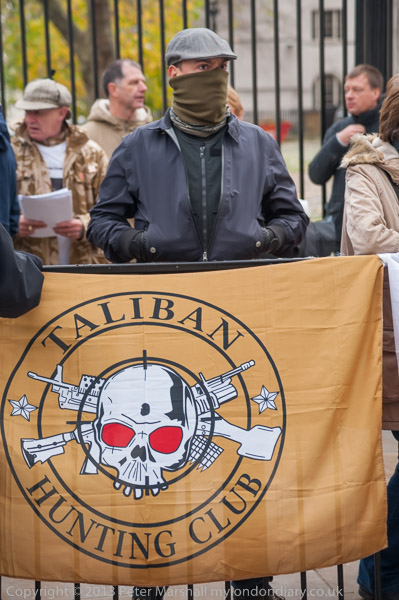
Although the EDL had predicted 500 would come, only fewer than 50 were there when I came to take photographs, and there were no placards and little to tell people why they were there, just the usual EDL flags, some with the message ‘No Surrender’, though quite a few of those taking part were wearing ‘I support Marine S’ t-shirts. Among the flags was one for the ‘Taliban Hunting Club’, with a skull with red eyes inside a gunsight and crossed guns, which seemed in particularly poor taste for this event.

Marine A, Mandela, CPS Fail & Cops Off Campus

The Geneva convention which Blackman said at the time of the killing he had just broken is an important protection for serving soldiers and many of them had strongly condemned the cold-blooded killing of a prisoner by Marine A and called for an appropriate sentence.

Later in the day Blackman was given a life sentence with a minimum of 10 years. Later this was reduced to 8 years, and after an appeal in 2017 the murder verdict was reduced to manslaughter on the grounds of diminished responsibility with a prison sentence of 7 years, though his dismissal with disgrace from the Marines remained in place. There had been a large public campaign calling for his release or a more lenient sentence and a general feeling that his initial trial had been unfair, with his commanding officer not being allowed to give evidence and a generally poor performance by his defence team. He was released from prison the following month having served sufficient time.

EDL Protest Supports Marine A


Tributes to Mandela – London, Friday 6th December 2013

Nelson Mandela died in Johannesburg on the previous day, Thursday 5th December, and people brought flowers to the Nelson Mandela statue in Parliament Square.

There were more flowers at South Africa House in Trafalgar Square, where a long queue waited patiently for several hours to sign a book of remembrance in the High Commission.

Tributes to Mandela


Bereaved protest at CPS Failure – Southwark Bridge, Friday 6th December 2013

Families whose loved ones have died in custody held a protest outside the offices of the Crown Prosecution Service in Rose Court at their failure to successfully prosecute police officers and others over these deaths. Since 1990 there have been 1433 deaths and not a single conviction.

The last successful prosecution brought against a police officer was for involvement in a black death in custody was in 1972, after the death of David Oluwale in 1969. Police officers have been prosecuted for several other black deaths in custody – Joy Gardner, Christopher Alder and Mikey Powell – but none of these cases was successful.

The standard response given by the CPS for not bringing prosecutions is that there is ‘not enough evidence to prosecute’. The reason is often that police hide or destroy evidence and fail to carry out any proper investigation of these cases from the start, failing to treat them as a crime but more as something to be covered up. Often the officers responsible for the deaths are are simply not questioned, and in some cases they refuse to answer questions. CCTV evidence is often not available with equipment problems being cited, and officers have often falsified their evidence to protect themselves or their colleagues.

Among those who spoke was Marcia Rigg, whose brother Sean Rigg was murdered in Brixton Police Station in 2008. She began her speech with a tribute to Mandela. An inquest the previous year had concluded that the police had used “unsuitable and unnecessary force” on Rigg, that officers failed to uphold his basic rights and that the failings of the police “more than minimally” contributed to his death.

In March 2013 three police officers were arrested who had clearly committed perjury at the inquest but the CPS decided not to charge them. Later after a review forced by the family one was charged but despite the evidence was unanimously acquitted by the jury in 2016.

More at Bereaved protest at CPS Failures.


‘Cops Off Campus’ Protest Police Brutality – Bloomsbury, Friday 6th December 2013

London University management was trying to ban all protests on the campus and had called in police the previous day when students had occupied part of the Senate House. Police appear to have used excessive force in removing the students and on Friday 6th a large group of students had come out to protest against them and the University calling police onto the campus.

The previous day’s protest had been over the privatisation of student fees, but there were other issues, including the university’s intention to close down the student union, seen as a part of their aim to end all protests. Students have also been taking the side of low paid staff who work in the universityy, particularly the cleaners, security and catering staff and supporting their campaigns for a living wage, proper sick pay, holidays and pensions which they are denied as their work is outsourced. It was largely protests over this that had led the university management to try and ban all protests.

Today’s student protest was intended to be an entirely peaceful and orderly march around some of the various sites of the university in the area to the west and north of Russell Square, but the police had come apparently determined to stop them, with police vans down every side street.

There were a few short speeches outside the University of London Union and then the students marched to the locked gates of Senate House and shouted slogans. When they attempted to move off to march around the block their path was blocked by police, with a few students who tried to go past being thrown roughly backwards. The students wanted to keep the protest peaceful – there were many more than enough of them to have pushed their way through had they wished to.

Behind them at the other end of Malet Street was another line of police, with more blocking the only side-turning away from the campus. The only route free was onto the campus and the walked past SIAS and out onto Thornhaugh St, where they turned left to Woburn Square and on to Torrington Place. Here they found the gate to UCL was locked and guarded by security. They turned into Gower Street, saw more police coming up behind them and rushed into UCL. After a short time there they decided to make their way by the back streets to Torrington Square and the student union. I’d had enough walking and took a more direct route, meeting them as they arrived back. It was getting rather dark and I’d done enough walking and I then left to catch a bus on my way home.

I could see no reason for the way that the police had reacted to a peaceful march around the University; it seemed to be simply trying to show the students who was boss by preventing what appeared to be a peaceful protest, and a reaction which created considerably more disruption in the area than the protest itself as well as representing a terrible waste of public funds. But I’m sure some of the police were grateful for some extra overtime with Christmas coming up.

More at ‘Cops Off Campus’ Protest Police Brutality.