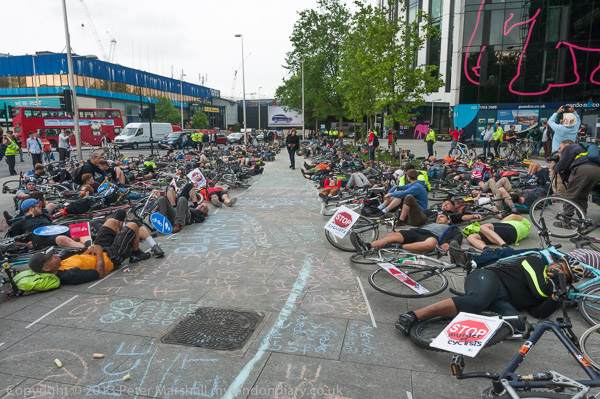
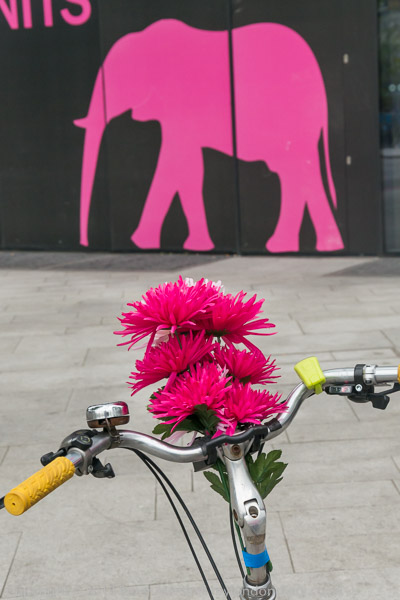
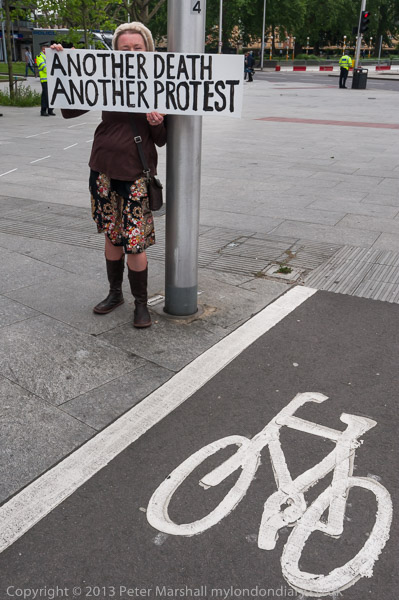
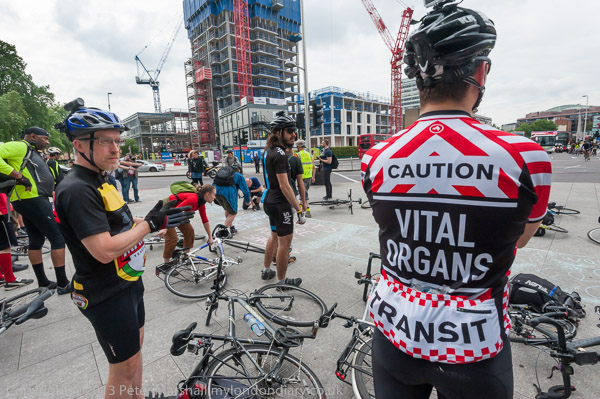
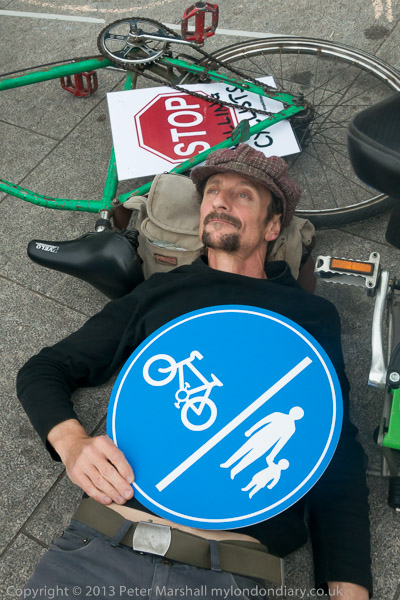
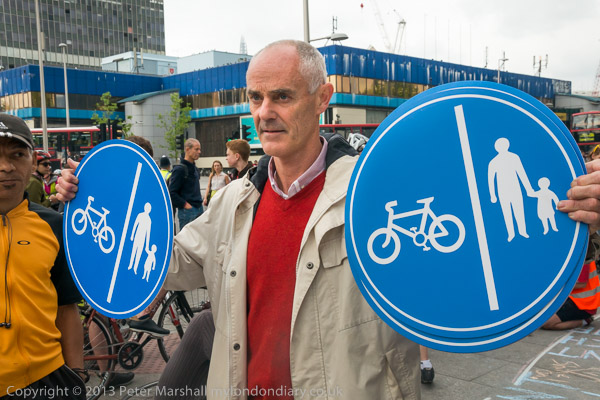
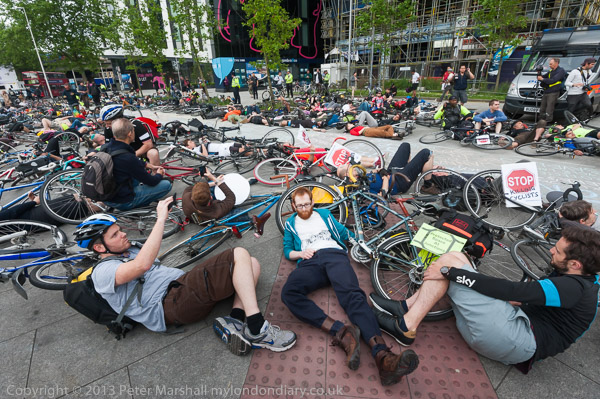
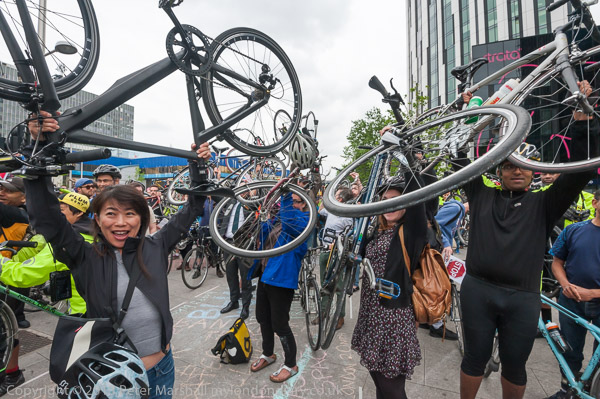
Die-In At The Elephant: In the early evening of Wednesday 21st May 2014, several hundred cyclists came to the Elephant and Castle, one of South London’s major transport junctions, following the death 8 days earlier there of a cyclist, 47 year-old Abdelkhars Lahyani, killed when he was run over by a heavy goods vehicle. The HGV driver was arrested on suspicion of causing death by careless driving.
Road design in London and elsewhere in the UK has always been about design for the movement of cars and lorries, with little regard given to the safe movement of cyclists and pedestrians, and campaigner Donnachadh McCarthy described this death as “a designed-in killing” rather than an accident.
The traffic system at the Elephant & Castle, one of south London’s busiest and more complex junctions, had been redesigned a few years ago at a cost of £3 million, but the changes made had not made proper provision for cyclists.
A cycle lane to nowhere – a dead end for cyclists
The junction is in the London Borough of Southwark, and their transport plan had argued against safe routes which would segregate cyclists from traffic. It stated that including them in traffic is useful to slow traffic flows; it may, but at the expense of regarding them as expendable, using vulnerable and unprotected human beings as some kind of traffic bollards.
The protesters marked out in chalk a “bypass lane” across the wide area of pavement close to the Strata Building at the junction with Newington Butts where the killing had taken place which would provide a segregated safe route for cyclists.
This chalked lane was soon filled with chalked messages about cycle safety and the protesters laid down their bikes on both sides of it before staging a die-in, leaving the lane with its chalking as a ‘sacred space’ in memory of the killed cyclist.
Afterwards there was a rally where the names of the 14 cyclists killed in London in 2013 and the six so far in 2014, after which poems by Seamus Heaney written about his feelings when his younger brother was killed in a road accident. Another speech was read out, written by a cyclist still in hospital with serious injuries after having been driven over by an HGV on a City road on the same day as Lahyani, and there were other speakers.
The final speech was by Donnachadh McCarthy, who set out very clearly the failures that were leading to the deaths of cyclists, and also thanked the police for their cooperation in the event. At the end of his speech he talked about the great advantages of cycling for personal health and for the environment: “Cycling is a gift: cleaner planet; safer lives.” But only if we make our cities safe to cycle in. As he pointed out as well as the roughly 60 cyclists and 300 pedestrians killed in London traffic accidents since the last election, an estimated 13,000 had died before their time because of traffic pollution.
My London Diary – May 2014
The junction in 2023 remains a dangerous place for cyclists, and no improvements appear to have been made here or elsewhere at the Elephant. It has bicycle symbols painted between the two lanes leading up to and advance waiting box at the traffic lights, though much of the paint had been worn by traffic when I last looked. Past the lights are some more road markings for bikes, but these can only be reached by cycling in the traffic.
Christian Aid Circle The City: This week every year is Christian Aid Week, when thousands of people engage in various activities to raise money for the work of this charity in the majority world. These include people trudging the streets of towns and cities delivering and then collecting gift envelopes, tea parties, sponsored walks and many other activities which to raise money.
Christian Aid is a charity embodying Christian principles but its support goes to people and grass roots organisations in many countries in the global south, many not Christian. It states it “exists to create a world where everyone can live a full life, free from poverty” and in 2021-2 helped 1.4 million people through its programmes. It provides humanitarian aid in emergencies but also runs many projects, particularly with women and promoting women’s rights and supporting the poorest and marginalised people.
Their web site lists the 25 countries in which they are currently active, working with local people and partner organisations – Bangladesh, Burkina Faso, Burundi, Colombia, Democratic Republic of Congo, Dominican Republisk, El Salvador, Ethiopia, Guatemala, Haiti, Honduras, India, Iraq, Israel and the occupied Palestinian territory, Kenya, Lebanon, Malawi, Myanmar (Burma), Nicaragua, Nigeria, Sierra Leone, South Sudan, Syria, Zambia and Zimbabwe.
Although I think they are a very worthwhile charity I’ve long supported others which work in similar ways but my wife is a local Christian Aid organiser and I’ve supported her in this work – including this year helping with a sponsored walk around the churches in our own area.
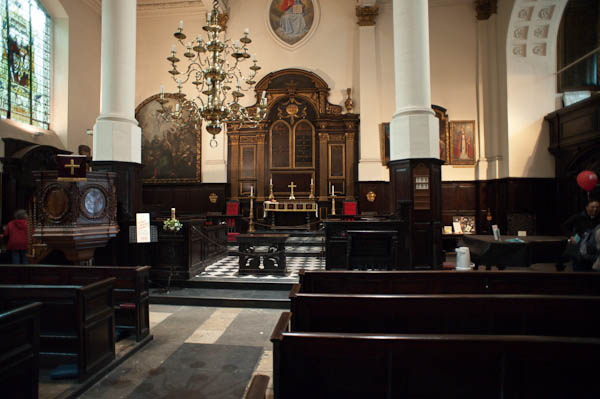
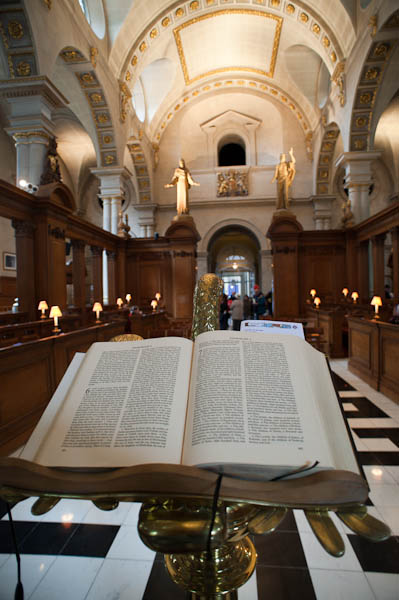
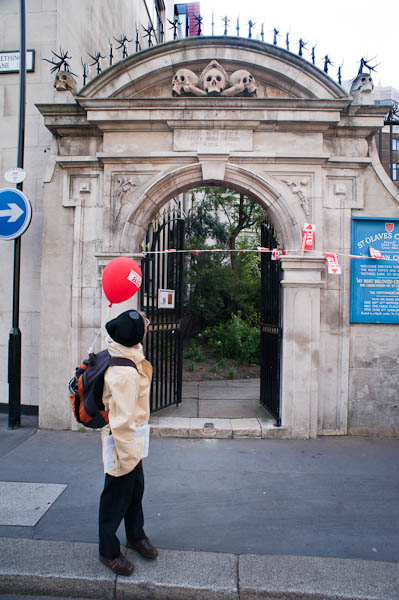
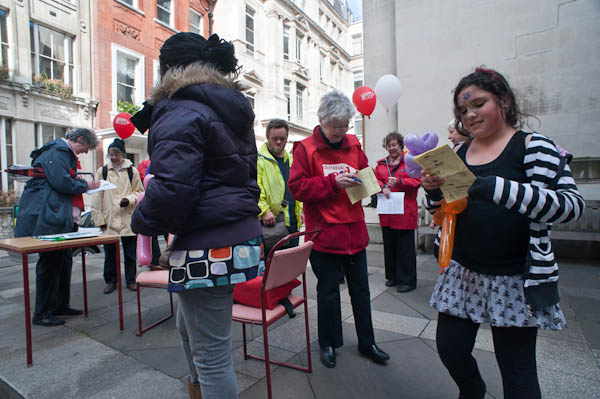
For a number of years she took part in an annual sponsored walk around the City of London, Christian Aid’s ‘Circle the City‘ a fund-raising sponsored stroll from church to church to church in the city. And often I went with her to keep her company and make sure she didn’t get lost. Of course I took a camera with me and took a few pictures, mainly of the many Wren churches we visited on the route. But in 2009 I decided to photograph it a little more seriously.
The pictures here are all from the walk on Sunday 17 May, 2009, and this is the post I made on My London Diary about it.
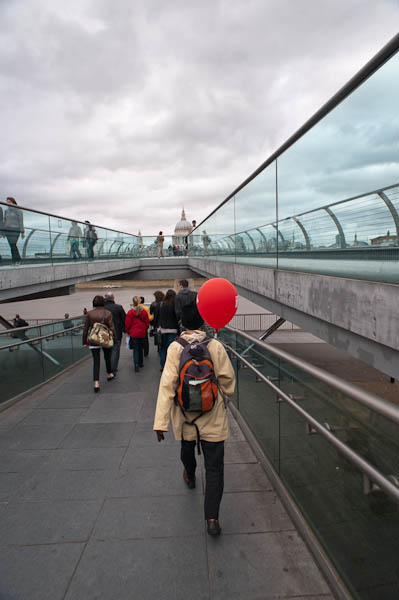
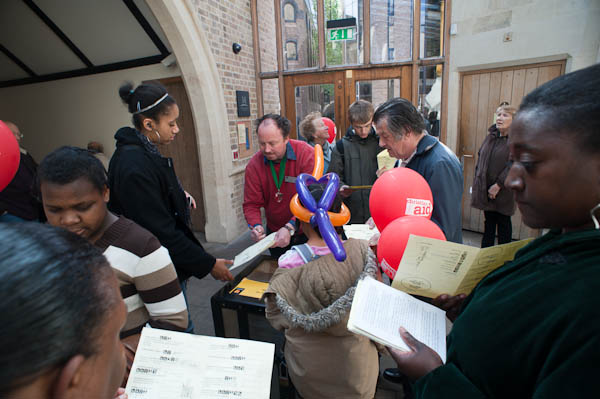
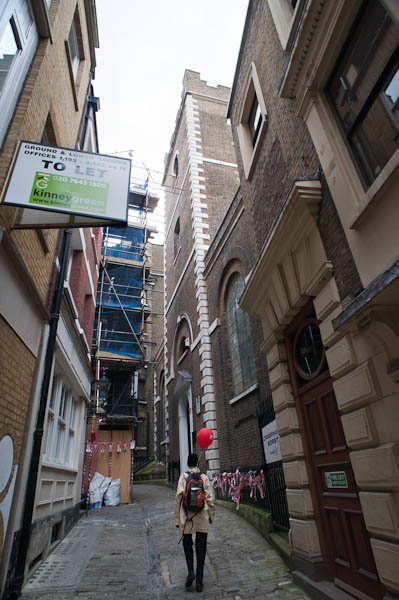
Sunday afternoon I followed a woman with a red balloon on a six mile (10 km) trail around the city, or rather two cities of London and Southwark, which led us to around 30 different ritual locations. We gained access to many of these and in several were offered drinks and food.
It was Christian Aid’s ‘Circle the City’ a fund-raising sponsored stroll from church to church to church… the woman was rather well known to me and all I got to drink was tea, coffee and lemon squash, though the asparagus quiche at All Hallows by the Tower was delicious.
In the course of our walk we got to see – if only rather briefly – the interiors of some of Wren’s finest, and one or two by other architects. And the event at the end of Christian Aid Week had raised a considerable amount for the projects that Christian Aid supports in the majority world.
If you don’t get a collector calling this week you can still make a donation to this worthwhile charity online at the Christian Aid web site. And of course donations are welcome at other times too, so if you are reading this later you can still support their work.
Hairdresser, North Cross Rd, East Dulwich, Southwark, 1989 89-4i-61
I’d taken a picture of this poster in a hairdresser’s window when I’d walked along North Cross Road a couple of months earlier but hadn’t been entirely satisfied with it. In winter I had been working with Kodak’s TMAX400 and I think I felt that the fine graphic detail on the poster would be better on the more fine-grained TMAX100 I had switched to for the summer. The difference isn’t huge but it does show. The framing is also a little different, though in making this digital image I have made this version just a little more skewed than my usual slight lean. I blame it on living in a house where nothing is quite a right angle.
North Cross Rd, East Dulwich, Southwark, 1989 89-4i-62
I’m not sure what the shop at 65 North Cross Road was then selling but I rather liked the graphic on the window. It could have been, as it now is, another hairdresser. The doorway was for the flat above.
I think I may have jumped on a bus on Lordship Lane to take me to Camberwell Green. Coming up to London for many of these walks I used a Travelcard which had first been introduced by the Greater Londo Council in 1981 and had greatly simplified travel around London. At the beginning of 1989 it had been extended to cover British Rail services, replacing an earlier One Day Capitalcard. The GLC had lost a legal battle to cut London fares in 1982, and was abolished by Thatcher in 1986, with fairly disastrous consequences, but their rationalisation of travel continued. Without it I don’t think I would have been able to do much of my extensive work across London. Now it seems that Tory cuts are going to force TfL to get rid of it for those of us travelling into London.
This is the next frame on my film, and was made around a mile and a half away, probably around a 15 minute bus ride from the previous image. The picture was made from Coldharbour Lane looking down Coldharbour Place, which continues with a narrow alley to Denmark Hill. The large building at left was a garage and has now been replaced by a larger block of flats, but the buildings at the right which front onto Denmark Hill remain and the wall at right is now covered by the ‘Great Wave’ mural based on Hokusai’s iconic image.
This Grade II listed church was built in 1823 and though some alterations were made in 1869 still looks remarkably like it did in Victorian times. I wounder why it has four doors along its frontage, and is without a central door. Possibly the doors at the left and right of the set may lead to galleries around the main hall, and some more strict churches had separate doors for men and women, but although the listed text has a fairly full description of the exterior it gives no clues for the reasons behind the design.
A rather fine row of shops with flats above, Denmark Mansions at 78-96 Coldharbour Lane. These mansions replaced earlier semi-detached villas with front gardens on the street at some time around 1900 though I can find no exact date.
Kenbury St, Camberwell, Lambeth, 1989 89-4i-51
A derelict frontage in Kenbury St, just off Coldharbour Lane. This is part of Kenbury Mansions and has long been restored. These buildings are rather decorative fronts on a rather large solid block behind, each front door leading to half a dozen flats.
Arcanum Works, Warner Rd, Camberwell, Lambeth, 1989 89-4i-54
Arcanum means the mysteries or secrets of a subject but other than the name I’m unsure what was mysterious about the Arcanum Terrazzo & Stone Company Limited who shared this works with the Decorative Tile Company Limited and the yard at rear with Wandle Paving Ltd.
This building is still there, but is now the Glory Divine Christian Centre & Community Hall. The factory behind is labelled as a Brewery on the 1877 OS large-scale map, but by the time of the 1916 OS map had turned sour as a Vinegar Works.
St Marys Greek Orthodox Cathedral, Camberwell New Rd, Camberwell, Lambeth, 1989 89-4i-55
The Greek Orthodox Cathedral of the Nativity of the Mother of God, Camberwell is a church in the Archdiocese of Thyateira & Great Britain. Greek Orthodox Christians had begun to celebrate in nearby St Giles in 1962.
In 1963 they moved into and later bought the former Catholic Apostolic Church, Camberwell New Road built for this splinter group of Anglo-Catholics in 1877, architect J & J Belcher. They had worshipped there until 1961. The church was damaged by bombing in 1941 and lost the impressive frontage rising behind the cloisters which can be seen in an illustration on Archiseek.com – with almost half the former nave now being a courtyard.
St Marys Greek Orthodox Cathedral, Camberwell New Rd, Camberwell, Lambeth, 1989 89-4i-42
I peered into the rather strange buildings to take this picture of the cloisters which the Anglo-Catholics had required of the architect. The more recent addition at left is probably very practical but rather spoils the impression.
The day after my walk around King’s Cross, in part on a walk led by GLIAS, on Sunday 9th April 1989 I was back in London on my own, south of the river for a walk beginning in Peckham.
People have often asked my why I photographed the areas of South London, and although I tell them I also photographed the North, East and West, my interest was certainly was certainly inspired by a remarkable book, London South Of the River, by Sam Price Myers, published in 1949, illutstrated by some fine wood engravings by Rachel Reckitt.
Back in 1989 there was relatively little graffiti in the area, but much of the walls in the 1930’s building at the centre of the picture where an arcade leads left towards Rye Lane was covered fairly colourfully last time I visited. You can just see a little of the station at right through the first arch. The second arch on Station Way leads to Blenheim Grove,
Myers does not have a great deal to say about Peckham, but has an engaging enthusiasm for the subject matter. His short section on the area does, like me start at Peckham Rye Station, though I had probably not arrived by train but on a bus to Peckham from Vauxhall. The book also contains some decent photographs, though greatly weakened by the rather pallid reproduction of the era, by a number of photographers including Ursula Hartleben and Bernard Alfieri.
My copy, bearing the stamp of the Illustrated London News Editorial Library, was certainly £4 well spent, and I find a copy in rather better condition now offered for sale on the web for £555; the advert shows several of Reckitt’s illustrations, and another was posted by a friend on Twitter. You can still find copies of the book in similar condition to mine for a rather more reasonable price.
This picture is looking north up Station Way from outside the station entrance towards Holly Grove. My interest on this occasion was obviously rather more in the 1930s building than the Victorian station,
Shop, Blenheim Grove, Peckham, Southwark, 1989 89-4h-21
This was another part of the 1930s development in front of the station between it and Rye Lane, here with shops and flats above. I walked the few yards east into Rye Lane and continued south down this, taking few pictures as I had photographed this area on previous walks.
Continuing south, Rye Lane merges into Peckham Rye, and I often confused the two. The numbers on the door frame here are 257-261 and this was a part of the former Co-Op building at the bottom of Rye Lane, now demolished and replaced.
The giant lock with its legend YALE LOCKS was became labelled the entrance to Ezel Court (which I think was just the flats above the shops), but I assume that at one time either 56 – here dealing with pets – or the shop to the left had sold locks. In recent years these have become a Mini Super Market and a restaurant. I had photographed this earlier in the year and another picture appears in my post Peckham Rye to Goose Green – 1989.
Houses, Kelmore Grove, East Dulwich, Southwark, 1989 89-4h-13
I continued down Peckham Rye to the junction where I turned to the west along East Dulwich Road. In 1879 this there were really substantial villas along the south of East Dulwich Rd, but by the early 90s Oakhurst Grove, Kelmore Grove and The Gardens at the back of these had been laid and lined with substantial family homes.
These beautifully decorated late Victorian houses are on the south side of Kelmore Grove, with slightly plainer examples on the other side of the road. Although only two storey, these are substantial semi-detached houses with a wide frontage with a large room on each side of the central hallway.
Houses, Oakhurst Grove, East Dulwich, Southwark, 1989 89-4h-14
The houses in Oakhurst Grove have alternate bays and rather curious towers in what are semi-detached three storey houses. The two doors in each pair are adjacent with only a room on one side and although taller they are less grand than those in the picture above. But they also have some fine brickwork and decorative elements.
World Justice And A Black Friday: Friday 2nd May 2008 was unusual for me as my work began with and event by Just Share in front of the Bank of England when my wife and I appeared together in public, a rather rare event as she seldom comes to London. But later it was a very dark day for London as the results of the Mayoral Election were announced, the begining of 8 years of rule by a dangerously incomptent, unreliable and untrustworthy man who went on to become prime minister and make a real mess of the country too. In between the two events I had time to visit an exhibition and take a little walk along the riverside.
Just Shares Take On The Bank – Royal Exchange, Bank, London
‘Just Share’, based at St Mary-le-Bow church in Cheapside, describes itself as “a coalition of churches and development agencies seeking to engage with the City of London on issues of global economic injustice” and to “address the widening gap between rich and poor in the global economy.”
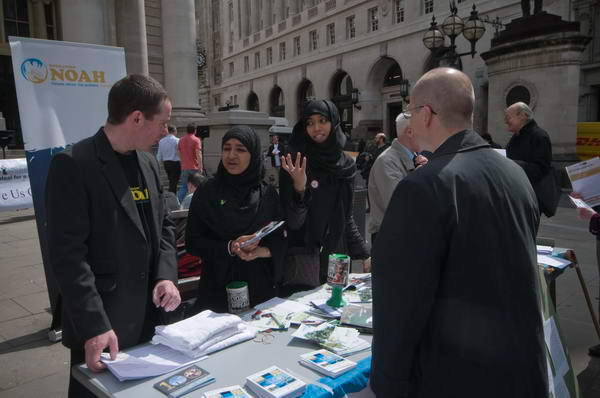
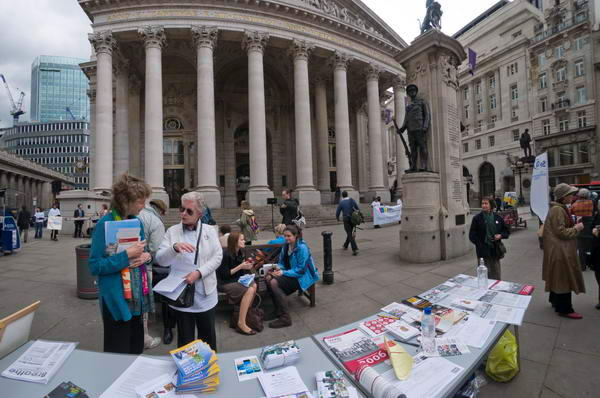
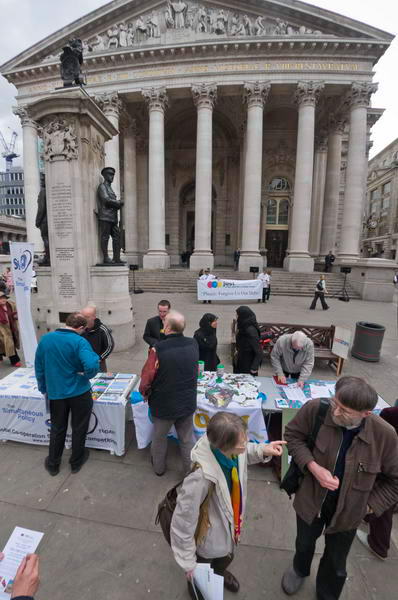
They had organised the event on the steps of the Royal Exchange in front of the Bank of England, with stalls from several groups involved in the trade justice movement including Operation Noah (a Christian-based charity campaigning about the environment) and Muslim Aid, before speeches by Ann Pettifor of Advocacy International and Operation Noah, previously Jubilee 2000, and The Guardian’s economics editor Larry Elliott.
Following this we walked the short distance to St Mary Woolnoth – one of Hawksmoor’s finest buildings, and where former slave captain John Newton, who wrote ‘Amazing Grace’, preached his last 28 years – a few yards away.
Here there was a seminar where Pettifor expanded her argument about the false basis of our current economic system, which is the subject of her book ‘The Coming First World Debt Crisis‘ arguing that the current global debt-based financial systems are unsustainable and that a structural change is necessary to give proper regard to actual production, and the rediscovery of the insights of earlier Christian (and of course Muslim) traditions.
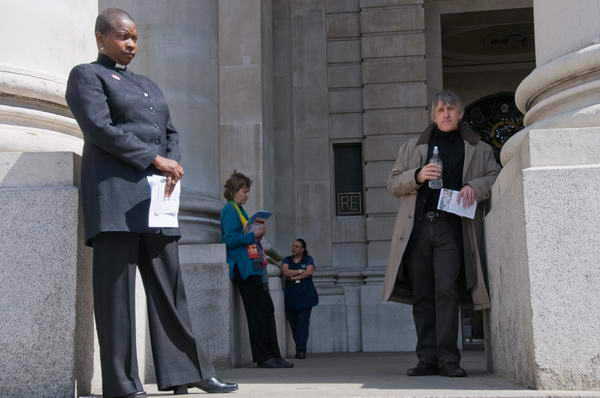
There wasn’t a huge attendance at the event, and probably a majority of those present were wearing dog collars. I didn’t find it easy to make interesting pictures though I did photograph most of the speakers. And I suspect it fell on very closed ears in financial circles where people were and are personally doing very well from our failed system.
It was some time before the result of the London Mayoral elections was to be announced in the early evening, and I made my way to the Hayward Gallery to see an exhibition there before taking a leisurely walk along the South Bank to City Hall. I think there may well have been time for a little food and liquid refreshment too.
On Bankside I made this picture of Cardinal Cap Alley and the house that Christopher Wren didn’t live in. You can see some more pictures from the walk, including at the Hayward Gallery, a distant view of Tate Modern’s chimney, St Pauls Cathedral and the Millennium Bridge and Fishmonger’s Hall at London Riverside.
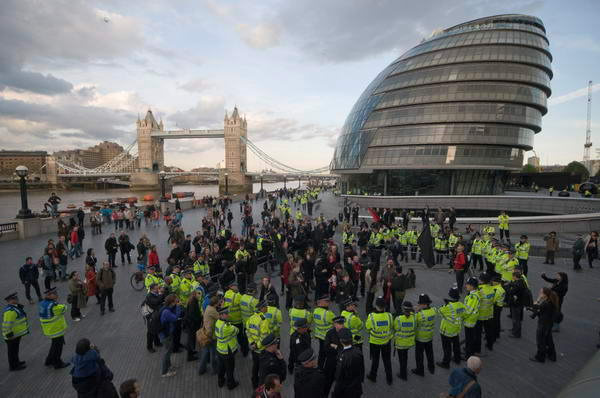
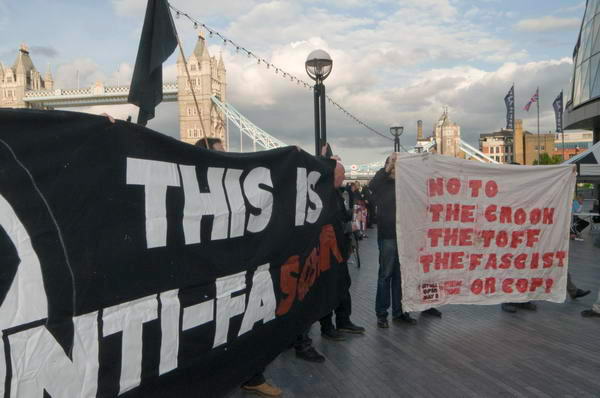
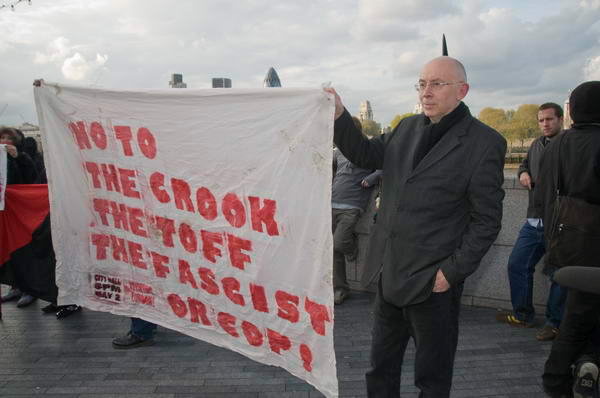
No to the Crook, the Toff, the Fascist or Cop – City Hall, Southwark
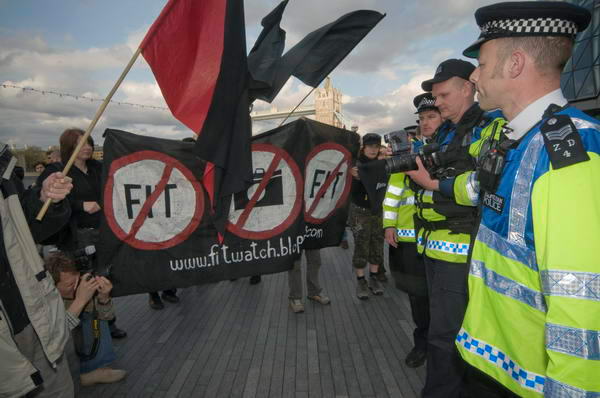
Like other photographers attending protests in London I had become used to being routinely photographed by police photography teams, the so-called Forward Intelligence Teams, FIT. But sitting reading on the steps in Potters Fields on this occasion waiting for things to start I attracted more than the usual attention, perhaps because the book I was reading had the title ‘Terrorist’. As I point out in My London Diary, this is not a training manual, but a novel by one of America’s leading novelists, John Updike.
I was filmed for over a minute and a number of still photographs were taken. Some months later I made a freedom of information request asking what pictures the police held of me, giving this as one of the dates on which I had been photographed. I paid my money, waited and eventually got the response – that they had no pictures of me.
I was there to take pictures as several anarchist groups had come to protest at the result, saying ‘No to the Crook, the Toff, The Fascist or Cop’, declaring none of the four candidates suitable to be Mayor. Personally I felt they were being a little unfair to previous mayor Ken Livingstone who while he had his faults had largely done his best for London and certainly now seems a shining beacon of honesty compared to most of the leading Tories – including Starmer – we have seen since.
Things outside City Hall remained pretty calm until Fitwatch got fed up with being photographed and began to try to frustrate the FIT teams by surrounding one of them with their banners. The police called up reinforcements and the Territorial Support Group (TSG) arrived and began pushing everyone around, including the protesters, press and bystanders, most of whom were tourists, in the direction of a penned area a short distance away. As I reported, ‘One French woman was bemused. “But why are they just letting themselves be pushed” she asked me as I took photographs. “Because this is England and not France” I replied.’
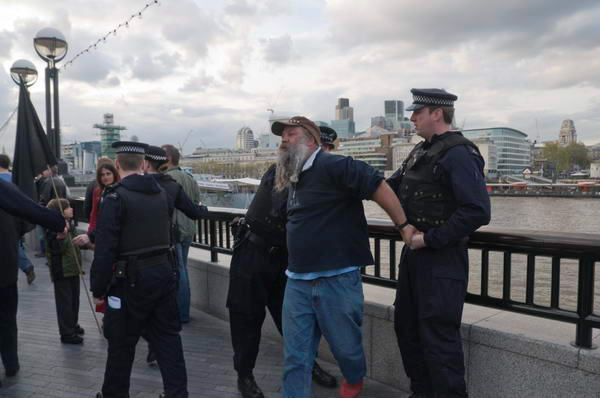
One man sitting watching from the river wall refused to move and was told he was obstructing the highway – which he clearly was not. Eventually they arrested him and dragged him away. But otherwise the police were reasonably well-behaved and on showing my press card I was allowed to walk away from the area.
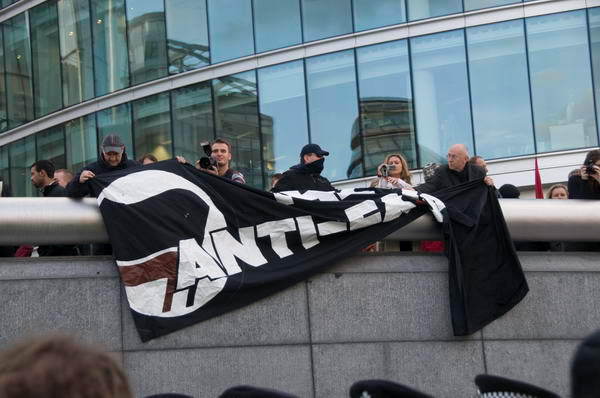
I was keen to do so, not just because I didn’t want to be kettled, but also because I had seen some of the cannier members of Class War moving away and was able to photograph them displaying an Anti-Fascist banner from a balcony overlooking the site for a few minutes until they melted away as officers began moving in our direction, finding refuge in a nearby pub. By the time the police arrived they obviously couldn’t be bothered to chase them, and contented themselves with moving the innocent public away from the balcony, and after a short time, also moving the press. I went and joined Class War in the pub briefly before leaving for home.
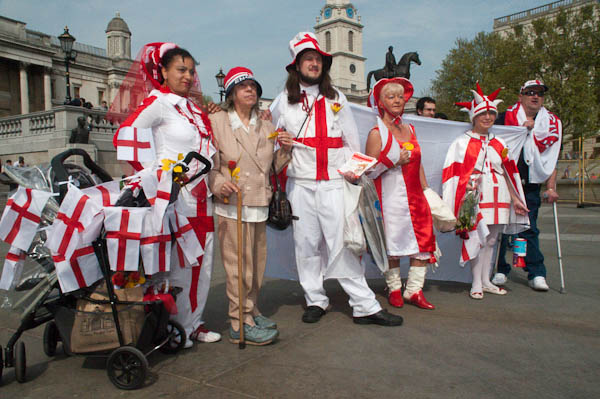
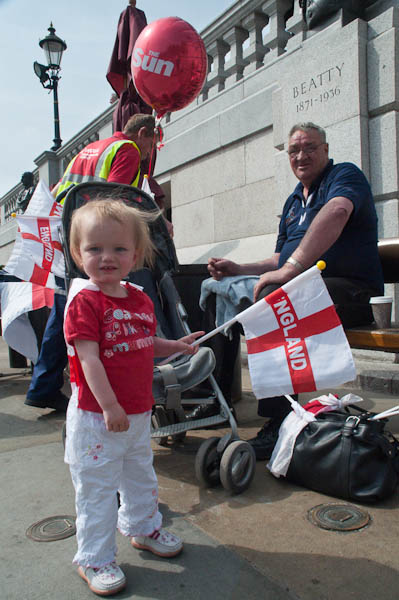
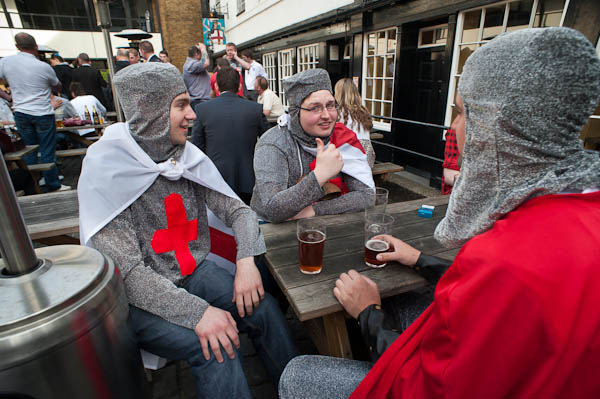
St George’s Day 2009: On Thursday April 23rd 2009 I came up to London to find and photograph celebrations taking place of St George’s Day. People had for some years been calling for a proper celebration of the English Patron Saint’s day, but it was still hard to find much celebrations to photograph.
St George’s Day – Trafalgar Square
I began at Trafalgar Square, where some events were said to be taking place, but there was relatively little happening when I arrived shortly after lunch. In 2009 St George’s Day was a Thursday which was perhaps why few people had come.
There were a handful of people from ‘The English Democrats’ who had dressed up for the day as a part of their campaign for an English Parliament and for St George’s Day to be made an English national holiday. I photographed them together with a couple of women making a charity collection for ‘Save the Children’.
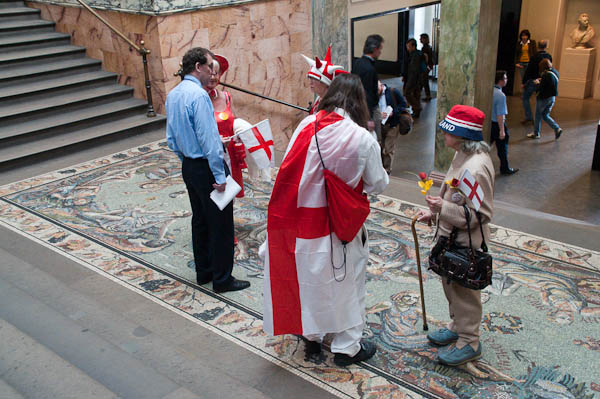
The English Democrats told me that the previous year they had been refused entry to the National Gallery because they were wearing the flag of St George. I went with them when they tried again this year and they were allowed in but were told they could not campaign or collect money in the gallery.
While I was in the square a number of others wandered in wearing shirts, hats or badges or red roses were obviously expecting something to be happening and were disappointed. Although some event was planned for the Saturday it seemed odd there seemed so little interest on the day itself.
The Lions part: St George & the Dragon – Red Cross Garden & Southwark Cathedral
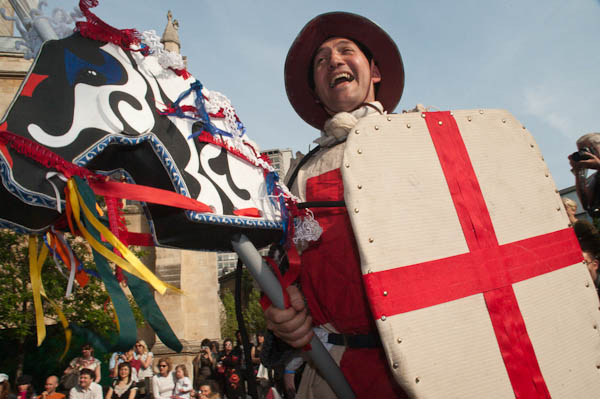
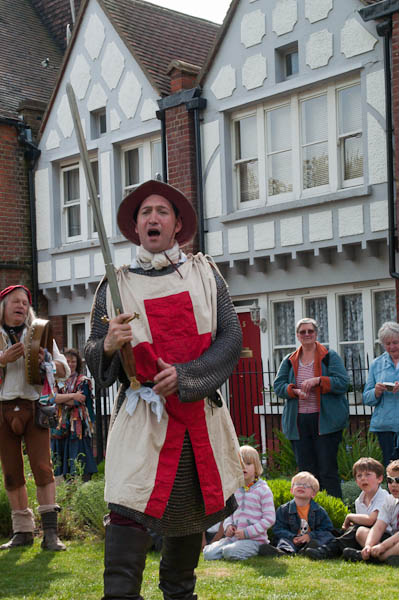
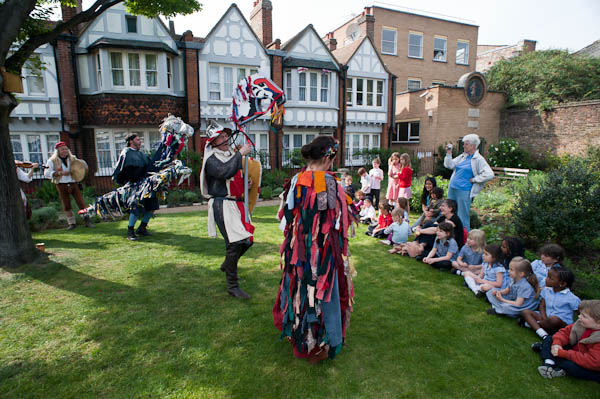
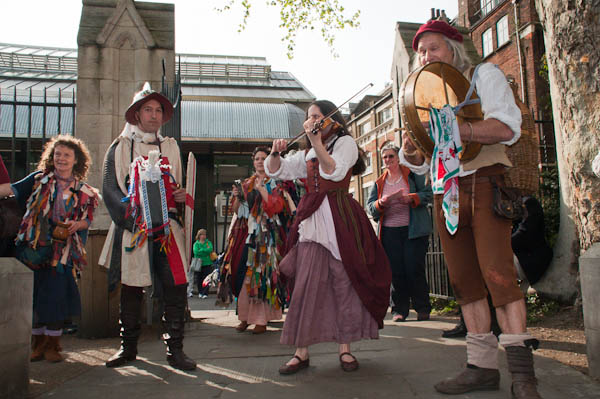
Rather more was happening across the river in Southwark, where The Lions part, a group of performers associated with the Globe Theatre on Bankside, were celebrating the day with a series of performances of ‘The Ballad of St George & the Dragon’.
I went to watch their short musical variation on the traditional story of St George in Red Cross Garden, which along with the adjoining hall and cottages was established by the social reformer Octavia Hill in 1897-90. I arrived a little late and the performance had already begun, but fortunately after a short interval they gave a second performance.
Many of the audience were children from the nearby cathedral school, and they clearly enjoyed it.
After the performance I walked with the players as they made their way through Borough Market to Southwark Cathedral to give another performance in the churchyard there.
I left the performers at Borough Market and made my way to the George Inn on Borough High St, a Grade I listed galleried coaching inn owned by the National Trust. It was rebuilt in 1677 following a great fire which destroyed much of Southwark with three fronts around a courtyard, though only one has survived. It was formerly known as the George and Dragon.
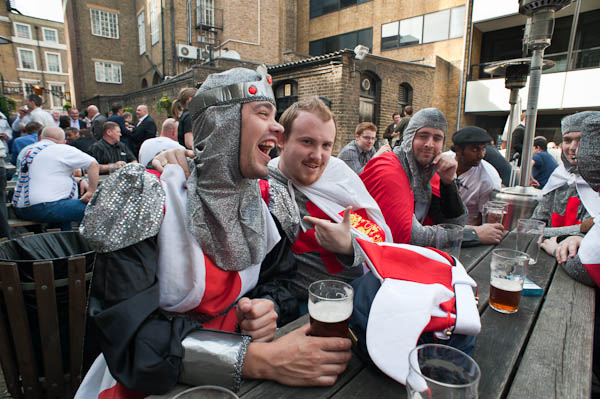
Again I arrived late, as there had been a procession of people in costume earlier, but there were still a few people there I could photograph.
I went back over the river to Trafalgar Square where I now found around 25 football supporters, many in England shirts having a noisy time on the plinth of Nelson’s column.
They seemed to be enjoying themselves and were happy to be photographed. One of the street performers with a regular pitch on the North Terrace had joined them, and the Heritage Wardens seemed to be emulating Nelson and viewing the various breaches of the bylaws with a blind eye.
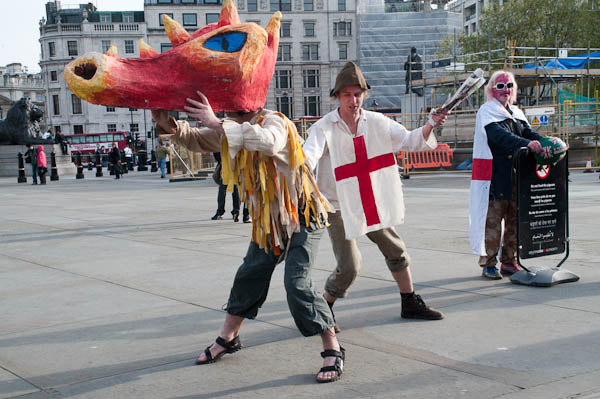
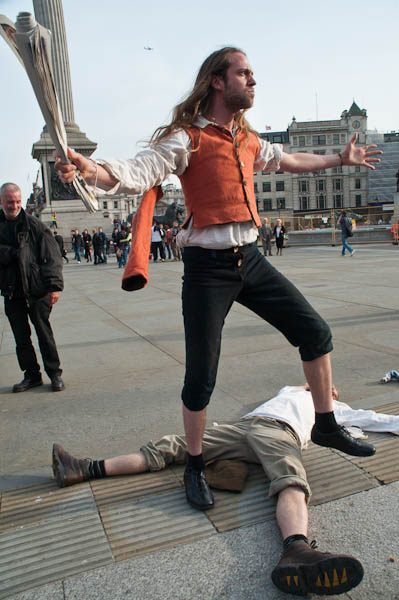
Apparently the National Gallery had been celebrating the day by inviting the the Suffolk Howlers to perform their traditional ‘St George & The Dragon’ in front of Tintoretto Saint George and the Dragon in the gallery.
After finishing there they had come out from the gallery and were going to give a performance in Trafalgar Square, despite the competition from those celebrating around Nelson.
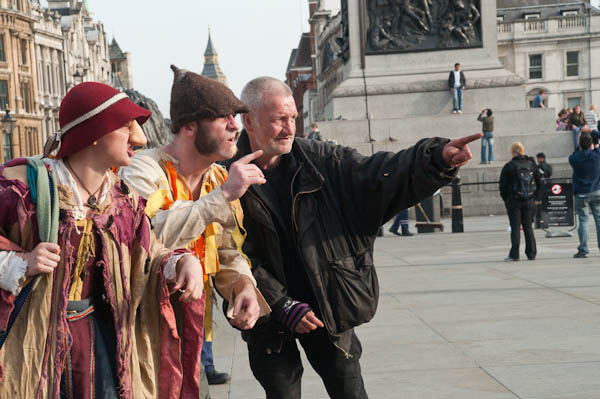
As I wrote, their version “had a little more complex plot than the version I’d seen earlier in Southwark, including Beelzebub, a doctor and a Turkish knight, with additional contributions from a couple of bystanders, one who had been imbibing from a bottle labelled Lucozade that appeared to have rather more intoxicating properties than usual, and the other the displaced street performer. While he largely draped himself over the “Please do not feed the pigeons banner’, Lucozade man took a far more active role in the proceedings, giving first aid to the injured St George and executing some surprisingly nimble dance steps and generally adding a chaotic improvisation to the performance. He really deserved the applause when he took a bow with the rest of the cast at the end of the play.”
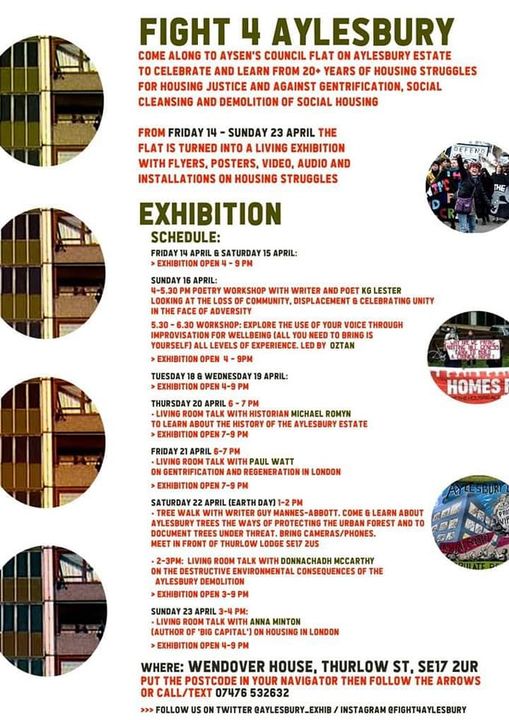
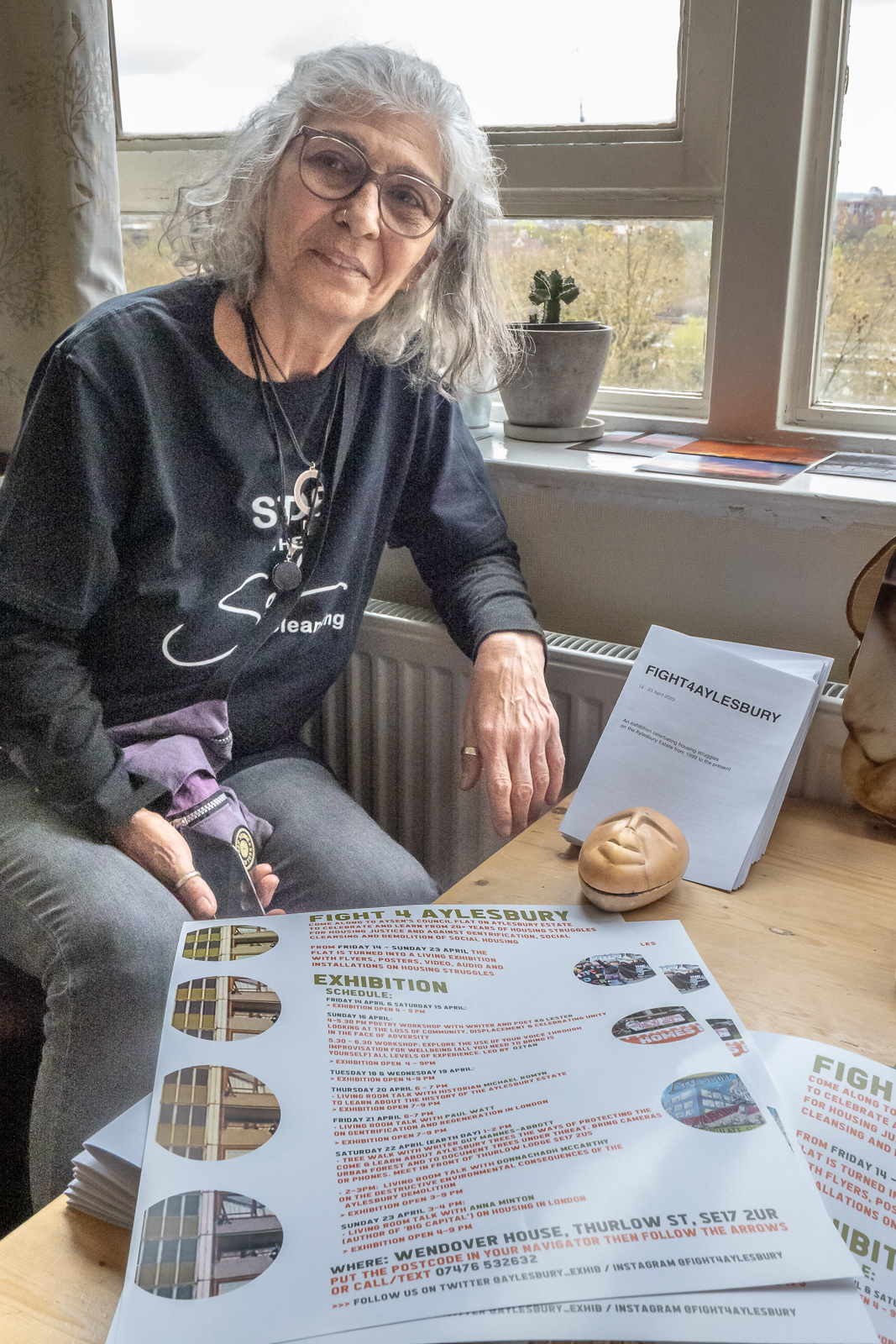
Last Friday I went to the first day of the Fight4Aylesbury exhibition which continues until 23 April 2023. It’s an unusual exhibition and one that is worth visiting if you can get to south London before it ends,
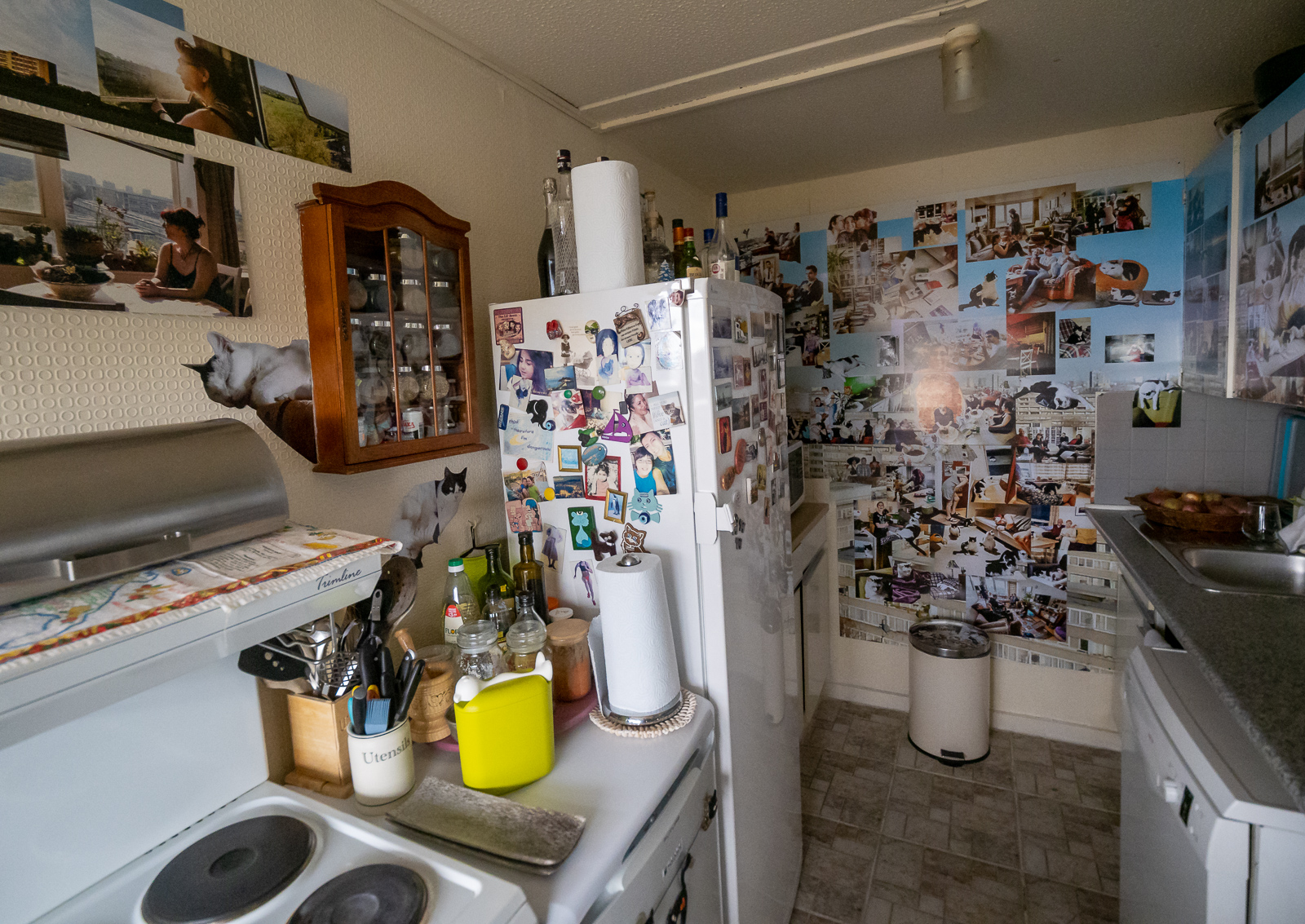
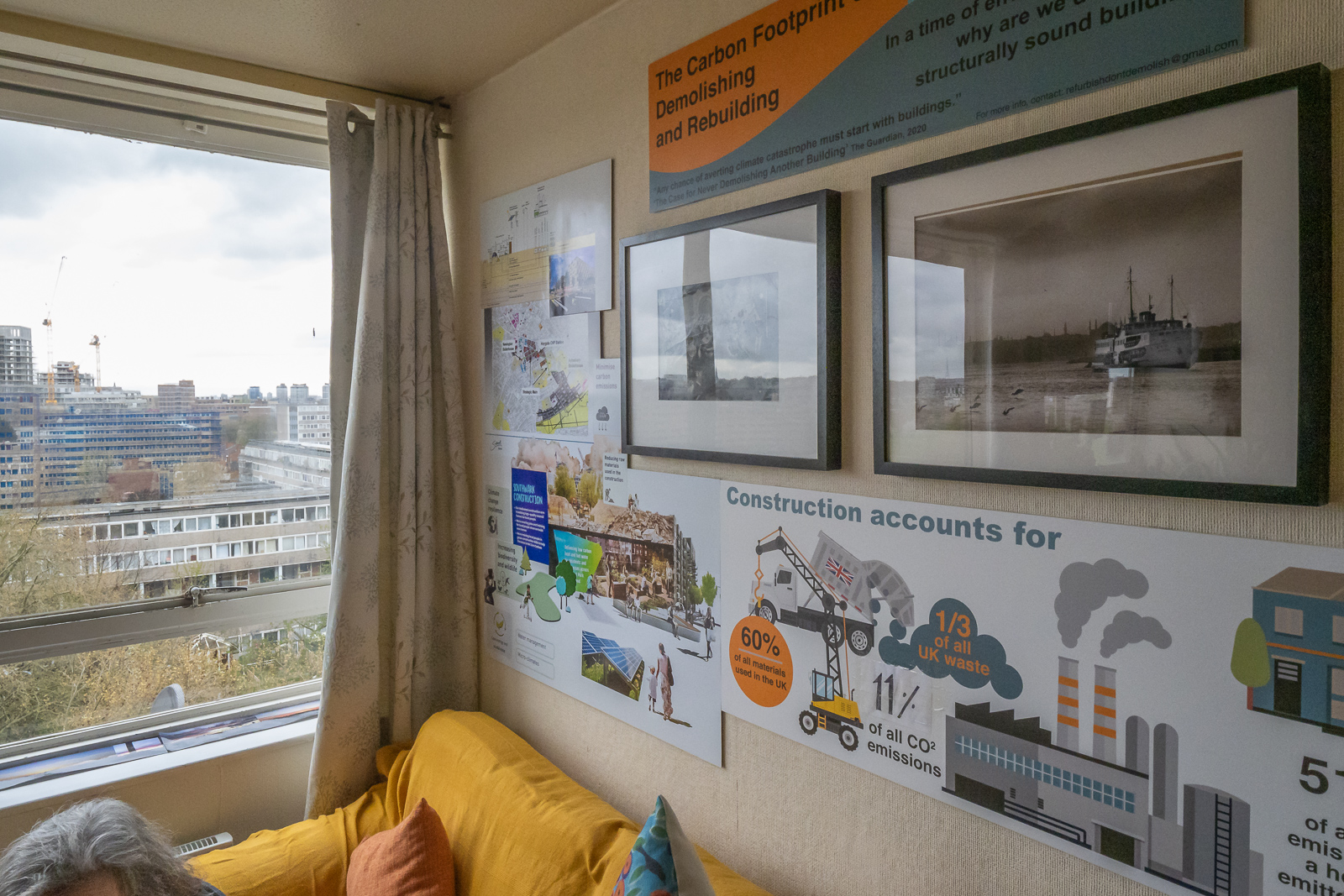
The exibition celebrates the struggle by residents on the Aylesbury Estate in Southwark to stay in their homes since the estate was first threatened in 1999 and takes over the flat of one of those still remaining, Aysen who writes:
Welcome to my home.
I am opening the doors to my flat for a collective clelbration of 20+ years of housing struggles to defend our council homes against social cleansing and gentrification. Our fight is ongoing.
Since 1999 the council has subjected us with privitisation, “re-generation” and now demolition. We, Aylesbury residents, other council tenant all over the country, and our supporters, have been resisting and are still resisting and defending our homes.
My home tells the story of this struggle.
Aysen
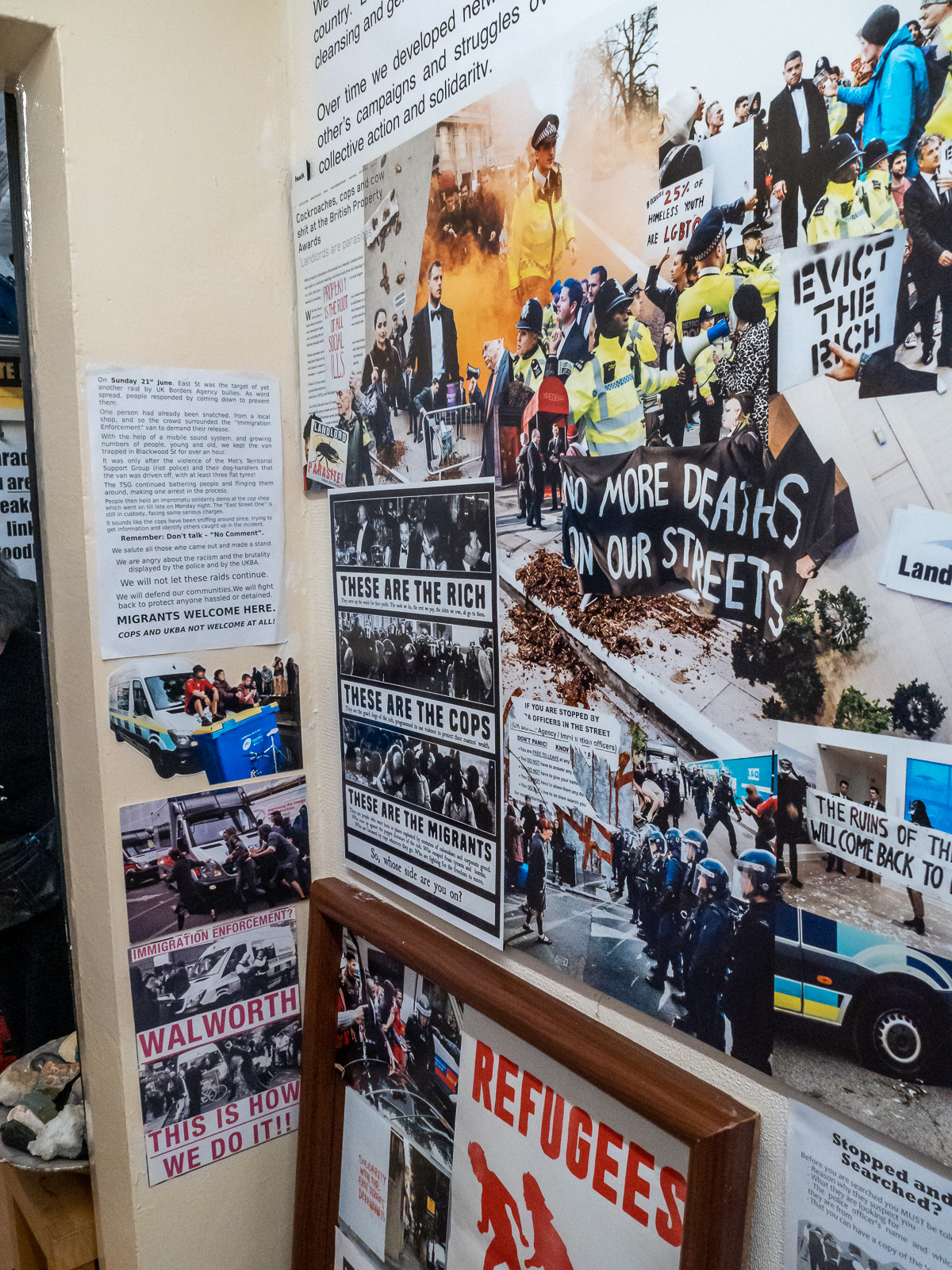
You are invited to Aysen’s council flat on Aylesbury Estate to celebrate 20+ years of housing struggles for housing justice and against gentrification, social cleansing and demolition of social housing. The flat has been transformed into a living exhibition with flyers, posters, video, audio and installations on housing struggles.The exhibition is in this block, Wendover
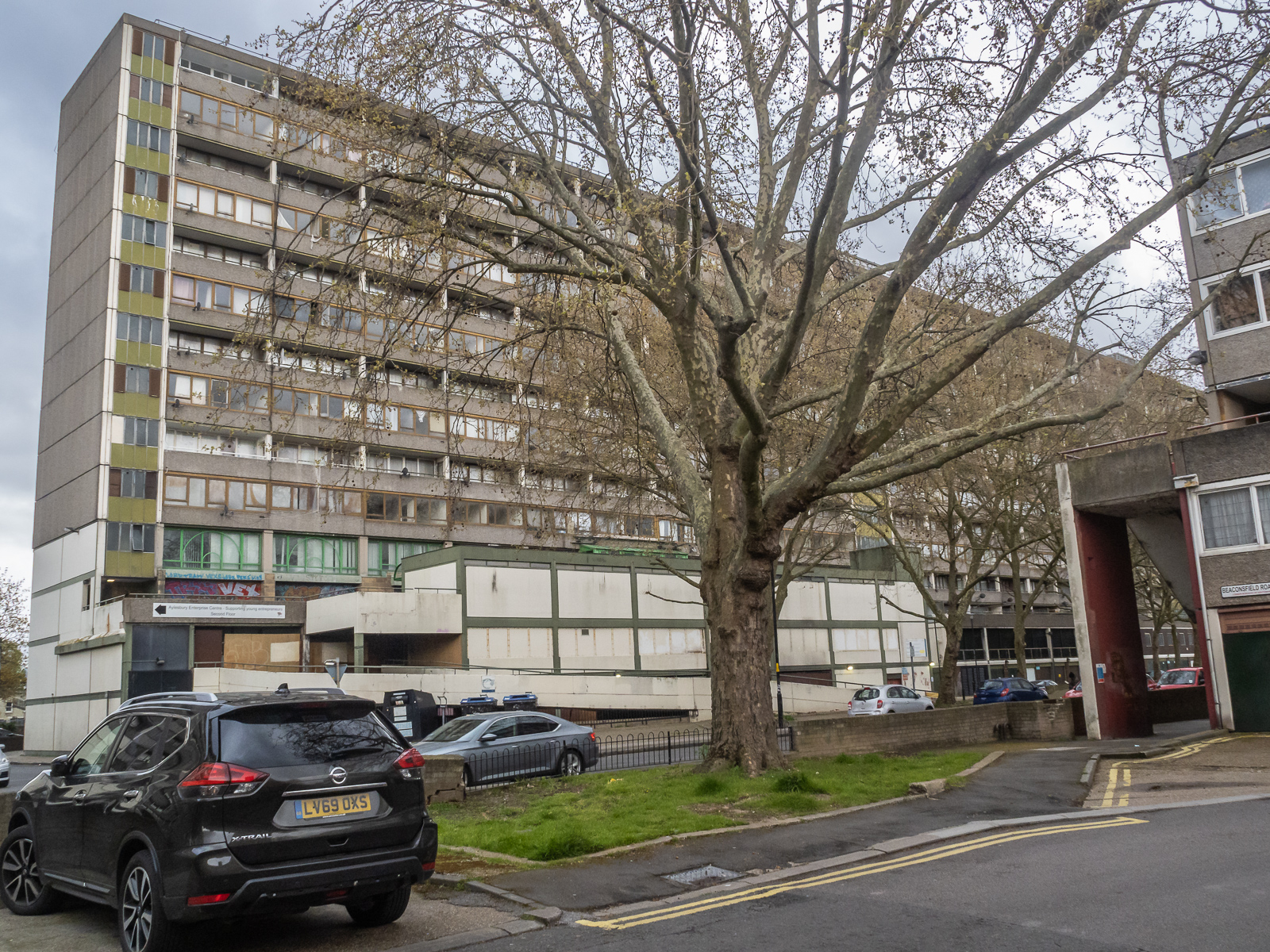
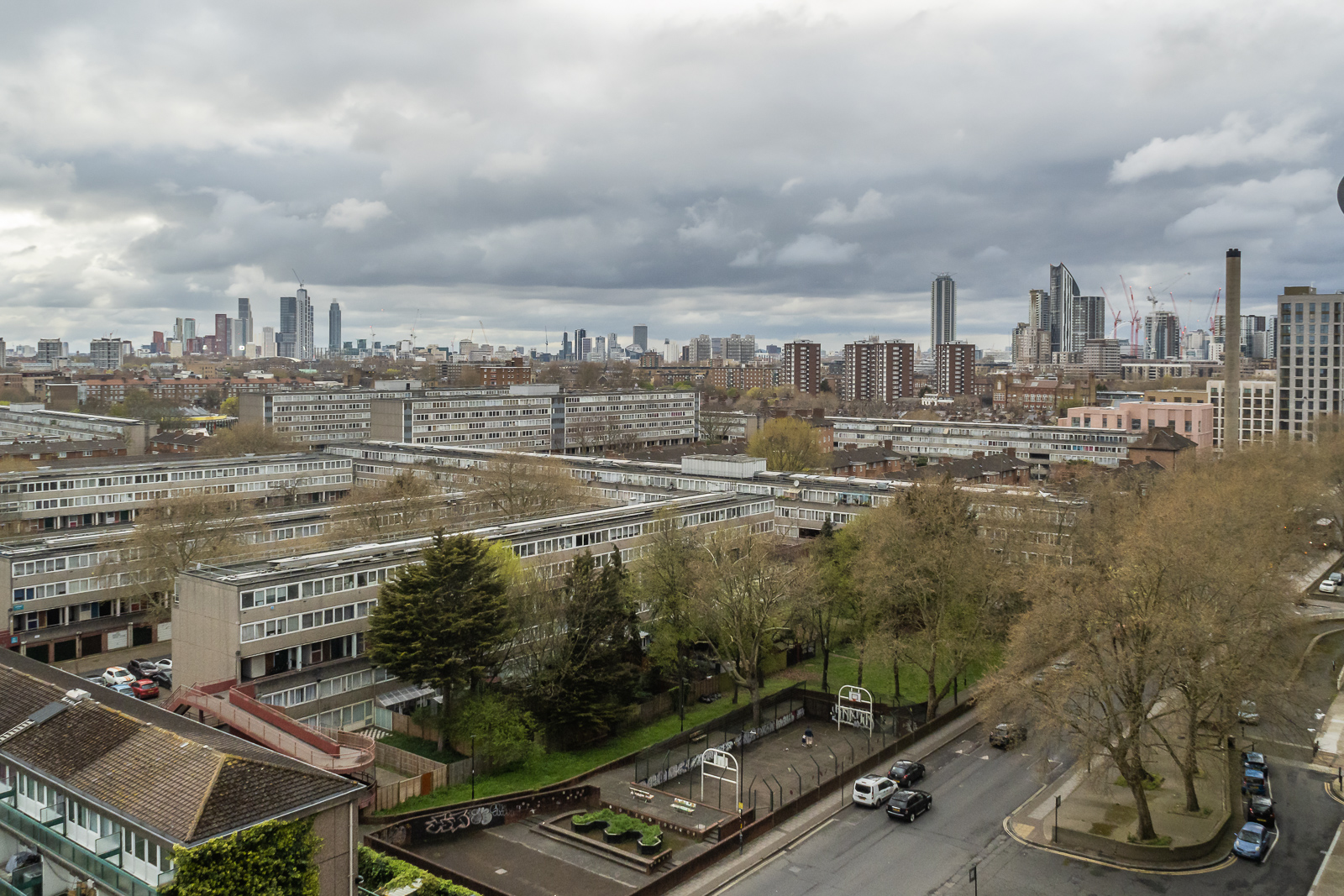
The Aylesbury estate, designed by Hans Peter “Felix” Trenton was one of the largest areas of council housing in Europe, built from 1963 to 1977 with 2,700 dwellings for around 10,000 residents in an area containing some earlier social housing a short distance south of the Elephant and Castle between East Street market and Burgess Park.
There are a number of large blocks of various heights, from 4 to 14 floors, all well designed and built to the high standards of the era, with rather larger rooms and more solid walls than current buildings. The estate also had a central boiler to supply heat more economically to the flats.
Southwark neglected the estate in the 1980s and 1990s, failing to carry out necessary maintenance and the estate and the estate environment became in poor conditions. The heating system in particular suffered. Southwark began to use this and the neighbouring Heygate Estate as ‘sink estates’, deliberately moving in families with various social problems and people with mental health issues. It was because the estate had become unpopular that Aysen, who had to leave Turkey after the 1980 coup, was able to get a flat here with her sister in 1993.
The estate came to get a reputation as “one of the most notorious estates in the United Kingdom“, reinforced by it becoming a popular area for TV crews filming “murder scenes, gun and drug storylines and gang-related crimes in soaps and gritty dramas.” In particular from 2004-15 Channel 4 used it in an “ident” for which they had added “washing lines, shopping trolley, rubbish bags and satellite dishes” to create what was described as “a desolate concrete dystopia.”
Its poor reputation led Tony Blair to hold his first speech to the press as Prime Minister in 1997 on the estate, promising that the government would care for the poorest in society. It was a promise that he and later prime ministers have spectacularly failed to keep.
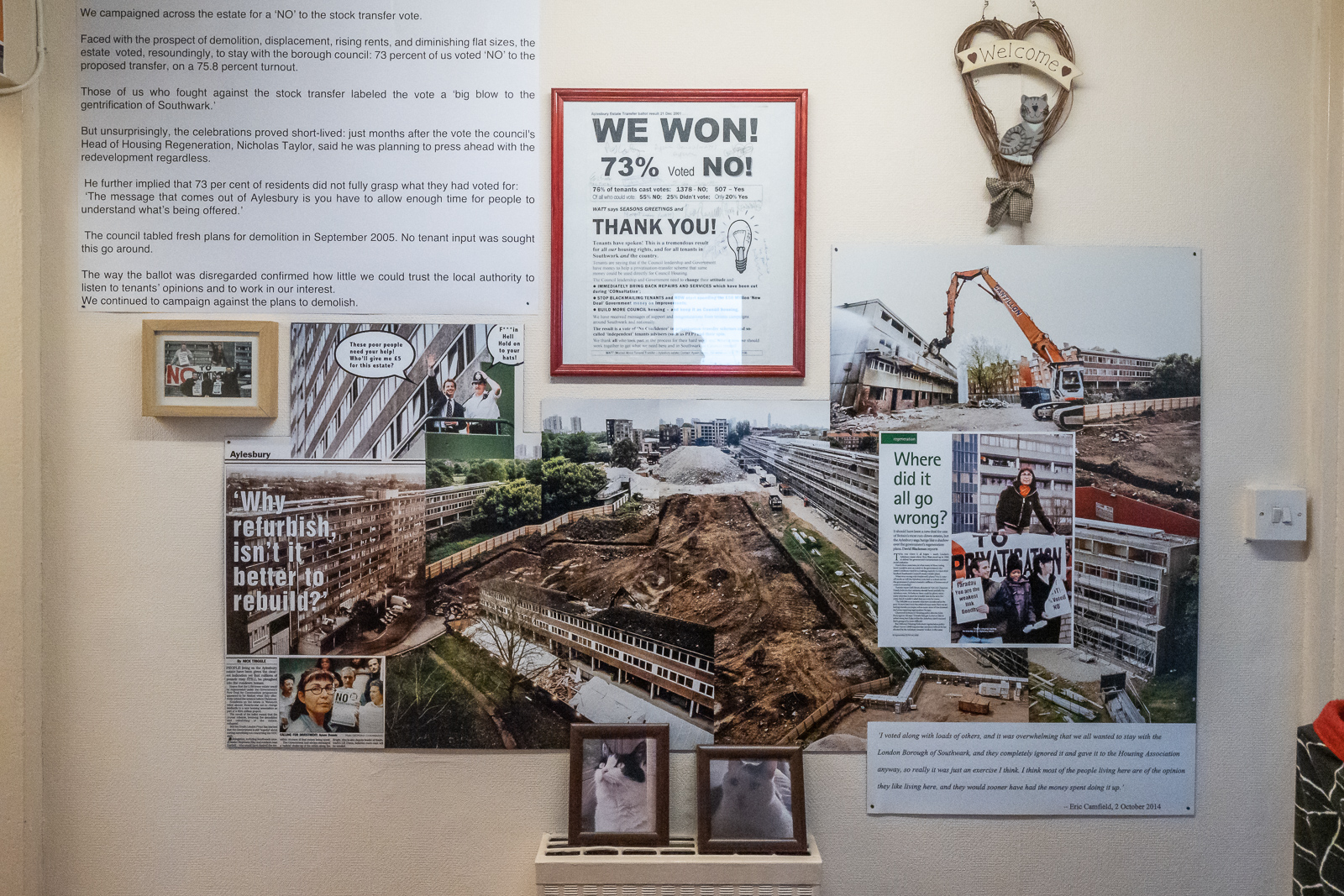
Southwark Council’s response to the estate’s decay they had overseen was to try and wash their hands of it by trying to transfer it to a private housing association to be redeveloped. But a campaign by residents in 2001 led to this being soundly rejected – not surprisingly they voted against demolition, displacement, rising rents and smaller flat sizes.
Undeterred, Southwark decided to go ahead with the redevelopment themselves, producing new plans for demolition in 2005. This time they didn’t bother to ballot the residents.
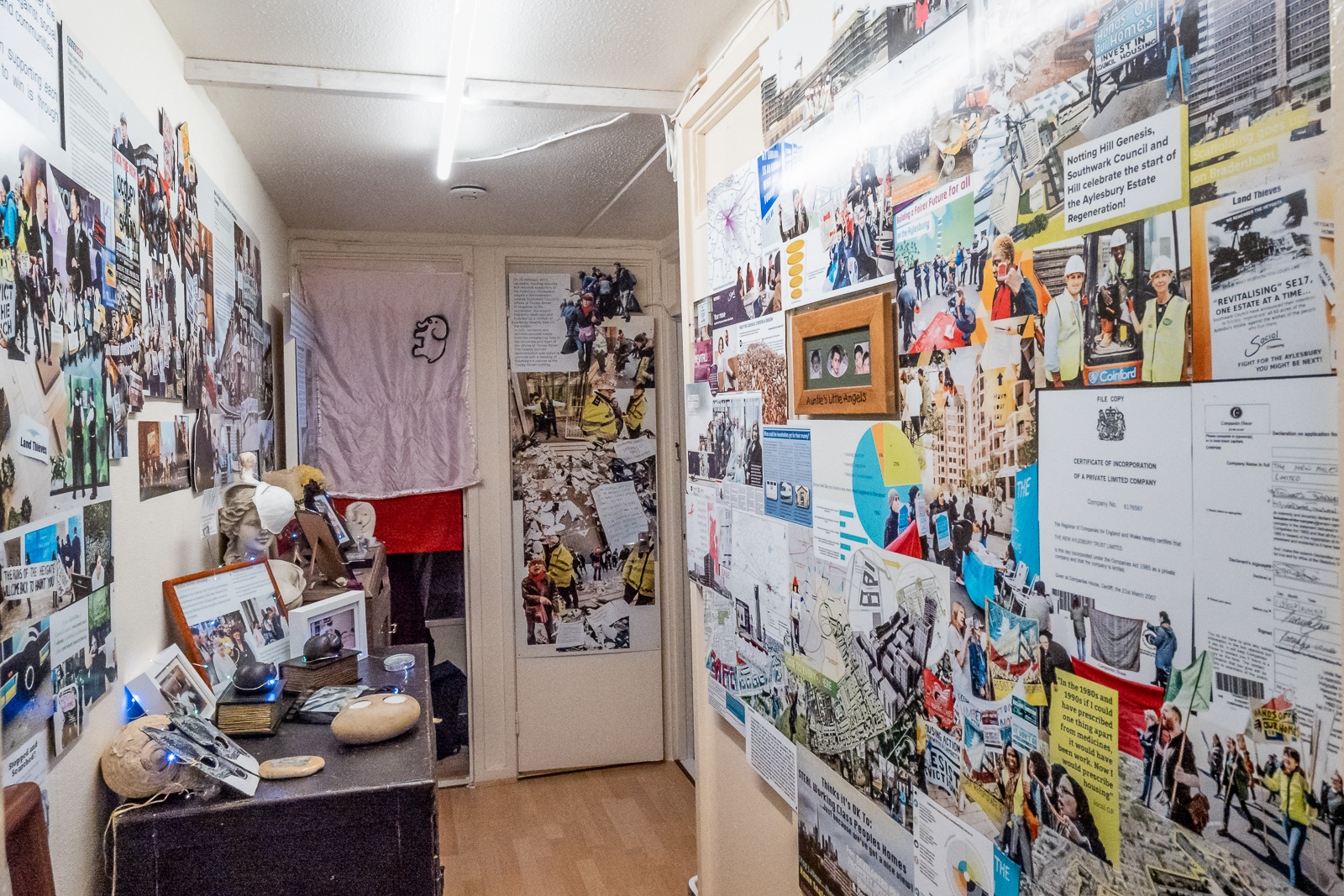
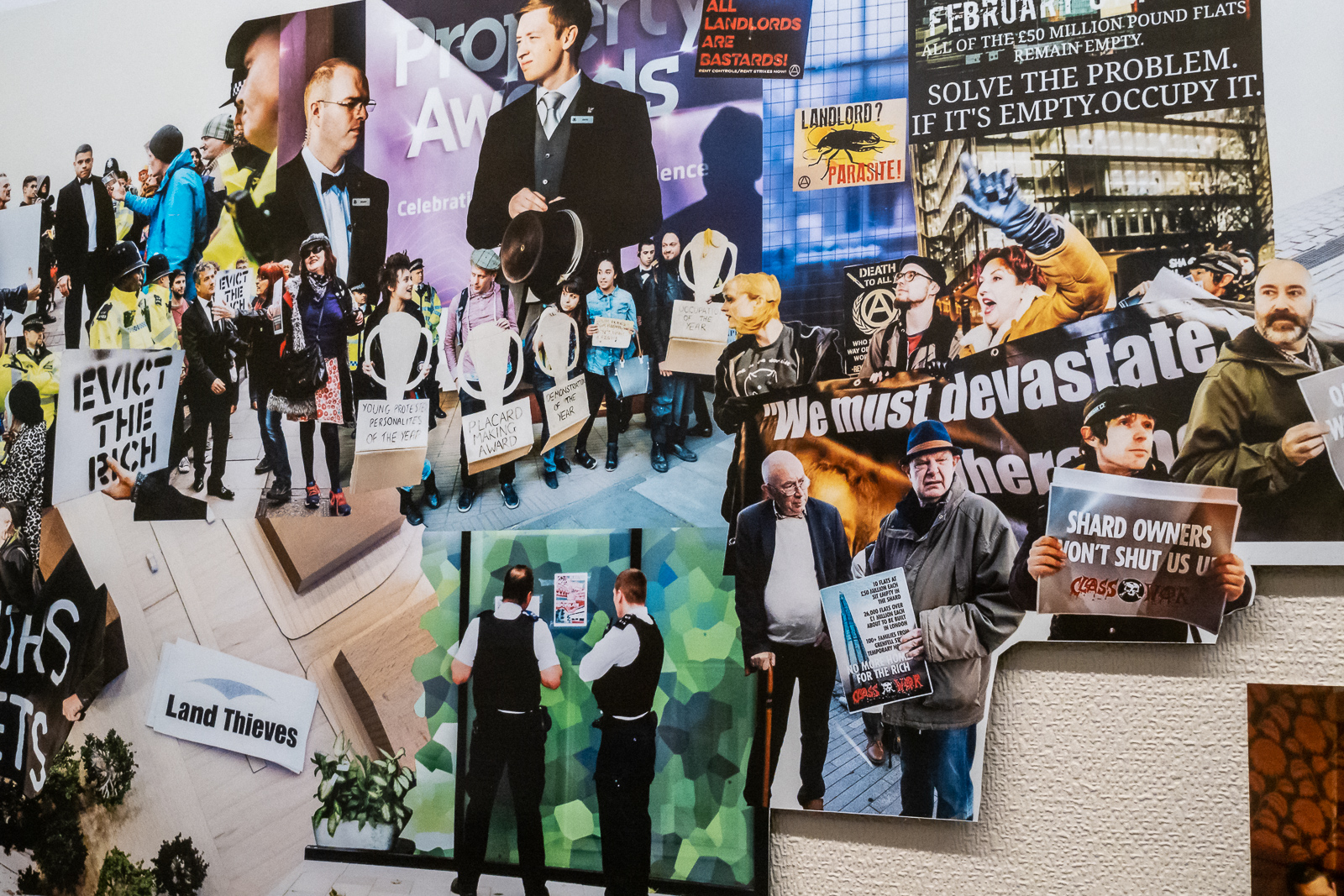
Solidarity collage which includes some of my images
The plans were for a 20 year phased demolition, with rebuilding of modern blocks by a housing association. The generous public space of the estate would be reduced and the housing density almost doubled. The first phase was completed in 2013 and Phase 2 is currently underway. All four phases are due for completion around 2032, and the 12 storey Wendover block in which the exhibition is being held has already been largely emptied of residents and is expected to be demolished around the end of this year.
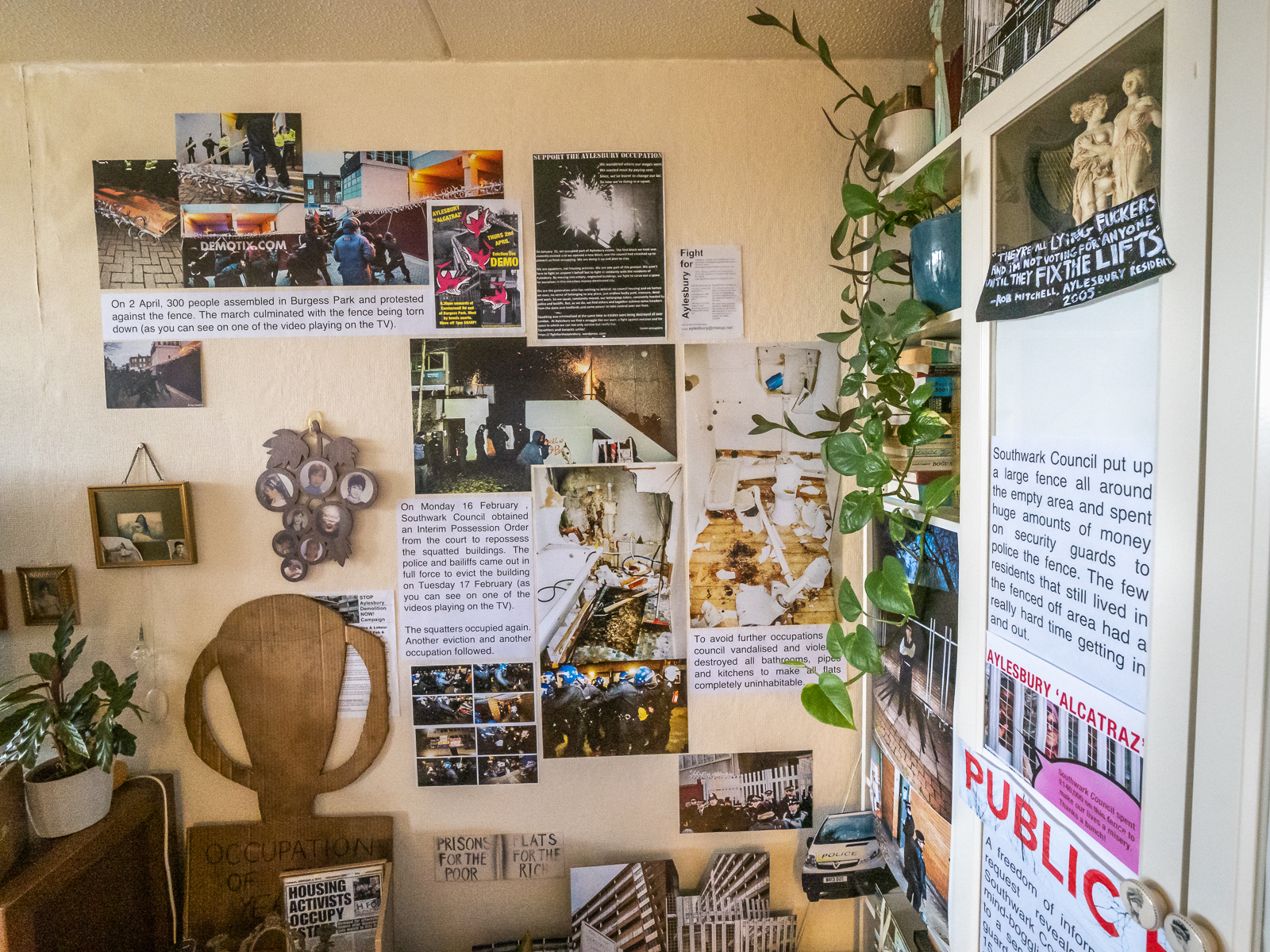
Residents have continued their fight to stop the redevelopment, with protests and in January 2015 housing activists and squatters occupied flats in one of the emptied blocks. Moving from block to block they were finally evicted 18 days later. The squatters occupied another building and again were evicted. Southwark spent £140,000 on a fence, completely destroyed all bathrooms, toilets, pipes and kitchens in empty properties and spent £705,000 on security guards to prevent further occupation.
Other protests took place, including one in which part of the fence was torn down, and various protests at council meetings. Aylesbury residents also joined with housing activists in Southwark and across London at various other protests. But although these brought the Aylesbury campaign and the scandals over housing to national attention, the demolition continues.
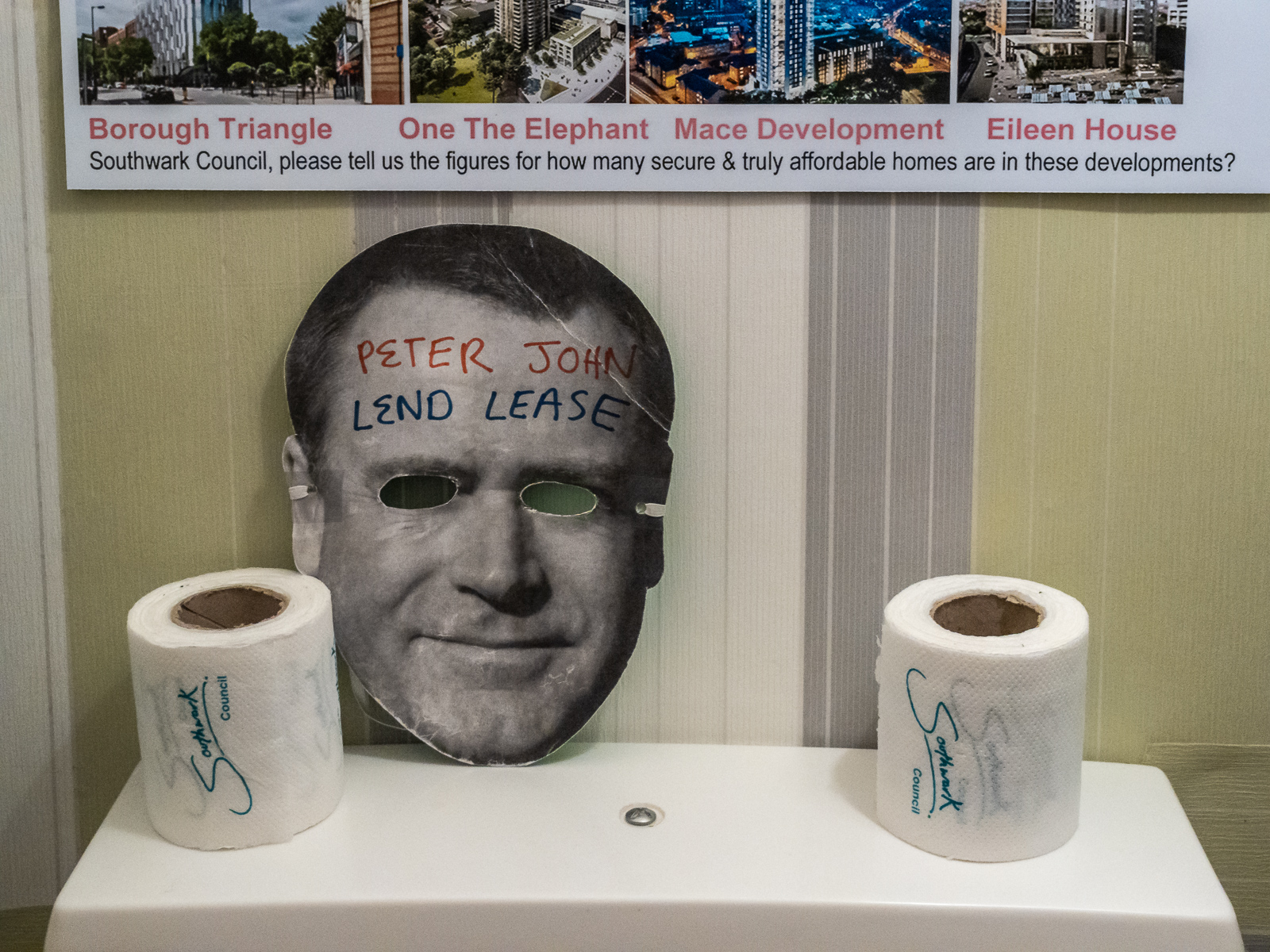
Part of the scandal has been the “well-oiled revolving door” between the council – councillors and officers – and developers. The toilet in the exhibition flat is devoted to Southwark Council, and in particular for its Leader for more than a decade Peter John, who stepped down in 2020. He described his years as a “decade of Delivery“; community; anti-gentrification collective Southwark Notes call it “a Wild West gold rush for developers.” A 2013 report showed that “20 percent of Southwark’s 63 councillors work as lobbyists” for developers in the planning industry.
Similar estates built with the same system elsewhere have been successfully refurbished at relatively low cost to bring insulation and other aspects up to current standards. These buildings will probably last into the next century and their demolition is expensive and incredibly wasteful of both the huge amount of energy that was embedded in them and and energy require to demolish and rebuild.
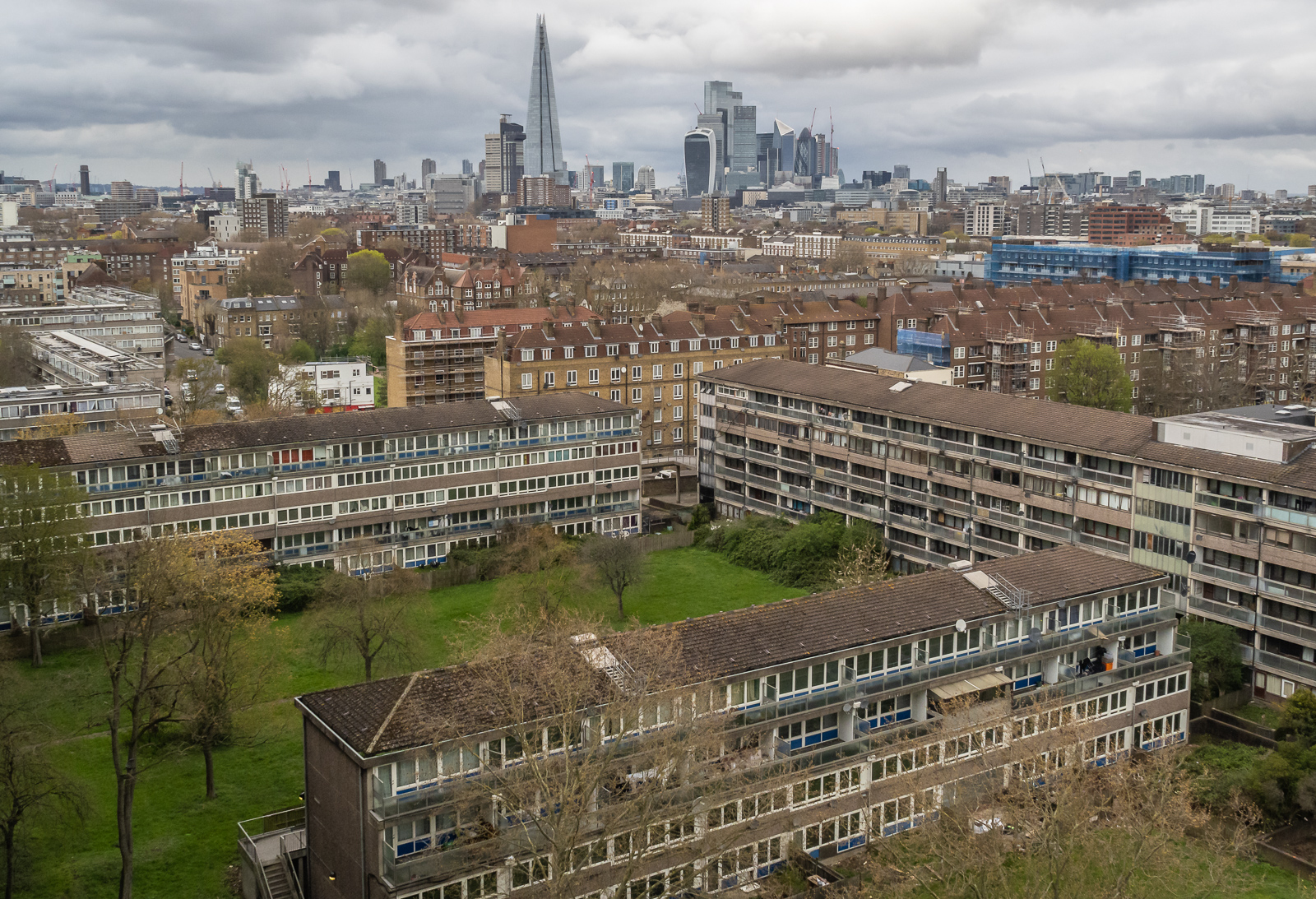
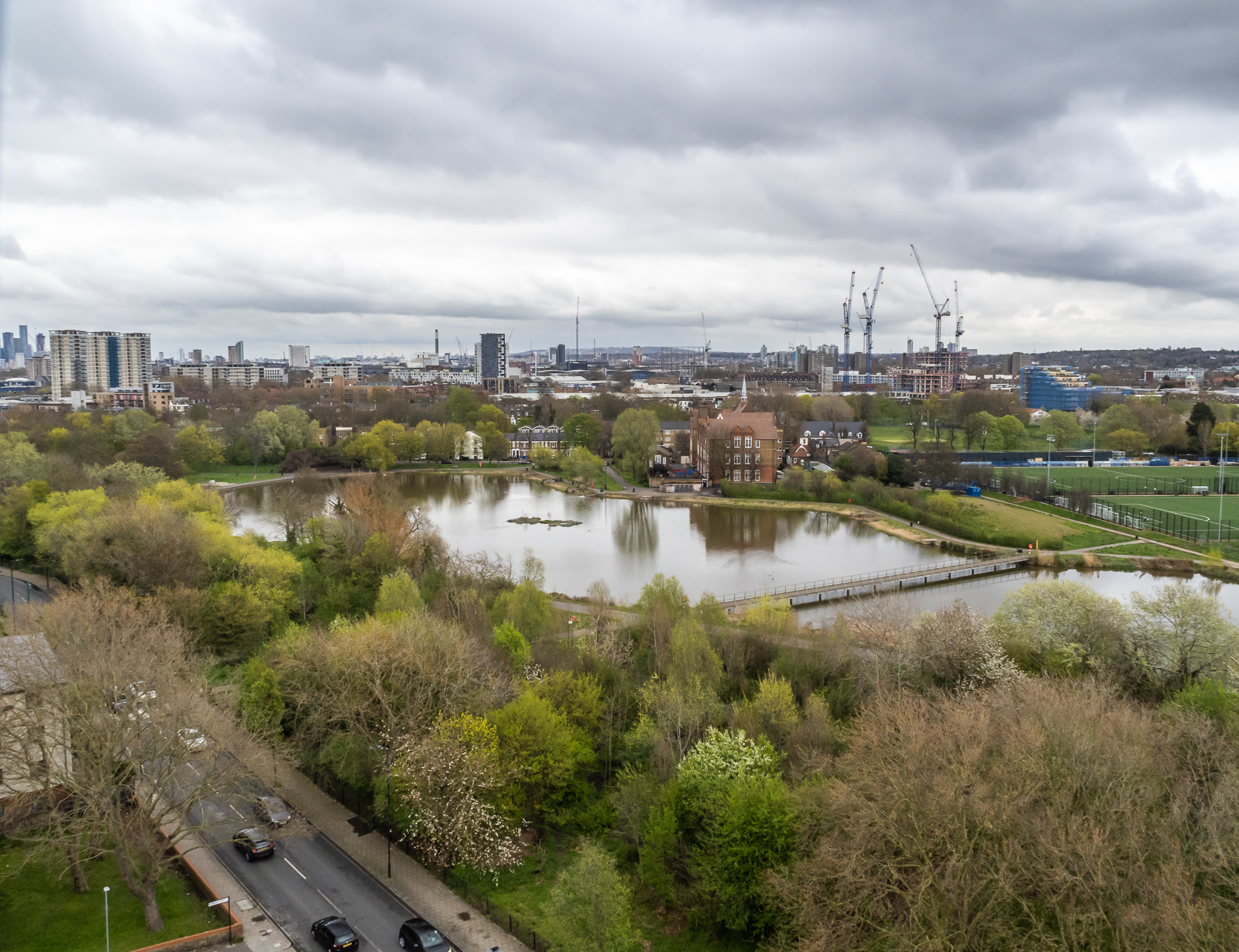
There is more to the exhibition – and you can see some hints of it in the pictures. After visiting the show I walked up four floors to the top of Wendover for the view. The windows were rather dirty and most fixed shut but I did find a few places where they were open slightly to let me take photographs of the views across London.
Canada Water, Southwark Homes & Cody Dock: Events and pictures from Saturday 25th March 2017
Canada Water, Southwark.
The Surrey Commercial Docks were the largest area of London’s Docklands and the only large docks on the south bank of the River Thames, built on a large marshy area at Rotherhithe, a little closer to London than the Royal Navy dockyard at Deptford.
The first dock here was dug out in 1696 and was the largest dock of that age, and could take 120 sailing ships. Later the dock became Greenland Dock, a base for the Arctic whaling trade, but in the 19th century there was a huge increase in trade with Scandanavia and the Baltic, and other docks were dug, as well as huge timber ponds which soon became its major trade.
Deal Porters sculpture by Philip Bews
Surrey Docks was in full swing the in the Victorian age, with nine docks, six timber ponds and the Grand Surrey Canal. Badly damaged by bombing in the Second World War, the docks never fully recovered and were then hit by containerisation. The docks were too small to handle container ships and closed in 1970. Most of the docks were filled in and the whole area was redeveloped.
By the time the London Docklands Development Corporation was set up by the Tories in 1980 the redevelopment initially led by Southwark Council was well under way and the area was set to have a rather different character from the redevelopments on the north bank.
But the LDDC appeared as the principal objector, to the council’s statutory development plan and was backed by the Department of the Environment. Southwarks plan for the whole of the south riverside from London Bridge to Deptford was rejected for showing ‘unrealistic commitment to public housing‘ and for its ‘opposition to office and other private development’. The LDDC went ahead with selling land and buildings for speculative development.
The LDDC rubbed its hands in glee at the thought of selling riverside sites which Southwark had planned for low cost rented housing to developers of large blocks of luxury flats, and rushed to clear aging council estates and replace them with privately owned properties, policies which were strongly opposed by Southwark Council.
But times have changed, and I had come to Canada Water for a march where local people had come to protest against very similar policies by Southwark’s Labour council, working for and with developers to demolish estates such as the Heygate and Aylesbury, with the replacements including only a very small percentage of social housing. I’d arrived early on purpose to give me time for a short walk around before the protest began.
Southwark campaigners marched from Canada Water to protest at Thurlow Lodge Community Hall on the Aylesbury Estate, calling on Labour-run Southwark Council to save homes and jobs in the borough.
Marchers and speakers at the rally before the march included those from tenants and residents organisations, local business networks and others. They had come to oppose Southwark Council demolishing council estates for luxury home building, selling off public land to private developers and profit-oriented housing associations and forcing out small businesses through policies they say are solely concerned with realising asset values and trample on the rights and needs of local residents.
On My London Diary there is a long list of some of the groups involved, but there were others too.
One of the bigger battles, still continuing, is over the future of the Aylesbury Estate in Walworth, just south of the Heygate Estate at the Elephant and Castle, where the council lost a great deal of public money in providing a huge site with great transport links to allow a private developer to make huge profits, losing around 2000 social rent homes. Many of the new flats are empty boxes, investments for wealthy foreigner profiting from rapid increases in London property prices.
Piers Corbyn with others sitting down on Albany Road at the end of the march
Much of the Aylesbury estate has now been emptied, and some demolished. The council was found to have acted acting unfairly towards leaseholders who were being offered derisory compensation – usually less than half the market value of comparable properties in the area. Those who took the court case got improved offers, but there is little evidence of it changing its ways and trying to cheat others. Among those involved in fighting to save the Aylesbury on this march was Piers Corbyn, Jeremy’s older brother, in the news more recently over arguably less worthwhile causes, particularly in opposition to Covid restrictions.
The Aylesbury Estate had been at the centre of the Labour Party’s plans for the regeneration of council estates, the site of Tony Blair’s first big press event. But Labour’s policy was more about grabbing headlines than providing the good low-cost housing that a proper social housing policy requires. Councils such as Southwark have used it to demonise and run-down their large estates, spending large sums with PR companies to do so and working with major developers, rather than properly consulting with residents and putting the necessary cash into estate maintenance, running them down on purpose.
It was a long march to the Aylesbury Estate, detouring to pass several housing estates and business areas threatened by the council, and a tiring one on a warm and sunny March Day, and we were all tired by the time it ended outside Thurlow Lodge Community Hall. This had been saved earlier this year by a community occupation after Southwark Council had wanted to evict the occupants, Divine Rescue, a body with a soup kitchen offering support, training and meals to around a hundred homeless people, and runs a a food bank. Southwark wanted to sell or let the community hall to make more money.
The march organisers had planned to end the march here with Divine Rescue providing hot drinks and toilet facilities after the long walk, but Southwark Council had warned Divined Rescue that there lease would again be threatened if they had anything to do with the protest, forcing them to withdraw their offer. The hall was locked and shuttered, guarded by Southwark Council security when we arrived. It seemed a very petty piece of bullying by the council.
The protesters sat down on Albany Road blocking traffic for around 10 minutes in protest at this, then moved to the area in front of the community hall for a final rally.
From the Aylesbury Estate I made my way to Cody Dock for the opening of my show there, ‘All Along the Lea‘, black and white photographs from the 1980s and 90s, arriving an hour or two early.
This gave me time to take a few more pictures, but also to have some food and a beer and listen to some live music and just to enjoy being there.
It was a pleasant opening with a decent crowd, with plenty of people coming to look at the pictures and talk, including the local MP. As I said and wrote, “When I took these pictures many people wondered why I was wasting time and film on such scenes, so I’m really pleased to have them appreciated now. “
I hadn’t chosen the title for the show, and it wasn’t accurate fro the pictures that were on the wall, almost all from Bow Creek. But I had photographed ‘All Along the Lea’ and my web site and the book ‘Before the Olympics‘ have pictures from the source at Leagrave to the outlets into the Thames both at Bow Creek, and, via the Limehouse Cut, at Limehouse Dock.
Bird in Bush Road, Peckham, Southwark, 1989 89-3c-21
I spent some time exploring the area around Malt Street and Ossory Road, now on the other side of Asda, where some demolition was taking place but took few photographs, none on-line, and then walked back along along the Old Kent Road to Peckham Park Road, going down this to Green Hundred Road. I found myself in a large area of council housing, much of which was fairly standard LCC five storey blocks dating from the late 1930s, solidly built, their height limited back then by the lack of lifts.
The foreground flats in this picture are from the late 60s and are on Bird in Bush Road, part of the GLC designed Ledbury Estate, and as well as these 4-storey maisonette blocks there were also four identical 14 floor H shape tower blocks, including this one, Bromyard House, which has its entrance on Commercial Way.
Bird in Bush Road, Peckham, Southwark, 1989 89-3c-22
This picture was taken from close to the east end of Bird in Bush Road, and the building cut off at extreme left of the image is the former Arthur Street Board School (now Camelot Primary School.)
The design dates of these flats, also on the Ledbury estate, is from the early 1960s and was replicated across London by the GLC, using the prefabricated Danish Larsen-Nielsen system. After one at Ronan Point suffered a disastrous collapse following a gas explosion flats built using this system should have been strengthened, but somehow Southwark Council failed to do so on this estate. I’m not sure whether this had now been put right. but none have yet collapsed.
This semi-detached residence dating from 1836 which was Grade II listed together with the neighbouring Doddington Place around nine years after I took this picture.
The name possibly comes from Doddington Hall in Cheshire, built by Samuel Wyatt for Sir Thomas Broughton in 1777-90 and its parkland landscaped by Capability Brown. There is also Doddington Place at Doddington near Sittingbourne in Kent, but this was only built around 1870.
Tustin Estate, Old Kent Rd, Peckham, Southwark, 1989 89-3c-11
The Tustin Estate is on the north side the Old Kent Road immediately west of Ilderton Road. It has three 20 storey towers, Windermere Point, Grasmere Point (in the centre here) and Ambleside Point, each with over 70 flats which were approved by the GLC in 1964. There are also six low-rise blocks on the estate.
According to Southwark Council, “In March 2021, residents voted in favour of demolishing and rebuilding the low-rise buildings in a residents’ ballot. This will include replacement council homes, additional council homes and key worker housing, shared equity homes and homes for private sale. There will also be a replacement school building, new commercial spaces and a new park. All existing residents will be able to move to a new council home in the first phase of the scheme.” I’m unsure how far this scheme has so far progressed and it remains to be seen whether the council will keep its promises, which it almost completely failed to do on some earlier schemes.
I returned to Clifton Crescent which I had photographed earlier and too a rather better and closer picture of this magnificent curved terrace. As I explained earlier, it was Southwark Council’s decision in 1972 to demolish this crescent that led to a local action group which became the Peckham Society in 1975. Fortunately they managed to stop the demolition when only No 1 had been lost. They convinced the council that retaining and restoring the properties was a cheaper option, and the lost house was rebuilt and the entire crescent, Grade II listed thanks to their efforts in 1974, was restored by 1977. The Crescent was built in 1847-51 and represents an interesting transition between earlier Regency styles and the simpler Victorian terraces.
Car spares, Loder St, Peckham, Southwark, 1989 89-3c-15
From there I made my way east, going under the railway on Culmore Road or Clifton Way and then south to Loder St. This whole area has been redeveloped since I made these pictures in 1989 and is now covered with low-rise housing. I made two pictures of this car breaker’s yard (you can see the other on Flickr).The tower blocks are those of the Tustin Estate.
Hatcham Liberal Club, Queen’s Rd, New Cross, Lewisham, 1989 89-3d-61
I walked down to Queen’s Road, I think along York Grove, stopping briefly to photograph a street corner. On Queen’s Road before catching a bus I photographed the Hatcham Liberal Club, built in 1880 in Queen Anne Dutch style and Grade II listed ten years after I took this picture. It was one of the largest of a number of late Victorian working men’s clubs and became a popular venue with a large hall at the back available for hire for parties and gigs and also for until it closed in 2006. In 2009 most of the interior was converted into flats.
Shops, John Ruskin St, Camberwell, Southwark, 1989 89-3d-62
I changed buses in Camberwell, where I made a slight detour to make another visit to photograph the row of shops on John Ruskin Street as the final picture of the day and this walk.
I stepped a few feet inside the Caroline Gardens Estate to photograph No 79A, which was one of two identical lodges at the ends of the main site. This one is at the north end and the plaque above the doorway has been restored and can now easily be read, ‘THIS LODGE ERECTED 1849 HENRY ENGLAND CHAIRMAN’.
The corner of this lodge occupies most of the right half of the picture, looking down the rather uneven pavement with some vintage street lamps to more of the Asylum buildings. I didn’t go further into the estate as I think I felt this and the earlier pictures of it were enough. The buildings of the Licensed Victuallers’ Benevolent Institution (Caroline Gardens) in Asylum Rd are Grade II listed and as my previous post mentioned were acquired by Southwark Council in 1960.
Lorry Park, Asylum Rd, Peckham, Southwark, 1989 89-3c-55
The lorry park on Asylum Road was something of a contrast to the elegance of the Asylum buildings, though I liked its selection of lines and blocks, the trailers, the fence, barrier and posts and wires.
I can’t see any trace of this now and but I think it was probably on the east side of the street where there is now a large car park for Lidl.
Wales Close, Asylum Rd, Peckham, Southwark, 1989 89-3c-56
On the west side of Asylum Road was this dead end back street, not named on my map from the 1980s but was where Wales Close is now. The tall blocks in the background are on the Ledbury Estate on Commercial Way.
Streets such as this were very much a reminder of London as a city full of industry with many areas like this full of small manufacturing businesses of all trades, as well as larger companies and great industrial estates.
Livesey Museum, Old Kent Rd, Peckham, Southwark, 1989 89-3c-43
Asylum Road ends at the Old Kent Road and the Livesey Museum was at No 682, just a short walk towards central London. The Livesey Museum was commissioned by George Livesey, chairman of the South Metropolitan Gas Company, in 1890 as a library for workers of the local gasworks and later entrusted to the people of the old parish of Camberwell as a public library. It was damaged in wartime bombing but restored and opened as the the Livesey Museum for Children from 1974 to 2008.
Southwark Council wanted to sell the building off, but found that they were not the owners, as it was owned by a covenanted trust. It was squatted in 2010 but then became home to Treasure House, providing special education to vulnerable young adults in Southwark.
I kept walking along the Old Kent Road towards Bermondsey, taking a few pictures including of Christ Church next to the museum and the murals on the North Peckham Civic Centre by Polish artist, Adam Kossowski. Plans for the demolition of this building were approved by Southwark Council in 2019, preserving the mural, listed in 2017.
I haven’t digitised my black and white picture as I thought I had taken better images in colour, but if so I’ve yet to digitise those either. The former North Peckham Civic Centre was the Twentieth Century Society’s Building of the Month for November 2020, and has been described as ” by far the finest 20th Century building on the Old Kent Road.” and was once described by Southwark Council as a building of ‘Architectural or Historic Interest’. But that seems not to be enough to save it, although it was still standing a few months ago.
The doorway to Offices I photographed at 500 Old Kent Road, on the side of the building in Malt Street has since disappeared, along with the row of late Victorian terrace housing in my next frame which I think were also on Malt Street. 500 Old Kent Road is now a part of the address of Asda Old Kent Road Superstore at 464-504, and Malt Street is considerably wider to give easier vehicle access to the Asda car park.