Windsor & Eton

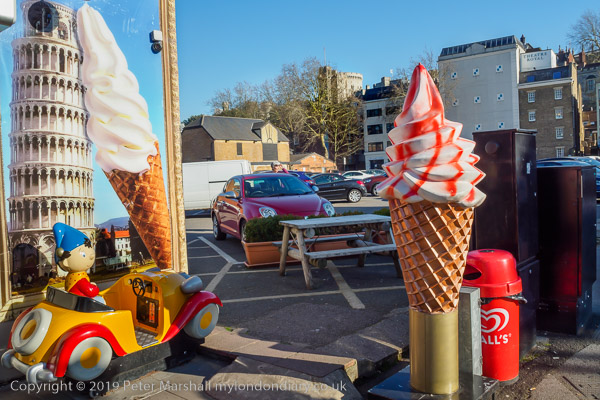
I suppose this isn’t everybody’s idea of a picture of Windsor Castle, but it does rather amuse me, and I was rather brought up with Noddy, who I now realise was at times terribly racist. Noddy was created by Enid Blyton when I was only four, and her last book about him was published in the year I went to university, though since then he has been kept more or less alive on TV and through what is still a best-selling franchise. Mr Golly, who serviced Noddy’s little car seems to have disappeared in the 1990s, and the Gollies who stole Noddy’s car and the song book strongly featuring the n-word are no longer mentioned. It was in the mid 1960s that the racist, classist and xenophobic nature of her books first came under attack. And Windsor Castle is a little less prominent than that Pisan tower.
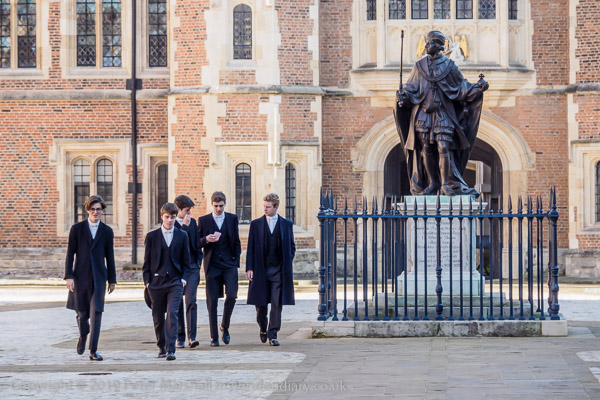
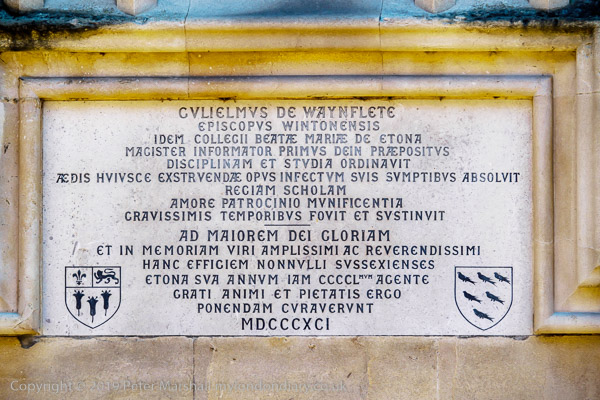
Eton is of course at the very heart of our English class system, and was appropriated by the wealthy from the school founded by Guliemus De Wayneflete for the education of poor boys – as the plaque records.
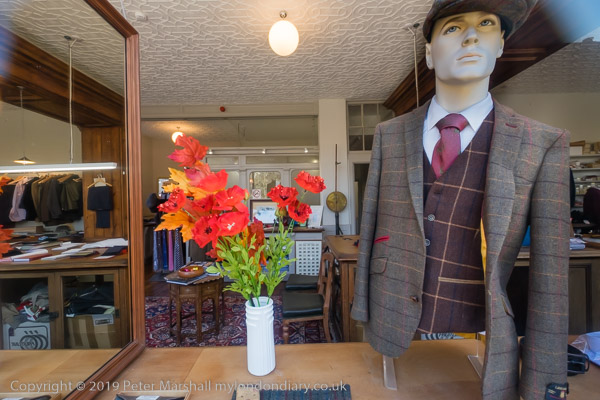
Much of Eton revolves around the school, and perhaps the most obvious signs of that, other than the school buildings themselves are the tailors shops, though it’s hard to imagine anyone actually buying anything in them.
Eton is a ridiculously wealthy and privileged place, though the school does offer some scholarships to gifted poor children, and we were once encouraged by his primary headmaster to put our elder son forward for one. I don’t think he would have survived, either the preparatory school that scholarship boys start at to repair some of the ravages of the state system and certainly not the school itself.
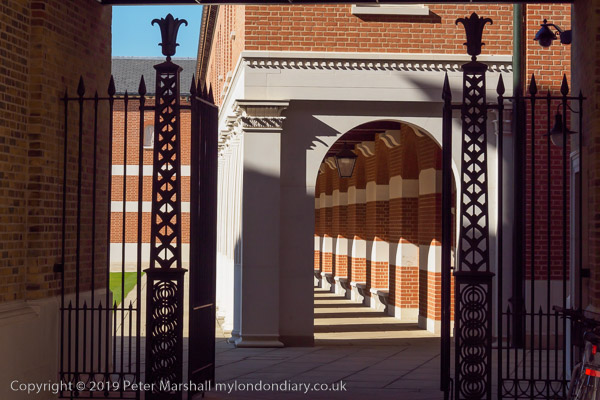
As you walk back towards Windsor, sanity does start to return and there is at least one decent pub where we lunched before returning over the pedestrianised bridge to Windsor, itself a curious place under the shadow of royalty and the military, and also a town full of tourists.
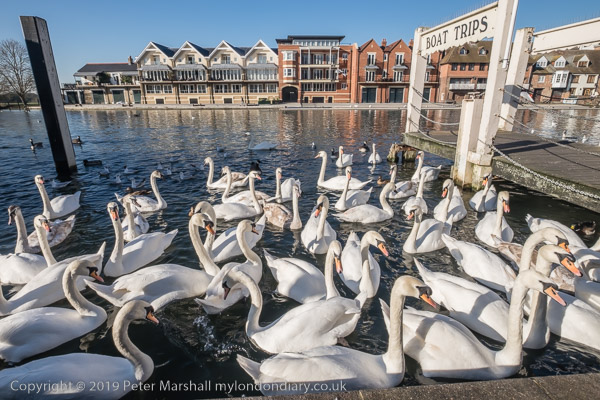
The swans were massing where tourists feed them, across the Thames from the Eton College boat house. I walked to the bus stop to return to the real world.


There are no adverts on this site and it receives no sponsorship, and I like to keep it that way. But it does take a considerable amount of my time and thought, and if you enjoy reading it, please share on social media.
And small donations via Paypal – perhaps the cost of a beer – would be appreciated.

All photographs on this and my other sites, unless otherwise stated, are taken by and copyright of Peter Marshall, and are available for reproduction or can be bought as prints.

To order prints or reproduce images

Bank refuses Venezuela its gold

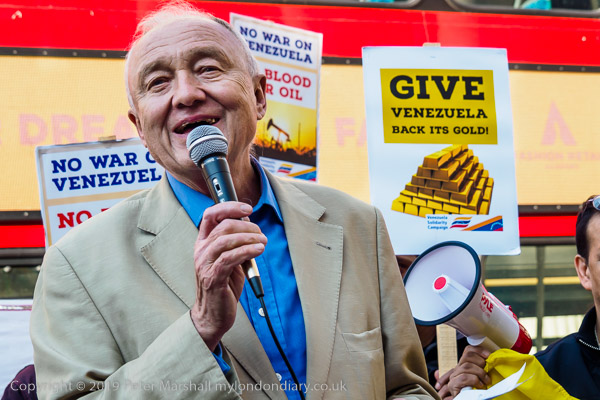
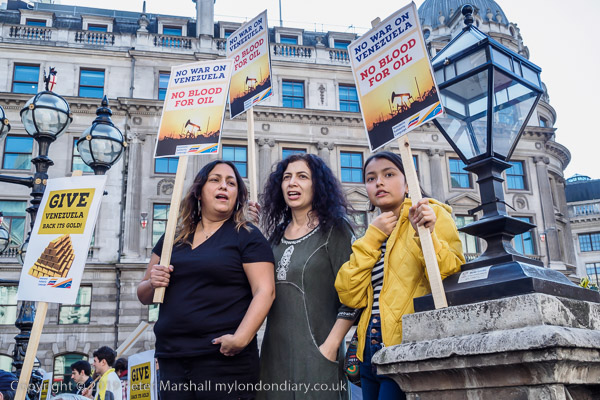
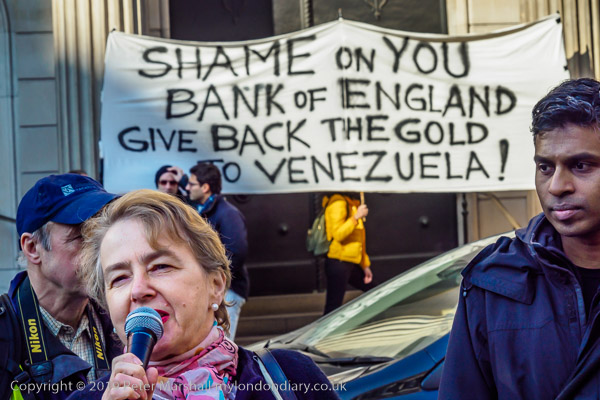
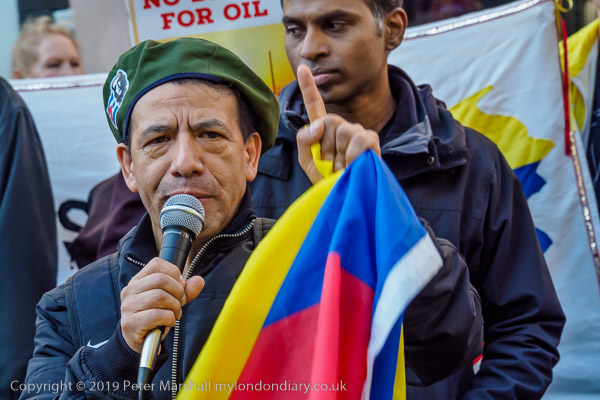
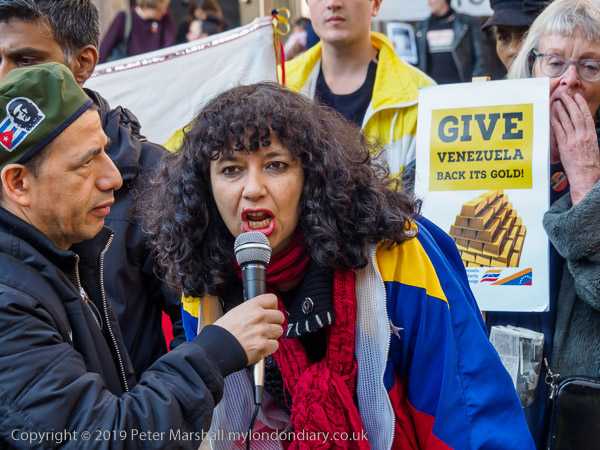
It’s always difficult for photographers when events more or less repeat themselves, and this was the third protest I’d covered in just a few weeks about the US attempt to engineer a regime change in Venezuela, and the second outside the Bank of England, with many of the same people taking part, and it was all too easy to produce more or less the same images. As the great Yogi Berra said, ” It’s deja vu all over again”, though he also said ” I never said most of the things I said.”

Ken Livingstone was also a figure with a second coming, having run the Greater London Council and begun to bring the capital up to date in the 1980s, his success so enraged Margaret Thatcher that she abolished the council and sold off its palatial headquarters just downstream across the Thames from the Houses of Parliament.

Livingstone returned as elected mayor of the new Greater London Authority after 14 years in which London had largely stagnated, acheiving office despite determined opposition from Thatcher’s successor (following the brief interregnum of John Major), Tony Blair. Although Livingstone was the choice of Labour members and affiliates, the votes of Blairite MPs, MEPS and GLA candidates made Frank Dobson the Labour candidate, and Livingstone stood as an Independent. In the first round of voting he came out on top, with three times the vote of the official Labour candidate who was eliminated, and was elected in the second round with a vote of almost 58% .

Four years later, Livingstone was re-admitted to the Labour Party and re-elected as London’s Mayor. Despite two largely successful terms in office, he lost the 2008 mayoral election to Boris Johnson, who set out to establish himself as London’s worst mayor despite often rapturous media coverage.

Of course Livingstone was not the only speaker, but he was the major speaker at the event. He had been in the crowd at the previous protest outside the Bank of England, but this time he spoke, reminding us of his relationship with the former President of Venezuela and the contribution made by Venezuela to enable him to provide half-price bus fares for lone parents, sick and disabled Londoners. Recently after an earlier protest calling for the Bank of England to return Venezuela’s gold I wrote more on Livingstone with some pictures I’ve taken.

Stop Trump’s Venezuela gold & oil grab


There are no adverts on this site and it receives no sponsorship, and I like to keep it that way. But it does take a considerable amount of my time and thought, and if you enjoy reading it, please share on social media.
And small donations via Paypal – perhaps the cost of a beer – would be appreciated.

All photographs on this and my other sites, unless otherwise stated, are taken by and copyright of Peter Marshall, and are available for reproduction or can be bought as prints.

To order prints or reproduce images

Soviet photos

I think I should start this post with a health warning. Do not click the link in this post unless you have hours you can afford to spend looking at photographs. You will probably want to rush out and get a bottle of vodka and be glued to your screen forgetting meals, appointments and the rest and come round some time tomorrow with a huge hangover.

It will almost certainly be worse if you can actually make out the Cyrillic characters or actually read Russian, but even without that the pictures are fascinating, with every issue of Советское фото – Soviet Photo magazine – over 400 of them from 1926-1991 now available to read online at Archive.com.

You can read more about the magazine and its history in both Russian and, if you scroll down, in English on the About tab, which also talks about the early controversies in its pages in the late 1920s and early 30s. It was here that the work of Aleksandr Rodchenko was first denounced as plagiarising the work of Western European photographers László Moholy-Nagy and Albert Renger-Patzsch – unfortunately leading the magazine to boycott his work – and later his and similar work politically denounced as formalist; foreign and elitist and not in line with the official party line of Socialist Realism.

Photography developed rather differently in Russia, something that was made clear to me in 1978 when ‘The Russian War 1941-5’, a superb collection of photographs edited by A. J. P. Taylor , Daniela Mrazkova & Vladimir Remes, many of the pictures in which are now well-known.

After the war there was also a disjunct between photography on the two sides of the iron curtain, with relatively little contact between the two. With a few exceptions, the work that we saw came from photographers who had managed to leave the Soviet bloc – though some of those exceptions were notable – such as Czech photographer Josef Sudek (1896-1976), the ‘Poet of Prague’. Things of course began to change with the fall of the Soviet Union in 1991.

This is certainly a site to add to your bookmarks, and one that, like vodka, is best taken in small doses.

Of course there is much more available on the Internet Archive, and a recent post looks at their work and at the problems of preserving Internet content. It’s something I have a definite personal interest in, as over 300 articles that I wrote about photography are now, for copyright reasons, only available among the 330 billion web pages, now stored on the ‘Wayback Machine’.


Catalan evening

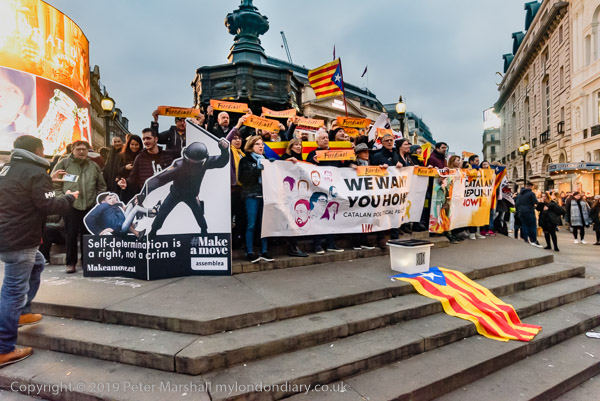
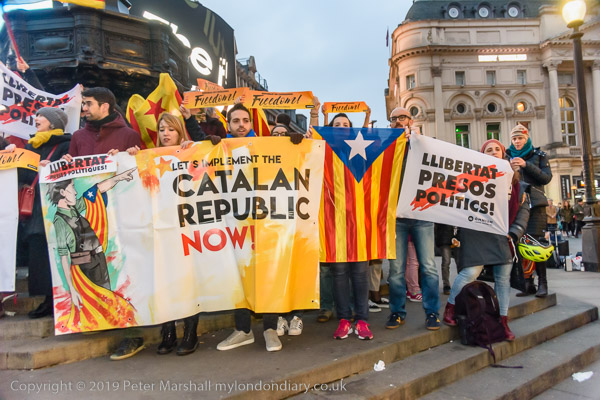
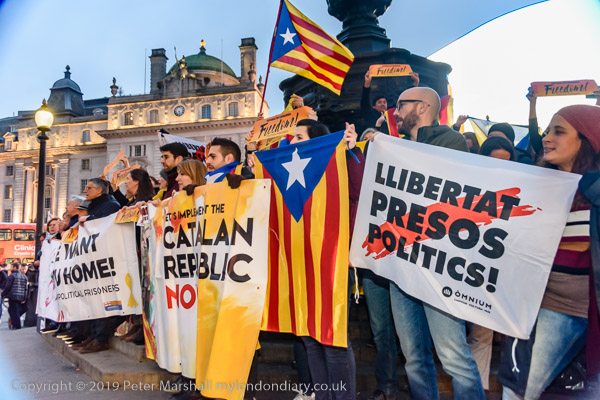
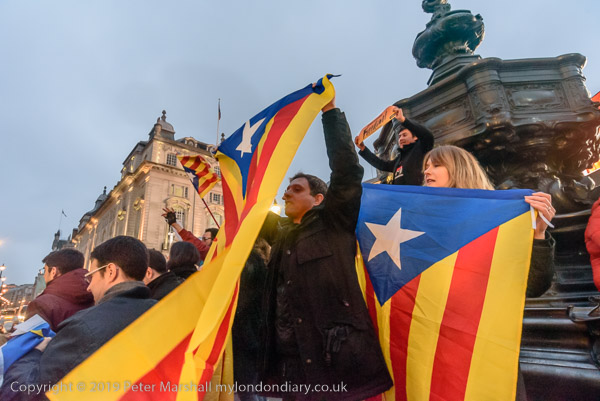
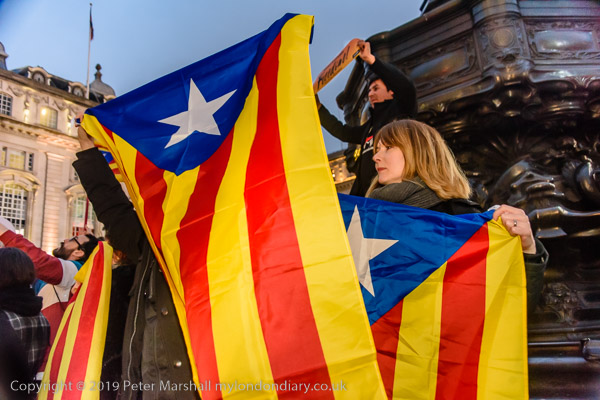
It was around a quarter past five by the time the Catalan protest got going on the steps around Eros, and in mid-February this was sunset, though it seemed rather darker than this suggests. Of course with the amount of street lighting and lights in shop windows and traffic it never really gets dark, but the contrast between the brightness of the advertising display on one side of Piccadilly Circus and the opposite side of the monument was pretty huge, and the protesters seemed to be in very deep shadow,

Using the Nikon D750 and D810, with both set to ISO 6400 allowed me exposures of around 1/125 at f5.6 without flash, though these were deliberately underexposed by a stop or so to keep something of a night look.

I didn’t have any fast lenses with me – and don’t own anything faster than f2.8 for the Nikons, finding them too heavy to carry and unsuited to most of the work I do where wide apertures mean the depth of field is too limited, though there are times when a fast telephoto would certainly help. But apart from the cost of the lenses I’d probably find myself needing the services of an osteopath. Although the Nikon lenses are remarkably good wide-open, when possible I like to stop down just a little, and most of these were taken at 1/2 to one stop down from the variable maximum.

I used flash for about half of these pictures, with a Nikon SB800 in the hot-shoe, but still worked at ISO 3200 to avoid getting people looking like cardboard cutouts in front of a black background, making sure that areas too far away to benefit from the flash were still getting enough exposure from ambient light. Although normally I work with the cameras on the ‘P’ setting (but often altering the selected shutter speed) Nikon’s flash system doesn’t really work with this, and when using flash I switch to aperture or shutter priority or sometimes full manual.

Flash on camera is always a problem where important parts of the subject are at different distances from the camera, and sometimes I make use of the fall-off of flash away from the centre, angling the flash head away from the closer parts of the subject. But inevitably some, often considerable, burning and dodging is needed when processing the images. Even in those taken without flash the lighting was pretty uneven and some correction was needed. If I can tell which of the images was taken with flash and which without except by looking at the EXIF data I don’t think I’ve got it right.

More at Against political trial of Catalan leaders


There are no adverts on this site and it receives no sponsorship, and I like to keep it that way. But it does take a considerable amount of my time and thought, and if you enjoy reading it, please share on social media.
And small donations via Paypal – perhaps the cost of a beer – would be appreciated.

All photographs on this and my other sites, unless otherwise stated, are taken by and copyright of Peter Marshall, and are available for reproduction or can be bought as prints.

To order prints or reproduce images

Valentine for Venus

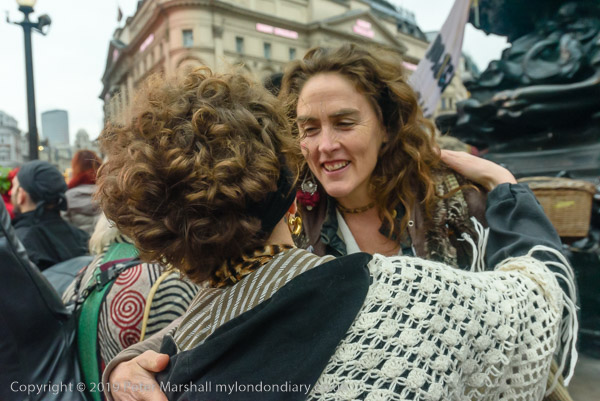
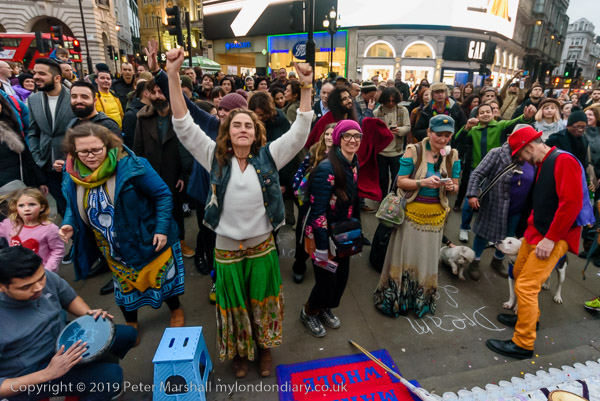
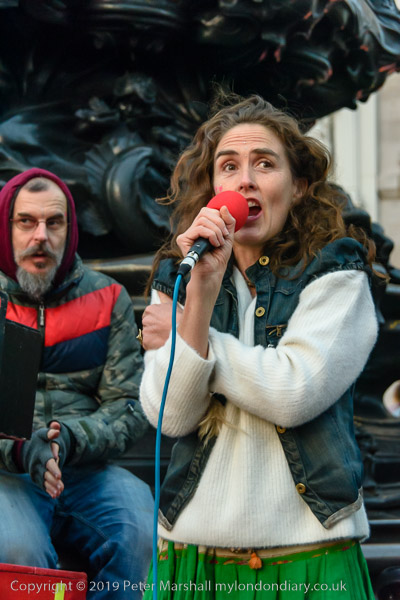
Like everyone else at this year’s Reclaim Love street party I was delighted that Venus CuMara, who founded this remarkable annual street party back in 2004 was there, and to hug her and to hear her speak.

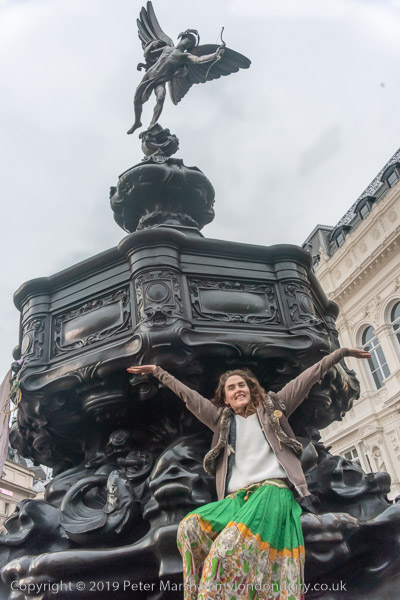
I missed that first event in 2004 as I was in Paris with my wife for Valentine’s Day and her birthday a few days later. This year was the 16th ‘Reclaim Love’ free Valentine’s Day street party and like all except I think the first which began in Trafalgar Square, took place around the statue of Eros in Piccadilly Circus, with drumming, music, dancing poetry to celebrate reclaim love as a manifestation of the human spirit from the sleazy commercialisation which has taken over Valentine’s Day as a festival of profit.

Many of us still have the free t-shirts which were handed out to all who wanted them at several of these events, with their message “MAY ALL THE BEINGS IN ALL THE WORLDS BE HAPPY AND AT PEACE, though mine is now a little stained and doesn’t often get worn.

It was this same mantra that was repeated as those present made a large circle around Piccadilly Circus to share Venus’s message of peace and love around the world. Venus called it a “Massive Healing Reclaim Love Meditation Circle beaming Love and Happiness and our Vision for world peace out into the cosmos“.

Police stood back and watched this unofficial event each year, sometimes coming to persuade those who had climbed up onto the top of the fountain to come down. I think the only more serious intervention came when one year everyone went to the sacred grove of trees in Green Park to make the large circle there, and the police in the park were definitely not amused.

Beginning in 2005, I’ve photographed the street party almost every year and shared the pictures on-line, both on Facebook and on My London Diary. I missed 2016, when I was too ill to go, and 2017 when I was in Hull (both celbrating the city of culture and again my wife’s birthday.)

Venus and I have talked on several occasions about bringing out a book with my pictures of the events and her poems and reflections, but haven’t got around to making it happen.

A couple of years ago we were shocked to hear that Venus was suffering from cancer, and she missed the 2018 party at a retreat in Indonesia. But this year she was back again, though with the cancer still spreading through her body, speaking about it and about how we should all hug ourselves and each other. Her cancer has made her even more determined to spread her message of love.

Much more at Reclaim Love 2019 street party


There are no adverts on this site and it receives no sponsorship, and I like to keep it that way. But it does take a considerable amount of my time and thought, and if you enjoy reading it, please share on social media.
And small donations via Paypal – perhaps the cost of a beer – would be appreciated.

All photographs on this and my other sites, unless otherwise stated, are taken by and copyright of Peter Marshall, and are available for reproduction or can be bought as prints.

To order prints or reproduce images

Secret Rivers

Just opened at the Museum of London Docklands is the exhibition Secret Rivers, which is worth going to see if you are around – and is free. Not all of the rivers featured are secret – they include the Thames and the Lea – but they are all of interest. As well as videos and maps and pictures including a few photographs there are also objects found in the rivers on display.

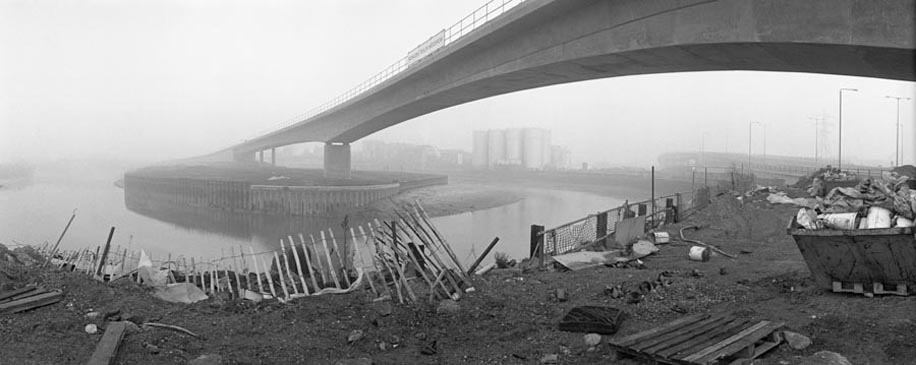
I’ll leave more general comments about the show to the reviews listed at the bottom of this post, but say a little more about my own minor contribution, the picture above of the DLR being built across the not very secret Bow Creek which I made in morning fog back in 1992. It was one of around a dozen images of the DLR extension shown as part of a group show on Transport at the Museum of London later that year.

I’d left home early on a Sunday morning in mid-January as a fine morning with clear sky was dawning, catching the first early morning train to Richmond then the North London Link to Canning Town. As we approached the destination I was disappointed to find everywhere was shrouded in mist; had I known I would have stayed in bed at home!

I’d recently bought what was then the most expensive camera I’d ever owned, a new Japanese Widelux 35mm model, a rotating swing lens camera, which had cost me around £2000 (equivalent to around £7000 today allowing for inflation) and had decided this was an ideal project to make use of its unique characteristics.

I was pretty fed up with the mist, as I wanted nice clear pictures, and it was also much colder than I’d anticipated in the mist, but as I’d spent a couple of hours travelling to the location I decided to take some pictures, and stuck at it for an hour or two, making around 40 exposures – roughly two films. The camera gave around 21 exposures on a normal 36x 35mm casette with negatives the same width as those made with a 6×6 camera but only 24mm tall.

It was a slow job, as the camera had to be carefully levelled on a tripod for each picture, otherwise the horizon would appear curved. The viewfinder was imprecise, and I soon learnt it was better to rely on the two arrows on the top plate which indicated the field of view to visualise the result.

The camera used no batteries, but was clockwork and entirely manual. Winding on the film also wound the shutter and rotated the lens, held in a vertical cylinder in front of the curved film behind, to its starting point. On pressing the shutter release, a slit behind the lens opened to epose the film as the lens rotated around a roughly 130 degree arc. I think the shutter speed was probably 1/125 s, based on the exposure of any point on the film, but it took perhaps 1/30th for the slit to travel across the film as the lens rotated.

I calculated the exposure using a separate hand-held meter, a Weston Master V, which could make relected light readings as in-camera meters do or, with the aid of a curiously shaped lump of translucent plastic, it could measure the light falling on your subject, almost certainly what I used for these pictures in the fog. The Weston meters used a selenium photo cell around two inches in diameter, which generated enough electricity to power the meter, and again needed no battery.

I’d walked from Canning Town down the Silvertown Way and over the Lower Lea Crossing to where the DLR crossed the creek. The mist I think was rather thicker than it looks in the picture, and I could hardly see Pura Foods. I took a few more pictures then my way back via the East India Dock Road to Canning Town cold and disappointed. It seemed to me to have been a wasted day – and I came back a week later to retake the images in clear daylight.

Once I’d developed and printed the films a couple of weeks later, I realised that although for most of what I’d taken the mist really spoiled the pictures, this image, with the viaduct disappearing into the distance was rather special. It remains one of my most widely published and exhibited works, but is the only one from that foggy day day that appears on my River Lea website.

More about the Secret Rivers show at:
Londonist
London Live (video)
The Guardian
Evening Standard
MuseumCrush

There are no adverts on this site and it receives no sponsorship, and I like to keep it that way. But it does take a considerable amount of my time and thought, and if you enjoy reading it, please share on social media.
And small donations via Paypal – perhaps the cost of a beer – would be appreciated.

All photographs on this and my other sites, unless otherwise stated, are taken by and copyright of Peter Marshall, and are available for reproduction or can be bought as prints.

To order prints or reproduce images
Streets & people

Thanks to PetaPixel for bringing to my attention the video 1838-2019: Street Photography – A Photo For Every Year with 182 photos — one photo for every year between 1838 when Daguerre set up his camera overlooking the Boulevard du Temple and 2019 with activists hassling an MP outside Parliament in London.

It’s a curiously hypnotic experience, with each photo appearing for around 6 seconds, with a musical soundtrack that reflects the changing decades, and a rather strange selection of images by Guy Jones, taken on streets around the world, though majoring on the USA. I found it rather annoying but I couldn’t stop watching, though I did turn the volume right down.

Almost all of the pictures certainly are taken on streets and show people, but it rather reflects the lack of any real integrity in the term ‘street photography‘. And while the pictures do reflect the changes in technology over the years, any real historical oversight is entirely prejudiced by every picture from the 20th and 21st century being presented as colour – which for most means a recently colorized version of an original black and white picture. Some colours were rather less than believable. This is faux history in the making.

You’ll probably recognise a few of the pictures, and some of the photographers, but mixed in with these are some rather anonymous postcard views, press images and amateur holiday snaps, which don’t always seem particularly appropriate to represent the year in which they are taken. It’s in a way a very uninformative video; often I found myself wanting to know more about why a particular picture was taken and what it it shows. And for those taken in more recent times I did wonder whether Jones has permission to use the images from the copyright holders. I hope so, though I saw no closing credits to indicate this.

Haddo

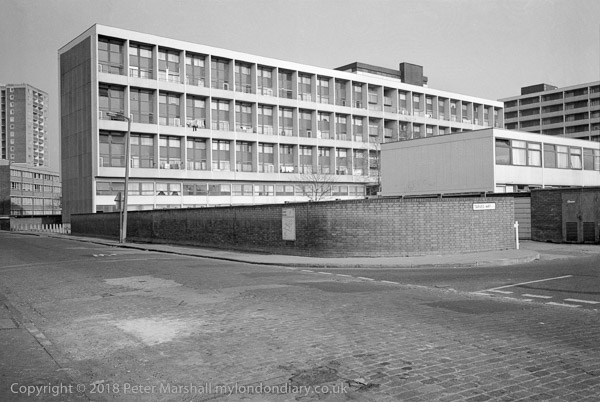
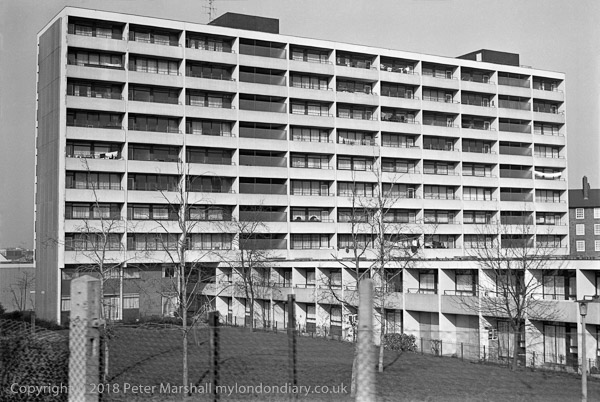
I woke up early this morning worrying about this picture, and that below of the Haddo estate in Greenwich, around Tarves Way off Norman Road close to Deptford Creek and Greenwich Station.

How is it that an estate which seems so neat and tidy and so well-loved both by the council and the residents behind their trim net curtains some 15 or 20 years after it was built in the 1960s (I can’t find the exact building date) had deteriorated to such an extent that the Haddo Estate around Tarves Way was one of the first to be ‘regenerated’ under New Labour with the homes emptied and demolished only 20 years later around 2003 at a cost of £90m?

Back around 2000, and to some extent now, politicians indulged themselves blaming the architect of these and other schemes, though more often it was perhaps the builders or system developers who were at fault for disasters such as Ronan Point, a short distance across the river. But many of the estates that have been or are being demolished were well designed, decently constructed and basically sound, perhaps good for at least another 50 years.

Many of the faults were faults of their time, which could have been prevented by proper maintenance or corrected with relatively inexpensive melioration – new windows, insulation etc. Resident caretakers and appropriate security systems – like those that turned Trellick Tower from sink to highly des res could perhaps have saved Haddo. Instead even many estates that were built with resident caretakers lost them, replaced by the occasional quick drive-by visit from a man in a council van – and the occasional heavy-handed police raid.

More fundamentally we have to ask how it happened that a housing policy once driven by social justice and civic pride that built many fine estates changed over that period to one led by estate agents, developers and profit. It happened under a regime that sought to remove all power from local authorities by a process of pauperisation and emasculation, forcing them to sell off properties at cut price and preventing them from using the proceeds to replace them.

And of course it goes wider than housing. Under Thatcher and Thatcherlite New Labour, greed and personal ambition at the expense of others became the order of the day. Our ideas about community, strong after the war and the era of the welfare state which followed it where whittled away by a leader who stressed self-reliance and the individual (or at best the nuclear family) and told us there was no such thing as society. Back in the early 80s I could walk around estates like this carrying a large bag of expensive camera gear and never feel any danger, but fifteen years later things had changed.

Part of the equation was certainly the relatively high standards, both of internal space in the dwellings and the green spaces around the buildings which make them such delectable targets for demolition and replacement with properties at high market or near market (the unaffordable “affordable”) returns.

I don’t know much of the details of the Haddo estate, either before or after its replacement, but have seen what has happened and is if anything now accelerating at other council estates in London, the majority in Labour-run boroughs.

Plans outlined in the building press showed ‘New Haddo’ was to have 510 homes, around half built for market rate sale, a third for some kind of so-called “affordable” rent and 85 for shared ownership. In most such regenerations by the time they come to completion, ways have been found to increase the proportion at market rates, by claiming that the developer cannot make sufficient profit – a figure set ludicrously high.

There appear to have been no homes in the new development at real social rents which most of those in the properties in my pictures will have been paying, and which will almost certainly have been sufficient to have paid off the council’s investment in building the estate.


There are no adverts on this site and it receives no sponsorship, and I like to keep it that way. But it does take a considerable amount of my time and thought, and if you enjoy reading it, please share on social media.
And small donations via Paypal – perhaps the cost of a beer – would be appreciated.

All photographs on this and my other sites, unless otherwise stated, are taken by and copyright of Peter Marshall, and are available for reproduction or can be bought as prints.

To order prints or reproduce images

BP out of the BM

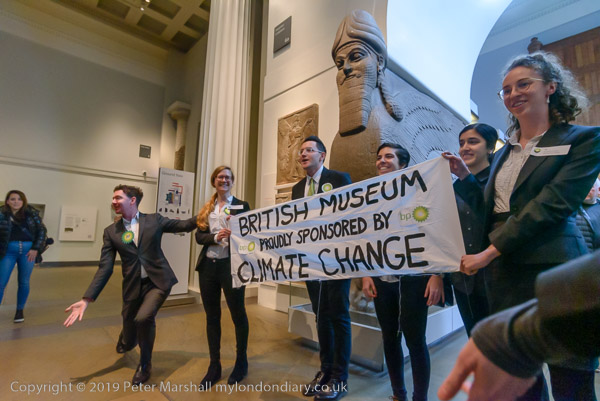
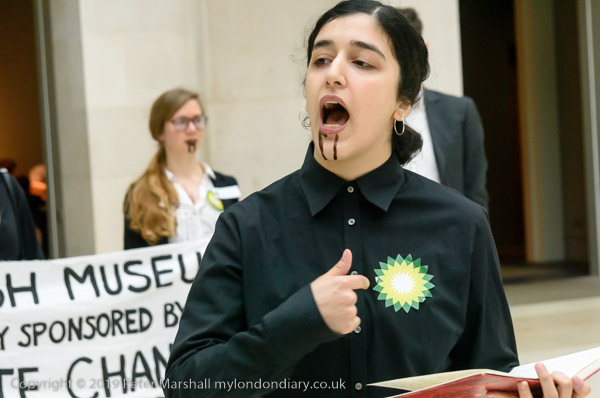
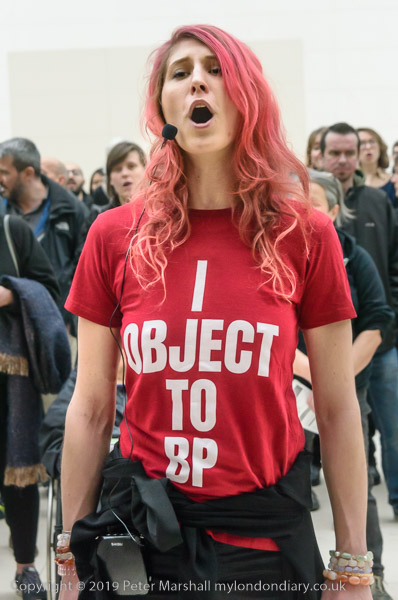
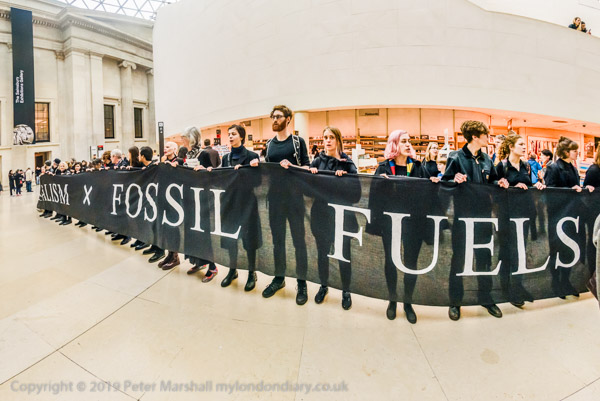
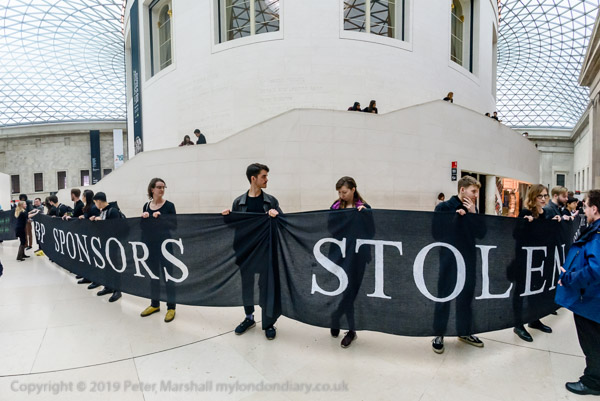
‘BP or not BP’ is a bunch of activists who stage performances of one sort or another at various cultural institutions and events to protest at the way the arts are being used to promote and sanitise companies guitly of destroying the planet and other crimes, ‘greenwashing’ to hide their mucky stains.

BP are a prime example of such a company, responsible for many murky political dealings in countries around the world in search of oil, Extracting oil has destroyed valuable ecosystems though pollution, with huge oil spills threatening large areas of ocean life. Its oil feeds the plastics and artificial fabrics industries, while the use of oil products in heating, air conditioning and transport etc is the cause of the huge increase in grrenhouse gases which is causing disastrous global warming.

BP gives a relatively small financial contribution to the British Museum, for which it gets a incredible return in good publicity, its logo on posters and on labels in the museum.

The protest took place on the 16th anniversary of the invasion of Iraq, conducted as is now clear from documents from many sources largely to ensure access by US companies to Iraqi oil resources rather than anything to do with the WMDs which all knew did not exist. It also took place while the BP-sponsored show I am Ashurbanipal: King of the World, King of Assyria‘ was nearing the end of its run. It’s a show which includes a number of looted objects from the area (which stretched from Egypt to the Persian Gulf), both from historical times when the BM was itself sending archealogists to the area and apparently some more recent acquisitions sold to dealers after Iraq was left in chaos and during the current conflict in Syria, bought with the aid of BP money.

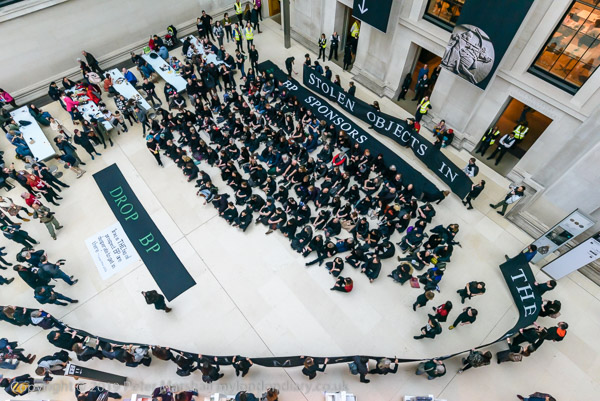
While several hundred protesters gathered at the front of the Great Court, a small performance took place in the Assyrian galleries, and was then repeated in front of the entrance to the Assyrian exhibition. Meanwhile the main protest got under way, amd after an introductory rally people were lead to from a ring all around the Great Court, with posters all round.

The Great Court is a large area around the old former BM Reading Room (where my wife once worked) and is said to be the largest covered public square in Euripe, with an area of 3,692.5 square metres. I think the chain around it holding the banners must have been around 600 feet long, though only relatively small sections were visible from any one point.

This was something of a challenge to still photographers, and I walked around it several times taking pictures. Long banners are always a challenge in terms of the aspect ratio. Even if you frame the people holdina banner from head to toe working in landscape format, this only results in a horizontal field of view of around ten foot. To frame longer banners results in the people and the banner shrinking to a narrower strip across the image.

You can improve matters by photographing the banner from one side, filling the frame height with the nearest person or going in even closer, and this is often my approach. But as the make the viewpoint more oblique, the banner text becomes less and less legible. And legible text is important with banners.

My friend taking video had a simpler task and did it well, filming as he walked around the whole circle. A similar approach using still photography would have resulted in a print with a roughly 100:1 aspect ratio, and while it might have been possible to join up the banner, as you moved from exposure to exposure the backgrounds would change.

I did take a series of pictures from the top of the stairs overlooking the area in front of the Assyrian exhibition, where the banners were brought and people sat on the ground. Possibly taken together they would show the whole string of banners (though I think some were folded before they reached the display), but more than the two on My London Diary make rather tedious viewing.

End BP sponsorship at British Museum

There are no adverts on this site and it receives no sponsorship, and I like to keep it that way. But it does take a considerable amount of my time and thought, and if you enjoy reading it, please share on social media.
And small donations via Paypal – perhaps the cost of a beer – would be appreciated.

All photographs on this and my other sites, unless otherwise stated, are taken by and copyright of Peter Marshall, and are available for reproduction or can be bought as prints.

To order prints or reproduce images
Goldsmith’s Security

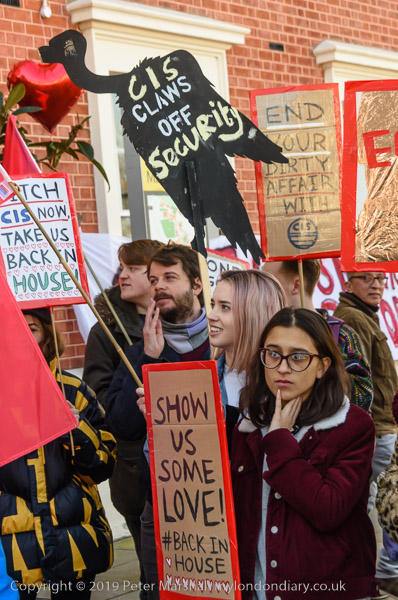
Goldsmith’s University is a part of the University of London located in New Cross in south-east London. Like many other organisations it has outsourced many of the service jobs on campus, paying private companies to provide the vital services that keep the university running.

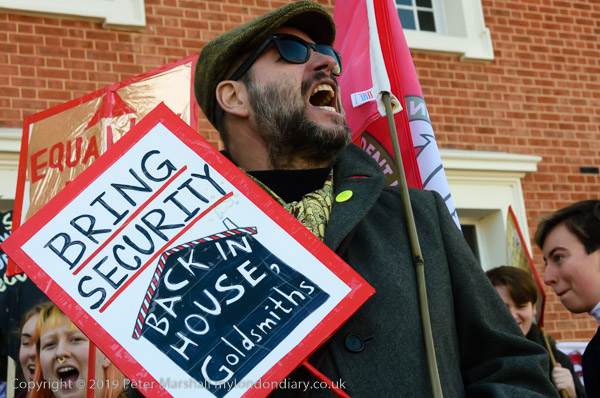
Outsourcing contracts are generally awarded to companies who put in the lowest tender, and they do this largely by cutting corners at the expense of their employees, who are on poor wages, with lousy conditions of service and often greatly overworked by bullying managers. At Goldsmith’s the security guards employed by CIS Security report not getting their statutory sick pay, grievance pay, maternity/paternity pay and public bank holidays off, and feel they are treated as second-class citizens, not allowed to make use of the car park, canteens that other staff can use.

Their campaign to be brought in-house – employed directly by the university – has been supported by the Student Assembly which passed a motion of support for the security guards and the campaign by their trade union, the IWGB, and asking for Goldsmith’s management to recognise the IWGB to which the majority of them belong.

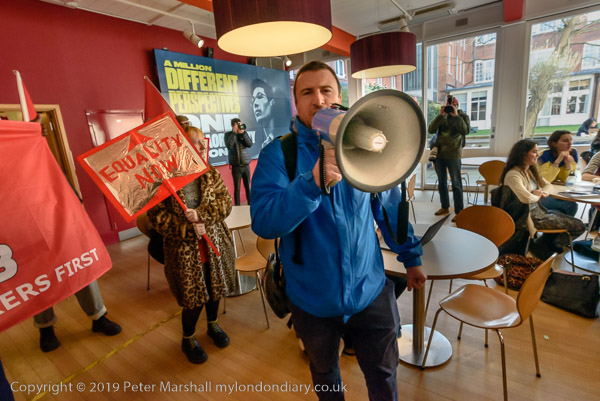
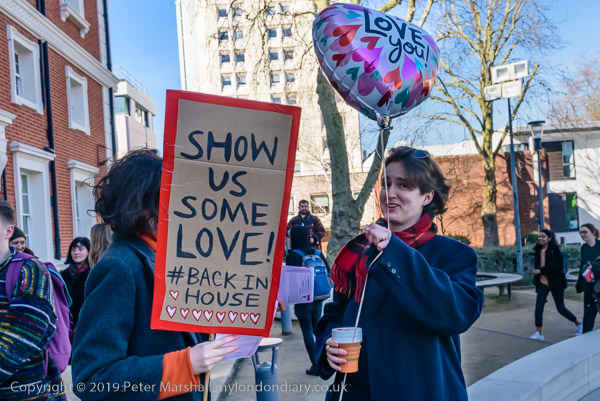
The protest, called by the Independent Workers Union of Great Britain’s (IWGB) Security Guards and Receptionists branch and supported by the Goldsmiths Students union and the Goldsmiths branch of university teachers union UCU, took place on St Valentine’s Day, and placards, posters and balloons reflected this, calling for the university to ‘show some love’ for the people who work there.

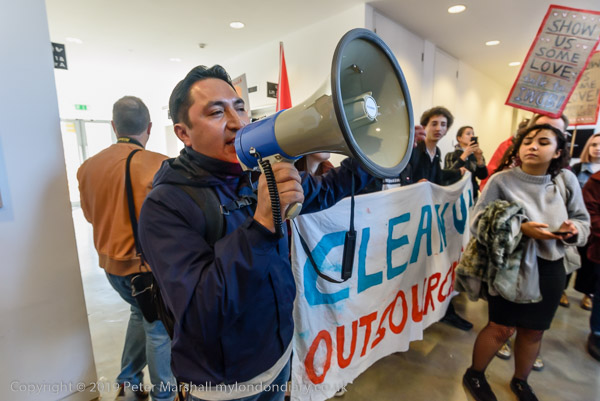
It was quite an eventful protest, and after a brief rally in front of the main building, the campaigners went inside and spoke to people eating in two canteen areas before walking through the buildings to emerge on the busy main New Cross Road, where they stopped traffic for some minutes by sitting on the road in front of Deptford Town Hall which now houses some of the university management. They returned onto campus and occupied the foyer of another building for a short rally before walking back to where they had started the protest for a final short rally.

More at Bring Goldsmith’s Security In-House.


There are no adverts on this site and it receives no sponsorship, and I like to keep it that way. But it does take a considerable amount of my time and thought, and if you enjoy reading it, please share on social media.
And small donations via Paypal – perhaps the cost of a beer – would be appreciated.

All photographs on this and my other sites, unless otherwise stated, are taken by and copyright of Peter Marshall, and are available for reproduction or can be bought as prints.

To order prints or reproduce images