PGDB Shortlist: Fazal Sheikh

Fazal Sheikh’s work is far better for me in the book (and on the web) than on the gallery wall. On his web site he describes himself as “an artist-activist who uses photography to create a sustained portrait of different communities around the world, addressing their beliefs and traditions, as well as their political and economic problems. By establishing a context of respect and understanding, his photographs demand we learn more about the people in them and about the circumstances in which they live.”

Reading the exhibition labels, and even more so the book, I found the texts considerably more interesting than the photographs. You can read the complete book, Ladli – ‘Beloved Daughter’ in either English or French on his web site (or of course you can buy it in print.) The text on the web (actually present as images) is just a little small for my comfort on the web, but the images are well reproduced.

Part of the problem on the gallery wall is the scale of the images. In his work, Sheikh makes use of a narrow plane of focus, usually rendering the eyes and face sharp, while the side of the head and ears are out of focus. It’s a technique that for me only really works at a particular size of print, as the print size alters the apparent degree of ‘fuzziness’, giving a different effect at different scales. The web images, at around 13.5 cms high are a little too small, and just look slightly annoyingly unsharp, for example the ears in the portrait of Kajal. It looks more like a slight mistake than deliberate decision, while in the large gallery prints they seemed too fuzzy. There is an uneasy line between when a ‘signature’ becomes merely a ‘formula’ and seeing all these works gathered together on the gallery wall rather than embedded in the lengthy text of the book did start to make me find the approach relentless.

Sheik’s prints are inkjet prints, and according to the catalogue are maked on “handmade Photo Rag paper.” They are actually pretty good prints, but the paper looked to me rather like a machine made Hahnemuhle paper that many of us use for our exhibition prints. But perhaps this is just another manifestation of the extreme problem that galleries have in spitting out (or gicleeing) the “i” word.

I think his are fine books, and that they deal with important issues. However I think that other photographers have produced essays around these topics that are more powerful photographically, less mannered and more direct.

The Final Four: Deutsche Börse

This evening I went to the opening of the Photographers’ Gallery Deutsche Börse Photographic prize, where work from the 4 shortlisted photographers is on display until April 4, with the winner to be announced on March 5, 2008.

The drinks for the event were kindly supplied by Asahi (beer) and Errazuriz (wine) but as usual were not to my taste. So perhaps my thoughts I’m now writing will be more lucid than might otherwise be the case. I’ve been a supporter and member of the gallery for over 25 years, because I think photographers ought to give their support to the major London gallery supposedly devoted to the medium. However I sometimes despair of the gallery’s taste in photography as well as wine and beer!

In previous years, when I was writing for the largest commercial site yet to deal seriously with photography (alas no longer) I’ve given a prediction of the winner of this prize (formerly sponsored by another bank.) I’ve always found it necessary to think who should win the prize because of their photography, but then to look at the jury and where they are coming from and try and predict the winner on political grounds. This is a process that usually gives me two chances out of four of being right, although my experience is that choosing the photographer “who has made the greatest contribution to photography over the previous year” (the stated purpose of the award) seldom finds the winner.

This year the contest is between John Davies (b1949, Britain), Jacob Holdt (b1947, Denmark), Esko Männikkö (b1959, Finland) and Fazal Sheikh (b1947, USA). Although I personally think one of them stands heads and shoulders above the rest, it is perhaps possible this year, unlike in some previous years, to see reasons why any of the four might walk away with the £30,000 first prize. There is a reasonably illustrated catalogue available from the Photographers Gallery at £16.99, though I didn’t feel moved to buy a copy, for reasons that will probably be clear when you have read my four pieces on the people in the show.

In my previous post on the Deutsche Börse Shortlist I gave some basic information about the four people selected, along with links to their work online. What I will write now are some fairly short pieces based on the work as now displayed at the gallery and my reactions to it.

John Davies
Jacob Holdt
Esko Männikkö
Fazal Sheikh

You can read some of the basic information about these photographers (and a little more) on other sites – one of the better examples is the Daily Telegraph, (not a paper I would normally bother to read, though many years ago my step-mother used to take it simply on the grounds that it had a crossword she could cope with.) This has features on Davies, Holdt, Männikkö and Sheikh, each accompanied by a set of pictures from those at the gallery.

Learning Lessons in Africa

I was very pleased to see that the Guardian Unlimited online feature ‘Learning Lessons in Africa’ has won the Journalism.co.uk multimedia storytelling competition. Using photographs by Ami Vitale and video by Danny Chung taken in Mali, the report was produced by Elliot Smith and designer Paddy Allen.

It is a well deserved award. The report superbly integrates the colour images by Vitale with black and white video by Chung. The commentary by Vitale (and a second story by Jeevan Vasagar) is lucid, intelligent, moving and very much makes it point, as to do her powerful images.

I’m also pleased because the report shows work that it funded by Oxfam, a charity I’ve been a supporter of since I started work.

Finally I’m pleased because Ami Vitale is a fine photographer whose work – you can see more on her http://www.amivitale.com/main.html web site – I’ve written about on several occasions in the past.


Me in Alcatraz. Photo (C) 2005, Ami Vitale

It was a great pleasure to meet her in Poland in 2005 – and to find that she was a a fan of the web site I was then running. As you can see from my diary (and the pictures) we got on very well together. You can also see her taking my picture on the street, although she took a better one in Alcatraz later.

A Busy Friday

Demonstrations are sometimes rather like buses, with none for ages and then three come along together. On the afternoon of Friday 25 Jan it was four rather than three, and I think there were a couple more I didn’t manage to get to.


Stop Kingsnorth – No new coal fired power stations

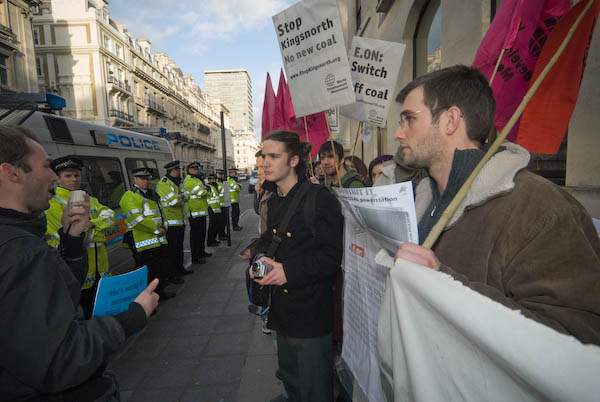
The first I photographed was outside the Pall Mall offices of energy company E.ON who have recently got planning permission from Medway Council to build a coal-fired power station at Kingsnorth on the Thames Estuary. It’s now up to the government to decide whether to give it the go-ahead – another test of whether they take environmental issues seriously.

Of course it’s time we were moving away from large power stations and the high energy losses that come with transferring electricity long distances on the grid, moving to a decentralised low energy use society.

I like the picture above because of the way it lines up demonstrators and police facing each other and shows the whole situation with a speaker addressing the demonstration at the left of picture.

In fact I largely had to work from the side as the officer in charge told me I was obstructing the pavement when I stopped in front of the demonstrators to take photographs. We had a small argument and I reminded him that the police had reached an agreement with the press that recognised we had a job to do and should be allowed to do it, but it didn’t help. I pointed out that if I stood in the large gaps between the officers on the kerb I would not be either obstructing the pavement or impeding the police in any way, but was simply refused permission to do so, without any attempt to justify the decision – but with the clear suggestion I would be arrested if I disobeyed the instruction. So much for police cooperation. As you can see from the other pictures I took, I didn’t entirely do as I was told, but it did make my work difficult.

From Pall Mall I walked along to Trafalgar Square, stopping briefly outside the Uganda High Commission where a group of Kenyans was beginning to gather to demonstrate against the Ugandan president who has given support to the fraudulent Kenyan President. I didn’t stop long as I wanted to go to a larger gathering in Whitehall.

President Musharraf was visiting England, and expected to arrive in Horseguards Avenue by car. A group of around 50 Pakistanis was waiting their to protest against him. I took some pictures of them (and as with the other demonstrations you can see them on ‘My London Diary’.)

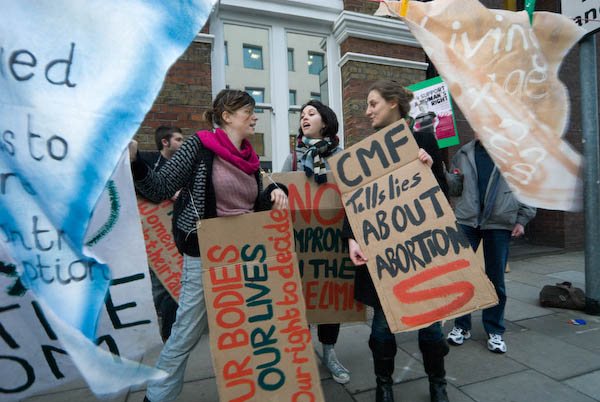
Finally I went to Borough in Southwark, where ‘Feminist Fightback‘ were demonstrating outside the offices of the Christian Medical Fellowship.

The CMF gave misleading evidence to the Parliamentary Committee which was considering possible reforms of the abortion act last year, and a number of its members with little direct scientific knowledge also gave evidence as if they were expert witnesses. They also support (and hosts) the minority report, which is in part based on their unreliable evidence.

Here there were no police and I was able to work without hindrance. Several people came out of the CMF office to talk to the demonstrators and they also had a table with soft drinks and biscuits although I don’t think anyone took any.

Although it was only a small demo, it was more interesting than many to photograph, and presented a few interesting problems, particularly because of a stiff breeze that kept blowing the items of ‘washing’ on the line that the demonstrators strung between a couple of roadside posts, making it hard or impossible to read the slogans on them. But I also liked the contrast between the CMF people and the demonstrators (with whom I felt considerably more at home despite a religious background.) Abortion is a subject that arouses strong and not always rational feelings, often with a failure to understand or appreciate what others are saying.

More about all these events – and of course more pictures – on My London Diary:
Stop Kingsnorth – No New Coal
Kenyans protest against Ugandan President
Protest against Musharraf
Feminist Fightback

Leica Full Frame?

Leica’s announcement last week of a “perpetual update program” involving hardware upgrades to the Leica M8 to keep the camera always up to date with the “latest refinements and developments in technology” is certainly an interesting development. Given that Leica has such a commitment to the body size and shape of its cameras, and the really solid build quality – unlike other modern cameras, it certainly makes great sense.

The cost of the upgrade is now said to be 1200 euros (£900.) This seems fairly reasonable compared to the replacement cost of a quality digital camera – and particularly given Leica prices. After the upgrade the M8 will essentially be a new camera with a new guarantee period. I’m not sure if the update policy will keep my M8 useful for as long as my Leica M2 has been but it is certainly a revolutionary policy for a digital model.

The Nikon D200 which I’ve now been using intensively for over 2 years, will cost me rather more to replace and I probably will do so fairly soon (and in any case I will soon have to take it in for fairly expensive repair.) So

One of the more interesting statements from Leica is “We are presently investigating
the possibility of further upgrade steps including the camera’s complete digital section, even including the sensor itself
.” What has become clear is that at some future date Leica hope that this will include the replacement of the current 1.3x sensor with a full-frame one, assuming that they can find a technical solution to the problem of using such a sensor with Leica wide-angle lenses. Those people who’ve said to me that they are “waiting for the M9” need wait no longer.

I downloaded and installed the new firmware (1.201) and it seems to have improved the colour balance noticeably; I haven’t yet found any problems. You can download it and the information about the upgrades from the M8 download page.

Reality Crossings

I’ve just today got my copy of the Winter 2007/8 issue of ‘European Photography‘ magazine (no. 82 – the web site is out of date and still shows 81, another worthwhile issue, but on ‘Photography in Berlin’ as the current issue), which is devoted to the project ‘Reality Crossings’ shown at the 2nd Fotofestival Mannheim_Ludwigshaven_Heidelberg (FMLH for short) in Sept-Oct 2007. Unfortunately I wasn’t invited to be there, but from this magazine issue I think that ‘Reality Crossings‘ may well turn out to have been one of those significant defining moments in photography – like such shows as Szarkowski’s “New Documents” in 1967 or William Jenkins’ “New Topographics: Photographs of a Man-Altered Landscape” at George Eastman House in 1975. And although I didn’t see either of those shows, they changed photography and they changed my photography.

Reality Crossings was a much more diverse show than either of those I’ve mentioned, and the issue contains a photograph (or in some cases, several) and a short statement (mainly by the curator) about the work of around 66 photographers as well as introducing almost 20 videographers. You can see some of the work on the festival web site, (the link is to the English version). I’d recommend anyone with an interest in contemporary photography to both buy the magazine and to look at the work on the web.

Of course many of the photographers in the show will be familiar. They include several I’ve written about elsewhere, including Michelle Sank, Michael Ackerman, Christian Schad and Michel Tichy (as you can see, not all the work is contemporary) as well as a number already on my ‘to-watch’ list.

Of course a publication – or even an exhibition – with such a large number of voices has to be unsatisfactory in that it can only give the merest glimpse of what activates the various authors. It’s even rather an introduction than a manifesto, but, as the introduction by curator Christoph Tannert states, it is “based on realism as an outlook on life” and demonstrates “that courage is indispensable in the pursuit of truth.

He goes on to say “The documentary must be confronted with the psychedelic extravagance of the photographic eye, which also involves conjugating structures, reflecting on form itself.” This is a thought which resonates with me (and I think will do so with all fellow ‘post-street‘ photographers) and which reflects some of the spirit which has inhabited my own work, both in the post-industrial landscapes of ‘London’s Industrial Heritage‘ and in the web-centred profligacy of ‘My London Diary.’

Future-Proof Camera?

Leica M8 owners have recieved an interesting e-mail promising an update package for the camera, the first in what is described as “a perpetual upgrade program” which will result in the Leica M8 being able to “incorporate the latest refinements and developments in handling ease and technology.”

Registered users can buy certificates for the upgrade in March, but the factory will not start the work until August 2008, and we have still to be told the cost, but it sounds as if it will be very useful.

Included are two features which are significant improvements:

  • Scratch-proof sapphire glass cover for the LCD monitor.
  • Noise-optimized shutter with a fastest speed of 1/4000s.

The shutter noise has been one complaint by many users, including myself, who found the M8 sound much more obtrusive than the film Leicas. You can compare the two in the sound files on the Leica M8 Downloads page.

Also welcome is the news that a firmware upgrade, version 1.201 available from tomorrow, Feb 1, (presumably from the download page above) will improve the automatic white balance, one of the annoying minor (for those of us who shoot RAW) defects of the camera.

Leica does seem finally to be getting its act together with the M8, and it’s good to see that it intends to keep the early purchasers of the camera up to date rather than bring out a new model every couple of years. I just hope the cost will not be too great.

Along with Cornerfix – and of course those IR cut filters – we look like ending up with a truly usable camera. Like earlier Leicas it is a great camera to use – within its limitations, and the discipline that this imposes can be extremely productive. I found it very useful in Paris last November when I wanted to travel fairly light, shooting mainly with a 35mm f1.4 lens. Although it isn’t as flexible as a digital SLR, for certain things it is still the best tool. While the SLR is the Swiss Army knife of photography, the Leica is more of a scalpel.

Who Polices the Police?

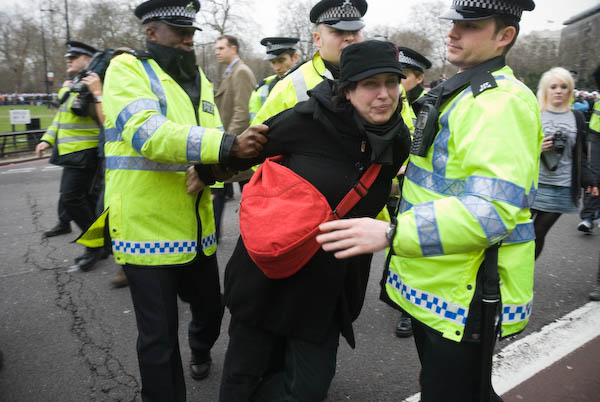
The answer of course is that the police do, and when 20,000 or so off-duty police marched through the centre of London last week, there were a few of their uniformed mates there to make sure things went smoothly. However the guy that usually divides the estimates of numbers on marches by 2 or 3 did seem to be taking a day off!

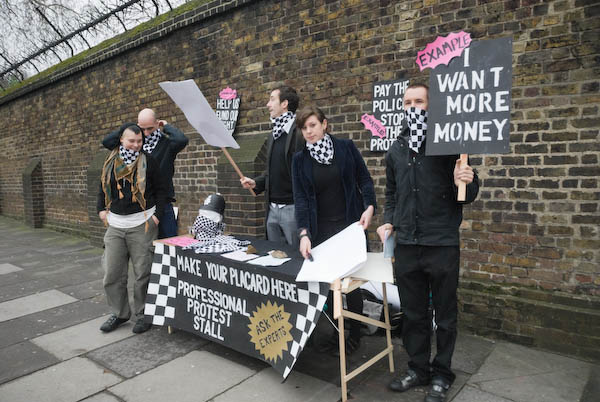
Apart from the numbers, it was a pretty miserable show, and the police clearly needed to take some lessons from the Space Hijackers, who had thoughtfully set up a professional demonstrators stand at Hyde Park Corner to give them advice.

At the start, both ‘Class War‘ and ‘FITWatch‘ had turned up to show them how a mere handful of demonstrators can create rather more interest. With the uniforms being watched by a large media crowd, they were mainly careful to act rather more carefully than is sometimes the case when dealing with – and arresting a couple – of the protesters. The start of  the march was delayed for around half an hour by the protests.

But unfortunately one single man outdid even these, the presence marching with the police of the BNP mayoral candidate for London – largely keeping out of the way of the press – was the evening paper’s headline story.

I’d photographed him at the start of the march, but hadn’t thought anything of it. It’s no secret than there are many BNP sympathisers in the police, and it was no surprise to see him there, It was only when other photographers started to get a little excited about it, later in the march, that I thought I should perhaps get a better picture – but by then he had disappeared. In fact the picture the newspaper used wasn’t any better than mine.

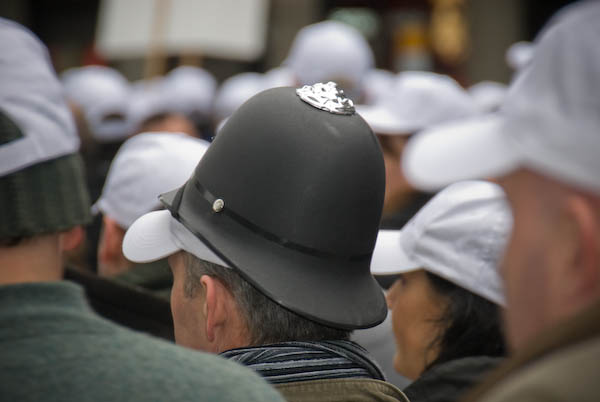
At least one policeman in 20,000 has a sense of humour, and there were even a few who were clearly amused by the ‘professional protesters’, though rather more who shouted abuse (often using language that could have got them arrested!)

I also came in for a certain amount of abuse and pushing for being a photographer at one point in the march. The police do really have some problems they need to sort out, and their relationship to the media is one – though perhaps less pressing than others.

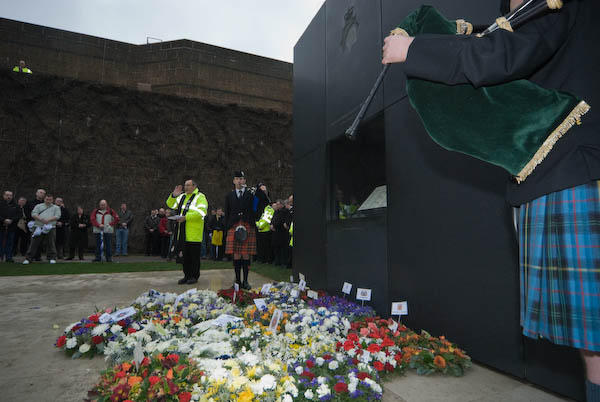
I’m not anti-police. They have a tough job to do, and need more and better training to do it. It is a dangerous job, and this was brought home when wreaths were laid at the National Police Memorial to commemorate those who have died doing it.

More pictures and text on the march on My London Diary.

All pictures are (C) 2008, Peter Marshall. All rights reserved.

Capa Treasure Trove

The discovery of Robert Capa‘s negatives from the 1930s, long thought to have been lost after he left them in Paris when he fled from the Nazis in 1939 is a remarkable piece of news, although rumours about their survival first began to spread around 1995.

Three flimsy cardboard cases containing around 50 tightly rolled nitrate base 35mm films of various lengths, in total around 3500 negatives, are now being investigated and catalogued by experts from the George Eastman House working for the ICP. Most of the strips are indexed in the lid of the box – and you can read many of these in the interactive graphic from the New York Times feature. Much of the story is told in the slide show there, and you can read more details in the article, The Capa Cache.

The negatives first came to light after a Mexico City film-maker inherited them from his aunt, whose father had been a general and Mexican diplomat stationed in Marseilles in the late 1930s, where he had helped Republican refugees to go to Mexico.

Capa had left his negatives with his darkroom manager, Cziki (Imre Weisz), another Hungarian, who took them to Marseilles, possibly hoping to flee to Mexico. But he was arrested and interned in Algiers (though he did later get to Mexico City, where he died in recent years.)

It took over ten years – and the efforts of curator Trisha Ziff – to persuade the film-maker and his family to make the collection public, and that the most suitable home for the negatives was the ICP, founded by Capa’s brother, Cornell Capa.

Some of his most famous images have already been located among the films, and more are likely to be found. Capa worked with his partner, Gerda Taro, until her death in the war, and the collection is likely to raise more issues about which of the images were her work, as well as possibly settling any remaining doubts about one of the most famous and controversial images in the history of the medium, Capa’s (or Taro’s?) “The Falling Soldier.

More Blueeyes

Another issue of the on-line photography magazine Blueeyes, edited by John Loomis and his team, is always worth a good look, and the seventeenth issue which appeared recently is another fine one.

Little Voice‘ is a powerful essay by Lisa Wiltse (b 1977, Weston, Connecticutt, USA) who got her BFA from the Art Institute of Boston in 1999 and is now a staff photographer for the Sydney Morning Herald. Her work has concentrated on humanitarian issues in Central America, Uganda, India. In Little Voice, she looks at the consequences of the annual flooding in Bangladesh, which this year displaced some 9 million people. The country is one of those most at risk from global warming, with a sea-level rise of only 1 metre being enough to flood half the country. Her essay demonstrates the emotional power of black and white photography at its best.

Cosmin Bumbut’s work on Blueeyes is very varied, with both colour and black and white and a wide range of subject matter and approach, coming from a number of different projects. Among the best images for me are several interiors, including a fine image of a two people and two where we see through doorways. Born in Romania in 1968, he studied at the Film Photography Dept 0f the Film & Theatre Academy in Bucharest, and he is now based in that city as a freelance photographer.

Bumbut was also one of the founders of Punctum, which is a downloadable Romanian photography magazine – the latest edition includes work by Lois Greenfield. Don’t miss looking at the pictures from Rosia Montana on his own site.

Kelly Shimoda was also born in Connecticut, but in 1976, and is a Brooklyn based freelance. She studied American Civilization & Latin American Studies at Brown University and worked for six years before taking the Documentary Photography and Photojournalism certificate program at the International Center of Photography in New York. In 2005 she founded the collective Veras Images, on whose site you can see work by her and ten other photographers.

Her project on Blueeyes, ‘Last Saturday Night‘, uses richly emotional colour to look at the final nights of the last two roller disco skating rinks in New York that closed early in 2007. Some of those skating there had started as kids 40 years ago.

As well as these major portfolios there are several other contributions worth looking at, and of course the archives. Blueeyes publishes documentary photography projects that focus on social, political, and environmental issues, and welcomes submissions of suitable unpublished projects – see the simple and clear guidelines on the site. But like many worthwhile things in photography, Blueeyes is a labour of love, produced without sponsorship and advertising – and without payment to any of those concerned.