Photographers and Politicians

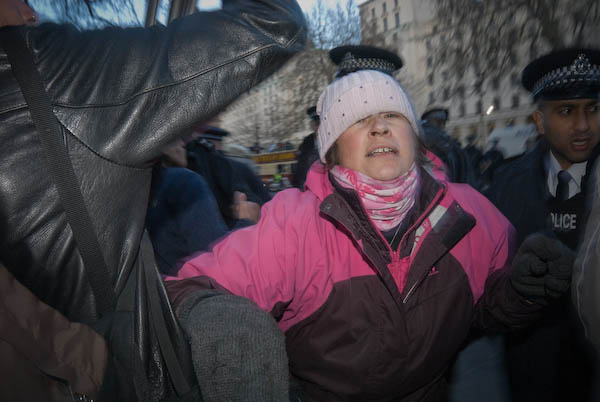
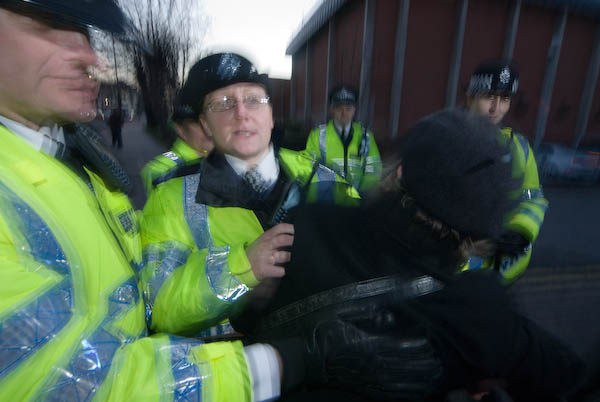
Nowadays it seems to be de riguer for celebs feeling a tad low on publicity oxygen to slap a pap, and the police always seem to have better things to do than investigate cases of assaults on photographers (perhaps because the officers are too busy assaulting those photographers who cover demonstrations – more on the event where this took place on My London Diary.) So it was good to hear (thanks to PDNPulse) that it isn’t open season for politicians to give us a kicking too – or at least not in the USA.

Douglas Bruce, a new qand already controversial Republican in the house from Colorado Springs, interrupted his public prayer at the start of the session in the Capitol, diverting his thoughts from the holy to the lowly photographer crouching rather too close to his feet for the photographers safety. Bible in hand, Bruce booted photographer Javier Manzano one in the knee, upset that he was being photographed during his prayers.

According to the report in The Denver Post, Bruce thinks its ok because he just “tapped him with the bottom of my shoe” and his assault didn’t leave the photographer squirming in agony – there was “no sound, no shriek, no anything” – clearly we need to make sure to squeal well, though that could be tricky should you happen to be knocked unconscious. Manzano actually didn’t seem to be badly hurt – you can see a video of the incident on CBS4Denver although it doesn’t show the actual impact – you see Bruce moving to take a fairly firm swing and hear a thump. And before you get to the action you do have to put up with some more thumping in an ad for medical heart testing.

Bruce is still refusing to apologise, adamant that it is the photographer who should apologise – presumably for doing his job of taking pictures and getting kicked. He continues to refuse despite a 5-1 ruling from a Capitol panel that the Speaker should request a formal apology from him for disrupting the dignity of the chamber. The panel also unanimously recommended that the House should censure him.

The Denver Post already has, with a columinst giving him the tag of ‘Girlyman’, because he “kicks like a little girl” and suggesting that in any other business his conduct would have led to suspension or dismissal.

The Denver Post prints a picture taken just before the kick by their own photographer, and it clearly gives Bruce a dignity that his subsequent action shows is unfounded. Manzano was working for the Rocky Mountain News, where his rather more straightforward picture appears with their feature on the incident.

As this article states “House rules allow the media full access to the floor where the incident occurred. No restrictions are placed on photographers during prayers or any other activities.” Of course, things are rather different in this country and it may perhaps be wise to give Gordon Brown a little more room.

Thinking of politics and the press, things are also different in Brazil.
Congress Brasilia
This picture shows is the area immediately next to the lower house in their Congress building, open to the public, where representatives stroll out from the chamber and are interviewed by the press. As for security, I did write my name and country in the visitor book, though I think this was probably optional.
Cornerfix

For most users of the Leica M8, Cornerfix must rank as one of the most useful piece of software available, and certainly the best value since it comes free, thanks to the generosity of its writer, Sandy McGuffog.

The M8 designers found that the way to get sharper results, and to make a 1.3x size sensor usable with their wide-angle lenses was to use a thinner IR barrier filter over the sensor. When they released the camera they appear not to have realised the problems this would cause photographing in particular some black synthetic fibres.

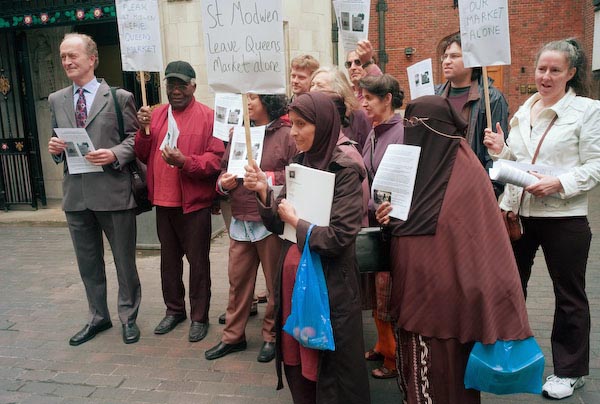
The first job I used my M8 for included photographing a group of people demonstrating against the development of Queen’s Market in Upton Park (pictures and text are some way down the page on the link) outside a shareholders’ meeting in the City of London. Most were wearing black but these clothes were rendered nicely by the M8 in various shades of plum and brown.


More uncorrected Leica images from this event

Careful selection of much of the black clothing in the image, darkening and slightly de-saturating it to produce a more natural result took several hours of work for a small repro fee. I’d done a quite a few test pictures before I took the camera out on this small job, but hadn’t chosen the right subjects or lighting to show how bad the problem could be.

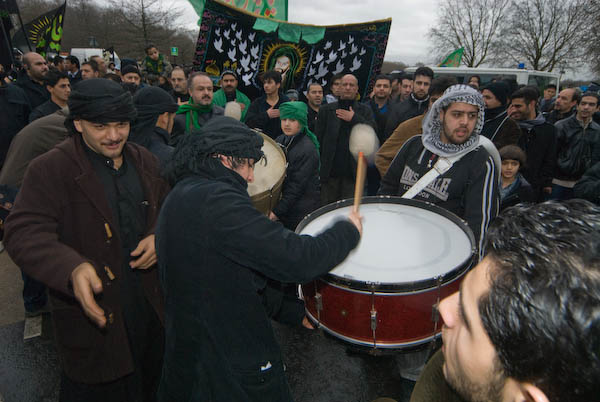
By contrast, here is a picture taken with the Leica under similar lighting at last Saturday’s Ashura procession in London, using the same 21mm Voigtlander lens, taken and processed as described below:

No problems with colour, although rather more shadow noise from the M8 than I would like. The pictures in My London Diary were taken on a Nikon D200, which is more flexible and gives better colour although slightly less resolution.

Leica’s solution was to partly to provide a couple of free IR cut filters for the front of the lens. Apart from these being in rather short supply and slow to arrive, these were an excellent solution for 50mm and longer lenses, but gave an additional problem with wide-angles. Rays from the corner of the image came through the filter obliquely, resulting in a longer path and an over-correction, resulting in cyan vignetting at image corners.

Modern Leica lenses have a set of dots on the rear of the mount which can be in six positions and allow infrared sensors on the camera body to identify the lens. Using this information, camera firmware can correct the vignetting. Overall it’s a very good system giving better image sharpness across the frame than other cameras, but it leaves a problem for those of us who want to use non-coded lenses.

Leica will add lens codes to some older lenses (at considerable cost) but my wide angle wasn’t one of them. In any case I mostly use the considerably cheaper and more compact Cosina Voigtlander lenses. Various people soon found do-it-yourself ways to code these lenses, and for a time my old Leitz 35mm was working well this way. Then the ‘Sharpie’ marks wore off, and after wasting several hours trying to get it working again I gave up.

Cornerfix removes the need for lens coding, correcting the vignetting in software by using a simply created lens profile. It can actually do a better job than firmware as you can create different profiles for different lens apertures, though I think this isn’t really necessary.

To create a profile, you need to photograph a neutral sheet – either grey or white – filling the frame and using even light, avoiding any exposure clipping. Loading this into Cornerfix enables you to create a profile in a few seconds.

As stated, you can create profiles for different apertures, and also for different lighting conditions, however so far I’ve not really found this necessary, perhaps because the light has generally been overcast! Perhaps if we get a summer?

You need to separate out your DNG files by which lens was used, and then these can be batch processed to produce files with _CF suffixed to the name. If you are someone who changes lenses, this could be a problem. File size is also a slight issue for archiving; the _CF files with lossless compression are considerably larger, and Adobe Lightroom seems to lose the compression, producing 40Mb files compared to the original .DNG from camera at around 10Mb.

So I’m having problems in fitting Cornerfix and the processed files into my workflow and archiving. Should I archive the originals or the processed files? How do I fit this in with using Lightroom?

But Cornerfix itself couldn’t be simpler:

Shoot your white or grey card, load the image, use the Lens Profile menu to create a lens profile and save it into your cornerfix directory or elsewhere.

Most of the image settings should be left at the default unless you have good reason to alter them, but you may like to enable lossless compression:

Once you have lens profile(s) for your lens or lenses, you simply need to load the profile, then load either a single image or a batch of images for processing and let the program get on with it.

Left is input file, right is output.

Total process time on my computer is around 8 seconds.

During batch processing it writes the output to the same directory, so you should normally have copied the files onto your hard disk first. The output files are also DNG files and can be processed in any raw processor as normal.

Ashura Procession in London

Saturday wasn’t much of a day for taking pictures, the odd spot of rain in the air and pretty well zero light. But one of the things about photographing events is that you just have to get on and do it, whatever the weather. And Saturday was the 10th day of Muharram, Ashura Day when Shia Muslims remember the martyrdom of Husain and his small group of followers at Kerbala, Iraq in 61AH.

I was surprised to one London blog mentioning this event as a part of “Hidden London” last week. It isn’t too easy to hide several thousand people walking along one of the major roads in the capital, especially as some of them are banging drums and blowing trumpets, while others chant through loudspeakers to lead the mainly black-clad walkers in their mourning.

I’ve photographed it several years, I think for the first time in 2000. Despite the weather I was pleased with several of the images I got, particularly this one:


Ashura Procession, London. (C) Peter Marshall, 2008

It’s an image that for me captures some of the fervour and chaos of the event, and the participation of the men involved (I also got another picture I like of some of the women.)

This is an uncropped digital ‘straight print‘ developed from the RAW file using Adobe Lightroom, and it would benefit from a little ‘burning‘ and ‘dodging‘ before making the final output, but I seldom find time for this before putting work on the web. You can see this and some of the other pictures I made at the event on My London Diary as usual.

Peter Marshall

Andrew Hetherington and Chris Floyd

A week or two ago I was looking at Andrew Hetherington‘s web site and wondering whether to write a blog post about this Dublin- born photographer who is currently extremely well-thought of in New York and whose work I first became aware of when he was selected for PDN’s 30 photographers to watch in 2003. (The site will still work if you allow pop-ups for it.)

I didn’t get round to writing about him then, largely because his site is so slow to load on my fairly basic 1Mb broadband connection that I got fed up. But just click on one of the portfolios and go and read e-mail for a minute or two or make a coffee, because they are really worth waiting for. Once loaded the site works reasonably slickly (almost as well as if it had been well-written in html) and the images are great – and good quality.

(You can also download each of the three portfolios as a PDF. Mix and Match 1 has I think 32 pictures and is around 3.2Mb. But I don’t recommend this, as someone has made rather a mess of this file – I didn’t bother to try the others. The image quality on screen is nothing like as good as you would expect from 100Kb jpegs, and very poor compared to the flash. They are also curiously distorted on my screen. The flash presentation shows images on my screen as sharp 98mm squares. At full size in the PDF they are extremly nastily artifacted and 198mm wide, 230 mm tall. The quality become almost acceptable when viewed at 33% but the distortion remains.)

One of Hetherington’s favourite photographers is obviously Martin Parr, but I say that not in any way to detract from his work but to locate it in a broad area of work. It’s easy to see why people are talking about him, and work that I think is successful in both artistic and commercial terms.

I came back to look at Hetherington’s web site thanks to a link from the EPUK newsletter about a feature on his blog, what’s the jackanory? where in a post called ‘London Calling‘ he picks up on a post by photographer Chris Floyd (have that mouse at the ready at the bottom left of this page to douse the music when that site loads) made as a comment on another blog, Rob Haggart’s A Photo Editor (is anyone in this business still taking pictures rather than typing into blogs?) with an interview in which he discusses with Chris Floyd the current state of photography in Britain.

Those of us in Britain will indeed recognise many of the things that Floyd says – and backs up from his own experience. The piece perhaps won’t endear itself to my friends in Birmingham, nor photographers in Manchester, Belfast, Edinburgh, Glasgow etc with the comment “Britain is not like America. The UK media market is London, London, London. Trailing a distant fourth place is London” though it may be hard to argue differently.

But its a long, interesting and fairly wide-ranging conversation about the current state of the industry, with some comments on Martin Parr and Ryan McGinley among others, as well as on being an artist. Of course it comes from a particular viewpoint, and is between two photographers whose ways of thinking come very much from their successful commercial practice and shared experience in New York.

And while you are on Chris Floyd’s site (see link and note above), don’t miss The Nineties, in the Archive Section. Some fine pictures I can appreciate even though I’ve no interest in (and don’t recognise) most of the celebrated subjects.

A House that was Home: Oyvind Hjelmen

Many of us have had the rather gloomy experience of clearing out a house when an elderly relative dies or goes into a home, and over the years I’ve seen quite a few photo essays around this theme, with photographers often photographing the house they grew up in as it is cleared ready to be sold.

I’ve done similar things myself, though more often regretted the fact that I never managed to get round to recording such places as my father’s old workshops at the back of his family house, sold when I was away from home at about the time I took up photography seriously. His premises were a health and safety officer’s nightmare, with a more extensive collection of tools from the cart-building trade than I’ve seen in any craft museum. But around 1970, nobody was interested in such things.


My Aunt’s house (C) Peter Marshall

Years ago, when one of my aunts moved out the home in which she had lived for around 50 years into sheltered housing, I did go round and photograph her, and her house in a small series of pictures, just before she moved.


My Aunt’s house (C) Peter Marshall

But most of the pictures I took, and almost all of those sets of work that I’ve seen by others in the past, have perhaps been too personal, too linked to the photographer’s own memories, to be of much interest to others. But there are exceptions, and one of them inspired this posting.

What made me think about this are a set of 12 pictures by Norwegian photographer Oyvind Hjelmen, ‘A House that was Home‘, on the ‘Lens Culture‘ web site. This series of a dozen small square images (the original prints are 12x12cm, exactly the size that I see them on my monitor) demonstrate Hjelman’s sensitivity to light and the subject. As Jim Casper writes, they “reverberate with a visual language of archetypes, memories and dreams.”


House that was Home VI

(C)
Oyvind Hjelmen

Jim has written rather more that you can read on the site, and I’ll leave it to him rather than write more myself – so do take a look. The above image from this series is also available as a signed limited edition print from Lensculture editions.

You can find out more about the photographer on his own web site which has four portfolios, including ‘House that was Home‘, which has one picture not shown on Lensculture.

Despite using Flash, it is a very clean and nicely designed site that is reasonably fast to load. The text is in English, although Google thinks otherwise and tells me “Yvonnee Charlotte Erdal bor i Bergen og er en anerkjent fotograf både innenfor kunstnerisk og kommersielt foto,” suggesting I might like to restrict my search to English sites. Fortunately I’m not so chauvinistic and though seriously linguistically challenged I don’t let it worry me. After all it is the pictures that matter, and they are worth looking at.

Using Your Existing Flash with a Nikon

One of the extra expenses in moving to recent Nikon cameras is that they are designed to with with flashes that use Nikon’s interesting i-TTL flash system. It’s an innovative system that uses flashes of light to communicate data, but one that I’ve not found entirely meets my need.

Apart from making older flash units like my perfectly serviceable Nikon SB-80DX apparently redundant, it also appears to make my older non-Nikon units unusable as well. Of course this isn’t really the case – just that they don’t work as i-TTL units.

Perhaps even more annoying, with i-TTL there seems to be a longer delay, at least with the Nikon D200, between the pre-flash – used for measurement – and the actual exposure flash. Long enough for many people to blink. As a work-around you can make one normal flash exposure and then lock the flash setting (perhaps using FV lock: CS f4) so that there is no pre-flash for further exposures. Its probably fine for some situations, but not for those where your subject is changing rapidly – most of what I do.


‘Freedom to Protest’? Police get heavy-handed at Downing St, Jan 12, 2008.
More pictures on My London Diary.
D200 with SB-80DX, 1/30 f8. EXIF indicates “
strobe return light not detected” but we know better. I used the settings below.
(C) Peter Marshall.

Important: You follow the advice given here entirely at your own risk. Some older flash units put high voltages on the hot shoe which may fry modern cameras. You should test older flashes before using them on any modern camera.

The only flash unit I’ve tried the method here with is a Nikon SB-80DX, but it should work with any unit that has an auto-exposure mode that allows you to select the aperture setting. The detailed instructions are for a Nikon D200, but there is no reason why a similar method shouldn’t work with other cameras.

  1. Fit flash to hot shoe.
  2. Turn on camera. Use the button to the left of the lens mount and set the flash to normal front curtain sync mode. (It won’t work in rear curtain sync, and you are better off never using red-eye reduction – correct it in software if you get it. The +/- flash exposure compensation setting using the flash button has no effect with this method, so don’t bother with it.)
  3. Set camera to A (Aperture Priority Auto) mode.
  4. Set the aperture and film speed you want to work at. In this example I’ll use f8 and ISO 400
  5. Turn on the flash, using up/down on the main control button to change the flashing ISO to 400, then press it to set.
  6. Set the flash mode on the flash to A.
  7. Set the aperture on the flash unit relative to that you set on the camera. As a starting point, set it one stop wider – f5.6 in this example. The important thing to remember is that setting a wider aperture gives less light and vice-versa. (For more precise control you could alter the ISO, but on the SB-80DX this is trickier to do. You may find it easier to start by setting the ISO on the flash to twice the figure on the camera.)
  8. On the camera, go to CS e2 and set the minimum shutter speed to use with flash. To use the flash as fill in daylight I usually set 1/60 or 1/125. In low light I generally want to use a slower speed (often 1/15 or 1/30) to get a little more exposure from the ambient light. For nice long blurs use a slower speed.
  9. Use CS e1 to set the flash sync to 1/250 (Auto FP) or 1/250.
  10. Everything should now work ok. But take a test shot and check the histogram.

Remember that setting exposure compensation will have no affect on the flash – but will alter the ambient contribution (if any) to exposure. To change the flash exposure you need to alter the aperture (or ISO) set on the flash unit.

If you find things start going wrong with your flash exposures, the first thing to check are that you haven’t changed either the Exposure Mode (A) or Flash Mode (front curtain sync.) It is surprisingly easy to press buttons without meaning to!

Peter Marshall 

Rights of Publicity etc

Perhaps the clearest thing you can say about Rights of Publicity is that they are a mess. And it’s a mess to which the recent decision in California concerning images of Marilyn Monroe, which you can read about on the ‘State of the Art‘ blog only adds. Monroe was of course photographed by many photographers, notably Dennis Stock, Milton Greene, Sam Shaw, and Tom Kelley. I suspect this is a story which will continue in various courts.

If you want to read more about the confusion of legislation world-wide, the best introduction I’ve found comes from the Australian consultancy Caslon Analytics.

My own advice for photographers is simple. Don’t photograph celebs. It may mean passing up a bit of income now, but it will avoid the possibility of a lot of hassle in the future for us and our heirs.


Outside the National Gallery, Jan 2008 (C) Peter Marshall

A better reason for not photographing them is simply that in general I find them – and the pictures of them that clog the press – extremely boring. There are just so many other more interesting things to photograph.

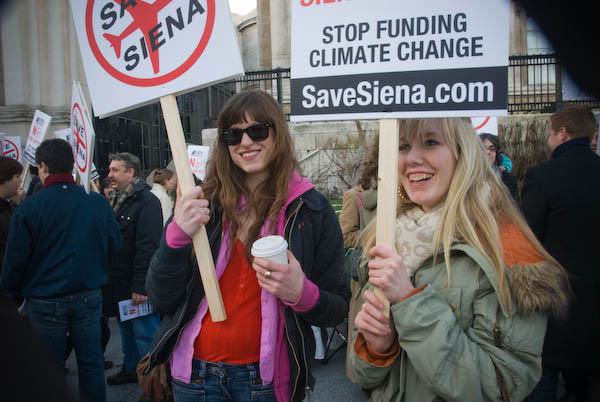
But it wasn’t a surprise when out of the sixteen stories I’ve so far posted this month, the only one to attract any attention from the mainstream press was a small protest outside the National Gallery in London against the expansion of an airport in Siena. Although it’s a cause I’m in favour of, here’s part of what I wrote about it:

The protest group is apparently led by the young grandson of a Lord, and includes models and young people from some of the richest families around (the kind of people who own Guinness rather than drink it.)

If you had a nice big villa there you probably wouldn’t want all sorts of riff-raff coming in on cheap flights either, and would have been there outside the National Gallery too.

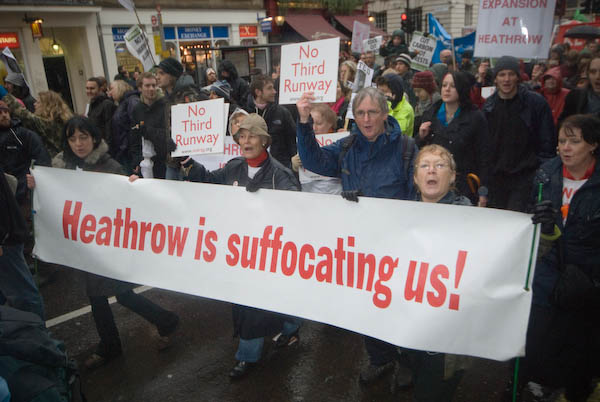
I do think it’s time to take urgent action about airport expansion, particularly because of the effect of increasing flights on climate change. Far more pressing than Siena is Heathrow, and the No Third Runway campaign.


Global Climate Change March, London, Dec 2007 (C) Peter Marshall

To be fair, those protesting against Siena that I talked to also told me that they would think about doing more to protest against the expansion of Heathrow.

This week’s crash-landing at Heathrow again raises the question of safety, and the danger of having a major airport in such a heavily built-up area. I grew up under the main flightpath in Hounslow, a major centre of population only a couple of miles from touchdown, and live in another highly populated area where where planes on approach to one of the alternative runways (fortunately now seldom used) come in low enough to rattle the windows. So while applauding the brave performance of the senior first officer John Coward, I’m also shocked at the fool-hardiness of the authorities in allowing Heathrow to remain, let alone to expand.

Haswell Plough

Chris Steele-Perkin‘s black and white images from Northumberland in the show ‘Haswell Plough to Harajuku‘ at HOST gallery in Honduras Street, London until 31 Jan are well worth a visit. He started shooting the work as a commission for Side Gallery (and one of the images in the show is of the late Murray Martin, one of the founders of Amber/Side, with whom Steele-Perkins often stayed while working on the project) but continued to go back and work on it for some years.

Central to his work was a market at Haswell Plough where the photographer got to know many of those he photographed. The work is a nostalgic view of the countryside as a rural Arcadia, recording it clearly but also with great affection, and I think you can see all of the pictures in the show, along with others in the display from his 2007 book, Northern Exposures, published by the Northumbria University Press and featured on the Magnum web site (click on ‘View all images’ for the obvious.)

In the HOST show, there were also a few large images and a montage of 100 colour prints from Harajuku. I think most or all of these are from his second book on Tokyo, Tokyo Love Hello also on Magnum. I felt the small images of these were actually more impressive than the larger prints, and looking at the images on the web I wonder if they are not even better there – and certainly would be so if better presented on screen. Quite understandably, for anything other than small thumbs, Magnum protect their commercial interests by using both a visible watermark and rather low quality jpegs. This isn’t a complaint – but a simple statement. Every time I go to the site I applaud Magnum’s generosity in making so much great photography available to us all.

The countryside work I find more interesting. Perhaps even though it is in my own country it is in certain respects more foreign to me than Japanese city life. When the Countryside alliance made its protest marches in London against the hunting ban, there were times when I felt a great distance between ‘them’ and ‘us’ – as the campaigners alleged.


In Trafalgar Square (C) 2002, Peter Marshall

Of course the countryside hasn’t closed down with the ban, nor has hunting entirely stopped. Different practices, a certain amount of deception and even some defiance, but country life continues.

Jane Bown: Deservedly Well-known

In the Guardian/Observer Newsroom at 60 Farringdon Road, London EC1, until 25 Jan 2008 you can see ‘Unknown Bown‘ 1947-67, with many of the images also on-line, in a Flash presentation that covers her photography over 60 years.


The Newsroom with some folders of the Manchester Guardian and Bown’s show

Hers is a truly remarkable career – and on-line you can see the first picture she took for the Observer on the 28th January, 1949, a portrait of Betrand Russell. In 2006, she was still taking portraits, and really not that differently, with the best perhaps her image of Dame Maggie Smith, as well as a freshly informal image of the Queen which makes her look like someone’s granny, just after the hairdresser has been in, gussied up for a trip out from the old people’s home.

The selection in the Newsroom does include some of her better-known pictures – and quite a few of those that are on-line, but also has pictures I’d not seen before, including some of the more interesting in the show. So while on-line, Southend on Sea 1954 is just her very well-seen view of two people in deckchairs from behind, in the gallery under the same title there is also a far more exciting and lively Cartier-Bressonesque group (she photographed the man himself in 1957), a man sprawling in the foreground, a woman standing holding a towel or clothing (and another man appears to be dangling one of her feet from his hand) as a boat leaves. And those hats! Similarly there is a picture from the 1957 Fuel Crisis on the wall which I find much stronger than the on-line image.

Much of this work was taken when she was herself a young mother, and there are some fine portraits of young children on the wall (perhaps just a few too many.) But throughout her career she was someone who obviously made people feel at ease – and children are perhaps more sensitive than most adults. She makes people – wherever they are – feel at home, at ease. Where some photographers set out to shock or surprise, her work usually has a warmth, a friendliness, a domesticity that appeals.

Where she does sometimes produce work that is striking is by her use of light. Perhaps her most striking portrait is that of Samuel Beckett, made in 1976, and it is certainly one that qualifies for the title ‘iconic’; on those rare occasions when I think of him, it is her image that I see. But perhaps the selection for the presentation suffers from an overdose of politicians and pop-stars, and is based rather too much on the names rather than the quality of the images. Of course they are all good pictures, but I think not always among her best images, and sometimes are overshadowed by the again iconic images by other photographers.

On show at the Newsroom is also the old Rolleiflex which I think it says cost her £50 in 1947, which seems excessive. In the 1960s she was still carrying this (or perhaps a similar replacement) to assignments in a shopping bag, though changing times and expectations led her to increasingly use an SLR from that time on.  At first it was a Pentax, but one of the things I have in common with her is that we both bought an Olympus OM1 more or less as soon as they came out in late 1972, though I think hers lasted longer, and definitely captured many, many more famous sitters. You can also see more of her work as a student, as well as a picture of her tutor, Ifor Thomas, who recognised the talent of this 21 year old who had just come out of the WRNS and enrolled on his course at the Guildford School of Art. At the time it was the only place in England where photography was not simply taught as a technical subject – though unlike some colleges today they also made sure that students learnt their craft.

I could write more, but I’ve just found two other features on her at the Guardian, Jane Bown: A biography, and an introduction to the Unknown Bown written by  Germaine Greer that perhaps tells you rather too much about Greer’s own prejudices, particularly on the subject of Diane Arbus,  but does also have some interesting thoughts about Bown and her work. Those who know their photography will also spot a few obvious errors, such as the fact that her Olympus OM1 will not be 40 until 2013 and is unlikely ever to sport a 50mm f2.5 lens. They didn’t make one, and most of us were happy with the f1.8, which was a superb performer at the f2.8 that Bown habitually set – with shutter speed of 1/60th using whatever light was available. And if she needed more, most people had a reading lamp. It’s also a discussion of her work that ignores the great cultural and photographic influences of the era in which she grew up and started work, in particular the illustrated weeklies such as ‘Picture Post‘.  While few in that era would have known the name of, for example, Henri Cartier-Bresson, and most photographs were published without attribution (as too many still are) the influence of his and other similar work was strong enough in the early 50s for young turks to feel the need to rebel against it, while others, such as Bown, developed their own style very much within its general ambit.

Trouble-shooting

Just when I thought I had flash sorted out, it jumps up and hits me, just refusing to do what it ought to be doing and what I wanted.


Not quite what I intended, but still usable…

I set 1/15s and it gave me 0.80s, and a rather more abstract effect than I wanted. Both images (C) 200, Peter Marshall

In the heat of the moment (I was covering a demo outside the jail against the death of women in Holloway Prison) it isn’t easy to think clearly. I still don’t know why the method I’ve been using with great success should suddenly stop working, but I do know what should have been the first solution to try.

In the old days, cameras were simple, mechanical devices. Worked by levers, springs, a bit of clockwork. If something went wrong it was usually pretty obvious – you couldn’t wind the film on, or nothing happened when you pressed the button. The big change came not with the switch to digital imaging, but with the introduction of electronics into the actual working of cameras. At first we mainly had it in exposure metering, and it was analogue rather than digital and pretty benign, even extremely useful. And it also gave us far more reliable and accurate shutter speeds.

In many ways the Olympus OM4 represented a near-perfect mix of manual and electronic camera, although if the battery went you were left with only a single emergency shutter speed of 1/60s. But for those of us who took black and white seriously, it had a built-in metering system that was perfect for the precise placement of shadow detail.

As someone who taught photography to beginners, the increasing electronic complexity of cameras after that soon became a nightmare. Where previously you could pick up any camera a student came with and show them exactly how to use it, you now – unless they owned the same model as you – had to get them to bring in the manual and pore through a hundred pages of Japlish for even the basics.

So if, like me you are out there and things get pear-shaped, the first thing to remember is that you are not dealing with a camera, but with a computer. If you are using a flash as well, things are even worse, because you have two computers and a network to trouble-shoot.

Fortunately I know a bit about computers (and networking) as well. The great majority of computer faults can be cured simply by re-booting. A few cameras actually do have a button you can press (often only with the tip of a pen) to do this, but more commonly it involves taking out the battery, counting for 10 seconds or longer and then replacing it. (The camera I have to do this most often with isn’t a digital camera, but a Konica Hexar F, a great camera for street photography despite only having a fixed 35mm lens.)

If you are using a flash, then it makes sense to give that the same treatment. Mine also has setting using the buttons which will reset it to factory defaults, which, given its incomprehensible menus and non-intuitive setting methods is probably no bad place to start.

Once you’ve rebooted the two computers, its also worth thinking about the network. There is an old rule about trouble-shooting networks, around 99% reliable, and is expressed simply: “Cables, cables, cables!” If like me you usually plug your flash directly into a hot shoe, then the appropriate paraphrase would be “contacts, contacts, contacts!” Clean them and then make sure you push the unit firmly all the way into the shoe.

More pictures from that demo are of course on My London Diary.