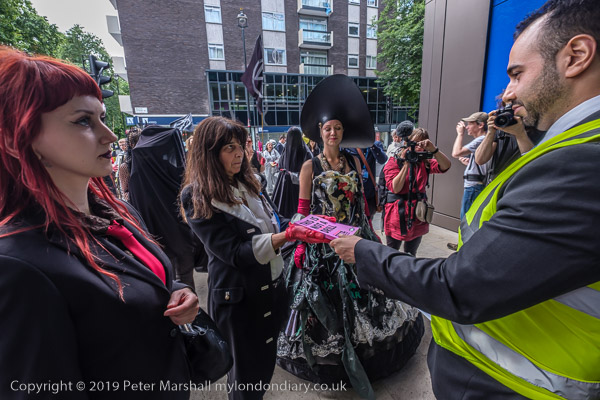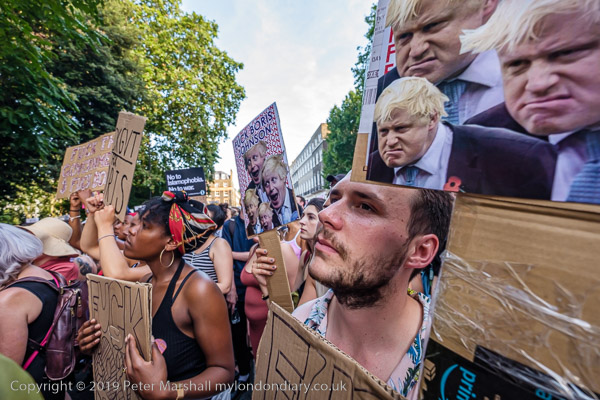
Boris J is not our Prime Minister

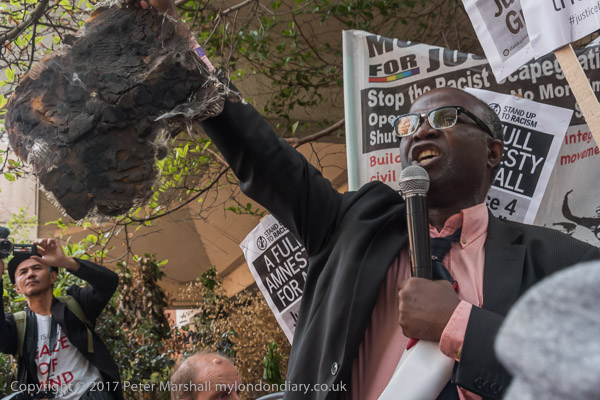
Boris J is not our Prime Minister – That title expressed the feelings of many of us when I wrote it on Wednesday 24th July 2019, the day 3 years ago that he assumed office. He had then been elected by the votes of 92,153 Conservative Party members in the leadership election, around twice the number received by Jeremy Hunt. Unfortunately 3 years later he is still our prime minister, if now only hanging on until a successor is elected.
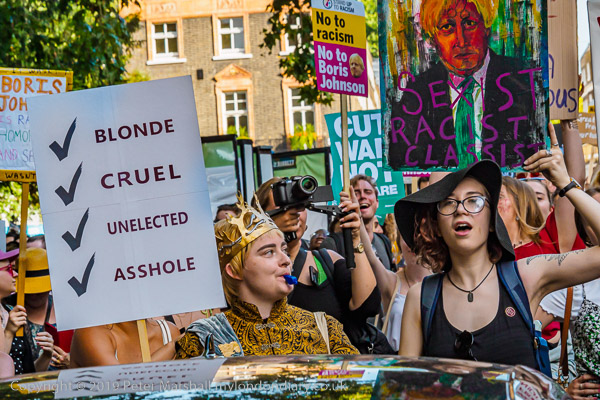
Later after the 2019 election where the Tories won a ‘landslide’ victory with an 80 seat majority after receiving 43.6% of the votes, the party could claim a mandate for its policies. But although many supported his policy of ‘Getting Brexit Done’ (and Starmer had possibly deliberately pushed the Labour Party under Corbyn into a popular defeat by persuading the Labour Party to back his ideas of another referendum) very few actually voted for Boris Johnson – his 52.6% majority in Uxbridge took only 25,321 votes.
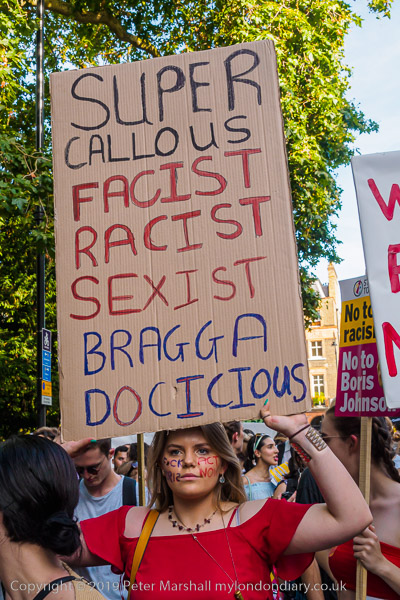
We have a crazy and undemocratic electoral system which suits the wealthy minority who remain very much in control of things and even though had Corbyn formed a government would have prevented many of his policies from becoming law.
The Forde report – finally published on the hottest day ever in the country when wild fires were sweeping London and the Tory prime-ministerial contest was in full swing to ensure it got little if any mention in the news – shows clearly how many of the officers and right-wing MPs made sure we failed to get a Labour government. You will need to download it and read its 138 pages if you wish to know what it says rather than the spin that some will put on it.
If anyone tries to tell you that there were faults on both sides or that it isn’t a damning condemnation of the Labour Party and how it machinated to ensure Corbyn’s defeat they are simply lying to protect themselves and their political future. The Forde report does its best to suggest there were two sides, but lacks credibility in this aspect by failing to note the crucial difference. One side largely kept to the rules and had a democratic mandate from hundreds of thousands – the great majority of party members, while the other was acting in its own self-interest often outside the rules and against the will, traditions and historical mission of the party.
The Forde report does not tell the whole story, and goes out of its way to try and be balanced over a situation which was very much out of kilter. It really needs to be read alongside the controversial leaked report into anti-semitism written to be submitted tot he EHRC which led to it being set up – and which led to Martin Forde QC being subjected to various and continuing legal threats from the moment he was appointed. Much that should have been in Forde’s report is simply not there. But although that document was widely distributed via social media, for legal reasons it will be difficult to find a copy now if you did not download it at the time. And for legal reasons I can’t make it available here though it can still be found and downloaded from abroad over a VPN.
John McDonnell tweeted after the report was published: “Shockingly Forde report findings confirm what was suspected. That party officials secretly diverted election funds in 2017, prevented supporters of Jeremy Corbyn from having a vote in the leadership election & used discriminatory abuse. To move on lessons need to be learnt.” And the report certainly does confirm those allegations.
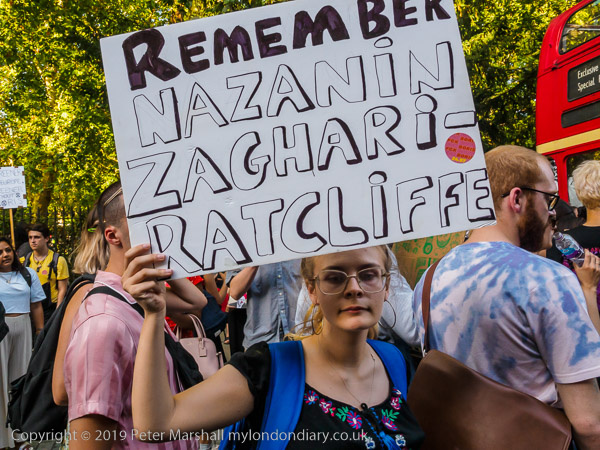
Boris Johnson as Foreign Secretary implicated her as a spy when she was held on a family visit

Others find sections of the report which they can use to yet again attack Corbyn for anti-semitism – even in some cases quoting paragraphs which are clearly in his favour to do so. There are certainly groups that are still determined to have his scalp, whatever the evidence.
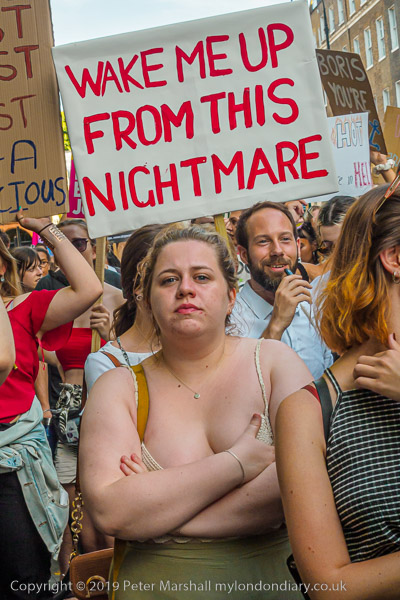
Unfortunately the nightmare will continue even when Boris is replaced

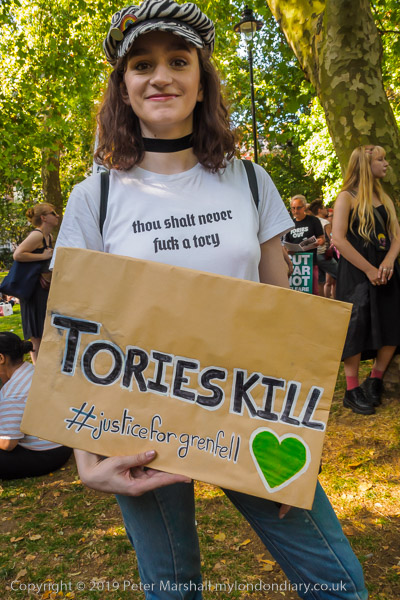
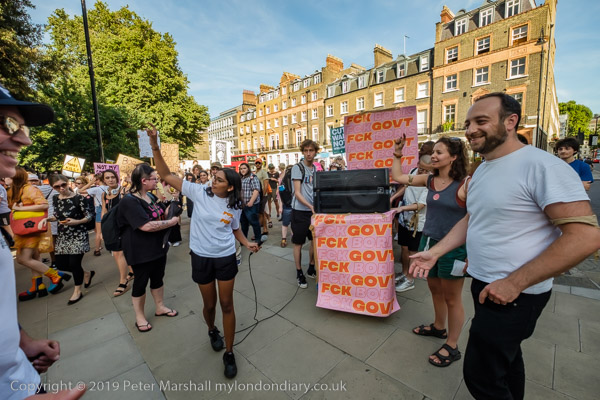
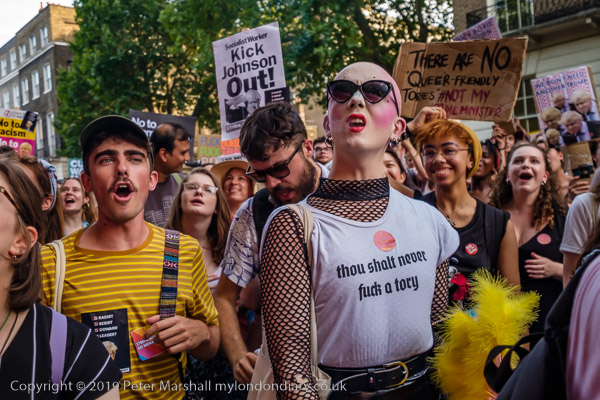
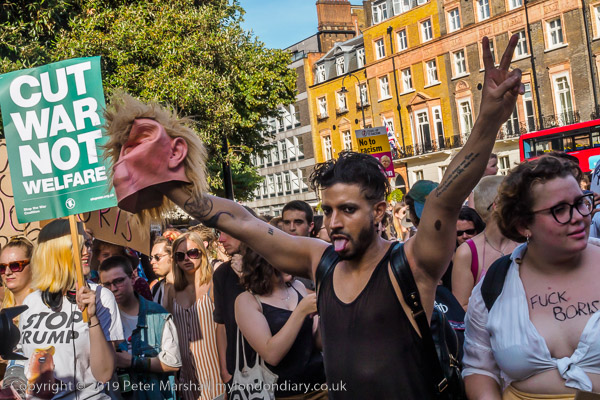
Back in 2019 there had been protests outside Downing Street during the day and in the evening a large crowd mainly of young people gathered for a protest party in Russell Square, where speakers included Shadow Chancellor John McDonnell who made a strong plea for a General Election.
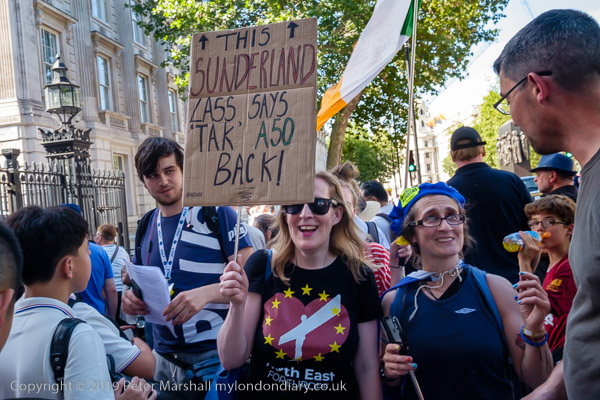
Earlier at Downing St

I decided to leave before the crowd set off for Downing St to join protesters there. I’d called at Downing St on my way to Russell Square and there were only a few present then, but apparently numbers had swelled considerably by the time the marchers arrived and I missed rather a lot of the action. But I was tired and wanted to go home and get on with processing the pictures I’d already taken.

Boris J is not our Prime Minister

July 19 Pictures

July 19 Pictures
Requiem for a Dead Planet at Daily Mail 2019

Most mornings when I sit down to write a post for >Re:PHOTO I start by searching on My London Diary for events I photographed on that particular day (or rather the day two or three ahead when I will schedule the post to appear.)

July 19 Pictures
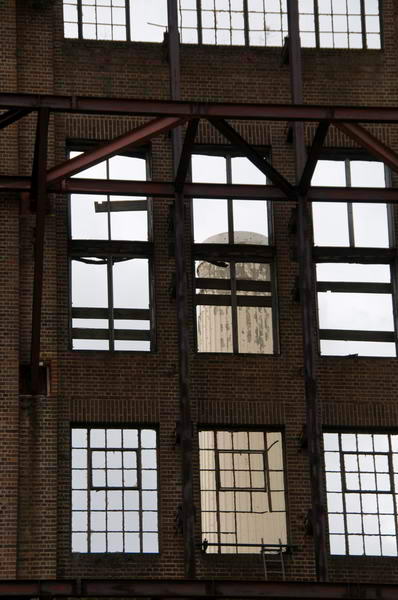
Battersea Power Station 2008

Occasionally there may be something else I feel moved to write about – some new development in photography, discovery about the history of photography, ethical debate or cataclysmic event – but these seem to come up less frequently than they used to, though I’m not entirely sure why this should be.

July 19 Pictures
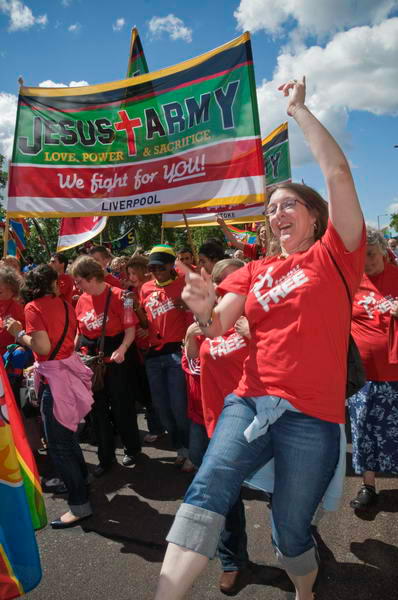
Jesus Army Marches on London 2008

Perhaps it’s because I spend more time now looking at my own old work, digitising images I made on film in the 1970s, 1980s and 1990s and worrying about what will happen to all this work after my death and rather less on going out, taking new work and meeting other photographers. Covid meant that for a long period there were few exhibitions to go to, and I haven’t yet got back into the habit.

July 19 Pictures
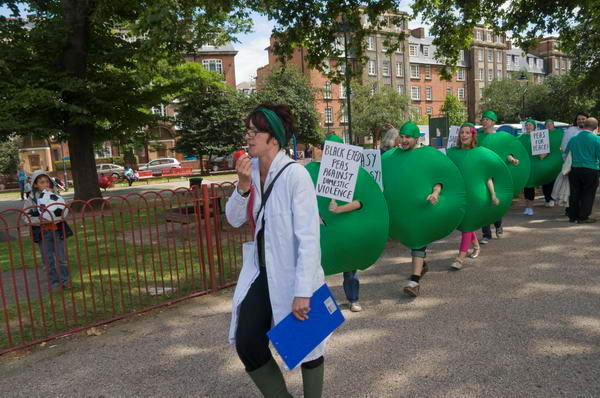
Bonkersfest 2008

My bookshelves have long all been full and overcrowded and I seldom buy new books unless they are by personal friends, and have cancelled my subscription to most of those expensive magazines I could never bring myself to throw away – the shelves once allocated to them are also full. I’m beginning also to wonder about the future of this large library – whether to try and set up an on-line bookshop to sell it, or to try to find some worthy institution to gift it to.

July 19 Pictures
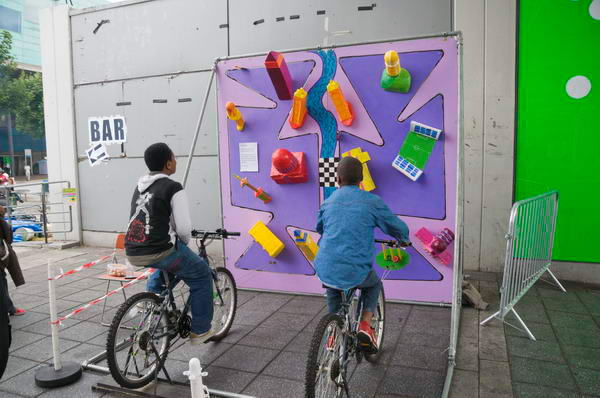
I Love Peckham 2008

Fortunately almost all of the posts in My London Diary give their date somewhere making it easy to locate the pictures I took on July 19 from around 1999 until 2021 using the Freefind search box on many of the site’s pages. Though in the early years of this period when I was still using film there were many events that didn’t make the site as I hadn’t digitised them, and the search somehow misses the occasional thing.

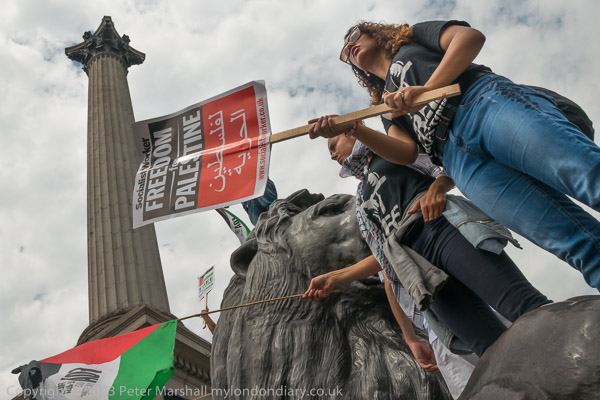
End Gaza Killing Now 2014

But searching for ’19 Jul’ and ’19th July turns up events in 2008, 2014, 2015, 2017 and 2019 and I open the pages from those years and look through them to see what I photographed on those days. This gives me a choice of things to write about, either picking one or two of the twelve events, or about all those I did on a particular day.

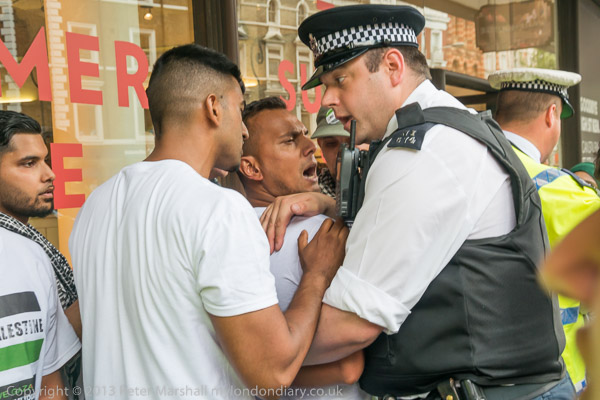
Police & Gaza Protesters 2014

So how do I choose? Perhaps I eliminate some topics I know I’ve already written about too often or too recently. I don’t want to rant yet another time – at least for a while – on Israel’s attacks on Gaza and seasonal events like the Swan Upping which happen on a particular day of the week perhaps don’t merit more than one post through the 7 dates on which they can occur.

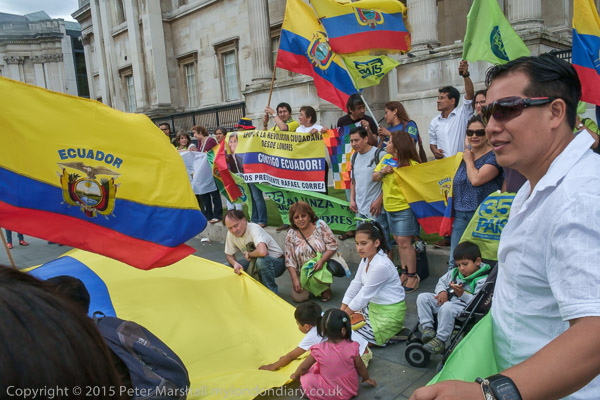
Ecuadorians support ‘Citizen Revolution’ 2015

Then there are some events I have very little to say about and others where I think the photographs are rather run-of-the-mill. Very occasionally some where what I would like to say might be legally unwise.

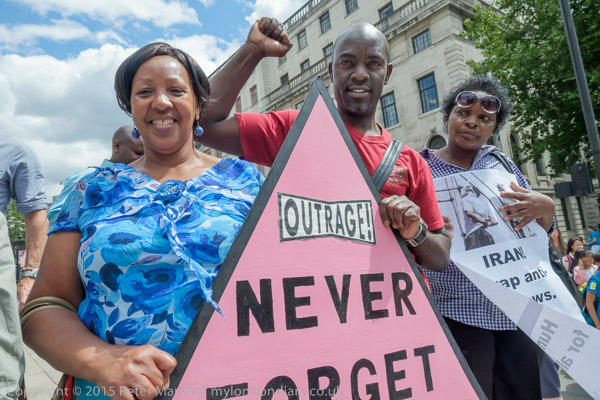
10 years since Iran hanged gay teenagers 2015

Today I can’t make up my mind, so here I’ve decided to post a single picture from each of the twelve, together with a caption that links to the post.

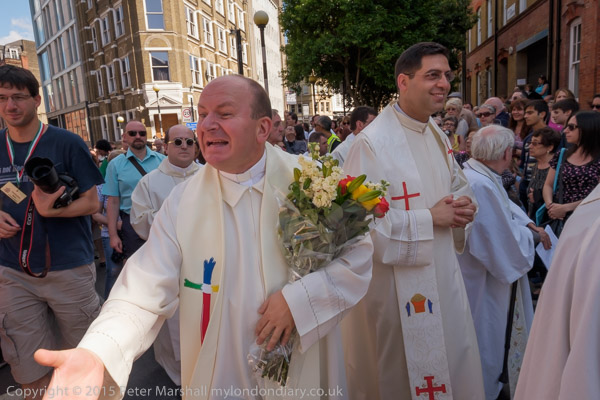
Festival of Our Lady of Mount Carmel 2015
Grenfell survivors tell Council “Resign now!” 2017
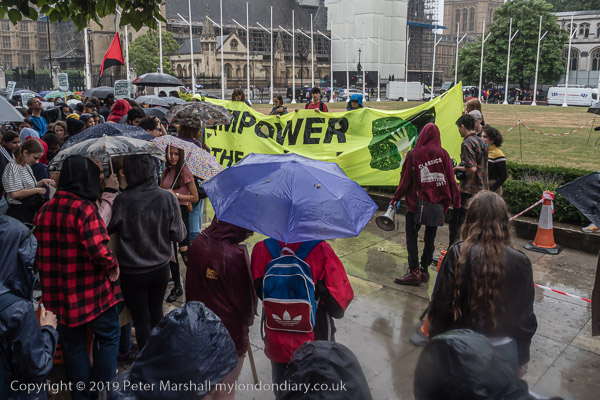
Students march for climate 2019

So you can choose if you want to read more about any of them – there are more pictures and text about them which I wrote at the time I took them on My London Diary.


3 Cosas at London University 2013

3 Cosas at London University 2013

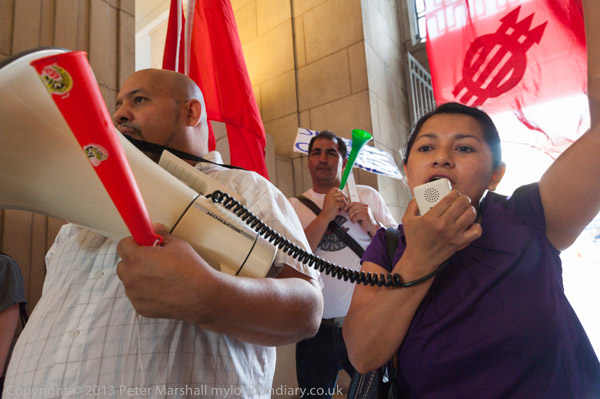
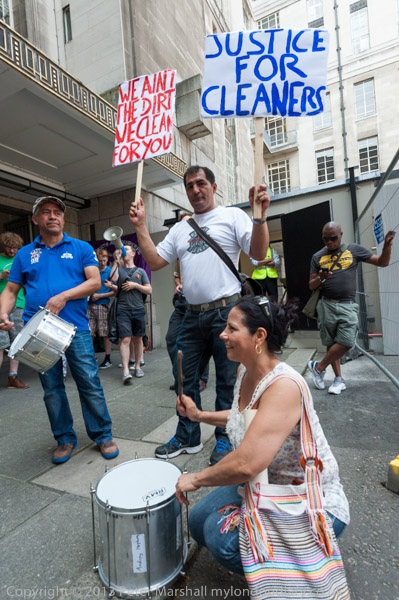
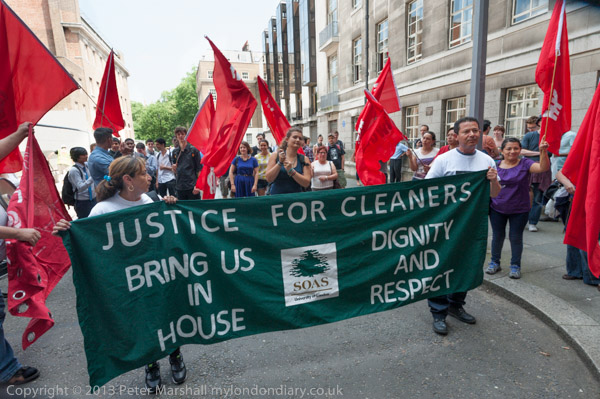
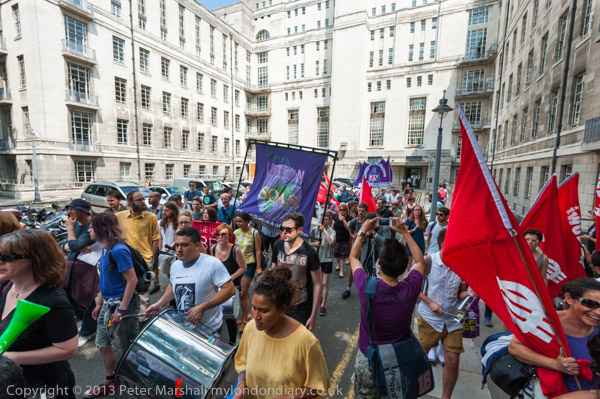
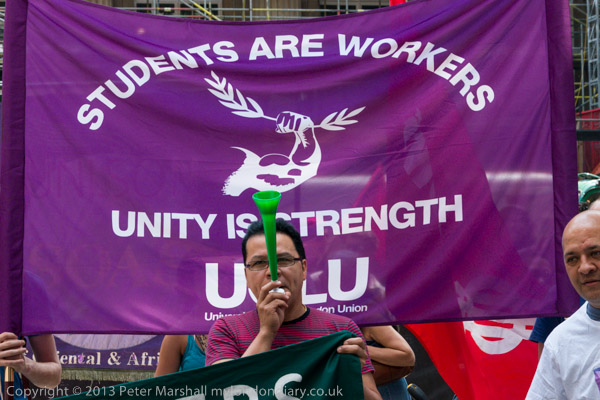
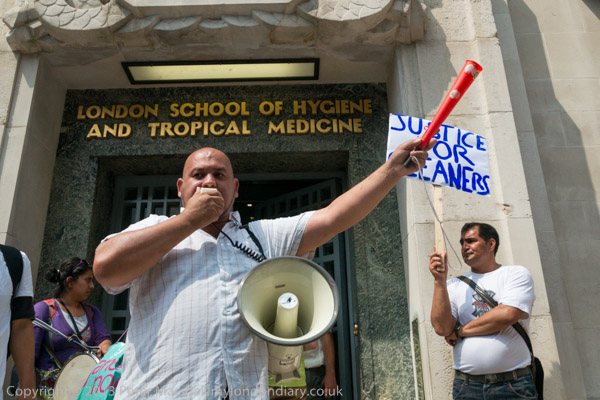
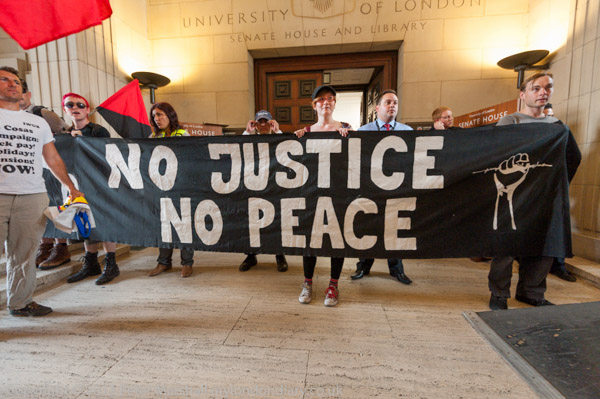
3 Cosas at London University 2013: The protest around the University of London Senate House on Wednesday 17th July 2013 was part of a long running campaign to get all workers at the university decent pay and conditions of service. At it’s root was the attempt by the university to dissociate itself from any responsibility for many lower-paid staff – cleaners, security, catering – whose work is essential to the running of the university by employing them indirectly through outsourcing companies.

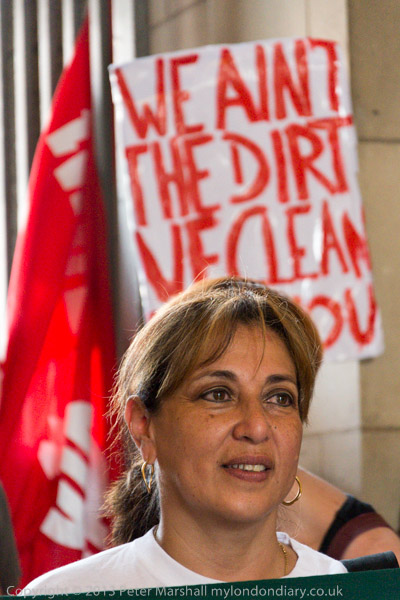
These staff work alongside others directly employed by the university who get good contracts with decent provision of pensions, holiday entitlement and sickness pay, but are on rock-bottom contracts, receiving only the statutory minimum requirements. Things are usually made worse by bullying managers from the outsourcing companies who overload the workers and often fail to provide proper safety equipment for the jobs.

Some Unison branches, along with students from the University of London Union and some teaching staff and others from neighbouring London Universities had worked successfully together to improve wages and conditions of these lower paid staff, with protests in 2010-2011 getting the London Living Wage for the workers. They had now joined together to campaign for ‘3 Cosas’ – the three causes of sick pay, holiday pay and pensions, with the Spanish title reflecting the background of many of the university cleaners in London’s Latin-American community.

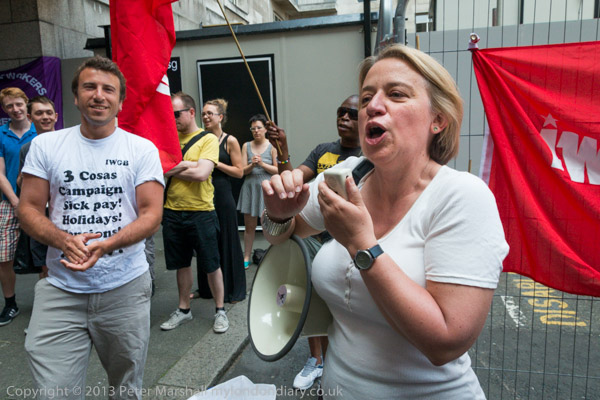
Green Party leader Natalie Bennett

Unison nationally had publicly dissociated itself from the protests by some local branches and had failed to support either for the successful Living Wage Campaign or the new 3 Cosas campaign. The Senate House Unison Branch had recently elected branch officers who supported the campaigns but the results of the election were annulled by the Unison union leadership.

This led to almost all of the outsourced workers and some of those directly employed leaving Unison in protest, joining the grass roots IWGB which had been active in its support and now represented a majority of the outsourced workers. Despite this the university refused to engage with the IWGB, continuing to recognise the far more submissive Unison who seem not to care about the low paid workers.

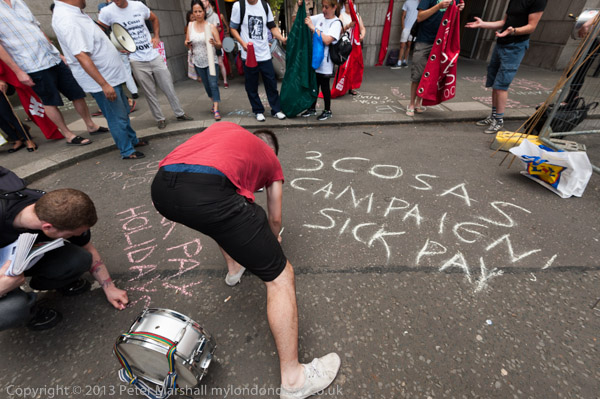
The protest on this day was larger and angrier than usual, as the University had called in police the previous day to handle a student protest – and police had arrested a young woman who had chalked a slogan on a wall plaque, charging her with criminal damage. Chalk was used by the protesters as it causes no damage and is easily wiped off.

The 3 Cosas campaign has received support from branches and officials of other trade unions, including the RMT and UCU, the university and college teachers. And among those who came to give their support was Green Party Leader Natalie Bennett who spoke briefly before have to rush off to a BBC interview.

Outside Stewart House

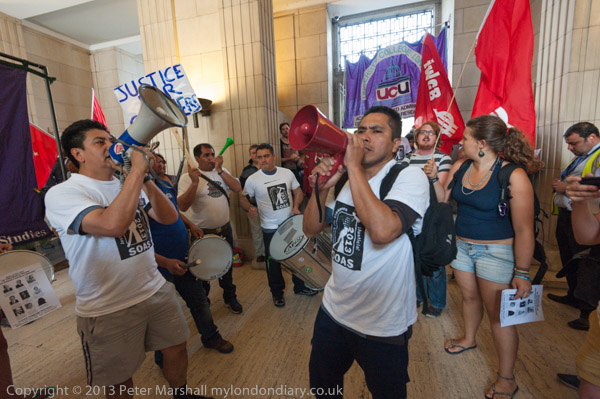
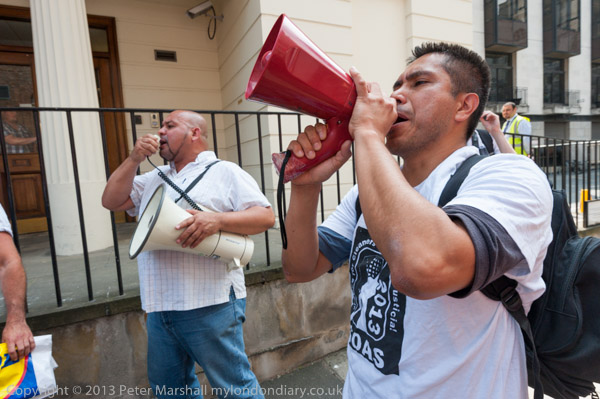
The protest began just outside the Senate House and as Bennett left the protesters moved into the open lobby area underneath the bottom of the building for a noisy few minutes chanting ‘Sick Pay, Holidays, Pensions, Now!’ and other slogans, blowing whistles and horns and using megaphone siren sounds to the accompaniment of some highly dynamic drumming from the SOAS samba band.

They then walked out from there and marched around the street to the south of the building opposite the British Museum North Entrance where there was a brief rally mainly to make those going into the museum aware of why they were protesting.

They walked back onto the university site for another noisy protest outside Stewart House, then back underneath Senate House where they stopped to listen to a speech from the ULU Vice-President. IWGB organiser Alberto Durango then invited everyone to go across the road and make their presence felt in front of the London School of Hygiene and Tropical Medicine, where the IWGB is just starting to fight for the cleaners there to get the London Living Wage.

After a few minutes there they returned for a final session at the Senate House for some final speeches. The woman who had been arrested for chalking the previous day was one of those holding a No Justice No Peace’ banner in front of a line of security staff blocking the entrance, and there were calls urging the university to drop the charge of criminal damage, and some of those present chalked slogans on the tarmac in a show of solidarity.

Many more pictures at London University Cleaners Protest


PIP, NHS, Trident & Wood St Cleaners

PIP, NHS, Trident & Wood St Cleaners – On Wednesday 13th July 2016 I photographed two protests about the inadequate and badly run Personal Independence Payments for disabled people, a protest supporting a cross-party bill to save the NHS from privatisation, a party against replacing Trident and the longest running strike in the history of the City of London.


PIP Fightback at Vauxhall – Vauxhall

PIP, NHS, Trident & Wood St Cleaners

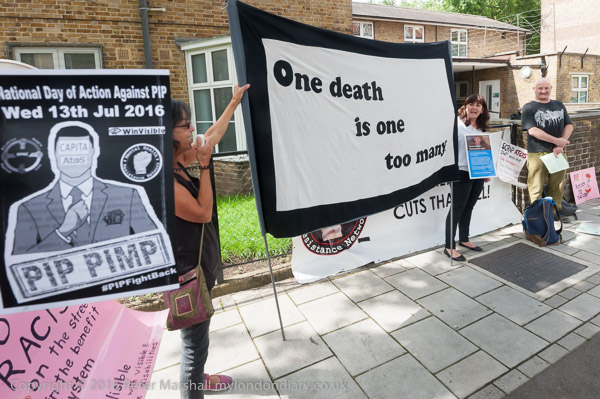
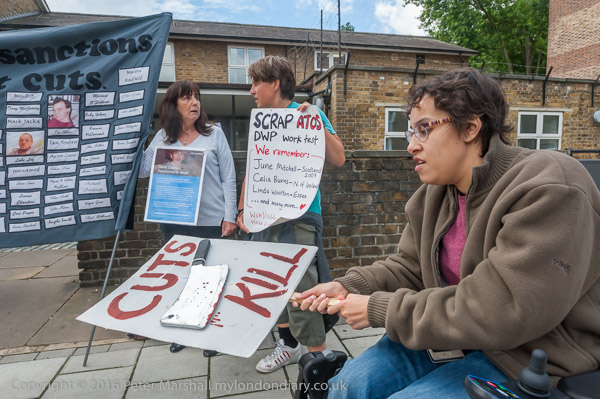
The hardest part of photographing the protest at the Vauxhall PIP Consultation Centre was actually finding the place, hidden away in a back street. This was one of around 20 protests around the country at the centres where ATOS carry out sham Personal Independence Payments ‘assessments’ on behalf of the DWP.

PIP, NHS, Trident & Wood St Cleaners

The assessments are almost solely designed to save money for the DWP, enabling them to ignore medical evidence of need and are carried out by people who are given a financial incentive to fail claimants. They often mean that genuine claimants lose essential benefits for months before they are restored on appeal. They have led to many becoming desperate, with some needing hospital treatment and a few have committed suicide after being failed.

PIP Fightback at Vauxhall


NHS Bill protest at Parliament – Old Palace Yard, Westminster

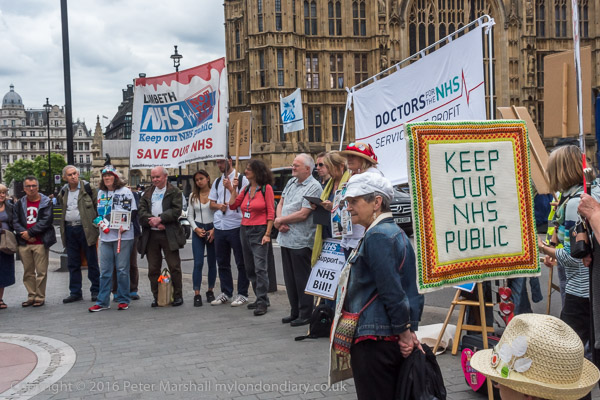
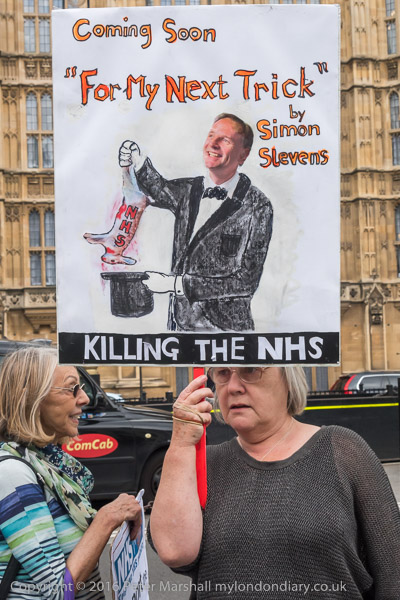
Labour MP for Wirral West Margaret Greenwood was later in the day presenting a ‘Ten Minute Rule Bill’ with cross-party support to stop the privatisation of the NHS and return it to its founding principles.

People from various campaigns had come out to support the bill, which although it had no chance of progressing into law did lead to a greater awareness of the privatisation which is slowly but apparently inevitably putting our NHS into the hands of private, mainly American, health companies, and eroding its basic principles.

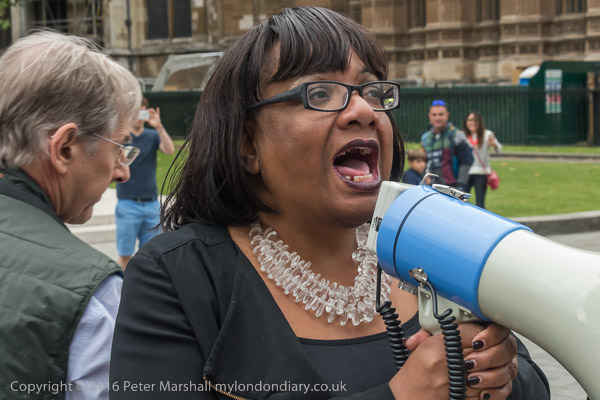
Among those who came out to speak was Shadow Health Minister Diane Abbott.
NHS Bill protest at Parliament


Disabled PIP Fightback blocks Westminster
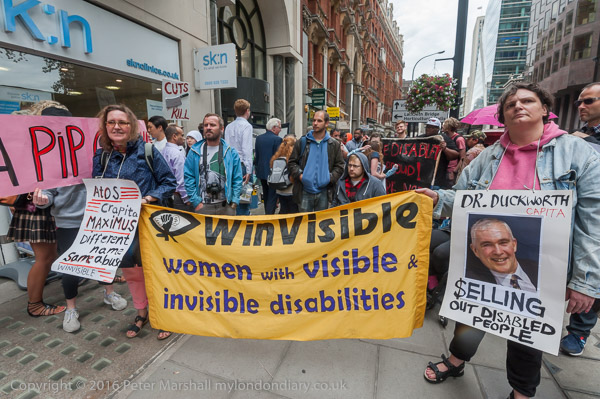
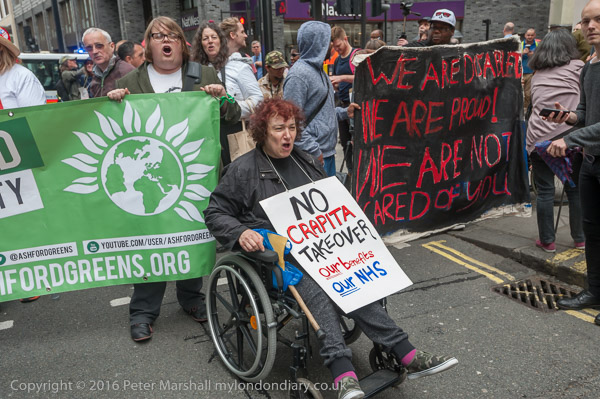
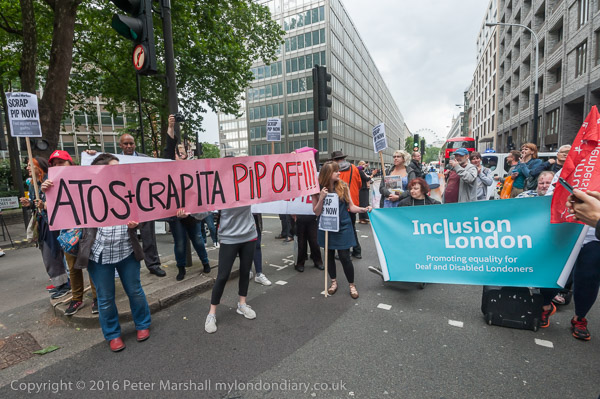
Campaigners from Mental Health Resistance Network (MHRN), Disabled People Against Cuts (DPAC) and Winvisible (Women with Invisible and Visible Disabilities) and other supporters met outside the Victoria St offices of Capita PLC, one of the companies along with ATOS responsible for carrying out the shoddy cash-saving PIP assessments.

In particular these assessments are unfair on many claimants whose conditions vary day to day including many with mental health issues. The assessments make no allowances for this and fail to take any account of the medical evidence in coming to their conclusions.

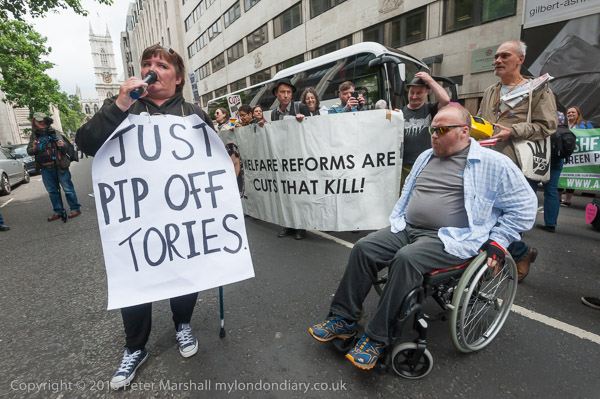
After protesting for some time on the very busy pavement where there were a number of speakers, Paula Peters of DPAC led the group out into the the middle of Victoria Street where they stood with banners and in wheelchairs blocking traffic.
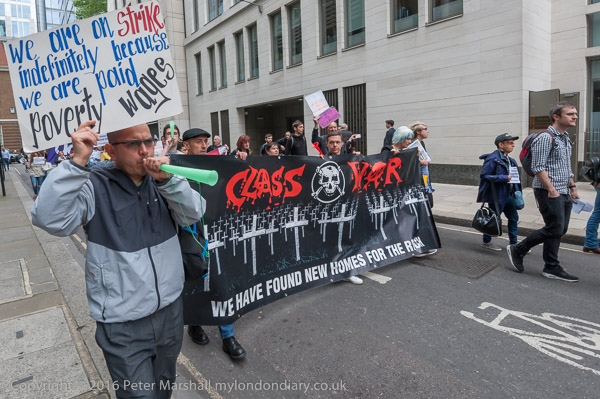
They then marched the short distance to the DWP headquarters in Caxton St, holding a further protest with speakers in the road outside.
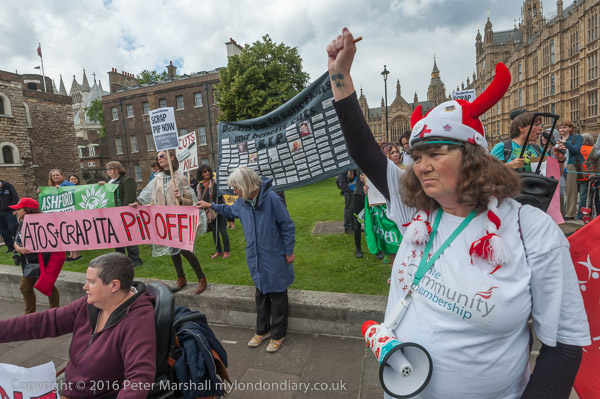
Finally they marched past the Houses of Parliament to College Green where the media had set up their ‘Westminster village’ crowded with cameras for Theresa May becoming Prime Minister. Police stopped them as they tried to go onto the grass in front of the TV cameras, and for some time they stood along the side before finally ignoring the police and going on to the green. Where the TV crews ignored the protest.
Disabled PIP Fightback blocks Westminster

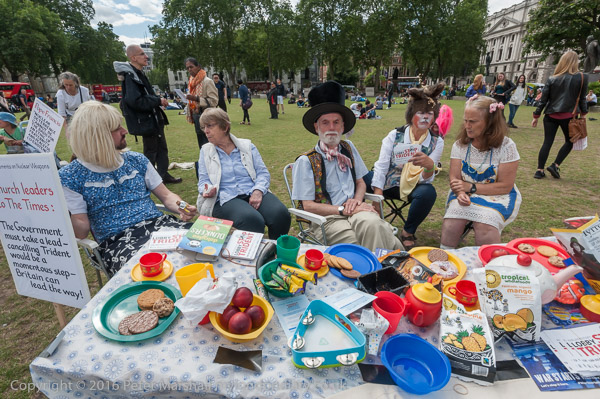
Trident Mad Hatters Tea Party – Parliament Square

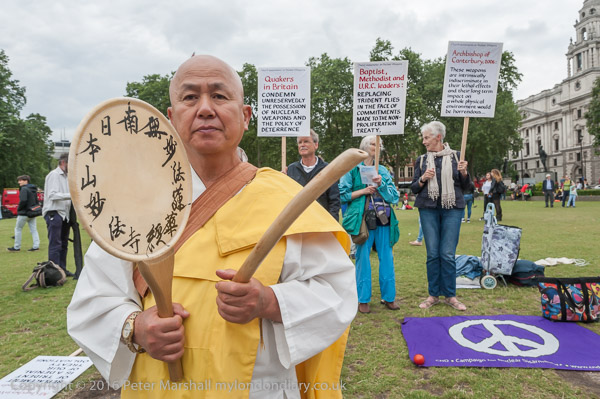
CND members and supporters were today lobbying MPs against plans to replace Trident at a cost of at least £205 billion.

In Parliament Square they had organised a ‘Trident Mad Hatters Tea Party’ and there were various Christian groups with placards placards stating the opposition by churches of the different denominations to the replacement, with Buddhists from the Battersea Peace Pagoda adding their support.

Trident Mad Hatters Tea Party


Solidarity for Wood St Cleaners – City of London

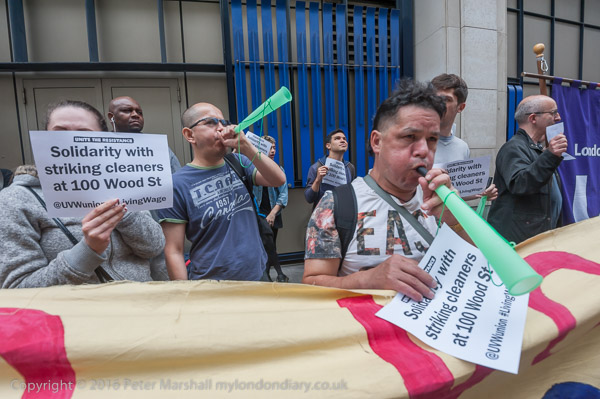
Finally I went to the heart of the CIty of London where a rally was taking place in support of cleaners belonging to the United Voices of the World union employed by anti-union cleaning contractor Thames Cleaning at the 100 Wood St offices managed by CBRE.

By 13th July this had already become the longest-running strike ever in the City of London and it continued into August. The UVW say:
As days became weeks, the inconvenience for white-collar workers at 100 Wood Street rightly turned into a major embarrassment for their employers, and especially for CBRE, the managers of the building. City of London police were called many times, security staff were intimidating, and the tenants were barely coping with a trickle of the former cleaning operation. Eventually, after a surprise flashmob in the CBRE’s lobby, and then a big march to mark the 50th consecutive day, the decision was taken after 61 days to raise all their pay to the London Living Wage!
https://www.uvwunion.org.uk/en/campaigns/100-wood-street/

Many more pictures at Solidarity for Wood St cleaners.


Clean Air and Fair Pay – 2019

Clean Air and Fair Pay – 2019. Two protests on Friday 12th July 2019 over different issues in different parts of London meant I had to leave the first before the rally at the end of the march.


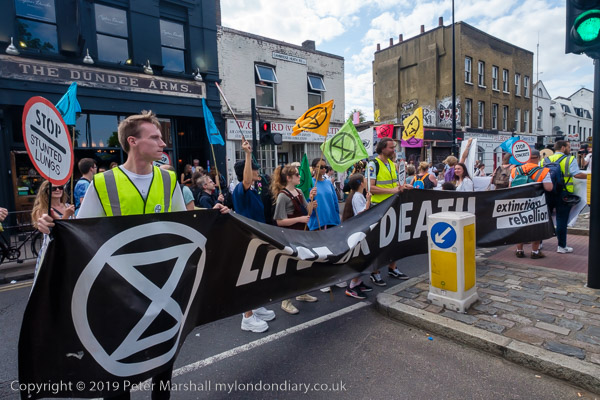
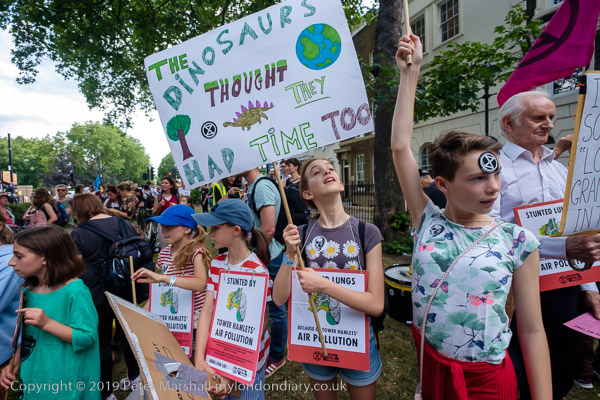
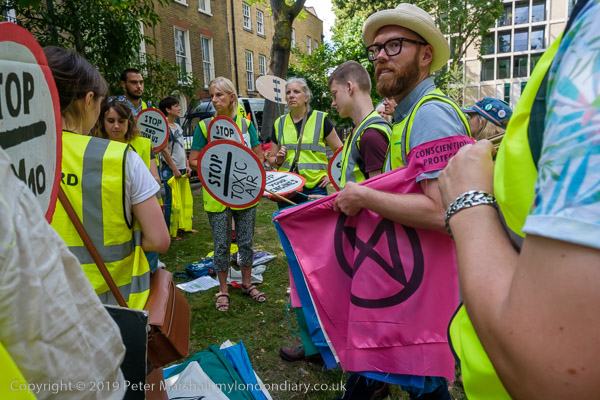
XR East London marches for clean air – Bethnal Green

Clean Air and Fair Pay - 2019

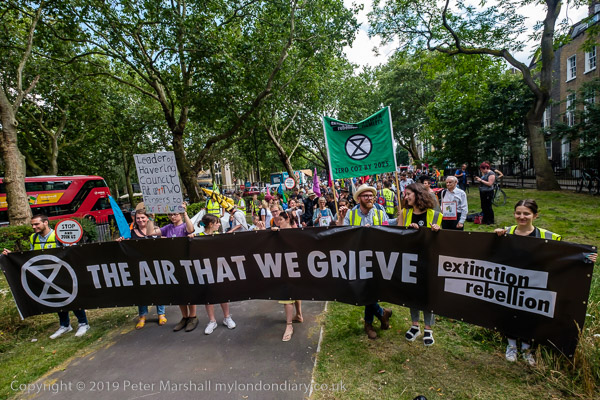
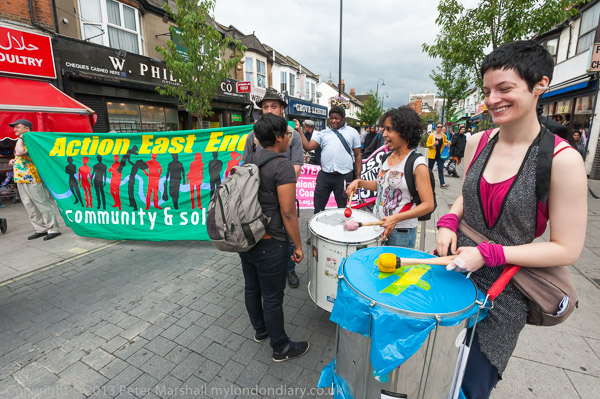
The march from Paradise Gardens at the centre of Bethnal Green to Hackney Town Hall was the initial event in a weekend of play, protest and education which Extinction Rebellion East London had organised under the title ‘East London Uprising’.

Clean Air and Fair Pay - 2019

Paradise Gardens was an obvious and appropriate if ironic meeting point for this march calling for the urgent action on the environment we need if the planet is to remain habitable. Although this has been protected commonland since 1678, this public green space is a thin and rather neglected strip between the busy Cambridge Heath Road and Paradise Row, a narrower street lined mainly by Grade II listed houses. It used to be simply a part of Bethnal Green Gardens which are on the east side of the main road but got its current name from Paradise Row – and the northern part of the gardens across the traffic-clogged road became Museum Gardens.

Clean Air and Fair Pay - 2019

Until shortly before this protest this small area of park had been closed as it was being used by contractors for nearby construction work, with the proviso that they restore it after their work was finished. This appeared to largely have been done, and had not affected the main attraction of the area, the dozen or so large trees along both edges.

When I arrived, people were still getting ready for the march, though most were simply standing around and waiting, some were getting their faces painted while the marching band were practising playing together, and the march stewards were getting their instructions. But finally people lined up behind the main banner with its message ‘THE AIR THAT WE GRIEVE’ and moved onto the fume-laden Cambridge Heath Road.

Air pollution is a huge problem in London, with many areas well above the EU’s legal limits for various pollutants much or all of the time. Traffic is a major source both of gases such as nitrogen oxides and also particulates, and moving towards electric vehicles, though an improvement will not solve the problem as much of the most dangerous particulates come from tyres and brakes. We need to cut traffic, by reducing the need for movement, shifting hugely to public transport and moving to using bicycles, electric bicycles and scooters particularly for shorter journeys.

Air pollution is said to be responsible for almost 10,000 premature deaths in London each year, and a much larger number suffer from serious lung and other conditions from it, greatly reducing their quality of life and creating a heavy burden and costs for our healthcare system. But encouraging people to adopt healthier means of transport needs much more spending on making these safer and more convenient.

The march up one of the area’s busier roads was largely uneventful, though it will have delayed many on their journeys through the area, but it will also have made many people in the area more aware of the problems. Those who drive in London are used to delays, with an overcrowded system in which any minor problem can cause lengthy delays – and as a bus passenger it isn’t unusual I often find myself getting off and walking when I’m in a hurry.

I left the march shortly after it moved across the border from Tower Hamlets into Hackney and was going up Mare Street towards the Town Hall. I was sorry to have to miss the childrens’ assembly which was to take place there at the end of the march, but wanted to be sure to be in time for the protest at Senate House in the centre of London.

More pictures: XR East London marches for clean air


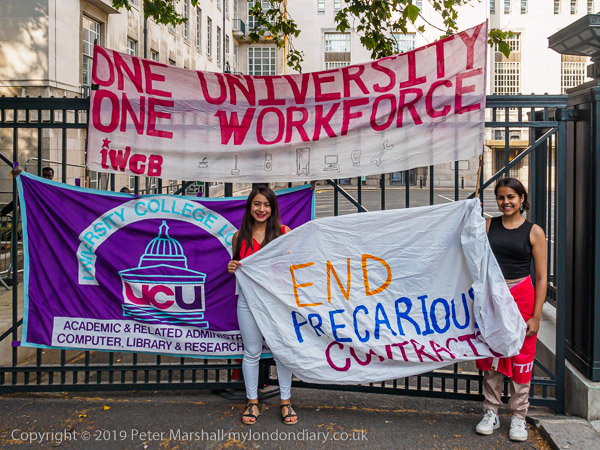
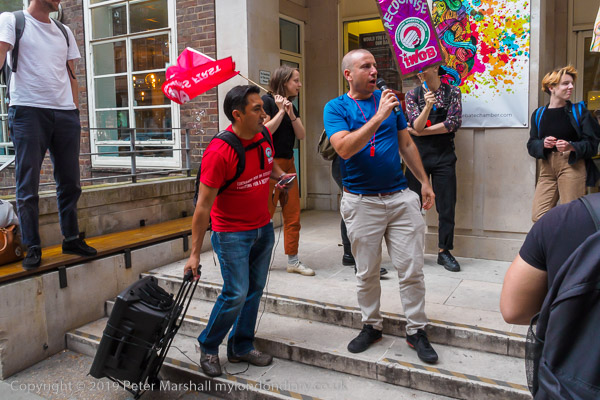
IWGB welcome new Vice Chancellor – Senate House, University of London

Most of the workers carrying out essential but low paid jobs at the University of London are not employed by the university but by contractors who provide their services to the university. This outsourcing results in the workers being poorly paid, often bullied and employed with only the minimum legal conditions of employment.

For years they have been protesting to be employed directly by the university and so get the same pay and working conditions as other staff in similar jobs that are on the payroll. In particular they want the same sick pay, holiday pay and pensions, and of course the London Living Wage.

Their campaigns have met with some progress – and three years on many have been brought in house, but the university dragged its feet for many years, spending large amounts on extra outsourced security staff and refusing to talk with the unions representing the low paid workers. Although trade union legislation means that as employers have to recognise unions, neither the contractors who employed these workers nor the university in whose premises they worked were willing to recognise or negotiate with their unions.

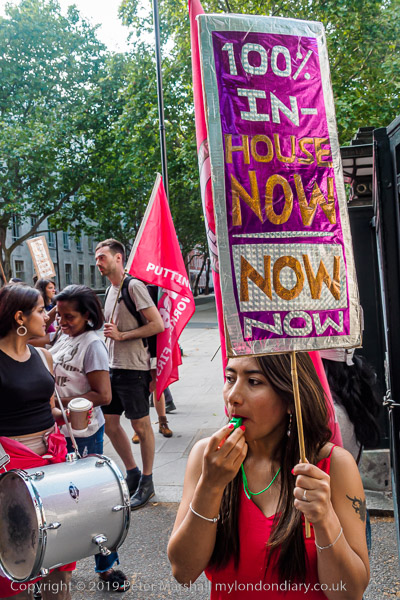
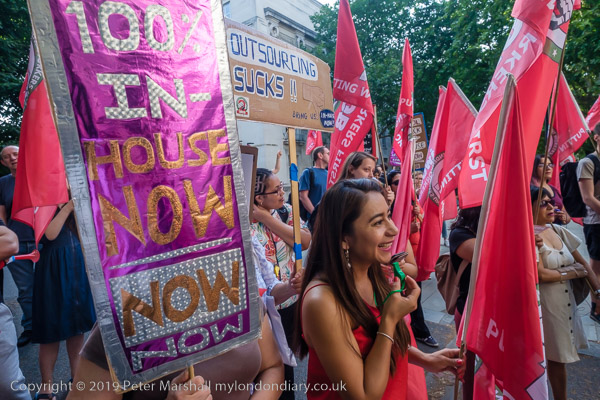
Progress has only been made by direct actions such as this by the grass-roots trade union IWGB, and by strikes by the workers. They had tried to meet with the new Vice-Chancellor Wendy Thomson but their request had simply been ignored.

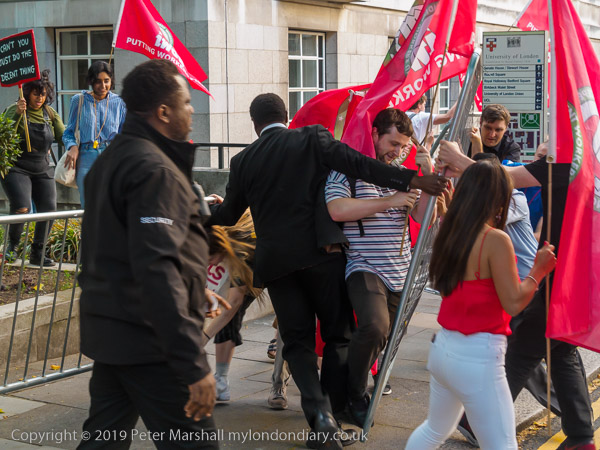
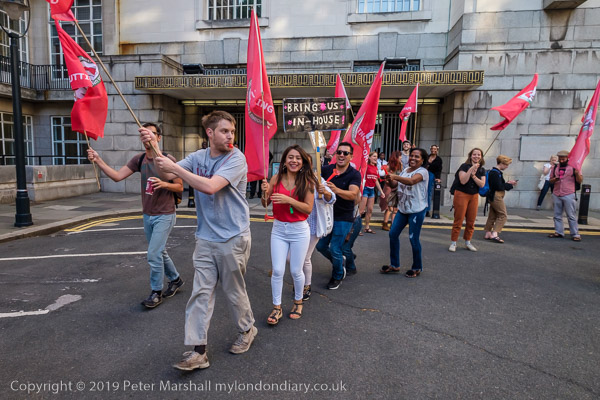
After a rally at the main gates and a protest outside Student Central (the former University of London Union, closed down by the University because it supported the workers) the protesters returned to Senate House. A small group pushed down some flimsy barriers with the extra security unable to stop them and the rest surged in after them to dance noisily in protest in the yard in front of the locked entrance to Senate House.

More at IWGB welcome new Vice Chancellor


Focus E15 Occupy Police Station for Newham Show

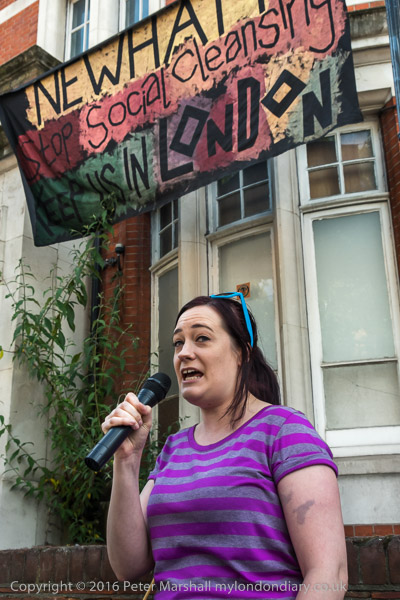
Jasmin Stone speaks at rally outside Newham Police station

Focus E15 Occupy Police Station for Newham Show – Sunday 10th July 2016

At the street stall outside Newham Town Hall

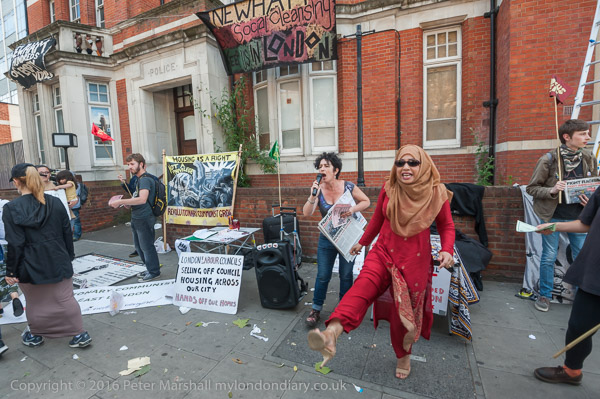
It says something about Newham’s elected Mayor from 2012 to 2018 that the major public event in the borough was called The Mayor’s Newham Show. It should of course have been the People’s Newham Show or even just the Newham Show. But Newham was a monolithic Labour fiefdom, ruled by Sir Robin Wales, and the event, paid for by the people, was very much a PR exercise for the Mayor.

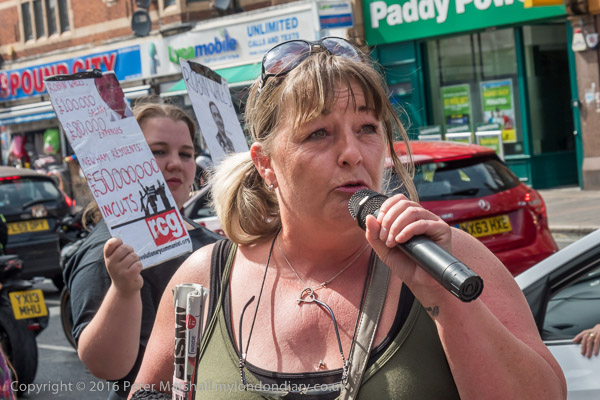
A worker for street homeless in Newham speaks

Housing action group Focus E15 were ejected from the Mayor’s Newham Show in 2014 when they approached the Mayor with protesting the borough’s housing policies – and Robin Wales was found guilty of a breach of the code of conduct by Newham Standards Committee.

The following year the council ordered private security to stop campaigners handing out leaflets at the show and members of the Focus E15 campaign were very forcibly thrown to the ground and evicted from the park in East Ham where the show is held.

They march the few yards to the police station

So in 2016, instead of trying to leaflet inside the Newham Show, the Focus E15 Campaign set up a stall outside Newham Town Hall on Barking Road close to the park and spoke and handed out leaflets to people walking to the show in Central Park. Their campaign began when they faced eviction from the Focus 15 hostel in central Stratford when Newham Council axed the grant and the council attempted to disperse them to private rented properties in cities including Liverpool and Manchester and to Wales.

Outside the former police station

They refused, demanding to be rehoused within reach of families, friends and facilities they were familiar with, protesting the council’s policy of social cleansing, though various marches, high profile protests and occupations of empty council properties. Their campaign, which included a weekly street stall on Stratford Broadway widened from being a personal campaign into a ‘Housing for All’ campaign against Newham and other councils who are failing in their duty to provide housing for ordinary people across London.

A woman on her way to Newham Show says everyone should kick the Mayor

Focus E15 continue to speak out and defend tenants from evictions and get suitable rehousing for those made homeless in Newham, while continuing to attack the council’s failure to provide adequate housing in Newham for long-term residents while hundreds of council homes have been empty for over ten years and the council encourages the building of huge areas of luxury flats for overseas investors and rich newcomers.

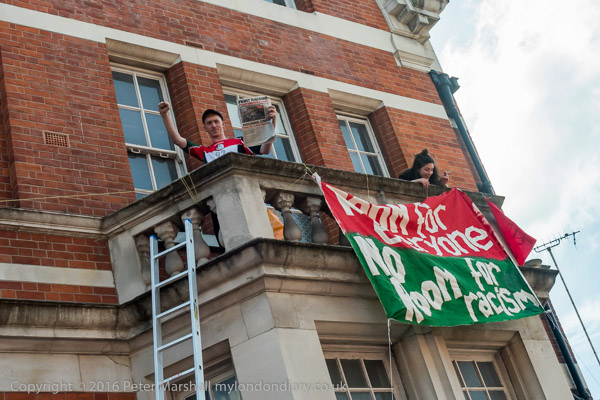
‘Room for Everyone – No Room for Racism’

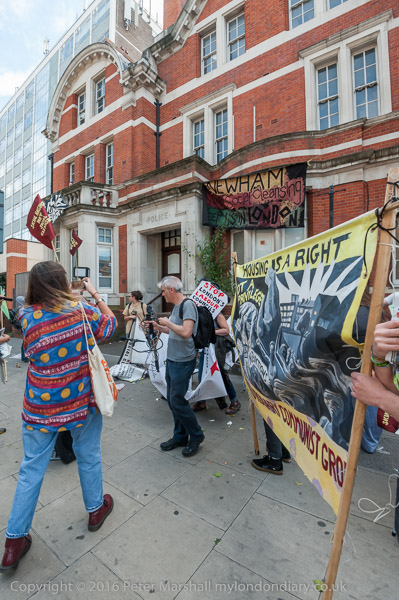
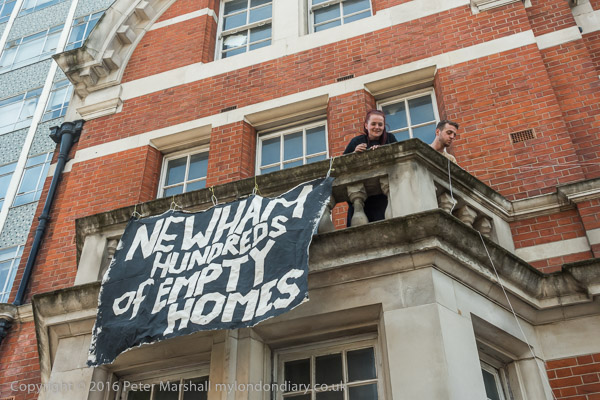
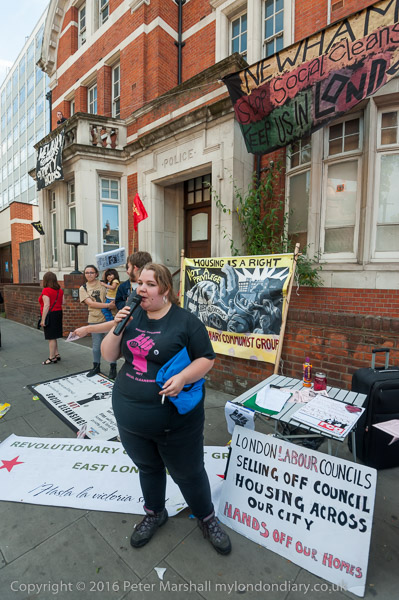
Among the many empty properties in Newham was the former police station on the corner of Barking Road opposite the Town Hall on High Street South leading to Central Park. After an hour or so of campaigning from the street stall they moved the short distance to this and four people climbed onto the two balconies with banners while the others held a rally in front of the building.

‘NEWHAM – Hundreds of Empty Homes’

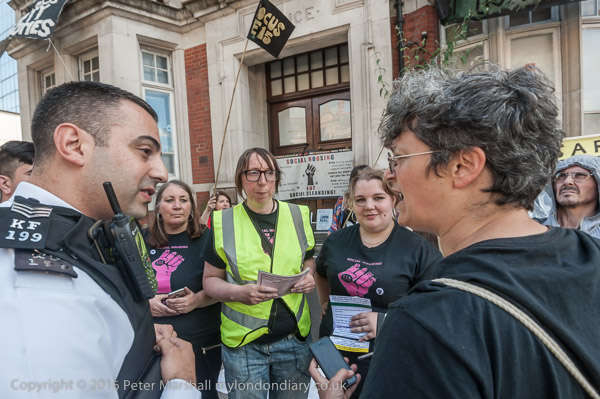
Police came to look at the protest, and tried to persuade the four on the balconies to come down, telling them they were worried that these were unsafe. There was nothing to suggest there was any risk at all as the building was still in good condition despite being unused. Police who want photographers to move also always lie to us and tell us that it is for our safety – and it almost never is, and sometimes actually results us moving into greater danger.

Almost certainly the people on the balconies were safe for the next twenty years or more – or until the building was demolished, and after they told police they would come down in a short time when the rally ended, the police gave up the pretence and simply watched from the opposite side of the road.

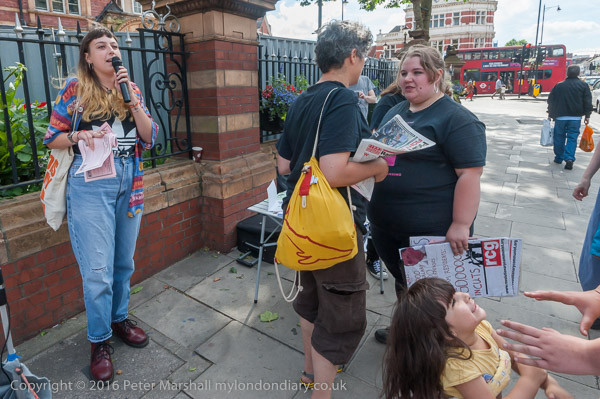
a woman from East End Sisters Uncut

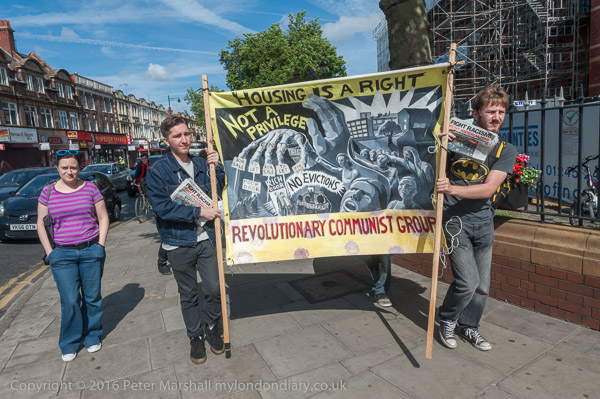
Support for the Focus E15 protest came from the Revolutionary Communist Group, Feminist Library, Boleyn Dev 100, Tower Hamlets Renters and Newham Green Party. Among the speakers at the rally was a woman from East End Sisters Uncut who talked about their occupation of an empty property in Hackney as a community resource in protest against Hackney Council’s housing failures.

In 2015 Newham sent 244 families families out of London, claiming it had no space or money to house them here. The borough then had the largest number of empty properties of any London borough – around 1,318 with a total value of around £470 million. Although Sir Robin Wales has now been replaced as Mayor, Newham’s housing policies are still failing the people, and the police station, last in use around 8 years ago, is still empty and firmly sealed against occupation. The Focus E15 campaign continues.

More at Focus E15 Occupy Police Station.


World Pride & Spanish Civil War

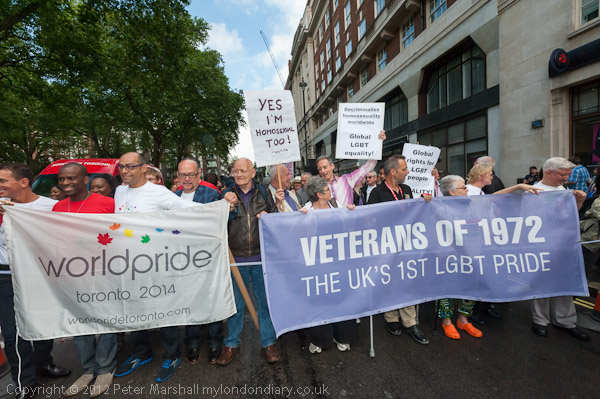
World Pride & Spanish Civil War. On Saturday 7th July 2012 there were two events taking place at the same time and I was determined to cover both. Fortunately having begun at the start of the WorldPride procession in Marylebone I was able to jump onto the Bakerloo Line to Waterloo and photograph the annual International Brigades Commemoration at Jubilee Gardens before returning on the same line to Charing Cross to photograph the end of the march.


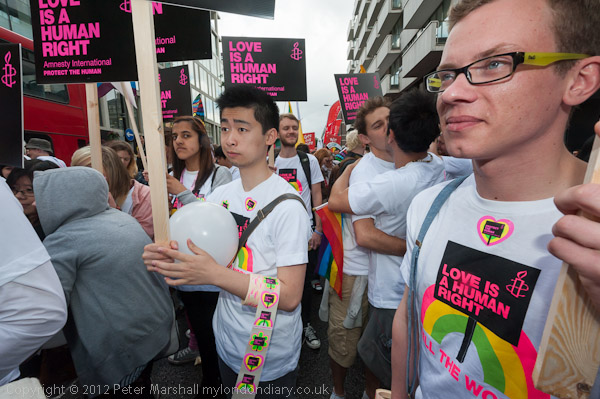
WorldPride London – Portman St & Westminster

Pride almost didn’t happen in 2012 as the organisers were met shortly before the event to provide financial assurances to the GLA, Met Police, Westminster Council, London Fire Brigade and Transport for London, which they were unable to do. Quite why London Mayor Boris Johnson decided to try to stop Pride in this way is not at all clear.

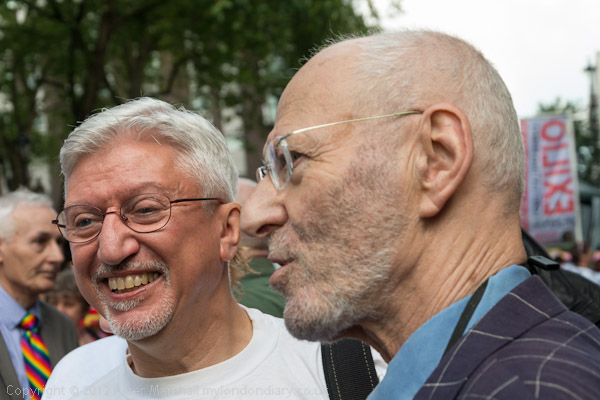
Two marchers in a group who had been at the first Gay Pride in 1972

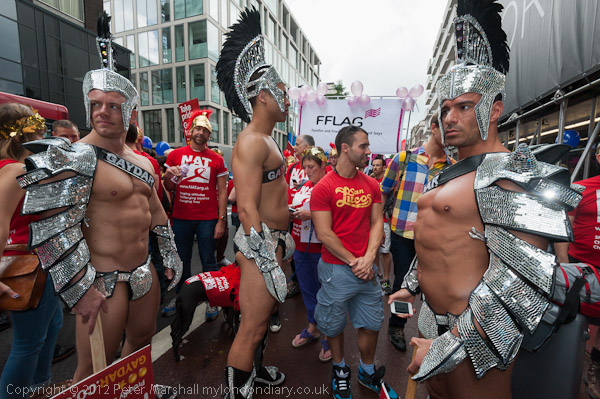
So rather than the planned event they decided to stage a ‘peaceful protest’ march or ‘procession’ specified as a democratic right under the Public Order Act 1986. This meant there were none of the corporate floats that have in recent years come to dominate the event, although company staff still marched in their company outfits.

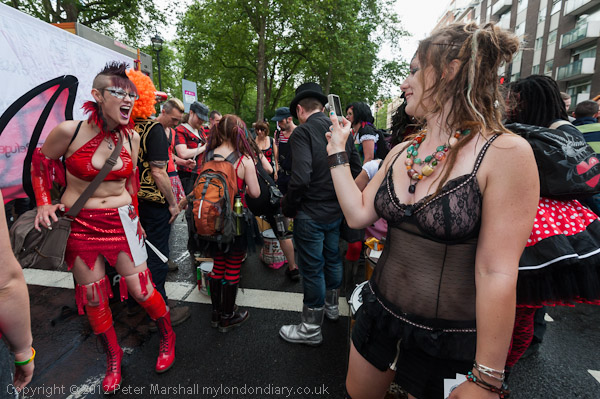
Gay Pride had in recent years lost much of its political edge, becoming a carnival of different lifestyles and a commercially sponsored jamboree, with large and expensive floats. Without these, although the corporates were still present, everyone was on the street together and the whole event seemed more intimate.

WorldPride 2012 was again a protest – as it used to be, though in a very different situation from when it began when for many that took part it was where they ‘came out’, taking the significant step in affirming themselves as gay and standing together against the prejudices of a society which was only just beginning to accept that being gay was not a perversion.

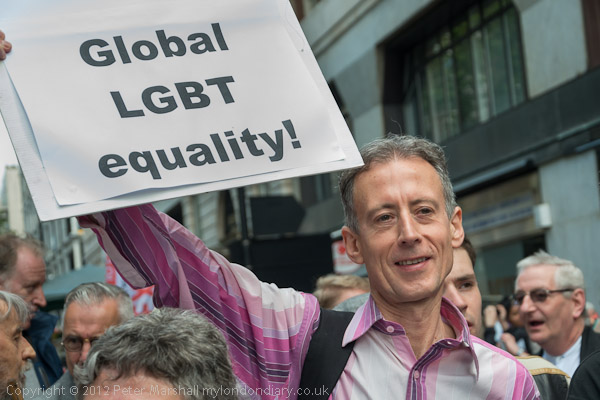
Of course there are still some communities in the UK where being gay remains unacceptable, and as campaigner Peter Tatchell reminded us, there are still some countries where people are being killed because they are gay.

There were a number of heavy showers while people were arriving for the event, and many put off arriving as late as possible. Although at first it looked as if the event might be a washout, by the time I was making my way towards Baker Street station the street was tightly packed making my progress slow.

When I returned to photograph marchers at the end of the event in Whitehall and Pall Mall I had missed the front of the march, but there were still many arriving hours after the procession had begun.


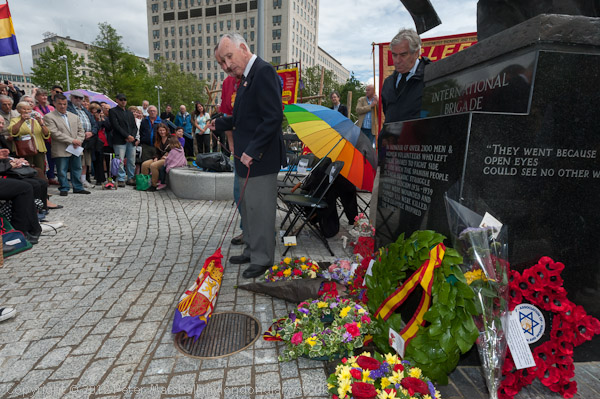
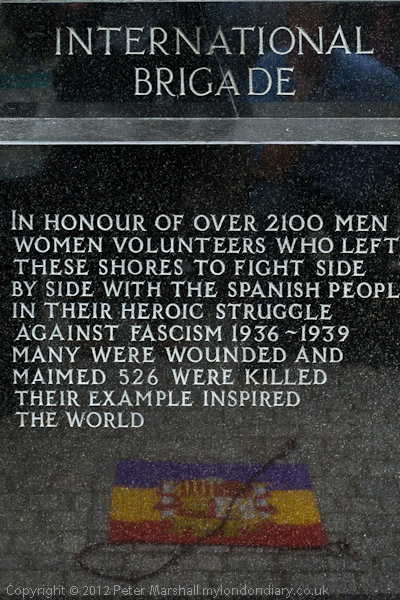
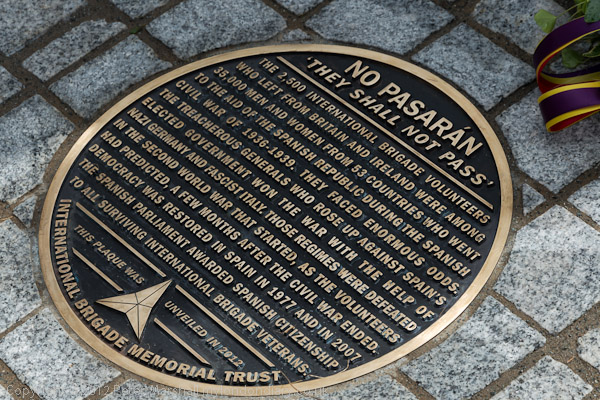
Sacrifice For Spain Remembered – International Brigade Memorial

David Loman unveils the new plaque in Jubilee Gardens

The annual International Brigades Commemoration has been on the same day as Pride in several years, and recording both has often been a problem. I was particularly keen to be there this year as it could well be the last to be attended by any of those who volunteered to go to Spain.

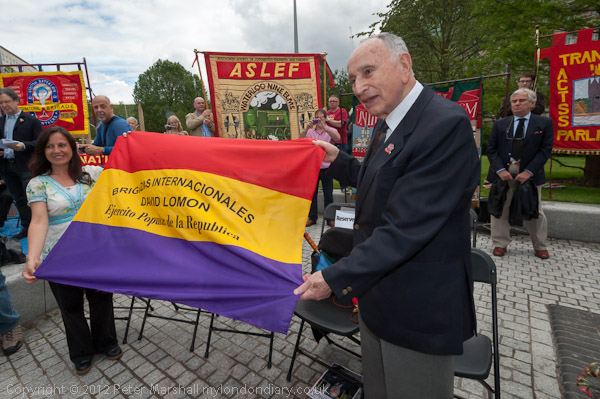
The war in Spain began in 1936, 76 years earlier. A new plaque was being unveiled in Jubilee Gardens by David Loman who was an 18 year old Jewish lad, David Soloman, from the East End when he went to fight in Spain in 1936, changing his name to Loman (also know as Lomon) because it was illegal. He was captured by Italian soldiers in 1938, surviving some months in a prison camp before being repatriated. He served in the Royal Navy in the Second World War and like other surviving members of the International Brigades he was awarded Spanish nationality in 2007 for his services to the Spanish nation and presented with a Spanish passport in 2011.

Now 94, and looking very sprightly Loman is one of only three remaining British veterans – the others being Lou Kenton then 103 and Stanley Hilton. Both Loman and Kenton died during before the commemoration in 2013. Hilton, who was living in Australia, died in 2016 aged 98.

David Loman holds the flag he was presented

There were many family members of those who fought in Spain at the commemoration, and there were a number of speeches and performances by folk musician Ewan McLennan, performance poet Francesca Beard, singer-songwriter Paco Marin and folk duo Na-Mara, but Loman was definitely the star of the occasion.

More at Sacrifice For Spain Remembered.


NHS and Housing Marches in East London, 2014

NHS and Housing Marches in East London, 2014


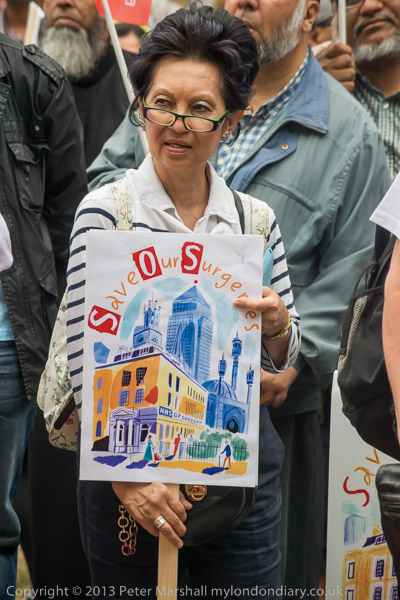
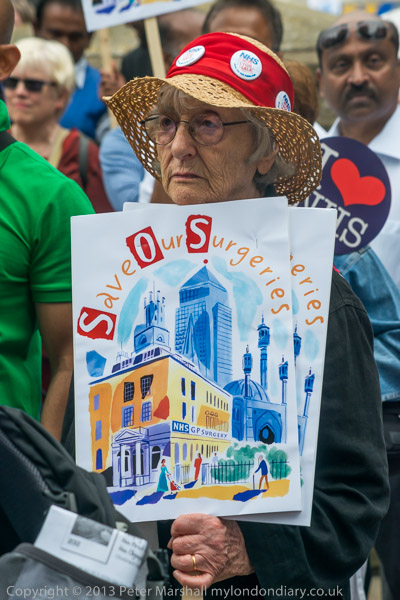
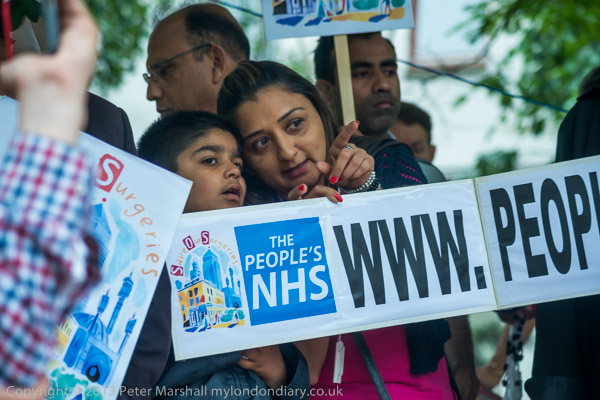
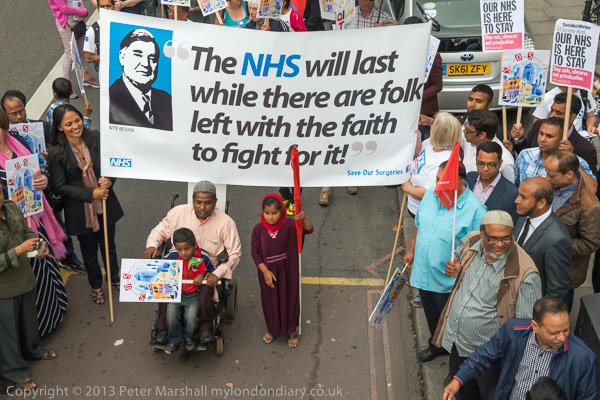
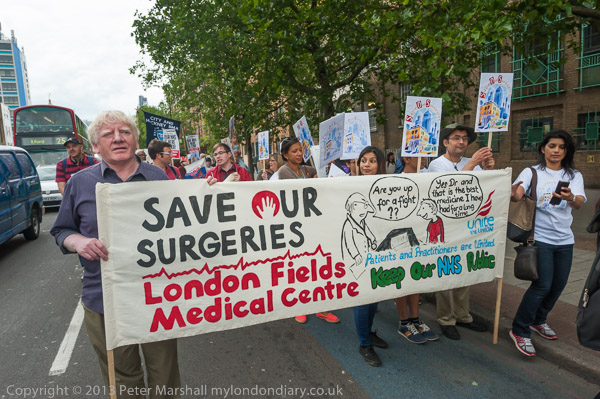
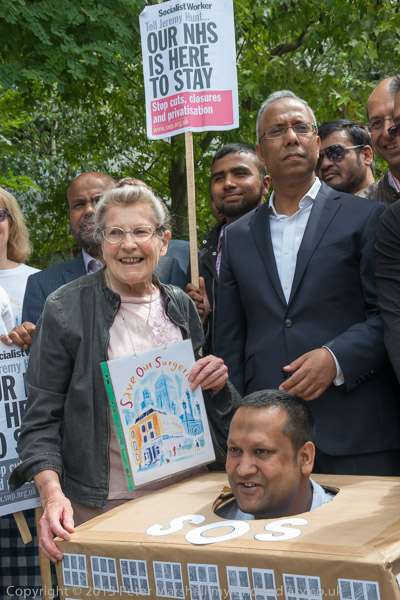
Save our Surgeries on NHS 66th Birthday – Whitechapel

The National Health Service came into operation in the UK on 5th July 1948, established by a Labour government despite considerable opposition from the Conservative Party and some doctors’ organisations. In most recent years there have been protests marking the anniversary against the increasing privatisation of the system, large parts of which have now moved away from being provided by the NHS itself to being provided by private companies, motivated by profits rather than public service.

The opposition to Aneurin Bevan’s plans in the 1940s led to a number of compromises, but the NHS was launched with three basic principles – to meet the needs of everyone, to be free at the point of delivery, and to be based on clinical need rather than the ability to pay. Although those principles remain, there are some respects in which they are not entirely met.

Prescription charges – currently £9.35 per item – were introduced in England in 1952, removed from 1965-8 but then re-introduced, remaining free for under-16s and over 60s, with some other exceptions. And we pay too for NHS dentistry, and many people find it impossible to get dental treatment under the NHS as no practice in their area will take them on.

Access to GPs and other services at surgeries around the country is also much more difficult for many, and it can be difficult or impossible to get an appointment in a timely fashion. Many services dealing with relatively minor medical issues are no longer available, and people have either to pay for them or continue to suffer. Some of these problems have been exacerbated by the take-over of many surgeries by healthcare companies as a part of the creeping privatisation of the NHS.

Twenty years ago, when I had a hospital stay of several weeks, hospitals have been forced to put some essential services – such as cleaning – out to tender, resulting in two of the three hospitals I was in being in filthy conditions.

In 2014, cuts in funding were threatening the closure of surgeries in Tower Hamlets as they failed to pay for the extra needs faced in inner-city areas. Local hospitals were also threatened, particularly because of the huge debts from PFI contracts for the building an management of new hospitals. The deals with the private sector made under New Labour have left the NHS with impossible levels of debt – and the companies involved with high profits, continuing in some cases for another 20 or 30 years.

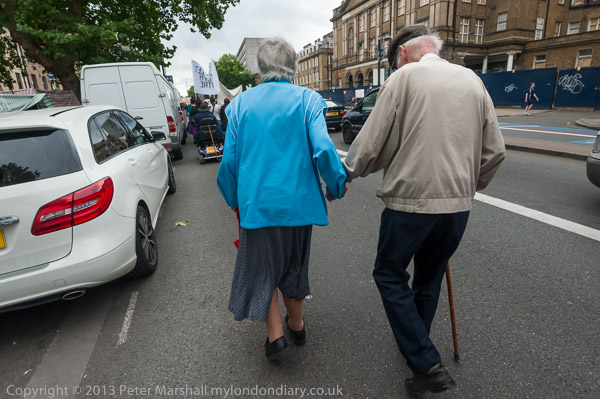
After a short rally with speakers including the local mayor and MP as well as health campaigners including local GPs, there was a march by several hundreds to a larger rally in Hackney. But I left the marchers shortly after it passed Whitechapel Station.

Save our Surgeries on NHS 66th Birthday


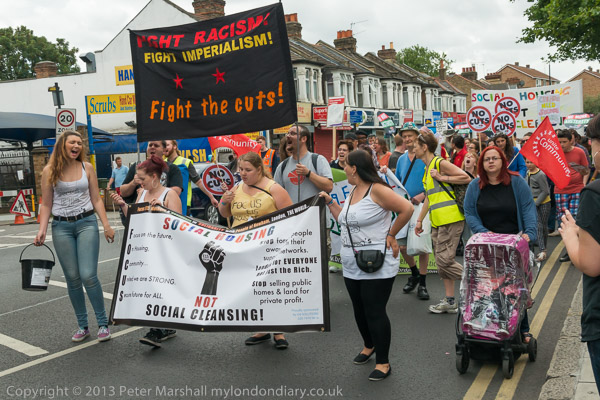
Focus E15 March for Decent Housing – East Ham

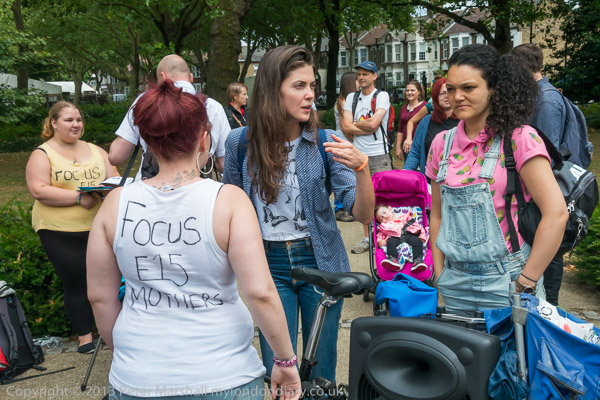
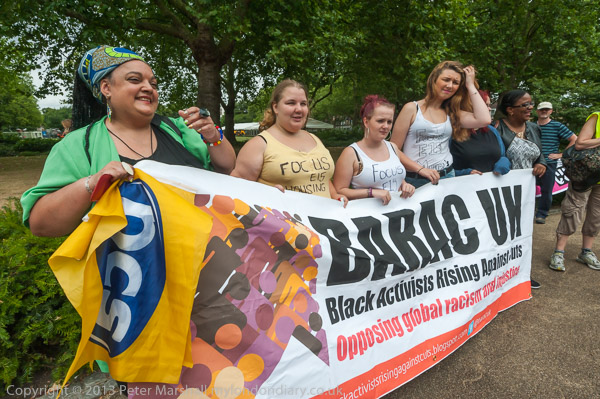
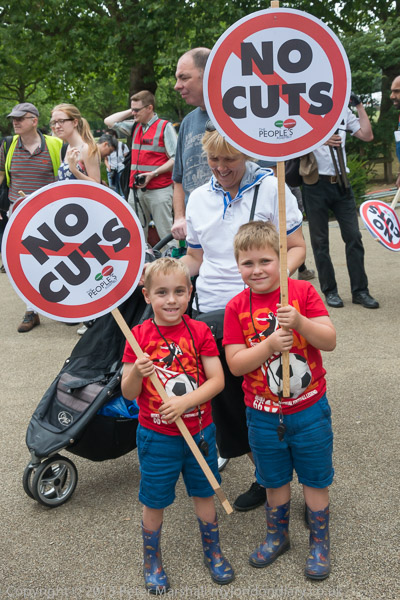
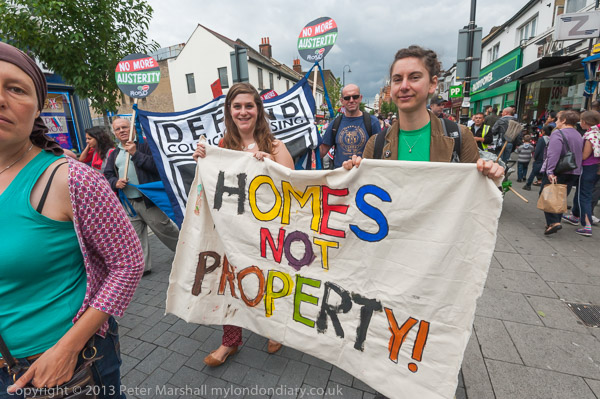
Earlier I had been to photograph a march through East Ham and Upton Park in a protest over the terrible state of housing in England, and in London in particular. The event had been organised by Focus E15 Mums with the support of Fight Racism Fight Imperialism, but included many other protest groups from Hackney, from Brent and from South London on the march as well as groups including BARAC, TUSC and others.

They included a number of groups who had stood up and fought for their own housing against councils lacking in principles and compassion who had suggested they might move to privately rented accommodation in Birmingham, Hastings, Wales or further afield, but who had stood their ground and made some progress like the Focus E15 Mothers.

Many London councils are still involved with developers in demolishing social housing and replacing it with houses and flats mainly for high market rents or sale, with some “affordable” properties at rates few can afford, and with much lower numbers than before at social rents. Many former residents are forced to move to outer areas of London in what campaigners call ‘social cleansing’.

Families that councils are under a statutory duty to find homes for are often housed in single rooms or flats, sometimes infected by insects or with terrible damp, often far from their jobs or schools. Councils are under huge pressure and funding cuts sometimes make it impossible for them to find suitable properties, though often there are empty properties which could be used, particularly on estates such as the Caarpenters Estate in Stratford which Newham had been emptying since around 2004 in the hope of redeveloping.

Government policies and subsidies for housing have largely been a way of subsiding private landlords, and we need national and local governments – as I worte ” determined to act for the benefit of ordinary people, making a real attempt to build much more social housing, removing the huge subsidies currently given to private landlords through housing benefit, legislating to provide fair contracts for private tenants and give them decent security – and criminalising unfair evictions.” Housing really is a national emergency and needs emergency measaures.

Much of what is currently being built in London is sold to overseas buyers as investments and often left empty as its owners profit from the rapid rises in property values in London. We need to make this either illegal or to impose heavy duties on overseas owners including increased council taxes on empty properties.

The march attracted considerable attention on the streets of East London, and as I note several motorists stopped to put money in the collection buckets – something I’ve never seen happen before. I left the march as it reached East Ham Station to go to the NHS event.

Focus E15 March for Decent Housing


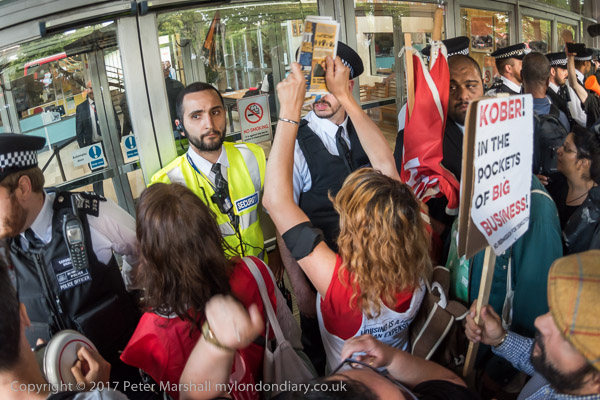
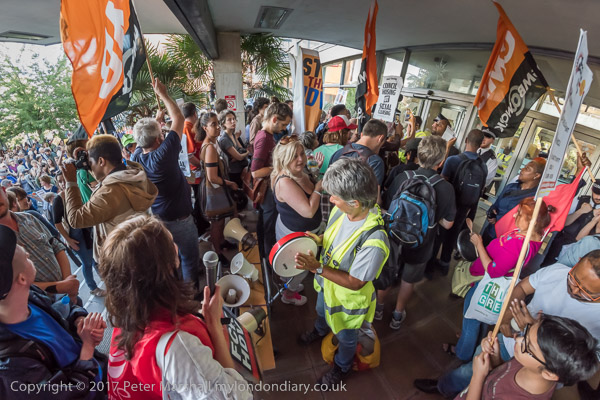
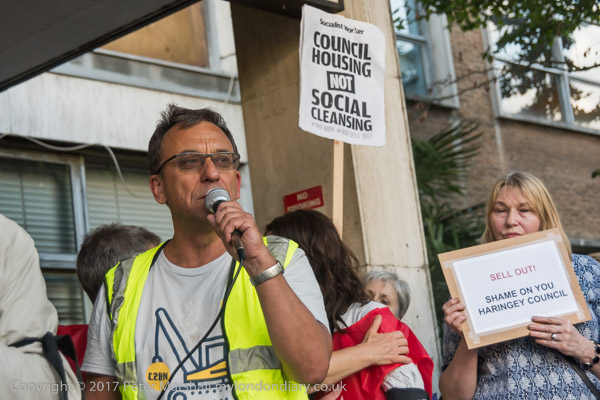
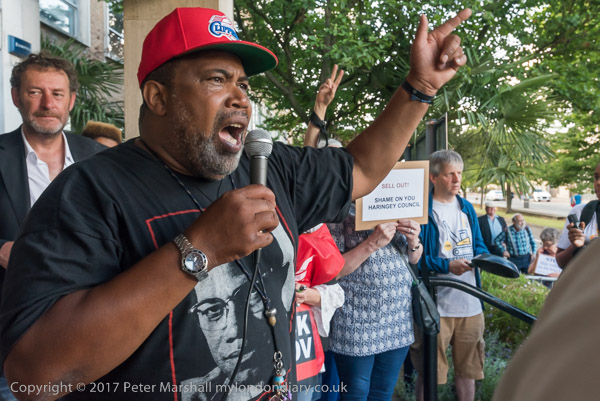
Haringey Residents protest housing sell-off

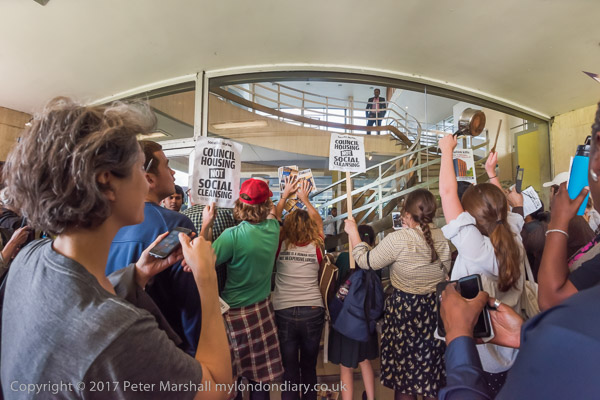
Angry residentshold up placards and posterson the glass wall of the Civic Centre

Haringey Residents protest housing sell-off – Wood Green, London. Monday 3 July 2017.

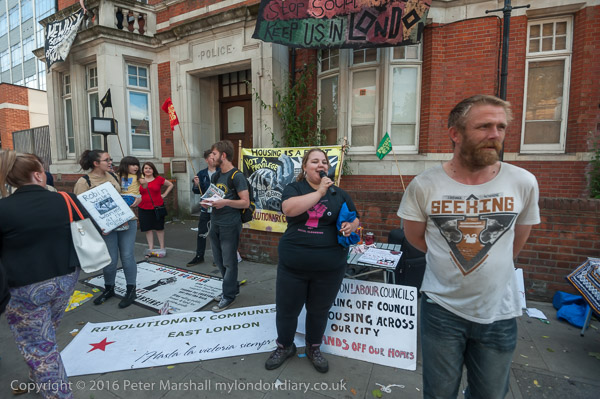
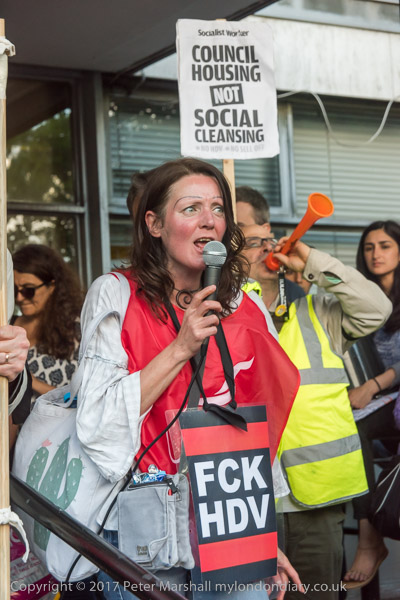
One of the London Labour councils whose housing policies were causing much local distress was Haringey, where the council was in process of setting up the Haringey Development Vehicle (HDV), Britain’s biggest collaboration yet between a local authority and a property developer, which will demolish a third of Haringey’s social housing, handing over half of an estimated £2 billion worth of publicly owned housing estates, schools, public facilities and private housing acquired through compulsory purchase orders to developer Lendlease.

Time to march from Duckett’s Common

Many feel that the cabinet system for local government is anti-democratic, removing decisions from the elected councillors as a whole to small highly selected groups for the convenience of administration. It means that ideas such as the HDV are not properly debated, and in this case it was about to be imposed without any real public consultation, and to many its only real purpose appeared to be to hand huge profits to the developer.

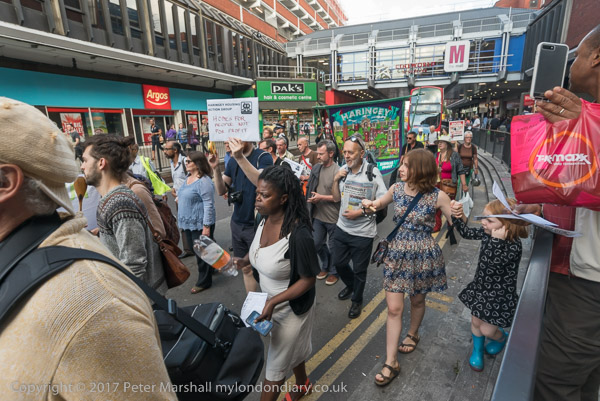
Marching through Wood Green shopping centre

The scheme to build 6,400 new homes would result in the demolition of many existing properties, and would have the consequence of driving many existing tenants and leaseholders out of the area as they would be unable to afford to buy the new properties or afford the rents. It would mean a massive wave of social cleansing.

Police & security stop all but a few entering

The formation of the HDV was opposed by many in the borough’s Labour Parties, trade unionists, Greens, tenants, small businesses and community groups and well over 500 of them came to make their opposition clear.

A large crowd at the front of the CIvic Centre

They had met at Ducketts Common and then marched through the centre of Wood Green, stopping briefly to block traffic on a road junction before moving on to the front of the Haringey Civic Centre where the council was meeting later to approve the HDV. They soon pushed aside the barriers which had been set up in front of the building to continue their noisy protest, with a row of police standing across the entrance.

But others went around to protest in front of the large glass windows at the back

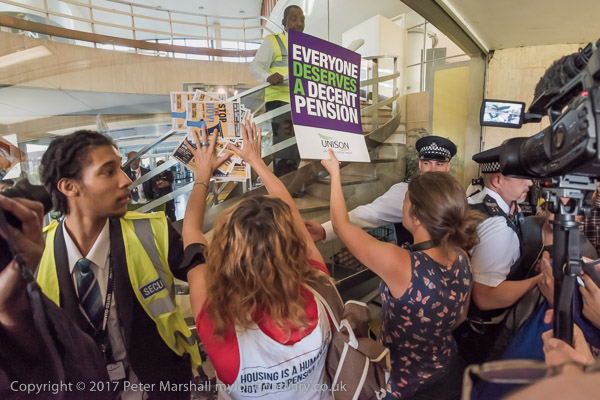
After an angry and noisy protest outside some made a rush to get into the building though a side entrance. I decided not to try and enter with them, and security and police managed to stop all but a few and then locked the building, leaving even some of the councillors coming to attend the meeting unable to enter.

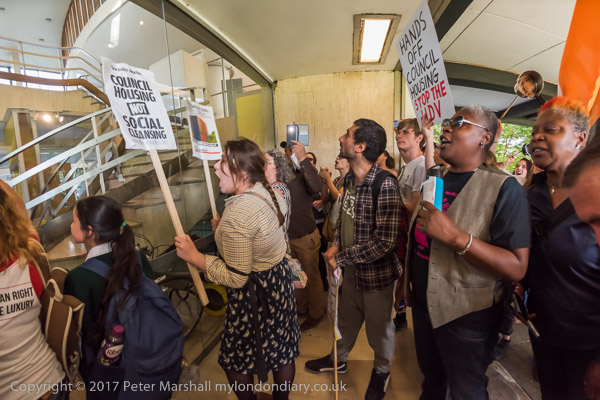
Many of the protesters moved the to the rear of the building and banged noisily on doors and large glass windows, and at one point the large glass panes began to flex by almost half an inch as people pushed against them and I moved back fearing they might shatter.

Eventually police came and pushed the people away from the glass

It looks from some of the pictures I took as if the protesters were actually inside, but they were on the outside of these large glass panels which gave a good view of the interior. Eventually police arrived and pushed the people back, forming a line in front of the glass.

A rally continued in front of the building entrance

I moved back to the front of the building where a rally was taking place with a number of mainly local speakers. This was still continuing as I left and the noise would have been very noticeable to councillors inside who were voting to go ahead with the scheme to give away around £2 billion to the Australian developers Lendlease.

Although this battle was lost, the war was at least partly won. The HDV was a major issue in the next set of council elections in the following May, with the many councillors from the left of the Labour Party strongly opposed to it getting elected, and the new council quickly voted to scrap the scheme to redevelop the Northumberland Park council estate with Lendlease. Instead Haringey set up its own housing company, Haringey Homes, and will carry out developments – including some with private developers such as Lendlease – in a way that avoids some of the social cleansing and retains more affordable and social rented properties. It has met some of the issues raised by the campaigners but by no means all.

The council’s new approach was in part made possible by a government decision to remove the cap on councils’ borrowing in their Housing Revenue Accounts (HRA) and also by a funding grant from the Mayor of London. But they still need to build some properties for market sale, though they state they are committed only to do this so they can deliver the “greatest possible number of council-rented homes.”

More at Haringey Residents protest housing sell-off.


XR Carmen’s Carbon Procession

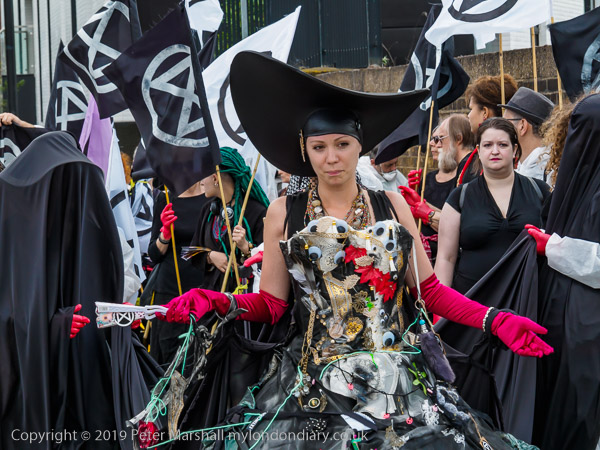
Carmen leads the XR Carbon Procession at Hyde Park Corner

Extinction Rebellion had obviously put in a lot of thought and effort into their Carmen’s Carbon Procession on July 2nd, 2019, and there were quite a few photographers and videographers who came to photograph it. Doubtless all of us filed our pictures with the agencies or publications, but I don’t know how many got published. Probably the only pictures used came from later in the day when they ended the event with a protest in Trafalgar Square close to where a large audience had gathered to watch the opera.

Protests in the UK seldom get reported, unless they result in considerable disruption, violence or involve celebrities behaving badly. So far as most editors are concerned they are not ‘news’. Of course much of the press and media is owned by a small group of billionaires whose interests those editors have to bear in mind even where there is not explicit direction. But more generally they operate under a general restraint of upholding the status quo and from their personal position as part of the well paid middle class – something which has been very apparent in the coverage of the recent RMT strikes.

But overall Extinction Rebellion have done much to bring the climate crisis into a wider public consciousness, and I applaude them for this even if I agree with some of their left and anarchist critics. And perhaps an opera-based protest exemplifies the middle-class nature of the organisation. But mobilising such a large middle-class movement is certainly an acheivement, and many of their harshest critics are those who have failed to mobilise more than a tiny fraction of the working class. Though nothing at the moment suggests that XR’s efforts will result in any of the decisive action needed to be anything but too little too late.

Relatively few people actually see protests on the streets, and most who do are too intent on getting on with their life, shopping or hurrying to meetings or to catch trains to take much notice. Much of XR Carmen’s Carbon Procession in any case took part on fairly empty back streets and it was more an event staged for the media than a protest.

The protest took place on the day that BP, a company which began life in 1909 as the Anglo-Persian Oil Company, Ltd, a part of our imperial exploitation of Iran’s vast oil reserves was greenwashing its polluting and climate-damaging activities through sponsorship of a Royal Opera House performance of Carmen to be relayed to 13 BP giant screens in major cities across the UK.

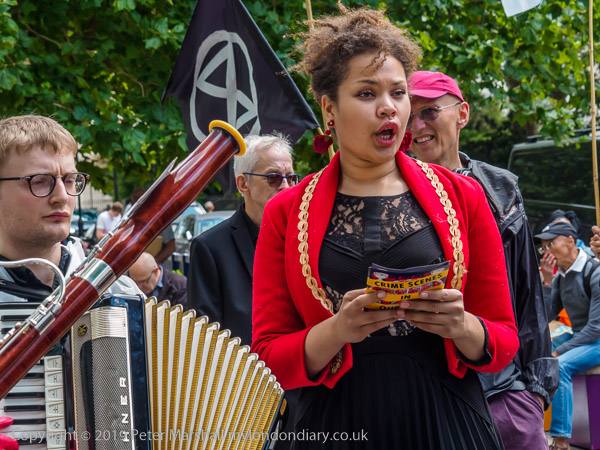
An opera singer performs a little from Carmen

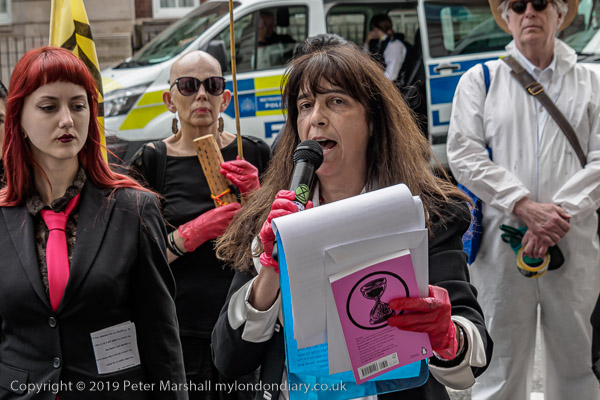
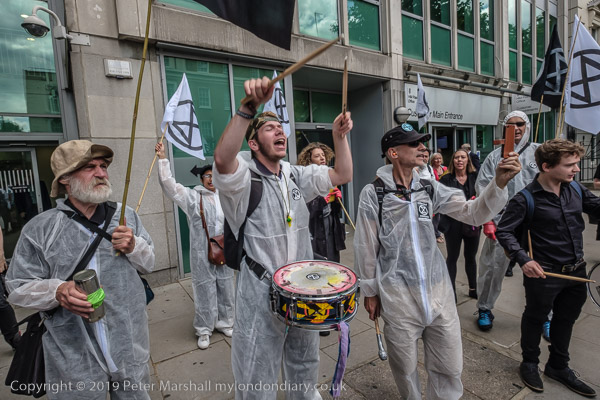
It toured the offices of oil companies belonging to the Oil and Gas Climate Initiative (OGCI) urging them to abandon the pretence they can combat global warming without a huge cut in oil production and delivering copies of the Extinction Rebellion Handbook ‘This is Not A Drill’.

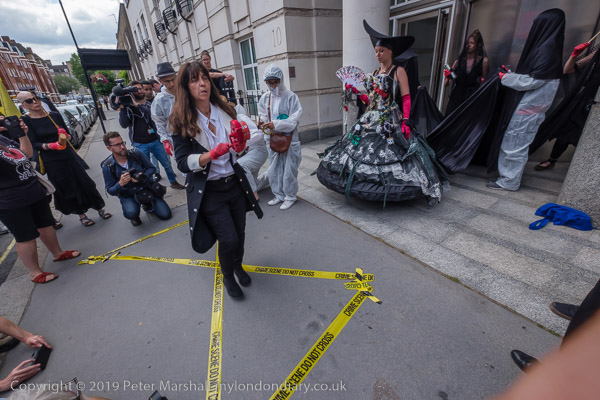
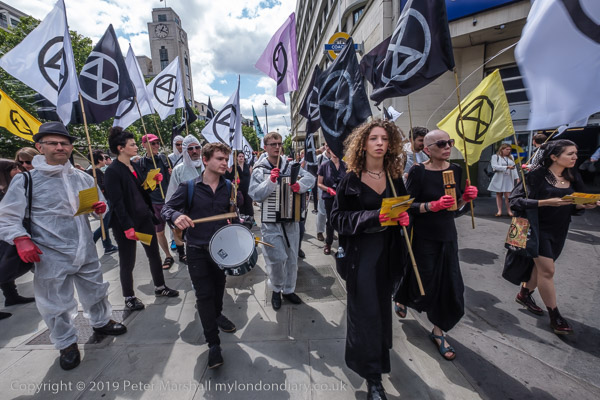
As well as Carmen in costume, there was a fine opera singer and a group of musicians, XR drummers to draw attention to the event and a team who marked out the company offices as crime scenes.

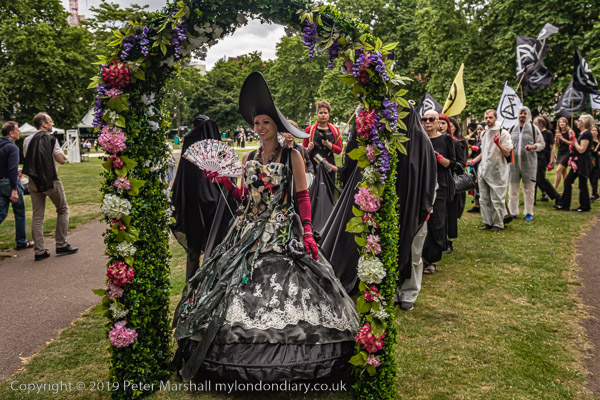
The procession found a floral arch in Grosvenor Square

The event met on Ebury Bridge before marking to perform in front of the nearby offices of Italian petroleum company ENI, on an otherwise rather empty street in Pimlico. They then moved on for another performance on a busy lunchtime street corner in Eccleston Square and then the China National Petroleum Corporation (CNPC) close to Victoria Station. By then they needed a rest in Hyde Park before going through Mayfair to the offices of Saudi Aramco at 10 Portman Square.

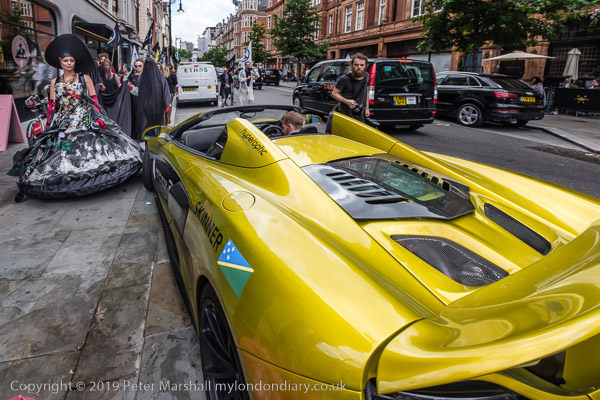
And an illegally parked symbol of the kind of extreme wasteful consumption that has got the planet in such a mess

It had taken them around three and a half hours to get there, and I decided I’d taken enough pictures and was getting tired. But probably the parts of the event more likely to be featured as news in the UK were to come. Their next planned performance was outside BP in St James’s Square, from where they were going on to protest close to the giant screen in Trafalgar Square, hoping to make clear to the audience there that the Royal Opera House should end their greenwashing sponsorship by BP.

Security at Saudi Aramco take a copy of the XR Handbook ‘This is not a Drill’

More at XR Carmen’s Carbon Procession