No M11 Link – Leyton 1994

No M11 Link: Although this was one of the major environmental direct action campaigns of the 1990s it was one I did not cover for several reasons. Protests were only a small part of my photography back then and Leyton was an inconvenient journey across London from my home. It was also a campaign which was being documented by a number of dedicated photographers on a largely full-time basis, while I was still working a full-time teaching job a two-hour journey away. But I did visit Claremont Road in Leyton and take a few pictures.

M11 Link Campaign, Claremont Rd, Leyton, Waltham Forest, 1994, 94-902-56

The M11 Link was first planned as a part of the grandiose London Ringways scheme of the 1960s but fortunately most of this was abandoned after the disastrous effects of relatively short sections such as the Westway in North Kensington became clear in the 1970s. But the ‘A12 Hackney to M11 link road‘ remained on the table despite various public inquiries from 1976 on, where local activists were vigorous in their opposition. It was a Tory government in 1989 with their ‘The Roads for Prosperity’ white paper that put it firmly back on the table and preparations for its construction began in 1993.

M11 Link Campaign, Claremont Rd, Leyton, Waltham Forest, 1994, 94-902-41

These involved the demolition of 263 properties along the route, some occupied by long-term residents but others by a wide range of newcomers who had moved in during the 1980s as planning blight affected the area – including many artists and squatters. When the campaign began in 1993, they were joined by “large numbers of anti-road campaigners from around the UK and beyond, attracted by the availability of free housing along the route” where properties had been compulsorily purchased and were empty.

M11 Link Campaign, Claremont Rd, Leyton, Waltham Forest, 1994, 94-902-42

The protesters made use of a wide variety of direct action methods to make construction more difficult, including sit-ins, sabotaging of equipment and materials, concreting themselves in tunnels and a fantastic network of actual nets in the sky between houses.

M11 Link Campaign, Claremont Rd, Leyton, Waltham Forest, 1994, 94-902-43

Police and security staff had to be employed in large numbers and had a very difficult job. The protesters also made great use of then new technology including Desktop Publishing and Fax machines to promote their activities, and achieved considerable news coverage in both the national newspapers and TV.

M11 Link Campaign, Claremont Rd, Leyton, Waltham Forest, 1994, 94-902-46

The main centre of the protest in 1994 was a small street in Leyton, Claremont Road, where all the houses were to be demolished and all but one of the original residents had been moved out and the houses were squatted by protesters who formed a vibrant community. As Wikipedia states, “The houses were painted with extravagant designs, both internally and externally, and sculptures erected in the road; the road became an artistic spectacle that one said “had to be seen to be believed”.

M11 Link Campaign, Claremont Rd, Leyton, Waltham Forest, 1994, 94-902-31

And it was this that I went to photograph in September 1994 and can be seen in the pictures here and on Flickr.

94-902-34-Edit
M11 Link Campaign, Claremont Rd, Leyton, Waltham Forest, 1994, 94-902-35

Two months later around 700 bailiffs and police in riot gear arrived on 28th November to evict the protesters. It took them several days due to the various obstacles – and a secret tunnel that enabled evicted protesters to return to the street. The bill for the police needed to protect the bailiffs came to over a million pounds. The total cost of evicting protesters along the whole route was £6 million.

M11 Link Campaign, Claremont Rd, Leyton, Waltham Forest, 1994, 94-903-51
M11 Link Campaign, Claremont Rd, Leyton, Waltham Forest, 1994, 94-903-53

Protests continued against the link road and slowed its progress and doubled its cost. You can read a good account of the Claremont Road eviction and the later ‘Battle of George Green’ on the green fuse web site.

The road was only finally opened in October 1999 as part of the A12. By this time it was an anachronism, partly because the M12 motorway scheme had been scrapped in 1994, but also because of the overall increase in traffic levels meant it was congested from the start. ” By 2014, the road had become the ninth most congested in the entire country.”

M11 Link Campaign, Claremont Rd, Leyton, Waltham Forest, 1994, 94-903-55

There are quite a few more pictures on Flickr – click on any of the above images and you can then go through the whole set. There are also eight panoramas from the site beginning here.


FlickrFacebookMy London DiaryHull PhotosLea ValleyParis
London’s Industrial HeritageLondon Photos

All photographs on this page are copyright © Peter Marshall.
Contact me to buy prints or licence to reproduce.

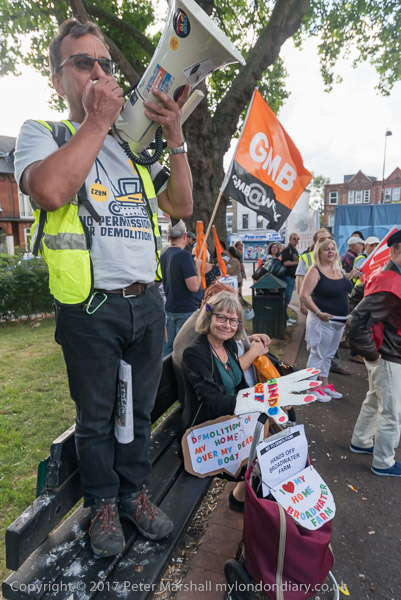
Haringey Residents protest housing sell-off

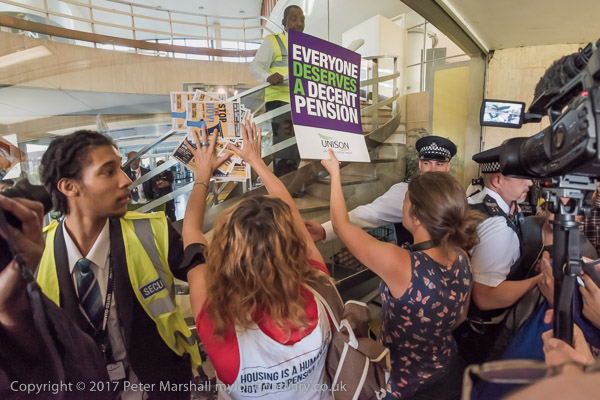
Angry residentshold up placards and posterson the glass wall of the Civic Centre

Haringey Residents protest housing sell-off – Wood Green, London. Monday 3 July 2017.

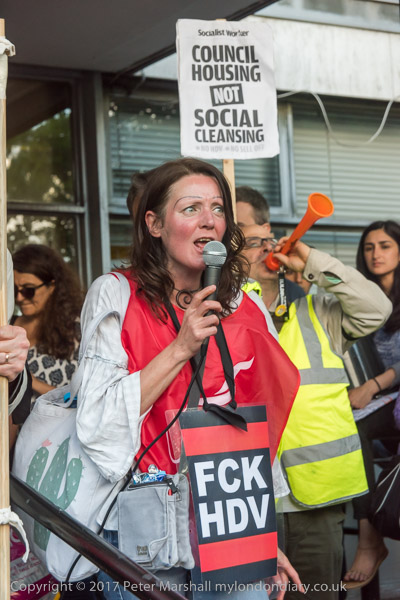
One of the London Labour councils whose housing policies were causing much local distress was Haringey, where the council was in process of setting up the Haringey Development Vehicle (HDV), Britain’s biggest collaboration yet between a local authority and a property developer, which will demolish a third of Haringey’s social housing, handing over half of an estimated £2 billion worth of publicly owned housing estates, schools, public facilities and private housing acquired through compulsory purchase orders to developer Lendlease.

Time to march from Duckett’s Common

Many feel that the cabinet system for local government is anti-democratic, removing decisions from the elected councillors as a whole to small highly selected groups for the convenience of administration. It means that ideas such as the HDV are not properly debated, and in this case it was about to be imposed without any real public consultation, and to many its only real purpose appeared to be to hand huge profits to the developer.

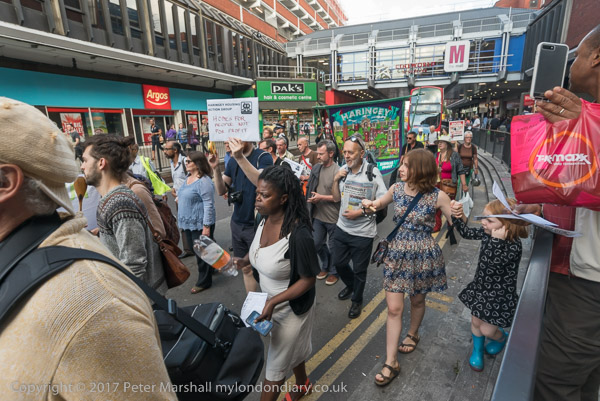
Marching through Wood Green shopping centre

The scheme to build 6,400 new homes would result in the demolition of many existing properties, and would have the consequence of driving many existing tenants and leaseholders out of the area as they would be unable to afford to buy the new properties or afford the rents. It would mean a massive wave of social cleansing.

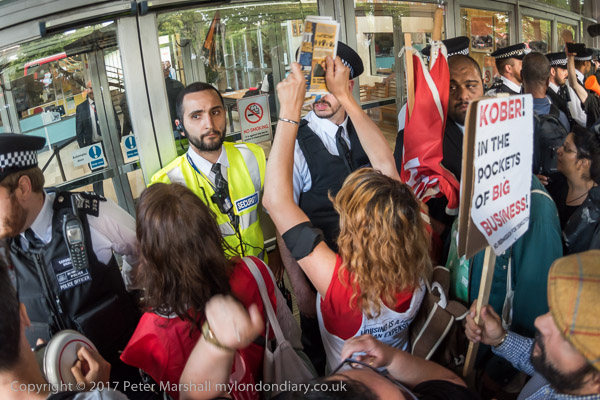
Police & security stop all but a few entering

The formation of the HDV was opposed by many in the borough’s Labour Parties, trade unionists, Greens, tenants, small businesses and community groups and well over 500 of them came to make their opposition clear.

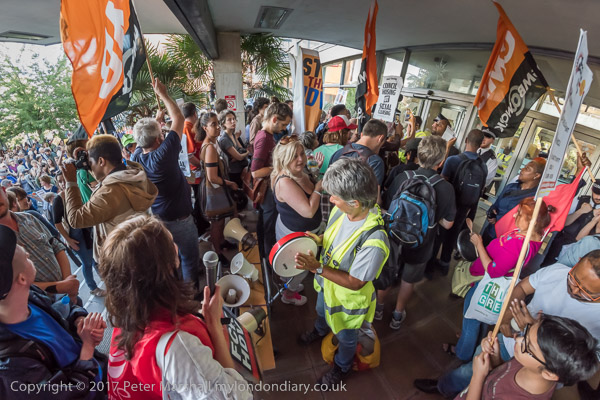
A large crowd at the front of the CIvic Centre

They had met at Ducketts Common and then marched through the centre of Wood Green, stopping briefly to block traffic on a road junction before moving on to the front of the Haringey Civic Centre where the council was meeting later to approve the HDV. They soon pushed aside the barriers which had been set up in front of the building to continue their noisy protest, with a row of police standing across the entrance.

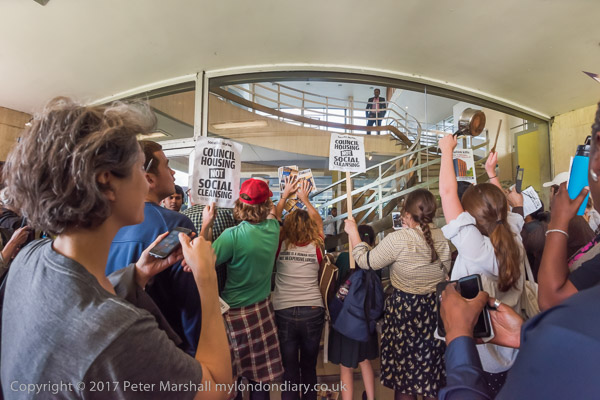
But others went around to protest in front of the large glass windows at the back

After an angry and noisy protest outside some made a rush to get into the building though a side entrance. I decided not to try and enter with them, and security and police managed to stop all but a few and then locked the building, leaving even some of the councillors coming to attend the meeting unable to enter.

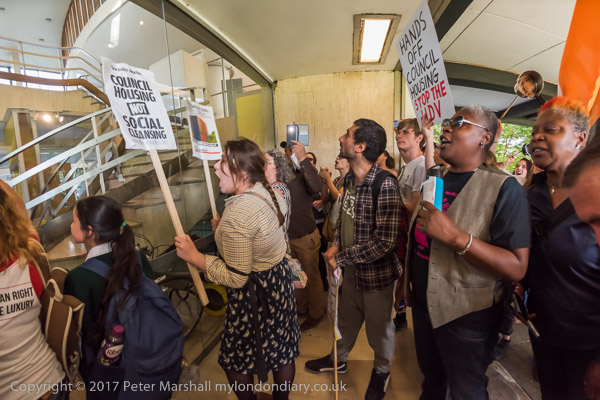
Many of the protesters moved the to the rear of the building and banged noisily on doors and large glass windows, and at one point the large glass panes began to flex by almost half an inch as people pushed against them and I moved back fearing they might shatter.

Eventually police came and pushed the people away from the glass

It looks from some of the pictures I took as if the protesters were actually inside, but they were on the outside of these large glass panels which gave a good view of the interior. Eventually police arrived and pushed the people back, forming a line in front of the glass.

A rally continued in front of the building entrance

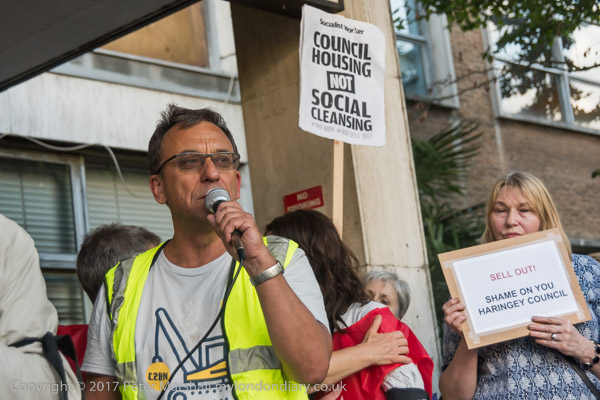
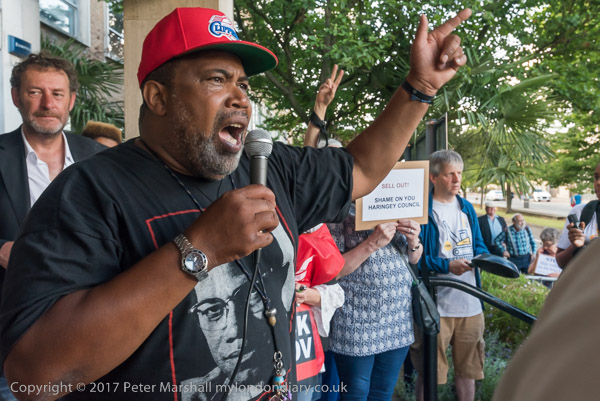
I moved back to the front of the building where a rally was taking place with a number of mainly local speakers. This was still continuing as I left and the noise would have been very noticeable to councillors inside who were voting to go ahead with the scheme to give away around £2 billion to the Australian developers Lendlease.

Although this battle was lost, the war was at least partly won. The HDV was a major issue in the next set of council elections in the following May, with the many councillors from the left of the Labour Party strongly opposed to it getting elected, and the new council quickly voted to scrap the scheme to redevelop the Northumberland Park council estate with Lendlease. Instead Haringey set up its own housing company, Haringey Homes, and will carry out developments – including some with private developers such as Lendlease – in a way that avoids some of the social cleansing and retains more affordable and social rented properties. It has met some of the issues raised by the campaigners but by no means all.

The council’s new approach was in part made possible by a government decision to remove the cap on councils’ borrowing in their Housing Revenue Accounts (HRA) and also by a funding grant from the Mayor of London. But they still need to build some properties for market sale, though they state they are committed only to do this so they can deliver the “greatest possible number of council-rented homes.”

More at Haringey Residents protest housing sell-off.