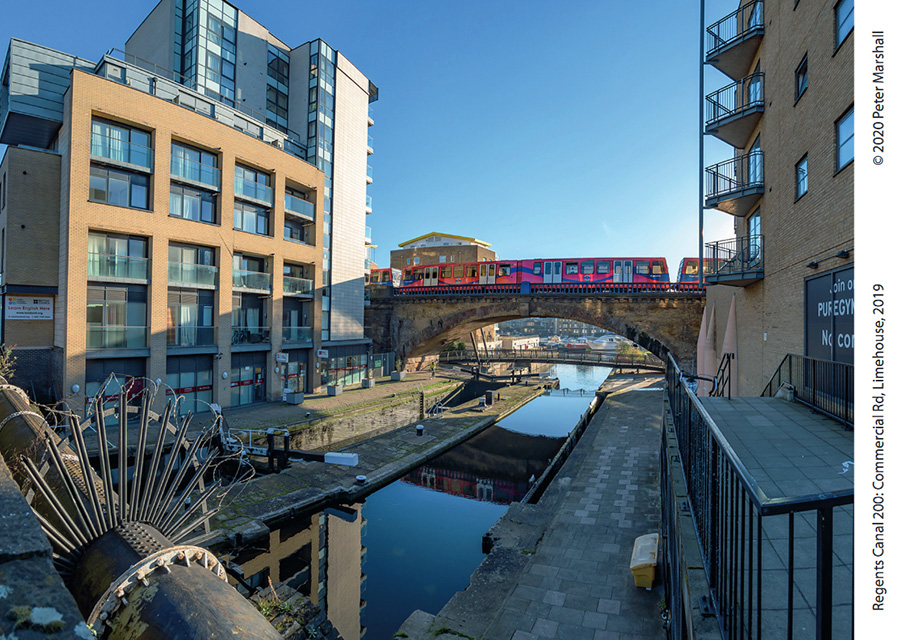
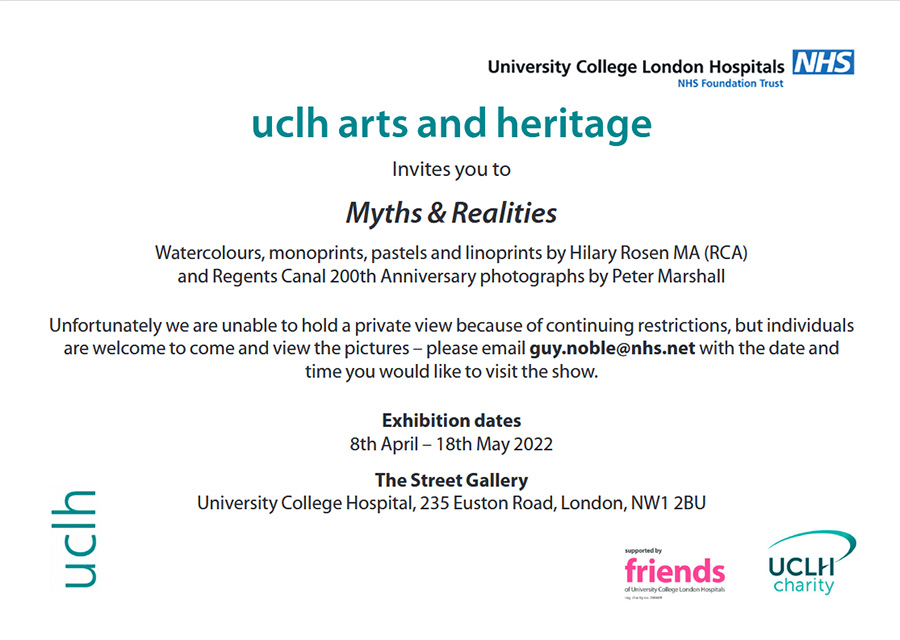
Regent’s Canal 200 Years at UCH – As this post goes online today, Thursday 7th April 2022 I am helping with the hanging of a dozen of my pictures, half of a joint show, Myths & Realities, with artist Hilary Rosen at The Street Gallery in University College Hospital on Euston Road.
The show was due to open in March 2020 as we went into Covid lockdown, and although now our government seems to think Covid is all done with, others know better and there are still restrictions in place in hospitals, so we are unable to host an opening. And although you are very welcome to visit the show you will need to make an appointment by emailing guy.noble@nhs.net at UCH. Both Hilary and I have invitation cards and are handing out copies to people we meet as well as sending some by post and more electronically – and the two images show both sides of mine. I’m very sorry I won’t be able to see you all there.
Below is a little more about my project which is in the show. As well as the 12 pictures on the wall at UCH I have put a larger group including these in an online album, Regent’s Canal 200 Years.
The Regent’s Canal was opened in 1820 to connect the inland canal system to the River Thames at Limehouse, so 2020 was its 200th anniversary. To commemorate this I began a series of colour panoramas along the canal for an exhibition in March-April 2020 at The Street Gallery in University College Hospital London, half of a joint show, ‘2020 Vision – Vistas and Views’ with artist Hilary Rosen. Unfortunately this show had to be postponed due to COVID-19, but has now been rescheduled with the title ‘Myths & Realities’ for 8th April 2022– 18th May 2022 at The Street Gallery, University College Hospital, 235 Euston Rd, London, NW1 2BU.
I first photographed the Regent’s Canal in 1979 and have taken many pictures along it over the years since then. I began my work for ‘Regent’s Canal 2020’ early in 2019 and made around eight visits in the following 12 months, producing several hundred images, of which 43 are online.
These images have an extremely wide angle of view, is roughly similar to the entire field of human vision and to record this on a camera and in print requires a move away from normal rectilinear perspective. They use a cylindrical perspective which retains vertical lines and edges as straight lines but shows other straight lines (except those passing through the image centre) with varying curvature, more pronounced towards the edges of the image. I’ve worked with various equipment in this way since around 1991 when I first bought a specialised panoramic camera.
Exhibiting on-line enables me to show more images than the 12 I had selected and printed for the UCLH show. They are presented in the order of a walk from Little Venice where the Regent’s Canal leaves the Paddington Arm of the Grand Union Canal, a pleasant walk of around 9 miles (with a couple of diversions for tunnels) which can easily be done in a day if you are not stopping to make pictures.
All images are available either as unframed C-Type photographs (image size approximately 16×9″ or 16×10.5″) at £220, as 40x60cm latex prints on canvas (£200) or as 40x60cm dye sublimation prints on canvas (£220). Dye sublimation prints are less intense and carry the image in the canvas, while latex inks sit on the canvas surface and give a more photographic effect.
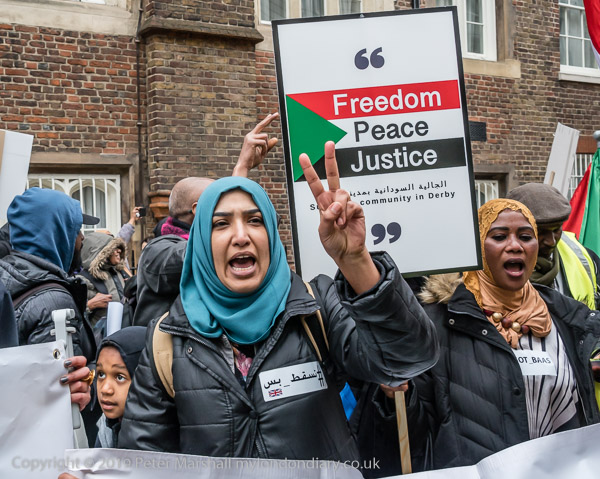
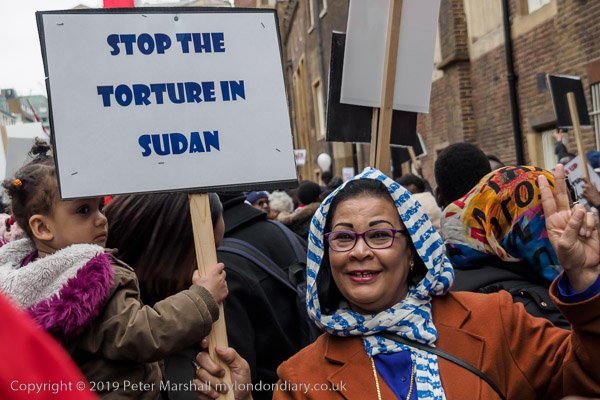
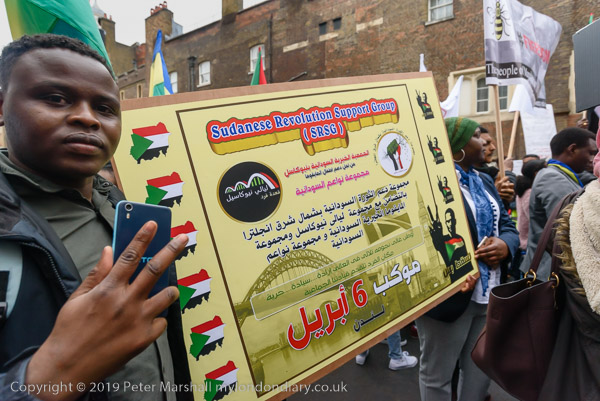
Al-Bashir & the Sultan of Brunei – On April 6th 2019 I photographed two protests in London both linked with the brutal excesses of Sharia law, in the Sudan and in Brunei.
Sudanese for Freedom, Peace and Justice – Sudan Embassy, St James’s
Sudan became united under Egyptian conquest in the 19th century and then coming under British rule in the 1880s after the British occupied Egypt in the 1880s, though since 1899 its governance was nominally shared by Britain and Egypt. After the 1952 Egyptian revolution Britain was forced to end its shared sovereignty and Sudan became independent in 1956.
Independence led to a civil war which eventually resulted in the independence of South Sudan in 2011. There was a military coup in 1958, then a return to civilian rule from 1964-9 with another military coup in 1969 and yet another in 1985 that overthrew dictator Jaafar Nimeiri. But in 1989 came the military coup led by Omar Hassan Ahmad al-Bashir, who became its dictator under various titles from 1989 until 2019 when the large-scale protests in Sudan which this London protest supported led to him being deposed by the military on 11th April. Later in the year power was transferred to a mixed civilian-military Sovereignty Council.
Under al-Bashir the country had been run under a severe implementation of Sharia law, with stoning, flogging, hanging and crucifixion. In 2020 Sudan ended the rule under Islamic law and agreed there should be no state religion. It abolished the apostasy law, public flogging and the alcohol ban for non-Muslims, and criminalised female genital mutilation with a punishment of up to 3 years in jail.
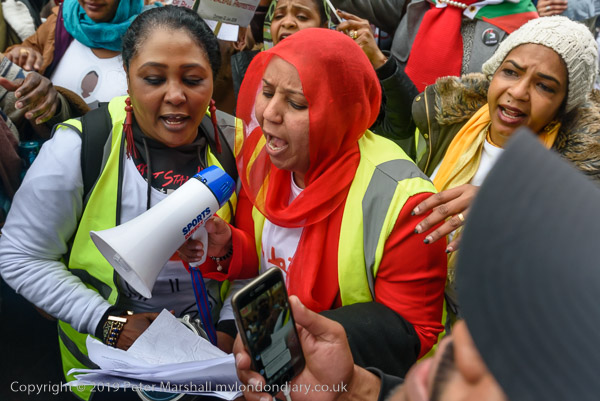
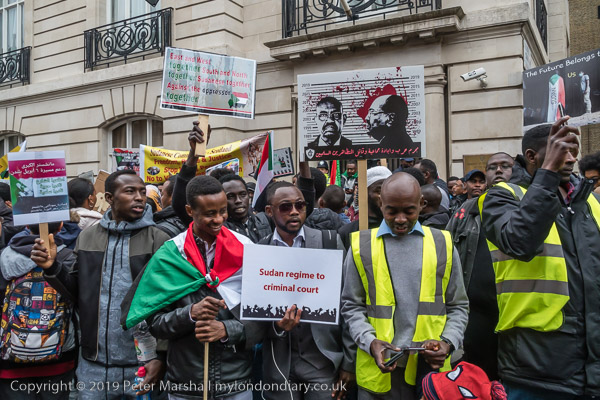
The protest was large and high energy, and called for an end to the violent and corrupt Sudanese regime and for president Omar al-Bashir to ‘Just Fall’ and stand trial by the ICC for genocide in Darfur, the Nuba Mountains and South Blue Nile.
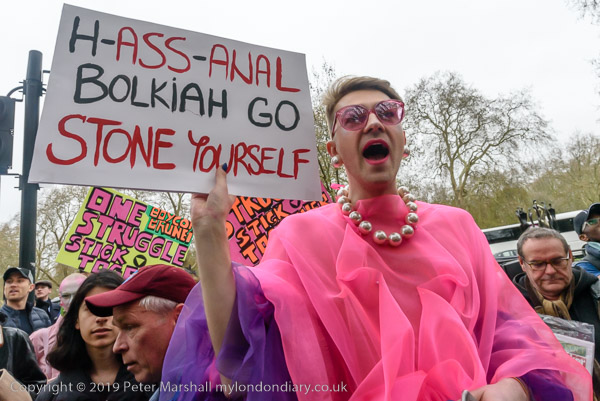
Brunei Sultan gay sex stoning protest, Dorchester Hotel, Park Lane
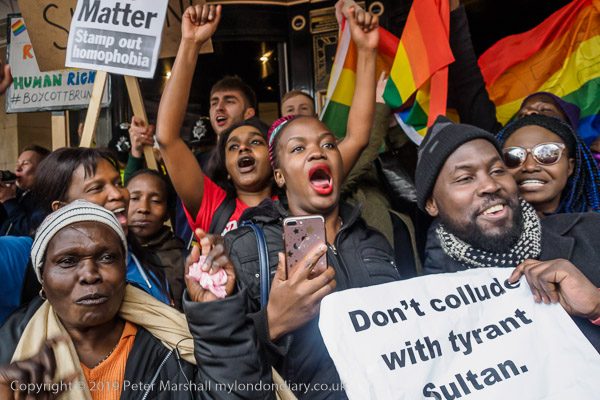
I arrived rather late at the protest outside the Dorchester Hotel on Park Lane, a short walk away (though I ran much of it) from St James’s to find a rather staid protest taking place against its multi-billionaire Sultan of Brunei who has announced death by stoning as a punishment for gay sex, adultery and blasphemy. The hotel was bought by him in 1985.
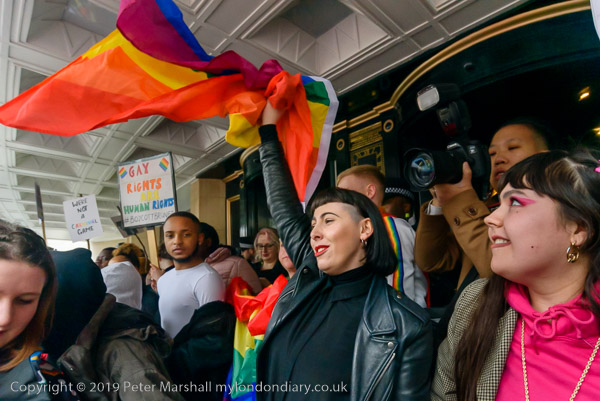
Although it was a colourful crowd, with a number of people in rainbow clothing and a few in drag, along with several well-known figures who spoke, including Labour Shadow Secretary of State for Foreign and Commonwealth Emily Thornberry MP and Peter Tatchell, the protesters kept outside the hotel yard with police harassing them to keep the road clear despite there not being enough room on the pavements, and to allow cars and taxis to take and collect hotel guests to the main entrance.
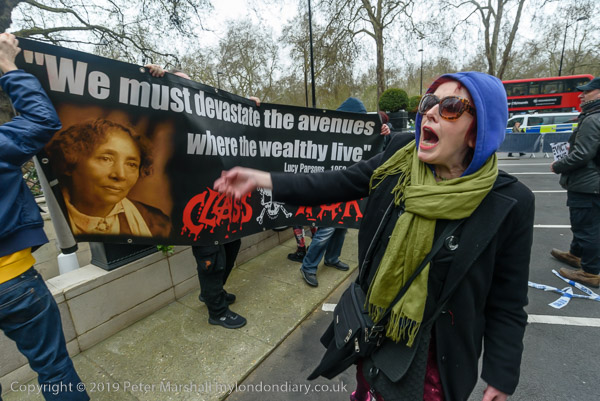
It took Class War to liven up proceedings, pushing aside the barriers in front of the hotel entrance and running inside the hotel yard with their Women’s Death Brigade and Lucy Parsons banners, ignoring the attempts of security and police to stop them. They stood on the steps of the hotel entrance, stopping guests entering or leaving and after a short delay many of the other protesters joined them, bringing placards and rainbow flags.
The protesters ignored the hotel staff who told them to leave and the police who came and threatened them with arrest, and were still blocking the entrance when I left 50 minutes later.
Bromley-by-Bow Gasholders: A week ago on Monday 28th March I was invited to go with a team from Cody Dock on a site visit to the gasholders which are a prominent feature of the local landscape, seen by many thousands every day from the Underground and National Rail lines as they travel in and out of London as well as local residents and walkers along the Lower Lea and Bow Creek, including those following The Line sculpture trail. We were there invited to study the heritage, history and ecology of the Bromley-by-Bow Gasworks site which has just been sold by its future developers.
The seven gas holders, all to a similar design were built between 1872 and 1882 and are all Grade II listed. Nine were built on the site but two are no longer there, the base of one now forming a large circular lake in the site. Holder No 1 was given an extra upper tier in steel in 1925-7 to more than double its capacity. All were taken out of use in the 1980s.
The real value of the site is not in the individual holders although these were some of the “most aesthetically distinguished and finely detailed gasholders ever built” (according to the listing text) but in the ensemble, thought to be “the largest group of Victorian gasholders known to remain in the world, which is testament to the scale of Britain’s pioneering gas industry and its contribution to the Industrial Revolution.” It is a heritage site not just of national importance but of world importance.
Given their importance the group, together with the adjoining memorial garden with its Grade II listed memorial lamp and statue of Sir Corbett Woodall surely deserves both Grade I listing and preservation, and the former gas works offices could form a heritage centre for the area. The offices were for some time a gas museum.
The circular pond is the base of a former gasholder
Just across the Channelsea river from the site is the Grade I listed Three Mills and a little to the south the former gas works Dock at Cody Dock, now a thriving creative and community hub, the sites linked by a riverside path which currently stops at Cody Dock but which should long ago have been opened as planned to lead to the Thames at Trinity Buoy Wharf, passing on the way the Bow Creek Ecology Park. Many sites along here played an important part in Britain and the world’s industrial history, but unfortunately little evidence remains, making it essential to preserve what does.
We were shown around the site in the morning by two of those responsible for planning the development who expressed their wish for the development to retain these elements which make the site unique and to open them up to the public, but good intentions are not enough, particularly for company accountants.
Given what has happened at other sites greater protection is required to make sure that any development in the area leaves the gasholders intact and preserves their landscape value, in particular the views of the ensemble from the railway and Underground lines, from Three Mills and the riverside footpaths by the Channelsea River and River Lea and the navigation. We do need more housing, or at least more social housing rather than luxury flats many of which remain largely unoccupied as investments, but we also need to preserve important monuments such as these which record and could celebrate our history.
Many more pictures from the day, mainly inside the holder site in my album Bromley-by-Bow Gas Holders. You can click on any of the images above to see a larger version in the album – and browse from there. Most of the images have an horizontal angle of view of approximately 145 degrees. There are more pictures of the area in various posts on My London Diary including Bow and The Fatwalk, Bromley-by-Bow to Star Lane and Gasworks Dock Revived.
Cost of Living Protest – 2022 Last Saturday, 2nd April 2022, I photographed a protest opposite Downing Street organised by The People’s Assembly Against Austerity and Stop the War Coalition. The People’s Assembly said on their web page:
Public outrage over the Cost of Living Crisis is growing fast and our response is gaining momentum. Right now is the time for us all to come together in unity and build our collective resistance. Now is the time to get out onto the streets to send a clear message to the government that we refuse to pay for their crisis.
The protest in London was one of 25 in cities around the country against the price increases and National Insurance contribution raise which will mean the largest fall in living standards since records began 80 years ago and a fall in real wages greater than ever in the past 200 years.
The Spring Statement by Chancellor Rishi Sunak made clear that it is the lower paid workers (and students), pensioners, those on benefits and the public sector workers in particular who will pay the price, while putting in place measures to protect big business and high earners.
Pay inequality in the UK – the ratio between what the average worker earns and the pay (including bonuses) of the bosses of leading companies – has risen spectacularly in recent years. Had the minimum wage kept up the the rise in what they are paid it would now be over £25 an hour – but went up on April 1st to £9.50 an hour for those aged 23 and over – with lower rates for younger workers.
Food banks are now struggling to keep up with demand, and report that some people coming to them are turning down anything which requires heating up as they cannot afford gas or electricity. Advice workers say more and more people are coming to them who have to chose between heating and eating – and many can only eat basics on alternate days and are depriving themselves of food to feed their children.
London, UK. 2 Apr 2022
I listened to the UK’s leading money-saving expert saying he had run out of tips to help people cope – and most of the advice he and others have given on energy saving are things we have always done in our household.
My wife and I have relatively low outgoings, living in a house we own and choosing not to own a car. Over the years we’ve been able to invest large amounts in double-glazing and insulation – and a few solar panels to supply a little of our electricity needs. When we moved in 48 years ago to a small Victorian semi built for agricultural workers we replaced the draughty rattling windows and draught-proofed doors. We decided central heating would be wasteful, so our energy bills are relatively low. Even so, they have now roughly doubled from what they were a year ago, with more increases coming later in the year. But we will be able to get by even though our income is low. Others are much less fortunate.
London, UK. 2 Apr 2022. Jeremy Corbyn.
And in particular the effects on disabled people are savage and shameful. Research shows they are five times as likely to be at risk of food insecurity and twice as likely to be living in cold homes as the non-disabled. And in a particularly targeted cruel and inhuman decision around 210,000 people on disability benefits have now been barred from claiming the Warm Home Discount payment despite the fact that they often have greater than normal needs for heating, hot water and energy to run specialist equipment.
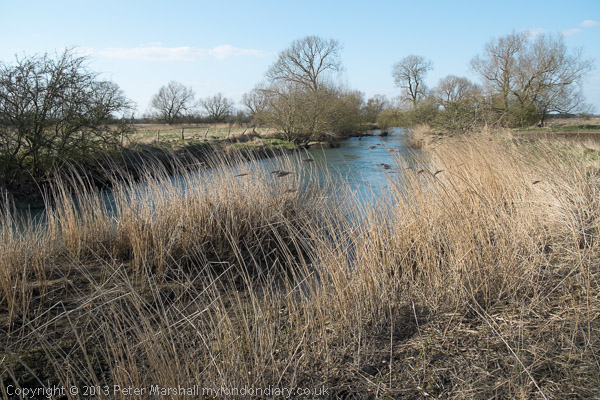
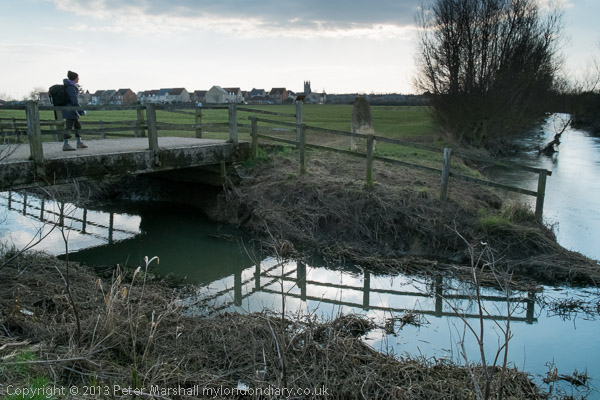
Old Father Thames – Buscot to Cricklade Nine years ago on Wednesday 3rd April 2013 I was walking the Thames Path with my wife and elder son, who had planned a three day walk along the upper reaches of the river as a birthday present for my wife. Her birthday is in the depths of winter but we thought the start of April might have better weather.
St John the Baptist at Inglesham, saved by William Morris from the threat of Gothicist ‘restoration’
We’d walked the lower parts of the Thames path and further out towards the estuary in a number of day walks, travelling by public transport to suitable starting points and back home at the end of the day. This had got us as far as Duxford, a short walk from the end of a bus route to Hinton Waldrist, 9 miles southwest of Oxford, west of where public transport to places close to the river is sparse and journey times from home too long.
The room next to ours at Buscot Manor; ours was plainer but very comfortable
So we had booked two nights accommodation to allow us to complete the walk, ending at the source which is close to Kemble station from where trains would take us home via Swindon and Reading.
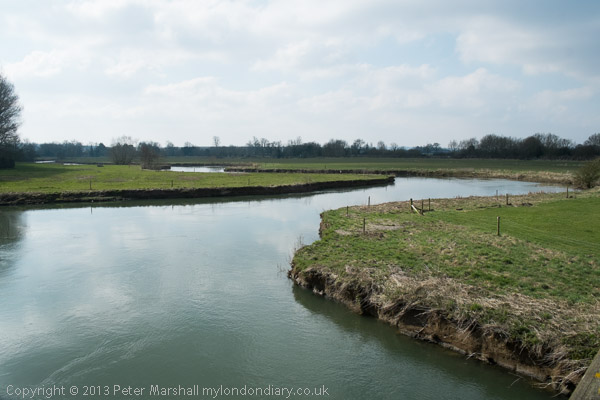
Meanders make the journey longer
On Tuesday we had set off early to take the train to Reading where we changed for Oxford and then found the bus to Hinton Waldrist. By the time we got within five miles of the village we three and the driver were the only passengers. It had been just below zero when we set out but had warmed up a little and the sun was shining as our walk began. You can read more about the days walk and see pictures at Thames Path: Shifford to Buscot. I’d finished the day in which we had walked around 15 or 16 miles totally exhausted, but a good soak in a hot bath had eased some of my aches and pains.
Old Father Thames
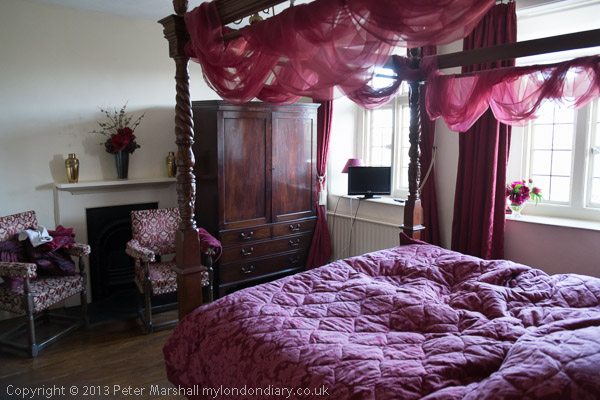
Wednesday we were up early for breakfast, having slept well at Buscot Manor, though we hadn’t paid the extra for a room with a four-poster, though I did take a photograph of one. Breakfast, shared around a large table with the other guests, was enormous and it was hard to get up from the table and begin our walk.
Ha’penny Bridge in Lechlade
Being gluttons for punishment as well as at the table we started the day by deliberately going in completely the wrong direction to make a tour of the village, now largely owned by the National Trust before rejoining the Thames Path.
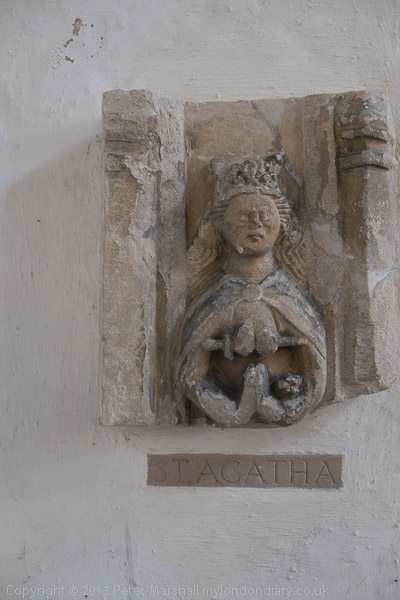
St Agatha in St Lawrence’s Church, Lechlade
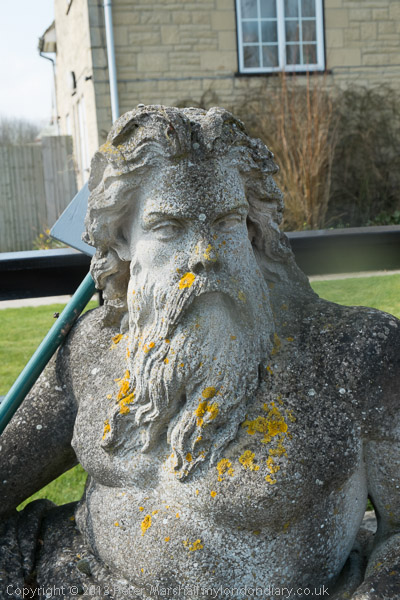
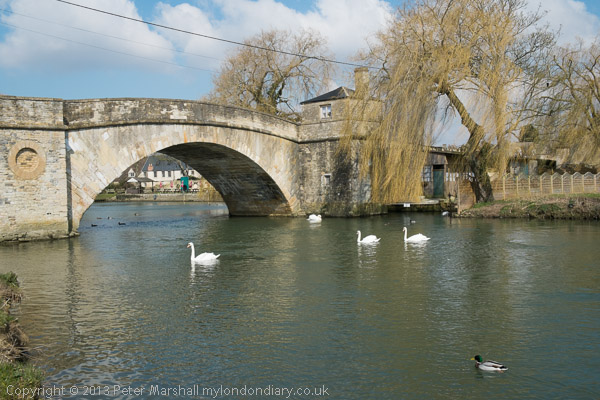
At St John’s Lock we found Old Father Thames, made in 1854 for the Crystal Palace and later moved to Thames Head but relocated here as protection against vandalism. At Lechlade, this is the highest lock on the Thames, which is theoretically navigable as far as Cricklade, though few boats now go beyond the Halfpenny Bridge in Lechlade.
The entrance to the Severn & Thames Canal
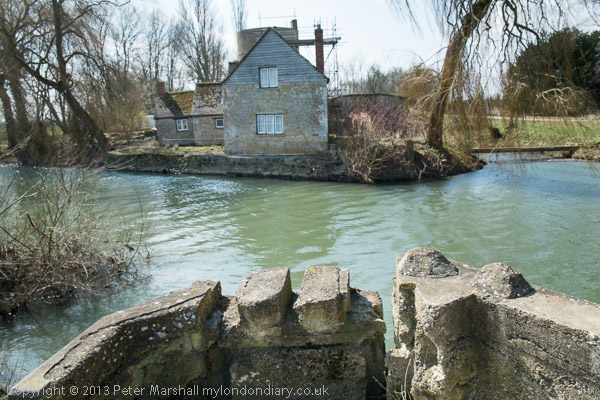
We spent some time in Lechlade, buying sandwiches for our lunch, then looking around the church before my companions mutinied and dashed into a tea-shop and I had to follow them. We wasted some time there before we walked out and carried on towards Inglesham. The area around here was perhaps the highlight of the whole walk, but our delay in Lechlade meant we couldn’t stop long enough to properly examine the mouth of the River Coln and entrance to the Thames and Severn Canal and the first bridge over the canal on our way. The canal was abandoned in 1927 though parts have now been restored.
St John the Baptist, Inglesham
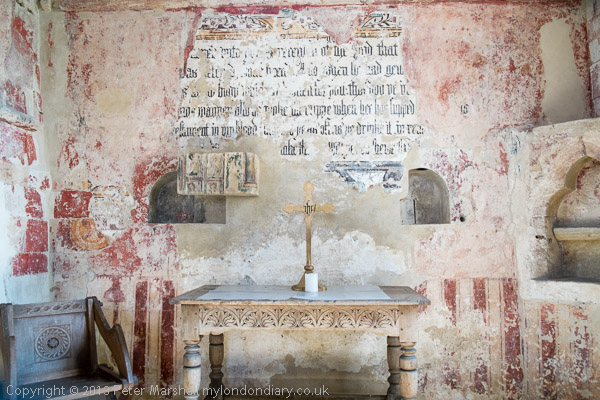
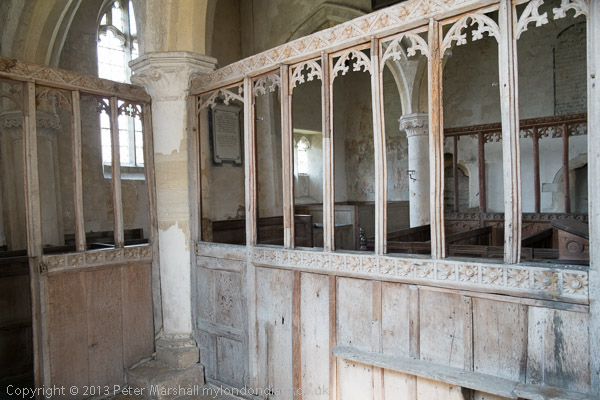
The real gem of the walk is the Church of St John the Baptist at Inglesham, a splendid medieval survival thanks to the efforts of William Morris, who along with his pre-Raphaelite friends founded the Society for the Protection of Ancient Buildings (SPAB) or ‘Anti-Scrape’ to oppose the gothicisation of buildings such as these. But past here the walk deteriorates, with a mile and a half beside a busy road and a further 2 mile road walk “offering no scenic attraction at all“.
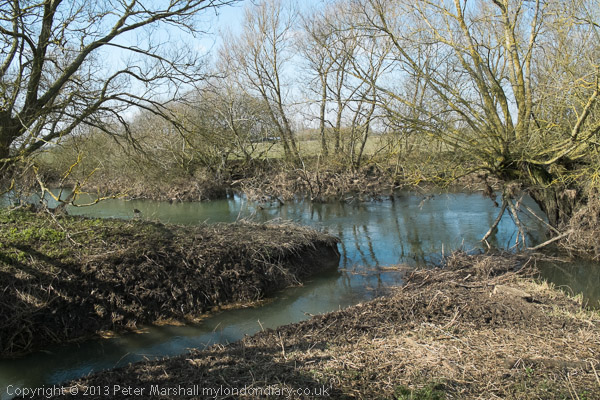
A rare glimpse of the Thames , our first since Inglesham
It might have been better if the Thames Path had taken a detour along the Thames and Severn Canal. As the Rambler’s Association noted in their 1977 Survey, the county councils “suggested a new footpath creation to follow the river from Lechlade to Cricklade but objections, primarily from farmers and anglers, led to the abandonment of this concept.” They comment that the Thames path here “is in places so dull or dangerous that it begs the question whether objections from landowning or angling interests should always be allowed to override the need for providing a simple public amenity.”
It’s only in the final mile or three into Cricklade that the walk comes alive again, rejoining the river and giving a glimpse of what the Thames Path in this region should be. We made our way to the White Hart, the principal inn at Cricklade since the time of Elizabeth I, though our room was in a modern extension at its rear. There was still just a little time to explore the town, basically a single street, before settling down to a decent Indian meal a short distance from the hotel.
Cricklade seen across a meadow from the path
You can read about the final day of the walk, where there were detours due to flooding and flurries of snow in a bitter wind before we reached the end, on my London Diary. Here are the links to all three days of our walk, which I’m glad we did then as I don’t think I could make it now.
Good Friday 2010 in London – This year Easter Day is celebrated on April 17th by Western Christianity, though as usual a week later by Eastern churches. But it is a ‘moveable feast’ and is on the first Sunday after the first ‘ecclesiastical full moon’ (don’t ask) on or following 21st March, which means it will always be somewhere between March 22nd and April 25th. In 2010, Easter Day was April 4th, so April 2nd 2010 was Good Friday. I photographed two public events for it in London.
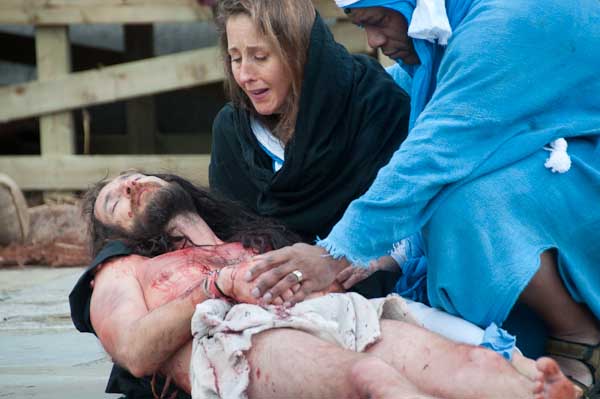
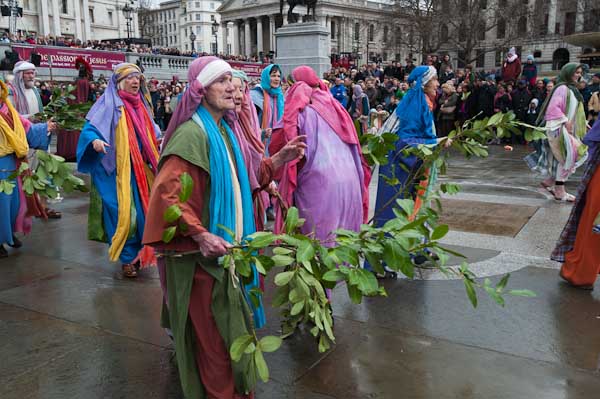
Jesus’s body taken down from the cross in Trafalgar Square
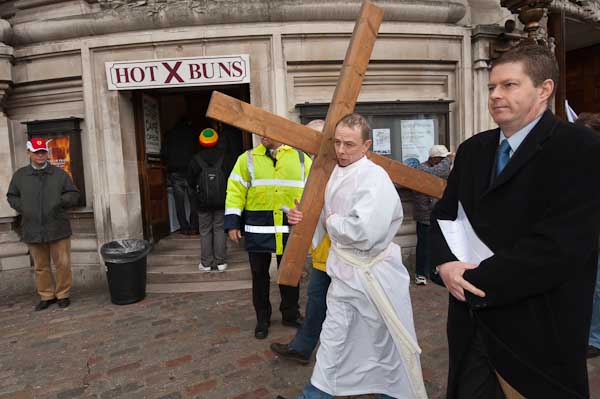
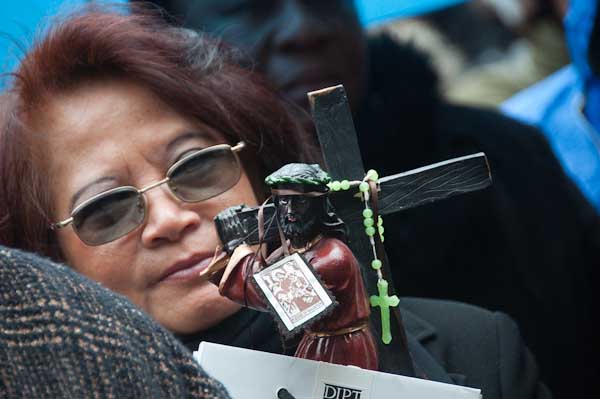
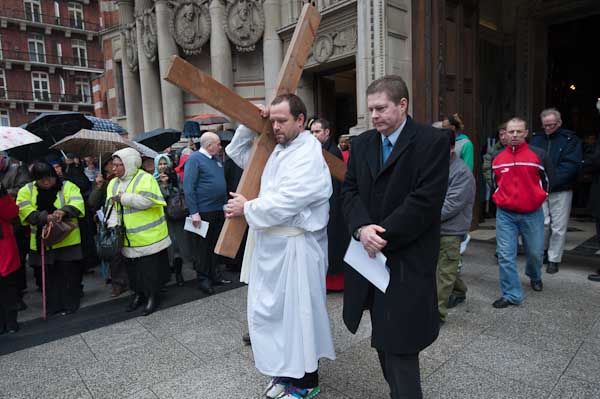
Crucifixion on Victoria St, Westminster
I photographed ‘The Crucifixion on Victoria Street’ on Good Friday for a number of years, though decided to stop doing so more recently, largely because of how I felt the behaviour of other photographers. When I first photographed the event there were relatively few of us taking pictures and we did so with some discretion, respecting the religious nature of the event. But over the years the number of photographers has increased greatly and it became more of a media circus, with a few really interfering with the proper nature of the event.
The event brings together clergy and congregations from a number of churches on and around Victoria Street, which includes the Westminster Abbey, the Roman Catholic Westminster Cathredral and Methodist Central Hall as well as other churches, church schools and projects in the area. They process along Victoria Street behind a man carrying a large wooden cross – in 2010 carried by men from the Passage, a project for homeless people close the the Cathedral – and stop for short services in front of the three main churches.
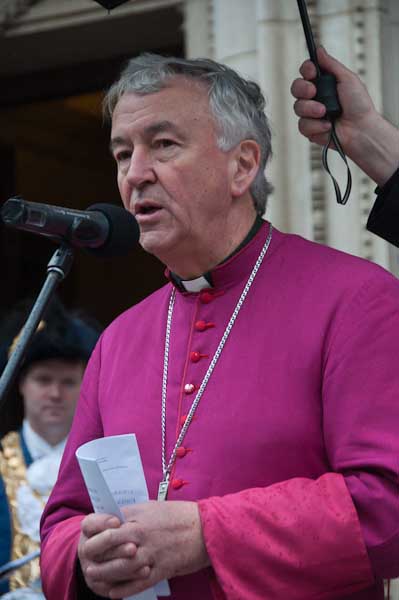
The main service was outside the entrance to Westminster Cathedral where there were hymns, bible readings, a meditation, prayers and a reflection on peace to honour the innocent victims of our times by The Most Reverend Vincent Nicholls, the third Archbishop of Westminster I’ve photographed on these steps.
I left the procession as it made its way towards Westminster Abbey where there was to be a final service.
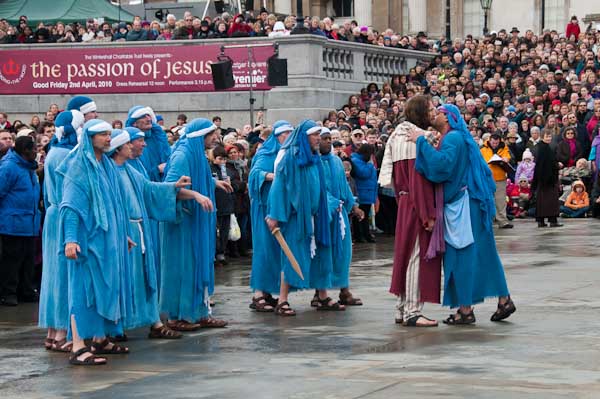
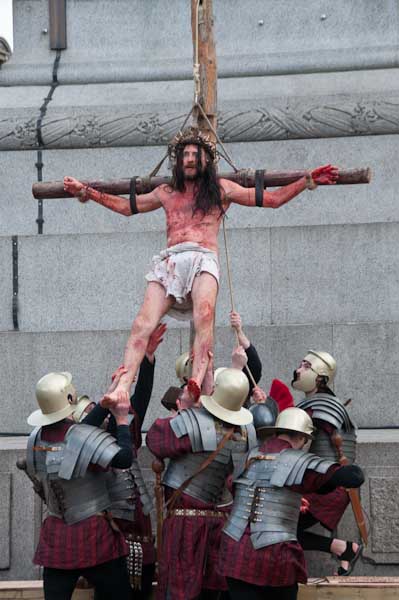
This was the first Passion Play to be performed in the square since 1965, and was a highly professional performance by a group based on the Wintershall estate near Godalming that have been putting on similar but larger and longer ‘Life of Christ’ plays there for a number of years.
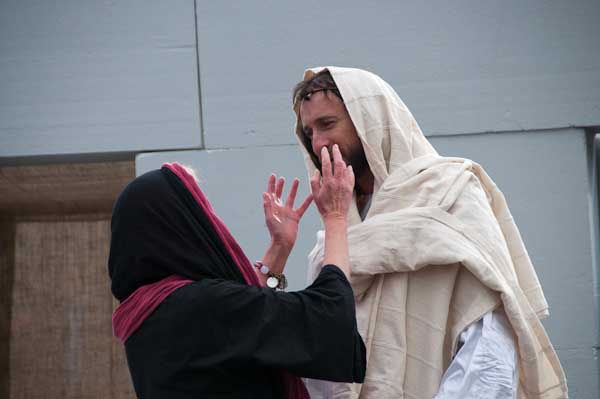
Judas betrays Jesus with a kiss
The play related key events leading up to the crucifixion and resurrection of Jesus, folowing the stories in the four gospels with both narration and the voices of the main characters coming to the crowd over loudspeakers around the square. It was a colourful and at times exciting rendition of what was for some of us a familiar story, but for some present was novel.
Photographing the live performance had to be from the sidelines, but I was able to do so fairly well, though mainly from longer distances than I like to work from. It was an interesting presentation of a difficult story to stage.
The pictures on My London Diary show the story in sequence and I think capture all the key moments.
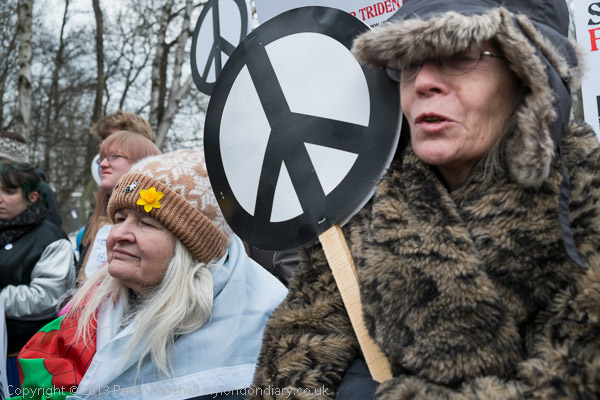
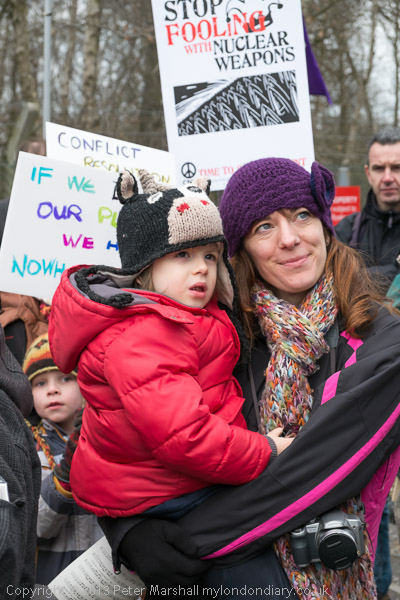
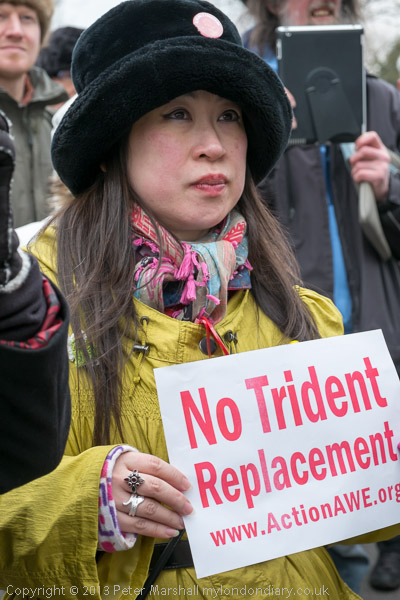
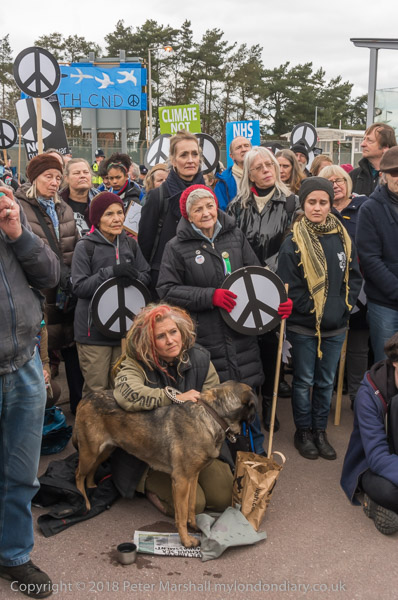
Nuclear Fools Day & CND at 60 – Twice in the last ten years, on 1st April 2013 and 1st of April 2018 I’ve got on my bike and cycled to Aldermaston to take part in protests by CND around the UK’s Aldermaston nuclear bomb factory, 12 miles west of Reading.
Aldermaston, 2013
I wasn’t there for the first big Aldermaston March in 1958, though one of my older brothers went, and I remember him coming back rather tired and muddy but please he had managed the whole 4 day march. CND had then just been formed and supported the march organised by the Direct Action Committee Against Nuclear War and the next year they began a series of annual marches, marching from Aldermaston to a rally in Trafalgar Square.
Aldermaston, 2013
The annual marches continued until 1963, and in 1964 there was just a one-day march in London which I think I may have taken part in, though by then I was a student and I don’t recall well which of many demonstrations I took part in during the sixties. I didn’t keep a diary and couldn’t afford to take photographs then. There was a shorter march in 1965 from High Wycombe and the march in the original direction to Aldermaston was revived in 1972 but with fewer marchers taking part. And a number of marches and rallies in London since then which I did photograph.
Aldermaston, 2013
The next revival of the march I think took place in 2004, and on that occasion I photographed the rally in Trafalgar Square at the start of the march on Friday 9th April and marched with around 2,300 to Hyde Park but left the around 430 of who set off to spend the night in Reading. I got on my bike on the Sunday to meet them again at Maidenhead, walking with them to their lunch stop at Knowl Hill, from where I walked back into Maidenhead to pick up my bike and ride home.
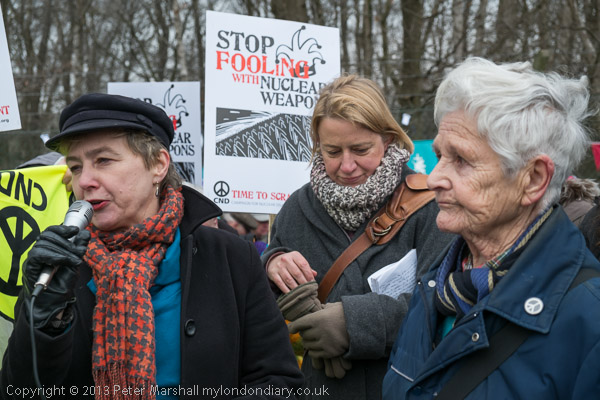
Kate Hudson, Natalie Bennett and Pat Arrowsmith, Aldermaston, 2013
On the Monday I was up early to catch a train to Reading where the final leg was starting with my wife and elder son. I didn’t feel I could walk the 12 miles with my usual heavy camera bag so took along just my Canon Digital Ixus 400, (aka PowerShot S400), an ultra-compact and light camera with a 36-108mm equivalent lens giving remarkably sharp 3.9Mp images, although the autofocus wasn’t always precise. You can view a large number of pictures from 2004 on My London Diary
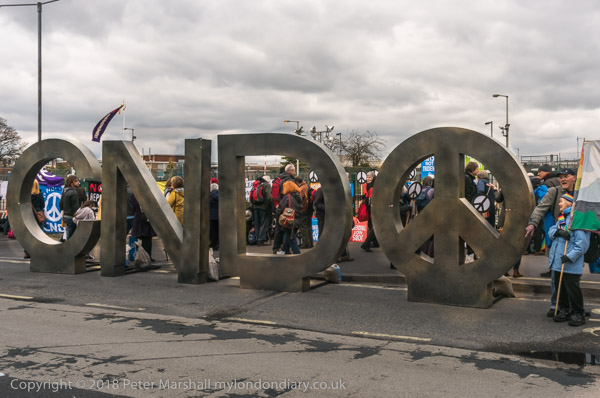
The pictures on this post come from two more recent events, the Nuclear Fool’s Day – Scrap Trident rally at Aldermaston on Easter Monday, 1st April 2013 and CND At 60 at Aldermaston on Sunday 1st April 2018. On both occasions I cycled from Reading station the 12 miles there carrying my normal camera equipment. I think I was a little tired when I got there on both occasions, and perhaps not working at my best. The ride back was a little easier as it is downhill much of the way.
Aldermaston, 2018
In 2013 there were protests all around the extensive site and the bike enabled me to get around and take pictures of the protesters at each of half a dozen gates around the over 5 miles of the site perimeter, as well as of people walking around and attaching messages and banners to the tall security fence.
Aldermaston, 2018
The speakers were also travelling from gate to gate, but in a couple of cars and a lorry and among those I heard and photographed were CND Vice-Chairs Jeremy Corbyn MP and Bruce Kent, CND General Secretary Kate Hudson, Green Party Leader Natalie Bennett and South East Green MEP Keith Taylor, Stop the War’s Chris Nineham and CND founding member Pat Arrowsmith and another veteran Walter Wolfgang, as well as US activist Linda Pentz Gunter, the founder of ‘Beyond Nuclear’.
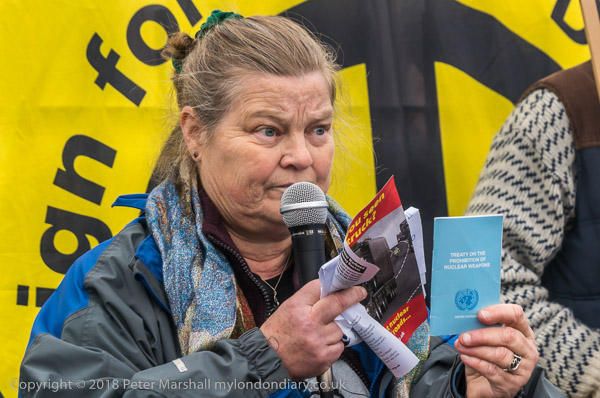
Rebecca Johnson holds up a copy of the UN treaty banning nuclear weapons
The 60th anniversary event in 2018 was easier to cover as it took place mainly in the Atomic Weaopons Establishment Car Park close to the Main Gate and on the fence close by, so I didn’t need to ride around the area, parts of which are rather hilly. As well as 60 years of campaigning by CND it celebrated the UN treaty banning nuclear weapons, finalised last year and signed by 122 nations, for which ICAN, the International Campaign to Abolish Nuclear Weapons, of which CND is a part was awarded the Nobel Peace Prize. Something that went almost unnoticed in the British media.
Palestine Land Day, Bunny Hop, and Afrin. Saturday 31st March 2018 was Holy Saturday, the day between Good Friday and Easter Day which most people now call Easter Saturday, though more correctly this comes a week later. But only one of the four events I photographed that day was connected to Easter.
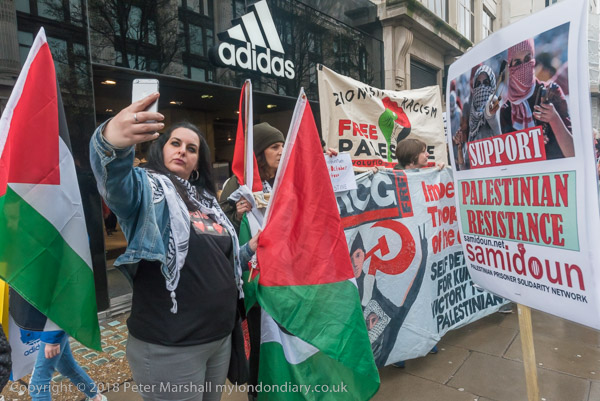
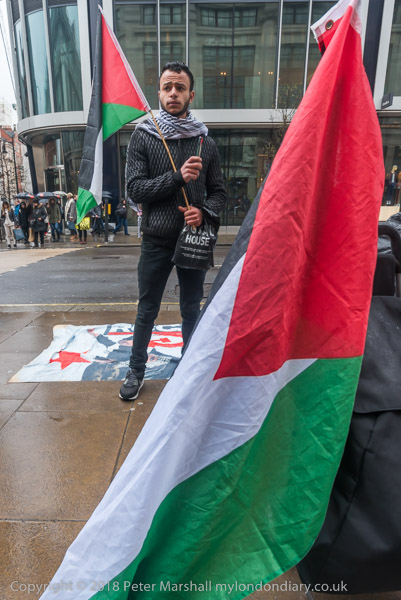
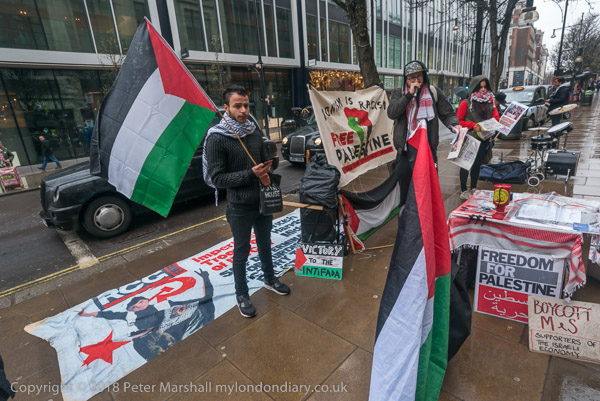
Land Day protest against supporters of Israeli state – Oxford St
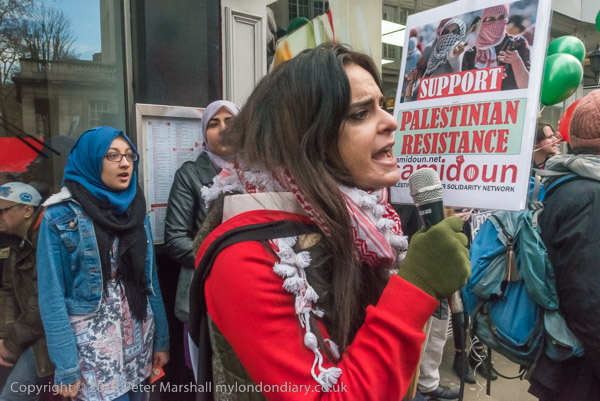
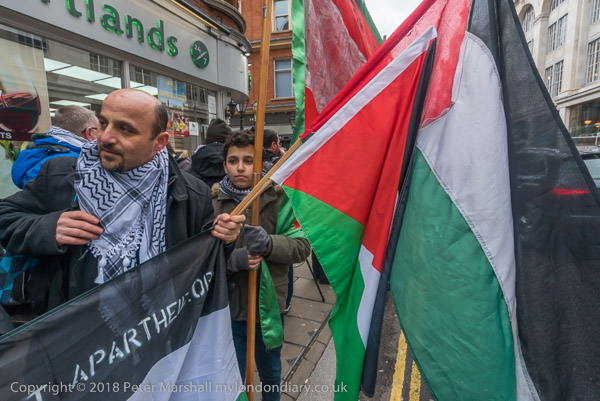
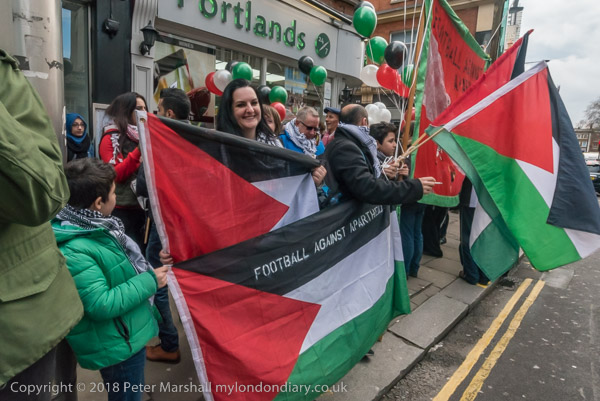
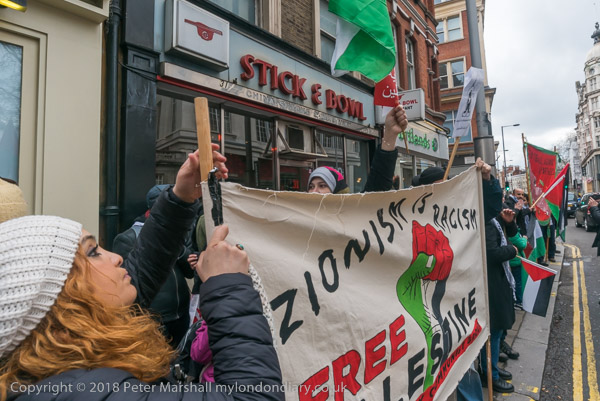
Palestine Land Day, observed annually by Arab citizens of Israel and Palestinians across the world, remembers the day in 1976, March 30th when a general strike and protests were called in Arab towns in Israel against plans by Israel to expropriate around 8 square miles of land in Galilee for Jewish settlements, about 2.5 square miles of which was Arab owned. The Israeli government tried to suppress the protests using police and the army as well as threatening strikers with dismissal. Six unarmed Palestinians were shot and killed and there were many injuries.
The annual Land Day celebrations since then in Israel have often been marked by violent attacks on protesters, with injuries and deaths. On 30th March 2018 Israel Defence Force snipers were placed in position on the separation wall in Gaza and opened fire on unarmed protesters several hundred yards away using live ammunition. 17 Civilians were killed and over 750 seriously injured by live fire, others injured by rubber bullets and tear gas.
This protest was led by a group which have been protesting regularly outside the Oxford Street main store of Marks & Spencers for many years against their support for Israel. They had planned a large rolling protest for the day following Land Day, going along Oxford Street stopping for short speeches outside stores with business links with Apartheid Israel, calling for shoppers to boycott them for selling Israeli goods. While I was with them as well as Marks & Spencers they also protested outside Selfridges, which sells Israeli wines, Adidas which supports the Israel football team, Boots which sells cosmetics made in Israel and Carphone Warehouse.
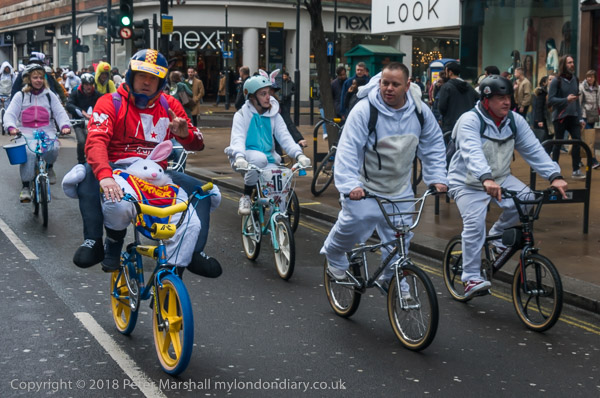
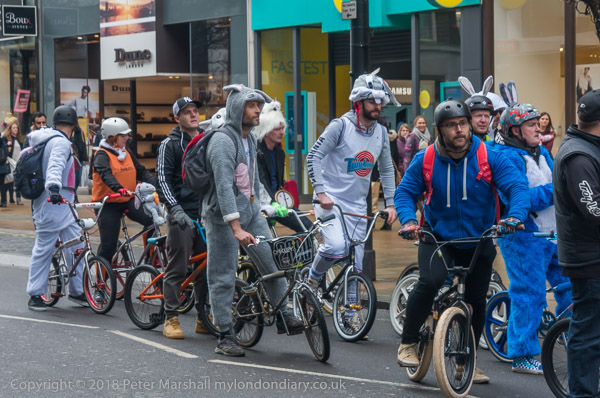
BMX Life is a group of BMX bike riders started after young Tommy Wright suffered a near fatal heart attack, and his family wanted to give something back after the support they had received at Evelina London Children’s Hospital. They have since raised over £60,000 for the register charity Evelina Children’s Heart Organisation ECHO.
The riders dressed as Easter Bunnies for what was their 4th Bunny Hop ride-out in London. Previously I’d met them riding at Christmas dressed as Santas and reindeer.
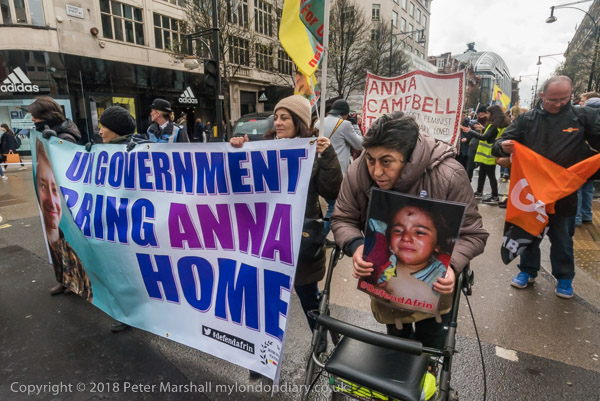
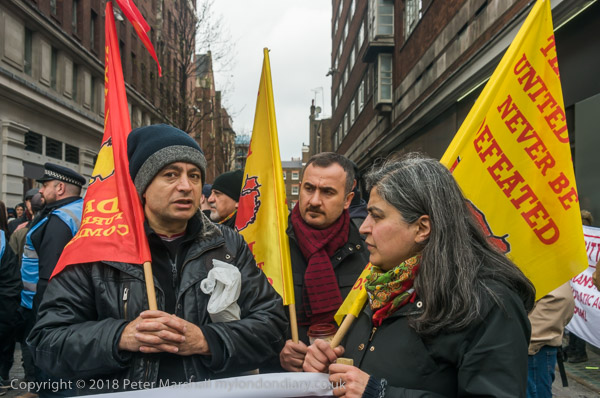
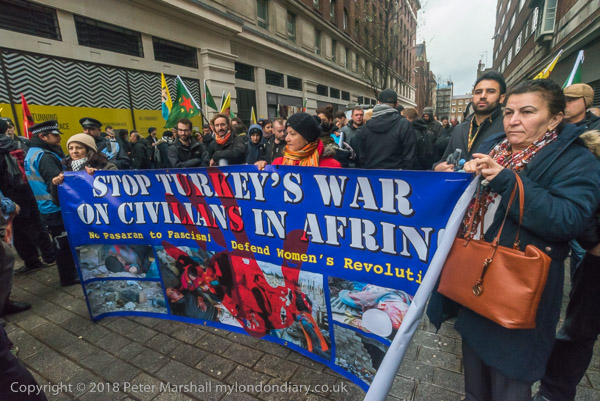
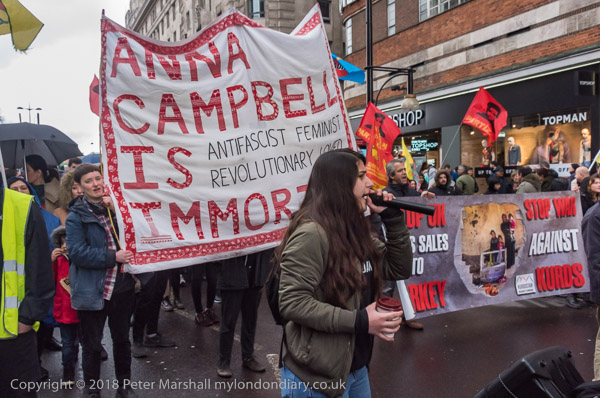
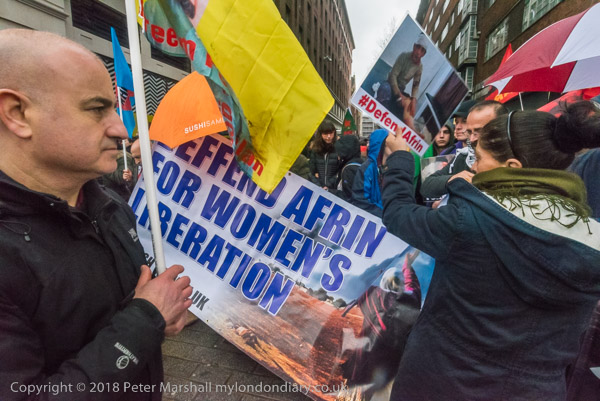
Kurds and supporters marched from close to Marble Arch to a rally in Parliament Square demanding an end to the invasion of Afrin in north-west Syria by Turkish forces and al Qaeda-affiliated militias in clear violation of international law, and its air strikes have deliberately targeted civilian areas.
The Turkish aim is to destroy a peaceful state and eliminate its majority Kurdish population, with President Erdogan announcing Turkey’s intention to invade all the Kurdish areas of Syria and “cleanse” the area of its Kurdish people.
Turkey is a member of NATO, with the organisation’s second largest army, supplied with weapons mainly from European countries including the UK who had recently signed a major arms deal. The British government has disgracefully expressed support for Turkey’s attacks, claiming it has a right to defend its borders, despite the fighting being outside them and the announced intention to push on to even more distant areas in Syria. The Kurdish peoples protection units YPG and YPJ fighting the attacks are only lightly armed but were putting up a determined resistance, but without further support were unable to defeat Turkey.
The protest called for an end to the invasion of Syria with an immediate ceasefire to enable the body of YPJ volunteer Anna Campbell to be returned to her family in Sussex, an end to all arms sales, to Turkey and other anti-human regimes in the Middle East, for humanitarian relief for Afrin and other areas of Syria and for an investigation into human rights abuses and war crimes in Afrin.
Eventually, after Afrin was captured, pressure from the US and the Council of the European Union condemning Turkey’s military action brought Turkish advances to an end, until President Trump withdrew US forces from the area, betraying the Kurds who had defeated ISIS with US air support. Further Turkish attacks then took place but were internationally condemned.
Against Israeli Land Day massacre – Israeli Embassy, Kensington
News of the cold-blooded massacre of Palestinian Land Day protesters with videos that shocked the world on March 30th led to an emergency protest being called close to the Israeli embassy on Kensington High Street (the embassy is a few yards away on the private Kensington Palace Gardens where no protests are allowed.)
I wrote “It is hard to see how anyone with the slightest streak of humanity or decency can fail to condemn the cold-blooded shooting of unarmed civilians carrying out a peaceful protest, but the coverage of the event in the UK media has been surprisingly muted, with the BBC giving considerable air-time to Israeli state speakers who have shamefully claimed the massacre was reasonable and fully justified.”
The UN called for an independent investigation, which Israel refused. But it was perhaps not coincidental that this is the only protest I can recall at the embassy where there has not been a usually small group of counter-protesters waving Israeli flags in support of the regime and its actions. But more likely it was because it was Passover.
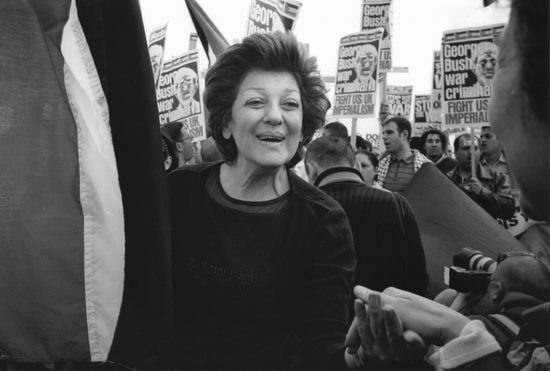
CND Protest US Star Wars Programme – 20th March 2002, twenty years ago today.
The US under President Bush was in 2002 intent on achieving what it termed ‘Full Spectrum Dominance’ and not content with ruling the planet on earth were developing a system to ensure their dominance in space. At the heart of this was their ‘Star Wars’ programme, using lasers to form a protective shield and destroy any incoming missiles before they reached US soil, enabling the US to launch a nuclear attack with impunity, knowing they could survive a retaliatory attack.
It was a weapons system that would have destroyed the idea of nuclear deterrence, the mutual assured destruction (MAD) doctrine of military strategy which had supposedly prevented nuclear war since Hiroshima and Nagasaki, and put the US in a position to threaten Russia with nuclear attack. The Cold War may have ended with the breakup of the USSR, but it was still the basis for US military strategy – with consequences were are now seeing in Ukraine.
But like most military spending and wars, it was a policy with great prospects for the arms industry, and in particular Lockheed Martin, the US’s large weapons manufacturer, with deep roots in the US administration – including at the time the wife of the US vice-President Dick Cheney, whose wife Lynn just happened to be on their board.
The UN had early seen the dangers of war in space with the 1976 Outer Space Treaty which made it an area solely for peaceful uses. And in November 2001 they passed a new UN resolution ‘Prevention Of An Arms Race In Outer Space’ with only the US, Israel and Micronesia abstaining.
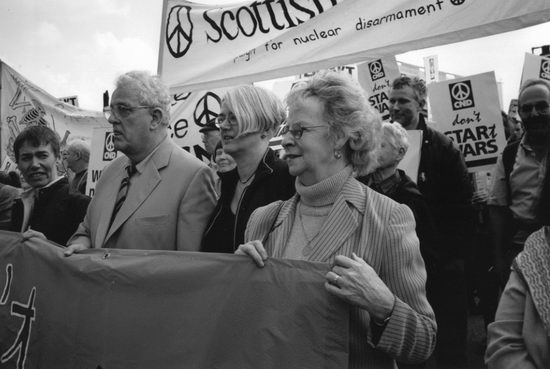
The US began its weaponisation of space by setting up the US Air Force Space Command in 1982. The UK lends a helping hand with allowing both Menwith Hill and Fylingdales to be used as a part of the Star Wars programme. I’ve not been to the various protests at these bases but I did photograph the march from Hyde Park to a rally in Trafalgar Square organised by CND against Star Wars on 30th March 2002, twenty years ago today.
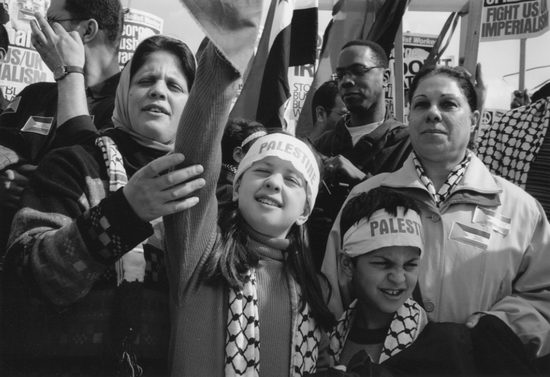
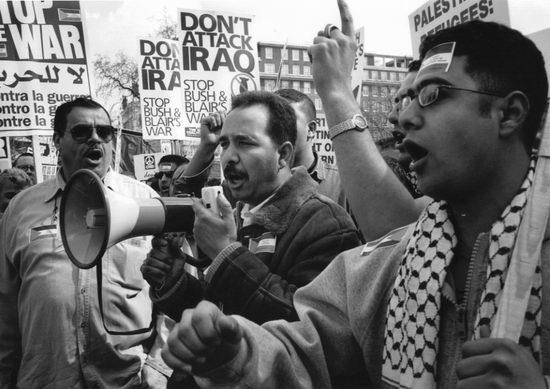
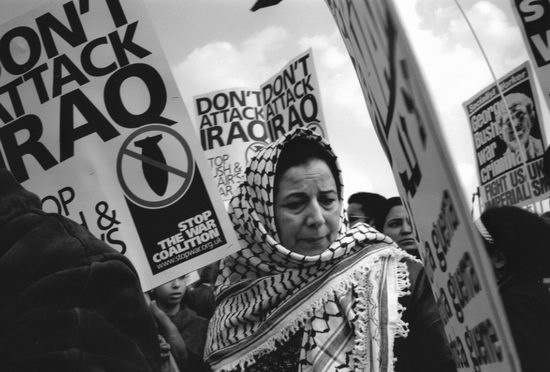
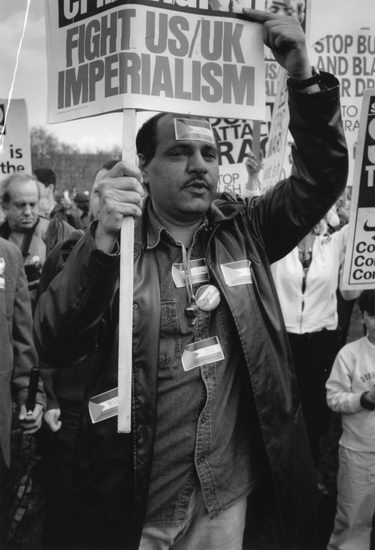
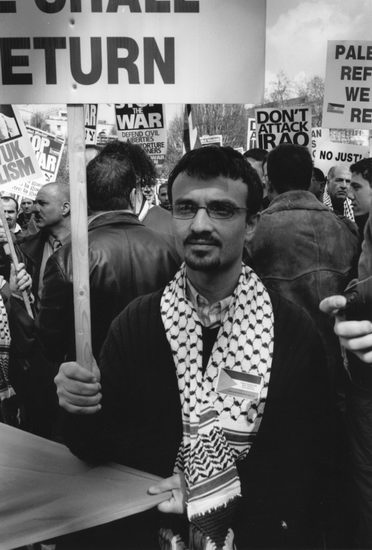
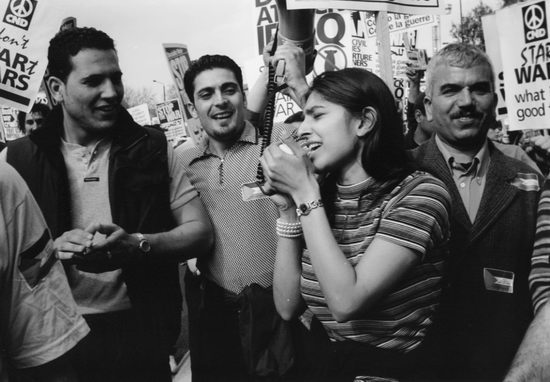
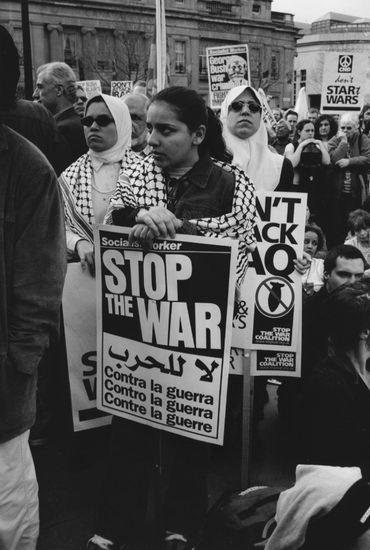
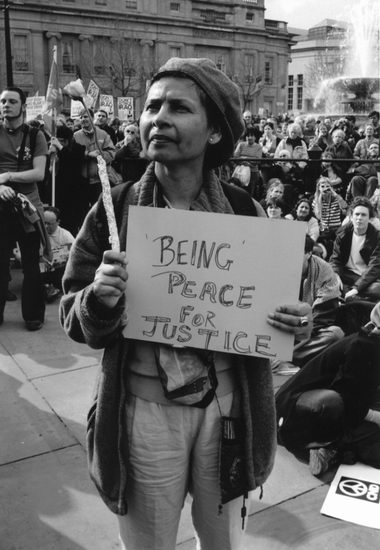
CND were joined by Stop The War protesting against the planned invasion of Iraq, as well as by pro-Palestine protesters following the publication of the Arab peace initiative which had been published two days earlier, but overshadowed by a Palestinian attack on a hotel during a Passover seder the previous day in which 30 Israeli citizens were killed. The initiative was in any case rejected as a “non-starter” by Israel.
Demonstrations back in 2002 still took place largely in black and white – and I was unable at the time to digitise any of the colour film I took. One day I hope to get around to it. Police acted as usual during the march, threatening at times to beat the marchers badly if they got out of hand, and large numbers protected the US embassy in Grosvenor Square to prevent any action there. They issued the usual estimate of numbers present, apparently unable to see half of the crowd.
I only put around a dozen images online – so most of them are here. The link to them is at the bottom of this page, from which you can also view the other events I photographed in March 2002.
Tottenham, Kilburn and Ponders End – I travelled to Tottenham and Kilburn to photograph protests but fortunately the people from Ponders End had come to protest at Westminster. All three protests I photographed on Saturday 29th March 2014 were about the inhumane policies of the Tory Government.
Mothers march for justice – Tottenham
Rev Paul Nicolson
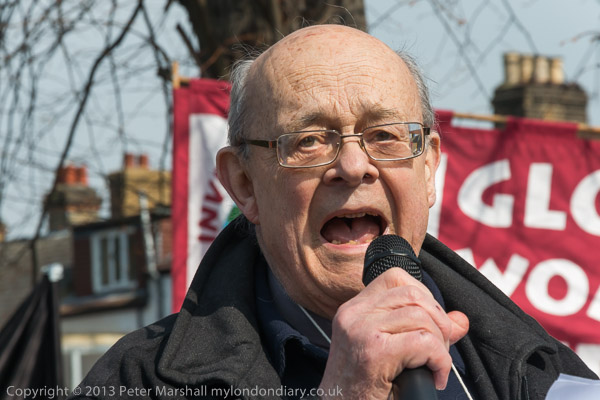
Rev Paul Nicolson of Taxpayers Against Poverty, an indefatigable lifelong campaigner on behalf of the poor died in 2020, aged 87. His first job after National Service in the Army had been with the family firm selling champagne around London, but after a dozen years until he discovered a vocation to become a worker-priest and was ordained as a deacon in 1967 and then a priest in 1968. Around 1981 he became a parish priest in Turville, the location chosen for The Vicar of Dibley, making his priority the support of the poor in a area of extremes of wealth.
He resurrected the practice, now common of being a McKenzie Friend, which allowed him to stand with and represent those brought to court over debts, particularly those unable to pay the Poll Tax. His revelations on the activities of bailiffs enforcing debts lead to a Code of Practice which, at least when enforced, gives some protection to the vulnerable, and it was his initiative in commissioning the Family Budget Unit to investigate the actual costs of living that led the the UK and London Living Wage being established.
Spiderman led the march
His work in later years was largely about housing and homelessness, and I met and photographed him on many protests. He set up the charity Zacchaeus 2000 (Z2K) but then resigned as its chair so he could campaign politically through Taxpayers Against Poverty.
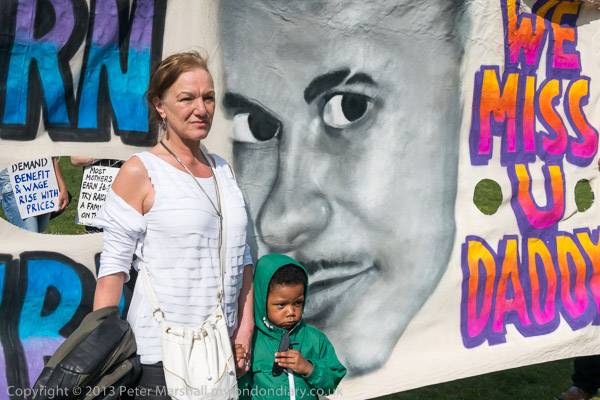
Carole Duggan, the aunt of Mark Duggan, murdered by police in front of a banner with his picture
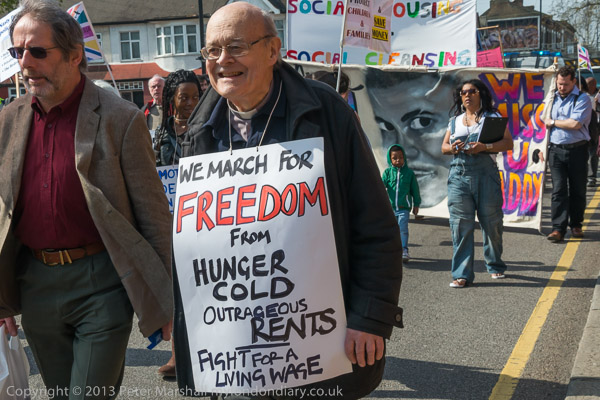
The march in Tottenham on 29th March 2014 organised by the Rev Paul Nicolson of Taxpayers Against Poverty demanded living incomes and decent truly affordable homes and rejected the unfair Tory bedroom tax, the housing benefit cap, unfair taxes, which were the cause of hunger and cold homes. He spoke before the march and walked on it with a placard hanging from a string around his neck: ‘We march for Freedom from Hunger, Cold, Outrageous Rents – Fight for a Living Wage’.
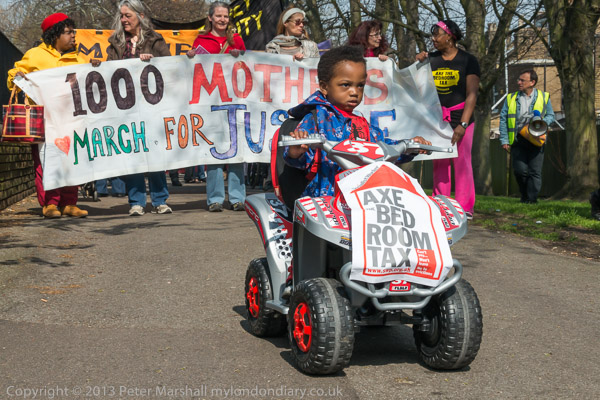
The march was smaller than hoped, several hundred rather than the hoped for ‘1000 Mothers March for Justice’, though more were expected to turn up at Tottenham Green East for the rally at its end, unfortunately after I had left. Those on the march included representatives from many local groups as well as others around London, and they carried an impressive number of banners.
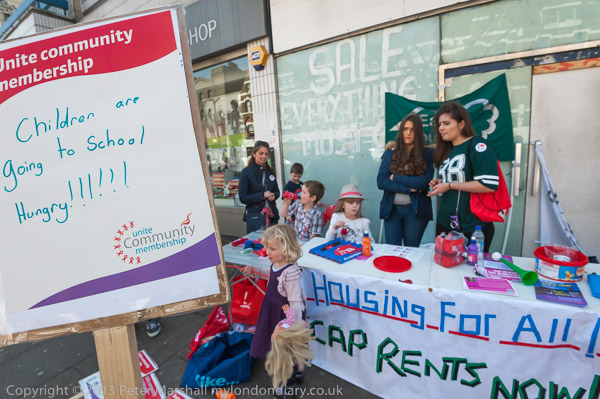
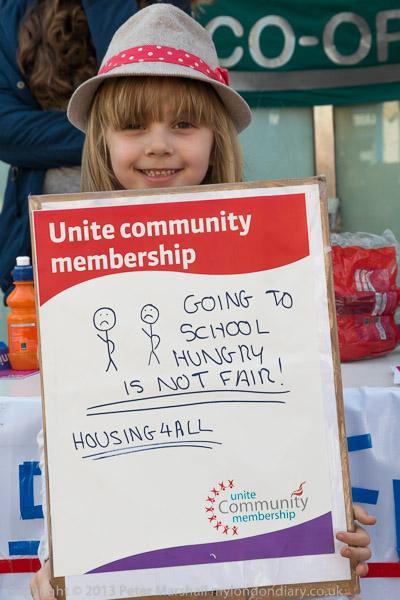
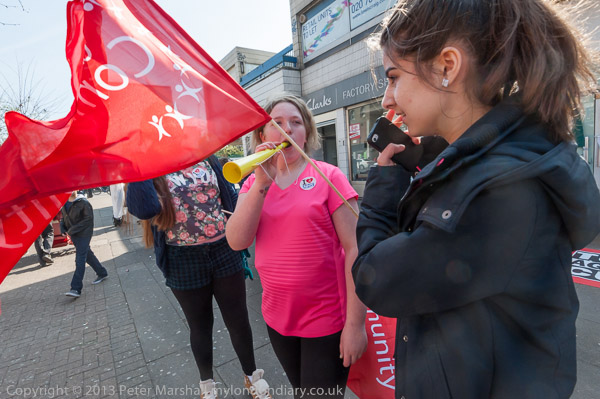
A few miles to the west, the Counihan Battlebus Housing For All campaign, along with the TUSC Against Cuts and Unite Community was holding a two hour protest in Kilburn Square on the main Kilburn High Road over child hunger and housing problems, calling for rents to be capped and for everyone to have a home.
In 2010 food banks were rare things in the UK, used over the year by around 60,000 people. After ten years of Tory policies this had increased to around 2.5 million, around 40 times as many. Much of that increase is a direct result of government policies, including its inhuman sanctions policy against benefit claimants, as well as of poverty wages and unfair employment practices such as zero hours contracts.
Moving people onto Universal Credit resulted in many being without resources for five weeks, sometimes considerably longer. As I wrote “Our government appear to be completely out of touch with how many people in the country live. They simply cannot comprehend what it means to be without money, or without friends or family you can rely on for a few thousand when you have a problem. Many people on low income simply don’t have any such resources – all they have is debts and bills to pay.”
Things have got worse since 2014, and soaring energy prices along with the additional National Insurance payments coming in next month will again put more families into desperate levels of poverty – and increase those evicted as they cannot pay the rent. It isn’t that the country doesn’t have the money – we are still one of the richest countries in the world – but that increasingly the already wealthy are getting richer while the poor sink into more desperate poverty.
And it’s successive governments – including New Labour – that are to blame, with a failure to build sensible amounts of social housing, the encouragement of high cost private housing and buy to rent. The wealthy have got tax breaks while many working full-time have been finding it harder and harder to make ends meet. And tax avoidance has reached huge levels thanks to a failure to plug silly loopholes and face up to the problems caused by off-shoring. We should have a zero-avoidance policy not one that encourages it.
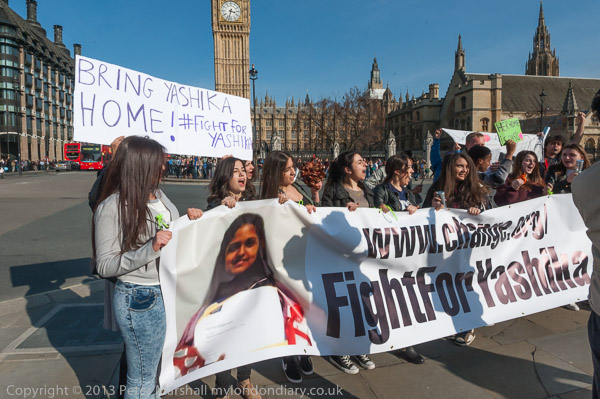
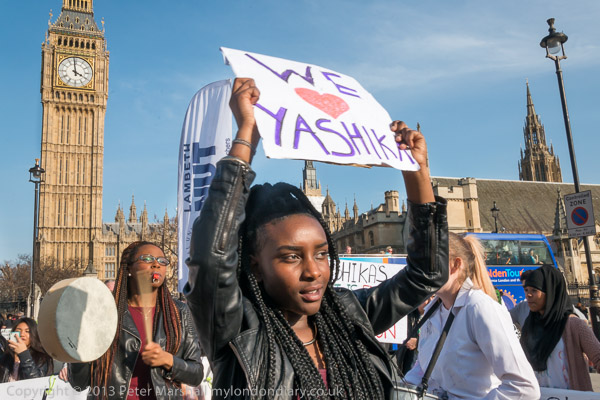
Fellow Students Fight for Yashika – Parliament Square
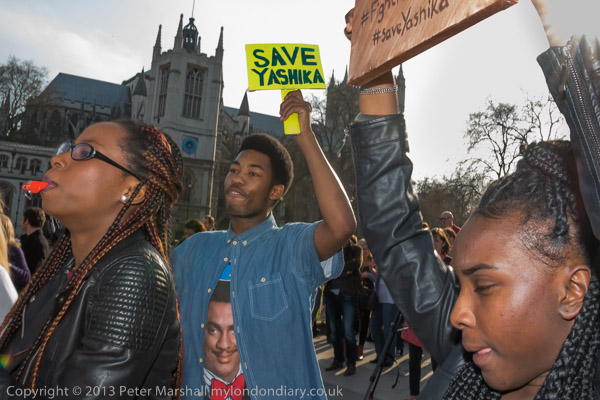
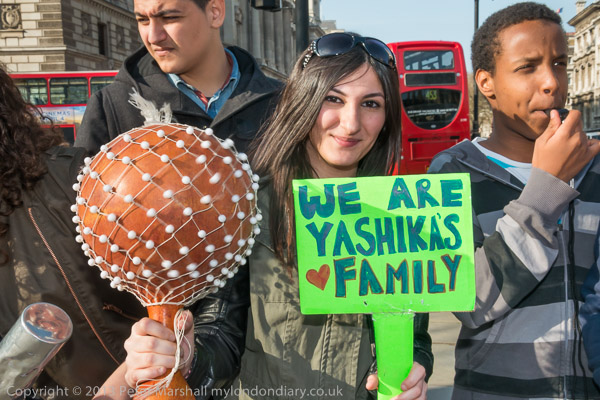
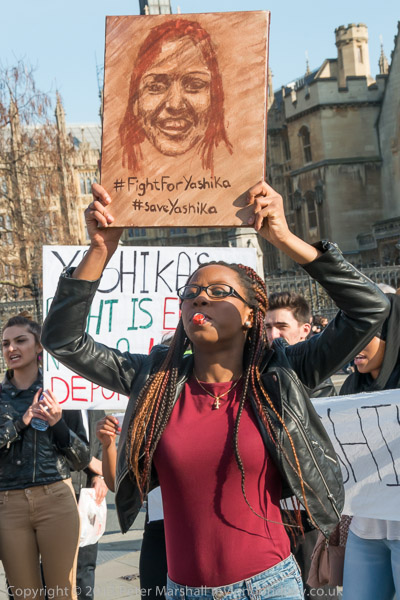
The final event I photographed was a lively protest by fellow students and supporters at Parliament urged then Home Secretary Theresa May to abandon the planned deportation of 19 year old model A-level student Yashika Bageerathi to Mauritius due to take place on Mothers Day.
She came here with her family who claimed asylum after physical abuse from a relative in Mauritius in 2012, but the claim was rejected and the whole family are under threat of eviction – and as she is now 19 they decided to deport her alone weeks before she was due to take her A levels in Ponders End.
We continue to see “a ‘tougher than you’ shift to the right over immigration played out by both government and opposition over the past years, each trying to outdo each other … So we get foolish and desperate measures like the immigration vans, and raids at tube stations and other public places by the Border Force based unlawfully on racial profiling.”
Migrants, including many who are here without legal right to remain, play an important part in keeping London running despite government attempts to identify and remove them. Estimates in 2014 were that there were around half a million in the city and without them, “London would grind to a halt. They do mainly the low paid dirty jobs no one else would want for pay that isn’t enough to live properly on in London – often at below the minimum wage because of their immigration status.”
The protests and a petition with over 170,000 signatures failed to have any effect on the heartless Home Office and Yashika was deported. But good news came later. Perhaps because of the huge publicity around her case she was welcomed and supported back in Mauritius and was able to take her exams there. Despite her studies having been interrupted by spells in Yarl’s Wood immigration prison she was able to gain her A levels and go on to university – and keep out of the media limelight.