A Walk in the City – 2019

A Walk in the City: Take a walk around parts of the City of London with me and my camera five years ago on Wednesday 7 Aug 2019. The first part of the walk I was on my own, but later I met up with a couple of friends and we continued to walk around but visited several interesting City pubs before ending up with a meal at what must be the worst Wetherspoons in Greater London at Cannon Street Station. Though I suppose it’s handy if you want to catch the train.
A Walk in the City

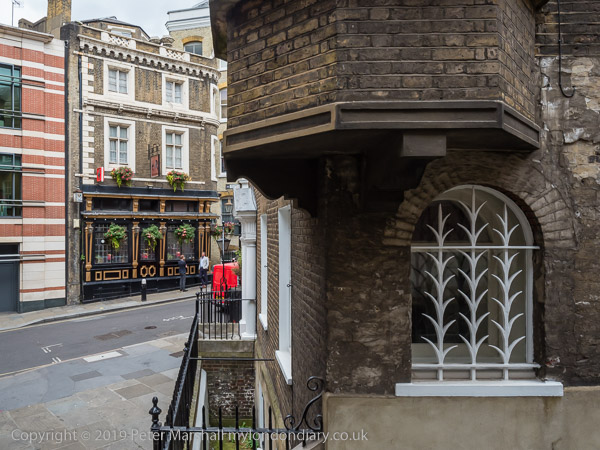
I’d taken a bus from Waterloo to the City and got off at St Paul’s and walked down to St Andrew’s Hill where I wanted to retake digitally an image I had made on film over 30 years ago.
A Walk in the City

Taken from the steps of St Andrew’s by the Wardrobe Church, the view of St Andrew’s Hill and the Cockpit pub was a taxing subject on film with the foreground in Wardrobe Terrace, and I never quite managed what I wanted. Using digital gave me a rather better result with no problems.
A Walk in the City

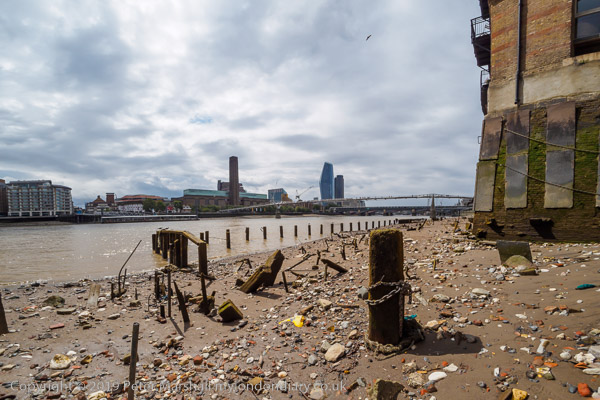
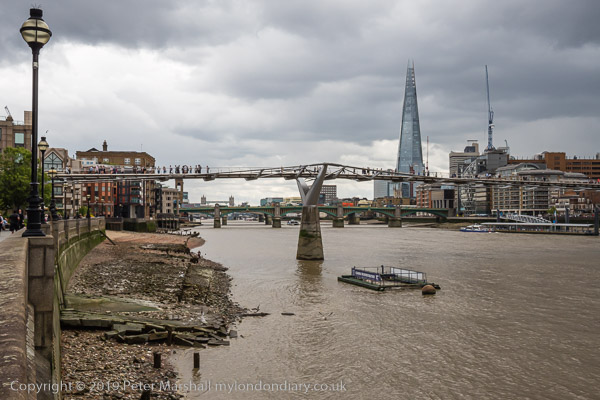
I walked on down to the River Thames and made some views along the river with the Millennium footbridge and the Shard now rather dominating the scene.
A Walk in the City

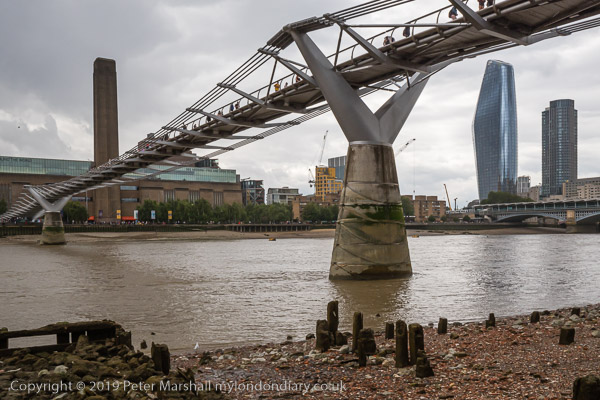
The tide was very low and I went down the steps onto the foreshore, though I needed to be careful walking on the stones and mud as I was only wearing a light pair of shoes which were very much not waterproof. I walked along under the Millennium Bridge and on towards Queenhithe, taking quite a few pictures.
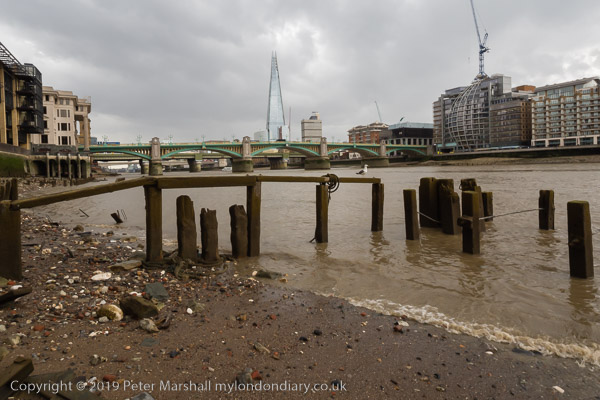
The foreshore can be dangerous and the tide comes in rapidly. Although anyone is free to visit it, searching in any way – metal detecting, ‘beachcombing’, scraping and digging etc requires a https://pla.co.uk/thames-foreshore-permits PLA permit. You are advised to wear sensible footwear and gloves – which of course I wasn’t – and to watch out for hazards including raw sewage, broken glass, hypodermic needles and wash from vessels. I stepped very carefully.
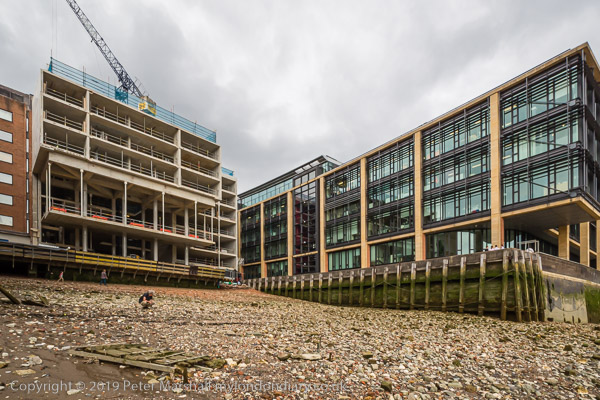
Buried below the sand and mud at Queenhithe are the remains of part of London’s Roman harbour and the later medieval quay. A scheduled ancient monument, it is probably the only existing Saxon harbour in the world, presented by King Alfred the Great in 883 AD to his brother-in-law Ethelred. It got the name Queenhithe later when the harbour dues became the property of the wife of Henry I, Queen Matilda. The dock was still in use mainly by the fur trade in the early 20th century, and there were still fur shops in the area around in the 1970s.
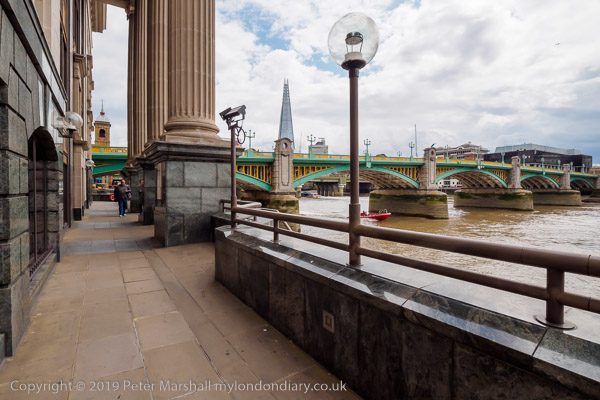
I didn’t stay long on the foreshore and couldn’t remember where the next set of steps up from it were, so went back onto the Thames Path where I had come down and walked east towards Monument Station where I was meeting two photographer friends.
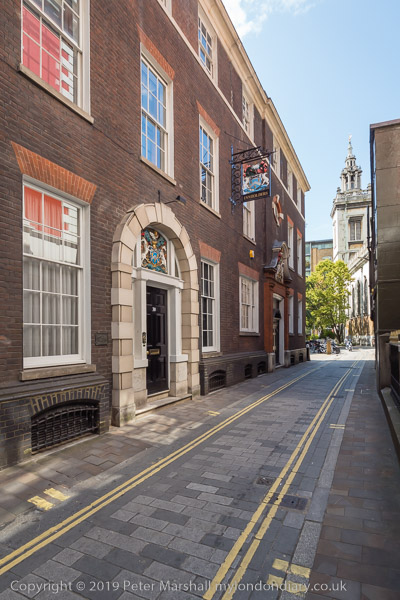
One of my friends had planned this walk and I was just a little surprised to find we were going back to one of the places I had visited earlier, St Andrew’s Hill, though less surprised when we went into the Cockpit pub.
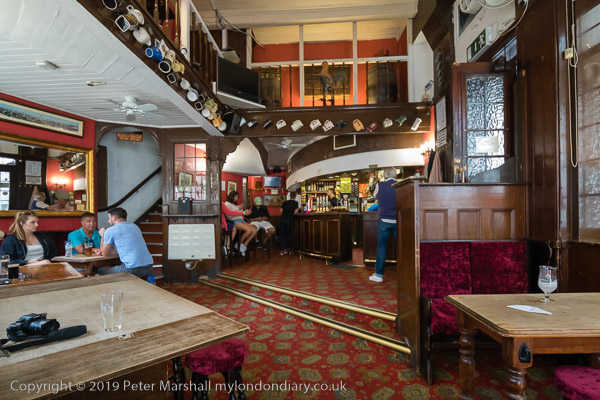
The pub is on a historic site, originally part of one of the gatehouses of Blackfriars Monastery. There was a pub here when Shakespeare bought a house nearby. And undoubtedly there was somewhere here where cock fights took place until cockfighting was banned – along with dog fighting, bear baiting and badger baiting – in 1835. But this is a Victorian theme pub, rebuilt around 1865, though some at least of its interior decoration almost certainly came from actual cockfighting venues. But punters never stood in the closed galleries here to watch fights. Now firmly on the tourist circuit it is still worth a visit, if just for a pint of Harvey’s Sussex Best Bitter.

Our walk continued through more of the streets in this area and then across New Bridge Street and on to Bride Lane and St Bride’s Passage and The Old Bell Tavern, once very much part of Fleet Street, the Street of Shame. The Old Bell Tavern is on the site where it all started, when in 1500 Wynkyn de Worde who had worked with William Caxton set up the first print shop on Fleet Street. The building is apparently derived from one that Christopher Wren knocked up for his masons when they were building St Brides, the journalists’ church.
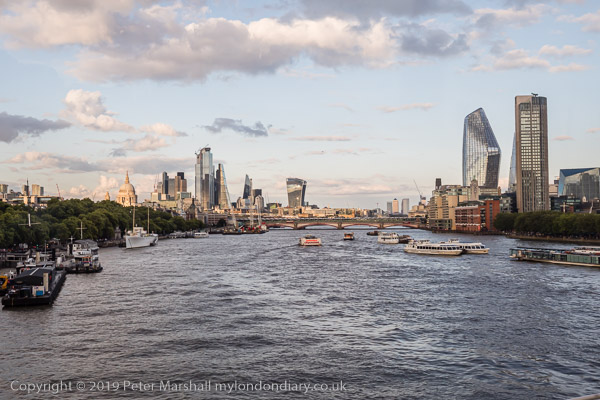
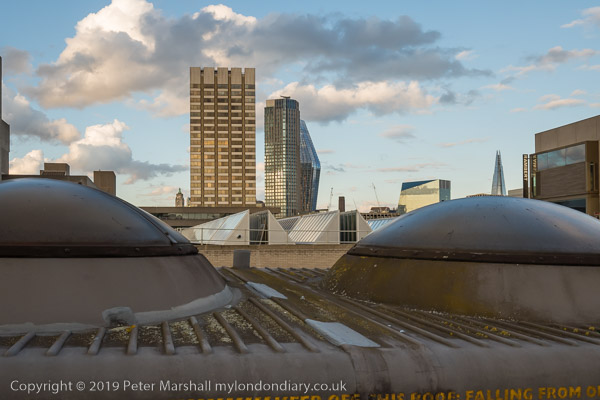
Our walk more or less finished there, though we took a bus to Cannon Street Station for cheap food at the Wetherspoons, though I found it very disappointing. Spoons do much better almost everywhere else. I caught a bus from St Paul’s Churchyard, sat in the front seat on the top desk and it had unusually clean windows so I took a few more picture on the way back to Waterloo.
More pictures from the day at City & Thames.


FlickrFacebookMy London DiaryHull PhotosLea ValleyParis
London’s Industrial HeritageLondon Photos

All photographs on this page are copyright © Peter Marshall.
Contact me to buy prints or licence to reproduce.


Cows, Cindy, Fonthill and Finsbury Park – 1989

Milking, Friern Manor Dairy Farm, Stroud Green Rd, Finsbury Park, Islington, 1989 89-9f-63

Cows, Cindy, Fonthill and Finsbury Park: I couldn’t resist posting another of those sgraffito panels from the former Friern Manor Dairy Farm on Stroud Green Rd, though I suspect even when these were made the conditions for both cows and milkmaids were very different from those enjoyed in the stalls behing the facade.

Modern dairy practice is of course also very different as you can see in Andrea Arnold’s 2021 cinéma vérité-style film ‘Cow‘, not made as vegan propaganda but giving a very direct view of how we use animals to produce food for the masses. Watching it didn’t convert me to the vegan cause but I do think we need to have and enforce much stricter standards of animal welfare – though those in the UK are already firmer than in most countries. I already pay more for milk and would happily pay even more.

Cindy Trading Company, Hanley Rd, Finsbury Park, Islington,1989 89-9f-66

The Old Diary is on the corner of Hanley Road and I walked down here just a short distance and photographed this shopfront which appeared to be of a former travel agency, possibly the ‘Flight Line Cruise’ whose phone number is written large. The Cindy Trading Company whose name is on the door was later listed as a hardware store selling a range of DIY and home improvement items at 186 Stroud Green Road, a short distance away – and is now a dissolved company.

At right is an advertisement for Metposts and I may have been attracted by this as I had recently put in a fence on one side of my garden at home using these. It wasn’t quite as easy as the advert suggests and by the time I’d finished and put down the sledgehammer I’d decided digging and concrete might have been easier.

Shop, Fonthill Rd, Finsbury Park, Islington, 1989 89-9f-45

I’m unsure what route I took from Hanley Road to Fonthill Road, possibly going down Regina Road or Evershot Road. I took a couple of pictures – neither digitised – of an interesting yard with two rather strange bell towers in the background, nothing like anything that I can now see in satellite images of the area, possibly a long-demolished public building,

Fortunately the location of this picture is confirmed by the reflection of the street sign for Fonthill Road. Also reflected is a sign for John Rowan Bookmaker, the company which developed the well-known Rowans Tenpin Bowl opposite Finsbury Park Station on Stround Green Road in what had previouly been a tram shed, cinema and Bingo hall.

By 1989 this end of Fonthill Road was already beginning to become one of London’s major fashion centres – and a few pictures I’ve not yet digitised reflect this. A few from 1989 in colour start here.

My walk on 24th September was coming to an end, and I took just one more picture of a shopfront on Seven Sister Road before catching the Victoria Line on my way home. But I was back in Finsbury Park a week later and I’ll include a couple of pictures from the actual park, Finsbury Park to end this post.

Free Nelson Mandela, Finsbury Park, Islington, 1989 89-9f-31

Nelson Mandela was released unconditionally from Victor Verster Prison on 11th February 1990 following years of campaigning for his release. Most of the other graffiti on this wall is unintelligible black scribble at least to me, but I can also make out in white ‘PARANOID EYES’ -presumably from the song on Pink Floyd’s 1983 album The Final Cut.

New River, Finsbury Park, Islington, 1989 89-9f-21

The New River was dug in 1613 to supply fresh drinking water to London from Chadwell and Amwell Springs near Ware in Hertfordshire.

Finsbury Park is around three miles from Finsbury which is on the northern edge of the City of London. People in Finsbury in 1841 signed a petition calling for a park that the people living in poverty in the area could make use of, and this was one of four sites that were considered.

This was around the last remains of the old Hornsey Wood, and by around 1800 had been developed with tea rooms and later a pub, as well as an artificial boating lake using water pumped up from the New River, and it was a popular place for shooting and archery “and probably cock fighting and other blood sports.”

There was some local opposition to sharing the area with the poor of Finsbury but the plans for what was originally to be called Albert Park (after Queen Victoria’s husband) went ahead, and the renamed Finsbury Park was approved by an Act of Parliament in 1857, though only completed and opened by 1869.

New River, Finsbury Park, Manor House, Haringey, 1989 89-10a-02

Lack of finance meant the park had deteriorate significantly by the 1980s, and the situation – like much in London – was greatly worsened when the Greater London Council was terminated with extreme malice by Thatcher in 1986. Haringey Council became responsible for the park “but without sufficient funding or a statutory obligation for the park’s upkeep.”

More recently £5 million Lottery Funding has enabled significant renovation of the park and its facilities. I last went to the park in March 2023 for the planting of a tree in memory of peace campaigner Bruce Kent by local MP Jeremy Corbyn and Kent’s wife Valerie. Both Kent and Corbyn were members of the Friends of Finsbury Park, with Corbyn now being a patron.

More from my October walk later.


FlickrFacebookMy London DiaryHull PhotosLea ValleyParis
London’s Industrial HeritageLondon Photos

All photographs on this page are copyright © Peter Marshall.
Contact me to buy prints or licence to reproduce.


Adidas, Wallenberg, Iraq – 2012

Adidas, Wallenberg, Iraq – Three very different events on Saturday 4th August 2012. You may remember that we had the Olympics in London in 2012 and War on Want held an Olympic-themed protest against the official Olympic sportswear partner. People celebrate the 100th anniversary of the birth of one of the great heroes of the last century and on the nearest Saturday to August 8th which Iraq celebrates as end of the Iran-Iraq War in 1988 there was an Iraq festival on the South Bank.


Adidas Stop Your Olympic Exploitation – Oxford St

Adidas, Wallenberg, Iraq

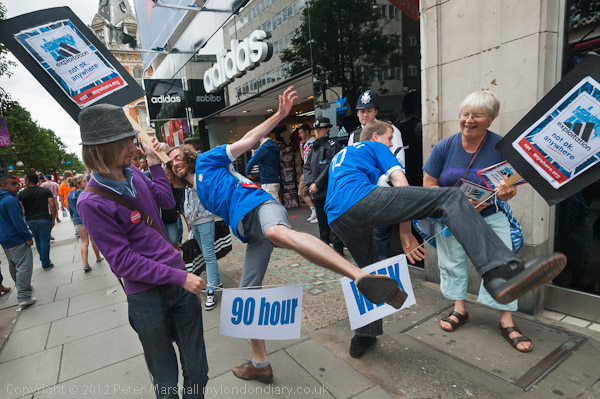
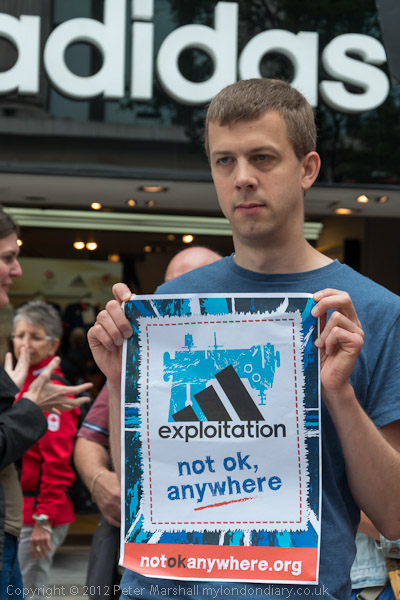
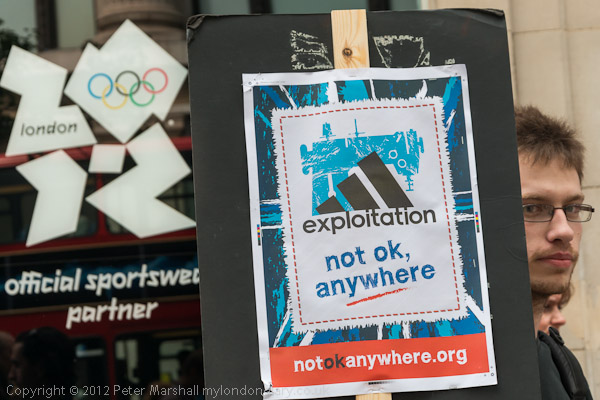
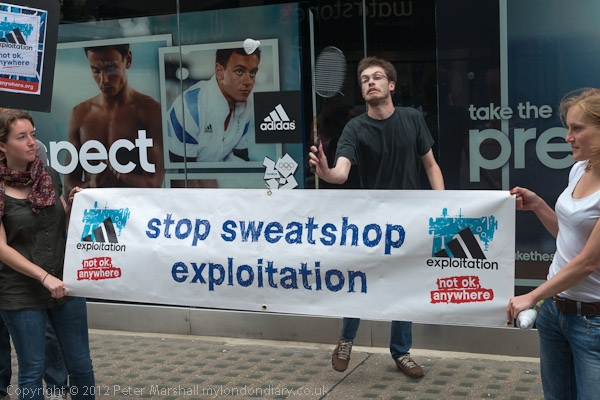
War on Want came to Adidas in Oxford Street at the peak of the London Olympics to highlight their claims that workers making clothes for the official sportswear partner of London 2012 get poverty wages are not allowed to form unions and have little or no job security.

Adidas, Wallenberg, Iraq

They say thousands of workers making closing for Adidas in Indonesia, Sri Lanka and China are not paid enough to cover basic essentials like housing, food, education and health care. Wages are so low that workers often need to work far longer hours than are legal – up to 90 hour weeks and are told if they try to organise trade unions to defend their rights, they face harassment or they will be fired.

Adidas, Wallenberg, Iraq

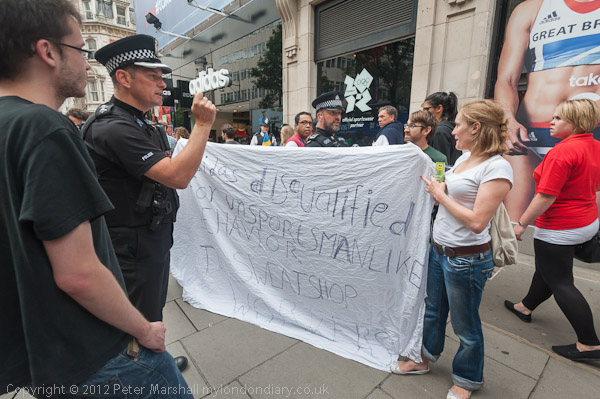
Because of the pressures of the Olympics, Oxford Street was being policed by Scottish officers who objected to the protest involving games including badminton and a hurdles race on the grounds that people walking past might be injured by the players.

Adidas, Wallenberg, Iraq

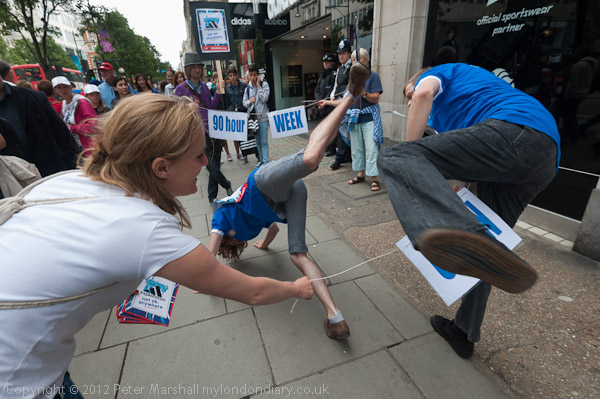
War on Want protesters moved a few yards onto a side street to continue their protest, but then came back onto Oxford Street to continue the hurdles races, with two runners making their way over the hurdles of ‘POVERTY WAGES’, ‘UNION BUSTING’ and ’90 HOUR WEEK’. The police let them play for a few minutes before telling them they had to stop as Adidas had complained – and they owned the area pavement in front of the store.

A woman from Adidas’s PR agency came to talk to me as I was beginning to take photographs and later sent me a detailed statement in which they denied War on Want’s claims but only provided any evidence based on activities in Bangladesh rather than the countries War on Want was protesting about. War on Want also published a press release giving detailed evidence on which their protest was based.

The protest was still continuing when I had to leave well over an hour after it began, with people still handing out leaflets including a freepost postcard to Herbert Hainer, the CEO of Adidas, care of War on Want, calling for Adidas to end the exploitation of workers.

More pictures at Adidas Stop Your Olympic Exploitation.


Raoul Wallenberg 100th Anniversary – Great Cumberland Place

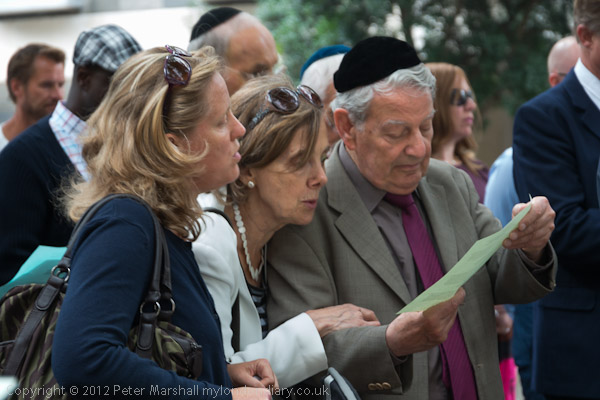
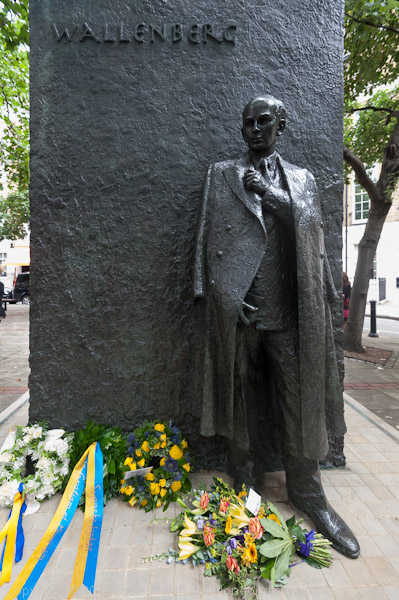
People around the world were celebrating Swedish diplomat Raoul Wallenberg who working in Budapest during the Second World War saved over 100,000 Hungarian Jews from Nazi death camps by issuing them with ‘protective passports’ identifying their bearers as Swedish subjects awaiting repatriation.

Although these had no legal status, they looked impressive and, sometimes with the aid of a little bribery, saved the bearers from deportation.

Wallenberg was born in Sweden on 4th August 1912 and was detained by Russian Security Services SMERSH during the siege of Budapest as a suspected spy on 17 January 1945 and taken to Moscow where he was most probably executed in the Lubyanka prison in 1947.

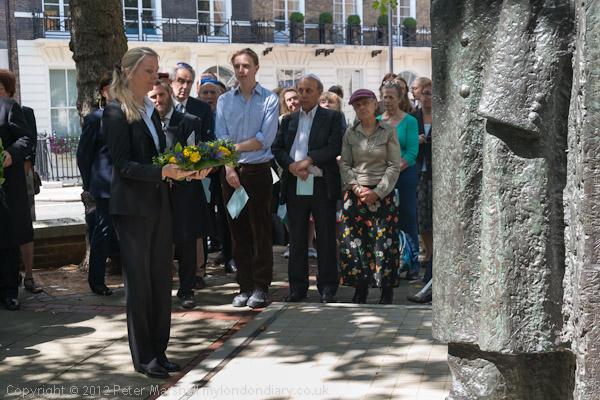
The London ceremony took place around the monument to him in Great Cumberland Place, outside the Western Marble Arch Synagogue in 1997. The statue by sculptor Philip Jackson, shows shows Wallenberg standing in front a a large wall made of stacks of the passports with his name inscribed high on it.

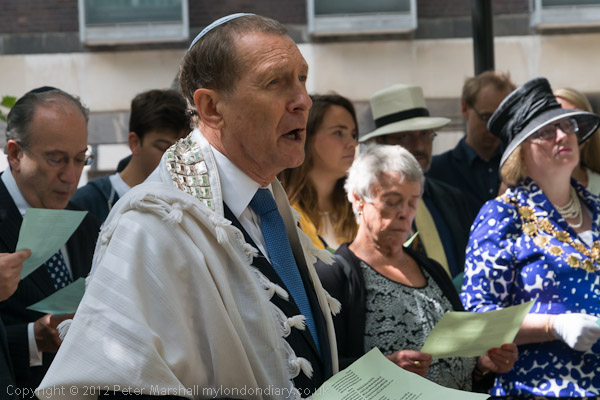
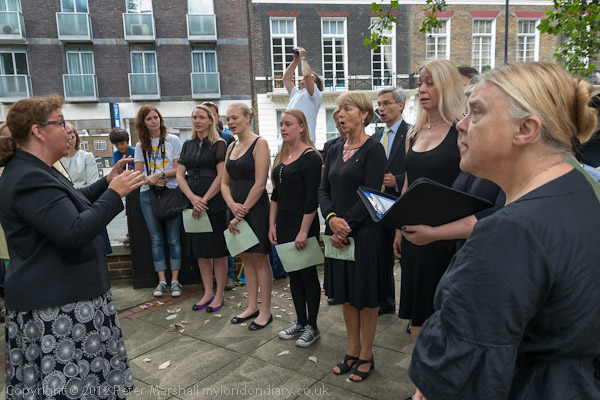
There were readings of Psalms, an address by Rector Michael Persson from the Swedish Church in London about Wallenberg, whose actions followed the Lutheran ideal of living, a calling to be yourself and to do good for other people. Wreaths were laid and there were a number of speeches with the event ending with a choir from the Swedish church singing.

Raoul Wallenberg 100th Anniversary


Iraq Day Festival, Queen’s Walk, South Bank

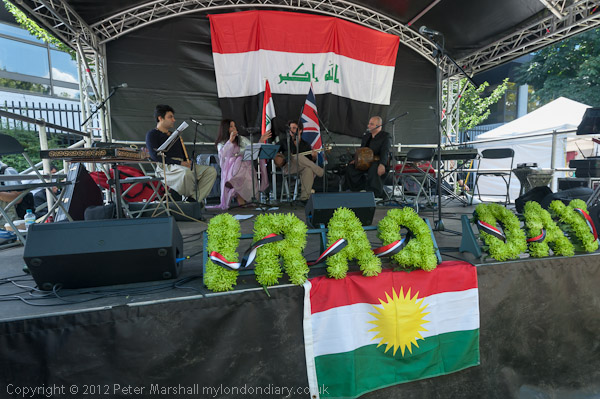
The festival had been “organized to celebrate the games with a hint of Iraq flavor” by the Iraqi Culture Centre in London and sponsored by Bayt Al Hekima- Baghdad in conjunction with Local Leader London 2012 program.

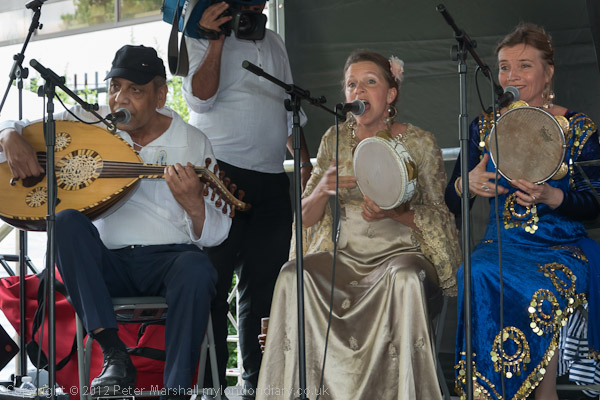
There was Iraqi music, art and food, although since it was taking place in Ramadan many of the Iraqis at the festival were fasting and unable to eat during the event.

These Kurdish musicians were told they had to leave and another group of Iraqi musicians replaced them

Although there was much of interest things didn’t go smoothly, either with the weather where there were some heavy showers or between the organisers and some of the performers.

One woman angrily stormed off the platform, furious at what she felt was cultural discrimination against the Kurds. And after I had been asked to photograph a fashion show that was to start in two minutes there was a loud and bitter argument between its director and the organisers, and an hour later when I went home it had yet to start.

More pictures Iraq Day Festival


FlickrFacebookMy London DiaryHull PhotosLea ValleyParis
London’s Industrial HeritageLondon Photos

All photographs on this page are copyright © Peter Marshall.
Contact me to buy prints or licence to reproduce.


Crouch Hill & Stroud Green – 1989

Crouch Hill & Stroud Green: My walk on Sunday 24th Sepember 1989 continued after I took a train from Blackhorse Road to Crouch Hill. Then the Gospel Oak to Barking line – apparently called by some the Goblin line was one of the least reliable in the country – perhaps it should have been called the Gremlin line. But for once a train came – and on a Sunday too!

The line is now part of the London Overground with a much improved service and in February this year was renamed the Suffragette line. It now also runs beyond Barking to Barking Riverside, though as yet there seems little reason to ever go there.

Marion Gray, Antiques, 33 Crouch Hill, Finsbury Park, Islington, 1989 89-9e-21

Almost immediately out of the station was the fine house, on the end of a rather less grand terrace on the west side of Crouch Hill. The station was opened in 1867/8 as a part of the Tottenham and Hampstead Junction Railway and this accelerated development in the area.

This house was sold in 2017 having long been converted into a ground floor nursery with three flats above. Last year it was covered in scaffolding, presumably for a major refurbishment.

Crouch Hill, Finsbury Park, Islington, 1989 89-9e-22

These shops are on the east side of Crouch Hill, immediately north of Japan Crescent and south of the railway. They still look much the same although the shops have changed and become considerably less useful.

I was attracted by the decorated brickwork, obscured on the leftmost building by some unfortunate cladding, and the curved brick partitions between the houses about the shop fronts.

At extreme right is the pub sign for Marler’s bar, opened in 1983 in a former post office. It’s a pub which has gone through a whole pile of names apprently including Hopsmiths, Noble, Big Fat Sofa, Flag, Racecourse, Tap and Spile and Brave Sir Robin. Andrew Marler was a partner of Tim Martin of Wethersppons, but the history of their collaboration appears to be dulled by alcohol and variously recorded.

Crouch Hill & Stroud Green

Fytos Fashion at 34, Crouch Hill, Finsbury Park, Islington, 1989 89-9e-23 was one of the 20 images that was a part of my web site and book ‘1989’, ISBN: 978-1-909363-01-4, and above is the page from that.

Alley, Crouch Hill, Finsbury Park, Islington, 1989 89-9e-24

I can tell you little more about EKASA ENTERPRISE WHOLESALE DISTRIBUTOR other than the list printed here – CONFECTIONERY TOBACCO STATIONERY DRINKS GREETING CARDS MEDICINE E.T.C.

They shared the alley, reached through a carriage entrance between shops at 17 Crouch Hill, with Albert E Chapman Ltd, whose sign including also Stretchwall U K Ltd was there until at least 2011.

Bowler Products Ltd, 14-16, Crouch Hill, Finsbury Park, Islington, 1989 89-9e-25

I hoped that Bowler products Ltd made either cricket balls or hats but they were Importers and Wholesale Distributors of a whole range of goods listed on their shop front but neither of these.

Old Style Delivery, Friern Manor Dairy Farm, Stroud Green Rd, Finsbury Park, Islington,   1989 89-9e-12
Old Style Delivery, Friern Manor Dairy Farm, Stroud Green Rd, Finsbury Park, Islington, 1989 89-9e-12

According to the Hornsey Historical Society this Grade II listed building “with its seven sgraffito panels, was built specially for the Friern Manor Dairy Farm Company on the site at the rear of Hanley Road, where the company rented cowsheds and stables.” There had been a dairy here “from the middle of the 19th century, first by Davis & Co. and then by George Taylor” but this building dates from around 1889-95. The company began earlier and an inscription states ESTABLISHED AD. 1836 The artist of the seven panels and architect are unknown, though the bricks came from Tommy Lawrence of Bracknell.

The buildings were let in the 1920s to United Dairies who used them until 1968. After this they eventually in 1997 they were carefully restored to become The Old Diary pub. This closed in 2020 but was reopened in 2022.

Present Day Delivery, Friern Manor Dairy Farm, Stroud Green Rd, Finsbury Park, Islington, 1989 89-9e-26
Present Day Delivery, Friern Manor Dairy Farm, Stroud Green Rd, Finsbury Park, Islington, 1989

I photographed all seven panels, and you can find some more pictures of them on Flickr, but here I’ll just share the two, one showing ‘Old Style Delivery‘ by two milkmaids with a yoke across their shoulders carrying pails, and this one, ‘Present Day Delivery‘ with the milkman driving a horse and cart carrying large churns.

Even as far back as I can remember in the immediate post-war years our milk was delivered using an electric milk float, at first I think a trailer with the milkman walking in front with a handle to control the power and steering and later with him sitting in a cab. But I do remember a visit to the outskirts of a small town in Germany back in the 1970s where the milk cart was horse-drawn and the milkman measured out the milk using litre or half-litre jugs into the containers brought out by the hausfraus.

We still now in our suburban area get our milk delivered in bottles by a milk operative in the middle of the night driving a now silent electric vehicle.

More on this walk shortly.


FlickrFacebookMy London DiaryHull PhotosLea ValleyParis
London’s Industrial HeritageLondon Photos

All photographs on this page are copyright © Peter Marshall.
Contact me to buy prints or licence to reproduce.


Schools, Warner Estate, Baptists & Art Deco – 1989

Schools, Warner Estate, Baptists & Art Deco: My motivation for this return to Walthamstow was I think to photograph the building whose pictures end this post. On a previous visit I had – for the only time I can remember – lost a cassette of exposed film. I’d realised this later in the same morning and had gone back on my tracks to search for it to where I changed films, but without success. And there had been one building I had photographed that I was keen to have pictures of as Art Deco was one of my particular themes at the time, working for a never published book, London Moderne. But I’d decided to walk around some other areas again before going to take those pictures.

Markhouse Road Schools, Markhouse Rd, Walthamstow, Waltham Forest, 1989 89-9e-63

Markhouse Road Schools it tells us on the building were ‘REBUILT 1907’. Walthamstow was forced by the government Education ministry to set up a school board 1880, before which there were “5 Anglican schools, 5 run by Protestant nonconformists, and 3, including an orphanage and an industrial school, by Roman Catholics.” The school boards provided elementary education for 5-13 year olds. Mark House Road board school opened in 1891 with infants, boys and girls departments.

Unfortunately the schools burnt down a few days before Christmas in 1906 and were almost completely destroyed. Walthamstow Urban Distric Council who had been running elementary schools in the area since 1903 rebuilt them and they reopened in 1908.

The school became a secondary modern school in 1946 and closed in 1966, though the building remained in use for various educational purposes for some years until it was finally demolished a few years after I made this picture.

Nat West, Bank, 10, St James's St, Walthamstow, Waltham Forest, 1989 89-9e-66
Nat West, Bank, 10, St James St, Walthamstow, Waltham Forest, 1989 89-9e-66

The rather fine entrance to the NatWest bank in St James St; the building on the north of the corner with Leucha Road, is still there, one of the two blocks built by the Warner Estate featured in the previous post on this walk, but the doorway, now for a food store, is sadly bereft of dragons and decoration.

Houses, Leucha Rd, Walthamstow, Waltham Forest, 1989 89-9e-51

Leucha Road, one many streets built as part of the Warner Estate in Walthamstow got its name from one of the family, Leucha Diana Maude who was the daughter of Clementina and Cornwallis Viscount Hawarden Earl de Montalt, a Conservative politician with an Irish peerage. Clementina was a noted amateur photographer and had ten children, eight of whom survived infancy, so there was no shortage of names for streets around here.

This was one of the earliest to be developed on the Warner Estate in 1895 and the buildings on it are two storey maisonettes, called “half houses” by the Warners.

Leucha Road was acquired by Waltham Forest Council in the late 1960’s and they repainted the doors which had been green like all other Warner properties in what the Conservation Area statement describes as “a pale and inappropriate “Council-house” blue“. The Warner Estate sold off 2400 of their properties to Circle 33 Housing Trust (now part of Circle Housing Group) in 2000 and of these 600 still had outside toilets.

Shops, High St, Walthamstow, Waltham Forest, 1989 89-9e-52

Another picture of some of the Warner estate shops in the High Street with at the left a rather strange ‘streamline’ feature which I think must have belonged to a building to the left demolished in some road-widening scheme.

Pretoria Ave, Walthamstow, Waltham Forest, 1989 89-9e-55

A house at 2-4 Pretoria Avenue with a rather nice gable, I think also a Warner building.

Baptist Church, Blackhorse Rd, Walthamstow, Waltham Forest, 1989 89-9e-41
Baptist Church, 65, Blackhorse Rd, Walthamstow, Waltham Forest, 1989 89-9e-41

A curiously barn-like structure dated 1932, Walthamstow (Blackhorse Rd) Baptist Church. This building replaced a ‘tin tabernacle’ in which the congregation had been meeting since 1898. The church is still a “friendly multi-cultural church in Walthamstow.”

Hammond & Champnesss Ltd, Works, Blackhorse Lane, Walthamstow, Waltham Forest, 1989 89-9e-45
Hammond & Champnesss Ltd, Works, 52, Blackhorse Lane, Walthamstow, Waltham Forest, 1989 89-9e-33

Not dated but also obviously from the 1930s was this building for Hammond & Champnesss Ltd on Blackhorse Lane.

Hammond & Champnesss Ltd was established as in 1905 by cousins Ernest Hammond and Harold Champness to make hydraulic water-powered lifts. They were joined by Ernest’s brother Leonard and for some time the company was Hammond Brothers and Champness Ltd.

Hydraulic lifts are raised and lowered by a piston inside a long cylinder with fluid pumped in to move the piston which is connected either directly or by ropes and pulleys to the lift cabin. They can be used in buildings up to five of six stories high.

Hammond & Champnesss Ltd, Works, Blackhorse Lane, Walthamstow, Waltham Forest, 1989 89-9e-32
Hammond & Champnesss Ltd, Works, 52, Blackhorse Lane, Walthamstow, Waltham Forest, 1989 89-9e-32

Hammond Brothers and Champness Ltd went bust in 1932 and the company was taken over by E Pollard & Co. Ltd who renamed it to Hammond & Champnesss Ltd but kept it operating as a separate company. This was taken over by US company Dover Corporation in 1971 but they continued to make lift components in Walthamstow until that company was taken over by Thyssen in 1999.

The building became Kings Family Network. It was refurbished in 2014 and is now Creative Works Co-Working office space.

This wasn’t the end of my walk that day, but after taking three pictures of this building I made my way to Blackhorse Road station and took the train to Crouch Hill.


FlickrFacebookMy London DiaryHull PhotosLea ValleyParis
London’s Industrial HeritageLondon Photos

All photographs on this page are copyright © Peter Marshall.
Contact me to buy prints or licence to reproduce.

Dangleway Revisited, Tamils Protest Killings – 2013

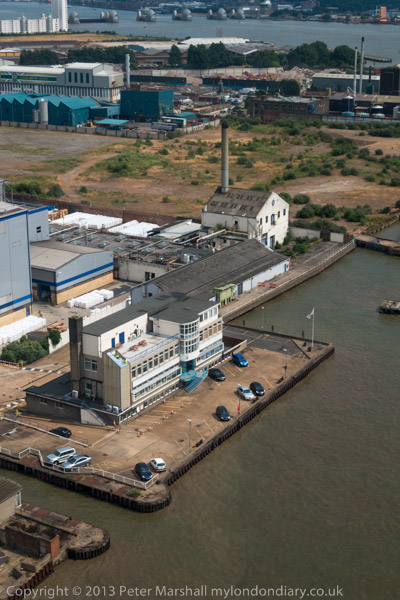
Dangleway Revisited, Tamils Protest Killings: On Tuesday 23rd July 2013 I revisited the Museum of Docklands and then took the DLR to Royal Victoria for another ride on the Arab Emirates cableway in a detour on my way into central London to photograph a rally by Tamils at Downing Street.


Another Dangleway Ride – Royal Victoria Dock to North Greenwich

Dangleway Revisited, Tamils Protest Killings

It was only a few weeks since my first ride on London’s cable car across the River Thames, but I was in docklands for a second visit to the ‘Estuary’ show at the Museum of Docklands. As one of those featured in the show I had been at the opening, but that was more about meeting people than seeing the work, though I had taken a short look at it all.

Dangleway Revisited, Tamils Protest Killings

The dangleway is fairly pointless in terms of transport, but is one of London’s cheaper tourist attractions, and though short it joins two areas of some interest. I suppose the views might not be to everyone’s interest, though I found them fascinating, and its certainly the cheapest way to do a little aerial photography.

More pictures at Another Dangleway Ride.


Tamils Protest Sri Lankan Killings

Dangleway Revisited, Tamils Protest Killings

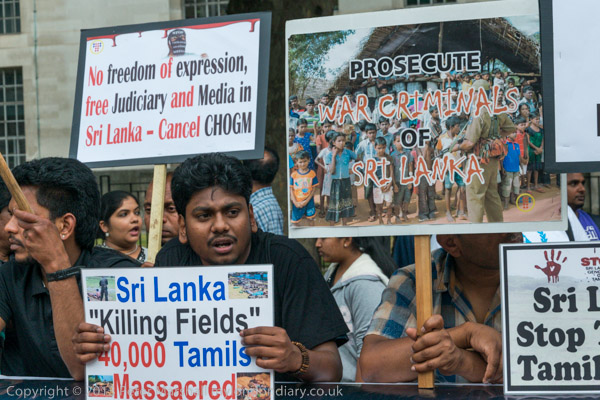
Tamils have long been the subject of discrimination in Sri Lanka, and the Civil War there from 1983 to 2009 against the Liberation Tigers of Tamil Eelam resulted in around 100,000 Tamil civilain deaths, as well as around 50,000 fighters on each side. The figures are unclear as the Sri Lankan government has always refused independent, international investigation to ascertain the full impact of the war.

Dangleway Revisited, Tamils Protest Killings

According to Wikipedia, “Since the end of the civil war, the Sri Lankan state has been subject to much global criticism for violating human rights as a result of committing war crimes through bombing civilian targets, usage of heavy weaponry, the abduction and massacres of Sri Lankan Tamils and sexual violence.”

The Tamil Tigers also became notorious for attacks on civilians, suicide bombings. assassinations and the use of child soldiers. The final stages of the war in 2006-9 were particularly bloody, and ended in a total defeat of the LTTE.

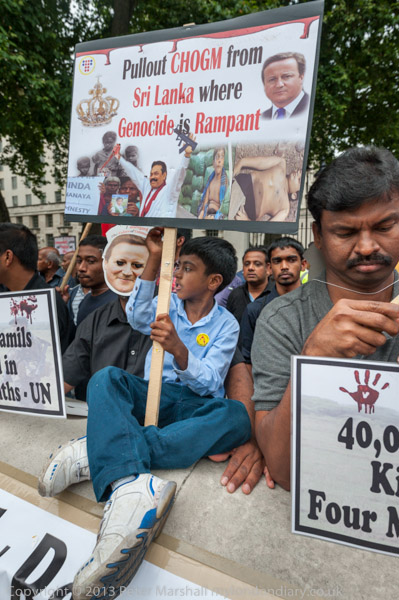
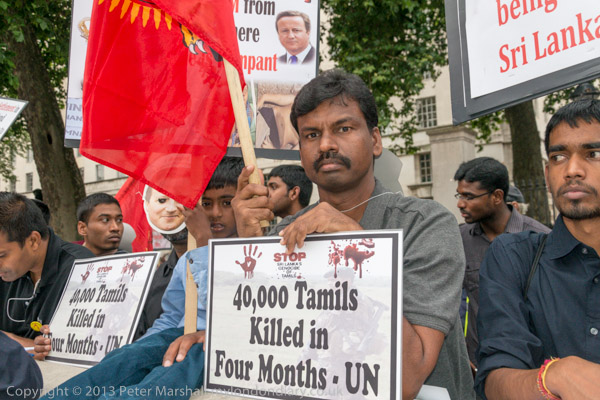
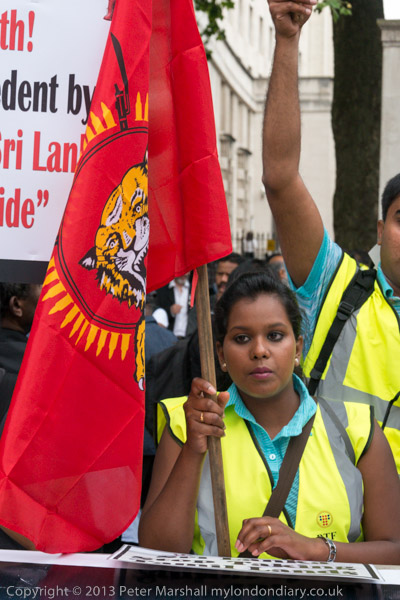
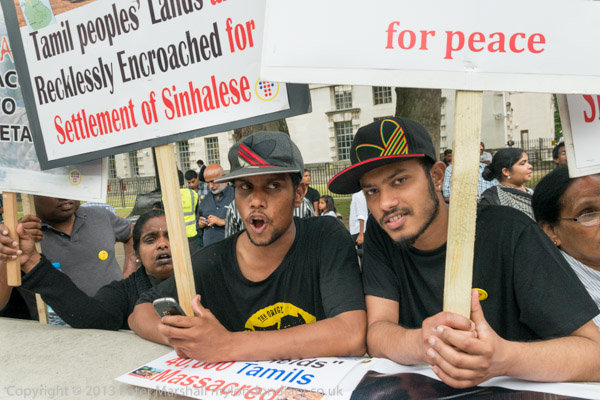
The British Tamil Forum at had come to Downing St on the 30th anniversary of the 1983 Black July when 3000 Tamils died in riots across Sri Lanka in an anti-Tamil pogrom orchestrated by the government.

This was not the first anti-Tamil pogrom, but its unprecedented frenzy of violence was a turning point after which Tamils knew they could never be safe in a state dominated by the Sinhalese.

In the four years since the Mullivaikkal Massacre of 2009 Tamils claim that an estimated 147,000 Tamils are either dead or missing, and they see the only solution as the formation of an independent Tamil state – ‘Tamil Eelam.’

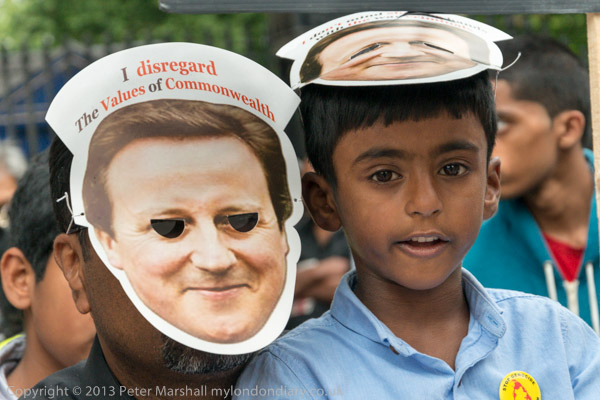
The protest called on the UK to boycott the Commonwealth Heads of Government Meeting (CHOGM 2013) in November 2013 hosted by Sri Lanka. They see this as legitimising a state which has been severley criticised by the UN and human rights organisation for the atrocities it has been committing.

People at the protest signed letters and cards calling on HRH The Prince of Wales to uphold the values of the Commonwealth and reconsider his decision to attend CHOGM 2013.

More pictures Tamils Protest Sri Lankan Killings.


FlickrFacebookMy London DiaryHull PhotosLea ValleyParis
London’s Industrial HeritageLondon Photos

All photographs on this page are copyright © Peter Marshall.
Contact me to buy prints or licence to reproduce.

Shops, Warner, Marx, English & A Lighthouse – 1989

Shops, Warner, Marx, English & A Lighthouse from my walk on Sunday 24th September 1989.

Shop Window, High St, Walthamstow, Waltham Forest, 1989 89-9c-36

I wasn’t quite sure what I thought about this window display with at right a dress with pictures with rear views of three mice as PRODUCER, DIRECTOR and EDITOR sitting in their directors chairs holding megaphone, script and clapper-board for TAKE 1.

To the left is a mannequin in some kind of underwear and holding another item of lingerie, with other items draped over what looks like a deckchair without its canvase. Behind the two is the larger face of a woman photographed in similar underwear.

I’m not sure how I would describe the faces and hair styles of the two mannequins; perhaps “imperious”?

La Three Shoes, High St, Walthamstow, Waltham Forest, 1989 89-9c-23

I’m unsure if ‘finial’ is the correct architectural term for these decorative features at the division between the shop fronts on the substantial block on the north side of the High Street between Pretoria Avenue and Carisbrooke Rd, I think at 19-35.

This block was developed by The Warner Estate Co. Ltd, registered in 1891 and responsible for much of the development of the area between the 1880s and the First World War, and it probably dates from the early 1890s.

Quite what the significance of the dragon, the flower and the grotesque devilish face are I leave to you. But I took four photographs of this, and another between 27 and 29 in the row.

Clock, Apollo, 4, St James's St, Walthamstow, Waltham Forest, 1989 89-9c-25
Clock, Apollo, 4, St James St, Walthamstow, Waltham Forest, 1989 89-9c-25

I tuned south down St James’s Street where on the right are two more blocks of Warner properties with more of the dragons and flowers but without the grinning gargoyles between the shops. Between the first and second floor buildings are mouldings with winged cherubs holding an ornate a bowl of fruit, surrounded by swirls of oak leaves. There is a flower at each bottom corner and in the centre, below the bowl what could be a mushroom or toadstool.

Shops, 2-10, St James's St, Walthamstow, Waltham Forest, 1989 89-9c-11
Shops, 2-10, St James St, Walthamstow, Waltham Forest, 1989 89-9c-11

Apollo Dry Cleaners are still I think in the shop at 4 St James St and you can see them in this picture of the row of shops. The clock which was above the Opticians at Number 6 has now gone, although I think two strips of wood which held it are still in place.

These shops – and those on the High Street in the top picture are not even locally listed but they are in the Walthamstow St James Conservation area, with these Warner properties on St James St marked for possible future local listing. There are also desciptions of these and the High Street properties.

Alfred English, Funeral Directors, St James's St, Walthamstow, Waltham Forest, 1989 89-9c-14
Alfred English, Funeral Directors, St James St, Walthamstow, Waltham Forest, 1989 89-9c-14

Funeral Directors Alfred English are still at 70 St James St, but the extension at he side of their large detached house is no longer a shop window and the large sign on the wall to its left and reflected in the window has also gone.

Alfred English have been funeral directors in Walthamstow since 1896, for many years as a family owned firm. It has become a part of Dignity Group which includes 795 Funeral Directors across the UK.

Marx House, 86, Markhouse Rd,  Walthamstow, Waltham Forest, 1989 89-9c-15
Marx House, 86, Markhouse Rd, Walthamstow, Waltham Forest, 1989 89-9c-15

I was rather disappointed to find that Marx House had no connection with Karl, but was named after Marx Gross its first occupier. But while that may be so, I think it may also have a connection with the street name, Markhouse Rd, which apparently derives from an early Marck Manor House. Mearc apparently meant boundary and the estate was on both sides of the boundary between Leyton and Walthamstow.

This was on Markhouse Common which was enclosed in the 1850s and development of this area then started with railways serving the area around. Until 2002 there was a pub at the junction of Markhouse Lane and Queen’s Road, which over the years had various names including the Commongate Hotel, JD’s, Couples and the Sportsman, but is now a hotel with its old name.

The Lighthouse Methodist Church, 120, Markhouse Rd, Walthamstow, Waltham Forest, 1989 89-9e-62

This local landmark was built in 1893 and was for many years a popular church in the area. Bullard King & Company, Limited had been founded in 1850 by Daniel King and Samuel Bullard with a fleet of sailing ships trading between London and Natal as The White Cross Line, and they moved to steam vessels in 1879, adding services to carry labourers from India to South Africa.

In 1889 Captain King donated the site on Markhouse Road and paid for the building, begun in 1892, making clear what he wanted to architect J. Williams Dunford. Apparently originally the church had a revolving light shining during services.

The light perhaps helped to attract worshippers and in 1903 it had congregations of over 1,500. The building was Grade II listed in 2007, and the listing text contains an unusually lengthy description including the following: “The lighthouse turret is distinctive, particularly given the church’s inland location, and is an uncommon feature of the design. Despite the obvious link between Christian imagery of Jesus as the Light of the World and the function of a lighthouse, there are no known examples of church designs which use a lighthouse architectural feature.

The building is still in use as The Lighthouse Methodist Church though I imagine congregations are now considerably smaller.

More from this walk in Walthamstow later.


FlickrFacebookMy London DiaryHull PhotosLea ValleyParis
London’s Industrial HeritageLondon Photos

All photographs on this page are copyright © Peter Marshall.
Contact me to buy prints or licence to reproduce.

Seven Sisters and Walthamstow High St – 1989

Seven Sisters and Walthamstow High St: On Sunday 24th September 1989 I returned to north-east London to continue my walks, this time starting a little to the west on the Middlesex side of the River Lea at Seven Sisters in Haringey. The Lea (or Lee), London’s second largest river, has been a significant boundary at least since the Iron Age when it separated the Catuvellauni from the Trinovantes, later the Middle Saxons from the East Saxons, then England from the Danelaw and until 1965 Middlesex from Essex (though some of Middlesex by then was in the County of London.) It still separates Haringey on the west from Waltham Forest on the east.

House, 176, St Ann's Rd, South Tottenham, Haringey, 1989 89-9c-44
House, 176, St Ann’s Rd, South Tottenham, Haringey, 1989 89-9c-44

I can’t remember now why I got off the Victoria Line at Seven Sisters and took a short walk from there on my way to Walthamstow, but possibly there was a temporary problem on the Victoria Line which terminated My train there. But I found this part-demolished house, once quite grand, at 176 St Ann’s Rd in South Tottenham.

The sign above the door is for N Nicolau who had manufactured dresses, jackets, skirts and slacks here, though I think the advertisement for vacancies for machinists, finishers and pressers was rather out of date. There were still plenty of clothing sweatshops in the area, and many were Greek or Cypriot run companies.

This house has been rebuilt in a rather plainer fashion, but there are still some other houses of a similar age on the street, largely developed in the later Victorian period. This is now in the St Ann’s conservation area around the church which was consecrated in 1861. The new building here is mentioned; “constructed of London stock brick … white rendered square bays and a slate roof and respects the character and appearance of this part of the Conservation Area.

J Reid, Pianos, St Ann's Rd, South Tottenham, Haringey, 1989 89-9c-45
J Reid, Pianos, St Ann’s Rd, South Tottenham, Haringey, 1989 89-9c-45

I liked the PIANOS sign surrounded by keyboards, though the 13 octaves on both top and bottom seemed excessive – our Broadwood manages with only seven and a few extra keys.

J Reid Pianos was established in 1928 and are still in business at 184 St Ann’s Road. You can buy a Reid Sohn piano from them, though these are now made in Indonesia, and they sell other makers too, with the “largesst selection of quality pianos in London“. They have also restored many pianos from “Barraud, Bechstein, Bell, Bernstein, Bluthner, Bosendorfer, Boston, Brinsmead, Broadwood, Carl Schiller, Challen, Challen, D’Este, Erard, Fazioli, Fenner, Feurich, Gaveau, Gebruder, Grotrian, Hoffman, Ibach, Kawai, Kemble, Knake, Knight, Lipp, Matz, Pleyel, Pleyel, Reid-Sohn, Ronisch (Rönisch), Sames, Samick, Sauter, Schiedmayer, Schimmel, Seiler, Squire, Steck, Steinmayer, Steinway (Steinway & Sons), Steinweg, Thurma, Weber, Welmar, Yamaha.

1858 Model Cottages, Avenue Rd, South Tottenham, Haringey,  1989 89-9c-46
1858 Model Cottages, Avenue Rd, South Tottenham, Haringey, 1989 89-9c-46

Model cottages were an early form of social housing for the working class and began with the help of Prince Albert who was the President of Society for Improving the Conditions of the Labouring Classes. He was unable to persuade the commissioners of the 1851 Great Exhibition in Hyde Park to include the model cottages designed by the SICLC in the exhibition as they were felt to be too political but he had them built next door at Knightsbridge Barracks – and later they were rebuilt where they still are in Kennington Park.

Following this, many of the housing societies set up in the Victorian era to provide relatively cheap and decent homes for the working class built model cottages at various sites across London. Rents were set at levels those in manual work could afford but still gave a decent return to the company investors.

These Grade II listed Model Cottages are some of the earliest to be built and were perhaps a local initiative linked with the neighbouring St Ann’s School and church. They have been restored since I took this picture, and the doorway at left now has a rather austere woman’s head above it – perhaps a modern version of a Mercer Maiden?

Seven Sisters and Walthamstow High St

The next picture, Car, House, Leaves, Bedford Rd, 148, West Green Rd, West Green, Haringey, 1989 89-9c-32, was one of those included with text in my book ‘1989‘.

High St, Walthamstow, Waltham Forest, 1989 89-9c-33

Finally I got back onto the Victoria Line to Walthamstow Central and walked to the High St, a very different scene on a Sunday Morning that the crowded market I had photographed recently on a Saturday afternoon.

Palmerston Rd, High St, Walthamstow, Waltham Forest, 1989 89-9c-34

I liked the font used for BEAU.BAGGAGE as well as the STOP PRESS around the window advertising the end of season sale. There was also the three signs at the top right of the shop which somehow seemed joined together. Then there was the street furniture – the waiting man on the traffic lights, the telephone unbox at left and a lamp post with a ‘No Entry’ sign at right.

All very carefully positioned in my frame with probably a little help from the 35mm shift lens which enabled me to choose my position and then slide the lens and view a little to the right or left (and up or down) to position the frame edges where I wanted them. Most of the photographs I took were made with this lens.

High St, Walthamstow, Waltham Forest, 1989 89-9c-35

Another picture of shops on the High Street, showing post-war and probably late Victorian buildings. At left is the Cakemaker’s Centre, with its picture of a balance and I think the name EASY WEIGH and in the centre the entrance to The Walthamstow Working Men’s Club & Institute.

The club celebrated its 150th anniversary in 2012 and claims to be the oldest surviving working men’s club in the country. It was founded in 1862 by Lord Henry Solly (1813-1903), British Unitarian minister, social reformer, and instigator & founder of the Working Men’s Club movement, the Charity Organisation, and the Garden City Movement.

This was a temperance club, with the aim to educate working men and free them from alcoholism. It had a library, a games room and a discussion room. The club is limited to 50 members and in 2012 all were still men. They said nothing prevented women joining but none had applied. It is still a temperance club, though members might sometimes bring a can of beer in, and as it is affiliated to the CIU, members can go to many other clubs across the country (including I think a couple in Walthamstow) and buy a beer.

Unlike most other working mens clubs which rely on bar sales this club gets an income from several of the shops whose premises it owns – I think including some in my picture.

More from Walthamstow on this walk in a later post.


FlickrFacebookMy London DiaryHull PhotosLea ValleyParis
London’s Industrial HeritageLondon Photos

All photographs on this page are copyright © Peter Marshall.
Contact me to buy prints or licence to reproduce.

Streatham, Spain and Guantanamo – 2006

Streatham, Spain and Guantanamo: Three events in London on Saturday 15th July 2006, a festival, a commemoration and a protest.


Streatham Festival Children’s Parade – Streatham

Streatham, Spain and Guantanamo

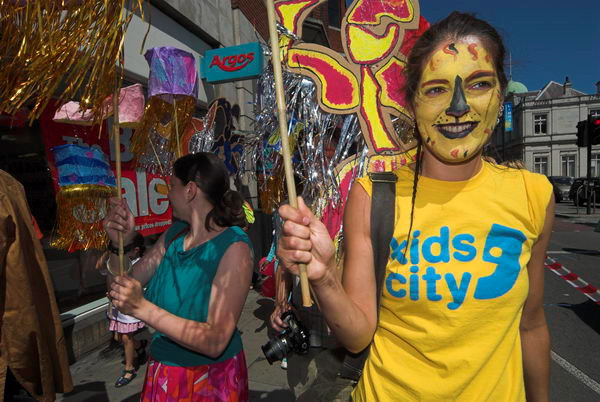
Streatham Festival held it’s first ever Children’s Parade, children working with artists from Arts Community Exchange and Kids’ City to create sculptures, banners and puppets for all to see.

Streatham, Spain and Guantanamo

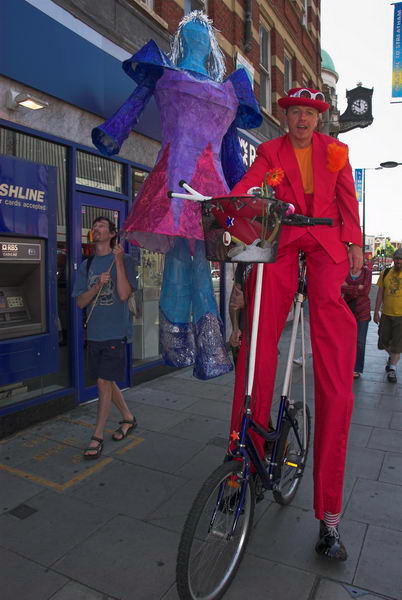
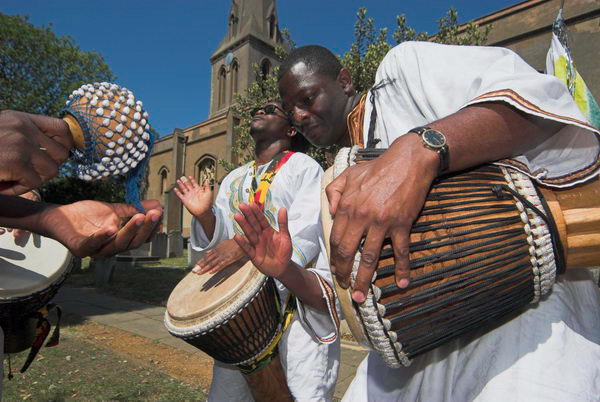
The parade was led by drummers Ancestral Hands and a cycling stilt-walker brought up the rear as it went along Streatham High Road to St Leonard’s Church.

Streatham, Spain and Guantanamo

One of my pictures from this parade was used in the remarkable The Streatham Sketchbook by Jiro Osuga and Mireille Galinou with photography by Torla Evans which was published in 2017 by Your London Publishing. Still available, this was described by Graham Gower of The Streatham Society as “superb and one the best books to be published on Streatham as a place – if not the best.”

more pictures


International Brigade Commemoration – Jubilee Gardens, Waterloo

Streatham, Spain and Guantanamo

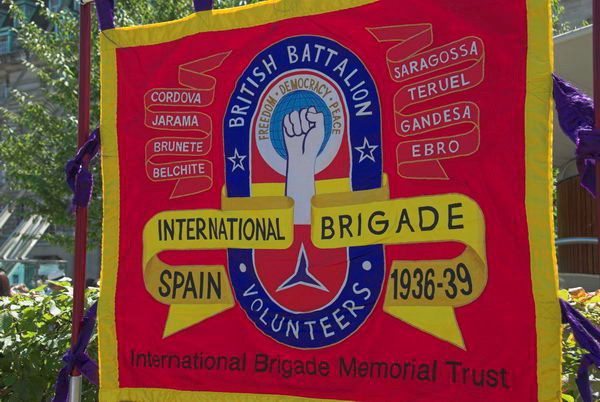
I’ve attended and photographed a number of the annual commemorations of those who went to fight the fascists in Spain in 1936-9, but this 2006 event was the most memorable. Here’s what I wrote about it in 2006.

Jack Jones

Several hundred people attended the annual commemoration at the International Brigade Memorial in Jubilee Gardens London Organised by the International Brigade Memorial Trust on Saturday 15 July.

Bob Doyle

Between 1936 and 1939 over 35,000 men and women, from more than 50 countries, volunteered for the Republican forces. Of the 2,300 who came from Britain, Ireland and the Commonwealth, over 500 were killed.

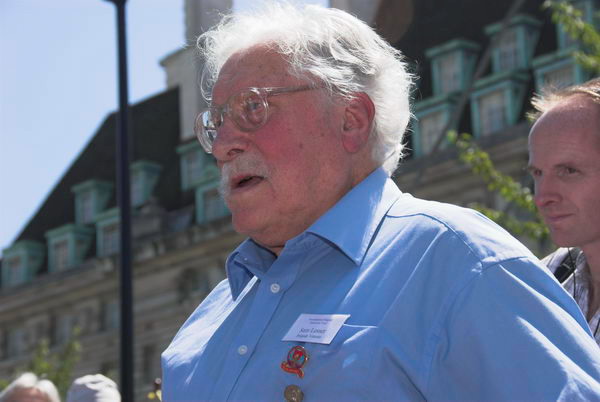
Sam Lesser

Volunteers came largely from working class areas across the country. most were members of communist organisations or otherwise active in the trade unions and other socialist bodies, and their average age was 29.

Jack Edwards

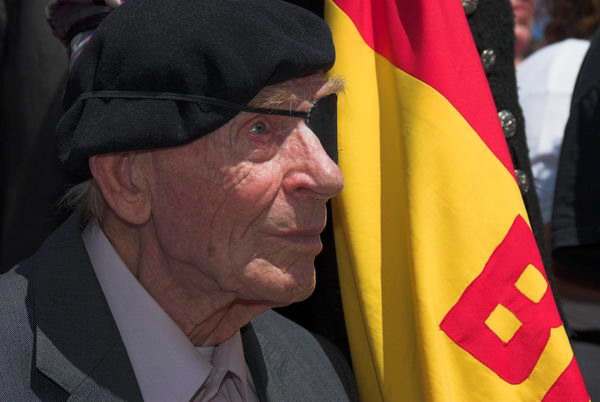
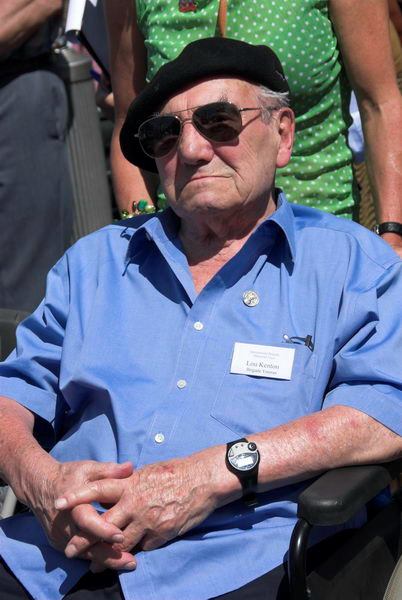
Seventy years later there are relatively few still alive and active enough to attend the commemoration, but it was good to see seven there. They were Jack Jones who chaired the event, Sam Lesser who spoke and read, as well as Bob Doyle, Paddy Cochrane, Lou Kenton, Jack Edwards and a surprisingly spry Penny Feiwel. As usual there was a reading of the names of those known to have died since the previous year’s meeting.

Penny Feiwel

Rodney Bickerstaff’s address raised the problem of keeping alive the memory of those who responded to the call to help the Spanish republic, but attendances at this annual event seem to have increased over recent years.

Lou Kenton

There was certainly more media interest than on previous occasions, in part because of the attendance of the Spanish Ambassador and his wife, reflecting the increasing interest from Spain; he also gave a brief speech. As was pointed out, it would have been nice to have a representative of the UK government also present.

Paddy Cochrane

As usual, the event concluded with the singing of the ‘Internationale’.

More pictures on My London Diary

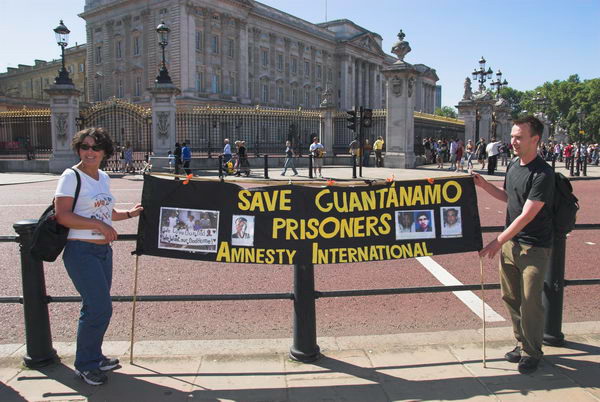
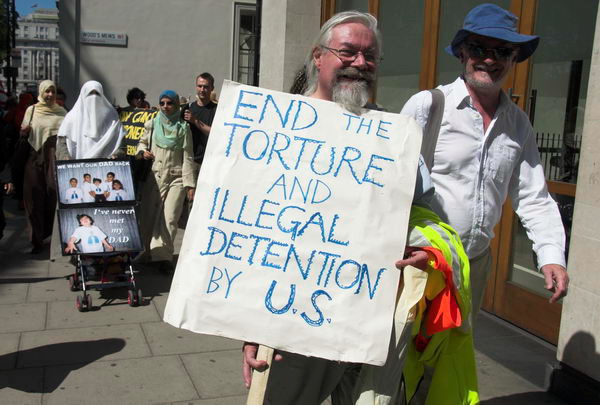
Shut Guantanamo now!

The National Guantanamo Coalition had called for a national demonstration in London to protest the deaths of three Guantanamo detainees earlier in the month.

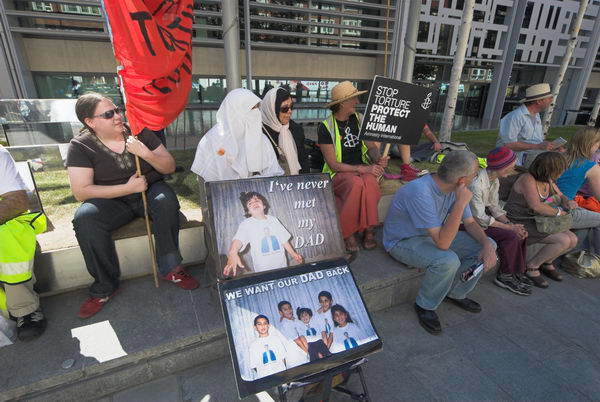
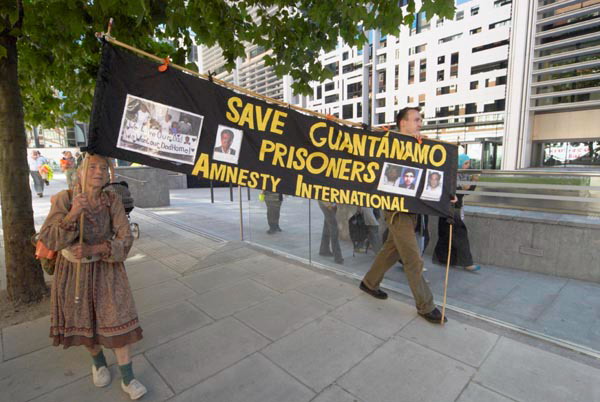
A group of protesters, mainly from the ‘Save Omar Deghayes’ campaign, but also representing other organisations, walked across London from Marble Arch to the new Home Office building in Marsham Street to hand in the petition calling for an independent enquiry into the three recent deaths at Guantanamo. The petition also calls for the immediate sending of all detainees to countries where their basic human rights would not be abused, an immediate closure of Guantanamo and other prisons where those held were denied proper legal process and for proper access to detainees by family and medical personnel.

It was a long, hot and dusty trek across London, particularly tricky for those with pushchairs as we navigated the Hyde Park subways, and we were all glad to arrive (thanks to helpful directions from the police) at the Home Office. The front of the building was like an oasis, shade, green grass, water and trees.

The police did make us get off the grass and also made some effort to stop the display of placards and banners, but most of these remained visible. They had also attracted some attention from the crowds around Buckingham Palace as we passed by.

more pictures

FlickrFacebookMy London DiaryHull PhotosLea ValleyParis
London’s Industrial HeritageLondon Photos

All photographs on this page are copyright © Peter Marshall.
Contact me to buy prints or licence to reproduce.

Swan Upping – 2008

Swan Upping: On Monday 14 July 2008 I caught a train back from Hull so as to be back in Staines in time to meet the Swan Uppers as the last boats in the flotilla were leaving the Swan in Staines (or Egham Hythe) after stopping for lunch.

Swan Upping

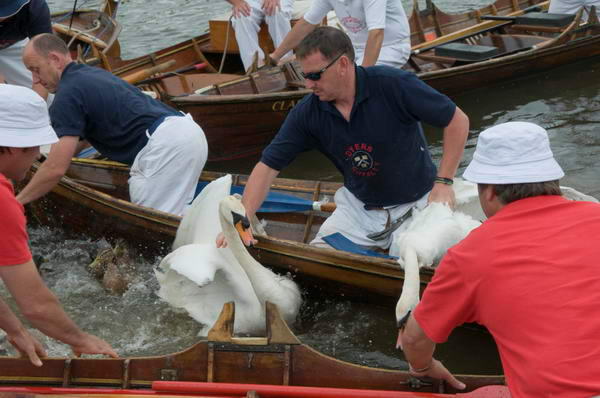
Every July two groups of Thames Watermen make their way upstream from Sunbury to Abingdon following a tradition established not long after the Norman conquest, though the earliest clear written records only date back to 1186.

Swan Upping
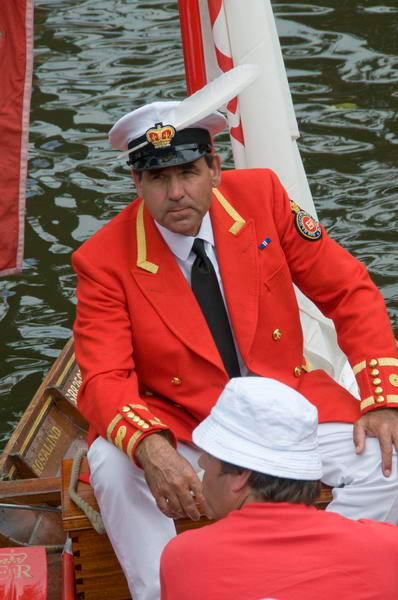
The Queen’s (now King’s) Swan Master David Barber

Ownership of swans is still controlled by ancient laws, with the Crown claiming ownership of all unmarked swans on open water.

Swan Upping

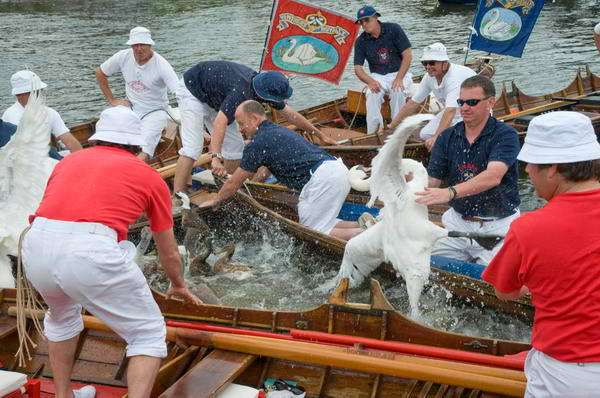
In medieval times, swans, or rather cygnets, were an important source of food and many had the right to own swans. Upping in those times was a way of establishing ownership and taking some cygnets to be fattened for the tables, but leaving enough birds to maintain the swan population at a healthy level. The upping was done in July when the cygnets were still too young to be able to fly away and escape.

Swan Upping

Today only three bodies apart from the Crown have maintained the right to own swans, a family with a Swannery on a lake in Abbotsbury and two London Livery companies who exercise their rights on those on the Thames.

The Vintners were officially granted their rights in 1472 and the Dyers at around the same date, though their right was then granted ‘by prescription’, a legal term meaning they had had the right as long as the law could remember – officially since the accession of Richard I in 1189.

Over the years chickens and ducks which could be easily farmed replaced swans as a source of food, and swans are now a protected species and it is illegal to kill them. The Royal Family may still retain the right to eat them, along with the fellows of St John’s College, Cambridge but neither body now does so.

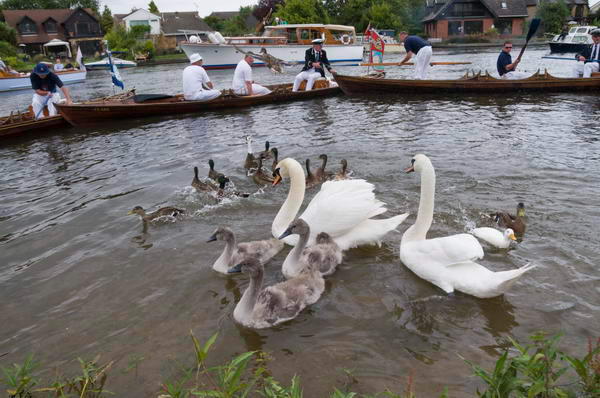
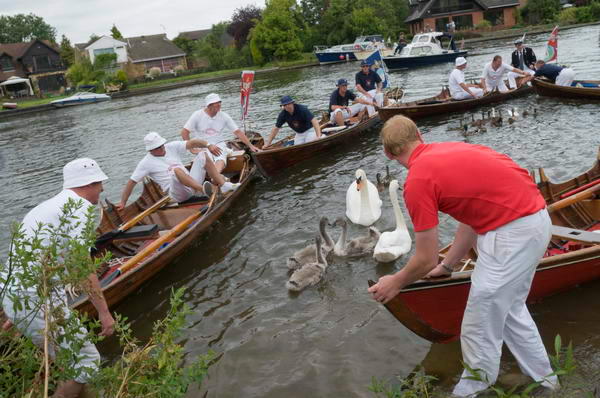
In more recent times, Swan Upping has come to play “an important role in the conservation of the mute swan and involves the King’s Swan Warden collecting data, assessing the health of young cygnets and examining them for any injuries.” The cygnets claimed by the Dyers and the Vintners used to have their beaks nicked with distinctive marks, but now the birds are simply ringed and their weight and length recorded before being returned carefully to the river, where they swim away apparently unaffected by their experience.
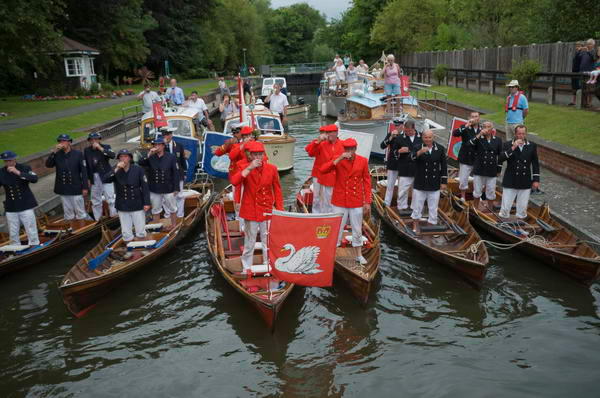
Six Thames skiffs rowed by watermen, two boats each for the Royal Swan Uppers, the Dyers and the Vintners make their way upstream, keeping a lookout for swans with cygnets. They wear red shirts for the Royals, blue for the Dyers and white for the Vintners.

Back when I first photographed the Uppers, most of the scouting for cygnets was actually carried out by an elderly man on a bicycle who I got to know slightly, and I rode along behind him. When Eric saw the birds he would try to entice them to a suitable spot on the bank with the help of crushed digestive biscuits.

In more recent years, a small dinghy with an outboard motor carrying the Warden of the Swans, on Oxford professor, has often driven a little ahead of the fleet to locate the swans. The ancient post of Keeper of the Kings Swans had been split into two new posts in 1993, the other part being the Marker of the Swans, who is rowed in one of the Royal skiffs.

Following behind the skiffs is a small flotilla of river cruisers, which includes a launch for the press. I did once book a place on this, but my place was cancelled shortly before the event when the major agencies and newspapers took an unusual interest, I think because the royals were taking an unusual interest.

But for most purposes, cycling along the towpath is the best way to cover the Swan Upping, and I was often there on the bank minutes before those on the press launch were able to land and join me. And the bank was usually the best place to be, closer to the action than the press launch could get.
At the end of the day the skiffs line up together in Romney Lock where the men put on their jackets and stand up in their boats to toast the Sovereign’s health.

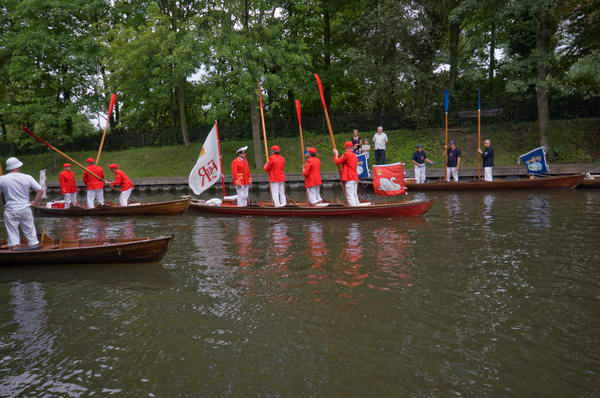
From Romney lock I ran around a quarter of a mile along the riverside path where the Dyers and Vintners stand in their boats with oars vertical to salute the Royal uppers who go past between them with their oars raised, before all six boats row off to the boathouse at Eton, with another 4 days of upping ahead of them.

More pictures from the 2008 Swan Upping on My London Dairy where you can also see many more pictures from previous years:

Details of this year’s Swan Upping which begins on Monday 15th July 2024 are on the website of the Swan Marker to His Majesty the King. If the weather is good I might stroll down and take a few pictures.


FlickrFacebookMy London DiaryHull PhotosLea ValleyParis
London’s Industrial HeritageLondon Photos

All photographs on this page are copyright © Peter Marshall.
Contact me to buy prints or licence to reproduce.