London 1980 (2)

More black and white images I made in 1980 and which I posted day by day on Facebook a year or so ago, along with comments and stories


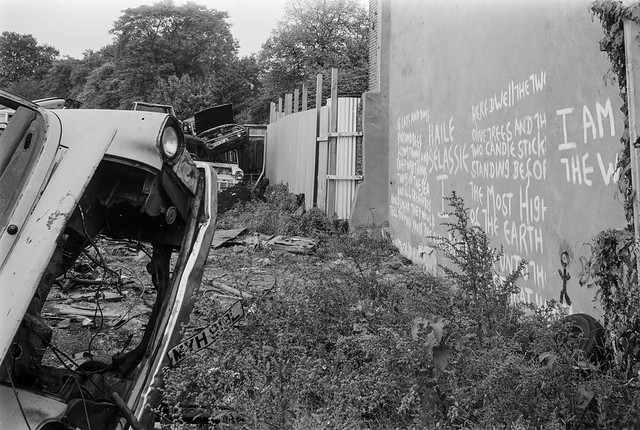
Mural, Vauxhall, Lambeth. 1980
23j-33: mural

http://londonphotographs.co.uk/london/1980/23j-33.htm

The mural announcing the presence of Vauxhall City Farm has I think long gone, and there has been considerable development of the buildings there. It now seems to me obviously to be a picture I should have taken in colour, and possibly I did, though quite likely I had only a single camera with me loaded with black and white film.

This picture was taken on a Minox EL, a tiny 35mm camera hardly large enough to take the film cassette, with plastic case whose front folded down pulling out the lens into position. Said to be the smallest 35mm camera in the world, it had a 35mm f2.8 lens, weighed only 200g and fitted into even a shirt pocket. For over 20 years one of these cameras (I got through 3 or four) went with me more or less everywhere.

They weren’t cheap (they were distributed by Leica in the UK) and were tricky to use, and the auto-exposure was often unreliable – later I found it worked better if you held the camera upside-down. The first one I bought just couldn’t take sharp pictures, and I sent it back to Leica, who wrote a rather snooty letter saying there were no performance specifications for the lens, but did exchange it for one that was tack-sharp. A few years later, that stopped working after it jumped out of my pocket when I was cycling to work and I got it replaced on insurance (and a hefty jump in premiums the following year.) When I had to send that one back to Leitz they said it was beyond economic repair but sold me a replacement at cost.

The Russians liked the Minox 35mm cameras so much they produced their own exact copy, the Kiev 35A, and I expect their spies still carry one on their visits to English cathedrals.


Duck pond, Vauxhall City Farm, Vauxhall, Lambeth. 1980
23j-33: ducks, pond, farm,

http://londonphotographs.co.uk/london/1980/23j-46.htm

Rather more buildings along the riverside are now visible across Vauxhall Pleasure Gardens from Tyers St than when I took this picture, but the backs of the houses on Kennington Lane are still recognisable, and the shops along their front have changed only a little to reflect the increasing gentrification of the area – at had at least last time I walked along there from the station to take a camera in to Fixation. The buildings on the green have also been replaced by a newer block along Glyn St.

The area in the distance, where only two blocks of buildings appear has become one of the fastest growing areas in London. I think the block right of centre might be the Nine Elms Cold Store, closed in 1979 but not demolished until the late 1990s, but cannot identify the block at left. There are now high rise buildings covering almost the whole of Nine Elms with more still being built. Along with expensive flats for foreign investors there is also expensive student housing built to lower standards but equally tall.

I think the duck pond with its duck house (presumably less ornate than MPs can afford on their expenses) has also gone, with new building on the City Farm site and an expansion of the farm estate.


Jesus, Mornington Crescent, Camden, 1980
23l-65: graffiti, horse trough,

http://londonphotographs.co.uk/london/1980/23l-65.htm

Another picture of the faded message on a horse trough which I wrote about in an earlier post.


Lillieshall Rd, Clapham, Wandsworth. 1980
23q-56: house,

http://londonphotographs.co.uk/london/1980/23q-56.htm

The house here was clearly a corner shop in use as an off-licence and it can still be seen on the corner with North St, though now simply housing. The adverts, including that covering the window at right, are long gone.

It was that faded upper sign advertising ‘RADIO REPAIRS’, and under it what I think must have once been the word ‘EXPERTS’ above the blanked out doorway that attracted me to take the picture of what was otherwise a very ordinary Victorian working-class building, typical of the area.

I’m surprised I didn’t take a picture of the whole side of the building, which actually has three such doors in a row, only the central one in use, each with a window above. But probably only the window in my picture was covered by advertising, and I suspect that the lens on my Leica simply did not have a wide enough view to show all three.

I also failed to photograph the now listed former “Tim Bobbin” pub, just down Lillieshall road, named after the Lancastrian schoolmaster, caricaturist and dialect poet who called himself the Lancashire Hogarth, and was a schoolmaster and notorious drinker born in Urmston who lived and died in Milnrow on the edges of Rochdale, where he is buried in St Chad’s Churchyard, his gravestone carrying the epitaph “Jack of all trades…left to lie i’th dark” he wrote for himself minutes before his death.

I don’t know why he should be celebrated by a pub in Clapham (there is one in Burnley too) nor why the owners should have decided around ten years ago to change the name to ‘The Bobbin’ and replace his rather pleasant portrait on the pub sign to a rather less interesting silhouette.


Death to Fascism, Bus Shelter, Battersea, Wandsworth. 1980
23t-32: house, graffiti,

http://londonphotographs.co.uk/london/1980/23t-32.htm

I can’t at this remove remember why I was wandering around South London taking pictures with the Minox on a day in April 1980, but I’m fairly sure I had not gone out with the main intention of taking pictures, otherwise I would have picked up the Leica or possibly my Olympus OM-1.

There must have been some other reason for my being there, and obviously having some time to spare. One possibility is that I had gone early and decided to walk from Queen’s Road Battersea to a meeting or exhibition at the Photo Co-op in Webbs Road in Clapham, which had started the previous year, rather than take the shorter walk from Clapham Junction.

As usual at the time I have no record of exactly where I was, and this street is fairly typical of many of the wider streets in the area, with its late Victorian housing. Only the main roads are this wide and have a pavement where I could get back far enough to make a picture like this with the 35mm lens.

I suspect I will have waited some time, not for the bus, but for people at the bus stop to arrange themselves rather better in the frames provided, but with little luck, and I think made this exposure as the bus the bus was about to arrive, knowing they would board.

Obviously it was the graffiti that attracted my attention. The large white letters of ‘DEATH TO FASCISM’ are easy to read in this small image but the smaller black ‘Kill A BLACK TODAY’ is perhaps harder to read.


House, Battersea, Wandsworth. 1980
23t-51: house,

http://londonphotographs.co.uk/london/1980/23t-51.htm

This is a section of a terrace somewhere in the Park Town estate in Battersea, around Queenstown Road, built up from the 1860s by James Knowles junior, one of London’s early organised and managed estates. Though well conceived it was not a great financial success, as the middle-classes for whom it was intended rather looked down on the pollution from the adjoining railways to north and east, and the estate was then re-purposed towards more working class artisan tenants.

Probably this property – a ‘six-roomed’ house – with external decoration to make it look rather grander than it was – was built as the three flats the doorbells now indicate, one on each floor. Much has been written about the estate, which led down to the rather grander buildings of Cedars Road and the North Side of Clapham Common.


Broughton St, Battersea, Wandsworth. 1980
23t-53: house, pub, church, hall

http://londonphotographs.co.uk/london/1980/23t-53.htm

This corner of Broughton St and St Philip St, looking towards Queenstown Road is still recognisable, though the Market House pub is now a private house and the RIdley Hall at the right of the picture has been rebuilt as Ridley Hall Evangelical Church, though in a similar design.

I took two frames with the Minox, with a fairly similar composition, but while the other was a little more upright, this is sharper. They were obviously taken within a few seconds, though the film wind on the camera was rather difficult to do at any speed, as neither the two men on the street corner or the group further down the street appear to have moved, but the cars are a few yards further down the road in the other image.

The ladders on the handcart reminded me of my father who often used a similar conveyance to take his ladders, paint, tools and occasionally beehives around Hounslow (and sometimes further afield) until his retirement in the late 1960s. By 1979 this was becoming rather less common, though one still saw window cleaners and others who had not yet acquired vans.


To be continued…

London 1980 (1)

It may not have escaped your notice that we are approaching Christmas and the New Year. This is a time when I may not be at a keyboard every day and will be concentrating on other things than writing posts for this site. But also when those of you who read it (and about 4,500 pages are currently read each day) will perhaps want something to entertain you when suffering from an excess of Turkey and mince pies.

Those of you who follow me on Facebook will know that for some time I have been posting an image and its story from my black and white work in the 1970s and 80s each day. But FB is pretty ephemeral, although it keeps a record of everything we post, comment or like to aid its profit-making activites, anything we posted more than a few minutes ago soon becomes hard to find. So as I’ve done previously I’ll post a series of digests here on >Re:PHOTO, where it is always easy to search the archives, and search engines should be able to find content. So here we go with the first set from 1980.


Jesus, Mornington Crescent, Camden, 1980
23i-15 factory, graffiti, horse-trough,

http://londonphotographs.co.uk/london/1980/23i-15.htm

I didn’t see this graffiti until it was faint, though its message was still clear, on the southern corner of Mornington Crescent. The wall is still there, though I can see no trace of ‘JESUS’, and the wall is now kept in better condition, doubtless having been painted several times since – and there is now a gate at its left.

The game ‘Mornington Crescent’ had made its first appearance on ‘I’m Sorry I Haven’t a Clue’ in August 1978, around 18 months before I made this picture, and it was doubtless in my mind on my wandering walk from Central London via St Pancras in February 1980 which took me to the street from which the Underground station and the great game were named.

The wall is at the end of the ‘Black Cat factory’, the former Arcadia Works of the Carreras Cigarette Factory, one of the finest remaining Art Deco buldings in London, controversially built between 1926-8 on the communal garden of Mornington Crescent. Designed by M.E and O.H Collins and A.G Porri, the long building (168m) was where Craven ‘A’ cigarettes were made, and the logo of the company, a rather domestic looking black cat, was reflected in two large Egyptian cats on each side of its entrance. High along the frontage, above the Egyptian-style pillars were a row of the trademark-style black whiskered moggies. But back when I made this picture, the factory was in a poor state, the decorations stripped when it had been converted to offices in 1961. The two giant Egyptian cats, representations of the Egyptian cat god Bast had been shipped out when the factory closed in 1959 to stand in front of other Carreras factories in Basildon and Spanish Town Jamaica. Apparently Carreras had originally planned to call the factory after Bast (aka Bastet) but then realised that everyone would refer to it as Bastard House.

Years later I got a shock when sitting on a bus going up the Hampstead Road, and had to rub my eyes and pinch myself to be sure I was not dreaming as I passed the factory restored to its former glory (almost) and with two black cats again guarding its entrance. The factory had been bought by a new company in 1996 who had restored it to an excellent replica of its Art Deco original. And had doubtless painted out any remaining traces of ‘JESUS’.


Fire Engine, Mornington Crescent area, Camden, 1980
23i-21: graffiti,

http://londonphotographs.co.uk/london/1980/23i-21.htm

Situsec seems to be a company which supplied asphalt and similar materials and made road repairs, but I can’t remember exactly where this picture of one of their yards was taken, though earlier in my walk I had been on Phoenix Road in Somers Town and a couple of frames later I was photographing painting on a fence on a corner site on Mornington Place for the Albert St Carnival. This yard was somewhere in my wandering between the two.

The walls are tall and thick, with buttresses; that in the foreground appears to have been built up with a thinner extension, which can also be seen on the rear wall, above which another brick structure, with arches roughly doubles the height to something like 20 ft, suggesting a building on a truly giant scale, which in this area suggests it was a part of some major work connected with the railways, either around St Pancras or Euston.

Clearly the wall on which the fire engine was painted has been fairly crudely breached since it was painted to provide or widen the entrance to the yard, where some cars are parked and notices on the wall read ‘Soft Sand’ and (I think ‘Sharp Sand’, though only a couple of letters of this are visible.)


Is Innocent O.K., Mornington Crescent area, Camden, 1980
23i-22: graffiti, shop,

http://londonphotographs.co.uk/london/1980/23i-22.htm

In 1974 the message ‘G Davis is Innocent, OK’ began to appear on walls, bridges and elsewhere across the country, protesting the innocence of the east London minicab driver jailed for his part in an armed robbery. Police were caught out as having lied to get his conviction, making up a statement he was alleged to have made, fiddling the results of ID parades, deliberately ignoring evidence. His conviction was clearly unsafe, and almost certainly he was innocent of that particular robbery at the London Electricity Board’s offices in Ilford for which the police had fitted him up – and for which he was the only man convicted.

Of course, though innocent of this particular crime, Davis was a villain, and within a couple of years of his release in 1976 by Royal prerogative he was back in jail again, this time admitting his guilt, for an armed robbery at the Bank of Cyprus on the Holloway Rd.

The graffiti in this picture was clearly inspired by this case, though who was innocent I clearly intended to remain anonymous, with only the final ‘OUS’ of the name in frame, next to the former shop at no. 54. Which street this was on is also something of a mystery, and I think the house in question has probably been so altered as to be unrecognisable.


Circus, Mornington Buildings, Camden, 1980
23i-24: graffiti,

http://londonphotographs.co.uk/london/1980/23i-24.htm

Mornington Buildings were on Mornington Place, I think at its corner with Mornington Terrace, and were in process of demolition when I photographed this painted fence. At its left are two posters for the ‘Albert St Carnival’, too small for the details to be clearly read, but which had I think been on the 14th July, probably from the previous year, 1979, and for which I assumed the painting had taken place.

The 2nd Earl of Mornington was the elder brother of the Duke of Wellington and became Governor-General of India, defeating the French there and making it a part of the British Empire. During the Napoleonic wars, by now Marquess Wellesley, he became ambassdor to Spain. By the time this estate was being developed in the 1820s he was made Lord Lieutenant of Ireland.

FB comment by Ken Bates: There was 2 separate blocks for Mornington Buildings, the larger block was on Mornington Terrace (now Clarkson Row), this block went right up to the corner with Mornington Place. There was then a gateway into the grass area behind it before the smaller block that was in Mornington Place.


Corner Cafe, Phoenix Rd/Midland Rd, Camden, 1980
23i-32: cafe,

http://londonphotographs.co.uk/london/1980/23i-32.htm

It should be easy to locate an image which contains a street sign and a street number, but although the street sign says Phoenix Road NW1, this is misleading, and this picture was made at the corner of what is now Brill Place and Midland Rd. The 1894 OS map actually calls the road Phoenix St, and shows a railway line crossing it – which I think the arch at extreme left was supporting – leading to the goods yard now the site of the British Library and Francis Crick Institute.

The Brill was the area between Euston Square and Kings Cross Station, getting its name from a tavern there and had a Sunday market where the many navvies in the area would come to buy their boots and clothing. Why the pub was called ‘The Brill’ seems a mystery; perhaps it was from the fish of the same name, or some connection with the Buckinghamshire village (there is a Brill in Cornwall too as well as Den Briel in the Netherlands, and it is also a Dutch family name) or was the word ‘brilliant’ just too long to fit on the inn sign?


Corner Cafe, Phoenix Rd/Midland Rd and gas holders, Camden, 1980
23i-33: cafe, gas holders, traffic light,

http://londonphotographs.co.uk/london/1980/23i-33.htm

A second picture of the Corner Cafe makes its position clear, showing both the gas holders on the corner of Wharf Rd and Cambridge St (now Camley St) and the road under the railway lines from Midland Rd that led to them, though the scene has now changed completely with the rebuilding of St Pancras Station to provide a shopping precinct which makes the walk from the Underground platform to get on a train much longer, something I curse every time I use the station.

The site of the cafe is now a rather neglected piece of land at the edge of the parking area for Neville Close. The gasholders are no longer on their original site and have flats inside them and St Pancras station now extend much further to the north.


Shop fitting, Camden, 1980
23i-52: plastic sheet,

http://londonphotographs.co.uk/london/1980/23i-52.htm

Much of what people think of as central London is a part of the London borough of Camden and I think this shop being fitted out was somewhere in the area roughly between Trafalgar Square and Monmouth St, and the next frame on the contact sheet (not shown on this site) is in Monmouth St, with the name board for ‘Neon’ and the ‘ghost sign’ next door for B Flegg, saddlers. This picture could well also have been in Monmouth St.

I walked around this are fairly often when visiting the Photographers’ Gallery, then on Great Newport St. In 1980 it acquired a second space a couple of doors down from the original premises. As well as showing some great photography (and particularly in later years some rather less great) it also had a cafe where you could sit and look at one of the shows, as well as meeting people.

Somehow it seemed a much friendlier place than the much improved new premises on Ramillies St, and I often met people – staff and other visitors I knew there, and it seemed rather easier to talk with strangers, who were always a part of a wider photographic community.

As well as visiting to see the shows, as entry was always free you could drop in while passing for another look – or just to have a coffee or even just use the toilets – I also used to go with some of my pictures to a ‘young photographers’ group which met regularly there and to which sell-established photographers often dropped in to give their opinions too. Though we learnt much and enjoyed it, these meetings were clearly something the gallery’s education officer, who was responsible for them found an ordeal, with much questioning of some of the gallery’s practices and more. When London Independent Photography came along in 1987 she clutched to them as a lifebelt to end the group.


To be continued…


All photographs on this and my other sites, unless otherwise stated, are taken by and copyright of Peter Marshall, and are available for reproduction or can be bought as prints.

GLIAS 50

I think I joined the Greater London Industrial Archaelogy Society (GLIAS) in around 1979, forty years ago, but it had then been going for 10 years. I’ve not been the most active of members, particularly in recent years when I’ve been too busy with other things, but over the years I’ve been on numerous walks, several outings, attended talks and lectures and even made some tiny contributions. I still enjoy reading the newsletters and occasional publications of the group.

The various walks usually took me back to areas of London I’d already explored when taking photographs, and they often made me much better informed about buildings I had already photographed. I’ve not been on any lately as they almost always take place when I’m now working. But in previous years, the walks were often followed by the publication of small walk leaflets giving the route and pointing out the IA features.

The first of these walk leaflets was for Tower Hill to Rotherhithe and this anniversary event more or less retraced its steps, led by one of the two original authors, Prof David Perrett, now Chairman and Vice-President of GLIAS. It was a walk I’d first taken – without the aid of the leaflet – in the opposite direction back in 1983 (though I’d photographed parts of the area previously) and quite a few pictures from that are now online on my London Photographs site.

This area on Bermondsey Wall has changed considerably since then, though the riverside of Wapping seen at the top of the image still looks much the same. Of course you can’t see it from this same point, which I think is now occupied by expensive flats.

Inspired by these walk leaflets I went on to produce one of my own, a folded A4 sheet printed on thin card by my laser printer, largely as an exercise in Desktop Publishing which I was then teaching a course on.

Over the next few years I made and sold over well over 500 copies, charging I think 20p for each of them, though I never got the cash for some that were sold locally in Bermondsey (it rankled though the money was insignificant.) My best paying customer was a local historian who used them for several years for the guided walks he did on the local area. I think it is now seriously out of date, but ‘West Bermondsey – The Leather Area‘ has for a long time been available as a free download. (PDF)

The first time I put images from the area on line was in a site called ‘London’s Industrial Heritage‘, designed for me by my elder son, and you can see some pictures from this area from the links on the Southwark page.

I haven’t put many of the pictures from the walk on My London Diary, but there are a few more at GLIAS 50th anniversary walk. If you live in or around London and have any interest in industrial archaeology you would find GLIAS worth joining – and it has a very reasonable annual subscription of £14 (£17 for family membership.)


All photographs on this and my other sites, unless otherwise stated, are taken by and copyright of Peter Marshall, and are available for reproduction or can be bought as prints.

There are no adverts on this site and it receives no sponsorship, and I like to keep it that way. But it does take a considerable amount of my time and thought, and if you enjoy reading it, please share on social media.
And small donations via Paypal – perhaps the cost of a beer – would be appreciated.


Wapping & the Thames

I arrived early for a private celebration of May Day with friends in a Wapping pub and took a short walk along the High St and riverside path, where I sat and ate my lunch sandwiches.

I’d made photographs here in the 1980s, and there were one or two that I’d hoped I would be able to fix the locations more precisely. It wasn’t easy as vitually everything between Wapping High Street and the river has been rebuilt with expensive riverside flats. New Crane Wharf (above) was still recognisable as here the old buildings had been converted.

The Thames sweeps around to the south to go around the Isle of Dogs, and from Wapping you can see Canary Wharf to the North of the River and the gasholder in Rotherhithe to the south – and both appear in photographs to be across the river.

You also see rather too much very pedestrian riverside architecture like the flats above. So little new building on the river bank has any architectural merit, all about maximising profit within the planning restrictions. It’s such a shame that the LDDC didn’t have higher aspirations for its control of the redevelopment of docklands.

Relatively little of the old riverside survives here, and Tunnel Mills and the other buildings at Rotherhithe are one very welcome exception. There are parts of the north bank too where some of the better warehouses have been saved, converted into expensive flats.

It was good also to be able to walk out onto Tunnel Pier, where I met two old friends also taking advantage of the opportunity.

And though the Captain Kidd pub to the left of Phoenix Wharf is relatively modern, dating from the 1880s, like many Sam Smith’s pubs it is a sensitive conversion of an old building, Sun Wharf, which along with Swan Wharf (now renamed Phoenix Wharf) and St John’s F & G Wharf at left were owned or leased by W H J Alexander and Company, who as well as wharfingers dealing in a wide range of goods including coffee, dried fruit, gum and bales of Australian wool, also used these premises to repair their tugs. Swan Wharf I think is the oldest of these buildings, dating from the 1840s and possibly designed by Sidney Smirke.

More pictures at Wapping and the Thames .


All photographs on this and my other sites, unless otherwise stated, are taken by and copyright of Peter Marshall, and are available for reproduction or can be bought as prints.

There are no adverts on this site and it receives no sponsorship, and I like to keep it that way. But it does take a considerable amount of my time and thought, and if you enjoy reading it, please share on social media.
And small donations via Paypal – perhaps the cost of a beer – would be appreciated.


Big School Strike for the Future

School students can see clearly the threat that faces the planet – especially with some predictions that human life will be extinct on Earth before they reach middle age. I’ve never expected to be still alive in 2050, though it’s just about possible, but these people clearly should be – but quite likely won’t if we continue “business as usual“.

But its also good to be with them and to feel the energy they have, and the enthusiasm they show. As well as in the actions on the day it comes out too in the many placards. There are some mass produced from the usual culprits, Socialist Worker and the Socialist Party, but even the SWP have produced a decent one for the cause, with a nice Wave and the message ‘System Change Not Climate Change’. But clearly there are many schools where the art department is full of people making their placards.

We clearly are at a point where we need drastic change, and are unfortunately stuck with dinosaurs in charge, fiddling about with Brexit and internal party politics (both Tory and Labour) while the planet almost literally burns.

We won’t of course go on like this. It’s a simple choice, change or die, and one that has become far more critical since I first got up in front of a microphone almost 50 years ago and said we can’t go on like this. We now know much more in detail about what is going on.

Police tried to stop the protesters at the end of the Mall, but while a crowd gathered in front of their line, others coming up behind simply swarmed around the sides and ran across the grass to get to the Victoria Monument in front of Buckingham Palace.

The police gave up and the others came through to gather around the monument, and their were speeches from several of the protesters to a tightly packed crowd – and I managed to squeeze my way through to take photographs. Mostly I was so close that the fisheye became almost essential, though the one at the head of this post was made with the 18-35mm at 18mm.

After the speeches there was something of a lunch break, with people making their way along various routes back towards Parliament Square – I chose the shortest way – where some protests continued. The largest block made its way over Westminster Bridge and then turned to the east; I left them on Stamford St, deciding I’d walked far enough, but they were still going strong.

London Schools Climate Strike


There are no adverts on this site and it receives no sponsorship, and I like to keep it that way. But it does take a considerable amount of my time and thought, and if you enjoy reading it, please share on social media.
And small donations via Paypal – perhaps the cost of a beer – would be appreciated.

All photographs on this and my other sites, unless otherwise stated, are taken by and copyright of Peter Marshall, and are available for reproduction or can be bought as prints.

To order prints or reproduce images


Million Women March

I photographed the first of these all-woman Million Women Rise marches in London in 2008, and have covered the event in most or all years since, always on a Saturday close to International Women’s Day. It’s an event that is supported over a hundred human rights and women’s groups around the country and is “led and organised by a majority of black women” and also includes many from other minority ethnic communities.

It’s an organisation that welcomes support from men in various ways, but on the day of the march asks them to “come and stand on the pavement and cheer us on.” And I do, though most of the time I’m too busy taking pictures to actually cheer.

Their web site has a list of ten demands, beginning with:

To acknowledge the continued discrimination faced by all women, the additional discrimination faced by Black women and women from other minority groups, and reflect this in all public policy in the UK and internationally

Million Women Rise web site- http://www.millionwomenrise.com/demands.html

I took pictures in the side road where the march gathered, where the marchers spill over onto the pavement and I could mix a little with the marchers before the march began, but for the march itself I stayed on the side as requested.

One slightly different aspect of this years march was the Pan Indian Dance Group who danced their way along Oxford St at the rear of the march – and I think went on to dance at the rally in Trafalgar Square, but by then I had left the event.

More pictures: Million Women March against male violence


There are no adverts on this site and it receives no sponsorship, and I like to keep it that way. But it does take a considerable amount of my time and thought, and if you enjoy reading it, please share on social media.
And small donations via Paypal – perhaps the cost of a beer – would be appreciated.

All photographs on this and my other sites, unless otherwise stated, are taken by and copyright of Peter Marshall, and are available for reproduction or can be bought as prints.

To order prints or reproduce images


London 1979 (7)

Continuing the series of posts showing work taken in London in 1979 as posted to Facebook with comments an image at a time in the first half of 2018.

Previous post in London 1979 series
______________________________________________________

London Photographs 1979 – Peter Marshall

This set of pictures is a little unusual in that they are all in portrait format and I think I must have set myself a small challenge. Almost all cameras  (except those that use a square format) have always been designed so that the natural way to use them is in landscape format.  Of course it isn’t hard to turn a camera through 90 degrees, but it can foten be rather tricky to find a good way to hold it steady and release the shutter smoothly.


Blackfriars Railway Bridges and pier Blackfriars Bridge, City, 1979
19j-24: river thames, pier, bridge, railway,

There were then still two rail bridges at Blackriars, with the nearer one at left being the Alexandra Railway Bridge built by engineer Joseph Cubitt (1811-1872) for the London, Chatham & Dover Railway around 1864. The river piers were groups of three cast-iron cylinders clad in stone and filled with concrete and some can still be seen, but the track and bridge girders on top of them were removed in 1985. The bridge led from the original Blackfriars Bridge station on the south bank to Ludgate Hill station which was closed in 1929. The track continued north on a bridge across Ludgate Hill which was removed in 1990 and replaced at a lower level by a tunnel leading into City Thameslink station.

Blackfriars Railway Bridge, also known as St Paul’s Bridge was completed in 1886 to lead to St Paul’s station, now known as Blackfriars. It is still in use and now has an impressive array of solar panels on top of it. There is now an entrance on the south bank too.

Although the Alexandra bridge pillars remain, not all are visible. They were in sets of three, one on each side and one in the centre of the bridge. Only the upstream two of each triplet remain visible with the third encased in a new concrete coating and used to support a widened Blackfriars rail bridge.

The pillar at right is of the Blackfriars Road Bridge, another built to a design by Joseph Cubitt. Opened in 1869 it replaced an earlier bridge of 1769, the third bridge across the Thames, after London Bridge and Westminster Bridge. To enable navigation the three Blackfirars bridges were required to be built with their piers aligned. The piers carry stone carvings by by sculptor John Birnie Philip showing birds, with those on the seaward side here showing marine life and seabirds.

Blackfriars Bridge was often said to be the point where the freshwater Thames met the saline tidal river, though of course the river is tidal for some miles further upstream – now to Teddington lock, though without this the tides would flow further.

But in earlier years the tide was restricted by the narrow arches of the old London Bridge, and before there was any real human intervention and the Thames spread more widely probably only travelled as far as Vauxhall.


St Paul’s Cathedral from Bankside, Southwark, 1979
19j-42: wall, church,

This wall was on Bankside, but and was a temporary flood defence, before the Thames Barrier was completed in 1982. These temporary barriers were later replaced by permanent ones which are I think rather less high.

One of the sillier pages on the BBC web site tries to answer the question ‘Why was the Thames Barrier built’ with the answer “In 1953 a very bad flood covered 160,000 acres on Canvey Island and killed 300 people in Essex. That forced the UK government to appoint a committee to look at flooding. The solution was the Thames Barrier, built at a place called Woolwich Reach.”

Which was not in any way going to help Canvey Island, miles further downstream, but has so far done a good job in preventing flooding upstream of Woolwich.


Temporary river wall, Bankside, Southwark, 1979
19j-43: river thames, foreshore, wall, Randall Webb, photographer

Another view of the wall makes clear that it was a flood barrier, as well as showing the late Randall Web, once a friend of mine, struggling with his camera. We were both members of something called Group 6, a small group of photographers from the Richmond and Twickenham Photographic Society who came to an evening meeting once a week to talk photography and arranged monthly outings on Sundays to take photographs – on one of which these pictures were taken. In 1982 we arranged our first group exhibition, later breaking away from the RTPS as Framework and producing a number of shows.

Randall myself and Terry King had been sitting together in a row in a meeting of the Richmond & Twickenham Photographic Society when an elderly former advertising photographer. a Mr Steinbock from Maidenhead delivered a lecture, showing us one of the small prints (“little gems”) that he had for many years exhibited in the annual Royal Photographic Society shows.

Though I didn’t much care for the picture, the idea of making non-silver prints like his gum bichromates intrigued us all as he described in some detail how he made them. I was teaching chemistry, and the store where I worked had an embarrassingly large stock of potassium dichromate, and I liberated a couple of surplus jars, one for my own experiments and the other as a gift to Terry.

Terry went on to became one of the best-known people in alternative processes, making prints, running workshops and organising conferences, while around 20 years later Randall Webb was co-author with Martin Reed of ‘Spirits of Salts: A Working Guide to Old Photographic Processes’.

I made one or two gum prints, and rather more with other alternative processes – cyanotype, kallitype, platinum, salted paper and more – before deciding that I was rather more interested in photography than alternative printmaking.


Wall, Bankside, Southwark,1979
19j-45: wall,

I can’t recall what the substantial wall at the right had been built around, but by this time it was a derelict site. The horizontal planks filling a doorway were I think highly coloured and probably around the site on which the modern reconstruction of the Globe, named “Shakespeare’s Globe”, opened in 1997, thanks largely to the efforts of Sam Wanamaker and the Shakespeare Globe Trust he founded.


Clown on Wall, Bankside, Southwark,1979
19j-46: wall, drawing, graffiti

Another wall close to the future site of the replica of Shakespeare’ Globe Theatre, with a picture of a clown. There was also another theatre in the area.


Lee Brothers, Borough Market, Southwark,1979
19j-62: railway arch, potato merchant, market

Although this sign has apparently been photographed and put on the web by every living photographer or tourist strolling through Borough Market with a phone or digital camera, not one of the links on Google gives any more information about Lee Brothers. Although the sign is still there they are not to be found in the list of traders, which moves from L’Ubriaco Drunk Cheese to Le Marché du Quartier without them.

I can add very little. Lee Brothers (Borough Market) Limited was only incorporated as a private limited company with share capital in 1987, some years after I made this picture and it is now dissolved. The stall below their sign in Bedale St has for some years been part of the fruit and veg wholesaler and retailer ‘Turnips’ run by Fred and Caroline Foster.

At the time I was probably more interested in the shaft of sunlight and the shadow on the road. I made two virtually identical frames with the same slight lean to the right, which suggests it was deliberate, though I can’t see why


Park St, Southwark,1979
19j-65: granary, store, warehouse, bridge,

15 Park St is next to the railway bridge.

There are faint residues of text about the right hand door, two lines which appear to end ..N.’ but I can make out nothing more. Later it read ‘Perot Export[ateur]’ which I suspect was probably added above the low door for a film made using this building. There are also faint traces of text at the right of this door, where later was the text, attributed to Banksy, ‘This is not a photo opportunity’, now also long gone, probably worn off my the number of times it was photographed. I think I resisted the opportunity.

Slightly more legible when I took this picture in 1979 was the ‘ghost image’ above the window at left which reads

‘KRA…..
GRANARIES

but I can’t tell you how the upper word, presumably a name, ends.

The building has appeared in a number of films but is probably best known from the hilarious film ‘Lock, Stock and Two Smoking Barrels‘ (1998) which centred around it. By then it had been considerably renovated.

______________________________________________________
More to follow shortly

Continuing the series of posts showing work taken in London in 1979 as posted to Facebook with comments an image at a time in the first half of 2018.

Previous post in London 1979 series

______________________________________________________

The pictures in this series of posts are exactly those on London Photographs, where landscape format images display slightly larger. Clicking on any picture will go to the page with it on the web site.

I have included the file number and some keywords in the captions; you can order a print of any picture on this site using the file number.
Order details and prices

______________________________________________________

There are no adverts on this site and it receives no sponsorship, and I like to keep it that way. But it does take a considerable amount of my time and thought, and if you enjoy reading it, a small donation – perhaps the cost of a beer – would be appreciated.

My London Diary : London Photos : Hull : River Lea/Lee Valley : London’s Industrial Heritage

All photographs on this and my other sites, unless otherwise stated, are taken by and copyright of Peter Marshall, and are available for reproduction or can be bought as prints.

To order prints or reproduce images

________________________________________________________

London 1979 (6)

Continuing the series of posts showing work taken in London in 1979 as posted to Facebook with comments an image at a time in the first half of 2018.

Previous post in London 1979 series
______________________________________________________

London Photographs 1979 – Peter Marshall


Jubilee Walk marker post, Southwark, 1979
19i-23: warehouse,St Paul’s Cathedral, bridge, wharf

The drunken marker post was a little to the north of Southwark Cathedral, just north of Montague Place, where there is still an open area on the riverside with a river view, though from where I took this picture now blocked by the modern office building which replaced West Kent Wharf and a part of Hibernia Wharves which had recently been demolished when I made this picture.

At top left you can see the riverside corner of St Mary Overy Wharf, with its decorative balustrade, and in giant letters the name of its occupiers from 1890 for the rest of its working life as a wharf, Cole & Carey.

Beyond the Cannon St rail bridge you can see some of the buildings of London, including of course St Paul’s Cathedral.

The Silver Jubilee Walkway, opened by the Queen in 1977 was renamed the Jubilee Walkway and refurbished in 2002. The 15 mile walk is now marked by plaques in the pavement and I think few if any of these original marker posts remain. It has been divided into five shorter lengths suitable for tourists.


Demolition West Kent & Hibernia Wharves, Southwark, 1979
19i-33: rubble, St Paul’s Cathedral, bridge, wharf, Hibernia, West Kent

Hibernia Wharf, built in 1838 was greatly extended 1858-61. It later became part of the property of The Proprietors of Hay’s Wharf who used it as a cold store until around 1968. A small part of the facade on London Bridge was retained and built into a company hall for the Worshipful Companies of Launderers, Glaziers and Scientific Instrument Makers, a late replacement for their Glaziers Hall burnt down in the Great Fire of 1666.

This was I think one of a number of pictures of the area (including some others already posted here) in a small one-person show on Southwark’s riverside I had in the Barge House, behind the OXO tower, no great distance from where the picture was taken. Although the show was small, the pictures were large, printed A0, and worked surprisingly well for 35mm at that size. Later I took some of those prints, along with other smaller prints I had made from elsewhere for a show of London’s Industrial History.


Demolition West Kent & Hibernia Wharves, Southwark, 1979
19i-41: rubble, Cannon St, bridge, wharf, Hibernia,

A huge pile of timbers from the wharves was burning on the demolition site. At left through a little smoke is St Mary Overy Wharf and across the river you can see Cannon St Station and Mondial House, then Europe’s largest international telecommunications complex. Planned in 1970 to open in 1972, it was years late in completion. Built with upper storeys stepped back to ensure it didn’t obstruct views of St Paul’s Cathedral and with a maximum height of 46m it had 4 floors below ground in addition to the 8 above.

In 2006 UBS was granted permission to demolish Mondial House to build its huge Watermark Place project with 545 000 sq ft of office and retail space. 1 Angel Lane is now occupied by Japanese investment bank Nomura International.


Demolition West Kent & Hibernia Wharves, Southwark, 1979
19i-46: rubble, Cannon St, bridge, wharf, Hibernia,

Another image from the demolition of West Kent & Hibernia Wharf. The building still standing behind the smoke at right is St Mary Overy Wharf.


Demolition of Hibernia Wharf, Southwark, 1979
19i-54: rubble,St Mary Overy, bridge, wharf, office, crane,

Further east on the demolition site, with London Bridge and Adelaide house visible through the smoke. Near the centre is the NatWest tower, constructed for the National Westminster Bank and occupied by them between 1980 and 1993, Richard Seifert managed to change the London building guidelines to erect the first extremely tall building in the City, 183m high and 47 floors, it was the tallest building in London until 1 Canada Square was built in 1990, and the tallest in the city until the Heron tower in 2009.

It was only actually completed almost ten years late after NatWest moved out; and its design from the air was supposed to resemble the NatWest logo. In 1993 it was severely damaged by IRA bomb and needed to be externally re-clad and internally refurbished, costing £75 million. NatWest decided not to move back in and sold it to UK property company Greycoat, who renamed it Tower 42 in 1995, the name a reference to the 42 upper stories which are cantilevered out from the base.


Demolition at Hibernia wharf, Southwark, 1979
19i-55: rubble,St Mary Overy, bridge, wharf, office, crane,

Another picture from a similar viewpoint


St Mary Overy wharf, Southwark, 1979
19i-65:wharf, office, crane,

Still standing in 1979, St Mary Overy Wharf was soon to be demolished and replaced by some rather dull buildings of roughly similar mass but with little detailing or individuality. It seems a shame that at least this facade was not retained.


St Mary Overy dock and River Thames, Southwark, 1979
19i-66:wharf, dock, river, offices, monument

There is still a dock here, now with a replica of Sir Francis Drake’s Golden Hinde, built in Appeldore and launched in 1973, since when she has been sailed around the world and on various other voyages before ending up- here as a tourist attraction.

I’m not sure the dock is in exactly the same place, and I think the mouth at least is rather narrower. The wharf on the left has now also gone, with its replacement set further back to provide a pedestrianised area and a beer garden at the riverside.

______________________________________________________
More to follow shortly

Previous post in London 1979 series

______________________________________________________

The pictures in this series of posts are exactly those on London Photographs, where landscape format images display slightly larger. Clicking on any picture will go to the page with it on the web site.

I have included the file number and some keywords in the captions; you can order a print of any picture on this site using the file number.
Order details and prices

______________________________________________________

There are no adverts on this site and it receives no sponsorship, and I like to keep it that way. But it does take a considerable amount of my time and thought, and if you enjoy reading it, a small donation – perhaps the cost of a beer – would be appreciated.

My London Diary : London Photos : Hull : River Lea/Lee Valley : London’s Industrial Heritage

All photographs on this and my other sites, unless otherwise stated, are taken by and copyright of Peter Marshall, and are available for reproduction or can be bought as prints.

To order prints or reproduce images

________________________________________________________

London 1979 (4)

Continuing the series of posts showing work taken in London in 1979 as posted to Facebook with comments an image at a time in the first half of 2018.

Previous post in London 1979 series
______________________________________________________

London Photographs 1979 – Peter Marshall


Wembley Stadium, Brent, 1979
19g-46: tree, sign, railing

Although I went to Wembley Stadium in 1979, I found little or nothing the the actual stadium area that interested me, making a few pictures of steps, shadows, sheds and signs, but really nothing of the actual stadium. I suspect I felt too many pictures had already been taken of it.


Palaces of Industry, British Empire Exhibition site, Wembley, Brent, 1979
19g-52: building, concrete, reinforced, derelict

I had come to Wembley to try photograph these derelict buildings which were built in 1922 and 1923 for the British Empire Exhibition of 1924 -25, probably because some of them were about to be demolished shortly I’m not quite sure exactly which buildings I photographed, and although some were demolished in 1980, the last only went in 2013.

Although they had been built for the temporary exhibition, their reinforced concrete made them difficult to demolish, and they had only remained there so long because it would have been expensive to get rid of them. I think this is one of the buildings that was still standing and being renovated when I returned three years later and took some more pictures on Engineers Way.

The Empire exhibition was important in accelerating the development of the surrounding areas of north-west London, much of which soon became covered with suburban housing in the years up to the second war.

The area is I think totally unrecognisable now, with about the only remaining building being the 1934 Empire Pool (now Wembley Arena), which I think I photographed a few years later.


Palaces of Industry, British Empire Exhibition site, Wembley, Brent, 1979
19g-64: building, concrete, reinforced, derelict,

A second picture of the derelict concrete buildings, apparently left standing after the exhibition as it was too expensive to demolish them.

I think I probably took rather more than the handful of pictures in the area during this visit than have survived, and suspect that one of the films that I took may have been ruined by a camera or cassette fault or in processing. Although it is possible to lose digital images though card or hard disk problems – and to delete them by human error, digital is in many ways more reliable than film, not least because you can see some or your mistakes on the back of the camera.

In the 70s and 80s I was always short of cash, and loaded almost all the film I used into cassettes from bulk 100 ft lengths. I used a ‘daylight loader’ which mean that a short length at the end of each film was exposed in attaching it to the cassette spool, though later I learnt to do this part of the procedure in total darkness to avoid this. Re-using cassettes led to occasional problems with light leaks. Sometimes I used plastic bodied cassettes made for reloading – and these had caps which were quite easy to twist off – sometimes too easy. The metal bodies used by Ilford and most other films had ends which popped off when you squeezed the cassettes and could be re-used but could get too easy to remove with repeated use. (Kodak’s were crimped on and needed a can opener to remove and were not re-usable.)

All normal cassettes used felt light-traps on the opening where film emerged and films might be ruined by scratches if grit was caught in these from loading the camera in a dusty place, and we had to try hard to keep them clean when reloading them. Those fabric light traps were not intended for repeated use and this sometimes led to leaks. Leica used to have their own metal re-usable cassette which worked without a light trap, the with a slot opening up inside the camera, but it was hardly practical.

Processing too had its traps. Developers not stored in air-tight containers could react with oxygen in the air and become less active or even entirely useless (though normally they went brown to show this.) Some were meant to be re-used, and careful counting of the number of films developed was necessary to avoid them becoming too weak. As mentioned in a previous post I had to abandon some developers as simply too unpredictable.

One of my late friends, a professional photographer who did a number of jobs for a leading oil company magazine, was flown out by helicopter by them to photograph their North Sea Oil rigs. It was an extremely long and tiring day, and on reaching home she loaded the films into a multiple tank to develop them. After she poured the first chemical into the tank she realised she had poured in the fixer rather than developer. (Fixer is the chemical used to dissolve the undeveloped silver halides from films after development as most photographers will know.) The films were ruined, and she had to go in the next day and confess to her client. Fortunately for her, she had worked for them on many previous assignments and they appreciated her work, and they arranged another helicopter to take her out and make the pictures again. That time she made sure she got the processing right.


22 St Agnes’s Place, Kennington, Lambeth, 1979
19h-22: house, decoration,

Friends of mine lived in a council flat a few minutes walk across Kennington Park from St Agnes Place. Lambeth Council had wanted to demolish the street to extend the already large park in 1969, but the properties were squatted and the demolition stopped. The council again tried to demolish them in 1977 but the residents resisted. There was considerable national publicity and a High Court injunction stopped the demolition, and the fight led to the defeat of the Conservative Lambeth Council and the resignation of its leader.

Some properties had been demolished, but the core of the street remained, with many of the houses having been renovated by the squatters. The area had become well known for its Rastafarian community and Bob Marley stayed there several times in the 1970s. Despite some local rumours, spread by some councillors, it always seemed a safe place when I was there, and a haven for many homeless and was a lively cultural centre, though I never attended any of the many free parties there or photographed other activities. It housed a Rastafarian temple and at least in later years it was the home of pirate radio stations Wireless FM and Rasta FM.

The residents formed a housing cooperative and paid their utility bills but Lambeth Council continued to try to evict them, obtaining a possession order in 2003 but failing to enforce it when the residents put up barricades. Two years later the council came back with a High Court order, which meant they could bring in the riot police; this time the residents who had decided only to put up a token show of resistance left peacefully. Most of the street was demolished, with just one property, the Rastafarian temple, remaining for a couple of years until police raided it for drugs and the occupiers were evicted. The council had said they would come to some kind of agreement with the temple occupiers, but reneged on that promise and the demolition was completed in July 2007. The drugs trial collapsed with all defendants being found not guilty.

Just two of the original 3-storey and basement terrace houses remain on the street, still joined to four smaller terraced properties of a similar age on one side,. Further down the street where the properties I photographed were are some newer properties, with more building still taking place. The site of the Rastafarian temple was at one time marked by some decorative paint on the railings, but I think these have now been painted over by the council, but the street no longer runs along quite the same route as it did.


The 12 Tribes of Israel, St Agnes’s Place, Kennington, Lambeth, 1979
19h-23: house, decoration,

The houses at 28-34 St Agnes Place were occupied by different groups from the Rastafari community for over 30 years. A thriving hub for the Rastafari community it became recognised as the Rasta International Headquarters.

First squatted in 1969, the remaining premises were closed after a police drugs raid in 2007, where the police made several arrests, but all were found not guilty as the case against them collapsed in court. Some people said that the drugs raid came after a dispute between residents that led to some giving false stories that crack cocaine dealing was taking place. Cannabis use plays an important role in Ratafarian religious ceremonies, used to enhance spirituality and promote unity. They interpret various Biblical references to the ‘herb of the field’, the ‘herb of the land’ and ‘The tree of life’ as meaning ganja (marijuana) and regard the prohibition of its use as an attempt by Babylon to impose an improper restriction on people’s religious freedom. Not all Rastas use ganja, and many condemn its irresponsible use simply to get high.

For those of you who don’t have your Bible at your side, Genesis 49 is where Jacob brings together his sons before his death and blesses them, giving instructions for his funeral, and in verse 28 in the King James version reads:

All these are the twelve tribes of Israel: and this is it that their father spake unto them, and blessed them; every one according to his blessing he blessed them.


Symbols, St Agnes’s Place, Kennington, Lambeth, 1979
19h-24: house, decoration,

It’s a shame that this photograph was not taken in colour, and much as I loved black and white photography and its ability to abstract, to render light and shade, express through form and line with a clarity that usually evades colour photographs, I often think that black and white was something of an aberration, an artifact resulting from the scientific basis of photography. If the efforts of Talbot and Daguerre had resulted in colour images, would anyone ever have bothered to invent black and white photography?

There were people in the 1840s who claimed to produce colour images – and did, but any relationship between the colours in their images and those of the subject was purely accidental, the colours being random freaks of chemistry and physics. Since all early photographic processes were only sensitive to the blue end of the spectrum, producing realistic colour was impossible. Though prints could be and were made in almost every colour though were seldom if ever black and white. Hand-colouring too dates back to the early years of photography, and particularly with the aid of computer technology can look very realistic, but is never authentic.

You can of course convert colour images to black and white, and there have been a few occasions when I have done so, realising at the time of taking or afterwards that a particular image would be stronger in b/w. Back in the darkroom days there was even special panchromatic printing paper made for the purpose, as normal black and white photographic paper is only sensitive to the blue end of the spectrum; printing from colour negatives on it needed lengthy exposures and gave rather odd tonal results.

Once we could scan negatives or transparencies it became much easier, and various software emerged, often as Photoshop plugins, which could make the conversion to black and white resemble more closely the tonalities of b/w film. With digital cameras it became simpler still, and with my Fuji cameras I can now – should I want to – actually view the world in black and white as I take pictures, with the Acros film simulation providing me with a truly filmic view and enabling me to digitally apply yellow, red or green filters.

Under extreme low light conditions or when my finger twiddling has led accidentally to seven stops of underexposure I’ve occasionally had to convert to b/w to get usable images, but otherwise it’s not a feature I’ve yet taken advantage of. And I find it intensely annoying when some younger photographers who have never learnt to use b/w convert their colour images in the hope that it somehow makes them more seriously documentary.

The Star of David would I think almost certainly have looked better in colour, and also those stripes and the door frame.


Writing by window, St Agnes’s Place, Kennington, Lambeth, 1979
19h-25: house, decoration, writing,

There was a great deal of writing on the walls here, and much of it – as in this picture – is misogynistic. It’s perhaps best that you can read only a little in this small reproduction, though enough is legible to get the general drift and of course it is clear on the larger original.

One of the more polite texts about women reads ‘Blessed is the man who can terrorise a woman with a look’, but there are also other subjects. One that rather appeals to me states ‘If there was anything in the world worth having – I would not want it’.


Doorway, St Agnes’s Place, Kennington, Lambeth, 1979
19h-34: house, decoration, writing, Rastafarian,

A wider view of the doorway to 28 St Agnes’s Place, the Rastafarian temple and Rasta International Headquarters (which included three houses, 24-28.)

As so often I ask myself why I did not take more pictures of the street, which I often walked through.

______________________________________________________
More to follow shortly

Previous post in London 1979 series

______________________________________________________

The pictures in this series of posts are exactly those on London Photographs, where landscape format images display slightly larger. Clicking on any picture will go to the page with it on the web site.

I have included the file number and some keywords in the captions; you can order a print of any picture on this site using the file number.
Order details and prices

______________________________________________________

There are no adverts on this site and it receives no sponsorship, and I like to keep it that way. But it does take a considerable amount of my time and thought, and if you enjoy reading it, a small donation – perhaps the cost of a beer – would be appreciated.

My London Diary : London Photos : Hull : River Lea/Lee Valley : London’s Industrial Heritage

All photographs on this and my other sites, unless otherwise stated, are taken by and copyright of Peter Marshall, and are available for reproduction or can be bought as prints.

To order prints or reproduce images

________________________________________________________

London 1979 (3)

Continuing the series of posts showing work taken in London in 1979 as posted to Facebook with comments an image at a time in the first half of 2018.

Previous post in London 1979 series
______________________________________________________

London Photographs 1979 – Peter Marshall


Vauxhall City Farm, Vauxhall, Lambeth 1979
18u-64: house, city farm, fence,

This was the original entrance in St Oswald’s Place and was replaced by a new building in 2015. I think the street was fairly narrow and for once the tilt of the camera was deliberate.


Hymn and goat, Vauxhall City Farm, Vauxhall, Lambeth 1979
18u-65: house, city farm, fence,

The farm had been tidied up since my visit ten months earlier – even the goat looks better groomed. The ‘HYMN’ was still there on the wall.

The contact sheet tells me that I took this and the previous image on 27th January, working with my Olympus OM1 and even details the development (D76 diluted 1:1 9 mins) which seems fairly short. The film was Kodak Safety film 5063 better known as Kodak TRI-X Pan Film.

Many photographers, particularly amateur photographers, using film spent long years experimenting with different developers, times and dilutions and exposure ratings, particularly those who got caught up in worshipping Ansel Adams and his Zone System. I dabbled a little, though you could only be a true aficionado if you used sheet film and exposed and developed each exposure separately depending on the lighting conditions. But using 35mm there were some compromises, particularly if a film was exposed under different lighting conditions and perhaps over several days or weeks. But many of us learnt to base exposures on shadow detail (using spot metering when time allowed) and tried to develop for the highlights. When the Olympus OM4 came out in 1983 it’s metering system made placing the shadows rather easier.

Different developers had different effects on film too, and different dilutions altered these. Some gave finer grain by dissolving some of the image, while others gave increased sharpness by edge effects (acutance.) Some enabled you to increase developing times while increasing the density of the darker areas of the negative less than others, enabling you to ‘push’ films, exposing them at higher film speed settings on camera or meter.

Developers varied from the bog-standard neat D76 favoured in the deep tanks in many professional darkrooms and regularly replenished as film after film went through to esoteric magic formulae sold in ampoules opened and diluted immediately before single use. Over the years I used quite a range of them, making some up myself from the ‘raw chemicals’, and publications such as the British Journal of Photography Annual used to have a selection of photographic formulae in their end pages.

My various experiments taught me several things, particularly that some developers were more reliable than others. One I used for some time enabled me to rate Tri-X at ASA2000, under-exposing over two stops, and produce prints from 35mm that led one club judge to comment that “it’s good to see that some ‘workers’ are still using medium format”. But I gave it up as sometimes films would come out with densities too low to be printable for no apparent reason. D76 was dependable, diluting it with equal amounts of water for single use solved any problems of deterioration with infrequent use, and also gave a slight increase in sharpness by reducing its solvent effect, and bought in bulk it was cheap.

Later I more or less standardised development, and much of my later black and white photography was in any case using chromogenic films developed in the standard C41 developer.


Regent Lion Filling Station, Coptic St, Camden, 1979
19c-16: house, petrol, filling station, Islington

Rising at the top of the picture is the unmistakable tower of St George’s Bloomsbury, but I had long forgotten the exact location of the Regent Lion Filling Station. I took it as the first of four frames before getting to St Chad’s St in the area to the south of King’s Cross, and I had long thought this picture must have been near there.

But I had walked some distance with the Leica M2 around my neck, and that this picture was taken on Coptic St, just to the south of the British Museum. Though the petrol pumps and the building above them have long gone, the building at the right edge of the picture is still recognisable on the corner of Museum St and Bloomsbury Way.

The company was incorporated in 1955 and appears to have been dissolved some time in the 1990s. The Regent trademark had a long history in petrol outlets, beginning with Burt Boulton & Haywood, a small independent distributor who had a wharf and chemical works at Prince Regent’s Wharf which is now the Thames Barrier Park. They were bought up by Trinidad Leaseholds in 1930, and post war they merged with Texaco and later Caltex, reverting to Texaco in 1967, who discontinued the use of the brand name for most of the outlets, though it was revived for special uses in 2004. The Regent Oil Company were also on Canvey Island and the site changed its name to Texaco at some point but is now closed.

Regent were one of several companies who sold road maps under their name from the 1930s to the mid 1960s, though later these were sold as Texaco or Chevron (another Texaco brand).


Hotel, St Chad’s St, Kings Cross, Camden, 1979
19d-15: house, hotel, cars

Little visibly has changed from when I took the picture, though parking is now more restricted and there are cycle lanes along St Chad’s St. The hotels have gone up a little in the world (and rather more in price) and look rather better cared for. The hotel sign is still there, but repainted with different text.

At the time this was London’s most celebrated red-light district, and a short walk away is Holy Cross, Cromer St, occupied by the English Collective of Prostitutes for 12 days in 1982 in a protest against intimidation and false arrests of prostitutes on the streets of the area by police under the 1959 Street Offences Act. Police were reported to be demanding free sex, demanding money, assaulting or beating up women and colluding with pimps to extract more money from the women.

The area – the Battle Bridge estate – went down in the world quickly after it was developed in the 1820s and 30s, with drunkenness and vagrancy common by the 1840s. When Kings Cross, Euston and St Pancras Station were built they brought in more people and more vice, both customers and prostitutes, some of whom were alleged in later years to commute to the area on ‘Have It Away Day’ tickets.

It was the arrival of drugs that really brought the area down, adding syringes to the local street detritus and fuelling both prostitution and petty crime by those desperate to feed their habits. Fast food too began to litter the streets, and in the 70s the area was probably at its lowest.

There were also huge development plans for the areas around Kings Cross, and later I became involved for several years with the King’s Cross Railway Lands Group, an independent community organisation that campaigned for 25 years until 2013 to “make sure that the people who live, work or study in the King’s Cross area are involved and benefit from its re-development.”


The White Shop, Whidborne St, Kings Cross, Camden, 1979
19d-21: shop, school, mural,


The White Shop, Whidborne St, Kings Cross, Camden, 1979
19d-24: workshop,

Whidborne St is a small street which links Argyle St which was part of the Battle Bridge estate of the 1830s to Cromer St in the area just south of St Pancras and Kings Cross stations, and this end of it north of Argyle Walk is something of a relic from the mid-nineteenth century, left when the slums of the Cromer St area were redeveloped by the East End Dwellings Company in the 1890s, some of whose tenements are at the left of the frame. The street it thought to have got its name from one of the directors of this company.

The White Shop at 6 Whidborne St is said to have been at one time the house of the headmistress of the Argyle Primary School which is at the right of the picture, though its small size and plain design makes it look more like a caretaker’s house. Two school entrances (not now in use) at the left of the shop are still present. The school was built as Manchester Street School (this part of Argyle St was known as Manchester St until some time in the early 20th century) in 1880 and later had links with Mary Ward and the 1897 Passmore Edwards Settlement in Tavistock Place which provided after-school activities for poor children until their parents left work.

The White Shop became a butcher’s shop “belonging to a Mr William Johnson” and when I photographed it in 1979 was still selling frozen foods and ‘Quality Meat’. It was converted into 2 flats in the 1990s, but later reverted to a single dwelling and plans for a rear extension and a mansard roof extension were passed in 2014. The conversion looks neat but the roof is rather out of character with the plain stock brick Victorian original.

Opposite, behind me as I took this picture was the Duke of Wellington public house, its address originally 33 Manchester St which became 5 Whidborne Street WC1. It has now become the Irish themed McGlynn’s.


Whidborne St, Kings Cross, Camden, 1979
19d-22: workshop,

A man in a white shirt stands leaning his back against the first floor window of a small block-shaped building on Whidborne St, one of two similar blocks (the other is wider) with a narrow yard behind the brick wall between them. Both have wide doors to the street, either to admit a hand cart or on the other block a horse-drawn vehicle.

I think these were all premises of C E Norris & Sons, and across the top of the building at the south end of the yard (which I think I may have photographed in colour, but can’t currently find the slide) was the slightly misleading text:

C.E. NORRIS & SONS LTD
OFFICES – 73/5 KENTON ST. W.C.1
PHONE – TER. 4577

Kenton St is a short walk away, off Tavistock Place on the other side of Judd St, and the offices were separate from this complex which I assume was the builder’s yard for the private registered company, incorporated in 1932. Members of the Norris family appear to have resigned from the business in 1991 and it applied for and was granted voluntary striking off in 2001, but was restored in 2013 though it does not seem to have submitted returns or accounts to Companies House.

The properties are probably late Victorian and today seem little changed except in use. The street sign is Whidborne St, WC, and thus comes from before the introduction of sub-districts as a wartime measure to increase efficiency in 1917.


River Thames and Westminster Bridge, Westminster from temporary Hungerford Bridge, Westminster, 1979
19f-13: river, bridge, houses of parliament, offices,

This view is now one that we can see any day, but back in 1979 it was unusual, usually only glimpsed between the girders of Hungerford Bridge as your train rolled in or out of Charing Cross station. The Hungerford footbridge was only on the downstream side of the railway bridge, but in 1979 repairs were needed and it was closed and a temporary bridge built hanging to its upstream edge.

London’s skyline has changed considerably since 1979, particularly with new tall blocks along the riverside, but most of the buildings here are still present, though the cold store at Nine Elms has been replaced by other, even taller buildings.


River Thames and Westminster Bridge, Westminster from temporary Hungerford Bridge, Westminster, 1979
19f-14: river, bridge, houses of parliament, offices,

A second picture, taken closer to the South Bank, shows the Embankment well before the London Eye. County Hall, then still occupied by the GLC, faced the Houses of Parliament across the river, a few years before Margaret Thatcher’s fit of pique put London’s government into disarray which the city has still not quite recovered from.

The boats moored in the river include the Chay Blyth, named after the first person to sail single-handed, non-stop westwards around the world in 1971, and now described as “one of the more traditional passenger boats operating on the Thames” but then relatively new, having been built in 1972 by Thomas W Hughan & Co Ltd at Point Wharf Greenwich, part of Delta Wharf just to the north of Victoria Deep Water Wharf. They built quite a few small vessels over the years, including many barges and apparently also the replica 1890’s Mississippi stern-wheeled Paddle Steamer Elizabethan. The company was dissolved in 1985.

______________________________________________________
More to follow shortly

Previous post in London 1979 series

______________________________________________________

The pictures in this series of posts are exactly those on London Photographs, where landscape format images display slightly larger. Clicking on any picture will go to the page with it on the web site.

I have included the file number and some keywords in the captions; you can order a print of any picture on this site using the file number.
Order details and prices

______________________________________________________

There are no adverts on this site and it receives no sponsorship, and I like to keep it that way. But it does take a considerable amount of my time and thought, and if you enjoy reading it, a small donation – perhaps the cost of a beer – would be appreciated.

My London Diary : London Photos : Hull : River Lea/Lee Valley : London’s Industrial Heritage

All photographs on this and my other sites, unless otherwise stated, are taken by and copyright of Peter Marshall, and are available for reproduction or can be bought as prints.

To order prints or reproduce images

________________________________________________________