Ten Years Ago – 3 Dec 2021

City Xmas Celebrations
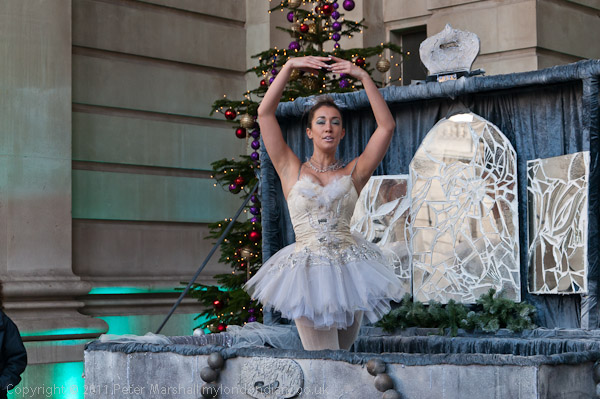
I thought I’d see how the City of London was celebrating Christmas and took a few pictures of a real life Music Box in front of the Royal Exchange before going inside and being told I couldn’t take photographs. And although I’d been told there were free drinks I think they were only available for the kind of people who looked as if they would spend vast amounts on the luxury items being sold inside. I went out and walked towards St Paul’s Cathedral, pausing briefly to photograph a band and Santa who had come with a couple of reindeer who seemed rather small to me for his lengthy journey.

City Xmas Celebrations


Occupy LSX Climate Justice Workshops

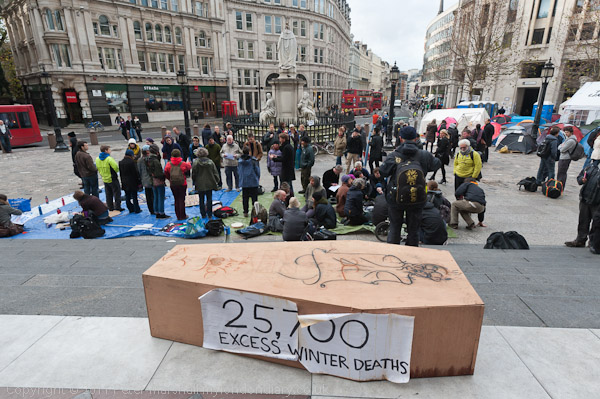
On the steps of St Paul’s Cathedral was a plain coffin with the message ‘25,700 EXCESS WINTER DEATHS’, a rather lower figure than that I photographed at last week’s Fuel Poverty Action protest – last winter the number was 63,000. Of course this can’t all be put down to 10 years of Tory austerity, and Covid will have played a part, though of course flu deaths were down.

Workshops are not generally the most exciting things to photograph, and I only took a few pictures. I left Occupy LSX shortly after they began a ‘Climate Walk of Shame’ around the offices of various climate change villians (‘unsavoury sites of climate criminality’) which began rather later than advertised to make my way to the Climate March (where they were also heading.)

Occupy LSX Climate Justice Workshops


Stand Up For Climate Justice
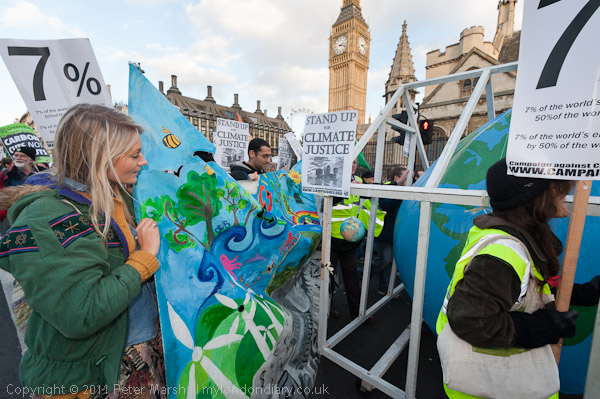
Ten years ago we had a chance to begin to disastrous climate change, but world leaders failed to lead. The protest was organised by the Campaign Against Climate Change and around a thousand people marched through London calling for Climate Justice, highlighting the fact the 7% of the world’s population cause 50% of the worlds emissions as the Durban climate talks take place. This was COP17 but by the time of COP26 in Glasgow little had changed.
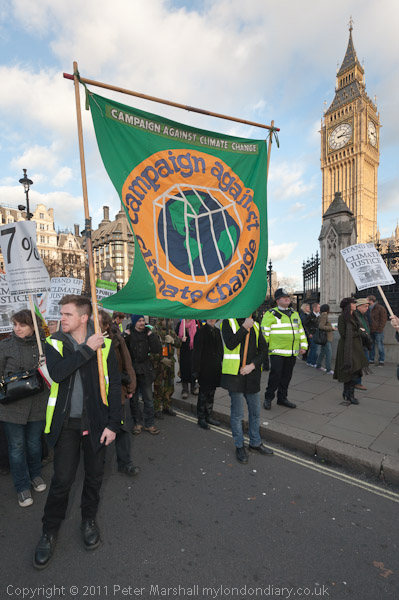
Here’s a few paragraphs from the post I wrote then on My London Dairy:

The 17th UN climate change conference taking place in Durban is widely expected to lead to a breakdown in efforts to combat global climate change, as the US continues to block serious attempts to combat climate change. The continued refusal of the US to accept mandatory limits on carbon emissions seems likely to prevent any progress on global reductions in emissions, and seems certain to lead to catastrophic increases in global temperature. To put it bluntly, our planet is going to fry.

Currently predicted global temperature rises by the end of the century would lead to an environmental crisis that would be expected to lead to huge areas of the world becoming uninhabitable, and billions dying through flood, famine and and other catastrophes. Those who will die will largely be the poor who currently are responsible for only a small proportion of the emissions, while the rich and highly polluting are those who will survive.

There is no longer any serious scientific debate about the reality of climate change, just about the the exact magnitude of the effects and the timescales involved. But all informed opinion agrees that urgent action is needed. We need to make drastic cuts in carbon emissions. The most industrialised countries who have contributed most to the increase in CO2 levels over the past centuries have a particular moral obligation to make drastic cuts.
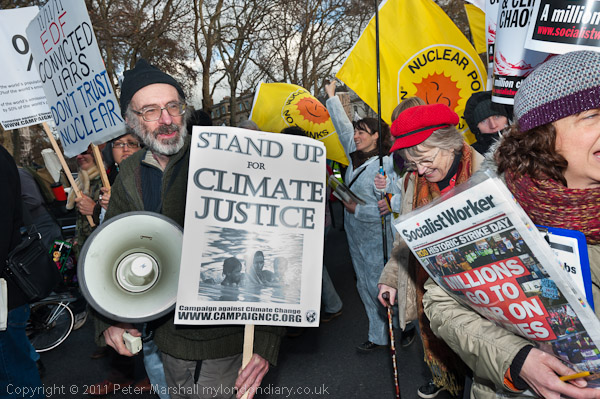
Deja-vu all over again! Though perhaps now I might have added something about Australia, China and India also heads firmly in the sand, and also about species extinction – including possibly ours.

Stand Up For Climate Justice


Congolese Election Protests Continue

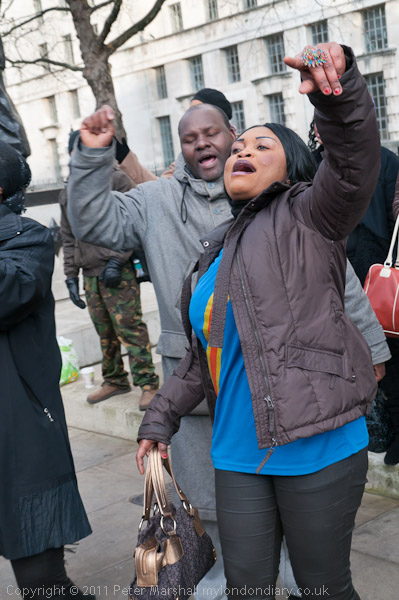
Congolese continued their protests in London against the election fraud, rapes and massacres and called on the British government to withdraw its support from the immoral regime of President Kabila responsible for the atrocities and voted out by the people.

Congolese Protest Against Kabila Vote-Rigging


London Wandering
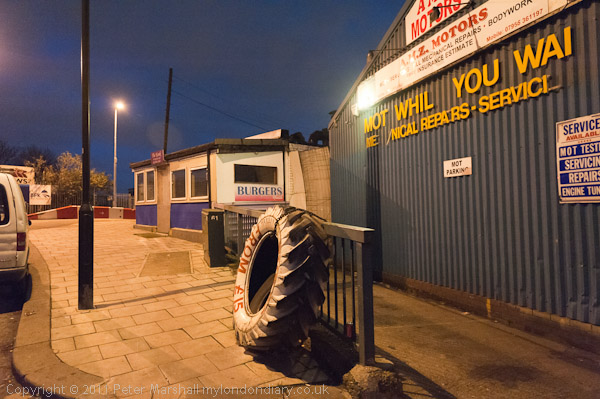
As often while walking about London between the various events I photographed I took a few pictures, including some in the city centre, and others as I made my way to and from an evening event in North Acton where a photographer friend was appearing. I’ve always meant to take more photographs of London at night, but have never got around to more than the occasional picture like the one above.
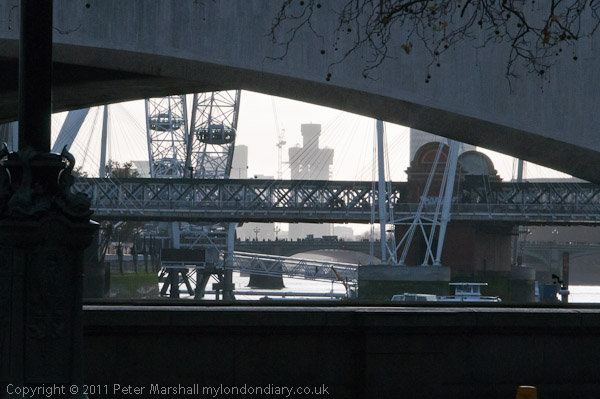
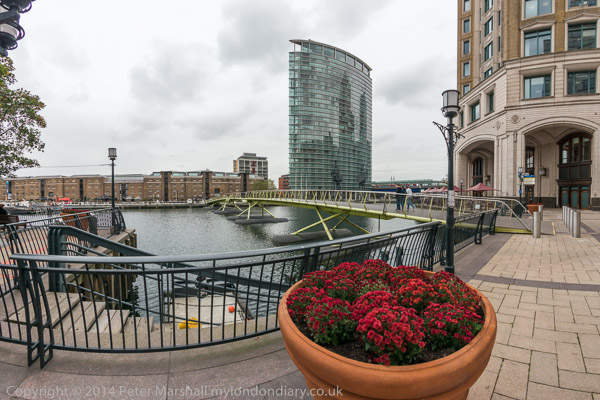
And while I’ve taken many thousands of pictures along the River Thames from its source to the estuary, it’s always good to find something just a little different as in this study of bridges.

London Wandering


Kilburn Again – 1988

St Lawrence Mansions, Priory Park Rd, Kilburn, Brent, 1998 88-6d-03-positive_2400
St Lawrence Mansions, Priory Park Rd, Kilburn, Brent, 1998 88-6d-03

I continued my walk along Kilburn High Road, photographing again some of the buildings I had photographed on my previous walk in Kilburn, and going down Priory Park Road to take a couple of pictures of St Lawrence Mansions, Victorian flats. These were used for some years by Brent Council to house homeless families, and applications by the owners to demolish them were turned down in 2012. In 2017 they were in used to house over 200 asylum seekers in desperately poor and overcrowded conditions in a hostel run by run by Clearsprings Ready Homes, a company that has been criticised in media reports about this and other asylum hostels.

Locksmiths, Willesden Lane, Kilburn, Brent, 1998 88-6d-61-positive_2400
Locksmiths, Willesden Lane, Kilburn, Brent, 1998 88-6d-61

I’ve always been interested in trade signs and liked the large keyhole of this locksmith’s,on Willesden Lane, close to its junction with Kilburn High Rd.

Willesden Lane, Kilburn High Rd, Kilburn, Brent, 1998 88-6d-62-positive_2400

Taken just a few yards closer to Kilburn High Rd, with Kilburn State Cinema tower visible. The large sign for Brondesbury Garage above Brondesbury Mews entrance has now gone, the Gentlemen’s convenience has disappeared, the billboards have gone and Biddy Mulligans is now a betting shop, but the view is still much the same.

Kilburn State, cinema, Kilburn High Rd, Brent, 1998 88-6d-63-positive_2400
Kilburn State, cinema, Kilburn High Rd, Kilburn, Brent, 1998 88-6d-63

Grade II* listing has protected the Gaumont State Theatre, a splendid art deco building withh opened in 1937, seating over 4,000. Since 2007 it has been a church and still contains one of the largest fully functioning Wurlitzer organs in Britain.

The National Club, Kilburn High Rd, Camden, 1998 88-6d-65-positive_2400
The National Club, Kilburn High Rd, Camden, 1998 88-6d-65

The National Club is another building I’ve previously photographed and written about in my post To Kilburn High Rd 1988 – and like the Kilburn State is now also a church. The boundary between Brent and Camden runs down the Kilburn High Road, with properties on the east side being in the LB Camden.

Wallace, chemists, Infected, graffiti, Netherwood St, Kilburn, Camden, 1998 88-6d-66-positive_2400
Wallace, chemists, Infected, graffiti, Netherwood St, Kilburn, Camden, 1998 88-6d-66

Wallace Manufacturing Chemists Ltd is still active according to Companies House, but no longer in Netherwood St. Its business is described as ‘Manufacture of basic pharmaceutical products’ with a registered office in Brentwood and I think is now a part of the Alinter Group based in Abingdon. Perhaps the graffitied ‘INFECTION’ was a mildly humourous comment on the closure of the premises making medicines – Histergan cream and tablets, Ironorm drops and Malarivon and Vigranon-B syrups.

Quex Rd, Kilburn, Camden, 1988 88-6d-45-positive_2400
Quex Rd, Kilburn, Camden, 1988 88-6d-45

These pictures show the doorway at 15 Quex Rd, on the corner with Mazenod Avenue, part of a set of mansions at 9-15 Quex Rd, just a few yards from Kilburn High Rd. I’ve called it Kilburn, but certainly for estate agents this is West Hampstead.

The road was built on a large estate on both sides of West End Lane which had been inherited in 1813 by John Powell Roberts following the death of his brother who fell from a horse. His brother had previously inherited this and a large house a Quex Park in Birchington, Kent under a trust following the death of his uncle, and the terms of that trust meant changing his surname to Powell, and John Powell Roberts became John Powell Powell. When he died in 1849 the various estates held by the trust passed to his nephew, Col Henry Perry Cotton.

Quex Road, named after the Powell-Cotton family seat, was at the heart of plans for the development of the estate made in 1866, which included a Roman Catholic church and Wesleyan Methodist and Unitarian chapels on Quex Rd built in 1868-9 and the street was more or less fully developed by 1885.

Eugene de Mazenod was a leading French Catholic bishop in the nineteenth century and founder of the Oblates of Mary Immaculate who became missionaries across the world and founded the Church of the Sacred Heart of Jesus in Kilburn in 1866, though their temporary building was replaced by one designed by E W Pugin and built after his death from 1875-1899.

Quex Rd, Kilburn, Camden, 1988 88-6d-46-positive_2400
Quex Rd, Kilburn, Camden, 1988 88-6d-45

Click on any image to go to a larger version in my album 1988 London Photos from where you can browse the other images in the album.


West India – North Dock 1988

The Ledger Building,  Hertsmere Rd, West India Docks, Poplar, Tower Hamlets, 1988 88-6c-52-positive_2400
The Ledger Building, Hertsmere Rd, West India Docks, Poplar, Tower Hamlets, 1988 88-6c-52

The Offices of the West India Docks an Hertsmere Rd at the west corner of what was the Import Dock of the West India Docks and were Grade I listed in 1950 together with the adjoining warehouses. They were built in 1803 , architect George Gwilt and converted to hold the dock ledgers by John Rennie, who added the portico in 1827.

In 2000 it was converted into a Wetherspoon pub, the Ledger Office and can be visited during normal opening hours and displays some information about the history of the docks which can be read while drinking a cheap pint.

Warehouses, Hertsmere Rd, West India Docks, Poplar, Tower Hamlets, 1988 88-6c-53-positive_2400
Warehouses, Hertsmere Rd, West India Docks, Poplar, Tower Hamlets, 1988 88-6c-53

These listed warehouses are now converted for various uses including the Museum of London Docklands which has both permanent and temporary displays on the history of the River Thames, the growth of Port of London and the docks historical link to the Atlantic slave trade, in which this building, a sugar warehouse, played an important role. Temporary exhibitions there have included some of my pictures including in the show ‘Estuary‘ celebrating the museum’s 10th anniversary in 2013

Warehouses, Hertsmere Rd, West India Docks, Poplar, Tower Hamlets, 1988 88-6c-55-positive_2400
Warehouses, Hertsmere Rd, West India Docks, Poplar, Tower Hamlets, 1988 88-6c-55

The area has been opened up by the removal of the dockside sheds and is now a popular tourist venue, though it has lost most of its previous allure. But it’s still an interesting area, both for the old and the new buildings.

Crane, West India Quay, Poplar, Tower Hamlets, 1988 88-6c-44-positive_2400
Crane, West India Quay, Poplar, Tower Hamlets, 1988 88-6c-44

Two dockside cranes remain on the side of the dock, close to West India Quay DLR station, perhaps left there to divert attention from a rather hideous hotel building to their north.

Bridge, West India Quay, Poplar, Tower Hamlets, 1988 88-6c-45-positive_2400

This picture taken I think from more or less underneath the DLR which goes across the North (Import) Dock gives some impression of the scale of the West India Docks , which I think when constructed in 1800-1806 were I think the largest enclosed high-security docks in the world – and a model for later docks elsewhere.

This dock now looks considerably smaller, with around half of its width taken up by a strange building on top of a new Crossrail station, looking to me rather like a woodlouse. Nothing in this picture remains except the listed dock wall at bottom left (and possibly the bollard on it.)

Bridge, West India Quay, Poplar, Tower Hamlets, 1988 88-6c-46-positive_2400

I think this bridge, built from what looks suspiciously like Meccano, was the Great Wharf Road Bridge, later replaced by what was intended as a more permanent structure as the Upper Bank Street Bridge. I can find no information about it on-line, but it appears to have a central lifting section with heavy counterweights in those four towers. That more permanent bridge was removed for the construction of the Crossrail station in 2012 and a new, much shorter bridge was built in five sections in Belgium by Hollandia and welded together in situ in, opening in 2020.

Docklands Light Railway, Poplar, Tower Hamlets, 1988 88-6c-32-positive_2400
Docklands Light Railway, Poplar, Tower Hamlets, 1988 88-6c-32

It was time to leave Docklands for home, and together with my two young assistants we got on the DLR, sitting right at the front of the train. This view from the front window as the train had just left Poplar Station and about to cross Aspen Way shows dockland cranes at left and St Anne’s Limehouse at right. Then DLR trains were single two-carriage units like the Stratford service in this picture.

This is the final part of posts here about my pictures from my walk around the docks on the Isle of Dogs in June 1988.

Click on any of the pictures to see a larger version in my album 1988 London Photos, from where you can browse the album. The pictures there are largely ordered by my negative reference numbers, which do not in detail reflect the order in which the pictures were taken used in the posts here.


North Pole & Heron Quay

The North Pole, Manilla Street, Millwall, Tower Hamlets, 1988 88-6b-22-positive_2400
The North Pole, Manilla Street, Millwall, Tower Hamlets, 1988 88-6b-22

Continuing my walk around the West India Docks I walked down from Marsh Wall to Manilla St, where I think you can still find The North Pole, a beer house built in the 1860s, on the corner at No 74. It closed as a pub in 2014, and I suspect the building’s days are numbered.

Cuba St, Millwall, Tower Hamlets, 1988 88-6b-23-positive_2400
Cuba St, Millwall, Tower Hamlets, 1988 88-6b-23

Nothing, or almost nothing in this picture of Cuba St has survived the redevelopment of this street on the fringe of the West India Docks. In the far distance you can just make out the distinctive frontage of the building on the corner of Cuba St and Westferry Road, the first few feet of which have been incorporated into a modern red-brick block and is now an Indian Restaurant. It seems to be much more than the usual facade, with the older building integrated into the development, Regatta Point, which is on a rather smaller scale than much of the new building, only 5 storeys of shops with flats above.

Docklands Enterprise, Wendy Ann Taylor, Sculpture, Heron Quays, Marsh Wall, Tower Hamlets, 1988 88-6b-24-positive_2400
Docklands Enterprise, Wendy Ann Taylor, Sculpture, South Dock, Marsh Wall, Tower Hamlets, 1988 88-6b-24

Wendy Ann Taylor, born 1945 claims to have been as one of the first artists of her generation to “take art out of the galleries and onto the streets”’ and has made a number of sculptures around London and in several of the new towns. This sculpture was commissioned by the LDDC and the Docklands Business Club and dates from 1987. It is still in place, although everything in the background of this picture has been replaced by newer and much taller developments. I took the shape emaphasised in my picture and repeated at right angles in her work as representing the river around the Isle of Dogs and the vertical as enterprise reaching for the sky.

Heron Quay, DLR, Middle Dock, West India Docks, Tower Hamlets, 1988 88-6b-14-positive_2400
Heron Quay, DLR, South Dock, West India Docks, Tower Hamlets, 1988 88-6b-14

You can still just about see the DLR as it goes across South Dock here but Heron Quay station is now completely engulfed in tall office blocks, the water now looking enclosed rather than open as it was. The distant gasholder at right at Greenwich has also now gone, though long invisible from here.

Heron Quay, West India Docks, Tower Hamlets, 1988 88-6c-63-positive_2400
Heron Quay, South Dock, West India Docks, Tower Hamlets, 1988 88-6c-63

I think it is a long time since any boats were moored here.

Heron Quay, West India Docks, Tower Hamlets, 1988 88-6c-65-positive_2400
Heron Quay, West India Docks, Tower Hamlets, 1988 88-6c-65

This picture is looking along Middle Dock, with the north side of the buildings, long demolished, of Heron Quay at right.

I continued my walk to the North Dock – and a few pictures in a later post.

Click on any of the pictures to see a larger version in my album 1988 London Photos, from where you can browse the album. The pictures there are largely ordered by my negative reference numbers, which do not in detail reflect the order in which the pictures were taken used in the posts here.


West India Docks 1988 (1)

Millwall Inner Dock, Tower Hamlets, 1988 88-6b-65-positive_2400
Millwall Inner Dock, Tower Hamlets, 1988 88-6b-65

When the Docklands Light Railway opened in 1997 there were just two lines, one from the City at Tower Gateway east to Canary Wharf and then south to Island Gardens, and the second coming down south from Stratford to Canary Wharf and then using the same track south. For cost reasons it had been decided not to make a connection with the existing Underground network, except at Stratford where the DLR shared a station with both the Central Line and National Rail. The tunnel link to Bank Station was only opened four years later.

So I and my two young assistants had walked as in my earlier post from London Bridge across Tower Bridge to Tower Gateway station, and then took the DLR to Crossharbour. It was something of a fairground-like attraction, particularly around where the line turned south to go into West India station, and in the first years the line was little used and it was usually possible at the terminus to get a seat right at the front of the driverless train and imagine you were in the driving seat.

Glengall Bridge, Millwall Inner Dock, Tower Hamelts, 1988 88-6b-66-positive_2400
Glengall Bridge, Millwall Inner Dock, Tower Hamlets, 1988 88-6b-66

There was considerable building work taking place around Millwall Inner Dock, as well as cranes and the lifting bridge and it made a good day out for small boys as well as older photographers.

My assistants, Millwall Inner Dock, Tower Hamlets, 1988 88-6b-52-positive_2400
My assistants, Millwall Inner Dock, Tower Hamlets, 1988 88-6b-52

And here they are on an empty plinth surveying the scene, sandwiches and drinks in their back packs.

Millwall Inner Dock, Tower Hamlets, 1988 88-6b-55-positive_2400
Millwall Inner Dock, Tower Hamlets, 1988 88-6b-55

Millwall Dock was only opened in 1868 and was then quite separate from the West India Docks to the north. It had an entrance from the Thames on the west side of the Isle of Dogs to a large dock running halfway across the ‘island’, with another large dock, later called the Millwall Inner Dock branching off to the north. Most of the cargo was timber and grain, and McDougall’s built a large flour mill on its south bank the year after it opened. In 1928 it was connected to the West India Docks by the Millwall Passage, and became a part of the same impounding system for water levels.

Guardian building, Marsh Wall, Tower Hamlets, 1988 88-6b-41-positive_2400
Guardian building, Marsh Wall, Tower Hamlets, 1988 88-6b-41

The Guardian print works in Wimpey’s Enterprise Business Park was built in 1985-7 and apparently its silver-blue reflective panels and tinted glass were meant to make its ugly box look smaller, merging the building with the sky. It doesn’t work in black and white and it didn’t work in reality. The Guardian now has its print works in Stratford.

Millwall Inner Dock, Marsh Wall, Tower Hamlets, 1988 88-6b-42-positive_2400
Millwall Inner Dock, Marsh Wall, Tower Hamlets, 1988 88-6b-42

Looking roughly south down Millwall Inner Dock from Marsh Wall. The chimney in the distance is that of Deptford Power Station, demolished in a spectacular explosion in 1992.

Docklands Light Railway, DLR, Daily Telegraph, Marsh Wall, South Quay, Tower Hamlets, 88-6b-43-positive_2400
Docklands Light Railway, DLR, Daily Telegraph, Marsh Wall, South Quay, Tower Hamlets, 88-6b-43

The Daily Telegraph moved in to this building to the east of South Quay DLR station when it was completed in 1987, naming it Peterborough Court. In 1992 they moved to Canary Wharf tower.

Our walk around the area continues in West India Docks 1988 (2) shortly.


Around Old St

H J Brooks & Co, Old St, Islington, 1988 88-5n-22-positive_2400
H J Brooks & Co, Old St, Islington, 1988 88-5n-22

These pictures continue the walk around Finsbury and going back east along Old St to South Shoreditch. They are all in my album 1988 London Photos, but here I’ve put them in the order in which I took them. I also made some other exposures not on line, and the album only contains those images I now find more interesting and worth preserving.

H J Brooks & Co were at a number 136 on the south side of Old St, close to Tilney Court and the building is still there, now offering IT services and support. Henry Brooks was one of many companies in this area in the furniture trade, supplying the various fittings which can be seen in the window.

Kapital Kwickprint, Old St, Islington, 1988 88-5n-24-positive_2400
Kapital Kwickprint, Old St area, Islington, 1988 88-5n-24

I think Kapital Kwickprint was quite close to the Old Street roundabout at the junction with City Road which I’ve since photographed on various occasions. The premises appear to be shared with Sheet Metal and Wire Workers Malbot Ltd, and it was their notices including a hanging sign that attracted my attention as well as a rather curious doorway, firmly shuttered and with the message ‘LETTERS FOR MALBOT LTD’ and an arrow pointing to a postbox beside it.

It is hard to identify this location now, but I think it was in Mallow St, where the next frame on the film was clearly taken. At top left is the address 3TO4.

Warehouse, Leonard St, Paul St, Shoreditch, Hackney, 1988 88-5n-12-positive_2400
Warehouses, Leonard St, Shoreditch, Hackney, 1988 88-5n-12

This very sturdy-looking building is still present on the corner with Paul St and is now offices with the name ‘Victoria House’ and address 1 Leonard Circus. Like the warehouses further along the street it probably dates from the 1870s.

Warehouses, Leonard St,  Shoreditch, Hackney, 198888-5n-13-positive_2400
Warehouses, Leonard St, Shoreditch, Hackney, 1988 88-5n-13

Part of an impressive row of warehouses on Leonard St dating from 1874-7 which have now been converted to office and residential use. C W Burrows at 69 describe themselves as House Furnishers – and this area was a great centre for furniture manufacture.

The business of J.Davis & Company (Machines) limited, now dissolved, was described at Companies House as “Wholesale of machinery for the textile industry and of sewing and knitting machines – Importing and distribution sewing machines.”

Great Eastern St, Shoreditch, Hackney, 1988 88-5n-15-positive_2400
Great Eastern St, Shoreditch, Hackney, 198888-5n-14

Great Eastern St was constructed in 1876 and these buildings date from shortly afterwards. You can see a small part of No 42 at right of picture, which is Grade II listed and built with No 40 in 1877.

Great Eastern St, Shoreditch, Hackney, 1988 88-5n-15-positive_2400
Great Eastern St, Shoreditch, Hackney, 1988 88-5n-15

And this picture shows the Grade II listed building at 40-42 built in 1877 by J. W. Brooker for the cabinet ironmongers Edward Wells & Co. As the listing states it is “in an eclectic style with Gothic, Italianate and Venetian influences.” This building was only listed in 2006, and is currently occupied by a cafe and an estate agent. I’ve photographed the entrance on the corner at right on other occasions.

Christina St, Shoreditch, Hackney, 1988 88-5n-16-positive_2400
Christina St, Shoreditch, Hackney, 1988 88-5n-16

Christina Street looking east from close to Phipp St. The site at right now has a building on it, and the street looks considerably tidier.

City Road area, Shoreditch, Islington, Hackney, 1988 88-6a-02-positive_2400
City Road area, Shoreditch, Islington, Hackney, 1988 88-6a-02

Today’s mystery picture. A quite distinctive building but I can’t remember what it was or exactly where it was, though probably somewhere quite close to Wesley’s Chapel on the City Road where I was photographing on the same walk a couple of frames later. It has a vaguely religious feel and may well have been sold and demolished since 1988. I hope someone will recognise it and tell me in a comment.


Click on any of the pictures to go to a larger version in my album 1988 London Photos, from where you can browse the album.


Finsbury 1988 (Part 2)

Helmet Row, St Lukes, Islington, 1988 88-5n-41-positive_2400
Helmet Row, St Lukes, Islington, 1988 88-5n-41

From Whitecross St I wandered across Old St into Helmet Row to make this picture, before going back across the road.

Old St, St Lukes, Islington, 1988 88-5n-42-positive_2400
Old St, St Lukes, Islington, 1988 88-5n-42

Helmet Row is the street beside this building, at at right is the tall spire of St Luke Old St, a Grade I listed chruch designed by John James and Nicholas Hawksmoor, the latter thought to be responisble for the unusual obelisk spire. In 1988 the church was derelict and roofless. Opened in 1733 it became redundant and closed in 1959, remaining empty until taken over as a music centre operated by the London Symphony Orchestra in 2003.

Golden Lane, Baltic St, Finsbury, Islington, 1988 88-5n-43-positive_2400
Golden Lane, Baltic St, Finsbury, Islington, 1988 88-5n-43

I don’t think I went out of my way to photograph buildings with street signs on them, but it was very useful when they did have one – or even two like this on the corner of Golden Lane and Baltic St. Both buildings are still there, although only that at the right of my picture is still Mencap. That at left has gained the name LONDON HOUSE written rather large on both sides.

Stables, Whitbread, Garrett St, Finsbury, Islington, 1988 88-5n-44-positive_2400
Stables, Whitbread, Garrett St, Finsbury, Islington, 1988 88-5n-44

Whitbread’s huge stables, built in 1897 are a reminder of a past age, one that was soon to come to an end, when traffic in London was all horse-drawn, and large numbers of horses were needed to convey barrels of beer to thirsty Londoners. This stables was built to replace a smaller stables on Chiswell street and ramps at the rear enabled horses to be kept on its three floors. The top floor originally had windows like those below, but these were bricked up when it was later used by a gun club as a firing range. Some have now been unbricked.

These stables could house around a hundred horses to pull the brewery drays, a small fraction of the many thousands of horses on London’s streets every day – with a transport system of hansom cabs and horse buses needing around 50,000 to keep running and many more in harness behind various carts and wagons, along with a few saddle horses. And with Shire horses weighing around a ton a piece the stables had to be very sturdy and the pollution problem with each producing between 15 and 35 pounds of manure per day was huge, leading to the Great Horse Manure Crisis of 1894. No solution could then be found to the problem, and it was only the internal combustion engine that eventually came to the rescue – its pollution, though toxic was largely gaseous.

School Caretakers, house, Baltic St, Finsbury, Islington, 1988 88-5n-46-positive_2400
School Caretakers, house, Baltic St, Finsbury, Islington, 1988 88-5n-46

The School Caretakers House and entrance to the Cookery School are still there in Baltic Street, though the school, built for boys, girls and infants by the London School Board in th 1880s, is now the Golden Lane Annexe of the London College of Fashion, part of UAL, the University of the Arts London.

Crescent Row, Finsbury, Islington, 1988 88-5n-31-positive_2400
Crescent Row, Finsbury, Islington, 1988 88-5n-31

The corner of Crescent Row and Sycamore St still looks much the same. Plans to demolish the building on the left edge of the picture were approved in 2017, but it appeared to have been renovated a year or so later.

Dress forms, Old St, Finsbury, Islington,  88-5n-34-positive_2400
Dress forms, Old St, Finsbury, Islington, 88-5n-34

The view through a window in Old Street. I think this later became a café bar.

More from around Old St in a later post. Click on any of the images to view a larger version in my album 1988 London Photos from where you can browse the album.


To Kilburn High Rd 1988

West Kilburn Baptist Church, Carlton Vale, West Kilburn, Brent, 1988 88-5l-33-positive_2400
West Kilburn Baptist Church, Carlton Vale, West Kilburn, Brent, 1988 88-5l-33

My wanderings around Kilburn Park had taken me back through the South Kilburn Estate to Carlton Vale and this fine example of a Baptist Church, built for the Rev Thomas Hall in 1865. Money was tight, but his brother who was an architect worked on the plans without payment. According to the Commemoration Booklet issued for its centenary the foundation stone was laid on ‘Several coins of the Realm bearing the portrait of her most Gracious Majesty Queen Victoria – one shilling, one sixpence, one halfpenny‘ and ‘the text, “Other foundation can no man lay than that is laid, which is Jesus Christ” (1 Corinthians 3:11).’ Six years later, the church still owed £380 of the £1250 it cost to build.

Willesden Lane, Brondesbury, Brent, 1988 88-5l-21-positive_2400
Willesden Lane, Brondesbury, Brent, 1988 88-5l-21

From Carlton Vale I continued northwest up Salusbury Road then turned right along The Avenue in Brondesbury to reach Willesden Lane opposite this house which is numbered as 66 Cavendish Rd, although this frontage is on Willesden Lane. This house struck me as having a intriguing individuality, although certainly not great architecture, incorporating several distinct variations of style and a rather oddly situated small window. Currently divided into around 13 small flats a planning application has been submitted to demolish it and use the site with its long garden along Willesden Lane to build a new 5 to 6 storey building with 21 flats.

Lawrence & Aitken, Albion Works, Kimberely Rd, Brondesbury, Brent, 1988 88-5l-23-positive_2400
Lawrence & Aitken, Albion Works, Kimberely Rd, Brondesbury, Brent, 1988 88-5l-23

Lawrence & Aitken , incorporated in 1927 but founded earlier and now dissolved, filed its last accounts in 1990. It gave the nature of its business as “Manufacture of other articles of paper and paperboard n.e.c. -” and was said to employ five people. The works date from 1904 and were built for cardboard makers Lawrence & Aitken under an agreement with the Simms Manufacturing Company Limited which is reproduced (but very hard to read) on the RAC website. The works is still there, though the building on the right has been replaced by housing called Kimberley Court.

Willesden Lane, Brondesbury, Brent, 1988 88-5l-24-positive_2400
Willesden Lane, Brondesbury, Brent, 1988 88-5l-24

In one of those mysteries that I’ve sometimes come across, the extension at left to J Green’s shop at 136 Willesden Lane has grown to the same height as the rest and the building is now wider, having four windows at first and second floor levels and a new floor on top while retaining the Graeco-Egyptian style of the original.

Both 134 and 136 were built for John Cramb, monumental mason supplying many monuments in the cemetery opposite, 134 in 1896 designed by George Neal and 136 by F C Dare in 1883-1884 . Both are locally listed.

Willesden Lane, Brondesbury, Brent, 1988 88-5l-26-positive_2400
Willesden Lane, Brondesbury, Brent, 1988 88-5l-26

These shops are still there but I think all now different businesses. So many flats and shops were for sale in 1988.

Willesden Lane, Brondesbury, Brent, 1988 88-5l-12-positive_2400
Willesden Lane, Brondesbury, Brent, 1988 88-5l-12

Missing ‘O’, ‘M’, ‘B’ and ‘G’ perhaps made this frontage more interesting.

The National Club, Kilburn High Rd, Kilburn, Camden, 1988 88-5l-13-positive_2400
The National Club, Kilburn High Rd, Kilburn, Camden, 1988 88-5l-13

In 1910 after the death of its owner, The Grange, a large house with extensive grounds on Kilburn High Road was sold to Oswald Stoll, the owner of the London Coliseum, who began building a theatre here. By the time it opened in 1914 his plans had changed and it became the Grange Cinema, with over 2,000 seats.

The cinema closed in 1975 and was opened as Butty’s Club and Dance Hall by Kilburn Irish publican Michael ‘Butty’ Sugrue, and later in 1976 also became the Kilburn National Club, owned by three local brothers who were builders, originally from Tipperary. The club was a major music venue, where stars including Johnny Cash and David Bowie played (there is a longer list here, along with more detailed information about the site.)

Applications to demolish the building were turned down in 1991 as English Heritage had listed it earlier in the year, as was another application in 1993. After the National Club closed in 1999 the building remained empty until it became the Victory Christian Centre in 2001 – but the church was closed in 2002 by the Charity Commission who didn’t approve of Pastor Goodman’s extravagances on expensive holidays and cars and a house in Northants. In 2003 it became a site of the worldwide Universal Church of the Kingdom of God.

The Secondhand Furniture Shop, Kilburn High Rd, Kilburn, Brent, 1988 88-5l-15-positive_2400
The Secondhand Furniture Shop, Kilburn High Rd, Kilburn, Brent, 1988 88-5l-15

An interesting example of a window display.

Loveridge Rd, Kilburn, Camden, 198888-5l-16-positive_2400
Loveridge Rd, Kilburn, Camden, 1988 88-5l-16

A few yards east of Kilburn High Rd the Underground – here decidely overground – goes across Loveridge Rd. I liked the washing hanging over Loveridge Mews, not something often found across a London street.

Confusingly, the boundary between the London Boroughs of Camden and Brent runs down the Kilburn High Road, splitting Kilburn in two. I’m sure there are still some pictures in the album where I’ve indicated the wrong borough.


London 22nd October 2014

ILF

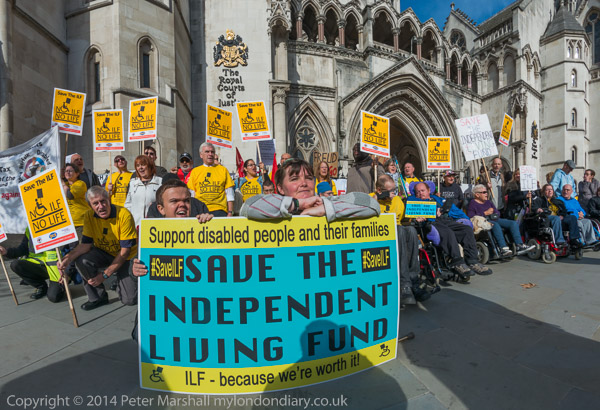
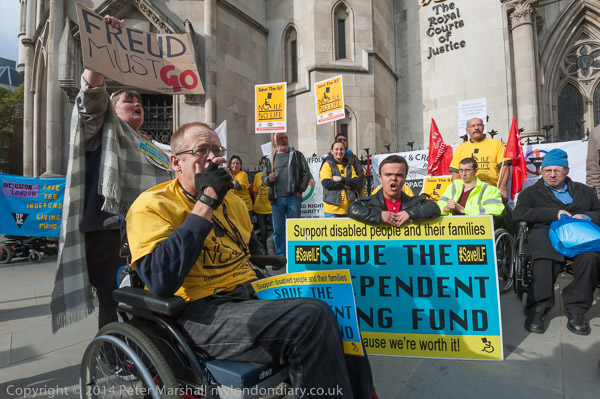
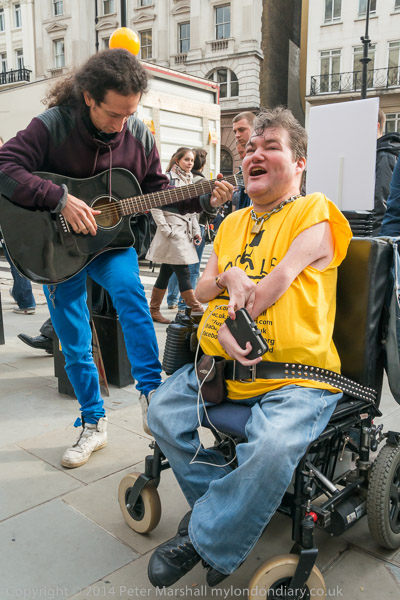
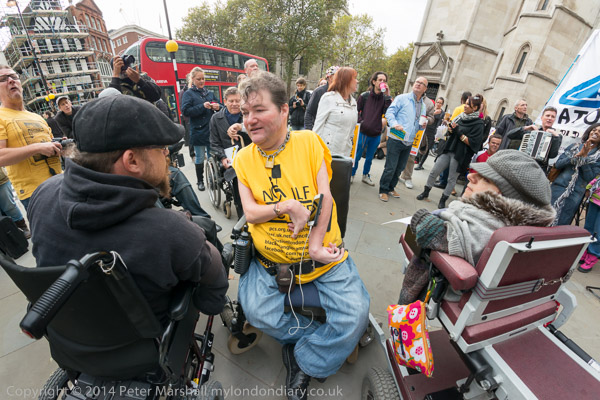
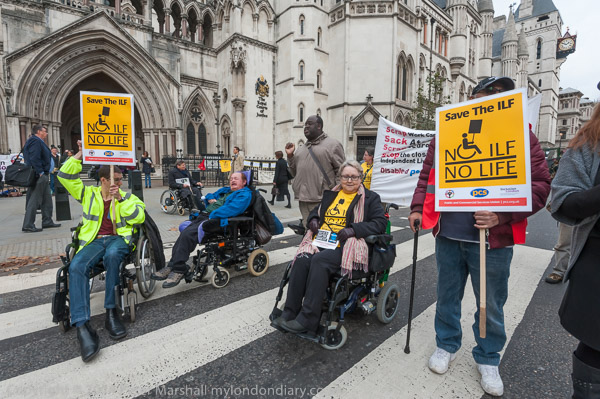
The Independent Living Fund enabled many disabled people to continue to live with dignity and to work making a positive contribution to society and the government decision to close it led to many protests and to legal actions to try and stop it under the Equality Act.

Although a court ruled that the minister concerned had acted illegally, all it required was that the new minister reconsidered the plans. He did so, and decided to go ahead, though with a three month delay. And a judge ruled in December 2014 that although in axing the ILF he knew that the closure would mean many disabled people would lose their ability to live independently in the community his decision was legal.

The decision to end ILF was clearly wrong, clearly immoral, but so long as the legal niceties were observed the government was able to go ahead with it, and our law gave no protection.

The vigil outside the court while the case was being heard attracted wide support, including from Inclusion London, Norfolk and Suffolk DPAC local DPACs, the Greater Manchester Coalition of Disabled People, Transport for All, Winvisable, PCS Union, the TUC, and other organisations,and there was even a simultaneous vigil in Toronto, Canada. Three MPs, John McDonnell, Andy Slaughter and Jeremy Corbyn, came to give their support, and there were speeches by campaigners including Paula Peters and Andy Greene, with John Kelly singing.

As expected the vigil ended with a short direct action by DPAC and others, briefly blocking the Strand outside the law courts.

Free Shaker Aamer

This was one of a long series of regular vigils opposite Parliament for Shaker Aamer, an innocent charity worker arrested by bandits and handed over to US forces who have imprisoned and tortured him for over 12 years. He was cleared for release in 2007 but remained in Guantanamo with our government failing to press for his release because his testimony could embarrass MI6 as well as the US.

London Panoramas

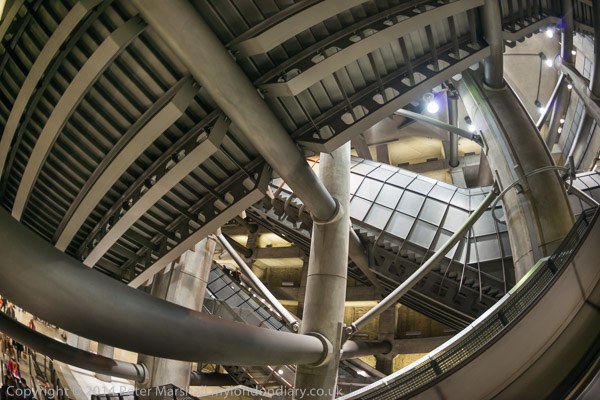
I had time before another protest to visit an exhibition at the Museum of London Docklands and on the journey to pause and make some panoramic images.

Probably the most interesting were inside Westminster station, where “the beams and buttresses, designed by Hopkins Architects and completed in 1999 for the opening of the Jubilee Line are also the foundations of the block of parliamentary offices above the station, Portcullis House, and were deliberately Piranesian, though sometimes I get more of the feeling of Escher as you seem to walk endlessly up escalators and around the interior.”

Democracy Camp – Poet Arrested

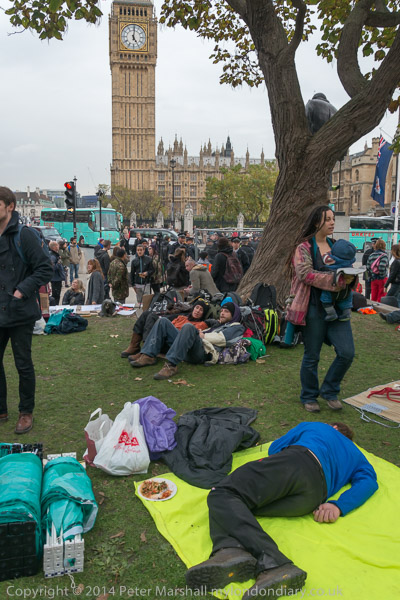
I returned to Parliament Square where the Democracy Camp was still holding workshops, though police and the GLA ‘heritage wardens’ had fenced off the main grass area.

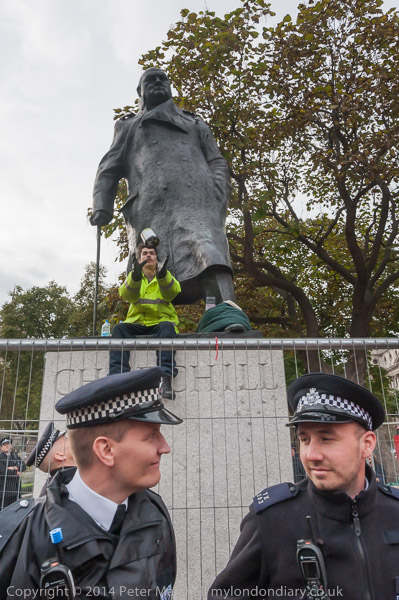
Danny, one of the protesters had been sitting on the plinth next to the statue of Churchill since the previous afternoon and poet Martin Powell arrived with a pot of food for him, which he tossed up to him, going straight into his hands, despite police warning him he could be arrested.

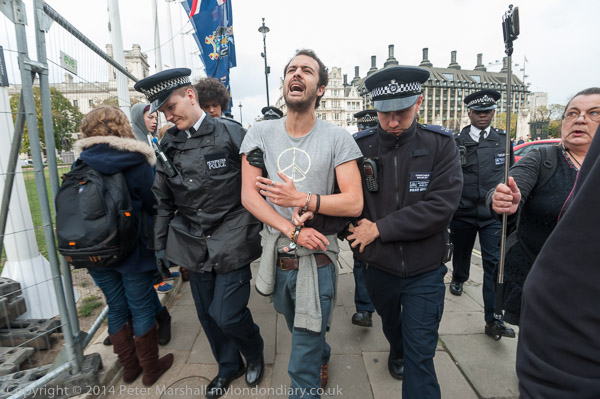
How can feeding the hungry be a crime?” he asked and he was arrested and led away in handcuffs around two sides of Parliament Squareperforming his poem ‘The Missing Peace’. I left while Danny was still on the plinth, though later that evening police finally found a ladder and brought him down after over 26 hours.

Musical Poor Doors

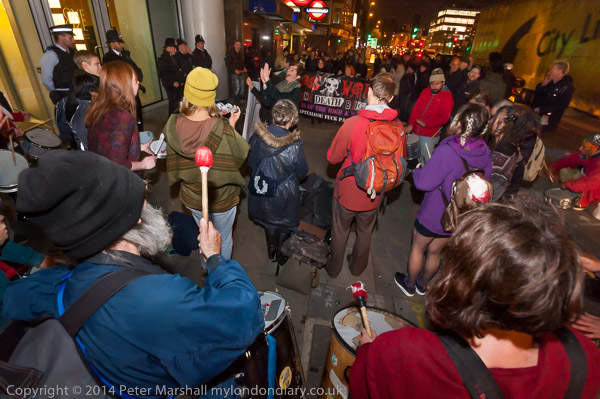
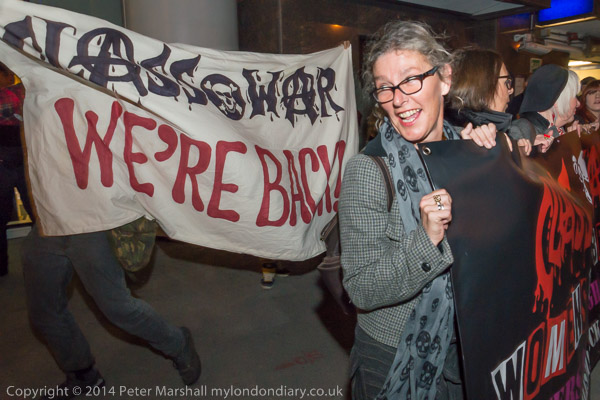
It was Class War’s 14th weekly protest at the ‘rich door’ of Redrow’s One Commercial St flats and it was a lively affair, with the banners dancing to the music of Rhythms of Resistance, a poetic performance and some rousing speeches against social apartheid.

There were a lot of police present and some stood in front of the door and ushered a few people in and out but made no attempt to stop the hour long protest, which though noisy remained entirely peaceful. Some of the police clearly enjoyed the music and watching the dancing.


More at:
Musical Poor Doors
Democracy Camp – Poet Arrested
Canary Wharf & Westminster Tube
End UK shame over Shaker Aamer
DPAC High Court Vigil for ILF


Kilburn Park 1988

Carlton Vale, Kilburn, Brent 1988 88-5k-26-positive_2400
Carlton Vale, Kilburn, Brent 1988 88-5k-26

My next walk at the end of May 1988 took me to Kilburn Park and Kilburn, and again in this post I have put the pictures in the order of my walk rather than the somewhat random order they have in the Flickr album 1988 London Photos. The church in the picture of Carlton Vale is St Augustine, Kilburn, and the large block of flats on the corner of Carlton Vale and Kilburn Park Rd was demolished in 2018-9, though I think the overhead walkway went many years earlier.

Kilburn, Brent 1988 88-5k-15-positive_2400
Kilburn, Brent 1988 88-5k-15

These lower blocks of flats were a part of the same South Kilburn estate and I think close to the corner of Carlton Vale and Cambridge Rd. The estate of high-density housing in low-rise flats and 11 tower blocks was begun in 1959 and further developed in the 1960s and 70s. Brent embarked on a comprehensive redevelopment in 2014, which is resulting in a considerable loss of social housing.

Oxford Rd, Kilburn, Brent, 1988 88-5l-61-positive_2400
Oxford Rd, Kilburn, Brent, 1988 88-5l-61

Unsurprisingly Oxford Road runs parallel with Cambridge Ave up to the Kilburn High Rd. These streets were two of those developed by local builder James Bailey in the 1860s, developing the area he called Kilburn Park. The name was given to the first underground station in Kilburn which opened in 1915 in Cambridge Ave.

Oxford Rd, Kilburn, Brent, 1988 88-5l-64-positive_2400
Oxford Rd, Kilburn, Brent, 1988 88-5l-64

These are typical houses of the era and were probably built from published designs in architectural pattern books. My grandather, who built a few houses on a much less grand scale had owned at least one of these and as children we were sometimes allowed to look at this beautifully illustrated volume.

Cambridge Avenue, Kilburn, Brent, 1988 88-5l-66-positive_2400
Cambridge Avenue, Kilburn, Brent, 1988 88-5l-66

At its southern end Cambridge Avenue leads to both Cambridge Road and the rather posher Cambridge Gardens.

Central Motors, Canterbury House, Canterbury Rd, Kilburn, Brent 1988 88-5l-52-positive_2400

Central Motors, Canterbury House, Canterbury Rd, Kilburn, Brent 1988 88-5l-52-positive_2400

Central Motors in Canterbury Rd still looks much the same, but Canterbury House, although retaining the facade had two extra storeys added in 2015-6 with luxury flats and penthouses. It as built in 1862 when this was still a part of Kilburn Lane as a railway signal factory for Saxby & Farmer who became one of the largest employers in the area but moved out around 1906.

South Kilburn Estate, Crone Court, Rupert Road, Brent, 1988 88-5l-53-positive_2400
Crone Court, South Kilburn Estate, Rupert Road, Brent, 1988 88-5l-53

Crone Court is on the corner of Rupert Rd and Denmark Rd on the South Kilburn Estate and is due for redevelopment in the next few years. The 12 storey block, 32m tall, was completed in 1964.

Joe's Used Ballbearing Emporium, Malvern Rd, West Kilburn, Westminster, 198888-5l-55-positive_2400
Joe’s Used Ballbearing Emporium, Malvern Rd, West Kilburn, Westminster, 1988 88-5l-55

Joe’s Used Ballbearing Emporium & Cycleworks was definitely in Malvern Rd, West Kilburn as it had a street sign higher up on the building. It had a remarkable window display and I took far too many pictures – a few of them here.

Joe's Used Ballbearing Emporium, Malvern Rd, West Kilburn, Westminster, 1988 88-5l-56-positive_2400
Joe’s Used Ballbearing Emporium, Malvern Rd, West Kilburn, Westminster, 1988 88-5l-56

Joe's Used Ballbearing Emporium, Malvern Rd, West Kilburn, Westminster, 1988 88-5l-41-positive_2400
Joe’s Used Ballbearing Emporium, Malvern Rd, West Kilburn, Westminster, 1988 88-5l-41

Joe's Used Ballbearing Emporium, Malvern Rd, West Kilburn, Westminster, 1988 88-5l-45-positive_2400
Joe’s Used Ballbearing Emporium, Malvern Rd, West Kilburn, Westminster, 1988 88-5l-45

Joe's Used Ballbearing Emporium, Malvern Rd, West Kilburn, Westminster, 198888-5l-31-positive_2400
Joe’s Used Ballbearing Emporium, Malvern Rd, West Kilburn, Westminster, 1988 88-5l-31

Click on any of the images to go to a larger version in my album 1988 London Photos from where you can browse the rest of the album.