Short Walks in London & Staines: As I mentioned a few days ago in my post on The New Trafalgar Dispatch, in September 2005 I was suffering from a knee injury. Over the next few days, from September 11th-17th I did manage to get out for some short walks close to home, and managed a short walk in London around Highbury Fields on my way to visit a friend.
I had been advised by my doctor that gentle exercise was likely to help, but had to do rather a lot of stopping and resting when the pain became too intense. And after a couple of days I had to give up taking the strong painkillers he had prescribed because of the side effects on my stomach and could only rely on paracetamol.
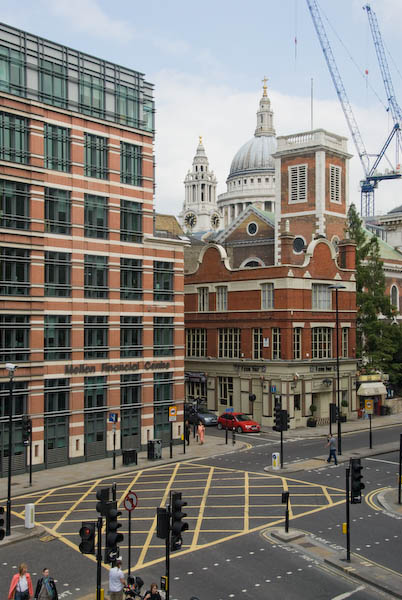
By Saturday17th it was beginning to feel a little less painful – and after Highbury I even made a short visit to St Paul’s Cathedral and Paternoster Square. The next day it felt good enough for me to risk going up to London again to photograph the Thames Festival.
I didn’t take a great many pictures – and here I’ll post all of those I thought worth putting on My London Diary in 2005.
Staines
Timms boat yard, now the only remaining yard in Staines
Daybreak, a Hull-registered Humber Keel was moored by Church Island Staines, next to the Lammas where we listened to the Staines Lammas Brass Band.
Highbury and Holloway
St Paul’s & Paternoster Sq
It took a few months – as my doctor had said it would – for my knee to get entirely back to normal, and twenty-two years later it still seems in reasonable shape. I hope it will keep going for a few more years.
Ravensbourne, Quaggy & More -Lewisham: The real end of my walks on April 1st 1990 was a short walk around Lewisham. The previous post from these walks was Monkey Business, Wrecked Cars & Roupell – 1990.
River Ravensbourne, River Quaggy, Lewisham, 1990, 90-4b-11
Arriving at Lewisham Station I crossed to the opposite platform and walked along it away from the exit to photograph this view looking south along the River Ravensbourne which curves away to the west – towards the right of the frame. Just after the river runs down a small slope it is joined by Lewisham’s other river, the smaller flow of the River Quaggy. There is now a small park, Confluence Park, where the two rivers meet, opened in 2021.
The scrap yard and the car sales and Allied Carpets are gone replace and the whole area redeveloped with tall blocks since around 2020. There is now another tall apartment block – around 15 storeys tall – to the left of the river,
Silk Mills Path runs alongside the north platform of the station and Maggie’s is still there now offering Breakfast-Lunch-Dinner. It gets excellent customer reviews for its reasonably priced meals and friendly staff. At right one of the arches leads under the railway to Station Road.
Lewisham did have a number of mills using power from the flow of the Ravensbourne, and the silk mills were a short distance downstream on its east bank at the end of Conington Road, close to Elverson Road DLR station. The site is now occupied by flats, built around 20 years ago. The mill had a large mill pond, part of which is now Tesco’s car park.
Although there are still some mulberry trees in the area, the essential feed for the silk worms, the Lewisham mill apparently relied on imported silk.
Houses, Lewisham High St, Lewisham, 1990, 90-4b-15
The River Quaggy runs in a an open channel in front of this long terrace at 15-31 Lewisham High Street, some way below street level, emerging into this from a tunnel under the central streets of Lewisham. It can next be seen from a bridge on Clarendon Rise just south of Lee High Road – see below.
River Ravensbourne, Riverdale House, Molesworth St, Lewisham, 1990, 90-4c-64
The Ravensbourne runs under recent flats on Molesworth Street and can be seen from the west side of the street where it runs under the railway line there. There is a small park, River Mill Park, with a bridge across the river.
This section of the river was channelled between tall concrete banks I think in the 1960s to alleviate the flood risk. The rather fortress-like Riverdale House was designed by Frederick Gibberd in 1981 as offices. In 2013 planning permission was granted for its conversion into luxury flats.
The site had a mill at the time of the Domesday Book and Riverdale Mill was restored as flats when this new building was erected on the rest of the site. It was built on the site of earlier mills as a leather mill in 1828, later becoming a flour mill and in 1901 was bought and turned into the John Wallis bakery, closing around 1970. It is the only remaining mill building in Lewisham.
Houses, St Stephens Grove, Lewisham, 1990, 90-4c-66
The River Quaggy emerges from a tunnel under the end of St Stephen’s Grove where it meets Lewisham High Street at the south side of Saint Stephen With Saint Mark, Lewisham, a Grade II listed Parish Church by Sir George Gilbert Scott built in 1863. This and St Stephen’s Terrace also date from the mid-1860s.
River Quaggy, Clarendon Rise, Lewsiham, 1990, 90-4c-52
The Quaggy apparently got its name for being very muddy – a real quagmire. Here it runs along the backs of the buildings on Lee High Road.
Following pressure from and plans developed by the Quaggy Waters Action Group under the name Operation Kingfisher in 1995, parts of the river have been restored to a more natural state and brought back above ground. Much of the work already completed has been driven by the need to control flooding by the river.
Mecca Leisure, Lewisham High St, Lewisham, 1990, 90-4c-54
Taken from the pavement in front of the building at 233-241 Lewisham High St, this shows some detail of the building, built as a Temperance Billiards Hall in 1910, architect Norman Evans, the company architect for Temperance Billiard Halls Ltd. This Grade II listed building was derelict when bought as new premises for The Tabernacle Church around 2010 and is slowly and carefully being restored – details on their web site.
Later on the walk I photographed the building again from across the road which gives a far better impression of the building when it was in use as a Mecca Bingo Hall – I’ll post this picture in the final post on this walk shortly.
Crime, Cleaners and Lewisham: On Saturday 15 September 2007 I went to Brent for a march against gun and knife crimes. Next I was in the City of London, usually deserted on a Saturday, but this was Open House Day and cleaners were taking the opportunity to protest at Lloyd’s of London where people were queueing to visit the buildings. Finally I travelled to New Cross where an event was taking place to remember the Battle of Lewisham on 13th August 1977, a month after its 30th anniversary.
Below are my three posts from My London Diary in 2007 (with usual corrections) and a few of the pictures and links to those I posted back then.
Not Another Drop – March against Gun and Knife Crime
Stonebridge Park, Brent
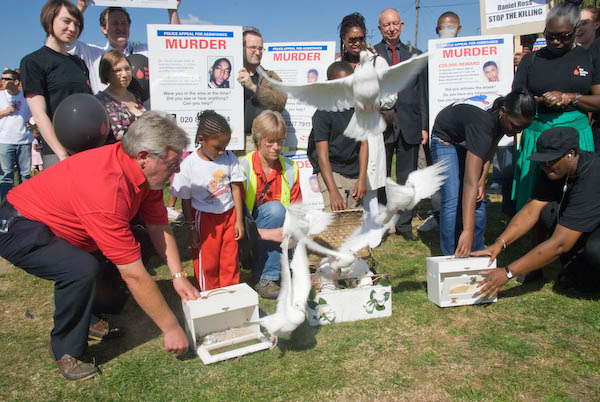
White doves were released just before the start of the march
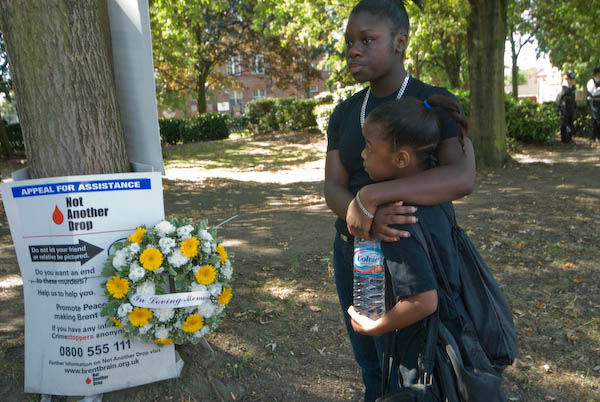
Brent has suffered more than most London boroughs from gun and knife crimes resulting in the deaths of far too many young men (and women) on its streets.
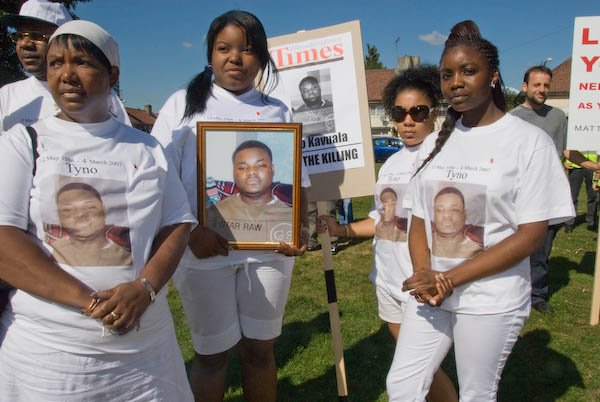
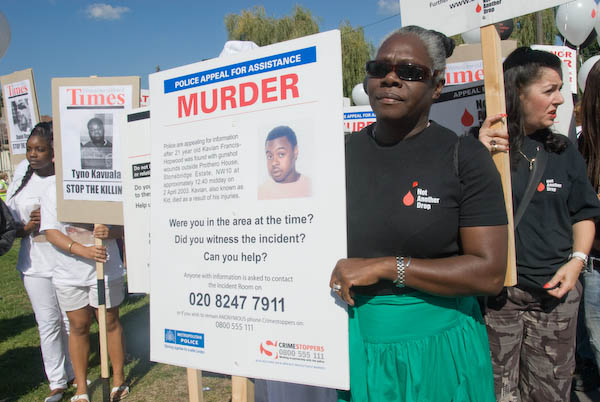
The annual police march was started in 2004 by Patsy Hopwood, whose son, Kavian Francis-Hopwood was shot dead on the Stonebridge Estate in 2003, and is part of the ‘Not Another Drop’ campaign organised by the Met and Brent Council.
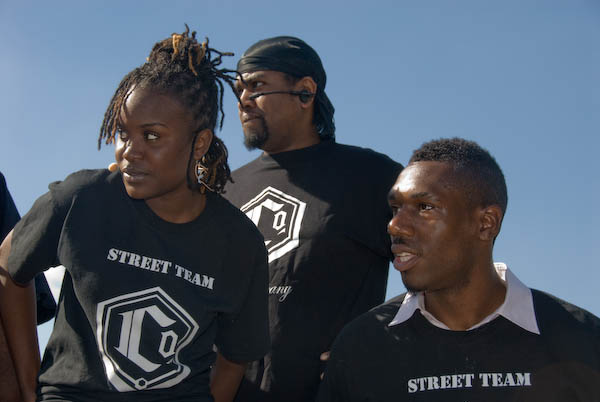
Around 250 people including two large church groups set off on the march across the borough to South Kilburn.
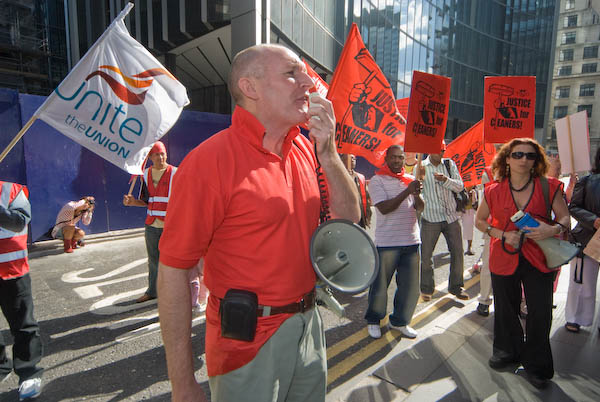
Cleaners from London Citizen Workers picket for a living wage
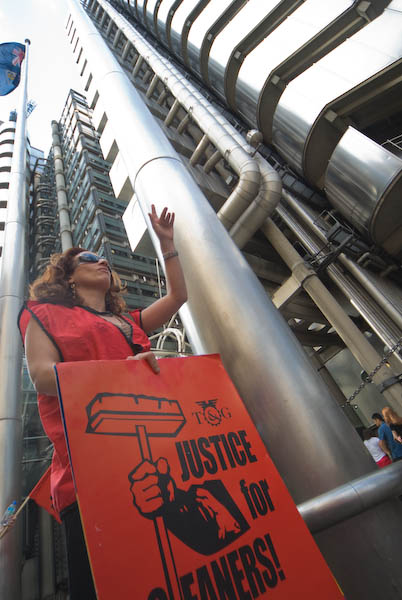
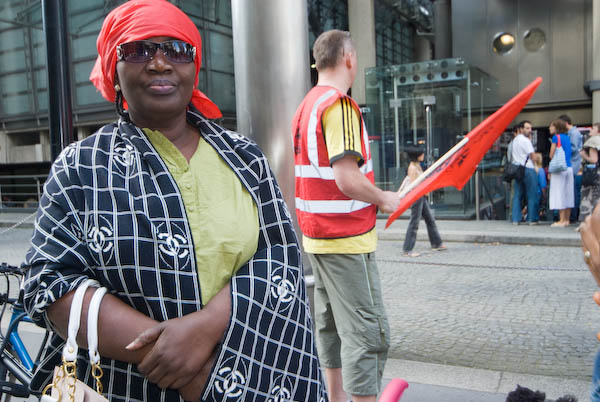
Cleaners at Lloyd’s Of London – a bastion of wealth and privilege in the City – are among the lowest paid workers in London and don’t get sick pay or holiday pay.
Open House Day provided a good audience for the London Citizen Workers Association to publicise their appalling treatment.
[The cleaning at Lloyd’s – and almost all other office buildings is outsourced with cleaners being employed by contractors, notoriously poor employers.]
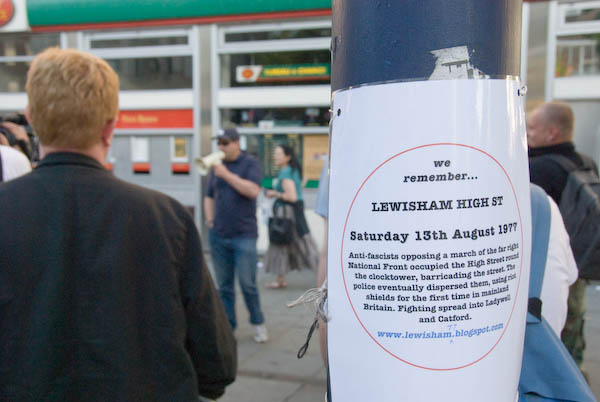
Photographer Red Saunders talks about his experiences in Lewisham on 13 Sugust 1977
It is now just over 30 years since the battle of Lewisham in which protesters humiliated the National Front when they attempted a march through the area.
The event began outside the New Cross Inn
Having escorted the National Front home, the police then turned on the anti-racist protesters, using horses, batons, and, for the first time on the British mainland, riot shields.
Batwinder Rana describes what happened to him in 1977
At this incredible outbreak of police violence, the community came out onto the streets and the police lost control. Lewisham now has a massive police fortress.
Our route took us past Mr Brenton Pink’s painted house on Loampit Hill
On a walk around the area, a number of those present [in 1977] talked about the event and their own experiences on the day.
and on to Lewisham High Street where the police used riot shields for the first time on the UK mainlandHere more people shared their experiences and the event ended.
On My London Diary you can see many more pictures including of others who spoke at the event at Lewisham77
I like to bring back to life many of the posts I wrote in the first six or seven years of My London Diary not just because of their interest and that many of the issues are still very relevant 20 or more years later, but also because as the site developed it became harder and harder to locate things and to find both images and particularly the text I had written about them.
These problems with My London Diary were largely resolved with a redesign of the site for new posts in 2008 which kept pictures and text together and a search facility. I also moved away from the lower case only text which had seemed appropriate when the site began around 2000. Revisiting posts from back then on >Re:PHOTO allows me to reunite text and some of the pictures (with links to the rest) and also to correct the many typos and misspellings from them. So here with these minor corrections is what I wrote back in 2006.
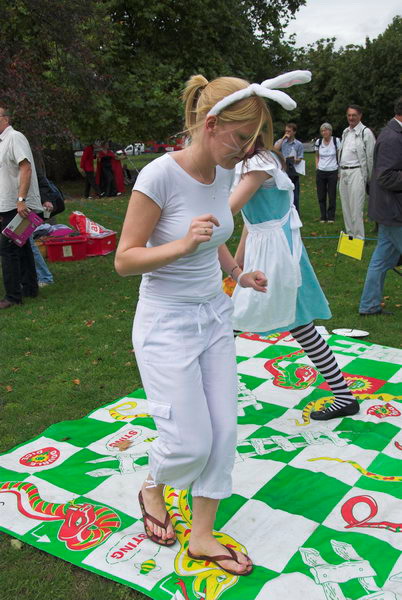
The White Rabbit, Alice and her friends were playing snakes and ladders
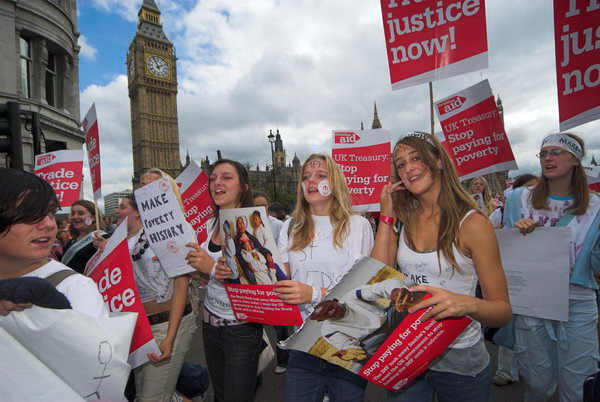
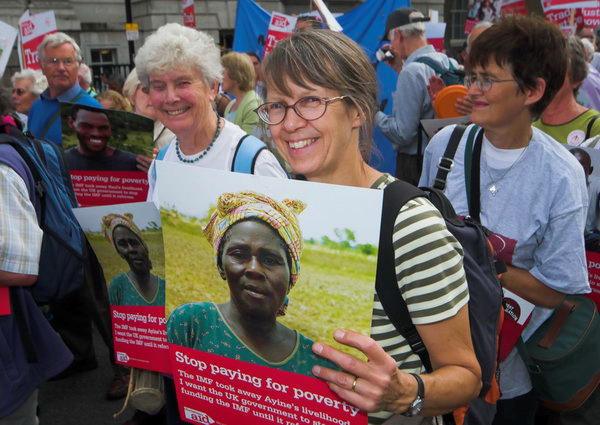
In Mary Harmsworth Park, waiting for the Christian Aid organised March On The Treasury to start I bumped – literally – into the Archbishop Of Canterbury. He looked even more distracted than usual. A couple of minutes later I returned to take his picture. Moving in his direction I took my eye off him for a second, and he vanished, leaving not even a cloud of smoke. Later we were told he had another appointment and so couldn’t stay.
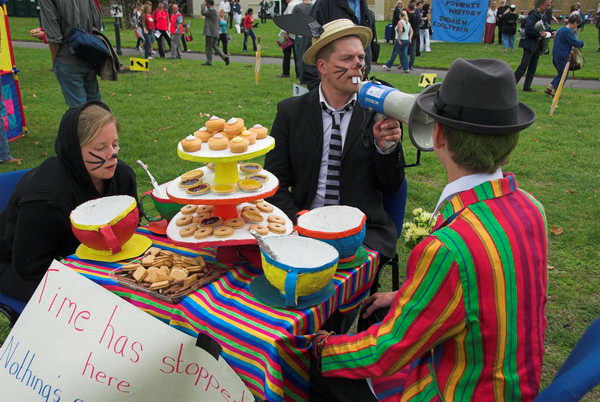
And the Mad Hatter was having his tea party
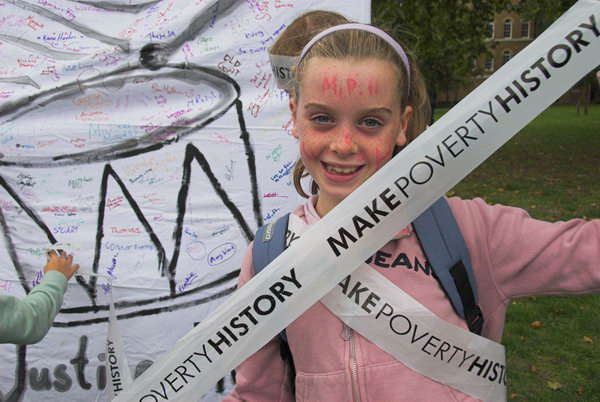
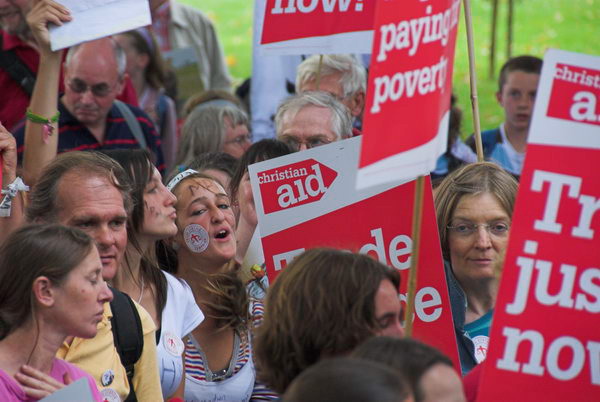
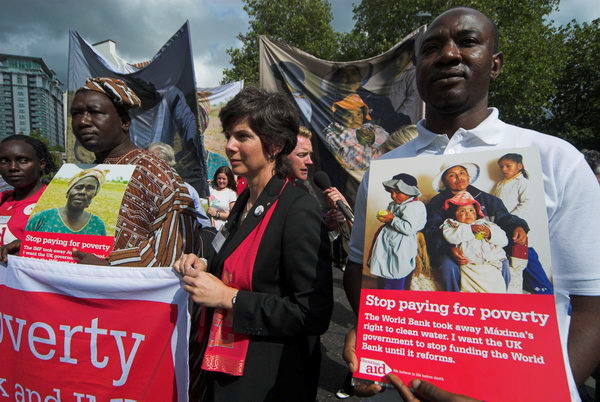
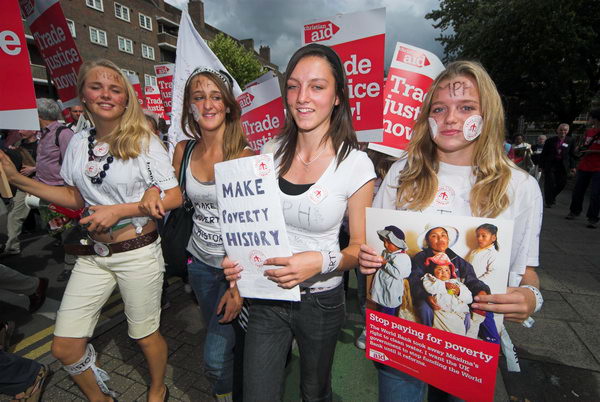
However there were plenty of other people to photograph, perhaps a couple of thousand in all. We were there to march on the Treasury, to demand that the government withhold funding from the International Monetary Fund, because of the unfair economic conditions they impose on countries that want loans. When the IMF insists on free trade in agricultural produce for example, cheap EU subsidised tomatoes from Italy can flood local markets and put the local tomato farmers out of business.
Daleep Mukarjee, Christian Aid’s Director was able to tell us (as most had heard on the radio earlier in the day), that Development minister Hilary Benn had announced that we were holding back £50 million for that reason. It would stretch belief to think that this announcement, coming on the day of this major demo, had no connection with the six-month campaign leading up to it. Of course it is only a first small step in what needs to be done.
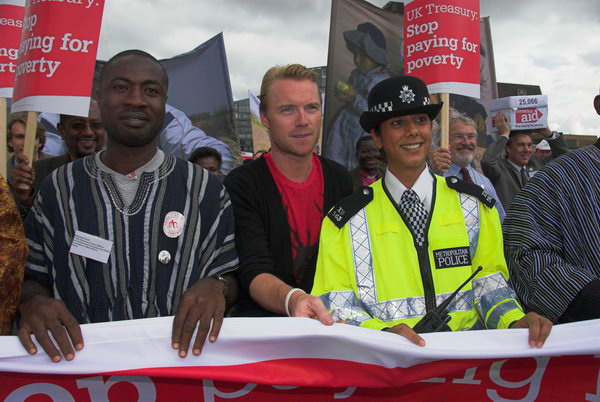
Among the other speakers was former Boyzoner Ronan Keating, (since going solo he has an impressive list of top ten singles and albums, though I’ve never knowingly heard any of them.) He gave a decent speech and spoke movingly about his trip to Ghana for Christian Aid.
A police woman poses to have her picture taken with Ronan Keating
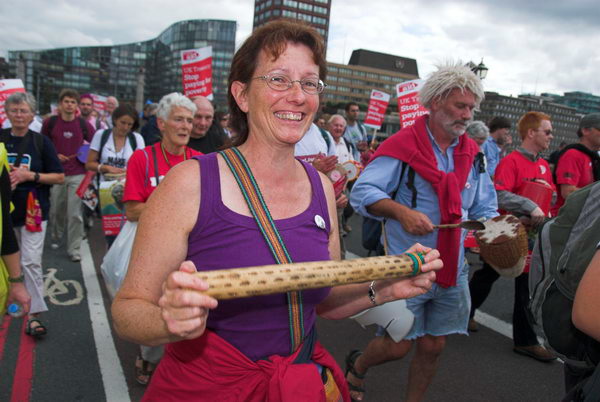
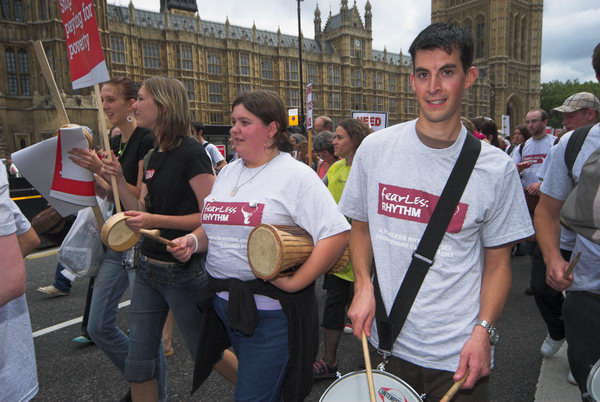
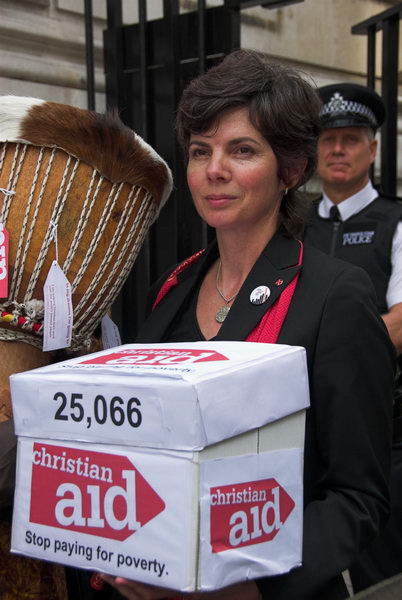
Then we were on the march, across Lambeth Bridge and up past the Houses Of Parliament to Whitehall, where the two thousand or so of us paused outside Downing Street while a small group went in to deliver an African drum and the Christian Aid petition to Gordon Brown’s door.
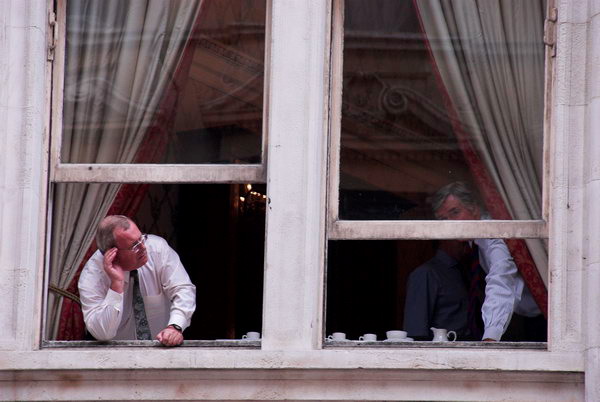
People in the Treasury were listening – But will more action follow?
The parade came to a halt outside the Treasury Offices in Whitehall Place, with more drumming and speeches. At least some of those inside took a little interest in what was going on, breaking off from their tea break to listen to the speeches.
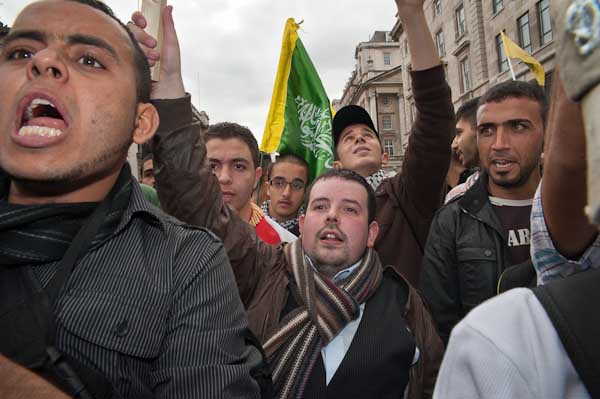
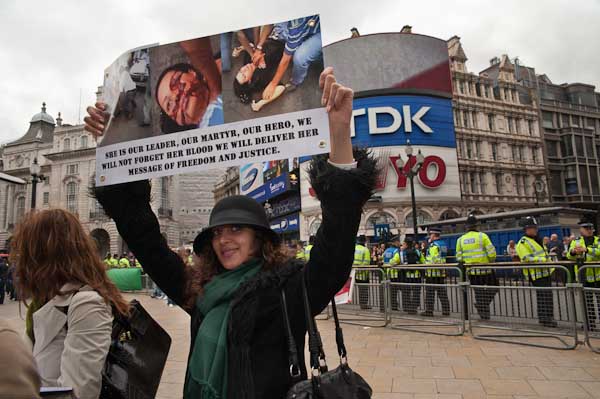
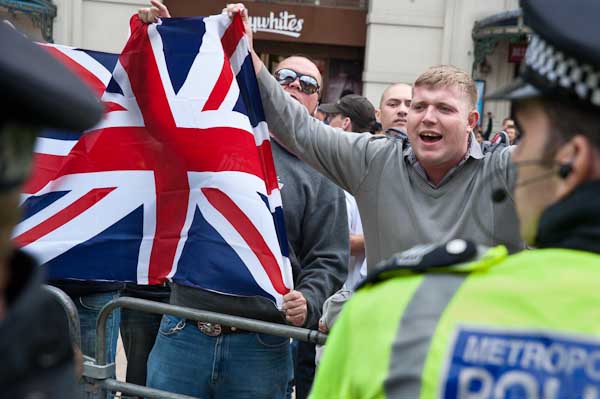
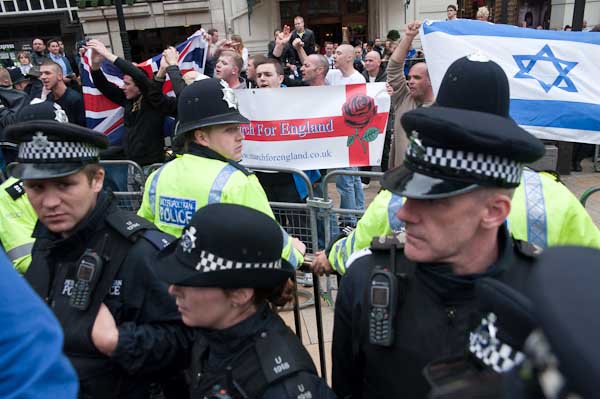
The annual Al Quds Day (Jerusalem Day) march in London as usual attracted controversy, with various groups coming out to protest against it. In 2009 these included Iranian democrats, royalists and socialists as well as far right groups including the English Defence League and March For England, but there seemed to be few organised Zionists on the streets.
Al Quds Day was initiated by Ayatollah Khomeini when he became Supreme Leader of Iran in 1989 as a day on the last Friday of Ramadan (the London march is on the following Sunday) to oppose the Israeli occupation and control of Jerusalem, and at least one of the groups involved in organising the event is said to received funding from the Iranian authorities – which accounts for the Iranian protesters.
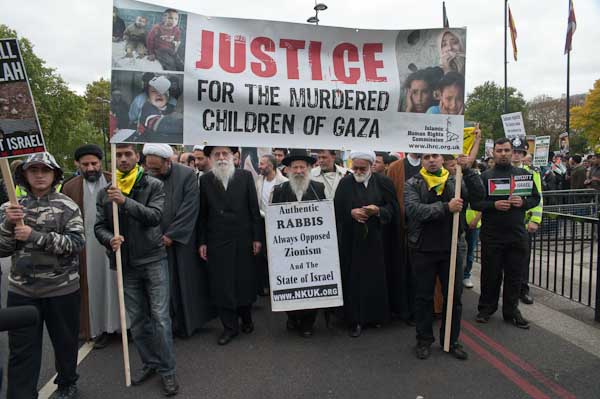
The march starts under the main banner ‘Justice for the Murdered Children of Gaza’
The march has become a wider protest calling for freedom for Palestine and an end to the Israeli occupation of land which for many centuries was Palestine. For many of the marchers this also means support for those fighting against Israeli occupation, both in Palestine and Lebanon.
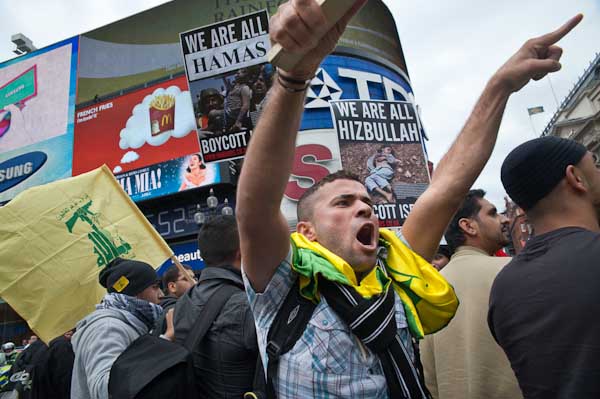
A few of the marchers carried Hezbollah flags, the flag of both the Lebanese Shia political party and its military wing. The military wing had been proscribed in the UK in 2008, but it was only in 2019 that this ban was extended to cover the political wing, making carrying the flag an offence. You can see a few of these yellow flags in my pictures. There are also some placards supporting Hezbollah and Hamas for their resistance to Israel.
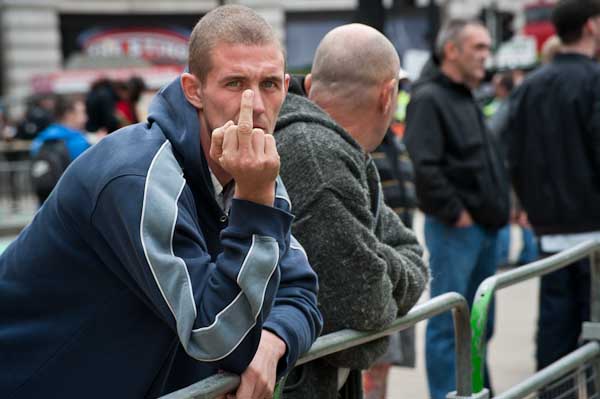
Demonstrators against the march were gathering earlier at Piccadilly CircusThey included Iranians as well as right wing football supporters
In 2009 the march was carefully policed to keep the marchers and protesters against the march from coming into contact and I saw some from both groups being stopped and searched in the area around Marble Arch where the march gathered.
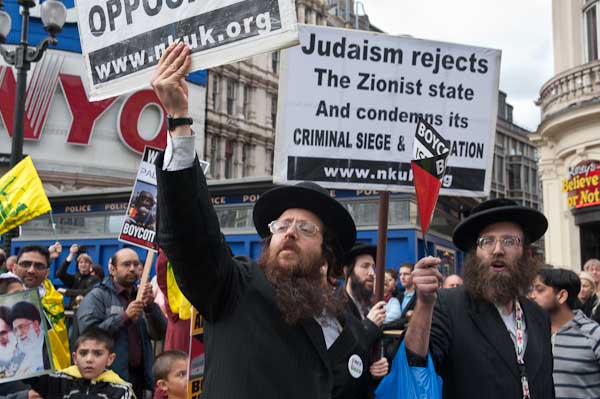
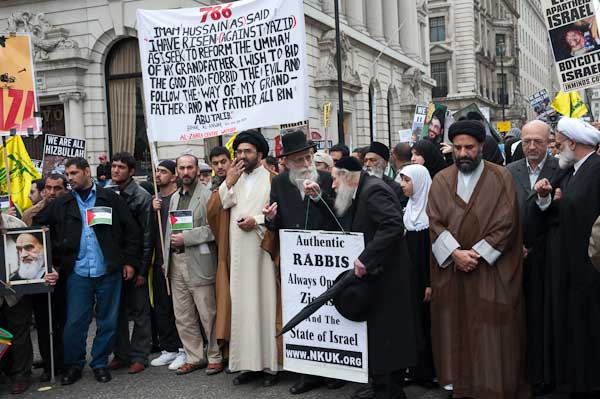
Neturei Karta marchers
People come to the march in coaches from mosques around the country and many come as families. Although there were separate men’s and women’s blocs the organisers announced that those who wanted to march as families were welcome to do so, and many, particularly the younger marchers, took advantage of this.
Rabbi Ahron Cohen who spoke at the rally at the end of the march
At the front of the march were Muslim clerics and two Neturei Karta Jewish leaders. These ultra-orthodox Jews are anti-Zionist and believe that Jews are forbidden from establishing a Jewish state until the arrival of the Messiah and support the peaceful dismantling of the state of Israel to become a part of Palestine.
The main counter-protest came at Piccadilly Circus, with most of those taking part encircled around ‘Eros’ by a double line of police. They protested noisily as the march went by but most of the marchers followed the advice of the march stewards and ignored them. Some held up their posters and there were minor scuffles when a few marchers tried to leave the march and approach them.
As well as shouting insults at the Muslims, the counter-protesters were also making threats, gestures and shouting at the photographers, and I was glad not to be too close although the police bodies between made taking pictures difficult.
Police had also told the march organisers that they could not march to Trafalgar Square but must end with a rally in the much smaller area of Waterloo Place, which became extremely crowded. I left after listening to the first few speakers.
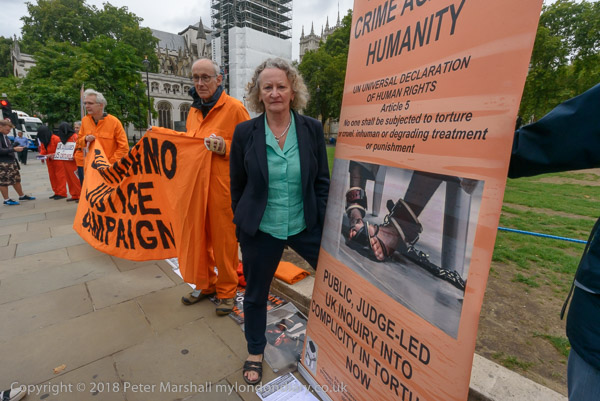
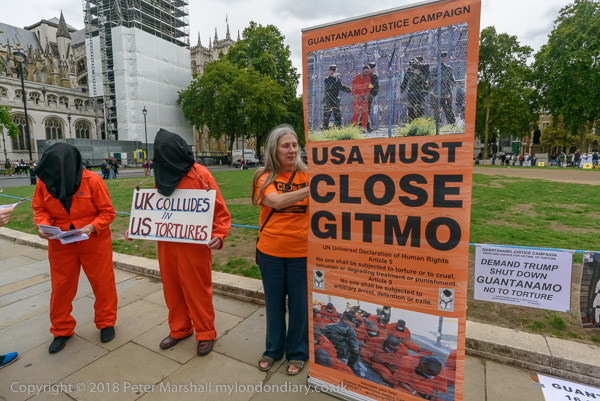
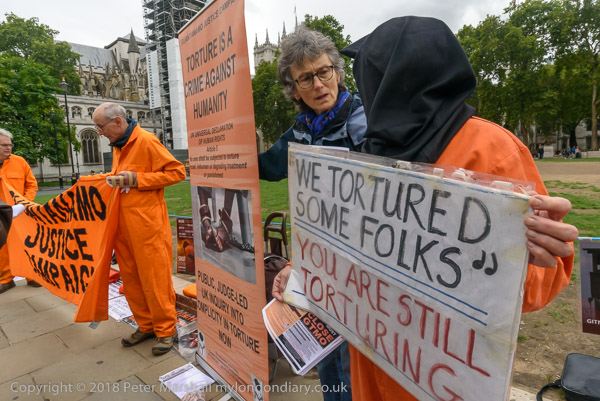
Guantanamo & Nanas Against Fracking: On Wednesday 12th September 2018 I went to Parliament Square where the Guantanamo Justice Campaign was holding a monthly vigil calling for an end to the illegal torture camp at Guantanamo and Nanas from Lancashire with others were calling for the government to end fracking. Later I went with the Nanas who marched to protest at the Department for Business, Energy and Industrial Strategy in Victoria St.
Trump told to close Guantanamo
Parliament Square
Baroness Jenny Jones came to visit the vigil
Another monthly vigil opposite Parliament called on UK Prime Minister Theresa May to make urgent representations to President Trump to close Guantanamo and end the brutality and torture which is continuing against the 40 men then still held there in indefinite detention.
They demanded Trump respect human rights and internation law, saying the illegal camp is a legal and moral outrage and a symbol of US torture and injustice.
The protesters were joined briefly by Green Party member of the House of Lords Jenny Jones, Baroness Jones of Moulsecoomb.
Lancashire Nana Tina-Louise Rothery speaks at the protest
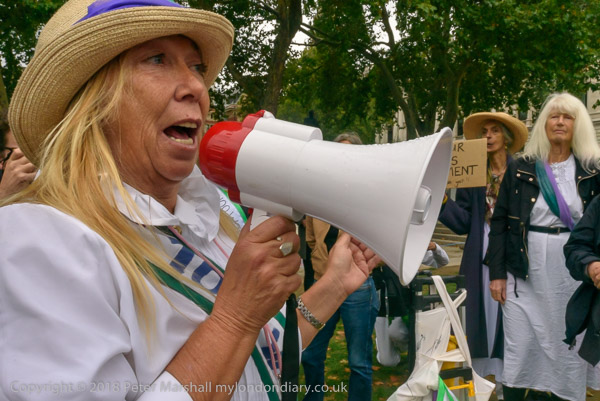
Following 3 months of “Love & Defiance” that took place from April-June in Lancashire by the Nanas they came to London to tell the government to stop ignoring science and the will of the people and ban fracking.
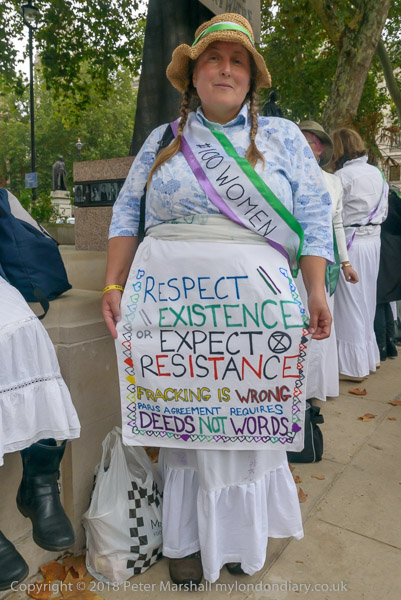
As well as threatening the areas of the country in which it was taking place with earthquakes and pollution, fracking is also a threat to the future of the planet through its high level of carbon emissions.
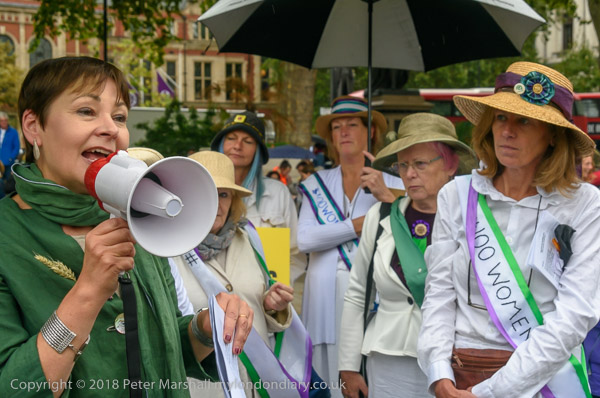
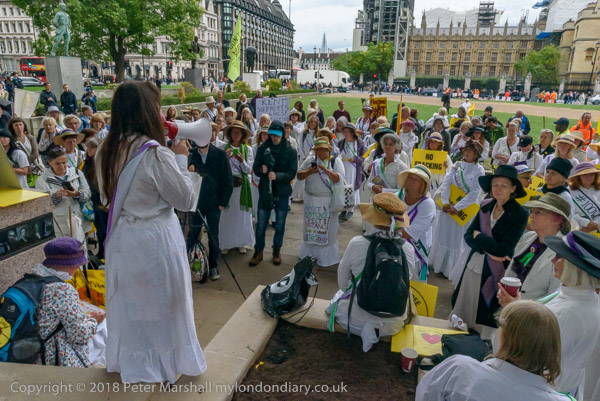
Many of the protesters wore suffragette costumes to mark the 100th anniversary of women first getting the vote in 1918 and called on the government now to make voting mean something. The rally took place in front to the statue of suffragist campaigner Millicent Fawcett.
Green Party MP Caroline Lucas
Speakers at the rally included Ruth George, Labour MP for High Peak, Jenny Jones, Baroness Jones of Moulsecoomb, Mike Amesbury, Labour MP for Weaver Vale, Lancashire Nana Tina-Louise Rothery, Shadow Chancellor John McDonnell and Green Party Deputy Leader Amelia Womack.
Also speaking at the rally were women against a proposed move of the statue of suffragette Emmeline Pankhurst, funded by suffragettes in 1930, from Victoria Tower Gardens next to the House of Lords to Regent’s Park, which they described as an “act of vandalism against women’s history“.
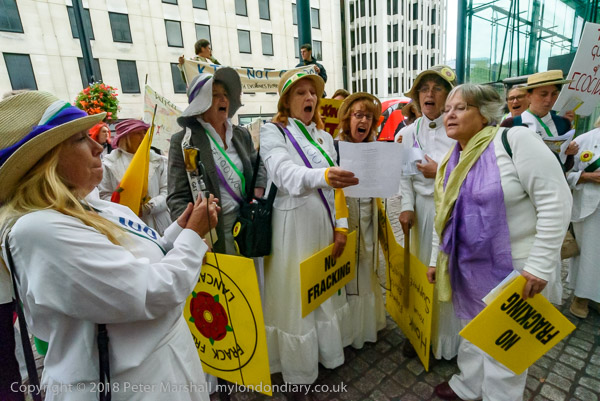
Nanas sing in protest against fracking at the BEIS
At the end of the rally in Parliament Square, the anti-fracking women protesters in Suffragette dress marched around the square and on to the Department for Business, Energy and Industrial Strategy in Victoria St for a noisy protest there.
Women get ready to march to the Department for Business, Energy and Industrial Strategy in Victoria StOutside the Department for Business, Energy and Industrial Strategy
One woman climbed on the low wall in front of the delivery bay at the centre of the frontage and others followed with more moving inside behind to support them.
The protest continued between the two wings of the offices and on the pavement in front with much shouting and singing.
Suicide, Arms Dealers & Letting Agent; Friday 11th September 2005 I began with a protest outside Parliament on a matter which is still being debated inside Parliament today, having been talked out by opponents in the House of Lords earlier this year – Assisted Suicide. I went on to the continuing protest outside the DSEi Arms Fair at the Excel Centre in Newham before finally going further east to Goodmayes in Redbridge where United Voices of the World were supporting a member to get back his life savings from a letting agent who failed to provide the property and was refusing to repay the money.
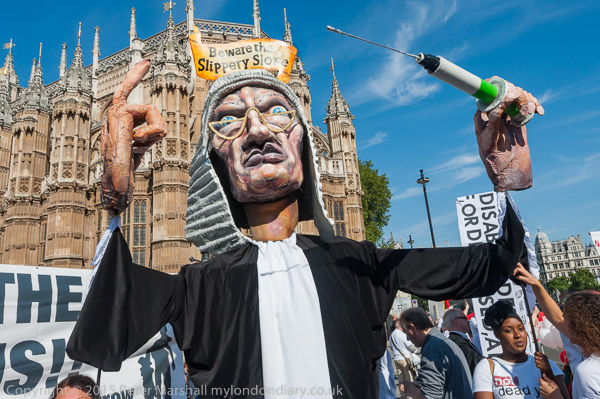
Assisted Suicide Debate Lobbies
Old Palace Yard, Westminster
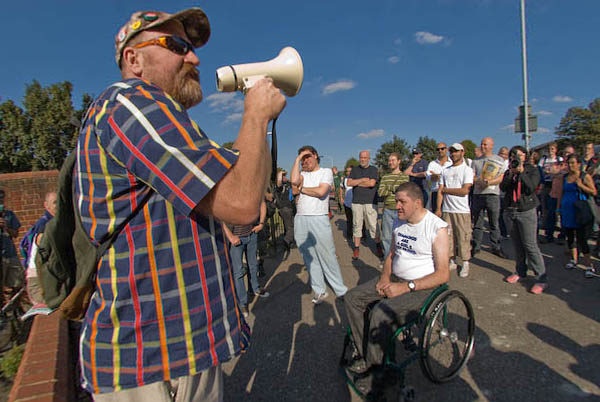
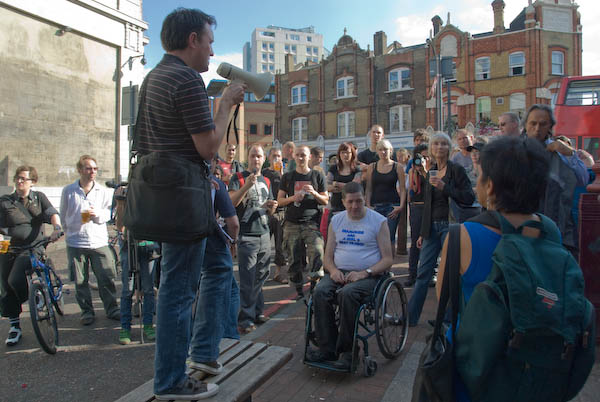
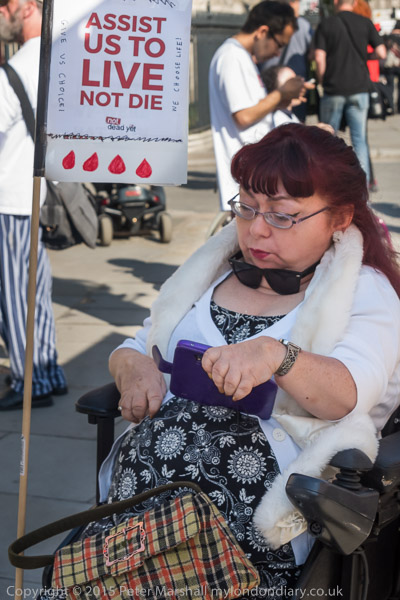
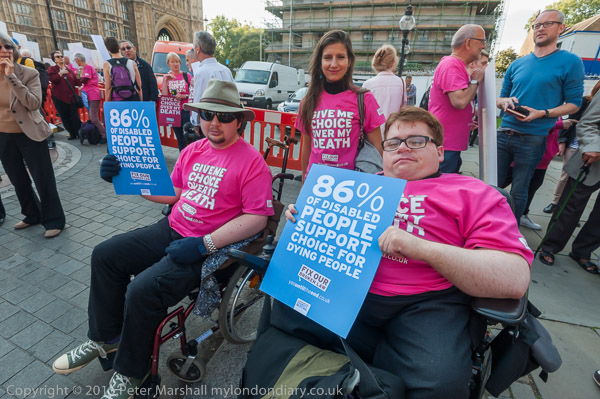
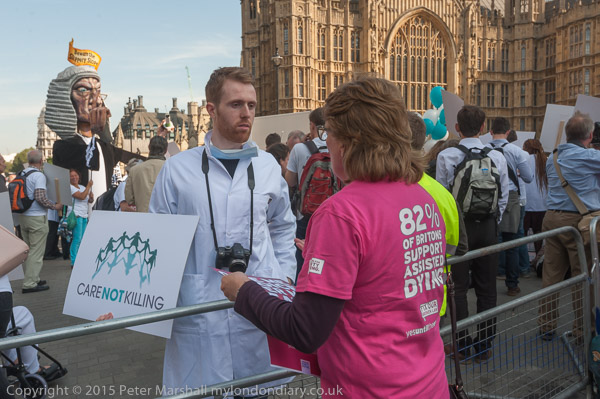
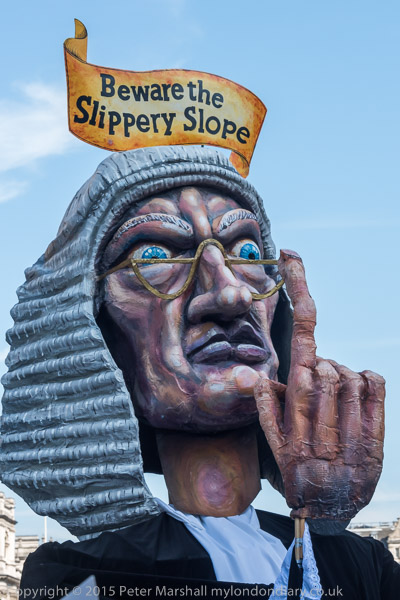
Rival groups of protesters for and against the Assisted Suicide Bill were protesting at Parliament on the day that the bill was being debated.
Not Dead Yet UK were opposing the bill and were supported by disabled protesters who had recently lost ILF support now feel threatened by the Bill.
The Campaign for Dignity in Dying had come to support it, calling for our broken law to be fixed. There were also some disabled protesters supporting them, and claiming the support of 86% of disabled people.
There was a barrier between the two groups and there were some quiet arguments across it. The current law is certainly not satisfactory but it is hard to see how it can be changed without putting some at risk. For good reason the activities of doctors are now much more in the open – we remember Harold Shipman, thought to have killed around 250 of his patients over 24 years as a Manchester doctor, but perhaps now there are too many who “strive needlessly to keep alive” rather than risk allegations of misconduct.
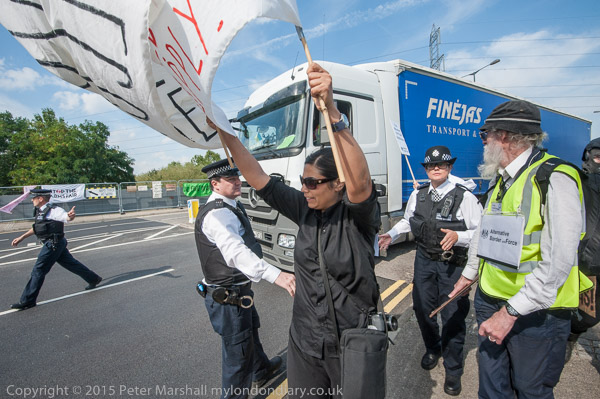
The ‘Alternative Border Farce’ attempt to stop lorries bringing exhibits to the arms fair
I arrived at the protest camp close to the East Gate into the Excel Centre while a rally was taking place on the side of the road leading into the centre.
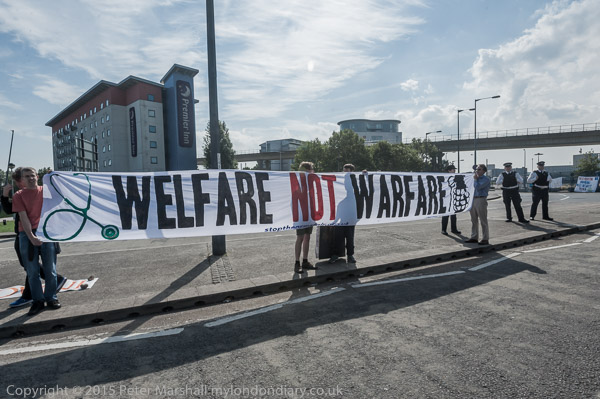
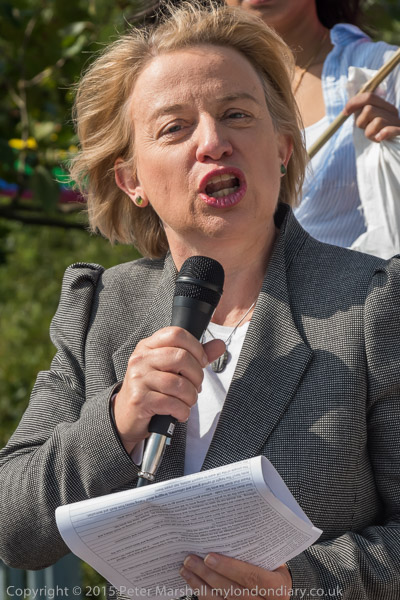
‘Welfare NOT Warfare’ was the message of a long banner held on the central pavementGreen Party Leader Natalie Bennett speaks about the UK’s failed foreign policy and massive arms supply at the root of the world’s worst refugee crisis since the Second World War.
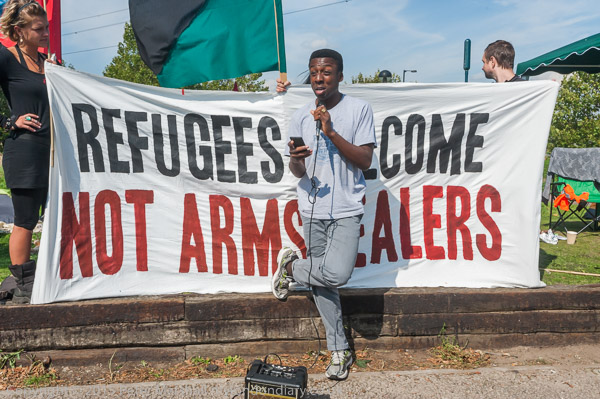
Speakers, including Green Party leader Natalie Bennett, Simon from Occupy The Arms Fair, Rita Chadha of Refugee and Migrant Forum of Essex and London, Cecil of Black Dissidents, Spike of Veterans for Peace pointed out the injustice in allowing free movement of arms while restricting the movement of the refugees the use of arms creates.
Cecil of Black Dissidents speaks about the racism behind the treatment of migrants
Arnold (from Sierra Leone) and Kiarash (from Iran) talked of their personal experiences of the problems faced by those seeking asylum in the UK, and some refugees waiting to come here from Calais were able to speak by phone.
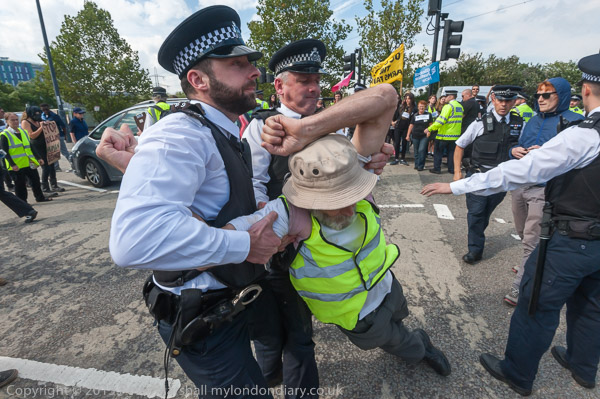
When the rally ended a group of protesters formed themselves into an ‘Alternative Border Farce’ and stood in the road in front of lorries attempting to go into the Arms Fair. Police warned them they might be arrested but while I was there simply pushed them, occasionally rather more forcefully than seemed necessary, out of the road when each lorry approached.
The protesters managed to hold up several lorries for a few minutes, but more police arrived and by the time I left they were able to escort the lorries through with a line of police on each side.
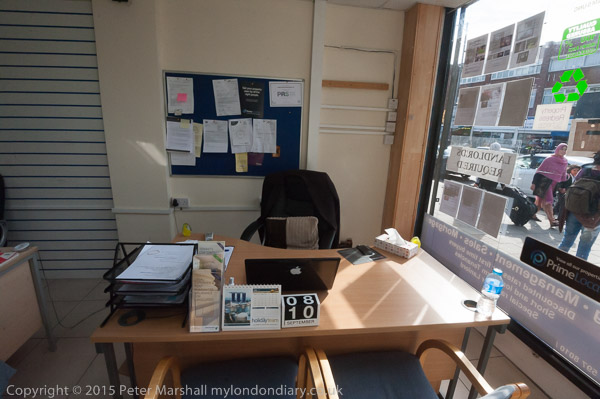
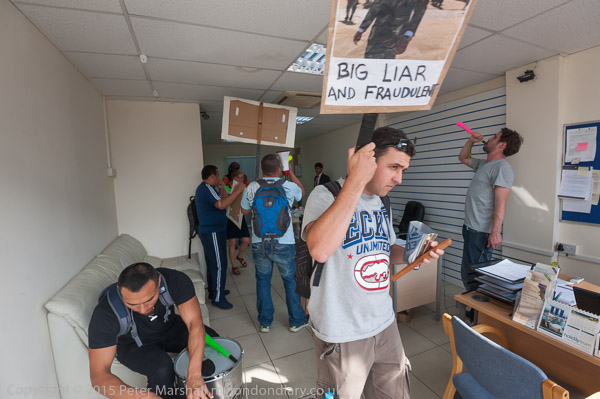
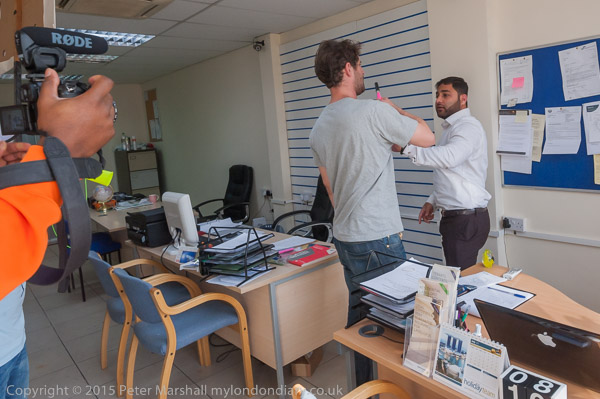
Hunter Home Properties Ltd is this single desk by the window
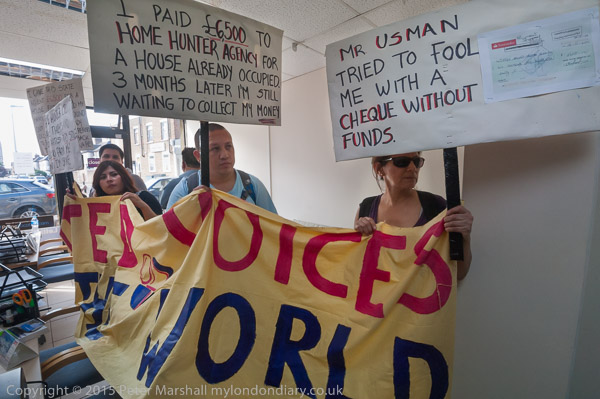
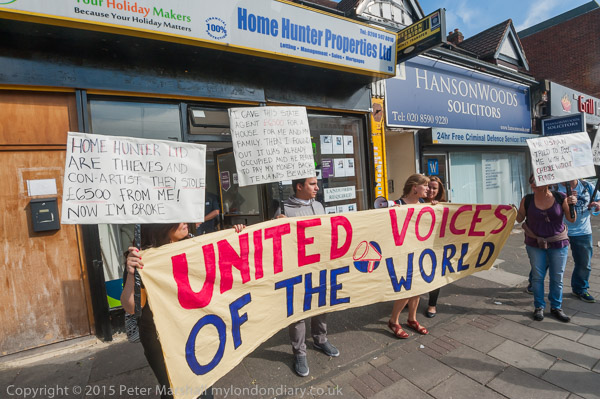
United Voices of the World trade union member Carlos had paid his life savings of £6,500 to estate agent Usman Bhatti of Home Hunter Properties Ltd in Goodmayes as deposit and 2 months rent on an house for his family. But the house was not available and he was now homeless and unable to get most of his money back.
The UVW had been trying to get Carlos’s money back for several month, and had been promised it would be paid and even given a cheque – which bounced. But now Mr Bhatti was not answering calls so the union decided to pay him a visit.
I went with a dozen members of the UVW and Carlos to the office in Goodmayes which Bhatti shares with other businesses – he had a single desk by the window though his company name was prominent on the shop front.
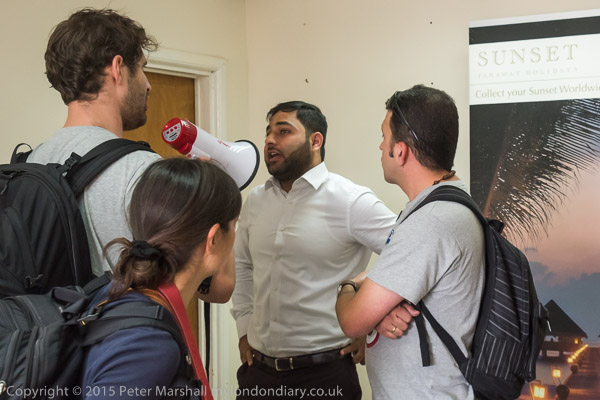
They went inside the shop and began a noisy protest with drums and horns, bringing in their banner and placard. UVW General Secretary Petros Elia then talked to Bhatti and the others went to continue the protest on the pavement outside.
Mr Bhatti promised to pay but could not do so immediately and said he would do so within two weeks, but the protesters were not convinced as he had make similar offers in the past and not kept to his promises.
The protesters went back into the shop and Mr Bhatti then lost his temper and tried to grab a vuvuzela that Elia was blowing in his direction, assaulting him. But he soon calmed down and took Carlos and Elia into a back room for more talks, accompanied by the videographer who was also recording the protest.
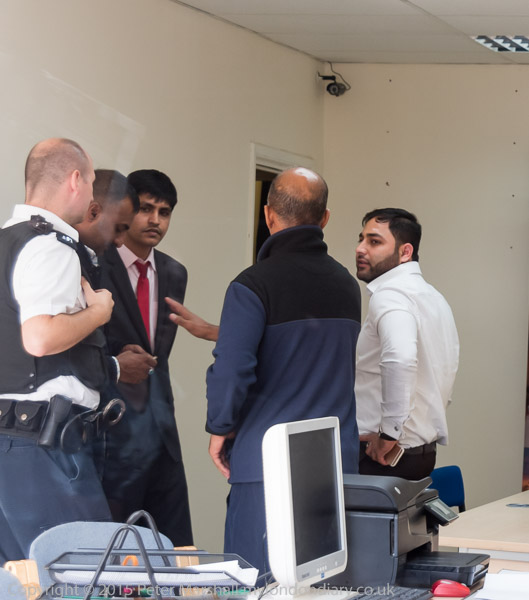
Shortly after they came out, two police officers arrived, talked to both the protesters and people inside the office. There seemed to be no problems and the protest was ending so I left to catch a train back into London.
Back home I I heard that shortly after I left the police had arrested Petros and another of the protesters, and that Petros was being charged with assaulting Mr Bhatti. I was shocked, not least because I had seen the opposite happening.
Tavy Bridge, Thamesmead: In October and November 1994 I returned to Thamesmead, a New Town which I had first photographed nine years earlier and spent a few days wandering around the area, developed largely from the end of the 1960s by the GLC under architect Robert Rigg to house families from poor and overcrowded Victorian working-class terraces, particularly those in East London.
The planners hoped to grow some of the community that had existed in those working class areas by giving the families of the initial residents priority for new housing, and had s strong belief that the water in lakes and canals as a calming influence of those who lived among them. Neither policies were as effective as had been hoped.
Tavy Bridge Centre, Thamesmead, Bexley, 1994, 94-115-52
Thamesmead is on low-lying land on the bank of the River Thames and had been flooded in 1953, so the living accommodation on much of the housing began at first floor level, with walkways there where people would meet and children play as they had done on the streets back in their old homes. The ground level was for cars, with roads and garages.
It didn’t work out too well in practice, partly because of a huge increase in car use, in part driven by the isolation of Thamesmead and poor public transport as well as increasing affluence. Shops, schools, pubs and more which might have been at the corner of the old streets were now much further away, and people increasingly got into cars, leaving the walkways deserted. And for those who did walk, there were almost always shorter routes at ground level across the streets and grassy areas than on the walkways.
As I think my pictures show, at least in part the result was an empty and rather alienating landscape, much used in films, notably Stanley Kubrick’s dystopian 1973 ‘A Clockwork Orange’, based on Anthony Burgess’s 1962 novel. And in real life it seemed also to encourage high levels of drug-related crime and violence with often racist gangs.
Thamesmead lies across the boundary of two London boroughs, Greenwich and Bexley, and the abolition of the GLC in 1985-6 was also a disaster for the development of the town, with ownership first being transferred to a new body, Thamesmead Town Limited (TTL) and later in 2000 the housing to Gallions Housing Association with Tilfen Land taking over the undeveloped land.
Tavy Bridge, Thamesmead, Bexley, 1994, 94-115-33
The Tavy Bridge area where this first section of pictures was taken was redeveloped by Gallions together with Wates Group – and new homes were then built with living accommodation at ground level, so almost certain to flood.
Limestone Social Club, T.C.A., Limestone Walk, Thamesmead, Bexley, 1994, 94-116-56
Bus Stop, Tee Dee’s, Hair & Beauty Salon, Thamesmead, Bexley, 1994, 94-116-55
Along with these photographs (and more in black and white on Flickr) I also made a number of panoramic images around Tavy Bridge which will feature in a later post.
Brick Lane, Brockwell Park & Lambeth Peace Month: Sunday 9th September 2007 was a slightly disappointing day for me, perhaps because I expected more and tried to do too much. I was going to London maiinly to meet a couple of friends and probably should have just done that and enjoyed some time with them – and perhaps a few beers. Even have left the cameras at home.
But the Green Fair and the Interfaith Picnic were interesting and I did manage to take a few pictures of aspects of London which now, looking back, are of more interest than I thought at the time. So here are some of the photos and what I wrote back in 2007 – and links to more pictures on My London Diary.
Brick Lane
Spitalfields.
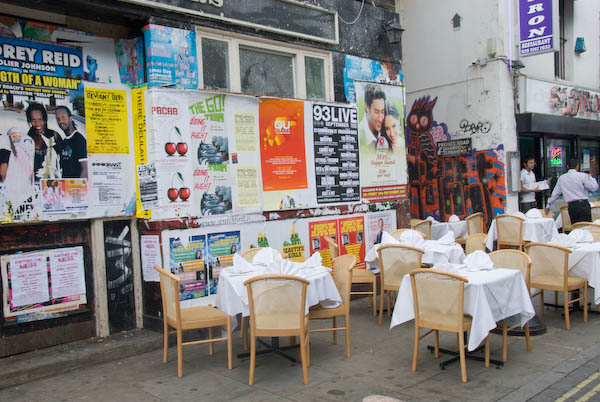
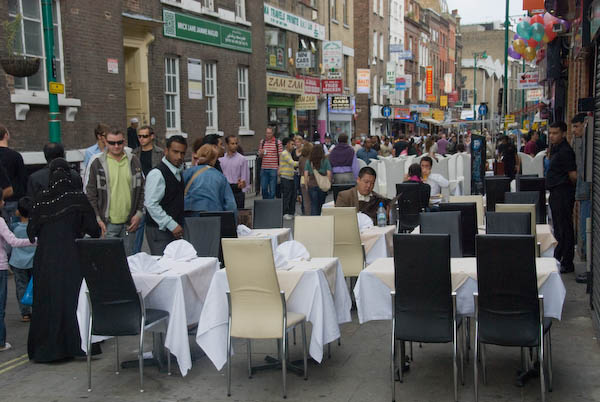
Not a lot was happening around lunchtime in Brick Lane, so I took a few snaps and went elsewhere.
Sunday none of the three events I visited really turned out to be what I expected. I started in Brick Lane where a music festival was on offer. It didn’t really seem to have started when I was there and I couldn’t be bothered to wait.
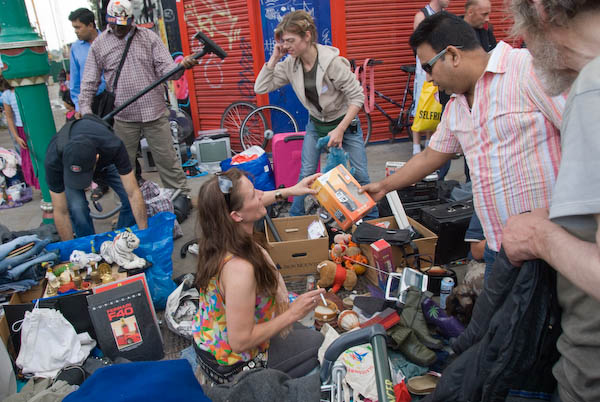
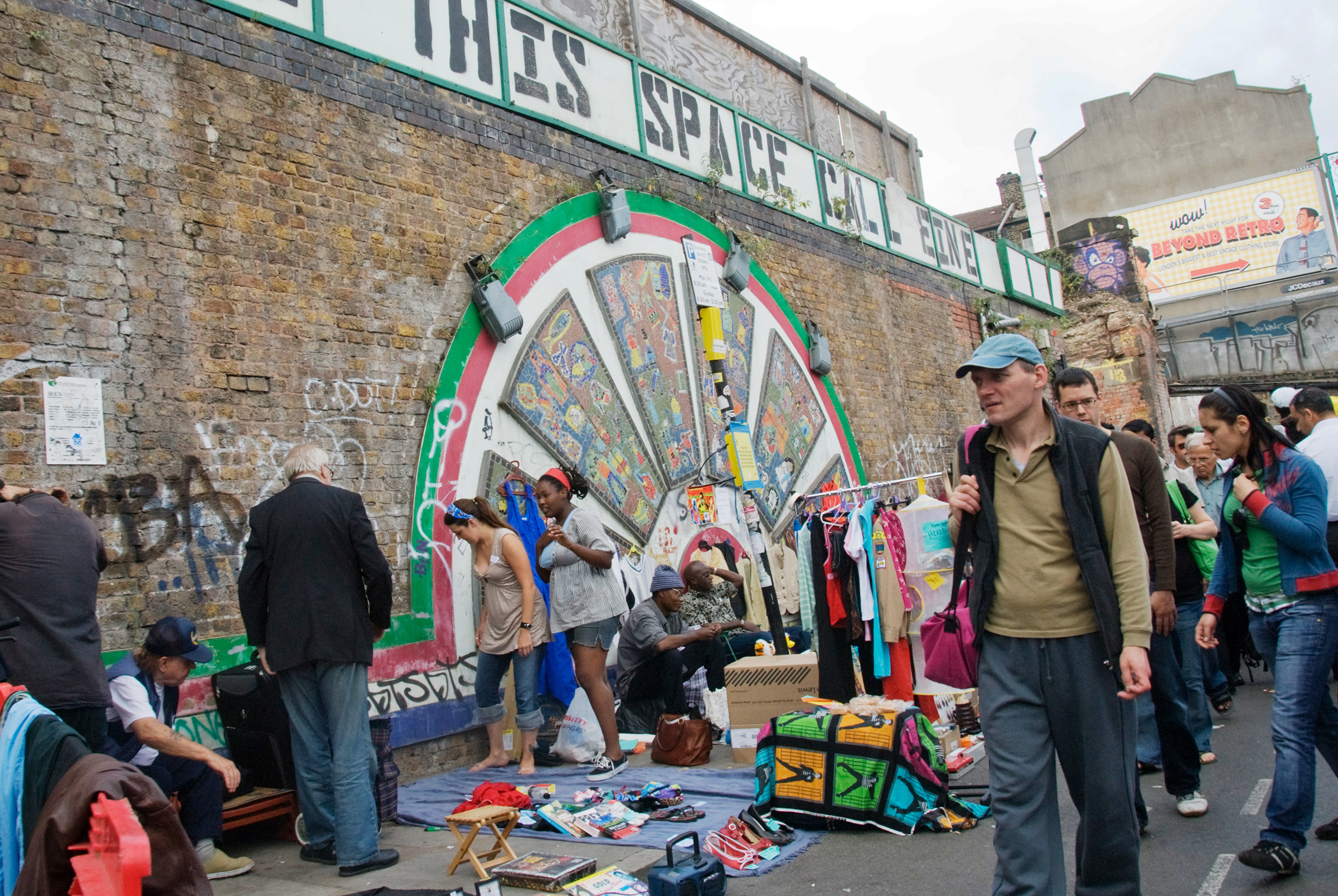
I took a few pictures in the market which takes place every SundaySo I took the underground to Blackfriars to get a train to Herne Hill
Then I went on to the Urban Green Fair at Brockwell Park (a short journey on the train from Blackfriars [to Herne Hill station.])
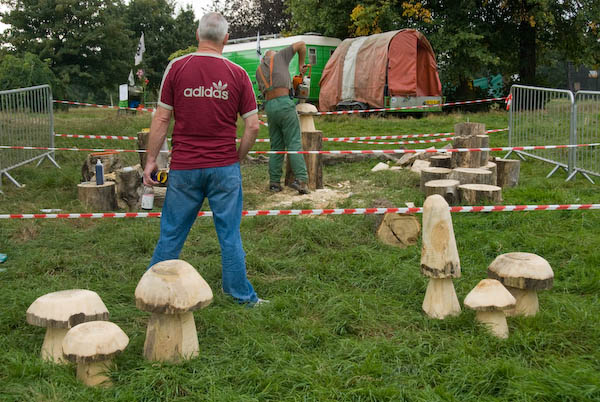
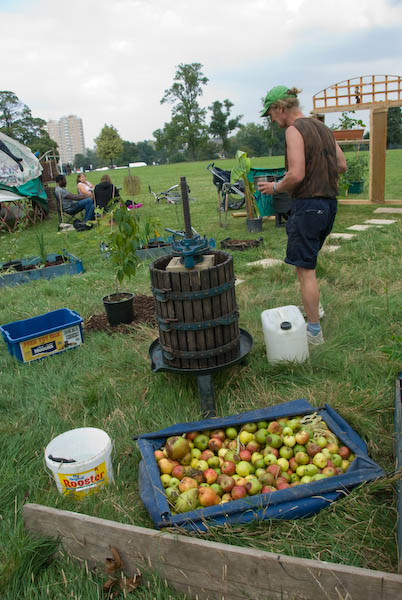
I’m not sure who would want a wooden mushroom, though some you could sit on.An apple press would be useful, but this Italian one was rather larger than I needed
This was a bit more interesting but did seem to be rather too much people trying to sell things, and I had hoped for more music and performances.
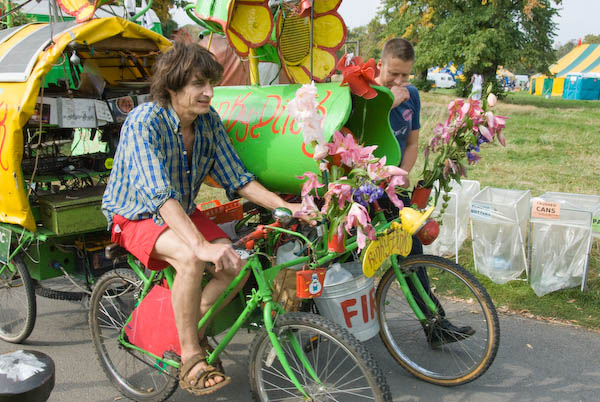
I met again the great pedal-powered Rinky-Dink sound system
Imam (centre) with assistant and Toaha Qureshi from Stockwell Green Islamic Centre
I met Dave and Bob at the Green Fair, and Dave told me that there was an Interfaith Peace Picnic just about to start in Windrush Square in Brixton. So I jumped on a 37 bus for the few stops there.
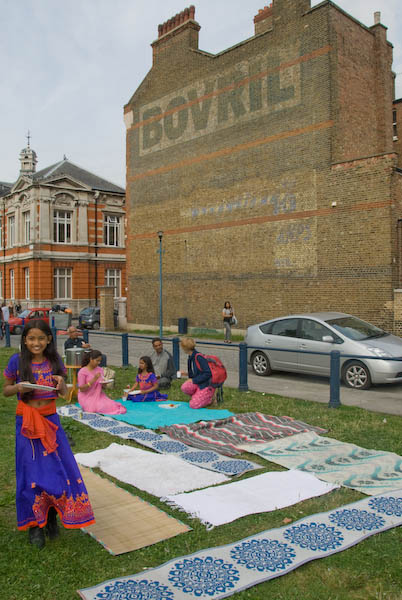
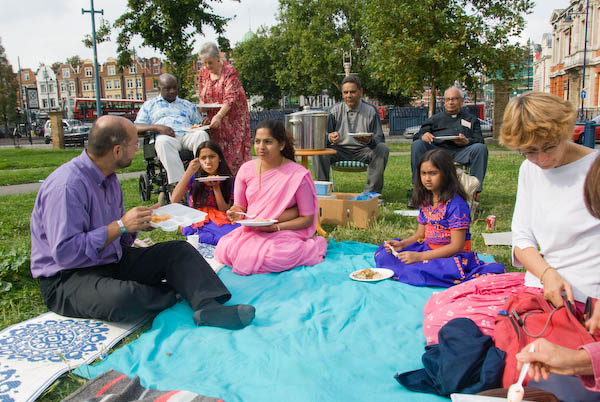
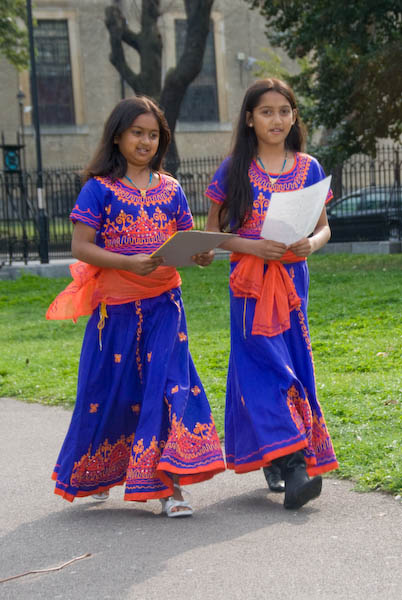
All the different groups present offered generous amounts of free vegetarian food, and it pained me to have to refuse most of it. I’d not heard of the Caribbean Hindu Cultural Society before; based on Brixton Hill it is apparently the oldest Hindu group in the country.
Members of the Caribbean Hindu Society, Lambeth, address the peace picnic.
The event was organised by the South London Interfaith Group, and also present were the Archdeacon of Lambeth, the Imam and others from the Stockwell Green Islamic Centre along with some from local churches.
Representatives from various groups gave short performances of different kinds (including a powerfully sung ‘Lord’s Prayer’ by one of the more senior Hindu men) and the whole event, as intended made “a visible public statement of respect and cooperation.”
All was very worthy and worthwhile, but there was perhaps little to photograph.
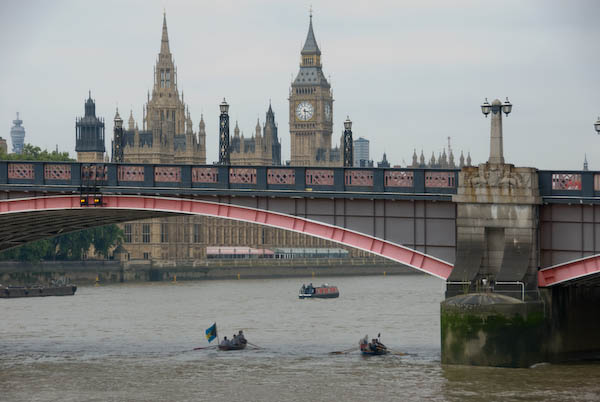
Great River Race & Malta Victory: On Saturday 8th September 2007 I went to Ham, a mile or so upstream from Richmond, for the start of the Great River Race, a charity event on the River Thames first held in 1988. It is open only to fixed-seat traditional craft – including skiffs, cutters, Celtic longboats, currachs, and dragon boats (certainly not all traditional craft of the Thames.)
Each boat must all carry at least one passenger and a cox as well as those rowing or paddling. Later I photographed some of the boats as they passed through Central London but they were too spread out to make interesting pictures.
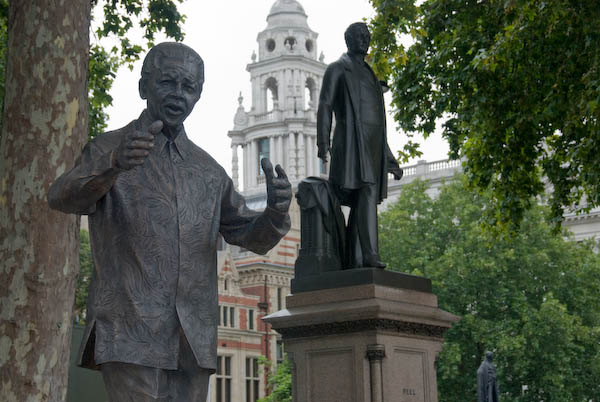
I was on my way to photograph the Maltese Victory Day procession from Westminster Cathedral, and left them some way down Victoria Street to photograph the statue of Nelson Mandela in Parliament Square which had been unveiled a few days earlier.
Here are some pictures from the day, along with what I wrote about them back in 2007. You can see many more pictures on My London Diary.
The Great River Race
Ham & Vauxhall
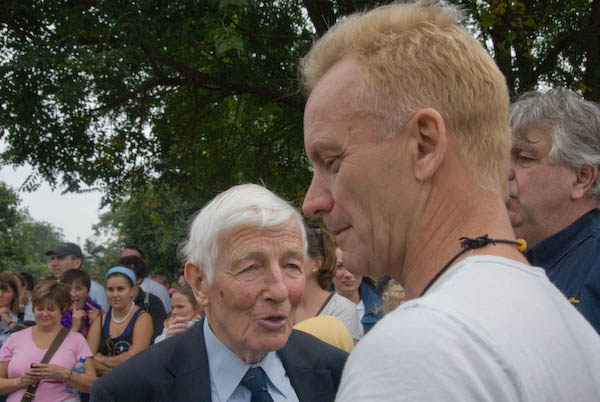
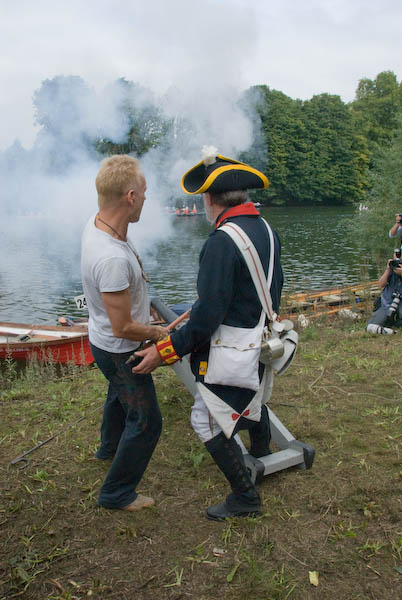
Crews paddling up to Ham for the start of the raceSting came to start the race by firing a cannon – earplugs were handed out to the press and others
The Great River Race isn’t really a particularly great race, but there were well over 200 boats involved, and considerable competition. The event is a handicap, and also has multiple classes and boats start at different times – some over an hour before the fastest – but should all arrive at Island Gardens [21.6 mile away at the tip of the Isle of Dogs] at around the same time. The boats include some of historical interest as well as those built entirely for speed.
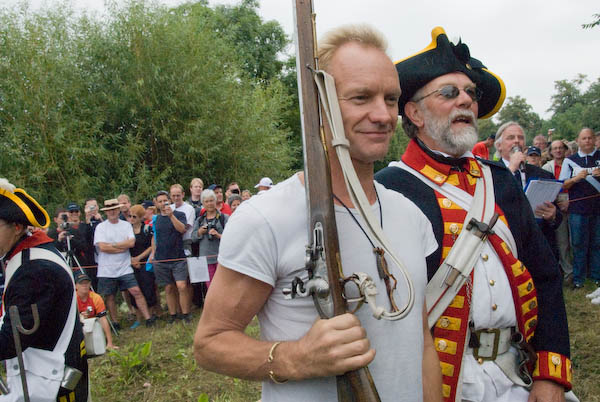
Sting had a musket to fire a 5 minute warningthen a cannon for the nominal start
It’s a long course, and can get a little rough further down in poor weather, but today was a fine day and everyone started from Ham in good spirits – and a few already well-fortified. Sting came along and fired a cannon as a starting signal and then the boats made their way in number order down to the real start a few hundred yards down river, a few at a time according to their handicaps.
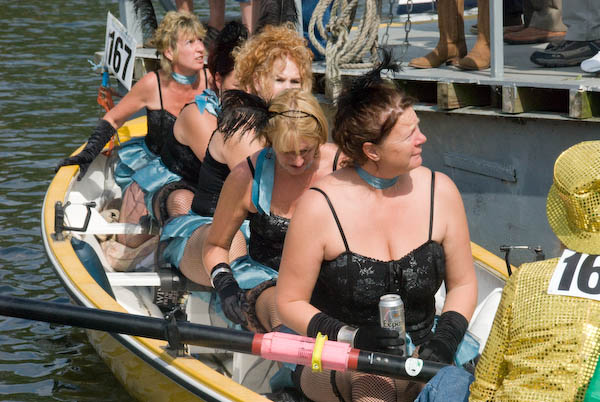
Media interest mainly centred on Sting and a high-powered crew of young ladies, The Sisterhood, who attracted a great deal of sponsorship. They have already made an enormous amount for charity with a fast paddle across the English Channel, but today turned out to be the second fastest ladies crew, their dragonboat being beaten by an outrigger canoe.
My personal favourites were a crew of Welsh ladies who seemed to have a more relaxed approach to the occasion. There did seem to be a great many participants from the Celtic fringes, as well as visitors from the continent.
After all the boats had left I [walked back to Richmond and] took the train to Vauxhall and saw the first few crews pass there, all still rowing well (the paddlers hadn’t yet caught up.)
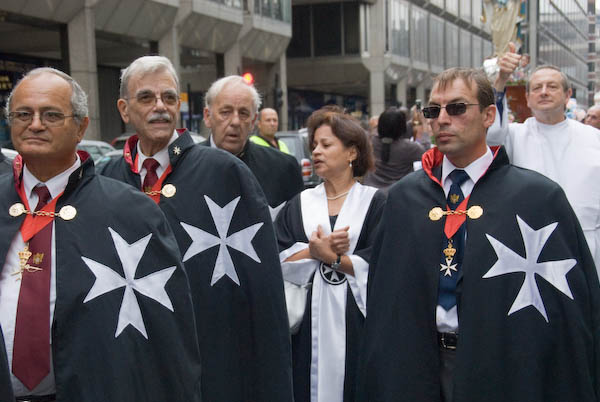
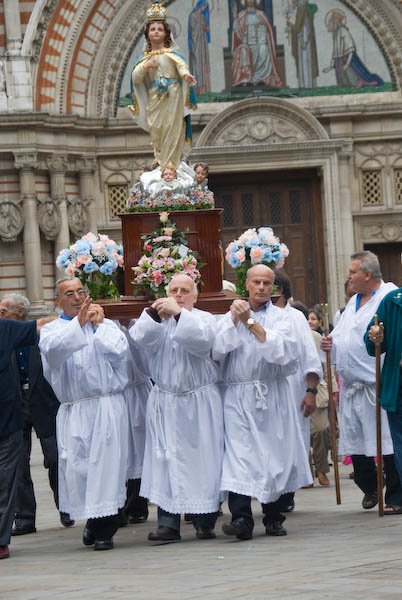
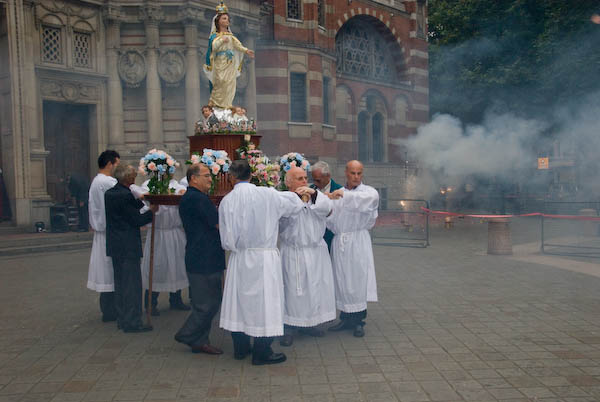
September 8th is a holiday in Malta, celebrated as the Feast Of Our Lady Of Victories (it is also the Feast Of The Nativity Of The Blessed Virgin Mary), and was the day in 1565 when the Knights Of St John Of Malta defeated the Turks. By coincidence it is also the day in 1943 that the Italian occupiers of the island surrendered to the allies.
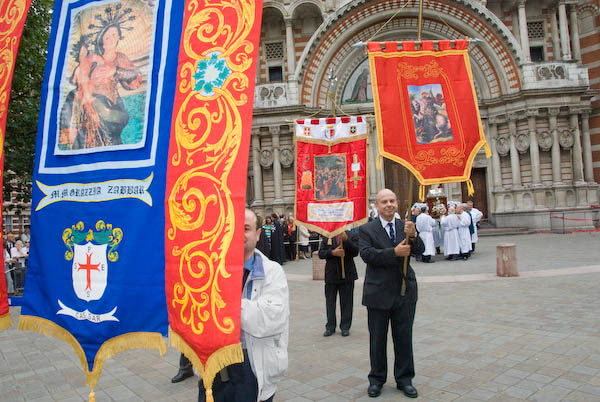
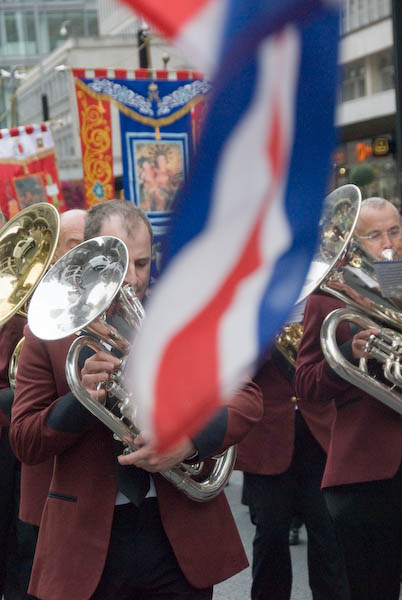
Traditional dress on the steps of the CathedralThe procession leaves Westminster Cathedralafter fireworkswith banners, andwith music.
The Maltese in London celebrate with a Mass at Westminster Cathedral followed by fireworks and a procession carrying a statue of the Baby Mary (Bambina) from there to the Sacred Heart Chapel Of Ease in Horseferry Road.
The statue had been unveiled by Prime Minister Gordon Brown on 29 August 2007, with Mandela, his wife Graça Machel and London Mayor Ken Livingstone among those present.