Kung Hei Fat Choi & Regicide – 2004

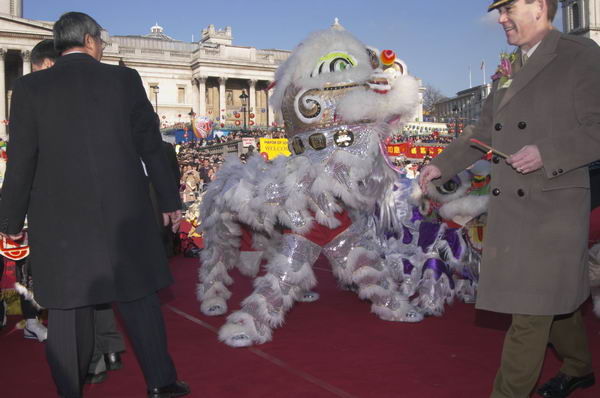
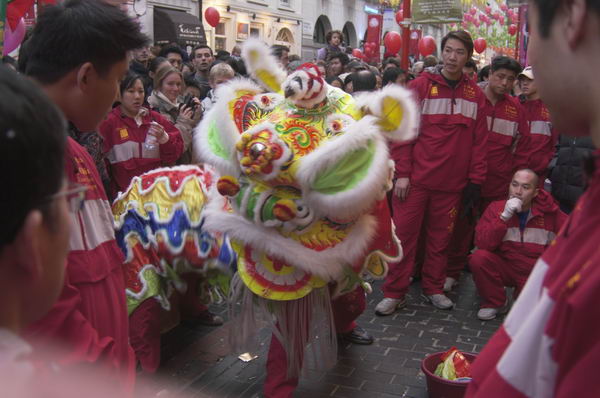
Kung Hei Fat Choi & Regicide: On 25th January 2004 I went with many thousands to celebrate the Chinese New Year in Trafalgar Square and Chinatown. In 2001 I had commented on My London Diary “there are too many people and too many photographers at the Chinese New Year celebrations in Soho, but somehow I keep on going” but for various reasons I think the next time I photographed it was in 2004. I was back again in 2005, 2006, 2007 and in 2008 for I think the last time.
Kung Hei Fat Choi & Regicide - 2004

Several things finally decided me to give the celebrations a miss. First was simply the crowds with more and more people coming to watch the event which made it difficult or impossible to move around and take pictures.

Kung Hei Fat Choi & Regicide - 2004

Then more and more people were photographing – mainly with their phones – and largely lacking any courtesy in doing so, coming to stand in front of me as I was trying to take pictures.
Kung Hei Fat Choi & Regicide - 2004

And, like many events, it had become more and more organised, with crowds being controlled and held behind barriers for the more official parts of the celebration.

Kung Hei Fat Choi & Regicide - 2004

But I suppose the main reasons were that my interests had changed and that I thought I had done enough on this event; my pictures each year were looking increasingly the same and I needed to do something different.

Kung Hei Fat Choi & Regicide - 2004

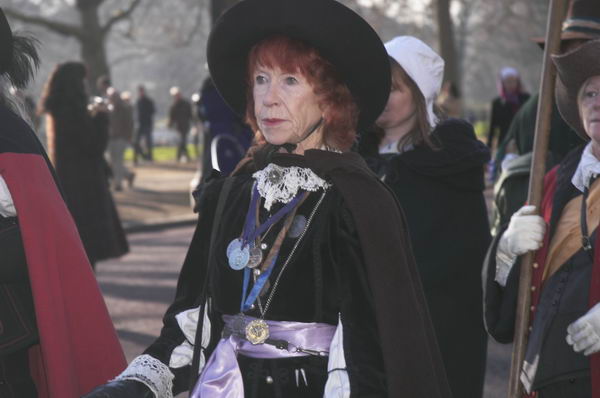
Also taking place on 25th January 2004 was a parade by reenactors of the execution of King Charles I. While I’m not a puritan (as I think many of my ancestors were) I am increasingly a Republican and while I might not be calling for the public execution of our current monarchy, I do think it is well past time we got rid of them and their privilege – as well as the rest of the aristocracy.
Of course it isn’t just the monarchy I would like to see go, but our whole class system of which they are the leading edge. Its real basis is the seizure of land following the Norman conquest in 1066 and my revolution would call for land reform, with the complete ending of private ownership of land (and water) which would become community resources, with no land ownership but instead could be held in trust to the community. But of course it’s a utopia which won’t happen.

Here’s the short text – with minor corrections – which I wrote in 2004.

The Chinese New Year was celebrated in Westminster on 25th Jan, with speeches in Trafalgar Square, fireworks in Leicester Square and immense crowding in and around Soho’s Chinatown, especially where the police sealed off some of the streets.

Fortunately the speeches were short, and the main point of most was to say ‘kung hei fat choi’, with various degrees of ethnic feel.

Also on the 25th, was a parade commemorating the execution of King Charles 1, who went from St James Palace to the Banqueting House in Whitehall to be beheaded on 30th Jan 1649. It’s an event that brings out the Republican in me!

It was a rather mournful procession, drab and silent, in complete contrast to the lively scenes a few yards to the north.

A few more pictures from the day on My London Diary begin here.


FlickrFacebookMy London DiaryHull PhotosLea ValleyParis
London’s Industrial HeritageLondon Photos

All photographs on this page are copyright © Peter Marshall.
Contact me to buy prints or licence to reproduce.
Epiphany Rising Against Monarchy

Epiphany Rising Against Monarchy
Relatively few nowadays observe the 12 days of Christmas which come to an end on January 6th with Epiphany. Traditionally in the UK and some other countries it was when Christmas decorations were taken down, but also a feast day celebrating the arrival of the Three Kings with their gifts. Nowadays most seem to put up decorations even before the start of Advent and often take them down by the New Year.

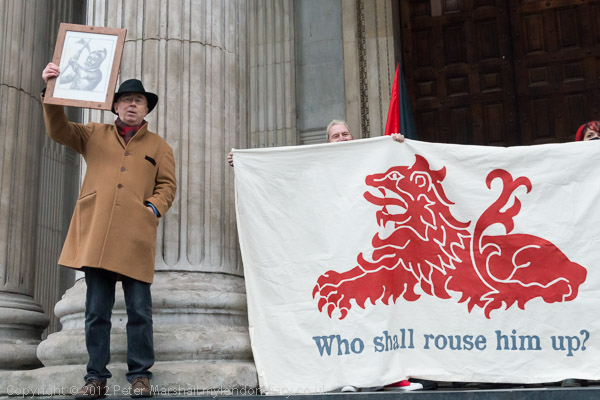
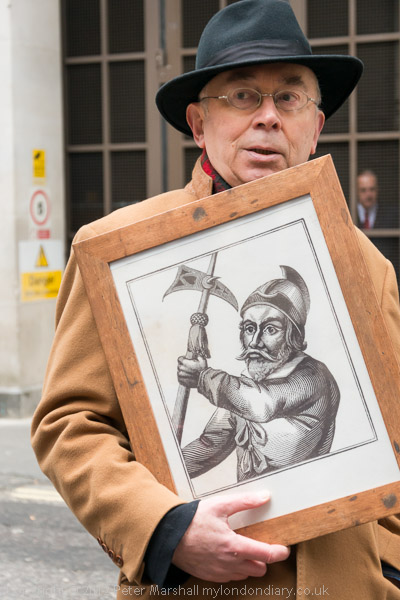
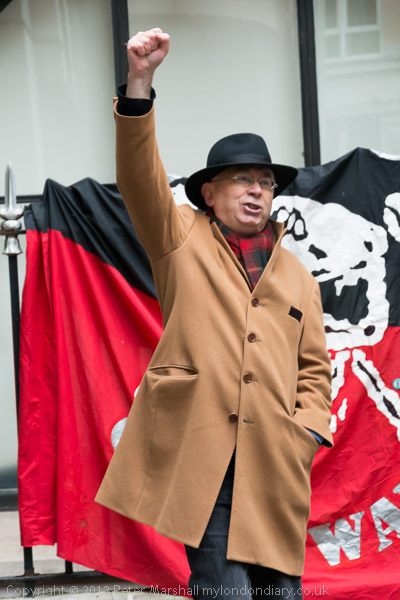
Ian Bone holds a picture of Thomas Venner

Epiphany gained a new importance in literature and moved to entirely lower case in the work of James Joyce, where his hero Stephen Daedalus defines it as “a sudden spiritual manifestation, whether in the vulgarity of speech or of gesture or in a memorable phase of the mind itself.” Epiphanies are moments of revelation that change the the way a character or person sees life or a particular situation, suddenly seeing things in a new light. I think all great photographs are epiphanies.

Ian Bone speaks

But getting back to the 6th of January, and in particular the 6th of January 1661 which was the subject of a partial re-enactment on the 6th of January 2013, we need to remember the centrality of religion in those times. Though many might now protest against the monarchy, particularly in recent days over the ennobling of a war criminal and the alleged criminal acts against minors by one of the royal family, few would now do so for the kind of religious reasons that led Thomas Venner and his fellow Fifth Monarchists to carry out a bloody armed insurrection in the City of London.

As I wrote in My London Diary:

The Fifth Monarchists were an important religious movement in England during the rule of Oliver Cromwell, seeing the execution of King Charles as being part of the fulfulment of the Biblical prophesy in the book of Daniel about the end of the four kingdoms of history being followed by the “rule of a son of man” for a thousand years (which they took as the rule by the Pope) after which would come the Christ’s reign on earth. For this to happen, the old order had to be ended by violence – as had begun with the beheading of the king.

They included three of those who had signed the execution warrant, but they soon become disillusioned with Cromwell, who they saw as trying to make himself a king and they began to agitate against him. Thomas Venner was imprisoned for several years for plotting to overthrow Cromwell, but released when Richard Cromwell became Protector.s

They were incensed by the restoration of the monarchy, and in particular by the savagery shown by the new order against the ‘regicides’, including Fifth Monarchist Major-General Harrison who showed great bravery during his gruesome public execution by hanging, drawing and quartering.

My London Diary

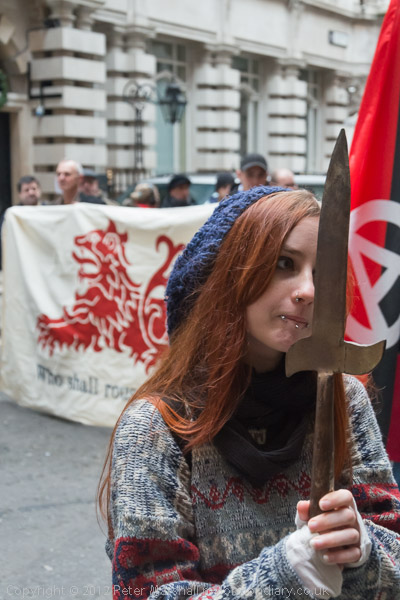
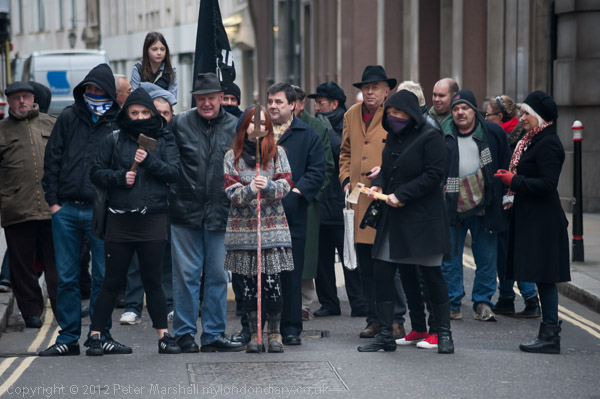
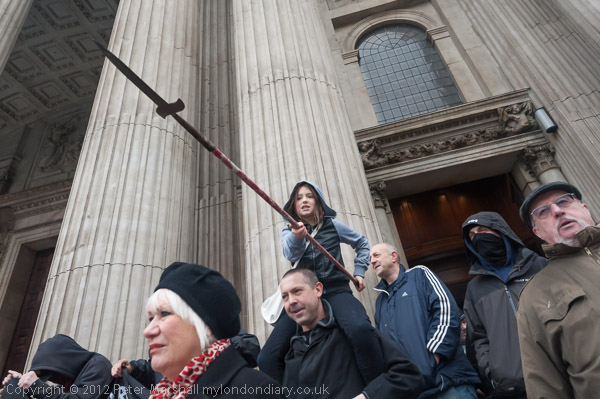
Like Venner’s the re-enactment began at Swan Alley (now Great Swan Alley) and with around a similar number of his 50 or so followers, and were variously armed with pikes and other weapons. The event in 2013 began with a speech by Ian Bone about the history of the earlier event, followed by several other anarchists and socialists whose comments related the it to our current times. The event was for a short film, Epiphany, with Ian Bone as writer working with director Suzy Gillett.

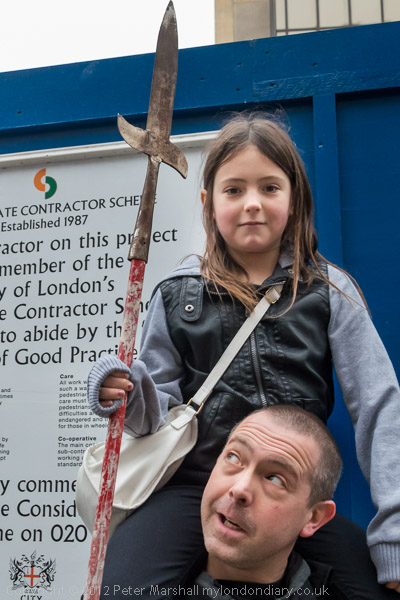
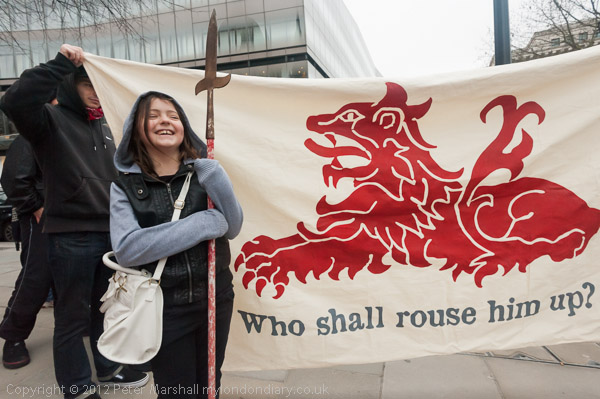
I suspect Venner’s address was rather more fiery, but we did have a very fine banner, with a heraldic lion and the text ‘Who shall rouse him up?’, and as in 1661 the mob was led out of the yard by a young woman bearing a pike and the battle cry “King Jesus and the heads upon the gates“. Among those taking part was Sam, grandson of Philip Sidney Noakes, the last of the Muggletonians, another of the radical seventeenth century religious movements with his daughter Rachel.

Sam, grandson of Philip Sidney Noakes, the last of the Muggletonians, with his daughter Rachel

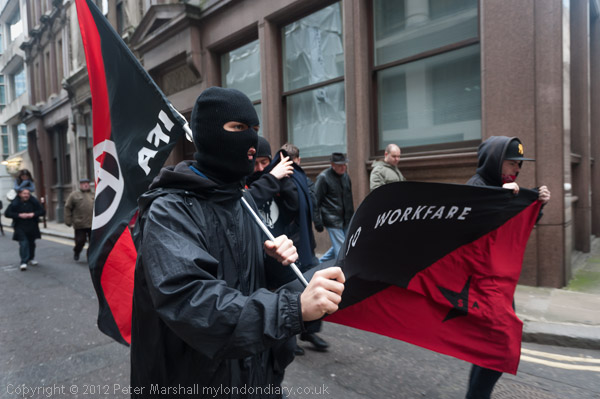
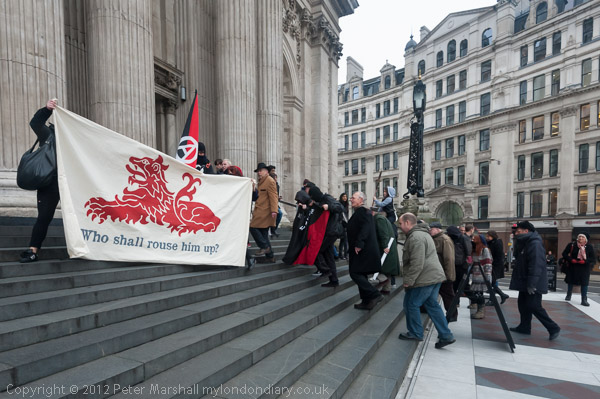
There were other anarchist banners and black and red flags and banners and people shouted some of the old slogans, ‘King Jesus‘, ‘Heads On Pikes‘ and ‘Nobility In Chains’. Though some were carrying axes and hammers, certainly illegal offensive weapons, none were put into use into what was a rather tame stroll with a number of stops to allow the film director Suzy Gillett to move the camera into position on the way via the Guildhall to the steps of St Paul’s Cathedral.

There the group were content with posing for photographs, rather than following Venner’s example and storming in and holding it for several days, along with other parts of the city, until finally the army was sent in against them. Most were then killed and the others captured after a long and bloody fight. Venner himself was wounded in 19 places before he was finally overpowered.

Together with ten others after a brief trial he was sentenced to be hung, drawn and quartered; the sentence was carried out in front of the meeting place of his congregation in Swan Yard on 19 Jan 1661. Many other Fifth Monarchists who had taken no part in the rising were hunted down and hung or imprisoned, and draconian laws were enacted against dissenters but this did not end the movement.

You can read a fuller account of the event in Epiphany Rising Against King on My London Diary, and even more detail in a post on the Bristol Radical History Group site.