Focus E15 Mothers Party Against Eviction 2014

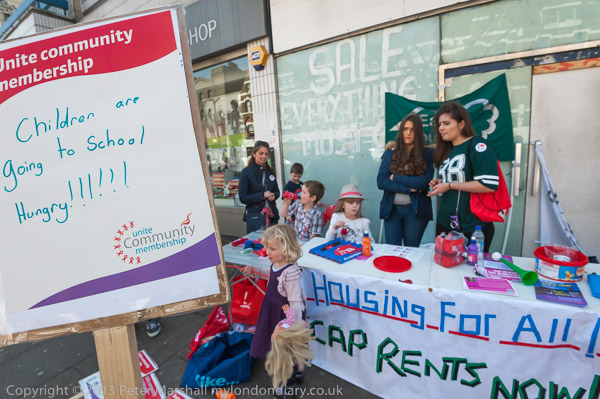
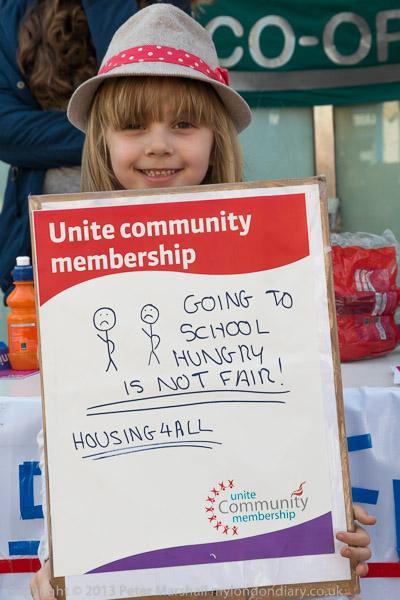
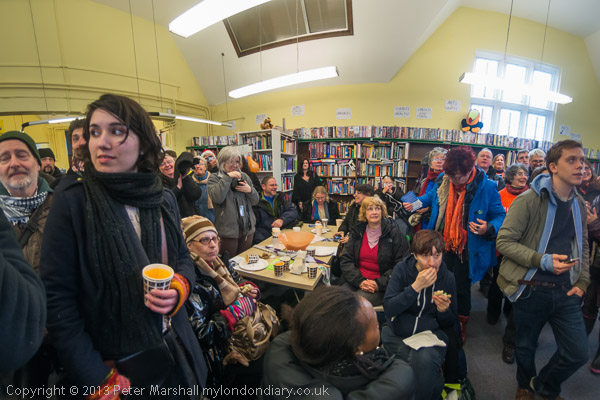
Focus E15 Mothers and children party in the show flat – 17th January 2014

Focus E15 Mothers Party Against Eviction 2014
Housing remains one of London’s larger problems, with sky-high house prices and market rents. At the start of 2022 the average flat rent in London is over £360 per week – around £19,000 per year, while the average property price according to Zoopla is £681,427.

Housing has always been a problem in London, but in the 1950s, 60s and 70s things were beginning to improve, largely due to both Labour and Conservative councils building council houses and flats. By the 1960s over 500,000 new flats were added in London and nationally around a third of UK households lived in social housing.

The government’s minimum wage for 2022 will be £9.50 per hour from April – an on that rate you would need to work for around 38 hours a week just to pay for a flat – and of course would have no chance of ever buying a flat or house. Things have got considerably worse since 2010, and in boroughs like Newham average rents now are 65% of average wages.

The building programme slowed down in the 1970s as governments made it more difficult for councils to build, but the real watershed came with Margaret Thatcher’s 1980 Housing Act which gave council tenants the right to buy their properties at between 33-50% of market value – and stopped councils from using the proceeds to built more properties.

Further housing acts under Thatcher led to the transfer of much social housing to housing associations, which were allowed to access private finance while councils were very much restricted in their borrowing. Housing associations continue to build some new properties, but the numbers are small in relation to demand, and much lower than those built by councils in the 1950s-70s. Official figures for 2019 show only 37,825 new homes built for letting at below market rents while over 1.1 million households are on housing waiting lists – around 30 times as many.

So it is not surprising that councils such as Newham have a huge housing problem, and the council says it has the highest levels of overcrowded housing in the country, one of the highest proportion of people living in insecure private rented homes and in houses of multiple occupation and the largest number of homeless people – including those in temporary accommodation.

Newham was one of the first councils to get an elected Mayor in 2002, and Robin Wales held that post until 2018 when he was deselected as candidate. Many blame him for the particular failures over housing in the borough and point to properties on the Carpenters Estate in particular, some of which have been deliberately left empty for around 15 years.

The first group to organise and call out the council on their failures over housing were young single mothers who were threatened with eviction after Newham Council removed funding from East Thames Housing Association’s Focus E15 Foyer in Stratford. Newham Council had tried to get them to move well away from London, in Hastings, Birmingham and elsewhere, away from friends, families, colleges, nurseries and support networks. These offers were for private rented accommodation, with little or no security of tenure and would leave them at the mercy of often unscrupulous or uncaring landlords.

For once the group stood together and determined – helped by friends – to fight the council, not just for their own cases, but also for others whom Newham is failing to provide accommodation. Though they attracted national publicity and won their fight to stay in the London they continue to hold a weekly protest and advice stall in central Stratford every Saturday – I visited it again in late 2021. Their fight exposed the failures of Robin Wales and was certainly one of the factors in his losing support in the borough.
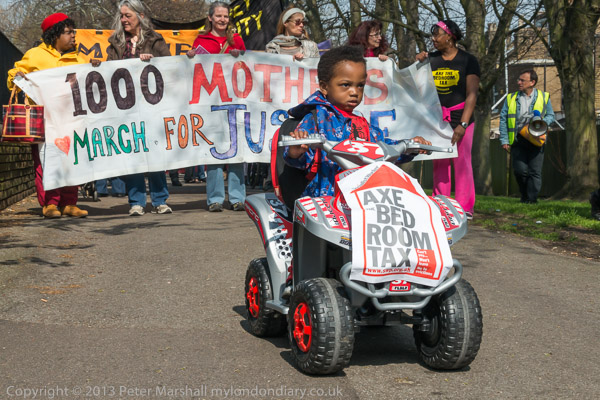
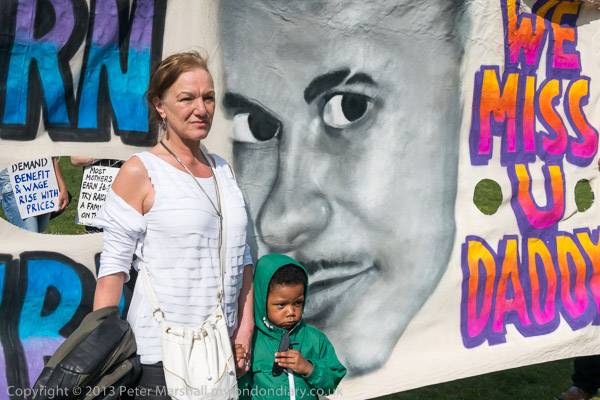
You can read more about the protes when a group of the mothers with their children went into the East Thames offices and held a party in their show flat on on My London Diary in Focus E5 Mothers Party Against Eviction. The East Thames staff who came to talk with them were generally sympathetic and attempted to reassure them but told them it was the responsibility of the council and not the housing association to rehouse them.


Pussy Riot, ATOS, Scientology & Stand with Brad

Pussy Riot, ATOS, Scientology & Stand with Brad
January 16th 2013 was an unusually busy day for protests in London on a Wednesday, though not all were quite what they seemed.

My working day started a short walk from Notting Hill Gate station, where a small group of protesters had come to take part in an International Day of Solidarity with Maria Alyokhina, one of the three members of the Russian punk band Pussy Riot who were sentenced for their performance of an anti-Putin “punk anthem” in a Moscow Orthodox cathedral the previous February.

Alyokhina was sent to serve two years in a prison camp at Perm in Siberia, one of the Soviet Unions harshest areas and was appearing in court that day to plea for her sentence to be suspended so she could raise her son, born in 2008, until he is 14.

She was kept in prison until 13th December 2013 when she was released under an amnesty bill by the Russian Duma, and since has continued her political activism, suffering further arrests and assaults. Last year – 2021 – she served two 15 day prison sentences before being put on a year’s parole.

The protest on the main road close to the Russian Embassy which is hidden down a very private street was scheduled to last three hours, and had got off to a slow start, with some of those arriving deciding to go away for coffee and come back later. Numbers were expected to rise later, but I couldn’t wait as I was due at another protest at the Royal Courts of Justice on the Strand.

I arrived at the vigil at the Royal Courts of Justice to find there was also a second protest taking place. I had come to meet disabled protesters who were supporting a tribunal hearing of a judicial review of Work Capablility Assessments on the grounds they violate the Equality Act as they are not accessible for those with mental health conditions.
Those taking part included members of the Mental Health Resistance Network, MHRN, Disabled People Against Cuts, DPAC, Winvisible, Greater London Pensioners Association and others, including members of the Counihan family and PCS members who work at the court.

Speakers at the rally reminded us of the special problems with the Work Capability Assessments for many with mental health conditions, as these are often spasmodic. On good days claimants may not seem very ill and seem fit for work, while on bad days they may be unable to attend an assessment and for this reason be automatically judged fit for work.

Their press release included the statement:
‘Dozens of disabled people are dying every week following assessment. Nearly 40% of those who appeal the decision to remove benefits have the decision overturned, meaning thousands of people are wrongly being put through a traumatic and harrowing experience needlessly. The governments own appointed assessor of the policy has ruled it ‘unfit for purpose’… This would not be acceptable in any other government contract, yet goes without comment or sanction by this government. No-one is called to account, no-one takes responsibility.’

Also protesting outside the courts were the ‘Citizens Commission on Human Rights (United Kingdom)’ who claimed that a child who has never been diagnosed with any mental illness was being dosed with a dangerous anti-psychotic drug prescribed by a psychiatrist. Wikimedia describes the group as ‘a Scientology front group which campaigns against psychiatry and psychiatrists’ and was established in 1969 by the Church of Scientology.

The court backed them in the particular case concerned, though most of the information about it was confidential and the court decision may not have been confirmed by the family court.

Among those taking part in their protest was a man in a white coat at the protest holding pill bottles representing the drugs they described as redundant and unscientific and instead promoting the benefits of ASEA, which appears to be an unscientific scam, promoted by dubious means. Basically salt water, the web site ‘Science-Based Medicine’ concluded: “The only value of the product is the entertainment value that can be derived from reading the imaginative pseudoscientific explanations they have dreamed up to sell it.”

Finally I went to Grosvenor Square for a protest outside the US Embassy where protesters, including members of ‘Veterans for Peace’, were holding a vigil in solidarity with Bradley (now Chelsea) Manning, on day 963 of his pretrial detention while his defence argued in court for charges to be dismissed for lack of a ‘speedy trial.’

They stood holding placards in silence while the audio of a 45 minute video, ‘Collateral Murder’ allegedly leaked by Manning to Wikileaks was played on a PA system. The video clearly shows US forces committing war crimes and has become a symbol of the need for Wikileaks and ‘for courageous whistle-blowers like Bradley Manning.’

The protest was one of a series organised by WISE Up Action, a Solidarity Network for Bradley Manning and Julian Assange, and after the vigil at the US Embassy many of those taking part were going to the daily vigil outside the Ecuadorian embassy where Assange was then inside having been granted asylum and under threat of arrest by British police should he leave. But it had been a long day and I decided it was time for me to leave for home before ‘Collateral Murder’ finished playing.

More at:
Stand with Brad at US Embassy
Stop Psychiatry Drugging Kids
Equality Protest Against ATOS Work Assessments
Pussy Riot London Solidarity Demonstration


Freedom To Protest Under Threat

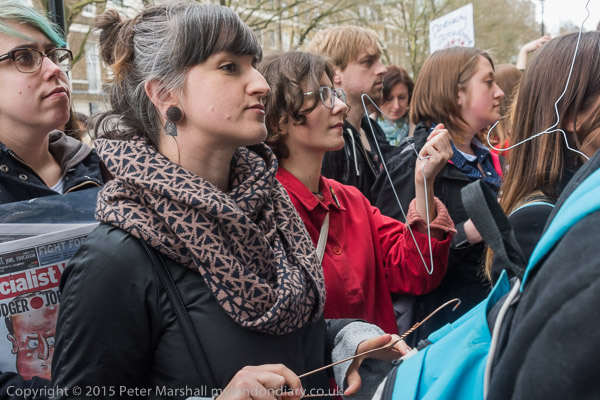
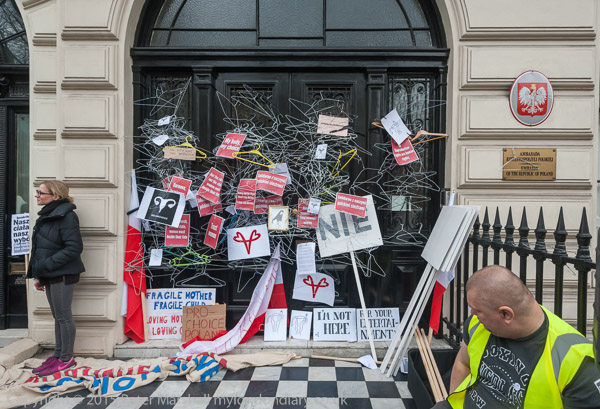
Back in 2008, people were protesting against the severe restrictions against our freedom to protest, that had been brought in by the Labour government under the Serious Organised Crime and Police Act 2005. As well as greatly widening the powers to arrest people and widening the scope of harassment, the act had criminalised trespass at certain protected sites and severely limited the holding of protests in a wide designated area of up to one kilometre from any point in Parliament Square.

CSG border post “To the left you have lost your freedom to protest

This latter provision was particularly aimed at Brian Haw and his Parliament Square Peace Campaign, but also prevented many other protests, and led to a number of arrests of campaigners. Parliament Square in particular had become the main focus of protests against the government and may government ministries were also inside the prohibited area.

There was wide disquiet about the effect of SOCPA on protest, and Prime Minister Gordon Brown had begun a public consultation with the Home Office on October 2007 issuing a document ‘Managing Protest’ which many felt threatened further threats to freedom of assembly throughout the UK.

The provisions regarding protests in the area around Parliament were replaced in 2011 by the Police Reform and Social Responsibility Act 2011 which gave police more draconian powers to restrict certain prohibited activities in and around Parliament Square – and have been used to seize tents, umbrellas, tarpaulins, sleeping bags and other equipment in the area.

Brian Haw complains that a police officer pushed his camera into his face and caused this injury

The Freedom to Protest is under even greater threat now, with the current passage through Parliament of the Police, Crime, Sentencing and Courts Bill – which a select committee has said “would curb non-violent protest in a way that is inconsistent with our human rights” and has led to many ‘Kill the Bill’ protests. Also disturbing is the reaction of many Tory politicians to the jury verdict in the Colston statue trial, which apears to be threatening state control of our legal system.

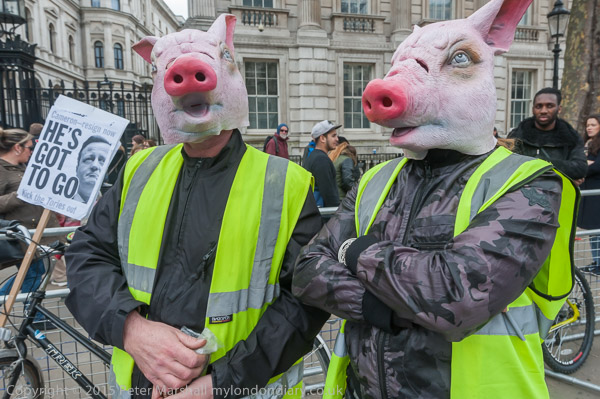
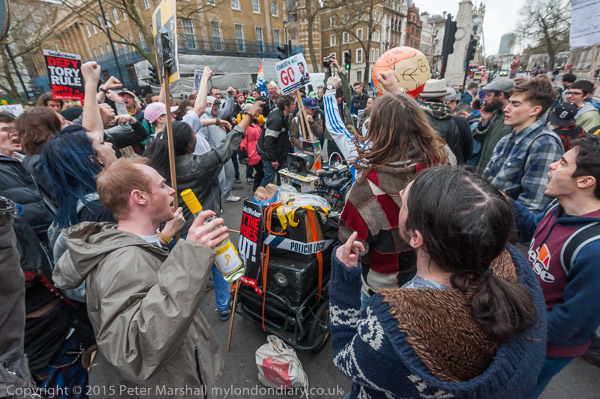
On Saturday 12th January 2008, I covered protests in Trafalgar Square and in front of Downing St upholding the freedom to protest. Earlier I had covered Hizb ut Tahrir marching to the Saudi Embassy against Bush’s Middle East tour and a small group of rich young people outside the National Gallery on the last day of the Siena exhibition protesting against the expansion of Siena airport which would bring more less well-heeled tourists into the area.

Although I’m very much against any expansion of air travel – the planet simply can’t afford it, I found it hard to take this particular protest too seriously – it seemed to be rather more about protecting privilege than opposing environmental crime.

And while I had gone to Downing St mainly for the Freedom to Protest demonstration, while there I photographed another protest calling on an end to the Israeli government’s siege of Gaza. This included a number of British Jews, including those calling for a boycott of Israeli goods.

Also present opposite Downing St were another large group of Kenyans, protesting against the re-election of the incumbent President Mwai Kibaki. A US commissioned exit poll suggested opposition leader Raila Odinga had won by a 6% margin and there was widespread international agreement that the election was rigged.

More on My London Diary:
Hizb ut Tahrir against Bush tour
Siena Airport Protest
CSG Border Post
Freedom to Protest – Downing St
End Gaza Seige
Kenyans Protest Election Fraud


Guantanamo – America’s Shameful Prison

Amnesty International protesters close to the US Embassy

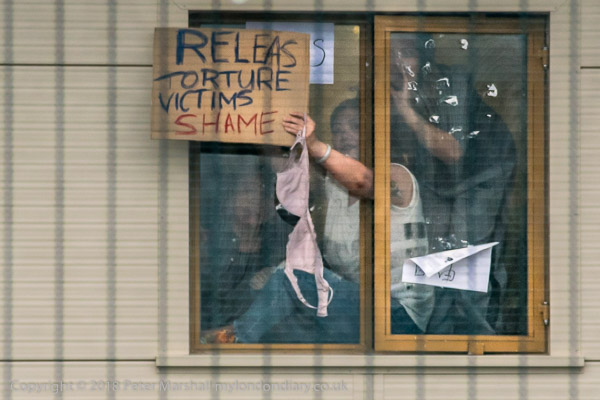
January 11th was for quite a few years a busy day for protests; it marked the anniversary of the setting up by the United States of a military prison as a torture camp at the disputed US Guantanamo Bay naval camp on the island of Cuba.

Prisoners’ had taken turns in the cage overnight

Set up in the aftermath of the 9/11 attack as a part of George W Bush’s ‘War on Terror’, the camp and the activities which took place there destroyed any final vestige of higher moral ground America could lay claim to in its role of world policeman, something that its various largely clandestine involvements in various South American American coups and activities in the Middle East and elsewhere had already largely laid waste.

Guantanamo is still there, still open, though the great majority of the 779 men brought there have been released. Most were totally innocent, victims of a US policy of offering $5,000 rewards for the capture of ‘terrorists’ to Pakistani and Afghan groups, who took the money for turning in anyone they felt would get them the money.

In October 2021, there were still 39 men held at Guantanamo, including ten who had long been cleared for release. Very few of those held over the years have faced trails trials and very few were involved in any acts of terrorism. Bush and Obama acted slowly but together released well over 700 of the prisoners, but Trump only released one, effectively stopping the process.

Protests continue in the UK, but on a much smaller scale, particularly since the last British resident, Shaker Aamer was released without charge or trial after 13 years of imprisonment and torture in 2015.

In 2008 Amnesty International organised a large protest in Grosvenor Square, a few yards from the US Embassy, though the street in front of the embassy had been closed to prevent protests there. They brought with them two cages, similar to those in which the prisoners were imprisoned outdoors at Guantanamo, with a large group of people wearing the orange jumpsuits which they are made to wear there. Protesters dressed as guards in military style uniforms harassed the ‘prisoners’ interrogating them and threatening them with violence and with aggressive-looking dogs.

From Grosvenor Square I went up to the Regents Park Mosque, where activists from Cageprisoners and the London Guantánamo Campaign, some also in those orange jumpsuits and one manacled hand and foot. There they were handing out leaflets to those attending Friday Prayers.

Later I went with them to Paddington Green Police station, where terrorist suspects are detained and questioned in this country. They were going on to continue to protest in Parliament Square, but I returned first to the US Embassy, where the London Catholic Worker Community was holding a two hour vigil closed to the corner of the Embassy, holding placards and lighting candles for those still held and several who had died there. Several were alleged to have committed suicide, but later evidence emerged strongly suggesting they had died during torture.

The final event of the day was a rally in Parliament Square organised by Cageprisoners and the London Guantánamo Campaign with a number of speakers including Victoria Brittain, former Guantanamo prisoner Moazzam Begg, laywers including Gareth Peirce, Bruce Kent, Yvonne Ridley and Jean Lambert MEP.

It was dark, cold and wet, but those present were cheered by the announcement at the end of the rally that Scotland Yard were investigating allegations of 14 criminal offences committed by Tony Blair and Lord Goldsmith and others which resulted in the deaths of Iraqi citizens during the armed invasion and occupation of Iraq.

Unfortunately and predictably these investigations came to nothing, and though the Chilcot report was damning in parts, Blair not only got off scot-free but this New Year was awarded a knighthood. A few days ago one of several petitions to have his “Knight Companion of the Most Noble Order of the Garter” rescinded reached over a million signatures. Mine was one of them.

Six years of Guantanamo: Amnesty
London Guantanamo Campaign / Cageprisoners
Guantanamo – London Catholic Worker
Guantanamo – Parliament Square Rally


Why we are short of Nurses

Why we are short of Nurses
On January 9th 2016 I took the pictures shown here of a rally and march against the axing of bursaries for student nurses and midwives. The current huge surge in hospitalisation of Covid victims as Omicron rages through the nation has highlighted the huge shortage of qualified medical people in the NHS at all levels.

For years, but increasingly since the Tory-led coalition came to power in 2010, there have been huge shortages, with the NHS having to recruit from overseas – including from many poorer countries which are even more short of staff than the UK.

We have of course been bringing in nurses and doctors from abroad for many years – at least from the 1950s – rather than training enough from our own population. It has never been that there were not enough young people who want to be nurses and doctors – and in my years as a teacher I taught quite a few suitable young men and women who were well qualified but failed to gain admission to medical schools where there were perhaps 12 applicants for every place.

Hospitals have also become hugely reliant on agency nurses rather than directly employed staff, partly because of relatively low pay, but also because of a lack of self-defeating lack of flexibility by underfunded NHS hospitals which actually results in increased costs.

But for training nurses, the Tory government really messed things up in 2016 by removing the training bursaries for NHS nurses and midwives. Unlike other students they perform essential work for the NHS in hospitals caring for patients as an integral part of their courses, which makes it virtually impossible for them to undertake other part-time employment during their studies.

And in 2017 things got even worse and nursing students have had to pay tuition fees in the same way as other university students, leaving them with large loans to pay off when they complete their courses and go into employment.

Len McClusky, General Secretary of Unite next to a Unison banner

In 2020 the Royal College of Nursing published a report Beyond the Bursary: Workforce Supply which makes the point that at the start of the pandemic there were almost 40,000 nursing vacancies in the NHS in England alone, and called on government to develop a fully funded workforce strategy and aim for “an oversupply of nurses given years of underinvestment and the growing needs of our population.

The report notes that following the removal of the bursary there was a 31% drop in applicants for nursing courses, and over 4% fewer being accepted. Where we needed and increase in numbers being trained due to the shortage, government policies directly produced a decrease.

The RCN called on the government to abolish the tuition fees for nursing courses and reimburse the fees for those students affected by the removal of the bursary. And although the welcomed the decision to bring back an annual maintenance grant of £5000 for nursing students (£8,000 for some difficult to recruit specialities) from September 2020 they asked for that to be increased to a level that reflects the actual cost.

Of course the pandemic has made things worse. Some have died from Covid, partly as a result of the failure to provide effective protective clothing – and those contracts given to Tory mates with no experience in the field while some established companies failed to get orders. Many among those who recovered from Covid continue to suffer its after-effects – ‘long-Covid’. Others have simply been exhausted by overwork – and this is “a workforce that felt undervalued, unrewarded and where one in three were nearing retirement age.”

Brexit too has taken its toll, both with nurses from European countries leaving the UK and the failure of our government to respect the early promises it made to EU citizens working in the UK has not helped. Brexit and the continuing squabbles by the government over the treaty it signed is also a deterrent to people to now come and work here.

The shortage of nurses – and other medical staff – is a direct result of government policies. Not just the Tories but also of Labour under Blair and Brown, and is a part of the slow sabotaging of the NHS as a part of a policy of creeping privatisation that has been underway since at least the Thatcher years, though vastly accelerated since 2010. Unfortunately it isn’t as one placard states that the Tories are short-sighted, but that they are playing a long game to undermine our National Health Service.

More pictures on My London Diary:
NHS Bursaries March
NHS Bursaries rally before march


Protest tells Harrods ‘Stop Stealing Tips’

Protest tells Harrods ‘Stop Stealing Tips’
On Saturday 7th December 2017, the United Voices of the World trade union held a protest outside Harrods in Kensington demanding that the restauarant workers there receive the service changes that customers pay on meals.

The UVW is a grass roots union that represents workers in low paid sectors, and their members include chefs and waiters at Harrods. As well as demanding that the workers get the tips they are also demanding that conditions and wages to be improved for waiters who are currently paid at or a few pence per hour above the legal minimum, overworked and poorly managed.

A few people seemed not to support the protest

Harrods, the richest and most prestigious department store in the world, is owned by the immensely wealthy Qatari royal family – and they were then adding to that wealth by taking up to 75% of the tips that customers believed and intended to be going to the staff who served them.

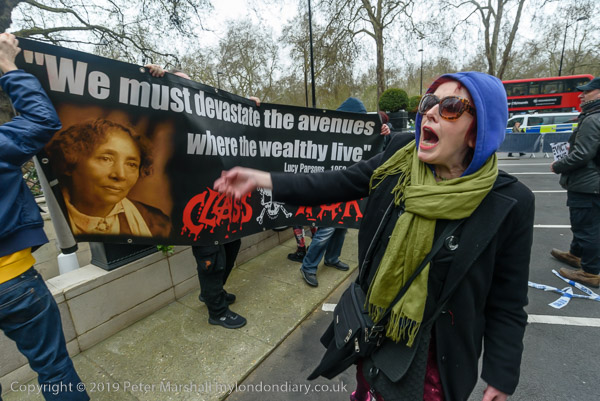
THe UVW succeeded in getting a great deal of public support and even some from our right-wing mass media (it almost certainly helped there that Harrods is owned by foreigners) and several hundred people came to protest outside the store, notably including supporters of Class War.

Harrods was supported by a large contingent of police, who at times went beyond there duty to keep the peace and seemed to be taking the side of the Qatari royal family who of course have many friends in high places including the Foreign Office who will have put pressure on the Met to take effective action against the protesters.

Police film the protest from inside Harrods – but Class War held a banner in front of the doors

I described the protest as “robust but peaceful” and although at times the protesters blocked the entrances and crowded around the doors, at times holding them open they made no real attempt to enter the store, as police warned that they would immediately be arrested for aggravated trespass. A couple were arrested for trivial matters on the street during the protest, but generally the protest went well and people were in a good mood as it ended and I caught the tube to go home.

Later I heard that as UVW members were packing away their flags, banners, drums and vuvuzelas, police had come and made 4 more arrests, including that of UVW General Secretary Petros Elia. It also appeared that some had been dragged inside the store and locked up by Harrods security staff before being handed over to police.

All were later released without charge, but on police bail – with the condition that they were not to go within 50m of Harrods. It appears to have been a deliberate abuse of the law to try to stop further protests at Harrods – however legitimate these may be. One man who had been grabbed after letting off a smoke flare on the street during the protest – now a rather common occurrence at protests – had apparently accepted a police caution.

Following the protest, and with threats of more protests to come, Harrods finally gave in and agreed to give 100% of the service charge to staff, with an independent tronc master to administer the distribution with staff on the committee.

The UVW continues to fight for its workers at Harrods, and in December 2021 planned a further protest in advance of a strike in the Christmas shopping period. The strike and protest were both called off after Harrods agreed to large pay rises, taking all the waiters and chefs above the London Living Wage – for some it meant a pay rise of almost £5,000 a year, and Harrods has also guaranteed annual increases of 3% from 2023.

Small but active trade unions such as the UVW, along with a few of the major unions are showing that collective action works, while some larger unions seem more rather less interested in their lower paid members. In March 2021, Labour’s North of Tyne Mayor Jamie Driscoll published an article in the Journal and Evening Chronicle and on his blog with the title ‘What Have Trade Unions Ever Done For Us?’ which included the following two paragraphs

For a start, unions stopped child labour. Unionised workplaces are safer, with 50% fewer accidents. Every year unions train 10,000 safety reps. Union members earn, on average, 12.5 per cent more than non-members. They have better job security, and stay in their jobs for an average of five years longer than non-members. Unionised workplaces have higher productivity and fewer industrial tribunals.

Apart from that, though, trade unions have only gained us paid holidays, maternity and paternity leave, paid sick leave, equal pay legislation, pensions, and workplace anti-discrimination laws. Oh, and the weekend. It was unions that fought for a five day working week.

Jamie Driscoll’s blog

If you work, join a union. “You have a legal right to join a union. It’s illegal for an employer to disadvantage you because you are a union member.”

John Lewis Cleaners Protest

A protester holds a message from John Lewis customer Una Kroll: ‘Outsourcing is a way of avoiding responsibility’

John Lewis Cleaners Protest
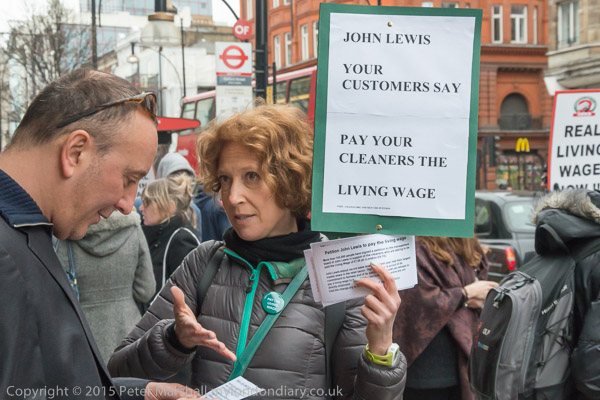
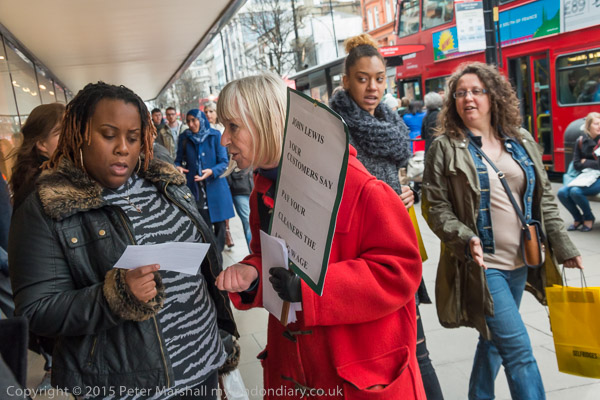
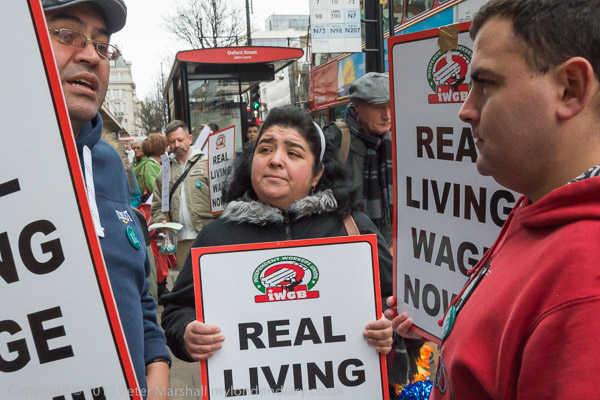
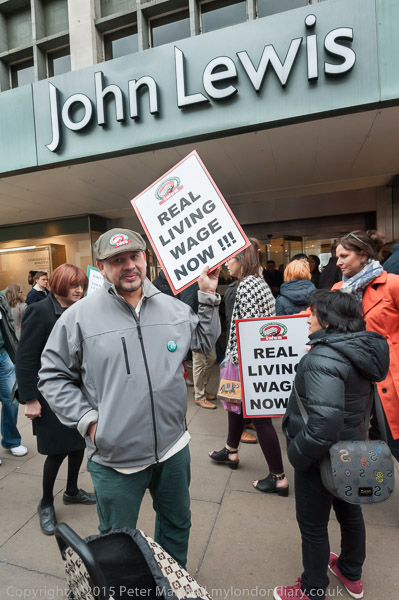
On Saturday 3rd January 2015 I met cleaners from the Cleaners And Facilities Branch of the IWGB (Independent Workers Union of Great Britain) outside John Lewis’s flagship Oxford Street store. They were there to hold a protest rally demanding the company lived up to its ethical reputation and paid the workers who keep the shop clean a living wage.

When John Spedan Lewis set up his small drapers shop on Oxford Street in 1864 he had the revolutionary idea of involving those who worked for him in the running and progress of the business, setting up a constitution that made all of them partners.

The ultimate purpose was expressed in Principle 1 of this consitution:

The happiness of all its members, through their worthwhile and satisfying employment in a successful business.
Because the Partnership is owned in trust for its members, they share the responsibilities of ownership as well as its rewards – profit, knowledge and power.

John Lewis Partnership

Green Party London Assembly member Jenny Jones, Baroness Jones of Moulsecoomb, speaking at the protest

But although staff on the counters and running other aspects of the business remain partners – and almost every year get an extra bonus payment as a share of the profits, the cleaners who work in the store who are not included in the scheme and say that in this and other respects they are being treated as second-class citizens.

Although the cleaners work in the store next to the John Lewis partners they are not employed by John Lewis. John Lewis pays a cleaning contractor to employ its cleaners, who get lower rates of pay and far inferior conditions of service than staff who are directly employed.

This lets John Lewis maintain the pretence of being an ethical employer while these people who work there get bullied, work under poor and often unsafe conditions, are paid less than a living wage and get only statutory minimum holidays and sick pay.

Mick Dooley of London TUSC

Neither John Lewis nor the cleaning contractor recognise the IWGB although a large majority of the cleaners belong to it, and neither had been willing to engage in talks about the dispute. John Lewis attempts to disclaim any responsibility for the cleaners, but the trade unionists and others who came to speak dismissed this as a a shallow attempt at deception. The work done by the cleaners takes place in the store and is essential to its running and should be properly recognised and paid.

In a protest before Christmas I had met with members of the IWGB in the restuarant at the top of the store and photographed an unannounced protest by them inside the store. This time was very different, with the protest being held on the wide pavement outside and given as much advance publicity as possible.

The union had received considerable support from John Lewis customers, with over 125,00 signing a petition calling on the company to live up to its ethical reputation and ensure that the cleaners are paid a living wage. Some of them came to protest with the union.

After speeches in front of the store on Oxford St, the protesters marched around the block containing the store which has entrances for shoppers on three sides. Although they arrived at some of these before the police and security they made no attempt to go inside, determined to avoid any trespass, though there were some arguments with police over a thin metal line in the pavement which marked the edge of the property.

Many shoppers on the street stopped briefly to find what the protest was about and most expressed support for the workers. The main doors to the store were closed by John Lewis security staff for much of the roughly an hour and a half protest.

Desperate Day For Gaza

December 27th 2008 was a desperate day for Gaza, when the Israeli military launched the beginning of a massive air attack on the small enclave. Operation Cast Lead had been six months in the planning and 100 pre-planned targets were struck in less than four minutes. The initial air attack was followed by others and on the 3rd of January 2009 with a ground attack. Israeli Defense Forces ended their attacks on 18th January 2009.

According to Wikipedia, the Israeli government stated was a response to weapons smuggling into Gaza and to Hamas rocket attacks on southern Israel with, according to the Israeli military 3,000 rockets hitting Israel over the whole of 2008 – despite a ceasefire agreement which held for around 5 months before an Israeli attack on a cross-border tunnel in Gaza in November. Rockets killed 8 people in Israel in 2008, four of them after the attack on Gaza began on 27th December.

Again according to Wikipedia (I’ve removed the 14 references to sources which you can find in the original);

A total of 1,100–1,400 Palestinians (295–926 civilians) and 13 Israelis were killed in the 22-day war.

The conflict damaged or destroyed tens of thousands of homes, 15 of Gaza’s 27 hospitals and 43 of its 110 primary health care facilities,800 water wells, 186 greenhouses, and nearly all of its 10,000 family farms; leaving 50,000 homeless, 400,000–500,000 without running water, one million without electricity, and resulting in acute food shortages. The people of Gaza still suffer from the loss of these facilities and homes, especially since they have great challenges to rebuild them.

Wikipedia

There is much more detail on the attack and its consequences, as well as on later attacks on Gaza in 2014, 2018 and 2021 on Wikipedia in articles including those cited above and there would be little point in going further into the details here.

There was a large protest in London against the attack early in January 2009, and I photographed this an other protests, including those the anniversary of the start of the attack on 27th December 2009, 2010, 2011 and 2012. There I’ve written more about the protests and with many more pictures, including pictures of Tony Benn, Jeremy Corbyn and many others speaking against the attacks and ongoing siege of Gaza.

January 2009 Gaza: Protest March from the BBC
December 2009 Remember Gaza
December 2010 London Vigil For Gaza
December 2011 End The Siege Of Gaza
December 2012 Gaza – End the Siege


Selling Off The NHS

Two news items in recent days (neither given any great prominence in the media) show clearly how the Tories are selling off the NHS.

Though it was the Financial Times which reported why Rishi Sunak failed to attend a roundtable discussion with the UK hospitality sector. He was in California and the UK meeting was said by Treasury insiders to have clashed with his scheduled call with “US healthcare bosses.” Like me you probably don’t read the FT, but you are unlikely to have heard much about this from the BBC.

The second recent news is that Virgin Healthcare, a company that has been awarded contracts worth well over £2 billion for providing parts of our NHS services was this month sold to the private equity group Twenty20 Capital.

Virgin Care runs 400 NHS and local authority services including GP surgeries and Physiotherapy, generally concentrating on simple services which leaves more difficult and expensive work to be carried out by the NHS. It has a structure including Virgin Group Holdings based in the British Virgin Islands which sets up companies with large amounts of debt it uses to legally avoid paying UK tax – though the owners the Branson family have donated £70,000 to the Tory party.

You can watch a Labour Party video in which Jeremy Corbyn, then the Labour Leader, holds up a 451 page uncensored report and the considerably slimmer heavily redacted version released by Boris Johnson’s government. The unedited version confirms that the US demanded that the NHS is firmly on the table in the trade talks. “These uncensored documents leave Boris Johnson’s denials in absolute tatters… We’ve now got evidence that under Boris Johnson the NHS is on the table and will be up for sale.”

On Friday 23rd December 2016, I photographed ‘Howls of protest for death of the NHS‘, a protest at Downing St on the day that contracts were signed across the country to implement the government’s ‘Sustainability and Transformation Plans’ which effectively means the NHS can be handed over to private companies without any public engagement or consultation, ending a public service whose vision which has long been the envy of the world, signing the NHS over for private profit.

Every 15 minutes the speeches were interrupted for a long and loud ‘howl of protest’ by those taking part. These were timed to coincide with three social media ‘Thunderclaps’ across Facebook, Twitter & Tumblr by several hundreds of people mainly unable to be at the rally.

Speakers at the rally included Paula Peters of DPAC, Ealing Councillor Aysha Raza, trainee nurse Anthony Johnson of the Bursary or Bust campaign, a trainee mental health nurse, a patient and campaigner Gina and retired paediatrician and co-chair of Keep Our NHS Public Tony O’Sullivan.

At the end of the rally a small group of those present led by several DPAC campaigners, were harassed by police and threatened with arrest as they marched on the road to hold a final howl outside Parliament, with another short speech by Paula Peters.

Though the NHS has been deliberately weakened and made more available for private companies to run for profit by successive governments we still do have an NHS which is largely free at the point of need. But half of NHS beds have been lost since Thatcher began the cuts and privatisation and over 40% of services in UK healthcare are now provided by private companies and many of those who are now running the government have made clear in speeches, pamphlets and books that they favour an insurance backed scheme based on the US model.

The US model is expensive and flawed. Two thirds of personal bankruptcy in the USA is because people are unable to pay for the cost of healthcare either because they cannot afford the insurance or often because their insurance will not cover the treatment they require.

The Health and Care Bill 2021 continues the threats to the future of the NHS and gives much greater powers to the government to direct the NHS and will undoubtedly lead to greater penetration of the service by private providers, including the major US healthcare companies that Chancellor Sunak was making plans with in California while neglecting his duties in the UK.

More from 23rd December 2016: Howls of protest for death of the NHS


Nelson Mandela’s Birthday

Back in 1988 on the 17th July, the day before Nelson Mandela’s Birthday on the 18th July, I joined thousands of marchers through London demanding he be freed from jail.

Free Nelson Mandela - Birthday March and Rally - London 1988 88-7h-66

https://en.wikipedia.org/wiki/Nelson_Mandela Mandela was born on 18th July 1918, so this was his 70th birthday and he was still in jail, then held in Pollsmoor Prison, near Cape Town, having been removed with other senior ANC members from Robben Island to remove their influence on younger ANC members held there.

Free Nelson Mandela - Birthday March and Rally - London 1988 88-7h-55

He was well treated in Pollsmoor and international attempts to end apartheid was increasing, along with secret meetings with the South African Minister of Justice. President Botha had actually offered to release him, if he “unconditionally rejected violence as a political weapon”, but Mandela had refused to leave while the African National Congress was still banned.

Free Nelson Mandela - Birthday March and Rally - London 1988 88-7h-31

Mandela’s 70th birthday was celebrated around the world, with a televised tribute concert at Wembley Stadium attracting an estimated 200 million viewers.

Free Nelson Mandela - Birthday March and Rally - London 1988 88-7j-65

The march in London was a large one, and I wasn’t then a seasoned photographer of protests, though I had taken pictures at a number of smaller events.

Free Nelson Mandela - Birthday March and Rally - London 1988 88-7h-34

Because of the size of the event there were a number of feeder marches leading to a rally in Hyde Park. I joined the march coming from Camden and went with it to the rally, where I took some pictures in the crowd but didn’t attempt to cover the speakers, who included the Archbishop of Cape Town, Desmond Tutu.

Free Nelson Mandela - Birthday March and Rally - London 1988 88-7i-43

I took altogether only just over a hundred black and white pictures, of which I’ve now uploaded around a quarter to an album, Free Nelson Mandela – March and Rally – London 1988. You can also click on any of the images in this post to go to a larger version from where you can browse all the pictures that are online.