Climate March & Open House 2014

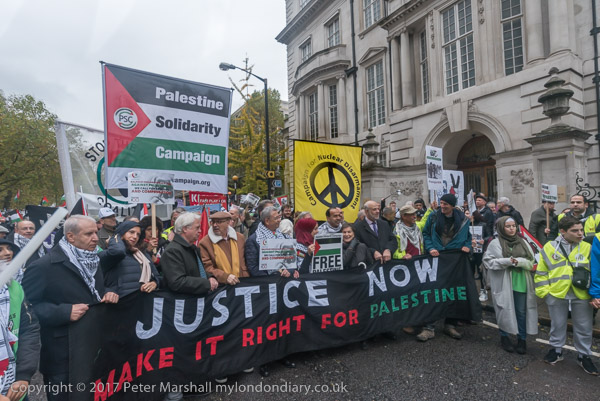
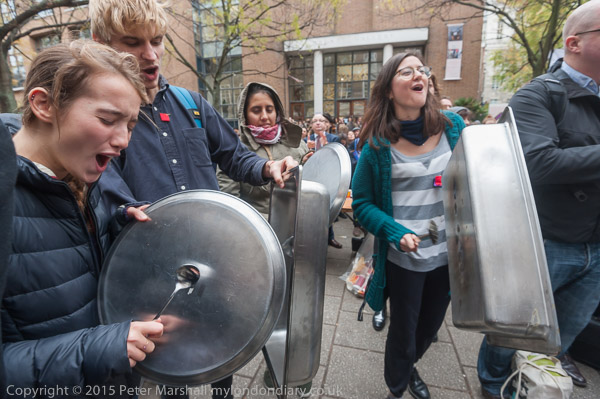
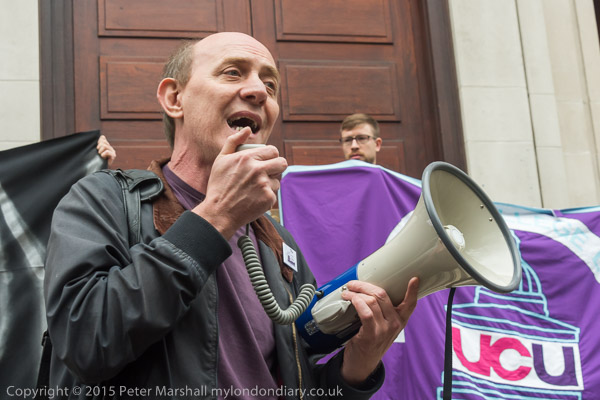
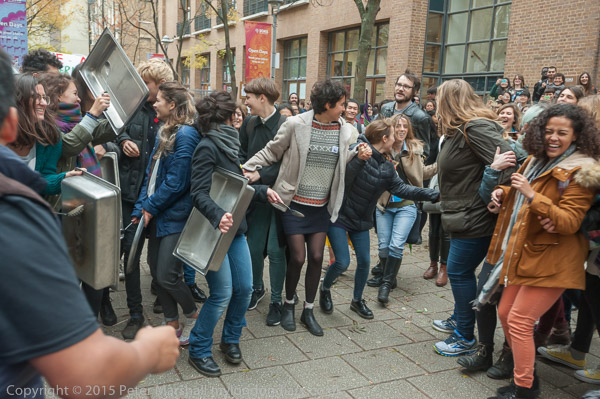
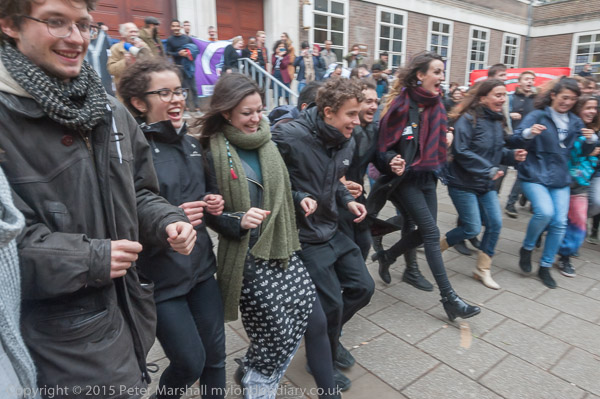
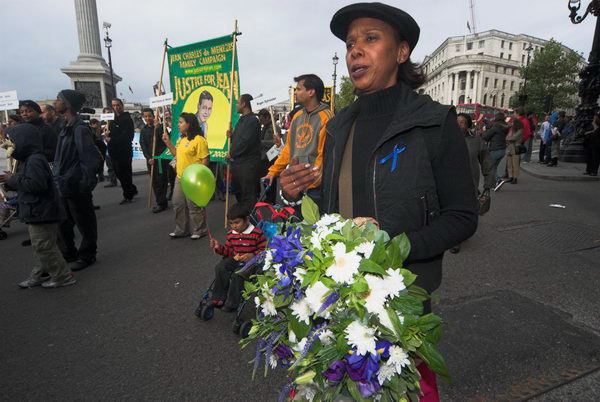
Climate March & Open House: On Sunday 21st September 2014 I photographed the so-called ‘Peoples Climate March’ in central London before going to party with Focus E15 Mothers on the Carpenters Estate where they celebrated a year of their fight to be rehoused in the area.


Peoples Climate March – Embankment

Climate March & Open House

As in this week in 2023, a Climate Summit was taking place in New York in September 2014 and marches were taking place in London and elsewhere to demand divestment in fossil fuels and an end to the domination of politics by the fossil fuel industry which has blocked action against climate change.

Climate March & Open House

Little has actually changed in the 9 years since then. More empty words and promises but too many governments including our own in the UK continuing to encourage exploration for more gas and oil and even approving new coal mines. And carbon levels continue to rise, with at least a 2 degree rise in global temperature now seeming inevitable.

Climate March & Open House

What has changed is that we are all much more aware that climate change is real and are feeling its effects. While many in the Global South have been suffering for years, we in Europe and North America have now felt the new record high temperatures and seen the increasing wild fires and unstable weather caused by global temperature rise.

Last Saturday I photographed another Climate March in London, and it had a rather more serious and committed air than the 2014 event, not just because it was organised by Extinction Rebellion, but because the global situation has worsened, with new an disturbing reports coming out almost weekly.

Climate March & Open House

Back in 2014 I wrote about some length about the march and how it “seemed to have been rather taken over by various slick and rather corporate organisations rather than being a ‘people’s march’ and seemed to lack any real focus.”

Climate March & Open House

Then I commented that “There was one block – the ‘‘Fossil Free Block’ that I felt was worth supporting, and what the whole march should have been about. We have to stop burning oil, coal, gas. We are certainly on our way to disastrous climate change if we fail to severely cut carbon emissions, and probably need to actually reverse some of the rise that has already occurred. Drastic action really is needed.”

The 2023 march was behind a banner ‘NO NEW FOSSIL FUELS’ and another read ‘BIG OIL HAS FRIED US ALL’. But it didn’t get the kind of corporate support of the 2014 event and I don’t think there were any celebrities on the march, though I think some spoke at the rally afterwards, but I had left before this.

Worryingly in 2023 it was much smaller than the 2014 March. Back in 2014 I still felt there was time to avert catastrophe, but now I’m rather less optimistic. It may be too late. I have a feeling that in another nine years time we will be marching again, world leaders will still be talking and doing little and the world will be descending into chaos. Given my age it may still see me out but I worry about those younger.

More on My London Diary at Peoples Climate March.


Focus E15 Open House Day

I left well before the end of the march in 2014 too, catching the Underground to Stratford to get to the Carpenters Estate in Stratford where Focus E15 Mothers were celebrating the first anniversary of their fight against LB Newham’s failure to provide local housing for local people.

It was a year since Newham Council had cut funding for their hostel in Stratford run by East Thames Housing and they had been given eviction notices. Newham, which had a statutory duty to rehouse them told them it would be in private rental property miles away in Birmingham or Hastings or Wales but they wanted to stay within reach of families, jobs support services and friends in London.

Unlike many others they decided to fight the council, and launched an active and successful campaign, later widening their personal fight into “a wider campaign for housing for all, for social housing in London and an end to the displacement of low income households from the capital, with the slogan ‘Social Housing not Social Cleansing’.”

Despite the desperate shortage of social housing in Newham, the council led by Mayor Robin Wales had been trying to sell off its Carpenters Estate for ten years, moving people out and leaving good homes empty. The estate is next door to Stratford Station and Bus Station and so has excellent transport links making it very desirable for development. It is a post-war estate with large numbers of good quality low-rise housing along with three tower blocks. By 2014, most of the properties had “been boarded up for years, empty while thousands wait on the council’s housing list.

Carpenters Estate June 2014

In June 2014 I’d come with Focus E15 to the estate and had photographed them pasting up large photographs of themselves on some boarded up flats with slogans such as ‘This home needs a family‘ and ‘This family needs a home‘ and ‘These homes need people‘. I’d been told something intersting might happen at the party and wasn’t surprised when after a noisy session by a samba band to mask the sounds of removing some of the metal shutters at the rear of the flats we saw some of the E15 mums and supporters waving at us from a first floor window.

“It was Open House Day in London and courtesy of the Focus E15 Mums, 80-86 Dorian Walk was now one of the houses open to the public, even if not on the official lists, and we formed an orderly queue in best Open House tradition to go in and look at the four flats.

I was surprised to see what good conditions the flats were in, “fitted kitchens and bathrooms still in good working order – with running water, wallpaper and carpets almost pristine, and the odd piece of abandoned furniture. In one of kitchens, the calendar from 2004 was still on the wall, a reminder that while Londoners are desperate for housing, Newham council has kept this and other perfectly habitable properties empty for ten years.”

Focus E15 occupied the flats for a couple of weeks, leaving after the the Council issued legal eviction notices but their fight continued. Most of them have been rehoused in London and they have supported many others in Newham and neighbouring boroughs to get proper treatment from the council and prevent evictions. Their actions saved the Carpenters Estate and it is now being regenerated, although the plans don’t satisfy many of the groups demands. Their campaigns for housing for people in Newham continue.

More on My London Diary at Focus E15 Open House Day.


Girls, Houses and St John

Girls, Houses and St John: The second and final set of missing pictures from my walk on June 4th June 1989 – continuing from Stockwell- Chapel, Church, Jazz & Housing

Two girls, Stockwell, Lambeth, 1989 89-6b-23

These two feisty young girls demanded to know what I was doing taking pictures in their manor, outside Cassell House close to the corner of Stockwell Rd and insisted that I take their picture. I think that probably they were sisters although they are dressed rather differently. The older of the two is wearing earrings. They are now 34 years older and if they see their picture I hope they like it.

Across the road you can make out Joseph Yates Timber Merchants at 17-19 Stockwell Road, whose shop was still there though boarded up in 2008. Together with the house behind it was replace by a new block shortly after, the shop becoming EZ Homeware and around 2018 a vape shop, Ez Cloudz.

House, 349, Clapham Rd, Clapham, Lambeth, 1989 89-6b-25

I turned left around the corner into Clapham Road, walking down towards Clapham, crossing Mayflower Road to a group of impressive Queen Anne style red-brick houses – I think this was number 349.

As you can see these houses have quite long front gardens which were then rather overgrown. I think the house had long been divided into flats. There is a broken window on the ground floor which looks as if it is boarded up. These buildings are locally listed

House, 357, Clapham Rd, Clapham, 1989 89-6b-11

This is a bay extension on 355 Clapham Road, which I found more interesting than the Grade II listed house at the left of the picture, the listing text of which begins “Substantial early C19 house, one of a pair of which the other is so much altered as not to be of special interest.” According to the Survey of London the house was first occupied in 1792.

House, 357, Clapham Rd, Clapham, Lambeth, 1989 89-6b-12

Another view of 357 makes it clear that the two storey bay above a basement garage in the previous picture is indeed a part of this house.

I think its doorway with the two front doors is probably also a later addition, though again I found it of interest, though its listed neighbour retains its original and perhaps more common if still fine entrance. I think my taste in buildings allows rather more for eccentricity while those who make the listings are more concerned with age and consistency of style.

House, 369, Clapham Rd, Clapham, Lambeth, 1989 89-6b-13

Listed as The Garden House with location ‘Union Mews, Lambeth, London SW9’ in 1981, this is an unusual house at 369 Clapham Road with no front door, though it does have a fairly plain Doric entrance around the side on the left. It was first occupied in 1815, and was built on land acquired by the Duke of Bedford in the early 18th century and let by him to Robert Robson. There is a fairly lengthy description of the house in the Survey of London volume orginally published by the LCC in 1956 which ends with “The premises are now occupied by Messrs. Ashton Brothers and a garden with seats extends from the pavement edge back to the house.”

My picture shows Ashton Funerals at the site in 1989 with ‘PRIVATE CHAPELS FUNERALS CREMATIONS’ and their name in large signage on rails on the frontage, and a well-kept garden, though I couldn’t resist including the Ad Hoc Wine Warehouse signs as well. The house is now flats and the Ashton signage has gone, and the wine warehouse having become car hire has now been demolished as a part of a new block of flats including and existing property at 363.

St. John the Evangelist, Clapham Rd, Clapham, Lambeth, 1989 89-6b-14
St John the Evangelist, Clapham Rd, Clapham, Lambeth, 1989 89-6b-14

Built 1840-42, architect Thomas Marsh Nelson the church is Grade II listed. A confined site led to an unusual orientation. It was truncated in 1986 and the Diocese of Southwark website comments “In short, this building has suffered due to a lack of clarity from its earliest day. First of all when the east-west axis was reversed and latterly the internal alterations described above. These changes plus the ravages of dry rot have left the interior merely as a jumble of ill-defined spaces without any overall cohesion.”

However the simple classical exterior is impressive, and rather unusual for the date of construction.

Various events and visits took me out of London for the next few weekends and it was July before I could return for my next walk around part of the city.


Gentrification, Life Jackets & Standing Rock – 2016

Gentrification, Life Jackets & Standing Rock: Three very different protests in London on Monday 19th September 2016


Save Brixton Railway Arches

Gentrification, Life Jackets & Standing Rock - 2016

Network Rail and Lambeth Council want to evict the small local businesses from the Railway arches, some of which have been serving the community for as long as anyone can remember. The sites will be refurbished and the rents trebled, so the new Atlantic Road ‘Village’ will be home to “loads of bland, overpriced, soulless branded shops that nobody wants“. This is clearly another disturbing step in the ongoing gentrification of Brixton being pursued by Lambeth Council.

Gentrification, Life Jackets & Standing Rock - 2016

When railways where built in London in the nineteenth century much of the land they ran across was already occupied by houses, shops and other businesses. Putting the rails on top of long viaducts was a cheaper and much less disruptive way of bringing the railways into the city then putting the lines at or below ground level.

Gentrification, Life Jackets & Standing Rock - 2016

This created long runs of arches below the viaducts as well as bridges over existing roads, and these arches were soon filled largely by small local businesses for which they provided relatively low rent premises. Many of them later became garages and other businesses connected with cars, lorries and taxis, but those in the centre of Brixton where the arches had frontages on Atlantic Road and Brixton Station Road were occupied by a whole range of shops.

Gentrification, Life Jackets & Standing Rock - 2016

Almost all of these were small businesses serving the local community – selling food, clothing, furniture, carpets, general stores, cafes, bars. Some well-known shops had been in the same arch since the 1930s.

Gentrification, Life Jackets & Standing Rock - 2016

Network Rail wanted to evict all these tenants so the arches could be refurbished and then re-let at hugely increased rents to increase their profits by replacing valued local businesses by the kind of bland high-price chains and franchises that have blighted high streets across the country. And Lambeth Council were backing them against a strong local ‘Save Brixton Arches’ campaign.

Few if any of the existing businesses could survive the long gap in trading for the revamping on the arches, and none would be viable at the increased rents. Many of them had decided to fight the evictions despite being threatened that if they legally challenged them they would not be offered leases after refurbishment.

On this Monday Network Rail had been intending to evict another of the traders, Budget Carpets, and people including from the local Green Party and the party’s co-leader Jonathan Bartlett, local Labour councillor Rachel Heywood and Simon Elmer from ASH had come to oppose the eviction. Rachel Heywood, a Labour councillor since 2006, was opposed to this and other policies such as library closures and council estate demolitions being pursued by the right-wing Labour cabinet and in 2018 was banned from the Labour Party for 5 years after it was announced she would stand as an independent.

The protest led to Network Rail postponing the eviction. The protesters then went into Brixton Market for a meeting where traders talked about how they have been bullied and their decision to fight the evictions.

More pictures at Brixton Railway Arches.


Life Jacket ‘graveyard’ – Parliament Square

The International Rescue Commission laid out 2,500 life jackets previously worn by adults and children refugees to cross from Turkey to Greece in Parliament Square as a reminder of the continuing deaths by drowning there.

The protest urged the UK to do more to welcome refugees to the UK and to meet the promises already made, and was criticised by a few bigots on the extreme right. Unfortunately instead the UK government has listened increasingly to the bigots and brought in even more repressive anti-migrant laws while failing to provide safe passages for migrants except for some very limited special cases.

Everyone wearing this lifejackets and those who have arrived in Europe since then in similar circumstances is now a criminal under UK law should they manage to get to this country.

At the protest I met again Green Party co-leader Jonathan Bartley who I had photographed earlier in Brixton. He told me his tweet about refugees and this life-jacket protest had attracted many extremely racist comments.

Life Jacket ‘graveyard’


London Stands with Standing Rock – US Embassy

Later in the day I went to the US Embassy in Grosvenor Square where people attended a non-violent, prayerful act of solidarity with the Standing Rock Sioux Tribe threatened by the construction of a huge oil pipeline close to their reservation in North Dakota and the Missouri River.

A protest at the pipeline which threatens the water supply of the tribe and 8 million people who live downstream has attracted several thousands from around 120 Native American tribes and their allies around the world and 70 have been arrested at gunpoint.

Although the protest has attracted many journalists who like the protesters have been harassed by police (and some protested) there has been very little press coverage. The pipeline had already resulted in the destruction of several sacred sites.

You can read more about the pipeline on Wikipedia. Legal injunctions on behalf of the Standing Rock Sioux Tribe were denied. The Obama administration attempted to get some re-routing of the pipeline but one of the first things Trump did on coming to power was to approve its construction. It was completed later in 2017 and put into service. Despite various court rulings since that there had not been proper environmental reviews it remains in operation.

More pictures at London Stands with Standing Rock.


Stockwell – Chapel, Church, Jazz & Housing

Stockwell – Chapel, Church, Jazz & Housing: I thought I had completed the pictures from my walk on 4th June 1989, but find there is a chunk I had left out. As those who have followed my various walks know I often wandered in circles. I think these pictures were taken following those in the post More Stockwell Green & Mary Seacole.

Khatme Nubuwwat Centre, 35 Stockwell Green, Stockwell, Lambeth, 1989 89-6b-46

The Khatme Nubuwwat Centre was previously known as Aalami Majlise Tahaffuze Khatme Nubuwwat and is also known as Stockwell Green Mosque. It was the subject of an investigation by the Charity Commission in 2016 over its links with Pakistani groups advocating the killing of Ahmadi Muslims. Its name means that Muhammad is the last of the prophets, while Ahmadis are a minority Muslim sect who believe the Prophet Mohammad is not the last and final messenger.

Khatme Nubuwwat Centre, 35 Stockwell Green, Stockwell, Lambeth, 1989 89-6b-31

Another picture of Stockwell Green Mosque with the number 35 and its name in 1989, Aalami Majlise Tahaffuze Khatme Nubuwwat, at the side of the door.

Confusingly this building still appears to be Grade II listed as Stockwell Green United Reformed Church, although it was sold to the mosque in 1988, when that church moved to smaller premises. It also gives the address as Union Mews. The listing text says it is a classical chapel dating from around 1830. It was known as Stockwell New Chapel and was where William Booth and Catherine Mumford the founders of The Salvation Army were married on 17th June 1855.

I’m surprised that when it was listed in 1981 a more exact date could not be given as most chapels have foundation stones with names and dates. It was built in 1798, but was extended and given this facade by architect Hames Wilson in 1850.

St Andrew's, Church, CofE, Landor Rd, Stockwell, Lambeth, 1989 89-6b-33
St Andrew’s, Church, CofE, Landor Rd, Stockwell, Lambeth, 1989 89-6b-33

I went back to Landor Road and made another picture of the Anglican St Andrew’s Church seen from the corner of Stockwell Green, showing the oversize circular window at its east end, doubtless part of H E Roe’s Romanesque rebuilding in 1867.

The house at the left, 22 Stockwell Green is early 19th century and Grade II listed.

Live Music, Stockwell Green, Stockwell, Lambeth, 1989 89-6b-34

I think this may have been an entrance to the Plough pub, on the corner of Stockwell Green and with the address 90 Stockwell Road, though nothing there resembles this now.

The Plough had been on this site since brewery records began in 1666, but was rebuilt in the 1930s as a Truman pub designed by A E Sewell. It was a well-known jazz venue in the 1960s and 70s with performances by some of Britain’s best jazz musicians and some live recordings were made in the bar.

By the 1990s the audience for live jazz had declined and two letters of its name had fallen from the sign and it was relaunched as a garish bar, the Plug. But this was unsuccessful and closed in 2001. The upper floors are now residential but the ground floor seems to still be empty 22 years later.

King George's House, 40 Stockwell Rd, Stockwell, Lambeth, 1989 89-6b-35
King George’s House, 40 Stockwell Rd, Stockwell, Lambeth, 1989 89-6b-35

Built as Ingram House, architect Arthur T Bolton, it opened in 1905 as a residential club for young men and later was taken over the the YWCA for young ladies. In 1937 it became King George’s House, a home for working boys aged 14-18 run by the John Benn Boys’ Hostel Association. It is now run by Evolve Housing as “an 87 bed service for single homeless young people from 16 years of age with a range of support needs.

The rather tall gates were firmly locked when I made this picture from the street.

Cassell House, Stockwell Gardens Estate, Stockwell, Lambeth, 1989 89-6b-21

Cassell House is in Stockwell Gardens West and has flat numbers 1-81. The estate was built by the London County Council from around 1930 on. Cassell House is a large complex with this curved block behind a group of buildings including the Swan pub on the corner of Clapham Road and Stockwell Road more or less opposite the Stockwell Underground Station.

Stockwell’s most famous gardens, the botanical gardens of John Tradescant lay a little to the north.

A few more of the ‘missing’ pictures in a later post.


Cinelli, Poppies and Music at Class War Poor Doors – 2014

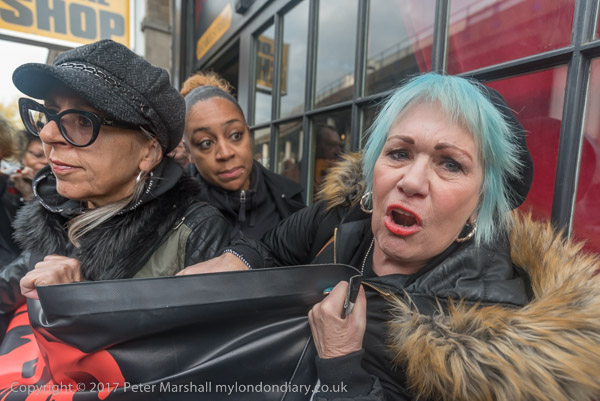
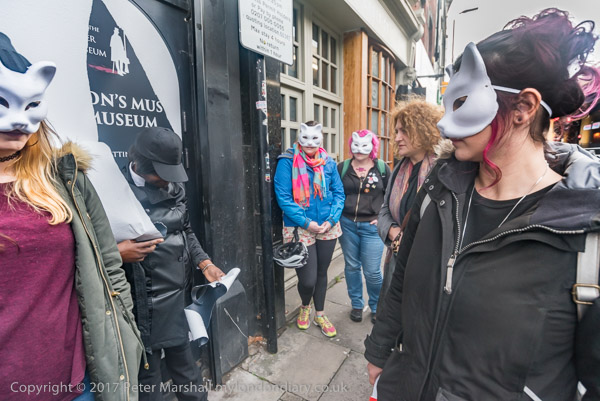
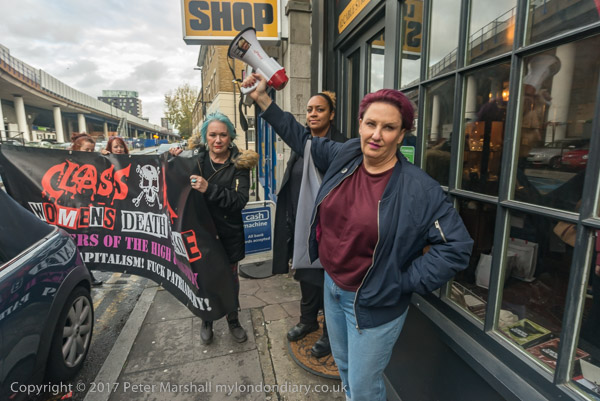
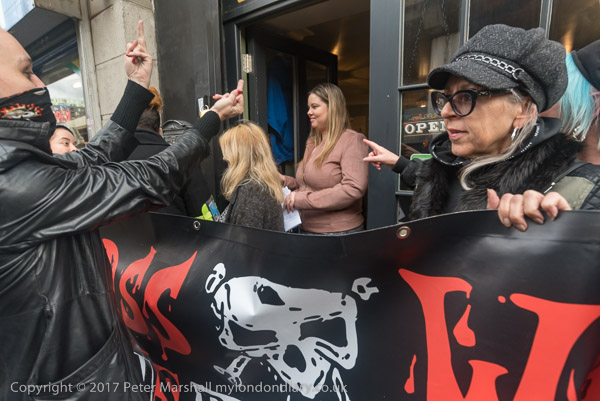
Cinelli, Poppies and Music at Class War Poor Doors. I only photographed one event on Wednesday 17th September 2014, one of the long series of weekly protests by Class War over separate entrances for rich and poor occupants of the large block of flats at One Commercial St on Whitechapel High Street.


Music at Class War Poor Doors – Aldgate

Cinelli, Poppies and Music at Class War Poor Doors

One Commercial St is a 21 storey largely residential block occupying an extensive corner site on Whitechapel High St and Commercial St which includes 207 flats above lower floors of offices, shops and an entrance to Aldgate East Underground Station.

Cinelli, Poppies and Music at Class War Poor Doors

The building, opened in 2014, received strong criticism in architectural circles, and Wikipedia quotes Building Design as commenting on what was developer Redrow’s “first flagship development” with “First flagship development? Please God let it also be their last. No one who can liken this incoherent hulk of ill-fitting glass sheets to a blade of light deserves to build again in such a sensitive location” and it was nominated for the Carbuncle Cup for “the ugliest building in the United Kingdom completed in the last 12 months“.
Cinelli, Poppies and Music at Class War Poor Doors

But it became controversial for other reasons too. To meet planning regulations the block contains some flats at affordable rents. While those in the main part of the building enter through an impressive foyer with a concierge desk and seating from the High Street adjoining Aldgate East Station, tenants of the affordable section had to go down what was then a dirty and dingy alley at the side of building, Tyne Street, to a door with a card-entry reader leading to a long empty corridor. On 17th September the card reader had been broken for 3 weeks, leaving the building insecure and the building management had failed to repair it.

Cinelli, Poppies and Music at Class War Poor Doors

This difference in treatment for rich and poor was highlighted in an article in The Guardian which commented on the growing trend for London’s new housing developments to include separate entrances like this for the less wealthy, known as “poor doors” and which gave One Commercial Street among the examples.

Many people expressed their distaste at this social segregation, and in New York Mayor Bill De Blasio announced he planned to take action to prevent new developments having such separate doors for low-income residents after a single such block was built there. But it was becoming common in London.

Anarchist group Class War decided it was time to take some action, and from July 2014 organised a weekly series of evening protests outside One Commercial Street, continuing (with a few breaks) until the following May. I photographed all but a couple of these, and later published a zine with some of the pictures I made. This is still available, but carriage costs make buying single copies expensive, however there is a good preview online.

Others joined with Class War on various occasions, and on Wednesday 17th September 2014 Reggae band Different Moods from Tottenham came to perform their ‘Poor Doors’ song specially written for the protests.

The protests by Class War did raise the profile of the problem, and resulted in some minor changes – including better lighting and cleaning for the side alley. They probably also embarrassed the owners enough to make them sell the building, though the new owners proved no better and the social segregation remains. And it’s perhaps why the building was later renamed and is now the Relay Building.

Music at Class War Poor Doors


Sea of Poppies – Tower of London

On my way to Aldgate I stopped at the Tower of London and made a photograph of the Sea of Poppies, work of art remembering the ‘Great War’, the ceramic poppies, one for each of the British forces killed in the war. I commented that for me “it seems decorative but shallow” and “lacks any real sense of the numbers involved and is far less graphic than the war cemeteries with their seemingly endless rows of crosses.

A little more at Sea of Poppies.


Vintage Cinelli in poor state

Earlier in the day I’d taken a picture showing the terrible state of my old bicycle, no longer ride able. It’s still in my shed, as several attempts to find a replacement chainwheel have failed. You can read more of the story about it at Vintage Cinelli in poor state. Perhaps I should try searching again.


Open House, Sewol, Iran, Sabah, Sarawak & Orange Order 2017

Open House, Sewol, Iran, Sabah, Sarawak & Orange Order: Saturday 16th September 2017 was another busy and varied day for me in London, beginning with two visits on Open House Day and continuing with four protests.


Open House – Banqueting House – Whitehall

Open House, Sewol, Iran, Sabah, Sarawak & Orange Order

Though I’d often walked past the Banqueting House in Whithall, usually on my way to protests at Downing Street or Parliament Square, I’d never before been inside the building. But when I came past on Open House Day there was only a short queue and entrance was free. I had time to spare as a protest I’d hoped to photograph had failed to materialise, so in I went.

Inigo Jones designed (or copied from Andrea Palladio) the Banqueting House for the Palace of Whitehall, built 1619-22, and it is the only remaining building from the palace. It was the first neo-Classical building in England.

More about it and more pictures on My London Diary at Open House – Banqueting House.


Open House & more – Peckham

Open House, Sewol, Iran, Sabah, Sarawak & Orange Order

I went to Peckham to see a few things in the Peckham Festival including the Open House showing of the Old Waiting Room at Peckham Rye station which was housing a photographic exhibition of old pictures of Peckham.

Open House, Sewol, Iran, Sabah, Sarawak & Orange Order

The building itself turned out to be more interesting than the exhibition which lacked any real examination of the more recent past of Peckham. But there were other things to see in Peckham, and a short walk around Rye Lane and the Bussey Building is always interesting.

More at Open House & more – Peckham.


41st monthly Sewol ‘Stay Put!’ vigil – Trafalgar Square

Open House, Sewol, Iran, Sabah, Sarawak & Orange Order

Back in Central London, my first protest was in Trafalgar Square where a small group mainly of SOuth Koreans was continuing their series of monthly vigils in memory of he Sewol victims, mainly school children who obeyed the order to ‘Stay Put’ on the lower decks as the ship went down.

They continue to demand the Korean government conduct a thorough inquiry into the disaster, recover all missing victims, punish those responsible and enact special anti-disaster regulations.

41st monthly Sewol ‘Stay Put!’ vigil


Overthrow the Islamic Regime of Iran – Trafalgar Square

Also in Trafalgar Square the 8 March Women’s Organisation (Iran-Afghanistan) were protesting on the 29th anniversary of the massacre of political prisoners in Iraq following a fatwa by Ayatollah Khomeini calling for the death of all Mojahedins and leftists as ‘fighters against God’ and ‘apostates from Islam.’

The fatwa led to over 30,000 political prisoners, mostly members of the main opposition People’s Mojahedin Organization of Iran (PMOI/MEK) being executed, largely hanged in groups of six and buried in mass graves.

The protesters call for the overthrow of the Islamic regime as necessary for the ‘litigation movement’ can achieve justice and build a society where such executions cannot occur and no one is suppressed, imprisoned or tortured for their ideas.

More pictures: Overthrow the Islamic Regime of Iran.


Black Day for Sabah & Sarawak – Downing St

A short distance down the road at Downing St, Sabahans and Sarawkians were protesting on Malaysia Day, which they say is a ‘Black Day for Sabah and Sarawak’, calling for a restoration of human rights and the repeal of the Sedition Act and and freedom for Sarawak and Sabah.

Among them was Doris Jones, the leader of the Sabah Sarawak Keluar Malaysia secessionist movement in London.

When Malaysia was founded on 16th September 1963 the two independent countries in North Borneo joined with the Federation of Malaya and Singapore and were given promises, assurances and undertakings for their future in the federation. These included ’20 points’ of an Inter-Governmental Committee (IGC) Report, which the prrotesters say have been cast aside, and anyone raising them is being detained under a draconian Internal Security Act.

More at Black Day for Sabah & Sarawak.


Lord Carson Memorial Parade – Cenotaph, Whitehall

The annual Lord Carson Memorial Parade, one of several annual parades by lodges of the Orange Order came to the Cenotaph for wreaths to be laid. As well as various lodges dedicated to the Apprentice Boys of Derry there were others remembering the Ulster regiments that fought on the Somme. As well as members of lodges in the Home Counties and London, these parades also include some who come from Ulster and Scotland.

Lord Carson (1854-1935) was a leading judge and politician in the UK becoming Solicitor General and First Lord of the Admiralty. He had joined the Orange Order at the age of 19, and in 1911 became the leader of the Ulster Unionists, determined to fight against home rule for Ireland by “all means which may be found necessary“, becoming one of the founders of a unionist militia that became the Ulster Volunteer Force.

But in later years he warned Unionists not to alienate the Catholics in the north, something which parades such as this clearly do in some areas of Northern Ireland. In London they are much less controversial, although I have at times been threatened by those taking part for photographing them. But on this occasion I received just a few hard stares and even some faintly welcoming grins from some who recognised me.

More pictures on My London Diary at Lord Carson Memorial Parade.


Serius, MOT, Two Bees & More

My walk which began in Clapham on Sunday 4th June 1989 continues in Stockwell. It began with Light & Life, Pinter and Stockwell Breweries and the previous post was Coldharbour, Atlantic & Brixton Rd – 1989.

Serius Gallery, 44 Bellefields Rd, Brixton, Lambeth, 1989 89-6a-22

All I can tell you about SERIUS GALLERY is written on the door of 44 Bellefields Rd, which continues with ‘QUEEN MARTIN’ and gives its opening hours as Mon-Fri 2-6pm and Sat, Sun 12-3. These houses are still there, looking in rather better condition but no longer as a gallery.

Nor can I tell you anything about Queen Martin, though these was a rather nice looking Victorian pub at 45 Bellefields Road opposite this house named The Queen, which was demolished in 2006 and replaced by an rather ugly block with flats above ground floor commercial spaces also named THE QUEEN.

MOT Centre, Ferndale Rd, Brixton, Lambeth, 1989 89-6a-24

The M.O.T. Centre for Cars & Motor Cycles offering Free Steering & Brake Safety Check would not inspire my confidence with its heap of car scrap at the left of the picture. This site is now a little tidier as Zaks Tyres and the Ferndale Road Car Wash, on the corner of Ferndale Road and Pulross Road.

The fence just visible above its notices is along the railway line.

Tintern St, Brixton, Lambeth, 1989 89-6a-12

I made another picture of the M.O.T centre (not on line) which continues on the other side of the railway bridge and a couple more and continued along Ferndale Road, wandering down some of the side streets. I’ve also not yet digitised a picture of the Brixton Seventh Day Adventist Church on the corner of Ducie St and Santley St, and my next picture on-line is this one from Tintern Street. The building at right of the picture is on the corner with Ferndale Road, with two shops there not visible in my picture.

The shopfronts have changed but the upper floors and general appearance are still much as they were in 1989, and the whole remains a rather nice reminder of the Victorian era. The main loss is in the shopfronts at the left of my picture. Of course it is no longer the ‘TWO BEES LADIES AND GENTS HAIRDRESSERS’ but still in the same trade as a Unisex Hair Salon.

Subverted Billboard, Bedford Rd, Clapham, Lambeth, 1989 89-6a-14

I’m not sure I entirely understood the amendments made to this billboard which advertised Billy Graham’s 1989 Evangelical Mission when I made this picture. It helps too look up Luke 12:19, which in the King James Version reads “And I will say to my soul, Soul, thou hast much goods laid up for many years; take thine ease, eat, drink, and be merry.” And to put the comment into more standard English, “Dollar bill still has to be my bowl of cherries.”

While it’s clear that the L is now a pound sign, and is followed by a dollar symbol. I think the ‘E’ at right is added to make this now read £$ FEE.

I think it was probably a different hand that posted a line of five anti-poll tax posters posters at bottom right.

Chequers Cafe, Bedford Rd, Landor Rd, Clapham, Lambeth, 1989 89-6a-15
Chequers Café, Bedford Rd, Landor Rd, Clapham, Lambeth, 1989 89-6a-15

The Chequers Café, a greengrocers and a pub on the corner of Bedford Road with Landor Road. The pub is still there. In 1989 it was the Bedford Arms, there since around 1874, but I think later was the Hog’s Head and simply the Bedford. In 2003 it became The Clapham North, the first of several pubs in the area opened by the pub group Livelyhood who made it one of Clapham’s most popular pubs. But they were simply tenants and the pub was bought by Young’s in 2013 and ten years later they decided to take over the lease. So now just another Young’s pub.

Houses, Atherfold Rd, Clapham, Lambeth, 1989 89-6a-16

This was the last picture on my walk on 4th June 1989. These unusually ornate early Edwardian houses caught my attention. They are terraced houses, but built to look grander than they are with substantial doorways over paired front doors. The houses at left are part of a short terrace of four, and then a longer terrace goes around a corner in the street.


Lewisham, Secular Europe & Malta Day – 2013

Lewisham, Secular Europe & Malta Day – Saturday 14th September 2013 was a very mixed day for me, beginning with a victory celebration by hospital campaigners in Lewisham, then moving to Westminster for a protest celebrating secularism in Whitehall before finally photographing a highly religious Malta Day celebration at Westminster Cathedral.


Lewisham Hospital Victory Parade

Lewisham, Secular Europe & Malta Day

Lewisham Hospital is a highly successful and well run hospital serving a large area of South London, and when the government planned to close large areas of its services there was a huge public outcry, with large marches to keep it open, as closure would have severely damaged the health service in the area.

Lewisham, Secular Europe & Malta Day

The planned closure was not in response to any failure by Lewisham; it’s sole purpose was to allow the NHS to continue to make massive PFI repayments due from the building of other London hospitals through contracts that were badly negotiated when interest rates were high and have already delivered huge profits to the lenders.

Lewisham, Secular Europe & Malta Day

As well as a hugely successful public campaign, both Lewisham Council and the Save Lewisham Hospital campaign went separately to the High Court for Judicial Review of the decision by Health Secretary Jeremy Hunt, and both were successful.

Lewisham, Secular Europe & Malta Day

The immediate response of the Health Secretary was to announce he would appeal the two decisions, and the campaign had launched a petition calling on him to accept the defeat gracefully and not waste any further time or taxpayers money over the appeal. Given the clear judgement of the court any appeal seemed unlikely to succeed.

The government also intend to change the law to make it much more difficult for people to contest their decisions in the courts after being defeated on this and other cases where they have failed to give proper consideration to policies. But having a government which seems to think ‘sod the law, we’re going to do as we like‘ doesn’t seem at all healthy for democracy.

The Victory Parade was rather smaller than the earlier protests which had brought thousands out onto the streets of Lewisham, with perhaps a little fewer than five hundred people, though more turned up to take part in the celebration event at the end of the parade in Ladywell Fields. But perhaps marching now seemed less important, and the poor weather will have put some off.

At the front of the parade was a Lewisham Council dustcart with large posters on it and following it were marchers with a small street band. Among those marching were two nurses wearing their uniforms from the Olympic opening ceremony, some ‘Olympic’ drummers and others in medical uniforms.

More pictures on My London Diary at Lewisham Hospital Victory Parade.


Secular Europe Protest – Downing St

Around a hundred people had marched from Temple to a rally opposite Downing Street for the 6th annual Secular Europe Campaign protest celebrating secularism and demanding an end to religious discrimination and indoctrination.

As well as the protest in London there was also a similar protest taking place in Krakow, Poland, a country where politics are still very much dominated by the Catholic Church.

Things are rather different in the UK, but we still have the anomaly of 26 Church of England bishops sitting in the House of Lords, reflected in some of the campaigners wearing paper versions of a Bishop’s mitre with the number 26 on the front.

We obviously need reform of the House of Lords, but the bishops seem to me a minor issue and are among the more sensible and progressive members of the house. There are still 92 hereditary peers, as well as many more wholly undeserved political appointees, particularly those given a seat as thanks for their political and other services to retiring Prime Ministers. The recent list by Boris Johnson included some that clearly bring our politics into disrepute, and if the list by Liz Truss is approved following her disastrous fifty days in office, our politics will clearly have become a farce.

The campaigners also called for an end to religious indoctrination in schools, though I was pleased to hear one speaker make clear that not all church or religious schools were guilty of this, with many providing a good education that encouraged their pupils to think for themselves.

Others complained about the lack of secular speakers on Radio 4’s ‘Thought for the Day’, and though I think the selection has widened a little in recent years there is certainly still room for a wider choice of viewpoints. And they still have some who make me cringe every time they appear.

Some of the other things that concern the secular movement are religious discrimination against women and gays, abuse of children by the clergy, the teaching of creationism in schools, the anti-abortion lobby and misinformation about contraception and AIDs, religious male circumcision and female genital mutilation, false accusations about witchcraft, Sharia law, forced marriages and the right to die with dignity. And of course many of these concerns are shared with many religious people.

More at Secular Europe Protest.


Malta Day Procession – Westminster Cathedral

Finally I walked to Westminster Cathedral where a Mass was taking place for Malta Day, attended by the Lord Mayor of Westminster, Councillor Sarah Richardson, taking pictures as people came out from the church for the procession which was to follow.

Malta Day, actually 8th September, is a public holiday in Malta, the Feast of Our Lady Of Victories or Victory Day. Celebrations in villages there mark the Nativity of the Blessed Virgin Mary, commemorated in statues of ‘il-Bambina’, one of which was carried in the procession.

The day also celebrates the Victory of the Knights of St John of Malta against the Turks in 1565, a victory over the French in 1800 and the surrender of Italy, then occupying Malta, in 1943.

Fire-crackers were set off in the plaza and a band played before the procession finally set off down Victoria Street.

As well as the statue of ‘il-Bambina’, there were also seeral large and colourful banners, men in the robes of the Knights of Malta, and girls in huge black hooded cloaks (Faldetta or Ghonella), which seemed a little sinister to me. For various personal reasons although I’ve never been there I’ve long regarded Malta as an epitome of religious intolerance.

More pictures at Malta Day Procession.


Harmondsworth, Colnbrook & Heathrow 2014

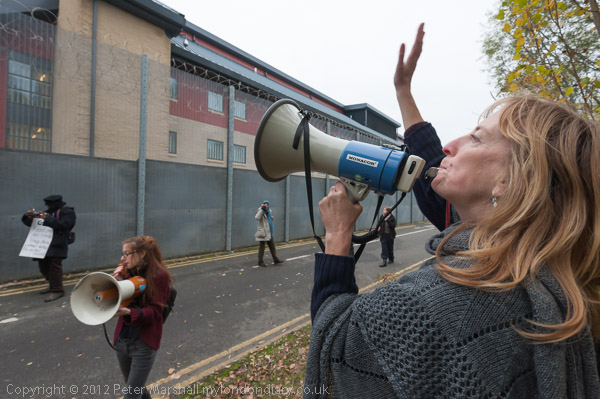
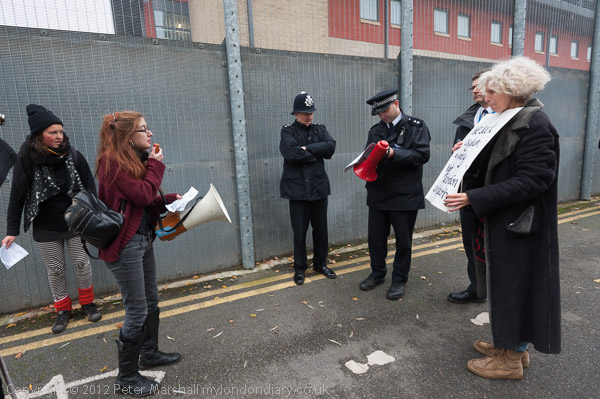
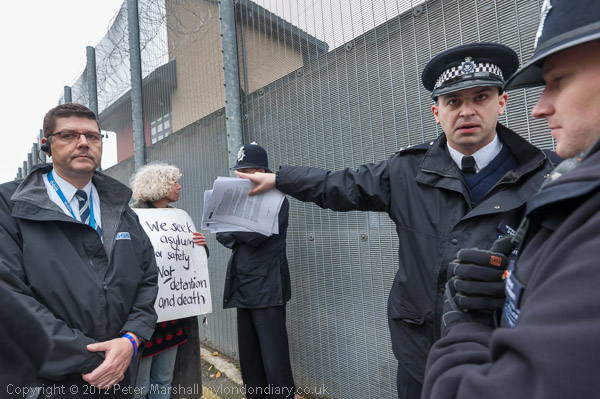
Harmondsworth, Colnbrook & Heathrow: Back in 2014 I could take a bus a short walk from my home which took me to within a few yards of what had recently been renamed the Heathrow Immigration Removal Centre on Bath Road to the north of Heathrow Airport. And since the bus only ran every half hour I arrived a while before the protest there began and had time for a short walk – and almost half an hour to wait on my way home.

Harmondsworth, Colnbrook & Heathrow

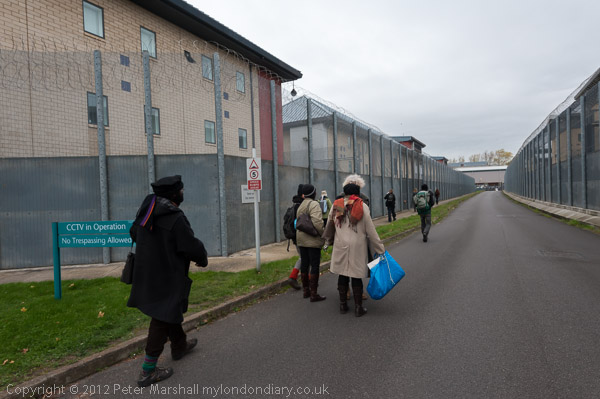
Surprising both buses had fairly clean windows and I also took a few pictures through them on my journey, and you can see a few more at Colnbrook and Heathrow. Before the protest I’d walked beside the Duke of Northumberland’s River which runs through the extensive grounds of the British Airways offices, and on the other bank is a tall fence for the Immigration Centre and BT premises.

Harmondsworth, Colnbrook & Heathrow

The river is a man-made distributary of the River Colne, dug to take water to the Isleworth flour mill and Syon House. Along with another channel, the Longford River, built to take water to Bushy Park and Hampton Court, it has been rerouted around Heathrow airport and some of the pictures from the bus show the two in their new largely concrete channels beside the perimeter road.

Harmondsworth, Colnbrook & Heathrow

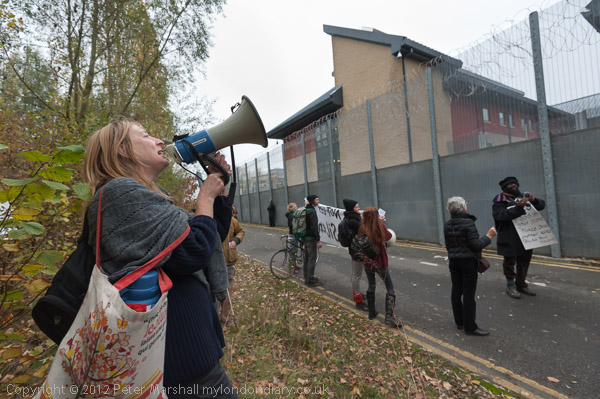
There are two immigration prisons on each side of a private road leading to the BT site behind. On the left of the picture is the Harmondsworth prison block, and on its right the high-security Colnbrook centre. At the start of the month both had been taken over by Mitie, as ‘Heathrow Immigration Removal Centre’, making ‘Care and Custody’, the Mitie subsidiary running the centre the “largest single private sector provider of immigration detention services to the Home Office.”

Mitie’s track record in running such centres should have disqualified them from running and government services. At Campsfield there had been three mass hunger strikes, a suicide and a disastrous major fire – perhaps why they had become one of the government’s favourite contractors.

Harmondsworth, Colnbrook & Heathrow

The name ‘Immigration Removal Centre’ reflects the government’s racist policies towards asylum centres. It wants to remove immigrants, whether or not they have a sound case for asylum. Such centres lock up people making it harder for them to pursue their case to remain in the UK and easier for them to be deported. The great majority of those imprisoned will eventually be given the right to remain in the UK, but may be held in centres like this for many months or even more than two years before being released so they can continue their lives – and make the positive contribution they will to UK society and our economy.

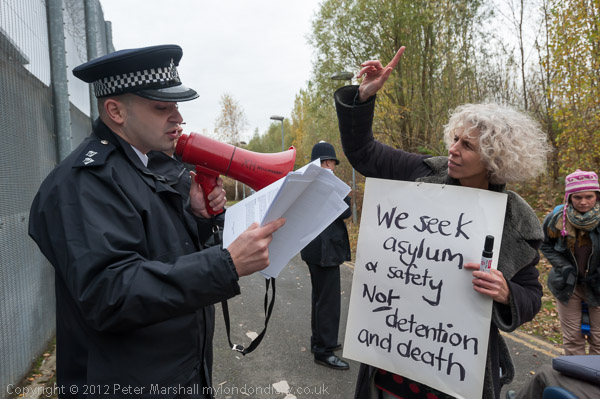
At previous protests here the protesters had been allowed to march down the private road between the two prisons and continue alongside the 20 foot fence around the Harmondsworth site back to the front. But now – perhaps due to the new management – police refused to allow them access, restricting the protest to a pen in front of the centre’s administrative block.

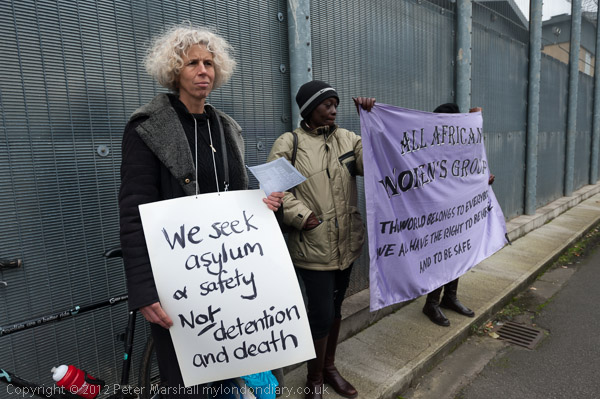
The protest was one of a number here organised by the Movement for Justice, and supported by many other organisation and the protesters argued for some time to be allowed to march down the roadway and around the Harmondsworth centre as usual but without success. Eventually the around a hundred protesters who had travelled out to the western edge of London moved into the pen provided.

The majority of those attending the protest were immigrants, many of whom had been held in this centre or others around the country. Harmondsworth imprisons male detainees, and many of the women at the protest had spent time in Yarl’s Wood near Bedford. Later MfJ would concentrate their protests at that centre.

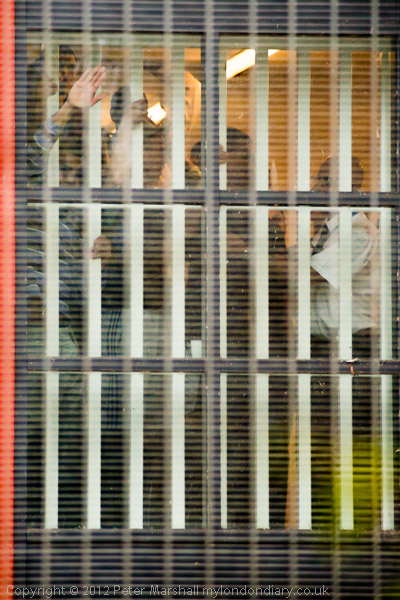
The protest was a very noisy one, with loud shouting and drumming and a great deal of dancing between the speeches. Phone calls from inside told the protesters that they could be heard inside the cell blocks.

Most of those who spoke were former asylum speakers and told of the suffering they had endured in our immigration detention. As some said, it was worse than prison, as the detention was indefinite. They had no release date to look forward too, and could have been deported at any time back to the countries which they had fled in fear of their lives.

Speakers also called for an end to the ‘Detained Fast Track’ system, deliberately set up when Labour where in power to make it impossible for many asylum claimants to defend themselves against deportation and remove them from the country before they are able to do so. It’s a shameful system that no country that believes in the proper rule of law, fair play and human decency could support.

Various legal challenges to ‘Detained Fast Track’ led to the High Court declaring in January 2017 that DFT had denied justice to asylum seekers for the previous ten years, with thousands being deported without a lawful hearing of their cases.

A friend of the family of Rubel Ahmed who described how he died in Morton Hall immigration detention centre in Lincolnshire on September 5th 2014 after having been refused refused medical treatment for his chest pains. Fellow prisoners heard him screaming for help, and had rioted after his death, taking control of the detention centre until brutally suppressed. One who contacted the press was brutally beaten by prison guards.

Many more pictures from the protest on My London Diary at Close UK Immigration Prisons.


Arms Trade Die-In at Parliament – 2013

Arms Trade Die-In at Parliament: On Thursday 12th September 2013 Campaign Against Arms Trade brought their protests against the DSEi arms fair then taking place in East London to Old Palace Yard opposite the Houses of Parliament in Westminster.

Arms Trade Die-In at Parliament

Their protest and die-in opposite Parliament was much more visible than those out in the fairly deserted streets of East London where the arms fair takes place at the ExCel Centre on the north side of the Royal Victoria Dock.

Arms Trade Die-In at Parliament

There the protest is directed against those taking part in the arms fair, both the exhibitors who are coming to sell their deadly weapons and those arriving to view and buy them.

Arms Trade Die-In at Parliament

They came to Westminster as MPs were arriving to take part in a debate on the role of United Kingdom Trade & Investment (UKTI), including its controversial Defence & Security Organisation (DSO), the government’s arms sales promotion unit.

Arms Trade Die-In at Parliament

The DSO sends out official invitations to the arms fair to 67 countries including many of the worlds most repressive regimes. Those on the invitation list included Algeria, Bahrain, Iraq, Oman, United Arab Emirates and Saudi Arabia, Libya, Afghanistan, Turkmenistan and Uzbekistan.

Arms sold at the arms fair in East London would inevitably fuel the civil war taking place in Syria and other armed conflicts around the world. The was in Yemen began the year following this arms fair, and Saudi Arabia has used weapons bought in East London in its fight against the Houthis there.

Also taking part in the protest were a number of campaigners from Bahrain where weapons sold at DSEi in Newham have been used to repress internal dissent.

Among the MPs who visited the highly visual protest was Jeremy Corbyn who stopped to speak briefly on his way to take part in the Parliamentary debate. He praised the protesters for their protests today and for their continuing events to stop the DSEi arms fair.

More pictures at Arms Trade Die-In at Parliament.