30 Sept 2007 – Two Religious Events

Martydom of Ali

On Sunday 30th September 2007 I photographed two events in London connected with religion, the first Muslim and the second organised by Christian Aid.
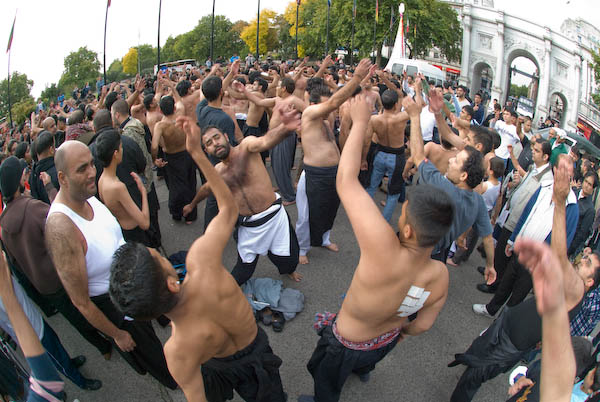
Shia Muslims hold a large parade every year mourn the martydom of Ali, a cousin who grew up the the house of the prophet Muhammad and was one of the first to profess his belief when the prophet disclosed his divine revelation when Ali was around ten years old. Later he married Muhammad’s daughter Fatimah and was a great warrior and leader and one of the foremost Islamic scholars.
Ali was elected as the fourth Caliph at a time when civil wars were taking place between Muslims following the death of his predecessor, and he fought in a number of battles, eventually being assassinated in 661 CE by a member of a group who regarded him as a heretic while praying in the mosque at Kufa, now in Iraq. Many of the details of events around this time are disputed.
Ali is one of the central figures of Shia Islam and they regard him as having been the rightful successor to Muhammad while Sunni Muslims supported the father-in-law of Muhammad, Abu Bakr who became the first Caliph. The split led to various battles but only became a schism almost 20 years after Ali’s death, when Ali’s son Husayn and family were killed at the Battle of Karbala in 680 CE.
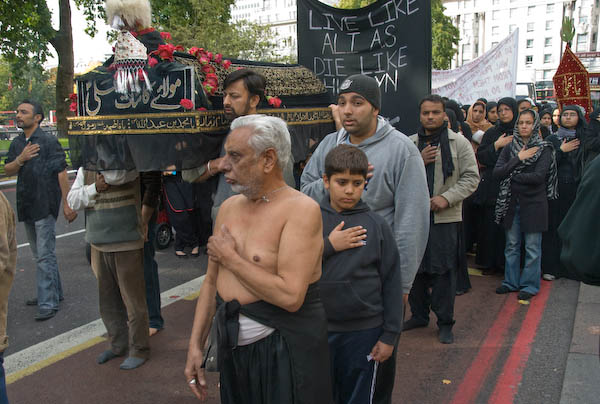
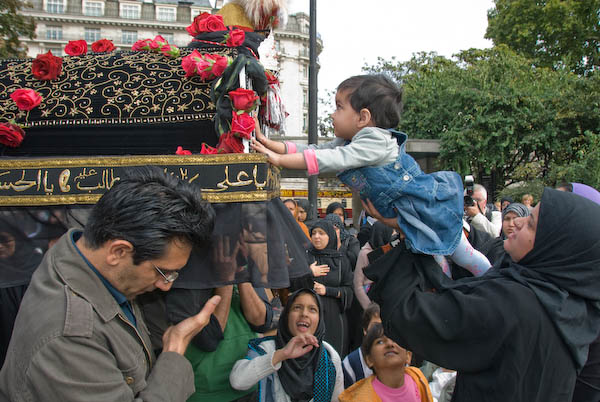
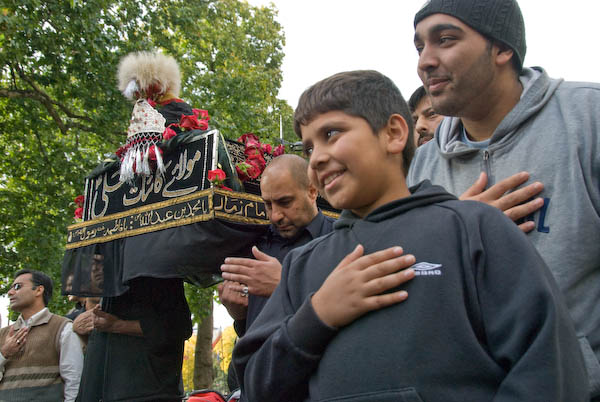
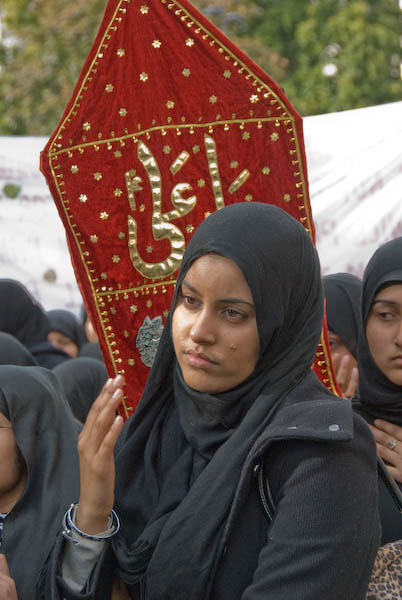
The ceremonies which involve a procession with an elaborate flower-decorated coffin, and tall banners about Ali, began at Marble Arch with a long period of mourning. There was much beating of breasts and then a procession moving very slowly down Park Lane with much continued mourning and beating of breasts. The men march in one group and then the women behind them, the two groups separated by the bier. Many of the men are stripped to the waist and their bodies become reddened by their powerful beating.
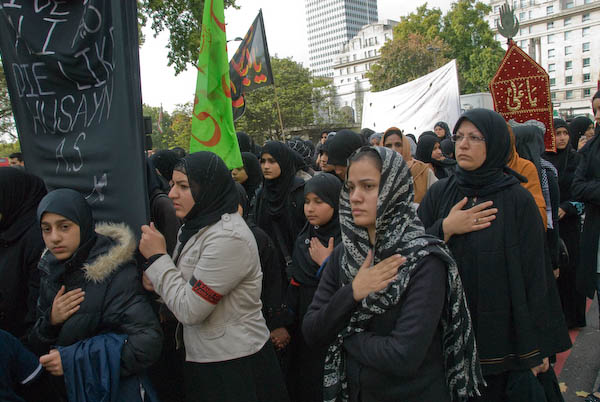
It’s an impressive event which I photographed on several occasions. The stewards at the event have sometimes told me “We do not photograph the ladies” but I’ve also had emails from some of the women thanking me for recording their participation in the ceremony.

Cut the Carbon
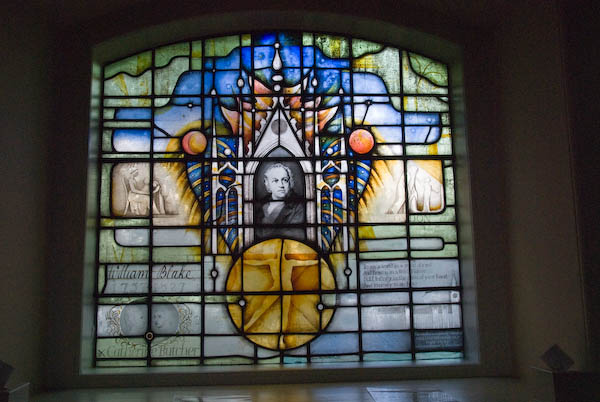
An event of a very different nature was taking place at St Mary’s Battersea, a church with fine views across the River Thames that Turner sat at window above the entrance to record – and a window inside remembers him, with another for William Blake, along with some splendid monuments, one with a relief illustrating Edward Wynter’s feats of crushing a tiger to death and overcoming 60 mounted moors.
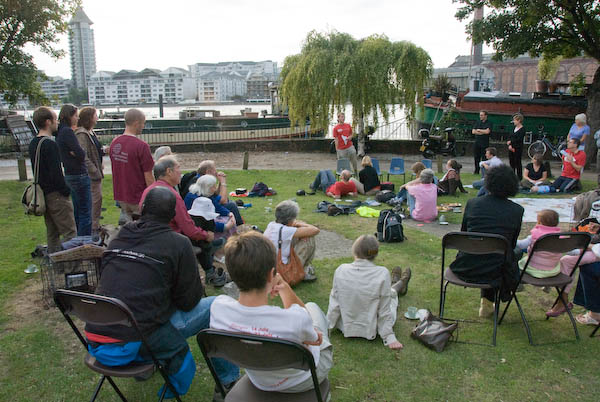
I was there with others to photograph the arrival of Christian Aid’s ‘cut the carbon’ march, arriving in London at the end of a thousand mile journey from Bangor in Northern Ireland via Belfast, Edinburgh, Newcastle On Tyne, Leeds, Birmingham and Cardiff to London – including a detour to meet Prime Minister Gordon Brown at the Labour Party conference in Bournemouth. The following day they were going on to City Hall and then to finish at St Paul’s Cathedral.
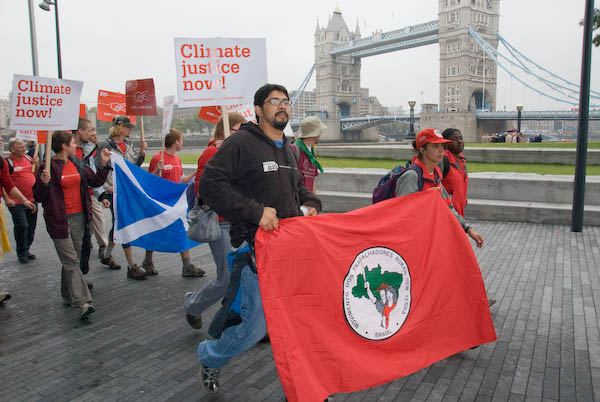
This was a march 14 years ago with an international perspective on climate change, with walkers from Brazil, El Salvador, Kenya, India, Bangladesh, South Africa, Congo and elsewhere. When I photographed it the following day in front of Tower Bridge it was led by marchers from Brazil representing an organisation of landless farm workers – and I was very pleased a few months later to include picture of them in my show on environment protests as a part of Foto Arte 2007 in Brasilia.

More at:
Mourning the Martydom of Ali
Cut the Carbon march

and on October 1st 2007
Christian aid Cut the Carbon march – final mile


All photographs on this and my other sites, unless otherwise stated, are taken by and copyright of Peter Marshall, and are available for reproduction or can be bought as prints.
Telling the Story – 19 July 2019

I often find myself thinking about my role as a documentary photographer when I’m taking pictures of protests. And of thinking about how I can carry out that role.

Clearly I’m not their to take part in the protest – though often I support the cause of the protesters I’m making pictures of. I’m an observer rather than a participant, though there are occasions when I will intervene in some way, largely the kind of actions that I would expect anyone to take, like stopping people walking into traffic or helping someone who has fallen down or dropped something.

There have been times too when I reminded police of the law (not always advisable) or protested at their use of unnecessary force. And on some occasions when marches have got lost or taken a wrong turning I’ve pointed this out to the marchers. Some embassies and companies are quite hard to find.

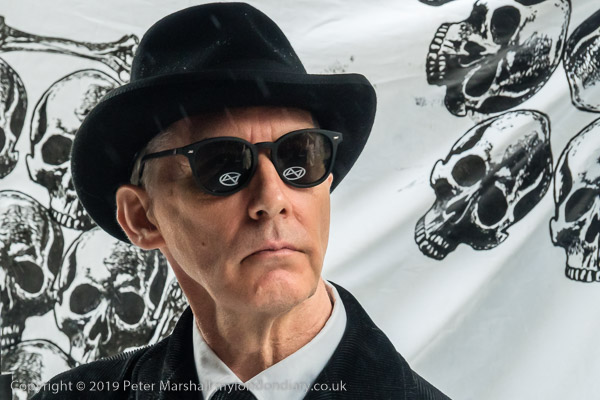
I never set up people or groups, though sometimes when photographing people I may ask or gesture them to look at me or to hold their poster or placard higher or lower. But it isn’t a portrait session and I don’t ask them to smile or scowl or act up for the camera. It would have been much easier to make the picture of the XR symbols in those dark glasses in the studio and it took a number of attempts to catch him looking in exactly the right direction and catch those reflections from a banner which I’d noticed moving across them earlier.

But it isn’t just a matter of passive observing. I’m choosing my position, framing my pictures, selecting the moment, working to try to present the story clearly and effectively.

It isn’t essentially about making dramatic or attractive pictures, though I always hope some might be.

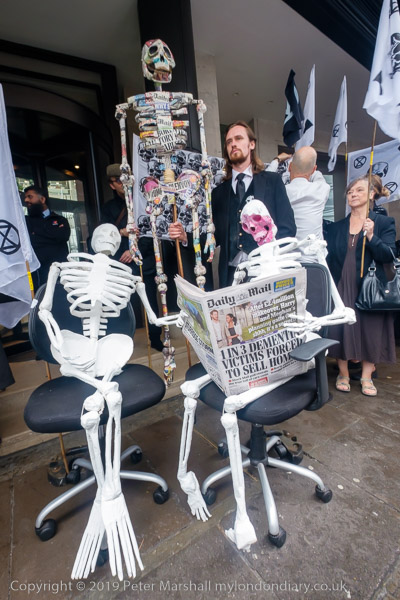
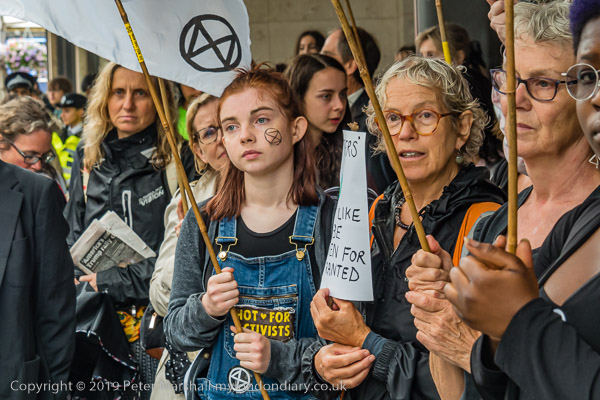
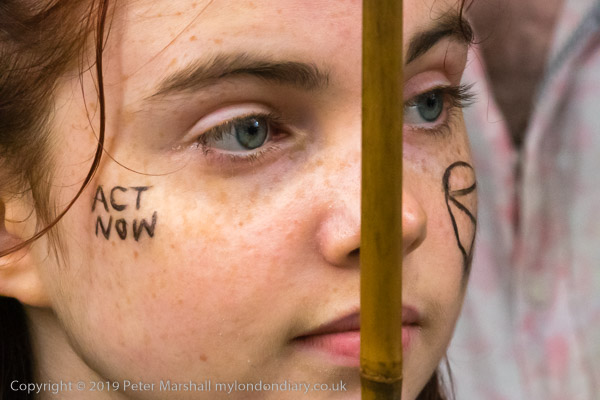
Extinction Rebellion’s ‘Requiem for a Dead Planet’ at Northcliffe House, home of the Daily Mail, Independent, Mail on Sunday, London Live and Evening Standard demanding they publish truth and end lies about climate change was a tricky one to cover, with heavy rain falling much of the time and a very limited area under cover for protesters and photographers. As we’ve seen in the past week, the weather is becoming more violent and this seemed appropriate if making the job more difficult.

Here’s some of the text I wrote at the time – the link below has more and more pictures:

“XR say avoiding climate & ecological devastation needs the media to tell the truth and stop publishing fake science denying climate change as well as advertising and editorial material that promotes high-carbon lifestyles, whether about fashion, travel food or other consumerist content so government can take the drastic action needed.

The protest included suitable requiem music by a small group of musicians in XR Baroque, a eulogy for lost species by a priest, speeches, poems, skeletons, banners and a die-in.”

Requiem for a Dead Planet at Daily Mail

All photographs on this and my other sites, unless otherwise stated, are taken by and copyright of Peter Marshall, and are available for reproduction or can be bought as prints.

Heathrow and More

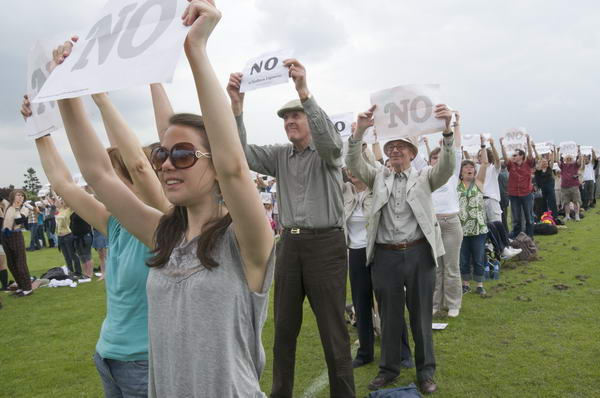
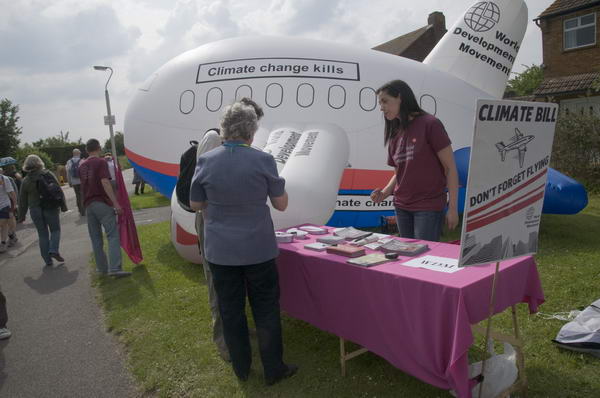
Heathrow – Make a Noise – No Third Runway – 31st May 2008

It really is long past time we saw some real policy changes to back up the governments promise to be leaders in the fight against global heating. We need real action on a number of front, but one obvious area is transport.

There are I think three major announcements that would clearly demonstrate some substance behind the rhetoric, and it would be good to see them all before the start of COP26 in Glasgow.

Firstly there should be a complete re-evaluation of the £27 road building programme for 2020-2025, with the cancellation of most or all new road schemes, with money being diverted into public transport schemes, better infrastructure for electric vehicles and better maintenance of the existing road network, particularly local roads.

Secondly we should see the cancellation of HS2, any economic case for which has disappeared. It’s hard to know why it was ever given the go-ahead, when better alternatives existed. There should be long term savings from stopping it even at this late stage, and it would be good to see more improvements to the existing rail system and in particular local rail and light rail systems.

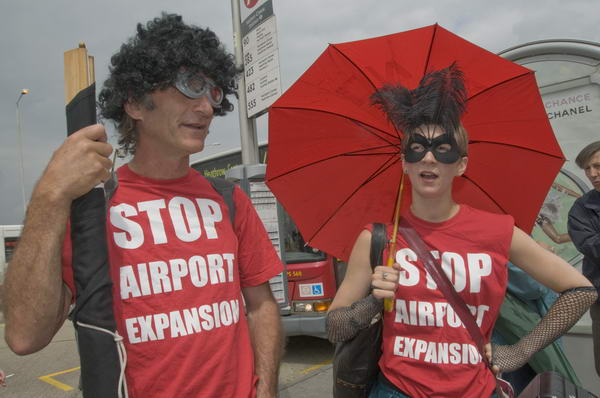
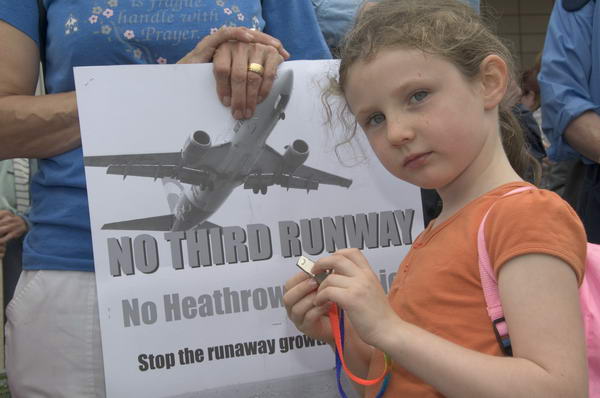
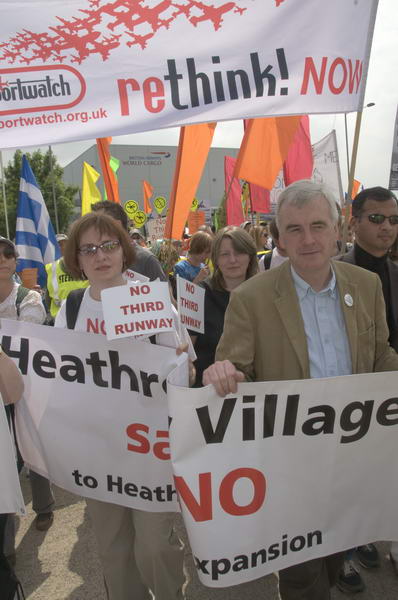
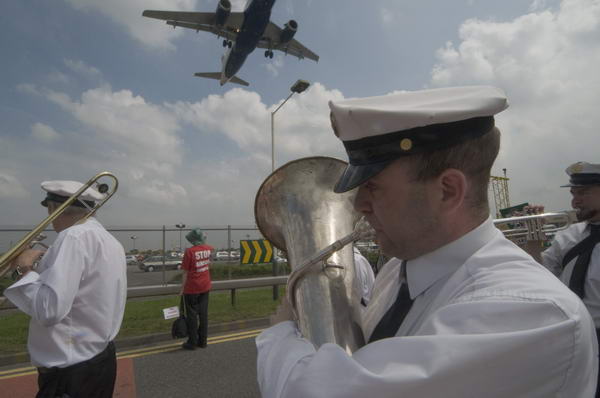
But perhaps the most important announcement would be to end all thoughts of airport expansion and in particular the plans for another runway at Heathrow. It seems very unlikely to actually go ahead, but it would be good for this to again be ruled out.

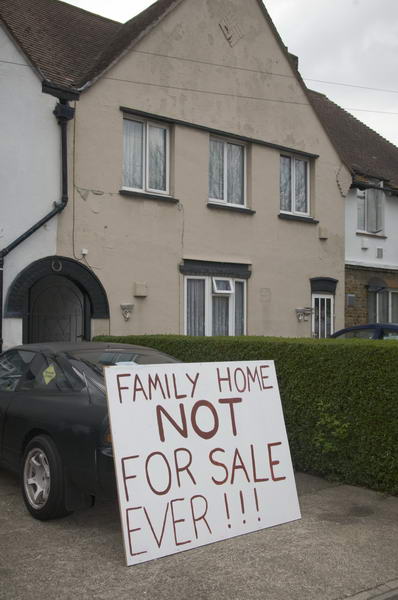
Back on May 31 2008 I was with campaigners marching from Hatton Cross on the edge of Heathrow around the north-eastern edge of the airport to the village of Sipson, a short distance to its north and under threat from demolition for an extra “third” runway. (Heathrow was built with six, but only two are now usable as planes have got larger with higher landing speeds as well as new building on the airport.)

I was one of the campaigners as well as taking photographs, having been a local resident for all but a few years of my life. When I was first aware of Heathrow, DC-3s and other relatively quiet propellor aircraft would amble above my garden perhaps every ten minutes or so and I would see the giant letters under their wings and cross them off in my spotter’s book as they made their way to or from the runway a little under 3 miles away.

By the time I was in secondary school and taking O and A levels, jets had taken over and the noise was ear-splitting and flights more frequent. My school was a mile further way from the airport, but still under a flightpath, and lessons were often interrupted by the noise. A year or two later we moved house as my father was re-marrying and we needed more space, and he chose a street still close to the airport but centrally between the two flypaths, where aircraft noise for us was greatly reduced.

When I moved back to the area in 1974, I chose a house well off the two main flypaths, though still under 4 miles from Heathrow. But when there were strong cross winds, perhaps 20 days a year, aircraft used two of the shorter runways which directed them over our roof – though sometimes it seemed almost as if they were going through the loft and the whole house shook. We had the whole house double-glazed which helped considerably – and the new windows didn’t rattle like the old ones had when the planes flew over.

The protest in May 2008 was a part of a long campaign, one of a number of protests I photographed since 2003 which eventually led to the plans for another runway to be dropped. Among those who opposed to expansion were both Conservative and Liberal Democrat parties (and later it was their coalition government which cancelled it on 12 May 2010) and then Mayor of London Boris Johnson. But Heathrow didn’t give up and after a biased commission report Heathrow expansion became government policy in October 2016. It was the wrong decision then and seems totally crazy now in the light of the climate crisis.

Heathrow – No Third Runway

We Need Bees

Yesterday I walked down my garden and found our three apple trees in full blossom, a fine sight, though one I didn’t feel a need to photograph. I rather like the way it appears just for a few days each year then disappears. I stood there for a minute or so, breathing in the scene, then realised there was something wrong.

One of the things that I’ve enjoyed with our various lockdowns has been the silence with fewer flights from Heathrow. We’re off the flightpaths but only a couple of miles distant, and in usual times there is a virtually constant drone – along with the noise of the various motorways a mile or two distant. Road traffic is more or less back to normal but we still here the birds singing and other natural noises more clearly.

Standing by the trees I realised what was missing – there were no bees. For a couple of minutes, no bees. Then along came a solitary bumble-bee. Quite a large one, but that bee is going to have a problem pollinating all that blossom.

Most crops rely on insects to pollinate the flowers and without them there are no crops. Bees are not the only pollinating insects but I think they are the main ones, and the decline in bee colonies has a drastic effect on food production – including my own apple trees.

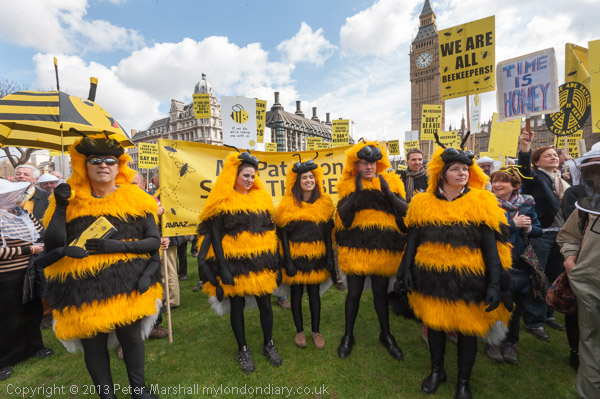
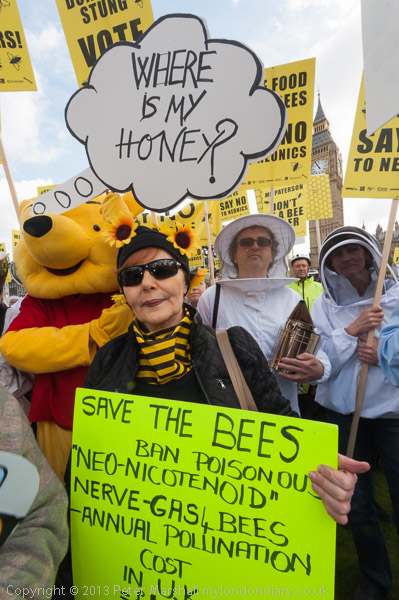
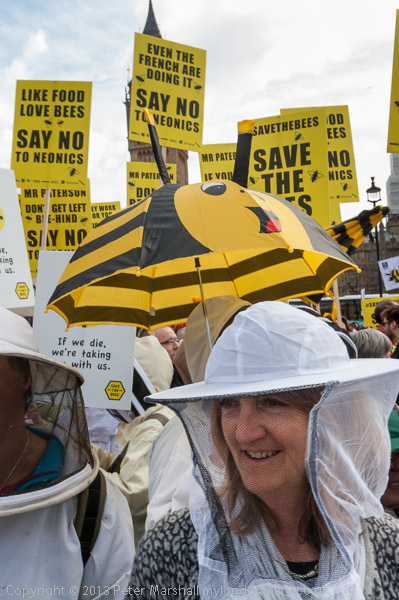
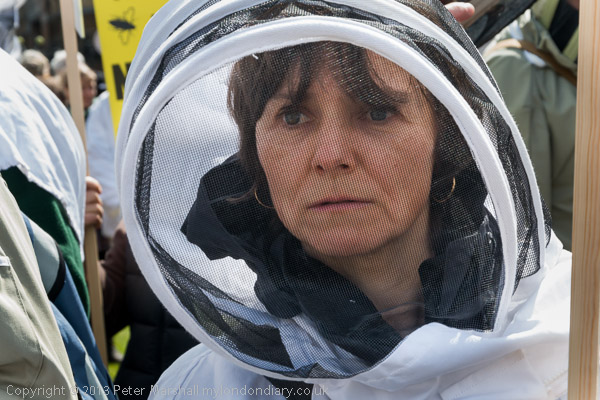
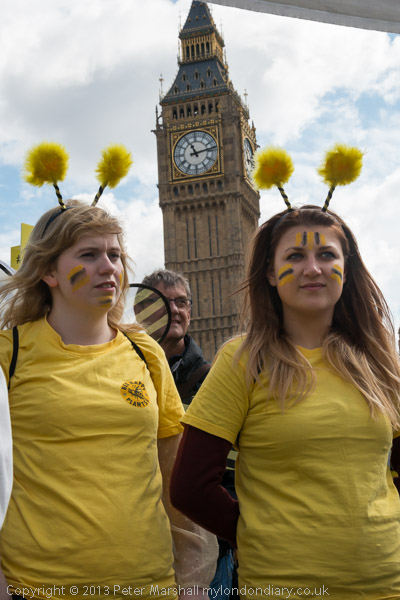
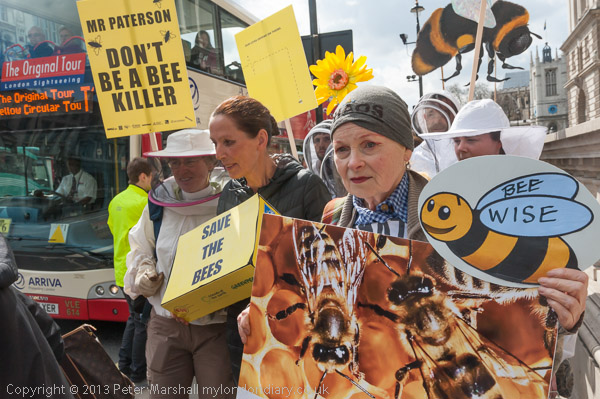
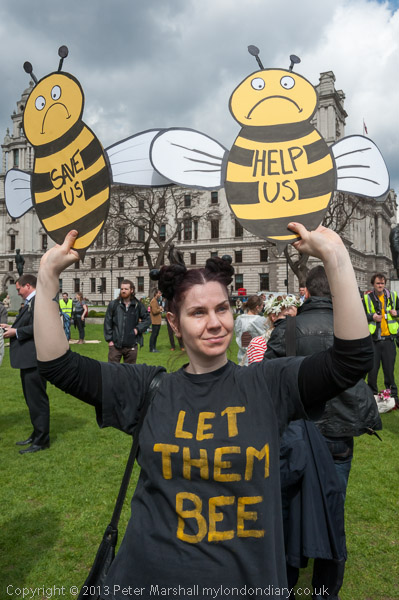
The beekeepers and environmentalists came to protest outside parliament to urge the UK to vote for a EU ban on bee-killing neo-nicotinoid pesticides which both kill bees directly and reduce their resistance to other factors. The EU later backed a ban on these pesticides with Michael Gove, then environment secretary stating that the risks of using them “to the bees and other pollinators which play such a key part in our £100bn food industry, is greater than previously understood.”

Katherine Hamnett and and Dame Vivienne Westwood with the ‘Save the Bees’ petition

However although the are generally now banned for outdoor use, the government early in 2021 authorised the use of one of these pesticides on the sugar beet crop to combat the threat of the virus yellows disease, though in the event the threat was found to be less than anticipated and the pesticide was not used.

Bee population in the UK seems to be continuing to decrease, though this year’s dearth in my back garden may be more a matter of the particular weather conditions and local habitat loss. Surveys of pollinating insects have shown a fairly consistent decline since the 1980s, with around a third having been lost since then, though the recent decrease in pesticide use may have reduced the rate of decline.

March of the Beekeepers

Scientists Call For Research-Based Policies

Recent events have brought scientists much more into centre stage, and politicians now claim to be “following the science” although this often means simply picking and choosing those bits from the wide range of scientific advice that suits their particular agenda.

Science isn’t monolithic, and its predictions are generally in terms of probabilities rather than certainties. Different disciplines may bring rather different emphases to aspects of complex problems and sometimes we need a wider view than that of a particular specialism – and even some common sense.

It seems clear that at the beginning of the Covid outbreak our government placed to much confidence in the advice of some mathematical modellers and failed to follow that based on medical experience in dealing with earlier pandemics on wearing masks and tightly controlling international travel that kept infection rates near zero in some countries. And that they had dismissed the evidence of earlier exercises in pandemic control and failed to follow the conclusion that we needed stockpiles of protective equipment.

Simple mathematical predictions close to the start of 2020 – like those I made metaphorically on the back of an envelope from then available data – suggested that by leaving the progress of the virus essentially unchecked we might expect around 400,000 deaths. It was perhaps calculations such as these that led to a massive programme of ordering vaccines.

Our various lockdown control measures – too little and too late – and gradual improvements in the care of those infected have so far managed to keep the numbers down to a little under half that initial estimate, though another wave may take us rather closer, particularly if variants prove more resistant to current vaccines.

A couple of days ago I was invited to complete an online opinion survey about the political challenges facing our government. One question asked me to pick one from a list as the major political challenge facing the UK government. I read through the list, which began with something about immigration and was shocked to find after reading the 10 choices I had to pick ‘Other’ and type in ‘Climate Change’.

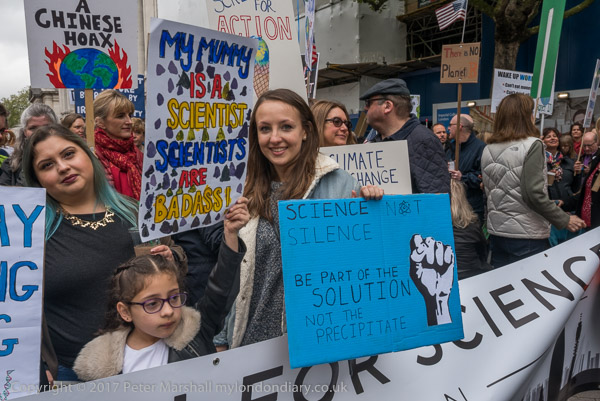
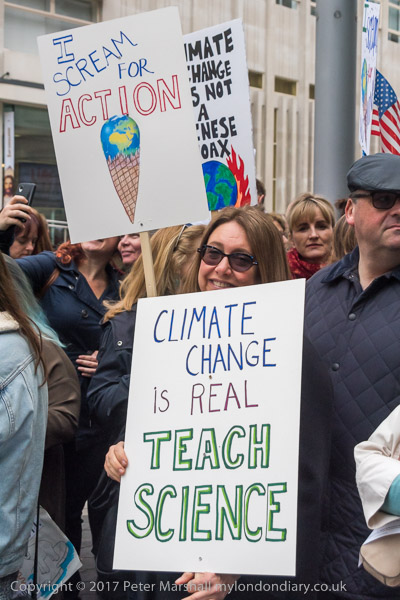
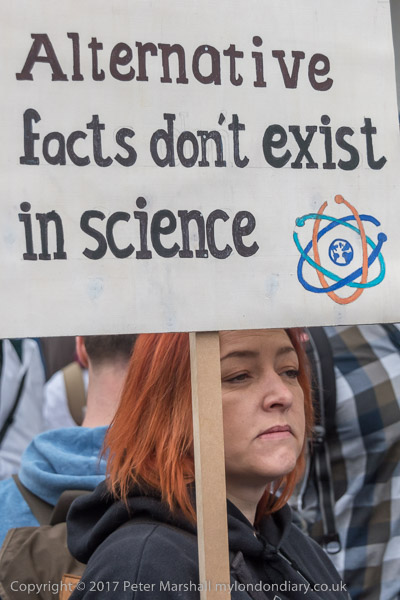
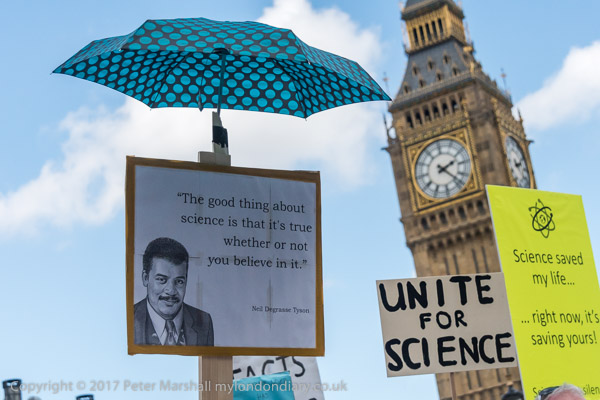
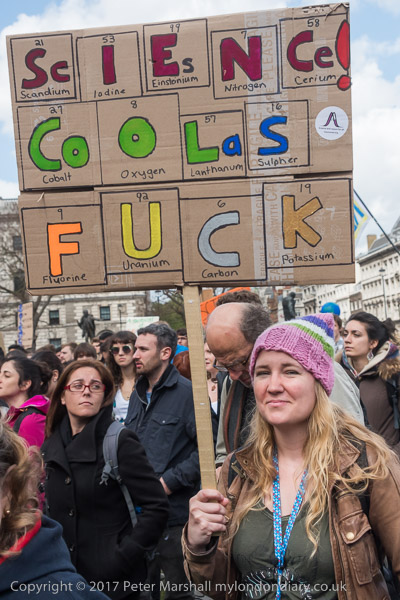
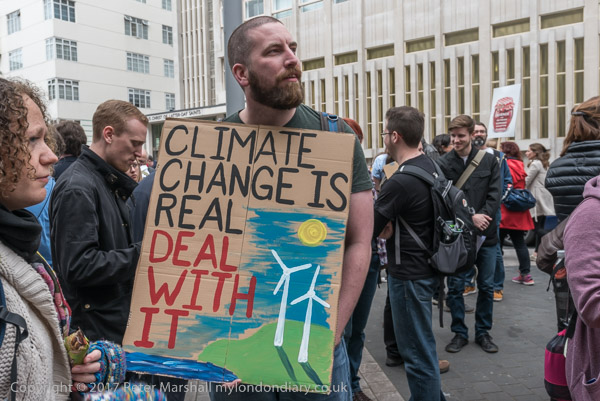
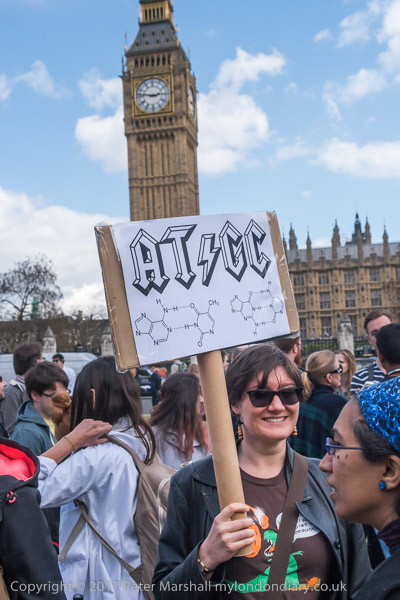
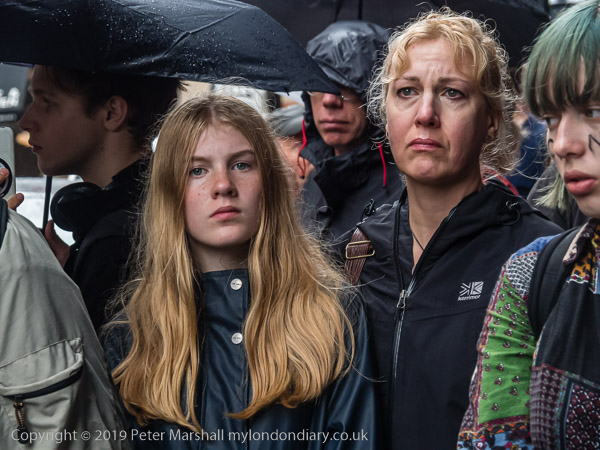
It was climate change that essentially prompted the protest by scientists on April 22nd 2017 to march through London from the Science Museum to a rally at Parliament. They came to celebrate the vital role that science plays in our lives and to call for an end to the fake news and fake science such as climate denial by politicians such as Trump which will prove disastrous.

The march drew attention to the need for international cooperation to combat the existential challenge of man-made global warming – and warned of the danger to this from Brexit and isolationism around the world.

It was an unusual event in many respects. As I pointed out on My London Diary and elsewhere:

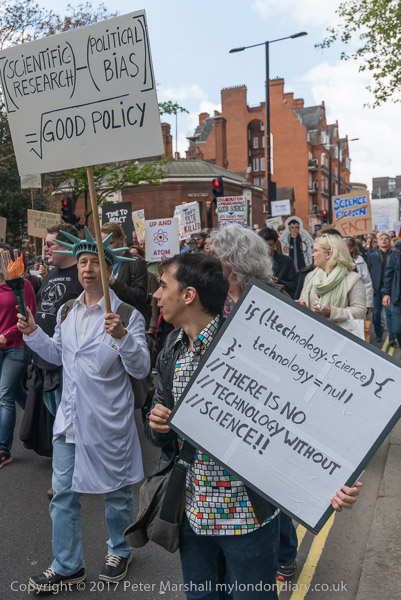
“It was a considerably more nerdy protest than most, and some of the posters and placards were difficult event for someone like me with a couple of science degrees in my past to understand. Many scientists do seem to have a problem in communicating with the rest of us and write slogans like ‘Do I have large P-value? Cos I feel Insignificant’ or ‘dT=α.ln(C1/C0)’.”

My London Diary

As well as covering the march and rally by scientists I also photographed campaigners calling for the reform of our secretive Family courts, Poice and Social Services which cover up their failures and corruption by gagging orders, and a protest outside the Consular department of the Russian Embassy to show solidarity with LGBT people in Chechnya, where over a hundred men suspected of being homosexual have been rounded up an put into camps and tortured, with three thought to have been killed. You can see more about these events and the scientists’ protest on the links below.

Reform Family Courts
LGBT rights abuses in Chechnya
Scientists Rally for Science
Scientists march for Science


All photographs on this and my other sites, unless otherwise stated, are taken by and copyright of Peter Marshall, and are available for reproduction or can be bought as prints.

Climate Change and the Budget

Once again the recent budget has failed to show any real commitment to make the changes we need to combat the climate crisis. The chancellor’s speech and the treasury details were strong on rhetoric, telling use that we need to make radical changes and that cutting carbon was a major government priority, but there were few and only minor changes announced that will combat climate change, while more major announcements that will accelerate it.

Perhaps one of the more disappointing areas were the announcements on infrastructure and on road building. The expected UK national infrastructure strategy was not yet available and is now expected “later in the spring” but it is unlikely to change the commitment made already to wrongheaded project of which HS2 is the most glaring. And the promise of the “largest ever investment in England’s motorways and major A roads” goes completely against the need to get more people using sustainable public transport and will certainly lead to increased road traffic.

Another way the budget encourages car use is of course the continued freezing of fuel duty, which has remained at 58p per litre (+VAT) since 2011. Had the increases promised in the June 2010 budget taken place it would now be at 84p. While fuel duty has been frozen, rail fares have continued to rise.

Although there were minor changes intended to encourage the decarbonisation of heating buildings, any long term plans on the scale needed are still lacking. It is an area which could be addressed in that long promised infrastructure strategy, and one that could be an important source of ‘green jobs’ so fingers are firmly crossed – but I fear we will get yet another disappointment.

There are other disappointments in this budget too. The support for measures to combat the increasing risks of flooding seems lukewarm, and the ambitious programme of tree planting seems to be only roughly a fifth of that in earlier promises, and clearly insufficient. The budget also restates a commitment to invest in carbon capture and storage which still seems very unlikely to deliver any real dividends. It is also very unclear if the £900m for research into nuclear fusion, space and electric vehicles will make any positive contribution to combating climate change.

Six years ago, on Saturday 7th March, I was with over 20,000 protesters marching through London to a rally outside Parliament demanding action on climate change with divestment from fossil fuels, an end to fracking and damaging bio-fuel projects and for a 100% renewable energy future which would create a million new jobs.

The case then was clear and the protest made it firmly, but since then governments had spent six years talking about it but doing very little, listening more to the lobbyists from fossil fuel companies rather than the science. Slowly there have been some changes, and more politicians are now saying the right kind of things, but there has been precious little action. It’s probably now too late to avoid some pretty disastrous effects of the inevitable global temperature rise, but we may still be able to mitigate them and avoid the worst possible consequences. But it will need governments to stop fiddling while the planet burns.

More on My London Diary:
Climate Change Rally
Time to Act on Climate Change


All photographs on this and my other sites, unless otherwise stated, are taken by and copyright of Peter Marshall, and are available for reproduction or can be bought as prints.
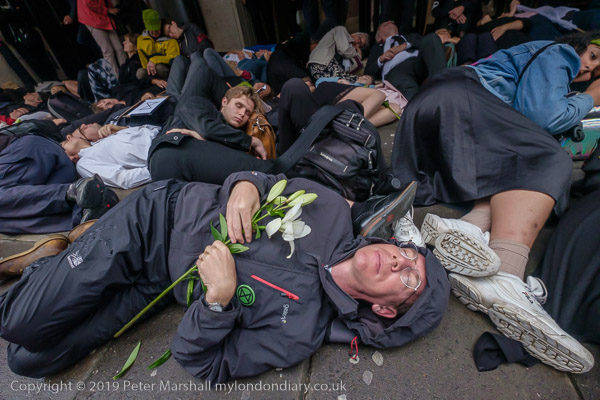

Kyoto & One In Love – 2005

The texts from two posts from My London Diary for Saturday 12 Feb 2005, sixteen years ago. I’ve had to change the formatting a little to fit this site, but otherwise the text is identical. There are more pictures from each event on My London Diary.

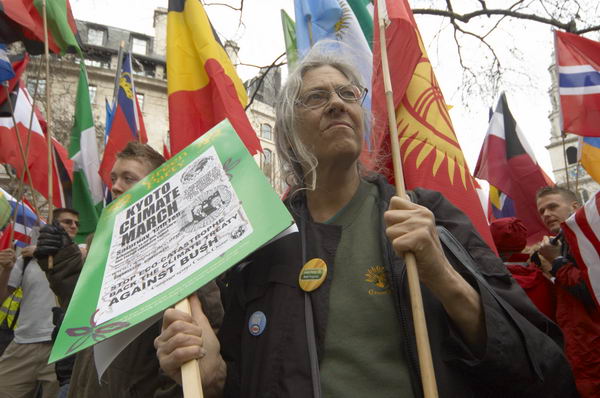
Campaign against Climate Change Kyoto Climate March

London, 12 Feb, 2005

When i talked about the dangers of increasing co2 emission and the need to cut down use of fossil fuels 35 years ago, i was a crank. now everyone except the usa oil lobby and their political poodles recognises that climate change is for real. even blair has recognised it as the most vital issue facing us, threatening the future of the planet, although actually taking effective action still is a step too far for him. however he did call for a conference to examine the problem, which told him and us that we had perhaps ten years to take action before it would be to late.

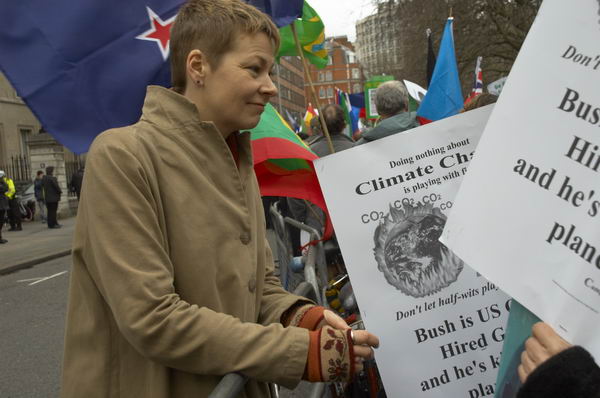
Caroline Lucas

kyoto is history now thanks to the US boycott, (although it comes into effect this week), but it should have been the first inadequate step on the road to action. every journey has to start somehow, and even a half-hearted step is better than none, and would have led the way to others. what got in its way was texan oil interests, whose political face is george w bush.

i’ve photographed most of the campaign against climate change’s kyoto marches over the past few years. this one was probably the largest, and certainly excited more media interest, truly a sign that the issue has become news.

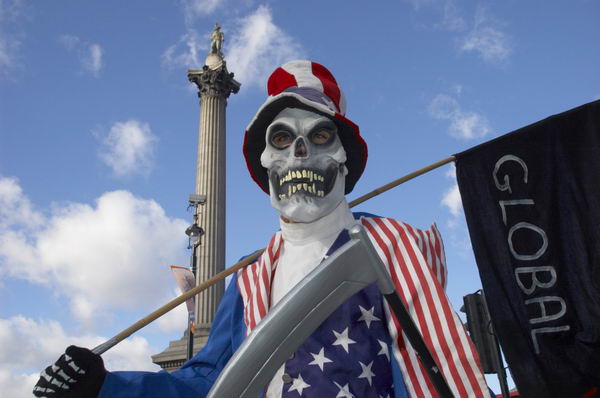
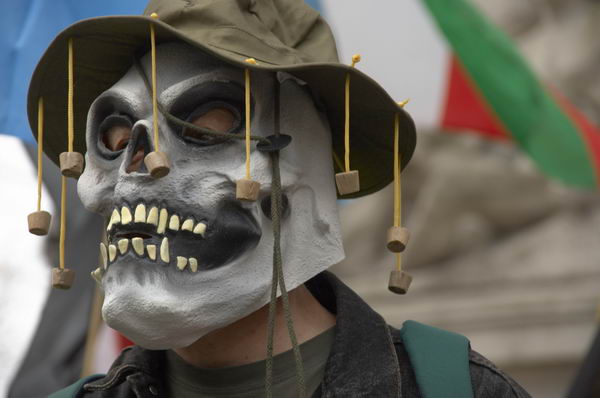
starting in lincoln’s inn fields, the march stopped first outside the uk offices of exxonmobil, on the corner of kingsway, for a brief declaration, then for a longer demonstration outside the australian high commission in aldwych (with guest appearances by ‘john howard’ and an australian ‘grim reaper’ with cork decorated hat), before making its way past trafalgar square and picadilly circus to the us embassy.


O-I-L One in Love

Reclaim Love, Eros, Picadilly Circus, London, London, 12 Feb, 2005

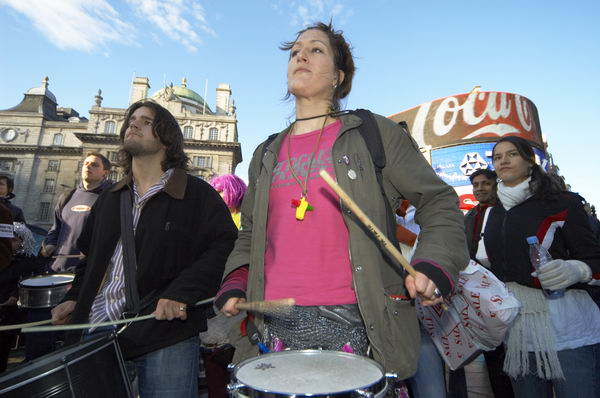
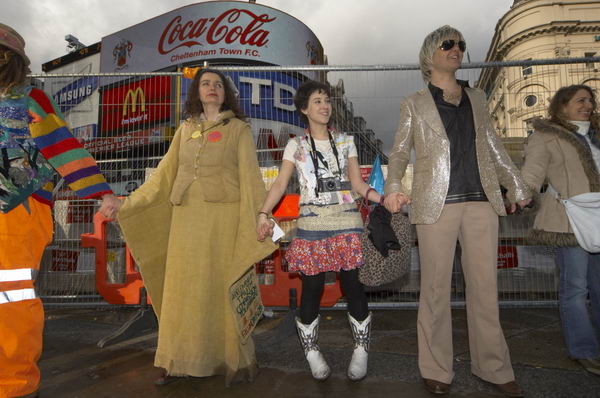
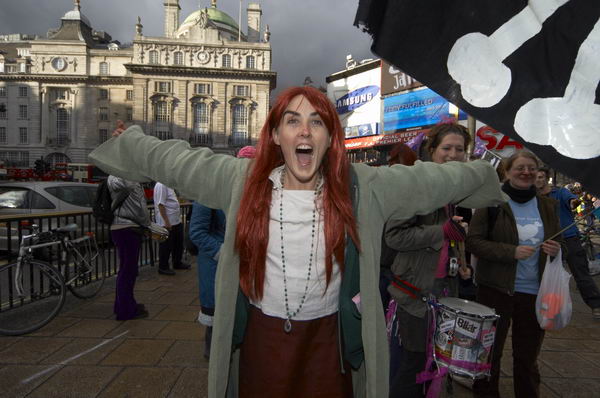
i left them in picadilly and returned to eros, where o-i-l, one in love, were organising a small gathering to “reclaim love” and “send love and healing to all the beings in the world” on the eve of valentine’s day. it’s something we could all do with, and it was good to see people enjoying themselves around the statue of eros, in what is usually one of the most depressing spots on london’s tourist circuit.

there was the samba band again, rhythms of resistance, (hi guys) and dancing and people generally being happy and friendly and free reclaim love t shirts and apart from the occasional showers it was harmless fun. rather to my surprise, the police either didn’t notice it or decided to ignore it, an unusually sensible strategy.


More pictures of both events on My London Diary.

This year there can be no street party at Eros in Piccadilly Circus, but Venus CuMara invites you to celebrate the 20th anniversary of Operation Infinite Love, Global Annual Love and Peace Meditation/street party by joining her on her Youtube ‘love stream / live stream/ life stream’ Global Love Meditation at 3.33 pm on St Valentine’s Day, Sunday 14th February 2021.

“MAY ALL THE BEINGS IN ALL THE WORLDS BE HAPPY AND AT PEACE”


All photographs on this and my other sites, unless otherwise stated, are taken by and copyright of Peter Marshall, and are available for reproduction or can be bought as prints.
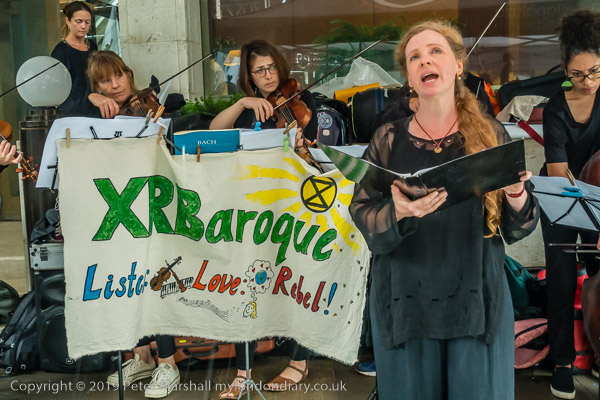

British Museum and BP

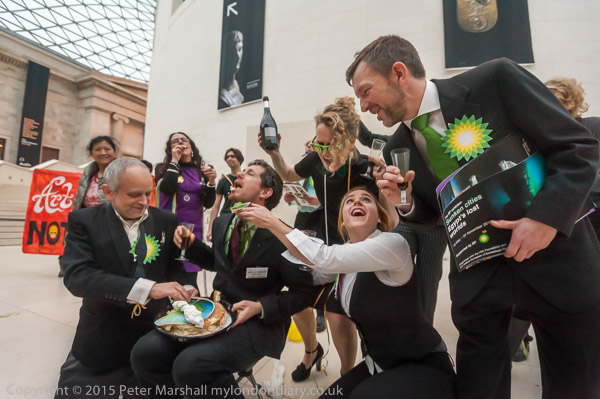
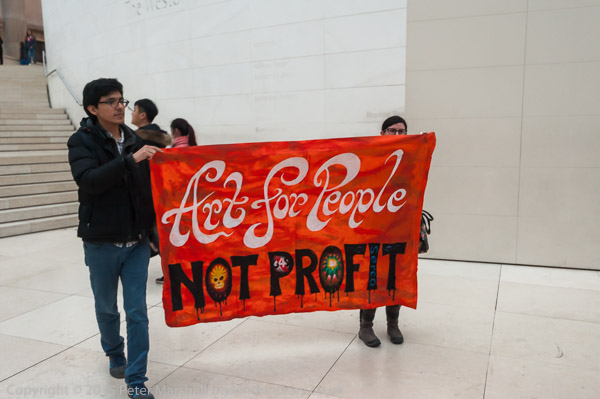
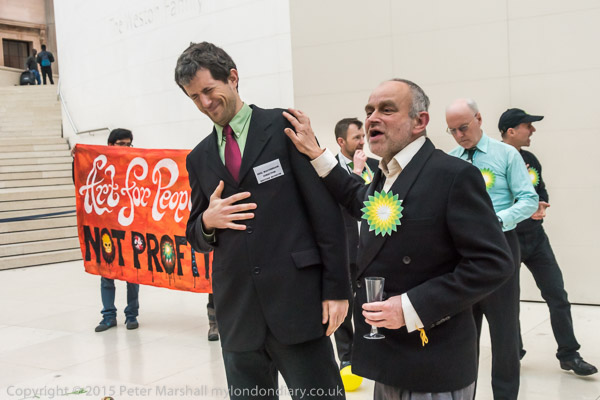
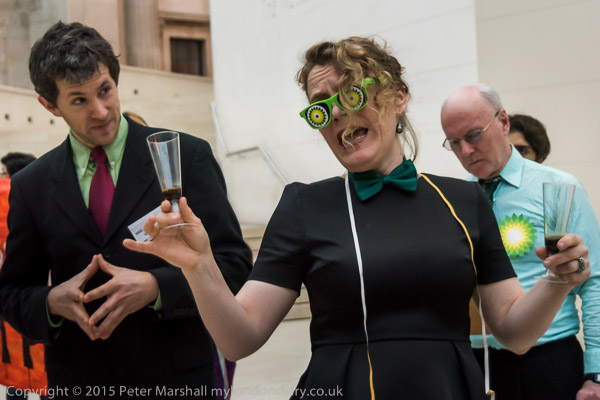
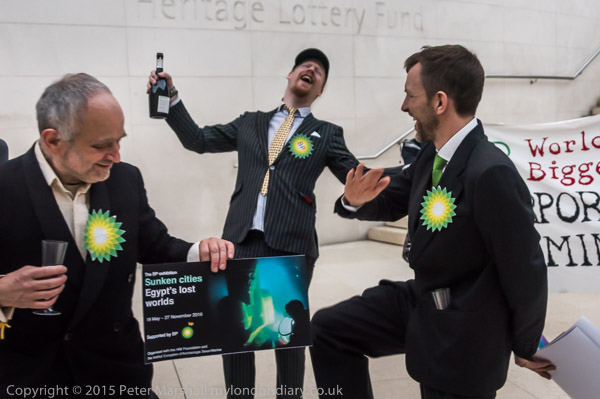
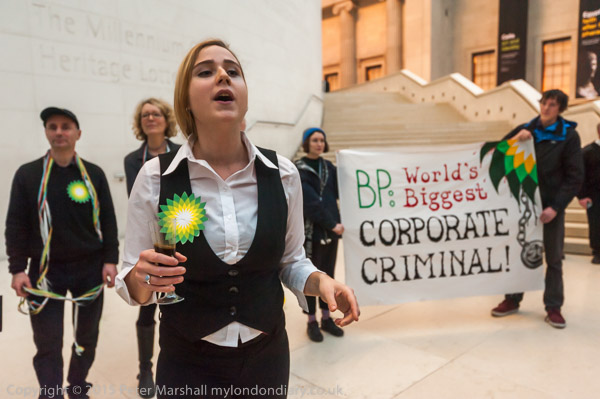
Five years ago today on 20th December 2015 I went into the British Museum with “actor-vists” from ‘BP or not BP‘ to photograph their ‘A Farewell to Neil MacGregor – Director of the British Museum‘ who had enjoyed a “cosy relationship” with the museum’s sponsor, BP.

Fossil-fuel companies make their profits largely through the combustion of the hydrocarbons they produce in the engines of cars, lorries and aeroplanes and the boilers used to generate electricity and heat buildings and other processes which turn the carbon in these fuels into the greenhouse gas carbon dioxide, the main cause of the global warming which is currently threatening the future of human life.

As well as that, the prospecting and exploitation of oil resources, now more and more taking place in environmentally fragile areas such as the Arctic, together with spillages, some inevitable but others demonstrating a remarkable lack of care are causing terrible damage to our environment. And of course most of what doesn’t get burned is made into plastics and we are now becoming aware of the huge amounts of this that ends up in the marine environment with disastrous consequences.

While continuing to fuel the global crisis, companies such as BP have invested heavily in promoting themselves as good guys, publicising the relatively small investments they have been making in renewable energies and other green areas. It’s a short-sighted policy as their long-term future – and ours – depends on a complete move away from carbon fuels, but one which keeps current investors rich at the cost of the rest of us.

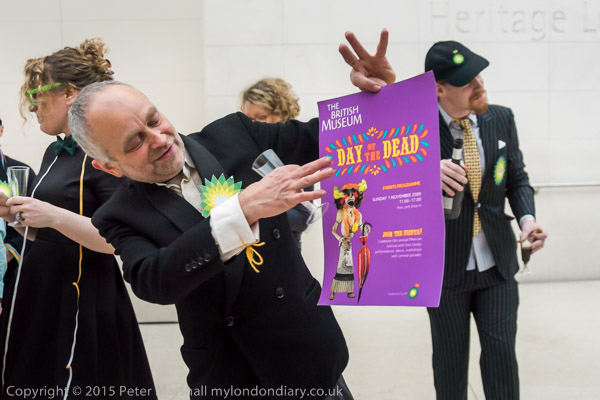
Almost certainly the most cost-effective part of the ‘green-washing’ of BP’s ecologically disastrous activities has been their sponsorship of many of our major cultural institutions including the British Museum, something which the cultural activists of ‘BP or not BP’ have highlighted in a number of artistic interventions. I was pleased to be able to photograph their play depicting ‘BP executives’ giving a farewell party to departing Museum director ‘Neil MacGregor’ inside the British Museum’s Great Court.

Although BP’s contribution is only a fraction of the museum’s budget, they get an engraved message on the wall of the rotunda in the Great Court and their logo prominently on the publicity for the museum’s major exhibitions which have included Vikings, Ming, Indigenous Australia: Enduring Civilisation, the Mexican Day of the Dead and Sunken Cities. As BP or Not BP point out, the last two are particularly unfortunate as BP has been given the largest corporate criminal fine in history of $18.7 billion for the underwater Deepwater Horizon oil spill which caused huge pollution of the ocean around the coast of Mexico.

My write-up on My London Diary gives a fairly full account of what happened with a lot more pictures. Many museum staff are unhappy about taking cash from BP and welcome the publicity protests like this give. The protesters assured the museum security that they would cause no damage and leave without any trouble after the relatively short performance which continued without any interruption and entertained a number of the visitors to the museum.

You can also read a fuller account, with some of my pictures and including the full text of the play on the on the BP or not BP website.


All photographs on this and my other sites, unless otherwise stated, are taken by and copyright of Peter Marshall, and are available for reproduction or can be bought as prints.

Climate Justice

2005

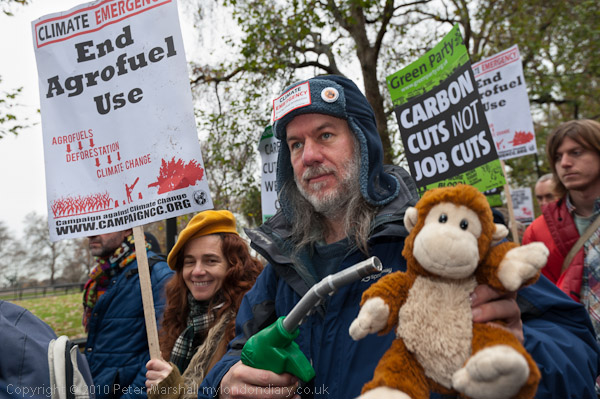
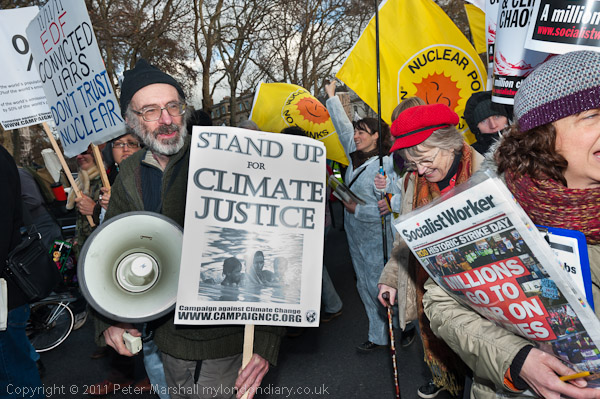
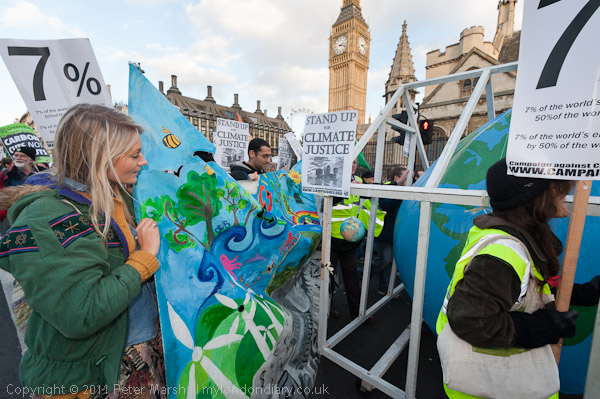
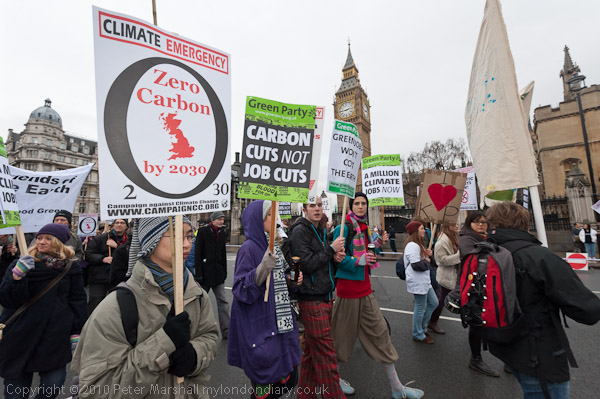
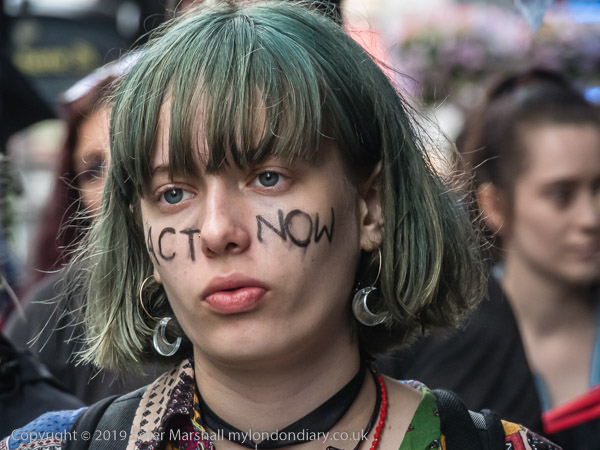
Around this time of year I’ve often been photographing marches for Climate Justice. I think the first at this time of year on My London Diary was probably on Dec 3rd 2005, when around 10,000 of us took part in a march through London led by the Campaign Against Climate Change as a part of an international day of climate protest.

2007

It wasn’t of course the first climate protest that I had photographed, and there are a number of earlier events covered in my diary which were also largely or entirely about the climate crisis:

Kyoto march to US Embassy, London, July 2001
Bush at Buck Palace, July 2001
Bush gets Busted, July 2001
Campaign for Climate Change, March 2002
Bush / Raymond Wedding March, Nov 2002
Kyoto march to US Embassy, London, Mar 2003
Kyoto Climate March, London, Feb 2005
London isn’t Venice, Yet!, Paddington, Apr 2005

2010

I’d had a strong interest in environmental matters since my student days back in the 60’s, although then our main attention was on the problems of pollution, population growth, food supply and resource depletion. That was before I really began to take photographs, and I can’t remember any protests or direct action over these issues (we had other things on our minds too) though I did write and speak very embarrasingly in public on them. And I became a Friend of the Earth when the organisation only existed in California though I was living in the UK.

2011

Although I bought my first digital camera in 1999, it was only a fairly primitive model, and not useable for serious photography despite what was described in reviews at the time as a “huge 2.3 megapixels sensor“, and until the end of 2003 all my real work was on film. The camera that changed that was the Nikon D100, still only 6Mp, but with much higher quality.

2011

It was this camera that really brought ‘My London Diary‘ to life, though as soon as Nikon brought out the much improved D70 I bought on – and then the D200 and D300, finally moving to full-frame. But for several years I worked with both digital and film, continuing to work mainly with a Hexar F with Leica and Voigtlander wide angle lenses, with just a cheap mid-range Nikkor zoom permanently on the Nikon. For quite a while it was the only Nikon lens I owned, and not changing lenses when working avoided getting dust on the sensor, and I only bought a second lens – the Sigma 12-24 zoom when I had a second body. But after than lenses quickly multiplied!

2005

After I had two DSLR bodies I quickly abandoned film, except for working with the various panoramic cameras that I was using mainly for landscape work. Although I made some panoramas digitally combining multiple exposures it was a few years (and considerably larger image files) before I worked out how I no longer needed film or special cameras to produce the kind of panoramic results I wanted with a digital camera and was able to quit using film entirely. Of course it has become rather fashionable to work on film now, but although I’ve kept all my old film cameras, I can’t really see that I will ever use them again. Digital is just so much better.

2011

Back to the Climate. At last we are beginning to hear the kind of speeches from people such as the United Nations Secretary General António Guterres that they should have been making years ago. On Monday he stated “The way we are moving is a suicide” and that unless the US cuts carbon emissions to net zero by 2050 humanity’s survival will be impossible.

2010

I’m still unconvinced that governments around the world will heed calls such as this – and that movements such as Extinction Rebellion and Fridays For Future inspired by Greta Thunberg have been dramatising. With our own UK government it is clearly still window-dressing rather than a real committment to change. It still seems that it will be too little too late, and recent reports suggesting targets will be easier than expected to reach are likely to mislead. It certainly will not be easy, and will require truly drastic system changes.

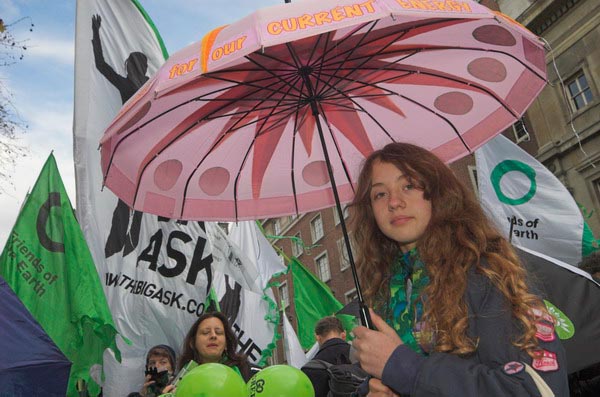
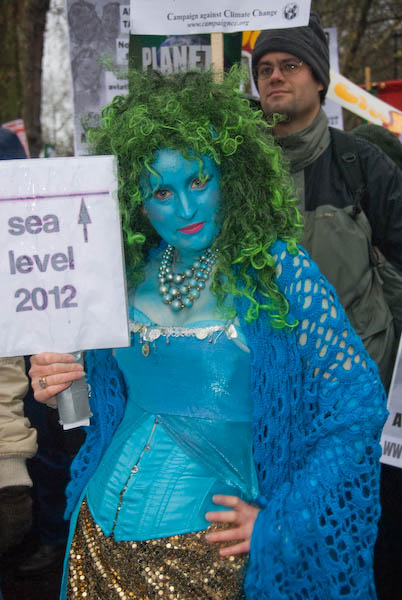
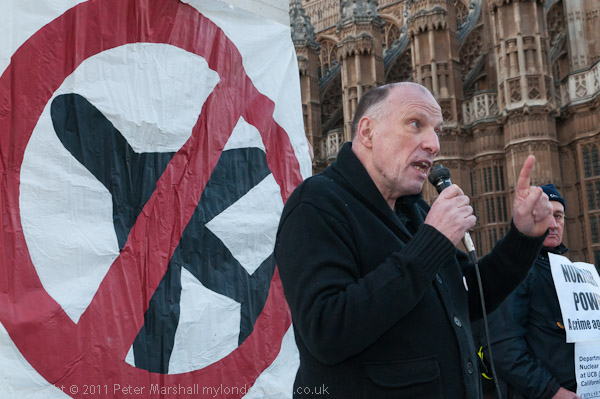
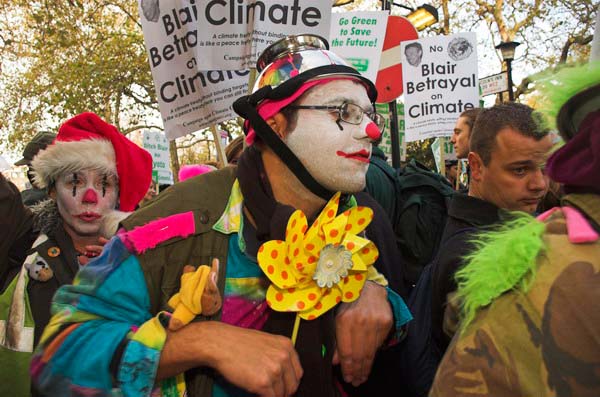
The pictures here are from Climate Marches on December 3rd, 2005, December 8th, 2007, December 4th 2010 and December 3rd 2011.


All photographs on this and my other sites, unless otherwise stated, are taken by and copyright of Peter Marshall, and are available for reproduction or can be bought as prints.
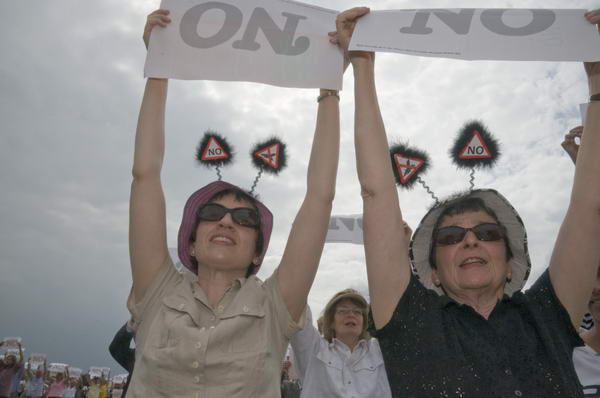

1st December 2018

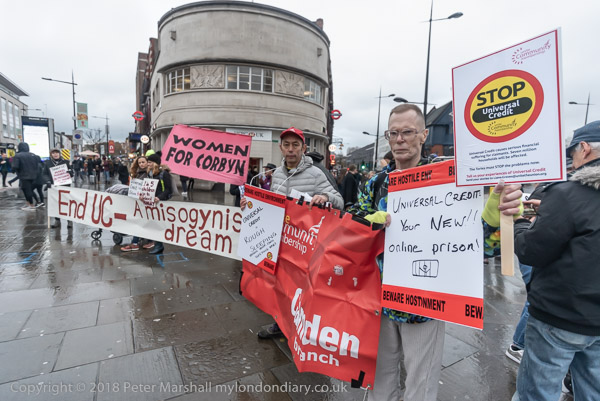
Two years ago, the first day in December had been declared Stop Universal Credit day of action by Unite Community and small groups around the country were holding protests and handing out leaflets in busy town centres about the many failures and great hardship caused by this poorly though out and badly administered benefit. They called for an end to the long wait before claimants receive money, for applications to be allowed at job centres as well as online, for better help when the system fails people, for direct payments to landlords to avoid rent arrears and evictions and an end to benefit sanctions for all claimants.
Universal Credit was intended to simplify the benefits system, but it failed to take into account the huge range and complexity of situations ordinary people face, and assumed that claimants would have the same kind of support that the middle-class and wealthy take for granted from families, friends and resources. And its failures were compounded by making it a vehicle for cutting costs. As I commented in 2018:

“UC has created incredible hardship, pushing many into extreme poverty and destitution, making them reliant on food banks and street food distributions, greatly increasing the number of homeless and rough sleepers. Thanks to Tory policies, more than 120,000-plus homeless children in Britain will spend Christmas in hostels and B&Bs, many without the means or facilities to provide a Christmas meal.
Some have said that UC is a part of a “state euthanasia” system for the poor, with academic estimates that it and other benefit cuts and sanctions since the 2010 elections having caused 110,000 early deaths, including many suicides. A cross party committee has called for its rollout to be halted until improvements are made, but the government has dismissed virtually all criticism of the system, making only insignificant changes.”

http://mylondondiary.co.uk/2018/12/dec.htm#universal

I took a detour on my journey into London to photograph the protest outside Camden Town station, where protesters were also pointing out that Universal Credit “hands more financial power to male claimants making it a misogynist’s dream, forcing women in violent relationships into greater dependency on their violent male partners.”


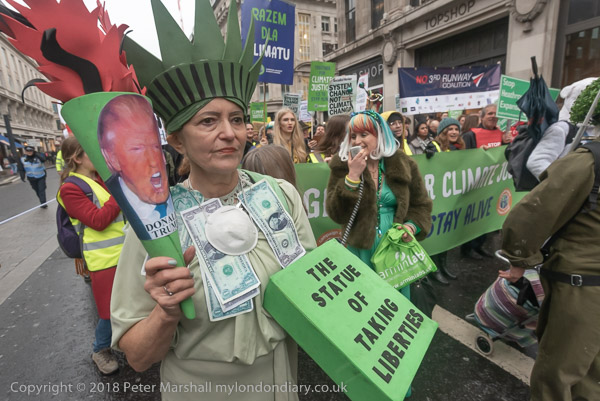
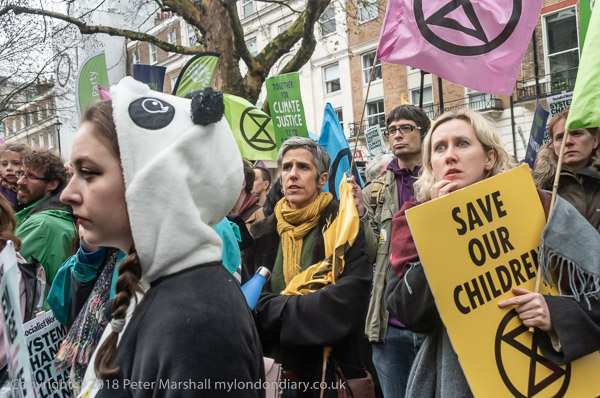
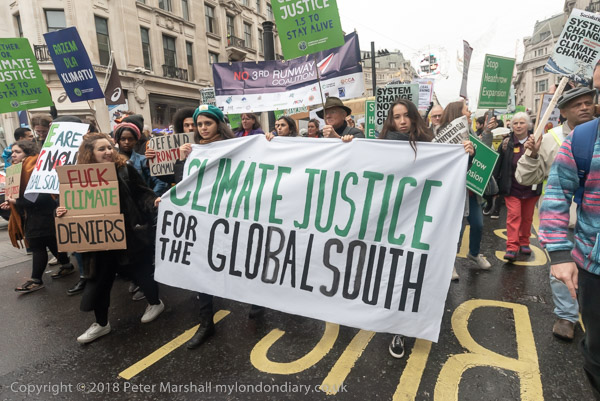
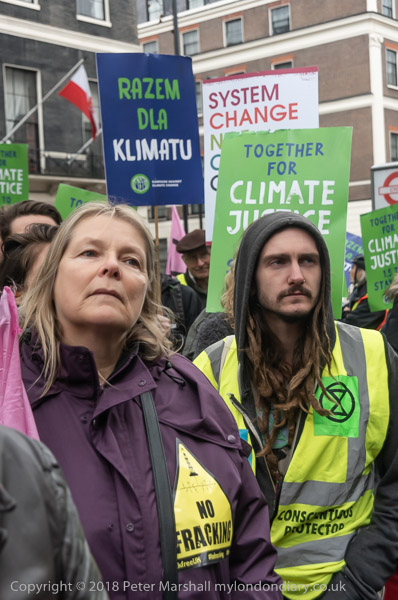
The major protest taking place in London was a march and rally organised by the Campaign against Climate Change. Together for Climate Justice began with a rally outside the Polish Embassy, in advance of the following week’s UN climate talks in Katowice, Poland.

Despite the impending global disaster, little real action is being taken by countries around the world and we still seem committed to a course leading inevitably to mass extinction. Behind the failure to act is the intensive lobbying of companies exploiting fossil fuels who have spent many billions in sowing doubt about the scientific consensus of global warming, and continue to produce vast quantities of coal and oil and explore for further resources, increasingly in the more ecologically sensitive areas of the Earth.

At the rally a wide range of speakers expressed their concerns that the talks in Poland are being sponsored by leading firms in Poland’s fossil fuel industry. And at the rally opposite Downing St where Frack Free United were to hand in their petition at the end of the march, a speaker from the Global South reminded us of the urgency of the situation; people there are already dying because of climate change.

Before the march we were all taught to say a few slogans in Polish, including ‘Razem dla klimatu‘ (Together for the Climate) which appeared on a number of placards, and the rather less pronounceable Polish for ‘Time to limit to 1.5’, as well as for ‘Climate, jobs, justice!’.


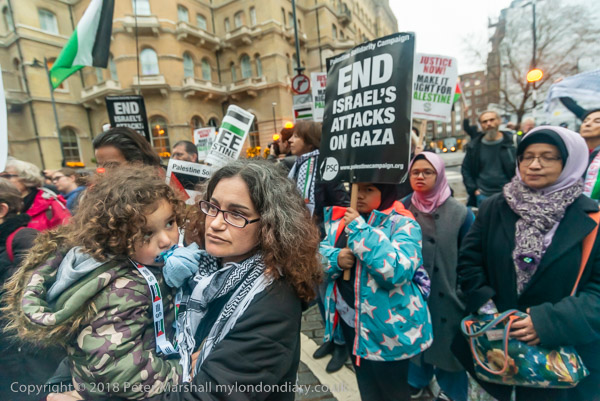
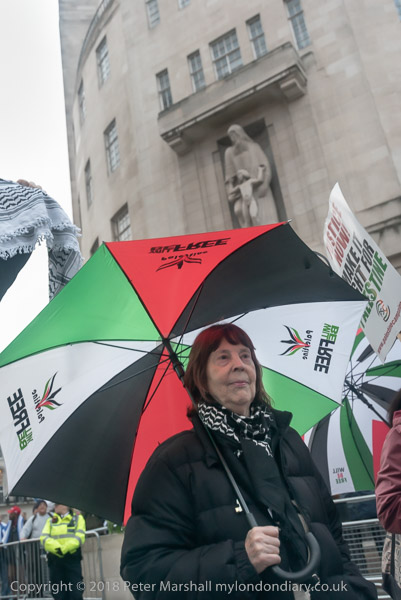
Finally I made my way to Broadcasting House, where The Palestine Solidarity Campaign and others were calling on the BBC to withdraw from the 2019 Eurovision Song Contest hosted by Israel, to avoid being complicit in Israel’s ongoing violations of Palestinian human rights.

Campaigners say the contest ‘artwashes’ Israel’s human rights record, including the killing of at least 205 Palestinians by Israeli forces in the besieged Gaza Strip since protests began at the end of March, and the passing of the Jewish nation state law which formalises an apartheid system in Israeli law.

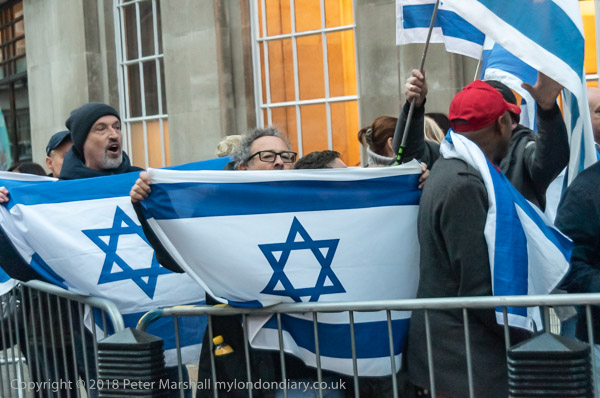
A small group of Zionists had come to oppose the protest, but made it clear that they did not want me to photograph them. Some lifted the Israeli flags they were holding to hide their faces when I pointed my camera in their direct or turned away.


More at:

BBC Boycott Eurovision Israel 2019
Together for Climate Justice
Stop Universal Credit day of action


All photographs on this and my other sites, unless otherwise stated, are taken by and copyright of Peter Marshall, and are available for reproduction or can be bought as prints.