Students March for Free Education – 2015

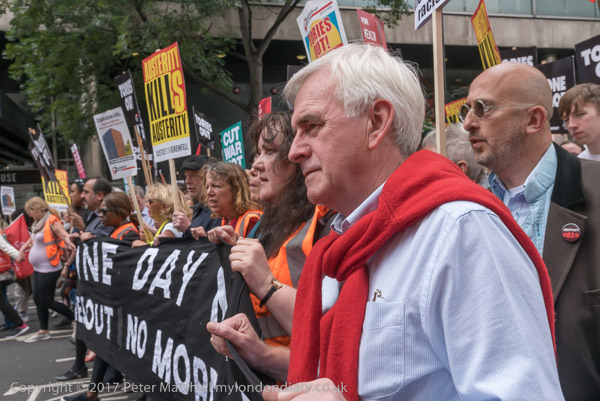
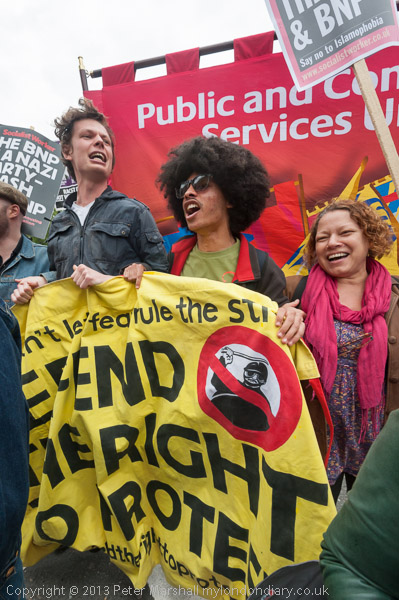
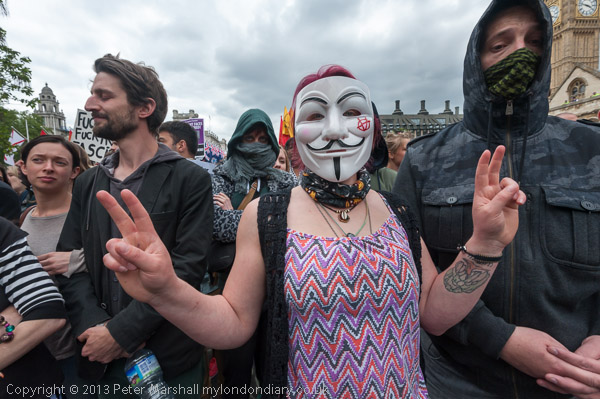
Students March for Free Education. On Wednesday 4th November 2015 students, led by the National Campaign Against Fees and Cuts (NCAFC) marched through central London against the abolition of maintenance grants calling for free education without fees and huge student debts and an end to turning higher education into a market system impoverishing staff and students.

Students March for Free Education - 2015

Back in the distant past when I was a student, UK students paid no tuition fees at UK universities and I got a grant of around £300 a year which was then just about enough to pay my living expenses, at least for the three terms I was away from each year, paid by my local authority.

Students March for Free Education - 2015

Because my family income was low, I got a full grant, while some of my friends from wealthier families got lower grants and had to rely on their parents to give them a ‘parental contribution’ – and not all did, though some others were more than generous.

Students March for Free Education - 2015

More recently, my two sons also benefited from maintenance grants and no fees, my younger son just squeezing into the final year before student fees came in. By then my salary as a teacher – our sole household income at the time – meant we were assessed to make a small parental contribution to his maintenance.

Students March for Free Education - 2015

Since then things have got a lot tougher for students, with loans for both tuition fees and their living expenses. New Labour brought in tuition fees in 1998, means-tested at £1000 per year, then tightened the screw in 2004 when they tripled to £3000 and poorer families now had to pay the full amount.

In 2012 the Tory-led coalition tripled the fee yet again, setting a maximum of £9000 – and I think all universities charged more or less that maximum. Currently they are frozen after being rasied to £9250 in 2017, but are expected to rise with inflation from 2025 if no further changes are made. For a few years in opposition Labour promised to remove tuition fees, but that promise seems to have been quickly forgotten after Starmer became leader.

It was Thatcher who first introduced student loans for maintenance but these were in addition to maintenance grants for those who did not get full grants. It was again New Labour in 1998 that abolished maintenance grants for all but the poorest students – and these went in 2016.

Student loans have operated under several systems since 1990, with the first major change taking place in 1998 and the next in 2012, when the first Income-Contingent Repayment Plan 1 was introduced. Students this year are on the 5th version of this, with a new version for those starting in 2023.

Martin Lewis summarises the 1923 changes in a clear graphic. Students who started in 2023 pay 9% of their income when they earn over £25,000 a year and keep paying for 40 years after they left university. Inflation-linked interest is added to the amount on loan, typically now around £60,000 for a three-year course.

Most students now also have to supplement their income with part time jobs, as estimates for the income needed to take a full part in three years of university life together with tuition fees come to more than £80,000. It’s a far cry from back when I was at university when students taking paid work during term-time was frowned upon or prohibited by the university authorities.

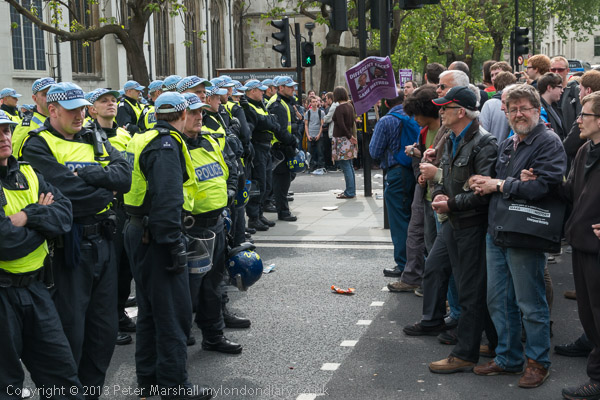
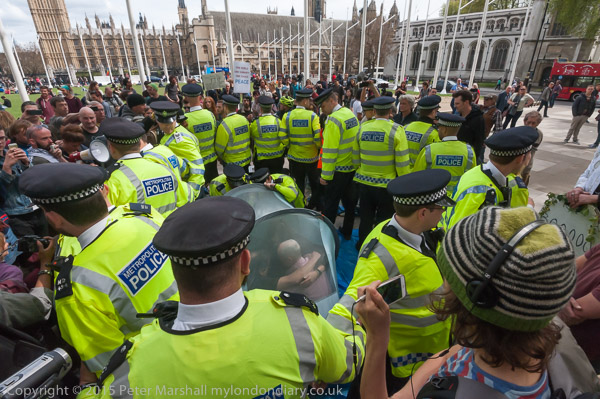
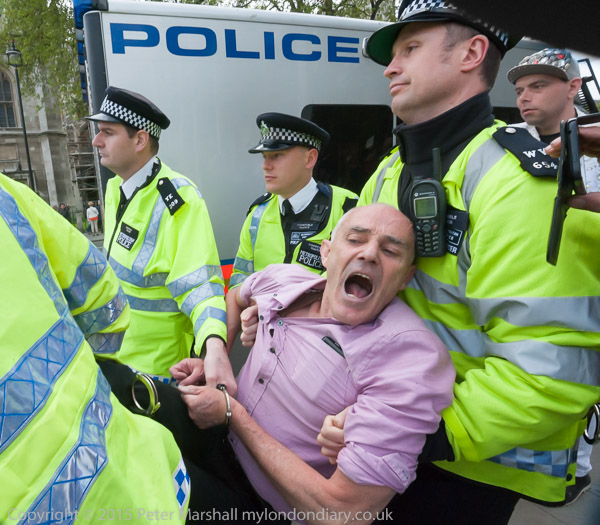
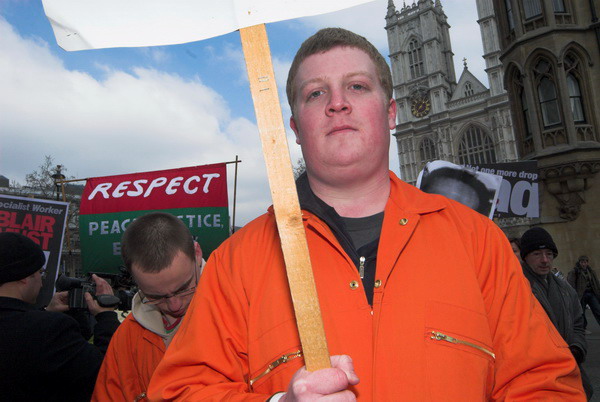
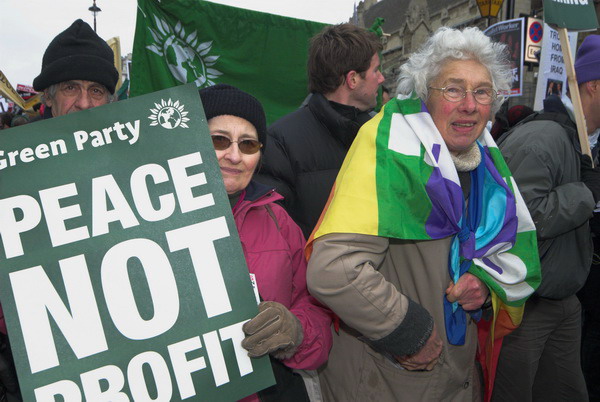
The 2015 protest formed up at Malet Street outside what had until 2013 been the University of London Union where there were speeched, then marched to Parliament Square . From there it went on the Home Office and Dept of Business, Innovation & Skills and became more chaotic, with a black bloc of students took over and police rather fragmented the march.

You can read about it and see many more pictures – and also of the celebration going on in Parliament Square following the release of the last British resident, Shaker Aamer from Guantanamo on My London Diary.

Free Education – No Barriers, Borders or Business
Students at Home Office and BIS
‘Welcome Home Shaker’ celebration


FlickrFacebookMy London DiaryHull PhotosLea ValleyParis
London’s Industrial HeritageLondon Photos

All photographs on this page are copyright © Peter Marshall.
Contact me to buy prints or licence to reproduce.
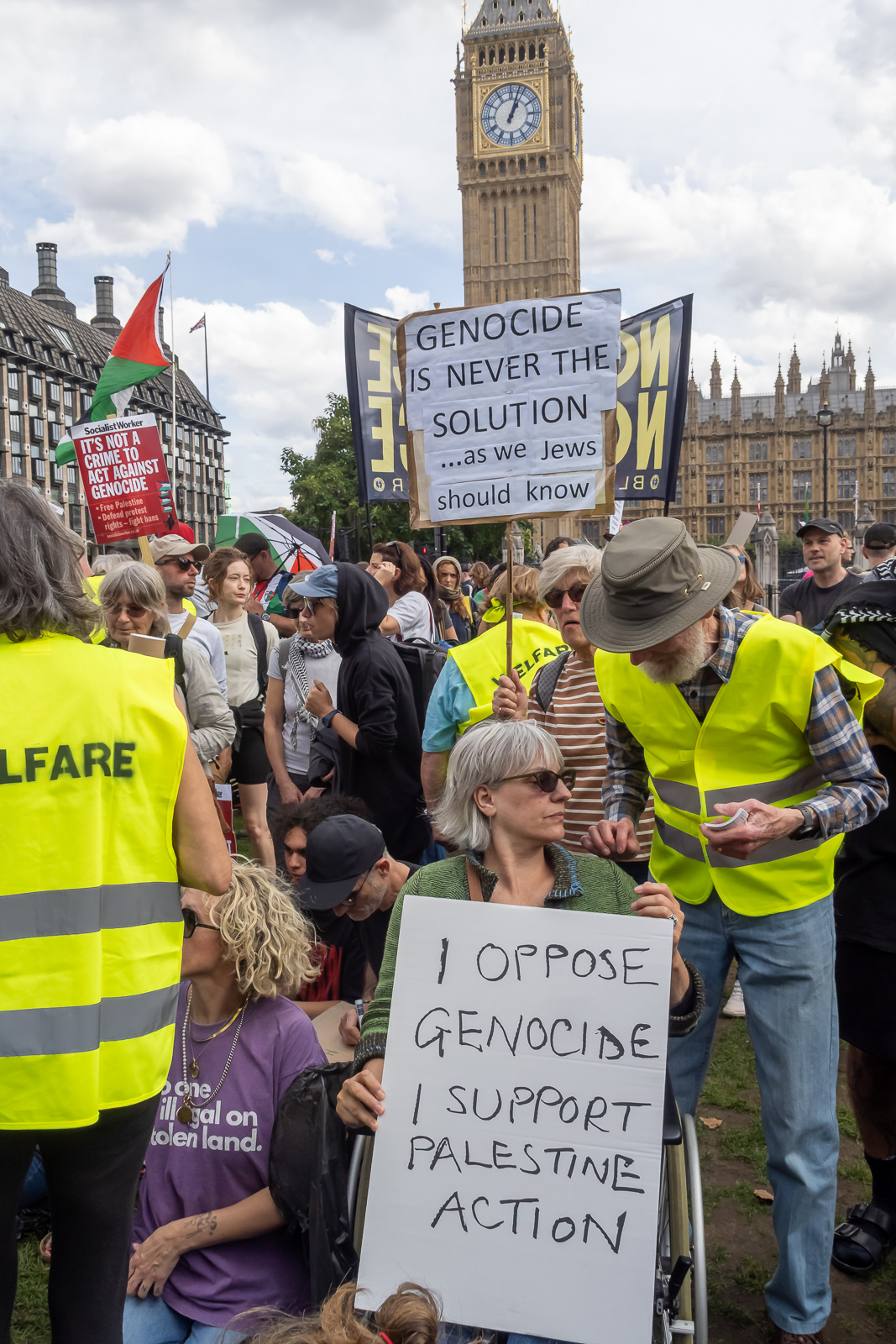
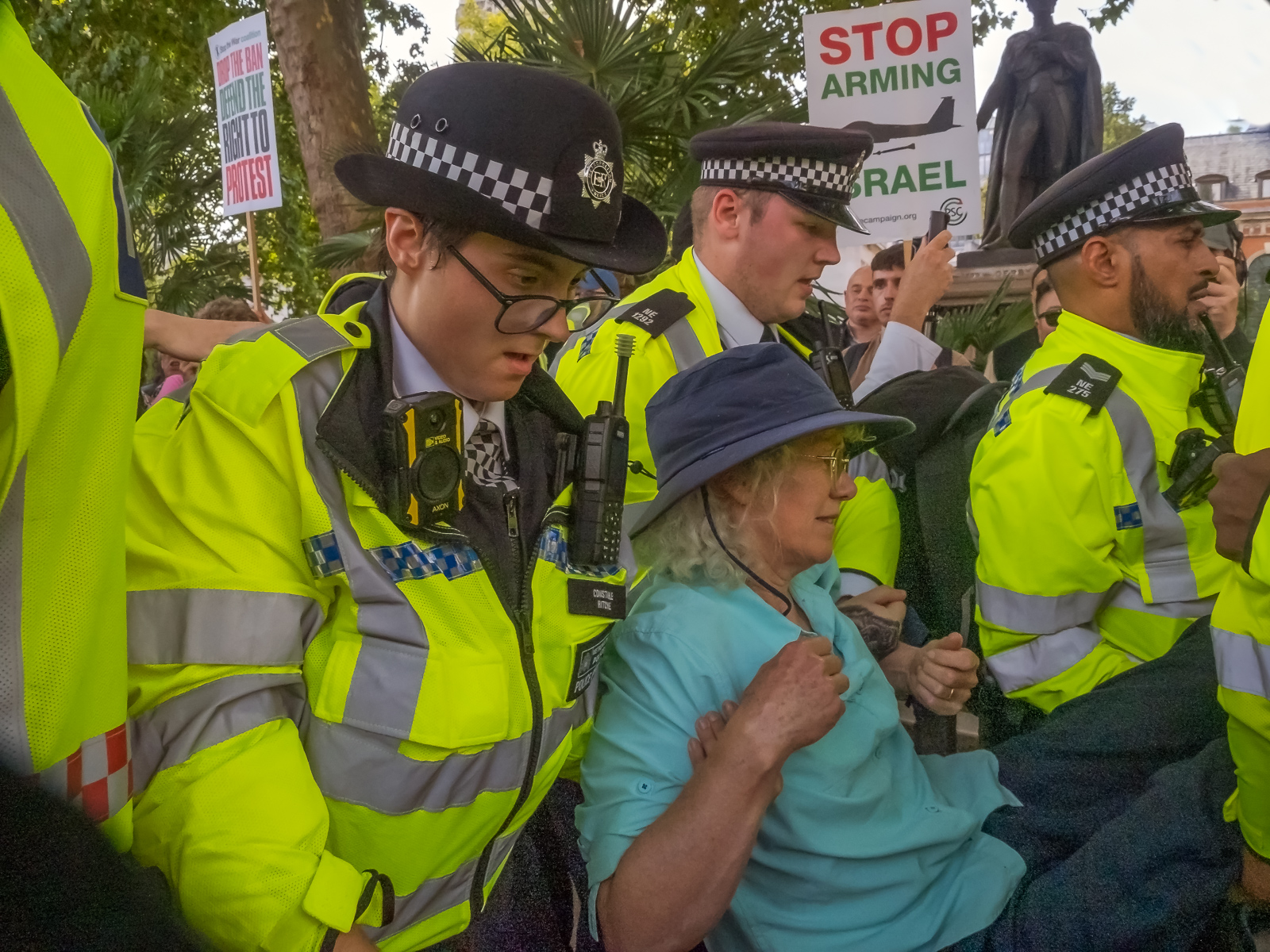
DPAC Court Vigil, a Poet Arrested, Musical Poor Doors & More 2014

DPAC Court Vigil, a Poet Arrested, Musical Poor Doors & More: Wednesday 22nd October 2014, ten years ago today was a busy day for me. You can read my full accounts of the various events I photographed on the links to My London Diary, along with many more pictures, but here I’ve only space for a short outline. Below is my day more or less in order.


DPAC High Court Vigil for ILF – Royal Courts of Justice,

DPAC Court Vigil, a Poet Arrested, Musical Poor Doors & More 2014

When disabled people won a court case over withdrawal of the Independent Living Fund the government simply put back the closure of the fund. Today’s protest by Disabled People Against Cuts (DPAC) supported a second case against the closure. Speakers at the vigil included three MPs, John McDonnell, Andy Slaughter and Jeremy Corbyn, as well as many from various disability groups.

DPAC Court Vigil, a Poet Arrested, Musical Poor Doors & More 2014

At the end of the protest, DPAC carried out their usual direct action, blocking Strand outside the court with their wheelchairs.

DPAC Court Vigil, a Poet Arrested, Musical Poor Doors & More 2014

More at DPAC High Court Vigil for ILF.


End UK shame over Shaker Aamer – Parliament Square, London

DPAC Court Vigil, a Poet Arrested, Musical Poor Doors & More 2014

Protesters were continuing their regular vigils opposite Parliament for Shaker Aamer, imprisoned and tortured for over 12 years and cleared for release in 2007. They believe he was still being held because his testimony would embarrass MI6 as well as the US.

End UK shame over Shaker Aamer.


Westminster Tube Station & Canary Wharf

I took the tube from Westminster to Canary Wharf to visit the Bridges exhibition at the Museum of London Docklands, later returning to Westminster. I paused in Westminster Station to take some panoramic images of the interior, designed as Piranesian, though sometimes I get more of the feeling of Escher as you seem to walk endlessly up escalators and around the interior.

I found the show a little disappointing, but took advantage of my visit there to take a few more panoramic images.

A few more pictures,


Democracy Camp – Plinth Guy & Poet Arrested – Parliament Square

I made a couple of visits to the Democracy Camp in Parliament Square both before and after going to Canary Wharf. Although the camp had been ejected from the main grass area workshops and rallies were still taking place throughout the day, and Danny, the ‘Plinth Guy‘ was still up there with Churchill since the previous day – and there were cheers when he completed 24 hours.

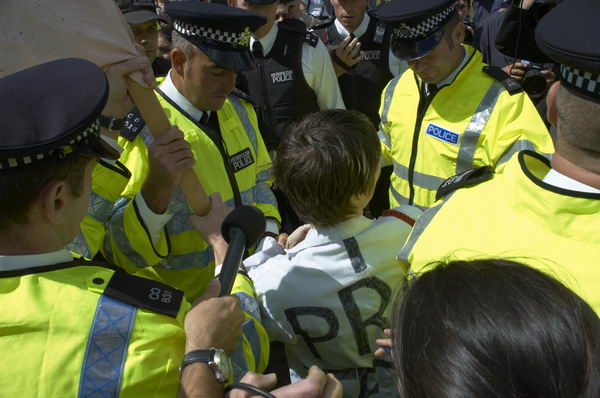
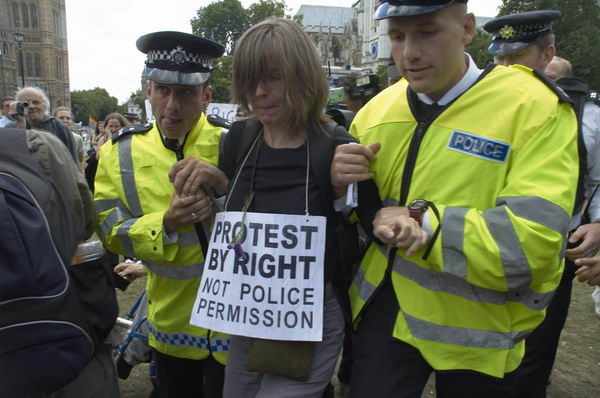
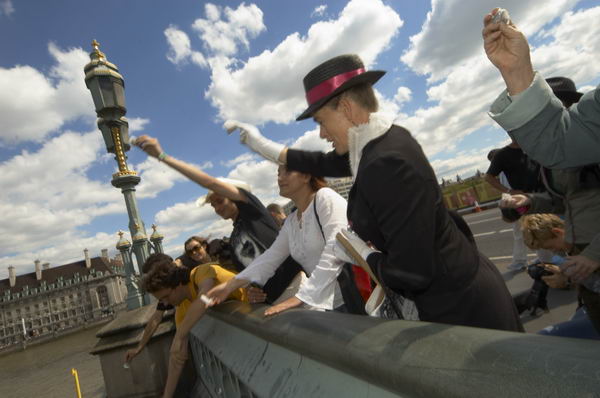
Earlier someone had been arrested for throwing him a bottle of water, and when performance poet and activist Martin Powell arrived with a plastic tub of food he was warned he would be arrested if he tried to give it to Danny.

He replied it could not possibly be a crime to feed a hungry person and threw it extremely accurately over police heads and into Danny’s waiting hands. Arrested and marched away he loudly recited his poem ‘The Missing Peace’.

Danny was still in place when I returned at 5pm but the police had called in their climbing team. I listened while its leader talked with him, and Danny told him he would not resist arrest if they came to take him down peacefully. But I had to leave before they started to do so.

Democracy Camp – Poet Arrested


Musical Poor Doors – One Commercial St

This was Class War’s 14th weekly protest at the ‘rich door’ of Redrow’s One Commercial St flats and it was a lively affair with the banners dancing to the music of Rhythms of Resistance, a poetic performance and some rousing speeches against social apartheid.

There ws strong police presence but there was no trouble, with a carnival atmosphere and banners dancing up and down the wide pavement in front of the rich door. Most of the police appeared to be enjoying the event too.

As usual after an hour of protesting people dispersed and I went into Aldgate East station to begin my journey home.

More at Musical Poor Doors.


FlickrFacebookMy London DiaryHull PhotosLea ValleyParis
London’s Industrial HeritageLondon Photos

All photographs on this page are copyright © Peter Marshall.
Contact me to buy prints or licence to reproduce.


Climate Rush – Deeds Not Words 2008

Climate Rush – Deeds Not Words: In 1903 Emmeline Pankhurst and other women who believed that more direct action was needed to get votes for women founded the Women’s Social and Political Union (WSPU) with the motto ‘Deeds not words‘.

Climate Rush - Deeds Not Words

In September 1908 together with Christabel Pankhurst and Flora Drummond, Emmeline Pankhurst issued a leaflet with the message:

Men and Women,
Help the Suffragettes to Rush the House of Commons,
on
Tuesday Evening, October 13th, at 7.30.

The three women were charged for this with inciting the public to undertake an illegal act. After speaking at a public meeting on 11th October they were instructed to attend Bow Street police station but defied this and a second request to report to police. They were arrested at 6pm on the 13th and so were unable to attend the Suffragette Rush they had called.

Climate Rush - Deeds Not Words

But despite this, 60,000 people came to Parliament Square and some attempts were made to rush through the 5,000 police cordon but failed. “Thirty-seven arrests were made, ten people were taken to hospital and seven police officers were placed on the sick list as a result of their injuries.”

Climate Rush - Deeds Not Words

One woman, MP Keir Hardie’s secretary, was working inside the building and ran into the chamber where MPs were debating, shouting ‘leave off discussing the children’s question and give votes to women first’ before being forcibly evicted.

Climate Rush - Deeds Not Words

The three leaders were tried and fined for conduct likely to provoke a breach of the peace and sent to Holloway when they refused to pay their fines.

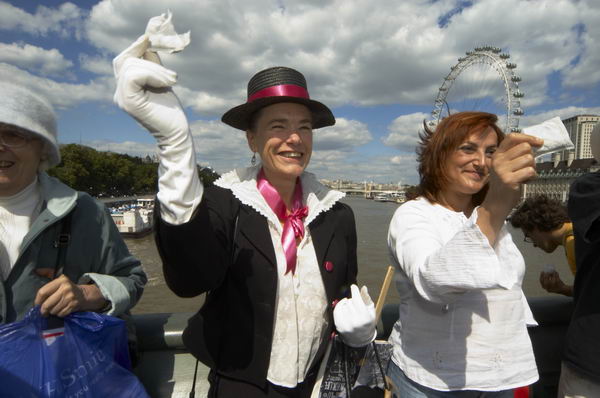
On 13th October 2008, the 100th anniversary of this Suffragette Rush, as I wrote, ‘women concerned with the lack of political action to tackle climate change organised and led a rally in Parliament Square, again calling for “men and women alike” to stand together.’

They were making three key demands – “no airport expansion“, “no new coal-fired power stations” and “The creation of policy in line with the most recent climate science and research.”

So far the repeated demands by Heathrow to expand have been resisted, but only by continued protests and helped by financial problems. But expansion remained Tory policy and having ruled it out set up a biased inquiry to reinstate it. The new Labour government has already shown support for expansion at London City Airport and seems likely to support new proposals at Heathrow.

Although the last coal-fired power station closed a few weeks ago, we now have an even more polluting and environmentally damaging wood-fired power station at Drax, which ridiculously receives green subsidies which in 2020 amounted to £832 million as well as “exemptions for taxes on carbon emissions, estimated at savings of £358 million“.

And although successive governments had paid lip-service to “the most recent climate science and research“, their actions and actual policies continue to show any of the urgency that this requires.

On 13th October 2008, the event began with a rally in Parliament Square with rather fewer attending than in 1908, around a thousand including many wearing white and dressing in the styles of a century earlier.

As the final speech by Green Party MEP and leader Caroline Lucas ended, “most of the crowd, led by Tamsin Omond and friends, walked and ran across the road towards the main door into Parliament, chanting the Suffragette slogan ‘Deeds Not Words’. Police “made only a token attempt to stop them on their way, falling back to protect the door itself with several lines of police, and preventing any protesters entering the building.

There was a long melee outside the door, with police picking up demonstrators and throwing them back. I saw no violence by demonstrators towards the police.” Eventually the whole area in front of the door was crowded with protesters and police held them to a standstill.

By the time I left around half an hour later a few people were also beginning to drift away. “Later I heard that around half a dozen people had been arrested, including Tamsin Omond, who was in breach of her bail conditions following the ‘Plane Stupid’ roof-top protest at the Houses of Parliament in February.”

You can read more about the protest in my account on My London Diary, which also has many more pictures: Climate Rush – Deeds Not Words.


FlickrFacebookMy London DiaryHull PhotosLea ValleyParis
London’s Industrial HeritageLondon Photos

All photographs on this page are copyright © Peter Marshall.
Contact me to buy prints or licence to reproduce.


Sack Parliament 2006 and the End of Freedom

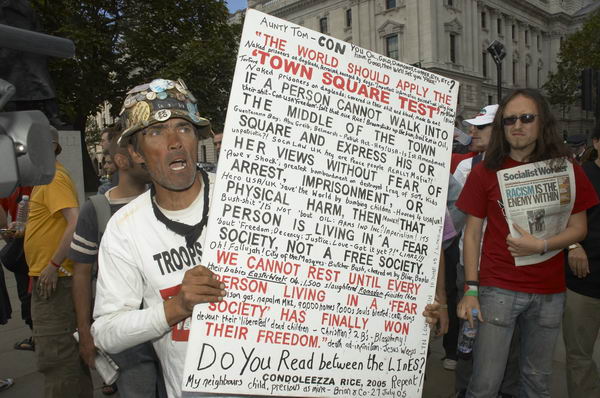
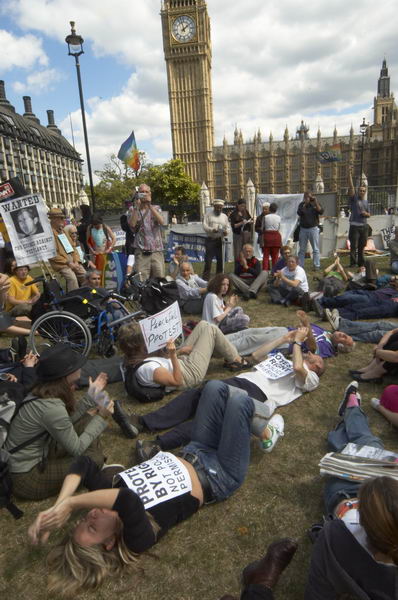
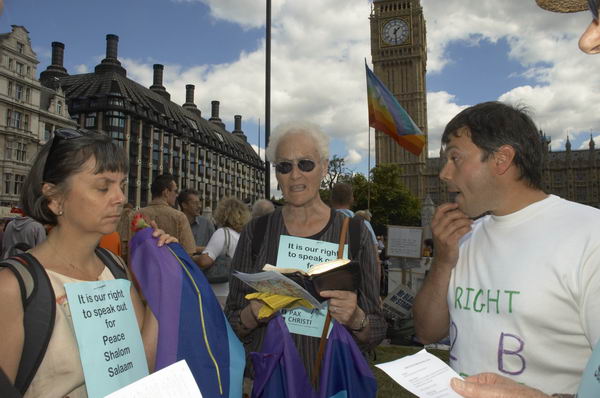
Sack Parliament on Monday 9 October 2006 was more a demonstration by police of their determination to protect the status quo following protests earlier in the year and the continuing saga of the Parliament Square peace protest which had led to their performance being criticised by politicians and our largely right-wing press than any real protest by the few who had come to protest against the increasing restrictions on our freedom to protest.

It was Brian Haw’s permanent peace protest in Parliament Square which led to the Labour Government including in the Serious and Organised Crime and Police Act 2005 severe restrictions on the right to protest in a large area around Parliament and giving police new powers to control protests.

Sack Parliament 2006 and the End of Freedom

Media frenzy about this protest was whipped up in the days before at least in part by police briefings, and the police clearly saw this as an opportunity to demonstrate that they could control events such as this. I wrote and published an unusually long piece on My London Diary about the event – reproduced here with some minor corrections.

Sack Parliament on Monday 9, and event to mark the return of MPs to Westminster, was of course only ever an amusing idea rather than a serious chance of a Ukrainian-style Orange Revolution. As the large press turnout showed, it was one that had caught the attention of the media (Mondays perhaps tend to be slack) but unfortunately not that of the demonstrating classes.

Sack Parliament 2006 and the End of Freedom

It got off to a bad start with the planned ‘Critical Mass’, which failed to gather more than a handful of cyclists. Heavily outnumbered by the police bike posse, they faded away, a couple cycling down the side of the National Theatre and the other 3 or 4 carrying their bikes up the steps to Waterloo Bridge.

Sack Parliament 2006 and the End of Freedom

At Parliament Square, things were little better. At the advertised start time, apart from the normal Parliament Square Permanent Protest there were perhaps 25 demonstrators and rather more press, along with what must have been around a thousand police, counting those sitting in vans around the area as well as the impressive number standing around.

Sack Parliament 2006 and the End of Freedom

Twenty minutes later the numbers had been more than doubled, mainly by the arrival of a group dressed largely in black. And soon after they made a charge at the police line into the road towards the Houses of Parliament.

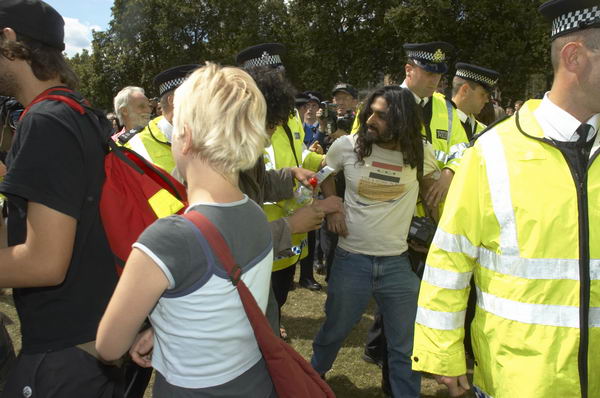
From the start it seemed a pointless gesture. The line held, and pushed them back, and soon the two sides were standing a few feet apart and glaring at each other. After a few more attempts to push through the police, the demonstrators ran back onto the grassed area of the square where they were surrounded by a cordon of police.

One of the photographers, an NUJ member I’d been talking to a few minutes earlier, was apparently pushed by police as they rushed the demonstrators. He fell and received a neck injury which left him with no feeling from the waist down. Police medics were on hand to give him first aid and to call an ambulance. Later I was pleased to hear he had been allowed home from hospital, and the injuries were apparently less serious than we feared.

I was inside the cordon to start with, but the police made no attempt to stop me as I decided to walk out, not even asking to see my press card (they had checked it earlier.) Around the square, small teams of police were rounding up anyone looking vaguely like a punk or a hippy and dragging them inside the cordon. Some of those they picked on seemed genuinely to have no connection with the protest. Eventually there were perhaps around 150 in there, including quite a few press, along with a few who clearly had little idea what the whole thing was about.

Apparently others who looked like possible demonstrators were stopped and arrested in Whitehall, or turned back on other roads approaching the square.

Outside the cordon, the normal demonstrations in the square went on, with the occasional interruptions by the police, nit-picking about where the demonstrators are allowed to stand and being largely ignored or abused.

Occasionally there were scuffles inside the cordon as demonstrators made an attempt to breach the police line, or police teams moved in to grab individuals. There were also occasional arrests around the square, including some of those who protested loudly they were simply bystanders.

At 14.13, roughly 40 minutes after the protesters had been imprisoned in the cordon, Police Superintendent Peter Terry (responsible for the taking away and destruction of most of Brian Haw’s property from the square and alleged by demonstrators to have lied in court) read from a handwritten statement telling the protesters that they were being detained in the square because he believed that their continued presence in the area would lead to a serious breach of the peace!

Around 15.00, police began to distribute notices to those outside the cordon warning them “we believe that you may be, or are about to be, involved in a demonstration located within an area subject to the provisions of the Serious and Organised Crime and Police Act 2005” and moving press and spectators well back from the cordon. There seemed to be little chance of getting further photographs, so I went to get on with work elsewhere.

According to a press report later in the evening, there were 38 arrests made. Those caught in the cordon who were not arrested at the event were apparently required to provide evidence of identity and address before being allowed to leave. SOCPA continues to be a blot on human rights in this country, and this protest, despite its apparent pointlessness and lack of support has underlined this point.

I’m one of a generation who grew up believing in British justice and a sense of fair play. We were rightly appalled at those countries where protest was banned, and demonstrators could be arrested. It sickens me to see this happening in front of what used to be a powerful symbol of freedom, the Houses of Parliament.

In 2007 the Labour Government, then led by Gordon Brown began a consultation about managing protest around Parliament which looked at different ways of imposing restrictions and those in SOCPA were repealed in the coalition’s by the Police Reform and Social Responsibility Act 2011. But they were replaced by giving police new powers to control a wide range of activities in the area.

Even more draconian powers allowing police to restrict protests across the UK cane into force under the Tory Police, Crime, Sentencing and Courts Act 2022 which seriously impact free expression, freedom of speech and the right to protest in the United Kingdom, and further powers and increased sentences for protesters were enacted by the Public Order Act 2023. We now have non-violent protesters serving lengthy jail sentences, with a Labour government which appears to be in no hurry to repeal these repressive police state laws.

More pictures on My London Dairy.


FlickrFacebookMy London DiaryHull PhotosLea ValleyParis
London’s Industrial HeritageLondon Photos

All photographs on this page are copyright © Peter Marshall.
Contact me to buy prints or licence to reproduce.


Corbyn Victory & Refugees Welcome – 2015

Corbyn Victory & Refugees Welcome: Saturday 12th September 2015 was a day of hope when Jeremy Corbyn won the Labour leadership election with a landslide victory, getting more than three times the vote of his nearest rival, Andy Burnham. Several hundred Corbyn supporters met at Speakers’ Corner before the Refugees Welcome march to listen to the results of the Labour Leadership election.


Victory Party for Jeremy Corbyn – Speakers’ Corner, Hyde Park,

Corbyn Victory & Refugees Welcome

Tension built as the Deputy Leader results came and then erupted with Jeremy Corbyn’s first round victory.

Corbyn Victory & Refugees Welcome

Corbyn had only been able to stand in the election because some Labour MPs who did not support him were prepared to nominate him so that the Labour left would have a candidate in the ballot and not feel it was rigged against them. They thought he would only get a miserably low percentage of the votes.

Corbyn Victory & Refugees Welcome

According to Wikipedia, the release of opinion polls before the election which showed Corbyn in the lead prompted “high-profile interventions by a number of prominent Labour figures including Gordon Brown, Tony Blair, Jack Straw, David Miliband, and Alastair Campbell, among others” who felt Labour with Corbyn as leader would be unelectable.

Corbyn Victory & Refugees Welcome

These interventions almost certainly increased support for Corbyn, and although these and other Labour figures such as Peter Mandelson, along with most of the media and press did their best to try to get rid of Corbyn, including various plots and mass resignations from the Shadow Cabinet, he remained popular in the country.

The 2017 election turned out to be a much closer contest than most had imagined, and it was only due to deliberate sabotage by Labour party officials that Corbyn lost. A leaked report in 2020 which demonstrated this led to the setting up of the Forde report into Labour party factionalism which although it called the earlier report “factional” confirmed many of its suspicions and conclusions – as well as criticising both sides in the party – remained secret until July 2022.

What shocked many of us was the evident relief shown by some leading members of the party as the 2017 election results were coming out that their party had lost. And the witch-hunt against the left in the party continues unabated.

On the 12th September 12th 2015 there was much more media interest in the few hundred celebrating Corbyn’s victory than in the huge Refugees Welcome march which followed, and in the media scrum I got knocked flying and my equipment scattered, but managed to gather it up and continue work.

Victory Party for Jeremy Corbyn


Refugees Welcome Here Rally & March

From Speakers Corner I joined the huge crowd – at least 50,000 – filling Park Lane as far as I could see. This national march was a response to the many reports of refugees fleeing war and persecution, with people wanting to show their support for refugees facing death and hardship and their disgust at the lack of compassion and inadequate response of the British government.

On My London Diary is a list and photographs of some of the speakers before the march set off. I photographed the front of the march as it set up at the southern end of Park Lane and went with it for the first couple of hundred yards into Piccadilly, where I stopped to photograph the rest of the march as it came past.

The marchers were fairly densely packed and spread across the whole of the roadway (and sometimes on to the pavement too) and it took exactly an hour to go past me.

There were many at the protest who were not the usual protesters, people who said this was the first protest they had ever attended, as well as those that I knew from previous protests, and there were many interesting placards and banners to photograph – and many more pictures on My London Diary.

As the end of the march passed me I rushed into Green Park Station and took the tube to Westminster, arriving on Whitehall as it went very noisily past Downing Street.

I ran back to Parliament Square, and this soon filled up with people and banners. I sat down on the wall close to the Churchill statue, realising I was rather tired and hungry.

Many marchers left rather than stay and listen to the speeches, though the square was still crowded and I decided I would leave too.

More on My London Diary:
Rally Says Refugees Welcome Here
Refugees are welcome here march
Refugees Welcome march reaches Parliament


FlickrFacebookMy London DiaryHull PhotosLea ValleyParis
London’s Industrial HeritageLondon Photos

All photographs on this page are copyright © Peter Marshall.
Contact me to buy prints or licence to reproduce.


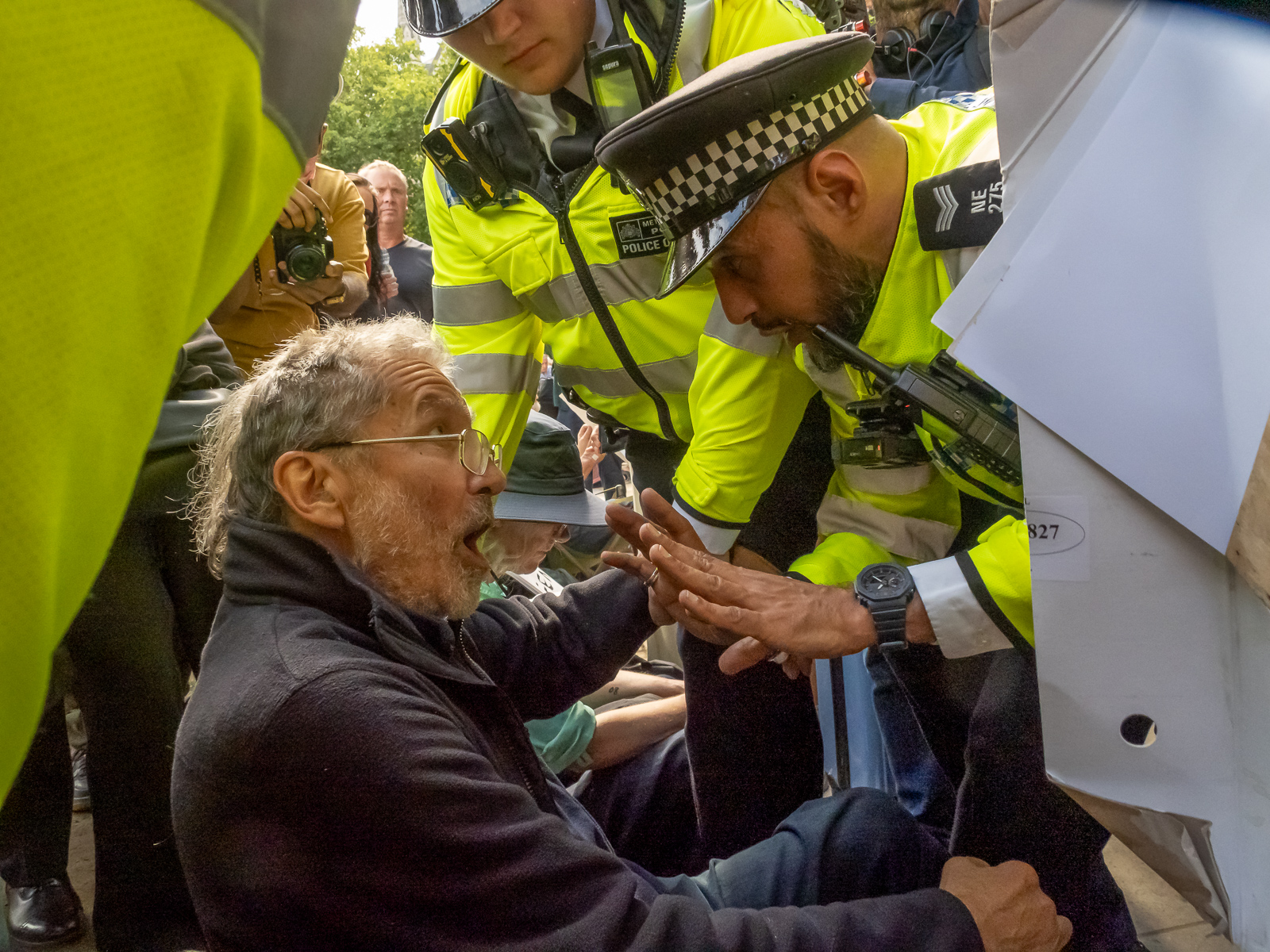
Brian Haw, Syria And EDL Stopped – 2011

Brian Haw, Syria And EDL Stopped: My working day on Saturday 3rd September 2011 began in Parliament Square, then an extreme right protest in Westminster, Syrians at Downing Street and finally to Whitechapel where several thousand came to stop the EDL entering Tower Hamlets.


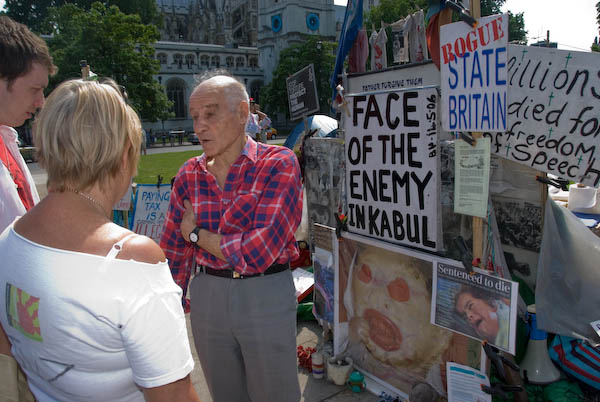
Brian Haw Peace Protest Continues

Brian Haw, Syria And EDL Stopped

Three days earlier, police had come to Parliament Square and taken away all of the material in the permanent 24/7 peace protest there begun by Brian Haw in 2001 and now continued after his death in June 2001 by Barbara Tucker and other supporters.

Despite the protestation by those carrying on the protest there, the police claimed the material had been abandoned and removed it. The police have for years been under pressure from politicians to end the protest and took advantage of the fact that Barbara Tucker was then being held in Holloway Prison. But a team of others had kept up the protest while she was away and were there when the police came are were still continuing the protest.

Brian Haw, Syria And EDL Stopped

This was not the first time that the display here has been stolen by police, the most famous being in May 2006, after which a reconstruction by an artist was controversially put on display at Tate Britain. Since 2006 there had been restrictions on the size of the display allowed there and continuous harassment and arrests of Brian Haw, Barbara Tucker and others involved.

Brian Haw, Syria And EDL Stopped

Parliament Square had then been fenced off to the public for some time, with the public denied access to the statues of Churchill, Lloyd George and others, with protests and public limited to the pavements around two sides of the square. But the fencing was useful to display a number of banners. Police did not touch the other peace protest on the pavement by Peace Strike.

Brian Haw Peace Protest Continues


Alternative Action Anti-Sharia Protest

Brian Haw, Syria And EDL Stopped

Alternative Action brought together “patriot activist groups” from the far-right who had previously taken part in EDL protests. They said they wanted to dissociate themselves from the loutish behaviour, violence and racism of EDL protests and in particular from the inflammatory incursion into Tower Hamlets the EDL were intending later in the day.

Among the groups involved were the English Nationalist Alliance, the British Patriotic Alliance, the Combined Ex Forces, the Ex EDL Association and the National League of Infidels. ‘Tommy Robinson’ had been reported as saying that the EDL would come to disrupt the peaceful march they had organised but this did not happen.

The setting up of Alternative Action reflects various bitter disputes over the leadership and policies of the EDL, in particular over the lack of accountability in the organisation and the behaviour of some of its self-appointed leaders, including Robinson and the ‘Jewish division’ of the EDL.

They had come to march from the Ministry of Justice to Downing Street to hand in a letter calling for one system of law in the UK and an end to Sharia courts. The march was peaceful although there was one minor incident when English Nationalist Alliance leader Bill Baker shouted at Syrian protesters, mistaking them for Islamic extremists, but others soon persuaded him to stop. Later some of those on the march expressed the view that it was inappropriate to allow protests involving foreign flags so close to the Cenotaph with its flags honouring our military dead.

Although well over a hundred had indicated on Facebook that they would march, only around 20 turned up. The march paused at the Cenotaph to lay a wreath and observe a minute’s silence in memory of the soldiers who have given their life for their country before continuing to the gates of Downing Street.

Although they had earlier made arrangements with the Downing St police liaison officer to deliver their letter, police at the gate refused to let them do so and would not take the letter. Other protests have had the same reception, which seems to me to be against the letter and spirit of democracy. The marchers then stopped on the pavement just past Downing Street for a rally and after a few minutes I left.

Alternative Action Anti-Sharia Protest


Protest Against Repression In Syria

Around a hundred members of the Syrian Community in London had marched from the Syrian Embassy to hold a noisy protest at Downing St calling for freedom in Syria and an end to oppression, atrocities and humiliation by the Assad regime.

They called on the UK to support further sanctions and bring diplomatic pressure to support the peaceful protests in Syria against the Assad regime which had begun on 15th March 2011 and had met with brutal repression.

Marches has been met with tanks, cities and villages attacked by helicopter gunships, men, women and children tortured and more than 1800 people killed, including many children. Soldiers who refused to open fire on civilians or take part in torture have been themselves killed.

Many of the women taking part wore Muslim headscarves, but there were others who did not, and although most of the drumming, dancing and flag-waving was by the men, this was not a rigidly segregated event although men and women mainly stood it separate groups. The variety of Syrian flags suggested that those taking part included those from various groups opposing the Assad regime.

Protest Against Repression In Syria


Tower Hamlets Unites Against EDL

The protest in Tower Hamlets by residents and their supporters against the plans by the English Defence League to hold a rally somewhere in their borough had started around 11am, but I only arrived later at the time the EDL rally was scheduled to start close to Aldgate East Station.

The street there was empty but blocked by a row of police who refused to let me through despite showing my press card, and I was prevented from going to where the EDL were holding their rally a short distance to the west, just inside the City of London.

Initially the EDL had planned to march through Whitechapel but home secretary Theresa May had banned marches. The EDL then tried to have a static demonstration on a supermarket car park close to the East London Mosque, but the supermarket and other possible sites in the area refused them. Pubs in the area where they intended to meet up for the protest also said they would deny access, and the RMT announced they would close the Underground stations because of the danger to staff.

Police stopped some EDL supporters and turned them back as they tried to enter London. Others got lost wandering around London trying to find pubs that would serve them, and the numbers at the EDL rally were apparently considerably less than the organisers or police had anticipated.

I gave up trying to get to the EDL rally and went instead to the large crowds who had come to Whitechapel High Street and Brick Lane to stop them, and then on to another large crowd who had come to defend the the East London Mosque. The community had clearly united to stop the EDL and there was a huge cheer when it was announced that EDL leader Stephen Yaxley-Lennon (aka Tommy Robinson) had been arrested after speaking at the EDL rally, where he had apparently boasted of having broken his bail conditions.

There was more jubilation when the crowd heard that police were moving the EDL away from the rally at Aldgate to Liverpool street and their coaches waiting across the river in Tooley Street.

The protesters began a ‘Victory March’ from the bottom of Brick Lane along Whitechapel High St, led by the Mayor, councillors and others who linked arms across the width of the road.

It stopped at the East London Mosque, but some activists decided to continue and were briefly stopped by police who told them their march was illegal because of the ban in place in Tower Hamlets.

They walked around the police who tried to stop them but a few hundred yards on stewards and some of the protest leaders including Mayor Lutfer Rahmen managed to bring the march to a halt, telling them to enjoy their victory and not continue as arrests now would become the story of the day for the press rather than it being one of a community victory over racism. They calmed down, some took up the offer of a cup of tea back in the Muslim Centre, while others, including myself, went home.

More on My London Diary at Tower Hamlets Unites Against EDL.


FlickrFacebookMy London DiaryHull PhotosLea ValleyParis
London’s Industrial HeritageLondon Photos

All photographs on this page are copyright © Peter Marshall.
Contact me to buy prints or licence to reproduce.
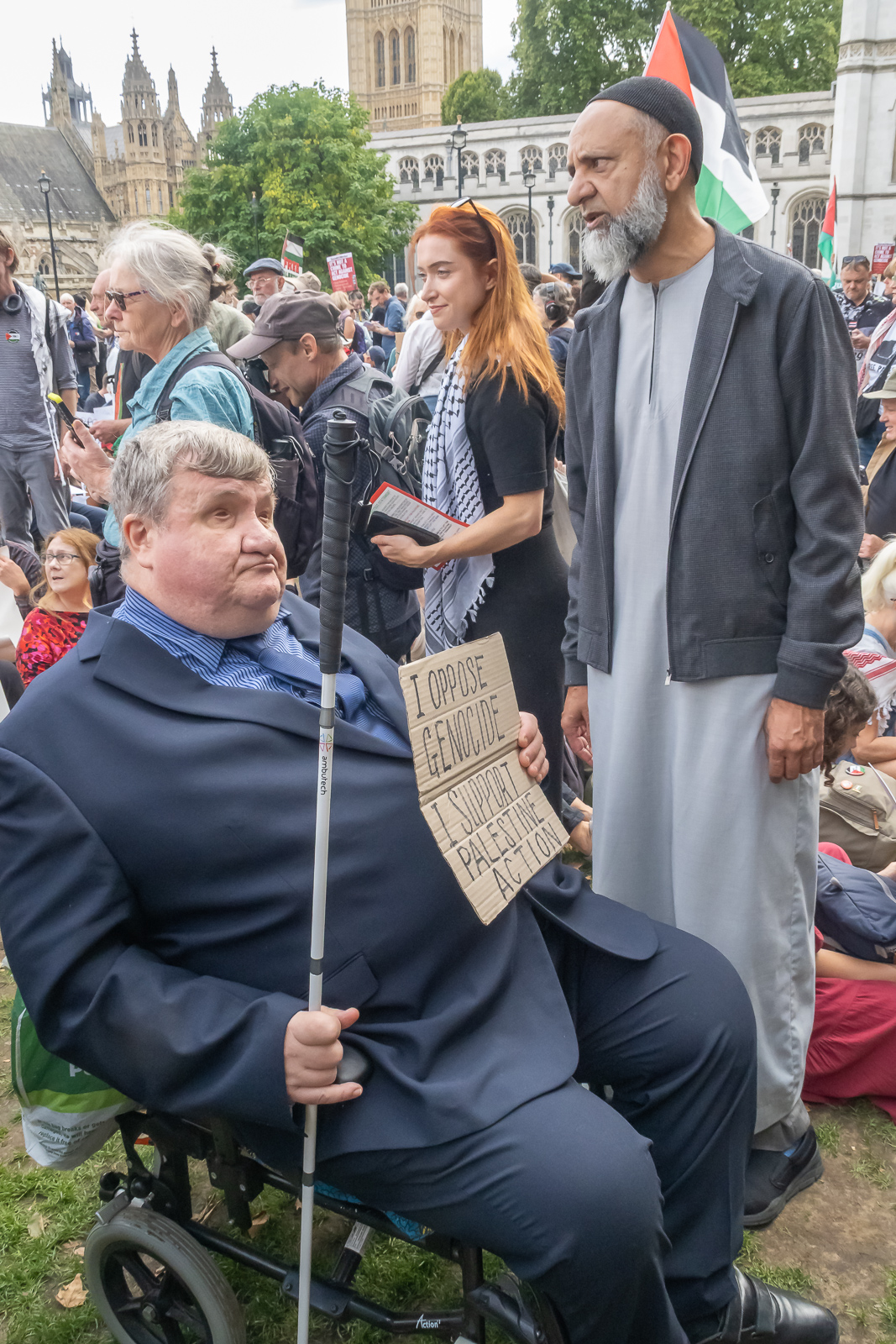

Stop the BNP, Olympic Allotments, End Deportation – 2008

Stop the BNP, Olympic Allotments, End Deportation: Saturday 21st June, 2006. A Love Music Hate Racism/Unite Against Fascism march, a visit to the replacement allotments for the Manor Gardening Society and a curiously legal protest against deporting refugees to Iraq.


Stop the Fascist BNP – LMHR/UAF – Tooley St – Trafalgar Square

Stop the BNP, Olympic Allotments, End Deportation

The Love Music Hate Racism/Unite Against Fascism “Stop the Fascist BNP” march turned out to be a little of a damp squib, although a fairly colourful one, as only 2-3,000 people turned up to march from Tooley Street in Bermondsey to Trafalgar Square.

Stop the BNP, Olympic Allotments, End Deportation

Perhaps Stop the War’s failure to capitalise on the mass following it gained with the largest ever demonstration in the UK in 2003 had discredited the idea of huge marches. Like Stop the War, Unite Against Fascism was seen by many as being largely a front for the Socialist Workers Party. The anti-fascist magazine Searchlight had disaffiliated from them in 2005, arguing for the need for new tactics and in particular to work in communities where the BNP were exploiting real problems rather than just opposing them on the streets and calling them fascists.

Stop the BNP, Olympic Allotments, End Deportation

A bigger march would have been better, but more importantly for the audience which Love Music Hate Racism was attempting to reach it needed to be much more of a free and fun event.

Stop the BNP, Olympic Allotments, End Deportation

The band who played at the start of the march were restricted to a single number, when they could well have played much more, and there was hardly any music on the march – I only saw one small marching band. Where were the great sound systems for people to dance behind?

And as I wrote, “I was frankly appalled by the attitudes of the stewards towards photographers, almost as if the event was trying to hide from publicity. I’ve had less hassle when photographing the BNP.”

More pictures at Stop the Fascist BNP – LMHR/UAF.


Manor Gardening Society – New Allotments – Marsh Lane, Leyton

The Manor Gardens Allotments fight to stay in place for the 2012 had failed. The gardens had presented the opportunity for the Olympics to show a real commitment to green ideas – and of course they had zero interest in really doing so. Green publicity stunts and lies yes, but Green actions and real content you had to be joking.

As I wrote “London in 1948 did really put the modern Olympics back on course, and it did so on vision and a shoestring – and even ended up making a profit. 2012 will be different in every respect. A commitment to corporate profit at high cost to the public purse appears to be the only vision on display, and a legacy of debt and environmental disaster seem to be the most likely outcomes.

All tenants were evicted in late 2007 and the allotments were moved onto some common land in Leyton at a cost of £1.8 million, but the job was done terribly badly. They even took soil from the allotment site, but heat-treated it, killing all the life in it. Healthy soil is full of life – and as well as killing weed the treatment has killed off the microorganisms it needs, as well as larger creatures such as worms.

The soil was dead – and would take years to recover. Over much of the site it had been heavily compacted by heavy machinery working on the road andhad almost zero drainage. Whole areas were waterlogged. The only healthy crops I saw were in grow-bags.

I commented: “Of course it doesn’t look like the old Manor Gardens – more like some kind of prison camp, but I was pleased to see again many of those from the old site, making a good job of getting things growing again. One thing that hadn’t changed was the community spirit and the welcome – and the splendid salad and other food.”

The New Lamas Lands Defence Committee had campaigned against the loss of common land, but were assured it was only temporary – but there is now a permanent site there. In 2016 some of the tenants of the Manor Gardening Society were allowed to return to a small site at Pudding Mill, on the Bridgewater Road in Stratford. Two thirds of this site is now under threat from a development proposed by the London Legacy Development Corporation along its southeast which will put it under permanent shade.

Manor Gardening Society – New Allotments


Tent City – Stop Deporting Iraqis – Parliament Square

Voices UK had organised a 24-hour ‘Tent City’ starting at noon on 21 June, Midsummer Day as a deliberately illegal demonstration in Parliament Square, at the centre of the SOCPA restricted zone.

Much to their surprise, 4 days before it began they received an e-mail from a police office with its subject “Tent City Demonstration” and the message “I would like to inform you that an application has been received for this demonstration and it will be duly authorised“.

They had not made an application and could only think that the police had themselves applied rather than have to police an intentionally illiegal protest. Although it was now legal under SOCPA, the protest was still in breach of Westminster City Council by-laws and a couple of their heritage wardens came out to give letters telling them so – apparently accompanied by the police officer who had sent the email.

Fighting is still taking place in Iraq involving various factions as well as the occupying US and UK forces. Many Iraqis will still be at risk of their lives if they are returned.

But for the Home Office – then under Labour Home Secretary John Reid, deportations are largely a matter of numbers, not of people. Things of course got even worse in later years under Theresa May, Amber Rudd, Sajid Javid, Priti Patel, Suella Braverman and James Cleverly, but I expect little change whoever wins our current election.

Tent City – Stop Deporting Iraqis


FlickrFacebookMy London DiaryHull PhotosLea ValleyParis
London’s Industrial HeritageLondon Photos

All photographs on this page are copyright © Peter Marshall.
Contact me to buy prints or licence to reproduce.

Brian Haw, Democracy, Cabs, Colombia & Israeli Atrocity – 2010

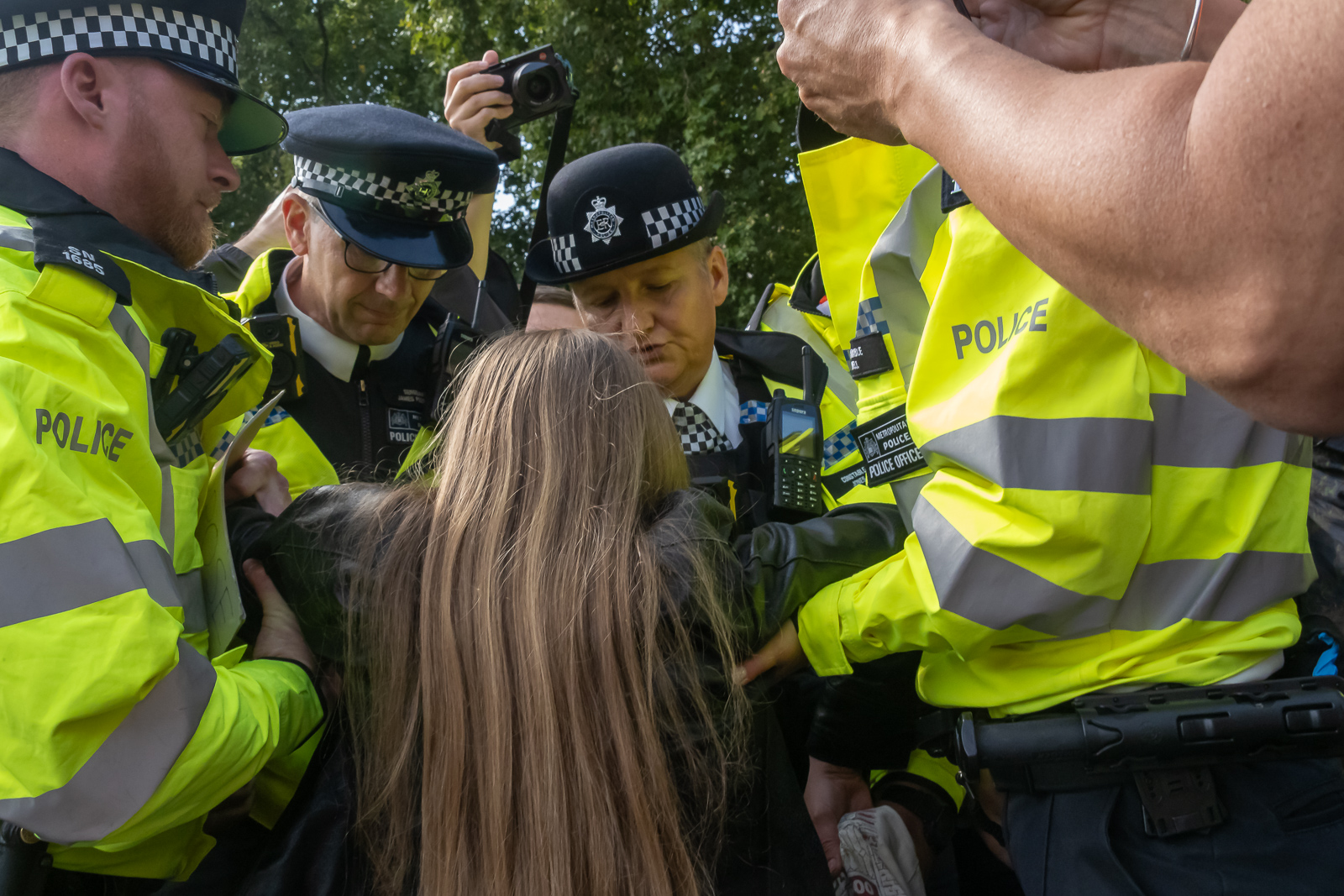
Brian Haw, Democracy, Cabs, Colombia & Israeli Atrocity: Six protests on Wednesday 2nd June 2010.


Brian Haw & Democracy Village – Parliament Square

Brian Haw, Democracy, Cabs, Colombia & Israeli Atrocity

It was 9 years since Brian Haw had begun his peace protest in Parliament Square and police marked the occasion by serving a summons on his fellow protester Barbara Tucker for using a megaphone. An officer writes out the details as I take photographs (more online.)

Brian Haw, Democracy, Cabs, Colombia & Israeli Atrocity

The previous week both Brian and Barbara had been arrested and held for 30 hours while the Queen came for the state opening of Parliament – as usual others in the campaign continued the protest during their enforced absence.

Brian Haw, Democracy, Cabs, Colombia & Israeli Atrocity

The arrest had come after Brian had objected to police carrying out a search of his home – a tent in Parliament Square – without a warrant – the 13th or 14th illegal search police have made as a part of the continual campaign of harassment against him over the years.

Brian Haw, Democracy, Cabs, Colombia & Israeli Atrocity

Still also in Parliament Square were the tents of the separate peace campaign Brian and Barbara label as the Police Camp, Democracy Village, there since the May Day protest a month ago.

A handful of those from the camp were protesting outside the railings around Parliament with banners demanding peace and questioning the authority of Parliament. Police generally left them along apart from telling some to climb down from the wall.

BrianHaw – Summons Marks 9 Years
Democracy Village Protest


Black Cabs Protest – Aldwych

Several thousand ‘black cabs’ had come to Aldwych with a number of ‘knowledge boys and girls’ on scooters currently training for the job, causing considerable disruption and delay to London traffic. They claim they are unfairly victimised by Transport for London, the Public Carriage Office and Westminster city council.

Many non-cabbies feel that these cabs are an outdated relic from the era of the hansom cab and that their operations in ‘plying for hire’ lead to unnecessary congestion. Minicab drivers feel that they are discriminated against in favour of the cabs and arguably have a rather stronger case.

Black cabs are largely used by a relatively small and well-off section of the community and we could surely have a better public transport system for the majority without them. But in my post on My London Diary I have a longer description of their grievances as well as reporting how police attempts to control the protest multiplied its effectiveness.

Black Cabs Protest


BP Picket for Colombian Oil Workers – St James’s Square

The Colombia Solidarity Campaign held a picket outside BP’s HQ in support of Colombian oil workers who have occupied a BP plant on the Cusiana oilfield and are stopping building works there while allowing normal work at the plant to continue.

On My London Diary you can read a lengthy piece on the dispute in an area of Colombia under military occupation and where peaceful protesters occupying the plant were attacked by armed commandos from the Colombian Army together with BP’s private security personnel.

Among the speakers at the picket was Jim Catterson of the ICEM, the International Federation of Chemical, Energy, Mine and General Worker’s Unions, ICEM, which represents more than 20 million workers around the world, and was calling for international solidarity with the oil worker’s union (USO) and the Movement for the Dignity of Casanare in the fight against BP.

Much more about the dispute and protest at BP Picket for Colombian Oil Workers.


Protest for Murad Akincilar – Turkish Embassy, Belgrave Square

A protest at the Turkish Embassy called for the release of trade unionist Murad Akincilar arrested the previous September while on extended holiday in Turkey and still in prison in Istanbul. Lack of medical care in prison has resulted in serious eye damage and partial blindness. His case was due to come to court again the following day.

Based in Switzerland where he works for trade union Unia, Akincilar had studied in London for a Masters degree at the LSE 18 years earlier and was known personally to some in the protest organised by Fight Racism! Fight Imperialism! and Gikder to support the campaign being organised by the Swiss trade union Unia.

Protest for Murad Akincilar


Zionist Federation Supports Israeli Atrocity – Israeli Embassy, Kensington

The Zionist Federation together with members of the English Defence League demonstrated opposite the Israeli embassy in support of the Israeli Defence Force killings in the attack on the Gaza aid flotilla.

A few Palestinian supporters had come to oppose this protest but the Palestinian Solidarity Campaign and Stop the War had decided not to support the counter-demonstration to avoid conflict.

On My London Diary I quote statements by the World Zionist Orgainsation and the World Jewish Congress (WJC) expressing regret at the loss of life that occurred, but the mood of this pro-Israel protest was very different, “one of a gloating triumphalism that seemed entirely inappropriate to the situation“, and I state I was “sickened when at one point a large group of the demonstrators began chanting ‘dead Palestinian scum‘.

I also recorded “I had been appalled to find that this was to be a demonstration jointly with the Zionist Federation and the English Defence League, some of whose members many of us have seen and heard chanting racist slogans on our streets. It seems unbelievable that a Jewish organisation should align itself – even if unofficially – with people like this.” Few EDL actually turned up.

One placard read ‘Peace Activists don’t use weapons’ but as I pointed out on My London Diary the the photographs on the WJC web site show “almost entirely exactly the kind of tools that would be expected to be found on any ship in its galley and for general maintenance, as well as items being taken for building work in Gaza” with the exception of “a few canisters of pepper spray, some catapults and what looks like some kind of ceremonial knife.

As I also pointed out in my report, the “the actions of the state of Israel in their attacks on Gaza, their disruption of everyday life for the Palestinians and the blockade is making the possibility of peace much more distant. I’m not a supporter of Hamas, but Israel needs to ask why Hamas enjoys such support in Gaza and to change its own policies which have led to this. Like other conflicts, resolution depends on winning hearts and minds and this can’t be done with tanks and bulldozers.”

I had few problems covering the protest but other press were less fortunate. Four “were surrounded and chased by a an angry group of threatening Zionist demonstrators at the end of the protest, before police eventually stepped in to protect them.”

More at Zionist Federation Support Israeli Atrocity.


FlickrFacebookMy London DiaryHull PhotosLea ValleyParis
London’s Industrial HeritageLondon Photos

All photographs on this page are copyright © Peter Marshall.
Contact me to buy prints or licence to reproduce.

Rev Paul Nicholson & More – 2014

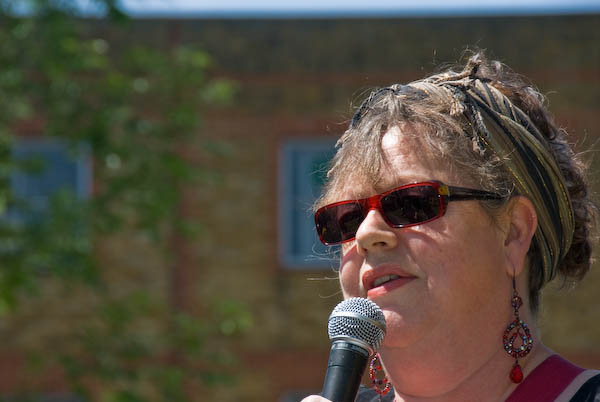
Rev Paul Nicholson & More: Many of us particularly in London have fond memories of the Rev Paul Nicolson (1932-2020), a redoubtable campaigner for the poorer members of our community. He appears somehow to have passed Wikipedia by but you can read more about his life from many online sources. On Saturday 29th March 2014 I photographed the Thousand Mothers March in Tottenham he and Taxpayers Against Poverty organised demanding demanding living incomes, decent truly affordable homes for all and rejecting the bedroom tax, the housing benefit cap, unfair taxes, hunger and cold homes.

Rev Paul Nicholson & More

Huff Post tells us Nicolson worked in the champagne trade from 1965 until he made a dramatic career change in 1967 and was ordained by the Church of England as a Minster in Secular Employment. This meant he had to find a job in the real world and he got a job at the ICI HQ in Millbank as a personnel officer. In 1975 he took one of the first Employment Trununals challenging ICIs redundancy procedures and was later involved in supporting other trade unionists elsewhere. In 1979 he ventured into politics becoming an Independent councillor where he then lived in North Herts.

Rev Paul Nicholson & More

After a long fight against the Poll Tax in 1997 he founded the charity Zacchaeus 2000 Trust (Z2K), based in London, a group who were were deeply concerned about the impact of the Thatcher Government’s ‘poll tax’ – a fixed payment from every adult, regardless of their income or circumstances. Z2K became a registerd charity in 2005 and Nicolson left it in 2012 withdrawing to found Taxpayers Against Poverty (TAP) to avoid the restrictions on political campaigning by charities.

Rev Paul Nicholson & More

Perhaps his most important action was to commission Minimum Income Standards research from the Family Budget Unity in 1999, which formed the basis of the London Living Wage, with Mayor Ken Livingstone setting up the Greater London Authority Living Wage Unit in 2005.

Rev Paul Nicholson & More

What would have been an ever greater achievement would have been the adoption by the authorities of the Memorandum to the Prime Minister on Unaffordable Housing he commissioned by Professor Peter Ambrose in 2005. New Labour read it but did nothing, continuing to concentrate on unaffordable housing. Had Corbyn been allowed to win by the Labour Party in 2017 we would have seen changes in the right direction – but policies like there were why thy fought hard to prevent his election.

Of course I’ve not mentioned the best-known fact about Nicolson. It was while he was living in Turville near High Wycombe that he allowed the BBC to take over his church to film The Vicar of Dibley. Dawn French was playing Grealdine Grainger as the Vicar, but the real vicar was Paul Nicolson, though I think he kept away from the cameras.

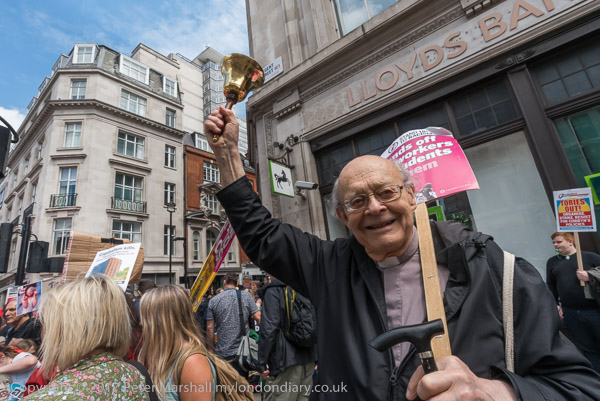
He retired and settle in Tottenham, becoming welll known for his campaigning in the area – and for a number of arrests and trials. He had called this march and its demands were neatly summarise on the placard hanging from a string around his neck: ‘We march for Freedom from Hunger, Cold, Outrageous Rents – Fight for a Living Wage’.

You can read a short article on him in the Guardian which contains around 30 of his letters which were published by the newspaper as well as links to many more. He truly was a great campaigner.

I left the march as it passed Tottenham Police Station with Carole Duggan walking in front of a large banner with the face of Mark Duggan, her nephew, murdered by police in Tottenham in 2011.

More about the march and many more pictures at Mothers march for justice.


I was on my way to two further protests that day which you can read about on My London Diary:

At Kilburn Square was a Kilburn Uniform Day protest where the Counihan Battlebus Housing For All campaign, along with the TUSC Against Cuts and TUSC were calling for rents to be capped and for everyone to have a home.

Kilburn Uniform Day

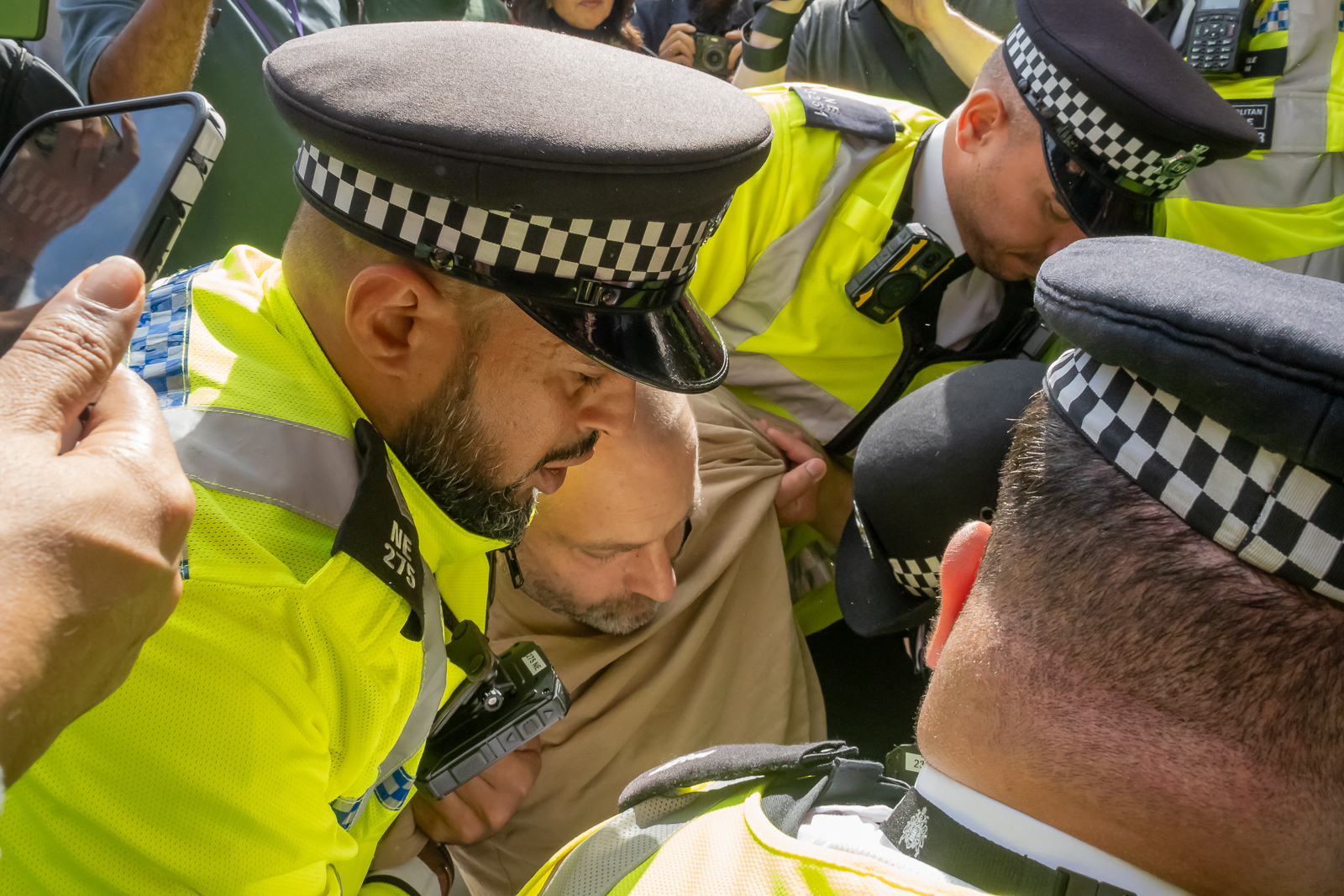
And in Parliament Square, staff and students from Oasis Academy Hadley in Ponders End were protesting against the Home Office plans to deport fellow A-Level Student Yashika Bageerathi to Mauritius.
She came here with her mother and two younger siblings in 2012 after physical abuse from a relative and claimed asylum in 2012. The application has been rejected and the whole family are under threat of deportation.

Yashika is now 19 and the Home Office decided they could deport her on her own and she had been in Yarl’s Wood immigration removal centre since March 19th. She and her fellow students want her to be allowed to stay – at least until she has taken her exams this summer. The #FightForYashica petition had attracted over 171,000 signatures.

Attempts by the Home Office to deport Yashika failed before this protest when pressure from campaigners led to British Airways refusing to take here. Ahe had been booked into an Air mAURITIUS flight for the day following this protest, but an avalanche of tweets led to them refusing to take her.

Finally she was deported on her own in April 2014 and fortunately was helped there to take her A-levels, receiving the grades she needed to go on to university and end her brief period in the public eye.

Fellow Students Fight for Yashika.


FlickrFacebookMy London DiaryHull PhotosLea ValleyParis
London’s Industrial HeritageLondon Photos

All photographs on this page are copyright © Peter Marshall.
Contact me to buy prints or licence to reproduce.

Shaker, Job Centres, Firefighters, Tube, Lambeth

Shaker, Job Centres, Firefighters, Tube, Lambeth – On Wednesday 25th February I photographed a number of protests in London, starting in Westminster with the Free Shaker Aamer campaign, striking firefighters and welfare rights activists, then with tube workers at Edgware Road and finally outside Lambeth Town Hall in Brixton.


Free Shaker Aamer – Parliament Square

Shaker, Job Centres, Firefighters, Tube, Lambeth

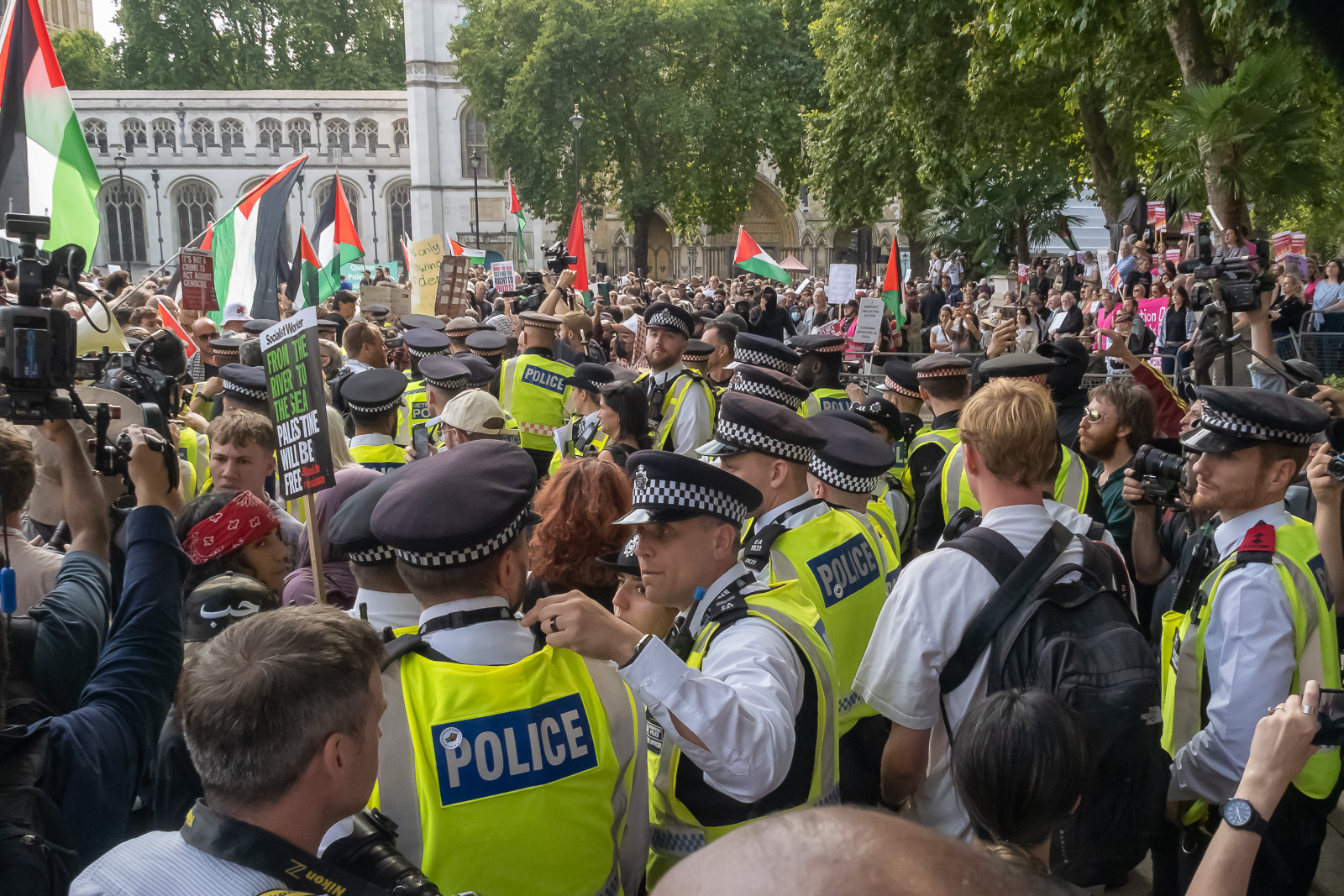
A protest opposite Parliament called for the urgent release of London resident Shaker Aamer from Guantanamo, where he has been held and regularly abused for 13 years without charge or trial.

Shaker, Job Centres, Firefighters, Tube, Lambeth

The Free Shaker Aamer Campaign had been holding weekly protests opposite Parliament whenever it was in session to remind government of the need for act over his release. He had long been cleared for release but was still held in the illegal prison camp with both US and UK governments dragging their feet as his testimony would be embarrassing to their security agencies, making clear their involvement in torture.
Shaker, Job Centres, Firefighters, Tube, Lambeth

The protest was longer than usual as an international event was taking place at the nearby QEII centre and they wanted to remind delegates there of Shaker’s torture and imprisonment. Eventually the long campaign of protests by this and other groups led the UK government they needed to back his release in practice and he was finally released on 30th October 2015.

More pictures: Free Shaker Aamer at Parliament


Striking Firefighters block traffic – Westminster

Shaker, Job Centres, Firefighters, Tube, Lambeth

Firefighters in England held a 24 hour strike on 25th Feb 2015 against the unworkable pension scheme the government intended to implement. They say that the devolved governments had recognised the problems in the scheme and made improvements but in England government ministers were refusing to talk with the union, simply ignoring requests for meetings. They accused the government of lies about the union, saying they were being labelled as militants despite them being ready and willing to enter into negotiations at any time.

After a rally in Westminster Central Hall, several thousand striking firefighters protested on the street outside Parliament before marching to Downing St. Their protest brought all traffic in the area to a standstill until they marched away.

They stopped outside Downing Street and refused to move, saying they would wait there until someone came out to talk to them. A senior police officer come to talk with Matt Wrack and the other FBU leaders there and was extrememly politie, taking Wrack’s mobile number before going away to see if anyone could be persuaded to come out from Downing St to meet the protesters.

I left them leaning on the barriers and looking into Downing Street waiting for someone to come and see them, though I doubted if anyone would ever emerge.

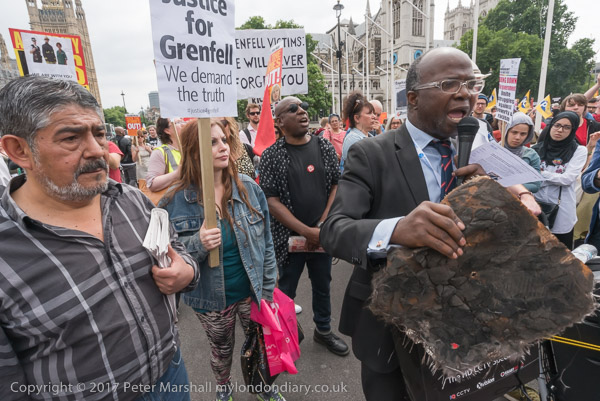
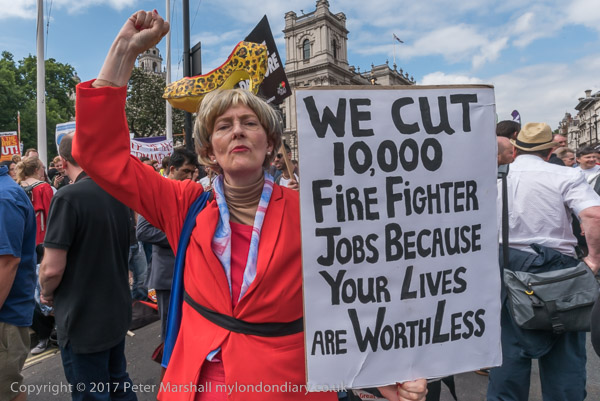
The Fire Service has also suffered like other public services from government cuts; in London these led to Mayor Boris Johnson making dangerous reductions, closing some fire stations and reducing equipment and staffing, which left the London Fire Brigade ill-equipped to deal with major disasters such as the Grenfell fire.

The FBU union later won a number of legal cases against the government over the changes that were made to the pensions scheme, leading to significant compensation for some members.

More at Striking Firefighters block traffic.


Welfare Advocacy not a Crime – DWP, Westminster

Welfare activists protested outside the Dept of Work & Pensions in Caxton Street as a part of the national day of action over the arrest of welfare rights activist Tony Cox. He had been arrested when he tried to accompany a vulnerable claimant to her job centre interview to argue for a fairer claimant agreement.

As well as several banners, one man was gagged in protest. By law claimants are allowed to have and adviser present with them at the interview, but when a claimant turned up with Cox, his interview was cancelled.

Cox and the claimant then left the job centre, but later in the day police arrived at his him and arrested him, charging him with threatening behaviour.

Welfare Advocacy not a Crime.


RMT protest Underground Job Cuts – Edgware Road Station (Bakerloo)

Around 20 RMT members handed out fliers at the busy Edgware Road Bakerloo Line station against the proposed 50% cut in station staffing and the closure of the ticket offices which they say will endanger the safety of both passengers and staff.

They got a very positive reception from many of the public going in and out of the station or walking past, although a PCSO came to harass and try to stop their picketing. Most of the public seemed to realise that staff do far more than sell tickets and offer service and protection to the travelling public.

Many promises were made to Underground staff and the public about how they would be protected when cuts were made, but most were later broken.

RMT protest Underground Job Cuts


Lambeth against £90m cuts – Lambeth Town Hall, Brixton

After taking some photographs of the protesting RMT staff I got on the Underground there, changing at Oxford Circus to take me to the end of the Victoria Line at Brixton.

There I walked down to Lambeth Town Hall on the corner of Acre Land to join around a hundred trade unionists, pensioners, library and other council staff, social housing tenants and other residents who were gathering for a lively rally outside Lambeth Town Hall.

A lively rally took place urging councillors who were arriving for the council meeting to reject library closures and other £90 millon cuts which were being passed there by the large Labour majority on the council. Labour then held 59 of the 63 council seats. Among the speakers at the rally was the only Green Party councillor, Scott Ainslie, who was to vote against the cuts. The Green Party gained four more seats in the 2018 council elections but lost three of these in 2022. Right-wing Labour councillors still have an overwheming majority and the council continues its policies which fail the community.

Lambeth’s finances were stretched by the development of a new Town Hall or Civic Centre the cost of which roughly doubled from the original contract of £55 million ot £104 million. Policies such as the closure of libraries and the demolition and sale of popular and well-built council estates like Cressingham Gardens had already produced a great deal of protest in the borough.

The £90 million cuts passed at the council meeting later that evening have had a disproportionate impact on children, old people and the disabled who always rely on local services more than the average person. Council employees at the rally opposed the cuts not only because they feared for their own jobs, but because they knew those that remain in post will not be able to offer the public the same quality of service that they do at present.

Lambeth against £90m cuts


FlickrFacebookMy London DiaryHull PhotosLea ValleyParis
London’s Industrial HeritageLondon Photos

All photographs on this page are copyright © Peter Marshall.
Contact me to buy prints or licence to reproduce.