Democracy, Black Cabs, Murad & Zionists

Democracy, Black Cabs, Murad & Zionists – My agenda for Wednesday 2nd June 2010 was a busy one, with protests about democracy in Parliament Square, London’s Black Taxis at Aldwych, a picket at BP’s St James’s Square HQ, trade unionists protesting at the Turkish Embassy and Zionists supporting the Israeli attack and killings on the Gaza aid flotilla.


Democracy Village Protest – Parliament Square

People had been camping in the Democracy Village in Parliament Square for just over a month and a few of them had come across the road with banners to protest. They held up banners, including a large one saying ‘We Respect The Soldiers We Do Not Support The War‘ and another ‘We Demand Peace In Afghanistan and No More War‘ and several made speeches with a megaphone. Another very artistically written notice on a large square of cloth on the pavement read ‘With Each Conscious Breath May You Know How Loved You Are in All Ways. You Are Divine. Let Your Light Shine’.

Democracy Village Protest


Brian Haw – Summons Marks 9 Years in Parliament Square
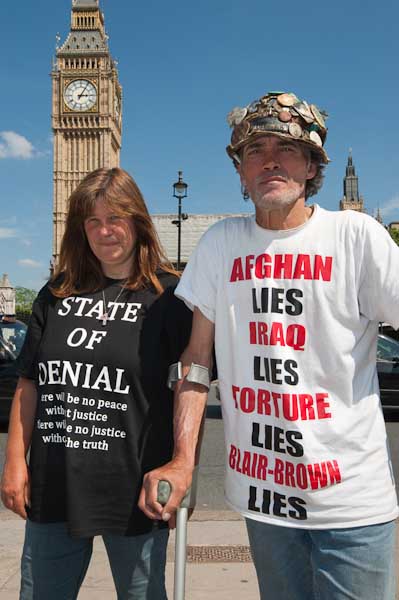
I went back to the other side of the road to talk with Brian Haw and Barbara Tucker who I had come to visit on the 9th anniversary of the start of Brian’s protest vigil opposite the Houses of Parliament in Parliament Square. A week ago they had been arrested and held for 30 hours on the day of the state opening of Parliament before the court released them on bail.
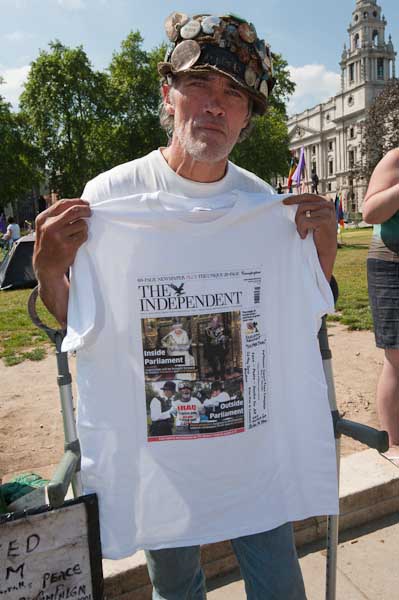
The arrest had come after Brian objected to police searching his tent in the early morning without a warrant – the 13th or 14th illegal search they have made, all part of a continual campaign of harassment. As we were talking we became aware of three police a few yards away standing and watching us. They then came over and served Barbara Ticker with a summons for using a megaphone in Parliament Square.
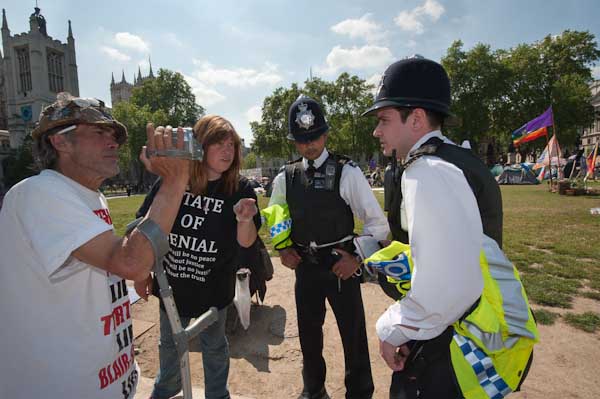
Brian and Barbara asked why she was being singled out for attention as there were at that time others In the Democracy Village actually using a megaphone and she was not at the time doing so. The officers made no attempt to answer this question.

BrianHaw – Summons Marks 9 Years


Black Cabs Protest – Aldwych
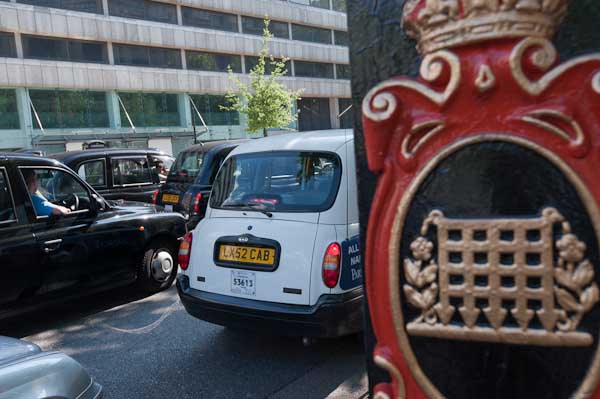
I don’t use taxis in London – or at least very seldom. I can only remember two occasions in the last thirty or so years, both when others insisted I go with them. It’s a wasteful, outdated and overpriced system which is responsible for much of the congestion in London, both by cabs carrying only small numbers of people compared to other public transport and also by ‘cruising for hire’ with no passengers on board.

My account on My London Diary gives some of their grievances, some of which I have some sympathy with, and I agree the police should be enforcing the law (rather than harassing protesters) but the whole system needs to be updated, taking into account the general availability of smart-phones and improvements in satellite navigation systems which increasingly make the ‘knowledge’ redundant and can provide real-time congestion information.

I didn’t find it an easy protest to photograph, which I think shows in the results. Lots of taxis are frankly rather boring, and not that unusual in London, where I commented that “While standing at a bus stop a couple of weeks ago I counted over 30 empty taxis going past before my bus arrived, and I couldn’t help but think we could have a better public transport system without taxis.”

Black Cabs Protest


BP Picket for Colombian Oil Workers – St James’s Square
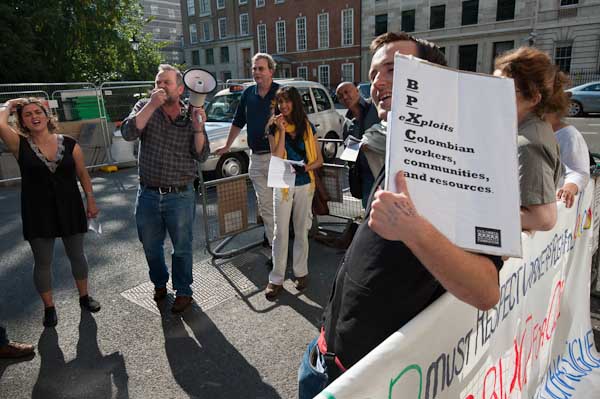
BP have a long-running dispute with the workers on the Cusiana oilfield in the Casanare department of Colombia, and its one where they are playing dirty, with union members accusing BP of carrying out a campaign of misinformation about what is happening in the plant, and in particular of falsely claiming the support of government officials for their lies about the action.

More or less as this picket was taking place, armed commandos from the Colombian army leapt over a security grid at the plant and attacked the workers who were carrying out a peaceful occupation of the Cusiana CPF (Central Processing Facility) in Tauramena.
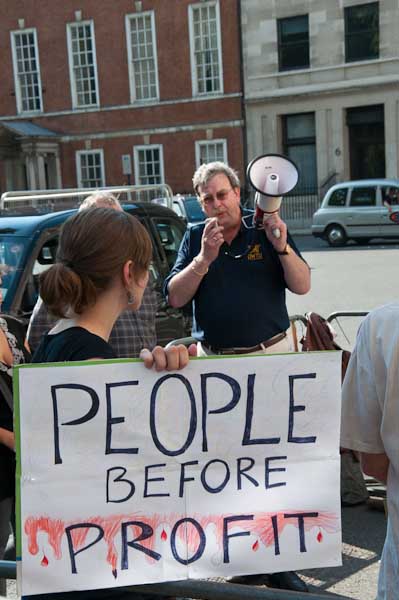
Previously BP had come to an out of court settlement on a UK High Court challenge over the pipeline from this oilfield to the coast, when farmers alleged that BP benefited from the actions of Colombian paramilitary forces who harassed and intimidated them in their protection of the pipeline. During the preparation of the case, of the lawyers for the farmers discovered she was on a death list and fled the country; she was granted political asylum in the UK.

The protest was organised by the Colombia Solidarity Campaign and was supported by the ICEM, the International Federation of Chemical, Energy, Mine and General Worker’s Unions, based in Switzerland which represents more than 20 million workers around the world, uniting trade unions in its sector around the world.

BP Picket for Colombian Oil Workers


Protest for Murad Akincilar Turkish Embassy, Belgrave Square

Trade unionist Murad Akincilar was arrested on a spurious charge of belonging to a terrorist organisation while on an extended holiday in Turkey last September and was in prison in Istanbul. His treatment in prison has resulted in serious eye damage and partial blindness. He was known personally to some of the protesters as he studied for a Masters Degree at the LSE, but since 2001 he has lived in Switzerland and worked for Swiss trade union Unia which was leading the campaign for his release.
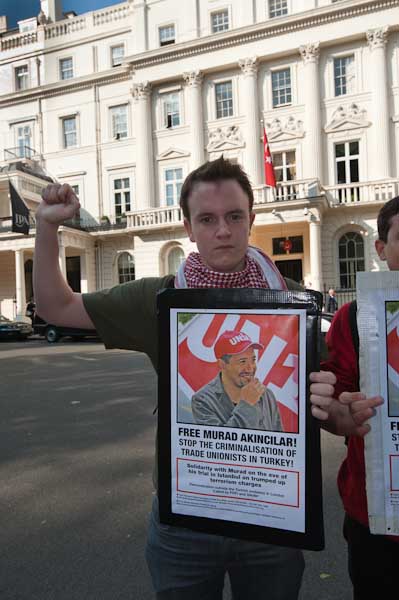
The protest opposite the Turkish Embassy was organised by Fight Racism! Fight Imperialism! and Gik-der, an organisation founded in north London in 1991 by migrants fleeing political and racial persecution in their home countries of Turkey and Kurdistan.

Protest for Murad Akincilar


Zionist Federation Support Israeli Atrocity – Israeli Embassy, Kensington
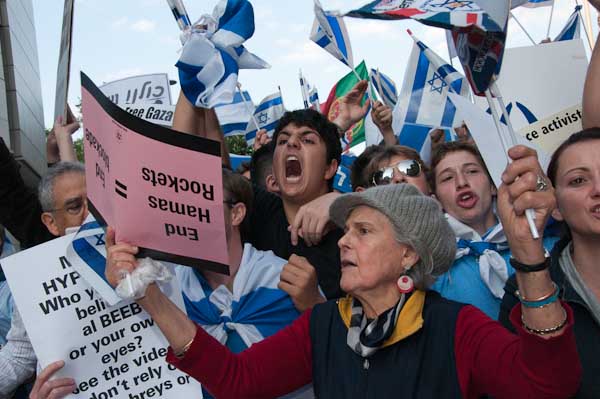
The Zionist Federation together with members of the English Defence League demonstrated opposite the Israeli embassy in support of the Israeli Defence Force killings in the attack on the Gaza aid flotilla.
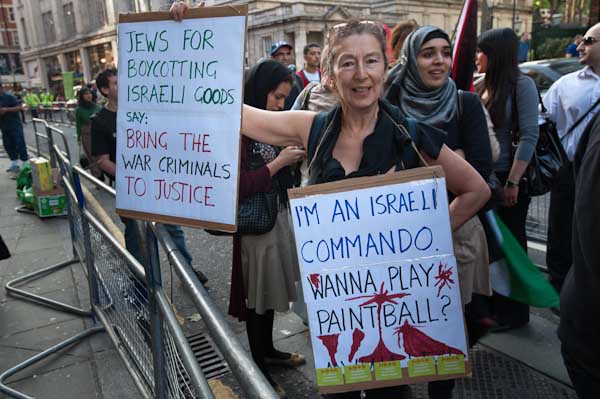
A smaller group of pro-Palestinian protesters had come to oppose them, although both the Palestine Solidarity Campaign and the Stop the War Coalition had decided not to support the counter-demonstration to avoid conflict.
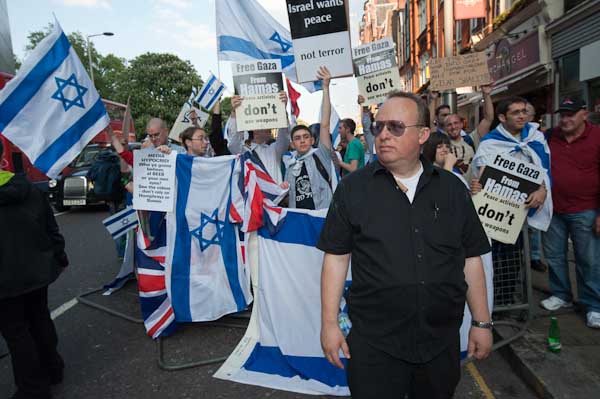
Although official Zionist sources had expressed some regret at the violence and loss of life, the mood of the supporters here appeared to be one of a gloating triumphalism that seemed entirely inappropriate to the situation. I was “sickened when at one point a large group of the demonstrators began chanting ‘dead Palestinian scum’ ” and appalled to find this was “a demonstration jointly with the Zionist Federation and the English Defence League, some of whose members many of us have seen and heard chanting racist slogans on our streets. It seems unbelievable that a Jewish organisation should align itself – even if unofficially – with people like this.”
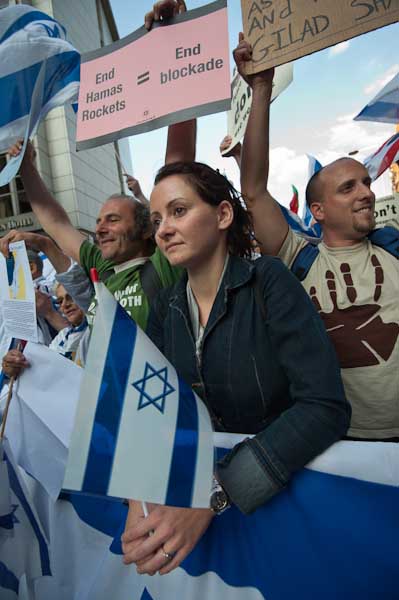
Attempts to justify the summary execution of one of the victims by shots to the head at close range by the existence of so-called weapons on the ships seemed insulting – almost all those shown in the photographs are “exactly the kind of tools that would be expected to be found on any ship in its galley and for general maintenance, as well as items being taken for building work in Gaza. The possible exceptions are a few canisters of pepper spray, some catapults and what looks like some kind of ceremonial knife.”
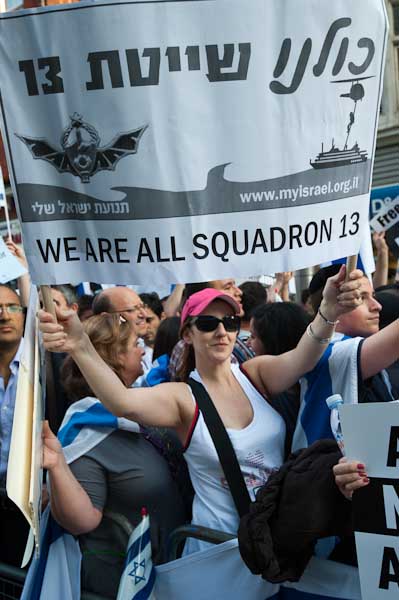
I’m very much in favour of peace in Palestine and Israel, but like many I feel “the actions of the state of Israel in their attacks on Gaza, their disruption of everyday life for the Palestinians and the blockade is making the possibility of peace much more distant… Like other conflicts, resolution depends on winning hearts and minds and this can’t be done with tanks and bulldozers.”

Police had to step in at the end of the protest when four press photographers were surrounded and chased by a an angry group of threatening Zionist demonstrators but all I suffered were a few threats and hostile gestures.

Zionist Federation Support Israeli Atrocity

Past Time To Act On Climate Change?

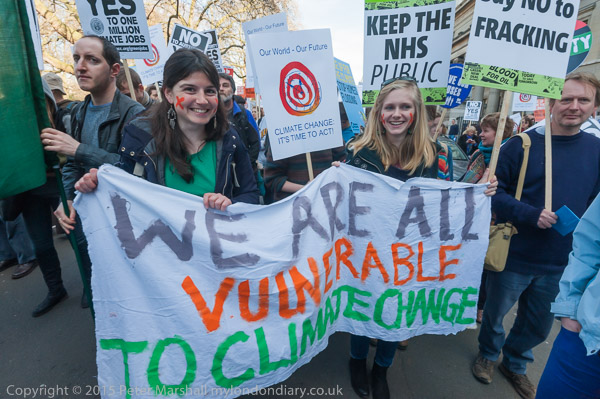
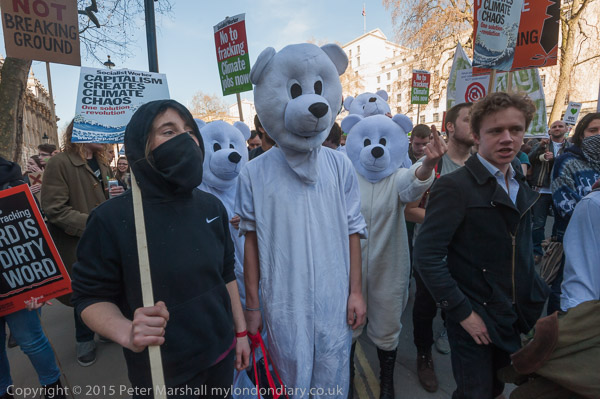
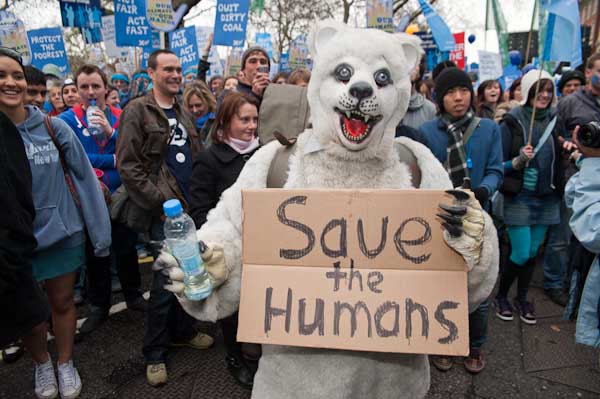
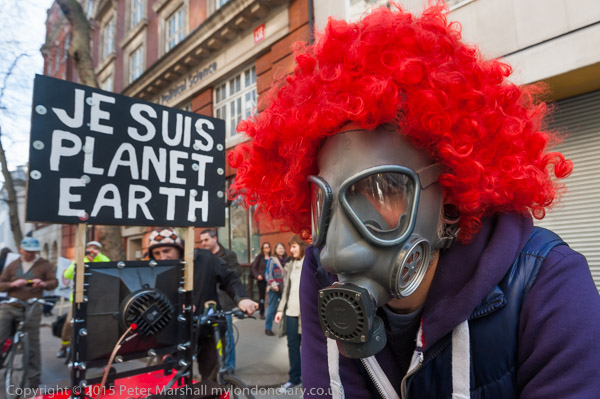
Past Time To Act On Climate Change? Seven years ago on Saturday 7th March 2015, 20,000 or so protesters marched through London to remind government and the nation it was Time to Act on Climate Change. Seven years on, the IPCC Sixth Assessment Report released a week ago warns “that climate breakdown is happening faster than expected and that the window to take action is closing fast. The report is a call to governments and private sector players to take drastic action against climate change.”

It’s a report that has largely been lost to public sight, pushed together with the stories about Tory sleaze and lies out of the news by the Russian invasion of Ukraine, though it has even more far-reaching implications. Not that I want to in any way minimise Putin’s criminal action and its terrible consequences for the people of Ukraine, largely innocents caught up in a situation of others’ making.

Of course the invasion of Ukraine has now raised the spectre of a nuclear war, which would almost certainly lead to mass extinction rather more rapidly than climate change, but the very dramatic prospect fortunately makes this almost unthinkable. Were it to happen it would almost certainly be by accident, something we have come close to several times in the past. Even our maddest politicians realise there is nothing to be gained by mutually assured destruction, and there would be no profits in it for the oligarchs or billionaires.

Climate change doesn’t happen in a massive flash, but is relatively slow and insidious. Even in the richer countries we are just beginning to feel its effects, and some in the Global South have long been suffering extreme hardship. But unless we heed the report and take drastic action without delay it will be too late to stop; many systems are coming close to their tipping points, past which there is no chance of recovery.

Scientists have been warning about the dangers for many years. Even 50 years ago when I was a student I spoke about the need to change the way we used the Earth’s resources and move to renewable systems of energy and agriculture, as many aspects of our current way of life were unsustainable.

Over 50 years ago it was clear to me that we needed to cut our dependence on fossil fuels, not just because of the carbon emissions and other pollutants, but also because thinking in the longer term it seemed a waste to burn what was a limited resource and an important chemical resource for plastics and other materials. I sold the only car I’d owned in 1967 or 8, because we needed to move away from a society based around private cars. It was clear too that we needed to farm in ways that conserved the soil and that many modern agricultural practices destroyed it – my father had joined the Soil Association which was established in 1946.

But of course there were huge profits to be made from fossil fuels and other industries that were driving up global emissions – and huge campaigns of obfuscation and lobbying. Most politicians in most countries were doing very nicely out of exploiting our natural resources – and the workers, who needed to be kept happy by more and more consumer goods as well as a huge and almost universal media promoting consumerism. Bread and circuses is of course nothing new.

Countries around the world, whatever their politics, are almost entirely run by politicians who have prospered from ‘business as usual’, and usually business corruption which they have colluded in by allowing money laundering, allowing huge tax avoidance and evasion and more. They have now learnt to talk the talk about climate change, but, as Greta Thunberg pointed out, it has been all “blah, blah, blah”, promises but little or no action.

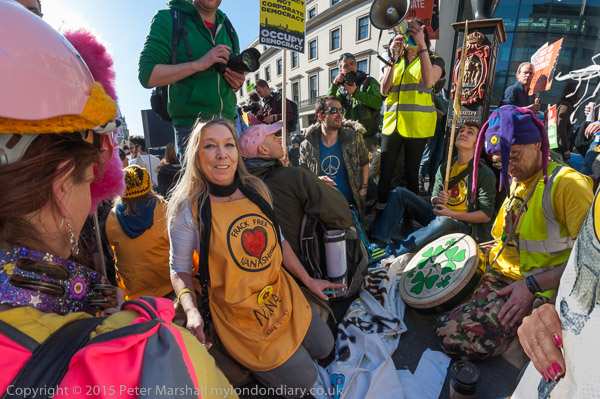
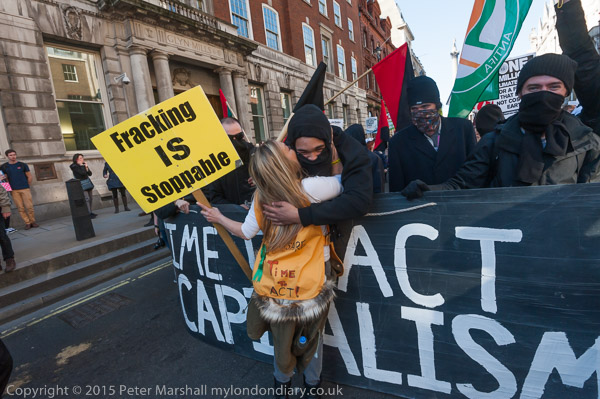
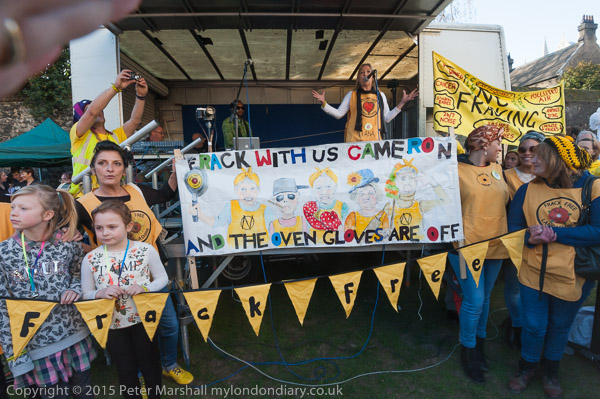
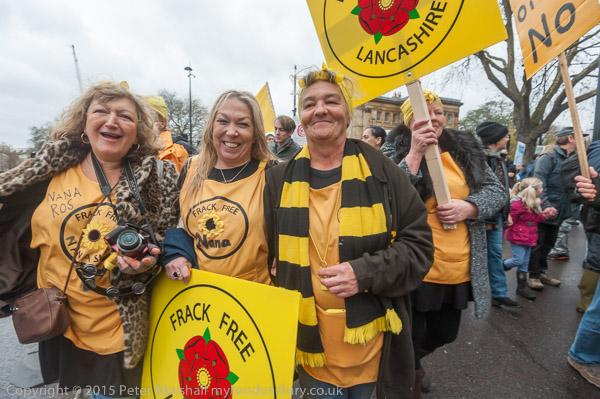
There were many different groups taking part in ‘Time To Act on Climate Change’, including the Campaign Against Climate Change who have organised regular protests in London since 2002, Friends of the Earth who I’ve supported since the 1970s, the Green Party, anti-fracking protesters including the fabulous ‘Nanas’ of Frack Free Lancashire, campaigners against Heathrow expansion – and I list a few more in Climate Change Rally, which also has pictures of some of the speakers.

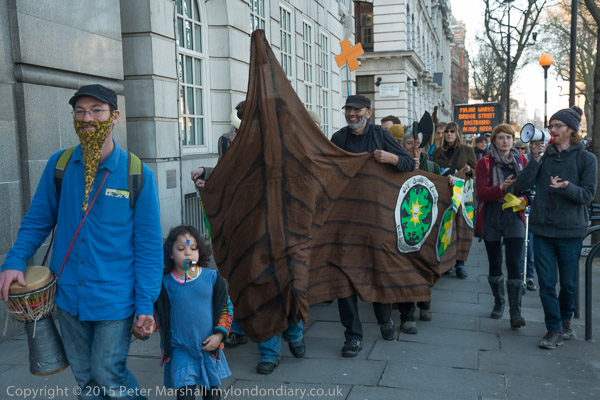
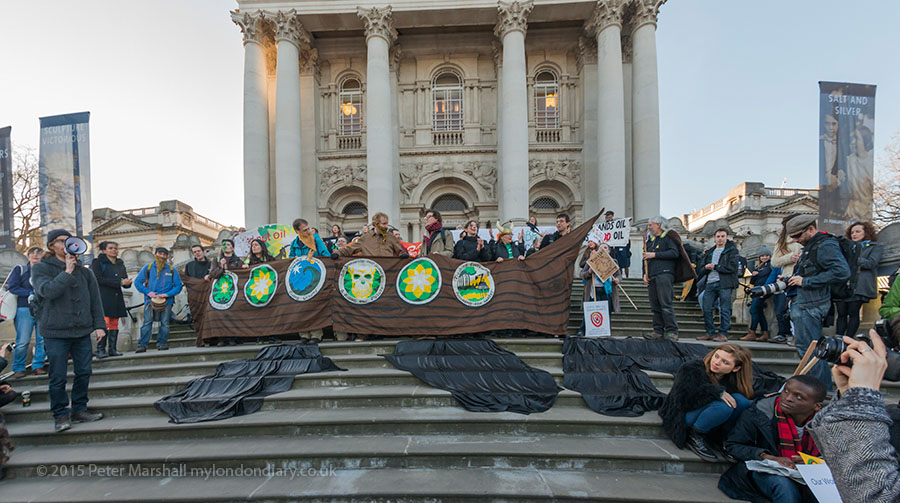
At the end of the rally I went on to photograph a protest by ‘Art Not Oil’ who invaded the steps of Tate Britain with their ‘longship’ and ‘oil spills’ in a protest demanding the Tate give up taking sponsorship from BP, who used their support of the arts to give themselves a positive public image despite the pollution and climate change their activites cause. It’s time to end this ‘greenwashing’.

Viking longship invades Tate steps has a few pictures of the event. The Longship first sailed to the British Museum where BP had sponsored a show on the Vikings. As I commented, the plastic oil spills used by the protesters “are a lot easier to clean up than the real ones BP has created such as Deepwater Horizon in the Gulf of Mexico, and which could be truly catastrophic in the Arctic.”

More on all these on My London Diary:
Viking longship invades Tate steps
Climate Change Rally
Time to Act on Climate Change


BP Or Not BP?

Since their birth as the Reclaim Shakespeare Company in 2012, BP Or Not BP? have carried out an incredible range of high-profile theatrical interventions which have received widepread media coverage against the abuse of our major cultural institutions by BP. One of the world’s major fossil fuel companies, BP uses its support of the arts to give it a respectable and worthy veneer while continuing to play its part in fuelling global warming and preventing real action against climate change.

According to the BP Or Not BP? website, the “have performed without permission at the Royal Shakespeare Theatre, the British Museum, the Edinburgh International Festival, the National Gallery, Cadogan Hall, the Royal Opera House, the Science Museum, the Roundhouse, the Noel Coward Theatre, the National Portrait Gallery and in Tate Britain.’

Some of these events have involved wide public participation, and have had considerable advance publicity andI’ve photographed a number of those that have taken place in London, but others have needed to be kept secret in advance, with only the players and a small number of trusted photographers and videographers being involved.
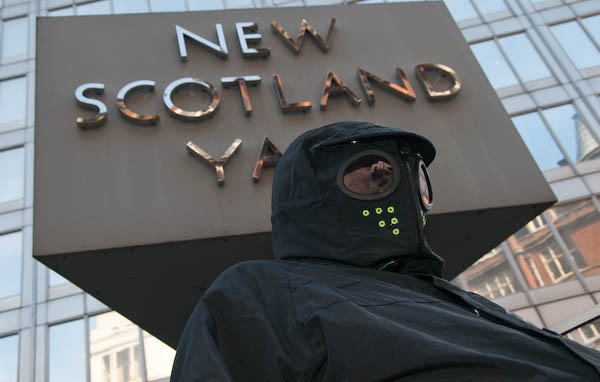
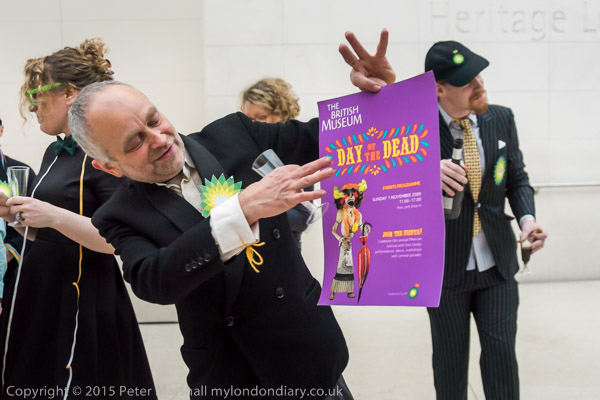
BP sponsored an exhibition on Mexico – the site of BP’s 2020 Deepwater Horizon disaster

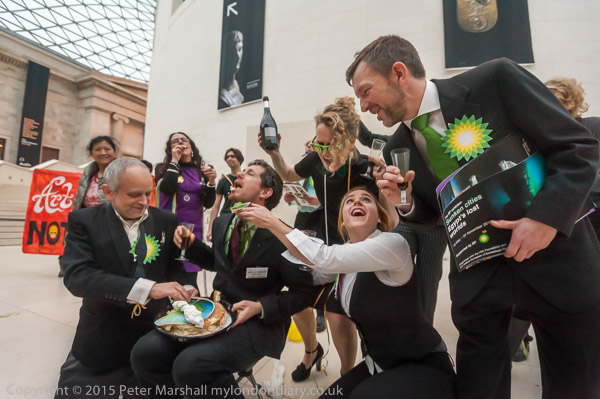
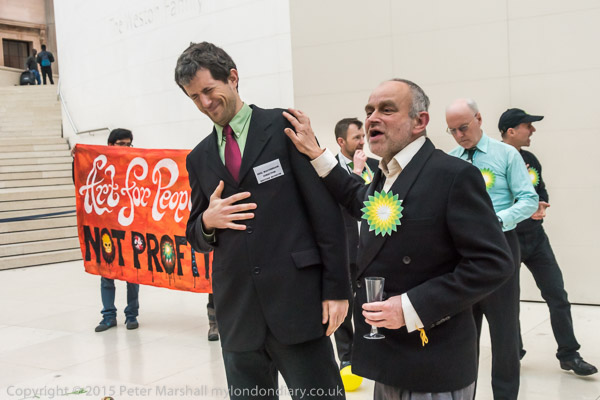
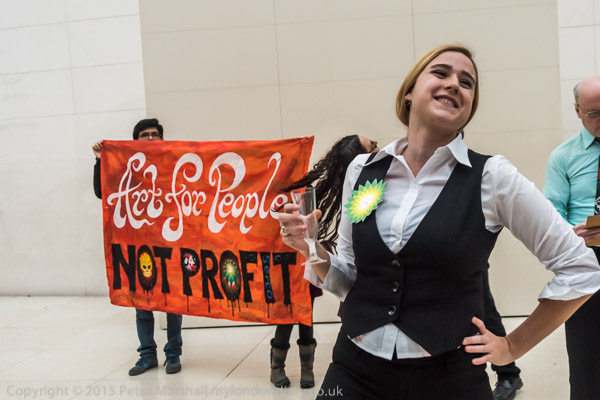
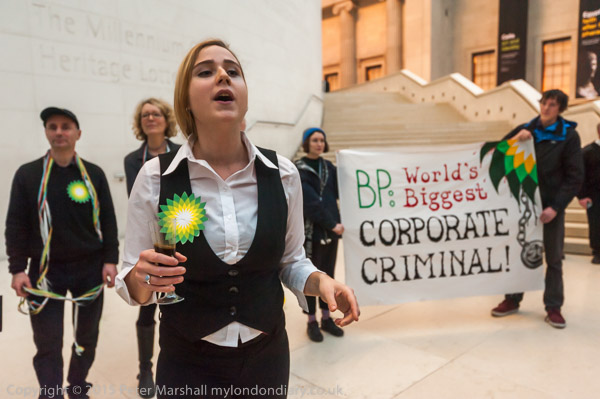
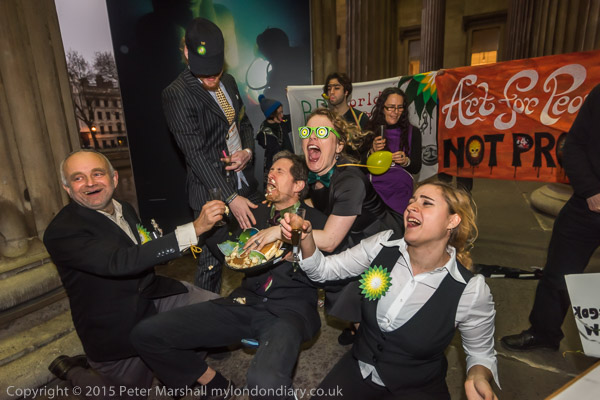
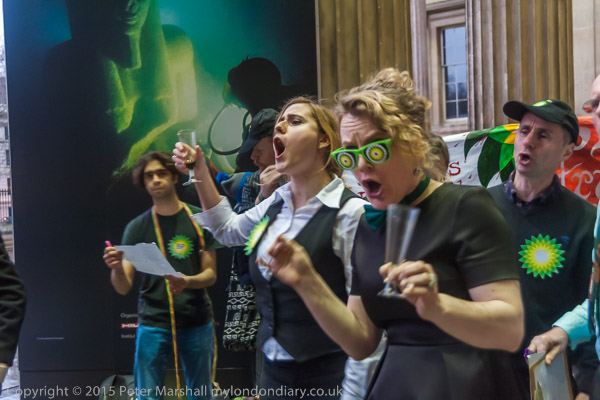
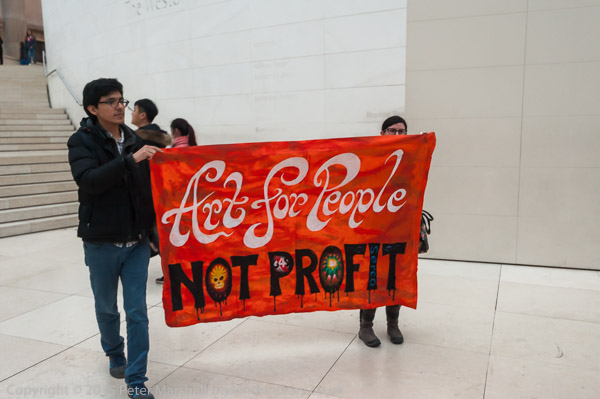
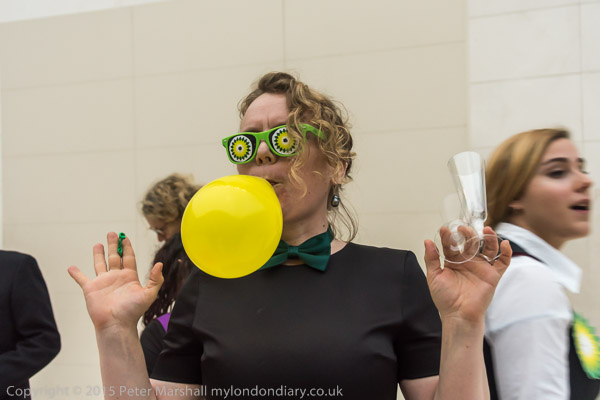
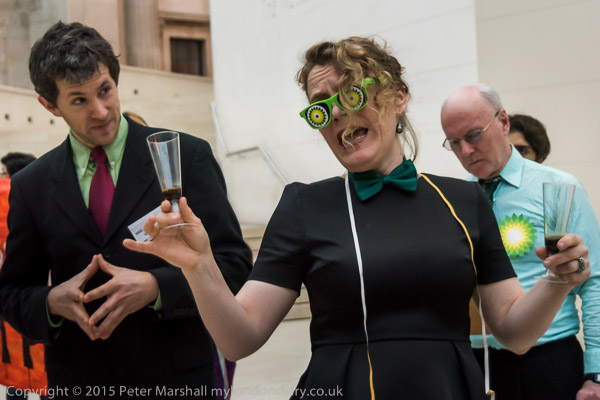
On 20th December 2015, I was pleased to be asked to photograph a performance of a play depicting ‘BP executives’ giving a farewell party to departing Museum director ‘Neil MacGregor’ inside the British Museum’s Great Court as visitors and security stood and watched. The pictures here are a small reflection of those I took on that occasion.
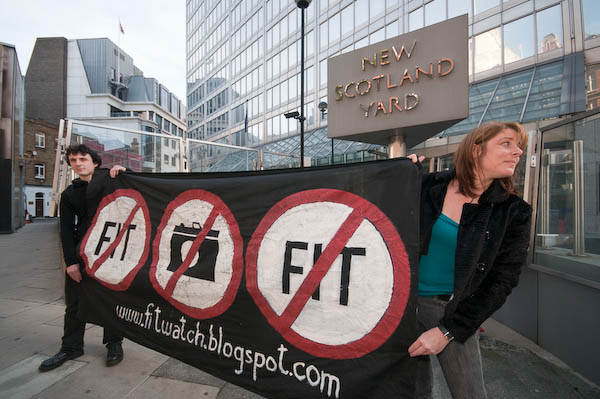
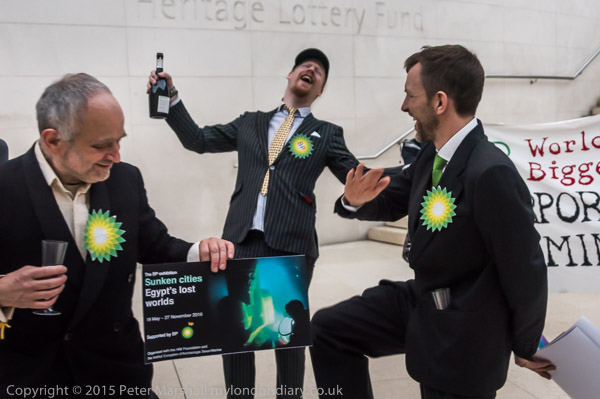
Sunken Cities – BP activities are causing sea level rise

You can read my account of the event at End BP’s British Museum Greenwash, along with a more detailed account of the proceedings including the full written script by BP or Not BP? on their web site. Although as I wrote, the actual performance contained considerable improvised embellishment.

In my account of the event, I included these paragraphs about the reasons behind the protest:

BP makes a relatively small contribution to the museums budget, a fraction of a percent, for which they get an engraved message on the wall of the rotunda in the Great Court and their logo prominently on the publicity for the museum’s major exhibitions, including Vikings, Ming, Indigenous Australia: Enduring Civilisation, the Mexican Day of the Dead and Sunken Cities, the last two perhaps particularly unfortunate as BP has been given the largest corporate criminal fine in history of $18.7 billion for the underwater Deepwater Horizon oil spill which caused huge pollution of the ocean around the coast of Mexico.
The current 5-year sponsorship deal between BP and the British Museum ends shortly and the museum and its new director will soon have to decide whether to renew its with the oil giant. While a good deal for BP, the amount concerned is a relatively small contribution to the museum’s budget, and thanks to the activities of BP or Not BP and other climate activists results in a great deal of bad publicity for the museum; hopefully they will look for less toxic sponsors.

After the performance inside the museu, there was another on the steps outside

Unfortnately the British Museum hasn’t ended its deal but renewed it and is still taking dirty oil money from BP. In November 2021 over 90 leading members of the archaeology and museum community sent an open letter to the Museum trustees calling on them to end BP sponsorship which they describe as “a strategy of reputational management. BP is taking advantage of the British Museum’s status as a highly respected institution, and of the public’s love of museums and heritage, to associate its brand with values of high culture, art, education, sophistication, reason, and knowledge. These values have powerful significance and appeal within our society and, crucially, among our political and civic decision-makers.”

BP or not BP? might put it more succintly: “‘greenwashing’ their very dirty, oily, reputation”.


Waving to Copenhagen – 5th Dec 2009

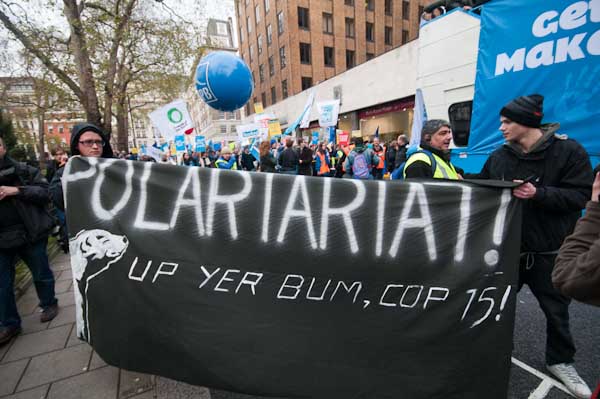
Remember Copenhagen? This was COP15, and generally thought to have been a great failure, with developed countries’ refusing to adopt targets on limiting emissions by 2020 and developing countries insisting on their right to develop their economies and catch up with the big polluters.

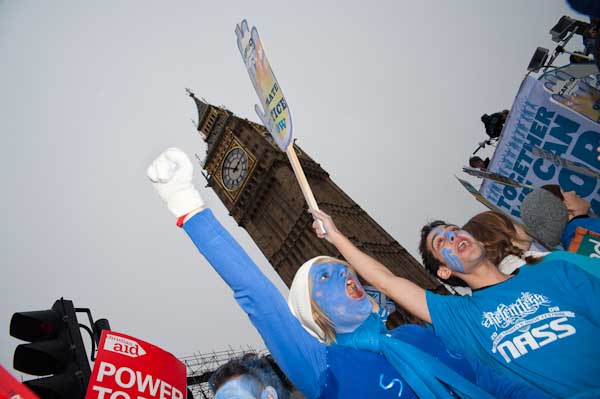
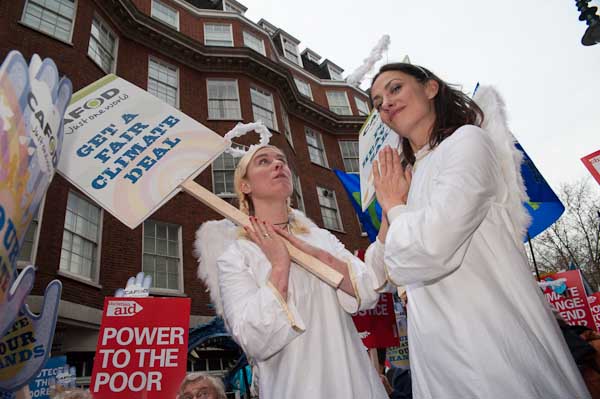
But 2009 did see an upsurge in general interest in climate change, and one of the largest events in London against it, with many large charities combining in the Stop Climate Chaos Coalition and conducting what seemed more a PR exercise than a protest, culminating in a ‘Big Wave’ outside the empty Houses of Parliament at 3pm. Everybody around Parliament waved, made a lot of noise and then wondered what to do next.

As I wrote at the time:
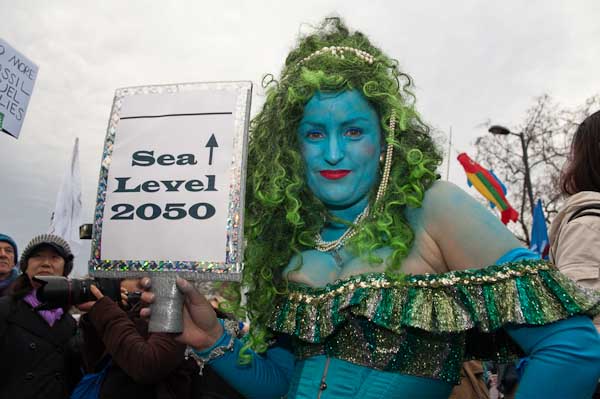
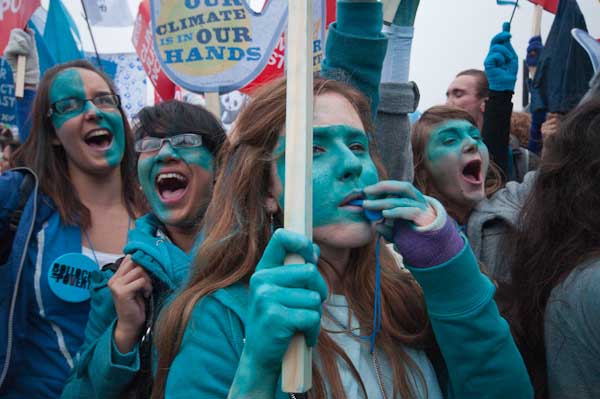
Although it was good to see a wider participation – although despite that huge potential and massive publicity the march was perhaps only a little more than five times the size of previous years – this year’s event, entitled ‘The Wave’ did seem more a stunt for the media than an informed political event. Surely with the backing of 11 million the coalition should be making demands, not just waving, and it’s perhaps hard to see the significance of blue hands and faces in a demonstration about global warming.

It did appear to have been an opportunity lost to adopt a more robust attitude and push our government at least into some action. The day of protest also involved all the other groups who had been protesting over climate change for some years – and seemed to me to rather be hi-jacking the annual climate march by the Campaign Against Climate Change rather than getting behind them and working with them. That feeling underlies much of my reporting of the day, which I split into the seven sections on My London Diary – as below.

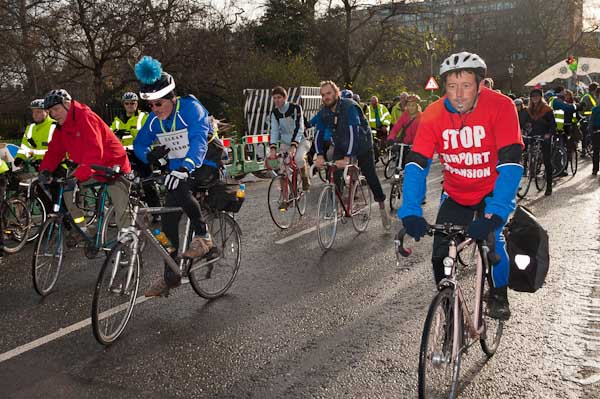
Climate Emergency Bike Ride

After two speeches at Lincoln’s Inn Fields, the ride, organised by the Campaign Against Climate Change went on to hold demonstrations outside the London offices of two multinationals guilty of activities that are contributing to climate change, BP in St James’ Square and E.On in Pall Mall. Speakers there outlined some of the damage the companies were doing to the environment and how their activities were accelerating climate change.

Climate Emergency Bike Ride.

Climate Emergency Rally

The Campaign Against Climate Change had also organised a rally in Hyde Park before the march organised by the Stop Climate Chaos Coalition who were gathering in nearby Grosvenor Square, presumably to avoid anything political. While the Coalition were simply calling for “a fair and effective international agreement” , CACC made clear that “there is no chance of an effective agreement until the North wins the trust of the South and it will only do that if Northern countries like the UK match words with action and take radical emission-reducing measures at home.” The failure of Copenhagen showed they were right.

Climate Emergency Rally

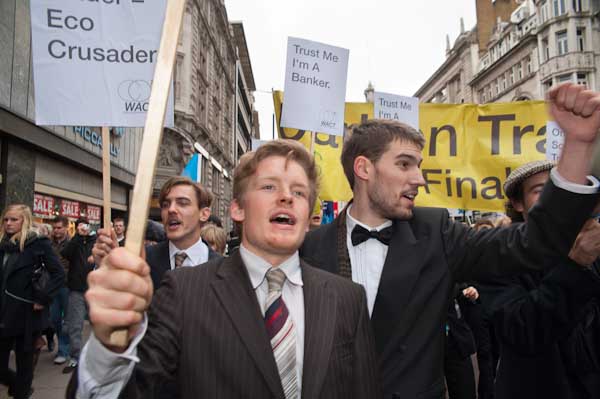
World Association of Carbon Traders

The ‘World Association of Carbon Traders’, group of around 50 smartly dressed ‘city gents’ – who included a few ‘gentesses’ and rather more bad false moustaches – along with power-dressed business women, joined the joined the Stop Climate Chaos Coalition march under the banner ‘Carbon Trading: The Final Solution’. Their ‘ CO2$’ logo and placards including ‘Trust Me, I’m a Banker, Capitalise On The Climate’, ‘In Markets We Trust’, ‘One Solution. Trade Pollution’, ‘Greed is Green’, ‘Carbon Trader = Eco Crusader.’ and ‘Cash In On Climate Change’, which as well as the ‘Permits to Pollute’ they were handing out made their ironic intention clear.

I recognised some of the faces of these agents from previous demonstrations by the Space Hijackers, a group who call themselves ‘Anarchitects’ whose various projects over the last ten years given a new creative face to protest.

World Association of Carbon Traders


The Wave – Before the March

I took a few pictures of the crowds gathering in Grosvenor Square for the Stop Climate Chaos Coalition march on my way to and from the CACC rally.

The Wave – Before the March

Anticapitalist Block – Not Much Waving

For a minute or two this banner led the march as it came through Berkeley Square while march stewards came and argued with them. After a short while and the intevention of a rather stout cop these protesters were persuaded to roll up their banner and suggested they join the march rather further back.

There they joined a few others dressed mainly in black, some carrying red or black flags behind another black banner with the message “NO BOMBS NO BAILOUT NO CAPITALISM“. The block left the march and went to Jubilee Gardens rather than stay for the wave at Parliament.

Anticapitalist Block

Marching to the Wave

Marching to the Wave

The Wave

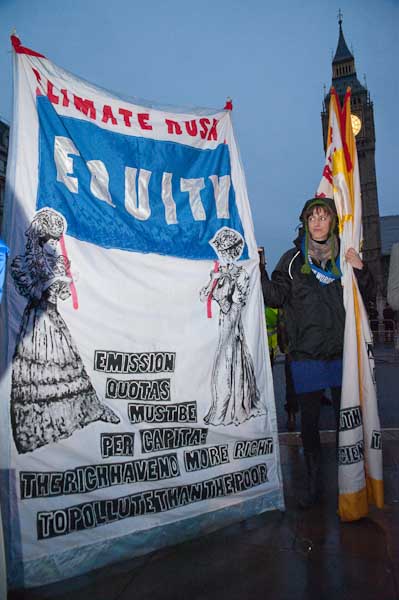
They waved. And then the stewards tried to get them to disperse. Some stayed on in Parliament Square., and I photographed some of them with banners, including Climate Rush. Their banner with a large heading ‘EQUITY’ carried the message “Emission Quotas Must Be Per Capita. The RIch Have No More Right to Pollute Than the Poor”.

In my caption I commented “It’s a principle seemed certain to prevent real progress at Copenhagen – as the rich and in particular the USA – won’t accept it.” And so Copenhagen was doomed to fail.

The Wave


Global South leads Climate March 2015

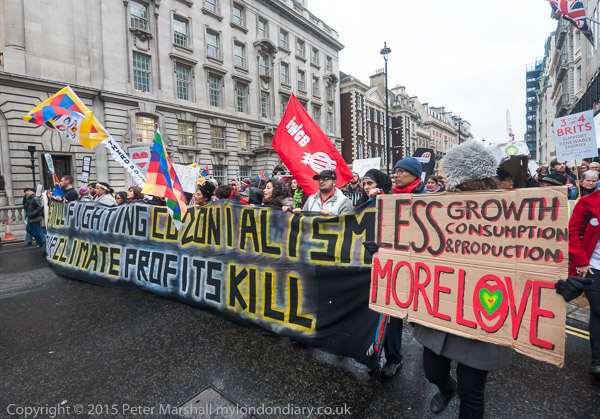
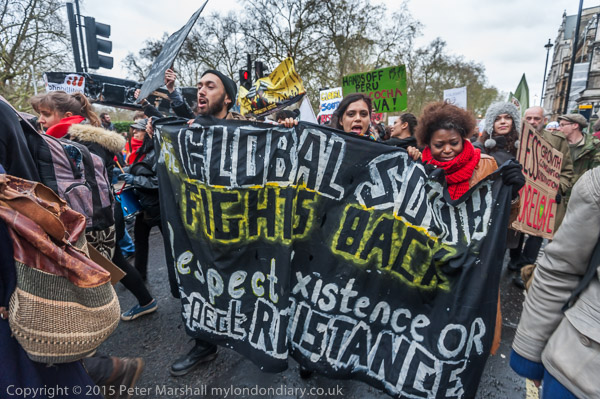
Global Frontlines bloc banner ‘Still fighting CO2onialism – Your Climate Profits Kill’

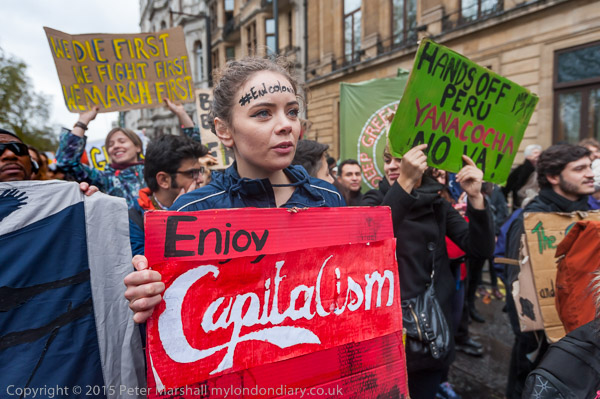
Many groups came together for a march through London on 29th November 2015 about the need for action over global warming and climate change on the weekend before the Paris talks. It had been agreed that the march should be led by the Global Frontlines block, as the Global South is already being more affecte by climate change.

But on the day the organisers, representing the large groups including Avaaz, changed their mind. They decided to put the main march banner along with some of those in carnival animal costumes at the front of the march as they felt the Global Frontline was too radical, wanting system change not sops.

The organisers decided to put their main banner and a section of animal costumed carnivalistas in front to hide this more radical group, but not surprisingly the Global Frontlines group were not having this and moved back in front of the carnival. The organisers then sent in the private security guards they had employed to steward the march rather than relying as most other protests do on volunteers, with orders to hold back the more radical block and remove some of the more political placards and coffins that were being carried.

It was hardly surprising that this move was resisted, and the protesters stood their ground, and repelled the security guards. The organisers then called the police to try and enlist their help to move the bloc from the front of the march, but other than passing on the organisers’ request I understand they sensibly refused to try to illegally remove the block. The whole argument was a disgraceful attempt to de-politicise the event and to marginalise those facing the sharp end of climate change, and one which they successfully resisted.

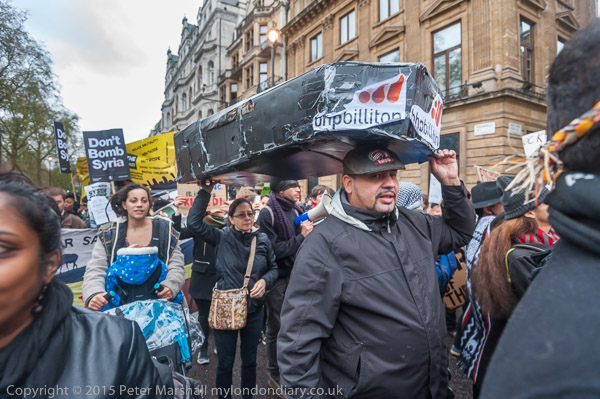
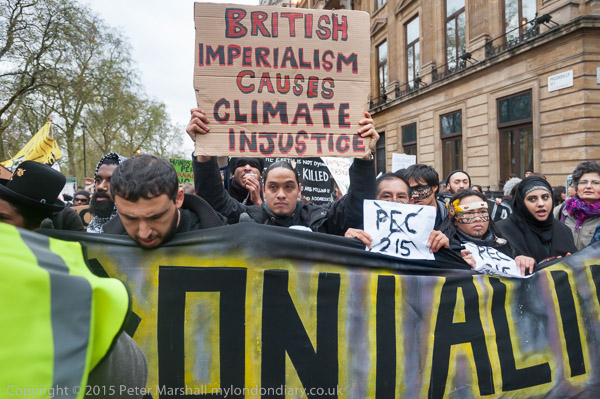
The banner at the front of the Global Frontlines block – and thus march as a whole – read ‘STILL FIGHTING CO2ONIALISM YOUR CLIMATE PROFITS KILL‘ and there were others with anti-colonial messages including ‘Extractivism is Colonialism‘ and other anti-mining sentiments. Apparently what worried the more conservative charities most was the message ‘British Imperialism causes Climate Change‘ as well as two coffins naming companies BP and BHP Billiton.

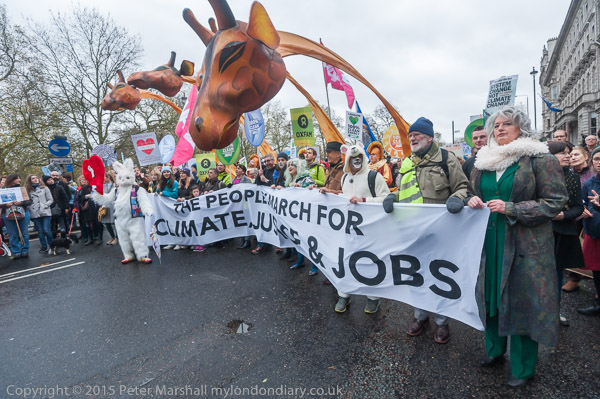
The organisers held back the rest of the march to leave a longish gap between this group and the rest of the march led by the the ‘The People’s March for Climate & Jobs‘ banner which the organisers had tried to put in the lead, along with its white rabbit and giraffes. But when the Global Frontlines stopped and sat in the road for a protest close the offices of BP in St James Square, many of the more radical groups in the main march streamed past this banner to join the march up again.

It was an unfortunate dispute, and one that for many of us undermined the credentials of some of the more affluent protest groups, who many on the left suspect of being funded by corporations and governments to try to tame the environmental movement rather than effectively oppose climate change. It seems quite clear that without some drastic system change we are doomed to see business as usual taking us to extinction.

More about the march and many more pictures – giraffes and all – on My London Diary:
Global Frontlines lead Climate March
March for Climate Action Starts


11 October 2008

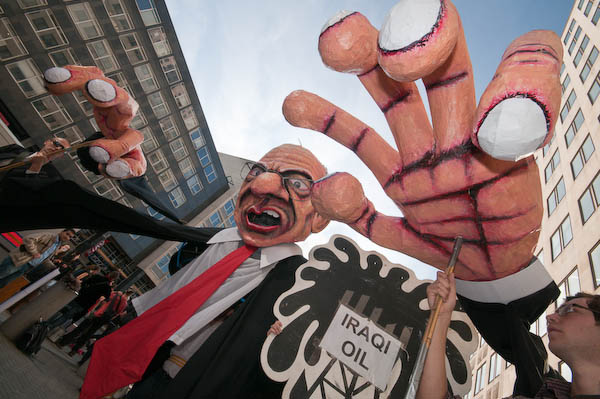
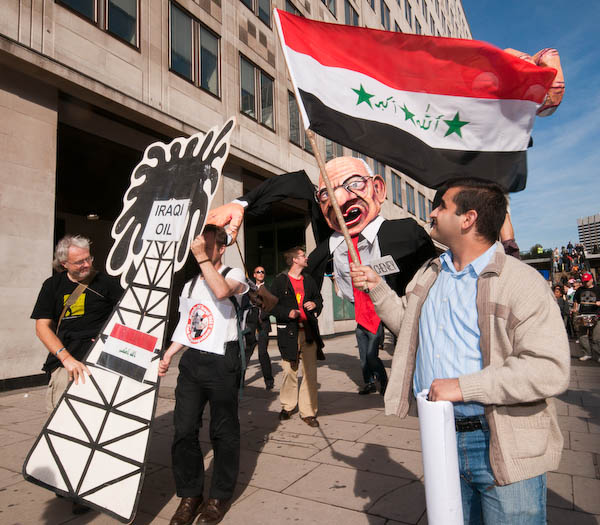
It was the start of the final 100 days of the Bush adminstration and the ‘Hands off Iraqi Oil’ coalition whose members included Corporate Watch, Iraq Occupation Focus, Jubilee Iraq, PLATFORM, Voices UK, and War on Want and was supported by the Stop the War Coalition and others had come to Shell’s UK headquarters at Waterloo to protest against plans by Britain and the USA for Iraq to hand over most of the country’s oil reserves to foreign companies, particularly Shell and BP.

Iraq had nationalised its oil by 1972, and it provided 95% of its government income. Many had seen the invasion of Iraq by the US and UK (along with Australia and Poland) as largely driven by the desire to gain control of Iraq’s huge oil reserves and the US had engaged consultants to help it write a new oil law which it got the Iraqi cabinet to approive in 2007 which would give foreign oil companies – including Shell and BP, long-term contracts within a safe legal framework. But large-scale popular opposition meant the Iraqi parliament failed to approve the new law. But in June 2008, the Iraqi Oil Ministry went ahead with short-term no-bid contracts to the major foreign oil companies – including Exxon Mobil, BP, Shell, Total and Chevron and later these and other contracts were made more favourable to the oil companies.

After the protest at Shell’s offices the protesters marched to protest outside the BP HQ in St James’s Square and then to the US Embassy, and I left to cover the London Freedom not fear 2008 event outside New Scotland Yard. Similar protests were taking place in over 20 countries to demonstrate against excessive surveillance by governments and businesses, organised by a broad movement of campaigners and organizations.

The London event highlighted the restrictions of the right to demonstrate under the Labour government’s The Serious Organized Crime and Police Act 2005, (SOCPA),, the intimidatory use of photography by police Forward Intelligence squads (FIT), the proposed introduction of ID cards, the increasing centralisation of personal data held by government, including the DNA database held by police, the incredible growth in surveillance cameras, ‘terrorist’ legislation and other measures which have affected our individual freedom and human rights.

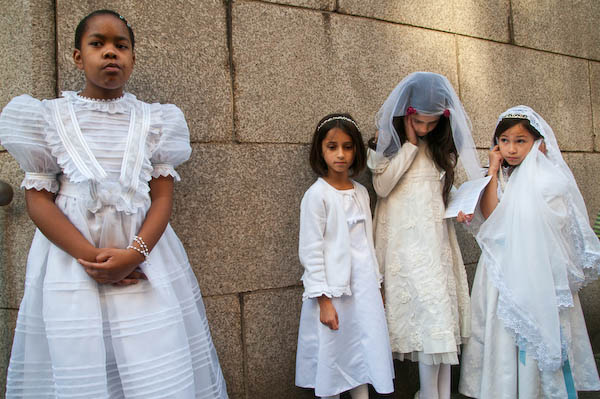
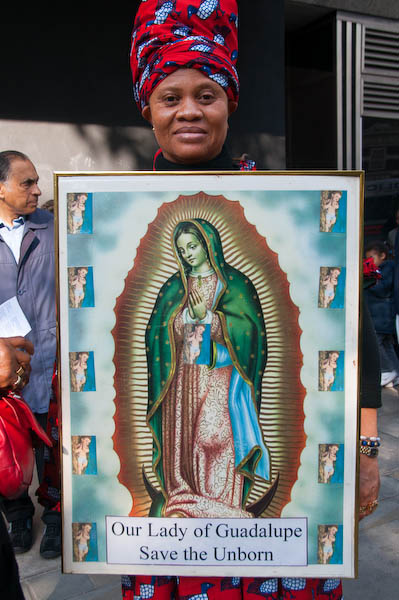
For something completely different I walked a quarter of a mile down Victoria Street to Westminster Cathedral where people were assembling for the Rosary Crusade of Reparation, one of the larger walks of public witness by Catholics in London.

This tradition began in Austria in 1947 with the roasary campaign begun by a priest praying for his country to be freed from the communist occupiers. The first annual parade with the statue of Our Lady of Fatima took place in 1948 in Vienna on the feast of the Name of Mary, Sept 12, which had been established by Pope Innocent XI in 1683 when Turkish invaders surrounding Vienna were defeated by Christian armies who had prayed to the Blessed Virgin.

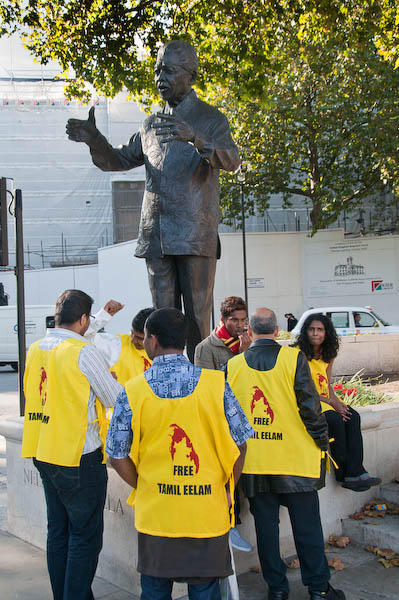
As the procession to a service at Brompton Oratory began I walked back up Victoria St to Parliament Square, where a number of other small protests were in evidence. All over the centre of London there were people giving out leaflets about the growing problems faced by Tamils in Sri Lanka, where they allege a program of ethnic cleansing is being carried out by the government. International media are banned from the Tamil areas of the country and NGOs have been ordered out of some areas, so there are few reports of the war. Worse was to come and in 2009 in the final stages of the war conservative estimates are that 70,000 civilians were killed in the the Mullivaikkal massacre.

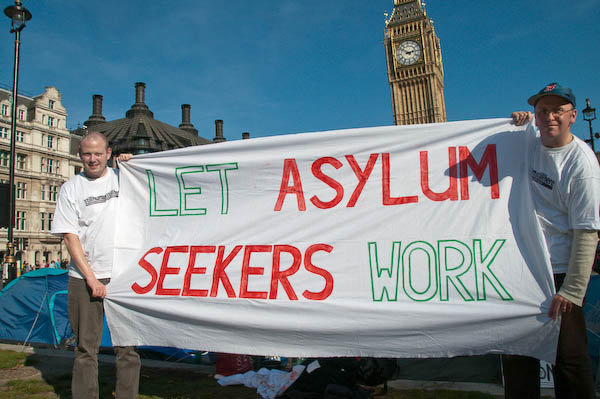
Others in the square were protesting against the UK’s scandalous treatment of asylum seekers and calling for the asylum detention centres to be closed down.

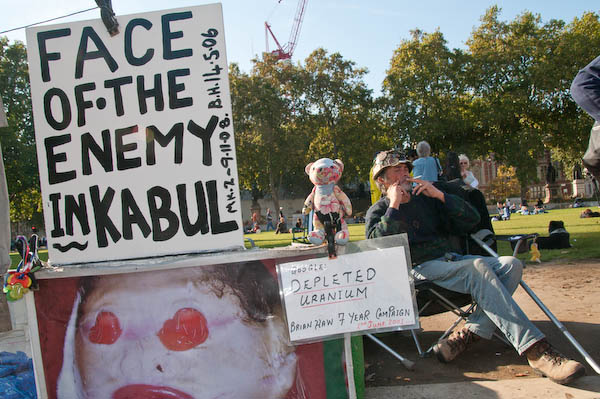
Brian Haw was still there, and I wrote:

Facing Parliament, Brian Haw‘s peace protest continues – he has been there for almost 2700 days – over 7 years – and it will soon be his 60th birthday. Brian says that now the police seem to have largely abandoned attempts to get rid of him legally there have been a number of odd attacks against him and others in the square – which the police have ignored. I took some time talking to a man who smelt of alcohol, was talking nonsense and acting unpredictably – and who then went and started to insult Brian. One of the other demonstrators stood between him and Brian who was filming him. I put down my bag as I took photographs in case I needed to step in and help, but fortunately he eventually moved away.

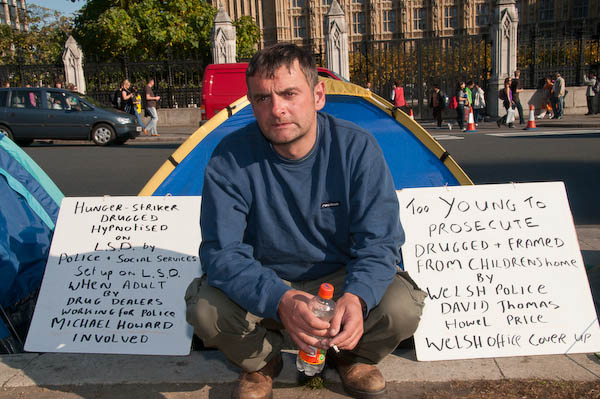
There were others protesting in Parliament Square, including one man who asked me to take his picture. He told me his name was Danny and that he had been there on hunger strike for two weeks, protesting over his failure to get his case investigated. He claimed to have been abused by police and social services following an incident in which as a seven year old child in Llanelli he was implicated in the death of a baby brother. I was unable to find any more information about his case.

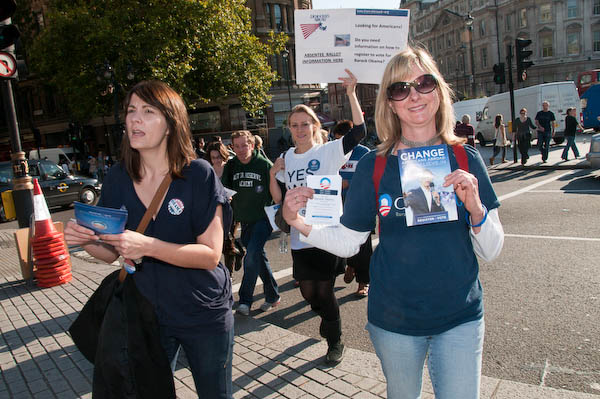
Finally I saw a group of people walking past holding leafelts with the the word CHANGE on them and rushed after them to find they were Obama supporters hoping to persuade Americans they met to register and vote in the election. It was time for me to go home.

Parliament Square
Rosary Crusade of Reparation
Freedom not Fear 2008
Bush & Cheney’s Iraq Oil Grab


Organised Crime – Public & Private Sector

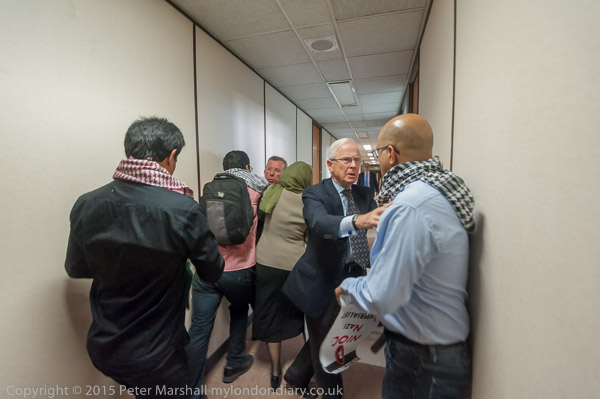
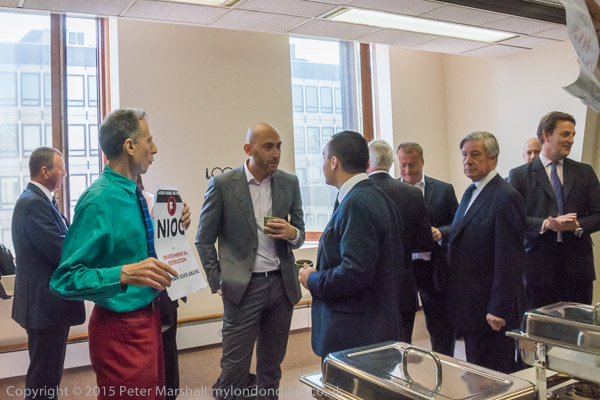
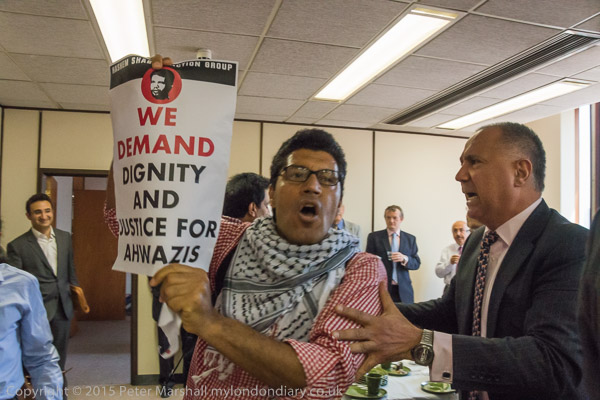
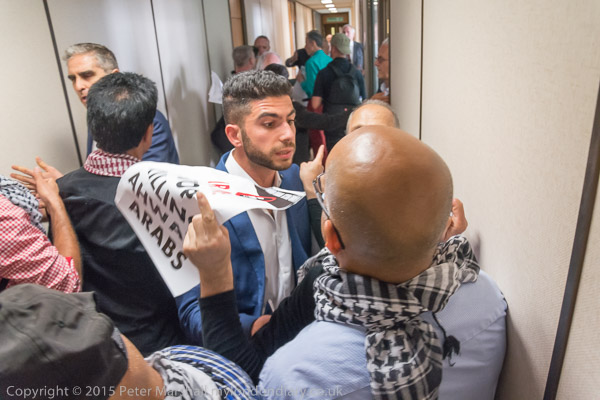
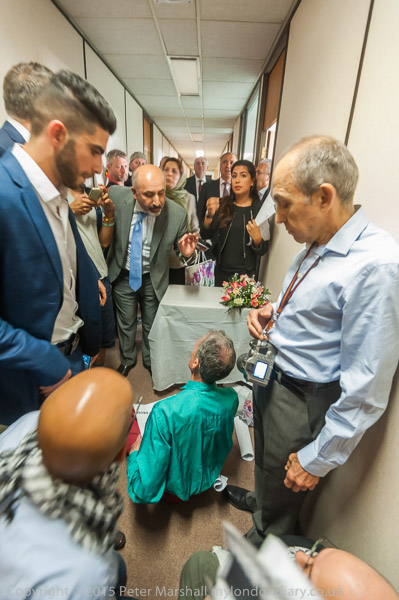
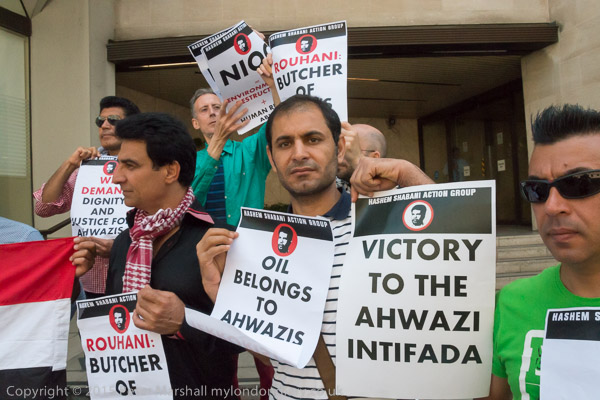
I don’t know who drew the often published cartoon which shows a young boy talking with his father and saying “Dad, I’m considering a career in organised crime” to which his father replies ‘Government or Private Sector”, but it comes to mind when thinking about the secret UK-Iran business meeting which I photographed Ahwazi activists and Peter Tatchell gate-crashing on July 3rd 2015. Though the UK-Iran crimes involve both sectors.

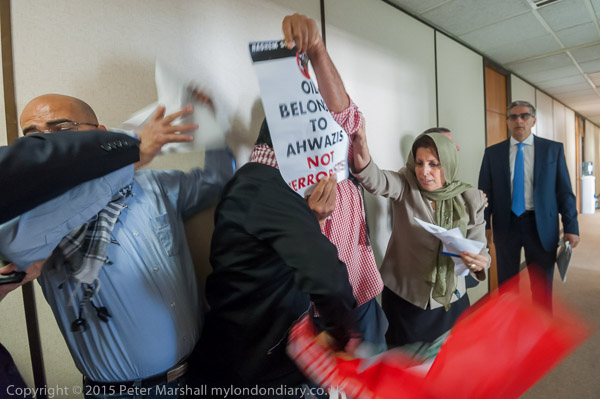
To take pictures I had to rush in with the group of protesters to the National Iranian Oil Company offices in Westminster, which are clearly private property and I Would probably be committing an offence, but I felt there was a clear public interest in covering the protest by the Hashem Shabani Action Group against the exploitation and environmental destruction of their homeland by Iran and the UK and the long history of anti-Arab oppression by the Tehran regime.

Fortunately I was able to enter the building without being personally confronted by the security staff who were busy trying to grab some of the protesters, and along with two other photographers and a couple of videographers was able to run up the six flights of stairs to the floor where the secret meeting was taking place, though I was in a pretty poor state by the time I reached the top landing, worried I might collapse. I was after all probably around 20 years older than most of the others, though only seven older than Peter Tatchell.

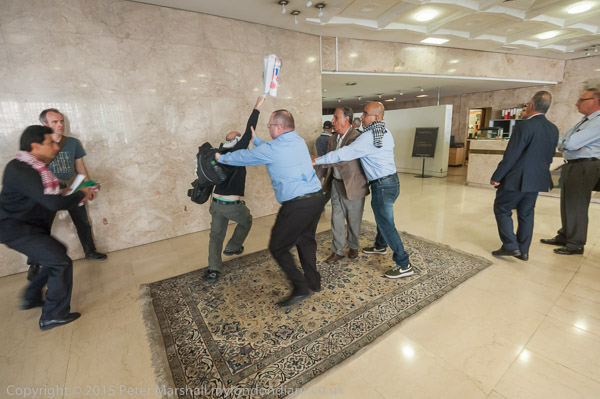
I did manage to photograph the peaceful protest inside the meeting, where most of those present were enjoying a buffet lunch, and to take some pictures of the confrontation in the corridor outside, where one youngish man in a blue suit, thought by the protesters to be an Iranian military officer, became rather violent and assaulted another of the photographers. But the corridor was dimly lit and some of my pictures were less than sharp, mainly blurred by moving subjects with the slowish shutter speed I needed.

I may have mentioned in other posts that I very seldom watch TV. I last lived with a TV back in 1968, when I got married and moved into a flat without one, and since then it’s been something I just don’t have time for in my life. Of course I’ve watched TV elsewhere – and can do so now by computer, but its never become a regular habit. One of the consequences of this is that there are many celebrities and public figures that I don’t easily recognise, only hearing them on radio or seeing the occasional picture in the press. So although Lord Lamont or Tory MP Richard Bacon, leader of the All Party Parliamentary Group on Iran, both leading the call for the peaceful and non-violent Hashem Shabani Action Group, (motto ‘Our weapons are pens. Our bullets are words‘), to be banned as a terrorist group were present, I failed to get newsworthy pictures of them.

Having made their point, the protesters decided to leave and I went with them, only to be stopped by police in the foyer of the building. We were prevented from leaving despite showing our press cards, but told we were not under arrest. The photographer who had been assaulted complained to the police, who went upstairs to ask questions, returning after a few minutes to say that the perpetrator probably had diplomatic immunity, and the photographer decided not to press charges.

Eventually after around 45 minutes – during which the building manager brought us fruit juice – press and protesters were allowed to leave and join those outside who had been unable to get past security for more photographs.

More on My London Diary about the dubious history of Britain and Iranian oil and the protest at Ahwazi crash secret UK-Iran business meeting.


All photographs on this and my other sites, unless otherwise stated, are taken by and copyright of Peter Marshall, and are available for reproduction or can be bought as prints.


Armenian Genocide, TTIP, Football and Cyclists in Tweed

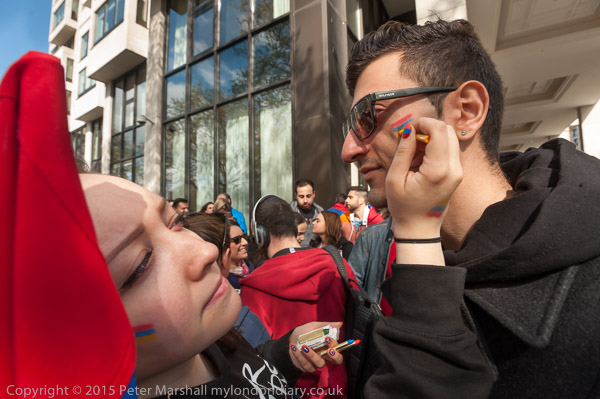
On Saturday 18th April 2015, Armenians marked the 100th anniversary of the start of the Armenian Genocide in Turkey in which 1.5 million were killed between 1915 and 1923. Turkey still refuse to accept the mass killings as genocide and the UK has not recognised the killing of this huge number of Armenians as genocide. The term was first published in 1943 by Polish lawyer Raphael Lemkin in his book ‘Axis Rule in Occupied Europe‘. After he had read about the killing of Armenians in Turkey and found that there was no law under which Talat Pasha, the grand vizier of the Ottoman Empire could be charged he invented and defined the term ‘genocide.

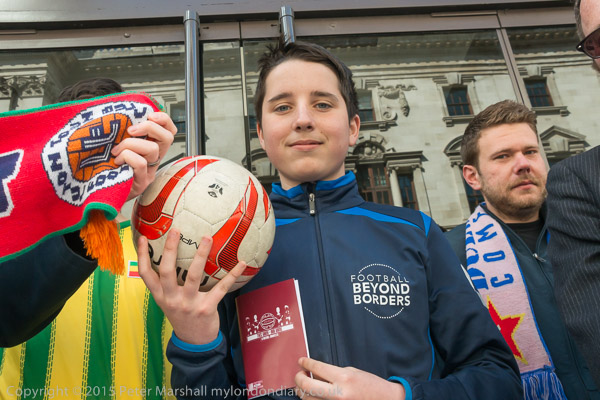
I left shortly before their march began to catch up with the Football Action Network who were taking copies of their manifesto to the Labour, Tory and Lib-Dem offices in Westminster. They were moving fast and there was no sign of them at Labour HQ; I ran on to the Tory HQ to find they had left, and finally caught up with them at the Lib Demo offices near Parliament Square. There I found supporters with scarves from Bolton, Luton Town and Dulwich Hamlet from Football Beyond Borders holding a couple of banners and passports with their demands, including a Football Reform Bill, a living wage for all staff, fair ticket prices, safe standing, and reforms to clubs & the Football Association.

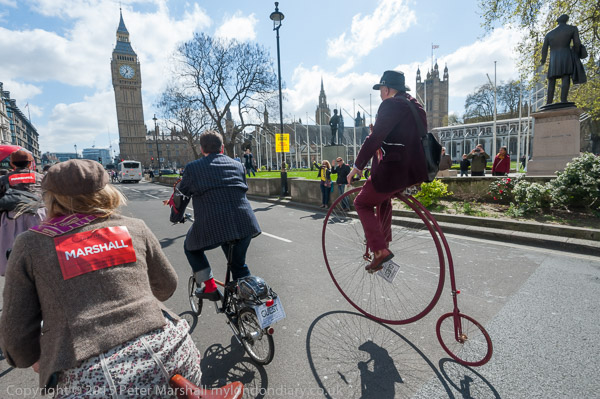
The next even came to me, as a group of cyclists on the Tweed Cycle Ride stopped at the traffic lights on the road opposite, and I ran to meet them, then ran along with them through Parliament Square when the lights changed to green. he Tweed Run raises money for the London Cycling Campaign and describes itself as “a jaunty bike ride around London in our sartorial best“. The vintage-themed ride stops for tea and a picnic and ends with “a bit of a jolly knees-up.” Not really my kind of thing.

I caught the tube to Shepherds Bush and a rally on the Green against TTIP, the Transatlantic Trade and Investment Partnership being secretly negotiated by governments and corporations which poses a threat to democracy and all public services. The huge public outcry across the EU against this and in particular the Investor-state dispute settlement (ISDS) already incorporated in some other treaties which allows companies to sue countries for ‘discriminatory practices’ including efforts to combat global heating is possibly why these talks were eventually abandoned in 2016, though our EU referendum may also have helped. After speeches the rally split into groups for discussion.

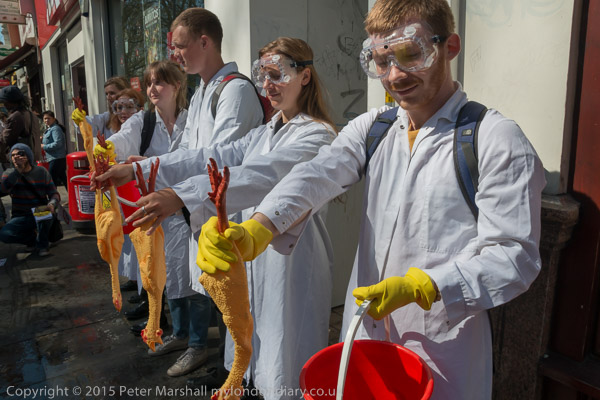
After the rally, white-coated War on Want campaigners moved across the road to a branch of Kentucky Fried Chicken for a performance with buckets and rubber chickens protesting against TTIP which would force us to admit US agricultural products produced by practices considered unsafe here – such as chlorine-dipped chickens, hormone stuffed beef etc. The need for these methods is driven by US intensive farming methods which have lower standards for safety and animal welfare than are acceptable here – and although TTIP ended without a treaty, our post-Brexit trade agreement with the US seems almost certain to include similar hazards.

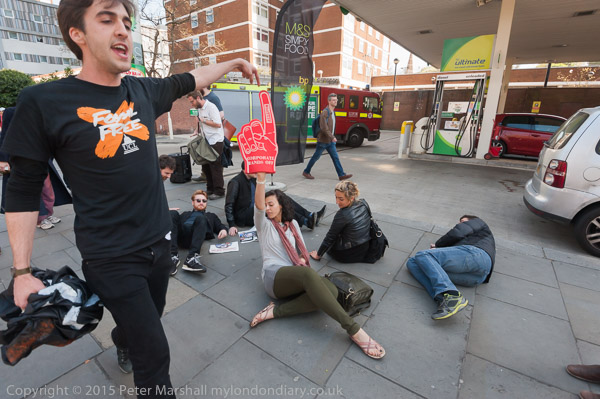
Next I moved with protesters to the BP garage on the opposite side of Shepherds Bush Green, where activists staged a die-in as TTIP would force countries to use dirty fuels including coal, tar oil and arctic oil and seriously delay cutting carbon emissions and the move to renewable energy.

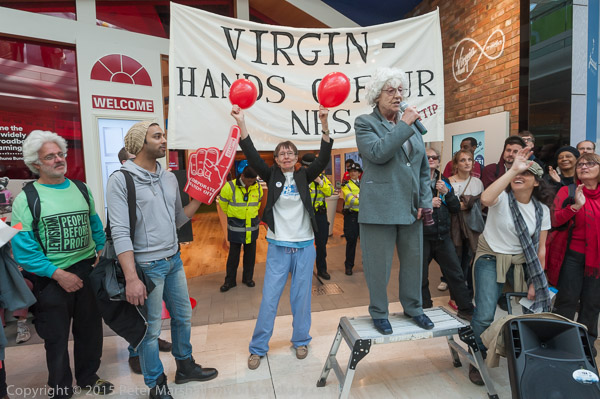
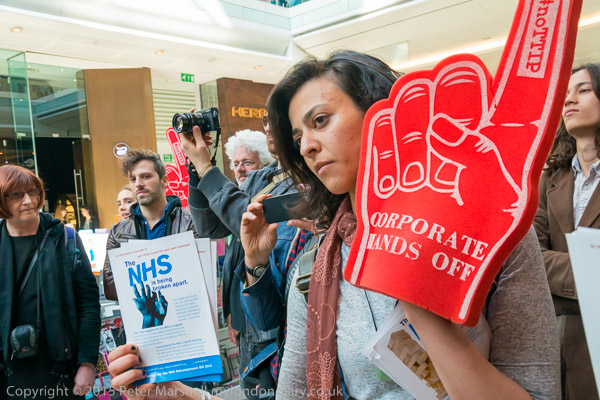
Finally, a group of protesters walked into the Westfield centre to stage a street theatre performance outside Virgin Media to illustrate the danger that TTIP poses to our NHS, allowing corporations to force the privatisation of all public services. Like other large shopping centres Westfield is a private place where protests and photography are not permitted, but police and security stood back and watched the event, and though security attempted to stop some videographers I kept a lower profile and was not approached.

Virgin Media is actually no longer a part of the Virgin empire, though it still pays Branson to use the name. Virgin Care now runs a large part of the NHS which is rapidly being privatised by the Conservative government. According to The Observer, because of a complex structure of holding companies with links to other parts of the Virgin empire with its roots in the British Virgin Islands, the company is “unlikely to pay any tax in the UK in the foreseeable future.”

Westfield ‘Save our NHS’ protest
BP die-in against Climate Change
KFC protest over TTIP
Stop TTIP rally
Tweed Cycle Ride
Football Action Network Manifesto
Centenary of Armenian Genocide

British Museum and BP

Five years ago today on 20th December 2015 I went into the British Museum with “actor-vists” from ‘BP or not BP‘ to photograph their ‘A Farewell to Neil MacGregor – Director of the British Museum‘ who had enjoyed a “cosy relationship” with the museum’s sponsor, BP.

Fossil-fuel companies make their profits largely through the combustion of the hydrocarbons they produce in the engines of cars, lorries and aeroplanes and the boilers used to generate electricity and heat buildings and other processes which turn the carbon in these fuels into the greenhouse gas carbon dioxide, the main cause of the global warming which is currently threatening the future of human life.

As well as that, the prospecting and exploitation of oil resources, now more and more taking place in environmentally fragile areas such as the Arctic, together with spillages, some inevitable but others demonstrating a remarkable lack of care are causing terrible damage to our environment. And of course most of what doesn’t get burned is made into plastics and we are now becoming aware of the huge amounts of this that ends up in the marine environment with disastrous consequences.

While continuing to fuel the global crisis, companies such as BP have invested heavily in promoting themselves as good guys, publicising the relatively small investments they have been making in renewable energies and other green areas. It’s a short-sighted policy as their long-term future – and ours – depends on a complete move away from carbon fuels, but one which keeps current investors rich at the cost of the rest of us.

Almost certainly the most cost-effective part of the ‘green-washing’ of BP’s ecologically disastrous activities has been their sponsorship of many of our major cultural institutions including the British Museum, something which the cultural activists of ‘BP or not BP’ have highlighted in a number of artistic interventions. I was pleased to be able to photograph their play depicting ‘BP executives’ giving a farewell party to departing Museum director ‘Neil MacGregor’ inside the British Museum’s Great Court.

Although BP’s contribution is only a fraction of the museum’s budget, they get an engraved message on the wall of the rotunda in the Great Court and their logo prominently on the publicity for the museum’s major exhibitions which have included Vikings, Ming, Indigenous Australia: Enduring Civilisation, the Mexican Day of the Dead and Sunken Cities. As BP or Not BP point out, the last two are particularly unfortunate as BP has been given the largest corporate criminal fine in history of $18.7 billion for the underwater Deepwater Horizon oil spill which caused huge pollution of the ocean around the coast of Mexico.

My write-up on My London Diary gives a fairly full account of what happened with a lot more pictures. Many museum staff are unhappy about taking cash from BP and welcome the publicity protests like this give. The protesters assured the museum security that they would cause no damage and leave without any trouble after the relatively short performance which continued without any interruption and entertained a number of the visitors to the museum.

You can also read a fuller account, with some of my pictures and including the full text of the play on the on the BP or not BP website.


All photographs on this and my other sites, unless otherwise stated, are taken by and copyright of Peter Marshall, and are available for reproduction or can be bought as prints.


More City colour

Some more pictures from my Flickr album made from en-prints of pictures taken in 1986-92 in the 1km wide strip of London in defined by the National G id reference TQ32, TQ32 London Cross-section.

IBM, Basinghall St, City, 1986 TQ3281-026
IBM, Basinghall St, City, 1986

Standing on Basinghall St and looking into the doorway to the large office tower housing IBM I was intrigued by a neon display., which seemed to be rather similar to a scaffolding tower on the opposite side of the street, visible in the reflection. You can see part of me taking the picture at its centre, my shoulder, arm and camera bag, leg and top of my shoe visible.

I was puzzled slightly at first as I appeared to be carrying my bag to the right of me, something I’ve never done since back in the mid 1970s, after I suffered badly with back pain. Although the specialist I saw never really managed to find a reason or cure, we did eventually discover that I could avoid the crippling pain by carrying my bag on the left shoulder rather than my right. But of course this is a reflection, so what appears to be right is actually left.

Britannic House, Moor Lane, Ropemaker St, City, 1992 TQ3281-100
Brittanic Tower, Moor Lane, City

Britannic House, Moor Lane (now 1 Ropemaker St), City was built as a prestige City HQ for British Petroleum (later BP) in 1967. The name Britannic House had been used for its nearby HQ in Finsbury Circus, designed for the company by the UK’s leading architect Lutyens when it was still the Anglo-Persian Oil Company. That rather lower but much more impressive building from 1921-5 required special permission from the LCC because of its height of at 38 metres and also presented building problems because it was partly above the underground Moorgate station.

The name Britannic House passed back to the Lutyens building when BP returned to it in 1991, and the Moor Lane building, a 35 storey 122m tall slab, was renamed Britannic Tower. When built it was the first City building taller than St Paul’s Cathedral, which was 111m (365 ft.)

Brittanic Tower was refurbished in 2000 with a fancy top adding another 5 metres and renamed Citypoint and is now the tenth tallest building in the City according to Wikipedia and the 54th tallest in Greater London. I think this particularly pointless piece of decorative sculpture at its base was lost in the refurbishment.

Carters, Umbrella Repairs, Royal Exchange, City, 1986 TQ3281-052
Carters, Umbrella Repairs, Royal Exchange, City, 1986

The case is still there outside 30 Threadneedle St on the north side of the Royal Exchange but is now empty and the shop is no longer Carters, but Pretty Ballerinas, a “fun and fashionable outlet store” offering a “wide range of colourful ballet flat shoes” as well as other styles, all with commendably low heels if rather high prices.

The rolled umbrella was once a part of the uniform of the City gent, but there are rather few of them around now. And umbrellas have become cheap and disposable, probably impossible to repair.

Simpsons, Ball Court, City, 1992 TQ3281-077
Simpsons, Ball Court, City, 1992

Simpsons is still there in Ball Court, one of a maze of alleys south of Cornhill, and still offering – at least after the current closure “traditional food served in ample portions with the 250 year old custom of set Daily Specials“. Although not cheap, it isn’t an expensive place by London standards. I’ve never eaten there but perhaps I might treat myself one day if I go to London again.

Bank of England, Bank, CIty, 1987 TQ3281-047
Bank of England, Bank, City, 1987

The London Troops War Memorial and beyond it, the Bank of England, which Google tells me is temporarily closed, and is certainly no longer a safe place to put your gold if you are a left wing South American country. Over the past years I’ve photographed several protests calling on the bank to let Venezuela have it gold kept here, which the Bank is refusing to release due to US sanctions.

Venezuela’s central bank, controlled by President Nicolas Maduro, is currently seeking an order in the English High Court to force the Bank of England to hand over the over $1 billion of Venezuelan gold reserve in its vaults which the country need to fight the coronavirus pandemic.

More from the City in a later post. You can see more pictures now in TQ32 London Cross-section.


All photographs on this and my other sites, unless otherwise stated, are taken by and copyright of Peter Marshall, and are available for reproduction or can be bought as prints.