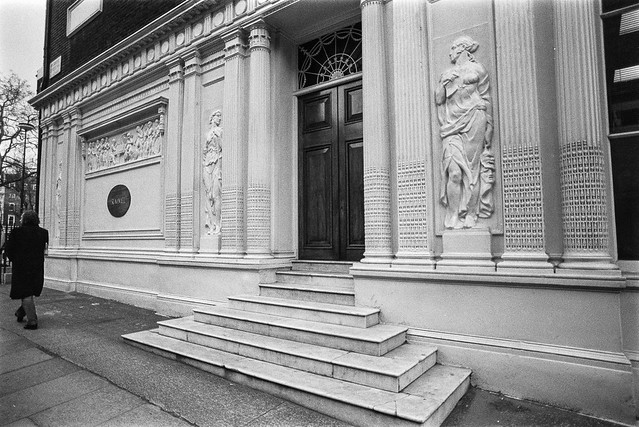
I’ve started, so I might as well finish. Here are a few of my pictures from Notting Hill Carnival in 1993, still in black and white. I did take a few in colour, probably using up a film already in the camera, but I’ve not really looked at them yet. Perhaps in a few days I’ll find time.
In the 1990s I was still working as a full-time teacher in a Sixth Form and Community College, and too often we seemed to start the term the Tuesday after carnival and I would go into work with ears still ringing part-deafened from the previous day. Carnival wasn’t just loud on the ears, the tarmac of the street vibrated with the beat, and so too did your internal organs, your whole body dancing to the music. It took me a few days to recover. Fortunately the first few days of term were mostly taken up with administration and not actual teaching.
It’s now around 20 years since I left full-time teaching to earn a living through writing and photography so even had I been able to go to carnival I wouldn’t be worried about going in to work today.
I seem to have taken rather fewer pictures than usual in 1993, or at least to have scanned rather fewer. I was in Notting Hill on both the Sunday and Monday and made almost 500 exposures, but there are only 17 in the album from that year. Looking at the contact sheets I think there are probably a few more worth adding when I have time.
All photographs on this and my other sites, unless otherwise stated, are taken by and copyright of Peter Marshall, and are available for reproduction or can be bought as prints.
I’ve tried on several occasions to photograph the Italian Fountains in Kensington Gardens, an ornamental garden said to have been a gift from Prince Albert to Queen Victoria in around 1860, designed by James Pennethorne and incorporating ideas from their holiday home at Osborne House on The Isle of Wight. There are five main designs on the urns there, including the ram’s heads you see a few times in this picture, a swan’s breast, woman’s head, dolphin and oval. Taken in May when I think the trees in the background are at their best, some in leaf and others still showing their structure. The garden has been renovated since I made this picture.
There seems to be a gate to the pavement of Connaught Place in Bayswater, probably to keep out the riff-raff like you and me, and I clearly chose to photograph through it as a frame to the formal architecture of the line of grand porches beyond. Although there are extremely expensive properties in a prestigious address, I find them rather dull, these heavy porches uneasy add-ons to the bland five-storey plain brick behind – which I chose not to include in my picture. But despite the porches, these are really the back doors of these building.
The houses may have their doors in Connaught Place but the clearly face to Hyde Park, where the row has these magnificent balconies. I also photographed them in landscape format, but need to replace that image on Flickr as I find the negative moved at left to give a double image when I was making the digital camera ‘scan’, probably because the negative holder was not fully closed.
Shepherd Market in Mayfair describes itself as “a charming small square and piazza with a variety of boutique shops, restaurants and impressive Victorian pubs” and ” A hidden gem known for its wonderful relaxed village-like atmosphere.” It gets its name from Edward Shepherd who developed the area in 1735-46 on open ground where the annual May Fair had been held. Wikipedia comments “It was associated with upmarket prostitutes from its building up until at least the 1980s” and they were still in business when I made these pictures in the area. In 1987 it still retained something of the shabby charm from its really run-down times when it was popular with artists and writers 60 years earlier. The area is something of a maze of streets and alleys and I no longer recall exactly where this picture was taken.
You can still find Da Corradi’s Italian Restaurant and Ye Grapes in Shepherd Market though I think both have changed somewhat are there are now more tables in the narrow street.
Hertford St runs from Park Lane to Shepherd Market and then takes a turn north to Curzon St. This building is still there on the corner with Shepherd St and I think is a part of an expensive and exclusive private member’s club outside which I’ve recently photographed protests calling for kitchen staff to get a living wage and better conditions of service. The club is on five floors and includes a nightclub, four restaurants, four bars, a private dining room, cigar shop, a courtyard and a roof terrace and has a dress code which prohibits ‘sportswear of any kind’, t-shirts, shorts, sandals and dirty trainers. Personally having watched the kind of people who go into it I’m pleased not to be a member.
Towering above the western end of Hertford St is the ugly bulk of the London Hilton in Park Lane, the first Hilton to open in the UK in 1963. 331 Feet tall it overlooks Mayfair, Hyde Park and, more controversially at the time of building, Buckingham Palace and its gardens. The hotel is on 28 floors and has 453 rooms and according to Wikipedia is now the 84th equal tallest building in London, though around twenty still under construction will soon edge it out of the top 100, though I think it will remain one of the tallest in the West End – only Centre Point and the Millbank Tower are taller.
You can just see the canal through the open hatch and across the galley area of the narrow-boat Crystal closest to the camera, but the view struck me as a remarkable interlocking of the boats, roads and buildings, different eras of construction and transport. The Westway here sits on top of the Harrow Road bridge over the canal, the Paddington Arm of the Grand Union which was opened in 1801. (Confusingly there is a separate Harrow Road bridge across the canal a hundred yards northwest and yet another a kilometre further on.) At right we have the concrete architecture built for the road operations of British Rail in 1968-9, around the same time as the Westway which opened in 1970. Its building made very clear the tremendous damage that building urban motorways caused to the city.
Footbridge, Lord Hill’s Rd, Westbourne Green, Westminster, 1987
There was just something zany about this view that appealed to me, with the smooth curve of the metal lamp support and the jagged line of the concrete bridge., and the two circular objects, lamp and mirror and that dagger of a church spire with its cross.
Regents Canal, Little Venice, Westminster, 1987
A rather more conventional view of the canal and a canal bridge, though I did deliberately include in the foreground those rails and slope leading to nowhere. This is the bridge at the west end of Little Venice, and takes Westbourne Terrace Road across to Blomfield Rd at the right of the picture. Google Maps names this place as the Little Venice ‘Ferry Terminal’.
The north end of the footbridge in a picture above, which linked Lord Hills Road and Blomfield Rd. Here I took a simpler approach to its concrete edge, making it a jagged diagonal, emphasized by the handrails. On one side of it the graffiti, to its right the regularity of the houses, probably dating from around 1850, in Blomfield Rd. The footbridge has since been replaced by a rather less interesting metal bridge.
The Blomfields came over with William the Conqueror in 1066, their name deriving from the village of Blonville-sur-Mer in Calvados, Normandy. There were many of them by the 19th century when this road was named, and among them several bishops, well-known architects etc. I suspect it was named after Charles James Blomfield (1786 – 1857) who was Bishop of London from 1828 until he resigned due to ill health in 1856.
Regents Canal, Blomfield Rd, Little Venice, Westminster, 1987
This area next to the Westbourne Terrace Road bridge and opposite the Canal Offices used to be home to a strange collection of stone works, but these were removed and for some years this was just an empty patch of grass. It is now a ‘wildlife refuge’, not for big game like those here, but, thanks to Edward Wilson Primary School, is The Bug Hotel, Bloomfield Garden.
Regents Canal, Blomfield Rd, Little Venice, Westminster, 1987
Westway, Regents Canal, Westbourne Grove, Westminster, 1987
Finally my young assistant takes a rest (and a photograph) by the canal underneath the Westway.
All pictures were taken in April 1987 and are from my Flickr album 1987 London Photos which now contains over 700 photographs.
All photographs on this and my other sites, unless otherwise stated, are taken by and copyright of Peter Marshall, and are available for reproduction or can be bought as prints.
There are no adverts on this site and it receives no sponsorship, and I like to keep it that way. But it does take a considerable amount of my time and thought, and if you enjoy reading it, please share on social media. And small donations via Paypal – perhaps the cost of a beer – would be appreciated.
Joseph Bros, Textiles, Great Portland St, Fitzrovia, Westminster, 1987
Joseph Bros (Textiles) Ltd according to Companies House is dissolved, last filing company reports in 2006, though some online directories still list it at an address in Finchley which appears to be a garage. But the building is still there, with its ground floor occupied until recently by an “avant-garde” cosmetics company claiming inspiration from Salvador Dali claiming a “cosmetic artistic approach to stop time and restore youthful appearance.” Seeing what Dali did with clocks in his ‘The Persistence of Memory’ and other works, I don’t think I’d want to entrust my own ‘clock’ to them.
Park Crescent, Marylebone, Westminster, 1987
John Nash’s Park Crescent, built in 1812-21 for the Prince Regent and still owned by the Crown Estate is of course Grade I listed, although only its facades are orginal, everything behind them having been restored in the 1960s. They had been badly damaged by bombing in 1940.
According to John Summerson‘s classic work ‘Georgian London’ published in 1945 (my copy is of the 1947 reprint though bought a little later) “Nash inaugurated the real stucco age with the building of Park Crescent in Parker’s Roman Cement in 1812“. He also comments that “the simple appropriateness of Park Crescent with its Ionic colonnades is beyond criticism“.
All Saints Church, Margaret St, Fitzrovia, Westminster, 1987
All Saints Church in a kind of fantasy gothic called for a very different treatment. It was designed by William Butterfield in 1850 and completed in 1859. Another Grade I listed structure it has been described by Simon Jenkins as “architecturally England’s most celebrated Victorian church” and was pioneering in its use of brick rather than the traditional gothic stone. It set a style that would be much copied for the next 20 years though largely less flamboyantly.
I’ve always felt it would be a good location for a horror film, but is actually a leading centre for Anglo-Catholics in the Church of England.
West London Synagogue, Upper Berkeley St, Marylebone, Westminster, 1987
Quite in contrast is the West London Synagogue, Upper Berkeley St, Marylebone, Westminster, opened in 1870. The congregation had split away from the Sephardi and Ashkenazi synagogues to worship as “British Jews”, adopting a practice based on the “written Torah”. In 1940 they becamae a part of mainstream Reform Judaism.
The architectural style of the building, by Henry David Davis (1838/9-1915) and Barrow Emanuel (1841-1904), is described as Neo-Byzantine, and is certainly unlike their other works I’ve been able to identify. As well as some artisanal blocks of flats for the East End Dwellings Company they also designed the City of London School for Boys still on Victoria Embankment. The synagogue seems to me a slightly odd amalgam of a fortress and a triumphal gateway.
I was amused by the shop sign and not at all sure that I understood it when I took this photograph of what appears to be a rather up-market off-licence. I’m still not sure about it, with a star, arrow and what seemed to me half a lyre with the text ‘E du V’. Doubtless there is some obvious cultural reference which is lost on me, and hopefully someone will point out my ignorance in response to this post.
The reflection in the window clearly indicates it was on a corner of Upper Berkeley St, though I’m not sure on which corner, possibly of Seymour St. It is surely long gone.
St Mary’s Church, St Mary’s School, Wyndham Place, Bryanston Square, Marylebone, Westminster, 1987
The church, listed Grade I, was designed by Robert Smirke and built in 1823-4. There is a very full description of the church in ‘A Topographical and Historical Account of the Parish of St. Mary Le Bone’ by Thomas Smith, printed and published in 1833 by John Smith and available at the Internet Archive. The descirption ends on p105-6 with these comments:
It would have been desirable, if possible, to have procured a site for this church in a more central part of the District than that which has been assigned to it. In short, it should almost seem as if the greatest possible pains had been taken to select a site, in all respects the most inconvenient for the majority of the congregation ; it being surrounded by streets of worse than a second rate description.
If it be said, that the accommodation of the poor has been principally consulted the answer is the poor are always sure to fill the free seats allotted to them wherever the service of the Church of England is decently and impressively performed. The tower and cupola of this church form a tolerably picturesque termination to the view from Cumberland Gate, Hyde Park.
This gem of a building is just around a corner from the BBC on a few yards down Duchess St, on the opposite side of Portland Place was built to the plans of Robert Adam in 1769-71 as the stable-coach house to Chandos House, Queen Anne Street, and was altered – according to its Grade II listing text “quite sympathetically” around 1924 by Arthur Bolton. The text states it is now part of the British Medical Association.
The lean of the lamp post emphasises the rectangular formality and symmetry of the building as does the man walking past. I’m not sure if I would have preferred not to have a taxi speeding into the picture. The 35mm shift lens enabled me to keep the verticals upright and get the whole building in frame from the opposite side of a fairly narrow street.
Mansfield St, Marylebone, Westminster, 1987
Just around the corner from the previous picture is this magnificent fence with its baskets of flowers. I felt the out of focus bush made a suitable contrast between natural vegetation and its representation.
I think this is the garden screen mentioned in the listing text and probably like the house behind dates from 1914.
Hinde St, Marylebone, Westminster, 1987
Doorways are one of the most important architectural features of buildings, and this one very clearly gives an impression of the luxury of the flats inside Hinde House.
Hinde St, Marylebone, Westminster, 1987
A similar doorway next door (London streets sometime number in odd ways) is a little plainer, perhaps suggesting that inside are flats for less important people. Though it is certainly not a ‘poor door’ leading to any social housing in the block.
The Royal Society of Medicine, Henrietta Place, Marylebone, Westminster, 1987
My theme of doors continues with the grand entrance for The Royal Society of Medicine in Henrietta Place.
And another door is a prominent feature in this building with its series of semi-circles on Marylebone Lane. It’s a building with the window at the centre of the picture set a little lower, so it seems to be winking at us.
Again a taxi has crept in. There are far too many of them, often simply cruising around empty in the centre of London, a significant cause of both pollution and congestion. They are slowly changing from diesel to electric which will help with the pollution, but wont ease the congestion. Ridiculously they are exempted from the congestion charge while minicabs have to pay it. We don’t need ‘ply for hire’ when cabs can be summoned by smartphone and its time for change.
Rimmel, Wigmore St, Marylebone, Westminster, 1987
There are a few more pictures of doors in the area in this section of my 1987 London Photos, but this at Bessborough House on the corner of Cavendish Square is perhaps the most impressive. According to the Grade II listing the house dates from 1770s with c.1800 and early C20 alterations. About this entrance it states “Blind return to Wigmore Street has neo-Adam style pilaster treatment to ground floor with shallow relief modelled “graces” between pairs of pilasters under entablature – all in stucco.”
When I took this picture it had the circular message at left that it was the premises of Rimmel, the cosmetics house founded in 1834 by French-born perfume chemist Eugène Rimmel and often known as Rimmel London. He put on sale a product for darkening eyelashes using the newly invented petroleum jelly and black pigment, marketed under the name mascara which was hugely successful both in the UK and internationally – and mascara is still called ‘Rimmel’ in a number of languages.
All photographs on this and my other sites, unless otherwise stated, are taken by and copyright of Peter Marshall, and are available for reproduction or can be bought as prints.
It’s always difficult to know where London’s districts begin and end, and sometimes it is rather a matter of personal opinion. There are some definite boundaries – postal districts and borough boundaries – though these seldom coincide with our perception of place, and most people – unless they actually live there are unaware that in central London you may be in Camden or Westminster etc. The City is a little more obvious, with its borders on some main streets clearly marked, but who would know when crossing the Charing Cross Road you might move from Westminster into Camden.
Poland St, Soho, Westminster, 1987
Names too change with the years. Fitzrovia for example only began to be used in the late 1930s, and other older area names are now seldom used. Building tube stations led to many of their names being used for areas which previously went under other names, and estate agents are notorious for promoting properties into nearby more salubrious areas – or inventing new area names, often by adding the word “village” to an existing name.
Never Park Here, Falconberg Mews, Soho, Westminster, 1987
Soho is perhaps one of the more clearly defined of all London areas, though some might quibble slightly at Googles definition, clearly bounded by major roads – Oxford St, Regent St, Shaftesbury Ave and Charing Cross Road. Many of us would also include Chinatown in its ambit, perhaps going south down Haymarket as far as Orange St to include Leicester Square. And perhaps some of the fringes just across Oxford St might qualify…
Carnaby St, Soho, Westminster, 1987
On the streets themselves, the more modern street names – since the mid 1960s – include the borough name, but many London streets have proudly retained their older signs, sometimes with a postal district (though sometimes the earlier version.)
Like all things, Soho is defined by what it isn’t. It isn’t Mayfair or Fizrovia or Bloomsbury or St Giles or Covent Garden or Westminster (the area not the Borough – which all or almost all of it is inside) or St James. And it’s not just a matter of geography, but also of character.
Walker’s Court, Soho, Westminster, 1987
And it was that character which was uppermost in my mind as I made these pictures.
You can see more of them on page 2 of my Flickr album 1987 London Photos.
All photographs on this and my other sites, unless otherwise stated, are taken by and copyright of Peter Marshall, and are available for reproduction or can be bought as prints.
After Bedford Park I turned my attention to Holborn, including the area around the Royal Courts of Justice where there are shops catering for legal necessities as well as premises meeting more general needs.
Urinal, Star Yard, Holborn, Camden, 1987
The urinal is still in-situ but I think is permanently closed. Just along the street is a Wetherspoons which serves the same purpose. It’s actually one of their more pleasant locations and I’ve several times enjoyed a quick lunch there. The food may only be so-so, (though there are a few things they do quite well) but the service is fast and the price very reasonable for London. Of course they treat the staff badly, but so do most pubs, and if things get back to anything like normal I’ll follow the union advice and not boycott them but refuse to cross any picket line.
Lincolns Inn Fields, Holborn, Camden, 1987
Lincolns Inn fields has plenty of fine architecture and also London’s most intriguing museum, founded by Sir John Soane. Currently closed it hopes to open on October 1st, but with pre-booked timed tickets only. If you’ve never visited I’d advise you to book as soon as you can. You can get some idea of the museum through yhe amazing digital online https://www.soane.org/explore Explore Soane, but the real thing is rather more satisfying. Because of the space limitations in the museum bags have to be left at the door.
Connock & Lockie, New Oxford St, Camden, 1987
I can do no better than quote from the company’s web site:
A centenarian business
Connock and Lockie was established by cousins William Henry Connock and John Lockie in 1902 on 60 New Oxford Street. Over the years, we have relocated several times and settled at our current address, 33 Lamb’s Conduit Street, in 2004. Throughout our 110 years of trading, we have proudly catered to the bespoke tailoring needs of discerning ladies and gentlemen.
http://connockandlockie.com
107-110 Great Russell Street,
‘Luxury hotel development, Completion 1987’ it states on the notice on the front of this building, and although in February 1987 when I made this picture it seemed unlikely, this is now the Cheshire Hotel, in London terms a budget hotel, with rooms around £70 per night. Quite why it changed its name from the Warwick Hotel to the Cheshire I don’t know, and the plain entrance has changed to a more pretentious one with four columns.
Grade II listed Space House was a speculative office development built 1964-8 by George Marsh of Richard Seifert & Partners for the developer Harry Hyams. It was technically innovative, using a precast concrete grid for rapid construction without the use of scaffolding, and remains visually arresting. As the listing text says, it’s assertive styling reflects “the confidence and dynamism associated with the period.”
This building and the connected building on Kingsway were to be vacated at the end of last year and ‘revamped’ for commercial letting.
Flitcroft St, St Giles, Camden, 1987
This bas-relief is above the old entrance gateway to St. Giles’s Church Yard where a bas-relief of The Resurrection was placed in 1687. It is a plaster copy of the original which is inside the church. The gateway was originally around the corner in the St Giles High St, but rebuilt in 1800 incorporating the old bas-relief and then moved to Flitcroft St in 1865. Flitcroft St gets its name from Henry Flitcroft who was the architect of the church, built in 1733.
The carving was originally in oak, and the carver, a man called Love was paid £27 for his work. The 1800 gate included a stone recreation of the work, now in plaster.
I occasionally used a photographic lab in Flitcroft St, which produced remarkable Cibachrome prints using a laser scanning technique on the transparencies which gave them an unbeatable contrast and clarity. They were also rather expensive!
All photographs on this and my other sites, unless otherwise stated, are taken by and copyright of Peter Marshall, and are available for reproduction or can be bought as prints.
Camden Town Cemetery, St Martin’s Gardens, Camden St, Camden, 1987
The slow process of putting up my old black and white pictures is continuing, thanks to the lockdown leaving the time on my hands. Although I’m going out of the house for exercise, that only occupies around 50 minutes of the day – and perhaps another half hour to recover.
This picture of the piled up gravestones in Camden Town Cemetery was taken in January and is one of the last from that month I’ve put on line. Although I’ve always liked to wander in cemeteries, often the only real places of peace and quiet in cities, and often good places to rest and eat my sandwiches, I’ve generally tried hard to avoid taking too many pictures in them unless there is a very strong reason to do so.
Partly because as a teacher of photography I saw far too many pictures by students of gravestones and monuments. They were easy to photograph, didn’t move much or complain about being photographed and supposedly said something profound about the human condition. At the in-house moderation of student photography coursework from across the country it was never long before I or another assistant examiner would be exclaiming “Not another sodding angel!”.
Wardour St, Soho, Westminster, 1987
In February I turned my attention to Soho, where photography was not always welcomed, though I didn’t intend to emphasise its more sordid aspects. It was one of London’s most varied and interesting areas, and remains so despite the ravages of property developers and Westminster Council.
But I didn’t avoid photographing the frontages offering ‘Intimate Bed Show – No Extras‘ though I didn’t go inside and photographed them in the early mornings when there were few touts or barkers around and any workers who might have occupied them were at home in their own beds. Nor did I meet the ‘Very Sexy Busty Brunette Model‘ whose notice was by a door in D’Arblay St, not even to make my excuses and leave.
But Soho was remarkable for the variety of shops, a place were almost everything was on sale – and sometimes it was difficult to know exactly what was on offer.
Butterfly, Upper James St, Soho, Westminster, 1987
There is still a clothes shop on the corner of Upper James St and Beak St, but it is now larger and more corporate, with a bland plate glass frontage, and Butterfly proved to be as ephemeral as its name suggests. Many other Soho businesses were longer lasting, and Randall & Aubin, late Morin and Cavereau remains in place on Brewer St, though many of the older continental businesses have now gone.
If you look through my pictures of Soho from 1987 you will find some showing the increasing Chinese presence in the area, including one of a crowd watching the New Year celebrations, but far less than in my later pictures of the area.
Charles II, Soho Square, Soho, Westminster, 1987
Soho Square still looked much the same when I was last there a few months before the lockdown, though I do wonder if Cibber’s statue of Charles II looks rather more worn now. Though we may now regret the restoration of the monarchy and feel that the puritanical excesses of the Commonwealth would better have been ended without bringing back a king the so-called ‘Merry Monarch’ does sound in some respects an improvement on our present royal house. And a king with no legitimate children who acknowledged at least a dozen by various mistresses is perhaps a suitable character to be remembered in Soho.
All photographs on this and my other sites, unless otherwise stated, are taken by and copyright of Peter Marshall, and are available for reproduction or can be bought as prints.
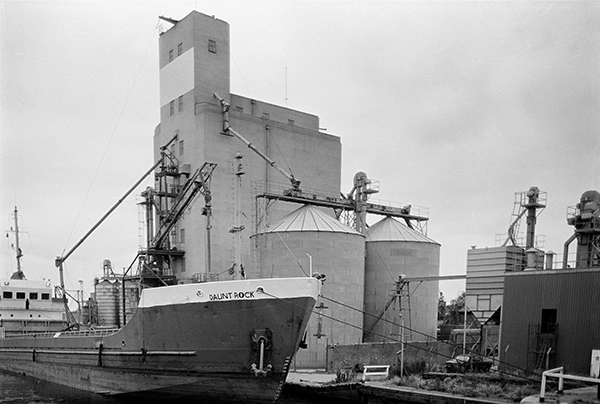
When I told my mother-in-law, a life-long Hull resident, that I was taking a day trip to photograph Goole she shook her head in disbelief, asking me whyever I would want to do that. She wasn’t a great fan of my pictures of Hull either, thinking I dwelt far too much on its less salubrious areas and on those old and dilapidated warehouses and derelict docks.
My only regret looking back is that I didn’t visit Goole more often. True its name isn’t inspiring – but then neither is Hull, perhaps why its more prosperous residents like to remind you it is really called Kingston upon Hull. For some reason the name Goole on Ouse has never been considered, though perhaps it should be Goole upon Dutch River or Don, which was diverted to meet the Ouse here in 1629 by Cornelius Vermuyden, not for the benefit of the few villagers of Goole, but to improve the hunting at Hatfield Chase for King Charlea I. But Goole got a bridge over the new river and barges could carry coal along it from the South Yorkshire coalfield at it could then be transferred to sea-going vessels.
In the 1820s the Aire and Calder Navigation opened a connection to the Dutch River and began the construction of docks and a new town at Goole. The canal opened in 1826 and in 1827 Goole became an official port with custom facilities, its docks able to handle vessels up to 400 tons. It’s main export remained coal until Thatcher closed the mines, with a system of compartment boats – the ‘Tom Puddings’ and special hoists giving a very efficient means to transfer the coal into seagoing ships. Timber was the main import, in part for use as pit props.
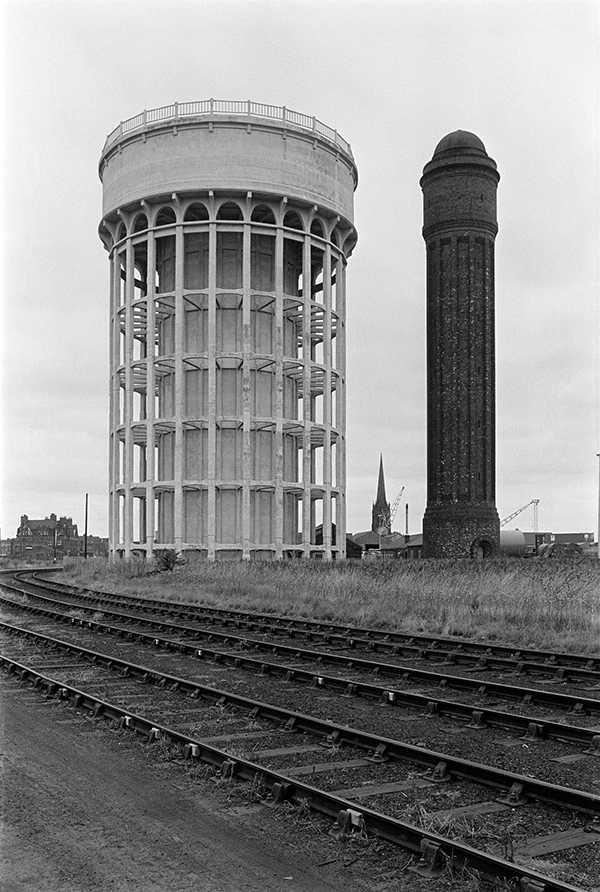
Railways first came to Goole in 1848 with a line to Pontefract and Wakefield, but it after the North Eastern Railway line from Doncaster to Hull was built in 1870 that the railway really became important. It was this route from Doncaster that I travelled on many times from and to the south between 1970 and now through Goole; sometimes the train stopped there, but more often travelled through at a leisurely pace, giving time to appreciate its landmark ‘salt an pepper’ water towers before swinging east to cross the River Ouse. But I never got off there until my first day trip in 1983.
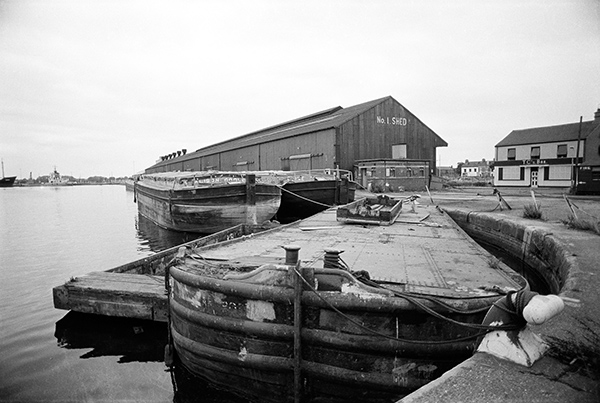
The Victorian ‘New Goole’ seemed to have survived reasonably well, and gave a remarkable access to the docks (in those days they were a little less fettered by health and safety), and I spent a full day wandering around and taking pictures, particularly in black and white, but with some in colour too. I’ve returned more recently and it is still an interesting place to visit, though a little less so.
I find to my surprise that it is very nearly seven years since I self-published my book ‘The Deserted Royals‘ and wrote a little about it here. Some of you who follow me on Facebook may have seen the rather wider range of pictures from that project made back in 1984 that I’m currently posting daily as my ‘story’ there, though I find Facebook particularly adept in hiding those posts I’d like to see and instead feeding me cats and celebs.
The ‘Royals’ in question are of course the Royal Docks, and most of my work was on the Royal Albert and King George V Docks in North Woolwich, by then part of the London Borough of Newham. I’d tried to photograph them from publicly accessible locations (with the usual mild bit of trespassing) but had found this very limiting, and wrote to the Port of London Authority who still owned these two docks, requesting permission to photograph them from the inside. Rather to my surprise they replied and granted me the access I’d requested. A similar letter to the owners of the Royal Victoria Dock went unanswered.
As well as the daily release on Facebook I will shortly be adding these pictures, along with others I took of London in 1984 to my Flickr album London 1984. At the moment it has pictures I took earlier in the year, including some from the West India Docks. I decided at the start of this year to put pictures on Flickr at a relatively high resolution and high quality and to trust any commercial users to respect my copyright and contact me to pay for usage. Although it’s almost certainly over-idealistic, I don’t think I’m likely to lose any significant income. I’ve used these larger images in this post and if you right click and open them in a new tab you can see them larger than in the post.
Here are a few of the pictures I’ve recently posted on Facebook, along with the usually short texts which accompany them, beginning below with an introductory picture and ending with today’s picture, about which I wrote a little more than usual.
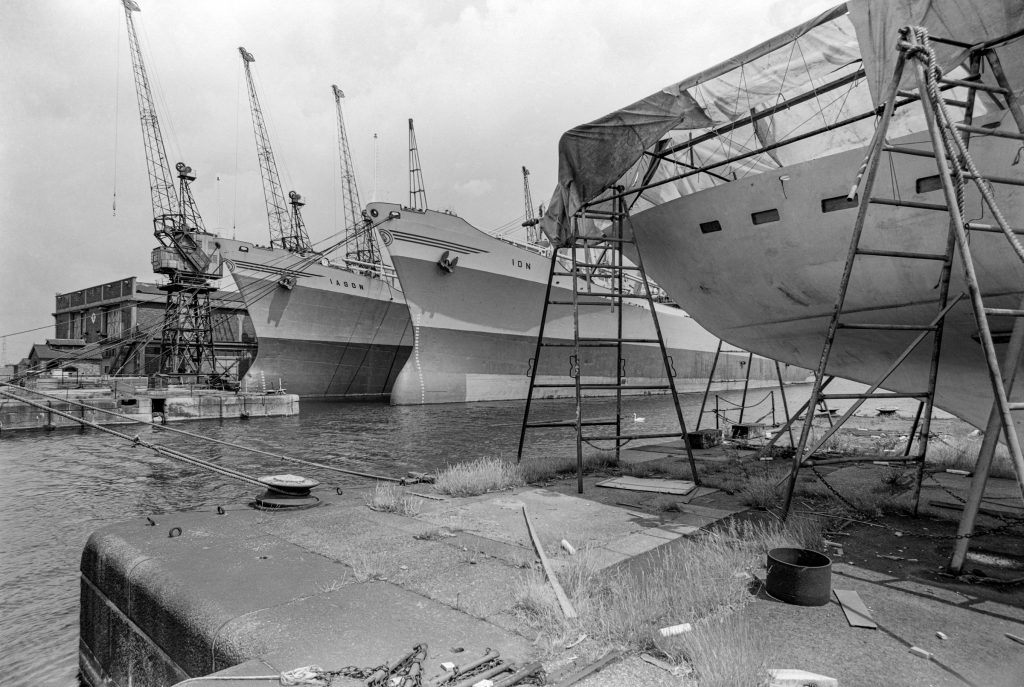
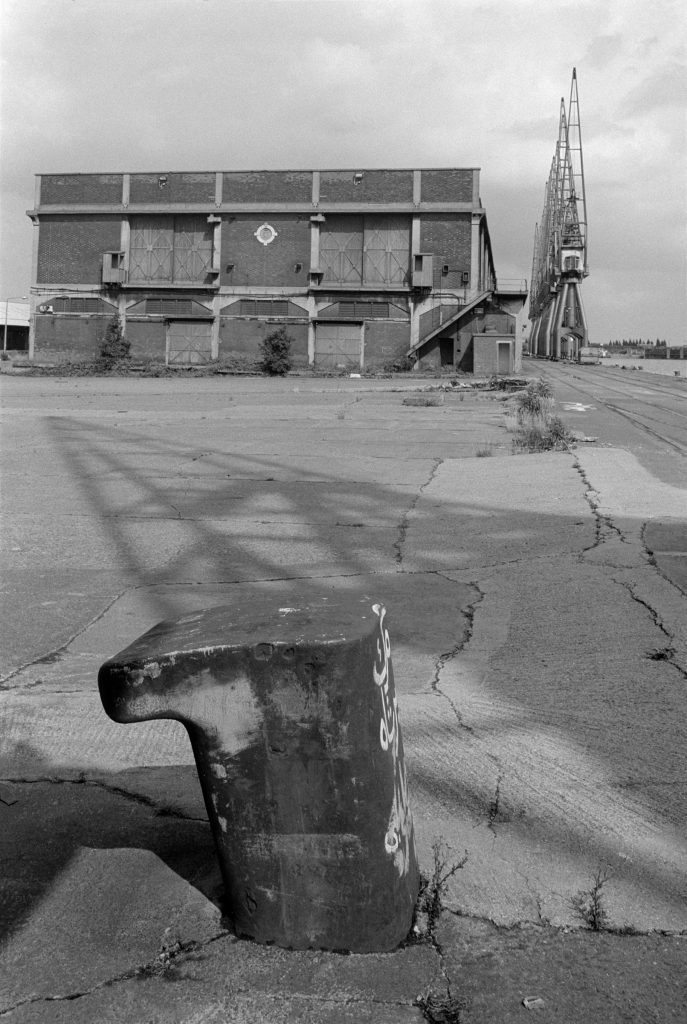
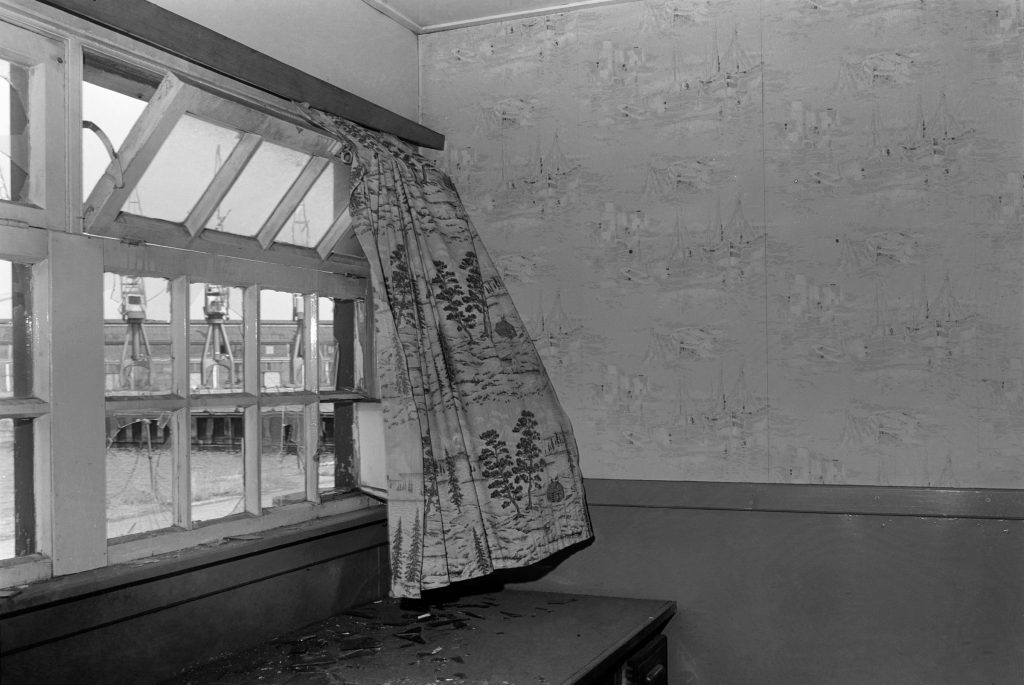
South Quay, King George V Dock, Newham 1984 84-7c-21. I had obtained permission from the PLA to photograph inside the dock area they owned – the King George V and Royal Albert Docks two docks on two days, and made my first visit in July. The security men in the gate house were clearly surprised that anyone should want to come and take pictures, but not very interested in what I did. Once inside there was no security presence and I could wander freely on the south quay of the King George V dock and on the central peninsula between the two docks, though their was no access to the north side of Albert Dock. I was not supposed to enter any of the buildings, which could be unsafe, but I did take a number of pictures through windows and doorways, and later did cautiously enter some of the smaller buildings that seemed safe. On my first visit I exposed around ten rolls of black and white film – 360 exposures as well as some colour transparencies over around six or seven hours of work. Iason and Ion are the two ships which could be seen in the distance in some pictures posted earlier, at the west end of the north quay of the King George V dock. To the left is the dry or graving dock at the west end of the dock, full of water.King George V Dock, Newham 1984 84-7e-63. A bollard and a more substantial shed on the land between the two docks, now the runway for London City Airport, looking roughly east. The row of cranes is along the north side of the King George V Dock.Office curtain, King George V Dock, Royal Albert Dock, Newham 1984 84-7l-53. This was one of the few pictures, possibly the only picture, where I used flash to capture the curtain blowing in the wind and to balance the light inside the office with that outside. It was quite a pretty curtain, a landscape with trees and something of a Japanese feel, but it was the wall-paper that attracted me more with its groups of small fishing boats in front of a shore with what was probably meant to be a fortress but looked to me more like a cement works like those further down the Thames. Obviously the scene outside the window with its cranes was vital to the picture, and balancing the light levels inside and outside was no simple matter. Nowadays modern cameras do this kind of thing automatically but back then it involved calculations using distance and the flash guide number, careful exposure measurements through the window and a great deal of luck. It was made more difficult by the slow flash sync speed of all SLR cameras of the time, limited by their focal plane shutters, in this case to 1/60th of a second. I think it was the first time I’d tried to do anything like this, though I had read about it in photographic magazines and I only took a single frame, so it was definitely a case of beginner’s luck
All photographs on this and my other sites, unless otherwise stated, are taken by and copyright of Peter Marshall, and are available for reproduction or can be bought as prints.