Yet More from Stoke Newington

Yet More from Stoke Newington: This is the final post about my walk on 8th October 1989 going down Stoke Newington High St towards Dalston with some minor detours. The previous post on this walk was Cemetery, Synagogue & Snooker.

Shops, 77, Stoke Newington High St, Stoke Newington, Hackney, 1989 89-10f-52

I wondered about the history of these three shops at 75-79 Stoke Newington History with the three-story Golden House Chinese takeaway at its centre. The first-floor brickwork on either side didn’t quite seem to match suggesting to me that the central building may have been a post-war addition to an existing building, or that these first floors may have been a later addition.

This central shop is still a Chinese takeaway but under a different name.

Hovis Bread, Batley Rd, Stoke Newington High St, Stoke Newington, Hackney, 1989, 89-10f-55
Hovis Bread, Victorian Grove, Stoke Newington High St, Stoke Newington, Hackney, 1989 89-10f-55

The Cinema Treasures site states that The Vogue Cinema at 38 Stoke Newington High St opened as The Majestic Electric Palace on 15th December 1910 and was closed on 21st June 1958 as a protest by Classic Cinemas against the landlord’s rent rise.

It remained shuttered and closed for 42 years until in November 2000 the foyer was converted into a Turkish restuarant with housing behind, described to me on Flickr as the “best Turkish restaurant ever.” The restaurant owners restored the Vogue sign.

My picture with the Hovis Bread ghost sign was taken from a few yards down Victorian Grove looking towards the cinema across the High Street. The block at right of the picture has now been replaced by a large building with a Tesco Extra on its ground floor.

House,  Victorian Grove, Stoke Newington, Hackney, 1989 89-10f-56
House, Victorian Grove, Stoke Newington, Hackney, 1989 89-10f-56

This street was originally called Victoria Grove, but its name was changed some time in the middle of the last century. Much of the area was redeveloped in the 1970s but these houses dating from the early years of Victoria’s reign in the 1840s or 1850s remain.

This Grade II listed pair with the unusual curved bays and balconies have the name ‘BRIGHTON VILLAS’ on a plaque between the first floor windows, hidden by the curvature of the nearer bay in my photograph. The nearer balcony roof has been replaced since I took this, matching the one on its neighbour.

Works entrance, Victorian Grove, Stoke Newington, Hackney, 1989 89-10f-41

The wall beside 3 Victorian Grove is still there, but now has only graffiti on it. There are still some industrial units behind the villas of Victorian Grove, though surely they will soon be replaced by expensive flats, but access to these is now thourgh a gated vehicle entrance further down the street.

Posters, Stoke Newington High St, Stoke Newington, Hackney, 1989  89-10f-42
Posters, Stoke Newington High St, Stoke Newington, Hackney, 1989 89-10f-42

Should you Google – as I did – ‘Trevor Moneville‘ – you will find he was a 33-year-old from Hackney, was found dead at HMP Lewes on April 18, 2021 from Sudden Death in Epilepsy (SUDEP) because of insufficient and unacceptable management of his care.

But this was a case of history repeating itself. A copy of the poster at top right is also in the collection of Hackney Museum, where the web site notes:

“Trevor Monerville went missing from Stoke Newington police station after being taken into custody on New Year’s Eve, reappearing after several days on the other side of London in Brixton prison. He had multiple injuries and later underwent emergency surgery in Maudsley Hospital. The case highlighted existing concerns about alleged institutional racism in the Metropolitan Police and led to the formation of the Hackney Community Defence Association in 1988.”

And in the centre of the picture is a poster for another, better known case of police brutality. Blair Peach was a young teacher murdered by the police Special Patrol Group who went beserk when policing an anti-racist protest in Southall on 23 April 1979.

Andy's Fashions, 141, Stoke Newington Rd, Stoke Newington, Hackney, 1989 89-10f-43
Andy’s Fashions, 141, Stoke Newington Rd, Stoke Newington, Hackney, 1989 89-10f-43

Further south Stoke Newington High Street becomes Stoke Newington Road, and back in 1989 I found myself confusing the two. Andy’s Fashions was at 141 Stoke Newington Road. No longer Andy’s, the shop is now Stitch “N” Time offering tailoring, alterations, repairs. and no longer has its wares on the pavement outside or partly blocking the entry to the Stoke Newington Estate of the Industrial Dwellings Society (1885) Ltd.

The IDS was established as the Four Per Cent Dwellings Company in 1885 by “Jewish philanthropists to relieve the overcrowding in homes in the East End of London” and changed its name in 1952. They opened the Stoke Newington Estate in 1903.

Curtains,  Stoke Newington Rd, Stoke Newington, Hackney, 1989 89-10f-32
Curtains, Stoke Newington Rd, Stoke Newington, Hackney, 1989 89-10f-32

Another shop somewhere on Stoke Newington Road, with a fine formation of net curtains for sale, though in my book ‘1989’ I imagined them rather differently, perhaps as the front of a vast army of angels, “Or a phalanx of klansmen or some strange voodoo creatures about to burst out onto the streets of London.

The book is still available on Blurb, though at a silly price for the print version, but you can see over half of it on the preview there or the full set of pages on the web site where this image and its text is on page 19.

The texts in that book were intended to explore the question of why some scenes grabbed my attention enough to make me fix them as photographs, and why they continue to excite my imagination and I hope that of other viewers.

Street Market, Shoreditch High St, Tower Hamlets, Hackney, 1989 89-10f-33

My walk had ended and I got on the bus to take me to Waterloo for the train home. I almost always sit on the upper deck on double-decker buses and enjoy the views from the windows. As the bus went slowly along Shoreditch High Street close to the junction with Commercial Street it passed the informal market on the pavement where I had time to take three frames through the window. The area looks a little different now, but the last time I went past on a Sunday there was still a rather similar market there.

This is the final post about my walk on 8th October 1989. You can find more pictures from London and elsewhere on Flickr, with both black and white and colour images in albums mainly arranged by the year I took them, such as 1989 London Photos and 1989 London Colour.


FlickrFacebookMy London DiaryHull PhotosLea ValleyParis
London’s Industrial HeritageLondon Photos

All photographs on this page are copyright © Peter Marshall.
Contact me to buy prints or licence to reproduce.


A Day Out in Deptford – 2018

A Day Out in Deptford: On Saturday 29th September I had decided to go on the Deptford Art & Gentrification Walk, part of the Deptford X Festival, and Deptford Aint Avinnit, an art crawl organised by ART&CRITIQUE. This was the second such walk, following on from an earlier event in May 2018.

A Day Out in Deptford

Over the afternoon we visited community spaces, galleries, studios, landmarks, waterways, green spaces and new developments on a guided walk through the street with a series of discussions on the relationship between art and gentrification and the huge changes that are currently sweeping through Deptford.

A Day Out in Deptford

As I wrote in My London Diary in 2018, “The walk took place because of the continuing struggle with Lewisham Council over their plans to build on the 20-year old community run Old Tidemill Garden, the adjoining council flats, Reginald House, and Tidemill Primary School, which closed in 2012.”

A Day Out in Deptford

“Local residents, including those whose homes in Reginald House are threatened with demolition have opposed the plans, and at the end of August a group of them had occupied the Old Tidemill Garden.”

A Day Out in Deptford

The development would mean the loss of environmentally valuable green space but more importantly would be a part of the social cleansing of London which Lewisham, like other London Labour dominated councils are taking part in, demolishing council housing at social rents largely by private housing.

The site was to be developed by Peabody with 209 housing units, 51 for sale at market prices, 41 in shared ownership schemes (which require relatively high incomes) and 109 to be let at London Mayor Sadiq Khan’s London Affordable Rent, something like 65% higher than current Lewisham council rents. As well as paying much higher rents, tenants under this scheme will have for less security of tenure.

The residents group had put forward alternative plans which suggested retaining the Tidemill Garden and council flats and building at higher density on the redundant school site to create a similar number of housing units, but the council refused to consider these and terminated the community lease on the gardens on 29th August – when residents squatted them.

“The garden was established in 1997 with the aid of Groundwork, the London Development Agency, the Foundation for Sport & Arts, Mowlem plc, Lewisham College and Lewisham Council, and much of the work on it was carried out by parents and children from Tideway Primary. It now includes 74 well-established trees and has been shown to improve air quality in the local area.”

The garden was where we had the longest discussion on the tour, but there were plenty of other places where we stopped to discuss what was happening, making it an interesting afternoon.

It was a fine day and I decided to go to Deptford a couple of hours early to take a walk around some of the parts that were not included on the tour. I’d first photographed Deptford in 1979 and took with me a copy of my book Deptford to Woolwich 1979-85.

Back in the early 1980s much of Deptford was a very different place, with industry around the Creek and Deptford Power Station. Almost all of that has now gone, replaced by tall flats including much student housing and the Laban Dance Centre. On the tour we visited some of the former industrial buildings which are now artists studios and galleries. On part of the tour I was able to show pictures of what some parts of Deptford looked like before the changes.

The many pictures on My London Diary are in three posts, links below. Deptford Walk contains pictures from my own unaccompanied walk before the art crawl. Deptford Art & Gentrification Walk has my pictures taken during the walk. A third post, Deptford Panoramas, has extreme wide-angle views taken during both walks. These have the normal aspect ration of 1.5:1, but an extreme angle of both horizontal and vertical view.

The pictures show many aspects of Deptford, still a vibrant area of London, though rapidly changing. The Tidemill Garden is now built on, Deptford Cinema closed in 2020 but has a number of ongoing projects, the High Street market was still busy last time I was there, and the Dog and Bell serves a fine pint.

Deptford Panoramas
Deptford Art & Gentrification Walk
Deptford Walk

Cemetery, Synagogue & Snooker – Stoke Newington 1989

Cemetery, Synagogue & Snooker continues my walk on Sunday 8th October 1989 which had begun at Seven Sisters Station. The previous post Stoke Newington Shops – 1989 had ended with me opposite the gates of Abney Park Cemetery, which I had visited on a walk the week before, Abney Park & South Tottenham, and I wrote more about the cemetery there.

Angel, Abney Park Cemetery, Stoke Newington, Hackney, 1989 89-10e-45

The cemetery has a huge assortment of memorials and I photographed a few of them, including this angel, perhaps a fairly typical depiction, with similar angels in memorials across the country. It also gives an idea of the wilderness which the cemetery had become by 1989.

Angel, Abney Park Cemetery, Stoke Newington, Hackney, 1989 89-10e-23

Another angel erected by a husband in sacred memory of his wife Elizabeth who “departed this life” only 28 years old in 1865. This is a rather more unusual monument and I wondered if it might perhaps resemble this young woman who may well like many of the time have died in childbirth. There are two cherubs on the plinth and below them a rather strange pipe with perhaps shoots emerging at both ends. I suspect someone may know the significance of this. I cannot quite make out the name of her husband, although someone had clearly removed the creeper from the stone in order to reveal it.

John Swan, Engineer, Abney Park Cemetery, Stoke Newington, Hackney, 1989 89-10e-26

The text on the monument at the right of this picture is clear, and this is the Grade II listed memorial to John Swan (1787-1869), the inventor of the screw propellor for use on ships, and also of the self acting chain messenger which apparently saved the nation around £70,000 a year, for which he “never received the slightest remuneration.”

I took around 20 pictures in the cemetery and have only digitised seven of them – you can find four not included in this post on Flickr.

Northwold Rd, Synagogue, Northwold Rd, Stoke Newington, Hackney, 1989 89-10e-13

Built as a Primitive Methodist Chapel in 1875, this building was bought by members of the Beth Hamedrash Ohel Yisrael Synagogue as “more suitable and commodious premises” than their previous synagogue at 46 Brooke Rd in 1953 and consecrated in 1955. It became known as Beit Knesset Ohel Yisrael or Northwold Road Synagogue.

The synagogue closed the month before I made this picture. The building at 16 Northwold Road became the Sunstone Women Only Gym and is now the Tower Theatre.

Northwold Rd, Stoke Newington, Hackney, 1989 89-10e-14

Northwold Road begins opposite Abney Cemetery gates and its first secition still includes a number of interesting buildings as well as the former synagogue, but these on the north side of the road opposite it have been replaced by a large grey six-storey block of housing.

The flats at right re a part of the George Downing Estate on Alkham Road and are on the other side of the railwa line.

House, 187, Stoke Newington High St, Stoke Newington, Hackney, 1989 89-10f-64

Grade II* listed along with its neighbours 189 and 191, this is part of what the listing text describes as “an Early C18 large scale composition of 3 houses, the centre one projecting, touching at corners”. (It actually says proecting, but this building has a large yard in front and 189 has its porch almost on the street,)

This house was built in 1712 for Silk merchant John Wilmer (1696-1773), a wealthy Quaker. It later became ‘The Invalid Asylum for the Recovery of the Health of Respectable Women’. Substantially rebuilt in 1983 it is now the Yum Yum Thai Restaurant.

Snooker, Slindon Court, 149, Stoke Newington High St, Stoke Newington, Hackney, 1989 89-10f-66
Snooker, Slindon Court, 147, Stoke Newington High St, Stoke Newington, Hackney, 1989 89-10f-66

Hard to remember why I cropped this so tightly as to remove the S from Snooker and the SLI of Slindon Court, but probably it was just to make what I felt was a more satisfactory composition. I had previously photographed this in colour with a slightly wider view.

Snooker, Slindon Court, Stoke Newington High St, Stoke Newington, Hackney, 1989, 89e04-62

Slindon Court is now the entrance to a gated mews development behind the shops here.

The final post on this walk is still to come.


FlickrFacebookMy London DiaryHull PhotosLea ValleyParis
London’s Industrial HeritageLondon Photos

All photographs on this page are copyright © Peter Marshall.
Contact me to buy prints or licence to reproduce.


St Michael, Gorillas, Pearlies & Urban Golf – 2006

St Michael, Gorillas, Pearlies & Urban Golf: Sunday 24th September was an unusual day for me, at times verging on the surreal as you can see from the pictures and the text below, a slightly corrected version of what I wrote at the time on My London Diary.

St Michael, Gorillas, Pearlies & Urban Golf

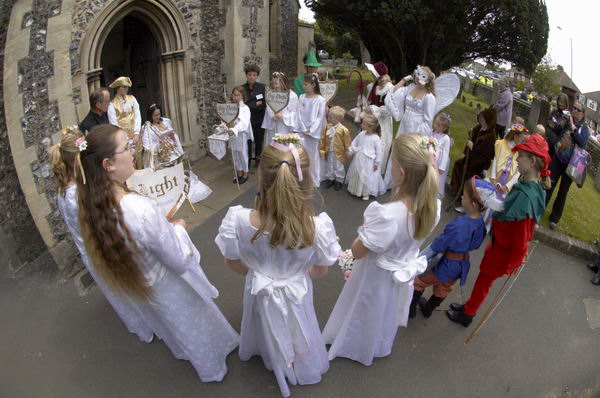
When I got up Sunday it poured with rain. What with that and the replacement bus service instead of trains, I almost stayed home, but I was glad I didn’t. By the time I arrived at Turnham Green, the sun was shining and four St Michaels were laying into a single angel with their plastic swords.

St Michael, Gorillas, Pearlies & Urban Golf

This was the Patronal Festival of the Anglican Church of St Michael And All Angels, a part of Bedford Park, the first garden suburb, begun in 1875. The event was complete with a not very fierce looking dragon and a colourfully dressed set of clerics and choristers.

St Michael, Gorillas, Pearlies & Urban Golf

more pictures

St Michael, Gorillas, Pearlies & Urban Golf

From there I rushed off on the District Line to photograph gorillas running through the centre of London. This was raising money for the Dian Fossey Gorilla Fund which helps to save the world’s last remaining gorillas from poachers, civil war, human disease and deforestation.

Running 7km in a gorilla suit isn’t my idea of fun, and by the finish the contestants – even those who had taken off their masks for the run – were swimming in sweat inside their costumes as they tucked into the free bananas and fruit smoothies.

more pictures

Things were a little more sedate at the Guildhall for the annual Pearly Kings And Queens (or Costermongers) Harvest Festival. As well as the pearlies and what looked like a pretty full set of inner London Mayors, along with a few donkey carts and a produce lorry there were people in various iinterpretations of Victorian dress, Chelsea Pensioners, and others of a vaguely traditional London character. The fairground organ looked good, although its music soon palls.

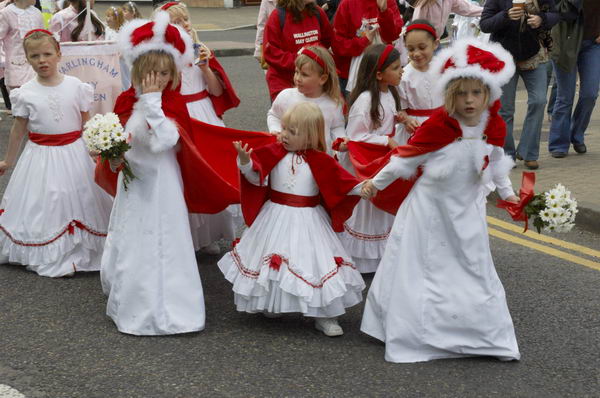
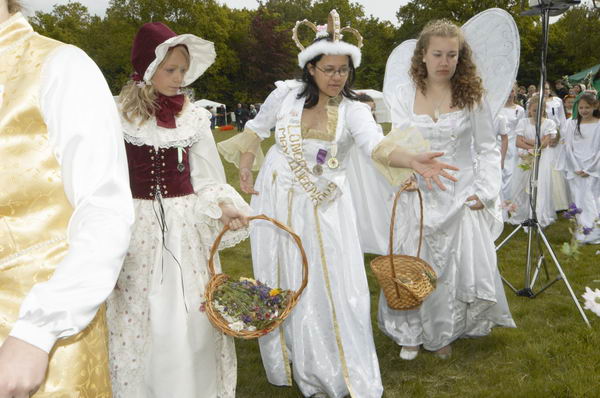
A colourful note was added by Donna Maria’s Maypole Dancers. Donna Maria was apparently a London May Queen having served her time in one of the South-east London realms. She revived maypole dancing with her group of girls dressed in flower costumes who give demonstrations at many events each year.

more pictures

The golfing event of the weekend was not of course the Ryder cup (where Europe were thrashing the USA) but the Shoreditch Urban Open Golf Tournament. 18 holes covering most of Shoreditch between the City Road and Great Eastern Street make it the only par 72 urban course in the world.

There are certain local rules that the Shoreditch Golf Club imposes, with the biggest change from the normal game being in the balls, which are considerably softer and lighter, to avoid damage to property and persons. Probably the greatest risk to both players and spectators (and photographers) were in the generously available free drinks thanks to the sponsors Jameson.

It was a nice afternoon, with a lot of people having fun, mainly watching the golfers. Some of the players looked very professional, a few even played as if they were, though I was please to see others obviously holding a club for the first time in their life. The caddies included some considerably more glamourous than you’d see at St Andrews.

The course seemed well-planned, with a pub or bar more or less at every green (and a few in-between.) I’m surprised there weren’t more golfers taking advantage of the opportunity, as this must be the best course in the country (or at least in the City.)

more pictures


FlickrFacebookMy London DiaryHull PhotosLea ValleyParis
London’s Industrial HeritageLondon Photos

All photographs on this page are copyright © Peter Marshall.
Contact me to buy prints or licence to reproduce.


Druids, Paddington & Hizb ut-Tahrir – 2013

Druids, Paddington & Hizb ut-Tahrir: This year the Autumn Equinox is on Sunday 22 September at 12.44pm GMT (1.44pm BST), and the Druid Order will again be holding their ceremony on Primrose Hill in London as they have for many years. They meet earlier to get things ready but the ceremmony begins around 12.30 The pictures here are from the event in 2013, and afterwards I took a walk around Paddington Basin before going to photograph the start of a march by the women and children of Hizb ut-Tahrir against the massacres of civilians being committed by the Assad regime in Syria.


Druids Celebrate Autumn Equinox – Primrose Hill

Druids, Paddington & Hizb ut-Tahrir - 2013

The Druid Order celebrated the Autumn Equinox (Alban Elued) with a ceremony on top of Primrose Hill in London at 1pm on Sunday 22 September 2013 in their traditional robes. They have been organising similar celebrations for just over a 100 years.

Druids, Paddington & Hizb ut-Tahrir - 2013

In My London Diary you can read a description of what takes place at this event, which marks the start of the Druid year.

Druids, Paddington & Hizb ut-Tahrir - 2013

On their web site they write “The harvest festival, when the power of heaven is infused into the fruits of the earth, and you reap what you have sowed. You see the full reality, what you made of your dreams, projects and plans, the actual reality, the truth that gives understanding and wisdom.”

Druids, Paddington & Hizb ut-Tahrir - 2013

The pictures on My London Diary are in the order in which I took them and I think include all the key moments in the ceremony, together with some commentary in the captions.

I had photographed this and the Spring Equinox ceremony at Tower Hill on a number of previous occasions and you can find pictures on the March and September pages for most years from 2007 to 2013.

By 2013 I was beginning to feel I had little more to say about the event and the following year, 2014 was the final time I went to take pictures.

A few of the pictures were taken with the help of a monopod which enabled me to hold the camera several feet above my head and take pictures with the help of a remote release. But although I could control the moment of release it was tricky to keep the lens pointing in the right direction.

Also on My London Diary is a brief history of the Druid Order, which although it has ancient roots in the Druidic tradition was founded a little over a hundred years ago.

There are a number of other Druid orders, some with very similar names, and members of the Loose Association of Druids including the Druid of Wormwood Scrubbs watched for a while before leaving for their own ceremony in the nearby Hawthorn Grove.

More on My London Diary at Druids Celebrate Autumn Equinox.


Paddington Basin

I had some time after the end of the Equinox ceremony before a protest I was to photograph and decided to take a walk around Paddington Basin, close to where that was to start.

Paddington Basin is the London end of the Paddington Arm of the Grand Union Canal and was opened in 1801 to bring goods by canal into Westminster and to the start of the New Road, a toll road across the north of London, now the A501. The Paddington end is now Marylebone Road and further on it becomes Euston Road.

Paddington Basin lost some of its traffic a little over twenty years later with the opening of the Regent’s Canal, which led from the Paddington Arm at Little Venice directly to the edge of the City and on to the River Thames at Limehouse.

Development of the area around the canal began in 1998 in one of London’s larger development areas under the Paddington Regeneration Partnership, later the Paddington Waterside Partnership.


Hizb ut-Tahrir Women March for Syria – Paddington Green

Women of Hizb ut-Tahrir appalled by the chemical attack and other massacres of women and children in Syria marched in London to show solidarity and called for Muslim armies to mobilise to defend the blood of their Ummah.

Hizb ut-Tahrir protests are always segregated and often seem to marginalise women, but this was clearly their show, with only one small group of men with a banner and a heavy public address system and around a thousand women and children.

The call to the march stated “rows upon rows of dead children in their burial shrouds have no doubt brought us to tears as Muslim women, for this is our beloved Ummah that is being killed.” They called on women to “Stand in solidarity with your sisters in Syria and speak out against the shedding of their blood and that of their families and children.”

Hizb ut-Tahrir oppose the current corrupt rulers in Islamic states and call on Muslims to rise up and get rid of corruption, and in particular of “the criminal regime of the butcher Bashar Al Assad” in Syria, and for “Muslim armies to mobilise and replace the rule of the dictator with the rule of Allah.”

I left the marchers as they went down the Edgware Road on their way to the Syrian Embassy in Belgrave Square.

Hizb ut-Tahrir was banned in the UK as a terrorist organisation in January 2024 after protests in London in which it praised attacks on Israel.

Hizb ut-Tahrir Women March for Syria


FlickrFacebookMy London DiaryHull PhotosLea ValleyParis
London’s Industrial HeritageLondon Photos

All photographs on this page are copyright © Peter Marshall.
Contact me to buy prints or licence to reproduce.


A Walk Around Bow Creek – 2006

A Walk Around Bow Creek: I can no longer remember what meeting I had gone to somewhere in London on Thursday 21st September 2006, perhaps one at the Musuem of London in connection with a planned exhibition (later cancelled) but I had taken my Brompton folding bicycle with me on the train, as well as my Nikon D200 camera and a couple of lenses.

The Nikon D200 was my third digital SLR camera and the first that was really great to use, with a decent viewfinder. Really the later models that I went on to buy offered only minor improvements and for most purposed the 10Mp images were large enough. At the time Nikon was still saying that the DX format was large enough – and it was only really marketing issues that made them later bring out “full-frame” cameras. And they were correct; I’m now finding the even smaller Micro Four Thirds does a great job, and the even smaller sensors in some phones have produced some remarkable images.

The smaller sensor meant that the 12-24mm Sigma lens I was using was equivalent to a 18-36mm full-frame lens, but also, because it avoided using the outer regioins of the image circle it maintained higher resolution into the image corners and had less vivnetting than if used on full frame. And the 1.5 multiplication factor made my longer zoom very much more compact than a full-frame lens with the same coverage.

I hadn’t taken any of my panoramic cameras with me, but did take some images with the intention of cropping them to a panoramic format, and some are among these pictures mainly from those I posted on My London Diary.

Having the Brompton meant it was much easier to travel around the area in the roughly two hours I spent taking pictures. It’s a great way to get around and unlike with a car you can stop pretty well anywhere, as you can if walking.

Here with some small alterations is what I wrote about this on My London Diary back in 2006:

I took off from a meeting and cycled to Canning Town, and wandered through the East India Dock estate to the walkway which leads to the Bow Creek Nature Reserve.

To my surprise, the gates on the bridge over the DLR which should lead to the riverside walkway to Canning Town Station were unlocked, and I was able to go over the bridge, only to find the path still blocked. I was just about able to take a few pictures, but not quite from the location I’d long wanted to reach to photograph Pura Foods.

I’d come to photograph the demolition of Pura Foods, soon to be replaced by a mixture of housing and retail development – and including a new bridge to Canning Town Station. This is in addition to another new bridge planned to take the riverside path from Canning Town across the Lea close to the Lower Lea Crossing down to Trinity Buoy Wharf Arts Centre, which was once promised for completion by December 2006.

[The development of London City Island was stalled for some years by the financial crash – and the lower bridge plans abandoned.]

Locals won’t be sorry to see Pura go, one of the few remaining obnoxious industries in this belt to the east of the city, although a successful campaign by local campaiging group TELCO against the smell had previously led to them cleaning up their act. Pura Foods was disappearing fast before my very eyes as I rode along the riverside path and then over the Lower Lea Crossing.

September 2006 My London Diary
More images


FlickrFacebookMy London DiaryHull PhotosLea ValleyParis
London’s Industrial HeritageLondon Photos

All photographs on this page are copyright © Peter Marshall.
Contact me to buy prints or licence to reproduce.


Thames Day – 2005

Thames Day: I probably won’t be going to Thames Day which takes place this year next Sunday 22nd September 2024, organised by the Thames Festival Trust and the City of London Corporation as “An exciting day of free family activities, Thames Day celebrates World Rivers Day and the significance of the river Thames to the nation’s capital city.”

Thames Day - 2005

Thames Day is a part of the larger Thames Festival which began in 1997 when it included a high wire walk across the Thames, and until 2012 organised activities on and around the river between Tower Bridge and Westminster Bridge.

Thames Day - 2005

In 2013, Thames Festival was relaunched as Totally Thames, a month-long season of river and river-related events along the whole 43 miles of the River Thames riverfront in London, from Hampton Court Bridge in the west to the Dartford Crossing in the east.”

Thames Day - 2005

Back in 2005, it was the London Mayor’s Thames Day and I spent much of Sunday 18th September photographing some of the range of activities taking place, though I left before the fireworks. Here’s what I wrote at the time, along with some pictures from the day.

Thames Day - 2005

“Thames day reminds London of its river, and its heritage, as well as providing some free entertainment. Some of the activities that make it up perhaps lack visual interest, and it didn’t help that the day was grey and dull. The flotilla of boats disappointed, although the sight and smell of a coal-fired screw steam tug in the upper pool brought back some memories.

The river police also were obviously having a good day, showing off the fairly impressive speed of their launches, and it was good to see the river looking almost crowded at times.

The barge race seemed rather false, relying more on weight and fitness of a crew rather than the traditional skills of watermen, who often managed such vessels single-handed.

Then there were various performances, including a large and enthusiastic children’s choir in The Scoop, and some Japanese drums and dance.

It livened up the day for lots of Londoners (and tourists) and the fireworks (i didn’t stay for them) will have given them some evening entertainment too.”

More pictures on My London Diary.


FlickrFacebookMy London DiaryHull PhotosLea ValleyParis
London’s Industrial HeritageLondon Photos

All photographs on this page are copyright © Peter Marshall.
Contact me to buy prints or licence to reproduce.


Working Lives – Lower Marsh

Working Lives – Lower Marsh: Last Saturday, 14th August 2024, was an unusual day for me, which I’ll perhaps write more about in a later post. But I’d finished photographing a protest a little after 1pm, rather earlier than I’d expected and sat down on the riverside path by the Thames at Nine Elms to eat my sandwiches and wondered what to do next.

Working Lives - Lower Marsh

One of several things that came to mind was the Working Lives Retrospective Photography Exhibition, organised by International Arts and Pedalling Arts, “highlighting points of connection in the working lives of people in Britain and Ukraine from the 1960s to the 1980s” with a set of photographs “from London and Kyiv and Odesa providing fresh insights into street and theatre culture in both cities.”

Man with Carpet, Lower Marsh, Waterloo, Lambeth, 1990, 90-712-33

The show continues until until next Sunday, September 22nd and the Street Photography section of this is located in a series of pictures in shop windows along Lower Marsh, a street close to Waterloo Station. It and features images taken in Lower Marsh in the 1970s and 1980s as well as some from Ukraine. The London pictures include three by me, and others by Paul Carter, Jini Rawlings and from unnamed photographers in the Lambeth Archives.

Market, Lower Marsh, Waterloo, Lambeth, 1990, 90-713-25

There is a map on the web site you can download (or pick up at the Walrus) with a list of the names of the 27 shops and offices taking part, mostly with one photograph, but a few with two. And the picture at the bottom of the web page is one of mine.

Frazier St, Lower Marsh, Waterloo, Lambeth 86-9r-11_2400

A few months ago an old friend who lives a few streets away from Lower Marsh had emailed me asking if I had taken any pictures on Lower Marsh, a busy market street back then. I did a search of my albums on Flickr and found a few pictures, mainly from 1992 and sent links to the exhibition organiser. Three were selected for the show and I supplied files for A1 prints to be made.

Working Lives - Lower Marsh

I’ve been out of London for some time and then busy with other things so I hadn’t found time to see the show. And until I walked onto Lower Marsh I hadn’t realised that one of my pictures was being used as the poster image.

Working Lives - Lower Marsh

Another part of the show was that the theatre photographs were to be screened on giant screens on a van parked in the street outside Cubana at the east end of the street where most people enter it from 2.30pm – 10.30pm on selected days. Walking towards it from the west in Saturday’s bright sunlight the images were almost invisible, but suddenly I found my poster picture appearing. I walked to the shaded side and everything became clear.

Working Lives - Lower Marsh

The same picture of a man carrying a rolled up carpet (and a walking stick) on the street also appears on a nicely printed postcards produced for the show which you can buy at the Walrus.

Working Lives - Lower Marsh

I found the show an interesting way to look at photographs. It’s now a vibrant street with cafés etc, rather different from the old market, but interesting to walk along and search for the pictures. And being spaced out as they are draws your attention to every picture and gives you more time to think about it than in a run on a gallery wall. At one or two places I felt a little uncomfortable when I had to peer at them over people sitting at cafe tables, but I don’t think they minded.

You can also see all square cropped versions of all of the street images on the web site accompanied by short audio clips of memories from English or Ukranian locals. You can also play these on your phone on the street from QR codes on the picture captions.


FlickrFacebookMy London DiaryHull PhotosLea ValleyParis
London’s Industrial HeritageLondon Photos

All photographs on this page are copyright © Peter Marshall.
Contact me to buy prints or licence to reproduce.


Stoke Newington Shops – 1989

Stoke Newington Shops: Continuing my walk on Sunday 8th October 1989 which had begun at Seven Sisters Station from where I had walked south down the High Road and the previous post, Church of the Good Shepherd, Synagogue & Stamford Hill had ended on Stamford Hill.

Star Mews, Cafe, Windus Rd,  Stoke Newington, Hackney, 1989 89-10d-15
Star Mews, Cafe, Windus Rd, Stoke Newington, Hackney, 1989 89-10d-15

I continued walking down Stamford Hill, taking a brief look down each side street, but nothing particularly attracted my attention until I reached Windus Road. Some way down this I came to the entrance to Star Mews.

The archway to Star Mews is still there between 52 and 54 Windus Road but there is no longer a cafe, the property is now residential with a small walled front garden. Star Mews is one of two mews in the street and leads to two single storey (now with roof windows) in the area behind which were presumably once stables.

The houses here are not grand, and I think these were probably built for small businesses who will have had horse-drawn carts for delivery rather than the carriages of mews in grander districts.

Shops, Willow Cottages, Stoke Newington, Hackney, 1989 89-10d-16

I went back to Stamford Hill and at the entrance to Stoke Newington Station turned into a small pedestrian side-street, Willow Cottages with this row of three shops, one of them Marshall’s School of Motoring so had to take this picture. These are still there beside the new station building, and G’s Car Service is now Ron’s Car Service. – the old station was almost invisible at street level – but this small area has altered so much I can’t be sure. The jewellers is now a hair salon and Marshalls have left the building, now occupied by Ria money transfer and a takeaway.

Shops,  Manor Rd, Stoke Newington, Hackney, 1989 89-10e-62
Shops, Manor Rd, Stoke Newington, Hackney, 1989 89-10e-62

I crossed the busy A10 Stamford Hill and went down Manor Road opposite where there was this row of shops on the north side. These three shops are single storey buildings, at the end of the two storey buildings of Manor Parade, but seem to have been built in the same style, probably like their larger neighbours in 1906, according to an ornamental date on their gable.

The site with two large advertising hoardings at right is on the side of the railway line, here in a cutting, and there is be little level land behind these shops.

Stoke Newington Shops
Notices, Manor Rd, Stoke Newington, Hackney, 1989 89-10e-63

This noticeboard without notices on the top of what was until fairly recently a private hire service office, Hill Cars, is another of the pictures which I used in my web site, exhibition and self-published book ‘1989’, ISBN: 978-1-909363-01-4, still available, and this picture is from those. The first paragraph refers to the page before this one in ‘1989’.

Andora, Builders Merchants, House, 16, Manor Rd, Stoke Newington, Hackney, 1989 89-10e-64

The house here is still at 16 Manor Road and is now residential and without the clutter and signage. Andora’s builders yard is now commercial premises on the ground floor with flats above and a vehicle entrance to more in the yard behind.

L T Locking, Estate Agent, 18a, Manor Rd, Stoke Newington, Hackney, 1989 89-10e-65
L T Locking, Estate Agent, 18, Manor Rd, Stoke Newington, Hackney, 1989 89-10e-65

This short row of shops was just beyond the builders yard, all at 18 Manor Road, although they seem to have been built at different times. Locking’s estate agency is in a taller and more elegant four storey tower, and the closer building at right was, according to a ghost sign under its first and second floor windows, the DEPOSITORIES of T HARRIS, though his name is not clear. This industrial warehouse is now an events and filming venue and was the birthplace of the original TV “Dragons Den” where the first season was shot in 2005.

Lipman Bros, Builders, 20, Manor Rd, Stoke Newington, Hackney, 1989 89-10e-66
Lipman Bros, Builders, 18, Manor Rd, Stoke Newington, Hackney, 1989 89-10e-66

Also now I think a filming location as ‘The House Next Door‘ (or possibly a part of The Depository’ and that is the next shop.) Earlier it had been home to the curiously named Balloon Lagon (lagon is French for lagoon), which sold odd balloons and then a property agency.

The post at left looks like a lamp post, perhaps for a gas lamp, but could also have simply held an advertising sign. Srill on the pavement it has now lost its upper half.

Rabinowitz, Kosher Butcher, 2, Cazenove Rd, Stoke Newington, Hackney, 1989 89-10e-41

Back on the A10, I walked down to the end of Stamford Hill at Cazenove Road, where it becomes Stoke Newington High Street, and went briefly down Cazenove Road and photographed a couple of the shops there. I’d previously photographed Madame Lillie on a walk in July 1989 so haven’t digitised the picture I took this time, but this one of Rabinowitz, Kosher Butcher & Poulter and The Metaqphysical & Inspirational World Universal Book Shop at 2 and 4.

I returned to the main road and crossed it to the gates of Abney Park Cemetery where the next post on this walk will begin.


FlickrFacebookMy London DiaryHull PhotosLea ValleyParis
London’s Industrial HeritageLondon Photos

All photographs on this page are copyright © Peter Marshall.
Contact me to buy prints or licence to reproduce.


Church of the Good Shepherd, Synagogue & Stamford Hill – 1989

Church of the Good Shepherd, Synagogue & Stamford Hill: Continuing my walk on Sunday 8th October which had begun at Seven Sisters Station from where I had walked south down the High Road. The previous post, South Tottenham & Stamford Hill had ended on Rookwood Road.

Church of the Good Shepherd, Ancient Catholic Cathedral, Rookwood Rd, Castlewood Rd, Clapton, Hackney, 1989 89-10d-34

This Grade II* listed church was built in 1892-5 for the Agapemonites, aka the Community of the Son of Man, a group founded by former Church of England minister Henry Prince who set up the Agapemone community whose name means ‘Abode of Love’.

Various scandals ensued when it emerged that this love was sometimes rather more than spiritual. Prince died in 1899 and John Smyth-Pigott became leader of the sect and his relations with numerous female followers caused greater scandal. In 1902 Smyth-Piggot declared the Second Coming had arrived and that he was Jesus Christ, the Son of Man.

An angry mob chased his carriage across Clapton Common and he retired to Somerset where he died in 1927.

St Luke, Ox, St John, Eagle, Church of the Good Shepherd, Ancient Catholic Cathedral, Rookwood Rd, Clapton, Hackney, 1989 89-10d-36

The church was built by Joseph Morris and Sons of Reading, the sculptures were by A G Walker and the church apparently has remarkable stained glass by Arts & Crafts artist Walter Crane. When the last Agapemonites died it became in 1956 the Ancient Catholic Cathedral Church of the Good Shepherd and in 2007 the Georgian Orthodox Cathedral Church of the Nativity of Our Lord.

St Mathew, St Mark, lion, Church of the Good Shepherd, Ancient Catholic Cathedral, Rookwood Rd, Clapton, Hackney, 1989 89-10d-22

Another picture of the sculptures on the church by A G Walker. The stained glass which I was unable to see was by Walter Crane. There is a lengthy description of the building in its Grade II* listing, first made when it was the Church Of The Ark Of The Covenant.

New Bobov Synagogue, Egerton Rd, Clapton, Hackney, 1989 89-10d-24

Built around 1914-15 in an Edwardian Baroque style the Grade II listed New Synagogue was bought in 1987 by the Babov Community Centre from the United Synagogue. The Bobov congregation (Beth Hemedrash Ohel Naphtoli) was founded in Poland but now has its headquarters in New York and is Strictly Orthodox Ashkenazi.

Newsagent, Used Cars, Stamford Hill, Hackney, 1989 89-10d-11

The Hill Candy & Tobacco Stores Ltd at 141 Stamford Hill was well covered with advertising for Camel, Marboro and others as well as sensational posters for the Evening Standard, ‘LONDON MURDER SPARKS ‘RIPPER’ FEAR. Tabloid journalists were probably the only people in London who were affected by this particular anxiety.

The shop is now an off-licence. The used car sales with its bunting at right is no longer but there is a parking area in front of the offices there now. The Turnpike House pub just visible in the distance on the corner with Ravensdale Road closed in 2021 and is now boarded up.
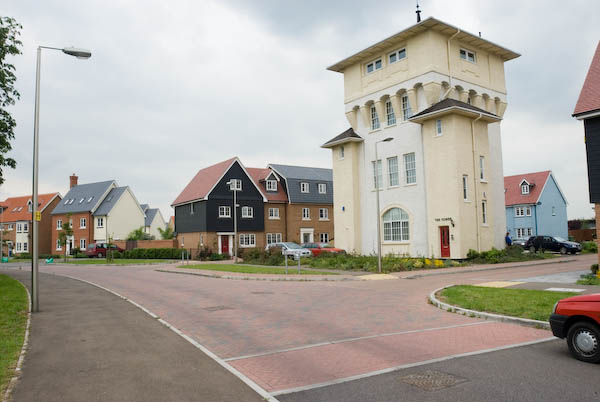
Eshel Hotel, Stamford Hill, Hackney, 1989 89-10d-12

Eshel is the Hebrew for Tamarisk. Genesis chapter 21 verse 33 states that Abraham planted one at Beersheba and prayed there to Yahweh in thanks for God’s covenant with him. That species of tamarisk is a slow growing desert tree and at some times in the year it secretes a sticky honeydew which some think was the manna which provided food for them in the wilderness.

I think this building is now offices for Orthodox Jewish organisations. The delicate wrought iron gates and railings with the menorahs in them were replaced a few years ago by rather more secure fencing.

My walk continued to Stoke Newington – another instalment shortly.


FlickrFacebookMy London DiaryHull PhotosLea ValleyParis
London’s Industrial HeritageLondon Photos

All photographs on this page are copyright © Peter Marshall.
Contact me to buy prints or licence to reproduce.