Feb 1987 Camden, London

Saddler, Monmouth St, Covent Garden, Camden, 1987 87-2c-13-positive_2400
Saddler, Monmouth St, Covent Garden, Camden, 1987

This building is a part of a comprehensive redevelopment of the area, the Comyn Ching triangle, by the Terry Farrell Partnership which took place from 1983-1991, retaining the facades with rebuilt or restored shopfronts. This part of the Grade II listed terrace at 65-71 Monmouth St was only rebuilt in the third and final phase of development which began around two years after I made this picture. The lettering ‘B. FLEGG/ ESTd.1847/ SADDLER & HARNESS MAKER/ LARGE/ STOCK /OF/ SECONDHAND SADDLERY & HARNESS/ HORSE/ CLOTHING/18, with the name B. FLEGG applied diagonally to each side’ was then painstakingly restored.

Though sometimes referred to as a ‘ghost sign’, like many others it should more correctly be called a ‘resurrected sign’.

Thornhaugh St, Bloomsbury, Camden, 1987 87-2b-54-positive_2400
Thornhaugh St, Bloomsbury, Camden, 1987

One of the minor themes in my work at this time concerned the urban tree. London is a city with a great many of them, notably those London Planes, a hybrid of American sycamore and Oriental plane which first appeared by cross-pollination of these two introduced species in the Lambeth garden of London’s best known plantsman, John Tradescant the younger, who named it after the city around the middle of the 17th century. It has been widely grown in streets and parks across the city since the late 18th century.

I think these trees in their regimented rows are probably flowering cherries though probably some with greater aboreal knowledge will correct me. But this was a militarised forest that rather made me shudder. The planting was apparently designed to stop students playing football in the area. It hasn’t lasted and there is now a green area here – though some of the trees in it may be these same specimens, and there are still a couple of large brutalist concrete boxes around a couple of groups of trees.

UCL Institute of Education, Thornhaugh St, Bloomsbury, Camden, 1987 87-2b-43-positive_2400
UCL Institute of Education, Thornhaugh St, Bloomsbury, Camden, 1987

And in the background of the previous image was one of my favourite brutalist buildings, with a playfulness by Denys Lasdun’s that is perhaps more exiting than his National Theatre. It was a part of a larger plan, never completed and much opposed at the time, though in the end it was only a lack of money that really stopped the destruction of more of the area and the building on the open areas such as the ‘garden’ above.

Phoenix Cafe, Chalton St, Somers Town, Camden, 1987 87-2a-64-positive_2400

The Ossulston Estate in Somers Town, close to Euston Station was a remarkable council estate built by the London County Council in 1927-31, taking inspiration from modernist public housing which the LCC’s Chief Architect G Topham Forrest had visited in Vienna. The 7-storey housing blocks are behind a low wall of shop units along Chalton St, of which the Phoenix Cafe was one. Some of these units are still in use as shops, though not this one.

The 310 flats were built to high standards for the time and the development also included The Cock Tavern  – all are now listed. Some of the estate has been extensively refurbished.

St Pancras Church, Euston Rd, Bloomsbury, 1987  87-2a-25-positive_2400
St Pancras Church, Euston Rd, 1987

One of my favourite church exteriors in London is that of St Pancras (New) Church in Euston Rd, built in 1819–22 in Greek Revival style to the designs of William Inwood and his son Henry William Inwood. Perhaps its most remarkable feature are these caryatids, who look to me pretty fed up, perhaps unsurprisingly as they have a stone roof sitting on their heads. They are above the entrance to the burial vault and hold symbols suitable to this position, empty jugs and torches which have gone out.

Mahatma Gandhi, Tavistock Square, Bloomsbury, Camden, 1987  87-2b-01-positive_2400

A short distance away in Tavistock Square is a memorial to Mahatma Gandhi, 1869 – 1948, who studied not far away at UCL in 1888. The powerful likeness is by Fredda Brilliant and the site for it was chosen by V K Krishna Menon who was a member of the Theosophical Society and for some years a St Pancras Councillor before being made High Commissioner for India in the UK. The memorial was erected for the 125 anniversary of his birth and unveiled by then Prime Minister Harold Wilson.

Most years for some time I have visited Tavistock Square each August for the annual remembrance on Hiroshima day around the Hiroshima Cherry tree a short distance from this statue. The square also contains a memorial to the victims of the 2005 bombing here, the Conscientious Objectors Commemorative Stone, a memorial and bust of surgeon Dame Louisa Aldrich-Blake (1865 –1925) and a bust of Virginia Woolf.

More pictures on Flickr in the album 1987 London Photos.


More 1987 – Mainly Soho

Camden Town Cemetery, St Martin's Gardens, Camden St, Camden, 1987 87-1k-46_2400
Camden Town Cemetery, St Martin’s Gardens, Camden St, Camden, 1987

The slow process of putting up my old black and white pictures is continuing, thanks to the lockdown leaving the time on my hands. Although I’m going out of the house for exercise, that only occupies around 50 minutes of the day – and perhaps another half hour to recover.

This picture of the piled up gravestones in Camden Town Cemetery was taken in January and is one of the last from that month I’ve put on line. Although I’ve always liked to wander in cemeteries, often the only real places of peace and quiet in cities, and often good places to rest and eat my sandwiches, I’ve generally tried hard to avoid taking too many pictures in them unless there is a very strong reason to do so.

Partly because as a teacher of photography I saw far too many pictures by students of gravestones and monuments. They were easy to photograph, didn’t move much or complain about being photographed and supposedly said something profound about the human condition. At the in-house moderation of student photography coursework from across the country it was never long before I or another assistant examiner would be exclaiming “Not another sodding angel!”.

Wardour St, Soho, Westminster, 1987 87-2f-55-positive_2400
Wardour St, Soho, Westminster, 1987

In February I turned my attention to Soho, where photography was not always welcomed, though I didn’t intend to emphasise its more sordid aspects. It was one of London’s most varied and interesting areas, and remains so despite the ravages of property developers and Westminster Council.

But I didn’t avoid photographing the frontages offering ‘Intimate Bed Show – No Extras‘ though I didn’t go inside and photographed them in the early mornings when there were few touts or barkers around and any workers who might have occupied them were at home in their own beds. Nor did I meet the ‘Very Sexy Busty Brunette Model‘ whose notice was by a door in D’Arblay St, not even to make my excuses and leave.

Shop WIndow, Berwick St, Soho, Westminster, 1987 87-2f-46-positive_2400

But Soho was remarkable for the variety of shops, a place were almost everything was on sale – and sometimes it was difficult to know exactly what was on offer.

Butterfly, Upper James St, Soho, Westminster, 1987 87-2g-14-positive_2400
Butterfly, Upper James St, Soho, Westminster, 1987

There is still a clothes shop on the corner of Upper James St and Beak St, but it is now larger and more corporate, with a bland plate glass frontage, and Butterfly proved to be as ephemeral as its name suggests. Many other Soho businesses were longer lasting, and Randall & Aubin, late Morin and Cavereau remains in place on Brewer St, though many of the older continental businesses have now gone.

Randall & Aubin, Charcuterie, Brewer St, Soho, Westminster, 1987 87-2e-62-positive_2400

If you look through my pictures of Soho from 1987 you will find some showing the increasing Chinese presence in the area, including one of a crowd watching the New Year celebrations, but far less than in my later pictures of the area.

Charles II, Cibber, Soho Square, Soho, Westminster, 1987 87-2e-24-positive_2400
Charles II, Soho Square, Soho, Westminster, 1987

Soho Square still looked much the same when I was last there a few months before the lockdown, though I do wonder if Cibber’s statue of Charles II looks rather more worn now. Though we may now regret the restoration of the monarchy and feel that the puritanical excesses of the Commonwealth would better have been ended without bringing back a king the so-called ‘Merry Monarch’ does sound in some respects an improvement on our present royal house. And a king with no legitimate children who acknowledged at least a dozen by various mistresses is perhaps a suitable character to be remembered in Soho.

Haverstock Hill, Chalk Farm, Camden, 1987 87-1a-12_2400
More at 1987 London Photos

All photographs on this and my other sites, unless otherwise stated, are taken by and copyright of Peter Marshall, and are available for reproduction or can be bought as prints.


A black woman and a gorilla

Photographers have often I think failed to pay sufficient regard to the people in their photographs. Its something that is particularly important because of the power differential that always exists between the person holding the camera and those being depicted. Its something implicit in the language of photography, when we use the metaphors of the gun or jailer, talking about ‘shooting’ or ‘capturing’ pictures, both terms I try hard to avoid. And particularly important where our work involved people of a different class or race.

It is a question that worried me greatly in my early years as a photographer, and explains why I made relatively few pictures of people in those years, outside my own circles of family, friends and communities, concentrating on the built environment. And it was why, though I had admired his earlier black and white work greatly, I felt considerable disquiet about the colour images of working class families holidaying on beaches which turned Martin Parr from a photographers’ photographer into a celebrity. They seemed the work of an intruder while previously he had worked within communities.

The years have somewhat mellowed my view of this work, and Parr has of course gone on to do so much more, including turning his camera on his own middle class, but I still find those pictures marred by class prejudice and I think that this was at least in part what led to their popularity in the media. But of course we have seen far worse by other photographers here and around the world, and Parr is in many ways one of the good guys of photography, through the foundation he set up to encourage young and emerging photographers from all backgrounds and one whose advice encouraged me on several occasions in my early years in photography.

I wasn’t until very recently aware of the work of Italian photographer Gian Butturini and his 1969 book on London, reissued in 2017 with the text ‘Edited by Martin Parr‘ on the cover. It’s the kind of European approach popular at the time when I first began as a photographer and which I set out in total opposition to in terms of its graphic nature and quest for instant impact rather than a more serious consideration of the subject. I’ve not seen the book, only those images I’ve seen on line, and not seen the particular pairing of images of a black woman and a gorilla at London Zoo a which so shocked student Mercedes Baptiste Halliday when she was given the book as a present that she began her 18-month campaign against the book which she says is “appallingly racist.”

Parr has now said he was ashamed of his association with the book and that he deeply regrets his failure to appreciate its racist implications, something Halliday points out is hard to understand from a visually literate person. Parr also points out that the claim on the cover that he edited the book is incorrect as it he only supplied an introduction to what is otherwise a facsimile of the photographer’s 1969 book. He has also said he will donate the fee he received to charity and has called for the book to be removed from sale and destroyed. It is no longer listed on the Damiani Editions web site.

The book and Parr have come into the news as the campaign has led to both the public apology from Parr and his decision to stand down as the artistic director of the first Bristol Photo Festival. But last year’s protests by Halliday outside Parr’s show at the National Portrait Gallery were brushed aside and ignored by the photographic establishment. Perhaps it was the decision by the photography students from the University of the West of England to cancel their end-of-year show at the Martin Parr Foundation in Bristol that precipitated Parr’s decision.

One supporter of Halliday has been Benjamin Chesterton, known to many in photography and film for his ‘duckrabbit’ blog which I’ve mentioned here on several occasions. Last month he made a post which looked critically at his own family’s history, ‘Our skin in the slave trade. Uncle Sir John Moore and I.‘ which – as ever – is well worth reading. The Guardian quotes him in its article about Parr and the Butturini case as making the very salient point, “The question remains why is it down to a black teenager to confront one of the UK’s leading photographers and curators?”

The Power of Photography

One series of pictures posted through the current lockdown that has often interested or amused me is by Peter Fetterman; in ‘The Power of Photography‘. To see them all in the order he posted them, open the page and scroll down to the very bottom to see the first image, ‘The Wailing Wall, Jerusalem, C. 1860′.

But before you scroll, read his introduction at the top of the page which I reproduce here:

Dear Friends,

I am pleased to introduce a new online series called the Power of Photography, highlighting hope, peace, and love in the world. With every entry, I’ll share personal reflections on my favorite images. I invite you to enjoy and reflect on these works during this time.

Peace & Love,

Peter Fetterman

The Power of Photography

Clicking on each of the images will give you more details about it – in this case that it is by an anonymous photographer and is a 9.75×9.75 inch vintage albumen print – and rather curiously is “Copyright The Artist” who as well as being anonymous is certainly long dead and whose copyright will have expired many years ago.

The negative from which it was printed will I think have been made using the wet plate process, which while it had considerable limitations and required a great deal of manipulative skill was in some respects the absolute pinnacle of the photographic process, with detail and resolution limited only by the lenses of the day. You can enlarge the on-screen image by clicking on it, but it then seems rather soft. Since all printing was by contact, the demand on lenses was not extreme, though you can clearly see some softening towards the edges in this and many images of the time. The print appears to be in excellent condition for its age, though there is clearly some fading at top right, but digital representations are often misleading.

Actually I think the images like this are best seen in reproduction, when some discrete retouching can help to repair the minor ravages of time and restore as best we can the original vision of the photographer, which is of more interest to me than the object.

Strangely the second image of the series seems to be missing, though you will probably have little difficulty in bringing “The Steerage” into your mind. There are other iconic images too, such as Cartier-Bresson’s 1938 ‘On the Banks of the Marne’.

But not all of the pictures are well-known and quite a few entirely new to me and by photographers I have not previously heard of, such as the beautiful Small Apples, 1984 by Finnish photographer Kristoffer Albrecht.

I don’t always share Peter Fetterman’s enthusiasms, but it is good to read the comments of someone so obviously enthusiastic about our medium – and to discover we have at least something in common outside of our interest in photography. So here is a little piece of London he may recognise.

Dobells, Records, Tower Court, Camden, 1987 87-2d-63-positive_2400
Dobell’s Records, Tower Court, Camden, London 1987

All photographs on this and my other sites, unless otherwise stated, are taken by and copyright of Peter Marshall, and are available for reproduction or can be bought as prints.


Reclaim the Streets – 1996

Broadgate 96-719-35-positive
Protesters including groups of drummers meet at Broadgate

I read a reminder a couple of days ago that this was the 24th anniversary of the 1996 Reclaim the Streets protest in West London, which began at Broadgate, then took the Central Line to Shepherd’s Bush, where line of police held up the protesters and the partying began while we waited for everyone to arrive.

Shepherds Bush 96-721-61-positive
Police manhandle a protester at Shepherds Bush

It wasn’t too long before some of the protesters had outflanked the police and the rest surged through to take over the A41M spur which leads from Shepherds Bush to Westway and to party across both carriageways.

Shepherds Bush 96-720-12-positive
Let London Breathe

There was a stage with music and dancing, and some people turned up with carpets and old sofas and made up living rooms on the tarmac.

Shepherds Bush 96-721-25-positive
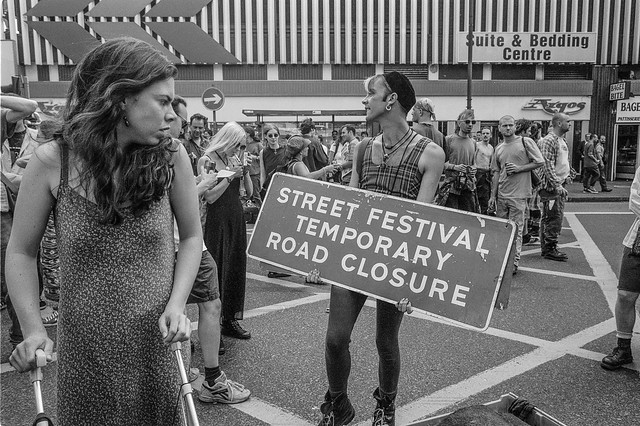
A woman looks at the notice ‘Street Festival – Temporary Road Closure

It was difficult to know exactly what was happening, particularly at Shepherds Bush, but also once we were partying on the motorway, and harder still to know how to photograph the event. Looking back I don’t think I did a very good job of it, though there are some pictures I quite like. But though I think they convey something of the spirit of the event, perhaps they don’t tell the story as well as I would like. There is also a certain sameness which results from them all being taken on 28mm or 35mm lenses, probably on a Minolta CLE or Leica M2.

RTS Party on A41M Motorway 96-724-55-positive
Partying on the A41M

You can read several stories with people’s own recollections of the day online which provide some of the background to these pictures on the Past Tense radical histories blog.

After I’d been photographing the partying on the motorway for some time I decided that nothing new seemed to be happening and it was time to go home and have a meal. I saw some others climbing over a low wall and followed them, making my way to Latimer Road tube.

RTS Party on A41M Motorway 96-725-11-positive
A living room with sofa and carpet on the A41M

The pictures were of course taken on film, and I seem to have only worked in black and white. I probably developed the films I had taken a few days later, and will have then printed perhaps half a dozen and probably a few weeks later taken them in to Photofusion’s picture library. Over the years a handful may have been printed in magazines and books, and I think I probably shared a few on various web sites, but many are now being seen for the first time outside the small group of friends with whom I met to share and criticise work. The images were digitised using the Nikon ES-2 adapter and a Nikon 60mm f2.8 macro lens on a Nikon D810.

You can see more of the pictures I took that day in my Flickr album Reclaim the Streets: London 13 July 1996.


All photographs on this and my other sites, unless otherwise stated, are taken by and copyright of Peter Marshall, and are available for reproduction or can be bought as prints.


From the Royals

I find to my surprise that it is very nearly seven years since I self-published my book ‘The Deserted Royals‘ and wrote a little about it here. Some of you who follow me on Facebook may have seen the rather wider range of pictures from that project made back in 1984 that I’m currently posting daily as my ‘story’ there, though I find Facebook particularly adept in hiding those posts I’d like to see and instead feeding me cats and celebs.

The ‘Royals’ in question are of course the Royal Docks, and most of my work was on the Royal Albert and King George V Docks in North Woolwich, by then part of the London Borough of Newham. I’d tried to photograph them from publicly accessible locations (with the usual mild bit of trespassing) but had found this very limiting, and wrote to the Port of London Authority who still owned these two docks, requesting permission to photograph them from the inside. Rather to my surprise they replied and granted me the access I’d requested. A similar letter to the owners of the Royal Victoria Dock went unanswered.

As well as the daily release on Facebook I will shortly be adding these pictures, along with others I took of London in 1984 to my Flickr album London 1984. At the moment it has pictures I took earlier in the year, including some from the West India Docks. I decided at the start of this year to put pictures on Flickr at a relatively high resolution and high quality and to trust any commercial users to respect my copyright and contact me to pay for usage. Although it’s almost certainly over-idealistic, I don’t think I’m likely to lose any significant income. I’ve used these larger images in this post and if you right click and open them in a new tab you can see them larger than in the post.

Here are a few of the pictures I’ve recently posted on Facebook, along with the usually short texts which accompany them, beginning below with an introductory picture and ending with today’s picture, about which I wrote a little more than usual.


South Quay, King George V Dock, Newham 1984
84-7c-21.
I had obtained permission from the PLA to photograph inside the dock area they owned – the King George V and Royal Albert Docks two docks on two days, and made my first visit in July. The security men in the gate house were clearly surprised that anyone should want to come and take pictures, but not very interested in what I did. Once inside there was no security presence and I could wander freely on the south quay of the King George V dock and on the central peninsula between the two docks, though their was no access to the north side of Albert Dock.
I was not supposed to enter any of the buildings, which could be unsafe, but I did take a number of pictures through windows and doorways, and later did cautiously enter some of the smaller buildings that seemed safe. On my first visit I exposed around ten rolls of black and white film – 360 exposures as well as some colour transparencies over around six or seven hours of work.
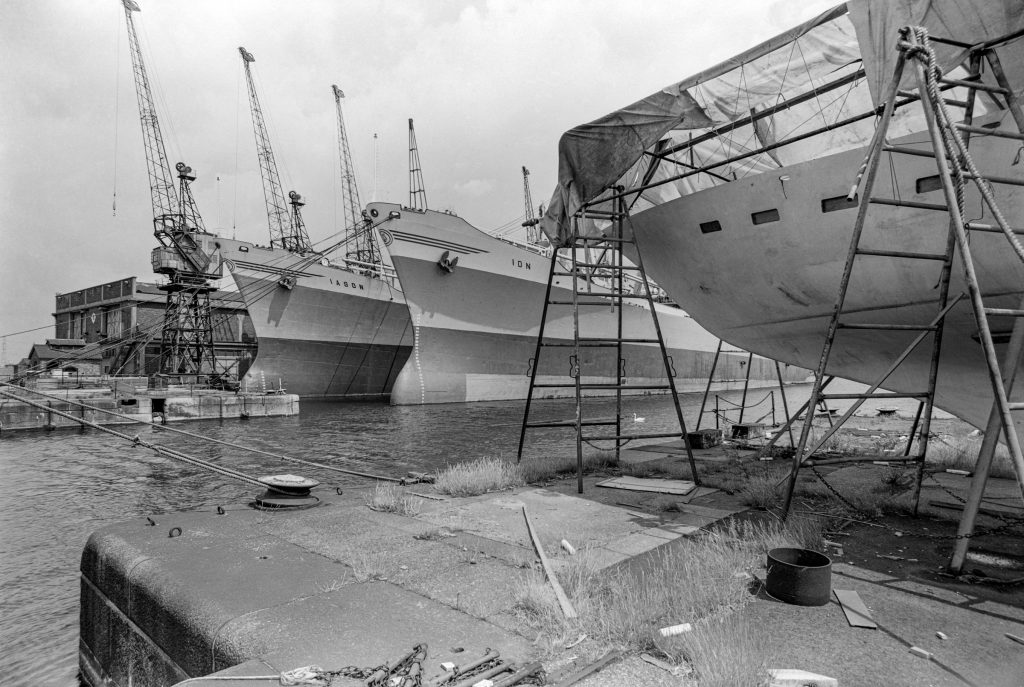
Iason and Ion are the two ships which could be seen in the distance in some pictures posted earlier, at the west end of the north quay of the King George V dock. To the left is the dry or graving dock at the west end of the dock, full of water.

King George V Dock, Newham 1984
84-7e-63.
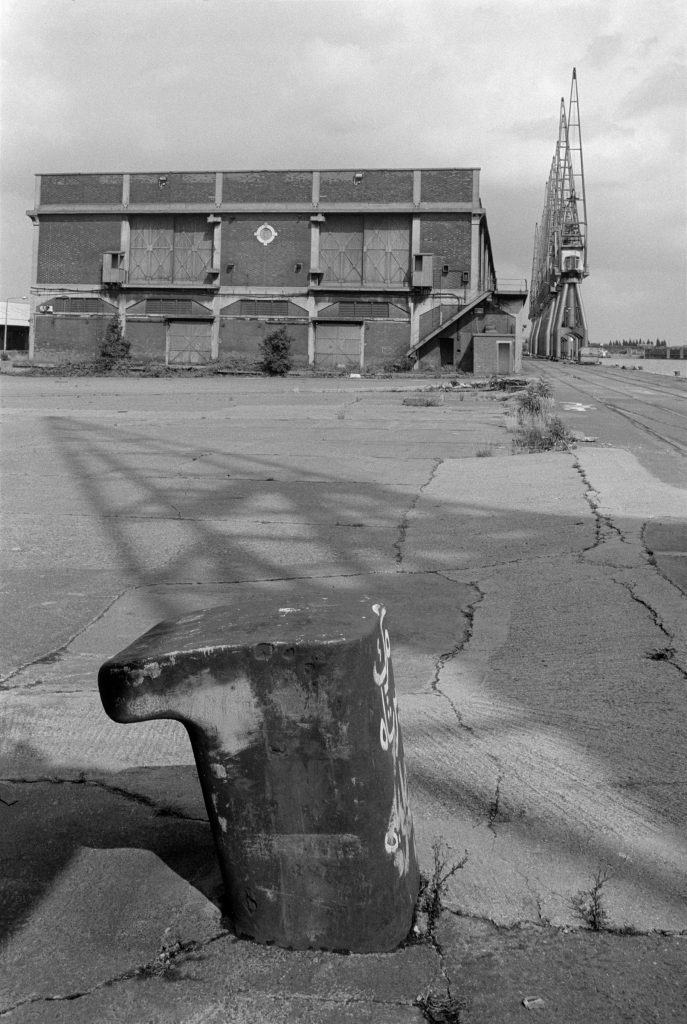
A bollard and a more substantial shed on the land between the two docks, now the runway for London City Airport, looking roughly east. The row of cranes is along the north side of the King George V Dock.

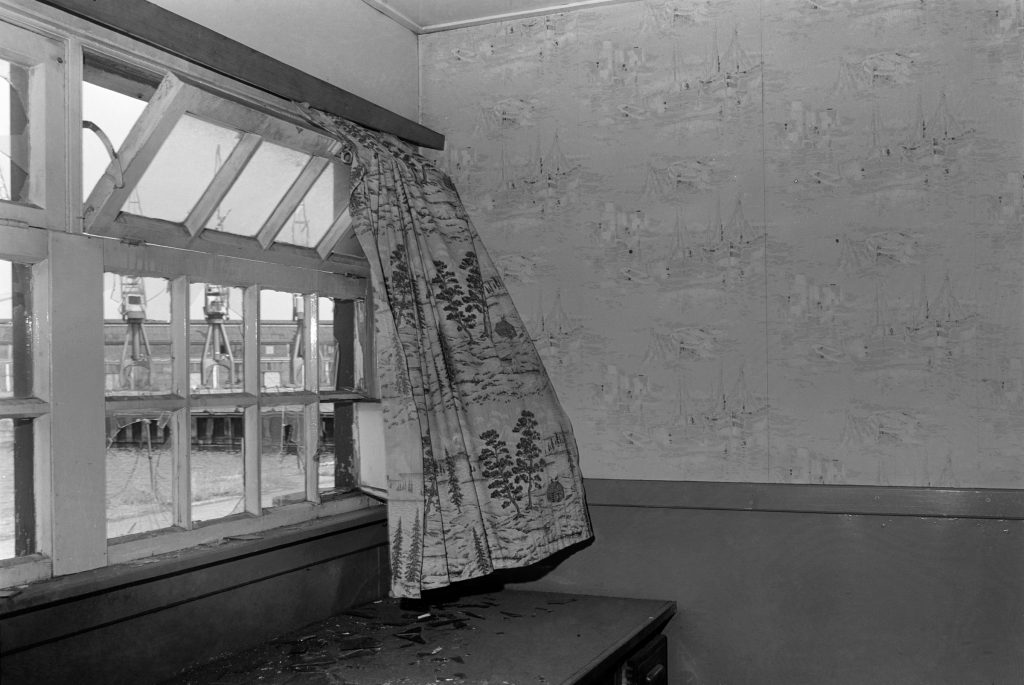
Office curtain, King George V Dock, Royal Albert Dock, Newham 1984
84-7l-53.
This was one of the few pictures, possibly the only picture, where I used flash to capture the curtain blowing in the wind and to balance the light inside the office with that outside. It was quite a pretty curtain, a landscape with trees and something of a Japanese feel, but it was the wall-paper that attracted me more with its groups of small fishing boats in front of a shore with what was probably meant to be a fortress but looked to me more like a cement works like those further down the Thames.
Obviously the scene outside the window with its cranes was vital to the picture, and balancing the light levels inside and outside was no simple matter. Nowadays modern cameras do this kind of thing automatically but back then it involved calculations using distance and the flash guide number, careful exposure measurements through the window and a great deal of luck. It was made more difficult by the slow flash sync speed of all SLR cameras of the time, limited by their focal plane shutters, in this case to 1/60th of a second. I think it was the first time I’d tried to do anything like this, though I had read about it in photographic magazines and I only took a single frame, so it was definitely a case of beginner’s luck

All photographs on this and my other sites, unless otherwise stated, are taken by and copyright of Peter Marshall, and are available for reproduction or can be bought as prints.


London in Lockdown – Chris Dorley-Brown

Many photographers have been busy with various projects taking advantage of the unique situations created by the Covid-19 lockdown, but the most impressive set of images I’ve come across so far are the hauntingly empty cityscapes by Chris Dorley-Brown which are featured in an article with the over-lengthy title ‘Chris Dorley-Brown’s photographs of London during lockdown are “terrifying and exciting in equal measure”’ on web site It’s Nice That.

These images of well-known locations from meticulously researched locations were all taken on weekdays, between the hours of midday and 2 PM and in the article Dorley-Brown says that they took him “about an hour each“. There are just a few people visible, mainly in the distance in some of the images, but they do convey an incredible feeling of emptiness and I imagine it took some time to exactly fine the best position and sometimes to wait for the few wanderers around the city to move into less conspicuous positions, and sometimes for the light.

There is something of a contrast between these and one of Dorley-Brown‘s earlier projects, The Corners, on his web site with other works, where he very effectively made use of multiple exposures to overpopulate the streets of East London in unreal but fascinating tableaux vivants.

Thanks to another photographer, Paul Baldesare, for drawing my attention to this article.


Photographers who have been able to keep working during the lockdown may be interested in a competition with free entry and a £1000 prize on the theme of ‘My New World‘:

The World as we knew it six months ago has been changing dramatically. Many people’s lives were put on hold, some endured hardship and loss, some had to reinvent themselves and perhaps have been working harder than before. There have been important social movements and appreciation of inevitability that we all facing a New World.  

This competition aims to collectively record the experience of people in the United Kingdom during and post lockdown reflecting new challenges and aspirations, bravery, kindness, love, sadness and humour. 

Launching Anna Steinhouse Photography Award

Entries – one image per person – are invited through Instagram until midnight Wednesday the 19th of August 2020. You can find full details of submission, terms and conditions at the link above

January 1987 continued

Regents Canal, Gloucester Ave, Primrose Hill, Camden, 1987 87-1c-22_2400
Regents Canal, Gloucester Ave, Primrose Hill, Camden, 1987

think I had a good month taking pictures in January 1987. I always liked the winter months for photographing places, although the weather wasn’t always kind. But London is a city of many trees, and though they enhance it greatly they also obscure many views. And I do like the way you can see the structure of the trees after they have shed their leaves for the winter, though perhaps they are at their best in spring as they begin to sprout again.

Most of the month I was in Camden, and walked a little beside the Regent’s Canal as it goes through Primrose Hill. There were just a few boats moving – the canals were less busy back then. I’ve always had an interest in the canals in London – and this year was to have exhibited a set of panoramas to celebrate the 200th anniversary of the Regent’s Canal, officially opened in August 1820. You can read more about that show which had to be abandoned in an earlier post here, and the set of pictures I took in preparation for it are – including the one from Camden below – are on Flickr.

Regents Canal 2020: Camden High St13-20190308-d0708
Regent’s Canal, Camden, 2019 – from ‘Regents Canal 200’
Primrose Hill, Camden, 1987 87-1c-51_2400
Primrose Hill, Camden, 1987

One of my favourite portraits is Bill Brandt’s 1963 photograph of a rather morose Francis Bacon looking out of the left of the frame at twilight in front of a lamp post on Primrose Hill. Of course my picture is nothing like his, an empty path and rather more naturalistic, but I think it captures something of the atmosphere of the place which attracted Brandt and made him choose it as a suitable stage for his picture.

Sir John Soane, memorial, Old St Pancras Burial Ground, Pancras Rd, Camden, 1987 87-1d-15_2400
Sir John Soane memorial, Old St Pancras Burial Ground, Pancras Rd, Camden

Sir John Soane (1753-1837) was a leading British architect working in a neo-Classical style. Although prolific, many of his buildings have been demolished or, like the Bank of England, greatly remodelled, though his three London churches, St Peter’s Walworth, Holy Trinity Church, Marylebone and St John, Bethnal Green remain, as does the Dulwich picture gallery and work at various stately homes.

His family tomb in the Old St Pancras churchyard, designed the year after his wife’s death in 1815 is perhaps the most clear example of his work, and is said to be the inspiration behind Giles Gilbert Scott’s red telephone box, made in 1924 shortly after Scott had been made a trustee of the Soane Museum in Lincoln’s Inn Fields – possibly London’s best and certainly one of its quirkiest museums.

Fence, Grafton Rd, Gospel Oak, Camden, 1987 87-1h-14_2400
Fence, Grafton Rd, Gospel Oak, Camden, 1987

I made several exposures of this short alley in Gospel Oak, beside a tall fence partly covered by dead creeping plants. and with a rectangular block behind. Fortunately fairly early on a Sunday morning in January there were few passers-by to doubt my sanity and I didn’t have to wait long for the passageway to be empty.

The barriers, the fence and the building each define planes with rectangular blocks at different angles – with both creeper and clear space roughly defining rectangles at an angle, and through that space the rectangle of the building seemed to me to match that of the barrier on the footpath.

Gilden Crescent, Kentish Town, Camden, 1987 87-1g-46_2400
Gilden Crescent, Kentish Town, Camden, 1987

You could furnish a home from the street in front of this shop selling (and buying) “All types of Old & Modern Furniture” and of course many did. We still use the chairs we carried home from a shop like this, and a few other pieces of furniture, though we had our own photographs of ancestors for the wall rather than buy those on display.

But other things too attracted me about this display as well as the neat rows of chairs, the mattresses and the gas cookers. There was the antique lamp post in the middle of the display at right, and, above the door, presumably from an earlier use, the advertisement in lieu of a shop name ‘WEIGHTS Cigarettes… For More Pleasure.”

Hockey, St Leonard's Square, Kentish Town, Camden, 1987 87-1i-46_2400
Hockey, St Leonard’s Square, Kentish Town, Camden, 1987

Two house bricks stand as a goal for these boys playing roller hockey on quad skates in a cul-de-sac in Kentish Town. I think it was a sport I had not met before – and those hockey sticks were made in the USSR.

Hockey Players, Holmes Rd, Kentish Town, Camden, 1987 87-1j-41_2400
Hockey Players, Holmes Rd, Kentish Town, Camden, 1987

A short walk away I came across another group of hockey players, standing with large sports bags and hockey sticks next to a mural showing roller hockey players on the wall of a skate shop. Their bags and sticks say ‘CANADIEN’ . I can’t remember now what they told me, and whether or not they were Canadian.


All photographs on this and my other sites, unless otherwise stated, are taken by and copyright of Peter Marshall, and are available for reproduction or can be bought as prints.

Beginning 1987

Forge Place, Malden Crescent, Kentish Town, Camden, 1987 87-1a-46_2400
Forge Place, Malden Crescent, Kentish Town, Camden, 1987

I’ve just begun to add black and white pictures from 1987 to a new album in Flickr, and am rediscovering quite a few pictures I had forgotten, including most of those in this post, all from the January pages of my filing sheets.

Eros, Piccadilly Circus, Westminster, 1987 87-1a-55_2400
Eros, Piccadilly Circus, Westminster, 1986-7

Probably that means they were taken in January 1987, though a film I loaded into the camera in December might not be finished until the following month, and I suspect that the picture of Piccadilly Circus with boarding around Eros was probably made before Christmas. Some statues get regularly boarded up.

Window with cross, Mansfield Rd, Gospel Oak, Camden, 1987 87-1b-35_2400
Mansfield Rd, Gospel Oak, Camden, 1987

I’d been waiting to start this album for a few months, as I’d got fed up with using my film scanner (too slow and now with an unreliable Firewire interface), my flat bed scanner (not quite sharp enough) and a bellows and macro lens on a Nikon D810 where I couldn’t quite get even lighting across the frame. The Nikon film holder that comes with the bellows works with mounted slides which crop the frame, but try as I might I couldn’t get even lighting across the full 35mm frame.

Dove, Southampton Rd, Gospel Oak, Camden, 1987 87-1b-46_2400
Dove, Southampton Rd, Gospel Oak, Camden, 1987

While it was fast and easy to photograph negatives, every one needed to be worked on in Lightroom and Photoshop to try and correct the lighting fall off, and I couldn’t find a way to do so automatically. I experimented with different light sources and made some slight improvements, but couldn’t solve the issue.

Stairs, Malden Rd, Gospel Oak, Camden, 1987 87-1b-52_2400
Stairs, Malden Rd, Gospel Oak, Camden, 1987

I decided to buy Nikon’s more recent kit for digitising images, the ES-2, and ordered one in early March, but dealers were out of stock and I only received it a couple of weeks ago. Fortunately, although not perfect, it is a great improvement in several ways. The ES-2 connects to the front of the 60mm macro lens with a short tube, and one advantage is that unlike the bellows it retains auto-focus. With the bellows I had to focus in live-view at the start of each session and then firmly lock it it place, remembering to exit live-view as this crops the image.

Generations, Geoffrey Harris, sculpture, Maitland Park Villas, Kentish Town, Camden 87-1b-62_2400
Generations, Geoffrey Harris, sculpture, Maitland Park Villas, Kentish Town, Camden 1987

But the main advantage is that the ES-2 is almost capable of giving even coverage across the whole 35mm frame and has a proper negative holder which takes a strip of up to 6 negatives, with click-stops to move from one to the next. It isn’t perfect and seems ridiculously overpriced but it is a great improvement, making the digitising of negatives easier and faster. For the moment I’m concentrating on black and white, but I think it should also make working with colour negatives much easier, and the workflow I’m using to batch process the files (more about that in a later post) should also work with them. Most images just need minor tweaks and fortunately most of my negatives from 1987 are quite clean.

Most of these pictures speak for themselves, though perhaps I should admit that the ‘cross’ is the shadow of a parking sign. You can see these and more in my album 1987 London Photos.


All photographs on this and my other sites, unless otherwise stated, are taken by and copyright of Peter Marshall, and are available for reproduction or can be bought as prints.


Further North in TQ32

Swimming Pool, Golden Lane Estate, City, 1992 TQ3282-017
Swimming Pool, Golden Lane Estate, City, 1992

I don’t know why TQ32 didn’t take me very much into north London during the years 1986-92 as certainly in later years I spent more time in Canonbury, Stoke Newington and Enfield etc, but this particular 1km wide strip perhaps just avoids the areas of them that interested me most.

Dummies,  Old St, 1988, Islington TQ3282-005
Dummies, Old St, 1988, Islington

It’s just an accident of geography that while Green Lanes begins just on its west edge, as it goes north it moves just a little to the west, taking it out of the area. Another accident that much of what I photographed in Tottenham lies just a short way to its east. Of course the pictures I took of these areas still exist and are either already on line in other albums or will I hope soon be there as I get around to uploading other strips of the project.

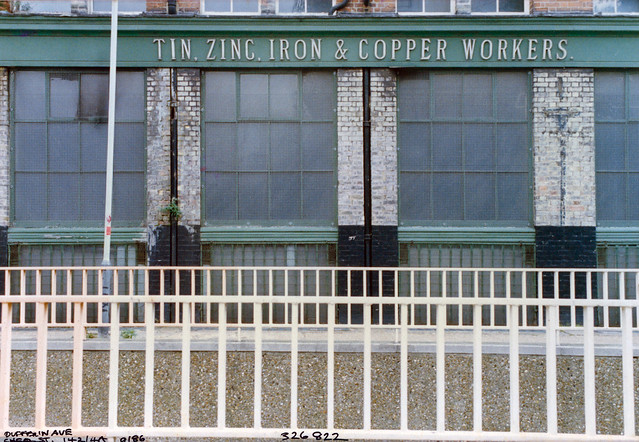
Tin, Zinc, Iron & Copper Workers, Dufferin Ave, Old St, 1986  TQ3282-003
Tin, Zinc, Iron & Copper Workers, Dufferin Ave, Old St, 1986

TQ3282 begins on the edge of the city where both Islington and Hackney and meet it around Old St in Finsbury, Shoreditch and Hoxton. I don’t think there are now any Tin, Zinc, Iron & Copper Workers in Dufferin Ave, which seems largely now to be home to various financial organisations and I think this building close to Bunhill Fields may have been replaced by something more modern, or at least refronted.

SEFCO Ltd, Honduras St, Old St  1986 TQ3282-004
SEFCO Ltd, Honduras St, Old St 1986, Islington

Honduras Street is one of several short streets between Old St and Baltic St, just west of Golden Lane, and at one time was where Olympus Cameras had their service centre, which is probably why I walked down it and took this picture of SEFCO Ltd which will probably have been taken on an Olympus OM camera.

There was a company called SEFCO Ltd offering to supply specially shaped rubber pieces from an address in Rosebery Avenue in a small ad in the magazine Electrical Engineering in September 1955 who may possibly be the same company moved to a different but nearby address, but otherwise I can find no other information on the internet.

In later years I visited Honduras Street to go to exhibitions and events when it became the home of Foto8 magazine and the Host gallery from 2002 to 2012.

Mural, Caribbean House, Bridport Place, Hoxton, 1986 TQ3283-001
Mural, Caribbean House, Bridport Place, Hoxton, 1986, Hackney

Among the other pictures that I made in TQ32 were a few from Hoxton and Stoke Newington and the start of Green Lanes, including a fine travel agent’s window and several of a photographer’s shop.

Photographer, shop window, Newington Green, Green Lanes, 1988 TQ3285-008
Photographer’s window, Newington Green, Green Lanes, 1988

And further north there are some of interest you can find for yourself, including one with some particular resonance at the moment which I probably photographed at the time in part for its street name, Black Boy Lane.

You will find the pictures on Pages 3 and 4 of TQ32 London Cross-section.