The North Circular Road crosses the Lea Navigation in Edmonton, where there are now a whole series of six bridges over it, though I think there were fewer when I was taking these pictures in 1983. The street map I used shows the North Circular as just a single carriageway, Angel Road, which on the east side became the Lea Valley Viaduct, and I think this picture is taken across the whole of the roadway.
To the south of the North Circular there were industrial and commercial areas on both banks, with Clements International UPH, “Europe’s Largest Maker” on the west, a huge furniture showroom (I suppose the UPH stands for upholstery) and beyond it to the south a timber wharf.
On the east bank wasDorford Wharf and the extensive Lea Valley Trading Estate and Kingsway Industrial Estate, and another timber wharf, which I’ll post pictures from later.After re-instalapi-ms-wi-
On the east bank wasDorford Wharf and the extensive Lea Valley Trading Estate and Kingsway Industrial Estate, and another timber wharf, which I’ll post pictures from later.
I think all of the businesses by the navigation were closed, including the cafe here. Now the whole area has been cleared.
Although commercial traffic on the Lea Navigation had come to an end, there were still a number of lighters on it, including this one moored in front of a timber wharf. There were so many timber wharves on the Lea because the entrances to the Limehouse Cut and Bow Creek leading to the Lea Navigation were opposite the Surrey Docks, where ships brought in timber from the Baltic and elsewhere and which had large storage ponds where it was stored and seasoned.
There is still a timber merchant not far away, just to the north of the North Circular at Ash Wharf, but none of its timber comes in by barge.
All photographs on this and my other sites, unless otherwise stated, are taken by and copyright of Peter Marshall, and are available for reproduction or can be bought as prints.
Three years ago December 9th was a Saturday and people were out on the streets in at least three protests which I photographed.
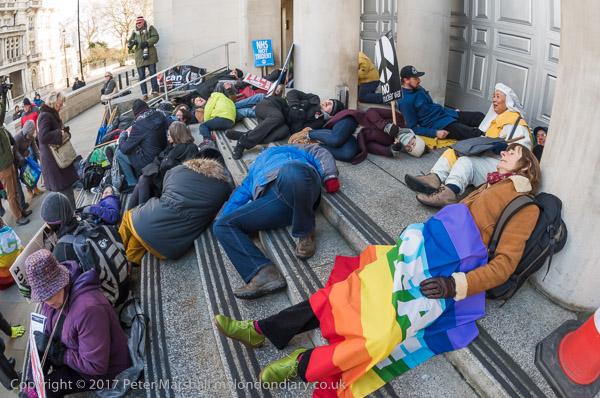
My day’s work began at the Ministry of Defence, where peace campaigners celebrated the award of the 2017 Nobel Peace Prize to ICAN, the International Campaign to Abolish Nuclear Weapons, with a die-in on the steps.
ICAN was awarded the prize for its role in pushing for a United Nations global nuclear ban treaty which was approved by 122 nations at the UN General Assembly in 2017. In October 2020 Honduras became the 50th country to ratify it and will come into force on 22 January 2021. The UK government refused to take and part in the negotiations and has refused to sign the treaty and the award of the Nobel prize hardly got a mention in the UK media.
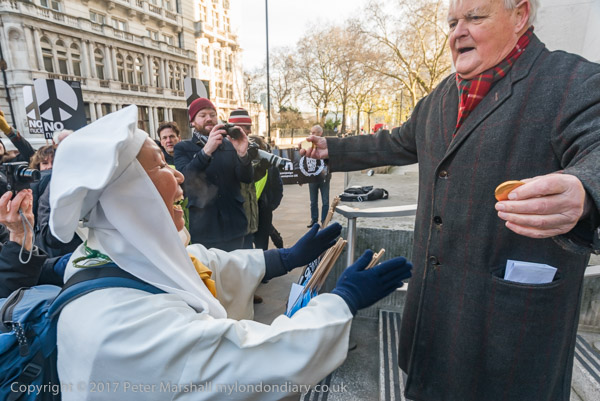
None of the main nuclear powers has signed the accord, and the protesters including members of ICAN UK, CND, Medact and WILPF, the Women’s International League for Peace and Freedom, urged the UK to sign up and scrap Trident replacement. Bruce Kent made a presentation of a large cardboard Nobel Prize to ICAN UK, and handed out small ‘Nobels’ (gold-covered chocolate coins) to all who come up for them. After a few speeches there was then a die-in on the steps of the ministry.
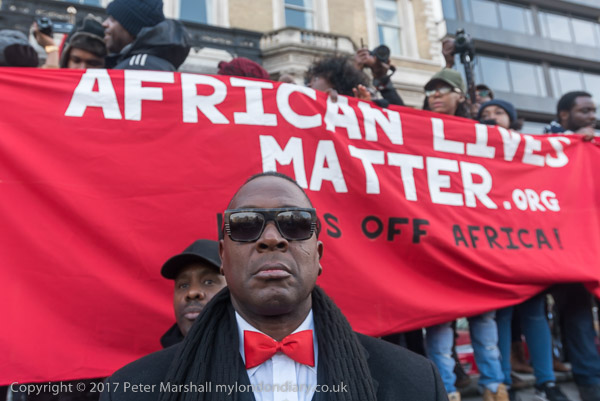
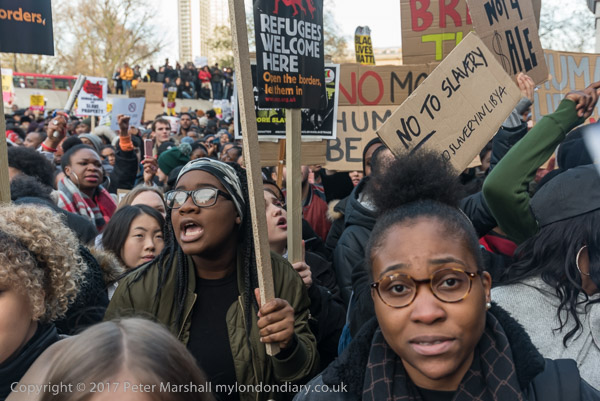
A large crowd had gathered in Belgrave Square for the National Anti-Slavery March, organised by African Lives Matter after the news that African migants detained in Libya were being sold as slaves by Arab slave traders.
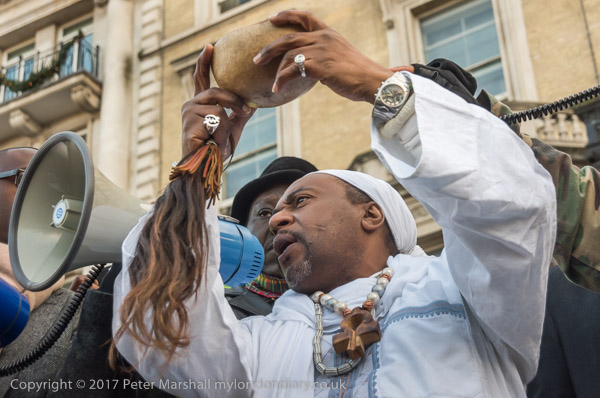
They marched to Knightsbridge and then along to Hyde Park Corner, going around the roundabout and then back along the other carriageway of Knightsbridge to the Libyan Embassy where there was a lengthy rally, including an African priest leading a libation ceremony in memory of the many Africans who have fought for their people against enslavement and colonialism; people in the crowd shouted out names for him to honour with pouring water onto the ground.
As well as demanding the closure of the Libyan detention centres, action by African governments to rescue people detained in the camps and condemnation of the slave trade and murders of migrants by all African leaders and the UN, calling on Libya to make and enforce laws that prevent these crimes against humanity, many also demanded reparations for the historic slave trade and the continuing despoliation of African resources by imperialist nations including the UK.
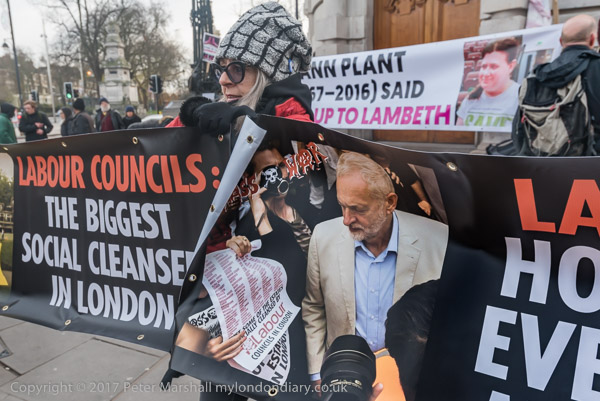
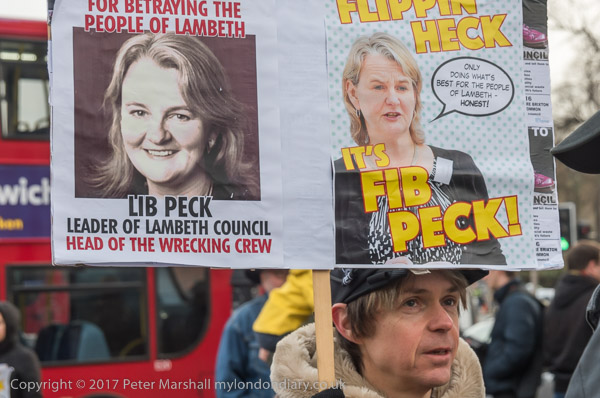
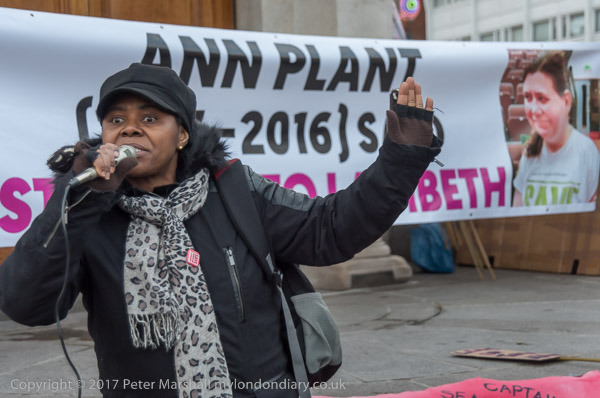
I had to leave before the rally ended as I was beginning to shake and feel unwell, weak and dizzy, the signs of an diabetic hypo, and I walked a short distance away to sit down eating one of the snacks I carry to give a rapid boost of my blood sugar. Soon I was feeling well enough to eat my lunch and take the tube to my final event of the day, a vigil outside Lambeth Town Hall in Brixton against the heartless policies of Lambeth Council.
Lambeth are one of the London Labour councils who are pursuing a policy of social cleansing under the guise of regeneration, realising the asset value of council estates by demolition and rebuilding with only small provision of social housing, resulting in many local council tenants and leaseholders being forced to move out of the area.
Lambeth have also made drastic cuts, shutting down community centres, cutting services for the disabled, those with mental health problems, young people and social services generally; although the Council claim these actions have been forced on them by Tory government cuts, the protester point out that Councillors’ expenses and allowances keep on growing and they have spent over £150m on a new Town Hall.
The vigil included a tribute to Cressingham Gardens resident and leading campaigner Ann Plant who died of cancer in December 2016, spending her final months continuing the fight to prevent the demolition of her home and her community by the council.
All photographs on this and my other sites, unless otherwise stated, are taken by and copyright of Peter Marshall, and are available for reproduction or can be bought as prints.
The recent failure of the Arcadia group brought memories of UK Uncut back to mind. Formed in 2010 this “grassroots movement using direct action to fight the cuts and highlight alternatives to austerity” organised a number of peaceful direct actions against tax dodgers in the following couple of years, though more recently it seems to have largely confined itself to posts on Twitter and Facebook – including this on 1st December this year by Rob:
It is not ‘Topshop owner Arcadia group could collapse into administration within days’, it’s ‘billionaire tax exile Sir Philip Green will let company in his wife’s name fail, with massive hole in pension pot and risking thousands of jobs at Christmas time during a pandemic.’
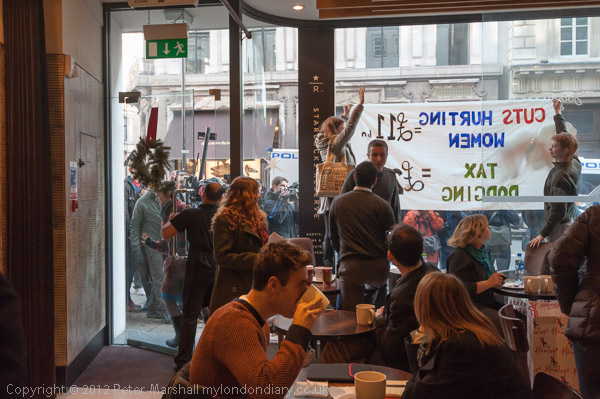
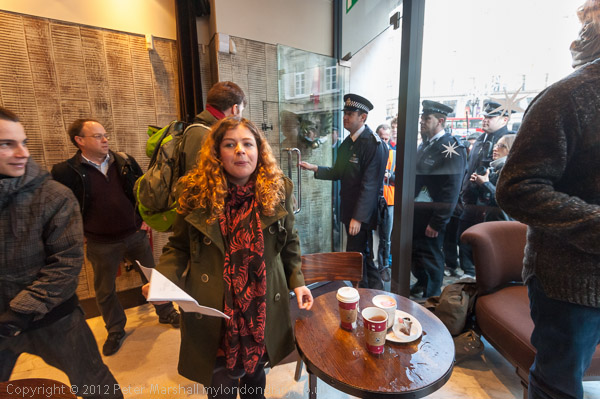
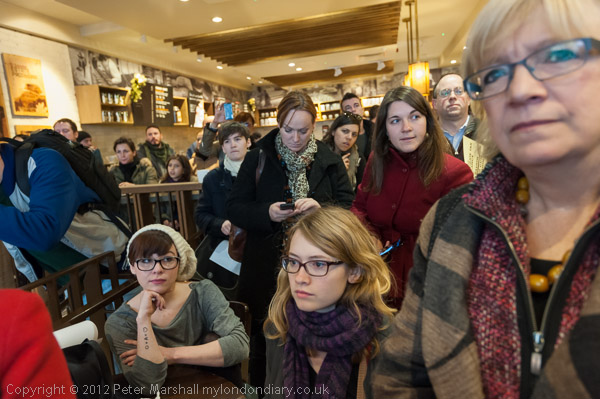
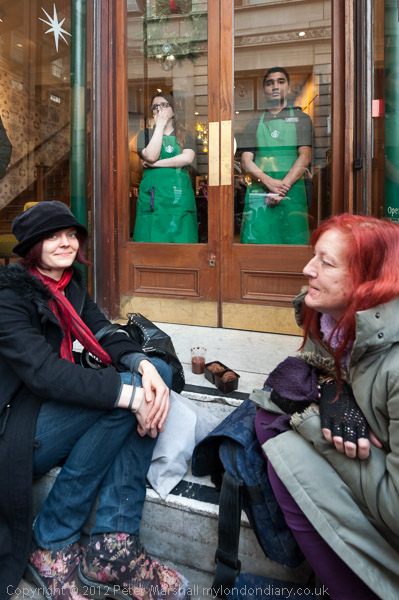
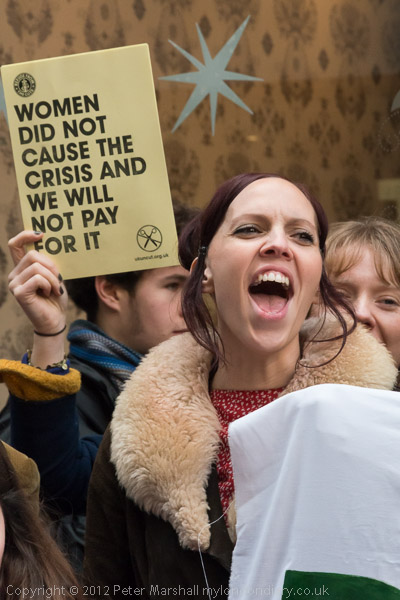
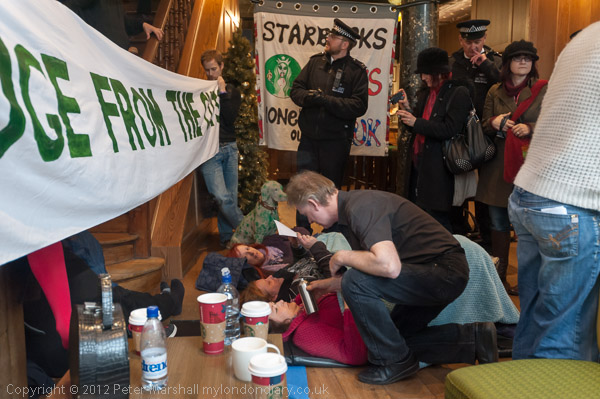
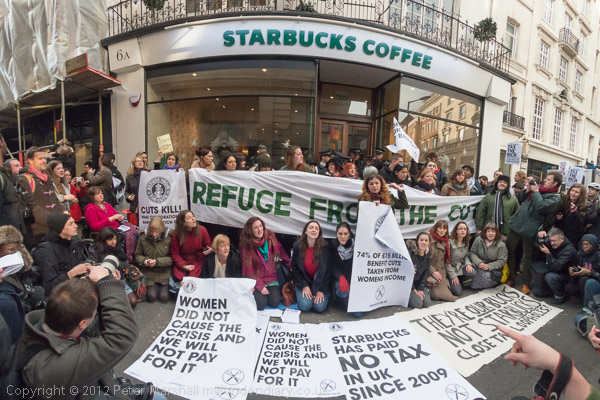
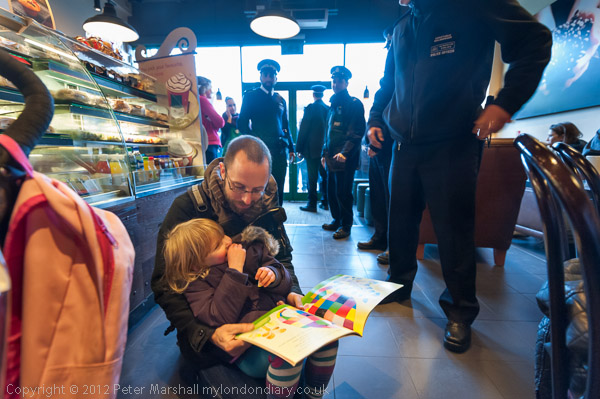
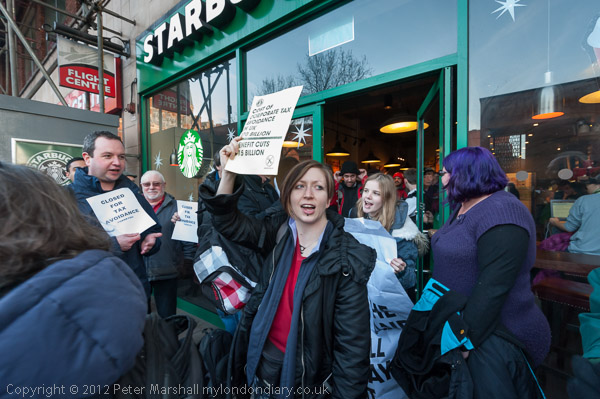
I photographed a number of UK Uncut events, and their biggest day of action was 8 years ago today, on Saturday 8 Dec 2012 when there were over 45 protests at Starbucks shops across the UK with women, men and children transforming Starbucks stores into in refuges, crèches and homeless shelters in protest against the impact of the government’s cuts on women and their refusal to clamp down on tax avoidance.
While actions by UK Uncut and others have certainly done much to raise public awareness about the huge amount of tax evasion and tax avoidance by the rich and corporations in the UK it has led to very little action to cut it down. According to HMRC figures for 2018/9, quoted by Full Fact, the the ‘tax gap’ – money that should have been collected as tax but wasn’t – was around £35 billion, of which “£12 billion is attributed to tax evasion, avoidance and organised crime.” Full Fact suggest that tax evasion and avoidance is currently about 15 times greater than benefit fraud.
HMRC claim to have taken many measures to reduce this loss, but it continues to be huge, with far too many loopholes still remaining for the wealthy and companies to legally avoid paying tax on income generated in the UK. Much of the activity of the City of London is devoted to keeping things this way, along with laundering money from criminal enterprises – and the City has its own representative in our parliament – the City Remembrancer – to keep things that way.
Meanwhile, the newspapers and broadcast media plug away at the idea of ‘benefit scroungers’, creating a perception that this is far more widespread than is the case. A 2013 Ipsos Mori survey found that the general public thought that almost a quarter of benefits were fraudulently claimed – over 20 times the actual level. Of course it is still too high, as is the level of those who are underpaid benefits, which is almost as much.
I went with UK Uncut into two Starbucks just off Regent St, going into the Conduit St branch a few minutes before the widely advertised start time for the protest. Staff were denying entry to those they thought would be protesters but I walked in without any problem, and was standing in a long queue to the counter when the protest began. There were speeches and some chanting of slogans inside for around 10 minutes, along with a much larger and noisier group outside who had been refused entry before police arrived and ordered us out, falsely accusing the protesters of behaving in an intimidatory manner towards the staff and customers and threatening them with arrest. We all left quietly to join the large and loud protest outside.
I went down to the nearby Vigo St Starbucks where a similar protest was taking place but was not allowed in and had to take photographs through the windows. Eventually the crowd outside the shop was joined by the others from Conduit St and a rally began.
UK Uncut in Euston Rd Starbucks
I while the rally was continuing to photograph another of the London protests at the Euston Road branch of Starbucks, where the Labour Representation Committee was joining in with the UK Uncut day of action. By the time they arrived, rather later than the advertised time, other UK Uncut supporters had already decided to go inside and sit down, and the doors were locked. Police were rather more friendly here and came and discussed the situation with those sitting down inside, who agreed they would leave when they were requested to do so by the management and then continue the protest outside.
All photographs on this and my other sites, unless otherwise stated, are taken by and copyright of Peter Marshall, and are available for reproduction or can be bought as prints.
I’m not sure why the name Ponders End so appeals to me. It has a rather down to earth quality (or perhaps down to water) which is apparently reflected in its etymology, stretching back over 600 years to the Ponder family, with a John Ponder being recorded as far back as 1373. He or his family apparently got their name because they kept or lived by a fishpond or mill pond on the River Lea. Ponders End was their end of Edmonton.
The River Lea was important for the movement of people and goods from the earliest times and was improved for navigation at various times in the middle ages; later the first modern gated lock on a river was built at Waltham Abbey in 1577 and the basis of the current Lea Navigation – including the Limehouse Cut – were laid in the 1770s, though there were further improvements well into the 20th century. You can read more on Wikipedia. In recent convention the spelling Lea is used for the river and natural features, and Lee for those man-made features such as the navigation but I tend to use Lea for both.
Because of its good transport links to London, industry began to arrive here in the 19th century, with wharves along the canal. Later with the growth of motorised transport development became centred along the Great Cambridge Road, the A10, a short distance to the west, particularly after its improvement in the 1930s. When I took these pictures back in 1983 the area was full of factories, but many were derelict, their demise accelerated by Thatcher’s national flight from manufacturing – something which was at the centre of my recording of out post-industrial landscape
The area had turned its back on the canal where all commercial traffic had ceased a couple of years earlier, but many of the structures were still present. Now almost all have been replaced by warehousing and some residential development. In later years I photographed around the little that remained, including Wright’s Flour Mill, parts of which date from the 18th century.
Back in 1983, there was no GPS and it was hard to determine the exact location of the pictures I took as I walked beside the navigation, and I made few records that would help. In a few pictures it is possible to see features which still exist, particularly the tall blocks of council flats close to Ponders End station.
The last two pictures are of one of Edmonton’s best known and largest industries, Thorn Lighting. Julius Thorn opened his Atlas Lamp Works Ltd in Edmonton in 1932, and later at the start of the war a second factory in Tottenham. The company is now part of the Austrian company Zumtobel. I think that these two pictures are part of their Angel Road site. The main production moved from here to Merthyr Tydfil soon after the Second Wolrd War, but speciality lamps were produced here until around the late 1960s.
More pictures in River Lea – Lea Navigation 1981-1992 on Flickr. Click on any of the pictures above to go to a larger version in that album, where you can also comment on the pictures.
All photographs on this and my other sites, unless otherwise stated, are taken by and copyright of Peter Marshall, and are available for reproduction or can be bought as prints.
I’m still rather in denial over Christmas, kind of hoping it will go away. Not that I don’t enjoy most of the things we won’t be doing this year, meeting up with friends, visiting distant family and so on, but somehow I never manage to get myself organised over things like Christmas Cards and presents until the last minute.
This year I did try, and a few weeks ago pored over the many Christmas catalogues that I’d been sent, and then went on line to make some orders – only to find that everything I had chosen was already sold out. It rubbed salt into the wound to then get e-mails from a couple of the companies promoting items that I’d already tried to order without success.
Christmas decorations outside houses began going up early this year – already some were twinkling away in mid-November. Linda brought home a tree a week ago, and I should have photographed her coming home with the pot at its base wedged tightly in her cycle pannier, but couldn’t summon up the energy. I did help her in the difficult task of extracting it from the pannier, and for the moment it is sitting outside in our back garden. We always buy growing trees, and usually they last a couple of Christmases before getting too large to bring inside. We have two specimens now at over 50ft in our smallish back garden, and I’ve had to cut down a couple more over the years when it was beginning to get too crowded.
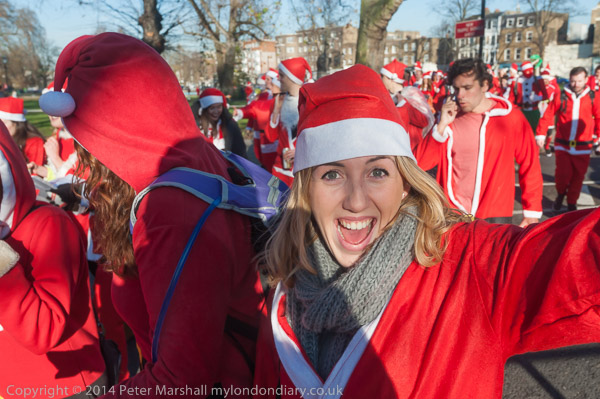
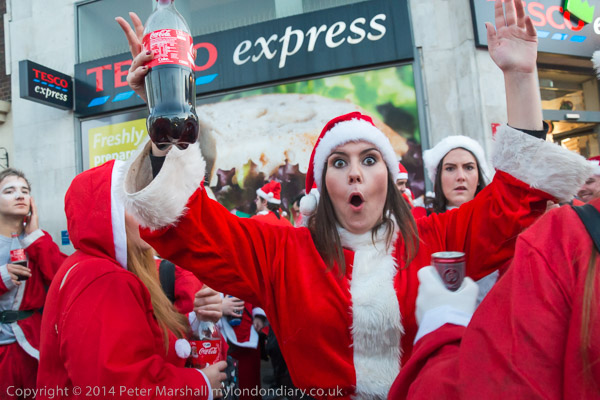
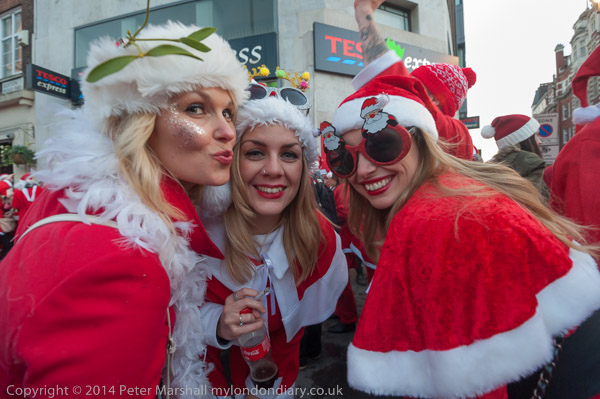
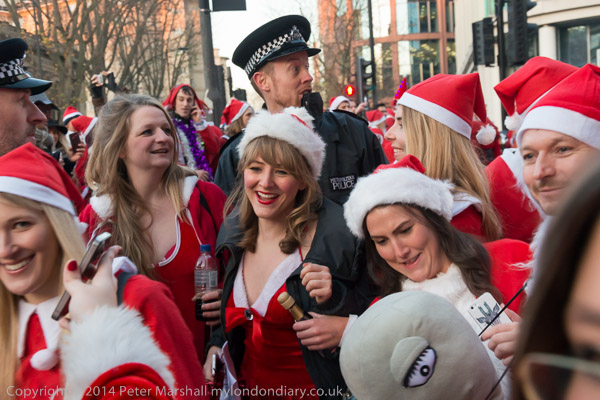
Although I’ve never myself dressed up as Santa (though I have the beard if I let it grow a bit) in past years I’ve often enjoyed photographing Santacon in London around this time of years. It began as a gloriously anarchic event with hundreds or thousands of Father and Mother Christmases, elves and reindeer spilling rather drunkenly across the city streets, but then the police stepped in as it was disrupting the spending festival on one of the busiest shopping days before Christmas.
These pictures of Santacon come from Dec 6th 2014 and I probably went as far as wearing a Santa hat to join in the festivities for an hour or so before retiring to a small pub a little off their route where a couple of friends were waiting for a rather quieter celebration.
Here’s my text from My London Diary where there are more pictures from Santacon:
Thousands in Santa suits and other Xmas deviations, police trying hard to keep smiling, cans of beer, doubtfully soft drinks, just a few Brussel sprouts in the air, crowded bars, sprawling mass of mainly young people having fun on the streets of London. Santacon
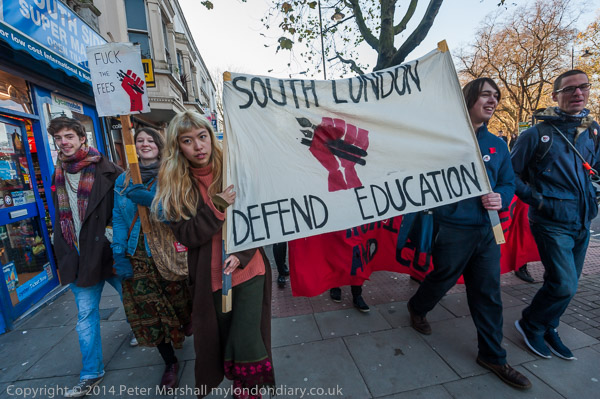
Of course this – and the extreme shopping were not the only things happening in London that day. After photographing the Santas at one of their three starting points I then joined the South London March for Free Education against tuition fees which was also starting just a few yards away on Clapham Common.
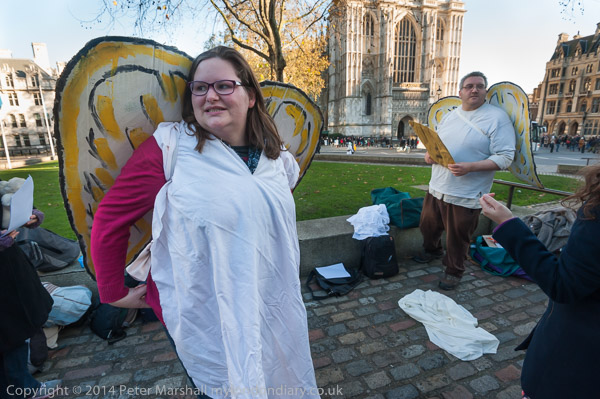
After marching with them through Clapham on their way to Brixton I took the tube to Westminster where there was a rather more Christmassy event taking place, a Fossil Free Nativity Play by Christian Climate Action, before leaving to join the North London Santas on the Euston Road.
All photographs on this and my other sites, unless otherwise stated, are taken by and copyright of Peter Marshall, and are available for reproduction or can be bought as prints.
I’ve now put more photographs in my Flickr album River Lea – Lea Navigation 1981-1992 to add pictures from Broxbourne to the River Thames to my earlier uploads.
Enfield Lock
I’ve gone through the contact sheets from 1981-3 and selected and digitised a few more pictures I found of interest to add to those I’d scanned preparing for earlier shows, but I think there are pictures from some of the later years in that period I may add later.
But for the moment this album is complete – with 418 pictures. Because I made these on a number of different visits to the area, it was difficult to put them into sensible order – and a few are still obviously in the wrong place. But I’ve tried to put them at least largely in order as the valley leads down to the River Thames at Leamouth.
Back in 1981-3 I was not too concerned with the exact locations of the pictures, and my contact sheets seldom have little indication except for the contents of the pictures. I can no longer find the notebooks in which I wrote about the project, though a few of the vintage prints have locations on them and a couple even grid references. I’ve tried to give locations on Flickr, and already a few viewers have been able to help me on this, and correcting a few mistakes I made. Corrections and comments are always welcome, and clicking on any of the images in this post will take you to a larger version where you can post comments.
So, for example, this picture I’ve captioned simply ‘Broxbourne, Herts, 1983‘ but I could be quite wrong. It could be Cheshunt or somewhere else. And I’d be happy to be told exactly where it is. It’s easier to remember pictures further south as I’m more familiar with the area, though thanks to some who have already corrected a few of my confusions such as mistaking the Clapham Park flats for the Trowbridge Estate.
Most of the pictures in today’s post are from Enfield, Ponders End or Brimsdown, in the London Borough of Enfield, where a large industrial area is located to the west of the canal. I think most of the structures I photographed back then have since been replaced.
In a later post I’l post more selected pictures from Ponders End and Edmonton and then further south. But you can see them already at Flickr album River Lea – Lea Navigation 1981-1992.
All photographs on this and my other sites, unless otherwise stated, are taken by and copyright of Peter Marshall, and are available for reproduction or can be bought as prints.
Gosheron Tapes, Kensington Church St, Kensington, Kensington & Chelsea
I’m often surprised by people who look at some of my photographs and say to me “ I never notice that”, but I think it’s true of all of us that we walk around without really noticing things. Even buildings like Vicarage House, home of Gosheron Tapes, whose frontage screams out onto the street. But Gosheron’s days – at least at this address – had clearly passed, as an estate agent’s sign and flyposts on the windows clearly show, though they seem to have continued making packaging materials elsewhere until at least 2005.
The building now has antiques on the ground floor and serviced offices elsewhere, including the Nicaraguan Embassy. I’ve failed to find any information about its exact date – somewhere around 1900 – or the monogram which appears to be CS on its frontage. Information is welcome.
Godfrey’s Model Bakery, Arlington Rd, Parkway, Camden, 1987
The ‘Tasty Corner’ on Arlington St and Parkway in Camden is now an estate agentss and its large sign with its baker for Godfrey’s Model Bakery has disappeared.
Palmers Pet Stores, Parkway, Camden, 1987
Many passed Palmer’s Regent Pet Store on their way to and from London Zoo from Camden Town Station. It was established by Mrs Florence Palmer around 1918 but was run from 1924 by George Palmer, who built up the business and expanded into a second neighbouring shop in the late 1930s. Perhaps surprisingly this shop was listed Grade II in 2007, largely for its shop front which the listing text suggests dates from around 1940, though the houses containing the shop were built in the 1820s.
The shop, which had sold Winston Churchill his cat Orlando as a kitten which later moved into Downing St, and a couple of Abyssinian kittens to Charlie Chaplain, stopped selling animals around 2005 and moved across the road. After being empty for several years it became a tea room.
Clarence Cottage, Albany St, Regent’s Park, Camden, 1987
On their way to the Zoo walkers might have walked down Albany St, or at least past its corner close to this hous, Clarence Cottage, which stii has its row of ornaments with a rather weather-beaten lion at its centre. Previously called Glenhaven, it isn’t clear to me why the mid-19th century house was Grade II listed in 1974, though it’s a pleasant enough building of its age, only really distinguished by this extension with a Ionic pedimented doorway onto the pavement outside and the ornaments above it – including that lion.
It’s in a area of London that has many fine buildings from that era and earlier – much of which is probably also listed.
Sussex St, Pimlico, Westminster, 1987
I came across two dogs in Westminster, looking to me rather snooty. But I’d failed to note down their exact location and it took me a long time to hunt them down again – but they are still there in Sussex St.
Perhaps the most surprising thing about the Romany Hotel is that it is still there as the Romany Hotel, though the signage has changed and now includes an e-mail address and a fairly discrete extra floor has been added on top.
But in keeping with today’s theme is the bird in flight at the top left corner. Although I’m no ornithologist at first glance it looked like some bird of prey, but I think it is really just a pigeon doing a good impression.
All photographs on this and my other sites, unless otherwise stated, are taken by and copyright of Peter Marshall, and are available for reproduction or can be bought as prints.
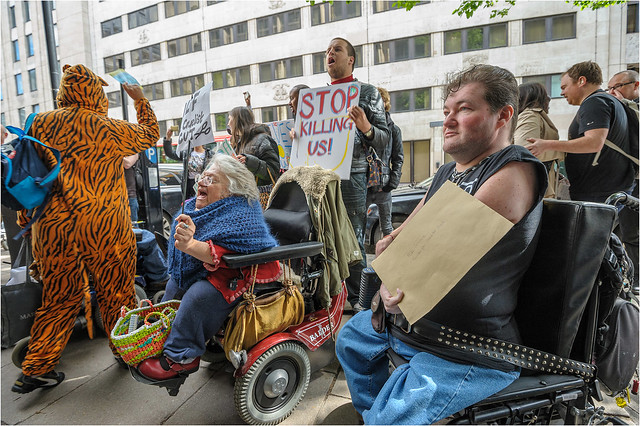
Paula Peters of Disabled People Against Cuts speaks outside ATOS offices in National Day of Protest against mishandling of Work Capability Assessments. 19 Feb 2014
I am one of the very long list of artists taking part in the show currently at the Elysium Gallery in Swansea, Change Makers: Ways of Protest.
Here is the full list from the gallery web site:
Asim Ahmed | Phoebe Beckett | Nazma Botanica | Jason & Becky | Beltalowda | Frans Van Den Boogard | Bourdon Brindille | Ben Browton | Hazel Cardew | Louise Burston | Elsa Casanova | Philip Cheater | Michael Cheung | Jonah Brucker-Cohen & Mark Ramos | Lucy Donald | Judit Csobod, Marcela Echeverki & Stephen Donnelly | Plein Le Dos | Angus Eickhoff | Camila Espinoza | Gisela Ferreira | Mark Folds | Virginie Foloppe | Dawes Gray | Amy Goldring | Emily Grimble | Carol Harrison | Vinay Hathi | Hannah Jones | Paul Jones | Julia Justo | Ken Kamara | Tim Kelly | Shona Davies, David Monaghan & Jon Klein | Bob Bicknell-Knight | Hannah Lawson | Catherine Lewis | Laura Elisabeth Levick | Peter Lewis | Peter Marshall | Alice Mason | Steph Mastoris | Celia Mora | Karl Morgan | Sarah Poland | Jota Ramos | Euros Rowlands | Fiona Roberts | Si Sapsford | David Sladeck | Ekene Stanley | Ben Steiner | John Thomson | Daniel Trivedy | Vladimir Turner | Kenechi Unachukwu | Undercurrents | Natacha Voliakovsky | Eef Veldkamp | Aisling Ward | Thais DeMelo & Pedro H.C |Dawn Woolley & Davin Watne | Caroline Wilkins | Ian Wolter | Tess Wood
Elysium gallery in partnership with Swansea Museum, Swansea County Council and Fusion presents ‘Ways of Protest’, an extensive exhibition looking at how the arts can be used as a vehicle for protest, and how activism and a desire for social change can drive individual and collective creativity.
Contemporary artworks by Welsh and International artists will be accompanied by archival artefacts from the vast Swansea Museum collection as well as memorabilia, photographs, interviews, and artworks provided by members of the public and protest groups from Swansea and Wales.
If you are in Swansea you can book a free time slot to see the show which continues until Saturday 23 January. New lock-down restrictions announced for Wales this week means that the show will have to close from 6pm on Friday 4th December it but it will re-open in January.
But otherwise you can find out more about the show on the Change Makers Festival Facebook Group or Instagram feed.
My contribution to the show is six A2 prints of protests in London by DPAC (Disabled People Against Cuts) and I accompanied my submission with this short text:
Disabled People Against Cuts
When the Tories came to power (with the Lib-Dems) in 2010 and began their savage austerity programme they turned the screw hardest on the disabled, thinking they would be an easy target. DPAC soon proved them wrong.
Disabled People Against Cuts and supporters block Oxford Circus in protest against the Welfare Reform Bill, which will penalise the poor and disabled. 28 Jan 2012
Disabled People Against Cuts chain wheelchairs to block roadway at Trafalgar Square in protest against benefit cuts and unfair fitness assessments. 18 Apr 2010
Disabled People Against Cuts hang pants with messages outside the Dept of Work and Pensions at launch of UK Disabled People’s Manifesto. 4 Sep 2013
Disabled People Against Cuts protest at the Dept of Work and Pensions against plans to end the Independent Living Fund. 12 May 2014
Disabled People Against Cuts protest at Conservative Party HQ the day before the General Election against Tory policies which have killed and impoverished the disabled. 2 May 2017
Click on any of the pictures to go to see the group larger on Flickr.
There were several reasons for my choosing this set of pictures (there were four more in my original submission.) Foremost was my great admiration for the people in DPAC and the way they have stood up to the cuts, putting themselves on the line as these pictures attempt to show. I wanted to present something coherent rather than simply choosing my most striking images and while there were several groups and issues among the hundreds I have photographed I could have chosen, DPAC was one that stood out, and also one that I thought would have considerable public appeal. The government may have little concern about the disabled who it writes off as unproductive, but the great majority of the people have a heart.
Because the show was to be in Swansea I did briefly consider sending pictures of Class War – which had its origins in that city – as readers of Bash The Rich will know (if you’ve not read it, get your copy now.) But Class War are perhaps the Marmite of protest (and I do like Marmite.) Of course if anyone other gallery would like to invite me to show work on protest, other pictures are always available. After all I have several hundred thousand of them.
All photographs on this and my other sites, unless otherwise stated, are taken by and copyright of Peter Marshall, and are available for reproduction or can be bought as prints.
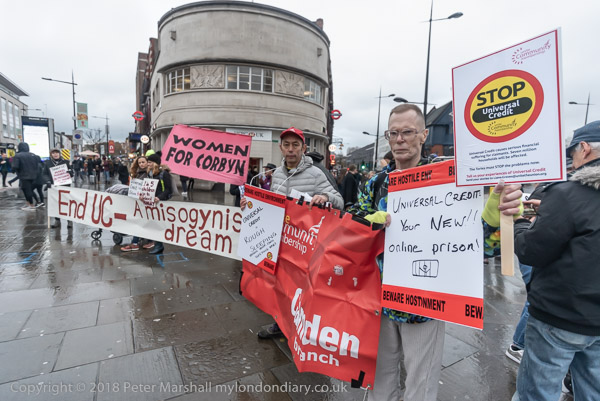
Two years ago, the first day in December had been declared Stop Universal Credit day of action by Unite Community and small groups around the country were holding protests and handing out leaflets in busy town centres about the many failures and great hardship caused by this poorly though out and badly administered benefit. They called for an end to the long wait before claimants receive money, for applications to be allowed at job centres as well as online, for better help when the system fails people, for direct payments to landlords to avoid rent arrears and evictions and an end to benefit sanctions for all claimants.
Universal Credit was intended to simplify the benefits system, but it failed to take into account the huge range and complexity of situations ordinary people face, and assumed that claimants would have the same kind of support that the middle-class and wealthy take for granted from families, friends and resources. And its failures were compounded by making it a vehicle for cutting costs. As I commented in 2018:
“UC has created incredible hardship, pushing many into extreme poverty and destitution, making them reliant on food banks and street food distributions, greatly increasing the number of homeless and rough sleepers. Thanks to Tory policies, more than 120,000-plus homeless children in Britain will spend Christmas in hostels and B&Bs, many without the means or facilities to provide a Christmas meal.
Some have said that UC is a part of a “state euthanasia” system for the poor, with academic estimates that it and other benefit cuts and sanctions since the 2010 elections having caused 110,000 early deaths, including many suicides. A cross party committee has called for its rollout to be halted until improvements are made, but the government has dismissed virtually all criticism of the system, making only insignificant changes.”
I took a detour on my journey into London to photograph the protest outside Camden Town station, where protesters were also pointing out that Universal Credit “hands more financial power to male claimants making it a misogynist’s dream, forcing women in violent relationships into greater dependency on their violent male partners.”
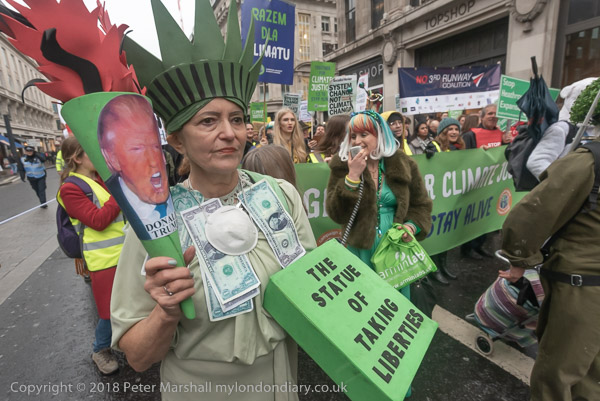
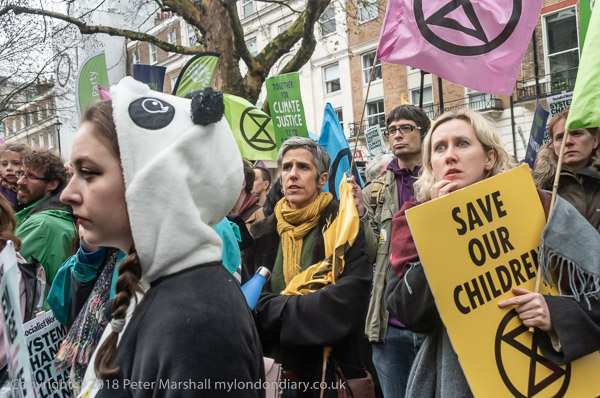
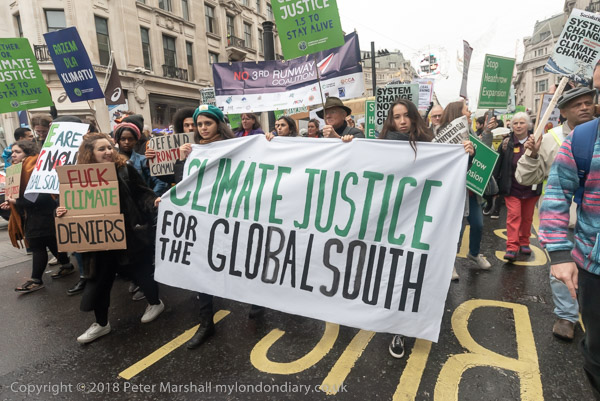
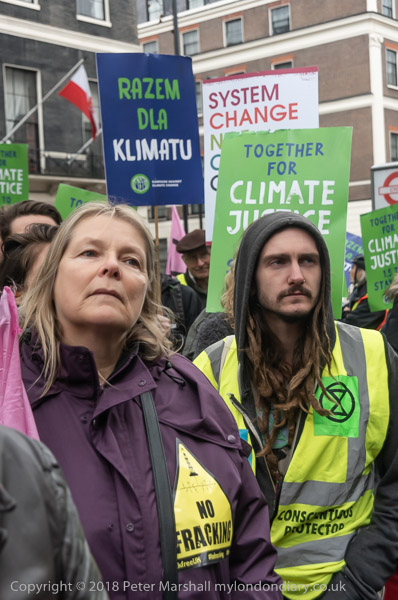
The major protest taking place in London was a march and rally organised by the Campaign against Climate Change. Together for Climate Justice began with a rally outside the Polish Embassy, in advance of the following week’s UN climate talks in Katowice, Poland.
Despite the impending global disaster, little real action is being taken by countries around the world and we still seem committed to a course leading inevitably to mass extinction. Behind the failure to act is the intensive lobbying of companies exploiting fossil fuels who have spent many billions in sowing doubt about the scientific consensus of global warming, and continue to produce vast quantities of coal and oil and explore for further resources, increasingly in the more ecologically sensitive areas of the Earth.
At the rally a wide range of speakers expressed their concerns that the talks in Poland are being sponsored by leading firms in Poland’s fossil fuel industry. And at the rally opposite Downing St where Frack Free United were to hand in their petition at the end of the march, a speaker from the Global South reminded us of the urgency of the situation; people there are already dying because of climate change.
Before the march we were all taught to say a few slogans in Polish, including ‘Razem dla klimatu‘ (Together for the Climate) which appeared on a number of placards, and the rather less pronounceable Polish for ‘Time to limit to 1.5’, as well as for ‘Climate, jobs, justice!’.
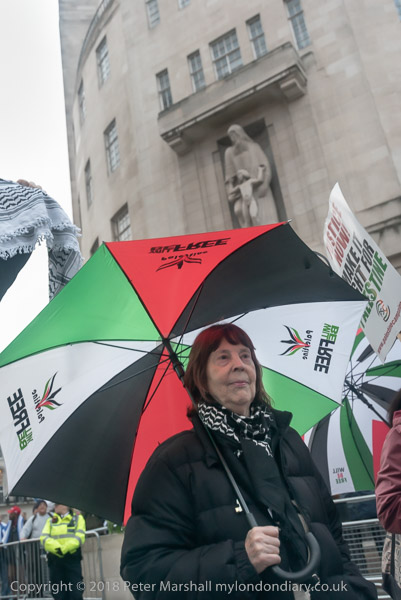
Finally I made my way to Broadcasting House, where The Palestine Solidarity Campaign and others were calling on the BBC to withdraw from the 2019 Eurovision Song Contest hosted by Israel, to avoid being complicit in Israel’s ongoing violations of Palestinian human rights.
Campaigners say the contest ‘artwashes’ Israel’s human rights record, including the killing of at least 205 Palestinians by Israeli forces in the besieged Gaza Strip since protests began at the end of March, and the passing of the Jewish nation state law which formalises an apartheid system in Israeli law.
A small group of Zionists had come to oppose the protest, but made it clear that they did not want me to photograph them. Some lifted the Israeli flags they were holding to hide their faces when I pointed my camera in their direct or turned away.
All photographs on this and my other sites, unless otherwise stated, are taken by and copyright of Peter Marshall, and are available for reproduction or can be bought as prints.
November 30th fell on a Wednesday in 2011, and it was the day of a strike by public sector workers against government plans to cut their pensions as part of the austerity programme following the banking crisis. As I wrote back then:
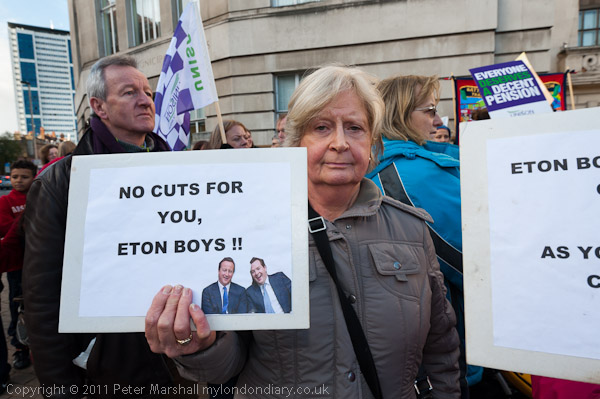
Feelings are certainly running very high over pension injustice, as well as over the government cuts in jobs and services. The widespread feeling across the country – not just trade unionists – that our government is made of of the wealthy and privileged who just do not understand the problems of ordinary people was reflected in the two hand-written placards I photographed, both with photographs of Cameron and Osborne alongside the texts ‘Eton Boys, Do you Feel Our Pain, As You Order Your Champagne‘ and ‘No Cuts For You, Eton Boys!!’
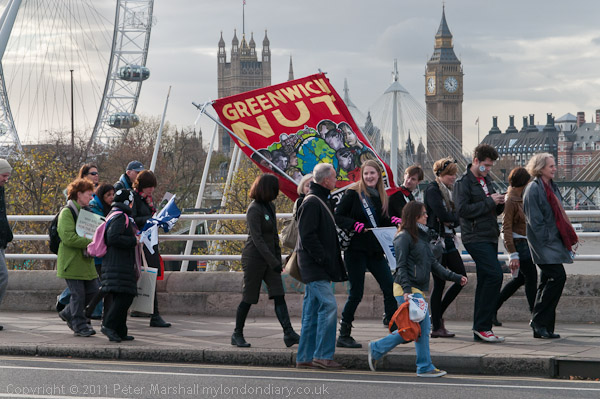
The day had begun early for strikers at Wandsworth Town Hall who had been on the picket line since 6am at the Town Hall and other council sites across the borough, though I only joined them around 4 hours later, when many were about to leave to join the TUC march in central London, and I also made my way to a packed Lincoln’s Inn Fields where around 20,000 were assembling.
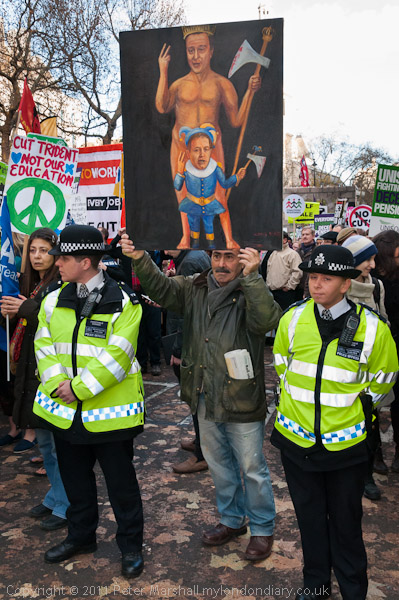
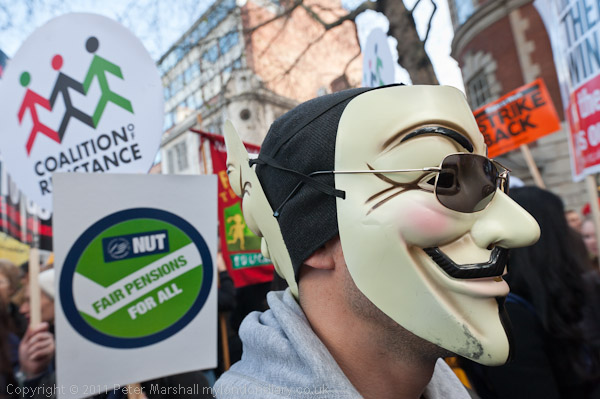
As well as public sector workers – including many from associations which have no record of previous strike action or taking part in protests – there were activists from groups such as the Education Activist Network and other student groups, people wearing ‘Anonymous’ Guy Fawkes ‘V for Vendetta’ masks and other supporters, including political artist Kaya Mar with his painting of coalition leader David Cameron and his Lib-Dem sidekick Nick Clegg carrying blood-stained axes.
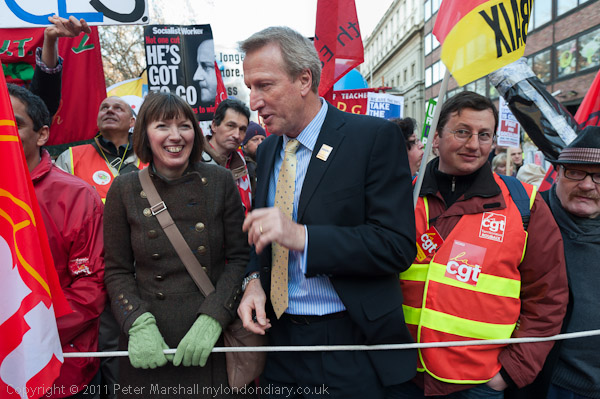
There were also a group of French trade unionists from the CGT, come to support their English colleagues – here in a picture beside Frances O’Grady, Dep Gen Sec of the TUC and John Rimmer, president of the NASUWT.
More joined the march along the route to Westminster. It was a peaceful march which hardly merited the huge police presence, and I think the French trade unionists will have thought it very restrained, although some groups, particularly some of the students, did liven it up a little with loud chanting and the occasional surge. The rally had already begun when I arrived, although the end of the march was still almost a mile back.
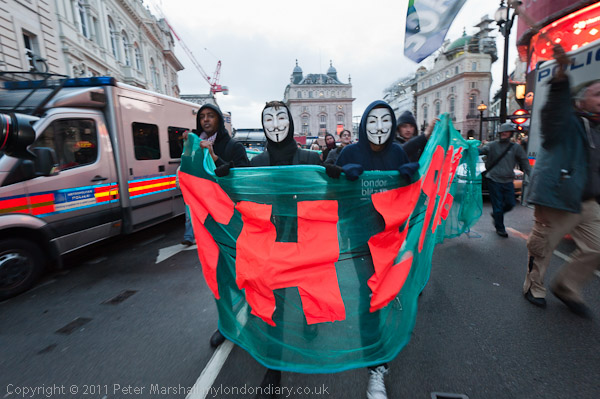
I didn’t wait to hear the speeches, but went to Piccadilly Circus, where Occupy London protesters from the camp outside St Paul’s Cathedral were gathering for a protest against corporate greed. I stood with them for around half an hour while we all waited for something to happen, watched by a large crowd of police. It began with a diversion as around 30 people with the ‘Precarious Workers Brigade’ banner that I’d photographed earlier on the TUC march rushed across the road to protest outside Boots, drawing much of the police attention.
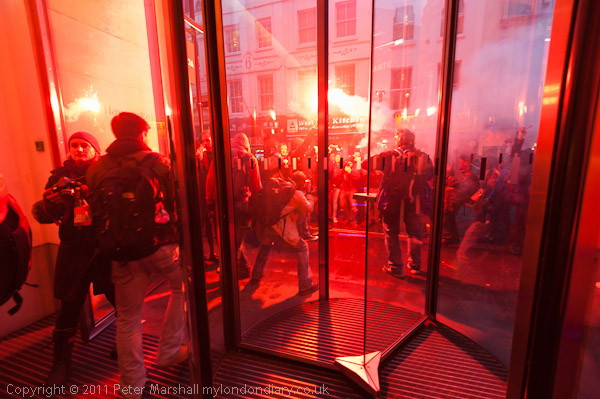
Others by Eros were getting ready the main banner ‘All Power to the 99%’ which they then rushed along the street with the rest of the protesters following, going down Haymarket, and I rushed along with them taking pictures. At Panton St, one of them lit a bright orange flare and they all turned down the street to Panton House, where some rushed into the foyer.
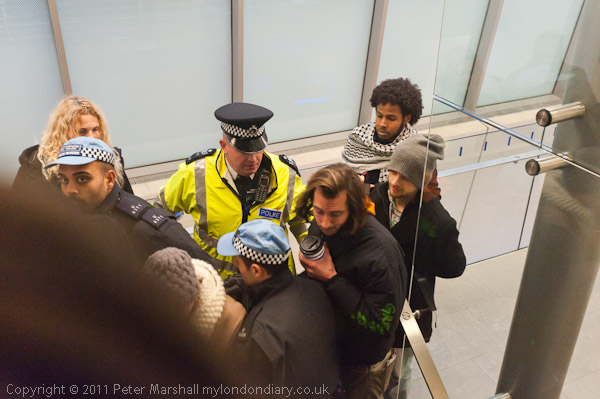
I stopped there to take a few pictures rather than rushing to follow them up the stairs. By the time I turned to follow them the stairs were rather crowded but I made my way up to the third or fourth landing before deciding I was out of breath and probably not going to get to the top as the stairs were too crowded. By then the police had begun to catch up, and stopped me going down. And although police were shouting and me and the others on the stairs to go down, other police were pushing us out of the way when we tried to do so as they rushed up to the roof.
Eventually I managed to make my way out and try to take a few pictures as protesters on the roof lowered banners over the edge while others outside formed a ‘human microphone’ to let everone know what the protest was about.
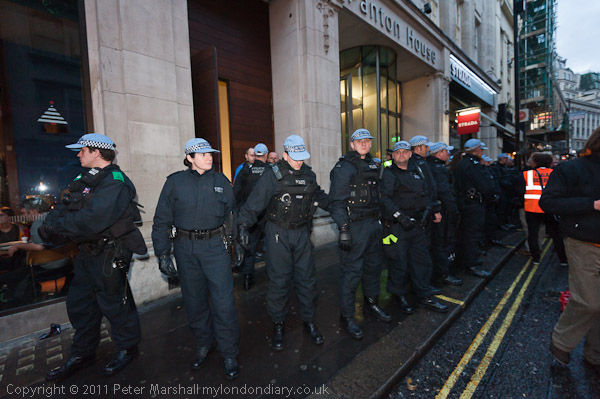
Occupy London had chosen Panton House as it contains the London offices of the mining Company Xstrata, whose CEO Mick Davies they say is the highest paid CEO in the UK, but according to their statement, “is a prime example of the greedy 1% lining their own pockets while denying workers pensions.”
I was sorry not to have made it to the roof as several other photographers had done, but at least I was able to slip through the police kettle and go home early after a rather tiring day.