ATOS Olympics 2012

Protesters outside the DWP where DPAC activists have occupied the lobby.

2012 was of course the year that London suffered the Olympics, which had been creating problems in East London since London was awarded the games in 2005. I’d photographed a number of event related to the games, both protests against it and others using it as a theme, as well as taking pictures around its perimeter and views into the site on Stratford Marsh, an area I’d photographed since the 1980s and which features strongly in my 2011 book ‘Before the Olympics‘.

With the games came the Paralympics, held a few days after the end of the main event on 29 August to 9 September 2012. Although these games were generally held to be a great success, and to have considerably raised the profile of disabled sport, there was criticism from many disabled groups about IT company Atos being the technology provider and sponsor of the games.

Atos Olympic medals and Atos Olympic flame

Atos was responsible for the work capability assessments for the Dept of Work & Pensions, and had clearly been both incompetent and discriminatory in this, finding many disabled people incorrectly fit for work to meet targets designed to cut the cost of benefits. Many who appealed the decisions were found to have been incorrectly assessed, but often shortly after this were called for another assessment and again wrongly found fit. It drove some disabled people to suicide.

Some disabled athletes obscured the Atos logo on their passes in protest, while activist groups led by Disabled People Against Cuts (DPAC) organised a week of action against Atos to coincide with the Paralympics, beginning with a spoof Opening Ceremony for the Atos Games in front of Tower Bridge.

DPAC made it clear that this is not a protest against sports or those taking part in the Paralympics, but against the government and Atos:

"We’re not against the Paralympics or the people taking part in it. We’re highlighting the hypocrisy of Atos, a company that soon may be taking disability benefits from the people winning medals for Team GB.

Ever since George Osborne announced he was slashing £18 billion from the welfare budget, the government has paid Atos £100 million a year to test 11,000 sick and disabled people every week, then decide whether they’re ‘fit for work’."
Tara Flood celebrates her second gold medal

One of those taking part in the opening ceremony was Tara Flood a Paralympic swimmer who won a gold medal in the 1992 Barcelona Paralympic games as well as 2 silver and 4 bronzes there and in the two other games she took part in. Along with two activists in wheelchairs she got on the podium and was awarded another gold medal and the others silver and bronze.

Paralympian gold medal winner Tara Flood is stripped of her gold medal and blue badge

Then along came an ATOS doctor who administered a fitness for work test, first on Tara. She was found fit to work and the gold medal was cut off and her disabled parking card taken away; the others were also found fit to work, losing their medals and benefits too.

The ATOS Games continued, and on Wednesday 29th I photographed DPAC deliver a coffin to the ATOS offices in Triton Square. Friday 31 saw them again outside the ATOS offices for the Closing Atos Ceremony which included the Atos Miracle Cure, making disabled people fit for work.

As the closing ceremony was coming to an end there was a special announcement that there would be another action elsewhere and eventually we learnt that some disabled activists had entered and occupied the lobby of the DWP.

I jumped on a bus, but should have taken the underground as the traffic was heavy in places, but I still got there before the main crowd who had travelled from the protest at the Atos offices. Police would not let them join the 20 or so who were inside so they protested on the pavement in front of the building. There were speeches and then a lot of minor scuffles when police tried to push the protesters back and I had to leave before the protest ended.

More on My London Diary:
DPAC Occupy Dept of Work & Pensions
Closing Atos Ceremony
Disabled Pay Respect to Atos Victims
Opening Ceremony for the Atos Games


All photographs on this and my other sites, unless otherwise stated, are taken by and copyright of Peter Marshall, and are available for reproduction or can be bought as prints.


Old Church St, Chelsea, 1988

Old Church St, Chelsea, Kensington and Chelsea, 1988 88-5b-21-positive_2400
Old Church St, Chelsea, Kensington and Chelsea, 1988 88-5b-21

Old Church St is, as its name suggests a rather old street in Chelsea, running north from Chelsea Old Church by the river up to the Fulham Road. It is thought to be the oldest street in Chelsea but it contains two of Chelsea’s most significant modern buildings. No 66 at the left was designed in 1935–1936 by Walter Gropius and Maxwell Fry for the scriptwriter Benn Levy and his actress wife Constance Cummings. They had bought a large site – perviously the garden of a large house – here together with publisher Denis Cohen, and shared it to build a house each, with a communal garden.

Gropius, the founder of the Bauhaus, came to England in 1934 and was fortunate to get a flat in the Isokon building in Lawn Road, Belsize Park, where he met many leading left-wing intellectuals of the age including modernist architects, among them the designer of the flats, Jack Pritchard. Pritchard and Gropius worked on several projects together, few of which were ever built.

Gropius also worked with Maxwell Fry, and this house they designed together was his most significant domestic work during the 3 years before he left to take up a professorship in the USA. My photograph doesn’t show it well, as it was built to face the private garden to which I did not have access, but for those interested there are plenty of pictures on-line. It was offered for sale in 2013 for £45 million, but I couldn’t afford it. Surprisingly the house is only Grade II listed.

Old Church St, Chelsea, Kensington and Chelsea, 1988 88-5b-34-positive_2400
Old Church St, Chelsea, Kensington and Chelsea, 1988 88-5b-34

Cohen House on the other half of the site, also completed in 1936 was designed by Erich Mendelsohn and Serge Chermayeff for the publisher Denis Cohen and is more visible from the road. Like Gropius, Mendelsohn was also fleeing from Nazi Germany and went on the the USA; Chermayeff, born to a Jewish family in Russia had come here as a young boy, was educated here and became a British citizen in 1928 and emigrated to the USA in 1940 . This building is Grade II* listed. The partnership between Mendelsohn and Chermayeff only lasted a few years but produced some of the country’s outstanding modernist buildings.

Old Church St, Chelsea, Kensington and Chelsea, 1988 88-5b-24-positive_2400
Old Church St, Chelsea, Kensington and Chelsea, 1988 88-5b-24

153 Old Church St. The gate at right I think leads to 153a. THe house at the right which you cannot see much of has a blue plaque for John Francis Sartorius (fl. 1775-1831), an English painter of horses, horse-racing and hunting scenes. Accord to Mark Keble in Chelsea The Resident, 153 Old Church Street was built between 1956-57 on the former site of the studio of the renowned Welsh portrait painter Augustus John (1878-1961).

Old Church St, Chelsea, Kensington and Chelsea, 1988 88-5b-32-positive_2400
Old Church St, Chelsea, Kensington and Chelsea, 1988 88-5b-32

This house is on the corner of Carlyle Square and Old Church St and the gatepost gives its address as 26 Carlyle Square. The land here which contained a number of buildings was sold to Lord Cadogan in 1835, who quickly had the existing houses and cottages cleared and building of a new square, Oakley Square, began in 1836-7. But progress was slow and there were only a few houses completed by 1851. The square was renamed Carlyle Square in honour of the historian and writer Thomas Carlyle in 1872.

Old Church St, Chelsea, Kensington and Chelsea, 1988 88-5b-33-positive_2400
Old Church St, Chelsea, Kensington and Chelsea, 1988 88-5b-33

This house is on the corner of Old Church St and Elm Park Rd at 125-127. The plaque records the fact that William De Morgan Ceramic Artist And Novelist (1839-1917) And His Wife Evelyn De Morgan Artist (1855-1919) Lived & Died Here. The house was specially adapted for their work – and you can just see the bottom of a large studio window in this picture.

Queen's Elm Square, Chelsea, Kensington and Chelsea, 1988 88-5b-26-positive_2400
Queen’s Elm Square, Chelsea, Kensington and Chelsea, 1988 88-5b-26

Queen’s Elm Square is on the west side of Old Church St close to the Fulham Rd. It was built in 1904-6 for the Sloane Stanley Estate, just behind the Queen’s Elm pub on the corner of Fulham Rd and Old Church St. This famous pub closed in the 1990s and the ground floor is now shops. The site was earlier a field known as the Queen’s Elm Field and began to be developed – including an earlier pub – in 1792.

The Vale, Chelsea, Kensington and Chelsea, 1988 88-5b-42-positive_2400
The Vale, Chelsea, Kensington and Chelsea, 1988 88-5b-42

The Vale is a short street running parallel to Old Church St north from the King’s Rd about 200 yards to its west. The unusual Russian House, at 27 The Vale, was built in 1914 just before the start of the First World War by architect F.E. Williams and incorporates at in the frontage of the substantial property a Russian Dacha that had formed a part of an exhibition at the Crystal Palace in the 1890s. The house was occupied by the British Red Cross during the war and later became the home of members of the Sainsbury family. It was then converted into flats, but in the 1990s converted back into a single house. It sold in 2018 for 12.75m

Click on any of the above images to see a larger version in my album 1988 London Photos and to browse other pictures in the album.


All photographs on this and my other sites, unless otherwise stated, are taken by and copyright of Peter Marshall, and are available for reproduction or can be bought as prints.


Chelsea – Social Cleansing

The Gateways, Sprimont Place, College Place,  Chelsea, Kensington and Chelsea, 1988 88-5a-43-positive_2400
The Gateways, Sprimont Place, College Place, Chelsea, Kensington and Chelsea, 1988 88-5a-43

The Gateways is a block of houses with a difference and though it may look ancient, was built in 1934 in a Tudor Revival style to designs by Herbert Winkler Wills (1864-1937) and William Kaula. Certainly unusual but not greatly to my liking the whole block was Grade II listed in 1993, some under the address Whitehead’s Grove.

Chelsea Green, Chelsea, Kensington and Chelsea, 1988 88-5a-45-positive_2400
Chelsea Green, Chelsea, Kensington and Chelsea, 1988 88-5a-45

All that remains of the old Chelsea Common is a small triangle at this road junction with two small fenced plots of grass, each with a small tree, separated by a footpath through its centre, room on both sides for a couple of park benches and a rubbish bin or two.

Chelsea Green, Chelsea, Kensington and Chelsea, 1988 88-5a-46-positive_2400
Chelsea Green, Chelsea, Kensington and Chelsea, 1988 88-5a-46

Stepping a few feet gave a clearer view of the pub, still now open but called The Wild Tavern, and the buildings down Elystan Place which are a part of The Gateways, with some good brickwork.

Bray Place, Draycott Ave, Chelsea, Kensington and Chelsea, 1988 88-5a-51-positive_2400
Bray Place, Draycott Ave, Chelsea, Kensington and Chelsea, 1988

The ornate ironwork around and in the door of 5 Bray Place finds an echo in the window opposite. This doorway has now been converted into a rather plain window and there are other changes to the exterior of the building. It remains a restaurant but with a different name under different management.

Blacklands Terrace, Chelsea, Kensington and Chelsea, 1988 88-5a-52-positive_2400
Blacklands Terrace, Chelsea, Kensington and Chelsea, 1988 88-5a-52

This building is on Blacklands Terrace, but confusingly has the address 18 Culford Gardens, which it and the building to its right stand on the corner of. I don’t know when it was built – or perhaps when this frontage was added, but it was very different from the properties around. The ground floor has since been altered and is now less starkly geometrical.

Avenue Court, Draycott Avenue, Knightsbridge, Kensington and Chelsea, 1988 88-5a-61-positive_2400
Avenue Court, Draycott Avenue, Knightsbridge, Kensington and Chelsea, 1988 88-5a-61

Draycott Avenue is lined with large and rather boring appartment blocks, mainly in red brick, which are slightly enlivened by some impressive doorways – and I think this is the most impressive. Most of these large blocks of flats were built in the 1930s, replacing streets of smaller houses. In Pevsner’s The Buildings of England London NW it describes them as “enormous and forbidding blocks of flats, either cautiously Art Deco or approximately neoGeorgian in style.”

Avenue Court, Draycott Avenue, Knightsbridge, Kensington and Chelsea, 1988 88-5a-01-positive_2400
Avenue Court, Draycott Avenue, Knightsbridge, Kensington and Chelsea, 1988 88-5a-01
Sloane Avenue Mansions, Sloane Avenue, Chelsea, Kensington and Chelsea, 1988 88-5a-62-positive_2400
Sloane Avenue Mansions, Sloane Avenue, Chelsea, Kensington and Chelsea, 1988 88-5a-62

Sloane Avenue Mansions also dates from the 1930s, redeveloping an area of smaller houses but was designed by G. Kay Green in a more modern style with touches of Art Deco. Built in 1931-3, it towers 11 stories above the street, though appears slightly less massive as the top two are set back slightly. Around 20,000 working class people had lived in homes around here that were cleared after the company decided to redevelop the area in 1908, though much of the area remained empty or full of part-demolished slums until the 1930s. The large blocks of flats were usually provided with underground garages for the wealthy flat-dweller.

Click on any of the images to go to a larger version in my album 1988 London Photos, where you can browse through the rest of the images in the album.


All photographs on this and my other sites, unless otherwise stated, are taken by and copyright of Peter Marshall, and are available for reproduction or can be bought as prints.


Al-Quds Day Protests in London 2011

Here is a long post I wrote on My London Diary in 2011. I have made only minor changes, mainly adding more pictures. Otherwise it is as written.

Portland Place to Trafalgar Square, London. Sunday 21 Aug 2011

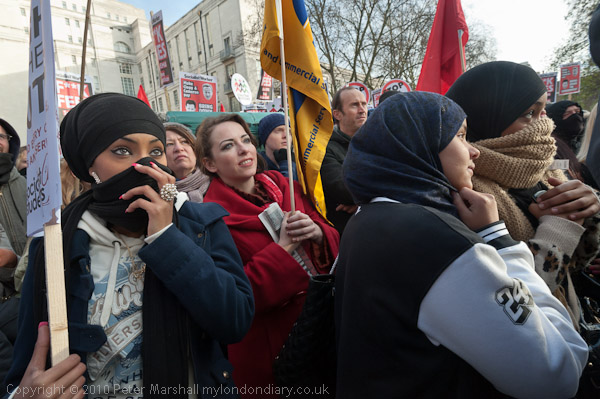
Muslim women show their support for Palestine
more pictures

Several thousand marched through London calling for freedom for Palestine in the annual Al Quds (Jerusalem) Day march. There were small counter-demonstrations by an Iranian opposition group and the EDL.

Al-Quds is the Arabic name for Jerusalem and Al Quds Day was started by the late Imam Khomeini of Iran as an expression of solidarity with the Palestinian people and of opposition to the Israeli control of Jerusalem, as well as more widely “a day for the oppressed to rise and stand up against the arrogant.” It is on the last Friday of Ramadan which this year is 26 Aug, but the march in London took place on the Sunday before this. Most of those taking part were Muslim and were observing the Ramadan fast.

The march is organised by the Islamic Human Rights Commission, an organisation that receives funding from the Iranian government. Despite this and the appalling human rights record of the Iranian Government the IHRC does carry out much worthwhile research and campaigning, including whole-hearted support of the Palestinian cause.

The proclamation of Al Quds day and its annual celebration have helped to revitalise worldwide interest in freedom for Palestine, and the even is supported by a number of mainstream UK campaigning organisations including the Stop the War Coalition and Ireland and Scottish Palestine Solidarity Campaigns, as well as major Muslim groups including the Muslim Association of Britain and Muslim Council of Britain. Also backing it, and present on the march were several Jewish groups including Jews Against Zionism, Jews for Boycotting Israeli Goods and Neturei Karta UK as well as other groups supporting Palestine.

The marchers, many of whom had come in coaches from around the country, gathered on Portland Place from a little before 2pm, and many said prayers on the pavement before the march formed up.

Protesters opposite the Al Quds Day march with Free Iran flag and placards condeming Khamenei

Shortly after this, a small group of protesters against the Iranian regime began a protest against them immediately opposite on the other side of the road. As I walked across the road towards them a police officer stopped me and gave me a warning that some of them or their families might face prosecution if their photographs appeared in the press, and because of this I might not be welcome. I thanked him for the advice and continued across and it was clear that the protesters actually welcomed the attention of myself and the other press photographers present.

The two groups remained in position, chanting slogans at each other for the next hour or so, while the very much larger group on the Al Quds march waited for marchers whose coaches had been held up in traffic. Although many of the marchers carried placards with the message ‘We are all Hizbullah’ and there were chants of this along with ‘We are all Palestinians’, and their were graphic images of victims of Israeli attacks on Palestinians, the main emphasis was on the need to boycott Israel and companies that support Israel, among those mentioned being Marks and Spencer, Starbucks and Coca-Cola.

A huge cheer went up when the Neturei Karta ultra-orthodox Jews arrived, having walked from Stamford Hill. They carried placards which repeated their opposition to Zionism and support for the Palestinians, and when the march started they were more or less at the front, accompanied by several Muslim clerics. The marchers made clear that they were not anti-Jewish and welcomed the support of these and other Jewish groups present opposed to Zionism and the illegal actions of the Israeli forces.

It was an impressive march, with almost all of those taking part carrying banners, placards or small Palestinian flags. There were also several very large Palestinian flags, including a very long one carried horizontally.

The route went down Regent Street and through Piccadilly Circus to Haymarket and then on to Trafalgar Square. Several EDL supporters watched it as it came to the bottom of Haymarket and police questioned two of them briefly. As the march turned into the top of Trafalgar Square four more came to see it and I saw police briefly question two women, one of whom had stood raising a finger to the front of it. Apparently two others were also questioned briefly.


Police escort EDL from Trafalgar Square to the pen set aside for them
more pictures of the EDL

The police had provided a small pen for the EDL on the south side of Pall Mall at the mouth of Spring Gardens, where they were almost invisible to the marchers who were turning into Trafalgar Square. It seemed to them – and I could only agree – to have been an unacceptably distant location.

A few of the EDL were standing closer, quietly watching the march and one was taking photographs. The police appeared not to recognise them. Later a number of them walked into Trafalgar Square and walked quietly around, but other photographers reported a small incident where one man who police had previously asked to leave the area returned and was apparently arrested.

A few minutes later a small group of EDL appeared with an EDL flag on the North Terrace balcony. They were soon surrounded by police who escorted them back down to the pen amid their complaints that British people should be allowed to demonstrate on the British soil of Trafalgar Square and show their English flag there. In all there seemed to be around twenty EDL supporters present.

Short speeches from several of those present stated that they were opposed to the Al Quds march because it supported Hizbullah, an illegal terrorist organisation, and restated their position that they were non-racist and not opposed to Muslims in general only to Muslim extremists. They insist that they are standing up for England and our English freedoms and have no problems with other people living here as long as they respect our way of life. There were a few moments when individuals started some of the chants which others object to, including ‘Muslim bombers off our streets’, but while I was there others present quickly told them to “shut it.”

The group continued to protest noisily but were too far away to be heard by the several thousand at the rally in Trafalgar Square.
more pictures

EDL pictures


All photographs on this and my other sites, unless otherwise stated, are taken by and copyright of Peter Marshall, and are available for reproduction or can be bought as prints.


Carnival Time 2005

Years ago much of my photography was of public events other than protests, partly because there seemed to be fewer protests, or perhaps it was simply harder to find out about when and where they were taking place.

Although social media existed, back in 2005 few groups that were organising protests had began to make much use of it. There were some groups that had web sites on which they published information, and a few wider organisations, particularly Indymedia that had some listings but finding information was still largely a matter of reading printed newsletters and flyposted posters along with lengthy sessions on the web, going through a long list of web sites and searching – and back in 2005 Google had just begun to be the hugely dominant search engine.

But I was also more interested in cultural events, both traditional English events and those that had been brought to us by our migrant communities. And in London many events involved people from all across our now very varied communities, whether their roots were in this country or abroad.

Cultural events change more slowly than political events, and many, particularly religious events tend to follow a set pattern and become less interesting to photograph for me. Though I might still enjoy going, for example, to Notting Hill Carnival after perhaps a dozen times I found I had little new to say. Though it was a knee injury that prevented me from getting there in 2005. I dragged myself painfully to the station, but fell down in agony on the steps and decided it wasn’t a year for dancing and began the painful journey home.

Earlier in the month I’d accompanied fellow photographers to a couple of more traditional English carnivals in Hayling Island and in Hastings, as well as photographing the Shoreditch Festival Parade and the Latino Carnaval del Pueblo in Southwark. The pictures in this post come from those events. That month I also found time to visit Brian Haw and to cover another protest in Parliament Square over new protest laws and one calling for a tax on foreign currency exchange transactions.

Back in 2005, My London Diary was in a slightly less developed state. My comments were still all in lowercase and there are no links to individual events. And although all the pictures on-line are digital colour I also took some pictures in medium format on black and white film.


In 2008 I took part in a show with 3 other photographers, English Carnival, and the web site from this remains on-line. My pictures are a black and white set from Notting Hill in 1990-2001, but those by the others – Paul Baldesare, Dave Trainer and Bob Watkins – are from traditional English events, and include several taken at events I was also photographing.


All photographs on this and my other sites, unless otherwise stated, are taken by and copyright of Peter Marshall, and are available for reproduction or can be bought as prints.


Kings Road & Chelsea Common 1988

Anderson St, Kings Road, Chelsea, Kensington and Chelsea, 1988 88-5a-21-positive_2400
Anderson St, Kings Road, Chelsea, Kensington and Chelsea, 1988 88-5a-21

It was the eye on the billboard that particulalry caught my attention on the corner of this long block of rather distressed looking shops and accomodation on the Kings Road, though I now have no idea what it was advertising and rather doubt if I did then. The long terrace has been considerably smartened now, with both advertising hoardings gone and the building has a smooth unblemised finish.

Royal Ave, Chelsea, Kensington and Chelsea, 1988 88-5a-22-positive_2400
Royal Ave, Chelsea, Kensington and Chelsea, 1988 88-5a-22

Royal Avenue was first laid out as a part of a scheme connecting the Royal Hospital Chelsea with Kensington Palace which was apparently approved by Sir Christopher Wren in 1681, but only ever got as far as the King’s Road. At first it was planted with two rows of horse chestnut trees and grass and was known as Chestnut Walk, then it got white ladder stiles over the walls at each ends and became known as White Stiles. The terraces on each side date from around 1840 and are Grade II listed. The chestnuts were replaced by lime and plane trees and the grass by gravel around the same time, and it was renamed Royal Avenue in 1875. In 1970 the road access to King’s Road was replaced by a broad area of pavement. It still looks much the same as when I made this picture in 1988.

Kings Road, Chelsea, Kensington and Chelsea, 1988 88-5a-23-positive_2400
Kings Road, Chelsea, Kensington and Chelsea, 1988 88-5a-23

Another view of the King’s Road that is relatively unchanged, although there is now a florists stall which would have obscured this view. Strangely the council have replaces the plain but elegant bollards here with rather more ornate versions which seem rather less in keeping with the elegant white stucco architecture of Wellington Square, behind me as I made this image. The square was developed around the time of the death of the Duke of Wellington in 1852 and was named for him.

The Pheasantry, Kings Road, Chelsea, Kensington and Chelsea, 1988 88-5a-13-positive_2400
The Pheasantry, Kings Road, Chelsea, Kensington and Chelsea, 1988 88-5a-13

The Pheasantry got its name from Samuel Baker who bred new breeds of pheasants and other species there in the nineteenth century, though the present building is thought largely to have been built and embellished after the building was bought in 1880 by Amédée Joubert & Son, upholsterers and sellers of furniture, tapestry and carpets. In the early 20th century it also housed artists and a ballet school, and from 1932 when Felix Joubert retired the basement became a bohemian restaurant and drinking club with a host of famous actors and artists among its patrons. The club closed in 1966, the basement becoming a nightclub and the rest of the building flats. Now it houses a branch of Pizza Express and a cabaret club. Wikipedia has more.

The Pheasantry, Kings Road, Chelsea, Kensington and Chelsea, 1988 88-5a-24-positive_2400
The Pheasantry, Kings Road, Chelsea, Kensington and Chelsea, 1988 88-5a-24

The listing text describes this as “Central entrance with split segmental pediment supported by 2 male caryatids.”

Shop window, Elystan St, Chelsea, Kensington and Chelsea, 1988 88-5a-33-positive_2400
Shop window, Elystan St, Chelsea, Kensington and Chelsea, 1988 88-5a-33

Elystan Street runs from the miniscule remains of Chelsea Common and was originally called College St. Here in 1913 the William Sutton Trust built 14 red-brick blocks of model dwellings, designed by E C P Monson, with 674 dwellings for around 2,000 working-class residents of Chelsea. Another large estate was also begun close to this in 1913 by the Samuel Lewis Housing Trust, with eight blocks of model dwellings completed after the First World War to house 1,390 people. (British History Online.)
Elystan St, Chelsea, Kensington and Chelsea, 1988 88-5a-35-positive_2400
Elystan St, Chelsea, Kensington and Chelsea, 1988 88-5a-35

Elystan St is better known now as the name adopted by a restaurant at No 43 with a Michelin star.
Monkeys, Restaurant, Cale St, Chelsea, Kensington and Chelsea, 1988 88-5a-36-positive_2400
Monkeys, Restaurant, Cale St, Chelsea, Kensington and Chelsea, 1988 88-5a-36

Monkeys in Cale St, also leading from the residual Chelsea Common, a small triangle of grass in a road junction looks more my kind of restaurant. It faces that triangle and still looks very similar, but now claims to be “London’s best Neapolitan pizzeria”.

Click on any of the pictures to see a larger version and to browse other images in my album 1988 London Photos.


All photographs on this and my other sites, unless otherwise stated, are taken by and copyright of Peter Marshall, and are available for reproduction or can be bought as prints.


Around Chelsea

Michelin Building,  Fulham Rd, Brompton, Kensington & Chelsea, 1988 88-4r-46-positive_2400
Michelin Building, Lucan Place, Fulham Rd, Brompton, Kensington & Chelsea, 1988 88-4r-46

It was too hard to resist the Michelin Building any time I walked past, though I felt it had already been photographed to death – and most of my pictures were in colour, including closer views of its decorative panels.

Opened in 1911 as the first UK headquarters and tyre depot for the Michelin Tyre Company Ltd, and designed by Michelin employee and engineer François Espinasse it was more an architectural advertising hoarding featuring the Michelin Man ‘Bibendum’, his name derived from “Nunc Est Bibendum“, “Now is the time to drink”. A precursor of art-deco, it is grade II listed. It was also a fairly early use of ferro-concrete, using the Hennebique system, which gave its interior wide spaces for a tyre bay and made it relatively fire-proof. This picture was made three years after Michelin moved out, when the building was redeveloped by publisher Paul Hamlyn and restaurateur/retailer Sir Terence Conran as offices, shop and restaurant. (mainly from Wikipedia.)

Fulham Road, South Kensington, Kensington & Chelsea, 1988 88-4r-54-positive_2400
Trees, Fulham Road, Kensington & Chelsea, 1988 88-4r-54

This house is on the west corner of Pelham Crescent, and the three trees that attracted my attention are still there, remarkably little changed 33 years later, though of course each spring they get covered with leaves.

Selwood Terrace, South Kensington, Kensington & Chelsea, 1988 88-4r-61-positive_2400
Selwood Terrace, South Kensington, Kensington & Chelsea, 1988 88-4r-61

The east side of this street is Neville Terrace and the west side is Selwood Terrace. This front garden with a wall covered with ivy is close to the Fulham Road and I think both wall and ivy have disappeared, possibly as a part of a basement extension to the property.

South Parade, Chelsea, Kensington & Chelsea, 1988 88-4r-62-positive_2400
South Parade, Chelsea, Kensington & Chelsea, 1988 88-4r-62

I think this tall building probably dates from around 1892 and is part of long terrace including a former fire station with that date on the north side of Chelsea Square. It was the Nurses Home for the Royal Brompton Hospital and is still a part of the hospital. Chelsea square was named Trafalgar Square when it was laid out in 1810 but that was later used for a rather larger square in Westminster. The square later became a tennis club before much of the area was rebuilt in neo-Georgian style in the 1930s.

The Crown, pub, Dovehouse St, Chelsea, Kensington & Chelsea, 1988 88-4r-63-positive_2400
The Crown, Dovehouse St, Chelsea, Kensington & Chelsea, 1988 88-4r-63

The Crown pub is on the corner of Dovehouse St and Dudmaston Mews, just a few yards south of the Fulham Rd and more or less surrounded by hospitals. No longer a Whitbread pub it has lost the crown sign, replaced by a dreary sign with a neon crown, and other largely flowery embellishments have ruined the simplicity of the frontage. The Princess Of Wales at the left of the row of buildings closed as a pub around 2000 and is now a French restaurant, with considerably more expensive food than The Crown.

Kings Road, Chelsea, Kensington and Chelsea, 1988 88-5a-11-positive_2400
Kings Road, Chelsea, Kensington and Chelsea, 1988 88-5a-11

I took fewer pictures of the Kings Road than I should have done. This shop window display seemed more erotic than most.

Kings Road, Chelsea, Kensington and Chelsea, 1988 88-5a-16-positive_2400
Kings Road, Chelsea, Kensington and Chelsea, 1988 88-5a-16

These rather disparate buildings are still there on the Kings Road, on the south side just east of Radnor Walk, though now occupied by different shops and rather less trendy.

Jubilee Place, Chelsea, Kensington and Chelsea, 1988 88-5a-15-positive_2400
Jubilee Place, Chelsea, Kensington and Chelsea, 1988 88-5a-15

And immediately opposite the previous picture is Jubilee place, leading north with this house and wrought ironwork at No 9 over double gates leading down to a basement garage.

Click on any of the images to go to larger versions in my album 1988 London Photos were you can browse through these and other pictures.


All photographs on this and my other sites, unless otherwise stated, are taken by and copyright of Peter Marshall, and are available for reproduction or can be bought as prints.


Marikana Anniversary 16th August

Justice for Marikana, South Africa House, 2019

In August 2012 workers at the Marikana platinum mine in Rustenburg demonstrated calling for a pay rise and better working conditions. After a week of protests police opened fire on the miners killing 34 and injuring others. The police attack came the day after Cyril Ramaphosa, now President of South Africa, then a non-executive director of mine-owner Lonmin and owner of the company Shanduka, a shareholder in Lonmin, had called on the the police to take action against the miners, who he called “plainly dastardly criminals”.

Protest at Investec, 14 Aug 2015

Although an official inquiry largely cleared Ramaphosa of guilt over the massacre, campaigners still hold him very much responsible for what is often called the “darkest hour of South Africa’s democracy” and still call for him to be brought to justice. Both the National Union of Mineworkers (NUM) and the Association of Mineworkers and Construction Union (AMCU) refuse to invite him to the annual remembrance ceremonies at Marikana.

Protest outside Lonmin’s office in London, 2017

Ramaphosa himself issues a partial apology for his messages and stated “I am determined to play whatever role I can in the process of healing and atonement for what happened at Marikana” but so far this appears to be an empty promise.

18th August 2012

There were protests in London in the days immediately following the massacre and there has been an annual protests on 14th August each year since then, either outside offices of Lonmin and other companies profiting from the mine or outside South Africa House in Trafalgar Square. When I’ve been in London I’ve gone to take part and to take photographs.

Charlie X is shut out of the block where Lonmin have their offices, 2017.
People place flowers on the portraits of the murdered miners at South Africa House, 2018
A woman holds pictures of the murdered miners at South Africa House, 2018
South Africa House, 2019

More on My London Diary:

2012: Solidarity with Marikana Miners
2014: Second Anniversary of Marikana Massacre
2015: Marikana Mine Murders protest at Investec
2017: Marikana Massacre Protest at Lonmin HQ
2018: Justice for Marikana vigil
2019: Justice for Marikana – 7 years on


All photographs on this and my other sites, unless otherwise stated, are taken by and copyright of Peter Marshall, and are available for reproduction or can be bought as prints.


South Kensington and Chelsea 1988

Redherring, Old Brompton Rd, South Kensington, Kensington & Chelsea, 1988 88-4q-52-positive_2400
Redherring, Old Brompton Rd, South Kensington, Kensington & Chelsea, 1988 88-4q-52

Red Herring had a shop for some years at 6 Old Brompton Road, more or less opposite South Kensington Station, which has now for some years been an opticians. They sold trendy casual clothes for women including shoes and bags. The poster at left in Arabic I think reflects the Iranian presence in the area.

Old Brompton Rd, South Kensington, Kensington & Chelsea, 1988 88-4q-53a-positive_2400
Old Brompton Rd, South Kensington, Kensington & Chelsea, 1988 88-4q-53

The Brompton Hotel is still there at 30 Old Brompton Road, getting rather mixed review which perhaps reflect its 3* status and rather cheap rates for London. You can no longer go in and swear an oath at Lawrence Bloomfield, though the curious short pillar is still there. The Punch wine bar has last its superstructure, though the low wall at the bottom remains and there is still a popular bar area, but now steps lead down to a steak restaurant.

Imperial Hotel, Queen's Gate, South Kensington, Kensington & Chelsea, 1988  88-4q-62-positive_2400
Imperial Hotel, Queen’s Gate, South Kensington, Kensington & Chelsea, 1988 88-4q-62

I couldn’t resist another picture of the Imperial Hotel on the corner of Queen’s Gate and Harrington Rd, demolished in 1992 and since then a cleared site used as a car park. In an earlier post I mentioned that planning permission had been granted in 1975 for the erection behind this facade of a cultural centre for the Islamic Republic of Iran and twenty self-contained flats, and later by Kensington and Chelsea for the use of the cleared site as a car park pending the building of this.

Shop,  Harrington Rd, South Kensington, Kensington & Chelsea, 1988  88-4q-63-positive_2400
Shop, Harrington Rd, South Kensington, Kensington & Chelsea, 1988 88-4q-63

There was a crude simplicity about this mosaic of a bottle advertising the off-licence to its left that attracted my attention.

Instutut Francais, Queensberry Place, South Kensington, Kensington & Chelsea, 1988 88-4q-64-positive_2400
Instutut Francais, Queensberry Place, South Kensington, Kensington & Chelsea, 1988 88-4q-64

The Institut français du Royaume-Uni was begun in 1910 by Marie d’Orliac to introduce Londoners to well-known French writers, thinkers and artists. This building in Queensbury Place by architect Patrice Bonnet (1979-1964) in an art deco style was opened in 1939. Along the top of the facade are an olive branch, a cockerel, an asp and an owl, symbolising peace, courage, knowledge and wisdom. The Grade II listing text attributes the building to A J Thomas, a former assistant of Edwin L Lutyens and the architect of St Pancras Town Hall.

Bray Place, Chelsea, Kensington & Chelsea, 1988  88-4r-13-positive_2400
Bray Place, Chelsea, Kensington & Chelsea, 1988 88-4r-13

Bray Place is a short street a little to the north and parallel to the King’s Road in Chelsea presumably named for Sir Reginald Bray who owned the manor at the time of Henry VII. This house with its two round windows is on the corner with Draycott Ave.

Bray Place, Chelsea, Kensington & Chelsea, 1988 88-4r-14-positive_2400
Bray Place, Chelsea, Kensington & Chelsea, 1988 88-4r-14

Mr Brunello is no longer here, and the shop is now a hairdresser, on the corner opposite the previous image at 3 Bray Place. The view is looking down Draycott Ave to the houses on Coulson St, and above them the tall block of flats, Whitelands House, a 10 storey block of flats dating from 1935-7 above the shops in the Kings Road by Frank Verity & Sam Beverley.

Draycott Avenue, Chelsea, Kensington & Chelsea, 1988 88-4r-15-positive_2400
Draycott Avenue, Chelsea, Kensington & Chelsea, 1988 88-4r-15

I can tell you nothing about this small half-timbered house on Draycott Avenue, which I suspect is considerably more modern than it looks. At a glance the tiles and windows look remarkably ancient, and the beams have something of the character found in genuinely old buildings. Perhaps someone reading this will know more and comment.

Click on any of the above images to go to a larger version in the album 1988 London Photos from where you can browse through other pictures that I made in that year in London.


All photographs on this and my other sites, unless otherwise stated, are taken by and copyright of Peter Marshall, and are available for reproduction or can be bought as prints.


Fire Risk Tower Blocks

Newham 12 August 2017

Ferrier Point, Canning Town

In the now over four years since the disastrous Grenfell Tower fire in June 2017 there has been little change and no reckoning, with a tediously slow inquiry taking place that began by shifting blame unfairly onto the firefighters but is at last making clear some of the deliberate failures by local government, manufacturers and installers of the fatal cladding and others with a complete disregard for the safety of those living in the tower.

Cladding was not of course the only issue, and there were many other failings that led to the terrible loss of life. Most basic was the attitude of governments of both parties towards health and safety issues, describing essential safety regulations as “red tape” and dismantling what were essential checks to increase the profitability of builders and developers and reduce the liabilities of building owners. It was a system that needed reforming and strengthening, perhaps learning from practice in other countries to provide effective control and not abandoning to commercial whim.

Most of what has emerged in the inquiry only reinforces what was already made clear from informed reports – such as that by Architects for Social Housing – within weeks of the fire, adding truly shameful detail to the broader outline. It surely should have come out in courts within months of the fire and some of those responsible might well be behind bars and companies charged with massive fines, and the main point of the inquiry seems to be to prevent the course of justice.

A resident of Tanner Point speaking

Local authorities and building owners have been forced to inspect their high-rise properties, and the government has provided at lest some of the money it promised to replace unsafe cladding in the public sector. But little has been done for those living in private blocks who are still living in fear and now pay increased charges for extra fire safety provisions. A parliamentary briefing paper estimates the total cost of replacement of unsafe cladding at around £15m, and so far government has come up with a third of that. Government policy has changed from the initial promise to fund “remediation of historical safety defects, to a suggestion that leaseholders should be protected from unaffordable costs” and even the provision for a low interest scheme to ensure they would not pay more than £50 a month has failed to materialise despite the promise in the current Building Safety Bill.

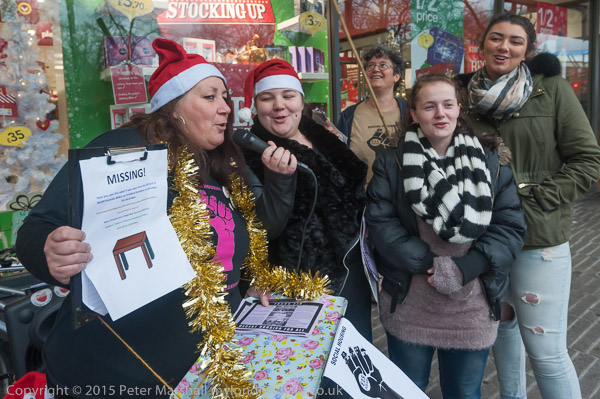
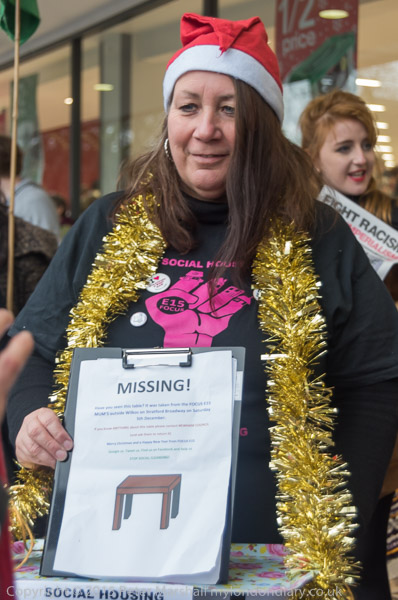
In August 2017, a number of tower blocks in the London borough of Newham were found to have unsafe cladding. Housing activists Focus E15 Mothers led a demonstration putting pressure on the council to act urgently to make the blocks safe. The council came to a decision the following month to remove the cladding though work to do so only began in April 2018.

The march began at Ferrier Point in Canning Town, with other groups including East End Sisters Uncut, Movement for Justice, the Socialist Party, the Revolutionary Communist Party, One Housing campaigners and Whitechapel Anarchists joining Focus E15 and some tower block residents.

From there they marched to Tanner Point in Plaistow North for a longer rally outside, including some speeches from tower residents. Then came another long march to Stratford and the Carpenters Estate.

The Carpenters Estate was a popular estate, close to Stratford station and the town centre, and was viewed by the council as a prime opportunity for highly profitable redevelopment schemes, wanting to demolish the estate which is well-planned and in good condition. Focus E15 led opposition that in 2013 ended plans for UCL to set up a new campus here and have constantly urged the council to bring back people to the estate where despite a critical housing shortage in the borough, 400 good homes had been kept empty for over 10 years. The march ended with a ‘hands around the Carpenters Estate’ solidarity event against decanting, demolition and social cleansing.

More pictures at Fire Risk Tower Blocks.


All photographs on this and my other sites, unless otherwise stated, are taken by and copyright of Peter Marshall, and are available for reproduction or can be bought as prints.